
June 2024: Paper 3B Astrophysics

35 marks · 13 question parts · Paper, mark scheme and report on AQA's site · Have the data and formulae booklet beside you

Question by question

QTopicMarksAOType
1.1 Telescopes 2AO2=2Calculation
1.2 Telescopes 2AO2=2Calculation
1.3 Telescopes 3AO1=1,AO3=2Explanation
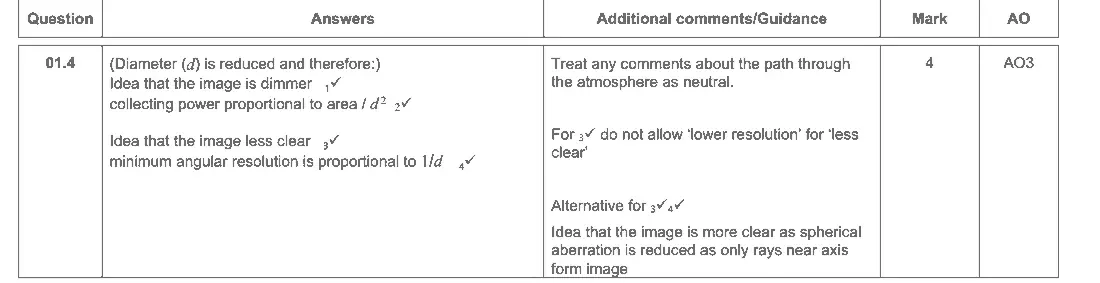
1.4 Telescopes 4AO3=4Explanation
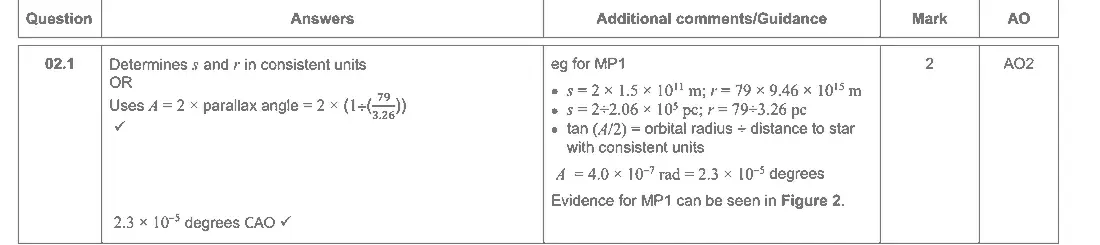
2.1 Classification of stars and the HR diagram 2AO2=2Calculation
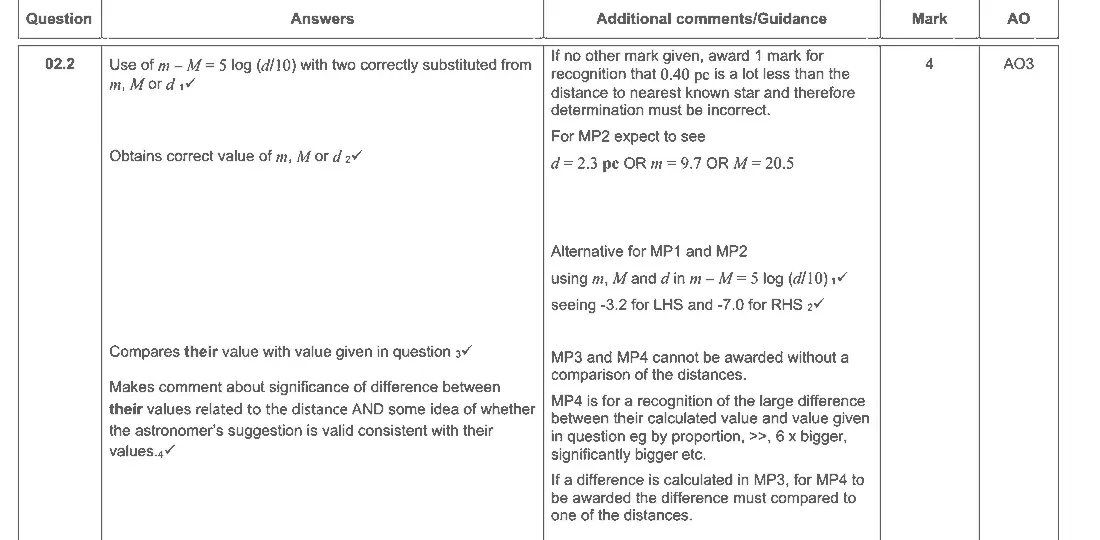
2.2 Classification of stars and the HR diagram 4AO3=4Calculation
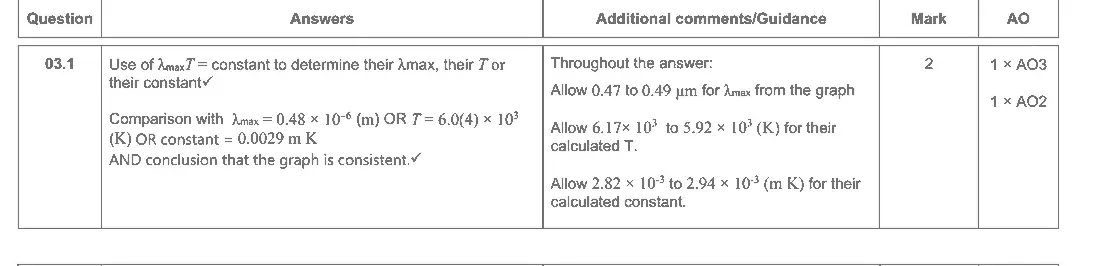
3.1 Classification of stars and the HR diagram 2AO2=1,AO3=1Show that
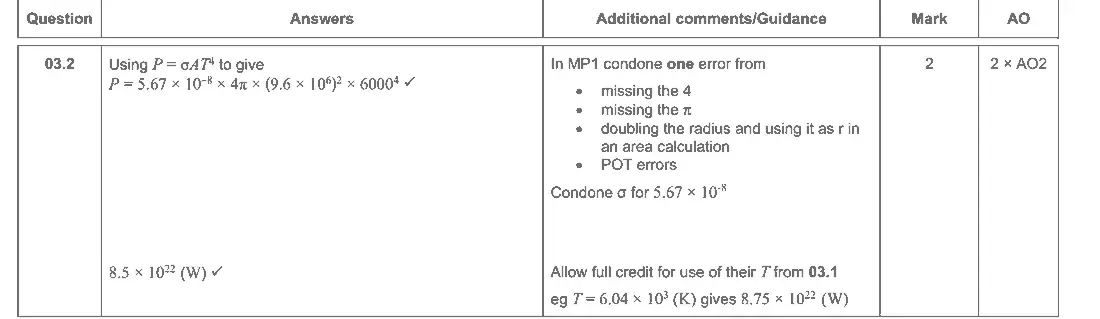
3.2 Classification of stars and the HR diagram 2AO2=2Calculation
3.3 Classification of stars and the HR diagram 1AO3=1Short answer
3.4 Classification of stars and the HR diagram 2AO3=2Explanation
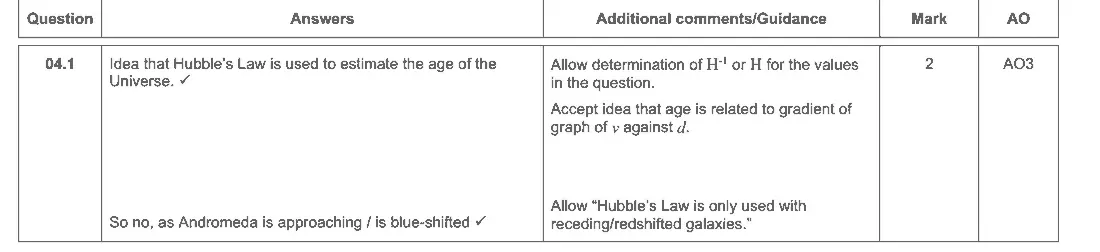
4.1 Cosmology: Doppler effect, Hubble's law, quasars and exoplanets 2AO3=2Explanation
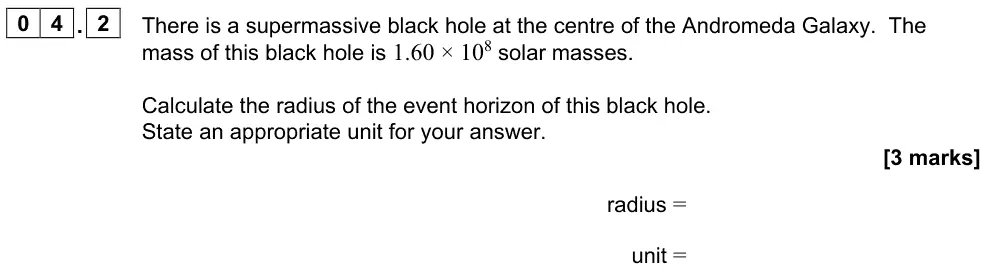
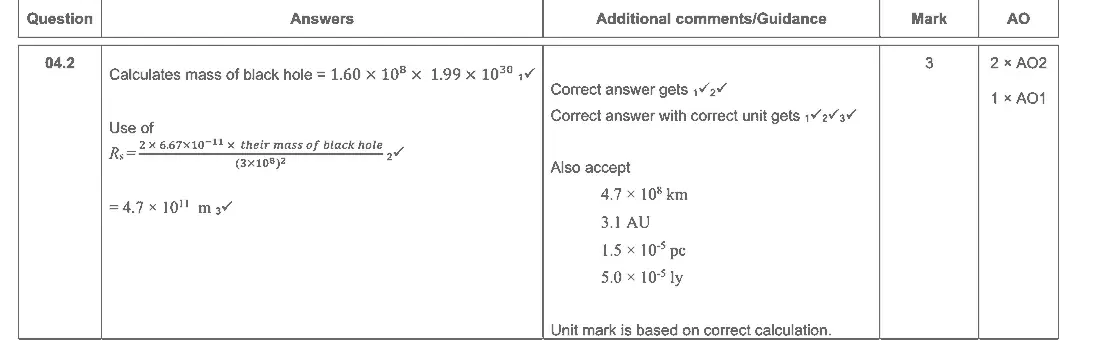
4.2 Classification of stars and the HR diagram 3AO1=1,AO2=2Calculation
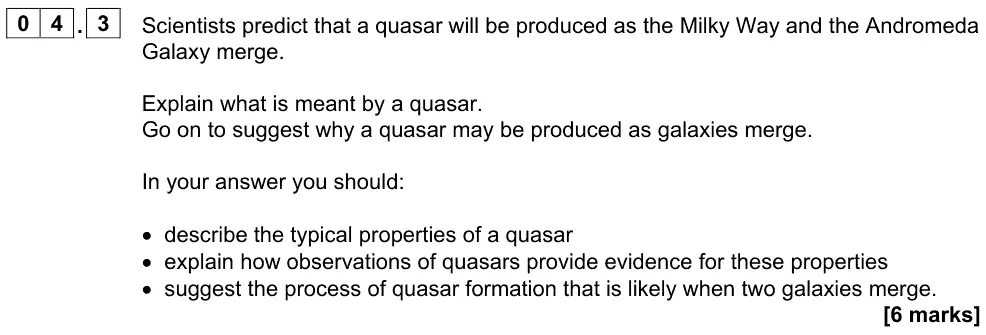
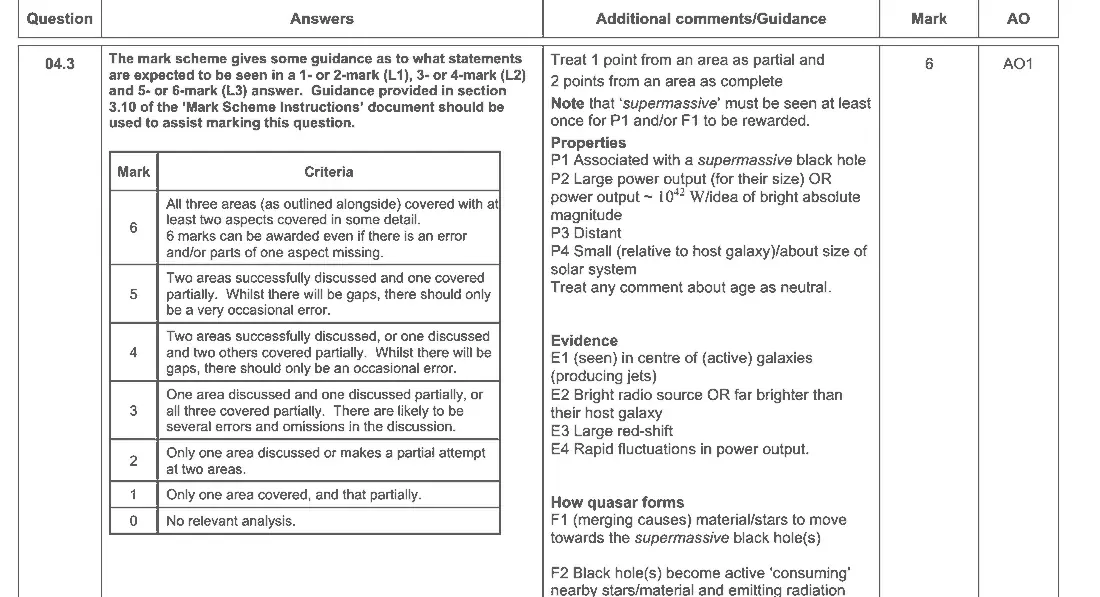
4.3 Cosmology: Doppler effect, Hubble's law, quasars and exoplanets 6AO1=6Extended response

The questions

1.11.21.31.42.12.23.13.23.33.44.14.24.3
June 2024 · Paper 3B Astrophysics · Q1.1 2 marks AO2=2 Calculation telescopes
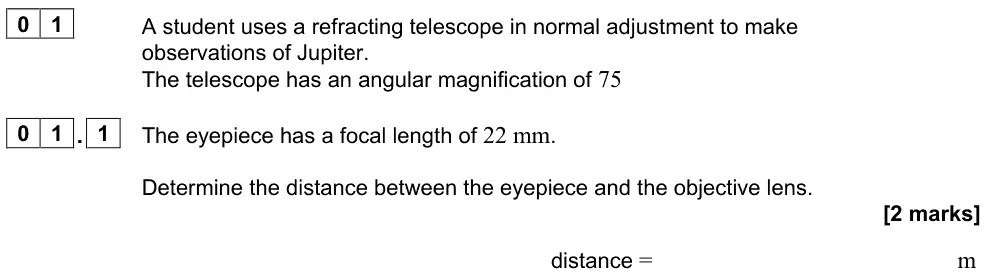
A student uses a refracting telescope in normal adjustment to make
observations of Jupiter.
The telescope has an angular magnification of 75
The eyepiece has a focal length of 22 mm.
Determine the distance between the eyepiece and the objective lens.
[2 marks]
distance =
m
June 2024 · Paper 3B Astrophysics · Q1.2 2 marks AO2=2 Calculation telescopes
Earlier part of question 1 that this part usesEarlier part of June 2024 Paper 3B Astrophysics question 1
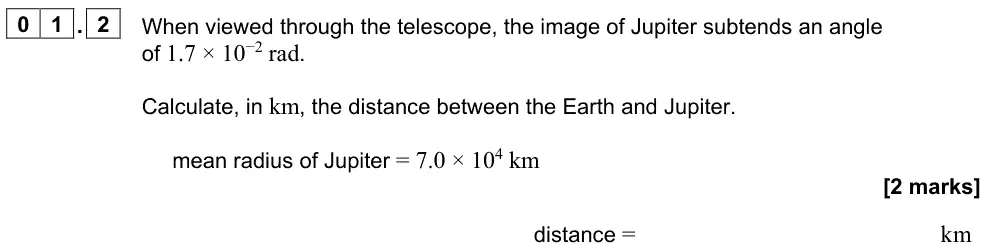
When viewed through the telescope, the image of Jupiter subtends an angle
of 1.7 × 10⁻² rad.
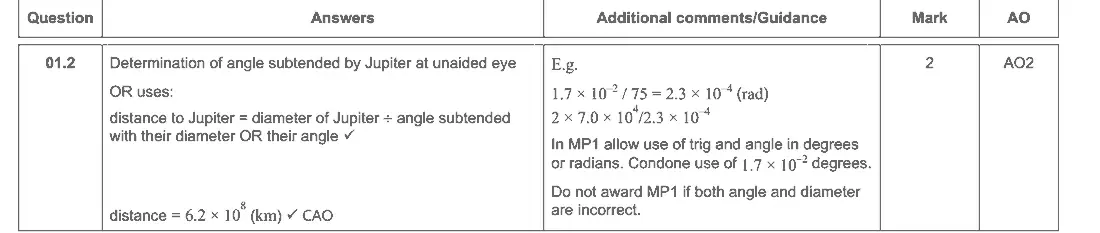
Calculate, in km, the distance between the Earth and Jupiter.
mean radius of Jupiter = 7.0 × 10⁴ km
[2 marks]
distance =
km
June 2024 · Paper 3B Astrophysics · Q1.3 3 marks AO1=1, AO3=2 Explanation telescopes
Earlier part of question 1 that this part usesEarlier part of June 2024 Paper 3B Astrophysics question 1
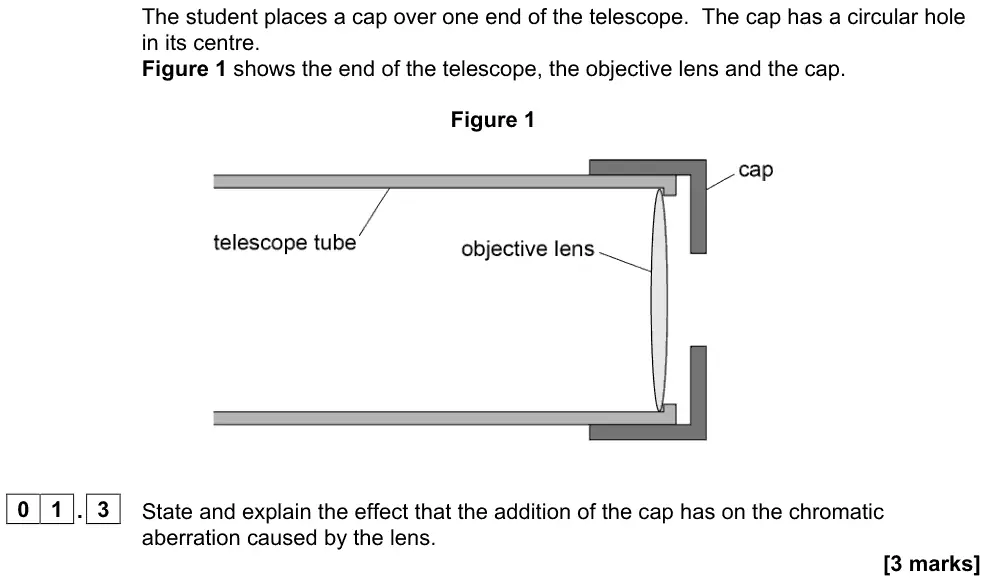
The student places a cap over one end of the telescope.  The cap has a circular hole
in its centre.
Figure 1 shows the end of the telescope, the objective lens and the cap.
Figure 1
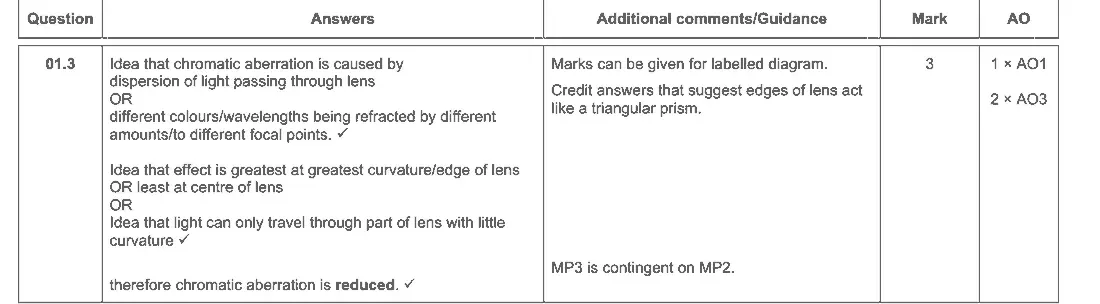
State and explain the effect that the addition of the cap has on the chromatic
aberration caused by the lens.
[3 marks]
June 2024 · Paper 3B Astrophysics · Q1.4 4 marks AO3=4 Explanation telescopes
Earlier part of question 1 that this part usesEarlier part of June 2024 Paper 3B Astrophysics question 1
Explain two other effects that the addition of the cap has on the image of Jupiter.
[4 marks]
1
2
June 2024 · Paper 3B Astrophysics · Q2.1 2 marks AO2=2 Calculation classification of stars
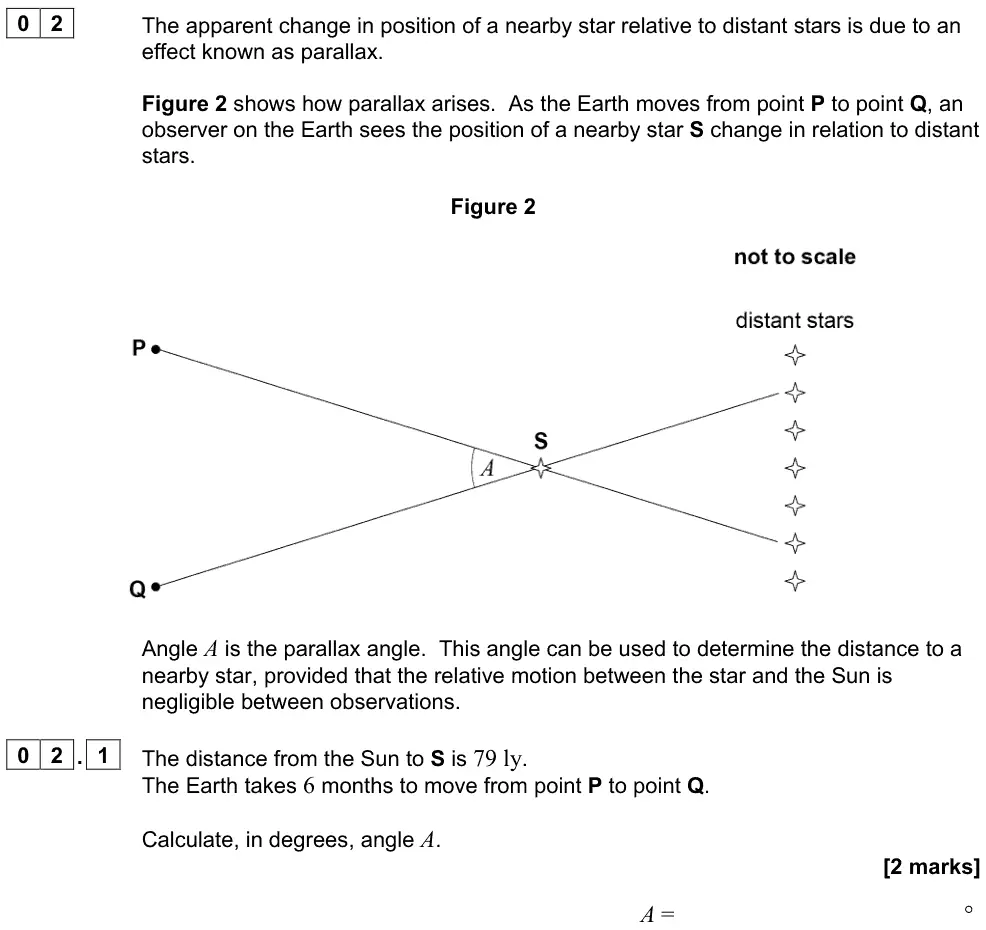
The apparent change in position of a nearby star relative to distant stars is due to an
effect known as parallax.
Figure 2 shows how parallax arises.  As the Earth moves from point P to point Q, an
observer on the Earth sees the position of a nearby star S change in relation to distant
stars.
Figure 2
Angle A is the parallax angle.  This angle can be used to determine the distance to a
nearby star, provided that the relative motion between the star and the Sun is
negligible between observations.
The distance from the Sun to S is 79 ly.
The Earth takes 6 months to move from point P to point Q.
Calculate, in degrees, angle A.
[2 marks]
A =
°
June 2024 · Paper 3B Astrophysics · Q2.2 4 marks AO3=4 Calculation classification of stars
Earlier part of question 2 that this part usesEarlier part of June 2024 Paper 3B Astrophysics question 2
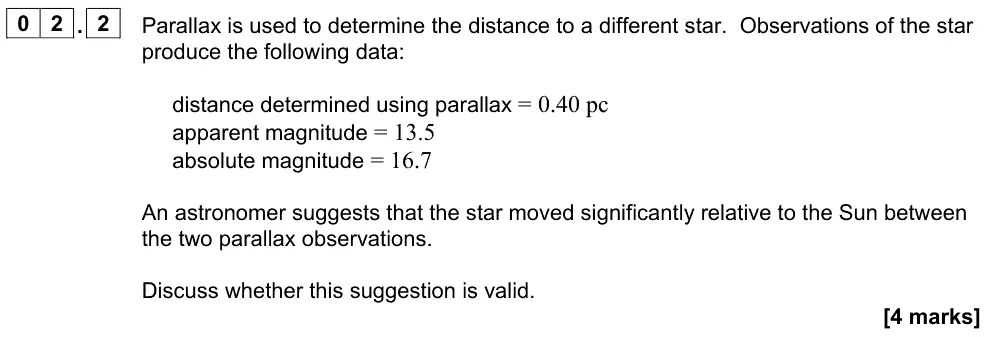
Parallax is used to determine the distance to a different star.  Observations of the star
produce the following data:
distance determined using parallax = 0.40 pc
apparent magnitude = 13.5
absolute magnitude = 16.7
An astronomer suggests that the star moved significantly relative to the Sun between
the two parallax observations.
Discuss whether this suggestion is valid.
[4 marks]
June 2024 · Paper 3B Astrophysics · Q3.1 2 marks AO2=1, AO3=1 Show that classification of stars
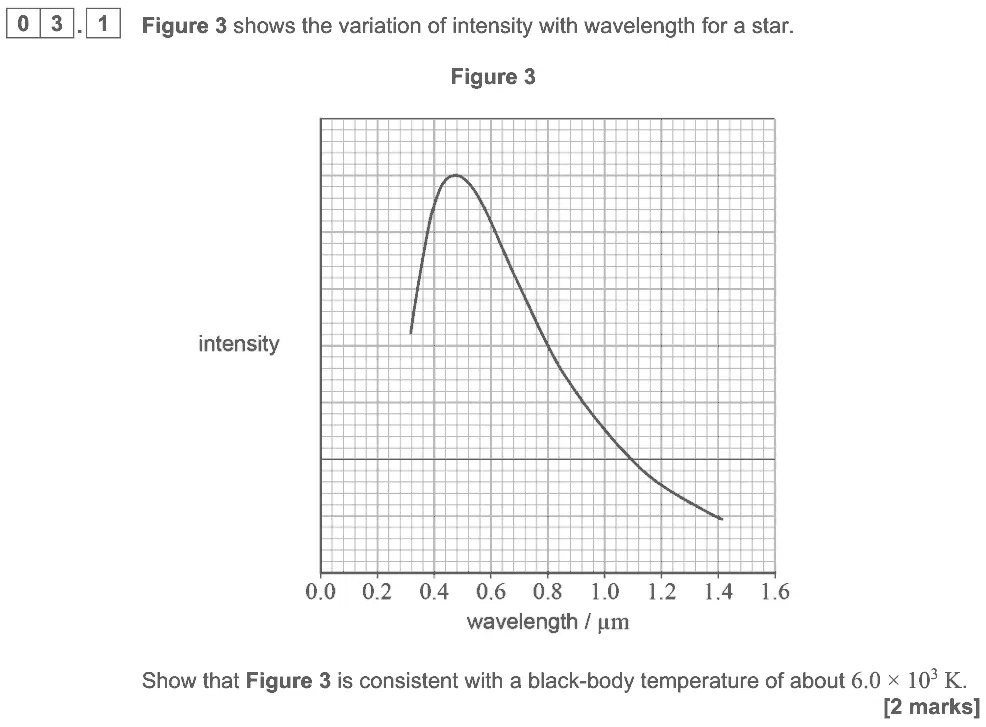
Figure 3 shows the variation of intensity with wavelength for a star.
Figure 3
Show that Figure 3 is consistent with a black-body temperature of about 6.0 × 10³ K.
[2 marks]
June 2024 · Paper 3B Astrophysics · Q3.2 2 marks AO2=2 Calculation classification of stars
Earlier part of question 3 that this part usesEarlier part of June 2024 Paper 3B Astrophysics question 3
The radius of the star is 9.6 × 10⁶ m.
Calculate the power output of the star.
[2 marks]
power output =
W
June 2024 · Paper 3B Astrophysics · Q3.3 1 mark AO3=1 Short answer classification of stars
Earlier part of question 3 that this part usesEarlier part of June 2024 Paper 3B Astrophysics question 3
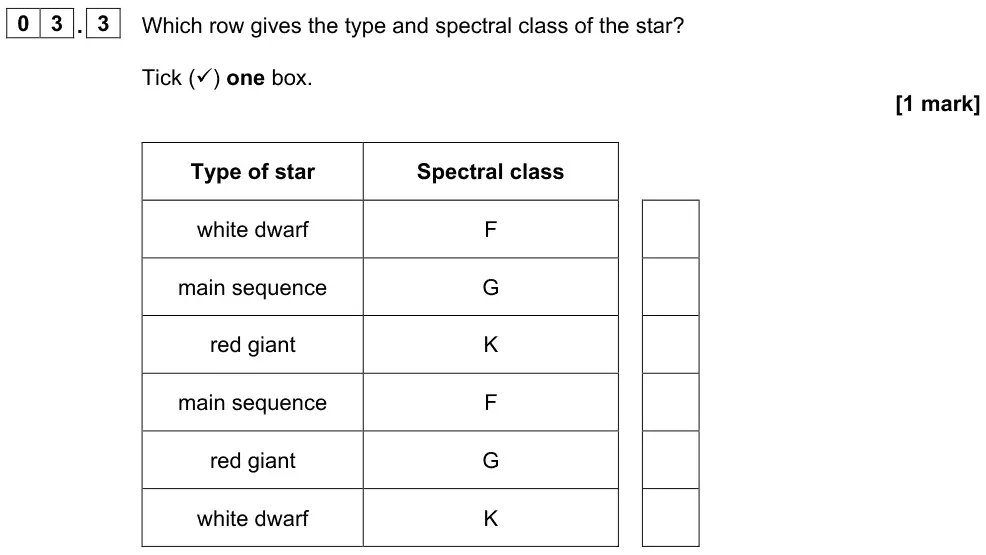
Which row gives the type and spectral class of the star?
Tick () one box.
[1 mark]
Type of star
Spectral class
white dwarf
F
main sequence
G
red giant
K
main sequence
F
red giant
G
white dwarf
K
June 2024 · Paper 3B Astrophysics · Q3.4 2 marks AO3=2 Explanation classification of stars
Earlier part of question 3 that this part usesEarlier part of June 2024 Paper 3B Astrophysics question 3
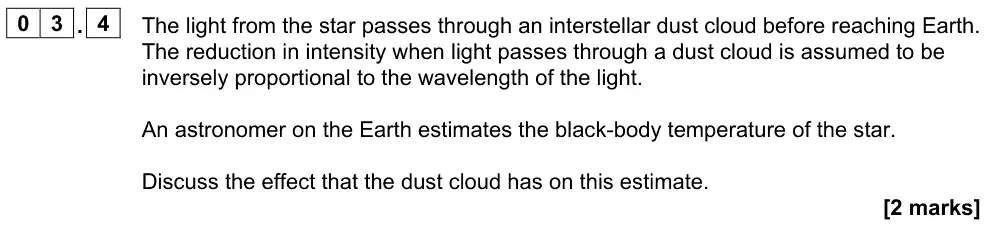
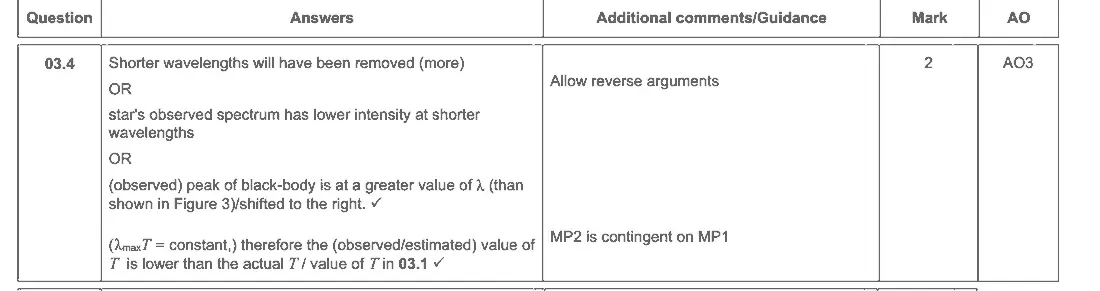
The light from the star passes through an interstellar dust cloud before reaching Earth.
The reduction in intensity when light passes through a dust cloud is assumed to be
inversely proportional to the wavelength of the light.
An astronomer on the Earth estimates the black-body temperature of the star.
Discuss the effect that the dust cloud has on this estimate.
[2 marks]
June 2024 · Paper 3B Astrophysics · Q4.1 2 marks AO3=2 Explanation cosmology
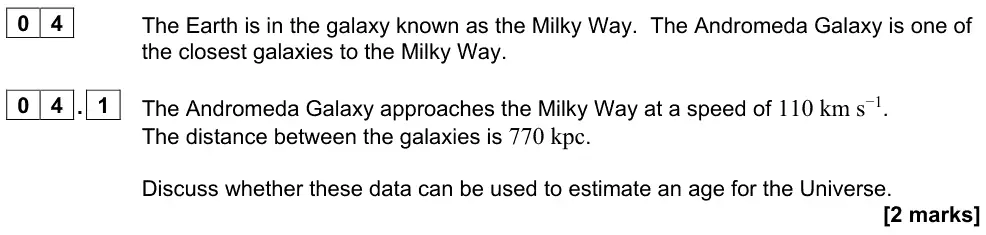
The Earth is in the galaxy known as the Milky Way.  The Andromeda Galaxy is one of
the closest galaxies to the Milky Way.
The Andromeda Galaxy approaches the Milky Way at a speed of 110 km s−1.
The distance between the galaxies is 770 kpc.
Discuss whether these data can be used to estimate an age for the Universe.
[2 marks]
June 2024 · Paper 3B Astrophysics · Q4.2 3 marks AO1=1, AO2=2 Calculation classification of stars
Earlier part of question 4 that this part usesEarlier part of June 2024 Paper 3B Astrophysics question 4
There is a supermassive black hole at the centre of the Andromeda Galaxy.  The
mass of this black hole is 1.60 × 10⁸ solar masses.
Calculate the radius of the event horizon of this black hole.
State an appropriate unit for your answer.
[3 marks]
radius =
unit =
June 2024 · Paper 3B Astrophysics · Q4.3 6 marks AO1=6 6-mark extended response cosmology
Earlier part of question 4 that this part usesEarlier part of June 2024 Paper 3B Astrophysics question 4
Scientists predict that a quasar will be produced as the Milky Way and the Andromeda
Galaxy merge.
Explain what is meant by a quasar.
Go on to suggest why a quasar may be produced as galaxies merge.
In your answer you should:
• describe the typical properties of a quasar
• explain how observations of quasars provide evidence for these properties
• suggest the process of quasar formation that is likely when two galaxies merge.
[6 marks]

Work with an AQA physics tutor

Want a paper marked and gone through with you? Message us.

Prefer email? Send an enquiry

If you are under 18, please include a parent's contact details. Enquiries go to enquiries@physicsaleveltutor.com and are deleted once handled. All tutoring is online.