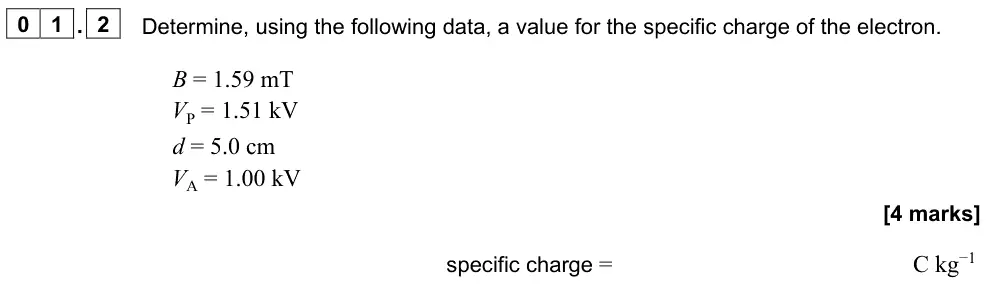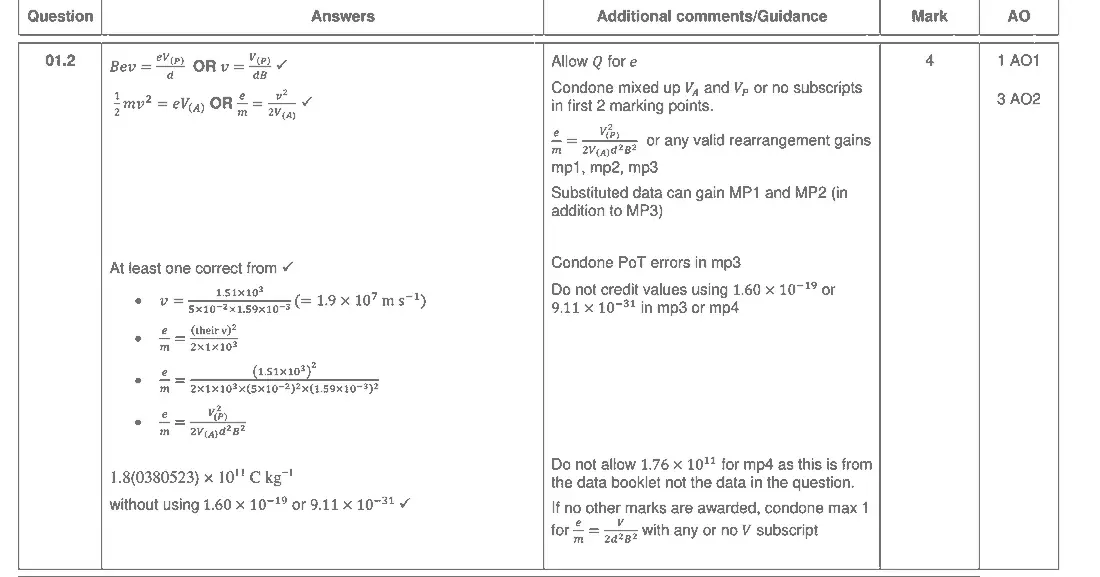
Mark scheme
Examiner's comment
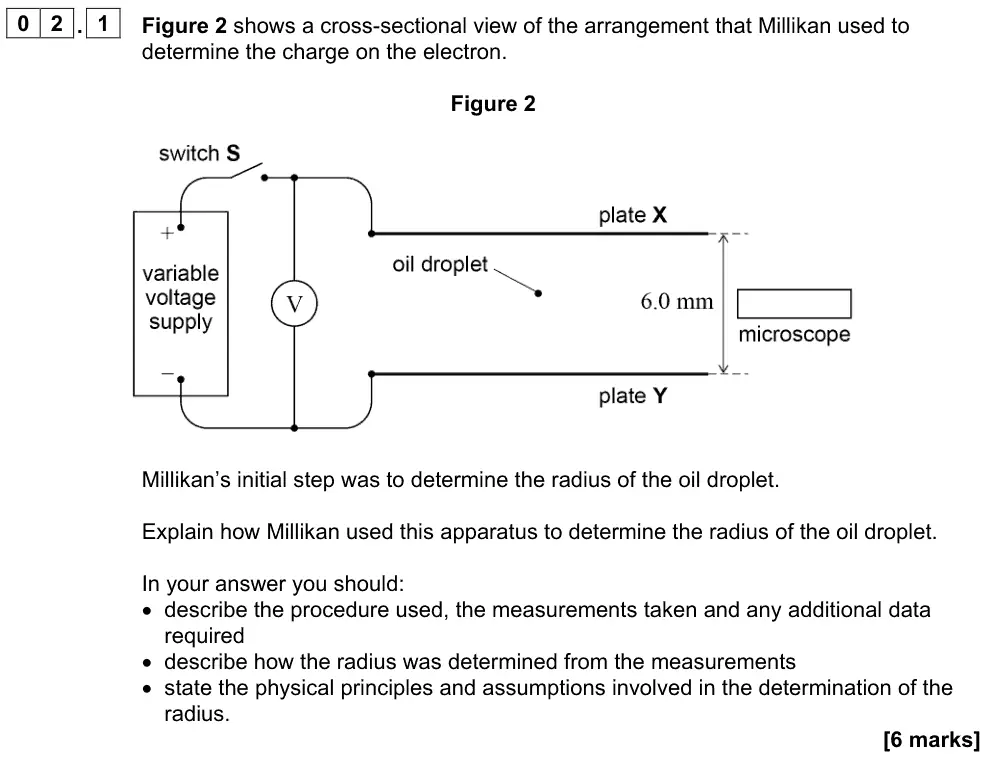
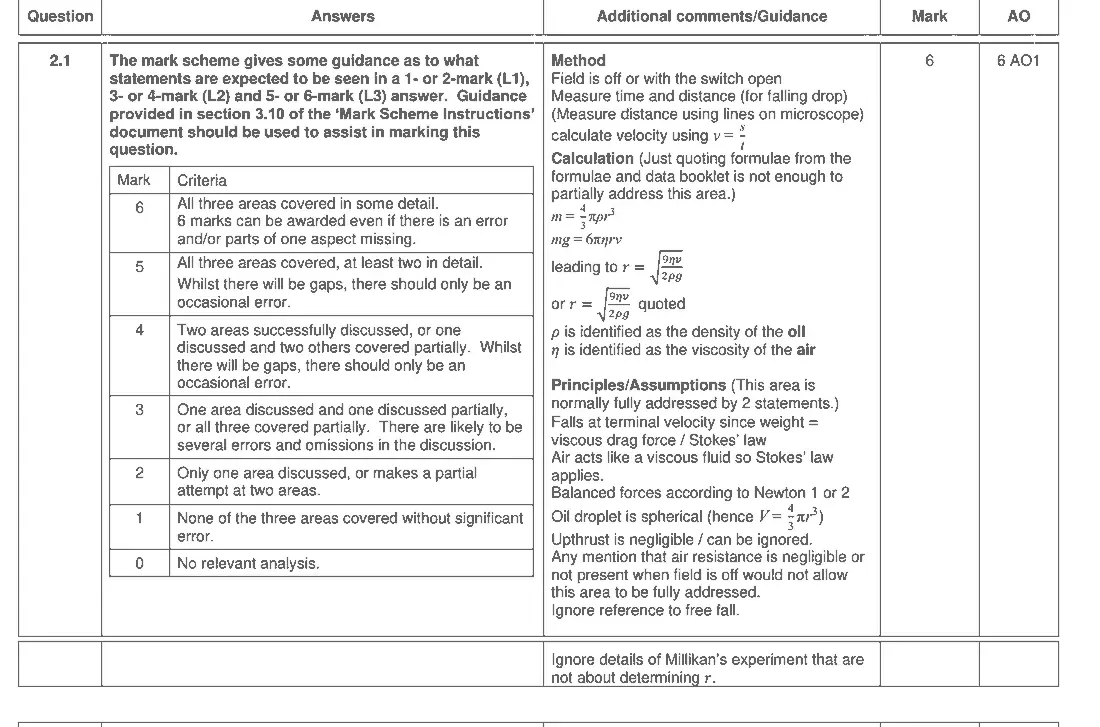
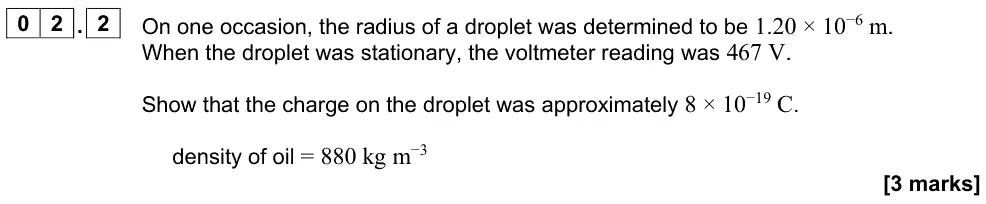
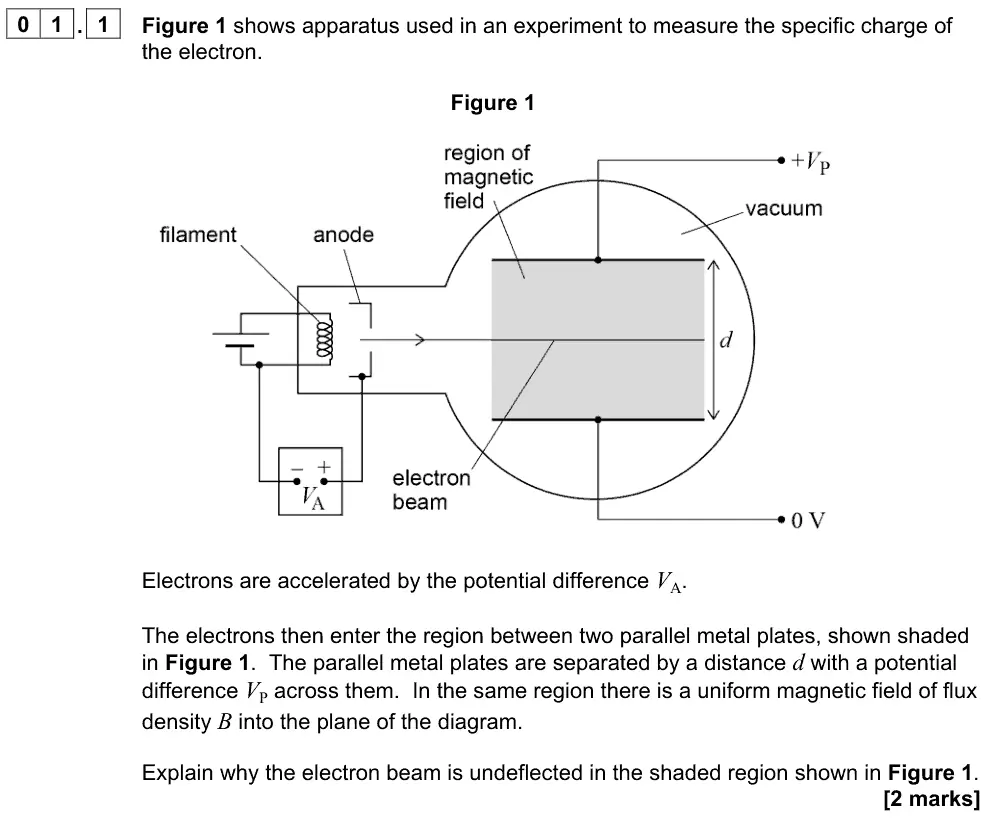
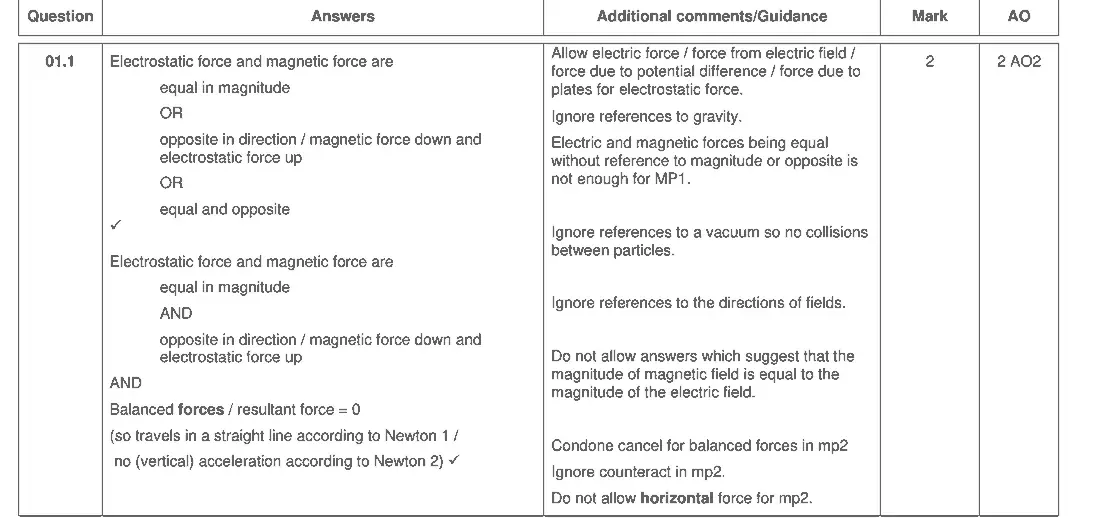
01.1 Most students found the question accessible, however many answers lacked the details required. In order to establish that the electron beam is undeflected, students needed to identify the two forces as electrostatic and magnetic. They then had to state these were equal in magnitude and opposite in direction, which meant that the forces were balanced. It was hoped that students would refer to either Newton’s first or second law to explain why balanced forces meant that the electron beam was undeflected; however, this was only seen in a very small number of responses, so it was not insisted upon. It is, however, an essential part of why the electron beam is undeflected. Most students’ responses lacked detail, choosing only to refer to balanced forces without naming the forces or stating why they were balanced or just referring to the forces as equal and opposite, rather than equal in magnitude and opposite in direction. A very small number referred to gravity being a factor. As the magnitude of the weight on an electron is negligible, references which included gravity as a downwards force were allowed provided they were otherwise correct, while references which replaced the magnetic force with the weight scored no marks. 02.1 This was the question marked on a levels-of-response basis and concerned the method used to determine the radius of the oil droplet. While many found this question accessible and were familiar with the experiment, a large number of answers lacked detail or discussed parts of the experiment that were not asked about. References to how the charge was determined or the significance of the Millikan’s experiment were ignored by examiners. A small number of responses seemed not to be familiar with Millikan’s experiment. responses which dealt with the determination of 𝑄𝑄 could gain this point provided it was clear that 𝑟𝑟 To address the question fully, students had to refer to the field being switched off. Student was determined with the field switched off. The method also required a description of how the terminal velocity was determined. While many were able to refer to measuring the time taken to fall 𝑠𝑠 a measured distance, many responses failed to state how the velocity was determined from these 𝑡𝑡. The details about using lines marked on the microscope to determine the distance values using was missing from nearly all responses and was not insisted upon, although it is a vital part of how Millikan was able to carry out the experiment. Most students were able to partially address this area, but few were able to address it fully. Most responses mentioned measuring the distance and time for the droplet to fall but lacked the calculation or a statement that the electric field had to be off. to the correct equation for 𝑟𝑟 students had to identify that 𝜌𝜌 was the density of the oil or 𝜂𝜂 was the Most responses had some idea of the determination. In order to fully address this area, in addition oil and which to the air. Some responses gave an equation for 𝑟𝑟2 which did not fully address how to viscosity of the air. Many either missed this out or wrongly identified which symbol referred to the calculate 𝑟𝑟. A small number of students just listed the equation and then said you should rearrange and solve for 𝑟𝑟; this was not enough to address this area. The principles and assumptions section proved to be the most accessible area to address. The most common response was that the oil droplet was a sphere. The next most common idea was that when the droplet falls at terminal velocity the weight was equal in magnitude and opposite in direction to the drag force. To balance the precision insisted on in 01.1 for a balanced-forces argument, the detail required here was reduced, which meant that statements such as ‘weight was equal to the drag force’ were accepted. However, this had to be linked to the concept of terminal velocity. Other responses included the fact that air acted like a viscous fluid allowing Stoke’s law to be applied or that upthrust or buoyancy was negligible. There was some confusion in this section with some students going from one sentence writing negligible. Others incorrectly referred to Stoke’s law or 6𝜋𝜋𝜋𝜋𝜋𝜋𝜋𝜋 as the buoyancy force. about terminal velocity and viscous drag force to the next which stated that air resistance was
Notes from the mark scheme and report
- Electrostatic and magnetic forces equal in magnitude and opposite in direction, so resultant force zero and no deflection (Newton 1/2)
- many just said 'balanced' or 'equal and opposite' without naming the forces