June 2025: Paper 3B Astrophysics

35 marks · 15 question parts · Paper, mark scheme and report on AQA's site · Have the data and formulae booklet beside you

Question by question

QTopicMarksAOType
1.1 Classification of stars and the HR diagram 3AO1=1,AO2=1,AO3=1Diagram or graph
1.2 Classification of stars and the HR diagram 1AO2=1Short answer
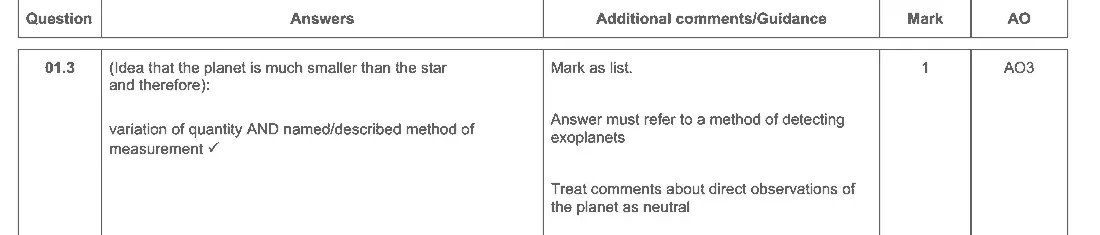
1.3 Cosmology: Doppler effect, Hubble's law, quasars and exoplanets 1AO3=1Short answer
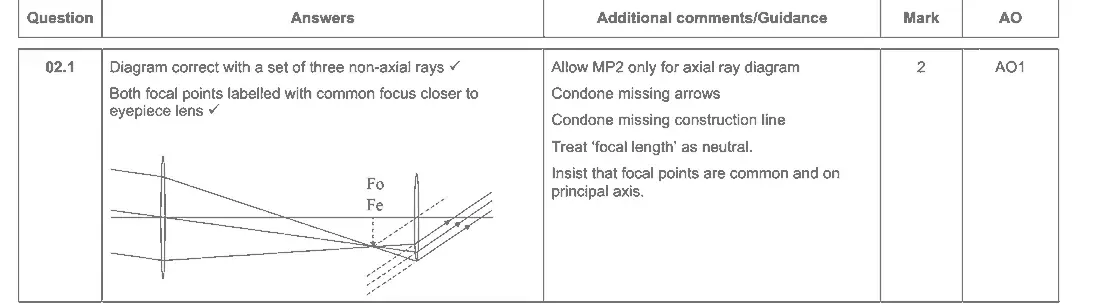
2.1 Telescopes 2AO1=2Diagram or graph
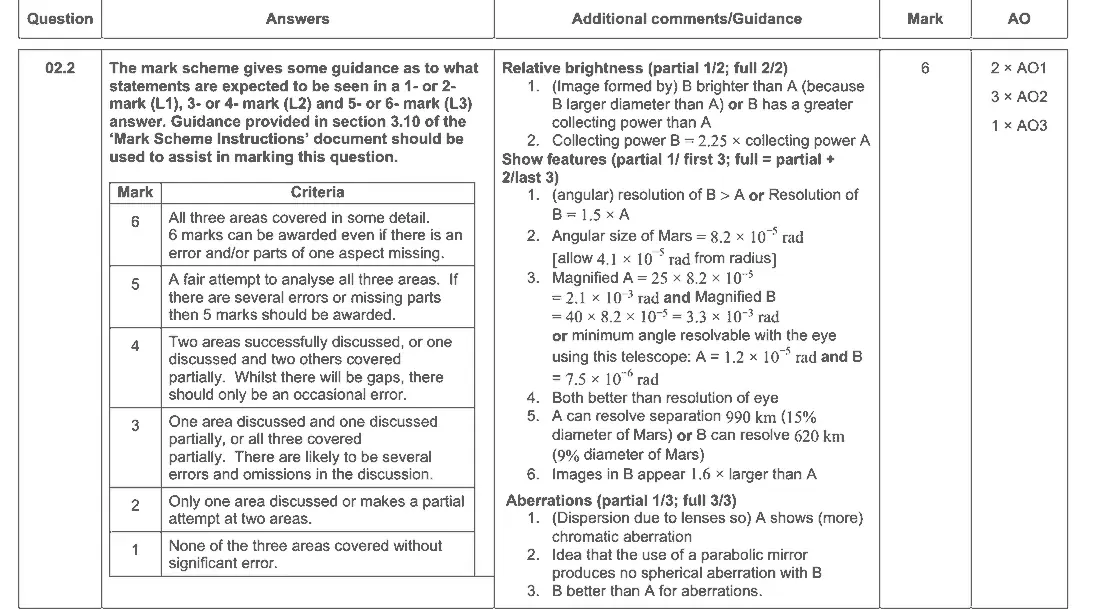
2.2 Telescopes 6AO1=2,AO2=3,AO3=1Extended response
2.3 Telescopes 2AO1=2Explanation
3.1 Cosmology: Doppler effect, Hubble's law, quasars and exoplanets 3AO2=3Calculation
3.2 Cosmology: Doppler effect, Hubble's law, quasars and exoplanets 1AO1=1Short answer
3.3 Classification of stars and the HR diagram 1AO1=1Short answer
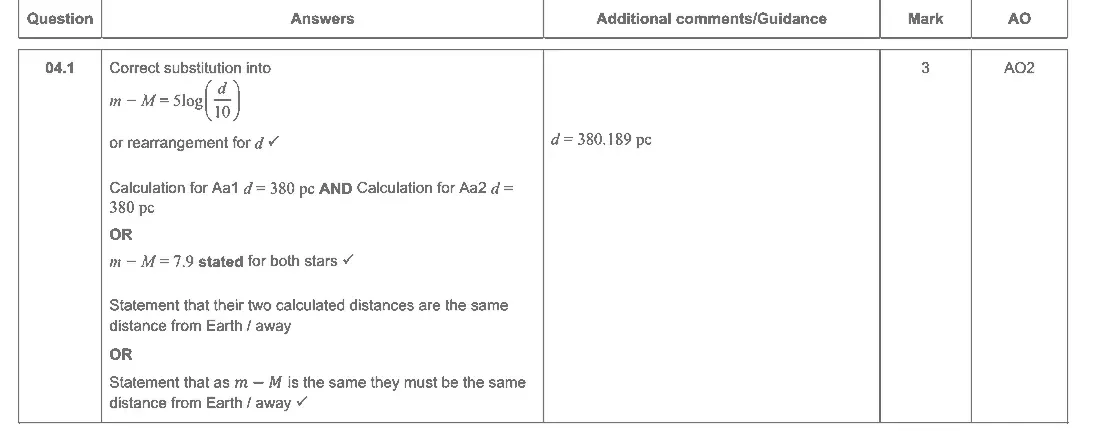
4.1 Classification of stars and the HR diagram 3AO2=3Show that
4.2 Classification of stars and the HR diagram 1AO1=1Short answer
4.3 Classification of stars and the HR diagram 1AO1=1Short answer
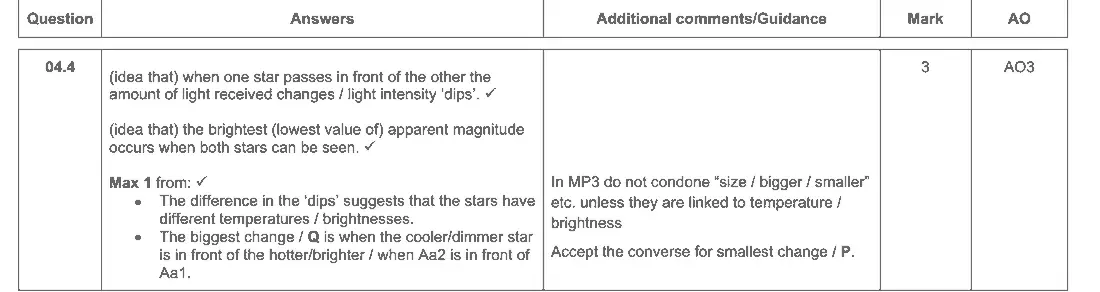
4.4 Cosmology: Doppler effect, Hubble's law, quasars and exoplanets 3AO3=3Explanation
4.5 Cosmology: Doppler effect, Hubble's law, quasars and exoplanets 2AO2=2Calculation
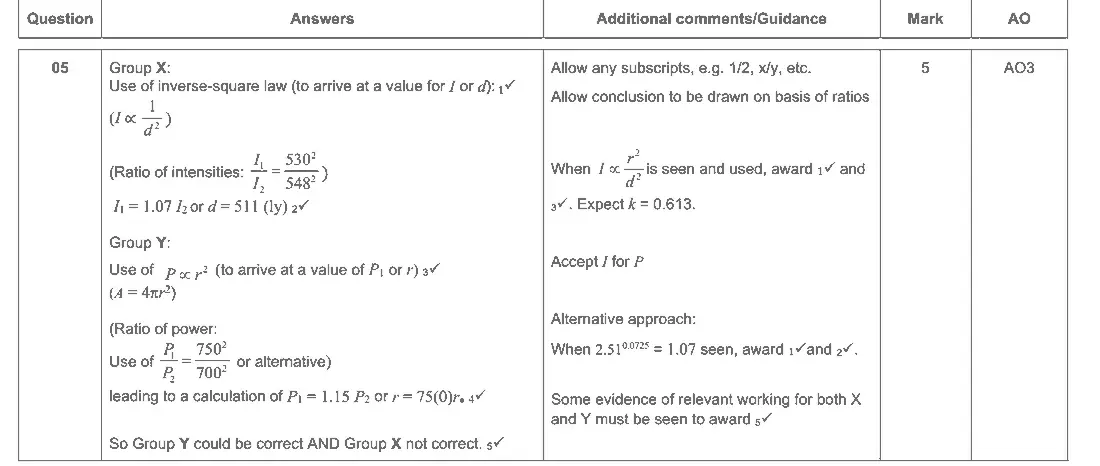
5 Classification of stars and the HR diagram 5AO3=5Calculation

The questions

1.11.21.32.12.22.33.13.23.34.14.24.34.44.55
June 2025 · Paper 3B Astrophysics · Q1.1 3 marks AO1=1, AO2=1, AO3=1 Diagram or graph classification of stars
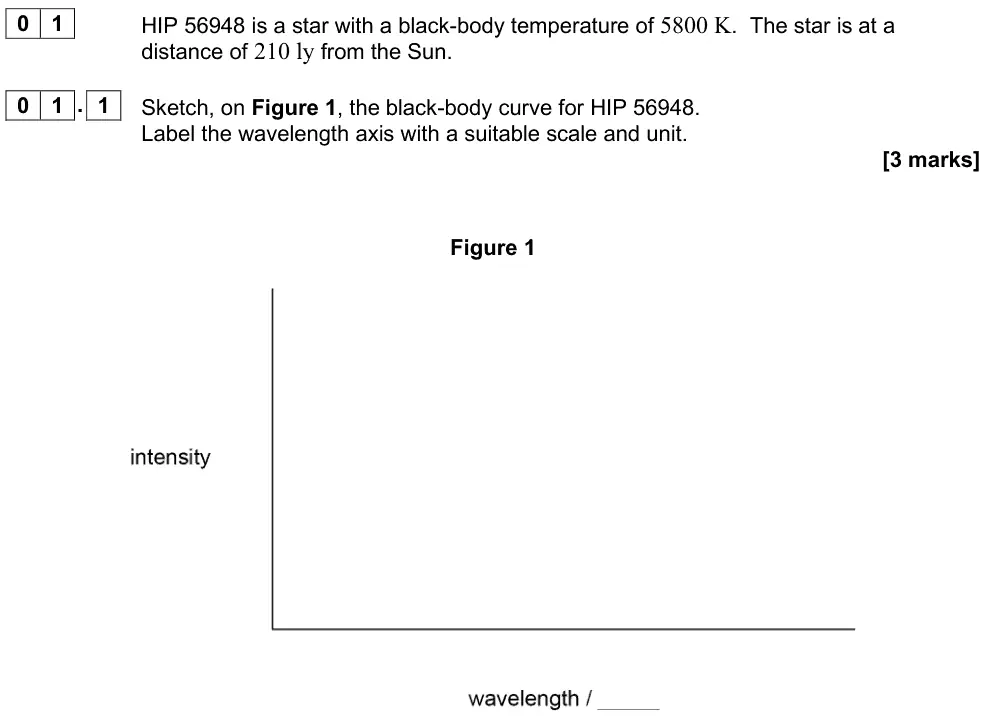
HIP 56948 is a star with a black-body temperature of 5800 K.  The star is at a
distance of 210 ly from the Sun.
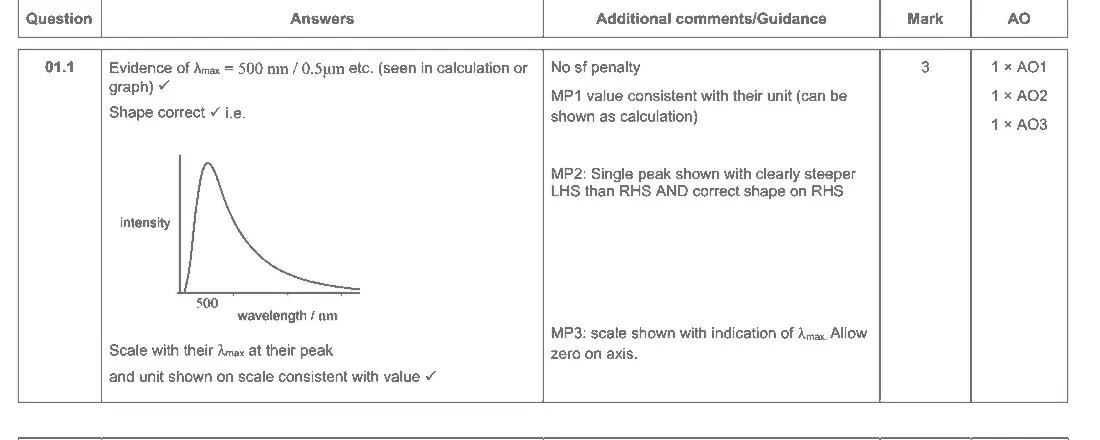
Sketch, on Figure 1, the black-body curve for HIP 56948.
Label the wavelength axis with a suitable scale and unit.
[3 marks]
Figure 1
June 2025 · Paper 3B Astrophysics · Q1.2 1 mark AO2=1 Short answer Hard classification of stars
Earlier part of question 1 that this part usesEarlier part of June 2025 Paper 3B Astrophysics question 1
The diameter of HIP 56948 is the same as the diameter of the Sun.
Suggest a value for the absolute magnitude of HIP 56948.
[1 mark]
absolute magnitude =
June 2025 · Paper 3B Astrophysics · Q1.3 1 mark AO3=1 Short answer cosmology
Earlier part of question 1 that this part usesEarlier part of June 2025 Paper 3B Astrophysics question 1
Astronomers study HIP 56948 in their search for Earth-like exoplanets because
HIP 56948 is similar to the Sun.
Suggest one difficulty in detecting an Earth-like planet around HIP 56948.
[1 mark]
June 2025 · Paper 3B Astrophysics · Q2.1 2 marks AO1=2 Diagram or graph telescopes
Draw a ray diagram for an astronomical telescope in normal adjustment.
Include in your diagram:
• three non-axial rays
• labelled principal foci for the lenses.
[2 marks]
June 2025 · Paper 3B Astrophysics · Q2.2 6 marks AO1=2, AO2=3, AO3=1 6-mark extended response telescopes
Earlier part of question 2 that this part usesEarlier part of June 2025 Paper 3B Astrophysics question 2
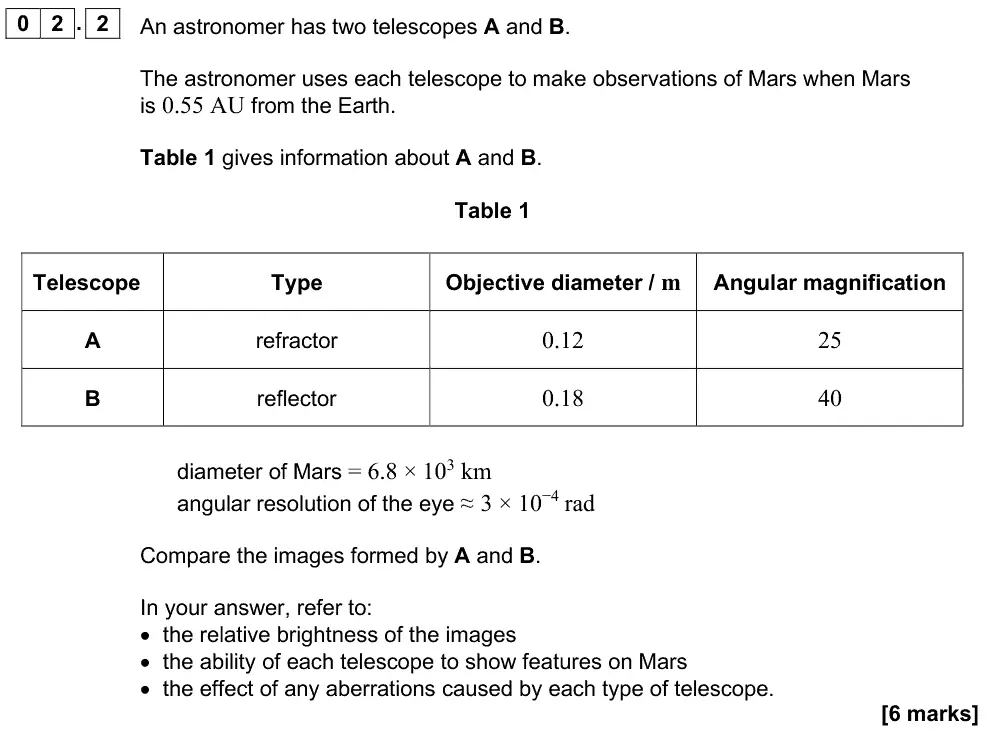
An astronomer has two telescopes A and B.
The astronomer uses each telescope to make observations of Mars when Mars
is 0.55 AU from the Earth.
Table 1 gives information about A and B.
Table 1
Telescope
Type
Objective diameter / m
Angular magnification
A
refractor
0.12
25
B
reflector
0.18
40
diameter of Mars = 6.8 × 10³ km
angular resolution of the eye ≈ 3 × 10⁻⁴ rad
Compare the images formed by A and B.
In your answer, refer to:
• the relative brightness of the images
• the ability of each telescope to show features on Mars
• the effect of any aberrations caused by each type of telescope.
[6 marks]
June 2025 · Paper 3B Astrophysics · Q2.3 2 marks AO1=2 Explanation telescopes
Earlier part of question 2 that this part usesEarlier part of June 2025 Paper 3B Astrophysics question 2
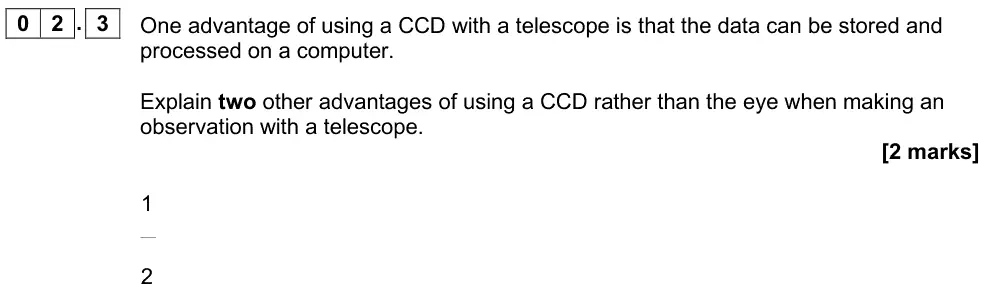
One advantage of using a CCD with a telescope is that the data can be stored and
processed on a computer.
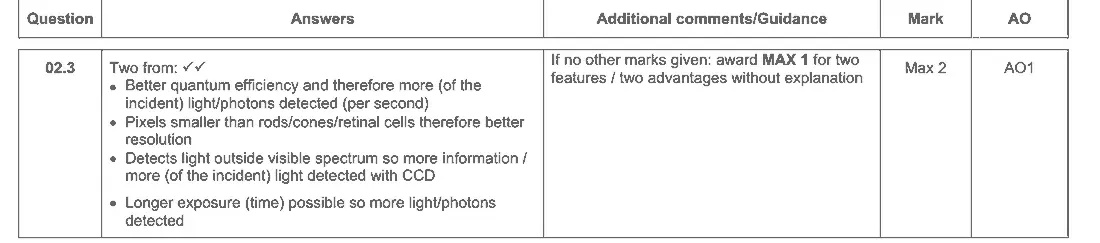
Explain two other advantages of using a CCD rather than the eye when making an
observation with a telescope.
[2 marks]
1
2
June 2025 · Paper 3B Astrophysics · Q3.1 3 marks AO2=3 Calculation cosmology
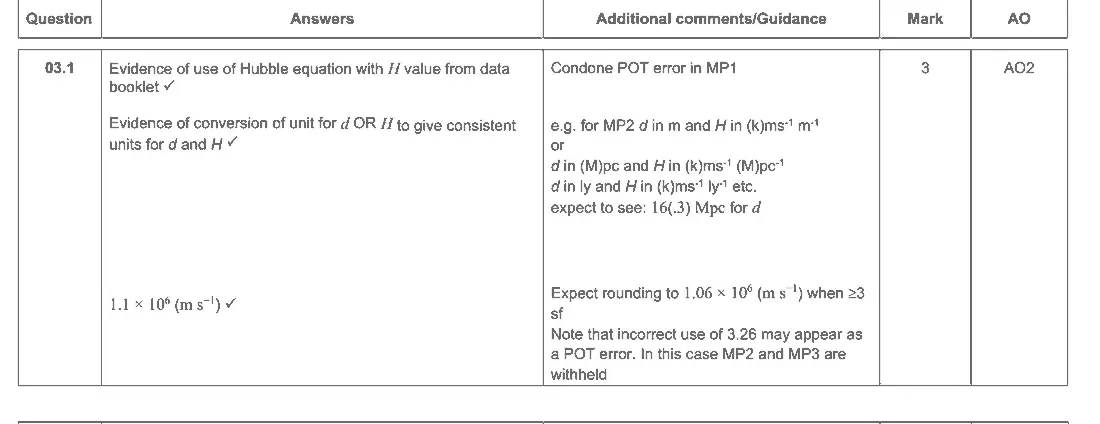
The galaxy M87 is at a distance of 5.3 × 10⁷ ly from the Earth.
Determine, in m s−1, the recessional velocity of M87 relative to the Earth.
[3 marks]
recessional velocity =
m s−1
June 2025 · Paper 3B Astrophysics · Q3.2 1 mark AO1=1 Short answer cosmology
Earlier part of question 3 that this part usesEarlier part of June 2025 Paper 3B Astrophysics question 3
Astronomers believe that M87 has an active supermassive black hole at its centre.
Suggest one observation that leads to this conclusion.
[1 mark]
June 2025 · Paper 3B Astrophysics · Q3.3 1 mark AO1=1 Short answer classification of stars
Earlier part of question 3 that this part usesEarlier part of June 2025 Paper 3B Astrophysics question 3
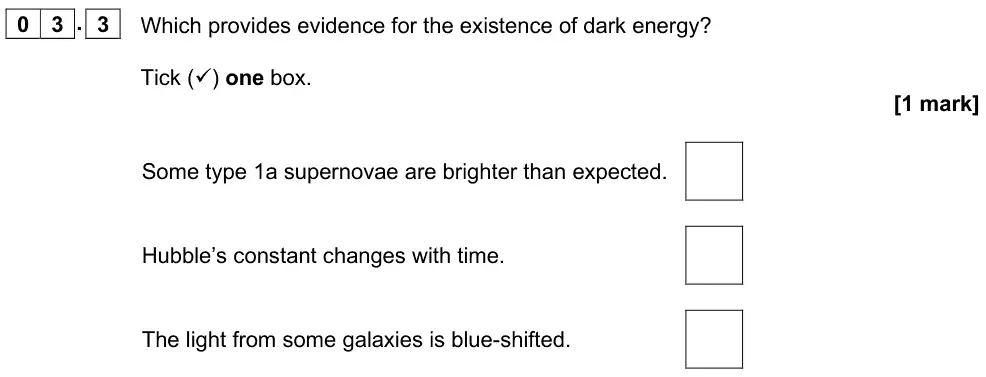
Which provides evidence for the existence of dark energy?
Tick () one box.
[1 mark]
Some type 1a supernovae are brighter than expected.
Hubble’s constant changes with time.
The light from some galaxies is blue-shifted.
June 2025 · Paper 3B Astrophysics · Q4.1 3 marks AO2=3 Show that classification of stars
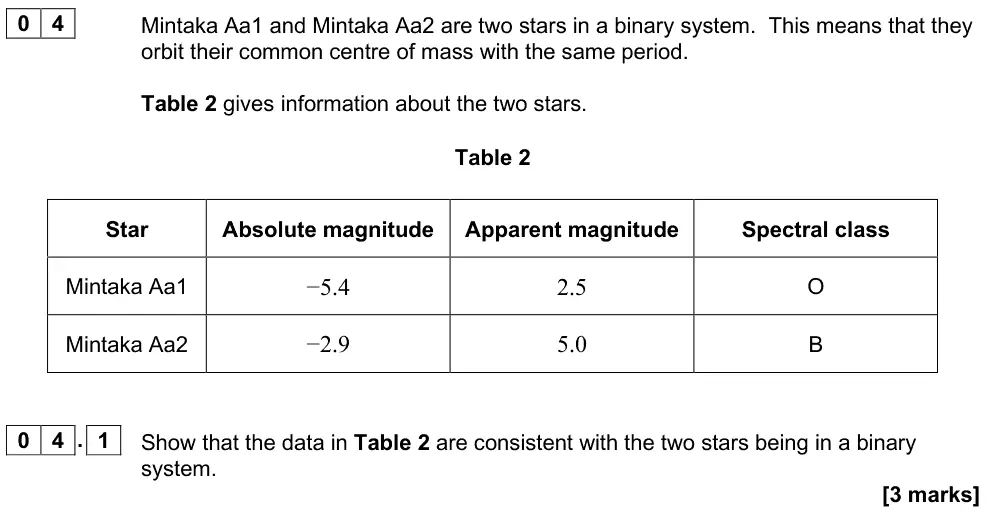
Mintaka Aa1 and Mintaka Aa2 are two stars in a binary system.  This means that they
orbit their common centre of mass with the same period.
Table 2 gives information about the two stars.
Table 2
Star
Absolute magnitude
Apparent magnitude
Spectral class
Mintaka Aa1
−5.4
2.5
O
Mintaka Aa2
−2.9
5.0
B
Show that the data in Table 2 are consistent with the two stars being in a binary
system.
[3 marks]
June 2025 · Paper 3B Astrophysics · Q4.2 1 mark AO1=1 Short answer classification of stars
Earlier part of question 4 that this part usesEarlier part of June 2025 Paper 3B Astrophysics question 4
State the most prominent absorption lines in the spectrum of Mintaka Aa2.
[1 mark]
June 2025 · Paper 3B Astrophysics · Q4.3 1 mark AO1=1 Short answer classification of stars
Earlier part of question 4 that this part usesEarlier part of June 2025 Paper 3B Astrophysics question 4
Explain which star in Table 2 has the greater temperature.
[1 mark]
June 2025 · Paper 3B Astrophysics · Q4.4 3 marks AO3=3 Explanation cosmology
Earlier part of question 4 that this part usesEarlier part of June 2025 Paper 3B Astrophysics question 4
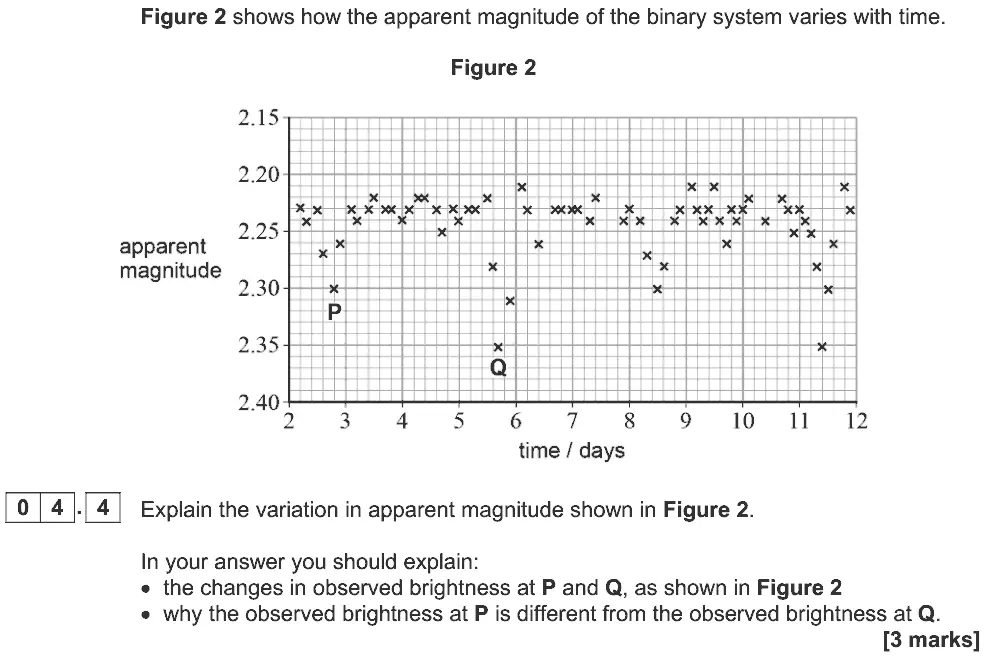
Figure 2 shows how the apparent magnitude of the binary system varies with time.
Figure 2
Explain the variation in apparent magnitude shown in Figure 2.
In your answer you should explain:
• the changes in observed brightness at P and Q, as shown in Figure 2
• why the observed brightness at P is different from the observed brightness at Q.
[3 marks]
June 2025 · Paper 3B Astrophysics · Q4.5 2 marks AO2=2 Calculation cosmology
Earlier part of question 4 that this part usesEarlier part of June 2025 Paper 3B Astrophysics question 4
Determine the angular velocity of the binary system.
[2 marks]
angular velocity =
rad s−1
June 2025 · Paper 3B Astrophysics · Q5 5 marks AO3=5 Calculation classification of stars
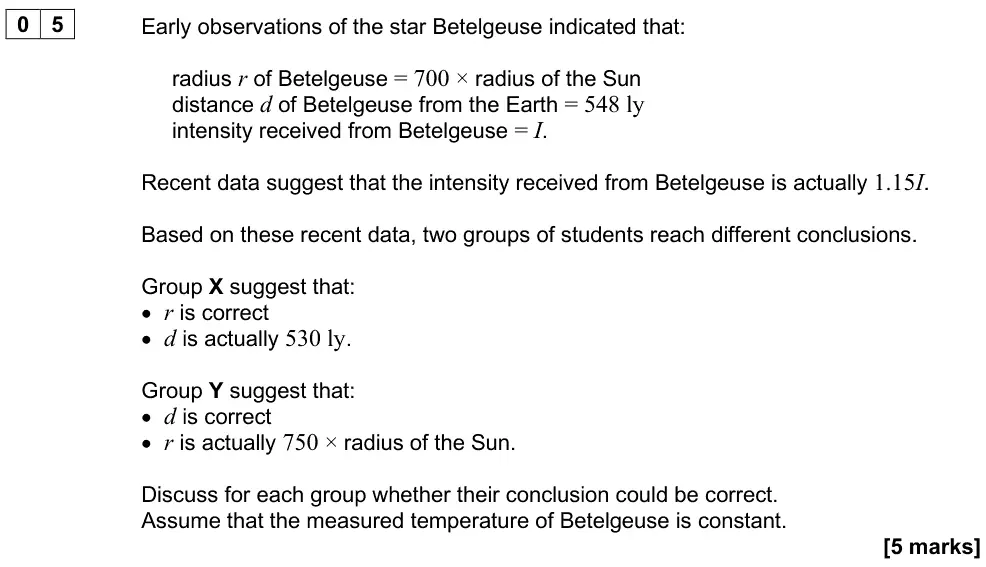
Early observations of the star Betelgeuse indicated that:
radius r of Betelgeuse = 700 × radius of the Sun
distance d of Betelgeuse from the Earth = 548 ly
intensity received from Betelgeuse = I.
Recent data suggest that the intensity received from Betelgeuse is actually 1.15I.
Based on these recent data, two groups of students reach different conclusions.
Group X suggest that:
• r is correct
• d is actually 530 ly.
Group Y suggest that:
• d is correct
• r is actually 750 × radius of the Sun.
Discuss for each group whether their conclusion could be correct.
Assume that the measured temperature of Betelgeuse is constant.
[5 marks]

Work with an AQA physics tutor

Want a paper marked and gone through with you? Message us.

Prefer email? Send an enquiry

If you are under 18, please include a parent's contact details. Enquiries go to enquiries@physicsaleveltutor.com and are deleted once handled. All tutoring is online.