June 2025: Paper 3B Turning points

35 marks · 13 question parts · Paper, mark scheme and report on AQA's site · Have the data and formulae booklet beside you

Question by question

QTopicMarksAOType
1.1 The discovery of the electron 3AO1=3Diagram or graph
1.2 The discovery of the electron 2AO2=2Show that
1.3 The discovery of the electron 1AO2=1Show that
1.4 The discovery of the electron 2AO2=2Show that
1.5 The discovery of the electron 3AO2=3Calculation
1.6 The discovery of the electron 2AO1=2Explanation
1.7 Measurements, units and uncertainties 3AO3=3Explanation
2.1 Wave-particle duality: from Newton to electron microscopes 3AO1=3Explanation
2.2 Wave-particle duality: from Newton to electron microscopes 1AO1=1Short answer
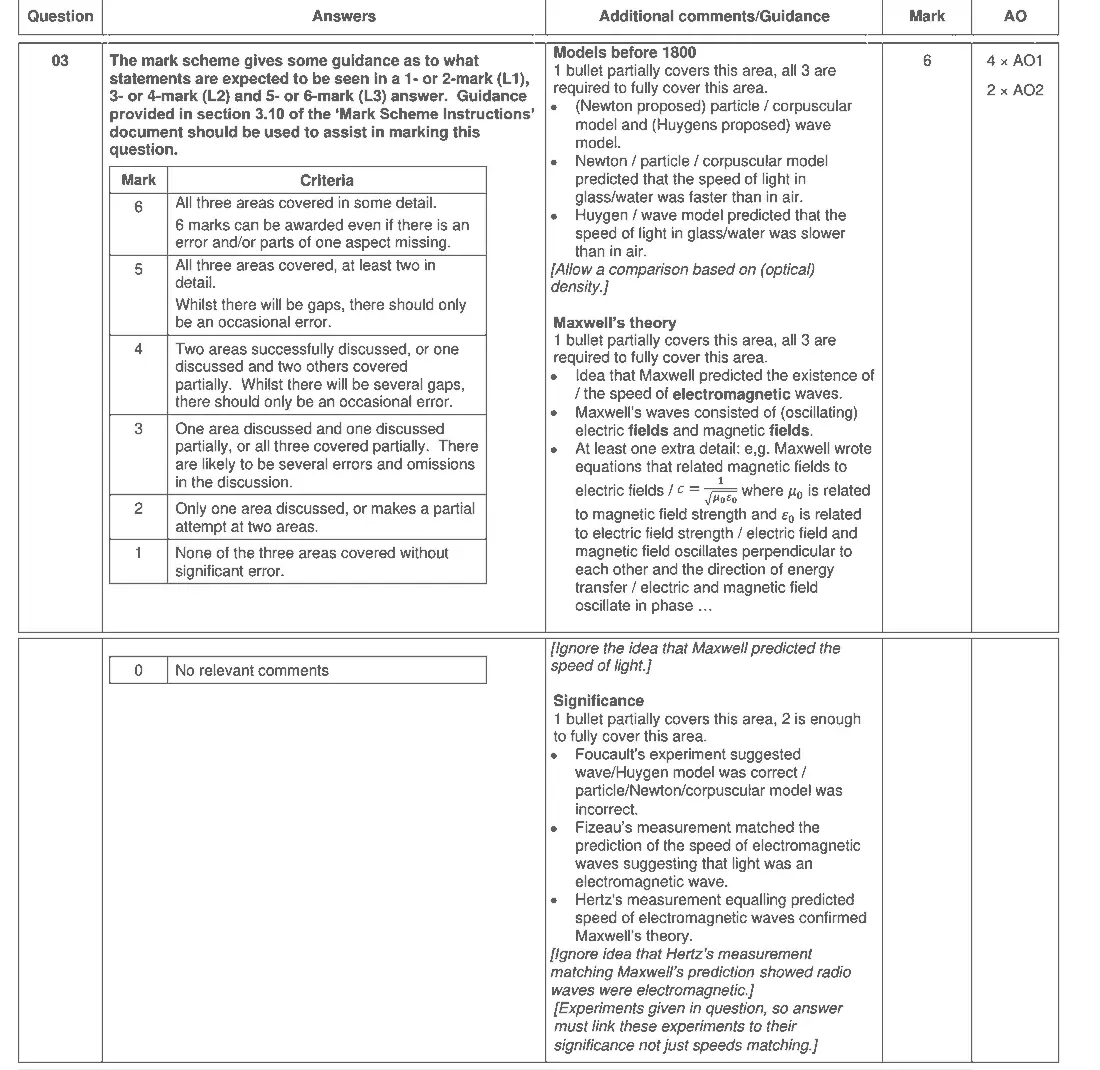
3 Wave-particle duality: from Newton to electron microscopes 6AO1=4,AO2=2Extended response
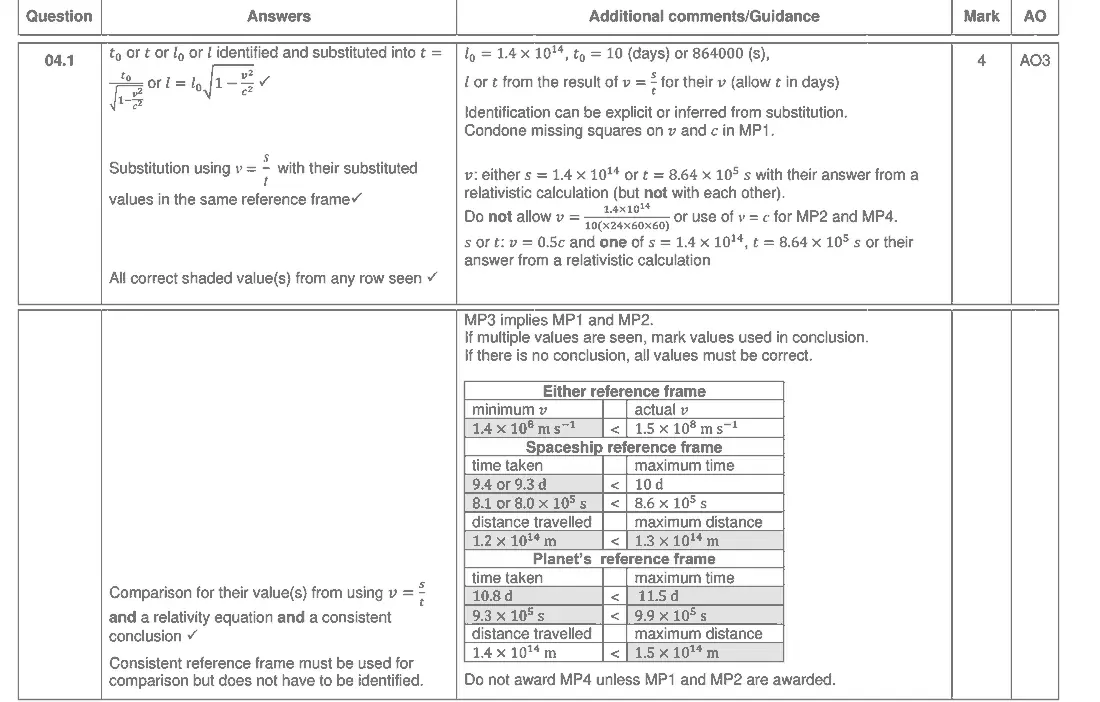
4.1 Special relativity 4AO3=4Calculation
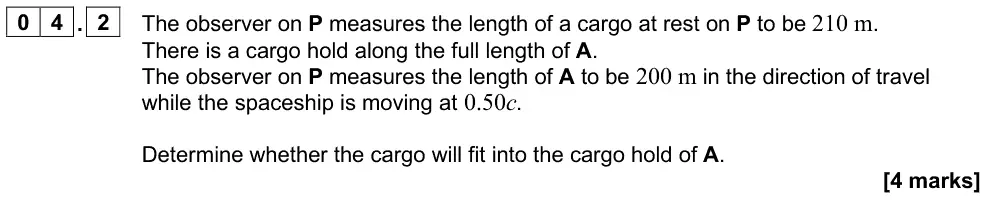
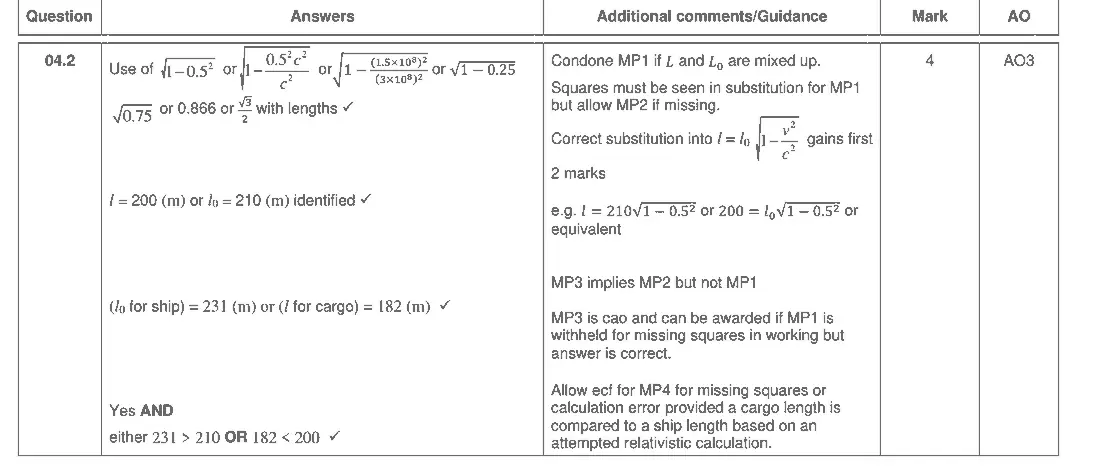
4.2 Special relativity 4AO3=4Calculation
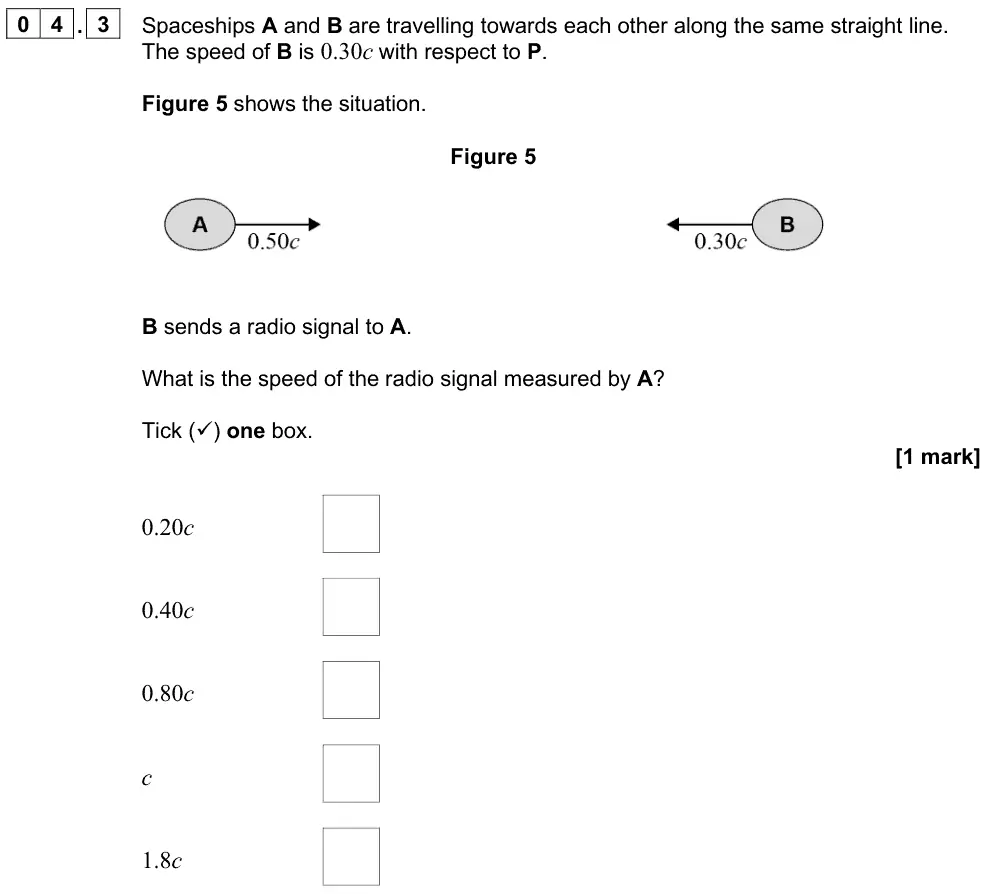
4.3 Special relativity 1AO2=1Short answer

The questions

1.11.21.31.41.51.61.72.12.234.14.24.3
June 2025 · Paper 3B Turning points · Q1.1 3 marks AO1=3 Diagram or graph discovery of the electron
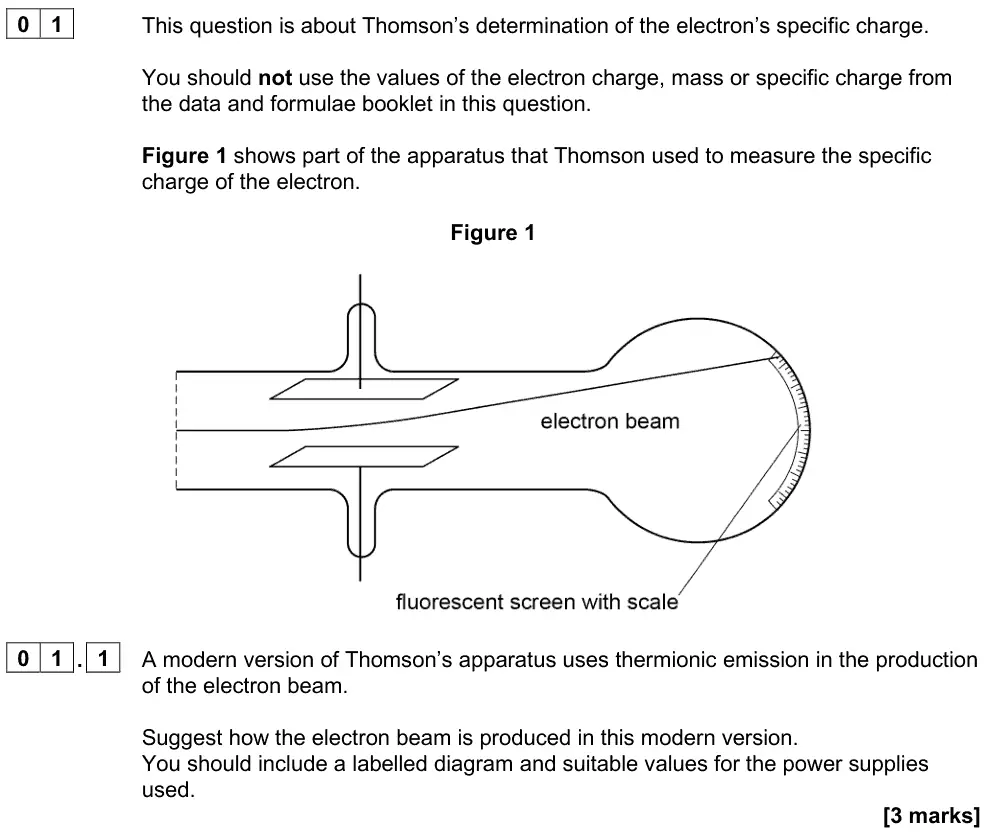
This question is about Thomson’s determination of the electron’s specific charge.
You should not use the values of the electron charge, mass or specific charge from
the data and formulae booklet in this question.
Figure 1 shows part of the apparatus that Thomson used to measure the specific
charge of the electron.
Figure 1
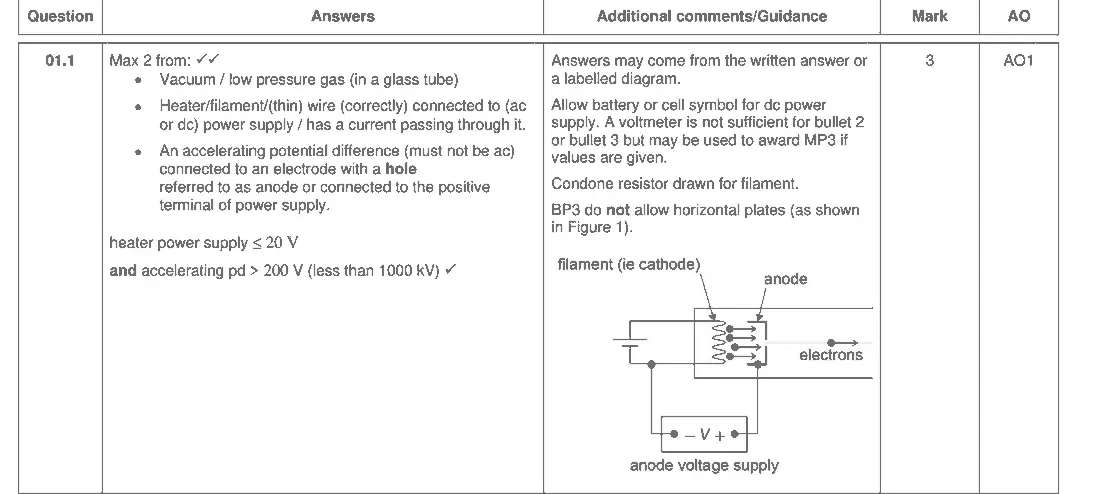
A modern version of Thomson’s apparatus uses thermionic emission in the production
of the electron beam.
Suggest how the electron beam is produced in this modern version.
You should include a labelled diagram and suitable values for the power supplies
used.
[3 marks]
June 2025 · Paper 3B Turning points · Q1.2 2 marks AO2=2 Show that discovery of the electron
Earlier part of question 1 that this part usesEarlier part of June 2025 Paper 3B Turning points question 1
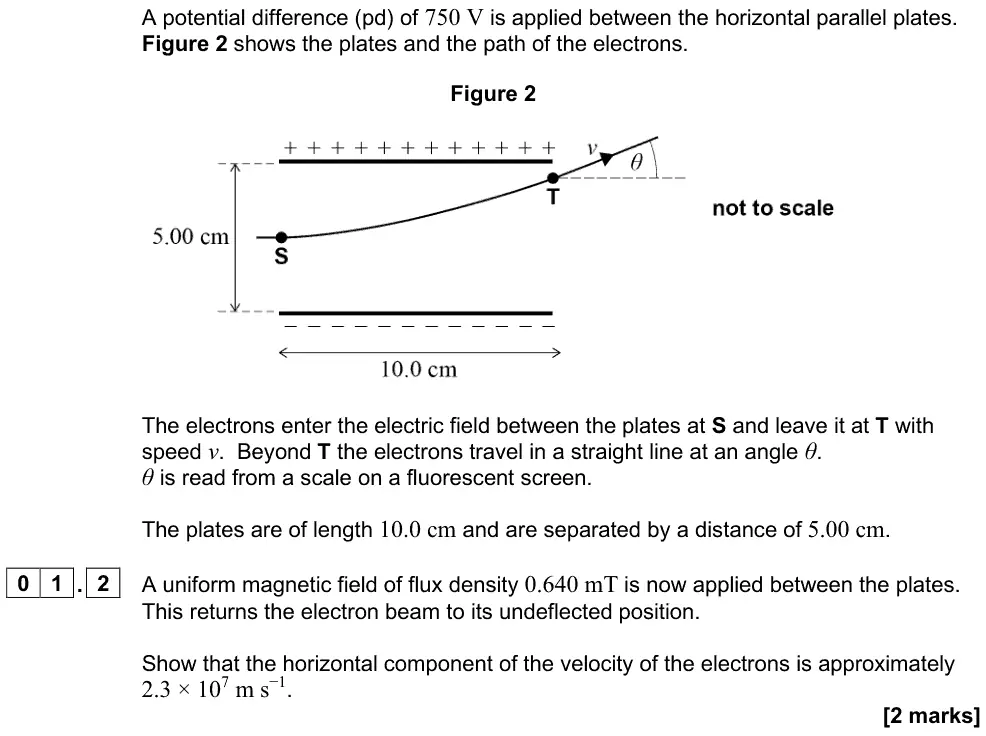
A potential difference (pd) of 750 V is applied between the horizontal parallel plates.
Figure 2 shows the plates and the path of the electrons.
Figure 2
The electrons enter the electric field between the plates at S and leave it at T with
speed v.  Beyond T the electrons travel in a straight line at an angle θ.
θ is read from a scale on a fluorescent screen.
The plates are of length 10.0 cm and are separated by a distance of 5.00 cm.
A uniform magnetic field of flux density 0.640 mT is now applied between the plates.
This returns the electron beam to its undeflected position.
Show that the horizontal component of the velocity of the electrons is approximately
2.3 × 10⁷ m s−1.
[2 marks]
June 2025 · Paper 3B Turning points · Q1.3 1 mark AO2=1 Show that Easy discovery of the electron
Earlier part of question 1 that this part usesEarlier part of June 2025 Paper 3B Turning points question 1
The magnetic field is switched off and θ is measured to be 25°.
Show that the vertical component of the velocity of the electrons at T is approximately
1.1 × 10⁷ m s−1.
[1 mark]
June 2025 · Paper 3B Turning points · Q1.4 2 marks AO2=2 Show that discovery of the electron
Earlier part of question 1 that this part usesEarlier part of June 2025 Paper 3B Turning points question 1
Show that the vertical acceleration of the electrons between the plates is
approximately 2.5 × 10¹⁵ m s−2.
[2 marks]
June 2025 · Paper 3B Turning points · Q1.5 3 marks AO2=3 Calculation discovery of the electron
Earlier part of question 1 that this part usesEarlier part of June 2025 Paper 3B Turning points question 1
Determine a value for the specific charge of the electron.
[3 marks]
specific charge =
C kg−1
June 2025 · Paper 3B Turning points · Q1.6 2 marks AO1=2 Explanation discovery of the electron
Earlier part of question 1 that this part usesEarlier part of June 2025 Paper 3B Turning points question 1
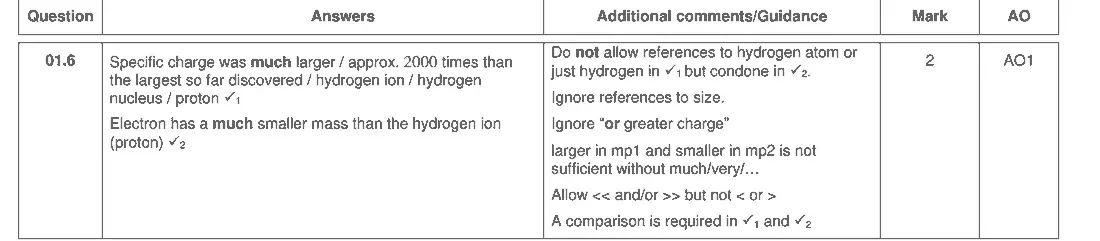
Explain the significance of the result of Thomson’s determination.
[2 marks]
June 2025 · Paper 3B Turning points · Q1.7 3 marks AO3=3 Explanation Hard measurements and uncertainties
Earlier part of question 1 that this part usesEarlier part of June 2025 Paper 3B Turning points question 1
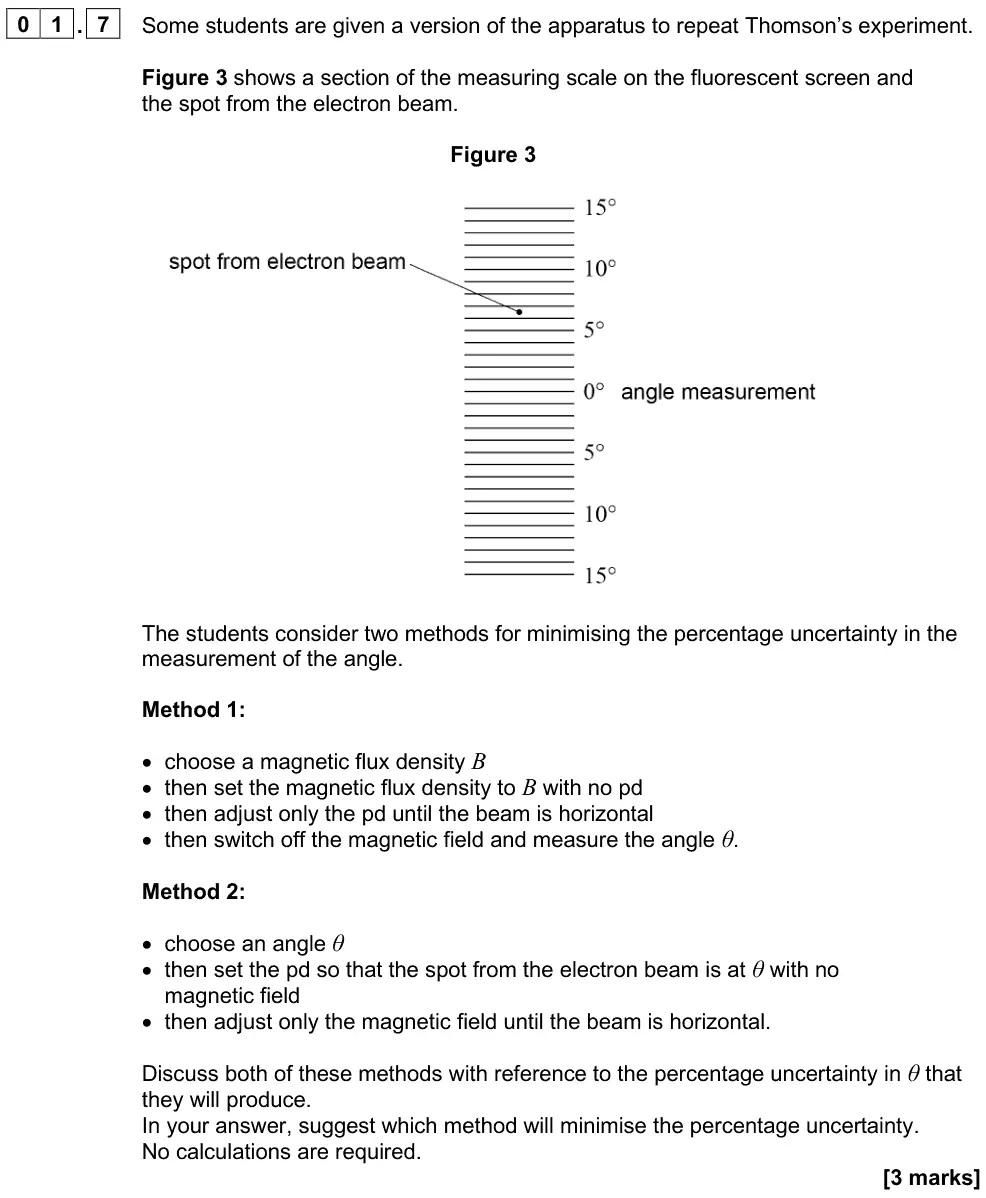
Some students are given a version of the apparatus to repeat Thomson’s experiment.
Figure 3 shows a section of the measuring scale on the fluorescent screen and
the spot from the electron beam.
Figure 3
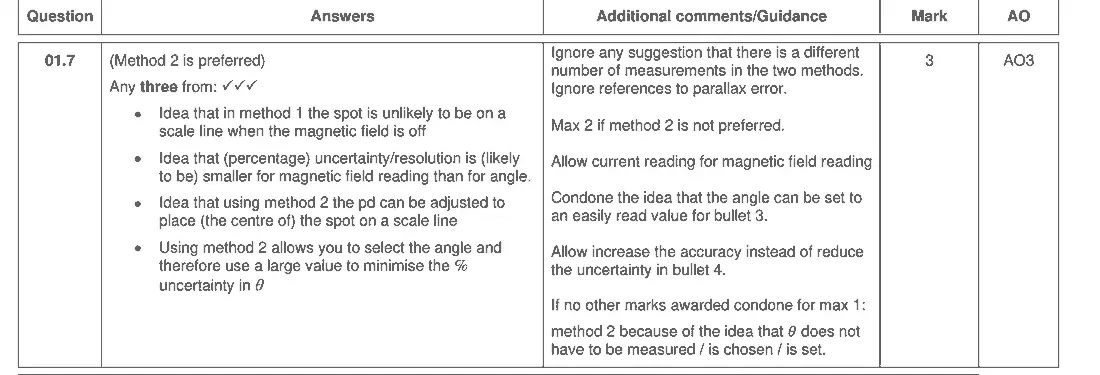
The students consider two methods for minimising the percentage uncertainty in the
measurement of the angle.
Method 1:
• choose a magnetic flux density B
• then set the magnetic flux density to B with no pd
• then adjust only the pd until the beam is horizontal
• then switch off the magnetic field and measure the angle θ.
Method 2:
• choose an angle θ
• then set the pd so that the spot from the electron beam is at θ with no
magnetic field
• then adjust only the magnetic field until the beam is horizontal.
Discuss both of these methods with reference to the percentage uncertainty in θ that
they will produce.
In your answer, suggest which method will minimise the percentage uncertainty.
No calculations are required.
[3 marks]
June 2025 · Paper 3B Turning points · Q2.1 3 marks AO1=3 Explanation wave particle duality history
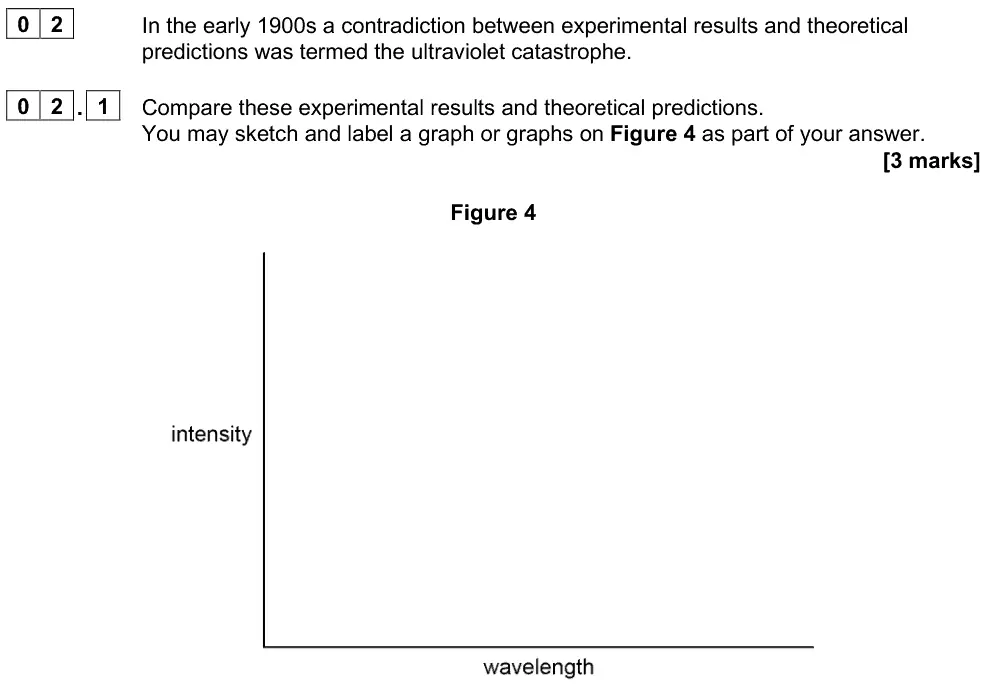
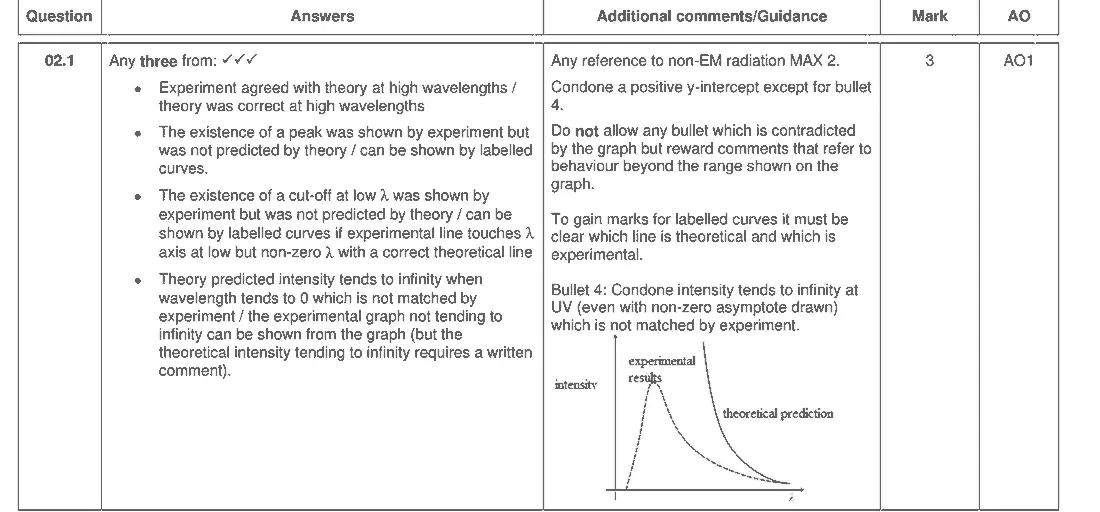
In the early 1900s a contradiction between experimental results and theoretical
predictions was termed the ultraviolet catastrophe.
Compare these experimental results and theoretical predictions.
You may sketch and label a graph or graphs on Figure 4 as part of your answer.
[3 marks]
Figure 4
June 2025 · Paper 3B Turning points · Q2.2 1 mark AO1=1 Short answer wave particle duality history
Earlier part of question 2 that this part usesEarlier part of June 2025 Paper 3B Turning points question 2
A proposal was made that allowed a resolution of the contradiction.
Outline this proposal.
[1 mark]
June 2025 · Paper 3B Turning points · Q3 6 marks AO1=4, AO2=2 6-mark extended response wave particle duality history
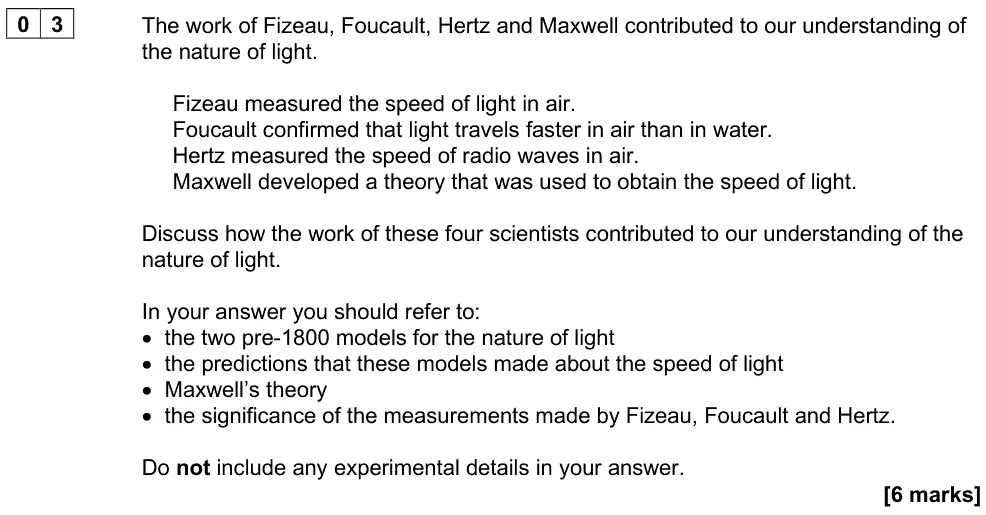
The work of Fizeau, Foucault, Hertz and Maxwell contributed to our understanding of
the nature of light.
Fizeau measured the speed of light in air.
Foucault confirmed that light travels faster in air than in water.
Hertz measured the speed of radio waves in air.
Maxwell developed a theory that was used to obtain the speed of light.
Discuss how the work of these four scientists contributed to our understanding of the
nature of light.
In your answer you should refer to:
• the two pre-1800 models for the nature of light
• the predictions that these models made about the speed of light
• Maxwell’s theory
• the significance of the measurements made by Fizeau, Foucault and Hertz.
Do not include any experimental details in your answer.
[6 marks]
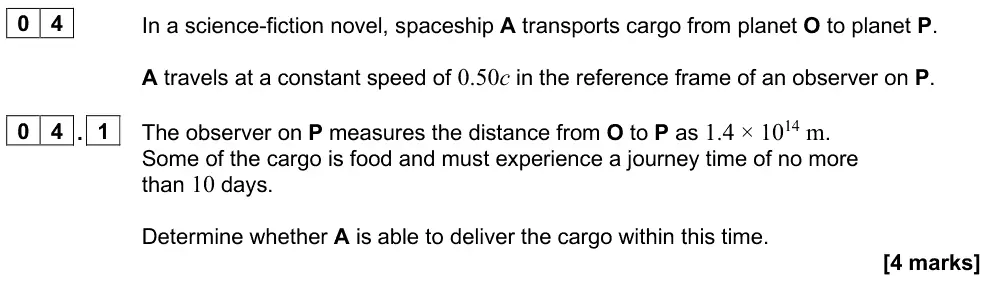
June 2025 · Paper 3B Turning points · Q4.1 4 marks AO3=4 Calculation special relativity
In a science-fiction novel, spaceship A transports cargo from planet O to planet P.
A travels at a constant speed of 0.50c in the reference frame of an observer on P.
The observer on P measures the distance from O to P as 1.4 × 10¹⁴ m.
Some of the cargo is food and must experience a journey time of no more
than 10 days.
Determine whether A is able to deliver the cargo within this time.
[4 marks]
June 2025 · Paper 3B Turning points · Q4.2 4 marks AO3=4 Calculation special relativity
Earlier part of question 4 that this part usesEarlier part of June 2025 Paper 3B Turning points question 4
The observer on P measures the length of a cargo at rest on P to be 210 m.
There is a cargo hold along the full length of A.
The observer on P measures the length of A to be 200 m in the direction of travel
while the spaceship is moving at 0.50c.
Determine whether the cargo will fit into the cargo hold of A.
[4 marks]
June 2025 · Paper 3B Turning points · Q4.3 1 mark AO2=1 Short answer special relativity
Earlier part of question 4 that this part usesEarlier part of June 2025 Paper 3B Turning points question 4
Spaceships A and B are travelling towards each other along the same straight line.
The speed of B is 0.30c with respect to P.
Figure 5 shows the situation.
Figure 5
B sends a radio signal to A.
What is the speed of the radio signal measured by A?
Tick () one box.
[1 mark]
0.20c
0.40c
0.80c
c
1.8c

Work with an AQA physics tutor

Want a paper marked and gone through with you? Message us.

Prefer email? Send an enquiry

If you are under 18, please include a parent's contact details. Enquiries go to enquiries@physicsaleveltutor.com and are deleted once handled. All tutoring is online.