November 2020: Paper 3B Astrophysics

35 marks · 14 question parts · Paper, mark scheme and report on AQA's site · An autumn series using the paper written for the cancelled summer exams · Have the data and formulae booklet beside you

Question by question

QTopicMarksAOType
1.1 Telescopes 2AO1=2Diagram or graph
1.2 Telescopes 3AO3=3Calculation
1.3 Telescopes 2AO2=2Calculation
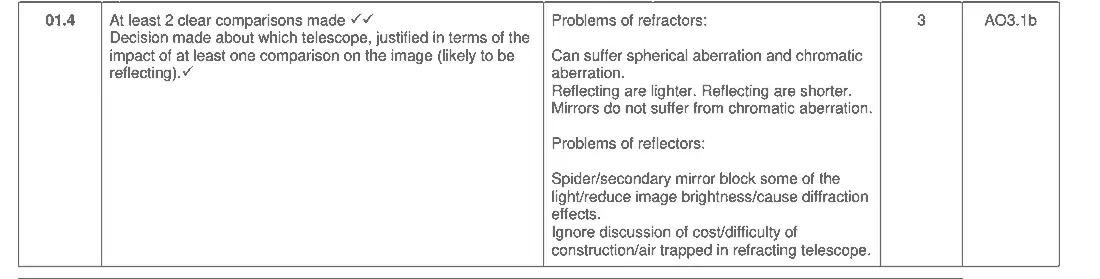
1.4 Telescopes 3AO3=3Explanation
2.1 Classification of stars and the HR diagram 1AO1=1Short answer
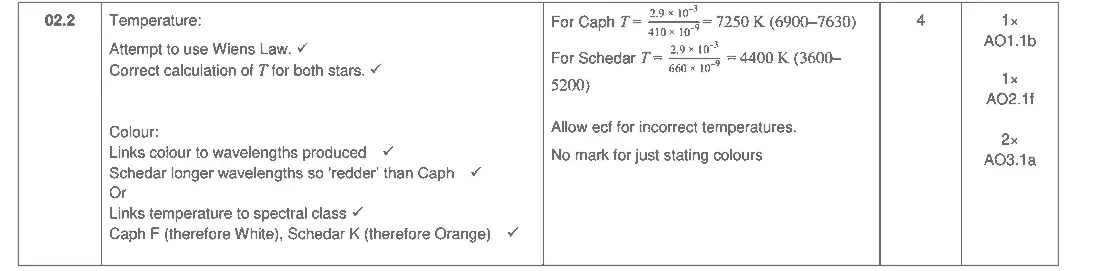
2.2 Classification of stars and the HR diagram 4AO1=1,AO2=1,AO3=2Explanation
2.3 Classification of stars and the HR diagram 1AO2=1Short answer
2.4 Classification of stars and the HR diagram 3AO2=3Calculation
2.5 Classification of stars and the HR diagram 2AO2=2Calculation
3.1 Classification of stars and the HR diagram 1AO1=1Short answer
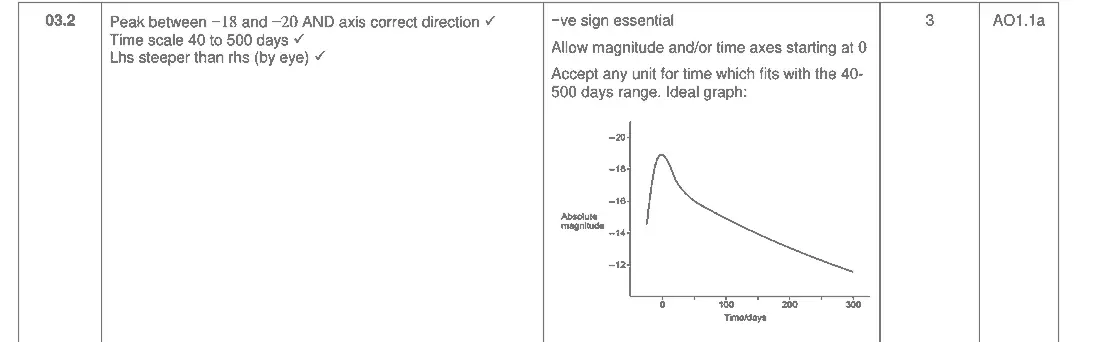
3.2 Classification of stars and the HR diagram 3AO1=3Diagram or graph
3.3 Cosmology: Doppler effect, Hubble's law, quasars and exoplanets, Classification of stars and the HR diagram 6Extended response
4.1 Classification of stars and the HR diagram 2AO2=2Calculation
4.2 Classification of stars and the HR diagram 2AO3=2Explanation

The questions

1.11.21.31.42.12.22.32.42.53.13.23.34.14.2
November 2020 · Paper 3B Astrophysics · Q1.1 2 marks AO1=2 Diagram or graph telescopes
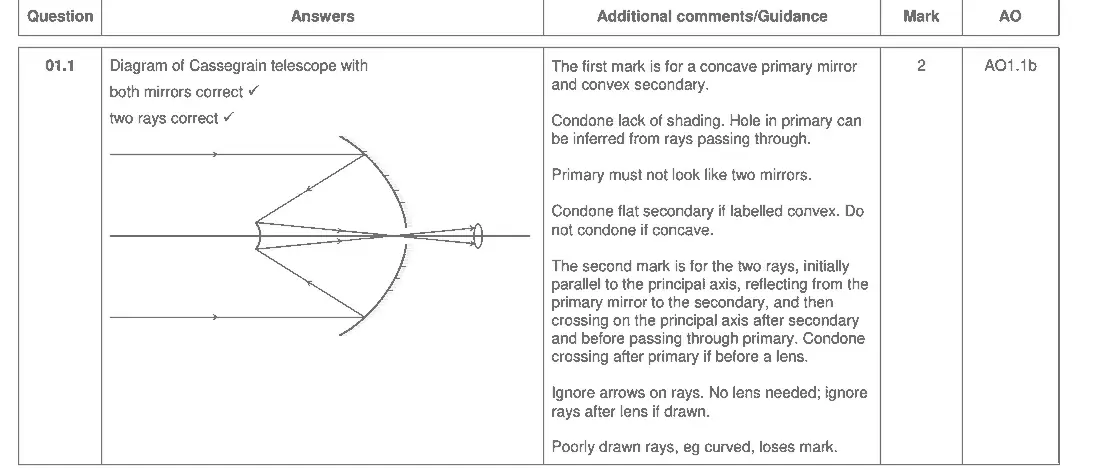
Draw a ray diagram for a Cassegrain telescope.
Your diagram should show the paths of two rays up to the eyepiece lens.
The rays should initially be parallel to the principal axis.
[2 marks]
principal
axis
November 2020 · Paper 3B Astrophysics · Q1.2 3 marks AO3=3 Calculation telescopes
Earlier part of question 1 that this part usesEarlier part of November 2020 Paper 3B Astrophysics question 1
A spacecraft passes Pluto at a distance of 12 500 km.  The telescope on board has
an aperture of diameter 0.21 m and operates at a wavelength of 450 nm.
Discuss whether this telescope is suitable for studying a crater with a diameter of
approximately 1 km on Pluto.
[3 marks]
November 2020 · Paper 3B Astrophysics · Q1.3 2 marks AO2=2 Calculation telescopes
Earlier part of question 1 that this part usesEarlier part of November 2020 Paper 3B Astrophysics question 1
The Hubble telescope has an aperture of diameter 2.4 m.
Compare the collecting power of the Hubble telescope with the telescope on the
spacecraft in Question 01.2.
[2 marks]
November 2020 · Paper 3B Astrophysics · Q1.4 3 marks AO3=3 Explanation telescopes
Earlier part of question 1 that this part usesEarlier part of November 2020 Paper 3B Astrophysics question 1
An astrophysicist had to decide whether to use a reflecting telescope or a refracting
telescope on the spacecraft in Question 01.2.
Discuss which type of telescope to use.
[3 marks]
November 2020 · Paper 3B Astrophysics · Q2.1 1 mark AO1=1 Short answer classification of stars
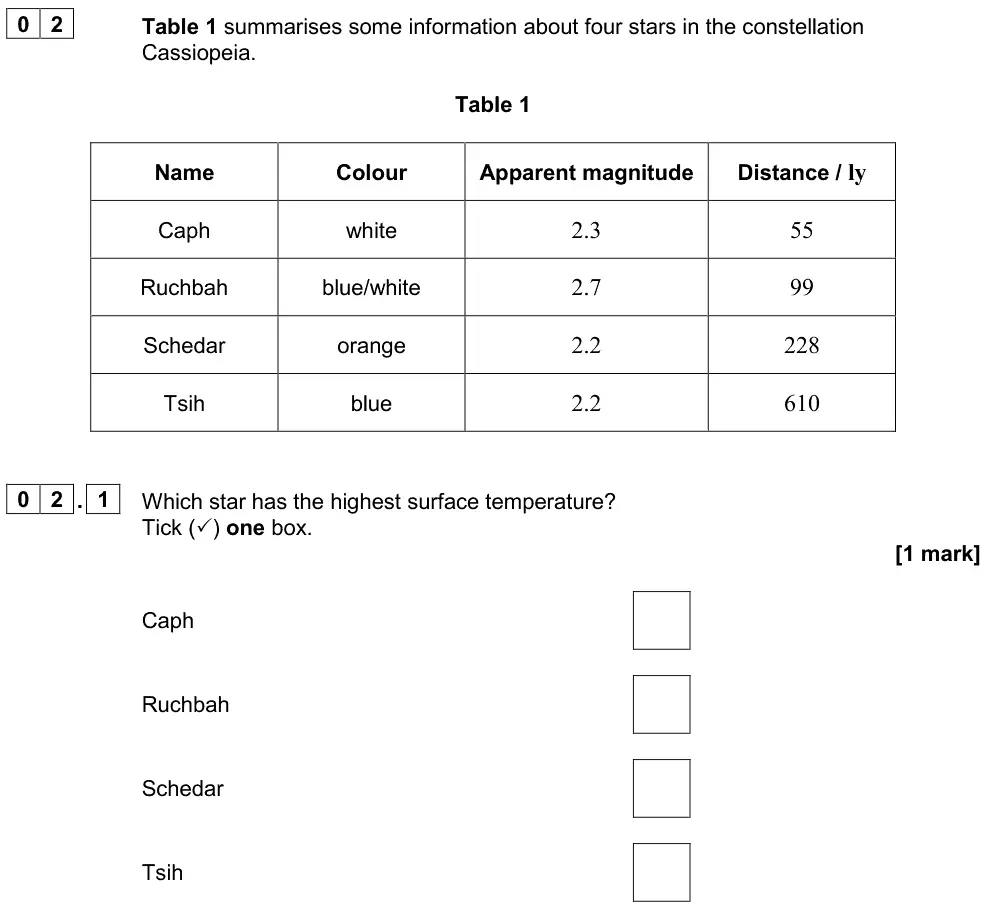
Table 1 summarises some information about four stars in the constellation
Cassiopeia.
Table 1
Name
Colour
Apparent magnitude
Distance / ly
Caph
white
2.3
55
Ruchbah
blue/white
2.7
99
Schedar
orange
2.2
228
Tsih
blue
2.2
610
Which star has the highest surface temperature?
Tick () one box.
[1 mark]
Caph
Ruchbah
Schedar
Tsih
November 2020 · Paper 3B Astrophysics · Q2.2 4 marks AO1=1, AO2=1, AO3=2 Explanation classification of stars
Earlier part of question 2 that this part usesEarlier part of November 2020 Paper 3B Astrophysics question 2
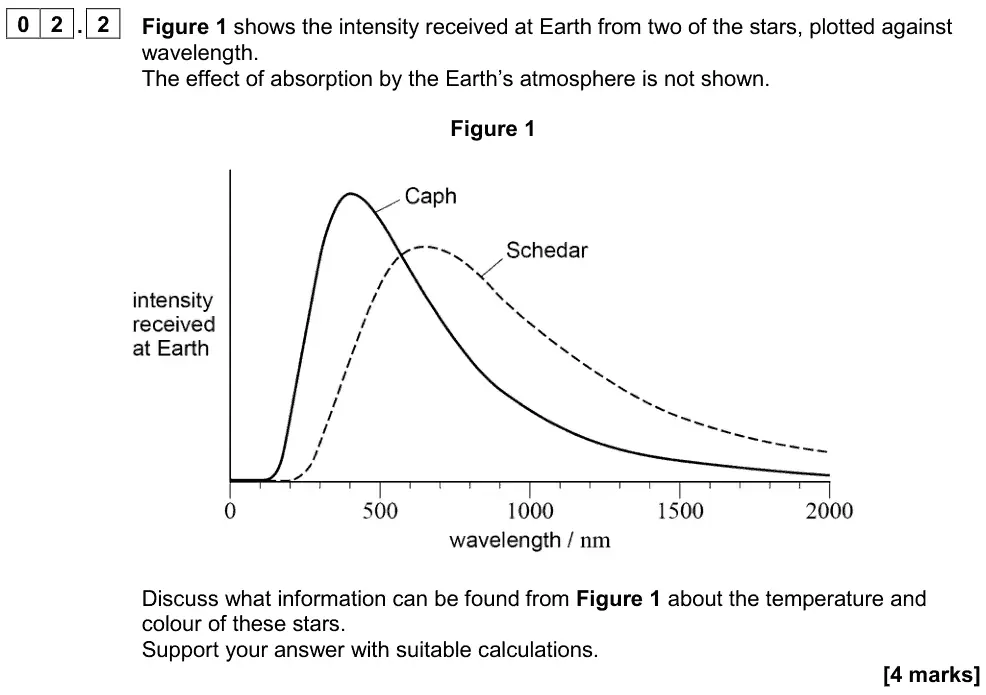
Figure 1 shows the intensity received at Earth from two of the stars, plotted against
wavelength.
The effect of absorption by the Earth’s atmosphere is not shown.
Figure 1
Discuss what information can be found from Figure 1 about the temperature and
colour of these stars.
Support your answer with suitable calculations.
[4 marks]
November 2020 · Paper 3B Astrophysics · Q2.3 1 mark AO2=1 Short answer classification of stars
Earlier part of question 2 that this part usesEarlier part of November 2020 Paper 3B Astrophysics question 2
State which star in Table 1 is dimmest on the absolute magnitude scale.
[1 mark]
November 2020 · Paper 3B Astrophysics · Q2.4 3 marks AO2=3 Calculation classification of stars
Earlier part of question 2 that this part usesEarlier part of November 2020 Paper 3B Astrophysics question 2
Calculate the absolute magnitude of Schedar.
[3 marks]
absolute magnitude =
November 2020 · Paper 3B Astrophysics · Q2.5 2 marks AO2=2 Calculation classification of stars
Earlier part of question 2 that this part usesEarlier part of November 2020 Paper 3B Astrophysics question 2
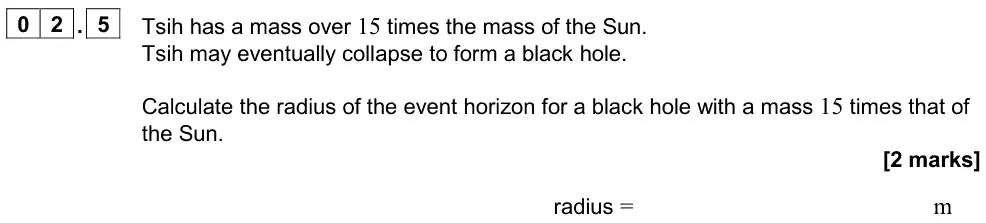
Tsih has a mass over 15 times the mass of the Sun.
Tsih may eventually collapse to form a black hole.
Calculate the radius of the event horizon for a black hole with a mass 15 times that of
the Sun.
[2 marks]
radius =
m
November 2020 · Paper 3B Astrophysics · Q3.1 1 mark AO1=1 Short answer classification of stars
Type 1a supernovae can be used as standard candles.
State what is meant by a standard candle.
[1 mark]
November 2020 · Paper 3B Astrophysics · Q3.2 3 marks AO1=3 Diagram or graph classification of stars
Earlier part of question 3 that this part usesEarlier part of November 2020 Paper 3B Astrophysics question 3
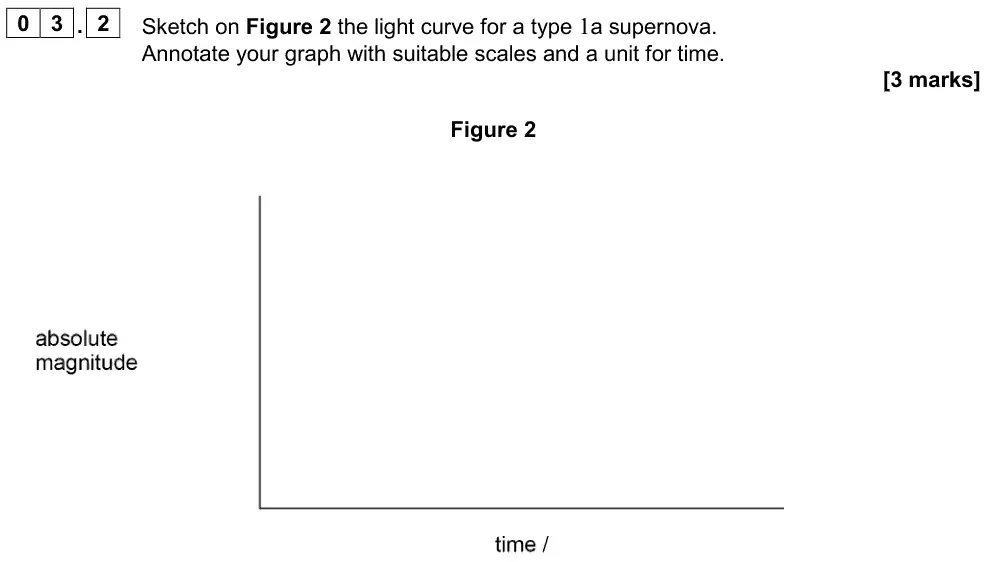
Sketch on Figure 2 the light curve for a type 1a supernova.
Annotate your graph with suitable scales and a unit for time.
[3 marks]
Figure 2
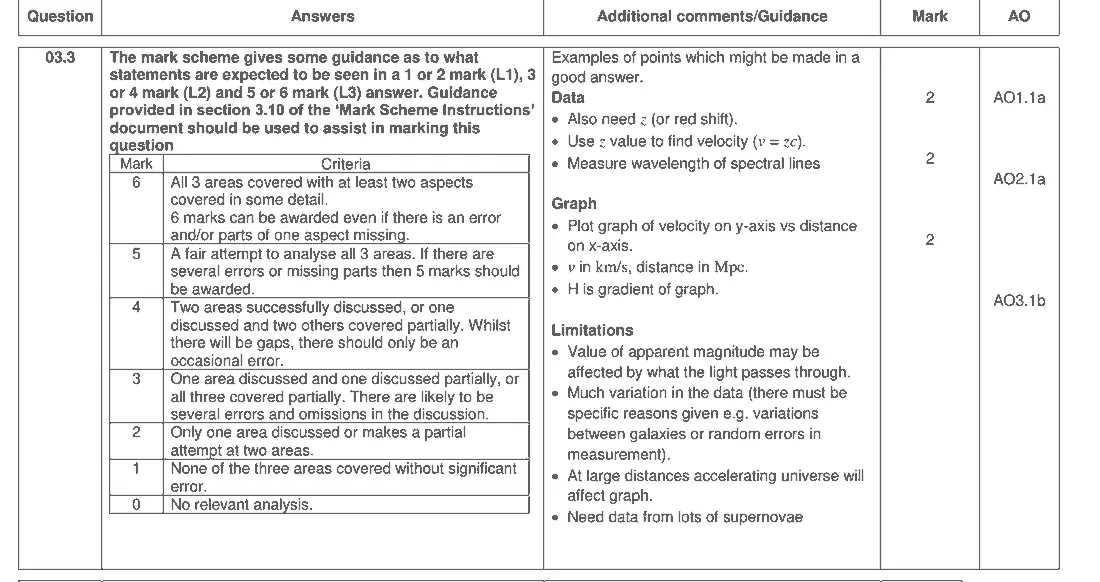
November 2020 · Paper 3B Astrophysics · Q3.3 6 marks 6-mark extended response cosmologyclassification of stars
Earlier part of question 3 that this part usesEarlier part of November 2020 Paper 3B Astrophysics question 3
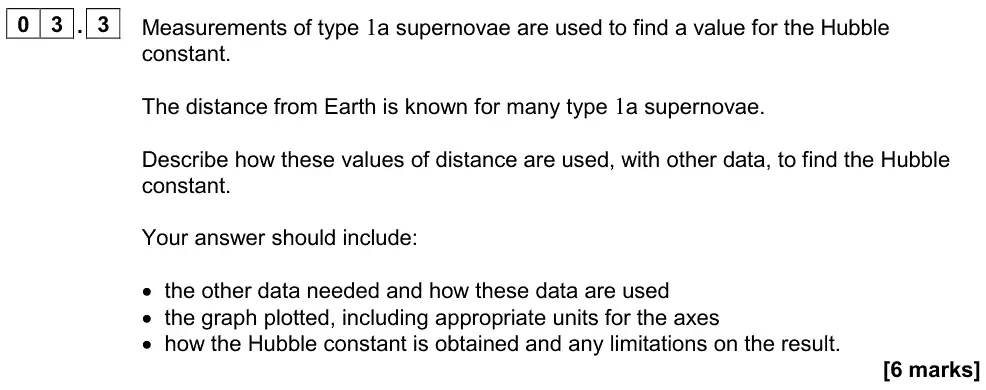
Measurements of type 1a supernovae are used to find a value for the Hubble
constant.
The distance from Earth is known for many type 1a supernovae.
Describe how these values of distance are used, with other data, to find the Hubble
constant.
Your answer should include:
• the other data needed and how these data are used
• the graph plotted, including appropriate units for the axes
• how the Hubble constant is obtained and any limitations on the result.
[6 marks]
November 2020 · Paper 3B Astrophysics · Q4.1 2 marks AO2=2 Calculation classification of stars
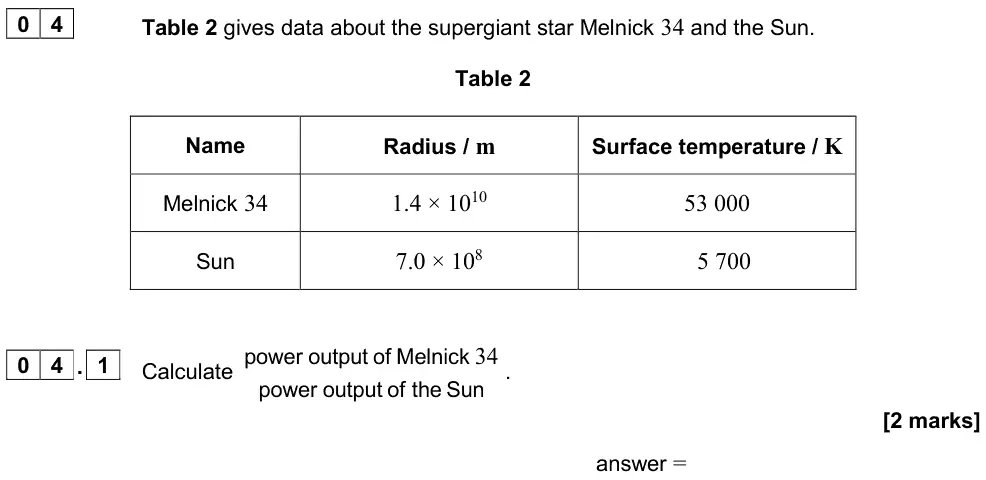
Table 2 gives data about the supergiant star Melnick 34 and the Sun.
Table 2
Name
Radius / m
Surface temperature / K
Melnick 34
1.4 × 10¹⁰
53 000
Sun
7.0 × 10⁸
5 700
Calculate
34
power output of Melnick
power output of the Sun
.
[2 marks]
answer =
November 2020 · Paper 3B Astrophysics · Q4.2 2 marks AO3=2 Explanation classification of stars
Earlier part of question 4 that this part usesEarlier part of November 2020 Paper 3B Astrophysics question 4
Discuss why the evolution of a supergiant star in the local part of our galaxy could be
dangerous for life on Earth.
[2 marks]

Work with an AQA physics tutor

Want a paper marked and gone through with you? Message us.

Prefer email? Send an enquiry

If you are under 18, please include a parent's contact details. Enquiries go to enquiries@physicsaleveltutor.com and are deleted once handled. All tutoring is online.