
November 2020: Paper 3B Turning points

35 marks · 14 question parts · Paper, mark scheme and report on AQA's site · An autumn series using the paper written for the cancelled summer exams · Have the data and formulae booklet beside you

Question by question

QTopicMarksAOType
1.1 The discovery of the electron 2Explanation
1.2 The discovery of the electron 1Short answer
1.3 The discovery of the electron 3Explanation
1.4 The discovery of the electron 2Explanation
2.1 Wave-particle duality: from Newton to electron microscopes 2Short answer
2.2 Wave-particle duality: from Newton to electron microscopes 2Diagram or graph
2.3 Wave-particle duality: from Newton to electron microscopes 2Short answer
2.4 Wave-particle duality: from Newton to electron microscopes 6Extended response
3.1 Wave-particle duality: from Newton to electron microscopes 2Explanation
3.2 Wave-particle duality: from Newton to electron microscopes 3Explanation
3.3 Wave-particle duality: from Newton to electron microscopes 3Calculation
4.1 Special relativity 2Calculation
4.2 Special relativity 2Short answer
4.3 Special relativity 3Explanation

The questions

1.11.21.31.42.12.22.32.43.13.23.34.14.24.3
November 2020 · Paper 3B Turning points · Q1.1 2 marks Explanation discovery of the electron
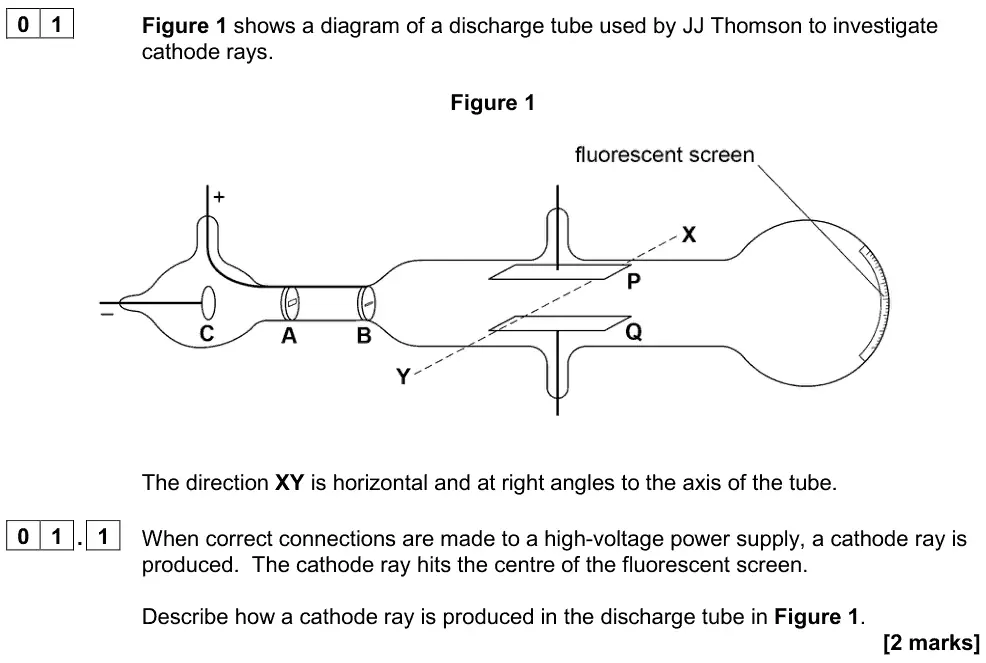
Figure 1 shows a diagram of a discharge tube used by JJ Thomson to investigate
cathode rays.
Figure 1
The direction XY is horizontal and at right angles to the axis of the tube.
When correct connections are made to a high-voltage power supply, a cathode ray is
produced.  The cathode ray hits the centre of the fluorescent screen.
Describe how a cathode ray is produced in the discharge tube in Figure 1.
[2 marks]
November 2020 · Paper 3B Turning points · Q1.2 1 mark Short answer discovery of the electron
Earlier part of question 1 that this part usesEarlier part of November 2020 Paper 3B Turning points question 1
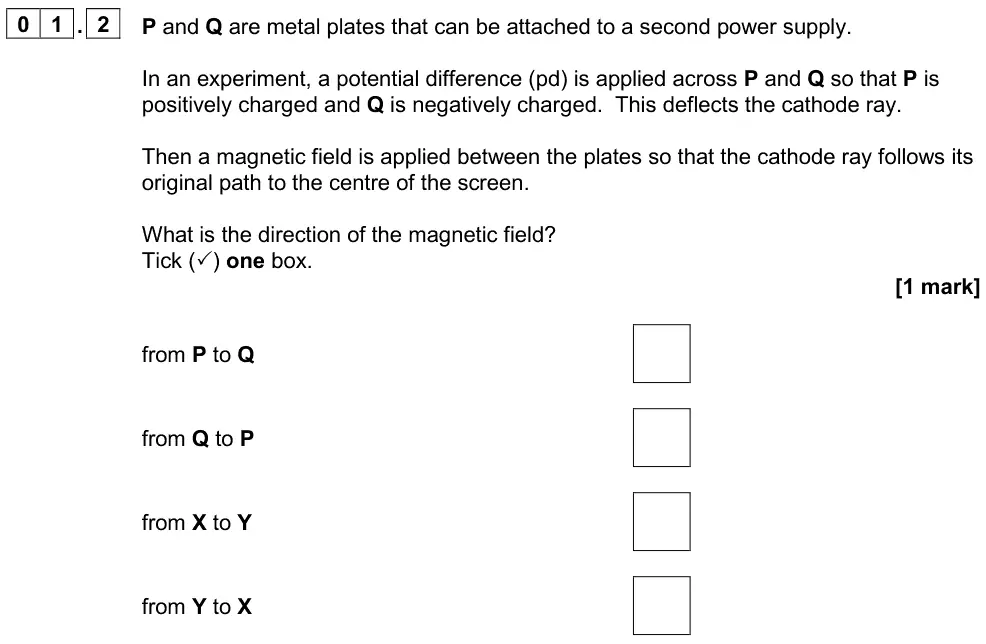
P and Q are metal plates that can be attached to a second power supply.
In an experiment, a potential difference (pd) is applied across P and Q so that P is
positively charged and Q is negatively charged.  This deflects the cathode ray.
Then a magnetic field is applied between the plates so that the cathode ray follows its
original path to the centre of the screen.
What is the direction of the magnetic field?
Tick () one box.
[1 mark]
from P to Q
from Q to P
from X to Y
from Y to X
November 2020 · Paper 3B Turning points · Q1.3 3 marks Explanation discovery of the electron
Earlier part of question 1 that this part usesEarlier part of November 2020 Paper 3B Turning points question 1
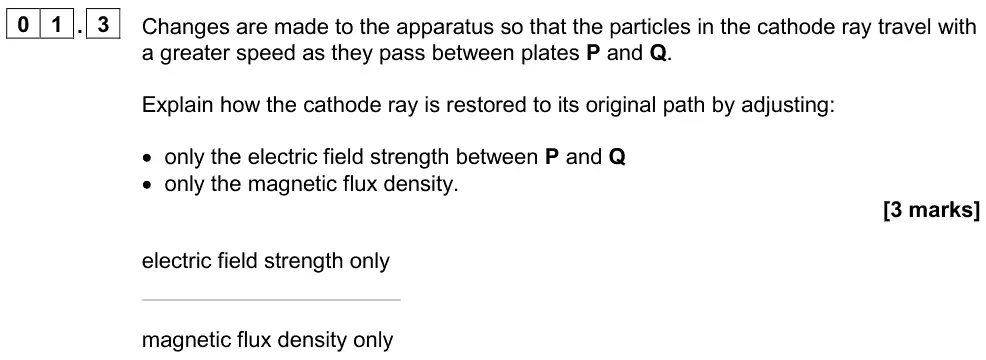
Changes are made to the apparatus so that the particles in the cathode ray travel with
a greater speed as they pass between plates P and Q.
Explain how the cathode ray is restored to its original path by adjusting:
• only the electric field strength between P and Q
• only the magnetic flux density.
[3 marks]
electric field strength only
magnetic flux density only
November 2020 · Paper 3B Turning points · Q1.4 2 marks Explanation discovery of the electron
Earlier part of question 1 that this part usesEarlier part of November 2020 Paper 3B Turning points question 1
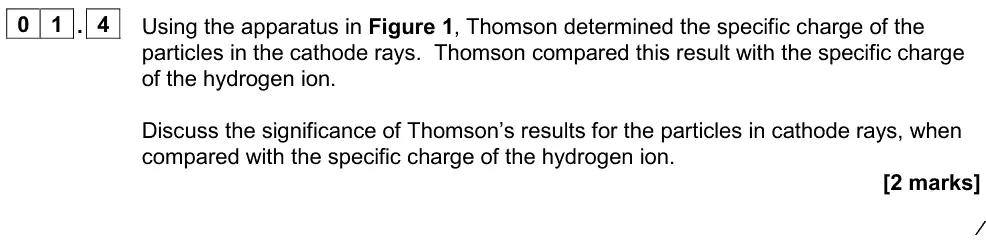
Using the apparatus in Figure 1, Thomson determined the specific charge of the
particles in the cathode rays.  Thomson compared this result with the specific charge
of the hydrogen ion.
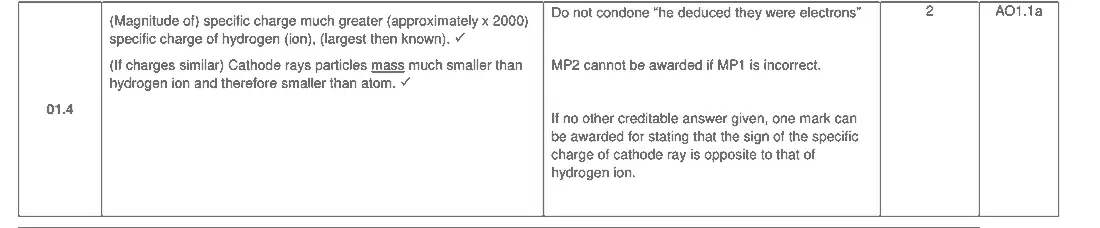
Discuss the significance of Thomson’s results for the particles in cathode rays, when
compared with the specific charge of the hydrogen ion.
[2 marks]
November 2020 · Paper 3B Turning points · Q2.1 2 marks Short answer wave particle duality history
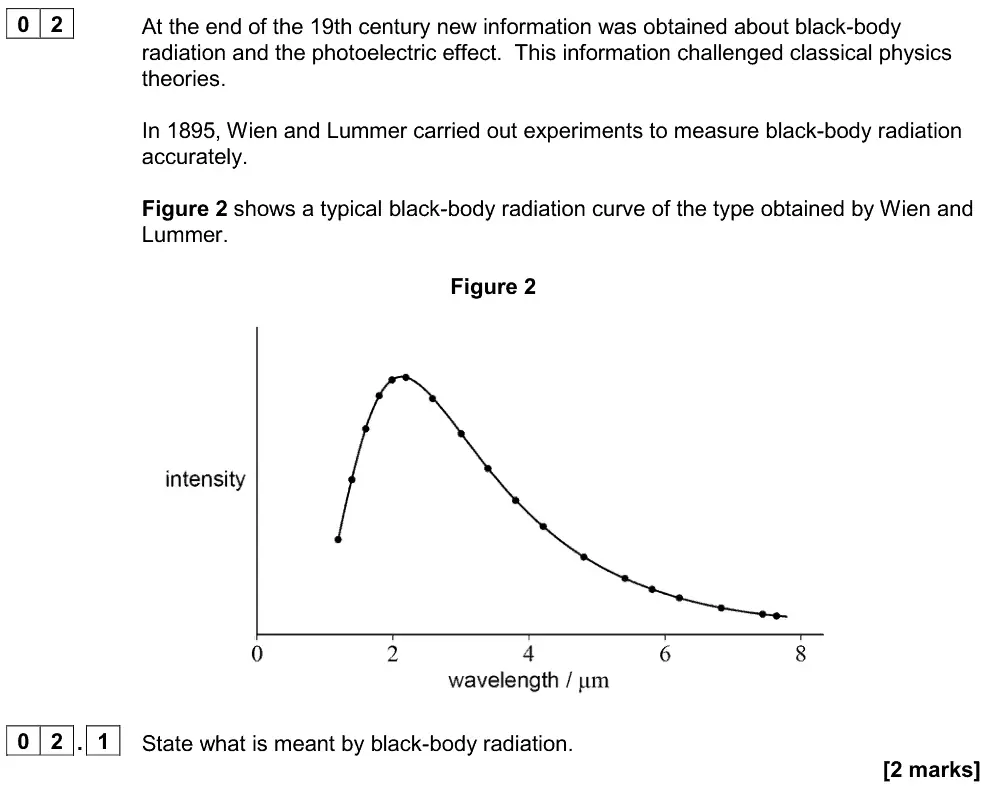
At the end of the 19th century new information was obtained about black-body
radiation and the photoelectric effect.  This information challenged classical physics
theories.
In 1895, Wien and Lummer carried out experiments to measure black-body radiation
accurately.
Figure 2 shows a typical black-body radiation curve of the type obtained by Wien and
Lummer.
Figure 2
State what is meant by black-body radiation.
[2 marks]
November 2020 · Paper 3B Turning points · Q2.2 2 marks Diagram or graph wave particle duality history
Earlier part of question 2 that this part usesEarlier part of November 2020 Paper 3B Turning points question 2
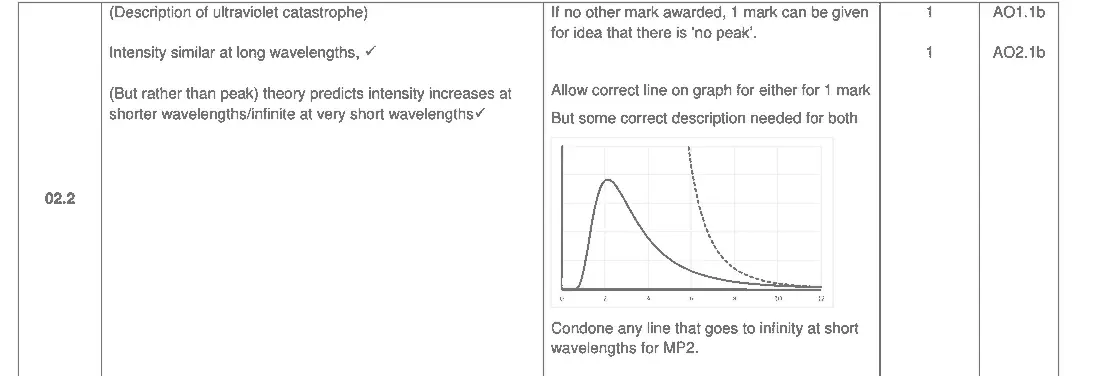
Describe how the predictions of classical theory compare with Wien and Lummer’s
experimental results.
Annotate Figure 2 as part of your answer.
[2 marks]
November 2020 · Paper 3B Turning points · Q2.3 2 marks Short answer wave particle duality history
Earlier part of question 2 that this part usesEarlier part of November 2020 Paper 3B Turning points question 2
In 1900 Max Planck suggested a solution to the problems of the classical theory.
Outline the main aspects of his suggestion.
[2 marks]
November 2020 · Paper 3B Turning points · Q2.4 6 marks 6-mark extended response wave particle duality history
Earlier part of question 2 that this part usesEarlier part of November 2020 Paper 3B Turning points question 2
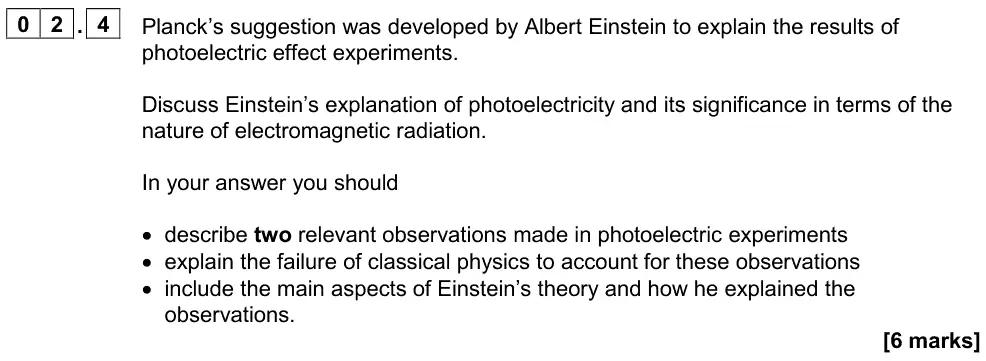
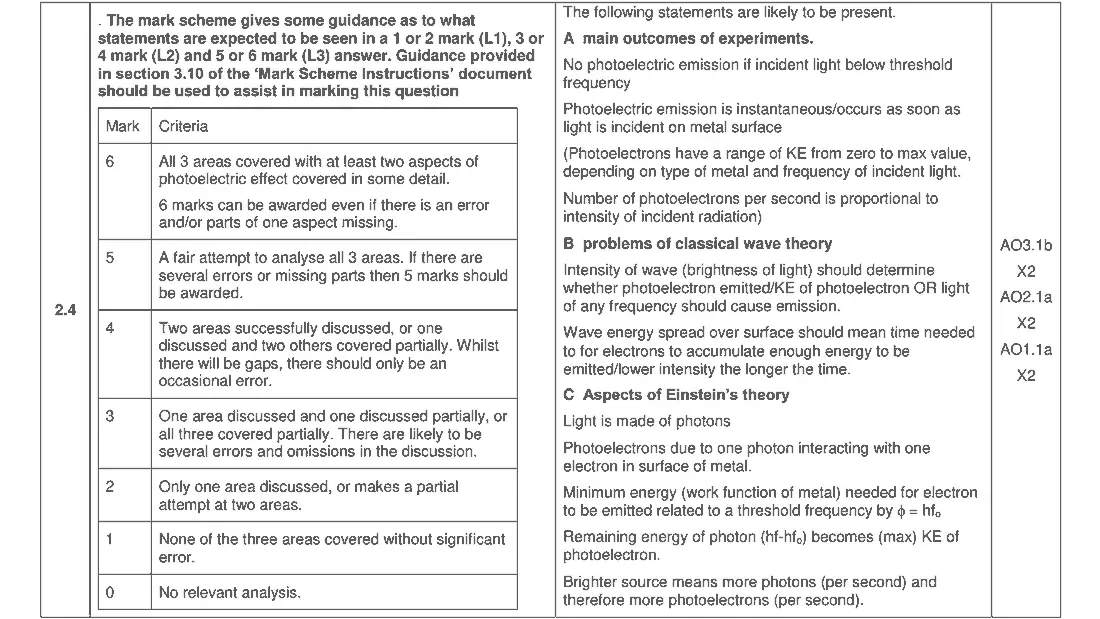
Planck’s suggestion was developed by Albert Einstein to explain the results of
photoelectric effect experiments.
Discuss Einstein’s explanation of photoelectricity and its significance in terms of the
nature of electromagnetic radiation.
In your answer you should
• describe two relevant observations made in photoelectric experiments
• explain the failure of classical physics to account for these observations
• include the main aspects of Einstein’s theory and how he explained the
observations.
[6 marks]
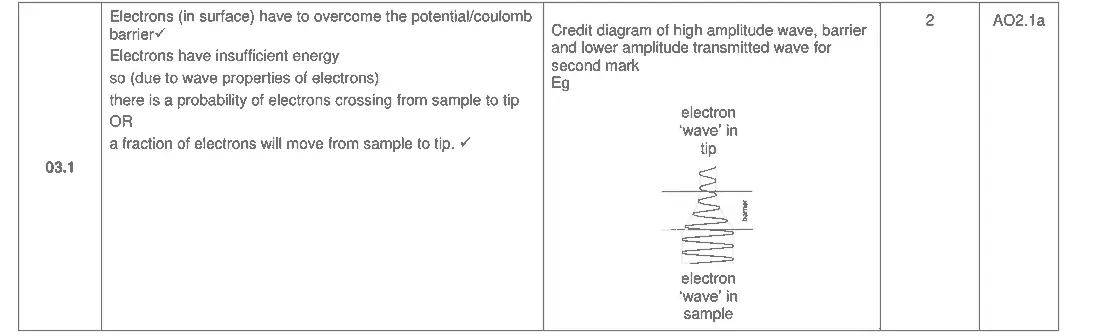
November 2020 · Paper 3B Turning points · Q3.1 2 marks Explanation wave particle duality history
The scanning tunnelling microscope (STM) uses a process called quantum tunnelling.
Explain what is meant by quantum tunnelling of an electron in an STM.
You may include a diagram as part of your answer.
[2 marks]
November 2020 · Paper 3B Turning points · Q3.2 3 marks Explanation wave particle duality history
Earlier part of question 3 that this part usesEarlier part of November 2020 Paper 3B Turning points question 3
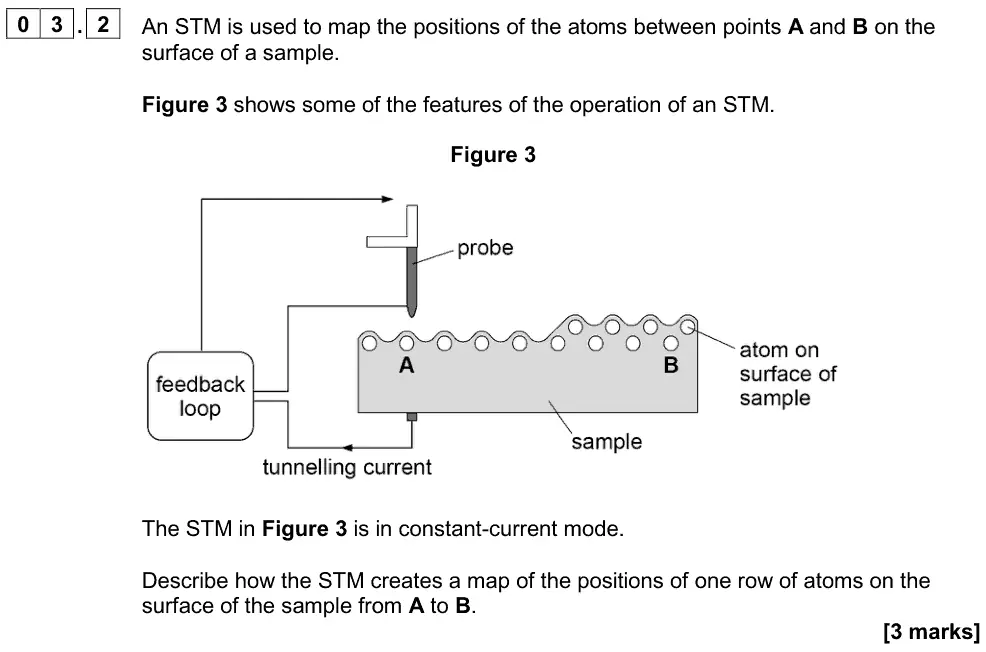
An STM is used to map the positions of the atoms between points A and B on the
surface of a sample.
Figure 3 shows some of the features of the operation of an STM.
Figure 3
The STM in Figure 3 is in constant-current mode.
Describe how the STM creates a map of the positions of one row of atoms on the
surface of the sample from A to B.
[3 marks]
November 2020 · Paper 3B Turning points · Q3.3 3 marks Calculation wave particle duality history
Earlier part of question 3 that this part usesEarlier part of November 2020 Paper 3B Turning points question 3
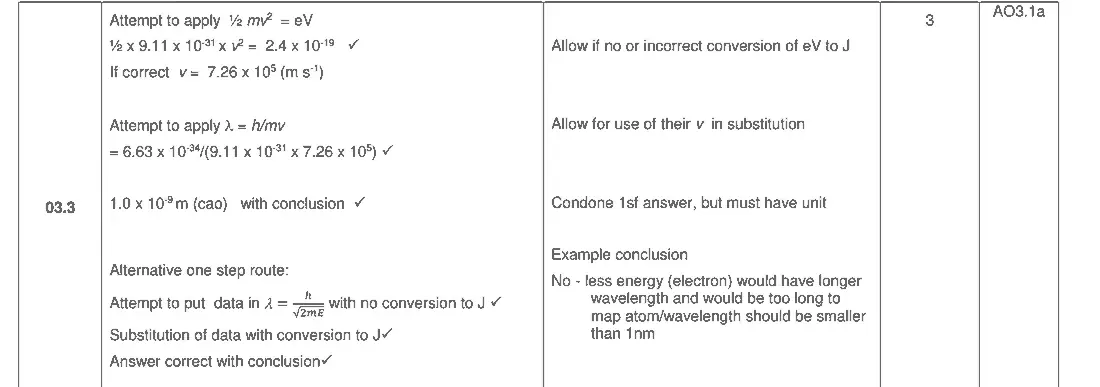
The smallest size of objects that the STM can resolve is similar to the de Broglie
wavelength of the tunnelling electrons.
Deduce whether electrons with kinetic energies less than 1.5 eV are suitable to map
the surface in Figure 3.
[3 marks]
November 2020 · Paper 3B Turning points · Q4.1 2 marks Calculation special relativity
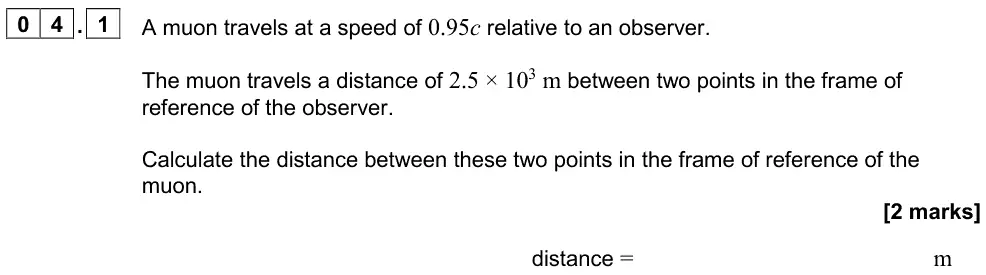
A muon travels at a speed of 0.95c relative to an observer.
The muon travels a distance of 2.5 × 10³ m between two points in the frame of
reference of the observer.
Calculate the distance between these two points in the frame of reference of the
muon.
[2 marks]
distance =
m
November 2020 · Paper 3B Turning points · Q4.2 2 marks Short answer special relativity
Earlier part of question 4 that this part usesEarlier part of November 2020 Paper 3B Turning points question 4
Measurements of muons created by cosmic rays can be used to demonstrate
relativistic time dilation.
State the measurements made and the observation that provides evidence for
relativistic time dilation.
[2 marks]
November 2020 · Paper 3B Turning points · Q4.3 3 marks Explanation special relativity
Earlier part of question 4 that this part usesEarlier part of November 2020 Paper 3B Turning points question 4
As the muons travel through the atmosphere, their speeds are reduced by interaction
with the particles in the air.
Discuss, with reference to relativity, the effect that this reduction of speed has on the
rate of detection of the muons on the surface of the Earth.
[3 marks]

Work with an AQA physics tutor

Want a paper marked and gone through with you? Message us.

Prefer email? Send an enquiry

If you are under 18, please include a parent's contact details. Enquiries go to enquiries@physicsaleveltutor.com and are deleted once handled. All tutoring is online.