
November 2021: Paper 3B Astrophysics

35 marks · 12 question parts · Paper, mark scheme and report on AQA's site · An autumn series using the paper written for the cancelled summer exams · Have the data and formulae booklet beside you

Question by question

QTopicMarksAOType
1.1 Classification of stars and the HR diagram 3AO1=3Short answer
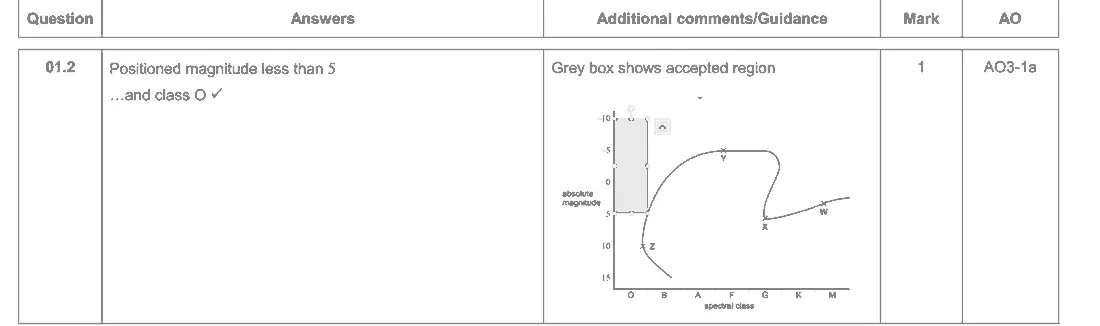
1.2 Classification of stars and the HR diagram 1AO3=1Diagram or graph
1.3 Cosmology: Doppler effect, Hubble's law, quasars and exoplanets 2Explanation
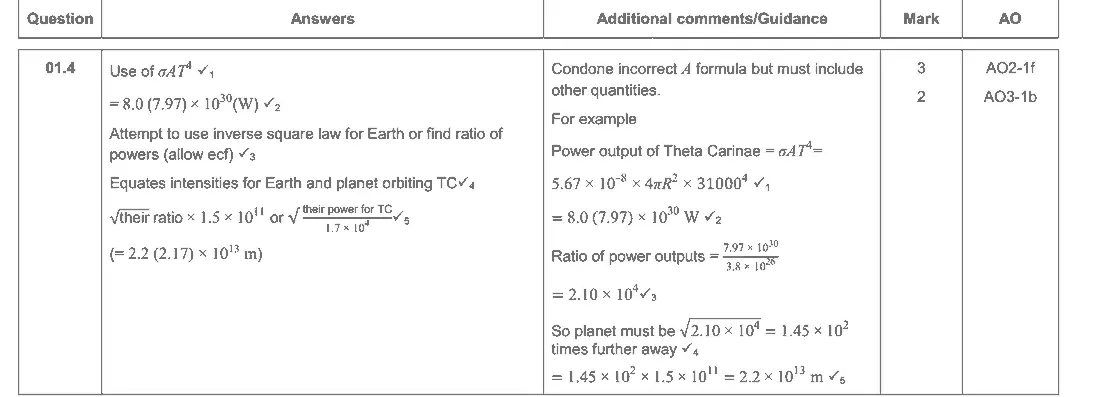
1.4 Classification of stars and the HR diagram 5Calculation
2.1 Classification of stars and the HR diagram 1AO1=1Short answer
2.2 Classification of stars and the HR diagram 3AO3=3Calculation
3 Classification of stars and the HR diagram 6Extended response
4.1 Cosmology: Doppler effect, Hubble's law, quasars and exoplanets 2AO2=2Explanation
4.2 Cosmology: Doppler effect, Hubble's law, quasars and exoplanets 4Calculation
5.1 Telescopes 2AO1=2Explanation
5.2 Telescopes 3Explanation
5.3 Telescopes 3AO3=3Explanation

The questions

1.11.21.31.42.12.234.14.25.15.25.3
November 2021 · Paper 3B Astrophysics · Q1.1 3 marks AO1=3 Short answer classification of stars
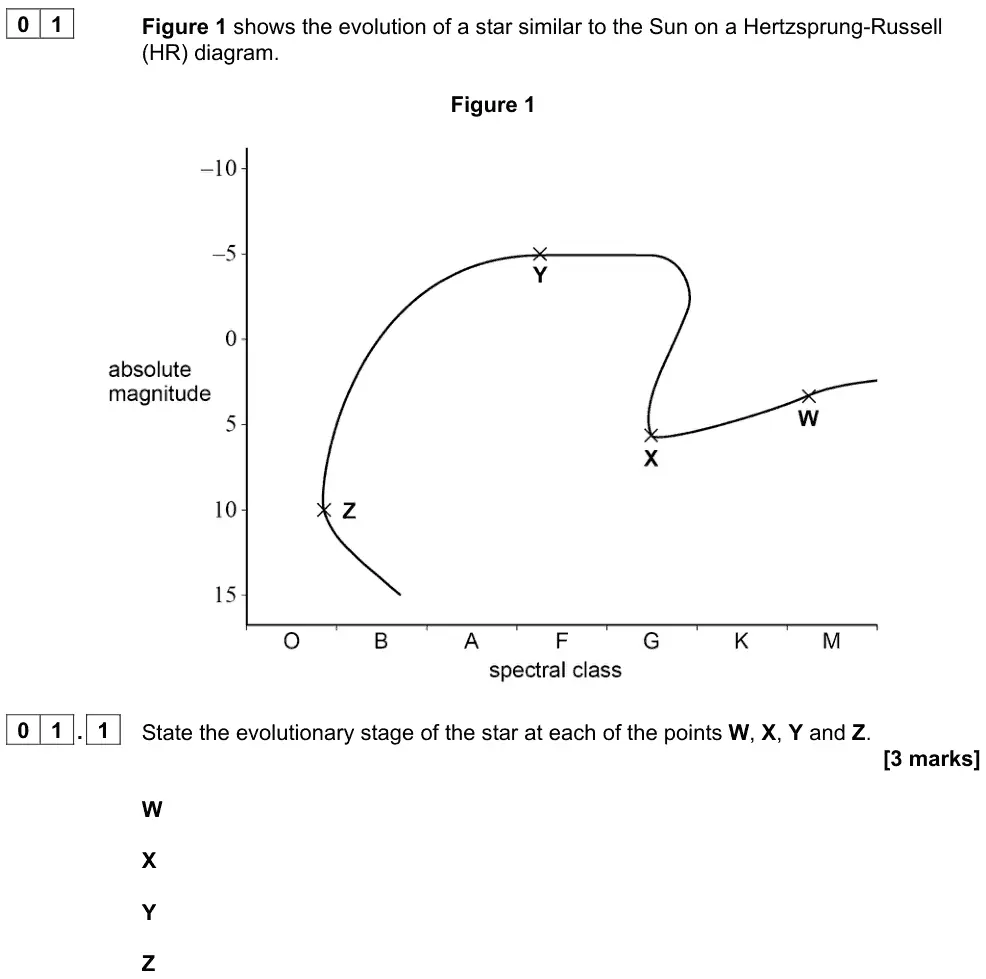
Figure 1 shows the evolution of a star similar to the Sun on a Hertzsprung-Russell
(HR) diagram.
Figure 1
State the evolutionary stage of the star at each of the points W, X, Y and Z.
[3 marks]
W
X
Y
Z
November 2021 · Paper 3B Astrophysics · Q1.2 1 mark AO3=1 Diagram or graph classification of stars
Earlier part of question 1 that this part usesEarlier part of November 2021 Paper 3B Astrophysics question 1
Theta Carinae is a star with a radius five times that of the Sun.  It has a surface
temperature of 31 000 K.
Annotate Figure 1 with a T to show the position of Theta Carinae.
[1 mark]
November 2021 · Paper 3B Astrophysics · Q1.3 2 marks Explanation cosmology
Earlier part of question 1 that this part usesEarlier part of November 2021 Paper 3B Astrophysics question 1
An astronomer suggests that an Earth-sized planet orbits Theta Carinae.
Explain one difficulty with using the transit method to detect this planet.
[2 marks]
November 2021 · Paper 3B Astrophysics · Q1.4 5 marks Calculation classification of stars
Earlier part of question 1 that this part usesEarlier part of November 2021 Paper 3B Astrophysics question 1
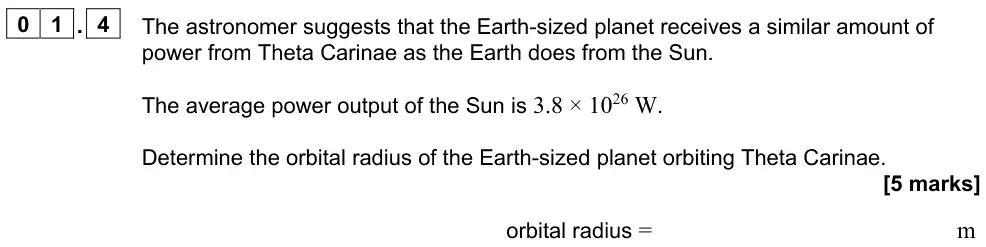
The astronomer suggests that the Earth-sized planet receives a similar amount of
power from Theta Carinae as the Earth does from the Sun.
The average power output of the Sun is 3.8 × 1026 W.
Determine the orbital radius of the Earth-sized planet orbiting Theta Carinae.
[5 marks]
orbital radius =
m
November 2021 · Paper 3B Astrophysics · Q2.1 1 mark AO1=1 Short answer classification of stars
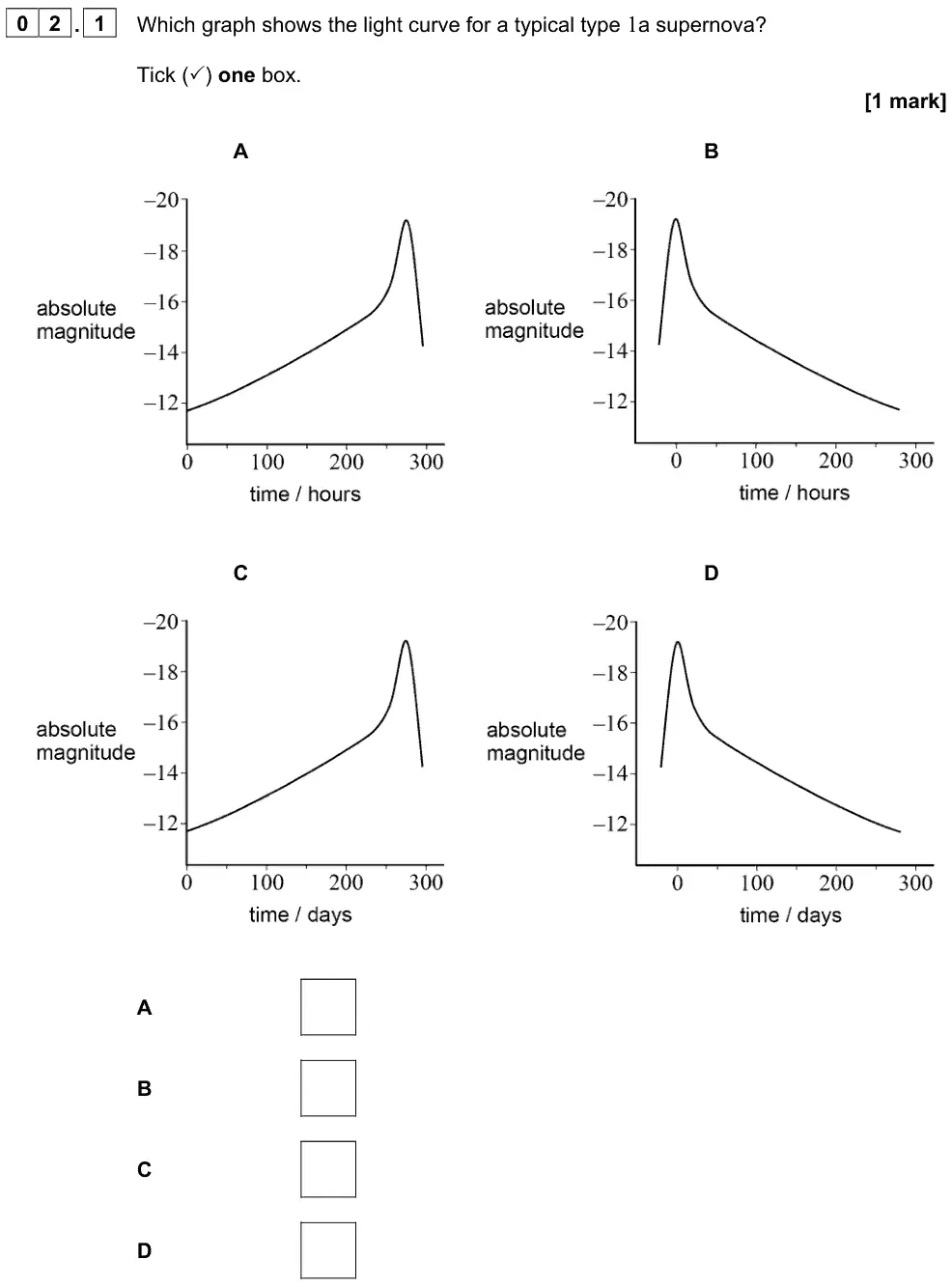
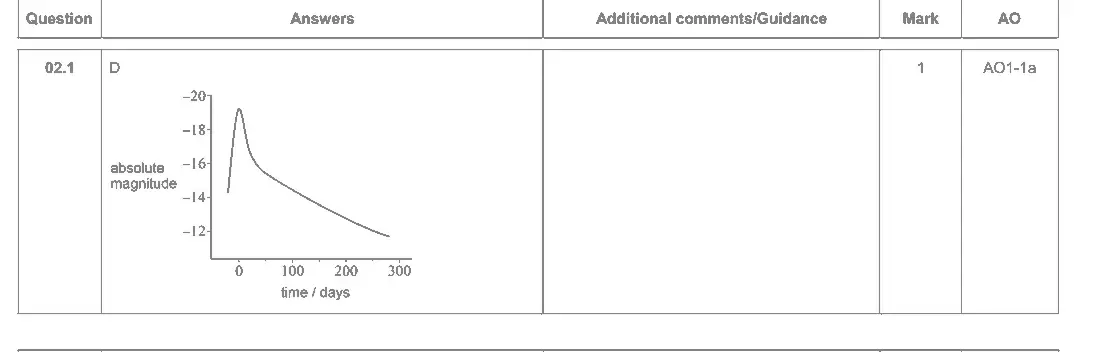
Which graph shows the light curve for a typical type 1a supernova?
Tick () one box.
[1 mark]
A
B
C
D
A
B
C
D
November 2021 · Paper 3B Astrophysics · Q2.2 3 marks AO3=3 Calculation Hard classification of stars
Earlier part of question 2 that this part usesEarlier part of November 2021 Paper 3B Astrophysics question 2
The Andromeda galaxy is approximately 7.7 × 10⁵ pc from Earth.
Deduce whether a type 1a supernova which occurred in Andromeda can be observed
from Earth with the naked eye.
[3 marks]
November 2021 · Paper 3B Astrophysics · Q3 6 marks 6-mark extended response classification of stars
Miaplacidus and Avior are two stars in the constellation Carina.
Miaplacidus is a class A star.
Avior is a class K star.
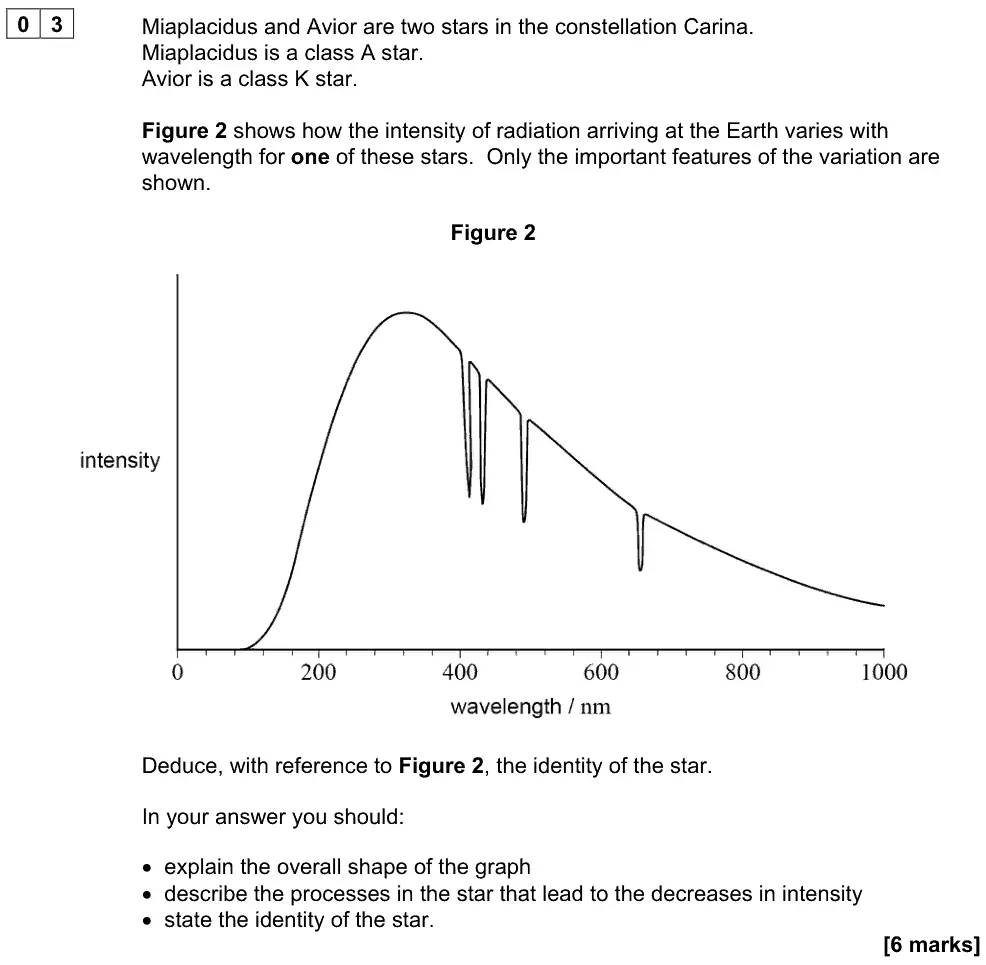
Figure 2 shows how the intensity of radiation arriving at the Earth varies with
wavelength for one of these stars.  Only the important features of the variation are
shown.
Figure 2
Deduce, with reference to Figure 2, the identity of the star.
In your answer you should:
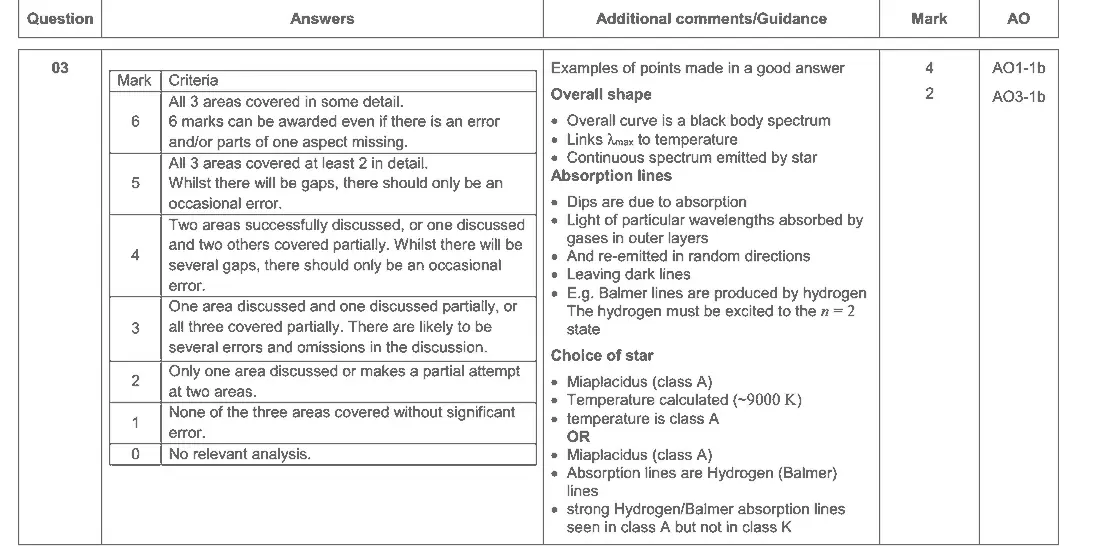
• explain the overall shape of the graph
• describe the processes in the star that lead to the decreases in intensity
• state the identity of the star.
[6 marks]
November 2021 · Paper 3B Astrophysics · Q4.1 2 marks AO2=2 Explanation cosmology
IC2497 is a galaxy that contained a quasar.  It is believed that the quasar stopped
emitting radiation several thousand years ago.
Suggest why the quasar stopped emitting radiation.
[2 marks]
November 2021 · Paper 3B Astrophysics · Q4.2 4 marks Calculation cosmology
Earlier part of question 4 that this part usesEarlier part of November 2021 Paper 3B Astrophysics question 4
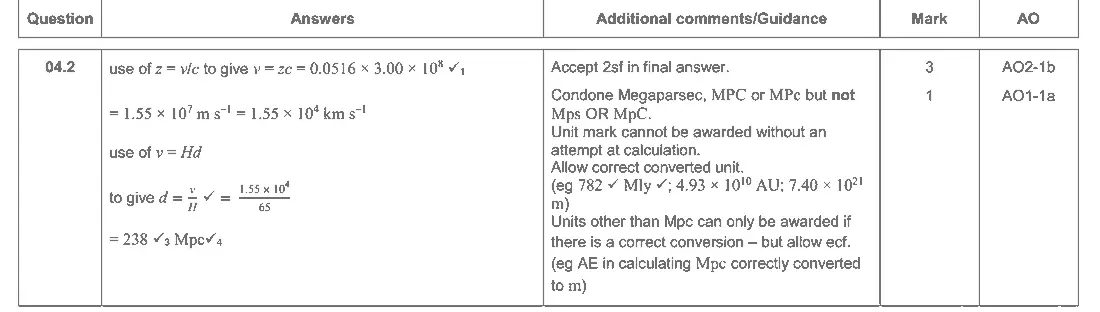
IC2497 has a red shift of 0.0516
Determine the distance from the Earth to IC2497.
Give an appropriate unit for your answer.
[4 marks]
distance =
unit =
November 2021 · Paper 3B Astrophysics · Q5.1 2 marks AO1=2 Explanation telescopes
Explain what is meant by the Rayleigh criterion.
[2 marks]
November 2021 · Paper 3B Astrophysics · Q5.2 3 marks Explanation telescopes
Earlier part of question 5 that this part usesEarlier part of November 2021 Paper 3B Astrophysics question 5
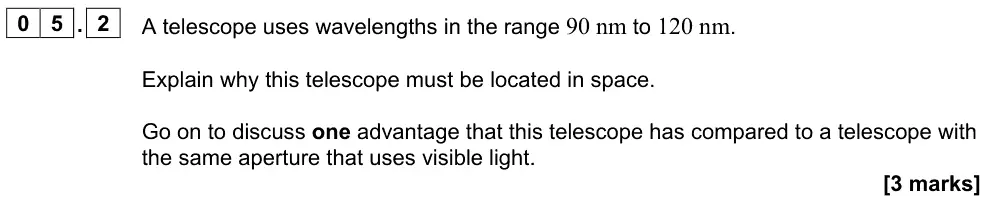
A telescope uses wavelengths in the range 90 nm to 120 nm.
Explain why this telescope must be located in space.
Go on to discuss one advantage that this telescope has compared to a telescope with
the same aperture that uses visible light.
[3 marks]
November 2021 · Paper 3B Astrophysics · Q5.3 3 marks AO3=3 Explanation telescopes
Earlier part of question 5 that this part usesEarlier part of November 2021 Paper 3B Astrophysics question 5
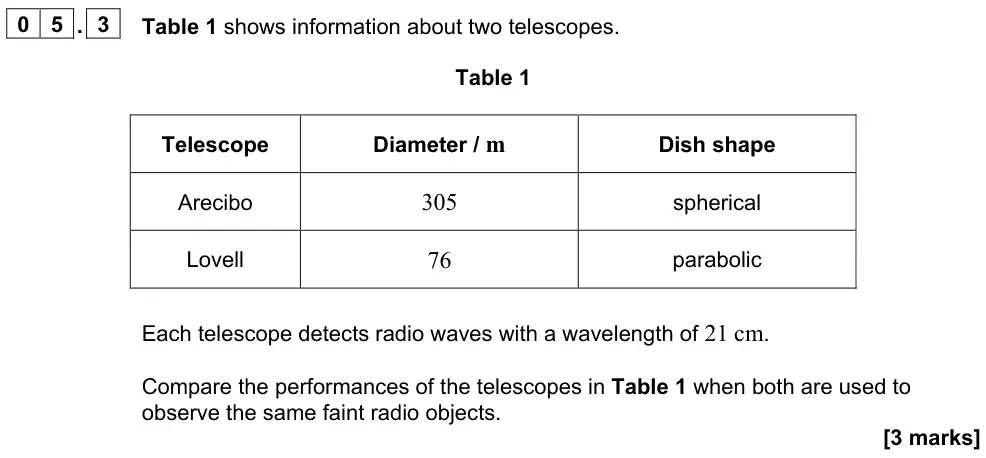
Table 1 shows information about two telescopes.
Table 1
Telescope
Diameter / m
Dish shape
Arecibo
305
spherical
Lovell
76
parabolic
Each telescope detects radio waves with a wavelength of 21 cm.
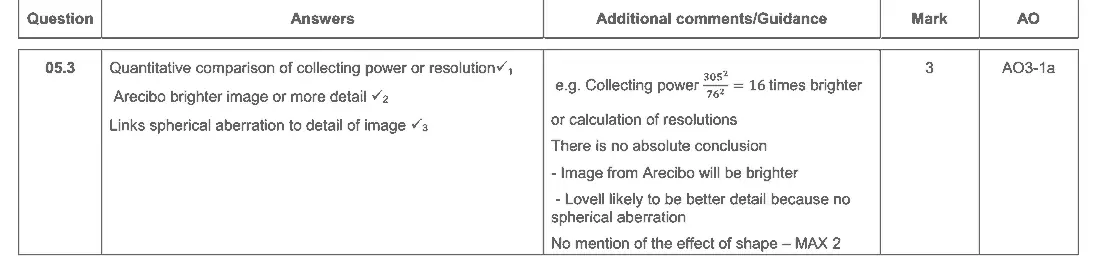
Compare the performances of the telescopes in Table 1 when both are used to
observe the same faint radio objects.
[3 marks]

Work with an AQA physics tutor

Want a paper marked and gone through with you? Message us.

Prefer email? Send an enquiry

If you are under 18, please include a parent's contact details. Enquiries go to enquiries@physicsaleveltutor.com and are deleted once handled. All tutoring is online.