Mark scheme
Notes from the mark scheme and report
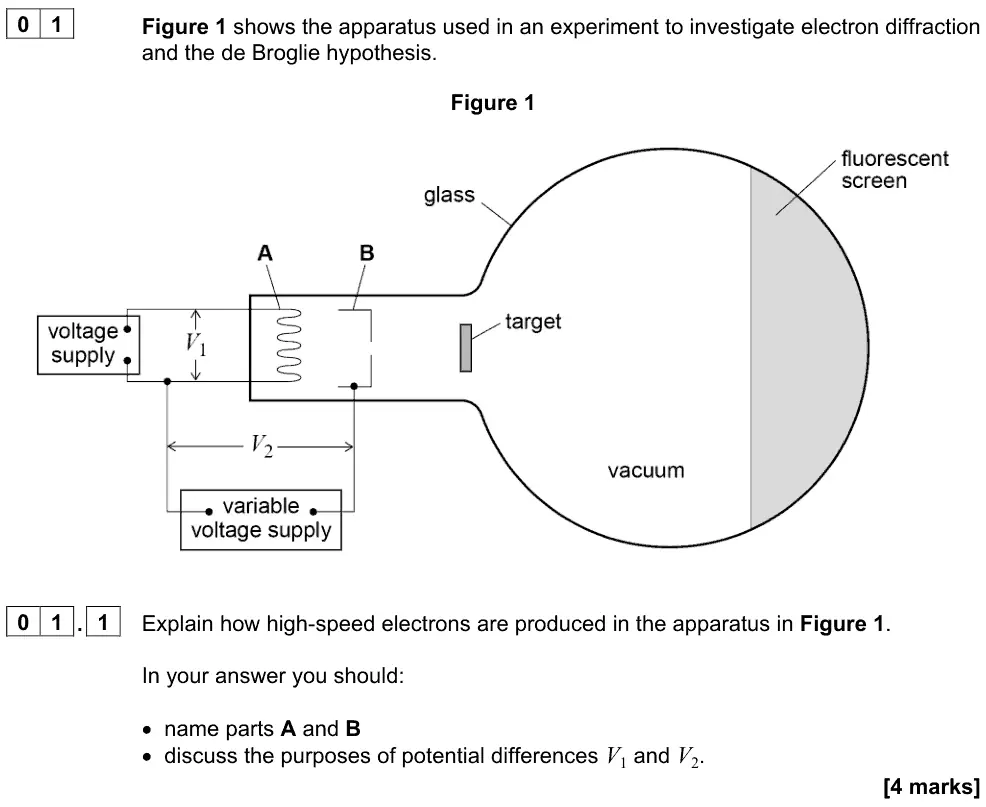
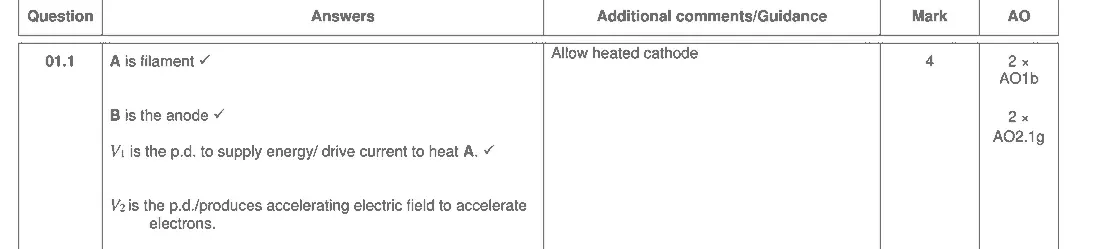
- A filament (heated cathode), B anode
- V1 drives the current that heats the filament for thermionic emission
- V2 accelerates the electrons towards the anode
35 marks · 11 question parts · Paper, mark scheme and report on AQA's site · An autumn series using the paper written for the cancelled summer exams · Have the data and formulae booklet beside you
| Q | Topic | Marks | AO | Type |
|---|---|---|---|---|
| 1.1 | The discovery of the electron | 4 | AO1=2,AO2=2 | Explanation |
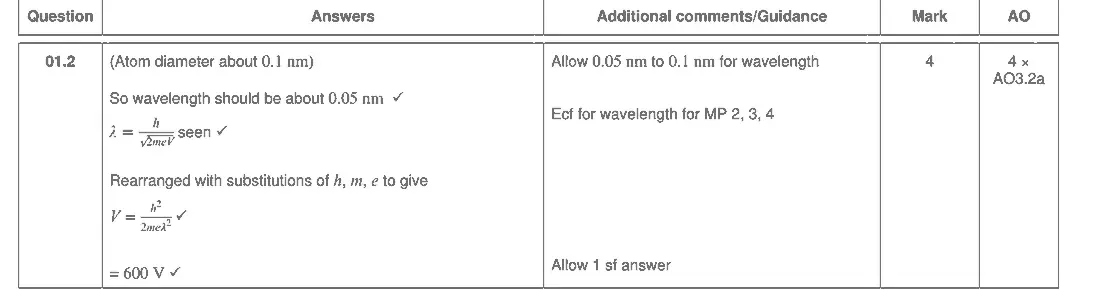
| 1.2 | Wave-particle duality: from Newton to electron microscopes | 4 | AO3=4 | Calculation |
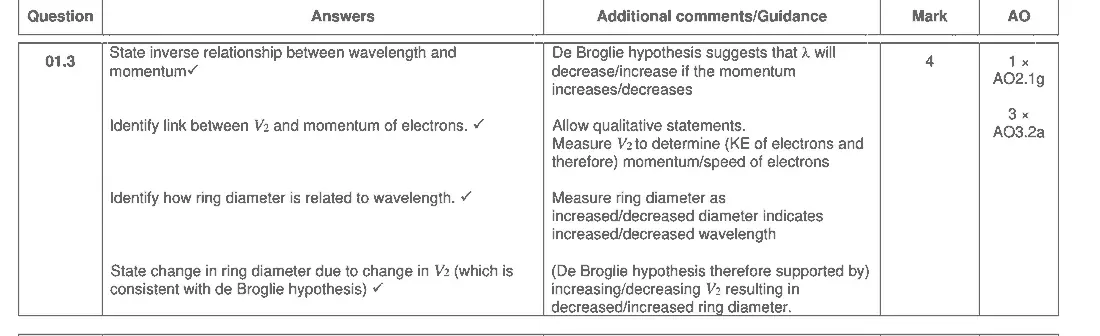
| 1.3 | Wave-particle duality: from Newton to electron microscopes | 4 | AO2=1,AO3=3 | Explanation |
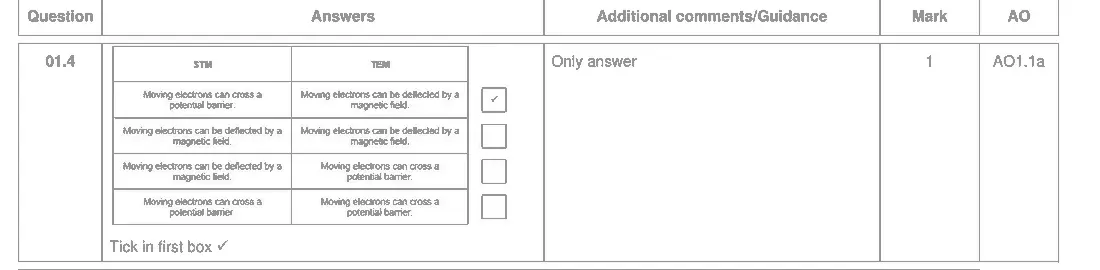
| 1.4 | Wave-particle duality: from Newton to electron microscopes | 1 | AO1=1 | Short answer |
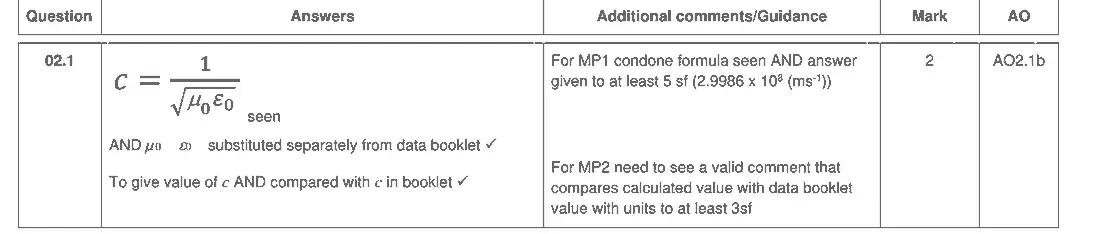
| 2.1 | Wave-particle duality: from Newton to electron microscopes | 2 | AO2=2 | Show that |
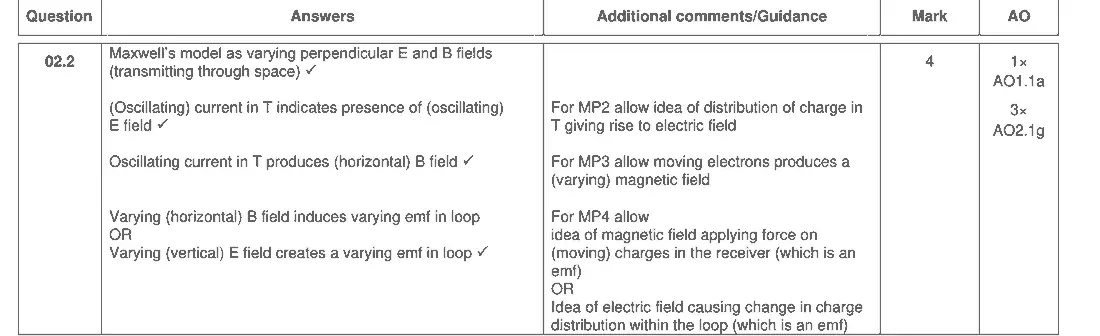
| 2.2 | Wave-particle duality: from Newton to electron microscopes | 4 | AO1=1,AO2=3 | Explanation |
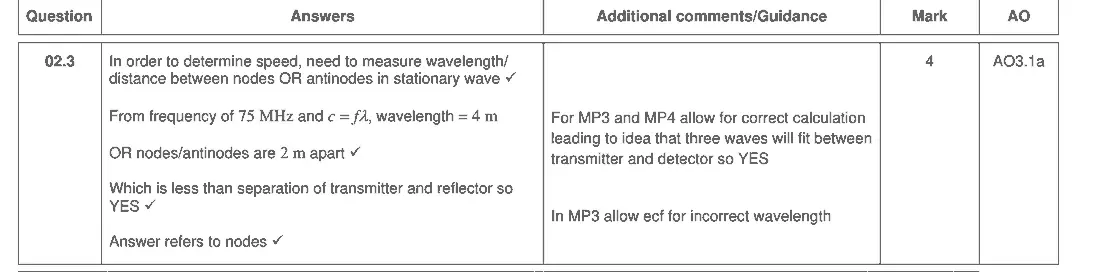
| 2.3 | Wave-particle duality: from Newton to electron microscopes | 4 | AO3=4 | Calculation |
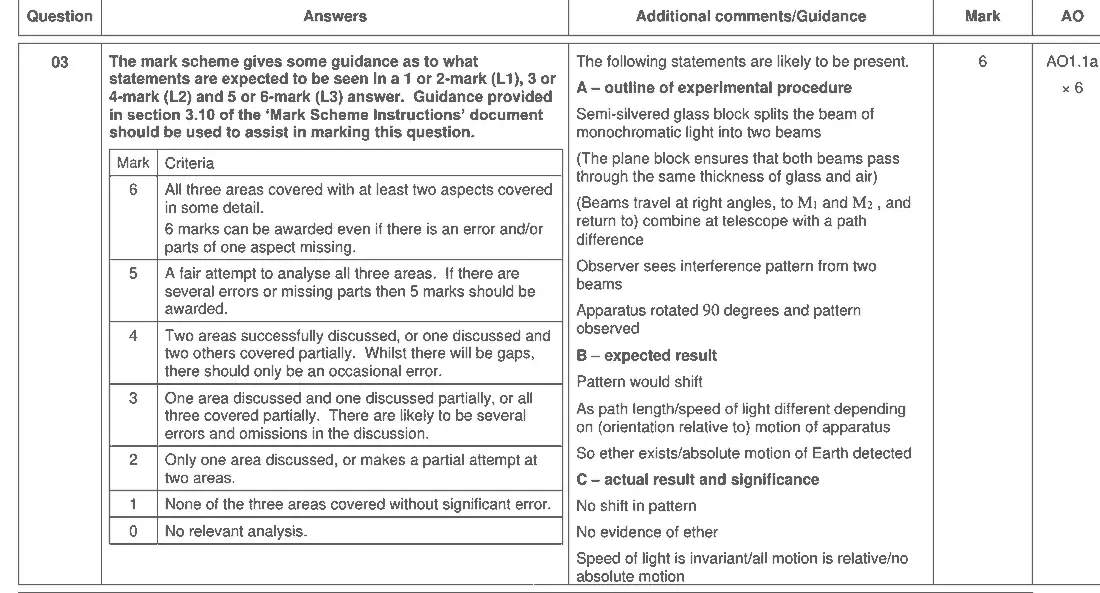
| 3 | Special relativity | 6 | AO1=6 | Extended response |
| 4.1 | Special relativity | 1 | AO1=1 | Short answer |
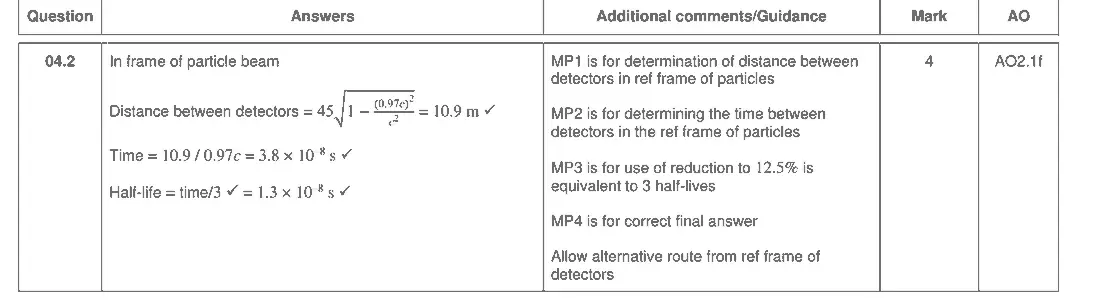
| 4.2 | Special relativity | 4 | AO2=4 | Calculation |
| 4.3 | Special relativity | 1 | AO2=1 | Short answer |
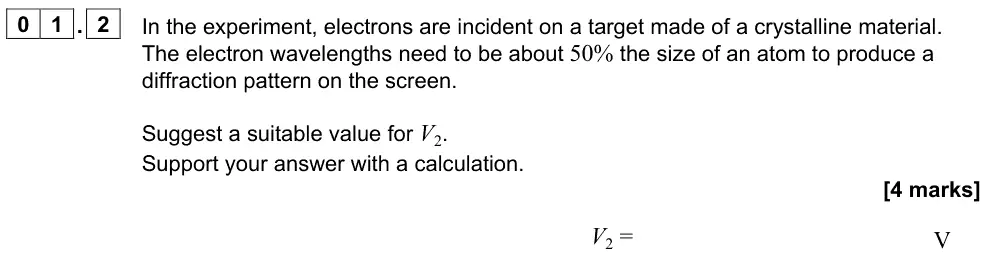
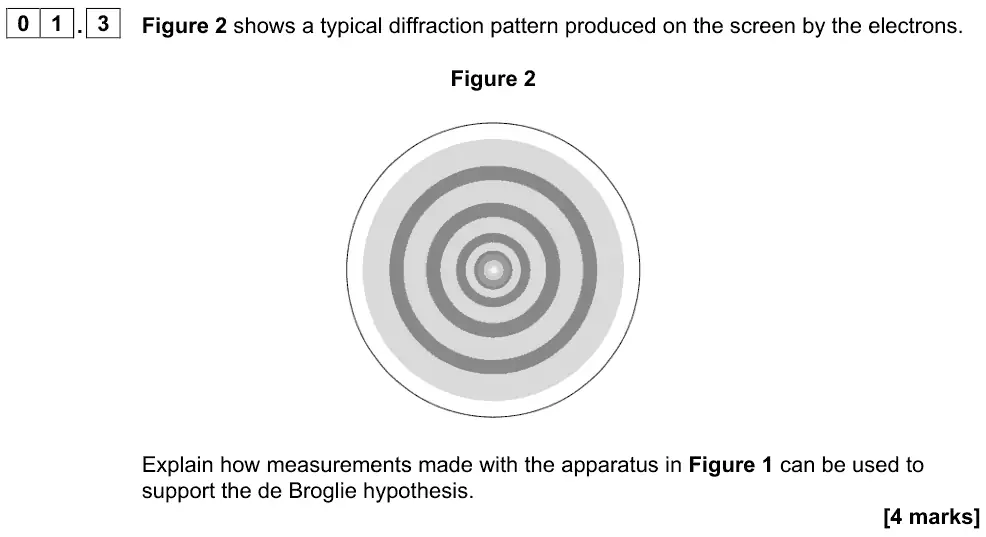
This question discriminated extremely well, with students picking up a range of marks on each question part. Answers which were written clearly and contained the appropriate level of detail were able to score well. In question 01.2 it was clear that students continue to be confused by equations that include both a V for p.d. and a v for velocity. It was pleasing to note how many students were able to identify a value for the wavelength, however. There was evidence of a significant lack of experience with the use of electron diffraction to investigate the de Broglie hypothesis in question 01.3.
Skills: MS2.2 Change the subject of an equation, including non-linear equations; MS2.3 Substitute numerical values into algebraic equations using appropriate units for physical quantities; MS0.4 Estimate results
This question discriminated extremely well, with students picking up a range of marks on each question part. Answers which were written clearly and contained the appropriate level of detail were able to score well. In question 01.2 it was clear that students continue to be confused by equations that include both a V for p.d. and a v for velocity. It was pleasing to note how many students were able to identify a value for the wavelength, however. There was evidence of a significant lack of experience with the use of electron diffraction to investigate the de Broglie hypothesis in question 01.3.
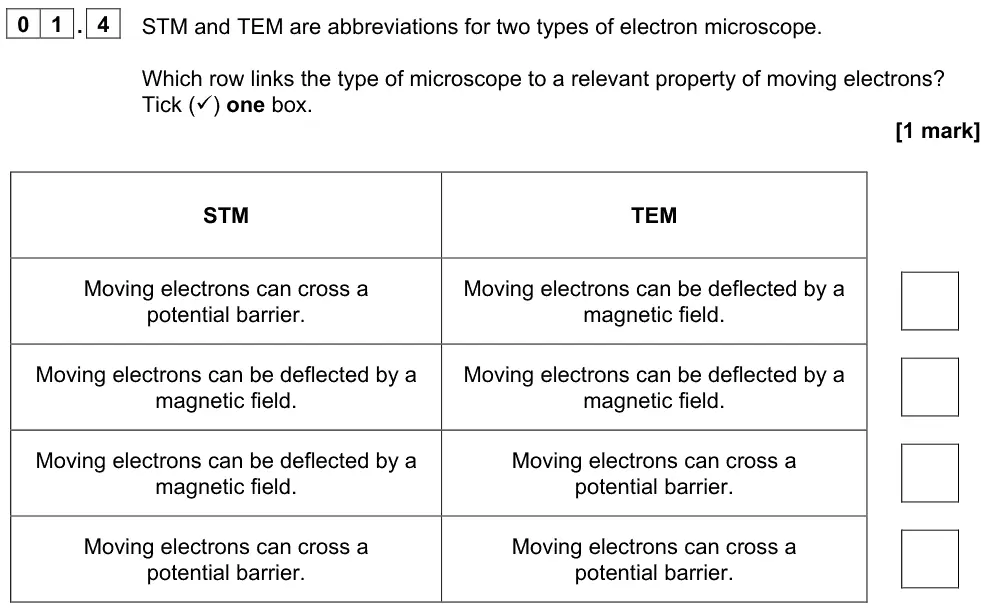
Many gaps in knowledge and understanding were seen. Only one of the 11 question parts had a mean mark greater than 50%, and that was the multiple-choice question (01.4). On average 13% of the students answering each question part made no attempt.
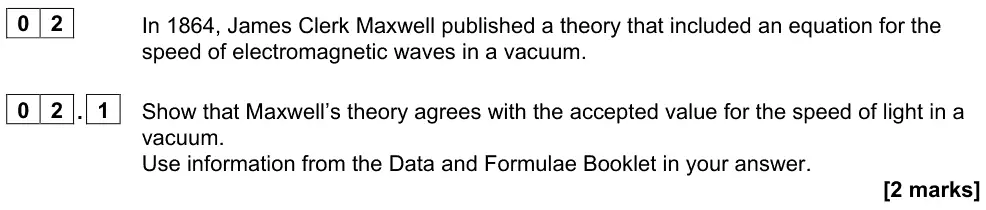
In order to score both marks in question 02.1 a comment was needed comparing the calculated value for the speed of light with that in the data booklet. This was commonly missed. In question 02.2, many students demonstrated some knowledge of Maxwell’s model but few could relate it to the experiment. Question 02.4 assessed Assessment Objective 3 (AO3) and was not answered well by many students.
Skills: MS2.3 Substitute numerical values into algebraic equations using appropriate units for physical quantities
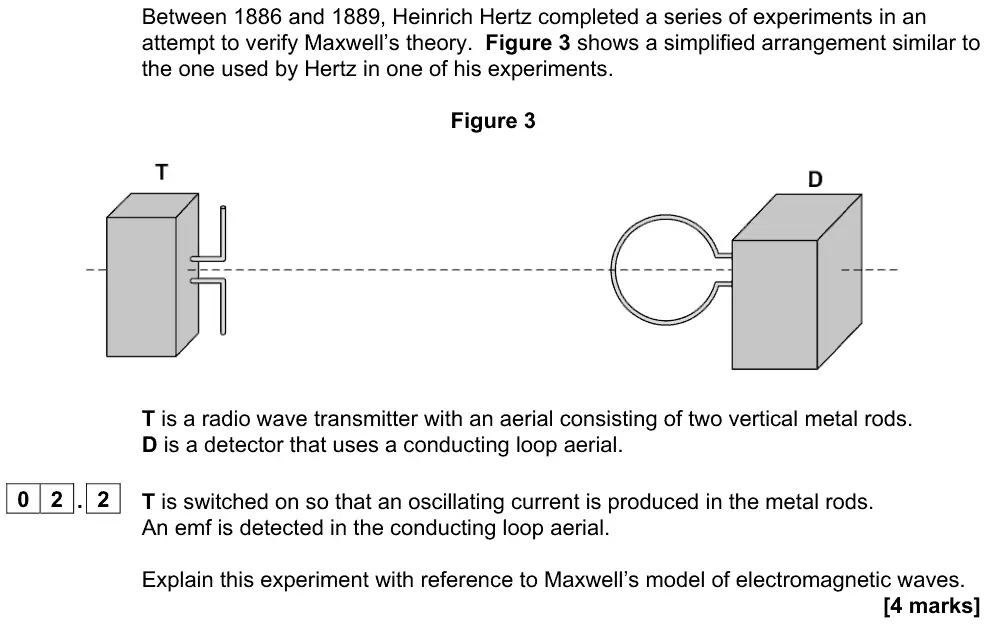
In order to score both marks in question 02.1 a comment was needed comparing the calculated value for the speed of light with that in the data booklet. This was commonly missed. In question 02.2, many students demonstrated some knowledge of Maxwell’s model but few could relate it to the experiment. Question 02.4 assessed Assessment Objective 3 (AO3) and was not answered well by many students.
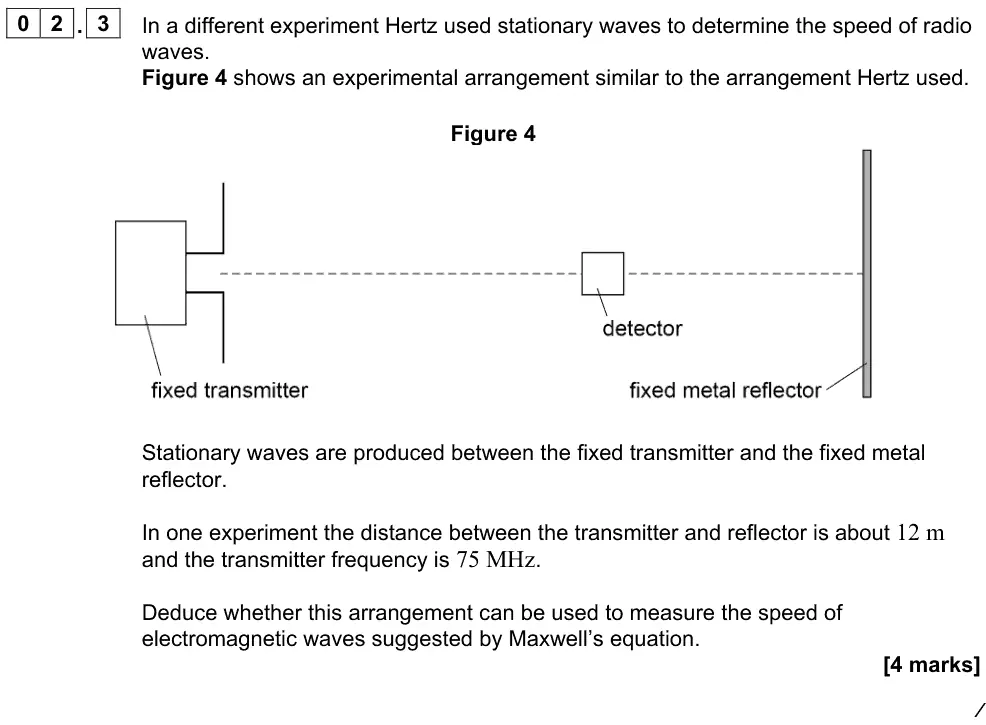
Skills: MS2.3 Substitute numerical values into algebraic equations using appropriate units for physical quantities; MS2.2 Change the subject of an equation, including non-linear equations
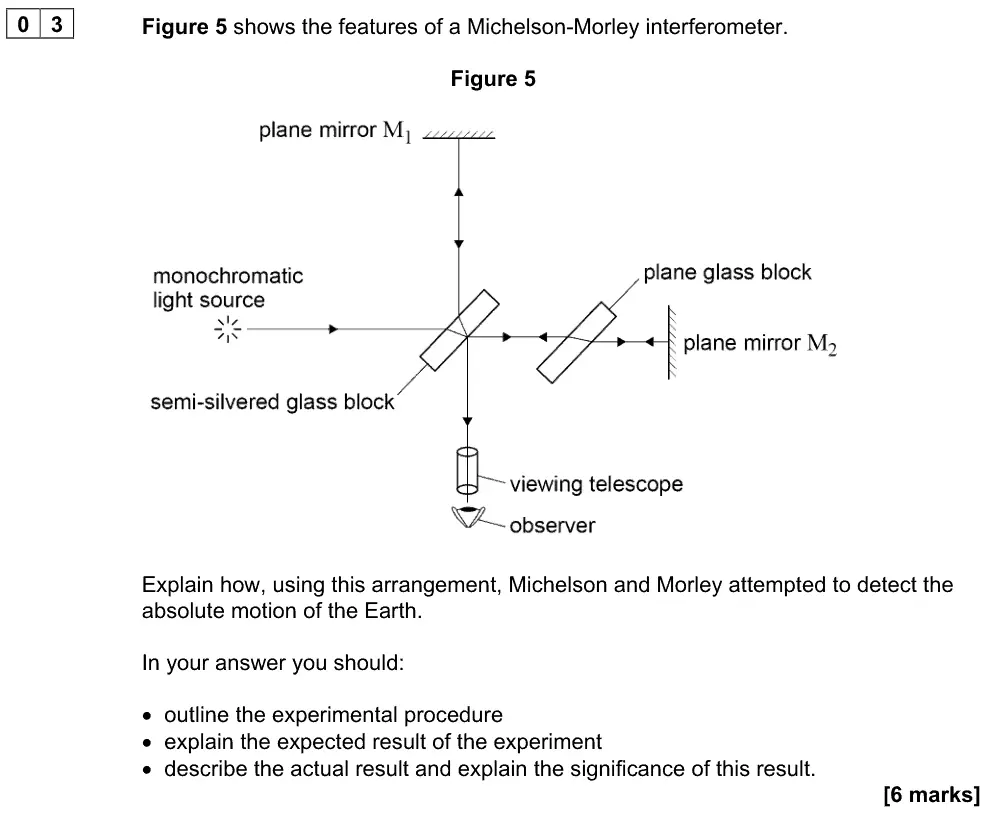
As usual the levels of response question produced a range of marks and discriminated very well. Few students were able to pick up all six marks, however. There was much confusion between this experiment and the one used to determine the speed of light.

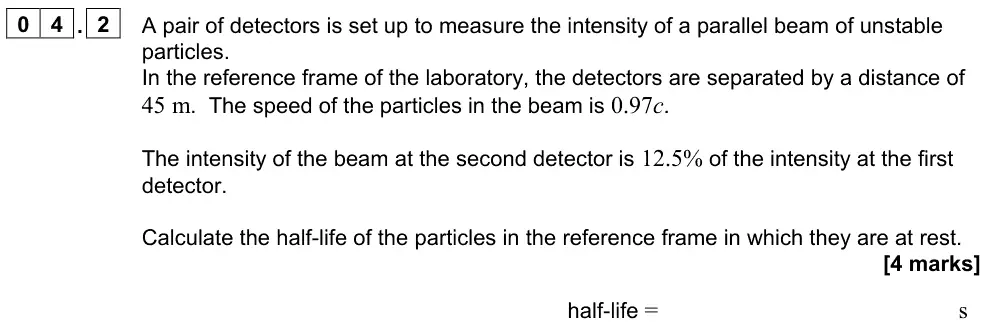
Skills: MS2.3 Substitute numerical values into algebraic equations using appropriate units for physical quantities; MS0.3 Use ratios, fractions and percentages; MS0.5 Use calculators to find and use power, exponential and logarithmic functions

Want a paper marked and gone through with you? Message us.