Specimen set 1: Paper 3B Astrophysics

35 marks · 15 question parts · Paper, mark scheme and report on AQA's site · Have the data and formulae booklet beside you

Question by question

QTopicMarksAOType
1.1 Telescopes 2Diagram or graph
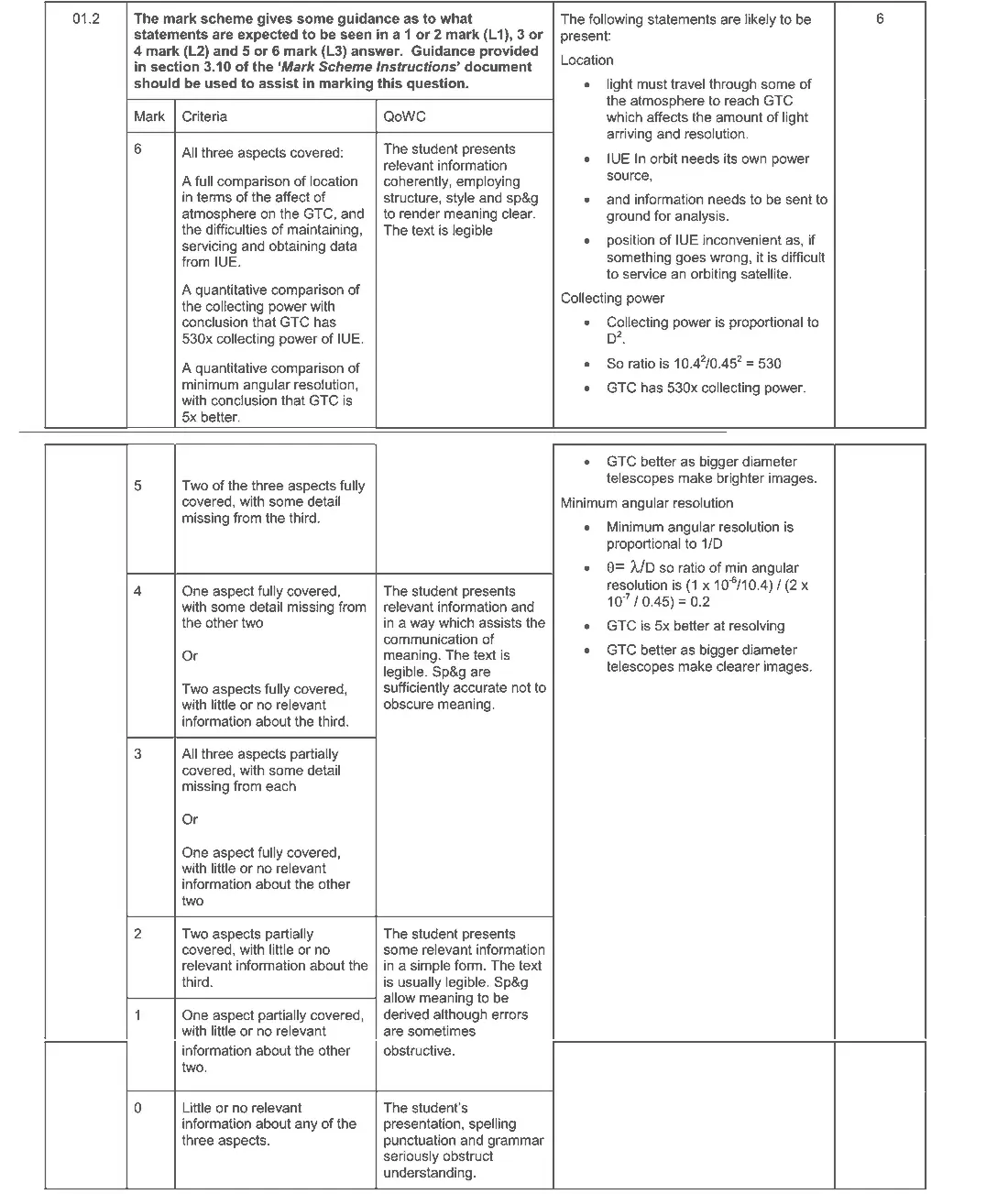
1.2 Telescopes 6Extended response
1.3 Telescopes 2Short answer
2.1 Classification of stars and the HR diagram 2Short answer
2.2 Classification of stars and the HR diagram 2Short answer
2.3 Classification of stars and the HR diagram 3Calculation
2.4 Classification of stars and the HR diagram 3Explanation
2.5 Classification of stars and the HR diagram 2Calculation
3.1 Classification of stars and the HR diagram 1Short answer
3.2 Classification of stars and the HR diagram 2Short answer
3.3 Classification of stars and the HR diagram 2Calculation
3.4 Classification of stars and the HR diagram 2Explanation
4.1 Cosmology: Doppler effect, Hubble's law, quasars and exoplanets 1Short answer
4.2 Cosmology: Doppler effect, Hubble's law, quasars and exoplanets 2Explanation
4.3 Cosmology: Doppler effect, Hubble's law, quasars and exoplanets 3Diagram or graph

The questions

1.11.21.32.12.22.32.42.53.13.23.33.44.14.24.3
Specimen set 1 · Paper 3B Astrophysics · Q1.1 2 marks Diagram or graph telescopes
The concave mirrors used in some reflecting telescopes can suffer from spherical
aberration.
Draw a diagram to show what is meant by spherical aberration when produced by a
concave mirror.
[2 marks]
Specimen set 1 · Paper 3B Astrophysics · Q1.2 6 marks 6-mark extended response telescopes
Earlier part of question 1 that this part usesEarlier part of Specimen set 1 Paper 3B Astrophysics question 1
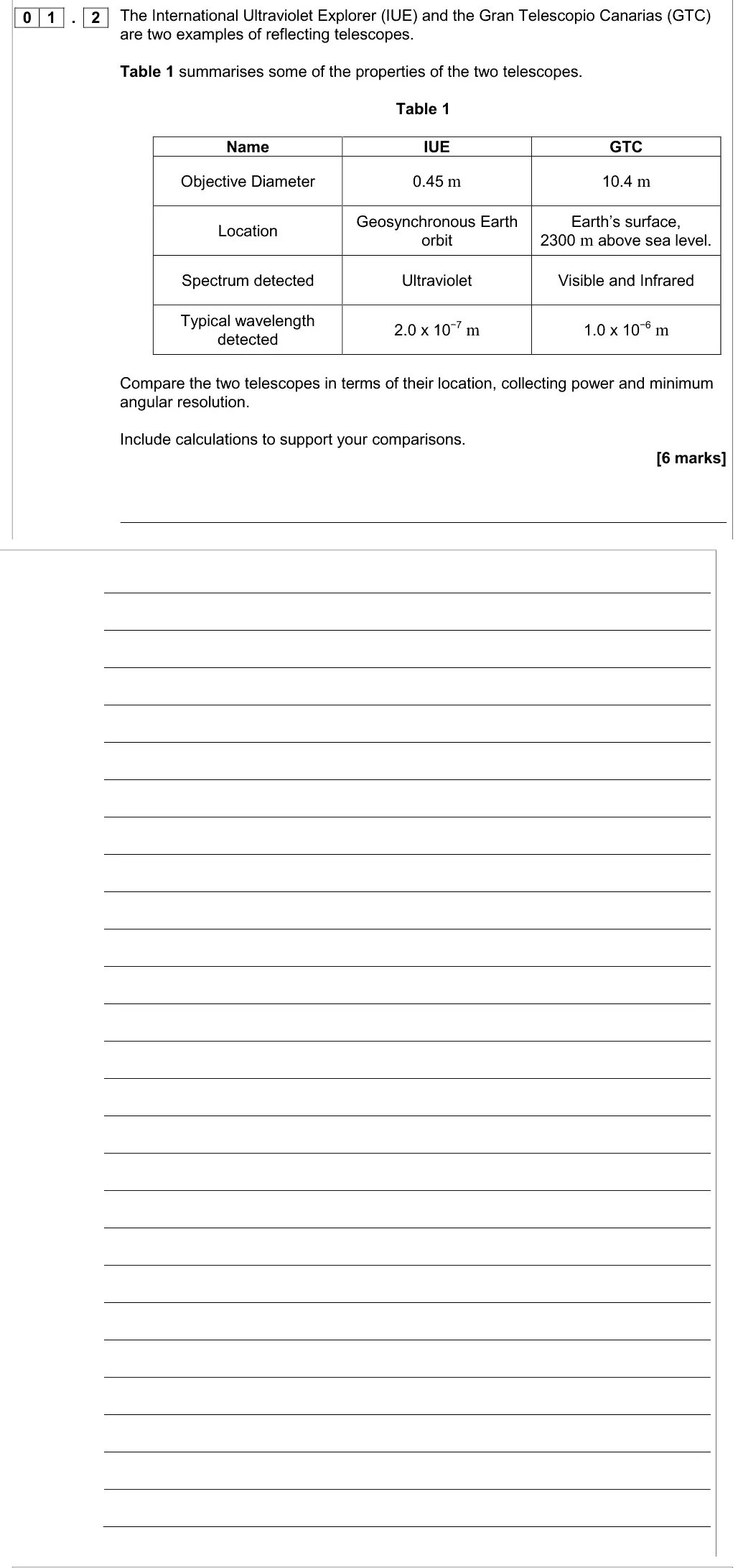
The International Ultraviolet Explorer (IUE) and the Gran Telescopio Canarias (GTC)
are two examples of reflecting telescopes.
Table 1 summarises some of the properties of the two telescopes.
Table 1
Name
IUE
GTC
Objective Diameter
0.45 m
10.4 m
Location
Geosynchronous Earth
orbit
Earth’s surface,
2300 m above sea level.
Spectrum detected
Ultraviolet
Visible and Infrared
Typical wavelength
detected
2.0 x 10⁻⁷ m
1.0 x 10⁻⁶ m
Compare the two telescopes in terms of their location, collecting power and minimum
angular resolution.
Include calculations to support your comparisons.
[6 marks]
Specimen set 1 · Paper 3B Astrophysics · Q1.3 2 marks Short answer telescopes
Earlier part of question 1 that this part usesEarlier part of Specimen set 1 Paper 3B Astrophysics question 1
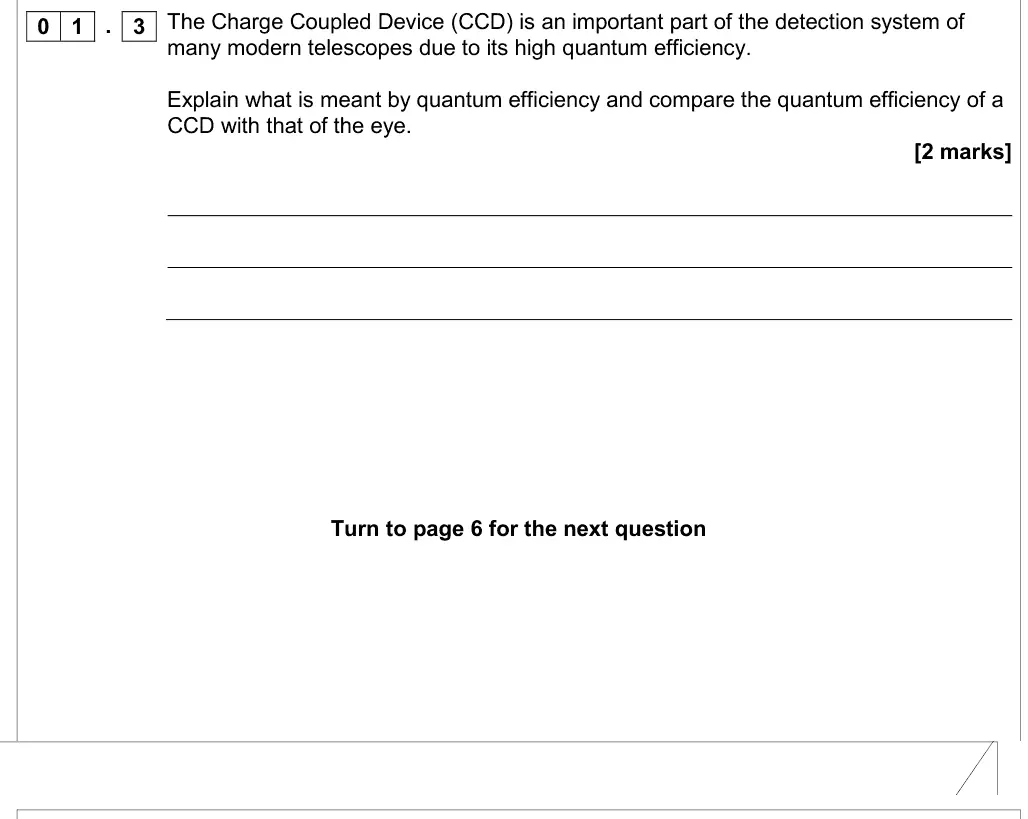
The Charge Coupled Device (CCD) is an important part of the detection system of
many modern telescopes due to its high quantum efficiency.
Explain what is meant by quantum efficiency and compare the quantum efficiency of a
CCD with that of the eye.
[2 marks]
Turn to page 6 for the next question
Specimen set 1 · Paper 3B Astrophysics · Q2.1 2 marks Short answer classification of stars
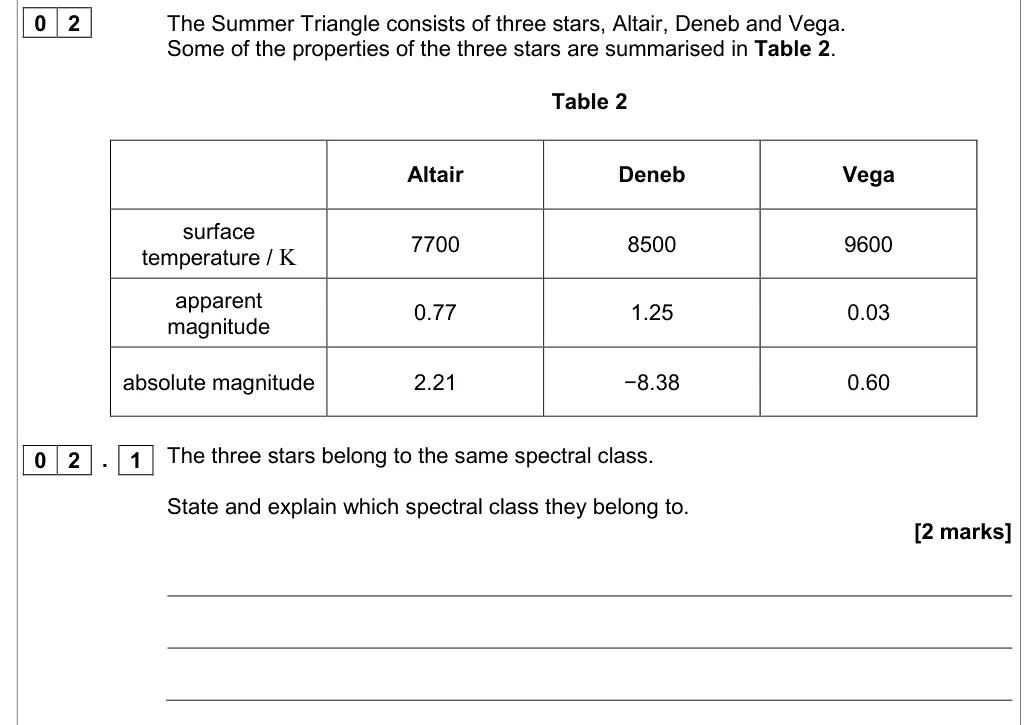
The Summer Triangle consists of three stars, Altair, Deneb and Vega.
Some of the properties of the three stars are summarised in Table 2.
Table 2
Altair
Deneb
Vega
surface
temperature / K
7700
8500
9600
apparent
magnitude
0.77
1.25
0.03
absolute magnitude
2.21
−8.38
0.60
The three stars belong to the same spectral class.
State and explain which spectral class they belong to.
[2 marks]
Specimen set 1 · Paper 3B Astrophysics · Q2.2 2 marks Short answer classification of stars
Earlier part of question 2 that this part usesEarlier part of Specimen set 1 Paper 3B Astrophysics question 2
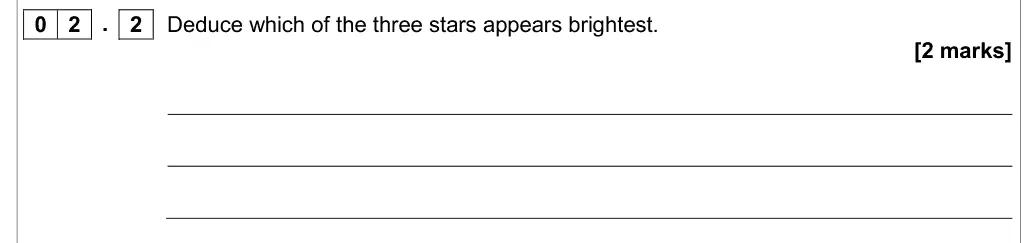
Deduce which of the three stars appears brightest.
[2 marks]
Specimen set 1 · Paper 3B Astrophysics · Q2.3 3 marks Calculation classification of stars
Earlier part of question 2 that this part usesEarlier part of Specimen set 1 Paper 3B Astrophysics question 2
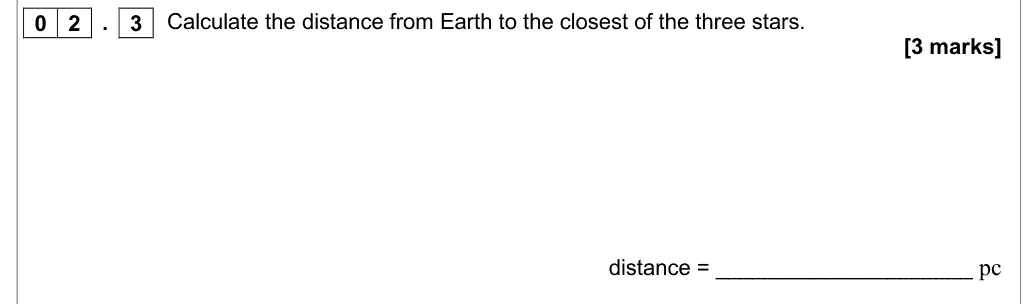
Calculate the distance from Earth to the closest of the three stars.
[3 marks]
distance =  pc
Specimen set 1 · Paper 3B Astrophysics · Q2.4 3 marks Explanation classification of stars
Earlier part of question 2 that this part usesEarlier part of Specimen set 1 Paper 3B Astrophysics question 2
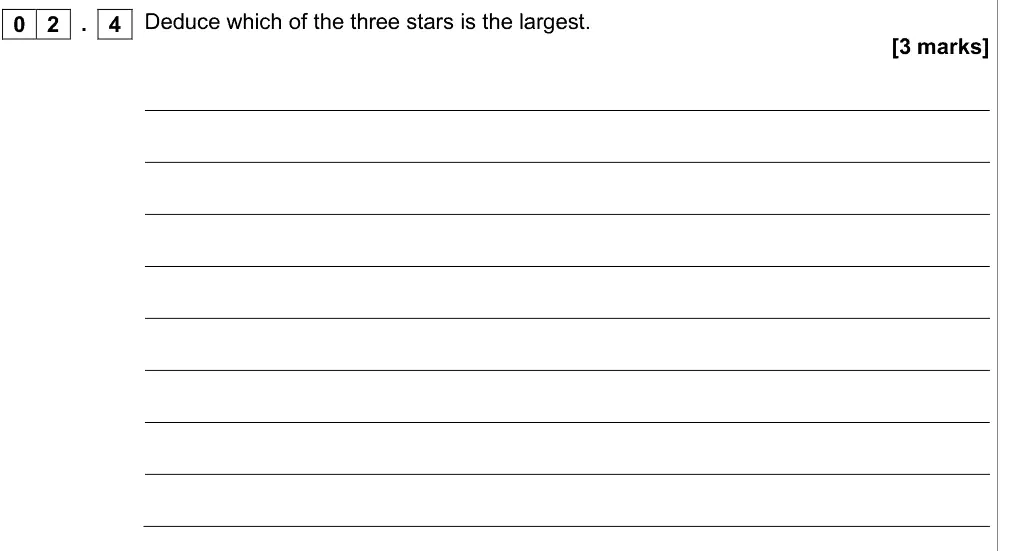
Deduce which of the three stars is the largest.
[3 marks]
Specimen set 1 · Paper 3B Astrophysics · Q2.5 2 marks Calculation classification of stars
Earlier part of question 2 that this part usesEarlier part of Specimen set 1 Paper 3B Astrophysics question 2
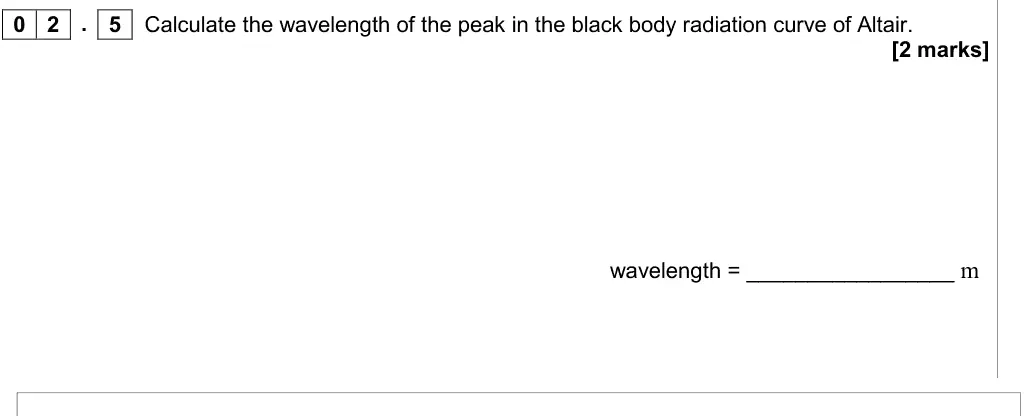
Calculate the wavelength of the peak in the black body radiation curve of Altair.
[2 marks]
wavelength =  m
Specimen set 1 · Paper 3B Astrophysics · Q3.1 1 mark Short answer classification of stars
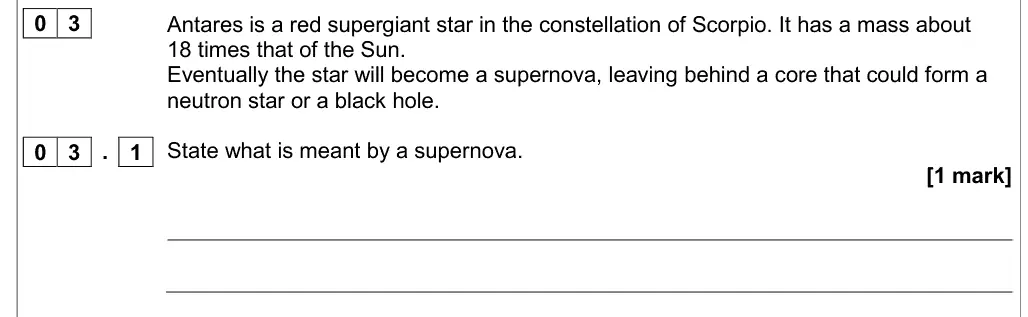
Antares is a red supergiant star in the constellation of Scorpio. It has a mass about
18 times that of the Sun.
Eventually the star will become a supernova, leaving behind a core that could form a
neutron star or a black hole.
State what is meant by a supernova.
[1 mark]
Specimen set 1 · Paper 3B Astrophysics · Q3.2 2 marks Short answer classification of stars
Earlier part of question 3 that this part usesEarlier part of Specimen set 1 Paper 3B Astrophysics question 3
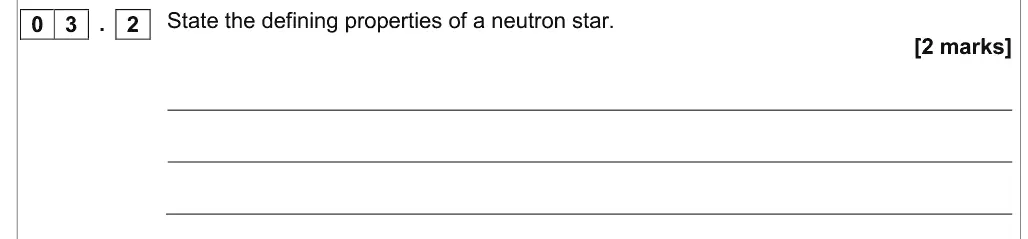
State the defining properties of a neutron star.
[2 marks]
Specimen set 1 · Paper 3B Astrophysics · Q3.3 2 marks Calculation classification of stars
Earlier part of question 3 that this part usesEarlier part of Specimen set 1 Paper 3B Astrophysics question 3
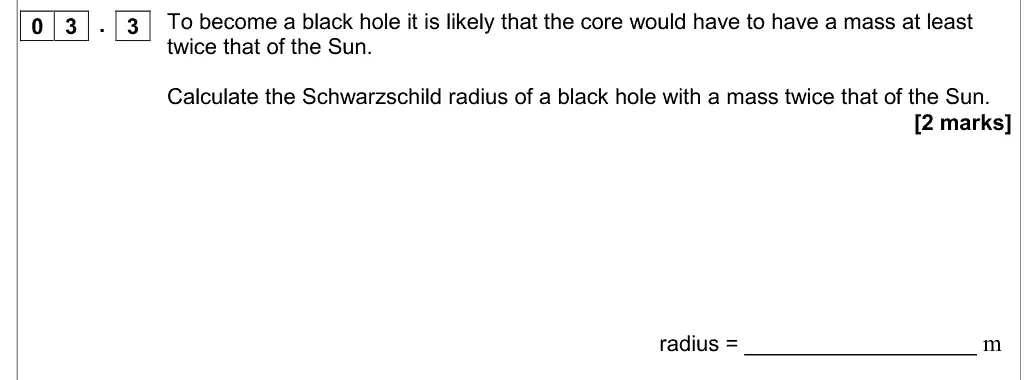
To become a black hole it is likely that the core would have to have a mass at least
twice that of the Sun.
Calculate the Schwarzschild radius of a black hole with a mass twice that of the Sun.
[2 marks]
radius =  m
Specimen set 1 · Paper 3B Astrophysics · Q3.4 2 marks Explanation classification of stars
Earlier part of question 3 that this part usesEarlier part of Specimen set 1 Paper 3B Astrophysics question 3
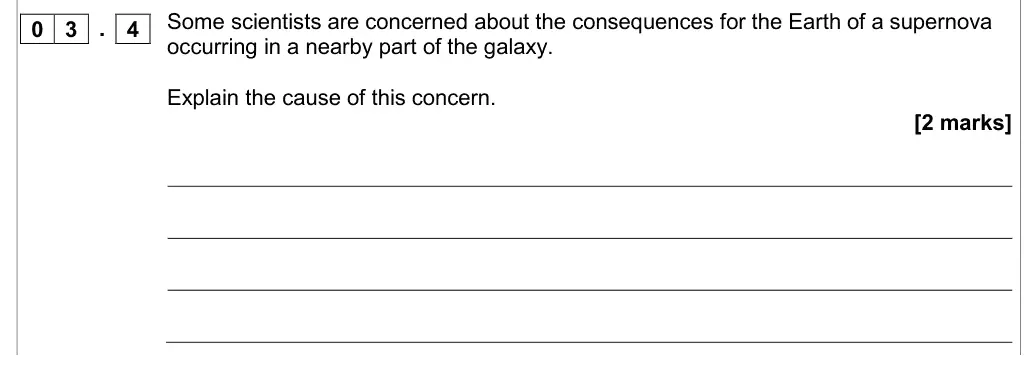
Some scientists are concerned about the consequences for the Earth of a supernova
occurring in a nearby part of the galaxy.
Explain the cause of this concern.
[2 marks]
Specimen set 1 · Paper 3B Astrophysics · Q4.1 1 mark Short answer cosmology
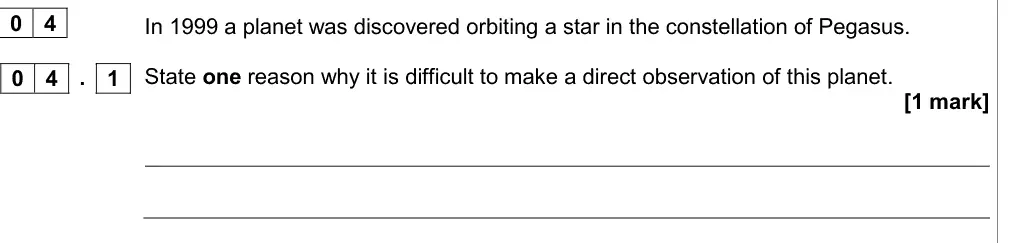
In 1999 a planet was discovered orbiting a star in the constellation of Pegasus.
State one reason why it is difficult to make a direct observation of this planet.
[1 mark]
Specimen set 1 · Paper 3B Astrophysics · Q4.2 2 marks Explanation cosmology
Earlier part of question 4 that this part usesEarlier part of Specimen set 1 Paper 3B Astrophysics question 4
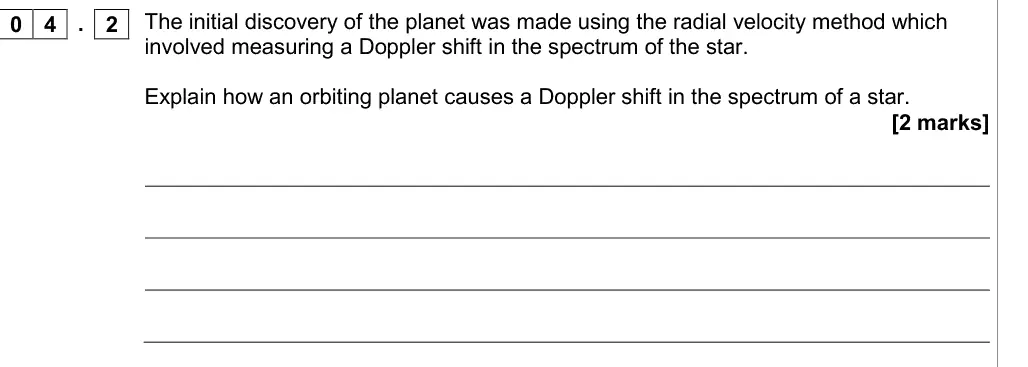
The initial discovery of the planet was made using the radial velocity method which
involved measuring a Doppler shift in the spectrum of the star.
Explain how an orbiting planet causes a Doppler shift in the spectrum of a star.
[2 marks]
Specimen set 1 · Paper 3B Astrophysics · Q4.3 3 marks Diagram or graph cosmology
Earlier part of question 4 that this part usesEarlier part of Specimen set 1 Paper 3B Astrophysics question 4
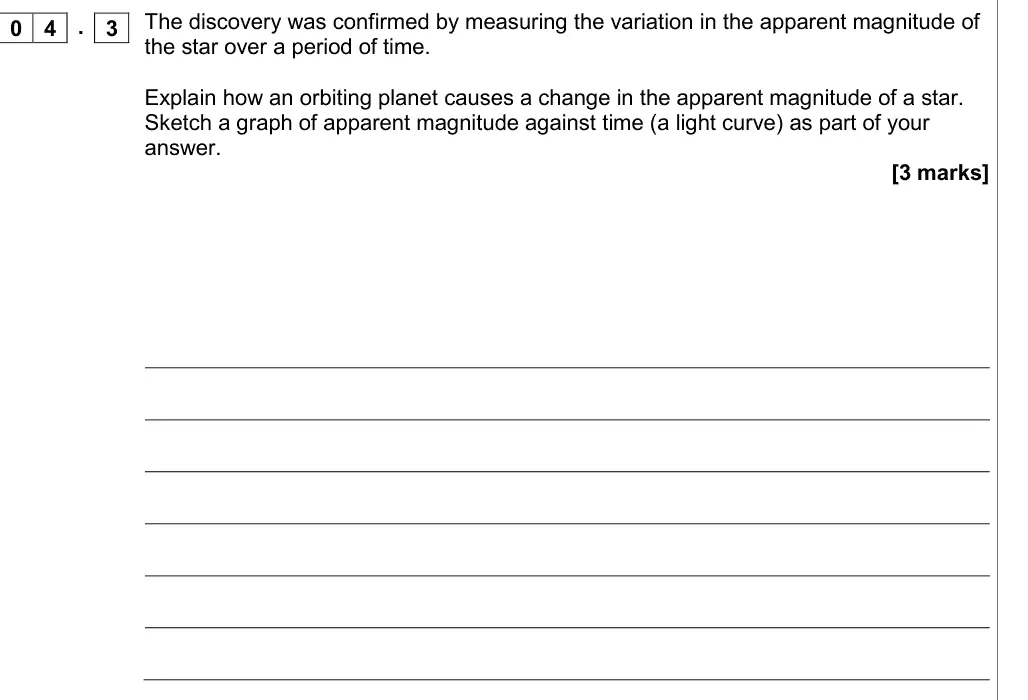
The discovery was confirmed by measuring the variation in the apparent magnitude of
the star over a period of time.
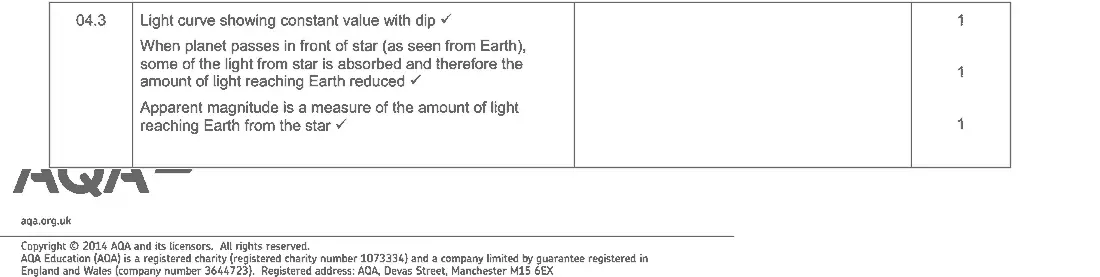
Explain how an orbiting planet causes a change in the apparent magnitude of a star.
Sketch a graph of apparent magnitude against time (a light curve) as part of your
answer.
[3 marks]

Work with an AQA physics tutor

Want a paper marked and gone through with you? Message us.

Prefer email? Send an enquiry

If you are under 18, please include a parent's contact details. Enquiries go to enquiries@physicsaleveltutor.com and are deleted once handled. All tutoring is online.