
Specimen set 1: Paper 3B Turning points

35 marks · 15 question parts · Paper, mark scheme and report on AQA's site · Have the data and formulae booklet beside you

Question by question

QTopicMarksAOType
1.1 The discovery of the electron 2Show that
1.2 The discovery of the electron 1Short answer
1.3 The discovery of the electron 2Calculation
1.4 The discovery of the electron 3Explanation
2.1 The discovery of the electron 2Short answer
2.2 The discovery of the electron 1Short answer
2.3 Wave-particle duality: from Newton to electron microscopes, The discovery of the electron 4Calculation
2.4 Wave-particle duality: from Newton to electron microscopes 3Explanation
3.1 Wave-particle duality: from Newton to electron microscopes 2Explanation
3.2 Wave-particle duality: from Newton to electron microscopes 1Short answer
3.3 Wave-particle duality: from Newton to electron microscopes 6Extended response
4.1 Special relativity 1Short answer
4.2 Special relativity 1Short answer
4.3 Special relativity 1Calculation
4.4 Special relativity 5Calculation

The questions

1.11.21.31.42.12.22.32.43.13.23.34.14.24.34.4
Specimen set 1 · Paper 3B Turning points · Q1.1 2 marks Show that discovery of the electron
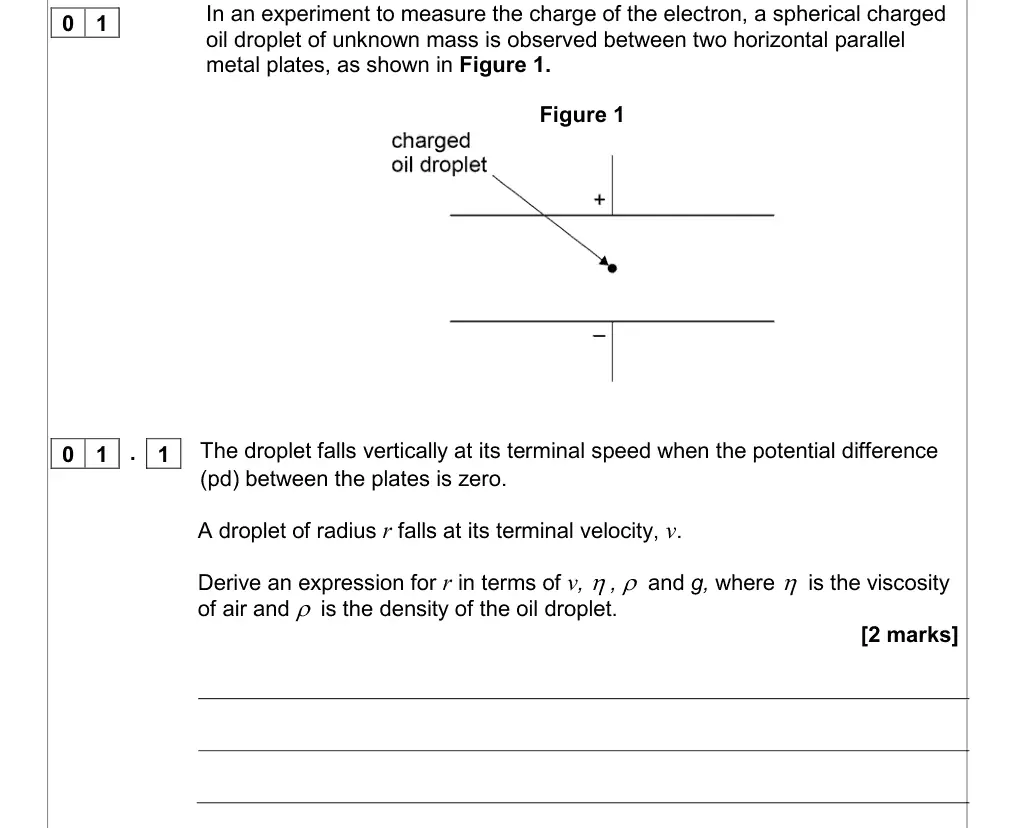
In an experiment to measure the charge of the electron, a spherical charged
oil droplet of unknown mass is observed between two horizontal parallel
metal plates, as shown in Figure 1.
Figure 1
The droplet falls vertically at its terminal speed when the potential difference
(pd) between the plates is zero.
A droplet of radius r falls at its terminal velocity, v.
Derive an expression for r in terms of v, η , ρ  and g, where η  is the viscosity
of air and ρ  is the density of the oil droplet.
[2 marks]
Specimen set 1 · Paper 3B Turning points · Q1.2 1 mark Short answer discovery of the electron
Earlier part of question 1 that this part usesEarlier part of Specimen set 1 Paper 3B Turning points question 1
Explain how the mass of the oil droplet can be calculated from its radius and
other relevant data.
[1 mark]
Specimen set 1 · Paper 3B Turning points · Q1.3 2 marks Calculation discovery of the electron
Earlier part of question 1 that this part usesEarlier part of Specimen set 1 Paper 3B Turning points question 1
A potential difference (pd) is applied across the plates and is adjusted until
the droplet is held stationary.  The two horizontal parallel metal plates are
15.0 mm apart.  The mass of the droplet is 3.4 × 10⁻¹⁵ kg.
The droplet is held stationary when the pd across the plates is 1560 V.
Calculate the charge of the oil droplet.
[2 marks]
charge =  C
Specimen set 1 · Paper 3B Turning points · Q1.4 3 marks Explanation discovery of the electron
Earlier part of question 1 that this part usesEarlier part of Specimen set 1 Paper 3B Turning points question 1
A student carries out Millikan’s oil drop experiment and obtains the following
results for the charges on the oil drops that were investigated.
−9.6 x 10⁻¹⁹  C           −12.8 x 10⁻¹⁹ C            −6.4 x 10⁻¹⁹ C
Discuss the extent to which the student’s results support Millikan’s
conclusion and how the student’s conclusion should be different.
[3 marks]
Specimen set 1 · Paper 3B Turning points · Q2.1 2 marks Short answer discovery of the electron
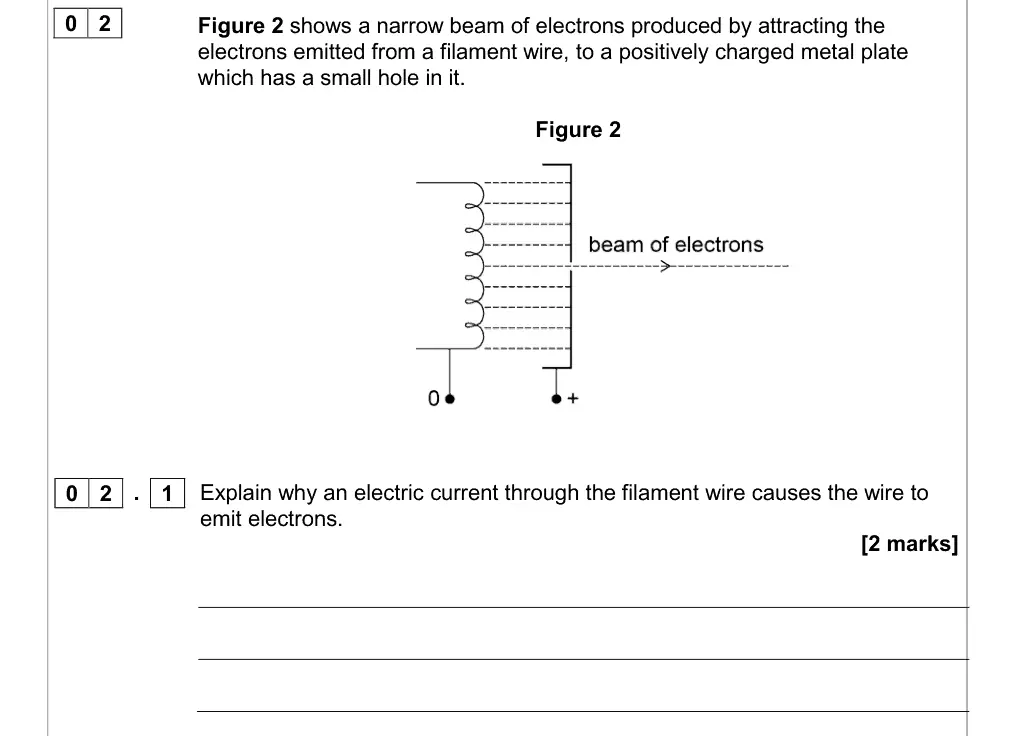
Figure 2 shows a narrow beam of electrons produced by attracting the
electrons emitted from a filament wire, to a positively charged metal plate
which has a small hole in it.
Figure 2
Explain why an electric current through the filament wire causes the wire to
emit electrons.
[2 marks]
Specimen set 1 · Paper 3B Turning points · Q2.2 1 mark Short answer discovery of the electron
Earlier part of question 2 that this part usesEarlier part of Specimen set 1 Paper 3B Turning points question 2
Explain why the filament wire and the metal plates must be in an evacuated
tube.
[1 mark]
Specimen set 1 · Paper 3B Turning points · Q2.3 4 marks Calculation wave particle duality historydiscovery of the electron
Earlier part of question 2 that this part usesEarlier part of Specimen set 1 Paper 3B Turning points question 2
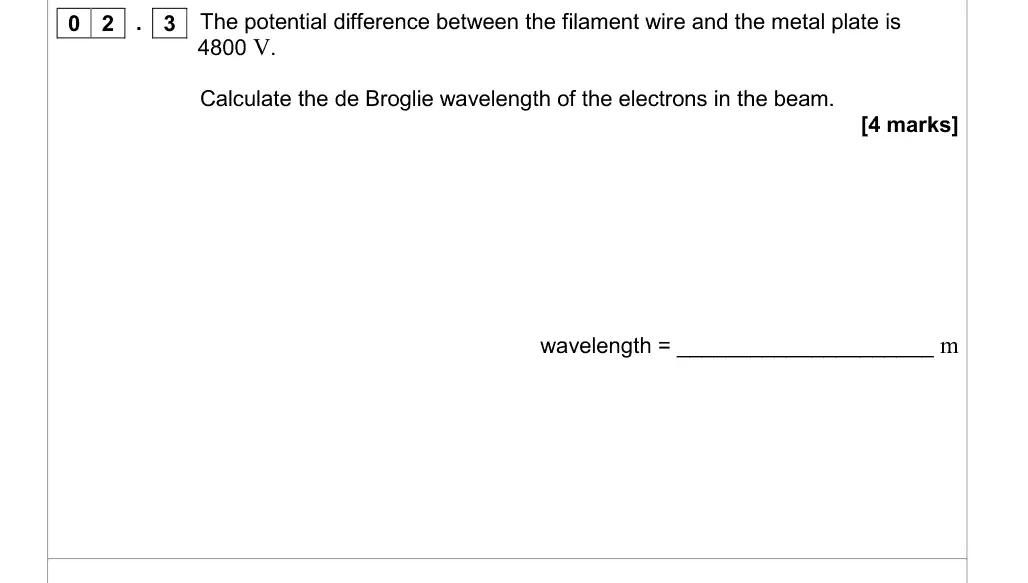
The potential difference between the filament wire and the metal plate is
4800 V.
Calculate the de Broglie wavelength of the electrons in the beam.
[4 marks]
wavelength =  m
Specimen set 1 · Paper 3B Turning points · Q2.4 3 marks Explanation wave particle duality history
Earlier part of question 2 that this part usesEarlier part of Specimen set 1 Paper 3B Turning points question 2
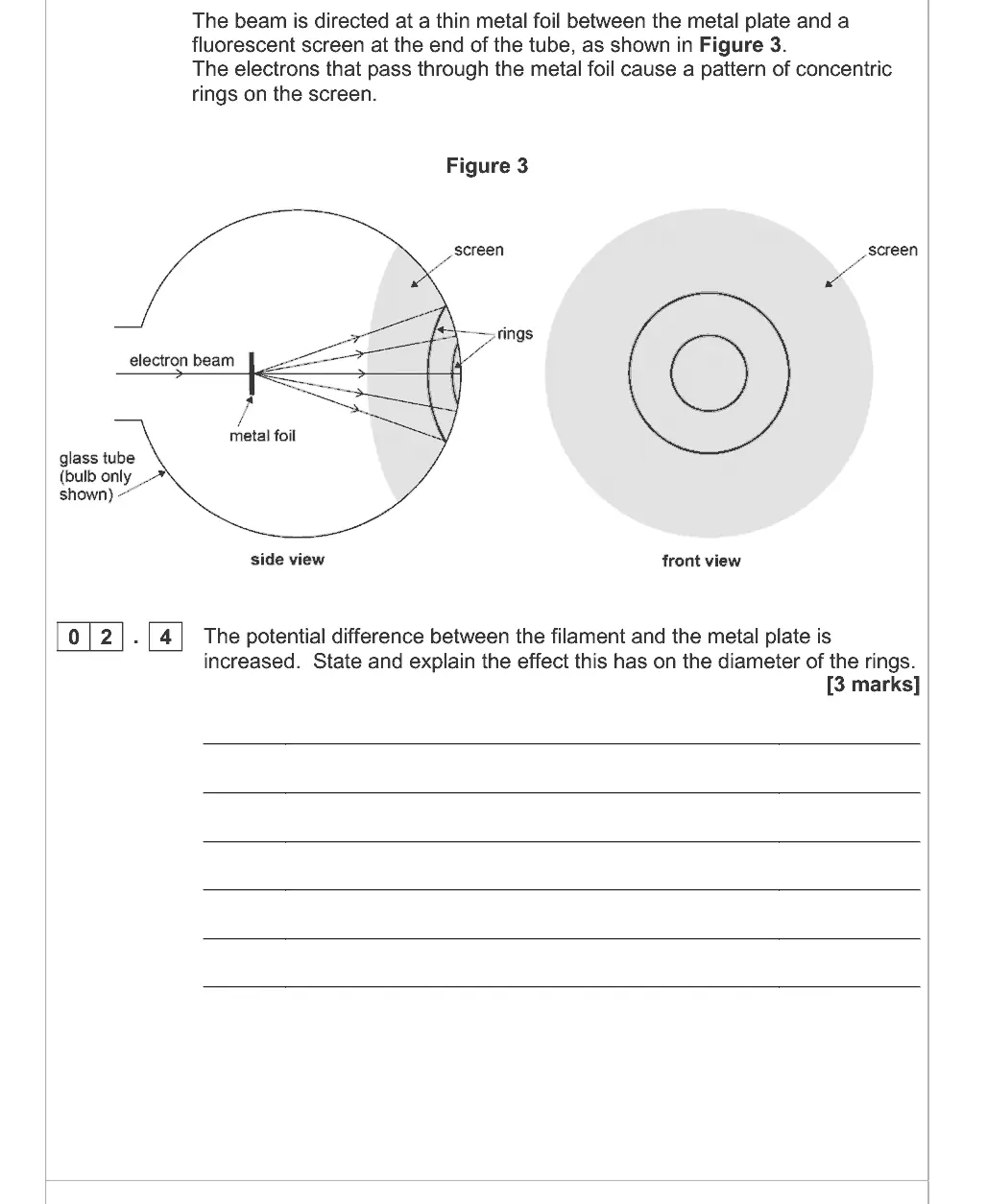
The beam is directed at a thin metal foil between the metal plate and a
fluorescent screen at the end of the tube, as shown in Figure 3.
The electrons that pass through the metal foil cause a pattern of concentric
rings on the screen.
Figure 3
The potential difference between the filament and the metal plate is
increased.  State and explain the effect this has on the diameter of the rings.
[3 marks]
travel at a speed of  ට
Specimen set 1 · Paper 3B Turning points · Q3.1 2 marks Explanation wave particle duality history
Maxwell’s theory suggested the existence of electromagnetic waves that
1
εoµo
.
Hertz later discovered radio waves and performed experiments to investigate
their properties.
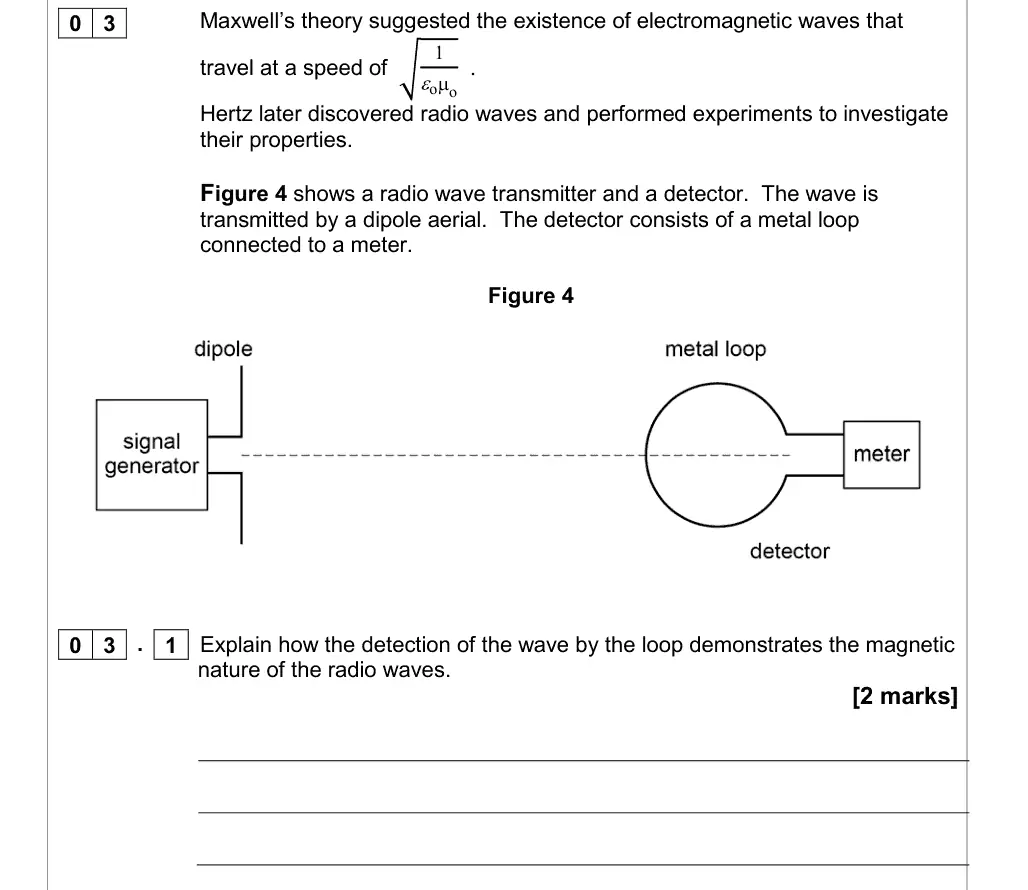
Figure 4 shows a radio wave transmitter and a detector.  The wave is
transmitted by a dipole aerial.  The detector consists of a metal loop
connected to a meter.
Figure 4
Explain how the detection of the wave by the loop demonstrates the magnetic
nature of the radio waves.
[2 marks]
Specimen set 1 · Paper 3B Turning points · Q3.2 1 mark Short answer wave particle duality history
Earlier part of question 3 that this part usesEarlier part of Specimen set 1 Paper 3B Turning points question 3
Explain how the electric nature of the waves emitted by the dipole could be
demonstrated.
[1 mark]
Specimen set 1 · Paper 3B Turning points · Q3.3 6 marks 6-mark extended response wave particle duality history
Earlier part of question 3 that this part usesEarlier part of Specimen set 1 Paper 3B Turning points question 3
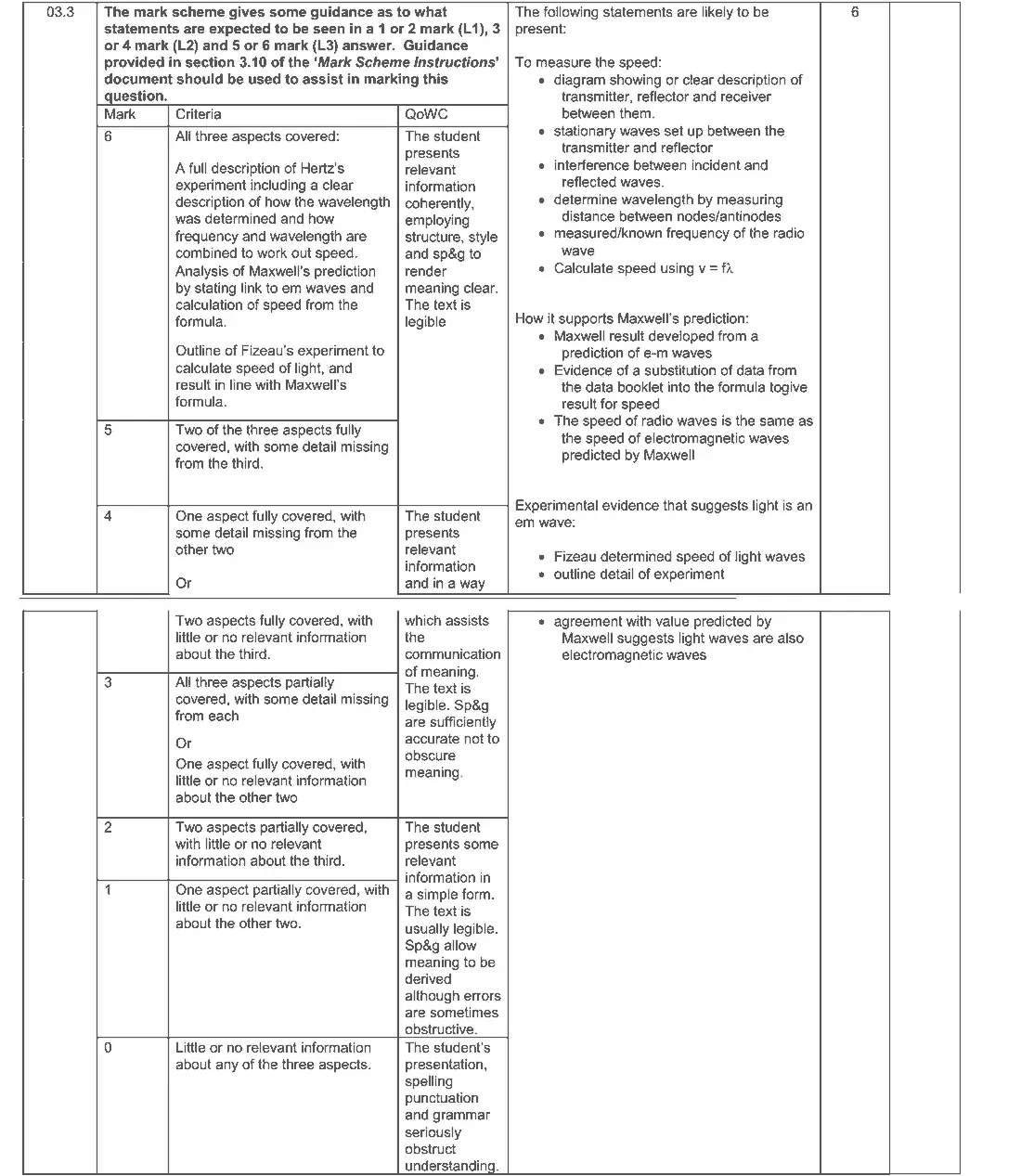
Hertz used an arrangement like that shown in Figure 4 to determine the
speed of radio waves.
Describe how the speed was determined.  Go on to discuss how the
experiments of Hertz confirmed  Maxwell’s prediction and the experimental
evidence that suggests that light is also an electromagnetic wave.
[6 marks]
Specimen set 1 · Paper 3B Turning points · Q4.1 1 mark Short answer special relativity
One of the two postulates of Einstein’s theory of special relativity is that the
speed of light in free space is invariant.
Explain what is meant by this postulate.
[1 mark]
Specimen set 1 · Paper 3B Turning points · Q4.2 1 mark Short answer special relativity
Earlier part of question 4 that this part usesEarlier part of Specimen set 1 Paper 3B Turning points question 4
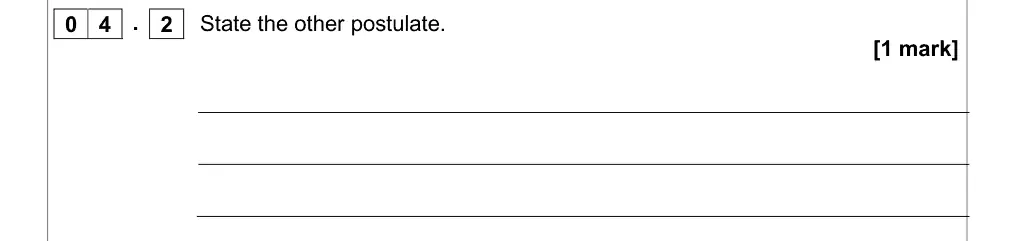
State the other postulate.
[1 mark]
Specimen set 1 · Paper 3B Turning points · Q4.3 1 mark Calculation special relativity
Earlier part of question 4 that this part usesEarlier part of Specimen set 1 Paper 3B Turning points question 4
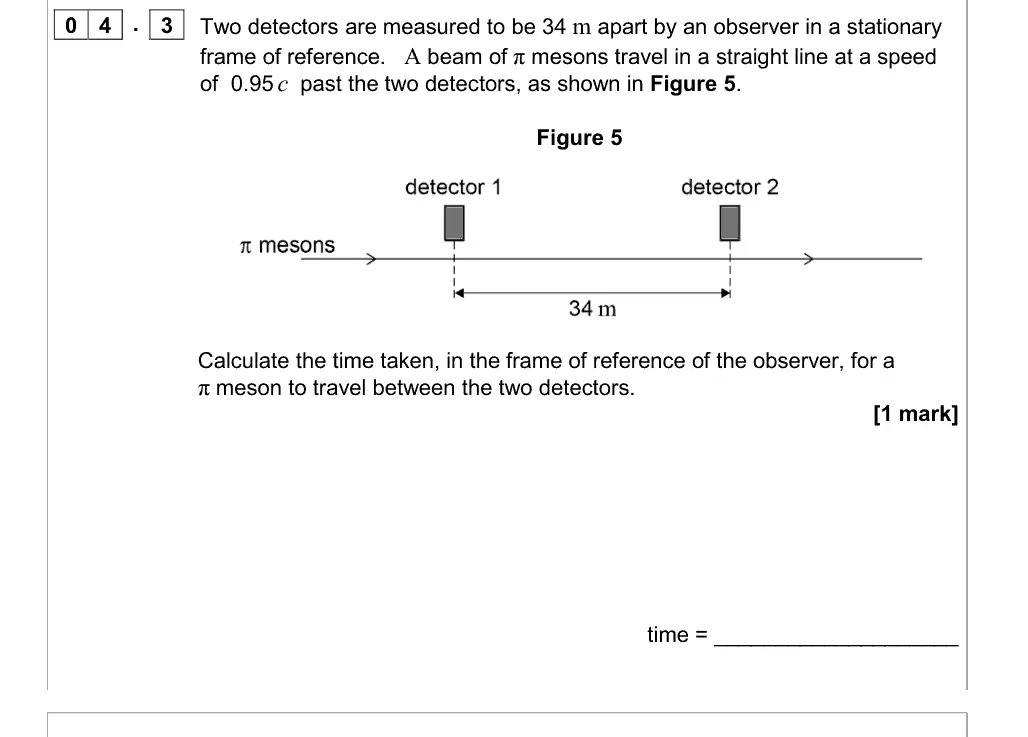
Two detectors are measured to be 34 m apart by an observer in a stationary
frame of reference.   Α beam of π mesons travel in a straight line at a speed
of  0.95 c  past the two detectors, as shown in Figure 5.
Figure 5
Calculate the time taken, in the frame of reference of the observer, for a
π meson to travel between the two detectors.
[1 mark]
time =
Specimen set 1 · Paper 3B Turning points · Q4.4 5 marks Calculation special relativity
Earlier part of question 4 that this part usesEarlier part of Specimen set 1 Paper 3B Turning points question 4
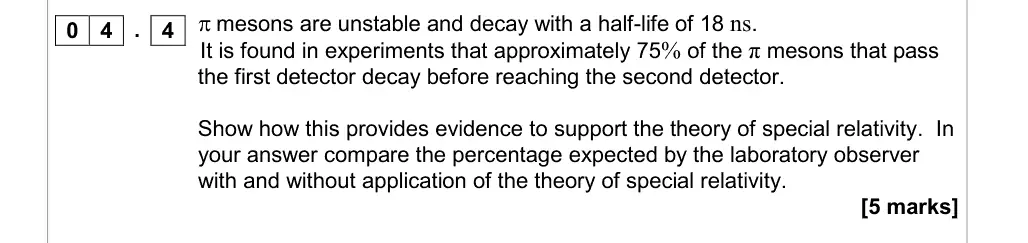
π mesons are unstable and decay with a half-life of 18 ns.
It is found in experiments that approximately 75% of the π mesons that pass
the first detector decay before reaching the second detector.
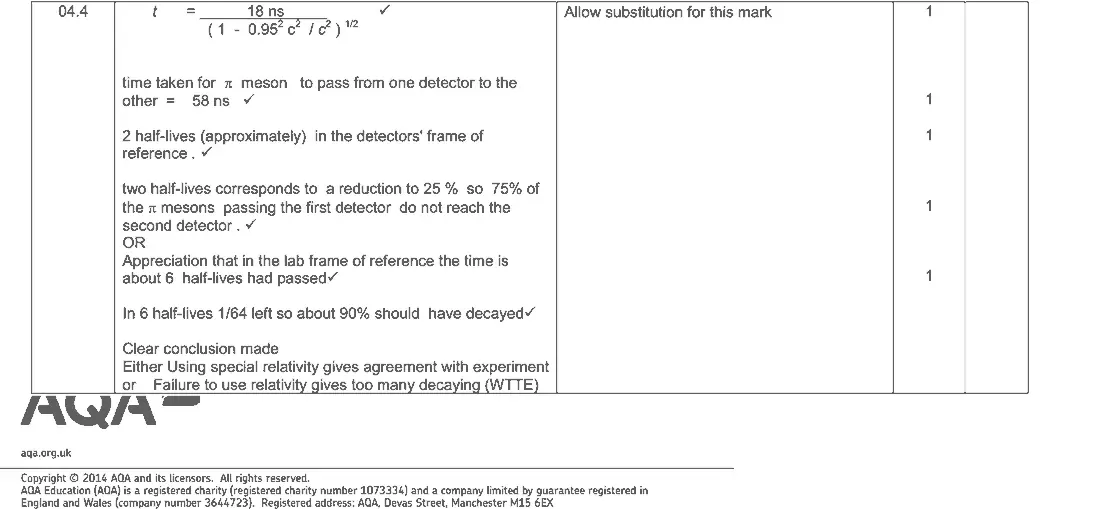
Show how this provides evidence to support the theory of special relativity.  In
your answer compare the percentage expected by the laboratory observer
with and without application of the theory of special relativity.
[5 marks]

Work with an AQA physics tutor

Want a paper marked and gone through with you? Message us.

Prefer email? Send an enquiry

If you are under 18, please include a parent's contact details. Enquiries go to enquiries@physicsaleveltutor.com and are deleted once handled. All tutoring is online.