June 2016: AS Component 2

75 marks · 26 question parts · Paper, mark scheme and report on Eduqas's site · Have the Data Booklet beside you

Question by question

QTopicMarksAOType
1(a) Resistance 2AO1=2Definition
1(b)(i) Resistance 3AO1=2,AO2=1Calculation
1(b)(ii) Resistance 3AO3=3Calculation
2(a) The nature of waves 2AO2=2Calculation
2(b)(i) Wave properties: diffraction, interference and stationary waves 3AO1=1,AO2=2Explanation
2(b)(ii) Wave properties: diffraction, interference and stationary waves, The nature of waves 4AO1=2,AO2=2Calculation
3(a) Resistance 1AO1=1Short answer
3(b)(i) d.c. circuits 3AO3=3Explanation
3(b)(ii) d.c. circuits, Resistance 3AO2=3Calculation
3(b)(iii) d.c. circuits 2AO2=2Explanation
4(a) Wave properties: diffraction, interference and stationary waves 3AO1=3Explanation
4(b)(i) Wave properties: diffraction, interference and stationary waves 3AO2=3Diagram or graph
4(b)(ii) Wave properties: diffraction, interference and stationary waves 3AO2=3Practical and data analysis
5(a) Wave properties: diffraction, interference and stationary waves 4AO1=1,AO2=3Calculation
5(b) Lasers 4AO3=4Calculation
5(c)(i) Lasers 3AO1=3Explanation
5(c)(ii) Photons 3AO1=1,AO2=2Calculation
6(a) Refraction of light 6AO1=6Extended response
6(b)(i) Refraction of light 2AO2=2Diagram or graph
6(b)(ii) Refraction of light 3AO1=1,AO2=2Calculation
6(b)(iii) Refraction of light 3AO3=3Explanation
7(a)(i) Photons 2AO1=2Definition
7(a)(ii) Photons 3AO1=1,AO2=2Calculation
7(b)(i) Photons 3AO2=3Calculation
7(b)(ii) Photons 2AO2=2Calculation
7(c) 2AO3=2Short answer

The questions

1(a)1(b)(i)1(b)(ii)2(a)2(b)(i)2(b)(ii)3(a)3(b)(i)3(b)(ii)3(b)(iii)4(a)4(b)(i)4(b)(ii)5(a)5(b)5(c)(i)5(c)(ii)6(a)6(b)(i)6(b)(ii)6(b)(iii)7(a)(i)7(a)(ii)7(b)(i)7(b)(ii)7(c)
June 2016 · AS Component 2 · Q1(a) 2 marks AO1=2 Definition resistance
1. (a) State Ohm’s law. [2]
June 2016 · AS Component 2 · Q1(b)(i) 3 marks AO1=2, AO2=1 Calculation resistance
Earlier part of question 1 that this part usesEarlier part of June 2016 Component 2 question 1
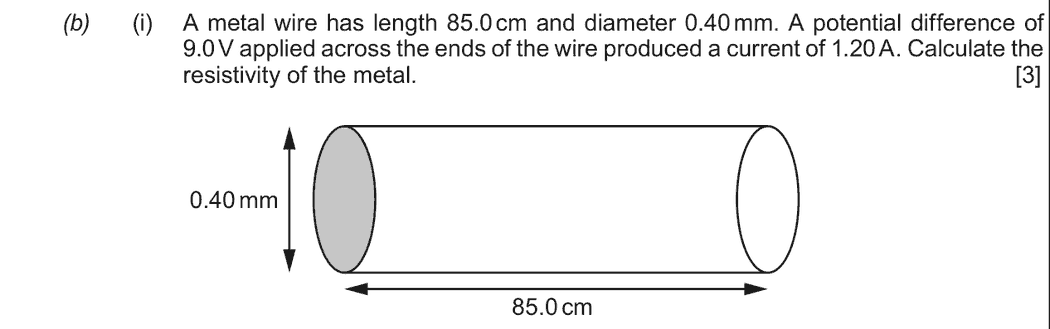
(b) (i) A metal wire has length 85.0 cm and diameter 0.40 mm. A potential difference of 9.0 V applied across the ends of the wire produced a current of 1.20 A. Calculate the resistivity of the metal. [3] 0.40 mm 85.0 cm
June 2016 · AS Component 2 · Q1(b)(ii) 3 marks AO3=3 Calculation resistance
Earlier parts of question 1 that this part usesEarlier part of June 2016 Component 2 question 1Earlier part of June 2016 Component 2 question 1
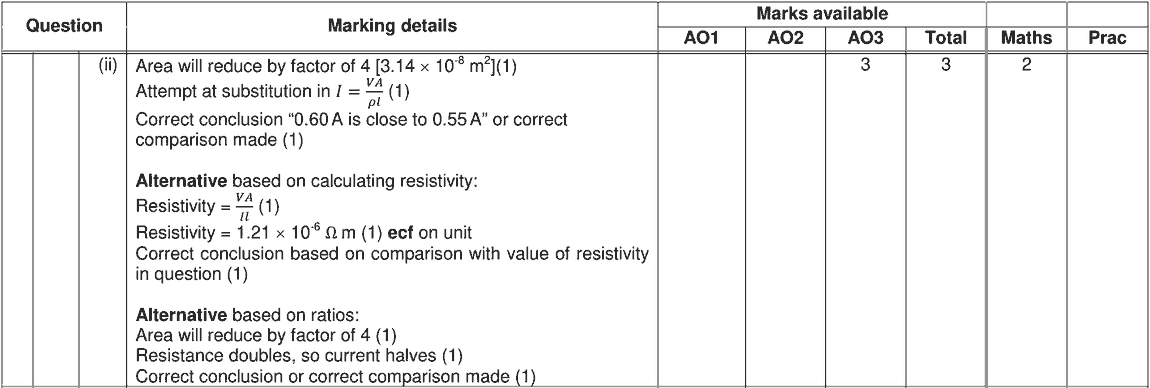
(ii) George repeats the experiment with another wire made of the same metal but half the length and half the original diameter. George measures a current of 0.55 A when the pd is kept at 9.0 V. Evaluate whether this value agrees with the expected value. [3]
June 2016 · AS Component 2 · Q2(a) 2 marks AO2=2 Calculation nature of waves
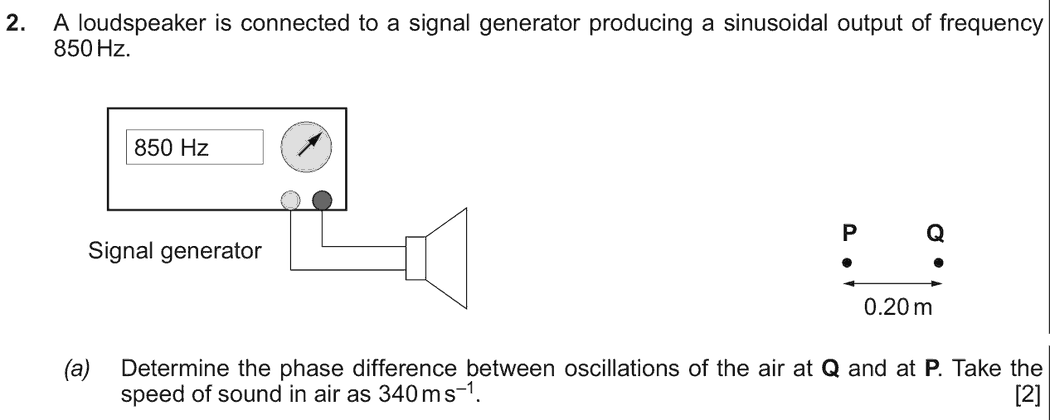
2. A loudspeaker is connected to a signal generator producing a sinusoidal output of frequency 850 Hz. 850 Hz P Q Signal generator 0.20 m (a) Determine the phase difference between oscillations of the air at Q and at P. Take the speed of sound in air as 340 m s–1. [2]
June 2016 · AS Component 2 · Q2(b)(i) 3 marks AO1=1, AO2=2 Explanation wave properties
Earlier part of question 2 that this part usesEarlier part of June 2016 Component 2 question 2
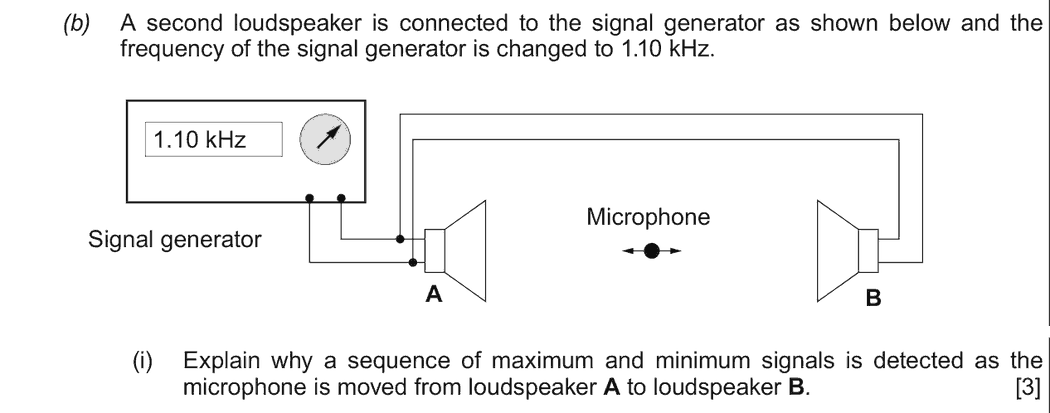
(b) A second loudspeaker is connected to the signal generator as shown below and the frequency of the signal generator is changed to 1.10 kHz. 1.10 kHz Microphone Signal generator A B (i) Explain why a sequence of maximum and minimum signals is detected as the microphone is moved from loudspeaker A to loudspeaker B. [3]
June 2016 · AS Component 2 · Q2(b)(ii) 4 marks AO1=2, AO2=2 Calculation wave propertiesnature of waves
Earlier parts of question 2 that this part usesEarlier part of June 2016 Component 2 question 2Earlier part of June 2016 Component 2 question 2
(ii) The microphone is positioned at a minimum near to loudspeaker A. It is then moved 60.0 cm towards B to another minimum position. Four successive maxima are detected. Determine a value for the speed of sound. [4]
June 2016 · AS Component 2 · Q3(a) 1 mark AO1=1 Short answer resistance
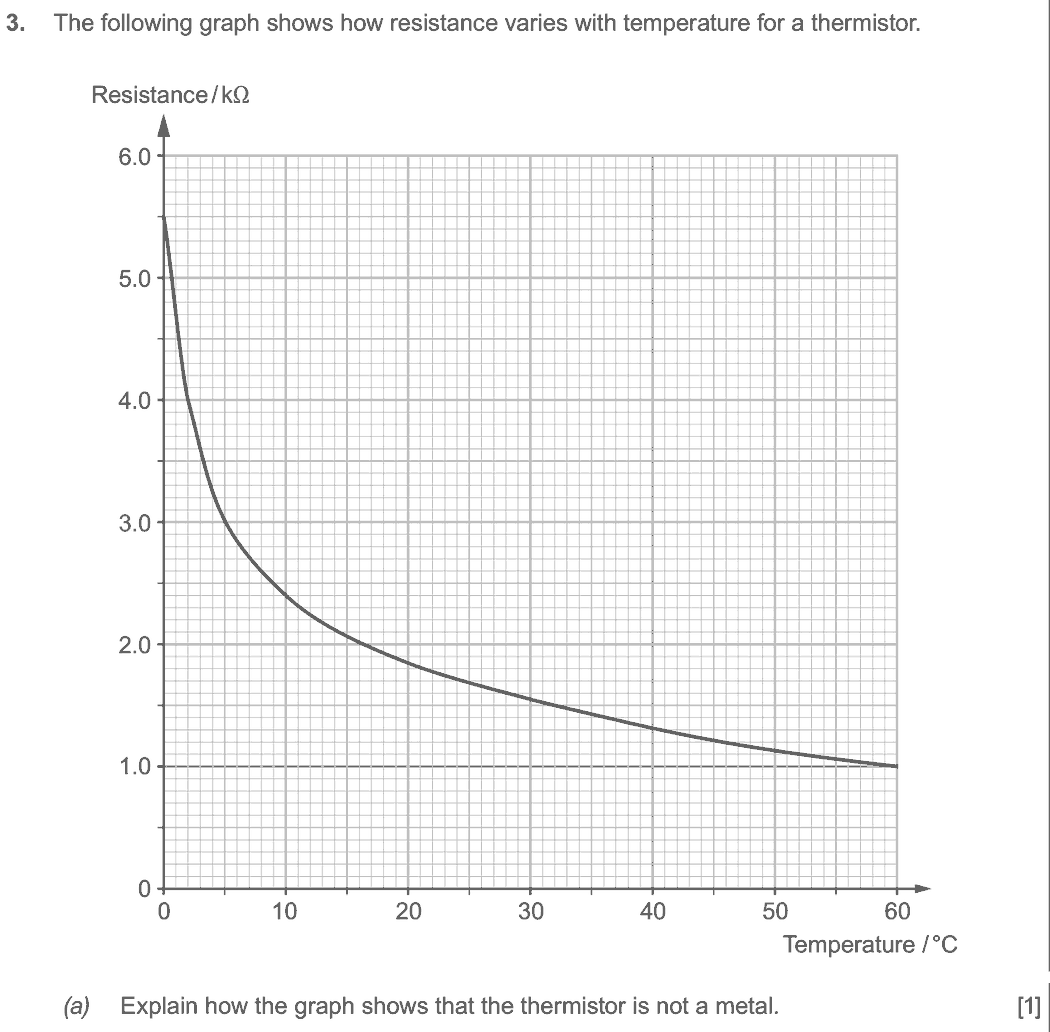
3. The following graph shows how resistance varies with temperature for a thermistor. Resistance / kΩ 6.0 5.0 4.0 3.0 2.0 1.0 0 0 10 20 30 40 50 60 Temperature / °C (a) Explain how the graph shows that the thermistor is not a metal. [1]
June 2016 · AS Component 2 · Q3(b)(i) 3 marks AO3=3 Explanation dc circuits
Earlier part of question 3 that this part usesEarlier part of June 2016 Component 2 question 3
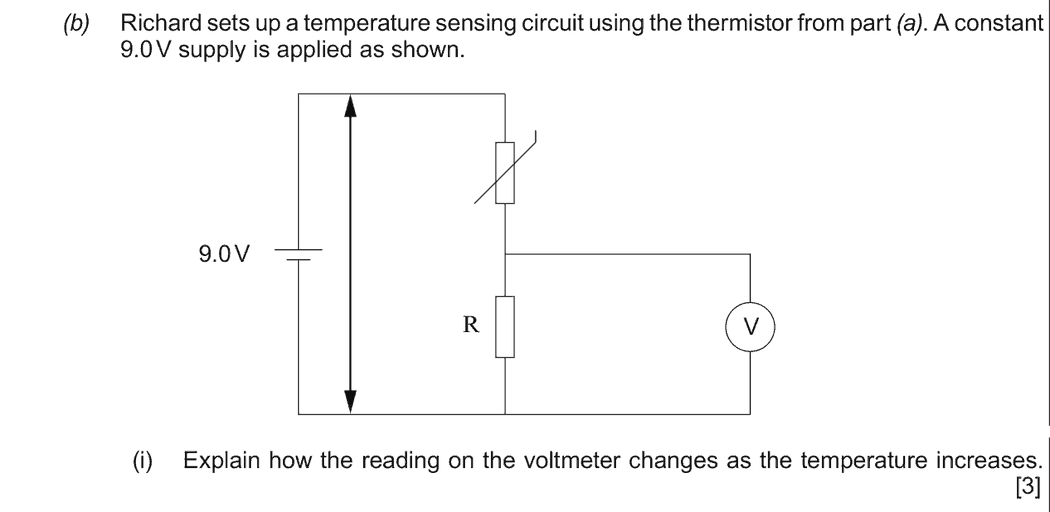
(b) Richard sets up a temperature sensing circuit using the thermistor from part (a). A constant 9.0 V supply is applied as shown. 9.0 V R V (i) Explain how the reading on the voltmeter changes as the temperature increases. [3]
June 2016 · AS Component 2 · Q3(b)(ii) 3 marks AO2=3 Calculation dc circuitsresistance
Earlier parts of question 3 that this part usesEarlier part of June 2016 Component 2 question 3Earlier part of June 2016 Component 2 question 3
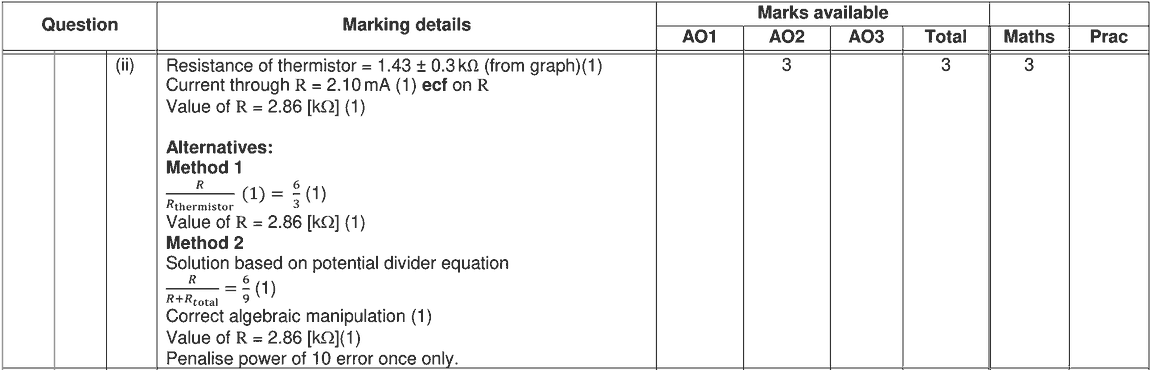
(ii) Determine the value of R for the voltmeter to read 6.0 V when the temperature is 35 °C. [3]

June 2016 · AS Component 2 · Q3(b)(iii) 2 marks AO2=2 Explanation dc circuits
Earlier parts of question 3 that this part usesEarlier part of June 2016 Component 2 question 3Earlier part of June 2016 Component 2 question 3
(iii) Richard replaces the voltmeter with a 6.0 V bulb expecting it to light with full brightness when the temperature is 35 °C. Explain why the bulb does not operate as expected. [2]
June 2016 · AS Component 2 · Q4(a) 3 marks AO1=3 Explanation wave properties
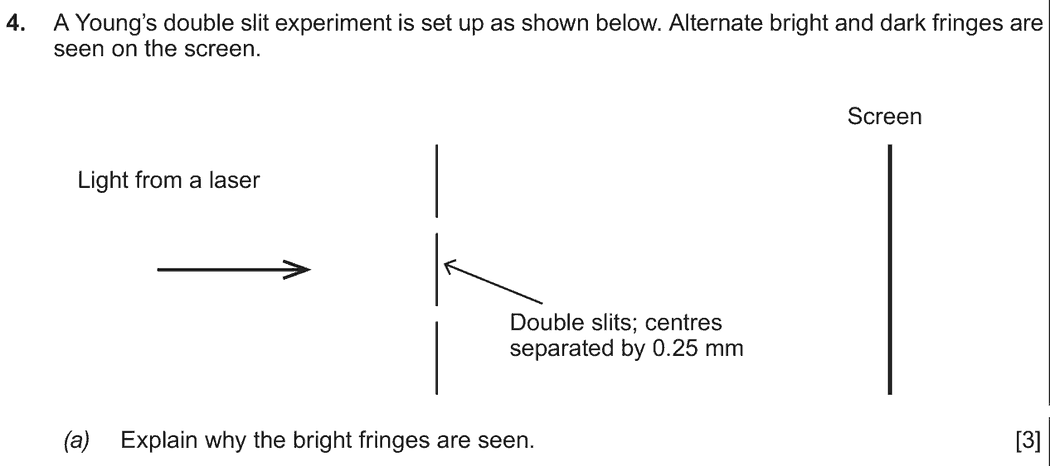
4. A Young’s double slit experiment is set up as shown below. Alternate bright and dark fringes are seen on the screen. Screen Light from a laser Double slits; centres separated by 0.25 mm (a) Explain why the bright fringes are seen. [3]
June 2016 · AS Component 2 · Q4(b)(i) 3 marks AO2=3 Diagram or graph wave properties
Earlier part of question 4 that this part usesEarlier part of June 2016 Component 2 question 4
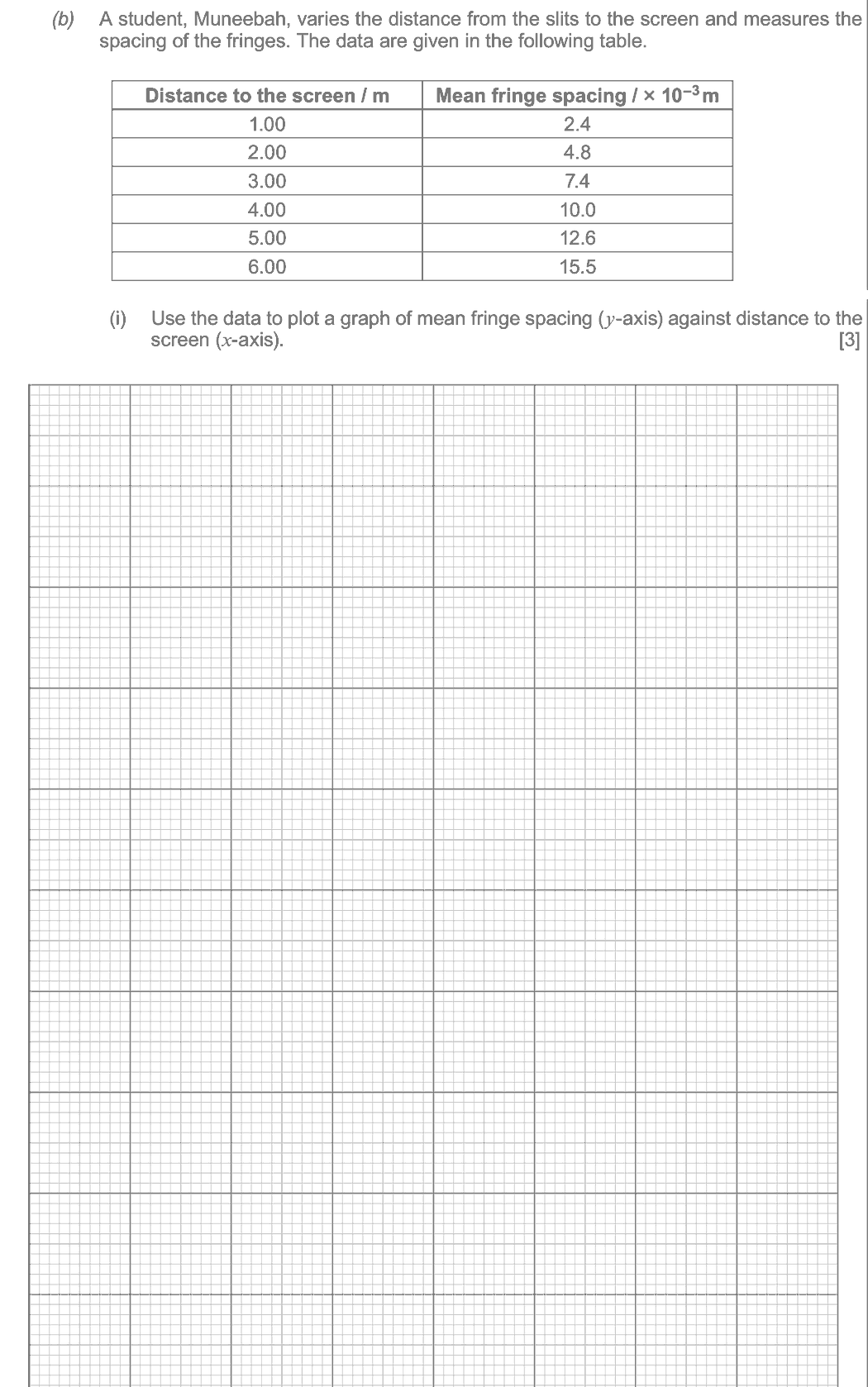
(b) A student, Muneebah, varies the distance from the slits to the screen and measures the spacing of the fringes. The data are given in the following table. Distance to the screen / m Mean fringe spacing / × 10–3 m 1.00 2.4 2.00 4.8 3.00 7.4 4.00 10.0 5.00 12.6 6.00 15.5 (i) Use the data to plot a graph of mean fringe spacing (y-axis) against distance to the screen (x-axis). [3]
June 2016 · AS Component 2 · Q4(b)(ii) 3 marks AO2=3 Practical and data analysis wave properties
Earlier parts of question 4 that this part usesEarlier part of June 2016 Component 2 question 4Earlier part of June 2016 Component 2 question 4
(ii) Use your graph to determine the wavelength of the laser light (the distance between the centres of the double slits is 0.25 mm). Show your workings clearly and give your answer to an appropriate number of significant figures. [3]
June 2016 · AS Component 2 · Q5(a) 4 marks AO1=1, AO2=3 Calculation wave properties
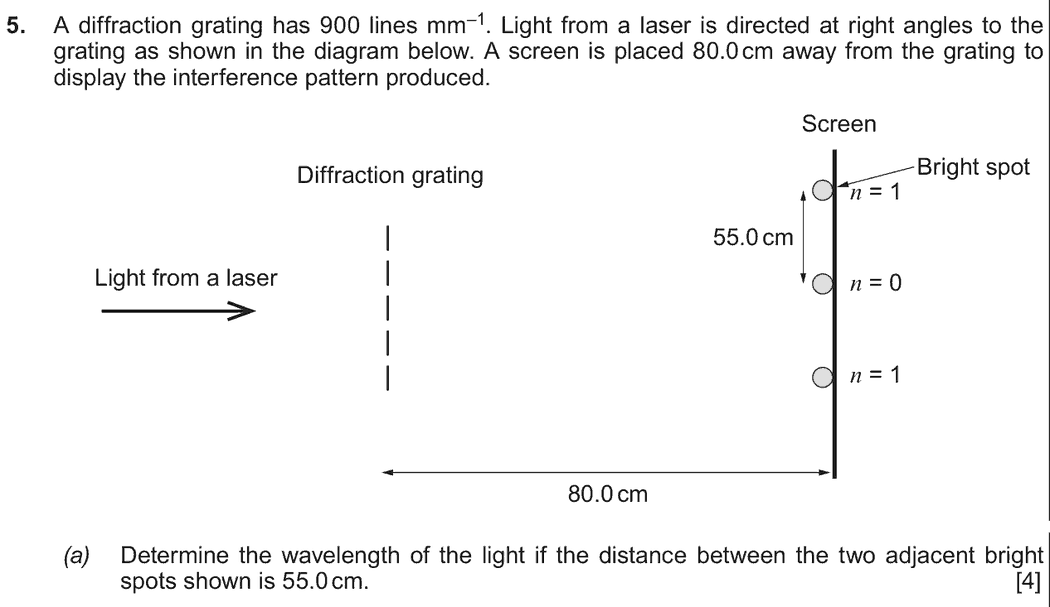
5. A diffraction grating has 900 lines mm–1. Light from a laser is directed at right angles to the grating as shown in the diagram below. A screen is placed 80.0 cm away from the grating to display the interference pattern produced. Screen Bright spot Diffraction grating n = 1 55.0 cm Light from a laser n = 0 n = 1 80.0 cm (a) Determine the wavelength of the light if the distance between the two adjacent bright spots shown is 55.0 cm. [4]
June 2016 · AS Component 2 · Q5(b) 4 marks AO3=4 Calculation lasers
Earlier part of question 5 that this part usesEarlier part of June 2016 Component 2 question 5
(b) Light from the Sun has intensity 1.36 kW m–2 on Earth and light from a standard laboratory laser has intensity 1.0 mW mm–2. Discuss with the aid of a calculation, whether students should wear protective goggles while using a standard laboratory laser. [4]
June 2016 · AS Component 2 · Q5(c)(i) 3 marks AO1=3 Explanation lasers
Earlier part of question 5 that this part usesEarlier part of June 2016 Component 2 question 5
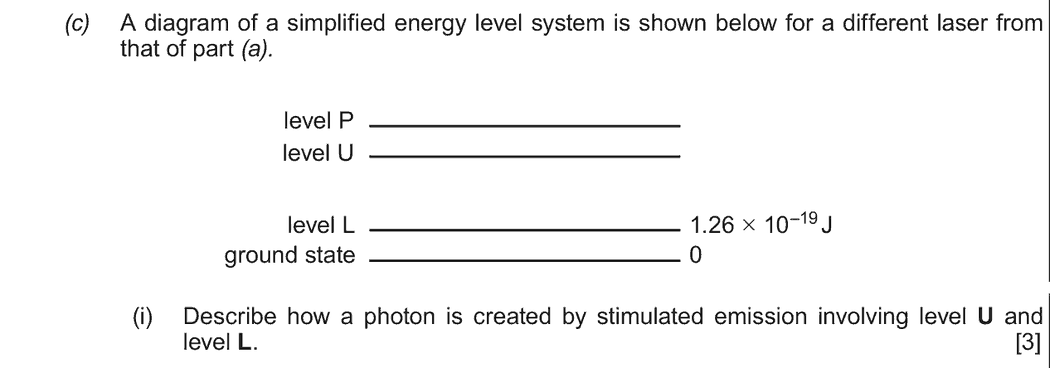
(c) A diagram of a simplified energy level system is shown below for a different laser from that of part (a). level P level U level L 1.26 × 10⁻¹⁹ J ground state 0 (i) Describe how a photon is created by stimulated emission involving level U and level L. [3]
June 2016 · AS Component 2 · Q5(c)(ii) 3 marks AO1=1, AO2=2 Calculation photons
Earlier parts of question 5 that this part usesEarlier part of June 2016 Component 2 question 5Earlier part of June 2016 Component 2 question 5
(ii) Determine the energy of level U given that the wavelength of the light from the laser is 5.90 × 10⁻⁷ m. [3]
June 2016 · AS Component 2 · Q6(a) 6 marks AO1=6 6-mark extended response refraction of light
6. (a) Explain in detail how you would carry out an experiment based on angles to determine the refractive index of glass in the form of a rectangular block. [6 QER]
June 2016 · AS Component 2 · Q6(b)(i) 2 marks AO2=2 Diagram or graph refraction of light
Earlier part of question 6 that this part usesEarlier part of June 2016 Component 2 question 6
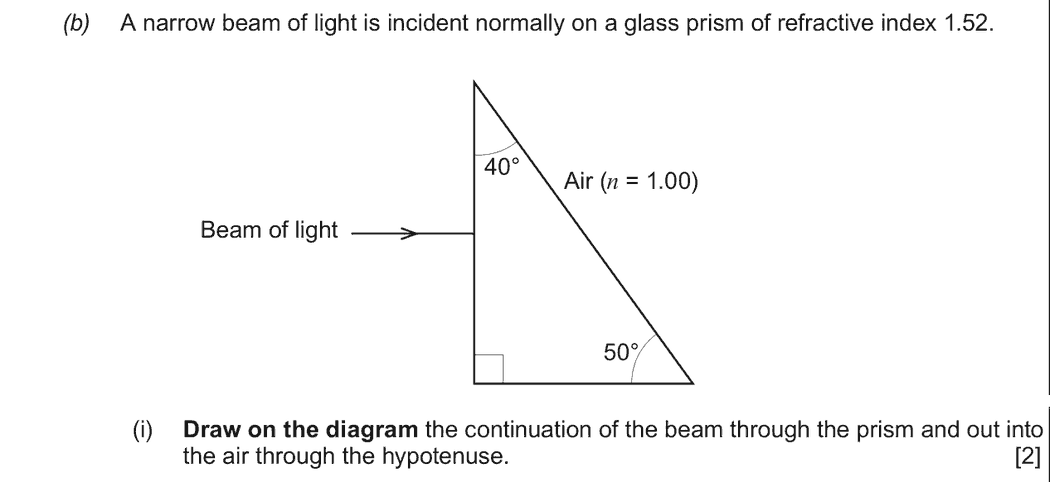
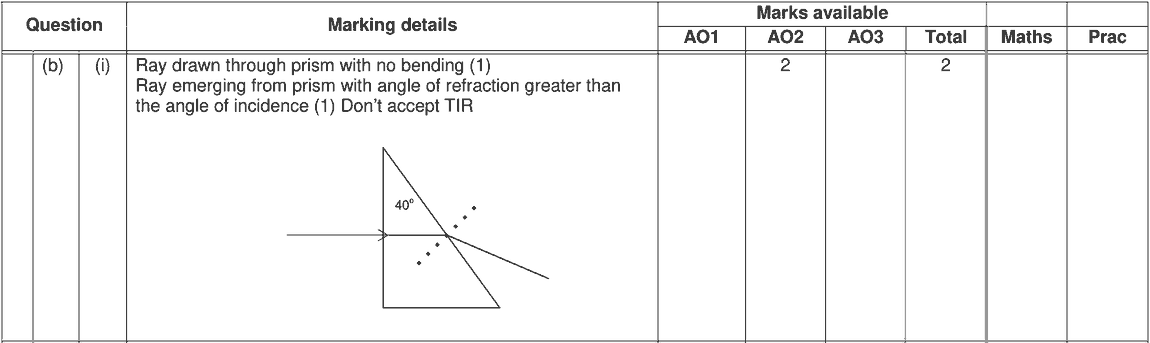
(b) A narrow beam of light is incident normally on a glass prism of refractive index 1.52. 40° Air (n = 1.00) Beam of light 50° (i) Draw on the diagram the continuation of the beam through the prism and out into the air through the hypotenuse. [2]
June 2016 · AS Component 2 · Q6(b)(ii) 3 marks AO1=1, AO2=2 Calculation refraction of light
Earlier parts of question 6 that this part usesEarlier part of June 2016 Component 2 question 6Earlier part of June 2016 Component 2 question 6
(ii) Calculate the angle through which the beam is deviated from its original direction. [3]
June 2016 · AS Component 2 · Q6(b)(iii) 3 marks AO3=3 Explanation refraction of light
Earlier parts of question 6 that this part usesEarlier part of June 2016 Component 2 question 6Earlier part of June 2016 Component 2 question 6
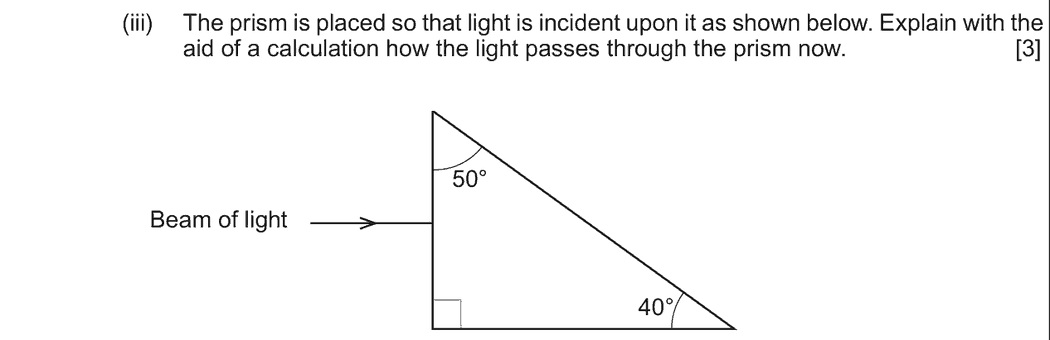
(iii) The prism is placed so that light is incident upon it as shown below. Explain with the aid of a calculation how the light passes through the prism now. [3] 50° Beam of light 40°
June 2016 · AS Component 2 · Q7(a)(i) 2 marks AO1=2 Definition photons
7. A satellite is orbiting the Earth. (a) (i) Any charge carried by the satellite could affect its sensitive electronic circuits. Satellites therefore need to be designed to minimise photoelectric emission from their surfaces. Explain what is meant by the photoelectric effect. [2]
June 2016 · AS Component 2 · Q7(a)(ii) 3 marks AO1=1, AO2=2 Calculation photons
Earlier part of question 7 that this part usesEarlier part of June 2016 Component 2 question 7
(ii) The satellite is coated with platinum, which has a work function of 5.24 × 10⁻¹⁹J. Determine the longest wavelength of incident sunlight that can eject an electron from the platinum. [3]
June 2016 · AS Component 2 · Q7(b)(i) 3 marks AO2=3 Calculation photons
Earlier part of question 7 that this part usesEarlier part of June 2016 Component 2 question 7
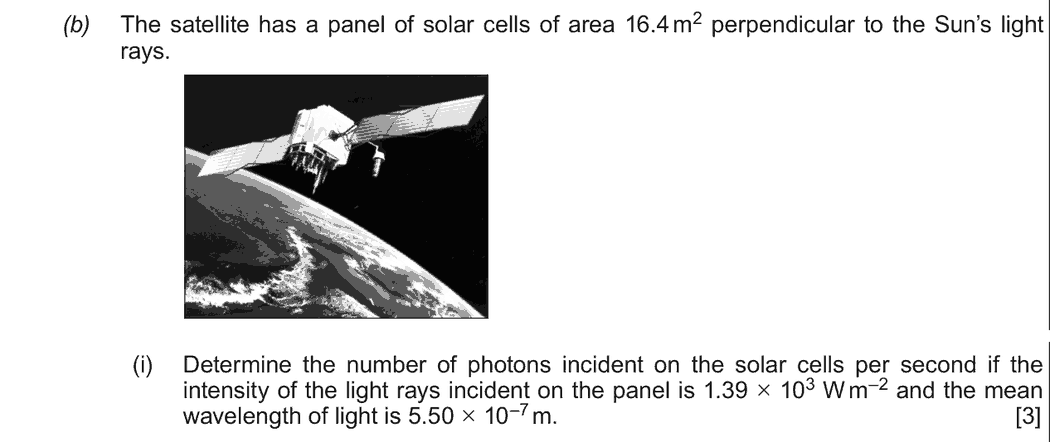
(b) The satellite has a panel of solar cells of area 16.4 m2 perpendicular to the Sun’s light rays. (i) Determine the number of photons incident on the solar cells per second if the intensity of the light rays incident on the panel is 1.39 × 10³ W m–2 and the mean wavelength of light is 5.50 × 10⁻⁷ m. [3]
June 2016 · AS Component 2 · Q7(b)(ii) 2 marks AO2=2 Calculation photons
Earlier parts of question 7 that this part usesEarlier part of June 2016 Component 2 question 7Earlier part of June 2016 Component 2 question 7
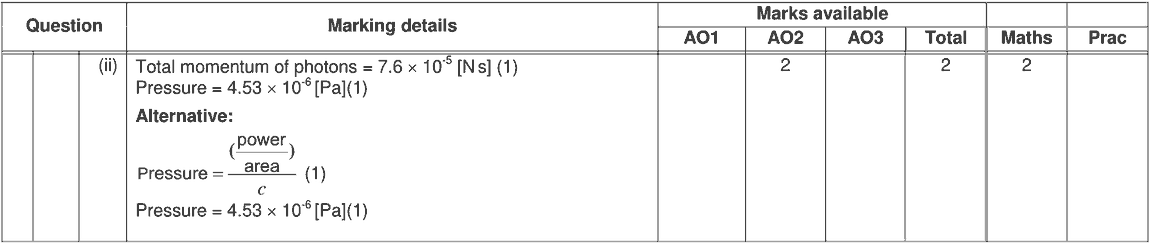
(ii) Hence or otherwise determine the pressure exerted by the photons on the solar panel. Assume that the panel absorbs all the photons. [2]
June 2016 · AS Component 2 · Q7(c) 2 marks AO3=2 Short answer
Earlier parts of question 7 that this part usesEarlier part of June 2016 Component 2 question 7Earlier part of June 2016 Component 2 question 7
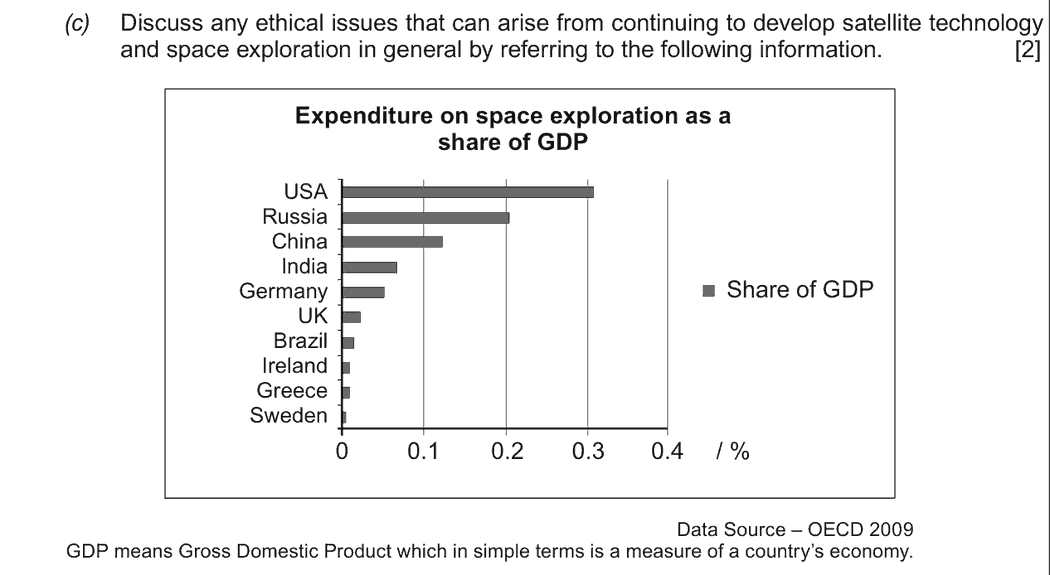
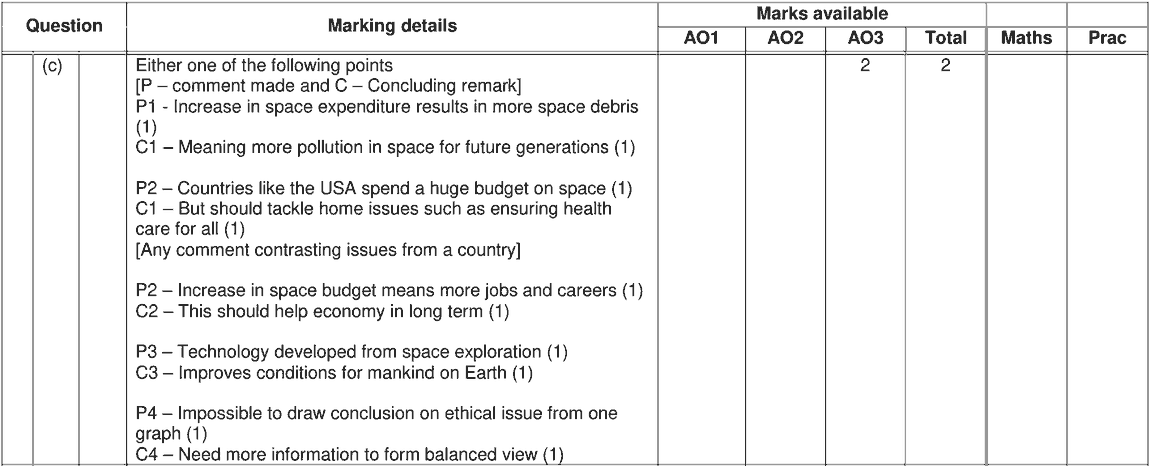
(c) Discuss any ethical issues that can arise from continuing to develop satellite technology and space exploration in general by referring to the following information. [2] Expenditure on space exploration as a share of GDP USA Russia China India Germany Share of GDP UK Brazil Ireland Greece Sweden 0 0.1 0.2 0.3 0.4 / % Data Source – OECD 2009 GDP means Gross Domestic Product which in simple terms is a measure of a country’s economy.

Work with an Eduqas physics tutor

Want a paper marked and gone through with you? Message us.

Prefer email? Send an enquiry

If you are under 18, please include a parent's contact details. Enquiries go to enquiries@physicsaleveltutor.com and are deleted once handled. All tutoring is online.