June 2017: AS Component 1

75 marks · 31 question parts · Paper, mark scheme and report on Eduqas's site · Have the Data Booklet beside you

Question by question

QTopicMarksAOType
1(a) Solids under stress 3AO1=3Short answer
1(b) Solids under stress 4AO1=4Diagram or graph
1(c)(i) Solids under stress 4AO1=2,AO2=2Calculation
1(c)(ii) Solids under stress 2AO2=2Calculation
1(c)(iii) Solids under stress 2AO1=1,AO2=1Calculation
2(a)(i) Kinematics 1AO1=1Definition
2(a)(ii) Kinematics, Basic physics: units, vectors and moments 2AO2=2Short answer
2(b)(i) Kinematics 2AO2=2Calculation
2(b)(ii) Kinematics 2AO2=2Calculation
2(b)(iii) Kinematics 1AO2=1Short answer
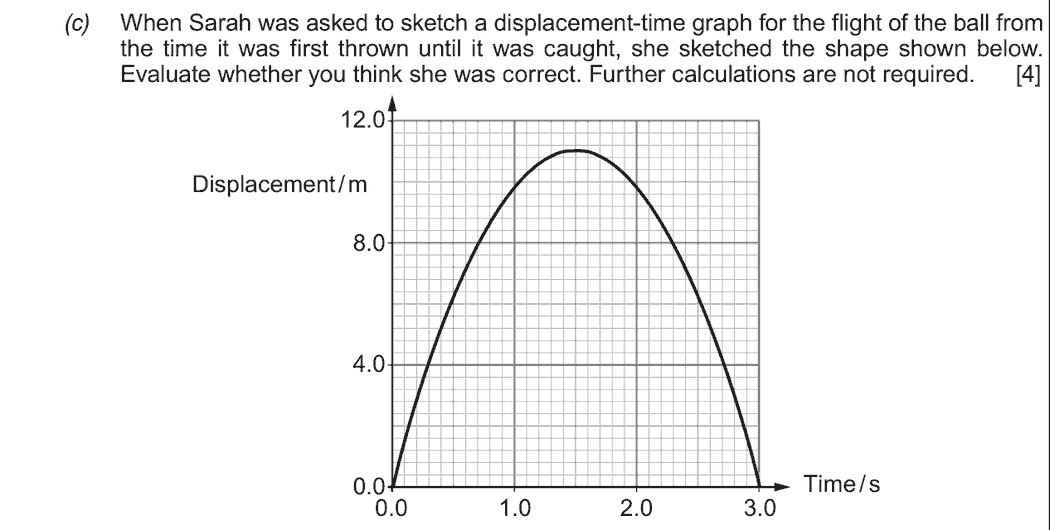
2(c) Kinematics 4AO3=4Explanation
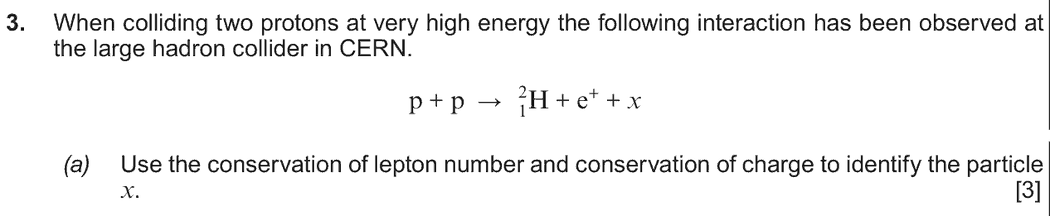
3(a) Particles and nuclear structure 3AO2=2,AO3=1Explanation
3(b) Particles and nuclear structure 2AO1=2Short answer
3(c) Particles and nuclear structure 2AO1=2Short answer
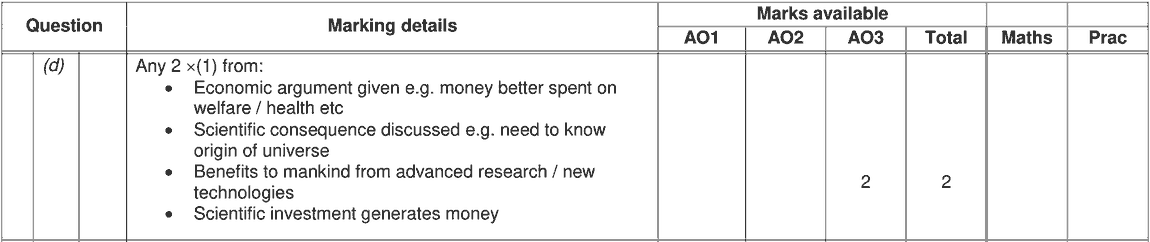
3(d) Particles and nuclear structure 2AO3=2Explanation
4(a)(i) Using radiation to investigate stars 1AO1=1Definition
4(a)(ii) Using radiation to investigate stars 3AO1=1,AO2=2Calculation
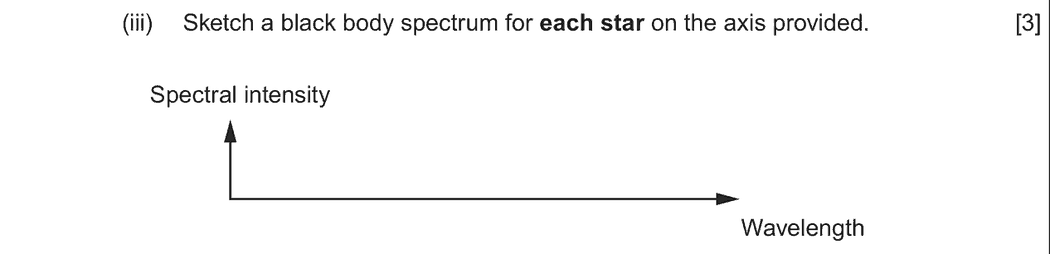
4(a)(iii) Using radiation to investigate stars 3AO1=3Diagram or graph
4(b) Using radiation to investigate stars 4AO1=2,AO2=2Calculation
5(a)(i) Kinematics 1AO2=1Practical and data analysis
5(a)(ii) Kinematics 2AO2=2Practical and data analysis
5(a)(iii) Kinematics 4AO2=4Practical and data analysis
5(a)(iv) Kinematics 1AO3=1Practical and data analysis
5(b)(i) Kinematics 2AO3=2Practical and data analysis
5(b)(ii) Kinematics 2AO3=2Practical and data analysis
6(a) Basic physics: units, vectors and moments 2AO1=2Definition
6(b)(i) Basic physics: units, vectors and moments 3AO2=3Practical and data analysis
6(b)(ii)I Basic physics: units, vectors and moments 1Practical and data analysis
6(b)(ii)II Basic physics: units, vectors and moments 2Practical and data analysis
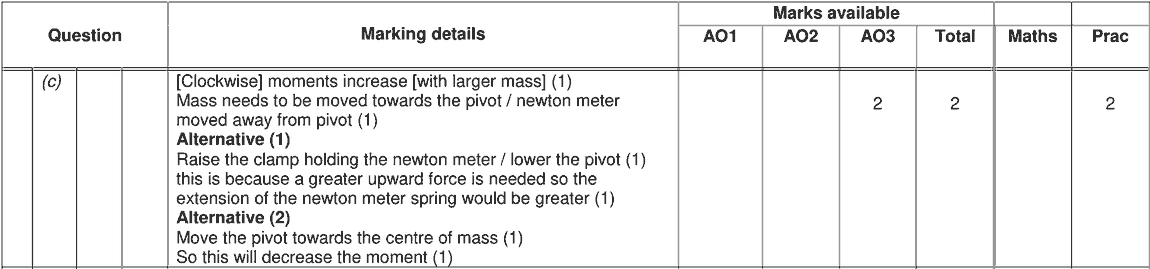
6(c) Basic physics: units, vectors and moments 2AO3=2Practical and data analysis
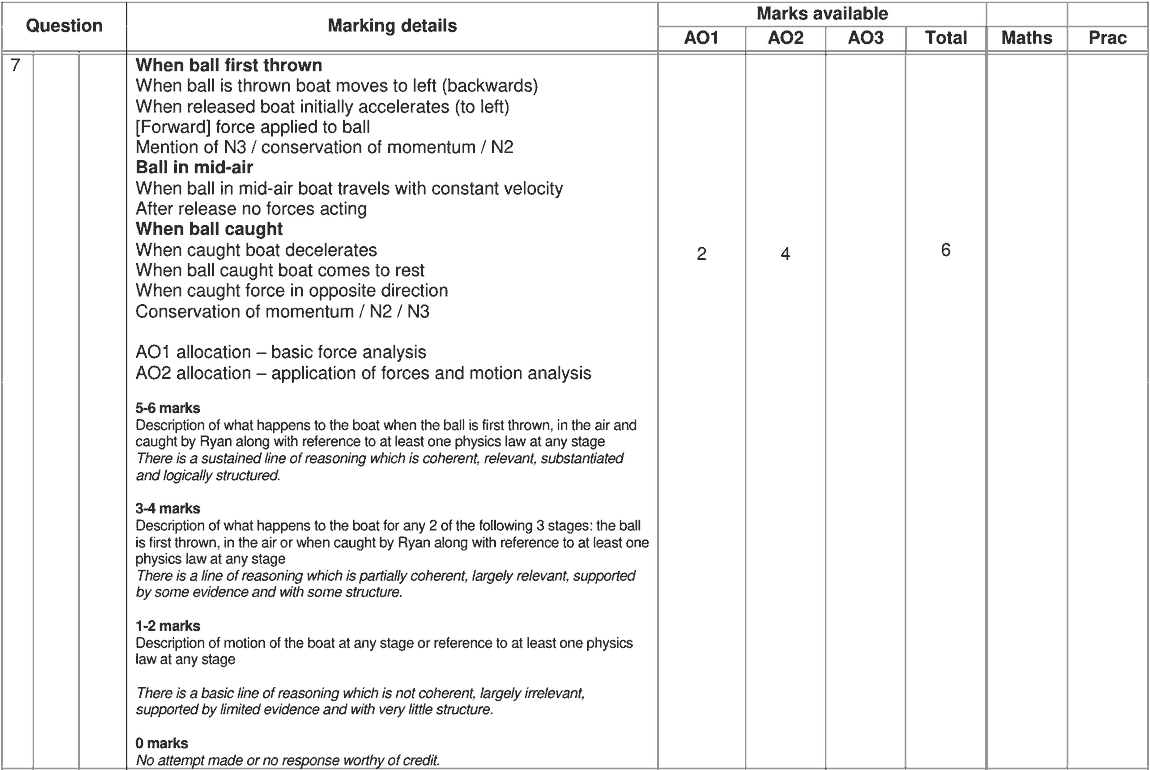
7 Dynamics: forces and momentum 6AO1=2,AO2=4Extended response

The questions

1(a)1(b)1(c)(i)1(c)(ii)1(c)(iii)2(a)(i)2(a)(ii)2(b)(i)2(b)(ii)2(b)(iii)2(c)3(a)3(b)3(c)3(d)4(a)(i)4(a)(ii)4(a)(iii)4(b)5(a)(i)5(a)(ii)5(a)(iii)5(a)(iv)5(b)(i)5(b)(ii)6(a)6(b)(i)6(b)(ii)I6(b)(ii)II6(c)7
June 2017 · AS Component 1 · Q1(a) 3 marks AO1=3 Short answer solids under stress
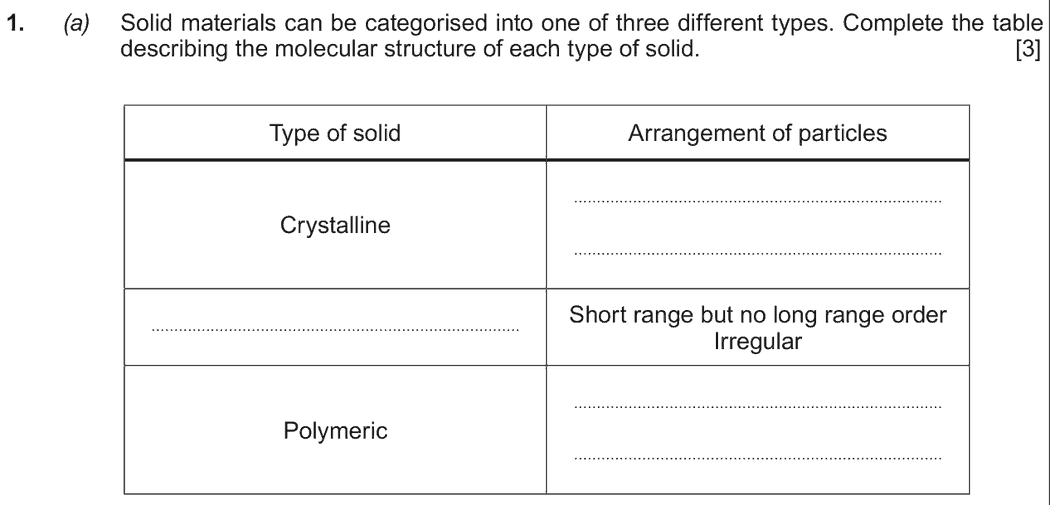
1. (a) Solid materials can be categorised into one of three different types. Complete the table describing the molecular structure of each type of solid. [3] Type of solid Arrangement of particles Crystalline Short range but no long range order Irregular Polymeric
June 2017 · AS Component 1 · Q1(b) 4 marks AO1=4 Diagram or graph solids under stress
Earlier part of question 1 that this part usesEarlier part of June 2017 Component 1 question 1
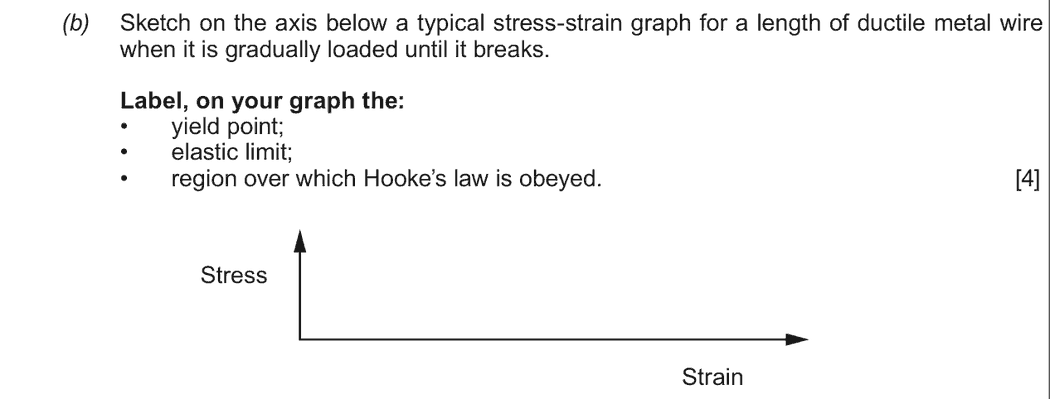
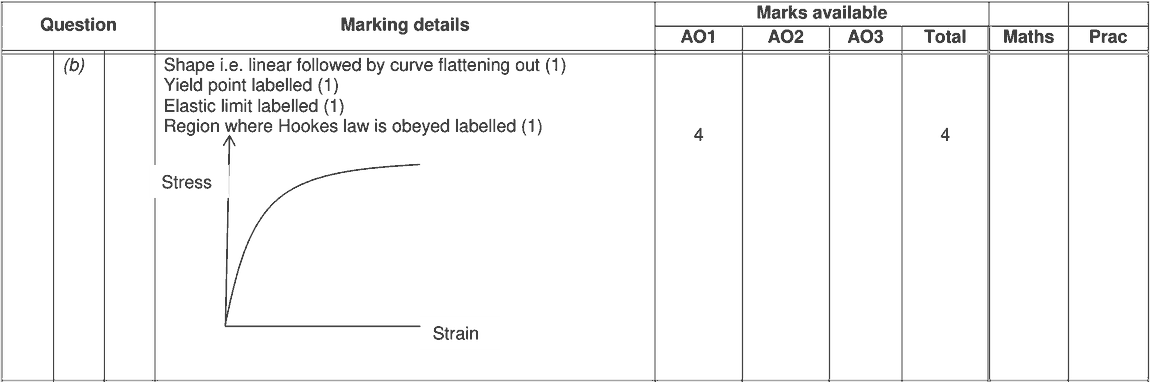
(b) Sketch on the axis below a typical stress-strain graph for a length of ductile metal wire when it is gradually loaded until it breaks. Label, on your graph the: • yield point; • elastic limit; • region over which Hooke’s law is obeyed. [4] Stress Strain
June 2017 · AS Component 1 · Q1(c)(i) 4 marks AO1=2, AO2=2 Calculation solids under stress
Earlier parts of question 1 that this part usesEarlier part of June 2017 Component 1 question 1Earlier part of June 2017 Component 1 question 1
(c) (i) A nylon fishing line of negligible mass has a breaking stress of 60 MPa. Calculate the minimum diameter of line needed to lift a fish of mass 5.0 kg vertically out of the water. [4]
June 2017 · AS Component 1 · Q1(c)(ii) 2 marks AO2=2 Calculation solids under stress
Earlier parts of question 1 that this part usesEarlier part of June 2017 Component 1 question 1Earlier part of June 2017 Component 1 question 1Earlier part of June 2017 Component 1 question 1
(ii) When lifting the fish vertically 2.00 m of the line extends by 40 mm. Use this information to calculate a value for the Young modulus of the nylon line at breaking stress. [2]
June 2017 · AS Component 1 · Q1(c)(iii) 2 marks AO1=1, AO2=1 Calculation solids under stress
Earlier parts of question 1 that this part usesEarlier part of June 2017 Component 1 question 1Earlier part of June 2017 Component 1 question 1Earlier part of June 2017 Component 1 question 1
(iii) If the fish struggles the force on the line can be increased by a factor of ten. Calculate the minimum diameter of line now required to stop the line breaking. [2]
June 2017 · AS Component 1 · Q2(a)(i) 1 mark AO1=1 Definition kinematics
2. (a) (i) Define velocity. [1]
June 2017 · AS Component 1 · Q2(a)(ii) 2 marks AO2=2 Short answer kinematicsbasic physics
Earlier part of question 2 that this part usesEarlier part of June 2017 Component 1 question 2
(ii) Give an example of a situation where an object has: [2] I. a changing velocity but a constant speed; II. acceleration in the opposite direction to velocity.
June 2017 · AS Component 1 · Q2(b)(i) 2 marks AO2=2 Calculation kinematics
Earlier part of question 2 that this part usesEarlier part of June 2017 Component 1 question 2
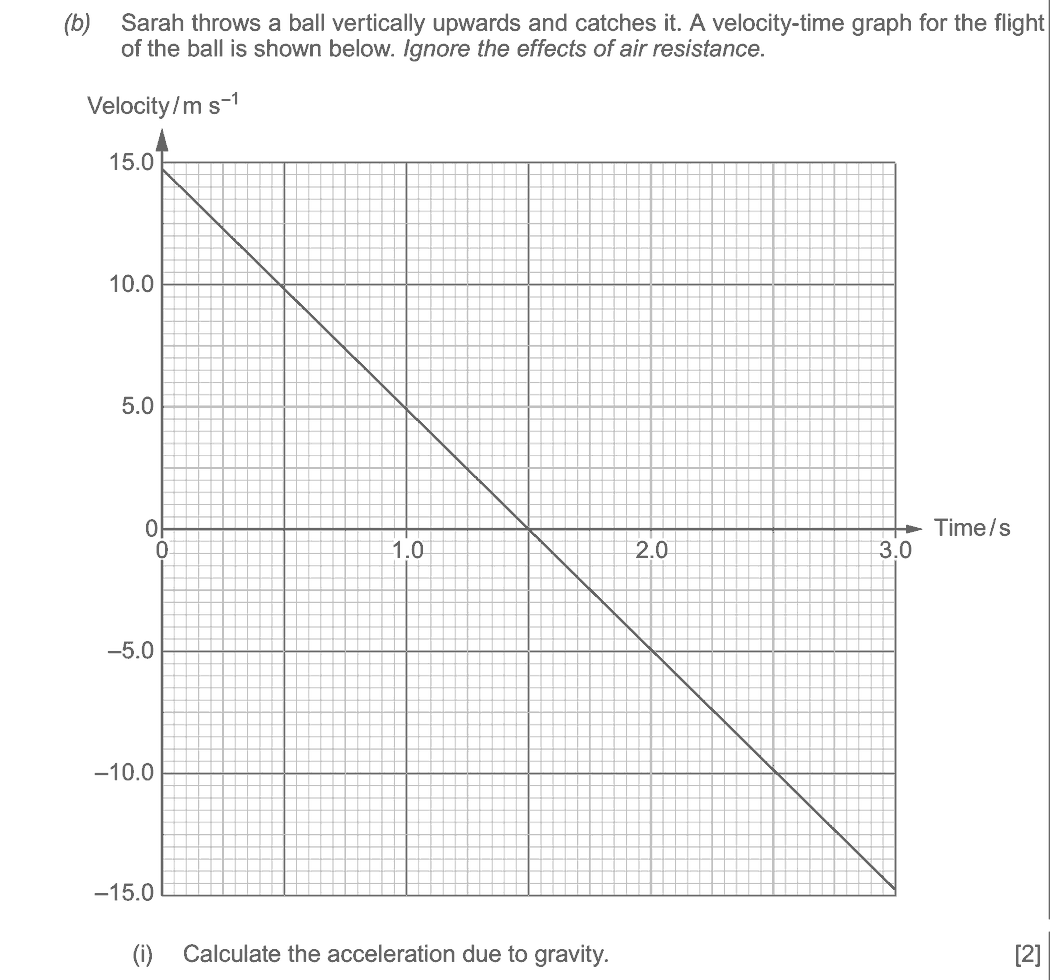
(b) Sarah throws a ball vertically upwards and catches it. A velocity-time graph for the flight of the ball is shown below. Ignore the effects of air resistance. Velocity / m s–1 15.0 10.0 5.0 0 Time / s 0 1.0 2.0 3.0 –5.0 –10.0 –15.0 (i) Calculate the acceleration due to gravity. [2]
June 2017 · AS Component 1 · Q2(b)(ii) 2 marks AO2=2 Calculation kinematics
Earlier parts of question 2 that this part usesEarlier part of June 2017 Component 1 question 2Earlier part of June 2017 Component 1 question 2
(ii) Calculate the maximum height of the ball from Sarah’s hand. [2]
June 2017 · AS Component 1 · Q2(b)(iii) 1 mark AO2=1 Short answer kinematics
Earlier parts of question 2 that this part usesEarlier part of June 2017 Component 1 question 2Earlier part of June 2017 Component 1 question 2
(iii) State the displacement of the ball from Sarah’s hand after 3 seconds. [1]
June 2017 · AS Component 1 · Q2(c) 4 marks AO3=4 Explanation kinematics
Earlier parts of question 2 that this part usesEarlier part of June 2017 Component 1 question 2Earlier part of June 2017 Component 1 question 2
(c) When Sarah was asked to sketch a displacement-time graph for the flight of the ball from the time it was first thrown until it was caught, she sketched the shape shown below. Evaluate whether you think she was correct. Further calculations are not required. [4] 12.0 Displacement / m 8.0 4.0 0.0 Time / s 0.0 1.0 2.0 3.0
June 2017 · AS Component 1 · Q3(a) 3 marks AO2=2, AO3=1 Explanation particles and nuclear structure
3. When colliding two protons at very high energy the following interaction has been observed at the large hadron collider in CERN. p + p → 2 H + e+ + x 1 (a) Use the conservation of lepton number and conservation of charge to identify the particle x. [3]
June 2017 · AS Component 1 · Q3(b) 2 marks AO1=2 Short answer particles and nuclear structure
Earlier part of question 3 that this part usesEarlier part of June 2017 Component 1 question 3
(b) State which force is responsible for this interaction. Give your reasoning. [2]
June 2017 · AS Component 1 · Q3(c) 2 marks AO1=2 Short answer particles and nuclear structure
Earlier part of question 3 that this part usesEarlier part of June 2017 Component 1 question 3
(c) State which of the above particles can be classed as: [2] (i) a baryon; (ii) an antiparticle.
June 2017 · AS Component 1 · Q3(d) 2 marks AO3=2 Explanation particles and nuclear structure
Earlier part of question 3 that this part usesEarlier part of June 2017 Component 1 question 3
(d) At present, countries in Europe contribute to funding research at CERN. Evaluate whether or not the money could be better spent on humanitarian aid. [2]
June 2017 · AS Component 1 · Q4(a)(i) 1 mark AO1=1 Definition radiation and stars
4. In this question the Sun and the star Vega can be considered to be black bodies. (a) (i) Define a black body. [1]
June 2017 · AS Component 1 · Q4(a)(ii) 3 marks AO1=1, AO2=2 Calculation radiation and stars
Earlier part of question 4 that this part usesEarlier part of June 2017 Component 1 question 4
(ii) The surface temperature of the Sun is approximately 6 000 K and that of Vega approximately 10 000 K. Calculate the wavelength of peak spectral intensity for each star and name the region of the electromagnetic spectrum within which they lie. [3]
June 2017 · AS Component 1 · Q4(a)(iii) 3 marks AO1=3 Diagram or graph radiation and stars
Earlier part of question 4 that this part usesEarlier part of June 2017 Component 1 question 4
(iii) Sketch a black body spectrum for each star on the axis provided. [3] Spectral intensity Wavelength
June 2017 · AS Component 1 · Q4(b) 4 marks AO1=2, AO2=2 Calculation radiation and stars
Earlier part of question 4 that this part usesEarlier part of June 2017 Component 1 question 4
(b) The radius of Vega is approximately 2.71 times that of the Sun. Determine the ratio: total power output of Vega total power output of Sun [4]
June 2017 · AS Component 1 · Q5(a)(i) 1 mark AO2=1 Practical and data analysis kinematics
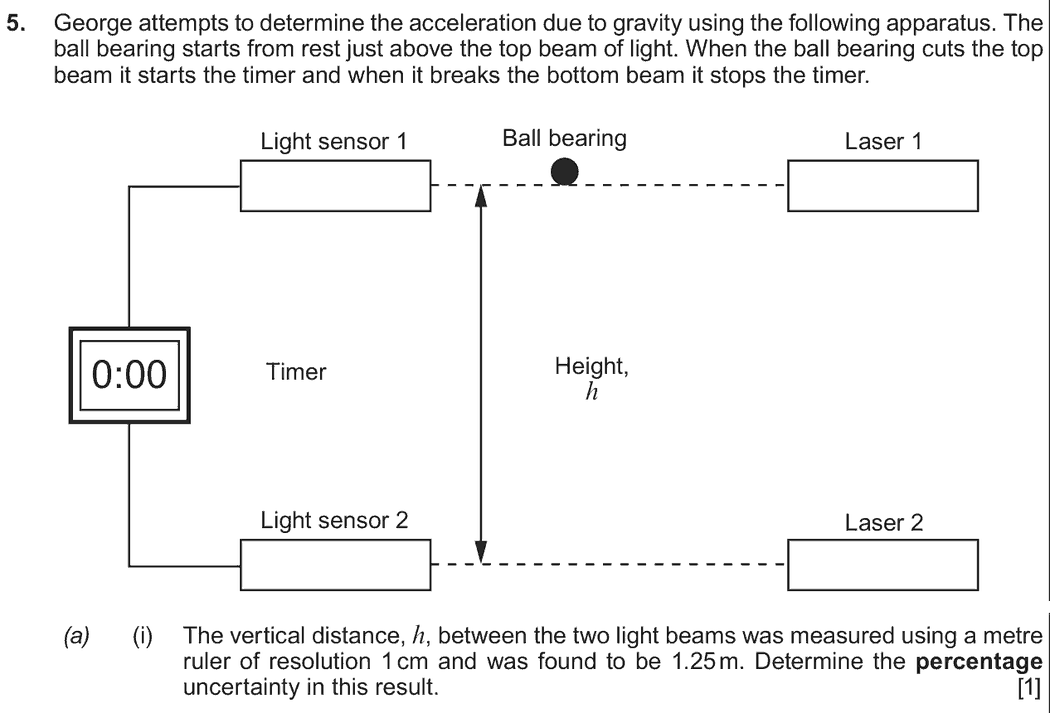
5. George attempts to determine the acceleration due to gravity using the following apparatus. The ball bearing starts from rest just above the top beam of light. When the ball bearing cuts the top beam it starts the timer and when it breaks the bottom beam it stops the timer. Light sensor 1 Ball bearing Laser 1 0:00 Height, Timer h Light sensor 2 Laser 2 (a) (i) The vertical distance, h, between the two light beams was measured using a metre ruler of resolution 1 cm and was found to be 1.25 m. Determine the percentage uncertainty in this result. [1]
June 2017 · AS Component 1 · Q5(a)(ii) 2 marks AO2=2 Practical and data analysis kinematics
Earlier part of question 5 that this part usesEarlier part of June 2017 Component 1 question 5
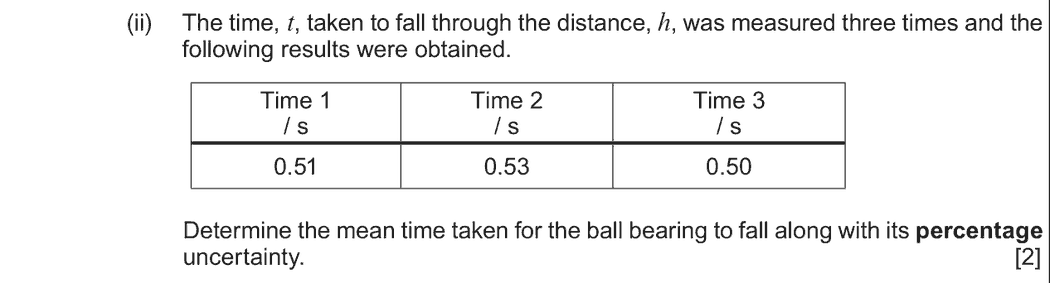
(ii) The time, t, taken to fall through the distance, h, was measured three times and the following results were obtained. Time 1 Time 2 Time 3 / s / s / s 0.51 0.53 0.50 Determine the mean time taken for the ball bearing to fall along with its percentage uncertainty. [2]
June 2017 · AS Component 1 · Q5(a)(iii) 4 marks AO2=4 Practical and data analysis kinematics
Earlier part of question 5 that this part usesEarlier part of June 2017 Component 1 question 5
(iii) Use the equation: gt2 h = 2 to determine a value for the acceleration due to gravity along with its absolute uncertainty. [4]
June 2017 · AS Component 1 · Q5(a)(iv) 1 mark AO3=1 Practical and data analysis kinematics
Earlier part of question 5 that this part usesEarlier part of June 2017 Component 1 question 5
(iv) State why the value you obtained in (a)(iii) is less than 9.81 m s–2. [1]
June 2017 · AS Component 1 · Q5(b)(i) 2 marks AO3=2 Practical and data analysis kinematics
Earlier part of question 5 that this part usesEarlier part of June 2017 Component 1 question 5
(b) (i) Annabel suggests that the experiment would be more accurate if times were obtained for the ball bearing to fall different vertical distances and a graph was drawn. Do you believe Annabel is correct? Justify your answer. [2]
June 2017 · AS Component 1 · Q5(b)(ii) 2 marks AO3=2 Practical and data analysis kinematics
Earlier parts of question 5 that this part usesEarlier part of June 2017 Component 1 question 5Earlier part of June 2017 Component 1 question 5
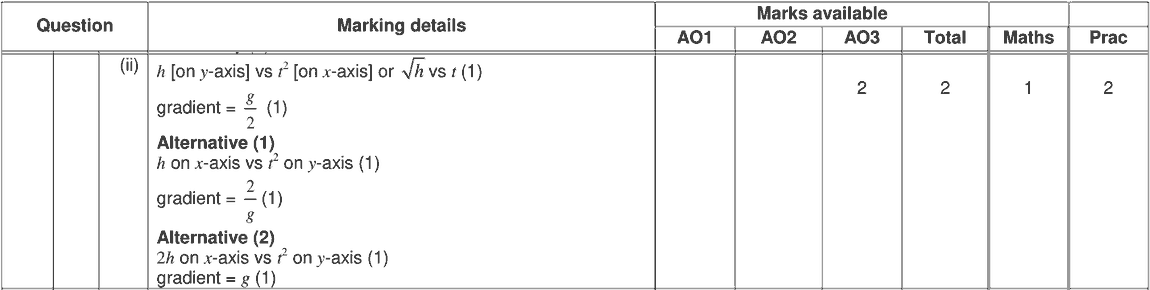
(ii) Explain which graph should be drawn to determine g and how it can be used to find a value for g. [2]
June 2017 · AS Component 1 · Q6(a) 2 marks AO1=2 Definition basic physics
6. (a) Explain, with the aid of a diagram, what is meant by the moment of a force about a point. [2]
June 2017 · AS Component 1 · Q6(b)(i) 3 marks AO2=3 Practical and data analysis basic physics
Earlier part of question 6 that this part usesEarlier part of June 2017 Component 1 question 6
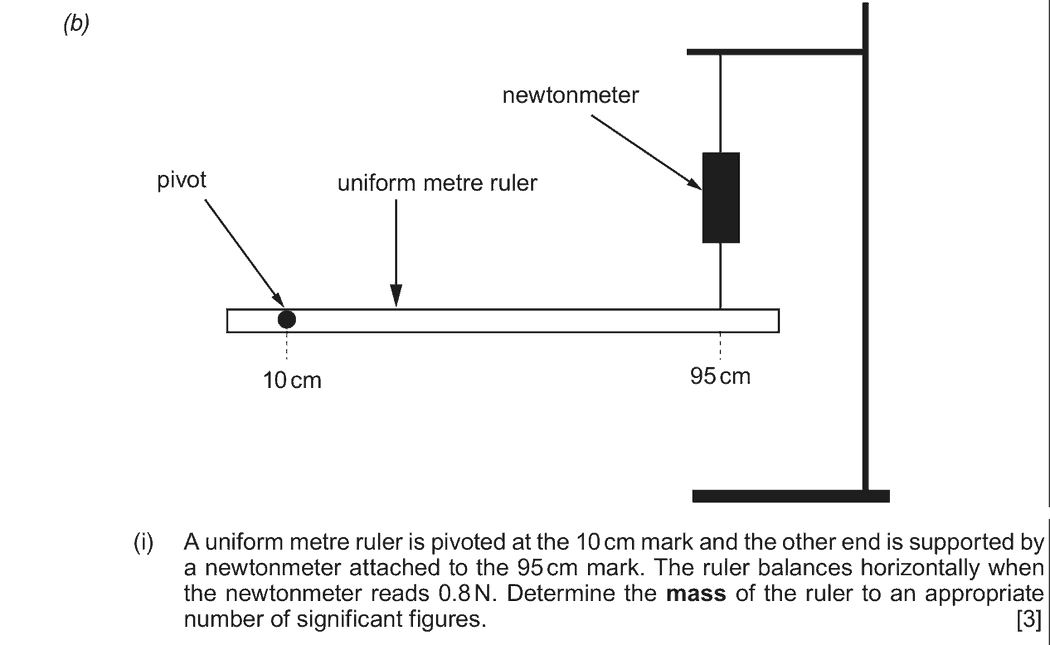
(b) newtonmeter pivot uniform metre ruler 10 cm 95 cm (i) A uniform metre ruler is pivoted at the 10 cm mark and the other end is supported by a newtonmeter attached to the 95 cm mark. The ruler balances horizontally when the newtonmeter reads 0.8 N. Determine the mass of the ruler to an appropriate number of significant figures. [3]
June 2017 · AS Component 1 · Q6(b)(ii)I 1 mark Practical and data analysis basic physics
Earlier parts of question 6 that this part usesEarlier part of June 2017 Component 1 question 6Earlier part of June 2017 Component 1 question 6
(ii) A mass of 0.5 kg is now added at the 70 cm mark on the ruler and the ruler is adjusted to be horizontal once more. I. How could you check the ruler is horizontal? [1]
June 2017 · AS Component 1 · Q6(b)(ii)II 2 marks Practical and data analysis basic physics
Earlier parts of question 6 that this part usesEarlier part of June 2017 Component 1 question 6Earlier part of June 2017 Component 1 question 6Earlier part of June 2017 Component 1 question 6
II. What is the new reading on the newtonmeter when the ruler is horizontal? [2]
June 2017 · AS Component 1 · Q6(c) 2 marks AO3=2 Practical and data analysis basic physics
Earlier parts of question 6 that this part usesEarlier part of June 2017 Component 1 question 6Earlier part of June 2017 Component 1 question 6
(c) If a uniform metre ruler of greater mass than the one in part (b) were used, describe how you could alter the apparatus so the ruler is horizontal once more. Explain your reasoning. [2]
June 2017 · AS Component 1 · Q7 6 marks AO1=2, AO2=4 6-mark extended response dynamics
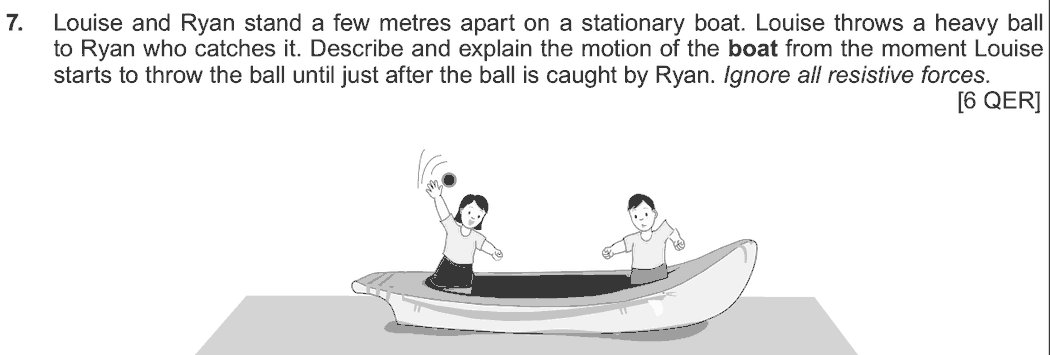
7. Louise and Ryan stand a few metres apart on a stationary boat. Louise throws a heavy ball to Ryan who catches it. Describe and explain the motion of the boat from the moment Louise starts to throw the ball until just after the ball is caught by Ryan. Ignore all resistive forces. [6 QER]

Work with an Eduqas physics tutor

Want a paper marked and gone through with you? Message us.

Prefer email? Send an enquiry

If you are under 18, please include a parent's contact details. Enquiries go to enquiries@physicsaleveltutor.com and are deleted once handled. All tutoring is online.