
June 2018: AS Component 1

75 marks · 31 question parts · Paper, mark scheme and report on Eduqas's site · Have the Data Booklet beside you

Question by question

QTopicMarksAOType
1(a)(i) Solids under stress 1AO1=1Practical and data analysis
1(a)(ii) Solids under stress 3AO1=1,AO2=2Calculation
1(a)(iii) Solids under stress 2AO3=2Practical and data analysis
1(a)(iv) Solids under stress 2AO1=1,AO2=1Calculation
1(b) Solids under stress 3AO1=3Explanation
2(a)(i) Basic physics: units, vectors and moments 2AO2=2Practical and data analysis
2(a)(ii) Basic physics: units, vectors and moments 3AO2=3Practical and data analysis
2(a)(iii) Basic physics: units, vectors and moments 2AO2=2Practical and data analysis
2(b) Basic physics: units, vectors and moments 4AO2=4Practical and data analysis
2(c) Basic physics: units, vectors and moments 2AO3=2Practical and data analysis
3(a) Kinematics 2AO1=1,AO2=1Show that
3(b) Energy concepts 3AO2=3Calculation
3(c)(i) Energy concepts 2AO1=1,AO2=1Calculation
3(c)(ii) Energy concepts 2AO2=2Calculation
3(c)(iii) Energy concepts 2AO1=2Short answer
3(d) Energy concepts 2AO3=2Explanation
4(a) Basic physics: units, vectors and moments 3AO1=2,AO2=1Show that
4(b)(i) Using radiation to investigate stars 4AO1=1,AO2=3Calculation
4(b)(ii) Using radiation to investigate stars 1AO3=1Short answer
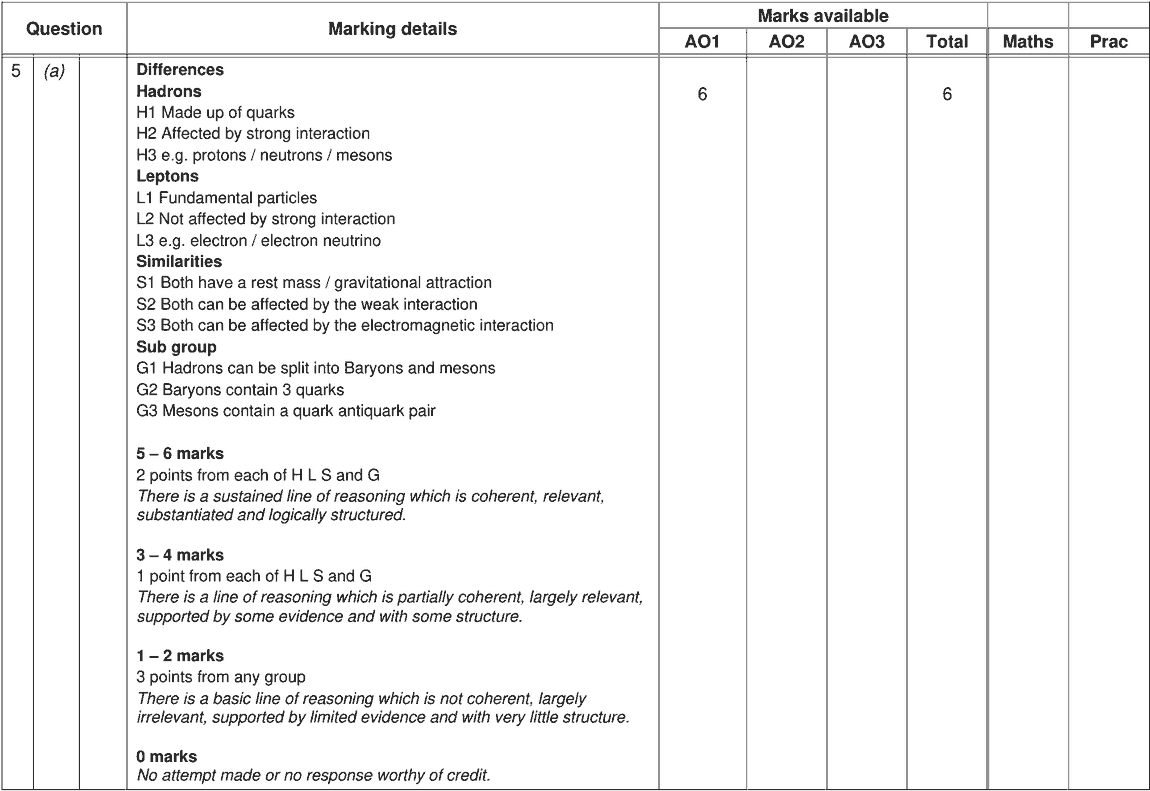
5(a) Particles and nuclear structure 6AO1=6Extended response
5(b)(i) Particles and nuclear structure 3AO2=3Explanation
5(b)(ii) Particles and nuclear structure 1AO2=1Short answer
5(b)(iii) Particles and nuclear structure 1AO1=1Short answer
6(a) Basic physics: units, vectors and moments 1AO1=1Definition
6(b)(i) Basic physics: units, vectors and moments 2AO1=1,AO2=1Calculation
6(b)(ii) Basic physics: units, vectors and moments 3AO3=3Calculation
6(b)(iii) Basic physics: units, vectors and moments 2AO1=2Short answer
7(a) Kinematics 2AO1=2Short answer
7(b)(i) Kinematics, Basic physics: units, vectors and moments 4AO2=4Show that
7(b)(ii) Kinematics 3AO3=3Calculation
7(b)(iii) Kinematics 2AO3=2Explanation

The questions

1(a)(i)1(a)(ii)1(a)(iii)1(a)(iv)1(b)2(a)(i)2(a)(ii)2(a)(iii)2(b)2(c)3(a)3(b)3(c)(i)3(c)(ii)3(c)(iii)3(d)4(a)4(b)(i)4(b)(ii)5(a)5(b)(i)5(b)(ii)5(b)(iii)6(a)6(b)(i)6(b)(ii)6(b)(iii)7(a)7(b)(i)7(b)(ii)7(b)(iii)
June 2018 · AS Component 1 · Q1(a)(i) 1 mark AO1=1 Practical and data analysis solids under stress
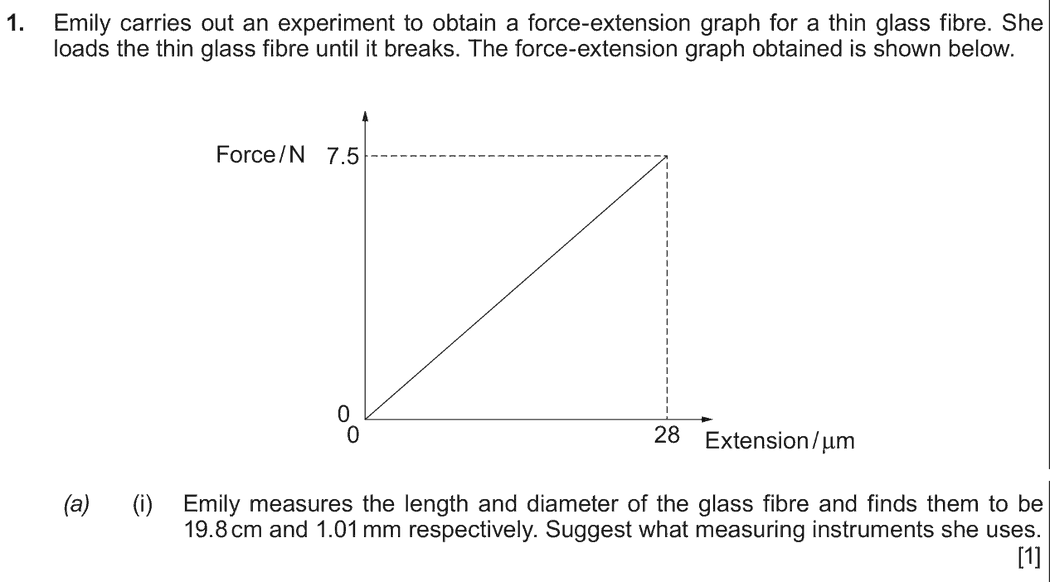
1. Emily carries out an experiment to obtain a force-extension graph for a thin glass fibre. She loads the thin glass fibre until it breaks. The force-extension graph obtained is shown below. Force / N 7.5 0 0 28 Extension / µm (a) (i) Emily measures the length and diameter of the glass fibre and finds them to be 19.8 cm and 1.01 mm respectively. Suggest what measuring instruments she uses. [1]
June 2018 · AS Component 1 · Q1(a)(ii) 3 marks AO1=1, AO2=2 Calculation solids under stress
Earlier part of question 1 that this part usesEarlier part of June 2018 Component 1 question 1
(ii) Determine the Young modulus of glass. [3]
June 2018 · AS Component 1 · Q1(a)(iii) 2 marks AO3=2 Practical and data analysis solids under stress
Earlier part of question 1 that this part usesEarlier part of June 2018 Component 1 question 1
(iii) Write a risk assessment for Emily’s experiment. [2]
June 2018 · AS Component 1 · Q1(a)(iv) 2 marks AO1=1, AO2=1 Calculation solids under stress
Earlier part of question 1 that this part usesEarlier part of June 2018 Component 1 question 1
(iv) Determine the energy stored in the glass just before breaking point is reached. [2]
June 2018 · AS Component 1 · Q1(b) 3 marks AO1=3 Explanation solids under stress
Earlier part of question 1 that this part usesEarlier part of June 2018 Component 1 question 1
(b) Glass is a brittle material. Describe the process by which glass fractures. [3]
June 2018 · AS Component 1 · Q2(a)(i) 2 marks AO2=2 Practical and data analysis basic physics
2. Xavi decides to use a rectangular piece of aluminium foil to determine the density of aluminium. He measured the width, w, and length, l, and obtained the following results: w = 20.0 ± 0.1 cm l = 30.0 ± 0.1 cm (a) (i) Determine the area of the foil along with its percentage uncertainty. [2]
June 2018 · AS Component 1 · Q2(a)(ii) 3 marks AO2=3 Practical and data analysis basic physics
Earlier part of question 2 that this part usesEarlier part of June 2018 Component 1 question 2
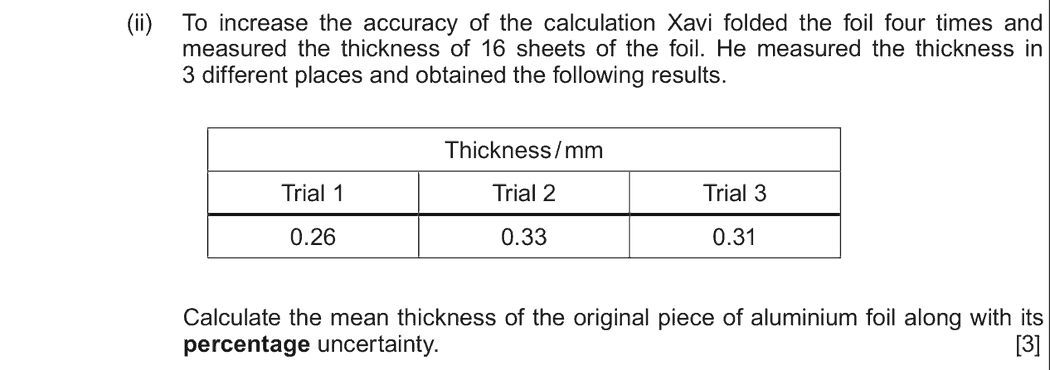
(ii) To increase the accuracy of the calculation Xavi folded the foil four times and measured the thickness of 16 sheets of the foil. He measured the thickness in 3 different places and obtained the following results. Thickness / mm Trial 1 Trial 2 Trial 3 0.26 0.33 0.31 Calculate the mean thickness of the original piece of aluminium foil along with its percentage uncertainty. [3]
June 2018 · AS Component 1 · Q2(a)(iii) 2 marks AO2=2 Practical and data analysis basic physics
Earlier part of question 2 that this part usesEarlier part of June 2018 Component 1 question 2
(iii) Determine the volume of the rectangular piece of aluminium foil along with its percentage uncertainty. [2]
June 2018 · AS Component 1 · Q2(b) 4 marks AO2=4 Practical and data analysis basic physics
Earlier part of question 2 that this part usesEarlier part of June 2018 Component 1 question 2
(b) The mass of the rectangular piece of aluminium foil was found to be 2.81 ± 0.01 g. Determine the density of aluminium along with its absolute uncertainty. [4]
June 2018 · AS Component 1 · Q2(c) 2 marks AO3=2 Practical and data analysis basic physics
Earlier part of question 2 that this part usesEarlier part of June 2018 Component 1 question 2
(c) State which of the measurements contributed most to the uncertainty in the calculation. Describe how you could reduce the uncertainty in this measurement to improve the results. [2]
June 2018 · AS Component 1 · Q3(a) 2 marks AO1=1, AO2=1 Show that kinematics
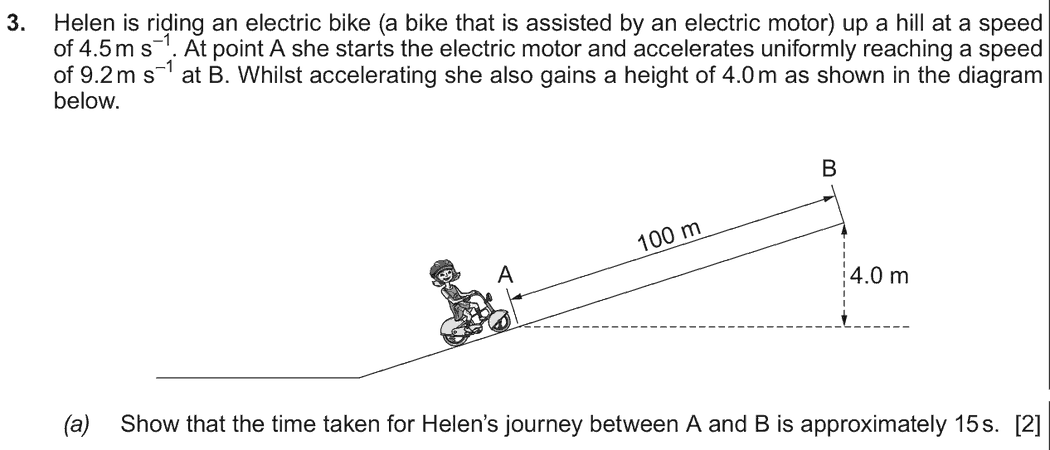
3. Helen is riding an electric bike (a bike that is assisted by an electric motor) up a hill at a speed of 4.5 m s–1. At point A she starts the electric motor and accelerates uniformly reaching a speed of 9.2 m s–1 at B. Whilst accelerating she also gains a height of 4.0 m as shown in the diagram below. B m 100 A 4.0 m (a) Show that the time taken for Helen’s journey between A and B is approximately 15 s. [2]
June 2018 · AS Component 1 · Q3(b) 3 marks AO2=3 Calculation energy concepts
Earlier part of question 3 that this part usesEarlier part of June 2018 Component 1 question 3
(b) Helen and the bike have a combined mass of 95 kg. Determine the gain in total energy between A and B. [3]
June 2018 · AS Component 1 · Q3(c)(i) 2 marks AO1=1, AO2=1 Calculation energy concepts
Earlier part of question 3 that this part usesEarlier part of June 2018 Component 1 question 3
(c) (i) If the bike’s electric motor operates at 36 V and 7.0 A calculate the electrical energy used by the motor between A and B. [2]
June 2018 · AS Component 1 · Q3(c)(ii) 2 marks AO2=2 Calculation energy concepts
Earlier parts of question 3 that this part usesEarlier part of June 2018 Component 1 question 3Earlier part of June 2018 Component 1 question 3
(ii) Helen, by pedalling, also provides 5 500 J of work between A and B. Determine the efficiency of the electric motor. Ignore all resistive forces on Helen and the bike. [2]
June 2018 · AS Component 1 · Q3(c)(iii) 2 marks AO1=2 Short answer energy concepts
Earlier parts of question 3 that this part usesEarlier part of June 2018 Component 1 question 3Earlier part of June 2018 Component 1 question 3
(iii) In practice resistive forces will act. Identify these forces and where they act. [2]
June 2018 · AS Component 1 · Q3(d) 2 marks AO3=2 Explanation energy concepts
Earlier part of question 3 that this part usesEarlier part of June 2018 Component 1 question 3
(d) Helen believes that by riding an electrically powered bike to the shops rather than using her car she is benefiting the environment. Explain whether or not Helen is correct. [2]
June 2018 · AS Component 1 · Q4(a) 3 marks AO1=2, AO2=1 Show that basic physics
4. (a) Stefan’s law can be written as: P = AσT 4 Show that Stefan’s constant, σ, has the base SI units of kg s–3 K–4. [3]
June 2018 · AS Component 1 · Q4(b)(i) 4 marks AO1=1, AO2=3 Calculation radiation and stars
Earlier part of question 4 that this part usesEarlier part of June 2018 Component 1 question 4
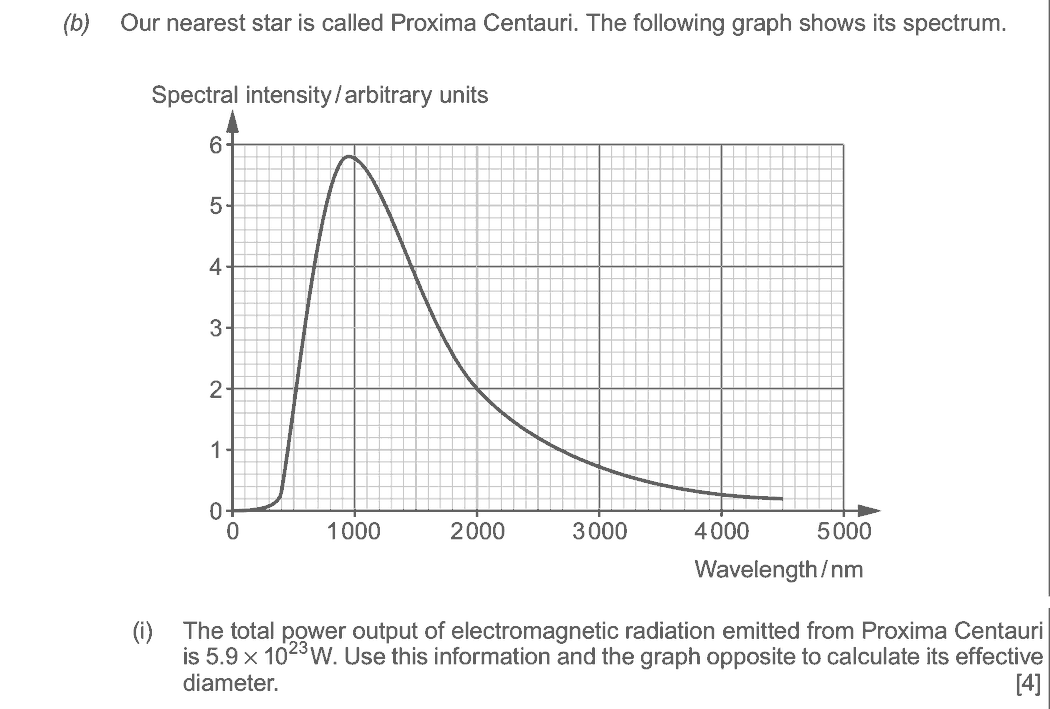
(b) Our nearest star is called Proxima Centauri. The following graph shows its spectrum. Spectral intensity / arbitrary units 6 5 4 3 2 1 0 0 1000 2000 3000 4000 5000 Wavelength / nm (i) The total power output of electromagnetic radiation emitted from Proxima Centauri is 5.9 × 10²³ W. Use this information and the graph opposite to calculate its effective diameter. [4]
June 2018 · AS Component 1 · Q4(b)(ii) 1 mark AO3=1 Short answer radiation and stars
Earlier parts of question 4 that this part usesEarlier part of June 2018 Component 1 question 4Earlier part of June 2018 Component 1 question 4
(ii) State what colour you would expect Proxima Centauri to appear and name the region of the electromagnetic spectrum in which most of the star’s power is radiated. [1]
June 2018 · AS Component 1 · Q5(a) 6 marks AO1=6 6-mark extended response particles and nuclear structure
5. (a) Subatomic particles can be classified as either hadrons or leptons. Giving examples of each, fully describe the differences and similarities between these two groups. Include the types of interaction they undergo and how one of the groups can be further sub divided. [6 QER]
June 2018 · AS Component 1 · Q5(b)(i) 3 marks AO2=3 Explanation particles and nuclear structure
Earlier part of question 5 that this part usesEarlier part of June 2018 Component 1 question 5
(b) Electron capture occurs when an electron interacts with a proton in the nucleus of an atom. The following interaction occurs: p + e– n + x (i) Identify the particle, x, explaining how you used the relevant conservation laws. [3]
June 2018 · AS Component 1 · Q5(b)(ii) 1 mark AO2=1 Short answer particles and nuclear structure
Earlier parts of question 5 that this part usesEarlier part of June 2018 Component 1 question 5Earlier part of June 2018 Component 1 question 5
(ii) Describe the change in quark flavour during electron capture. [1]
June 2018 · AS Component 1 · Q5(b)(iii) 1 mark AO1=1 Short answer particles and nuclear structure
Earlier parts of question 5 that this part usesEarlier part of June 2018 Component 1 question 5Earlier part of June 2018 Component 1 question 5
(iii) State and explain which interaction is responsible for this decay. [1]
June 2018 · AS Component 1 · Q6(a) 1 mark AO1=1 Definition basic physics
6. (a) State what is meant by the centre of gravity of an object. [1]
June 2018 · AS Component 1 · Q6(b)(i) 2 marks AO1=1, AO2=1 Calculation basic physics
Earlier part of question 6 that this part usesEarlier part of June 2018 Component 1 question 6
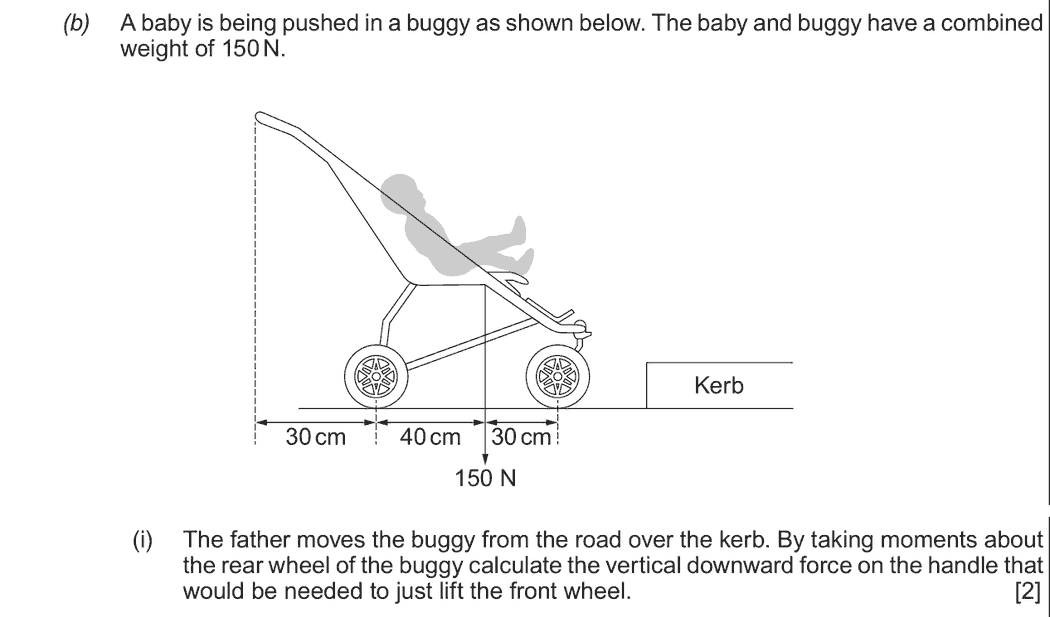
(b) A baby is being pushed in a buggy as shown below. The baby and buggy have a combined weight of 150 N. Kerb 30 cm 40 cm 30 cm 150 N (i) The father moves the buggy from the road over the kerb. By taking moments about the rear wheel of the buggy calculate the vertical downward force on the handle that would be needed to just lift the front wheel. [2]
June 2018 · AS Component 1 · Q6(b)(ii) 3 marks AO3=3 Calculation basic physics
Earlier parts of question 6 that this part usesEarlier part of June 2018 Component 1 question 6Earlier part of June 2018 Component 1 question 6
(ii) The father finds it a lot easier to turn the buggy around and, using the handle, lift the back wheel onto the kerb while keeping the front wheel on the ground. Explain why the father finds this new approach easier and justify your answer with a calculation. [3]
June 2018 · AS Component 1 · Q6(b)(iii) 2 marks AO1=2 Short answer basic physics
Earlier parts of question 6 that this part usesEarlier part of June 2018 Component 1 question 6Earlier part of June 2018 Component 1 question 6
(iii) Describe two ways in which you could alter the design of the buggy in order to make it more stable. [2]
June 2018 · AS Component 1 · Q7(a) 2 marks AO1=2 Short answer kinematics
7. (a) Ignoring the effects of air resistance, describe how, if at all, the vertical and horizontal components of a projectile’s velocity change during flight on Earth. [2]
June 2018 · AS Component 1 · Q7(b)(i) 4 marks AO2=4 Show that kinematicsbasic physics
Earlier part of question 7 that this part usesEarlier part of June 2018 Component 1 question 7
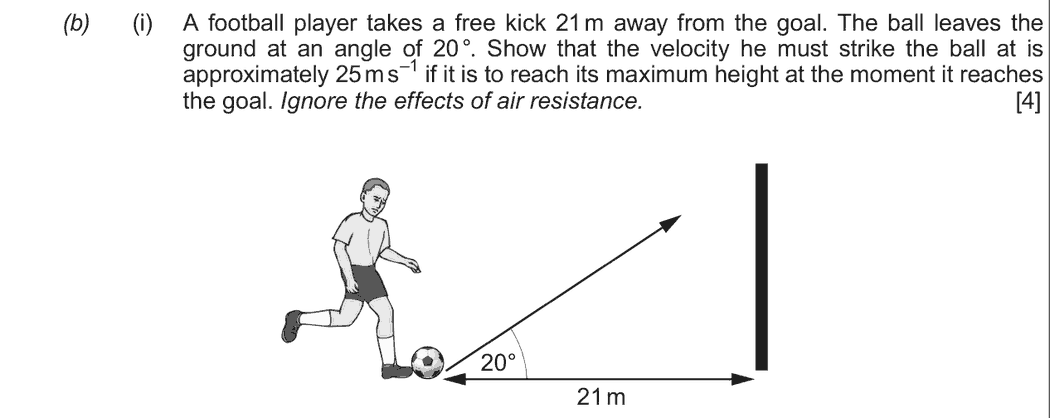
(b) (i) A football player takes a free kick 21 m away from the goal. The ball leaves the ground at an angle of 20 °. Show that the velocity he must strike the ball at is approximately 25 m s–1 if it is to reach its maximum height at the moment it reaches the goal. Ignore the effects of air resistance. [4] 20° 21 m
June 2018 · AS Component 1 · Q7(b)(ii) 3 marks AO3=3 Calculation kinematics
Earlier parts of question 7 that this part usesEarlier part of June 2018 Component 1 question 7Earlier part of June 2018 Component 1 question 7
(ii) The height of the cross bar is 2.44 m above the ground. Justify numerically whether the ball crosses the goal line above or below the bar. [3]
June 2018 · AS Component 1 · Q7(b)(iii) 2 marks AO3=2 Explanation kinematics
Earlier parts of question 7 that this part usesEarlier part of June 2018 Component 1 question 7Earlier part of June 2018 Component 1 question 7
(iii) Discuss how air resistance might affect the height at which the ball reaches the goal. [2]

Work with an Eduqas physics tutor

Want a paper marked and gone through with you? Message us.

Prefer email? Send an enquiry

If you are under 18, please include a parent's contact details. Enquiries go to enquiries@physicsaleveltutor.com and are deleted once handled. All tutoring is online.