June 2019: AS Component 2

75 marks · 25 question parts · Paper, mark scheme and report on Eduqas's site · Have the Data Booklet beside you

Question by question

QTopicMarksAOType
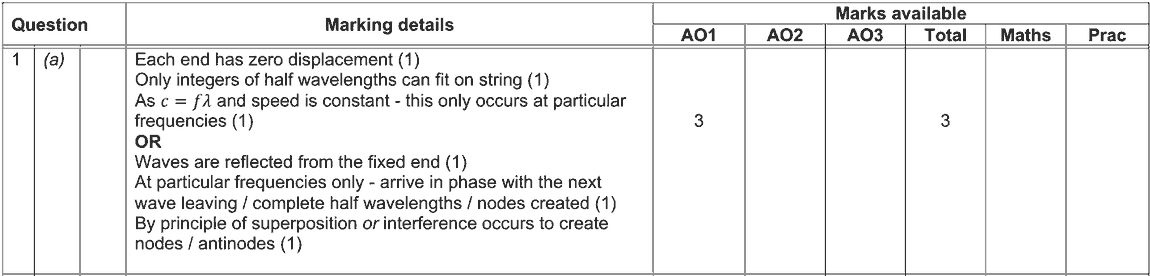
1(a) Wave properties: diffraction, interference and stationary waves 3AO1=3Explanation
1(b)(i) Wave properties: diffraction, interference and stationary waves, The nature of waves 3AO1=1,AO2=2Calculation
1(b)(ii) Wave properties: diffraction, interference and stationary waves 4AO2=4Calculation
2(a) The nature of waves, Wave properties: diffraction, interference and stationary waves 6AO1=2,AO3=4Extended response
2(b) The nature of waves 3AO3=3Short answer
3(a) Refraction of light 3AO1=2,AO2=1Explanation
3(b) Refraction of light 3AO1=1,AO2=2Calculation
4(a)(i) Resistance 3AO1=1,AO2=2Calculation
4(a)(ii) Resistance 4AO2=4Practical and data analysis
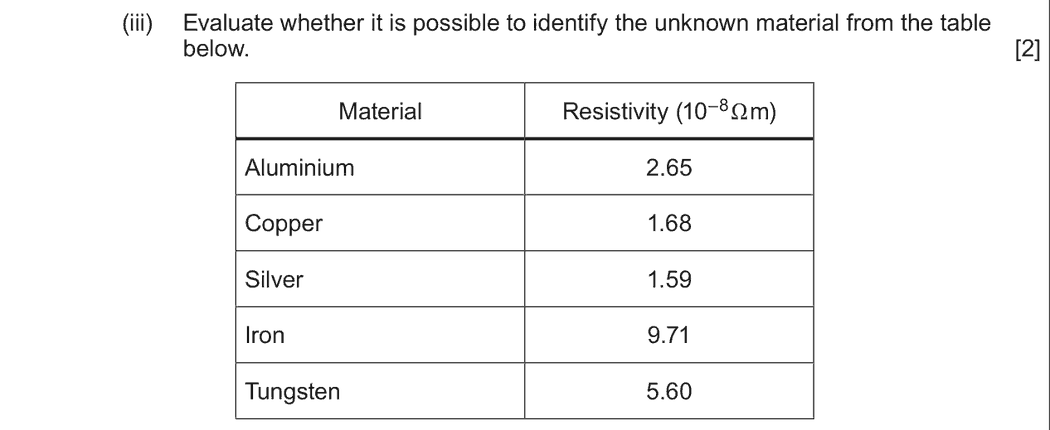
4(a)(iii) Resistance 2AO3=2Practical and data analysis
4(b)(i) Resistance, Conduction of electricity 4AO1=4Explanation
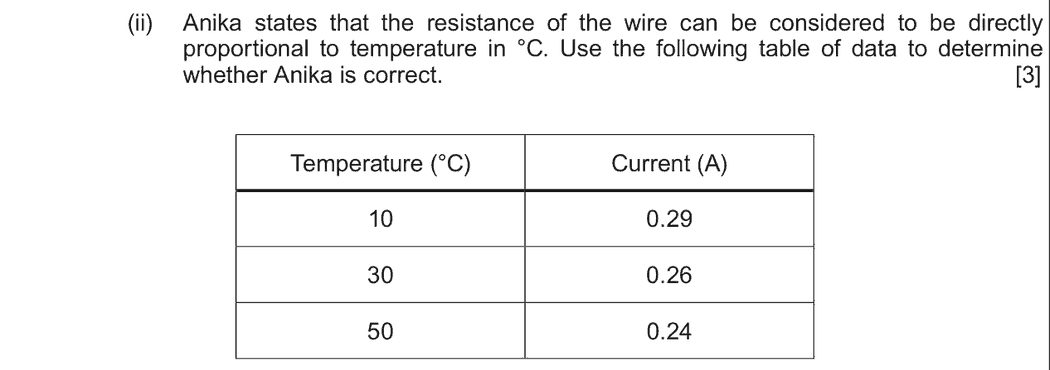
4(b)(ii) Resistance 3AO3=3Practical and data analysis
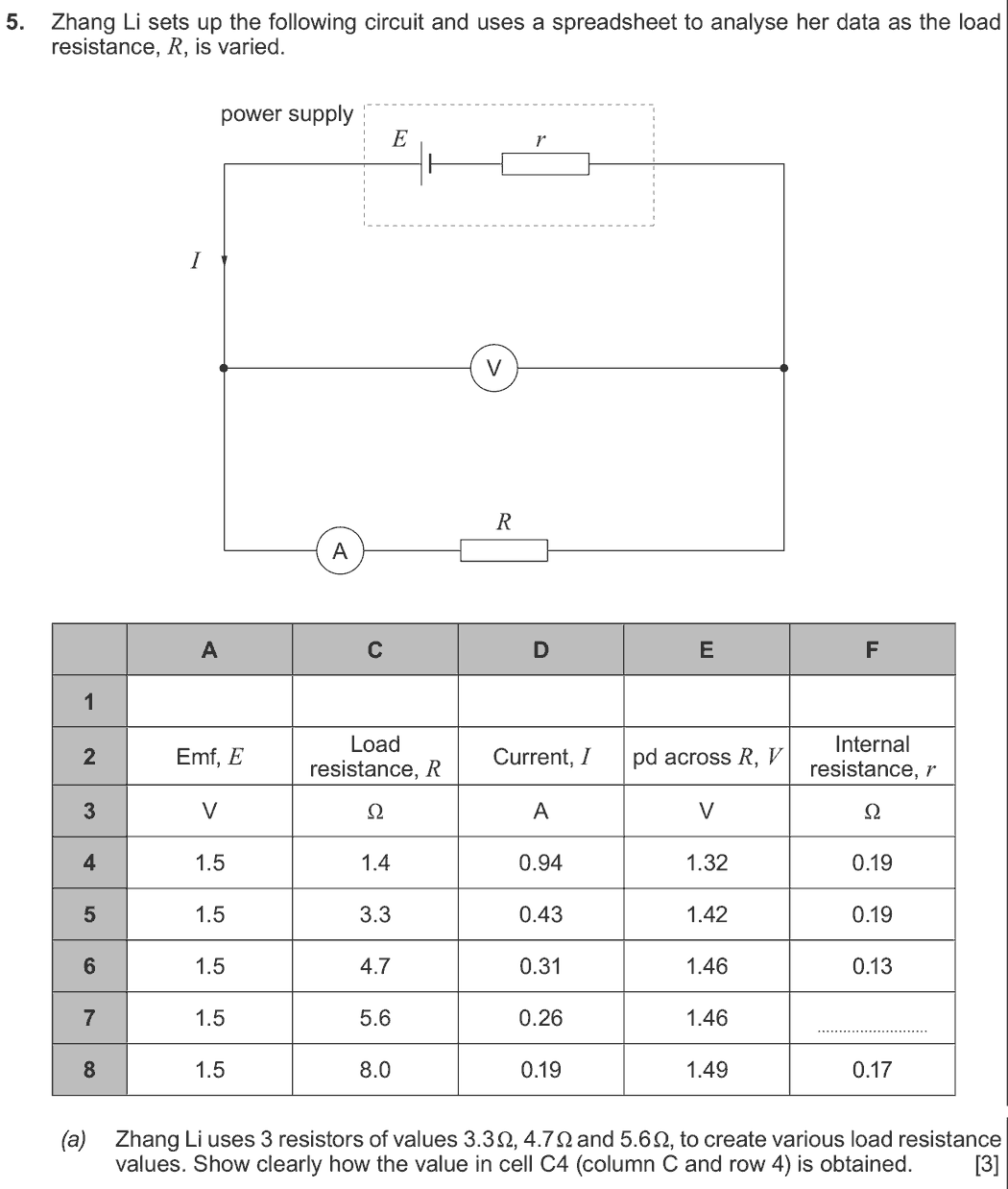
5(a) d.c. circuits 3AO1=1,AO2=2Show that
5(b)(i) d.c. circuits 6AO1=2,AO2=4Explanation
5(b)(ii) d.c. circuits 2AO1=1,AO2=1Calculation
5(b)(iii) Resistance 3AO1=1,AO2=2Calculation
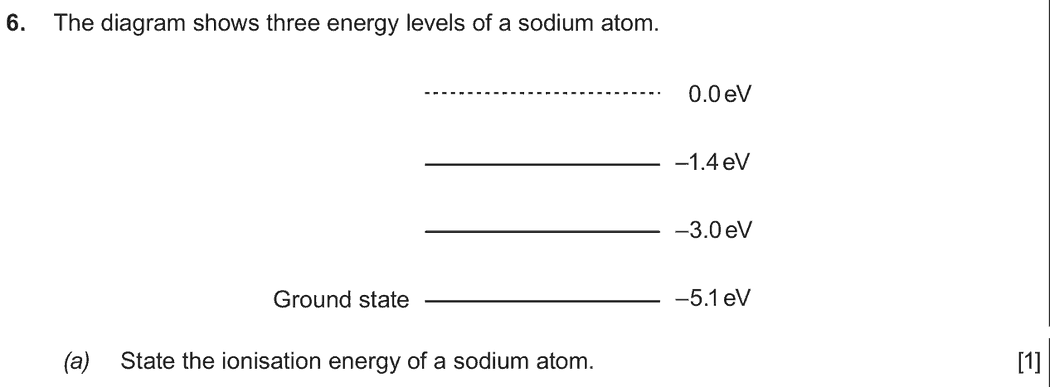
6(a) Photons 1AO1=1Short answer
6(b) Photons 3AO1=3Explanation
6(c)(i) Photons 3AO3=3Calculation
6(c)(ii) Photons 3AO1=1,AO2=2Calculation
7(a) Photons 2AO1=2Definition
7(b)(i) Photons 2AO2=2Calculation
7(b)(ii)I Photons 2AO2=2Calculation
7(b)(ii)II Photons 2AO2=2Diagram or graph
7(b)(ii)III Photons 2AO2=2Explanation

The questions

1(a)1(b)(i)1(b)(ii)2(a)2(b)3(a)3(b)4(a)(i)4(a)(ii)4(a)(iii)4(b)(i)4(b)(ii)5(a)5(b)(i)5(b)(ii)5(b)(iii)6(a)6(b)6(c)(i)6(c)(ii)7(a)7(b)(i)7(b)(ii)I7(b)(ii)II7(b)(ii)III
June 2019 · AS Component 2 · Q1(a) 3 marks AO1=3 Explanation wave properties
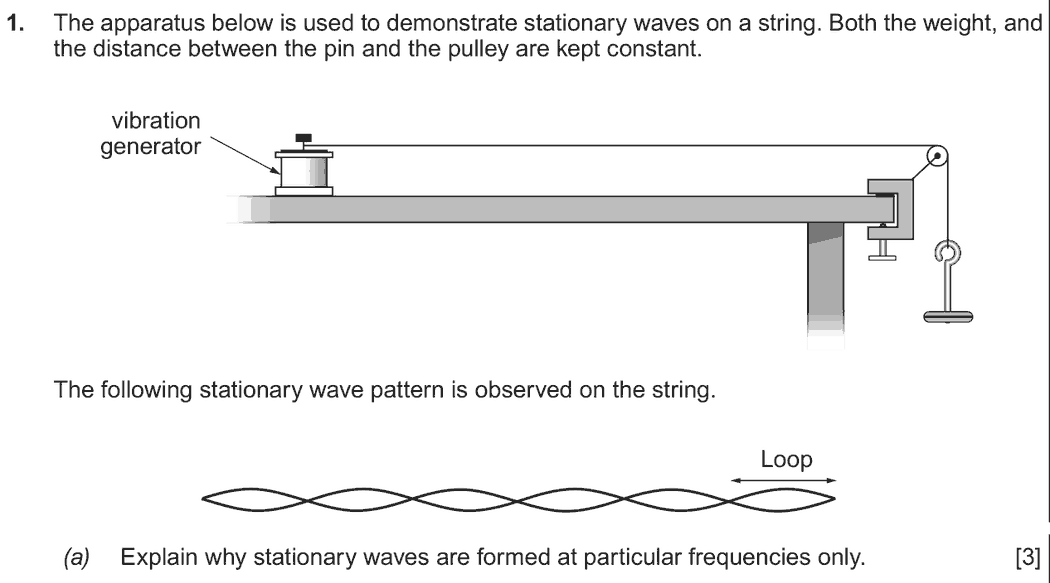
1. The apparatus below is used to demonstrate stationary waves on a string. Both the weight, and the distance between the pin and the pulley are kept constant. vibration generator The following stationary wave pattern is observed on the string. Loop (a) Explain why stationary waves are formed at particular frequencies only. [3]
June 2019 · AS Component 2 · Q1(b)(i) 3 marks AO1=1, AO2=2 Calculation wave propertiesnature of waves
Earlier part of question 1 that this part usesEarlier part of June 2019 Component 2 question 1
(b) Another stationary wave is formed when the frequency is 450 Hz and the length of each loop is 12.0 cm long. (i) Calculate the speed of the waves on the string. [3]
June 2019 · AS Component 2 · Q1(b)(ii) 4 marks AO2=4 Calculation wave properties
Earlier parts of question 1 that this part usesEarlier part of June 2019 Component 2 question 1Earlier part of June 2019 Component 2 question 1
(ii) At a higher frequency there are two more loops formed than at 450 Hz and each is of length 10.0 cm. Determine the number of loops observed at 450 Hz. [4]
June 2019 · AS Component 2 · Q2(a) 6 marks AO1=2, AO3=4 6-mark extended response nature of waveswave properties
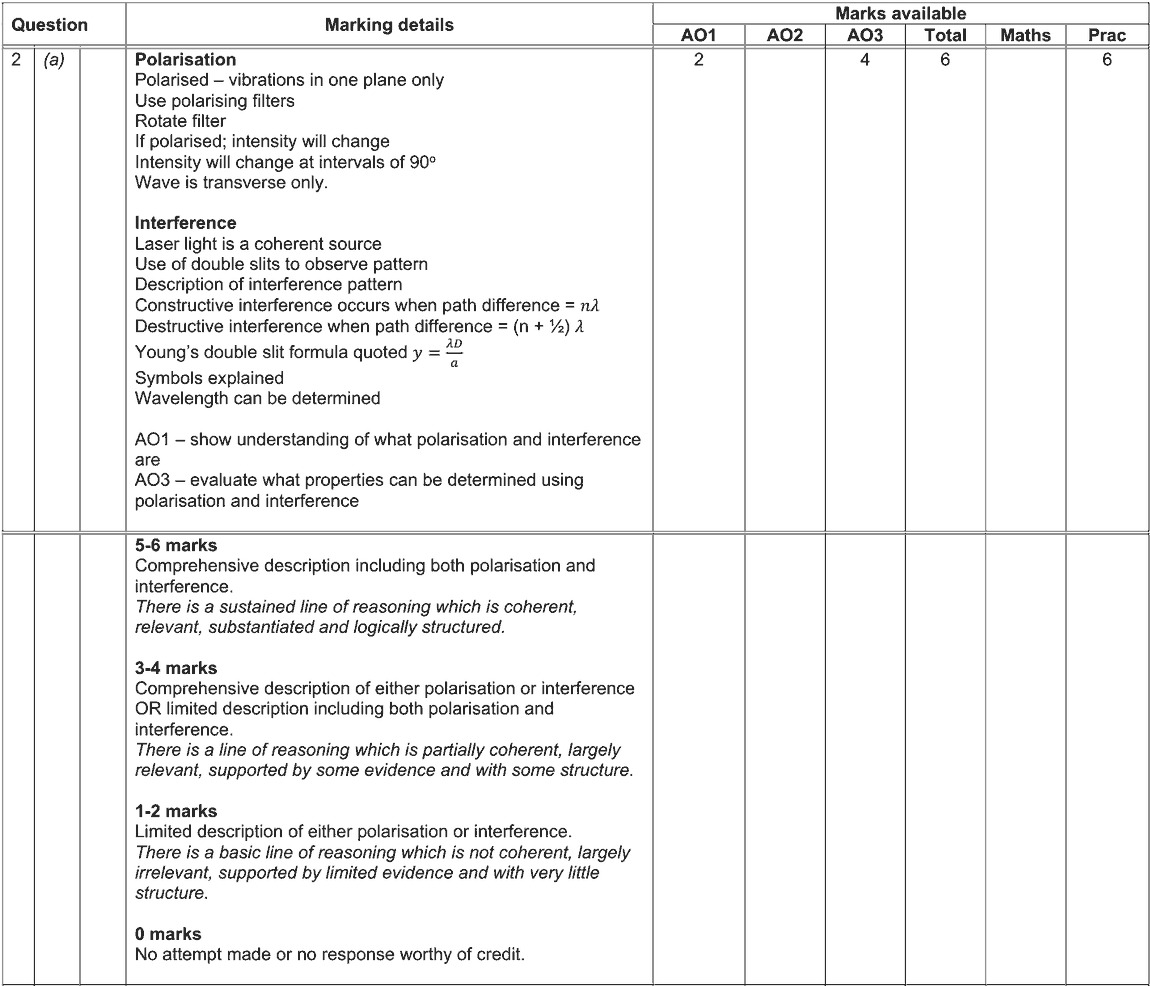
2. (a) Explain what properties of light from a laser can be determined using polarisation and interference. Give practical details. [6 QER]
June 2019 · AS Component 2 · Q2(b) 3 marks AO3=3 Short answer nature of waves
Earlier part of question 2 that this part usesEarlier part of June 2019 Component 2 question 2
(b) The polarisation of light is used in Liquid Crystal Display TVs. These have been developed from research into new organic materials. Discuss the importance of research and development into new materials, in general, by giving a benefit and an issue that may arise from using new materials. [3]
June 2019 · AS Component 2 · Q3(a) 3 marks AO1=2, AO2=1 Explanation refraction of light
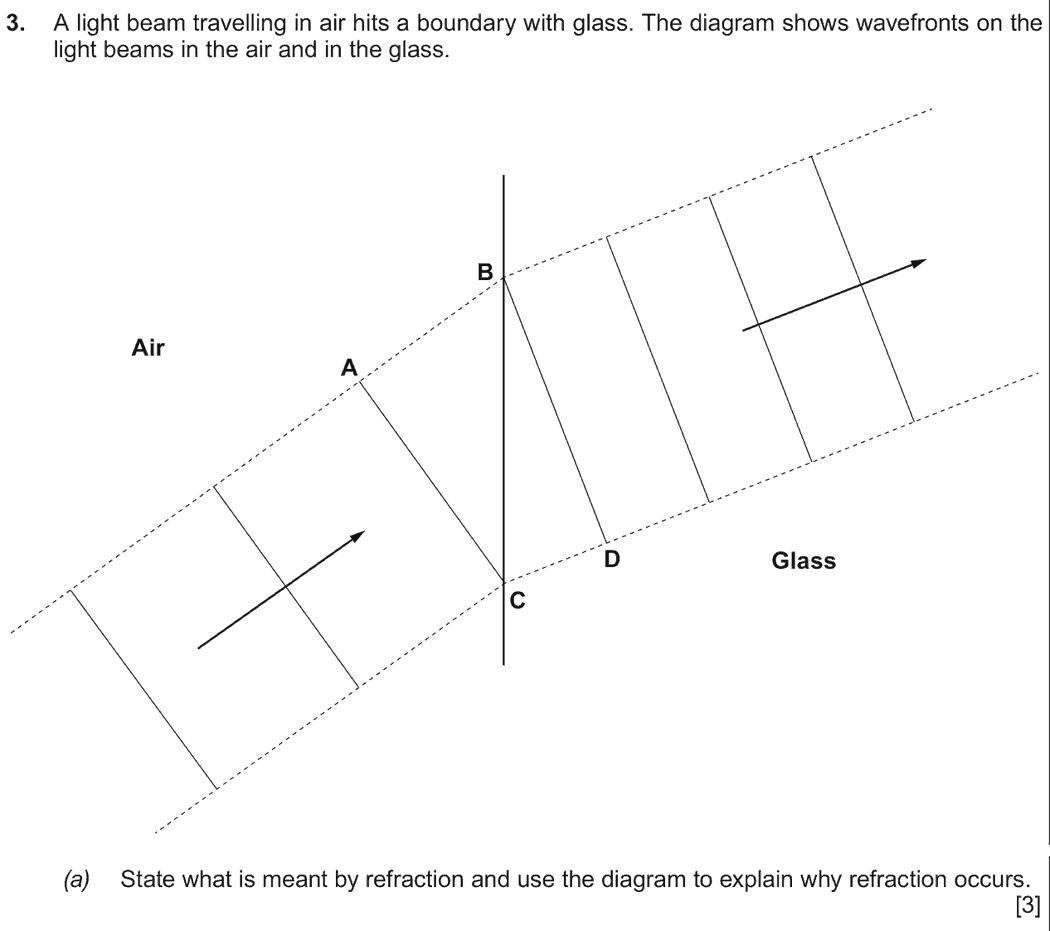
3. A light beam travelling in air hits a boundary with glass. The diagram shows wavefronts on the light beams in the air and in the glass. B Air A D Glass C (a) State what is meant by refraction and use the diagram to explain why refraction occurs. [3]
June 2019 · AS Component 2 · Q3(b) 3 marks AO1=1, AO2=2 Calculation refraction of light
Earlier part of question 3 that this part usesEarlier part of June 2019 Component 2 question 3
(b) By measuring appropriate lengths from the diagram calculate the speed of light in the glass. [3]
June 2019 · AS Component 2 · Q4(a)(i) 3 marks AO1=1, AO2=2 Calculation resistance
4. A length of wire of an unknown material is found at a crime scene. The diameter of the wire is measured as 0.28 ± 0.01 mm and its length 32.4 ± 0.1 cm. The resistance of the wire is measured as 0.085 ± 5 %. (a) (i) Calculate the resistivity of the material of the wire. [3]
June 2019 · AS Component 2 · Q4(a)(ii) 4 marks AO2=4 Practical and data analysis resistance
Earlier part of question 4 that this part usesEarlier part of June 2019 Component 2 question 4
(ii) Calculate the absolute uncertainty in the resistivity. [4]
June 2019 · AS Component 2 · Q4(a)(iii) 2 marks AO3=2 Practical and data analysis resistance
Earlier part of question 4 that this part usesEarlier part of June 2019 Component 2 question 4
(iii) Evaluate whether it is possible to identify the unknown material from the table below. [2] Material Resistivity (10–8 m) Aluminium 2.65 Copper 1.68 Silver 1.59 Iron 9.71 Tungsten 5.60
June 2019 · AS Component 2 · Q4(b)(i) 4 marks AO1=4 Explanation resistanceconduction of electricity
Earlier parts of question 4 that this part usesEarlier part of June 2019 Component 2 question 4Earlier part of June 2019 Component 2 question 4
(b) Anika applies a fixed potential difference of 6.0 V across a different piece of metal wire. At a temperature of 0 °C the current is found to be 0.30 A. At 50 °C the current is 0.24 A. (i) Explain in terms of electrons why the current is smaller at 50 °C than at 0 °C. [4]
June 2019 · AS Component 2 · Q4(b)(ii) 3 marks AO3=3 Practical and data analysis resistance
Earlier parts of question 4 that this part usesEarlier part of June 2019 Component 2 question 4Earlier part of June 2019 Component 2 question 4Earlier part of June 2019 Component 2 question 4
(ii) Anika states that the resistance of the wire can be considered to be directly proportional to temperature in °C. Use the following table of data to determine whether Anika is correct. [3] Temperature (°C) Current (A) 10 0.29 30 0.26 50 0.24
June 2019 · AS Component 2 · Q5(a) 3 marks AO1=1, AO2=2 Show that dc circuits
5. Zhang Li sets up the following circuit and uses a spreadsheet to analyse her data as the load resistance, R, is varied. power supply E r I V R A A C D E F 1 Load Internal 2 Emf, E Current, I pd across R, V resistance, R resistance, r 3 V A V 4 1.5 1.4 0.94 1.32 0.19 5 1.5 3.3 0.43 1.42 0.19 6 1.5 4.7 0.31 1.46 0.13 7 1.5 5.6 0.26 1.46 8 1.5 8.0 0.19 1.49 0.17 (a) Zhang Li uses 3 resistors of values 3.3 , 4.7 and 5.6 , to create various load resistance values. Show clearly how the value in cell C4 (column C and row 4) is obtained. [3]
June 2019 · AS Component 2 · Q5(b)(i) 6 marks AO1=2, AO2=4 Explanation dc circuits
Earlier part of question 5 that this part usesEarlier part of June 2019 Component 2 question 5
A4 – E4 (b) (i) Zhang Li uses the spreadsheet formula = to determine the internal D4 resistance in cell F4. Explain in terms of energy why this is a valid method. [6]
June 2019 · AS Component 2 · Q5(b)(ii) 2 marks AO1=1, AO2=1 Calculation dc circuits
Earlier parts of question 5 that this part usesEarlier part of June 2019 Component 2 question 5Earlier part of June 2019 Component 2 question 5
(ii) Determine the internal resistance value for cell F7. [2]
June 2019 · AS Component 2 · Q5(b)(iii) 3 marks AO1=1, AO2=2 Calculation resistance
Earlier parts of question 5 that this part usesEarlier part of June 2019 Component 2 question 5Earlier part of June 2019 Component 2 question 5
(iii) Zhang Li can choose between 4.7 resistors with power ratings of 0.25 W or 0.50 W. Justify, numerically, which resistor power rating she should use in the circuit. [3]
June 2019 · AS Component 2 · Q6(a) 1 mark AO1=1 Short answer photons
6. The diagram shows three energy levels of a sodium atom. 0.0 eV –1.4 eV –3.0 eV Ground state –5.1 eV (a) State the ionisation energy of a sodium atom. [1]
June 2019 · AS Component 2 · Q6(b) 3 marks AO1=3 Explanation photons
Earlier part of question 6 that this part usesEarlier part of June 2019 Component 2 question 6
(b) White light passes through a cloud of sodium atoms. The light which emerges is found to have the continuous spectrum of white light but with dark lines crossing the spectrum. State briefly how the dark lines are caused and what happens to the atoms in the process. [3]
June 2019 · AS Component 2 · Q6(c)(i) 3 marks AO3=3 Calculation photons
Earlier part of question 6 that this part usesEarlier part of June 2019 Component 2 question 6
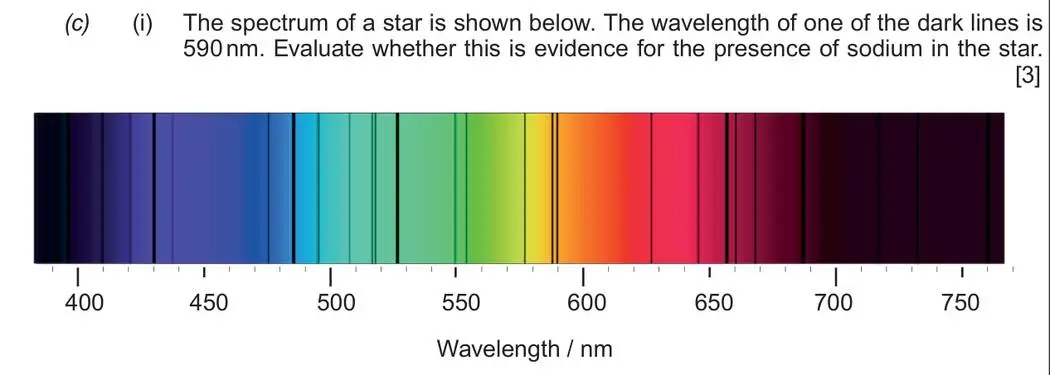
(c) (i) The spectrum of a star is shown below. The wavelength of one of the dark lines is 590 nm. Evaluate whether this is evidence for the presence of sodium in the star. [3] 400 450 500 550 600 650 700 750 Wavelength / nm
June 2019 · AS Component 2 · Q6(c)(ii) 3 marks AO1=1, AO2=2 Calculation photons
Earlier parts of question 6 that this part usesEarlier part of June 2019 Component 2 question 6Earlier part of June 2019 Component 2 question 6
(ii) The wavelength of peak emission of the star is 100 nm. Determine its surface temperature. [3]
June 2019 · AS Component 2 · Q7(a) 2 marks AO1=2 Definition photons
7. Einstein’s photoelectric equation can be written as Ek max = hf – φ (a) Explain what is meant by the term work function, φ . [2]
June 2019 · AS Component 2 · Q7(b)(i) 2 marks AO2=2 Calculation photons
Earlier part of question 7 that this part usesEarlier part of June 2019 Component 2 question 7
(b) (i) Light of frequency 7.3 × 1014 Hz is incident on a sodium surface at a rate of 2.5 × 10–10 J s–1. Determine the number of photons per second incident on the sodium surface. [2]
June 2019 · AS Component 2 · Q7(b)(ii)I 2 marks AO2=2 Calculation photons
Earlier parts of question 7 that this part usesEarlier part of June 2019 Component 2 question 7Earlier part of June 2019 Component 2 question 7
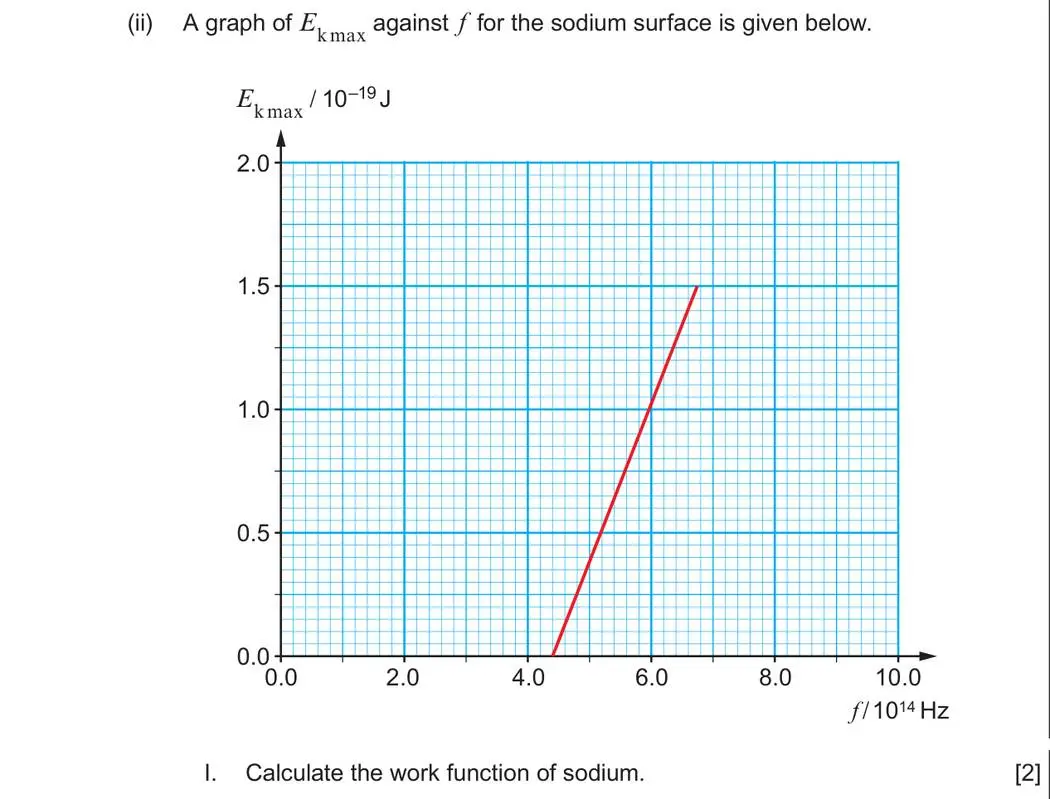
(ii) A graph of Ek max against f for the sodium surface is given below. Ek max / 10–19 J 2.0 1.5 1.0 0.5 0.0 0.0 2.0 4.0 6.0 8.0 10.0 f / 1014 Hz I. Calculate the work function of sodium. [2]
June 2019 · AS Component 2 · Q7(b)(ii)II 2 marks AO2=2 Diagram or graph photons
Earlier parts of question 7 that this part usesEarlier part of June 2019 Component 2 question 7Earlier part of June 2019 Component 2 question 7Earlier part of June 2019 Component 2 question 7
II. Draw a line on the graph to show how Ek max varies with f for a metal which has a greater work function than sodium. [2]
June 2019 · AS Component 2 · Q7(b)(ii)III 2 marks AO2=2 Explanation photons
Earlier parts of question 7 that this part usesEarlier part of June 2019 Component 2 question 7Earlier part of June 2019 Component 2 question 7Earlier part of June 2019 Component 2 question 7
III. The rate at which light falls on to the sodium surface is increased from 2.5 × 10–10 J s–1 to 3.0 × 10–10 J s–1. Explain clearly why the graph would not change. [2]

Work with an Eduqas physics tutor

Want a paper marked and gone through with you? Message us.

Prefer email? Send an enquiry

If you are under 18, please include a parent's contact details. Enquiries go to enquiries@physicsaleveltutor.com and are deleted once handled. All tutoring is online.