June 2022: AS Component 2

75 marks · 27 question parts · Paper, mark scheme and report on Eduqas's site · Have the Data Booklet beside you
Question by question

QTopicMarksAOType
1(a) The nature of waves 3AO1=3Explanation
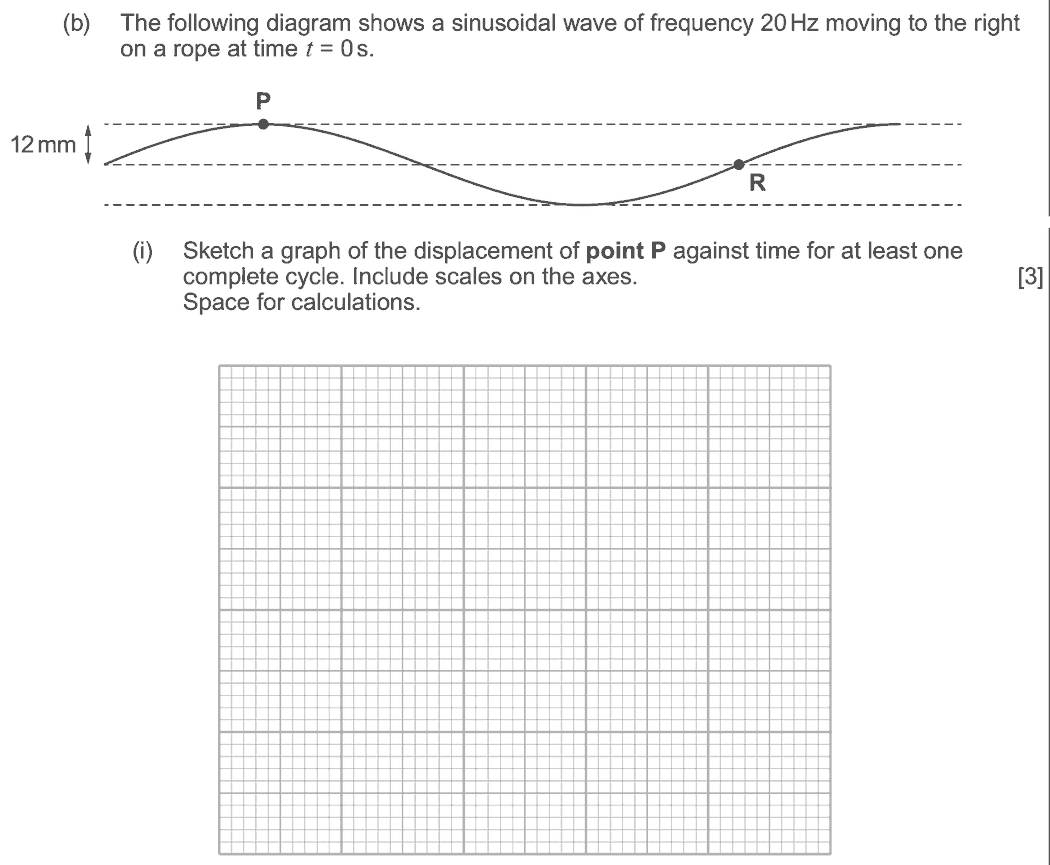
1(b)(i) The nature of waves 3AO2=3Diagram or graph
1(b)(ii) The nature of waves 2AO2=2Short answer
1(c)(i) Wave properties: diffraction, interference and stationary waves 2AO1=2Definition
1(c)(ii) Wave properties: diffraction, interference and stationary waves 3AO2=3Diagram or graph
2(a) Wave properties: diffraction, interference and stationary waves 1AO1=1Definition
2(b) Wave properties: diffraction, interference and stationary waves 3AO2=3Diagram or graph
2(c)(i) Wave properties: diffraction, interference and stationary waves 2AO1=1,AO2=1Show that
2(c)(ii) Wave properties: diffraction, interference and stationary waves 4AO1=2,AO2=2Practical and data analysis
2(d) Wave properties: diffraction, interference and stationary waves 4AO1=1,AO2=3Practical and data analysis
2(e) Wave properties: diffraction, interference and stationary waves 3AO3=3Practical and data analysis
3(a) Conduction of electricity 2AO1=1,AO2=1Calculation
3(b)(i) Resistance 1AO1=1Definition
3(b)(ii) Resistance 2AO1=1,AO2=1Calculation
3(c)(i) Resistance 2AO1=2Practical and data analysis
3(c)(ii) Resistance 6AO3=6Extended response
4(a) Photons 2AO1=2Short answer
4(b) Photons 4AO3=4Calculation
4(c) Lasers 4AO1=4Explanation
4(d)(i) Photons 2AO2=2Show that
4(d)(ii) Photons 3AO1=1,AO2=2Calculation
4(d)(iii) Photons 3AO1=1,AO2=2Calculation
4(e) Photons 2AO3=2Explanation
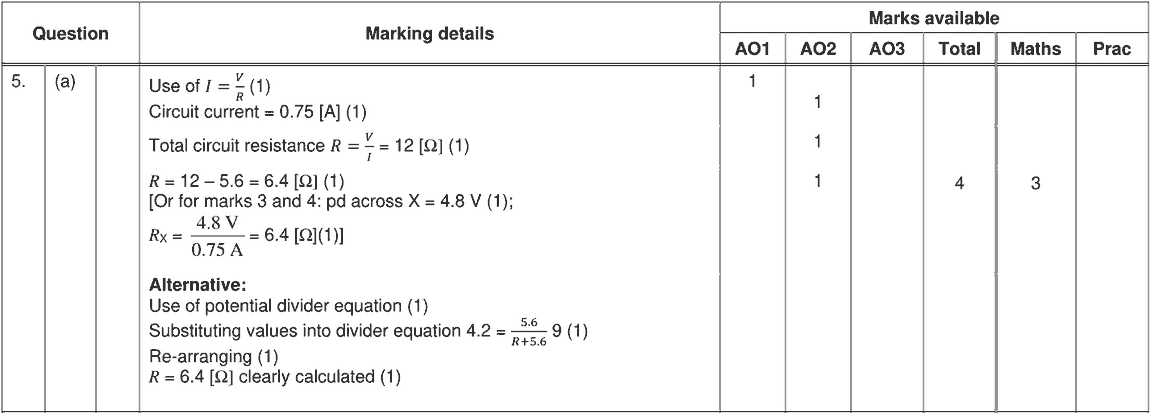
5(a) d.c. circuits, Resistance 4AO1=1,AO2=3Show that
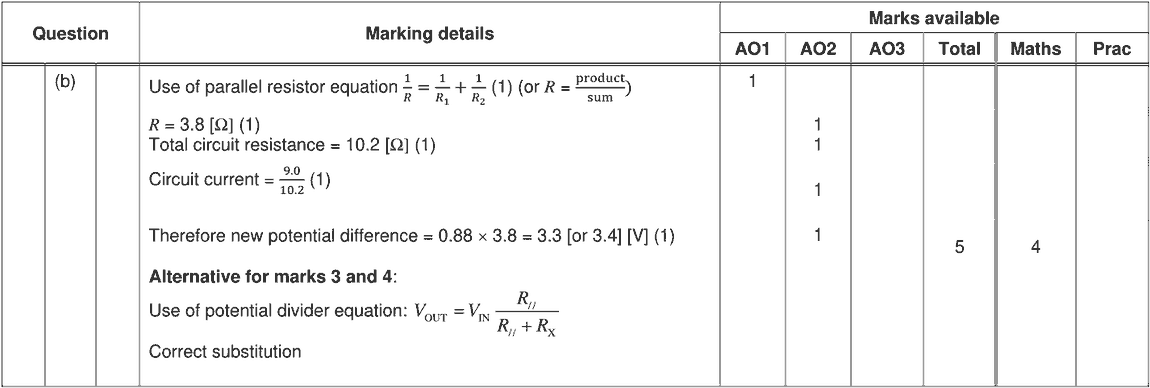
5(b) d.c. circuits 5AO1=1,AO2=4Calculation
5(c) d.c. circuits, Resistance 2AO2=2Explanation
5(d) Resistance 1AO1=1Short answer

The questions

1(a)1(b)(i)1(b)(ii)1(c)(i)1(c)(ii)2(a)2(b)2(c)(i)2(c)(ii)2(d)2(e)3(a)3(b)(i)3(b)(ii)3(c)(i)3(c)(ii)4(a)4(b)4(c)4(d)(i)4(d)(ii)4(d)(iii)4(e)5(a)5(b)5(c)5(d)
June 2022 · AS Component 2 · Q1(a) 3 marks AO1=3 Explanation nature of waves
1. (a) Waves may be described as being either transverse or longitudinal. Explain the difference between the two types of waves. [3]
June 2022 · AS Component 2 · Q1(b)(i) 3 marks AO2=3 Diagram or graph nature of waves
Earlier part of question 1 that this part usesEarlier part of June 2022 Component 2 question 1
(b) The following diagram shows a sinusoidal wave of frequency 20 Hz moving to the right on a rope at time t = 0 s. P 12 mm R (i) Sketch a graph of the displacement of point P against time for at least one complete cycle. Include scales on the axes. [3] Space for calculations.
June 2022 · AS Component 2 · Q1(b)(ii) 2 marks AO2=2 Short answer nature of waves
Earlier parts of question 1 that this part usesEarlier part of June 2022 Component 2 question 1Earlier part of June 2022 Component 2 question 1
(ii) Compare the motions of points P and R on the rope. [2]
June 2022 · AS Component 2 · Q1(c)(i) 2 marks AO1=2 Definition wave properties
Earlier parts of question 1 that this part usesEarlier part of June 2022 Component 2 question 1Earlier part of June 2022 Component 2 question 1
(c) (i) State the principle of superposition. [2]
June 2022 · AS Component 2 · Q1(c)(ii) 3 marks AO2=3 Diagram or graph wave properties
Earlier parts of question 1 that this part usesEarlier part of June 2022 Component 2 question 1Earlier part of June 2022 Component 2 question 1Earlier part of June 2022 Component 2 question 1
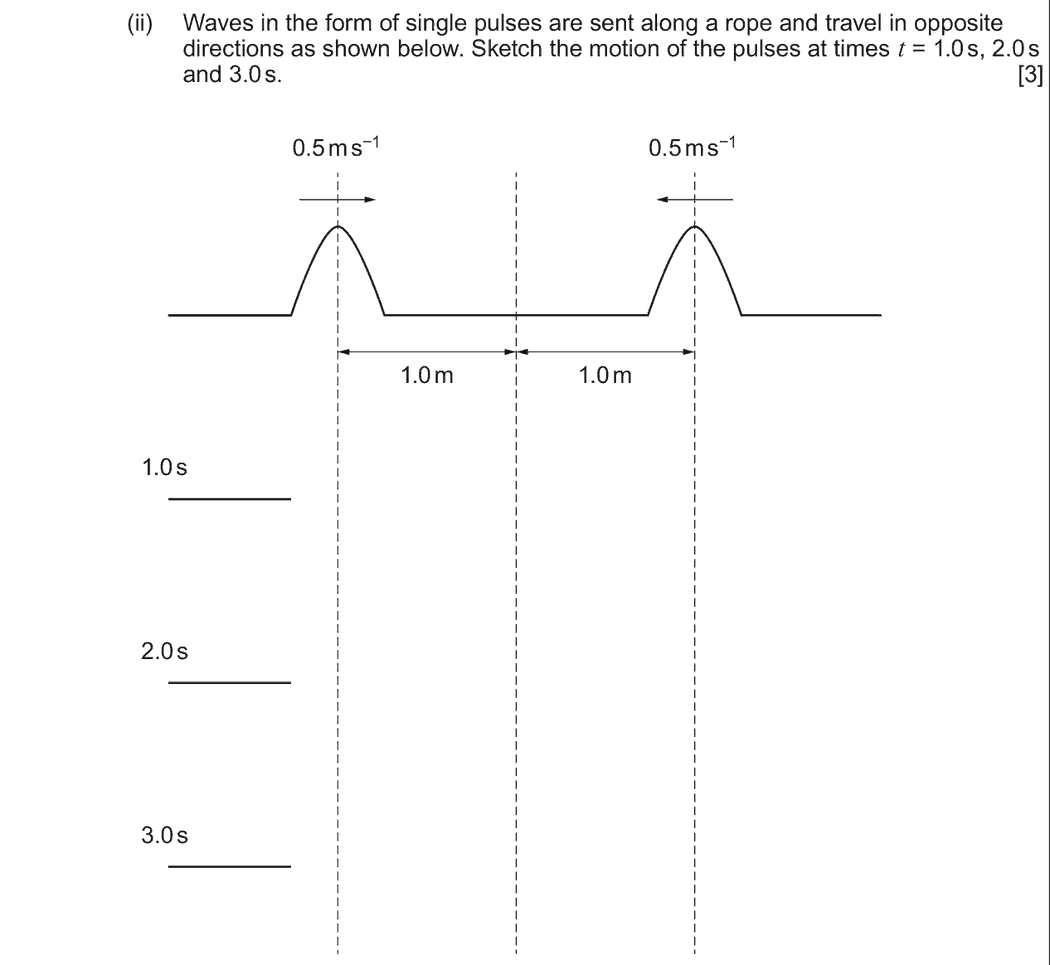
(ii) Waves in the form of single pulses are sent along a rope and travel in opposite directions as shown below. Sketch the motion of the pulses at times t = 1.0 s, 2.0 s and 3.0 s. [3] 0.5 m s−1 0.5 m s−1 1.0 m 1.0 m 1.0 s 2.0 s 3.0 s
June 2022 · AS Component 2 · Q2(a) 1 mark AO1=1 Definition wave properties
2. (a) Explain the term diffraction. [1]
June 2022 · AS Component 2 · Q2(b) 3 marks AO2=3 Diagram or graph wave properties
Earlier part of question 2 that this part usesEarlier part of June 2022 Component 2 question 2
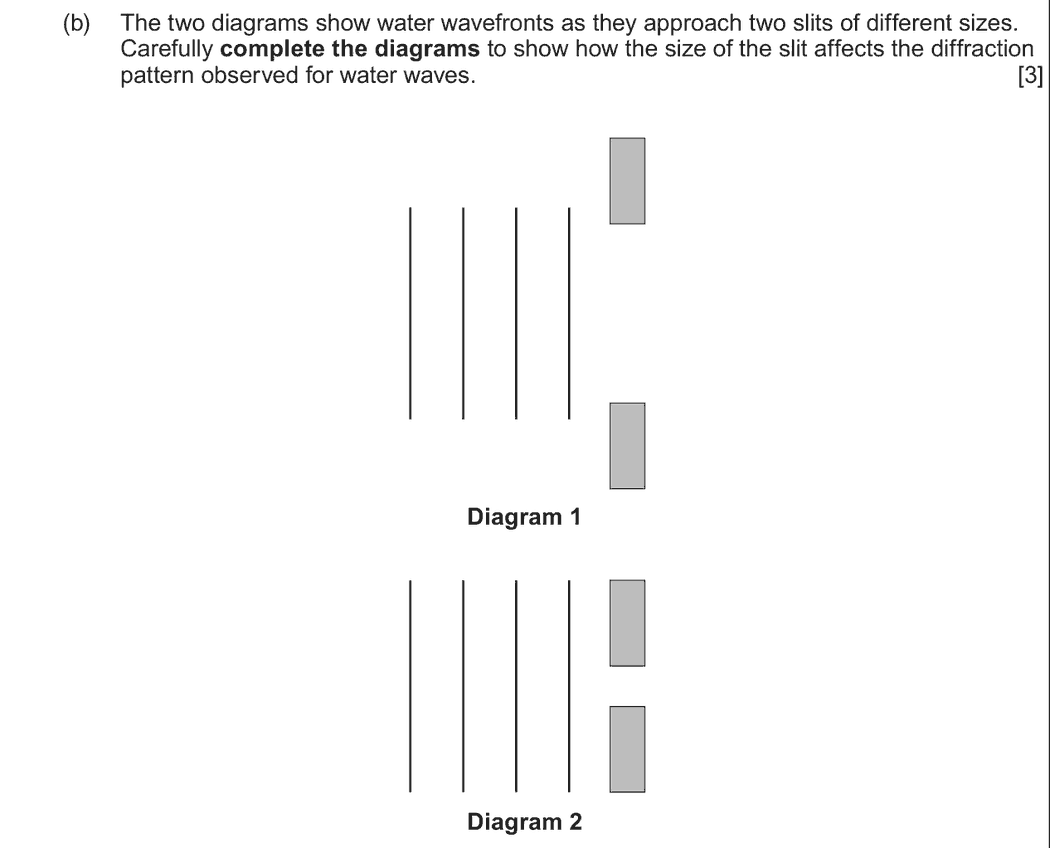
(b) The two diagrams show water wavefronts as they approach two slits of different sizes. Carefully complete the diagrams to show how the size of the slit affects the diffraction pattern observed for water waves. [3] Diagram 1 Diagram 2
June 2022 · AS Component 2 · Q2(c)(i) 2 marks AO1=1, AO2=1 Show that wave properties
Earlier parts of question 2 that this part usesEarlier part of June 2022 Component 2 question 2Earlier part of June 2022 Component 2 question 2
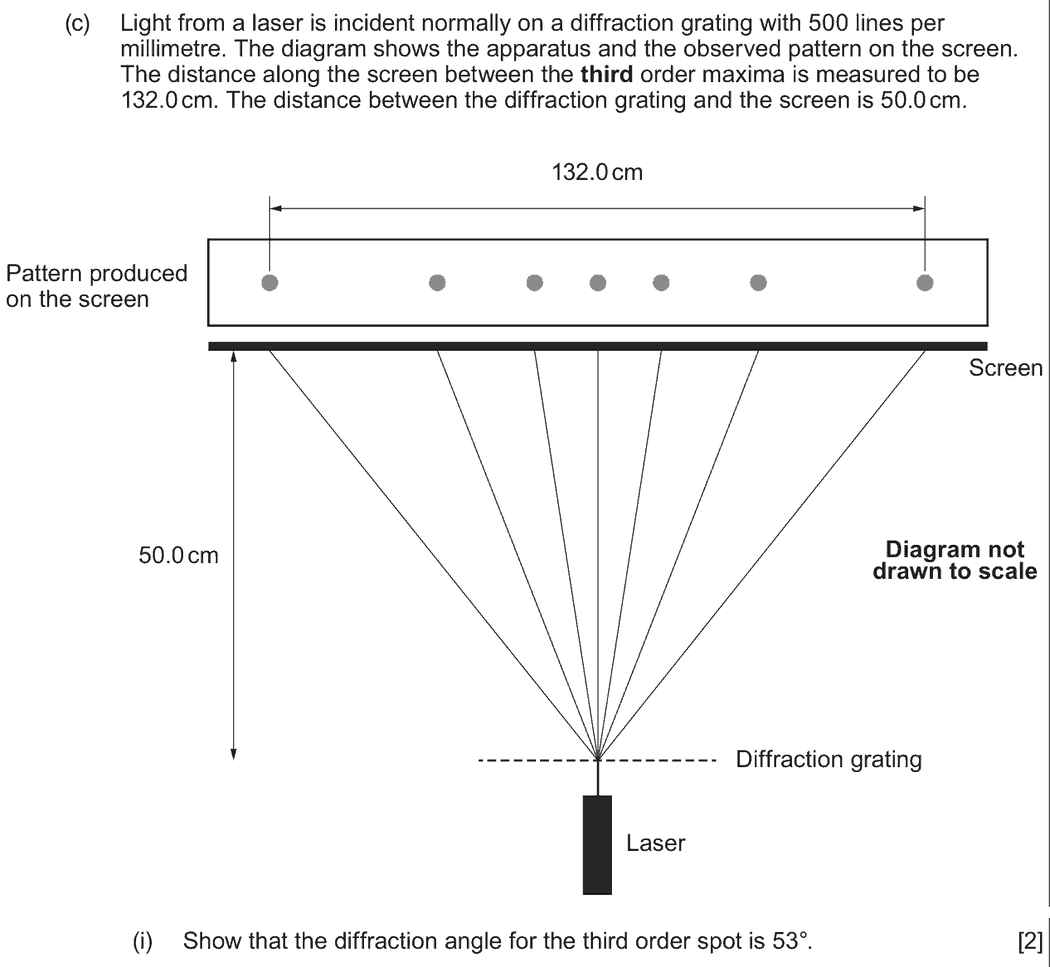
(c) Light from a laser is incident normally on a diffraction grating with 500 lines per millimetre. The diagram shows the apparatus and the observed pattern on the screen. The distance along the screen between the third order maxima is measured to be 132.0 cm. The distance between the diffraction grating and the screen is 50.0 cm. 132.0 cm Pattern produced on the screen Screen 50.0 cm Diagram not drawn to scale Diffraction grating Laser (i) Show that the diffraction angle for the third order spot is 53°. [2]
June 2022 · AS Component 2 · Q2(c)(ii) 4 marks AO1=2, AO2=2 Practical and data analysis wave properties
Earlier parts of question 2 that this part usesEarlier part of June 2022 Component 2 question 2Earlier part of June 2022 Component 2 question 2Earlier part of June 2022 Component 2 question 2
(ii) Calculate the wavelength of the laser light. [4]
June 2022 · AS Component 2 · Q2(d) 4 marks AO1=1, AO2=3 Practical and data analysis wave properties
Earlier parts of question 2 that this part usesEarlier part of June 2022 Component 2 question 2Earlier part of June 2022 Component 2 question 2Earlier part of June 2022 Component 2 question 2
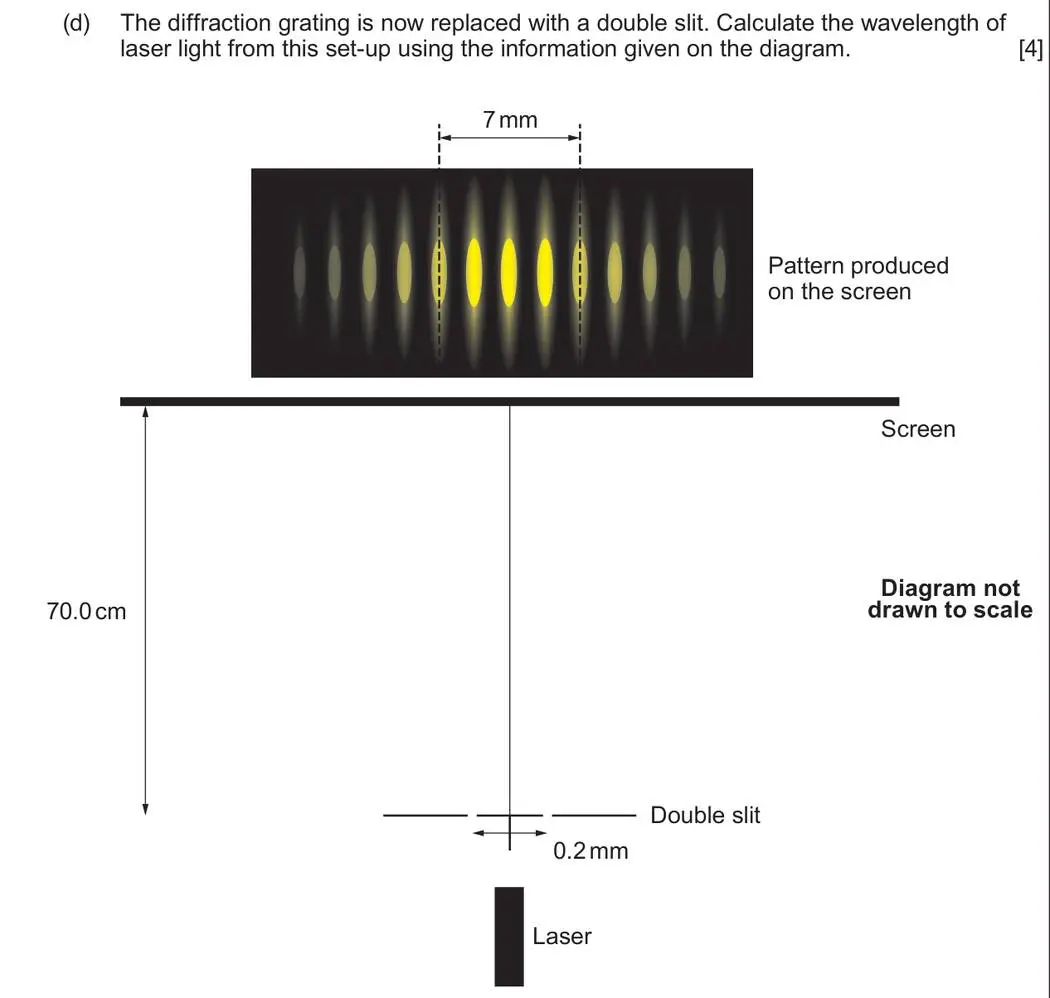
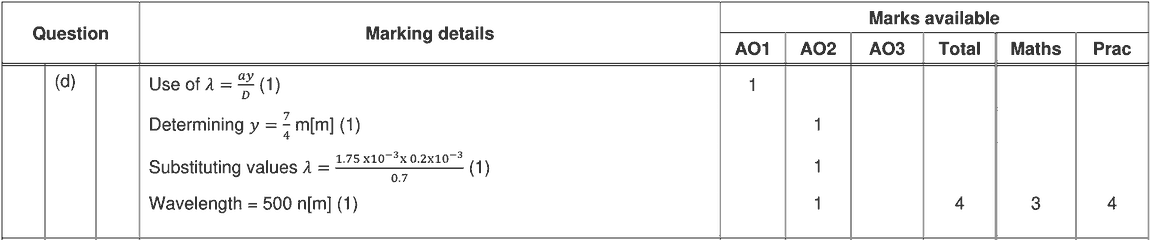
(d) The diffraction grating is now replaced with a double slit. Calculate the wavelength of laser light from this set-up using the information given on the diagram. [4] 7 mm Pattern produced on the screen Screen Diagram not 70.0 cm drawn to scale Double slit 0.2 mm Laser
June 2022 · AS Component 2 · Q2(e) 3 marks AO3=3 Practical and data analysis wave properties
Earlier parts of question 2 that this part usesEarlier part of June 2022 Component 2 question 2Earlier part of June 2022 Component 2 question 2Earlier part of June 2022 Component 2 question 2Earlier part of June 2022 Component 2 question 2
(e) In the methods of parts (c) and (d), the slit separation and the number of lines per mm are measured precisely by the manufacturers and have negligible uncertainty. All other distances are measured with a metre ruler that has a resolution of ± 1 mm. Explain why the method using a diffraction grating gives a smaller uncertainty in the laser wavelength than using a double slit. [3]
June 2022 · AS Component 2 · Q3(a) 2 marks AO1=1, AO2=1 Calculation conduction of electricity
3. (a) There is an electric current of 0.16 A in a filament lamp. Calculate the charge that passes through the lamp in 15 minutes. [2]
June 2022 · AS Component 2 · Q3(b)(i) 1 mark AO1=1 Definition resistance
Earlier part of question 3 that this part usesEarlier part of June 2022 Component 2 question 3
(b) (i) Define the unit of potential difference, the volt. [1]
June 2022 · AS Component 2 · Q3(b)(ii) 2 marks AO1=1, AO2=1 Calculation resistance
Earlier parts of question 3 that this part usesEarlier part of June 2022 Component 2 question 3Earlier part of June 2022 Component 2 question 3
(ii) Calculate the energy converted by the lamp in part (a) if the potential difference across it is 6.0 V. [2]
June 2022 · AS Component 2 · Q3(c)(i) 2 marks AO1=2 Practical and data analysis resistance
Earlier part of question 3 that this part usesEarlier part of June 2022 Component 2 question 3
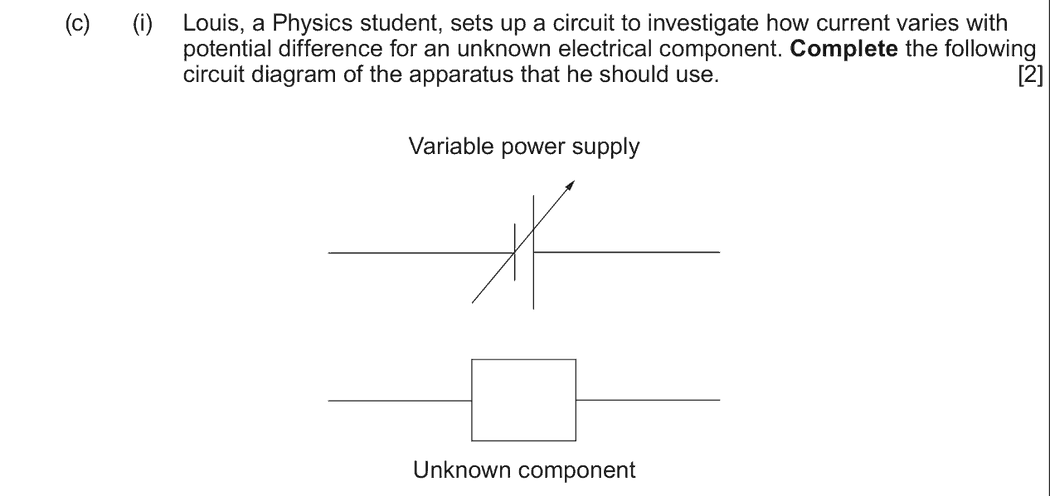
(c) (i) Louis, a Physics student, sets up a circuit to investigate how current varies with potential difference for an unknown electrical component. Complete the following circuit diagram of the apparatus that he should use. [2] Variable power supply Unknown component
June 2022 · AS Component 2 · Q3(c)(ii) 6 marks AO3=6 6-mark extended response resistance
Earlier parts of question 3 that this part usesEarlier part of June 2022 Component 2 question 3Earlier part of June 2022 Component 2 question 3
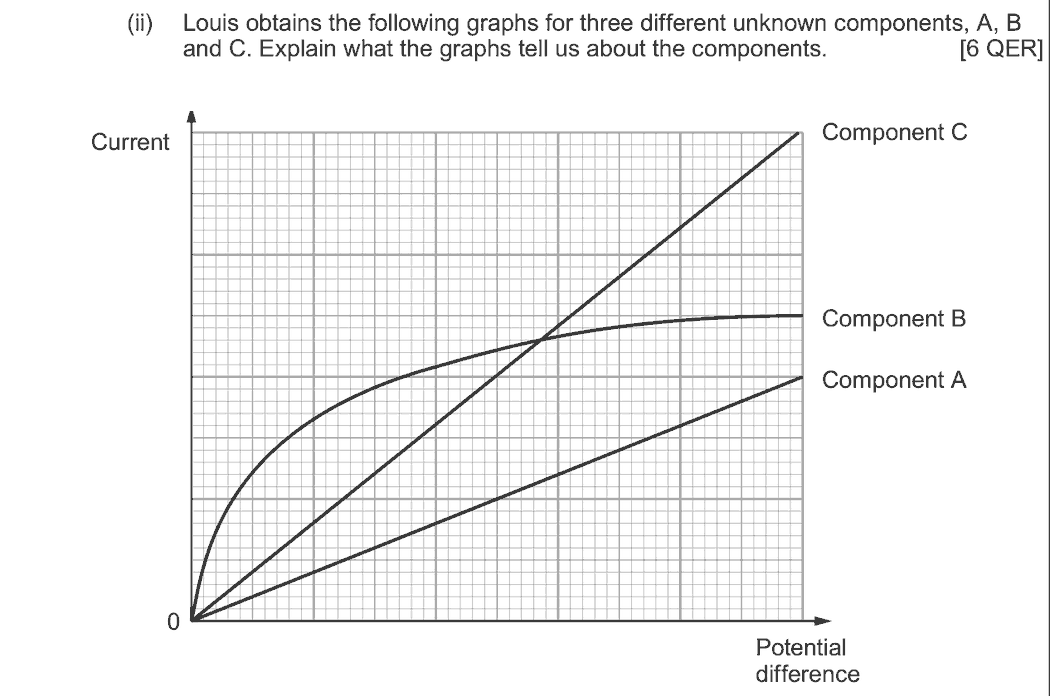
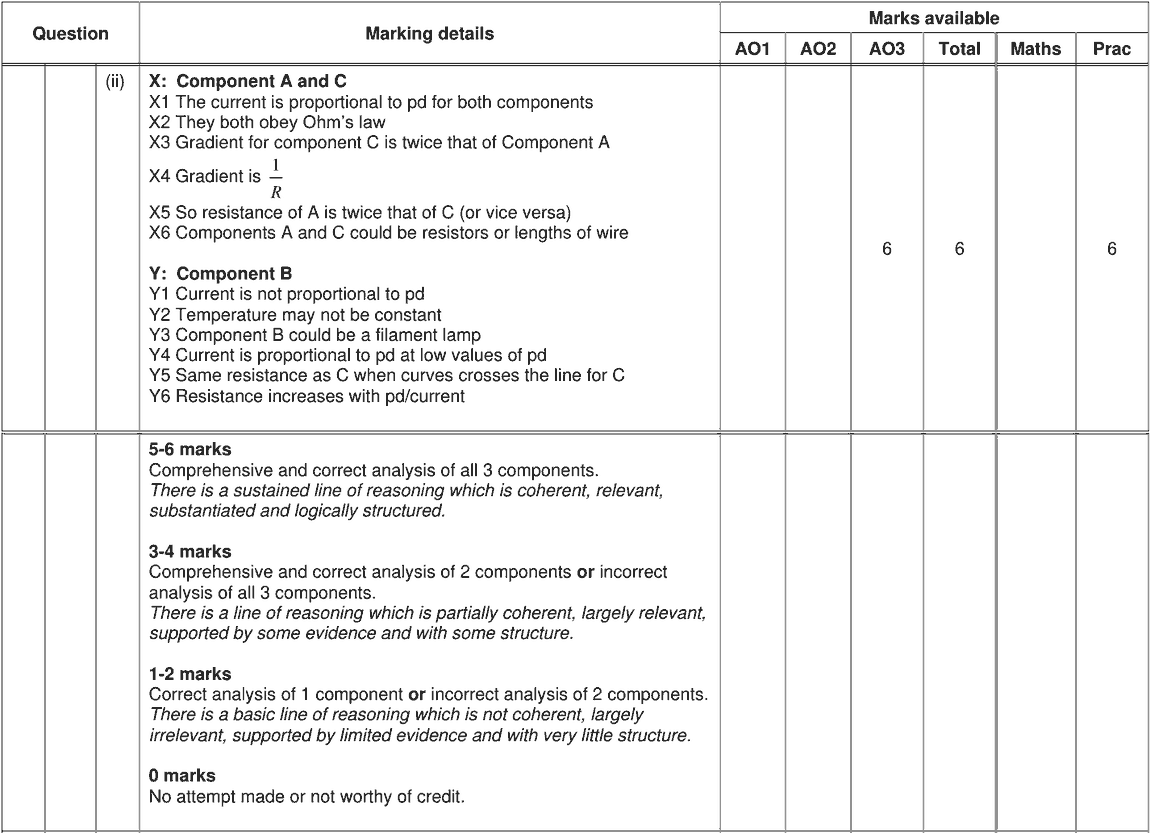
(ii) Louis obtains the following graphs for three different unknown components, A, B and C. Explain what the graphs tell us about the components. [6 QER] Component C Current Component B Component A 0 Potential difference
June 2022 · AS Component 2 · Q4(a) 2 marks AO1=2 Short answer photons
4. (a) Catherine uses a diffraction grating to observe the first order emission spectrum from a lamp containing gas atoms. Describe what she observes. [2]
June 2022 · AS Component 2 · Q4(b) 4 marks AO3=4 Calculation photons
Earlier part of question 4 that this part usesEarlier part of June 2022 Component 2 question 4
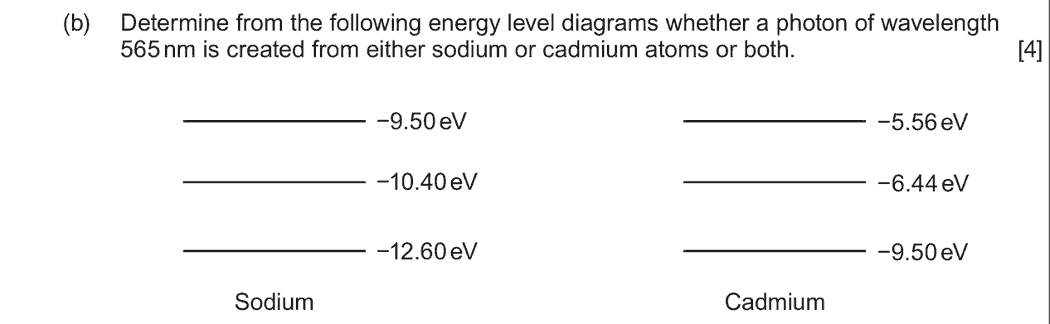
(b) Determine from the following energy level diagrams whether a photon of wavelength 565 nm is created from either sodium or cadmium atoms or both. [4] −9.50 eV −5.56 eV −10.40 eV −6.44 eV −12.60 eV −9.50 eV Sodium Cadmium
June 2022 · AS Component 2 · Q4(c) 4 marks AO1=4 Explanation lasers
Earlier part of question 4 that this part usesEarlier part of June 2022 Component 2 question 4
(c) Explain why a population inversion, metastable state and stimulated emission are required for a laser to work. [4]
June 2022 · AS Component 2 · Q4(d)(i) 2 marks AO2=2 Show that photons
Earlier part of question 4 that this part usesEarlier part of June 2022 Component 2 question 4
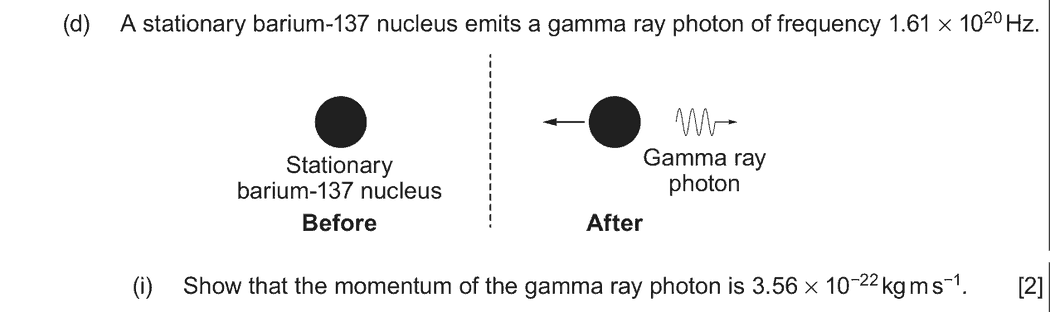
(d) A stationary barium-137 nucleus emits a gamma ray photon of frequency 1.61 × 10²⁰ Hz. Gamma ray Stationary photon barium-137 nucleus Before After (i) Show that the momentum of the gamma ray photon is 3.56 × 10⁻²² kg m s−1. [2]
June 2022 · AS Component 2 · Q4(d)(ii) 3 marks AO1=1, AO2=2 Calculation photons
Earlier parts of question 4 that this part usesEarlier part of June 2022 Component 2 question 4Earlier part of June 2022 Component 2 question 4
(ii) Calculate the final speed of the barium-137 nucleus if the mass of the barium is 2.29 × 10⁻²⁵ kg. Give your reasoning. [3]
June 2022 · AS Component 2 · Q4(d)(iii) 3 marks AO1=1, AO2=2 Calculation photons
Earlier parts of question 4 that this part usesEarlier part of June 2022 Component 2 question 4Earlier part of June 2022 Component 2 question 4
(iii) Calculate the total energy released in this emission. [3]
June 2022 · AS Component 2 · Q4(e) 2 marks AO3=2 Explanation photons
Earlier part of question 4 that this part usesEarlier part of June 2022 Component 2 question 4
(e) Evaluate the benefits for scientists and engineers of determining the value of physical constants such as the Plank constant and numbers such as π to a high degree of accuracy. [2]
June 2022 · AS Component 2 · Q5(a) 4 marks AO1=1, AO2=3 Show that dc circuitsresistance
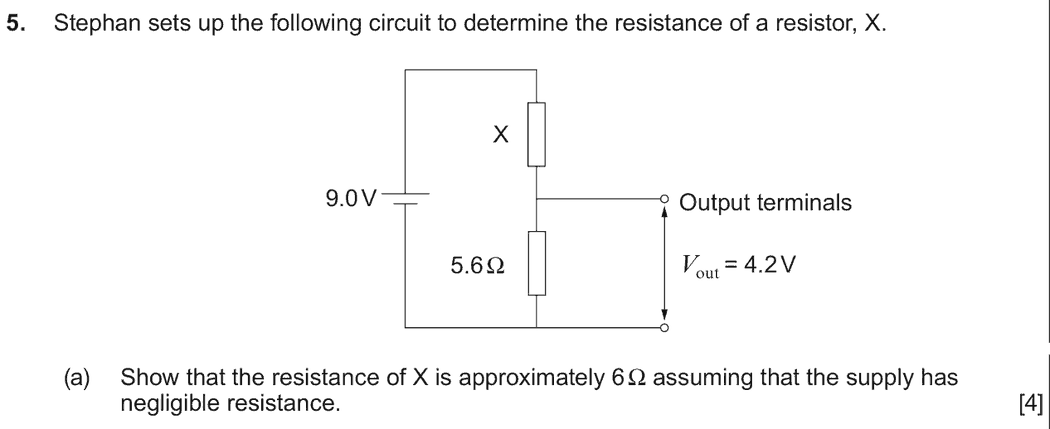
5. Stephan sets up the following circuit to determine the resistance of a resistor, X. X 9.0 V Output terminals 5.6 Ω Vout = 4.2 V (a) Show that the resistance of X is approximately 6 Ω assuming that the supply has negligible resistance. [4]
June 2022 · AS Component 2 · Q5(b) 5 marks AO1=1, AO2=4 Calculation dc circuits
Earlier part of question 5 that this part usesEarlier part of June 2022 Component 2 question 5
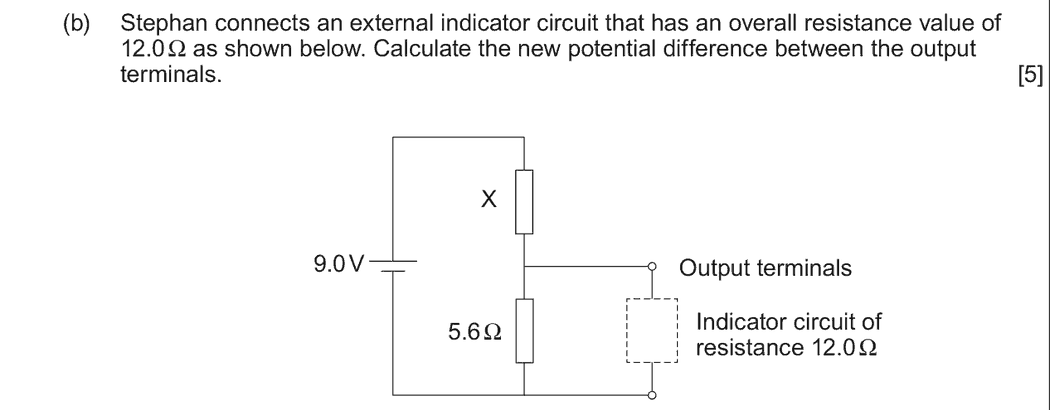
(b) Stephan connects an external indicator circuit that has an overall resistance value of 12.0 Ω as shown below. Calculate the new potential difference between the output terminals. [5] X 9.0 V Output terminals Indicator circuit of 5.6 Ω resistance 12.0 Ω
June 2022 · AS Component 2 · Q5(c) 2 marks AO2=2 Explanation dc circuitsresistance
Earlier parts of question 5 that this part usesEarlier part of June 2022 Component 2 question 5Earlier part of June 2022 Component 2 question 5
(c) Bruno suggests that Stephan replaces resistor X with a thermistor that changes its resistance from 10 kΩ at 0 °C to 8.7 kΩ at 30 °C. Explain why the circuit cannot be used as a temperature sensor if the indicator circuit requires a minimum current of 10 mA to operate. [2]
June 2022 · AS Component 2 · Q5(d) 1 mark AO1=1 Short answer resistance
Earlier parts of question 5 that this part usesEarlier part of June 2022 Component 2 question 5Earlier part of June 2022 Component 2 question 5
(d) Explain why superconductors cannot be used as temperature sensors at very low temperatures. [1]

Work with an Eduqas physics tutor

Want a paper marked and gone through with you? Message us.

Prefer email? Send an enquiry

If you are under 18, please include a parent's contact details. Enquiries go to enquiries@physicsaleveltutor.com and are deleted once handled. All tutoring is online.