Mark scheme

Examiner's comment
The conditions for equilibrium were well known.
Notes from the mark scheme and report
- No resultant force (1) and no resultant moment, or sum of clockwise moments = sum of anticlockwise moments (1)
75 marks · 31 question parts · Paper, mark scheme and report on Eduqas's site · Have the Data Booklet beside you
The conditions for equilibrium were well known.
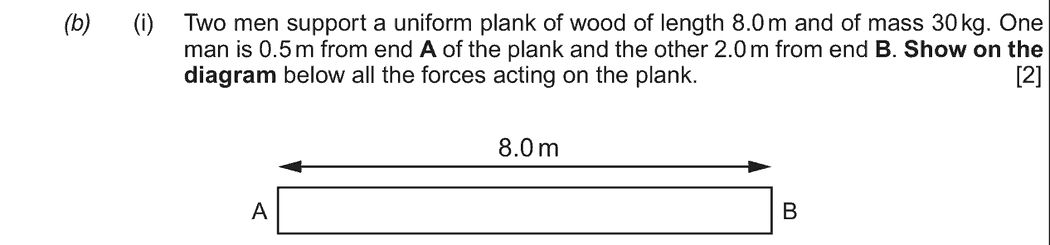
The diagram was well labelled. However a few candidates used ‘floating’ arrows which did not touch the diagram so they lost a mark and a few others forgot to label the arrows.
Skills: Mathsmarks The mark scheme's Maths column gives this part at least one mark for mathematical skills

This was generally well done with a large number of candidates gaining all 4 marks.
Skills: Mathsmarks The mark scheme's Maths column gives this part at least one mark for mathematical skills

&(iv) Generally well done again.


The definition of vector and scalar quantities was well known and the examples given were almost always correct.
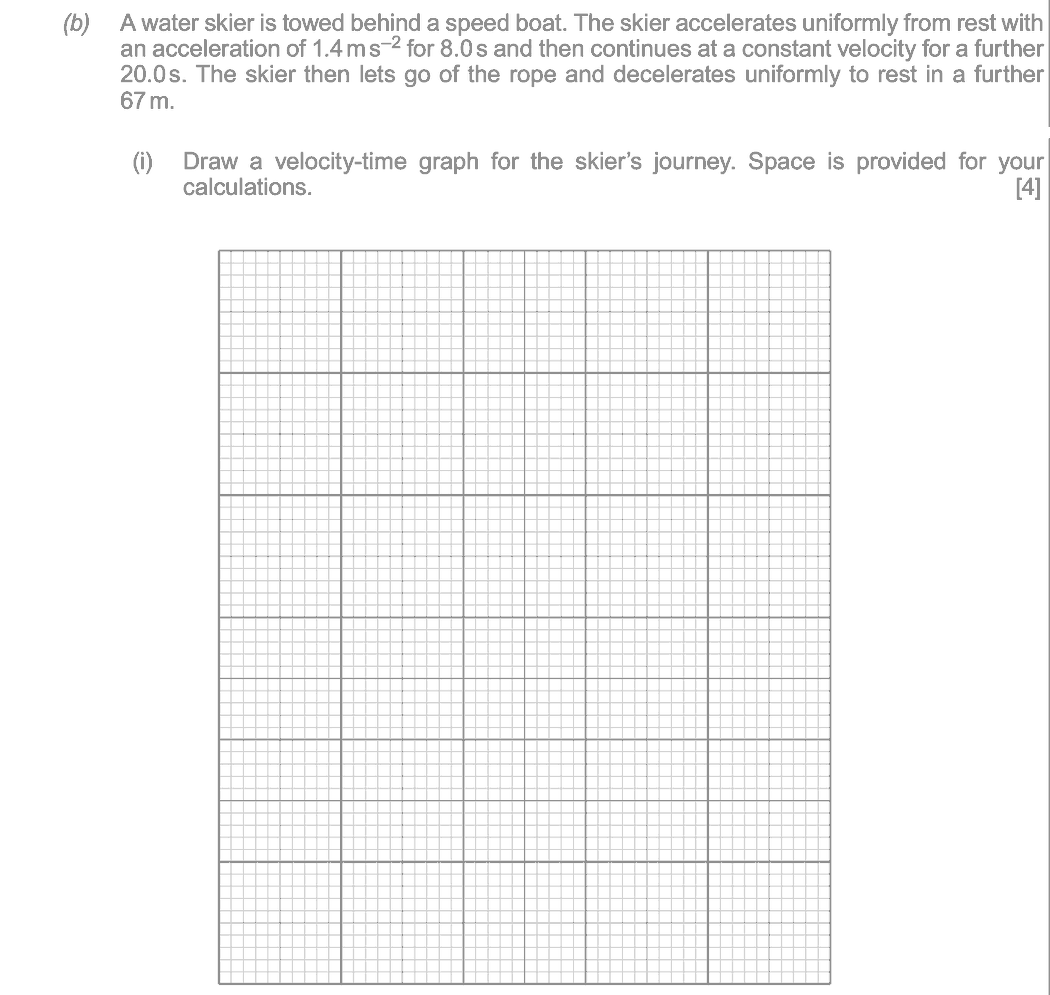
Most calculated the constant velocity correctly and also determined the final time, it was a bit disappointing that a few candidates then plotted this information using a very poor scale on the axes which, in some cases, were not titled.
Skills: Graphskills Reading, plotting or sketching graphs; gradients, intercepts and areas; Mathsmarks The mark scheme's Maths column gives this part at least one mark for mathematical skills

The distance the skier travelled was generally well answered with candidates either using the equation for the area of a trapezium or splitting the area up to find the total.
Skills: Graphskills Reading, plotting or sketching graphs; gradients, intercepts and areas; Mathsmarks The mark scheme's Maths column gives this part at least one mark for mathematical skills

This was the most problematic part of the question, with very few candidates gaining more than 1/3 marks. Some candidates obtained a mark for realising there was zero resultant force when the skier was travelling at constant velocity but very few stated there was a constant forward force between 0 and 8 seconds and a constant backward force between 28 and 40 seconds.

The recoil velocity of the gun was well done using conservation of momentum.
Skills: Mathsmarks The mark scheme's Maths column gives this part at least one mark for mathematical skills

These parts differentiated well with only the better candidates managing to determine the angle in part (ii).
Skills: Mathsmarks The mark scheme's Maths column gives this part at least one mark for mathematical skills

These parts differentiated well with only the better candidates managing to determine the angle in part (ii).
Skills: Trigonometryand vectors Resolving, components, vector addition, angles; Mathsmarks The mark scheme's Maths column gives this part at least one mark for mathematical skills

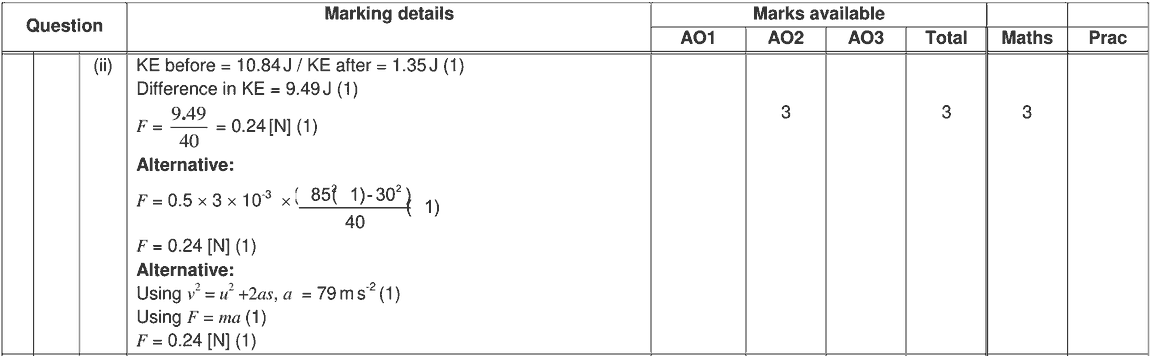
These parts caused a number of candidates problems. In part (i) many candidates realised the velocity would change due to air resistance but didn’t specify that the horizontal velocity was the important component. There were a number of different ways to answer part (ii) with many using the work – energy theorem and others equations of motion.

These parts caused a number of candidates problems. In part (i) many candidates realised the velocity would change due to air resistance but didn’t specify that the horizontal velocity was the important component. There were a number of different ways to answer part (ii) with many using the work – energy theorem and others equations of motion.
Skills: Mathsmarks The mark scheme's Maths column gives this part at least one mark for mathematical skills

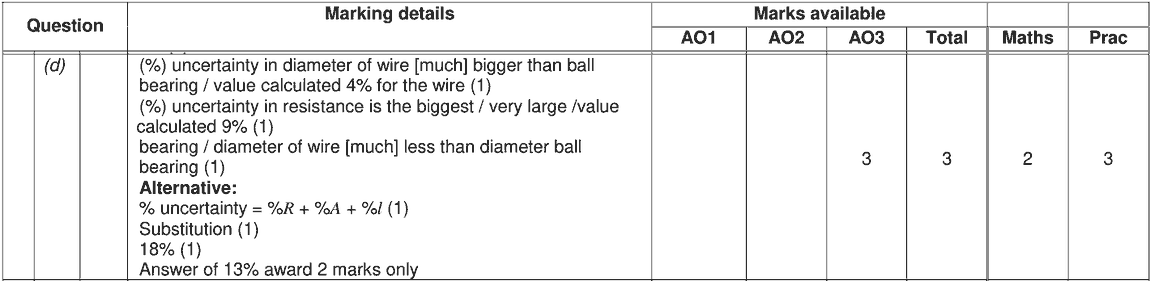
This was the most poorly answered question on the paper with a number of the candidates seemingly unprepared for a practical question of this type. In fact many candidates were unable to calculate percentage uncertainty never mind convert a percentage uncertainty to an absolute uncertainty. Part (d) was very poorly answered with few candidates realising there was a very large uncertainty in the resistance and also few attempted to determine the percentage uncertainties in the readings given.
Skills: Uncertainties Resolution, absolute and percentage uncertainty, combining uncertainties, error bars; Mathsmarks The mark scheme's Maths column gives this part at least one mark for mathematical skills; Practicalmarks The mark scheme's Prac column gives this part at least one mark for practical skills

This was the most poorly answered question on the paper with a number of the candidates seemingly unprepared for a practical question of this type. In fact many candidates were unable to calculate percentage uncertainty never mind convert a percentage uncertainty to an absolute uncertainty. Part (d) was very poorly answered with few candidates realising there was a very large uncertainty in the resistance and also few attempted to determine the percentage uncertainties in the readings given.
Skills: Uncertainties Resolution, absolute and percentage uncertainty, combining uncertainties, error bars; Unitsand conversions Unit marks, base units, prefixes and conversions; Mathsmarks The mark scheme's Maths column gives this part at least one mark for mathematical skills; Practicalmarks The mark scheme's Prac column gives this part at least one mark for practical skills
This was the most poorly answered question on the paper with a number of the candidates seemingly unprepared for a practical question of this type. In fact many candidates were unable to calculate percentage uncertainty never mind convert a percentage uncertainty to an absolute uncertainty. Part (d) was very poorly answered with few candidates realising there was a very large uncertainty in the resistance and also few attempted to determine the percentage uncertainties in the readings given.
Skills: Uncertainties Resolution, absolute and percentage uncertainty, combining uncertainties, error bars; Unitsand conversions Unit marks, base units, prefixes and conversions; Mathsmarks The mark scheme's Maths column gives this part at least one mark for mathematical skills; Practicalmarks The mark scheme's Prac column gives this part at least one mark for practical skills
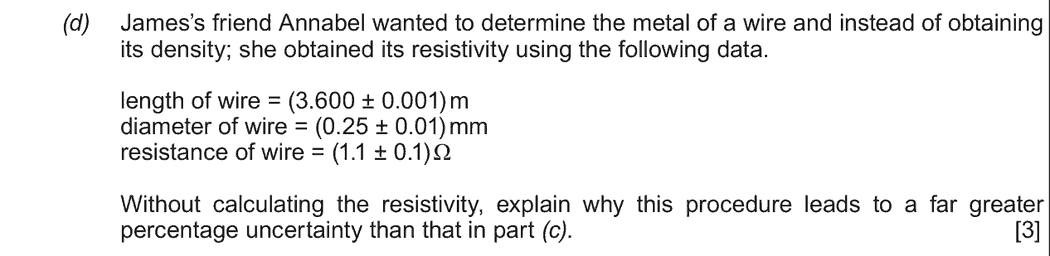
This was the most poorly answered question on the paper with a number of the candidates seemingly unprepared for a practical question of this type. In fact many candidates were unable to calculate percentage uncertainty never mind convert a percentage uncertainty to an absolute uncertainty. Part (d) was very poorly answered with few candidates realising there was a very large uncertainty in the resistance and also few attempted to determine the percentage uncertainties in the readings given.
Skills: Uncertainties Resolution, absolute and percentage uncertainty, combining uncertainties, error bars; Mathsmarks The mark scheme's Maths column gives this part at least one mark for mathematical skills; Practicalmarks The mark scheme's Prac column gives this part at least one mark for practical skills

This question was generally well done with the majority of candidates having learnt the terminology used in this section of the specification. Some candidates had problems in identifying the particle in (b)(ii) and also lost method marks by not clearly showing whether they were attempting to conserve charge or lepton number. The candidates who scored well on this clearly labelled which law they were using followed by a series of numbers to represent the charges / lepton numbers.

This question was generally well done with the majority of candidates having learnt the terminology used in this section of the specification. Some candidates had problems in identifying the particle in (b)(ii) and also lost method marks by not clearly showing whether they were attempting to conserve charge or lepton number. The candidates who scored well on this clearly labelled which law they were using followed by a series of numbers to represent the charges / lepton numbers.
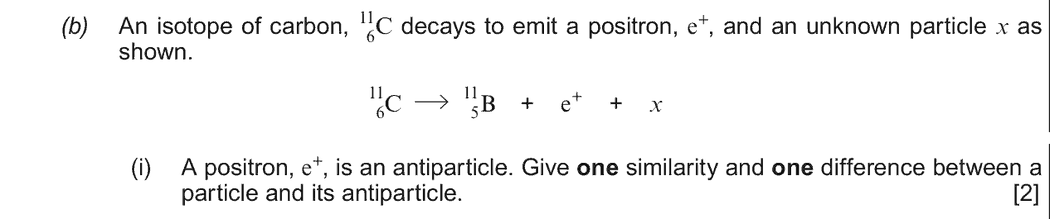
This question was generally well done with the majority of candidates having learnt the terminology used in this section of the specification. Some candidates had problems in identifying the particle in (b)(ii) and also lost method marks by not clearly showing whether they were attempting to conserve charge or lepton number. The candidates who scored well on this clearly labelled which law they were using followed by a series of numbers to represent the charges / lepton numbers.

This question was generally well done with the majority of candidates having learnt the terminology used in this section of the specification. Some candidates had problems in identifying the particle in (b)(ii) and also lost method marks by not clearly showing whether they were attempting to conserve charge or lepton number. The candidates who scored well on this clearly labelled which law they were using followed by a series of numbers to represent the charges / lepton numbers.

This question was generally well done with the majority of candidates having learnt the terminology used in this section of the specification. Some candidates had problems in identifying the particle in (b)(ii) and also lost method marks by not clearly showing whether they were attempting to conserve charge or lepton number. The candidates who scored well on this clearly labelled which law they were using followed by a series of numbers to represent the charges / lepton numbers.
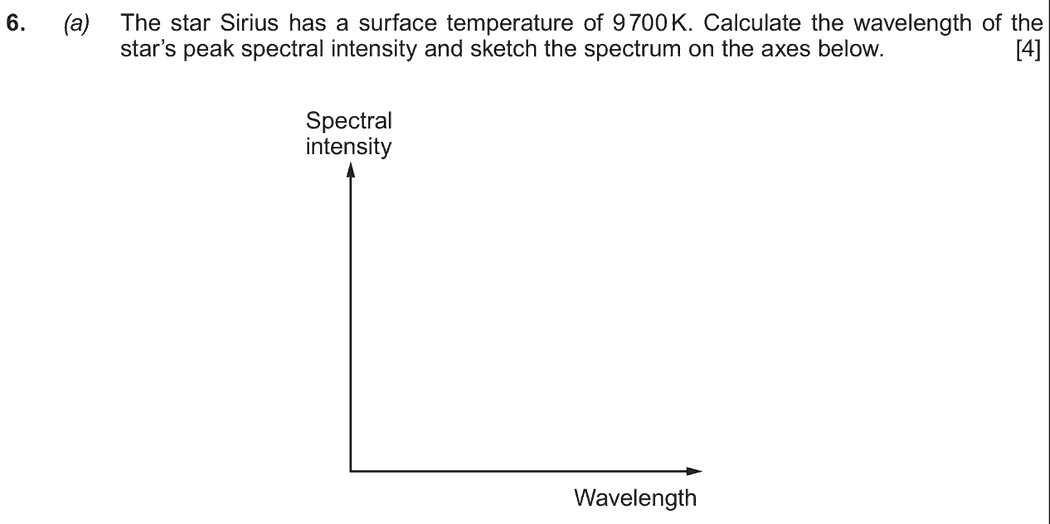
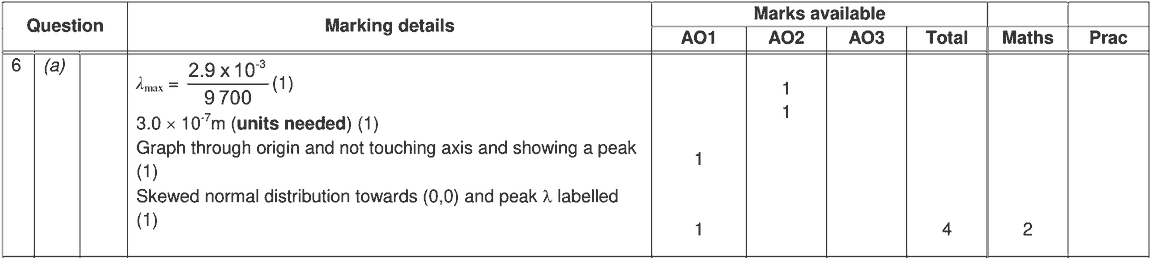
The vast majority correctly used Wien’s law to determine the wavelength but then lost a relatively easy mark by not including the unit. In addition, whilst the majority drew a skewed normal distribution for the intensity many forgot to label the peak wavelength so losing another fairly simple mark.
Skills: Graphskills Reading, plotting or sketching graphs; gradients, intercepts and areas; Mathsmarks The mark scheme's Maths column gives this part at least one mark for mathematical skills

Electron volts are new to the specification and some candidates had problems with part (ii) as a result of this.

Electron volts are new to the specification and some candidates had problems with part (ii) as a result of this.
Skills: Unitsand conversions Unit marks, base units, prefixes and conversions; Mathsmarks The mark scheme's Maths column gives this part at least one mark for mathematical skills

This part was intended to be difficult and provided a range of marks.
Skills: Mathsmarks The mark scheme's Maths column gives this part at least one mark for mathematical skills

The definition of the Young modulus was well known.
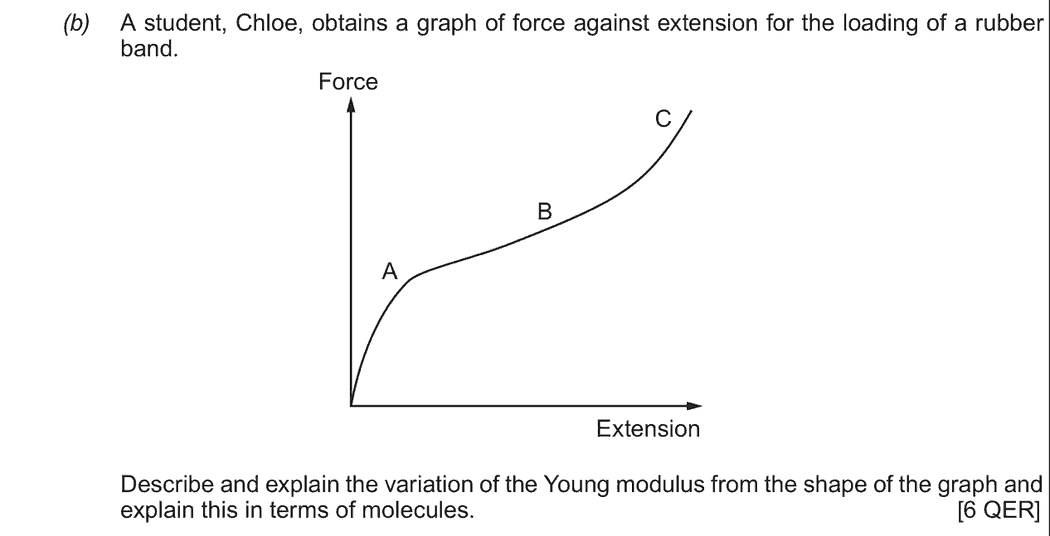
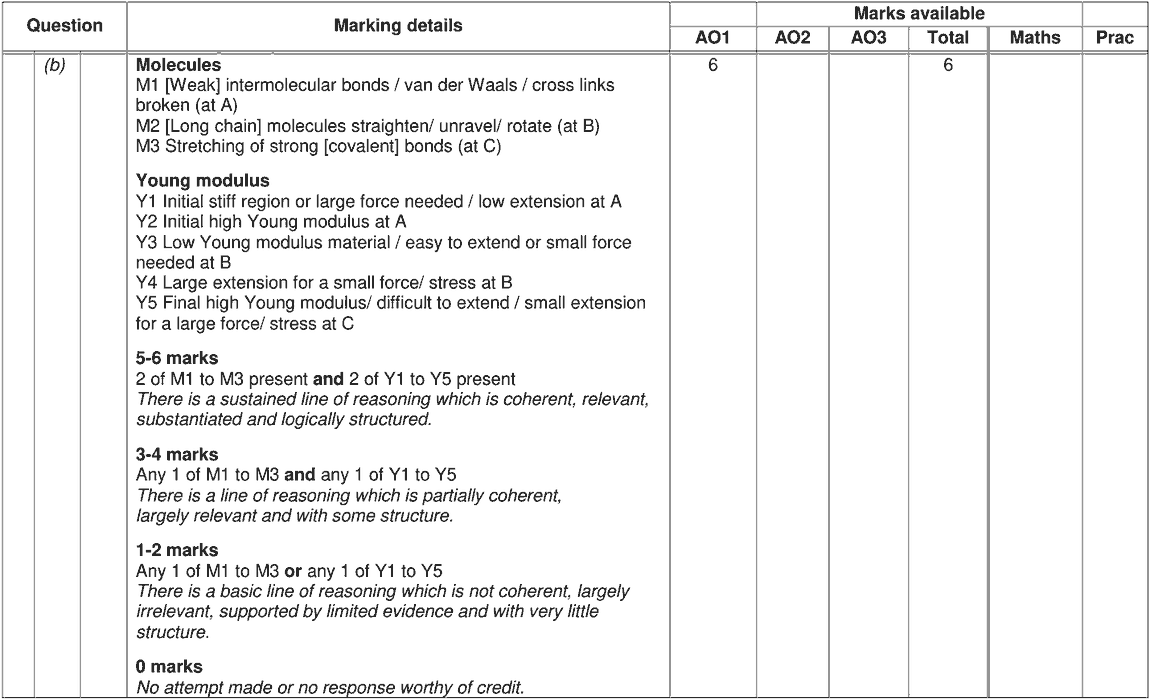
The QER question was rather disappointing with many candidates confusing the force-extension graph of rubber with that of a crystalline material and so talked about grain boundaries and dislocations. Candidates who realised this was a polymer still had problems in correctly describing the three stages of change in Young modulus at a molecular level.
Skills: QER The 6-mark quality of extended response question

The line for unloading and the explanation of hysteresis was well done.
Skills: Graphskills Reading, plotting or sketching graphs; gradients, intercepts and areas; Practicalmarks The mark scheme's Prac column gives this part at least one mark for practical skills

This was also well answered. PHYSICS AS Summer 2016
Skills: Issues Benefits, risks, ethical or environmental issues (How Science Works)
Want a paper marked and gone through with you? Message us.