June 2019: AS Component 1

75 marks · 31 question parts · Paper, mark scheme and report on Eduqas's site · Have the Data Booklet beside you

Question by question

QTopicMarksAOType
1(a)(i) Solids under stress 1AO1=1Definition
1(a)(ii) Basic physics: units, vectors and moments, Solids under stress 3AO1=1,AO2=2Short answer
1(b)(i) Solids under stress 3AO1=3Diagram or graph
1(b)(ii) Solids under stress 2AO2=2Explanation
1(b)(iii) Solids under stress 2AO1=2Explanation
2(a) Energy concepts 1AO1=1Definition
2(b)(i) Basic physics: units, vectors and moments 2AO2=2Show that
2(b)(ii) Energy concepts 2AO2=2Calculation
2(c)(i) Dynamics: forces and momentum 2AO1=2Definition
2(c)(ii) Dynamics: forces and momentum 2AO2=2Calculation
2(d) Dynamics: forces and momentum 2AO3=2Short answer
3(a) Solids under stress 1AO1=1Definition
3(b)(i) Energy concepts, Solids under stress 3AO2=3Calculation
3(b)(ii) Dynamics: forces and momentum, Solids under stress 2AO2=2Calculation
3(c)(i) Kinematics 3AO1=1,AO2=2Calculation
3(c)(ii) Kinematics 2AO1=1,AO2=1Calculation
4(a) Using radiation to investigate stars 1AO1=1Definition
4(b) Using radiation to investigate stars 3AO3=3Calculation
4(c)(i) Using radiation to investigate stars 3AO1=1,AO2=2Diagram or graph
4(c)(ii) Using radiation to investigate stars 2AO3=2Explanation
5(a) Basic physics: units, vectors and moments 6AO1=6Extended response
5(b) Basic physics: units, vectors and moments 5AO2=3,AO3=2Calculation
6(a)(i) Kinematics 1AO1=1Definition
6(a)(ii) Dynamics: forces and momentum 2AO3=2Short answer
6(b) Kinematics 4AO2=4Practical and data analysis
6(c)(i) Kinematics 4AO2=4Practical and data analysis
6(c)(ii) Kinematics 2AO3=2Practical and data analysis
7(a) Particles and nuclear structure 2AO1=2Explanation
7(b)(i) Particles and nuclear structure 2AO1=2Short answer
7(b)(ii) Particles and nuclear structure 3AO2=2,AO3=1Explanation
7(c) Particles and nuclear structure 2AO2=1,AO3=1Short answer

The questions

1(a)(i)1(a)(ii)1(b)(i)1(b)(ii)1(b)(iii)2(a)2(b)(i)2(b)(ii)2(c)(i)2(c)(ii)2(d)3(a)3(b)(i)3(b)(ii)3(c)(i)3(c)(ii)4(a)4(b)4(c)(i)4(c)(ii)5(a)5(b)6(a)(i)6(a)(ii)6(b)6(c)(i)6(c)(ii)7(a)7(b)(i)7(b)(ii)7(c)
June 2019 · AS Component 1 · Q1(a)(i) 1 mark AO1=1 Definition solids under stress
1. (a) (i) Define the Young modulus of a material. [1]
June 2019 · AS Component 1 · Q1(a)(ii) 3 marks AO1=1, AO2=2 Short answer basic physicssolids under stress
Earlier part of question 1 that this part usesEarlier part of June 2019 Component 1 question 1
(ii) Express the unit of the Young modulus in terms of S.I. base units. [3]
June 2019 · AS Component 1 · Q1(b)(i) 3 marks AO1=3 Diagram or graph solids under stress
Earlier part of question 1 that this part usesEarlier part of June 2019 Component 1 question 1
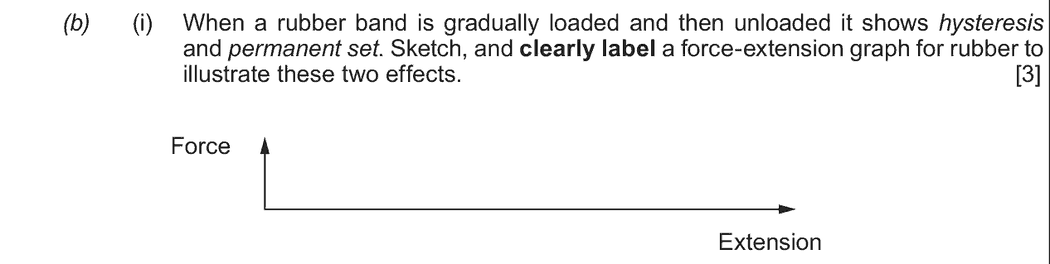
(b) (i) When a rubber band is gradually loaded and then unloaded it shows hysteresis and permanent set. Sketch, and clearly label a force-extension graph for rubber to illustrate these two effects. [3] Force Extension
June 2019 · AS Component 1 · Q1(b)(ii) 2 marks AO2=2 Explanation solids under stress
Earlier parts of question 1 that this part usesEarlier part of June 2019 Component 1 question 1Earlier part of June 2019 Component 1 question 1
(ii) Considering the molecular structure of rubber explain why it has a much lower value of Young modulus than that of a metal. [2]
June 2019 · AS Component 1 · Q1(b)(iii) 2 marks AO1=2 Explanation solids under stress
Earlier parts of question 1 that this part usesEarlier part of June 2019 Component 1 question 1Earlier part of June 2019 Component 1 question 1
(iii) What is the effect on the Young modulus of rubber when its temperature rises? Explain your answer. [2]
June 2019 · AS Component 1 · Q2(a) 1 mark AO1=1 Definition energy concepts
2. A wooden block on a string (ballistic pendulum) is a device that can be found at well equipped shooting ranges. It is used to find the speed of a bullet. To calculate the speed it is necessary to use both the principles of conservation of energy and momentum. (a) State the principle of conservation of energy. [1]
June 2019 · AS Component 1 · Q2(b)(i) 2 marks AO2=2 Show that basic physics
Earlier part of question 2 that this part usesEarlier part of June 2019 Component 1 question 2
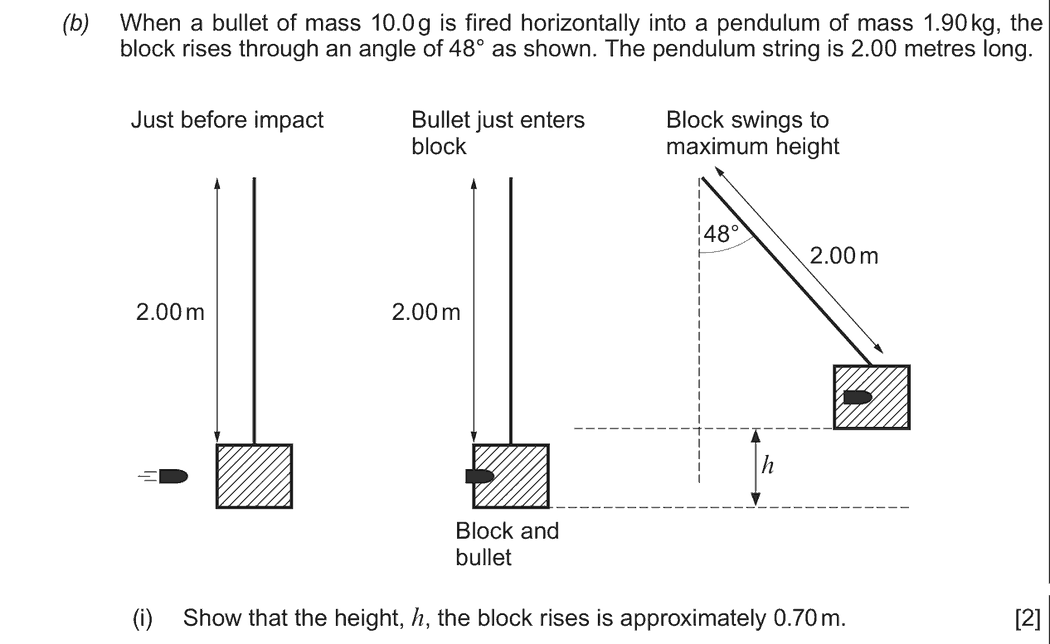
(b) When a bullet of mass 10.0 g is fired horizontally into a pendulum of mass 1.90 kg, the block rises through an angle of 48° as shown. The pendulum string is 2.00 metres long. Just before impact Bullet just enters Block swings to block maximum height 48° 2.00 m 2.00 m 2.00 m h Block and bullet (i) Show that the height, h, the block rises is approximately 0.70 m. [2]
June 2019 · AS Component 1 · Q2(b)(ii) 2 marks AO2=2 Calculation energy concepts
Earlier parts of question 2 that this part usesEarlier part of June 2019 Component 1 question 2Earlier part of June 2019 Component 1 question 2
(ii) Using the principle of conservation of energy, determine the velocity of the block and the bullet just after the bullet has embedded itself in the block. [2]
June 2019 · AS Component 1 · Q2(c)(i) 2 marks AO1=2 Definition dynamics
Earlier parts of question 2 that this part usesEarlier part of June 2019 Component 1 question 2Earlier part of June 2019 Component 1 question 2
(c) (i) State the principle of conservation of momentum. [2]
June 2019 · AS Component 1 · Q2(c)(ii) 2 marks AO2=2 Calculation dynamics
Earlier parts of question 2 that this part usesEarlier part of June 2019 Component 1 question 2Earlier part of June 2019 Component 1 question 2Earlier part of June 2019 Component 1 question 2
(ii) Determine the speed of the bullet just before it enters the block. [2]
June 2019 · AS Component 1 · Q2(d) 2 marks AO3=2 Short answer dynamics
Earlier parts of question 2 that this part usesEarlier part of June 2019 Component 1 question 2Earlier part of June 2019 Component 1 question 2
(d) Discuss whether you feel it would be appropriate for a Physics teacher to carry out this experiment in school with a group of sixth form students. [2]
June 2019 · AS Component 1 · Q3(a) 1 mark AO1=1 Definition solids under stress
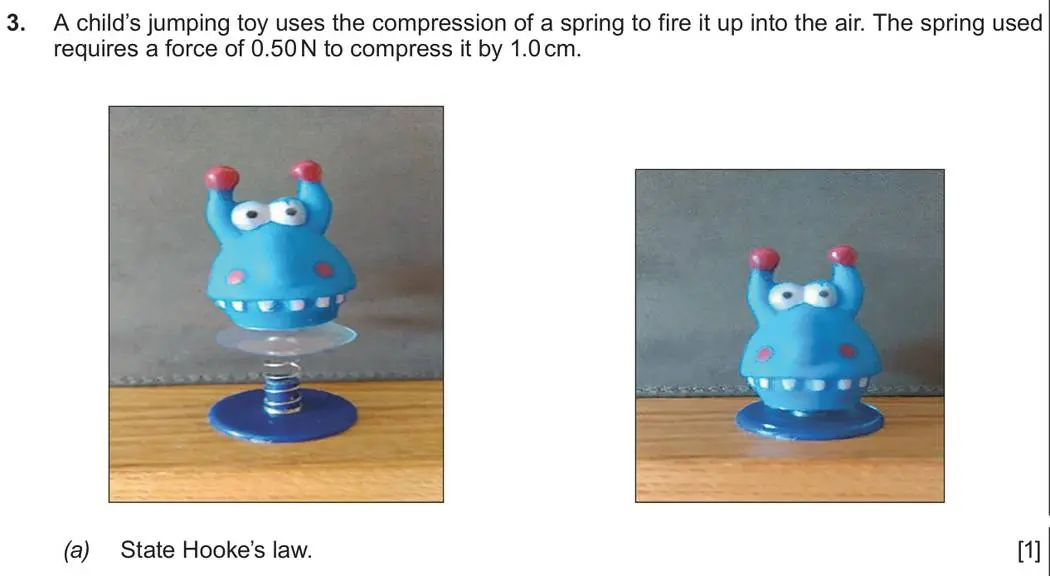
3. A child’s jumping toy uses the compression of a spring to fire it up into the air. The spring used requires a force of 0.50 N to compress it by 1.0 cm. (a) State Hooke’s law. [1]
June 2019 · AS Component 1 · Q3(b)(i) 3 marks AO2=3 Calculation energy conceptssolids under stress
Earlier part of question 3 that this part usesEarlier part of June 2019 Component 1 question 3
(b) The toy has a mass of 20 g and the spring is compressed by 6.0 cm and then released. (i) Calculate the velocity with which it leaves the ground. [3]
June 2019 · AS Component 1 · Q3(b)(ii) 2 marks AO2=2 Calculation dynamicssolids under stress
Earlier parts of question 3 that this part usesEarlier part of June 2019 Component 1 question 3Earlier part of June 2019 Component 1 question 3
(ii) Determine the initial acceleration of the toy as the spring extends. State any assumption you make. [2]
June 2019 · AS Component 1 · Q3(c)(i) 3 marks AO1=1, AO2=2 Calculation kinematics
Earlier part of question 3 that this part usesEarlier part of June 2019 Component 1 question 3
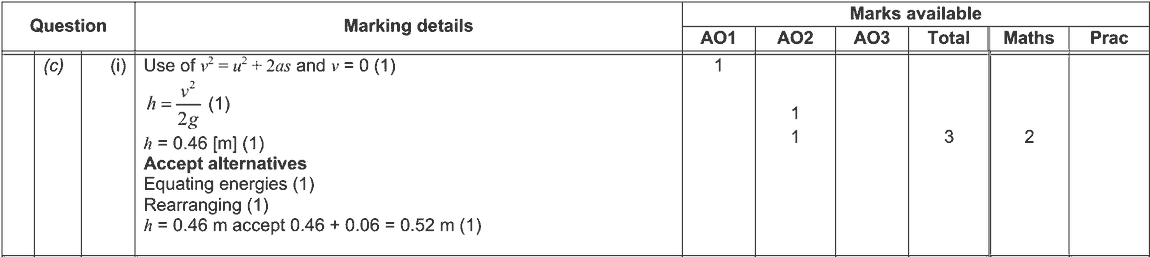
(c) (i) Ignoring air resistance, determine the maximum height gained by the toy. [3]
June 2019 · AS Component 1 · Q3(c)(ii) 2 marks AO1=1, AO2=1 Calculation kinematics
Earlier parts of question 3 that this part usesEarlier part of June 2019 Component 1 question 3Earlier part of June 2019 Component 1 question 3
(ii) Determine the total time of flight. [2]
June 2019 · AS Component 1 · Q4(a) 1 mark AO1=1 Definition radiation and stars
4. (a) Define a black body. [1]
June 2019 · AS Component 1 · Q4(b) 3 marks AO3=3 Calculation radiation and stars
Earlier part of question 4 that this part usesEarlier part of June 2019 Component 1 question 4
(b) A physics student, Tony, notices that the classroom is warmer when it has a number of students in it rather than when it is empty. Tony claims that each student will behave like a perfect black body and will emit about the same amount of heat as a 200 W light bulb. Assuming a typical human body has a surface area of 2 m2. Evaluate whether or not Tony appears to be correct. Normal body temperature can be taken to be 37 °C. [3]
June 2019 · AS Component 1 · Q4(c)(i) 3 marks AO1=1, AO2=2 Diagram or graph radiation and stars
Earlier part of question 4 that this part usesEarlier part of June 2019 Component 1 question 4
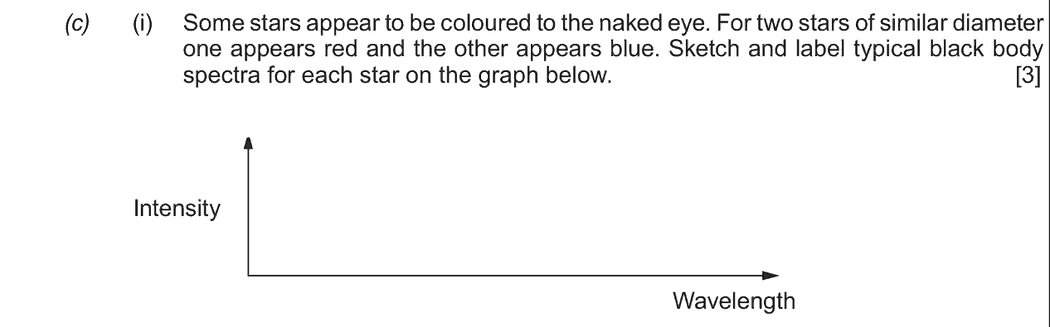
(c) (i) Some stars appear to be coloured to the naked eye. For two stars of similar diameter one appears red and the other appears blue. Sketch and label typical black body spectra for each star on the graph below. [3] Intensity Wavelength
June 2019 · AS Component 1 · Q4(c)(ii) 2 marks AO3=2 Explanation radiation and stars
Earlier parts of question 4 that this part usesEarlier part of June 2019 Component 1 question 4Earlier part of June 2019 Component 1 question 4
(ii) Suggest why it is that no stars appear to be green in colour. [2]
June 2019 · AS Component 1 · Q5(a) 6 marks AO1=6 6-mark extended response basic physics
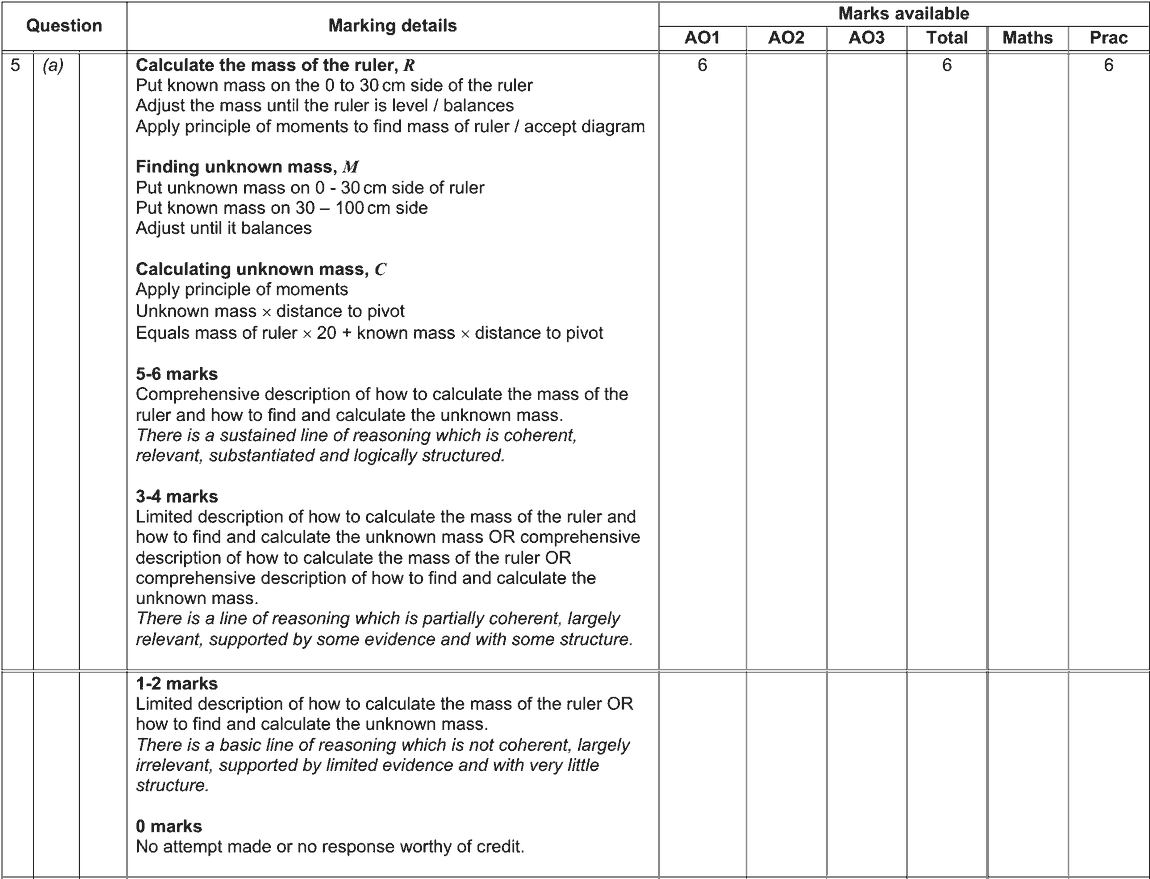
5. (a) Describe how you could determine the mass of an unknown object using only a metre ruler, pivoted at the 30 cm point, and a known mass. Assume both the known and unknown masses are similar to the mass of the metre ruler. You cannot change the position of the pivot. [6 QER]
June 2019 · AS Component 1 · Q5(b) 5 marks AO2=3, AO3=2 Calculation basic physics
Earlier part of question 5 that this part usesEarlier part of June 2019 Component 1 question 5
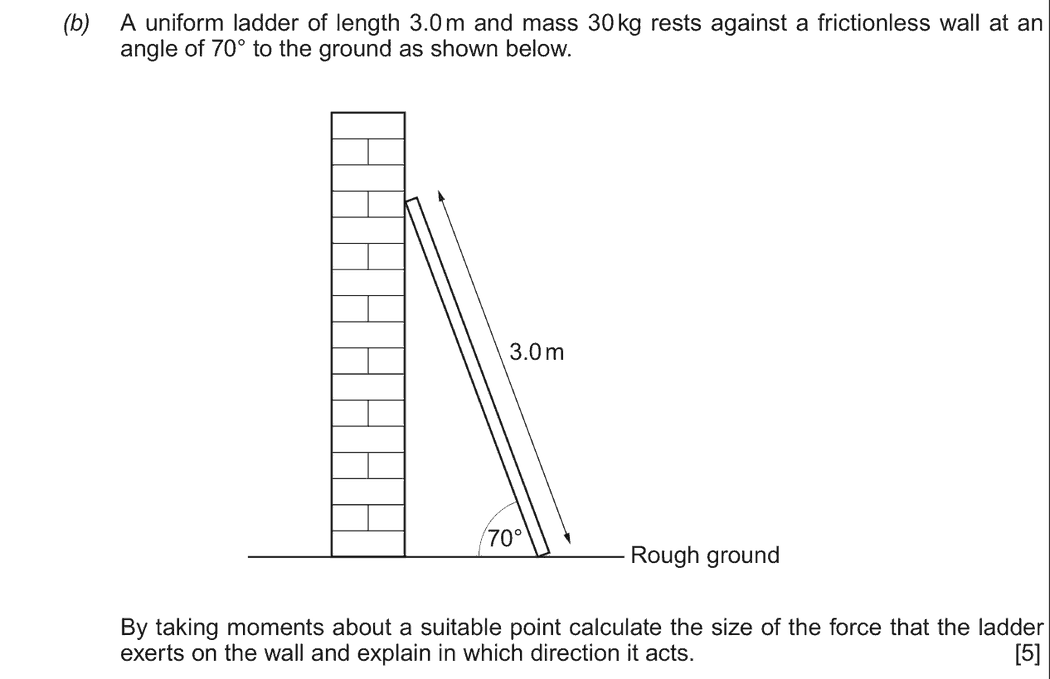
(b) A uniform ladder of length 3.0 m and mass 30 kg rests against a frictionless wall at an angle of 70° to the ground as shown below. 3.0 m 70° Rough ground By taking moments about a suitable point calculate the size of the force that the ladder exerts on the wall and explain in which direction it acts. [5]
June 2019 · AS Component 1 · Q6(a)(i) 1 mark AO1=1 Definition kinematics
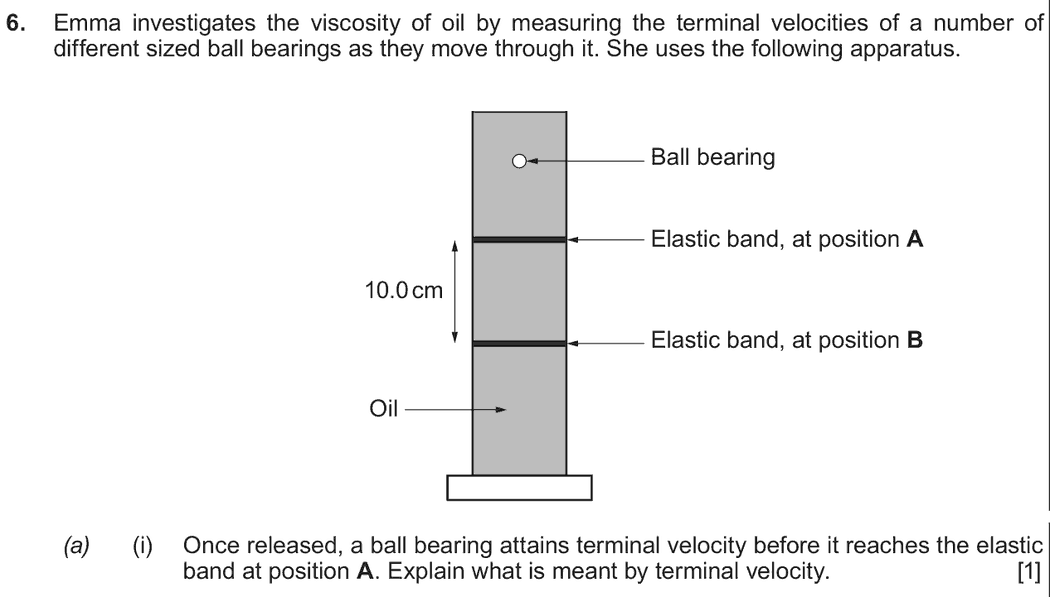
6. Emma investigates the viscosity of oil by measuring the terminal velocities of a number of different sized ball bearings as they move through it. She uses the following apparatus. Ball bearing Elastic band, at position A 10.0 cm Elastic band, at position B Oil (a) (i) Once released, a ball bearing attains terminal velocity before it reaches the elastic band at position A. Explain what is meant by terminal velocity. [1]
June 2019 · AS Component 1 · Q6(a)(ii) 2 marks AO3=2 Short answer dynamics
Earlier part of question 6 that this part usesEarlier part of June 2019 Component 1 question 6
(ii) At terminal velocity the two main forces acting on the ball bearing are its weight and the drag of the oil. According to Newton’s third law, for each of these forces there is a corresponding equal and opposite force. Identify each of these forces and the body upon which it acts. [2]
June 2019 · AS Component 1 · Q6(b) 4 marks AO2=4 Practical and data analysis kinematics
Earlier part of question 6 that this part usesEarlier part of June 2019 Component 1 question 6
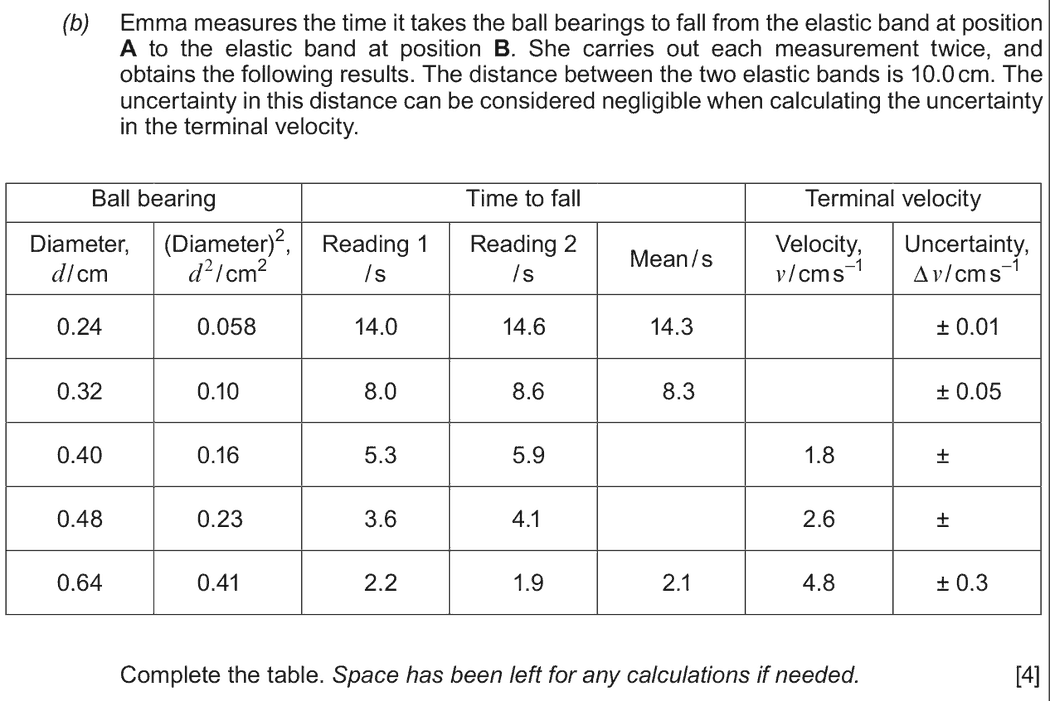
(b) Emma measures the time it takes the ball bearings to fall from the elastic band at position A to the elastic band at position B. She carries out each measurement twice, and obtains the following results. The distance between the two elastic bands is 10.0 cm. The uncertainty in this distance can be considered negligible when calculating the uncertainty in the terminal velocity. Ball bearing Time to fall Terminal velocity Diameter, (Diameter)2, Reading 1 Reading 2 Velocity, Uncertainty, Mean / s d / cm d 2 / cm2 / s / s v / cm s–1 ∆ v / cm s–1 0.24 0.058 14.0 14.6 14.3 ± 0.01 0.32 0.10 8.0 8.6 8.3 ± 0.05 0.40 0.16 5.3 5.9 1.8 ± 0.48 0.23 3.6 4.1 2.6 ± 0.64 0.41 2.2 1.9 2.1 4.8 ± 0.3 Complete the table. Space has been left for any calculations if needed. [4]
June 2019 · AS Component 1 · Q6(c)(i) 4 marks AO2=4 Practical and data analysis kinematics
Earlier parts of question 6 that this part usesEarlier part of June 2019 Component 1 question 6Earlier part of June 2019 Component 1 question 6
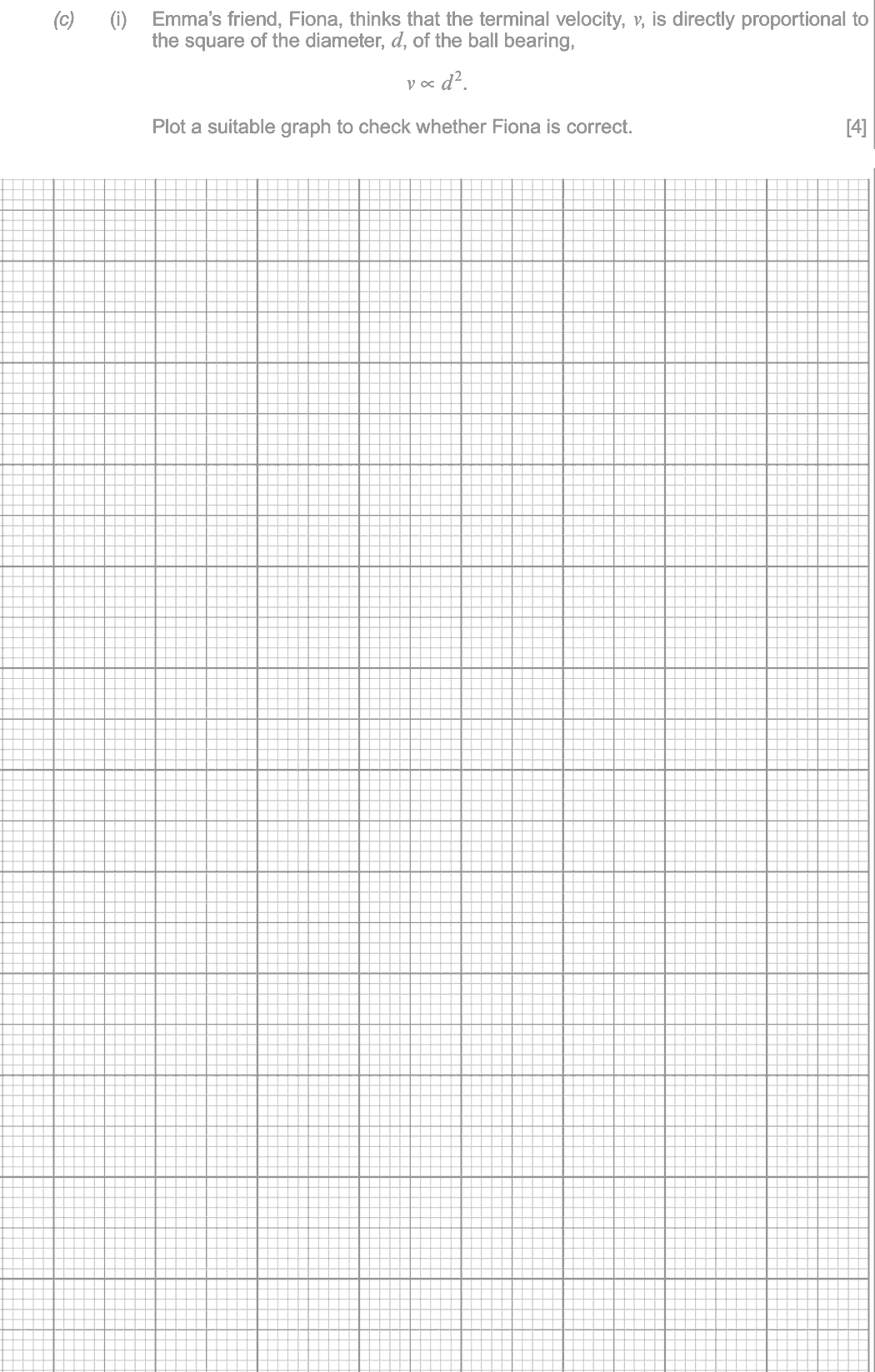
(c) (i) Emma’s friend, Fiona, thinks that the terminal velocity, v, is directly proportional to the square of the diameter, d, of the ball bearing, v ∝ d 2. Plot a suitable graph to check whether Fiona is correct. [4]
June 2019 · AS Component 1 · Q6(c)(ii) 2 marks AO3=2 Practical and data analysis kinematics
Earlier parts of question 6 that this part usesEarlier part of June 2019 Component 1 question 6Earlier part of June 2019 Component 1 question 6Earlier part of June 2019 Component 1 question 6
(ii) Evaluate whether or not Fiona is correct. [2]
June 2019 · AS Component 1 · Q7(a) 2 marks AO1=2 Explanation particles and nuclear structure
7. (a) Quarks and electron neutrinos are fundamental particles whereas protons and neutrons are not. Explain this statement. [2]
June 2019 · AS Component 1 · Q7(b)(i) 2 marks AO1=2 Short answer particles and nuclear structure
Earlier part of question 7 that this part usesEarlier part of June 2019 Component 1 question 7
(b) (i) State why it is that electron neutrinos are very difficult to detect. [2]
June 2019 · AS Component 1 · Q7(b)(ii) 3 marks AO2=2, AO3=1 Explanation particles and nuclear structure
Earlier parts of question 7 that this part usesEarlier part of June 2019 Component 1 question 7Earlier part of June 2019 Component 1 question 7
2 H, (ii) Electron neutrinos can be detected when they interact with deuterium nuclei, 1 that are present in heavy water. The following reaction is observed. ve + 2 H → p + p + x 1 Identify particle x and justify your answer using the conservation laws. [3]
June 2019 · AS Component 1 · Q7(c) 2 marks AO2=1, AO3=1 Short answer particles and nuclear structure
Earlier part of question 7 that this part usesEarlier part of June 2019 Component 1 question 7
(c) When a positron and an electron meet they annihilate to produce two gamma ray photons. e+ + e– → γ + γ State which force is responsible for this interaction, giving your reasoning. [2]

Work with an Eduqas physics tutor

Want a paper marked and gone through with you? Message us.

Prefer email? Send an enquiry

If you are under 18, please include a parent's contact details. Enquiries go to enquiries@physicsaleveltutor.com and are deleted once handled. All tutoring is online.