June 2022: AS Component 1

75 marks · 29 question parts · Paper, mark scheme and report on Eduqas's site · Have the Data Booklet beside you
Question by question

QTopicMarksAOType
1(a)(i) Basic physics: units, vectors and moments 1AO1=1Short answer
1(a)(ii) Basic physics: units, vectors and moments 2AO1=2Short answer
1(b) Basic physics: units, vectors and moments 3AO2=3Calculation
1(c) Basic physics: units, vectors and moments 2AO2=2Show that
1(d) Kinematics 3AO1=1,AO2=2Calculation
2(a) Dynamics: forces and momentum 2AO1=2Definition
2(b)(i) Energy concepts 2AO2=2Calculation
2(b)(ii) Dynamics: forces and momentum 2AO2=2Calculation
2(c)(i) Kinematics 2AO3=2Explanation
2(c)(ii) Kinematics 2AO2=2Short answer
3(a) Dynamics: forces and momentum 3AO2=3Diagram or graph
3(b) Dynamics: forces and momentum 3AO3=3Practical and data analysis
3(c) Dynamics: forces and momentum 4AO2=4Practical and data analysis
3(d) Dynamics: forces and momentum 2AO3=2Explanation
4(a) Solids under stress 6AO1=6Extended response
4(b)(i) Solids under stress 1AO2=1Short answer
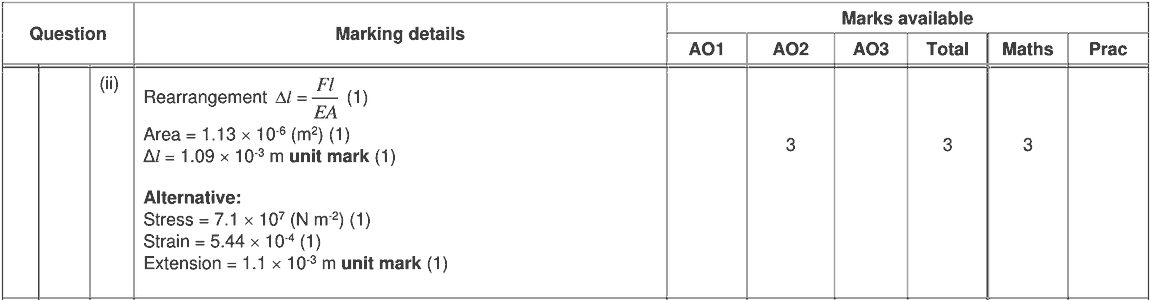
4(b)(ii) Solids under stress 3AO2=3Calculation
5(a) Basic physics: units, vectors and moments 2AO1=2Definition
5(b)(i) Basic physics: units, vectors and moments 4AO2=4Calculation
5(b)(ii) Solids under stress 3AO1=1,AO3=2Calculation
5(c) Solids under stress 2AO3=2Short answer
6(a)(i) Particles and nuclear structure 4AO1=4Short answer
6(a)(ii) Particles and nuclear structure 1AO1=1Short answer
6(a)(iii) Particles and nuclear structure 1AO1=1Short answer
6(b)(i) Particles and nuclear structure 3AO1=1,AO3=2Explanation
6(b)(ii) Particles and nuclear structure 2AO3=2Explanation
7(a) Using radiation to investigate stars 3AO1=3Explanation
7(b) Using radiation to investigate stars 3AO2=3Calculation
7(c) Using radiation to investigate stars 4AO1=1,AO2=3Calculation

The questions

1(a)(i)1(a)(ii)1(b)1(c)1(d)2(a)2(b)(i)2(b)(ii)2(c)(i)2(c)(ii)3(a)3(b)3(c)3(d)4(a)4(b)(i)4(b)(ii)5(a)5(b)(i)5(b)(ii)5(c)6(a)(i)6(a)(ii)6(a)(iii)6(b)(i)6(b)(ii)7(a)7(b)7(c)
June 2022 · AS Component 1 · Q1(a)(i) 1 mark AO1=1 Short answer basic physics
1. (a) (i) State the difference between vector and scalar quantities. [1]
June 2022 · AS Component 1 · Q1(a)(ii) 2 marks AO1=2 Short answer basic physics
Earlier part of question 1 that this part usesEarlier part of June 2022 Component 1 question 1
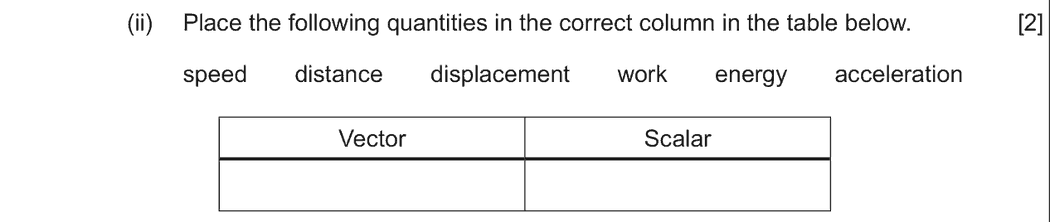
(ii) Place the following quantities in the correct column in the table below. [2] speed distance displacement work energy acceleration Vector Scalar
June 2022 · AS Component 1 · Q1(b) 3 marks AO2=3 Calculation basic physics
Earlier part of question 1 that this part usesEarlier part of June 2022 Component 1 question 1
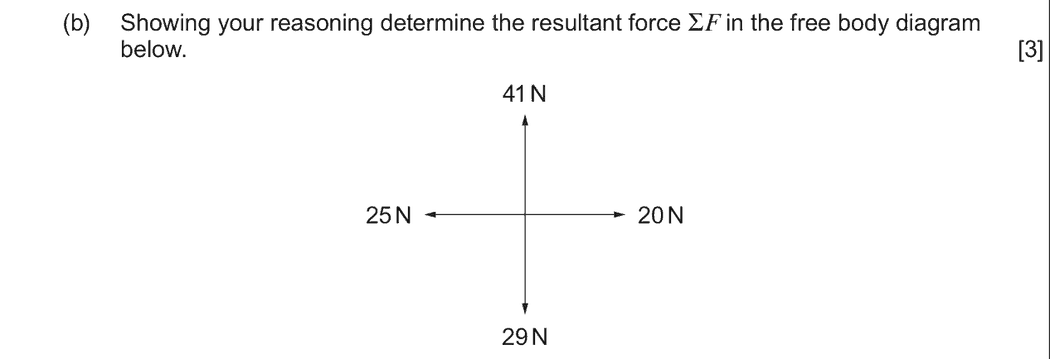
(b) Showing your reasoning determine the resultant force ΣF in the free body diagram below. [3] 41 N 25 N 20 N 29 N
June 2022 · AS Component 1 · Q1(c) 2 marks AO2=2 Show that basic physics
Earlier part of question 1 that this part usesEarlier part of June 2022 Component 1 question 1
(c) One of the equations of uniformly accelerated motion is given below: 1 2 at2 x = ut + Show that this equation is correct in terms of units. [2]
June 2022 · AS Component 1 · Q1(d) 3 marks AO1=1, AO2=2 Calculation kinematics
Earlier part of question 1 that this part usesEarlier part of June 2022 Component 1 question 1
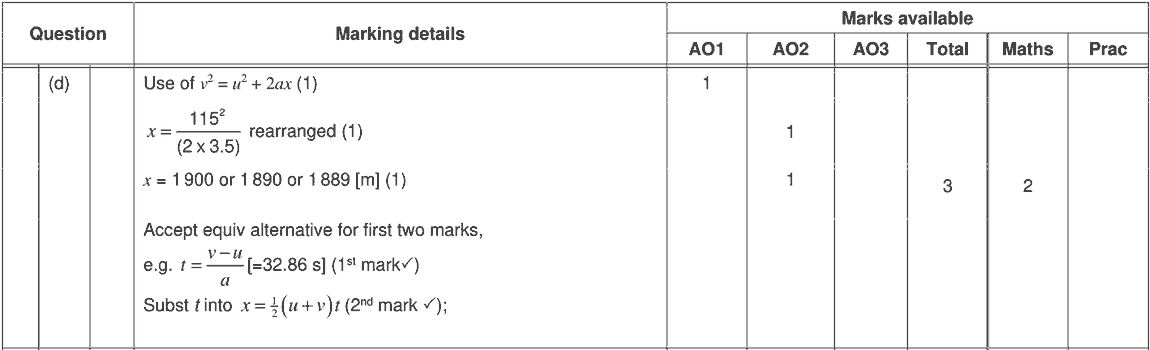
(d) An aeroplane has a maximum acceleration on the ground of 3.5 m s−2. If its take-off speed is 115 m s−1 determine the minimum length of the runway required for it to achieve take-off speed. Assume it starts from rest. [3]
June 2022 · AS Component 1 · Q2(a) 2 marks AO1=2 Definition dynamics
2. A cricket ball of mass 0.16 kg is thrown vertically upwards with a speed of 9.0 m s−1, arriving back at ground level 1.7 seconds later with a speed of 7.0 m s−1. (a) State Newton’s second law of motion in terms of momentum. [2]
June 2022 · AS Component 1 · Q2(b)(i) 2 marks AO2=2 Calculation energy concepts
Earlier part of question 2 that this part usesEarlier part of June 2022 Component 1 question 2
(b) (i) Calculate the work done against air resistance during the flight. [2]
June 2022 · AS Component 1 · Q2(b)(ii) 2 marks AO2=2 Calculation dynamics
Earlier parts of question 2 that this part usesEarlier part of June 2022 Component 1 question 2Earlier part of June 2022 Component 1 question 2
(ii) By considering the total change in momentum during the flight find the mean force acting on the ball. [2]
June 2022 · AS Component 1 · Q2(c)(i) 2 marks AO3=2 Explanation kinematics
Earlier part of question 2 that this part usesEarlier part of June 2022 Component 1 question 2
(c) (i) A team-mate of the cricketer says the ball will take longer to complete the upward part of the journey than the downward part. Discuss if he is correct. [2]
June 2022 · AS Component 1 · Q2(c)(ii) 2 marks AO2=2 Short answer kinematics
Earlier parts of question 2 that this part usesEarlier part of June 2022 Component 1 question 2Earlier part of June 2022 Component 1 question 2
(ii) At which point during the flight is air resistance at its minimum? Give a reason for your answer. [2]
June 2022 · AS Component 1 · Q3(a) 3 marks AO2=3 Diagram or graph dynamics
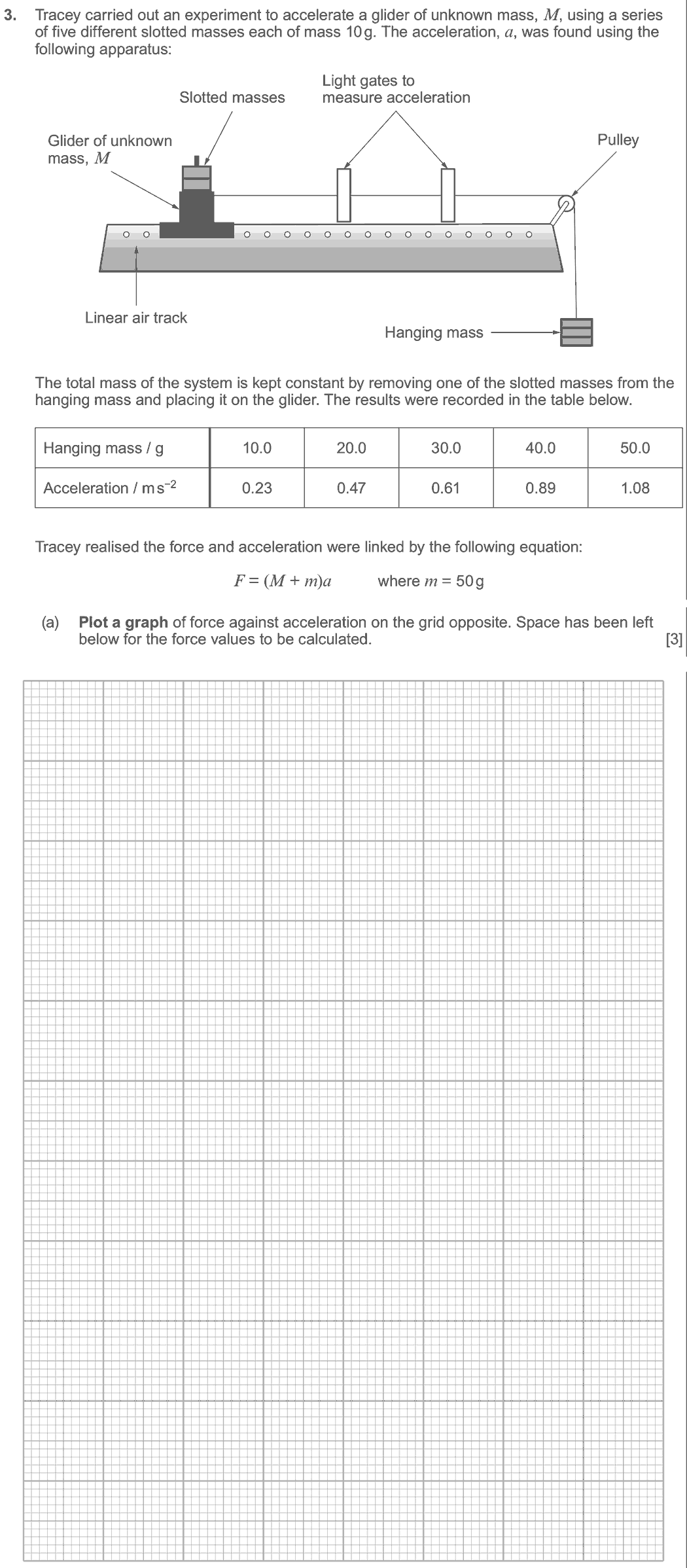
3. Tracey carried out an experiment to accelerate a glider of unknown mass, M, using a series of five different slotted masses each of mass 10 g. The acceleration, a, was found using the following apparatus: Light gates to Slotted masses measure acceleration Glider of unknown Pulley mass, M Linear air track Hanging mass The total mass of the system is kept constant by removing one of the slotted masses from the hanging mass and placing it on the glider. The results were recorded in the table below. Hanging mass / g 10.0 20.0 30.0 40.0 50.0 Acceleration / m s−2 0.23 0.47 0.61 0.89 1.08 Tracey realised the force and acceleration were linked by the following equation: F = (M + m)a where m = 50 g (a) Plot a graph of force against acceleration on the grid opposite. Space has been left below for the force values to be calculated. [3]
June 2022 · AS Component 1 · Q3(b) 3 marks AO3=3 Practical and data analysis dynamics
Earlier part of question 3 that this part usesEarlier part of June 2022 Component 1 question 3
(b) Discuss to what extent your graph agrees with the equation given on page 6. [3]
June 2022 · AS Component 1 · Q3(c) 4 marks AO2=4 Practical and data analysis dynamics
Earlier part of question 3 that this part usesEarlier part of June 2022 Component 1 question 3
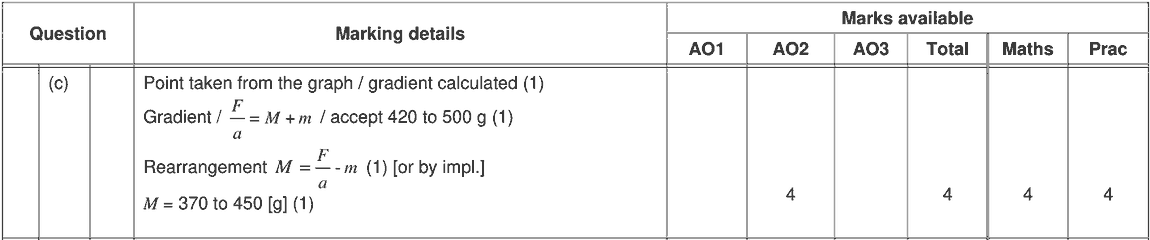
(c) Use your graph to determine the value of the unknown mass, M. [4]
June 2022 · AS Component 1 · Q3(d) 2 marks AO3=2 Explanation dynamics
Earlier part of question 3 that this part usesEarlier part of June 2022 Component 1 question 3
(d) Tracey predicts that the glider will continue with the same acceleration after the masses have hit the floor, evaluate if she is correct. [2]
June 2022 · AS Component 1 · Q4(a) 6 marks AO1=6 6-mark extended response solids under stress
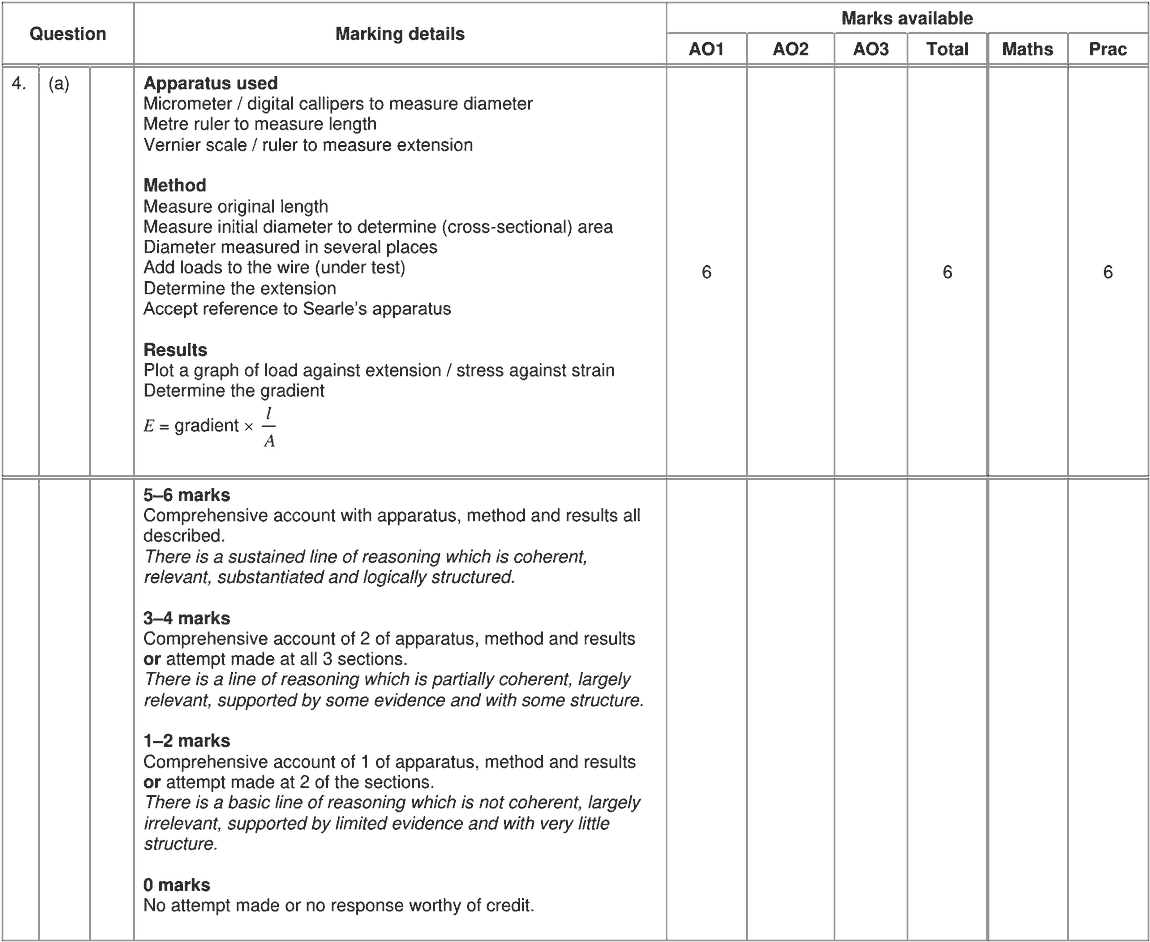
4. (a) Describe an experiment to determine the Young modulus of a metal wire. [6 QER]
June 2022 · AS Component 1 · Q4(b)(i) 1 mark AO2=1 Short answer solids under stress
Earlier part of question 4 that this part usesEarlier part of June 2022 Component 1 question 4
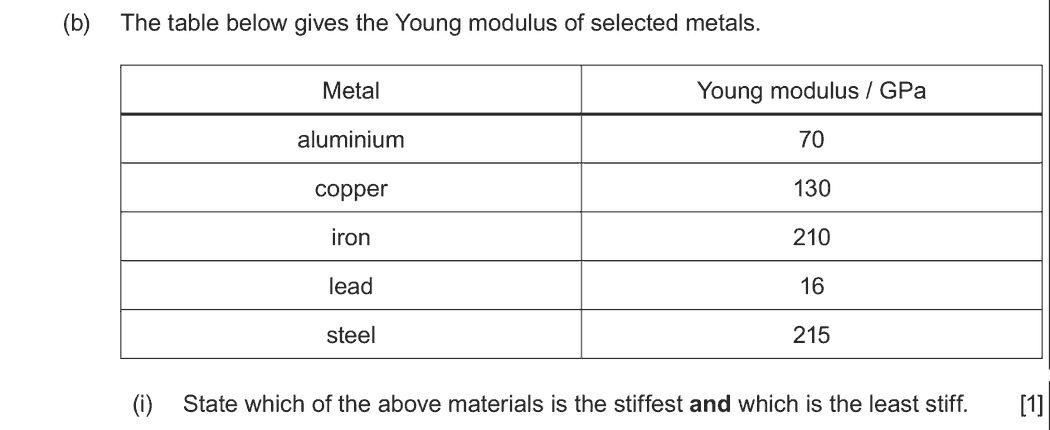
(b) The table below gives the Young modulus of selected metals. Metal Young modulus / GPa aluminium 70 copper 130 iron 210 lead 16 steel 215 (i) State which of the above materials is the stiffest and which is the least stiff. [1]
June 2022 · AS Component 1 · Q4(b)(ii) 3 marks AO2=3 Calculation solids under stress
Earlier parts of question 4 that this part usesEarlier part of June 2022 Component 1 question 4Earlier part of June 2022 Component 1 question 4
(ii) A force of 80.0 N is applied to a copper wire 2.00 m long. If the diameter is 1.20 mm determine its extension. [3]
June 2022 · AS Component 1 · Q5(a) 2 marks AO1=2 Definition basic physics
5. (a) State the principle of moments. [2]
June 2022 · AS Component 1 · Q5(b)(i) 4 marks AO2=4 Calculation basic physics
Earlier part of question 5 that this part usesEarlier part of June 2022 Component 1 question 5
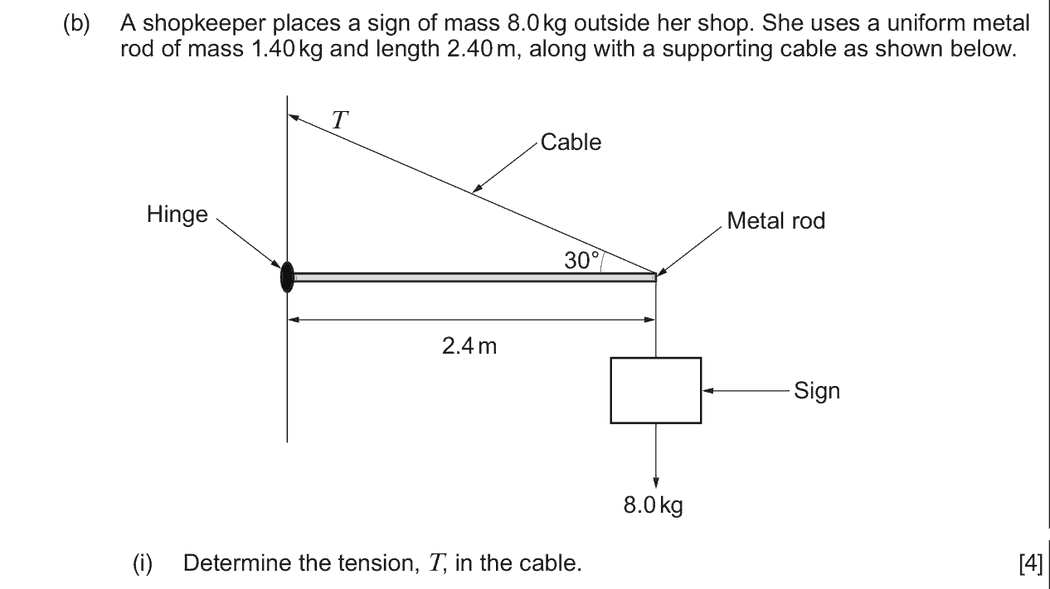
(b) A shopkeeper places a sign of mass 8.0 kg outside her shop. She uses a uniform metal rod of mass 1.40 kg and length 2.40 m, along with a supporting cable as shown below. T Cable Hinge Metal rod 30° 2.4 m Sign 8.0 kg (i) Determine the tension, T, in the cable. [4]
June 2022 · AS Component 1 · Q5(b)(ii) 3 marks AO1=1, AO3=2 Calculation solids under stress
Earlier parts of question 5 that this part usesEarlier part of June 2022 Component 1 question 5Earlier part of June 2022 Component 1 question 5
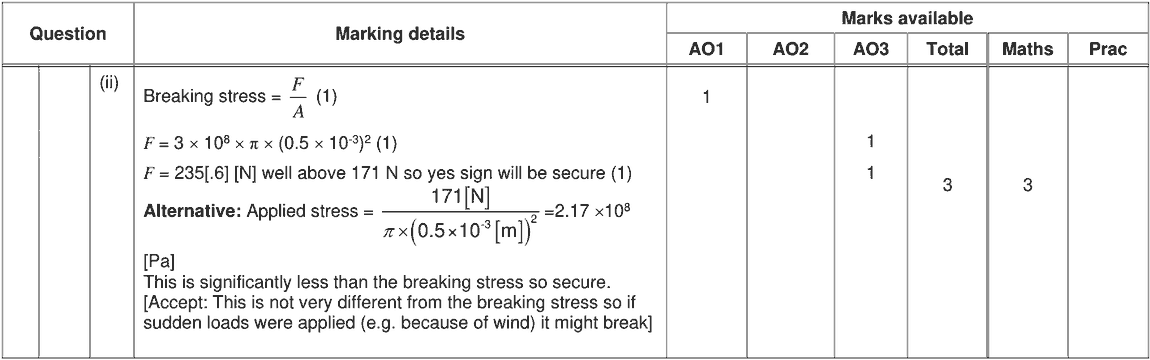
(ii) The shopkeeper decides to use a copper wire of diameter 1.0 mm and breaking stress 3.0 × 10⁸ Pa as the supporting cable. Evaluate whether the sign will be secure. [3]
June 2022 · AS Component 1 · Q5(c) 2 marks AO3=2 Short answer solids under stress
Earlier parts of question 5 that this part usesEarlier part of June 2022 Component 1 question 5Earlier part of June 2022 Component 1 question 5
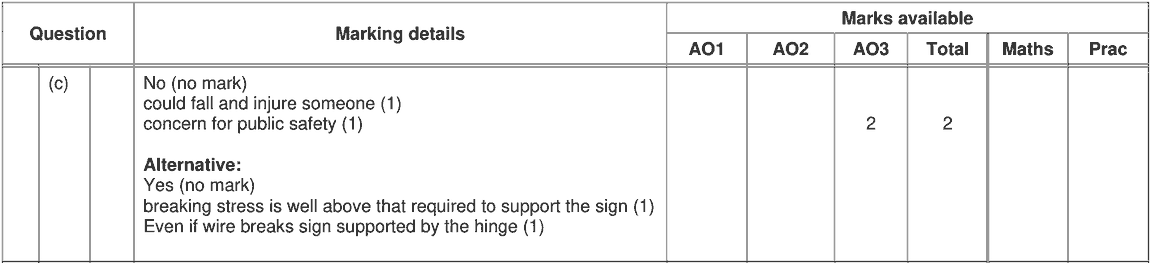
(c) Discuss whether or not the shopkeeper should be allowed to erect the sign without consulting the local council planning department or a qualified engineer. [2]
June 2022 · AS Component 1 · Q6(a)(i) 4 marks AO1=4 Short answer particles and nuclear structure
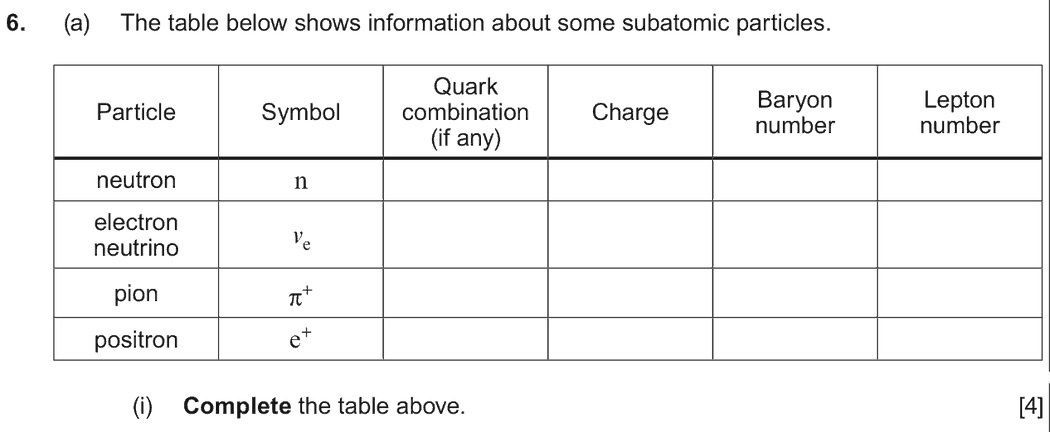
6. (a) The table below shows information about some subatomic particles. Quark Baryon Lepton Particle Symbol combination Charge number number (if any) neutron n electron ve neutrino pion π+ positron e+ (i) Complete the table above. [4]
June 2022 · AS Component 1 · Q6(a)(ii) 1 mark AO1=1 Short answer particles and nuclear structure
Earlier part of question 6 that this part usesEarlier part of June 2022 Component 1 question 6
(ii) State which one of the above particles is usually classed as an antiparticle. [1]
June 2022 · AS Component 1 · Q6(a)(iii) 1 mark AO1=1 Short answer particles and nuclear structure
Earlier part of question 6 that this part usesEarlier part of June 2022 Component 1 question 6
(iii) State one difference and one similarity between a charged particle and its antiparticle. [1]
June 2022 · AS Component 1 · Q6(b)(i) 3 marks AO1=1, AO3=2 Explanation particles and nuclear structure
Earlier part of question 6 that this part usesEarlier part of June 2022 Component 1 question 6
(b) (i) The following reaction has been observed in the large hadron collider at CERN. e− + p → Δ++ + x + π− where Δ++ is a first generation baryon. Identify particle x. Justify your answer using the conservation laws. [3]
June 2022 · AS Component 1 · Q6(b)(ii) 2 marks AO3=2 Explanation particles and nuclear structure
Earlier parts of question 6 that this part usesEarlier part of June 2022 Component 1 question 6Earlier part of June 2022 Component 1 question 6
(ii) Deduce which force is responsible for the interaction, giving a reason for your answer. [2]
June 2022 · AS Component 1 · Q7(a) 3 marks AO1=3 Explanation radiation and stars
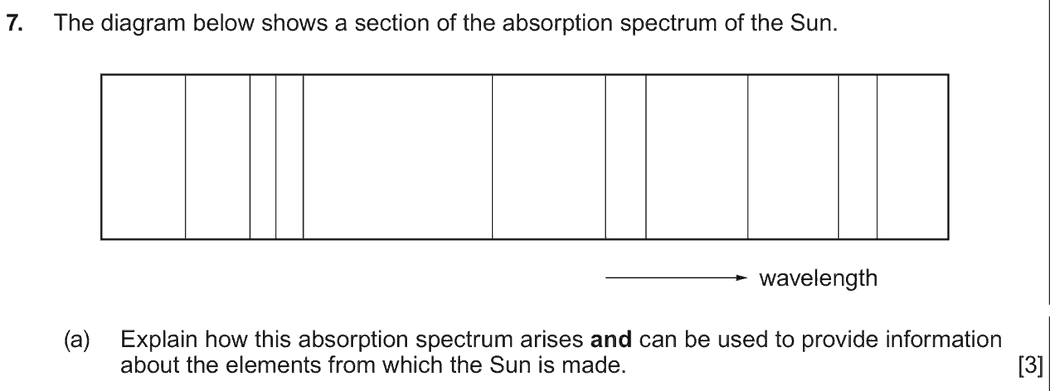
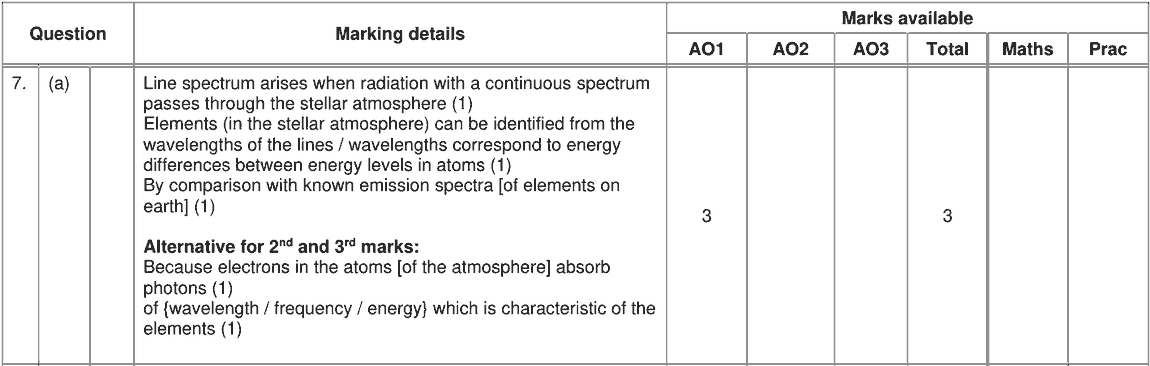
7. The diagram below shows a section of the absorption spectrum of the Sun. wavelength (a) Explain how this absorption spectrum arises and can be used to provide information about the elements from which the Sun is made. [3]
June 2022 · AS Component 1 · Q7(b) 3 marks AO2=3 Calculation radiation and stars
Earlier part of question 7 that this part usesEarlier part of June 2022 Component 1 question 7
(b) The star Polaris is 431 light years away and the intensity of its radiation reaching the earth is 4.1 × 10⁻⁹ W m−2. Determine its luminosity. (1 light year = 9.5 × 10¹⁵ m) [3]
June 2022 · AS Component 1 · Q7(c) 4 marks AO1=1, AO2=3 Calculation radiation and stars
Earlier part of question 7 that this part usesEarlier part of June 2022 Component 1 question 7
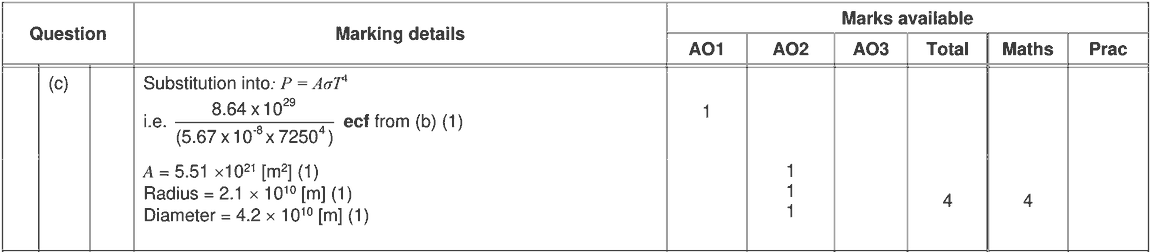
(c) Calculate the diameter of Polaris given that its surface temperature is 7 250 K. [4] For For continuation continuation only. only.

Work with an Eduqas physics tutor

Want a paper marked and gone through with you? Message us.

Prefer email? Send an enquiry

If you are under 18, please include a parent's contact details. Enquiries go to enquiries@physicsaleveltutor.com and are deleted once handled. All tutoring is online.