
June 2024: AS Component 1

75 marks · 31 question parts · Paper, mark scheme and report on Eduqas's site · Have the Data Booklet beside you

Question by question

QTopicMarksAOType
1(a)(i) Basic physics: units, vectors and moments 2AO1=2Short answer

1(a)(ii) Basic physics: units, vectors and moments 2AO1=2Short answer
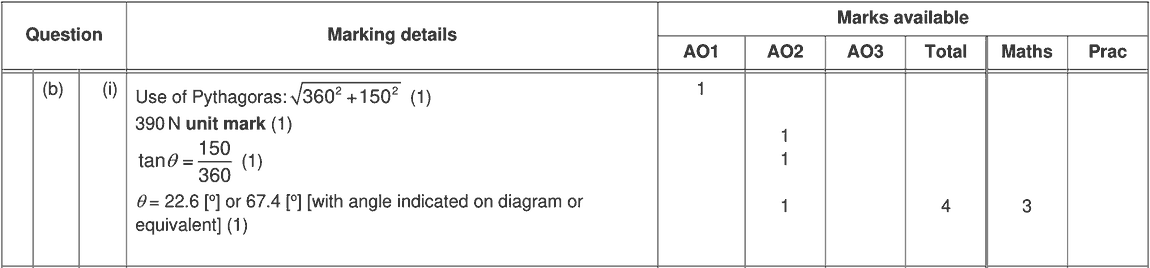
1(b)(i) Basic physics: units, vectors and moments 4AO1=1,AO2=3Calculation
1(b)(ii) Basic physics: units, vectors and moments, Dynamics: forces and momentum 2AO2=2Short answer
2(a) Basic physics: units, vectors and moments 2AO1=1,AO2=1Show that
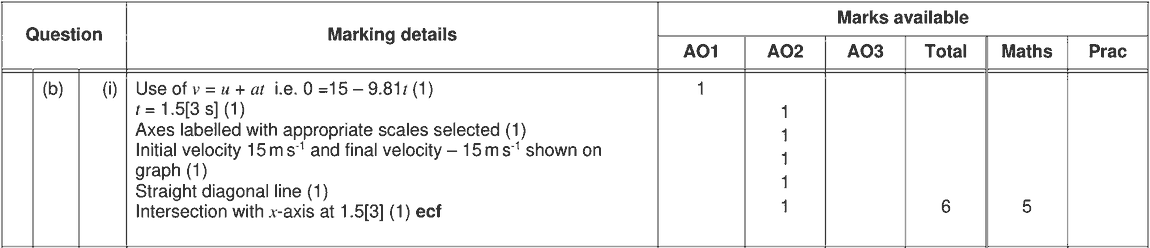
2(b)(i) Kinematics 6AO1=1,AO2=5Diagram or graph
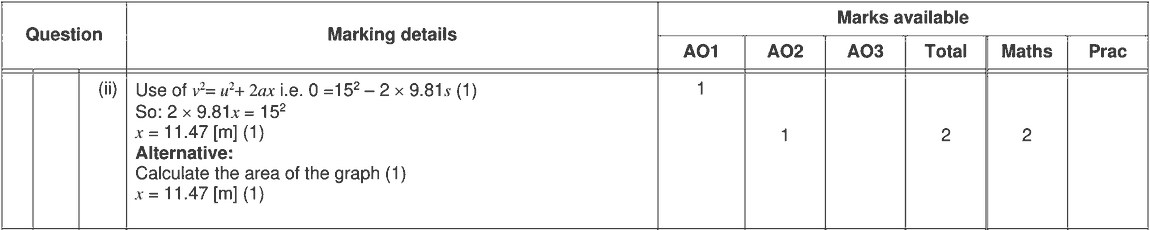
2(b)(ii) Kinematics 2AO1=1,AO2=1Calculation
3(a) Energy concepts 2AO1=1,AO2=1Show that
3(b)(i) Kinematics 2AO1=1,AO2=1Calculation
3(b)(ii) Energy concepts, Basic physics: units, vectors and moments 3AO2=3Calculation
3(b)(iii) Energy concepts 2AO1=1,AO2=1Calculation
3(b)(iv) Energy concepts 2AO2=2Calculation
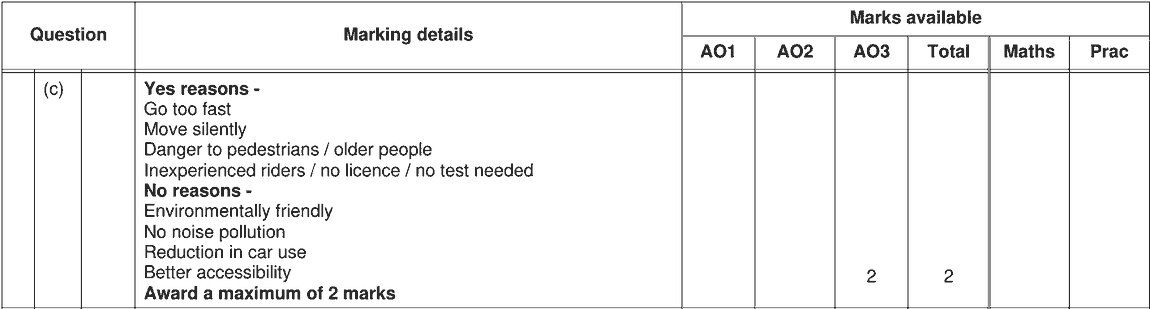
3(c) Energy concepts 2AO3=2Short answer
4(a)(i) Solids under stress 1AO1=1Definition
4(a)(ii) Solids under stress 2AO1=2Short answer
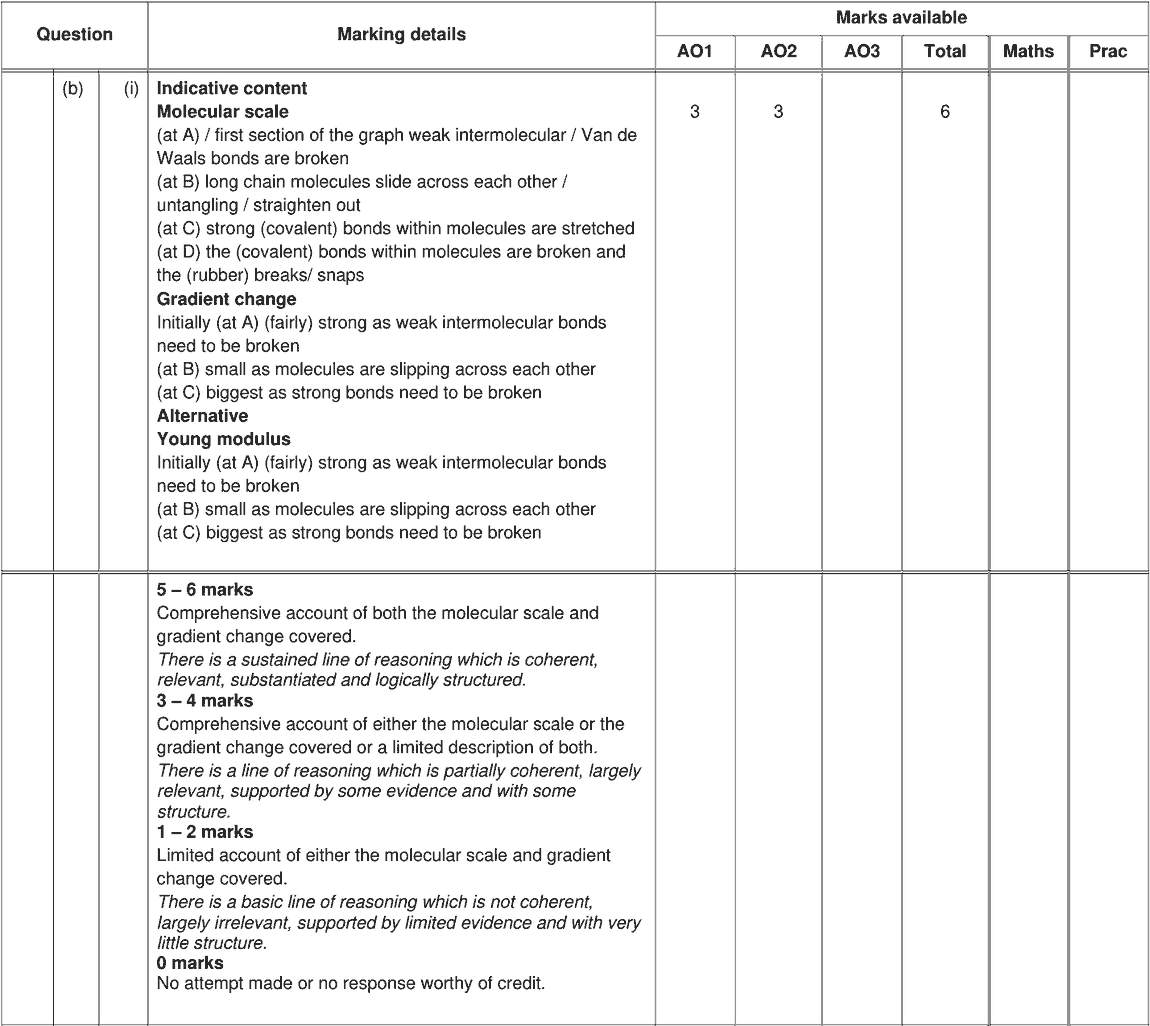
4(b)(i) Solids under stress 6AO1=3,AO2=3Extended response
4(b)(ii) Solids under stress 1AO2=1Diagram or graph
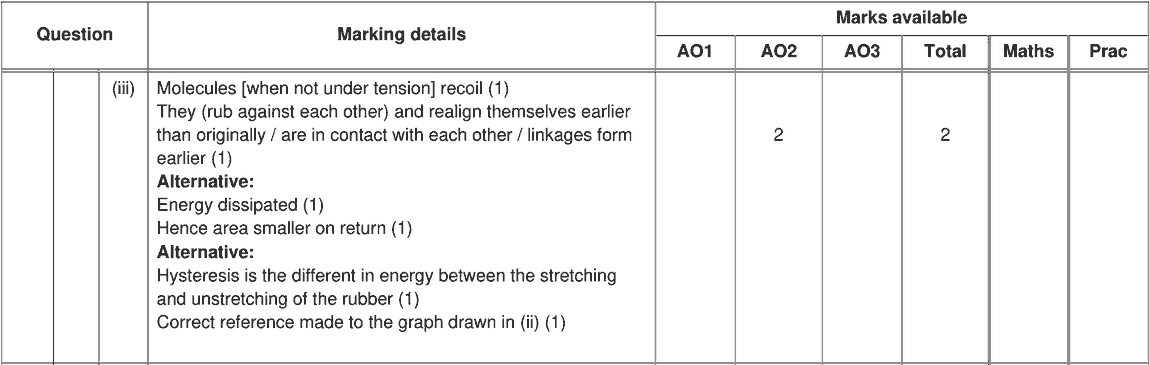
4(b)(iii) Solids under stress 2AO2=2Explanation
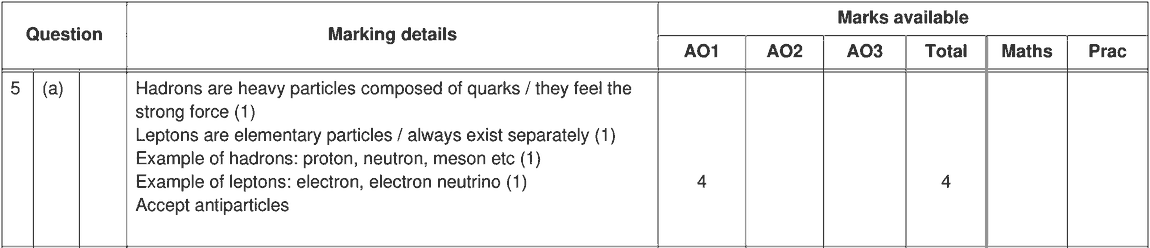
5(a) Particles and nuclear structure 4AO1=4Explanation
5(b)(i) Particles and nuclear structure 4AO3=4Explanation
5(b)(ii) Particles and nuclear structure 2AO3=2Explanation
6(a) Kinematics 2AO1=2Explanation
6(b)(i) Kinematics 1AO2=1Practical and data analysis
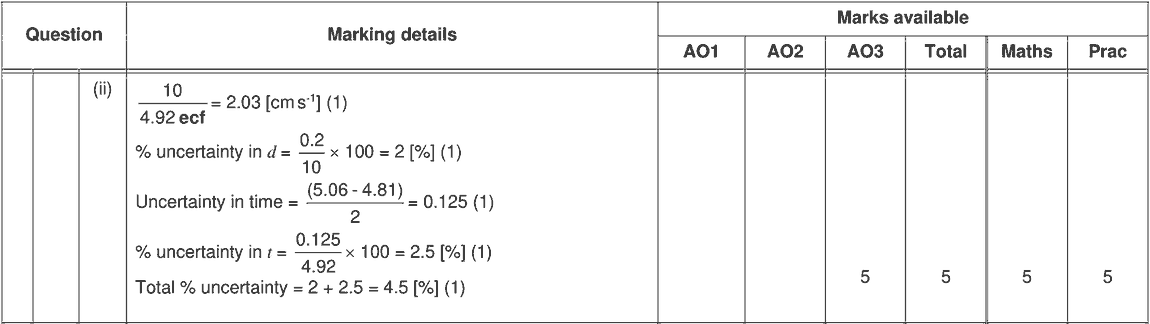
6(b)(ii) Kinematics 5AO3=5Practical and data analysis
6(b)(iii) Kinematics 2AO2=2Practical and data analysis
6(b)(iv) Kinematics 2AO3=2Practical and data analysis
7(a) Using radiation to investigate stars 1AO1=1Definition
7(b)(i) Using radiation to investigate stars 2AO1=1,AO2=1Calculation
7(b)(ii) Using radiation to investigate stars 1AO1=1Short answer
7(b)(iii) Using radiation to investigate stars 2AO2=2Calculation
7(b)(iv) Using radiation to investigate stars 2AO2=2Calculation

The questions

1(a)(i)1(a)(ii)1(b)(i)1(b)(ii)2(a)2(b)(i)2(b)(ii)3(a)3(b)(i)3(b)(ii)3(b)(iii)3(b)(iv)3(c)4(a)(i)4(a)(ii)4(b)(i)4(b)(ii)4(b)(iii)5(a)5(b)(i)5(b)(ii)6(a)6(b)(i)6(b)(ii)6(b)(iii)6(b)(iv)7(a)7(b)(i)7(b)(ii)7(b)(iii)7(b)(iv)
June 2024 · AS Component 1 · Q1(a)(i) 2 marks AO1=2 Short answer basic physics
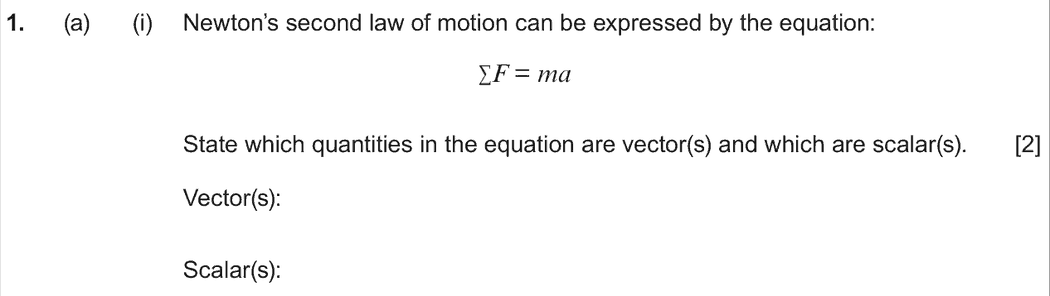
1. (a) (i) Newton’s second law of motion can be expressed by the equation: ∑F = ma State which quantities in the equation are vector(s) and which are scalar(s). [2] Vector(s): Scalar(s):
June 2024 · AS Component 1 · Q1(a)(ii) 2 marks AO1=2 Short answer basic physics
Earlier part of question 1 that this part usesEarlier part of June 2024 Component 1 question 1
(ii) State the difference between vectors and scalars. Give one further example of each. [2]
June 2024 · AS Component 1 · Q1(b)(i) 4 marks AO1=1, AO2=3 Calculation basic physics
Earlier part of question 1 that this part usesEarlier part of June 2024 Component 1 question 1
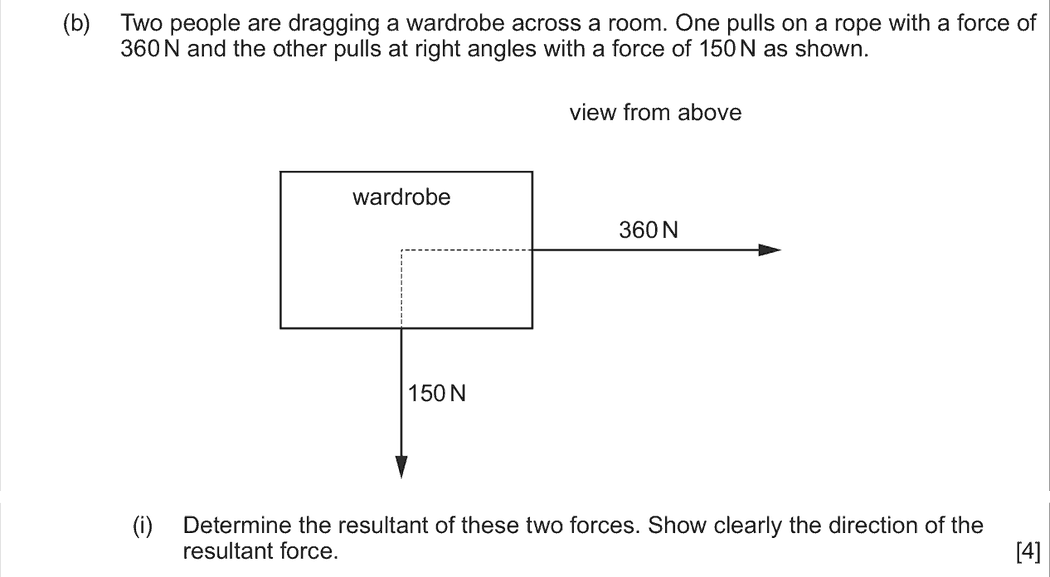
(b) Two people are dragging a wardrobe across a room. One pulls on a rope with a force of 360 N and the other pulls at right angles with a force of 150 N as shown. view from above wardrobe 360 N 150 N (i) Determine the resultant of these two forces. Show clearly the direction of the resultant force. [4]
June 2024 · AS Component 1 · Q1(b)(ii) 2 marks AO2=2 Short answer basic physicsdynamics
Earlier parts of question 1 that this part usesEarlier part of June 2024 Component 1 question 1Earlier part of June 2024 Component 1 question 1
(ii) Determine the force of friction acting on the wardrobe when it is moving at a constant velocity. [2]
June 2024 · AS Component 1 · Q2(a) 2 marks AO1=1, AO2=1 Show that basic physics
2. (a) One of the equations of motion can be written as: v = u + at Show that the equation is homogeneous in terms of units. [2]
June 2024 · AS Component 1 · Q2(b)(i) 6 marks AO1=1, AO2=5 Diagram or graph kinematics
Earlier part of question 2 that this part usesEarlier part of June 2024 Component 1 question 2
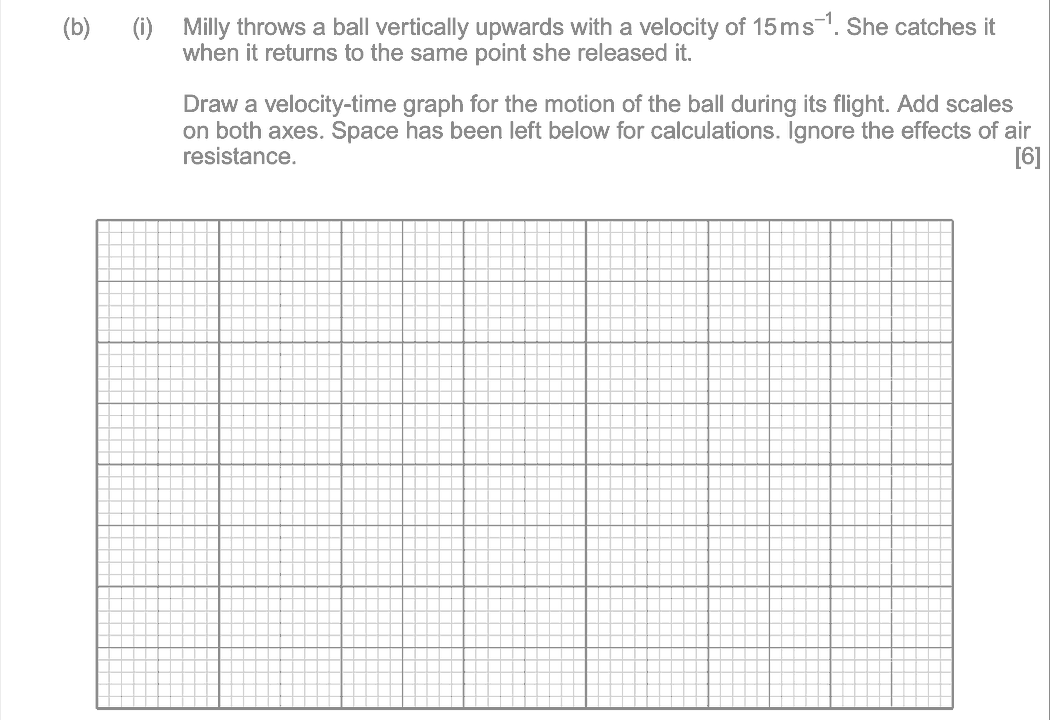
(b) (i) Milly throws a ball vertically upwards with a velocity of 15 m s–1. She catches it when it returns to the same point she released it. Draw a velocity-time graph for the motion of the ball during its flight. Add scales on both axes. Space has been left below for calculations. Ignore the effects of air resistance. [6]
June 2024 · AS Component 1 · Q2(b)(ii) 2 marks AO1=1, AO2=1 Calculation kinematics
Earlier parts of question 2 that this part usesEarlier part of June 2024 Component 1 question 2Earlier part of June 2024 Component 1 question 2
(ii) Calculate the maximum height reached by the ball. [2]
June 2024 · AS Component 1 · Q3(a) 2 marks AO1=1, AO2=1 Show that energy concepts
3. (a) Billy’s physics teacher says that when his electric scooter is travelling at a velocity, v, with a force, F, the power, P, can be expressed by: P = Fv Starting with the definition of work show that Billy’s teacher is correct. [2]
June 2024 · AS Component 1 · Q3(b)(i) 2 marks AO1=1, AO2=1 Calculation kinematics
Earlier part of question 3 that this part usesEarlier part of June 2024 Component 1 question 3
(b) Billy rides his electric scooter on a road that is 200 m long at a constant speed of 8.5 m s–1. (i) Determine the time taken for Billy’s journey. [2]
June 2024 · AS Component 1 · Q3(b)(ii) 3 marks AO2=3 Calculation energy conceptsbasic physics
Earlier parts of question 3 that this part usesEarlier part of June 2024 Component 1 question 3Earlier part of June 2024 Component 1 question 3
(ii) Billy and his scooter have a combined mass of 85 kg. The road has an upward incline of 1.5 °. Determine the gain in potential energy during his journey. [3]
June 2024 · AS Component 1 · Q3(b)(iii) 2 marks AO1=1, AO2=1 Calculation energy concepts
Earlier parts of question 3 that this part usesEarlier part of June 2024 Component 1 question 3Earlier part of June 2024 Component 1 question 3
(iii) Billy’s scooter operates at 36 V and 6.0 A. Calculate the electrical energy used by the motor during the journey. [2]
June 2024 · AS Component 1 · Q3(b)(iv) 2 marks AO2=2 Calculation energy concepts
Earlier parts of question 3 that this part usesEarlier part of June 2024 Component 1 question 3Earlier part of June 2024 Component 1 question 3
(iv) Determine the overall efficiency of the scooter. [2]
June 2024 · AS Component 1 · Q3(c) 2 marks AO3=2 Short answer energy concepts
Earlier part of question 3 that this part usesEarlier part of June 2024 Component 1 question 3
(c) Some people think electric scooters should be banned from using pavements and pedestrian areas. Explain, giving your reasons, whether you agree or disagree. [2]
June 2024 · AS Component 1 · Q4(a)(i) 1 mark AO1=1 Definition solids under stress
4. (a) (i) Define the Young modulus of a material. [1]
June 2024 · AS Component 1 · Q4(a)(ii) 2 marks AO1=2 Short answer solids under stress
Earlier part of question 4 that this part usesEarlier part of June 2024 Component 1 question 4
(ii) Rubber is a polymer. Describe its structure on a molecular scale. [2]
June 2024 · AS Component 1 · Q4(b)(i) 6 marks AO1=3, AO2=3 6-mark extended response solids under stress
Earlier part of question 4 that this part usesEarlier part of June 2024 Component 1 question 4
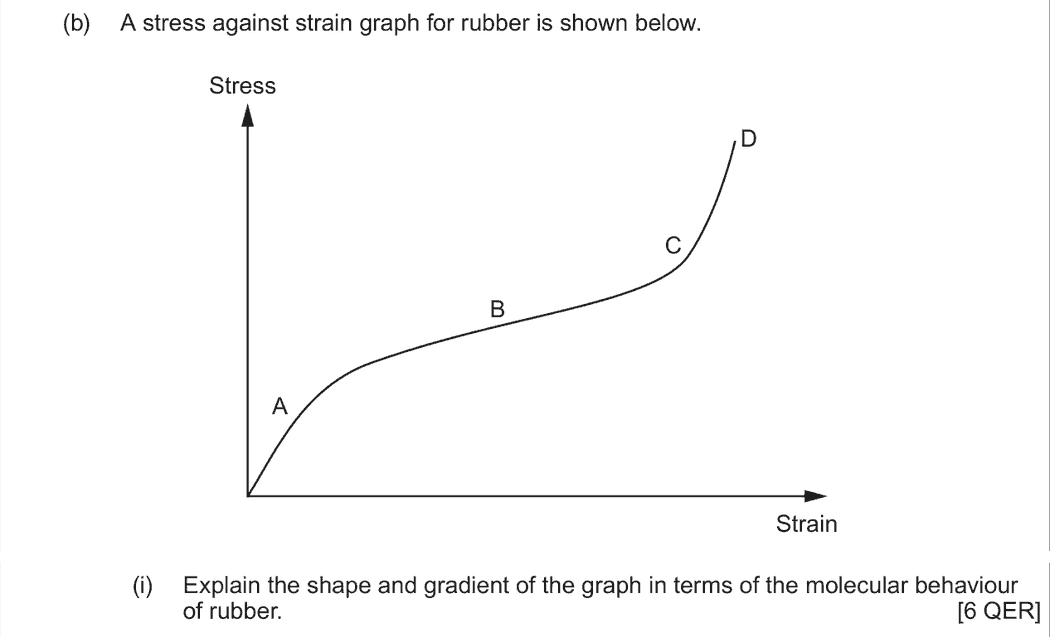
(b) A stress against strain graph for rubber is shown below. Stress D C B A Strain (i) Explain the shape and gradient of the graph in terms of the molecular behaviour of rubber. [6 QER]
June 2024 · AS Component 1 · Q4(b)(ii) 1 mark AO2=1 Diagram or graph solids under stress
Earlier parts of question 4 that this part usesEarlier part of June 2024 Component 1 question 4Earlier part of June 2024 Component 1 question 4
(ii) On the same axes, sketch the graph that would be obtained when unloading the rubber band, assuming it undergoes hysteresis. [1]
June 2024 · AS Component 1 · Q4(b)(iii) 2 marks AO2=2 Explanation solids under stress
Earlier parts of question 4 that this part usesEarlier part of June 2024 Component 1 question 4Earlier part of June 2024 Component 1 question 4
(iii) Explain why hysteresis occurs. [2]
June 2024 · AS Component 1 · Q5(a) 4 marks AO1=4 Explanation particles and nuclear structure
5. (a) Explain how hadrons and leptons differ from each other. Give one example of each. [4]
June 2024 · AS Component 1 · Q5(b)(i) 4 marks AO3=4 Explanation particles and nuclear structure
Earlier part of question 5 that this part usesEarlier part of June 2024 Component 1 question 5
(b) (i) Scientists at CERN observed the following reaction, where x is an unidentified particle. ve + n = p + x Identify particle x. Give your reasoning. [4]
June 2024 · AS Component 1 · Q5(b)(ii) 2 marks AO3=2 Explanation particles and nuclear structure
Earlier parts of question 5 that this part usesEarlier part of June 2024 Component 1 question 5Earlier part of June 2024 Component 1 question 5
(ii) Doug believes this to be a strong force interaction. Determine whether Doug is correct. [2]
June 2024 · AS Component 1 · Q6(a) 2 marks AO1=2 Explanation kinematics
6. (a) A ball bearing quickly reaches terminal velocity when falling through oil. Explain in terms of forces why a terminal velocity is reached. [2]
June 2024 · AS Component 1 · Q6(b)(i) 1 mark AO2=1 Practical and data analysis kinematics
Earlier part of question 6 that this part usesEarlier part of June 2024 Component 1 question 6
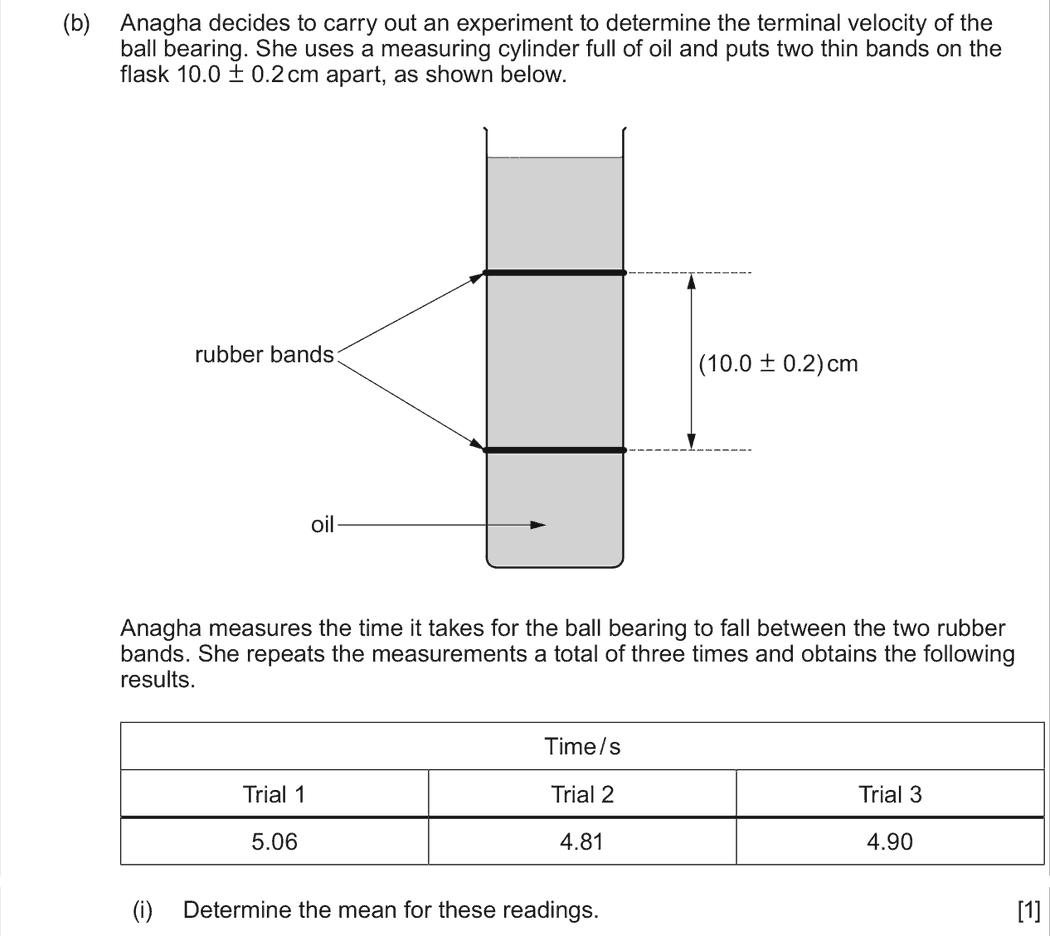
(b) Anagha decides to carry out an experiment to determine the terminal velocity of the ball bearing. She uses a measuring cylinder full of oil and puts two thin bands on the flask 10.0 ± 0.2 cm apart, as shown below. rubber bands (10.0 ± 0.2) cm oil Anagha measures the time it takes for the ball bearing to fall between the two rubber bands. She repeats the measurements a total of three times and obtains the following results. Time / s Trial 1 Trial 2 Trial 3 5.06 4.81 4.90 (i) Determine the mean for these readings. [1]
June 2024 · AS Component 1 · Q6(b)(ii) 5 marks AO3=5 Practical and data analysis kinematics
Earlier parts of question 6 that this part usesEarlier part of June 2024 Component 1 question 6Earlier part of June 2024 Component 1 question 6
(ii) Determine the terminal velocity along with its percentage uncertainty. Assume the ball bearing reaches terminal velocity by the time it gets to the first rubber band. [5]
June 2024 · AS Component 1 · Q6(b)(iii) 2 marks AO2=2 Practical and data analysis kinematics
Earlier parts of question 6 that this part usesEarlier part of June 2024 Component 1 question 6Earlier part of June 2024 Component 1 question 6
(iii) Determine the absolute uncertainty in the terminal velocity. Hence, state the terminal velocity with its absolute uncertainty to a suitable number of significant figures. [2]
June 2024 · AS Component 1 · Q6(b)(iv) 2 marks AO3=2 Practical and data analysis kinematics
Earlier parts of question 6 that this part usesEarlier part of June 2024 Component 1 question 6Earlier part of June 2024 Component 1 question 6
(iv) Determine two ways in which Anagha could reduce the uncertainty in her final result. [2]
June 2024 · AS Component 1 · Q7(a) 1 mark AO1=1 Definition radiation and stars
7. (a) Neutron stars have an outer layer that radiates as a black body. Explain what is meant by a black body. [1]
June 2024 · AS Component 1 · Q7(b)(i) 2 marks AO1=1, AO2=1 Calculation radiation and stars
Earlier part of question 7 that this part usesEarlier part of June 2024 Component 1 question 7
(b) RX J1856.5 -3754 is one of the closest neutron stars to Earth in the constellation Corona Australis. It has a diameter of 20 km and a surface temperature of approximately 7 × 10⁵ K. (i) Calculate the wavelength of its greatest spectral intensity. [2]
June 2024 · AS Component 1 · Q7(b)(ii) 1 mark AO1=1 Short answer radiation and stars
Earlier parts of question 7 that this part usesEarlier part of June 2024 Component 1 question 7Earlier part of June 2024 Component 1 question 7
(ii) State which part of the electromagnetic spectrum this radiation belongs to. [1]
June 2024 · AS Component 1 · Q7(b)(iii) 2 marks AO2=2 Calculation radiation and stars
Earlier parts of question 7 that this part usesEarlier part of June 2024 Component 1 question 7Earlier part of June 2024 Component 1 question 7
(iii) Calculate the total power emitted by the neutron star. [2]
June 2024 · AS Component 1 · Q7(b)(iv) 2 marks AO2=2 Calculation radiation and stars
Earlier parts of question 7 that this part usesEarlier part of June 2024 Component 1 question 7Earlier part of June 2024 Component 1 question 7
(iv) The distance from the neutron star to the Earth is 3.8 × 10¹⁸ m. Calculate the intensity of the radiation from the star received at the Earth. [2]

Work with an Eduqas physics tutor

Want a paper marked and gone through with you? Message us.

Prefer email? Send an enquiry

If you are under 18, please include a parent's contact details. Enquiries go to enquiries@physicsaleveltutor.com and are deleted once handled. All tutoring is online.