June 2025: AS Component 2

75 marks · 29 question parts · Paper, mark scheme and report on Eduqas's site · Have the Data Booklet beside you

Question by question

QTopicMarksAOType
1(a)(i) The nature of waves 2AO1=2Definition
1(a)(ii) The nature of waves 2AO1=2Explanation
1(b)(i) The nature of waves 2AO2=2Calculation
1(b)(ii) The nature of waves 3AO2=3Diagram or graph
2(a)(i) Wave properties: diffraction, interference and stationary waves 2AO1=2Explanation
2(a)(ii) Wave properties: diffraction, interference and stationary waves 2AO1=1,AO2=1Explanation
2(b)(i) Wave properties: diffraction, interference and stationary waves 2AO2=2Explanation
2(b)(ii) Wave properties: diffraction, interference and stationary waves 3AO3=3Calculation
2(c)(i) Using radiation to investigate stars 1AO1=1Definition
2(c)(ii) Using radiation to investigate stars 1AO1=1Short answer
3(a) Resistance 6AO1=6Extended response
3(b) Conduction of electricity 3AO1=1,AO2=2Calculation
3(c)(i) Resistance 1AO1=1Definition
3(c)(ii) Resistance 3AO1=1,AO2=2Short answer
4(a) Refraction of light 2AO1=1,AO2=1Calculation
4(b)(i) Refraction of light 3AO1=1,AO2=2Calculation
4(b)(ii) Refraction of light 3AO3=3Calculation
5(a) Resistance 2AO1=2Definition
5(b)(i) d.c. circuits 3AO1=1,AO2=2Show that
5(b)(ii) d.c. circuits 3AO2=3Calculation
5(c) d.c. circuits 3AO2=3Calculation
6(a)(i) Resistance 3AO1=1,AO2=2Practical and data analysis
6(a)(ii) Resistance 6AO3=6Practical and data analysis
6(b) Resistance 2AO3=2Short answer
7(a)(i) Photons 3AO1=1,AO2=2Calculation
7(a)(ii) Photons 2AO1=1,AO2=1Explanation
7(b)(i) Conduction of electricity, Photons 3AO2=3Calculation
7(b)(ii) Photons 1AO3=1Calculation
7(b)(iii) Photons 3AO2=3Practical and data analysis

The questions

1(a)(i)1(a)(ii)1(b)(i)1(b)(ii)2(a)(i)2(a)(ii)2(b)(i)2(b)(ii)2(c)(i)2(c)(ii)3(a)3(b)3(c)(i)3(c)(ii)4(a)4(b)(i)4(b)(ii)5(a)5(b)(i)5(b)(ii)5(c)6(a)(i)6(a)(ii)6(b)7(a)(i)7(a)(ii)7(b)(i)7(b)(ii)7(b)(iii)
June 2025 · AS Component 2 · Q1(a)(i) 2 marks AO1=2 Definition nature of waves
1. (a) (i) Explain what is meant by a progressive wave. [2]
June 2025 · AS Component 2 · Q1(a)(ii) 2 marks AO1=2 Explanation nature of waves
Earlier part of question 1 that this part usesEarlier part of June 2025 Component 2 question 1
(ii) Progressive waves can be transverse or longitudinal. Explain the difference between these two types of waves. [2]
June 2025 · AS Component 2 · Q1(b)(i) 2 marks AO2=2 Calculation nature of waves
Earlier part of question 1 that this part usesEarlier part of June 2025 Component 2 question 1
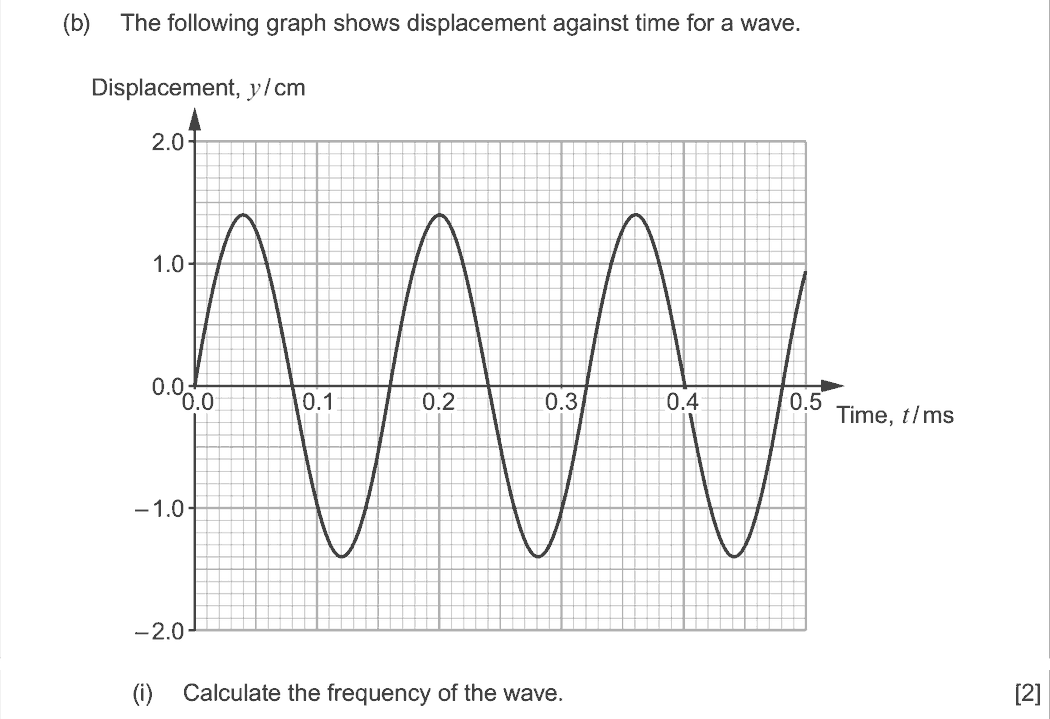
(b) The following graph shows displacement against time for a wave. Displacement, y / cm 2.0 1.0 0.0 0.0 0.1 0.2 0.3 0.4 0.5 Time, t / ms – 1.0 – 2.0 (i) Calculate the frequency of the wave. [2]
June 2025 · AS Component 2 · Q1(b)(ii) 3 marks AO2=3 Diagram or graph nature of waves
Earlier parts of question 1 that this part usesEarlier part of June 2025 Component 2 question 1Earlier part of June 2025 Component 2 question 1
(ii) Sketch, on the grid opposite, a wave that has half the amplitude and a phase difference of 90º compared to the original wave. [3]
June 2025 · AS Component 2 · Q2(a)(i) 2 marks AO1=2 Explanation wave properties
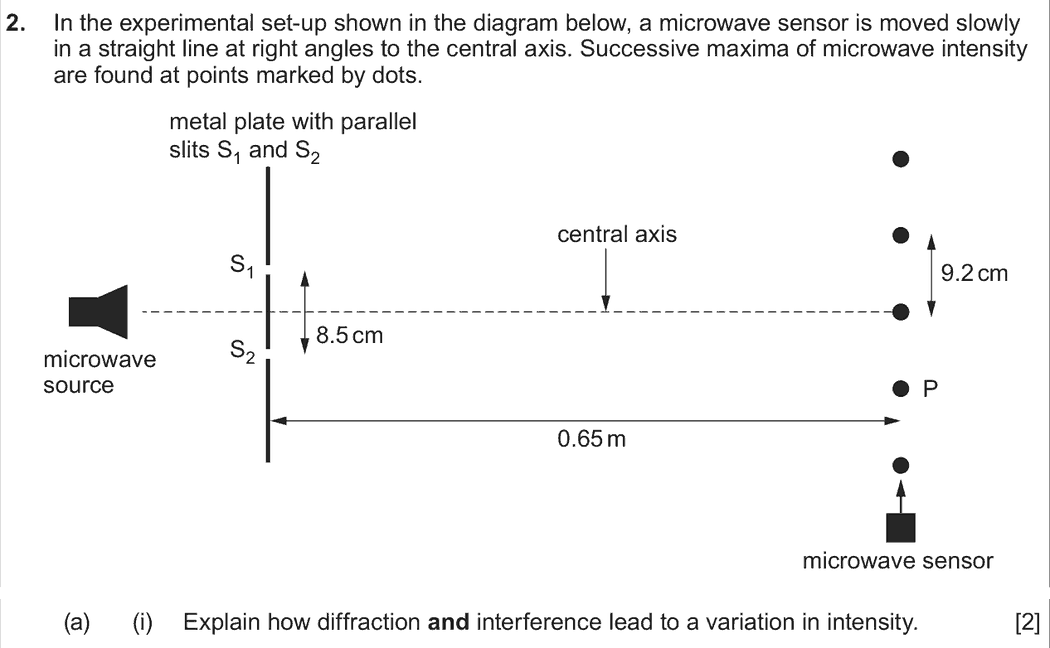
2. In the experimental set-up shown in the diagram below, a microwave sensor is moved slowly in a straight line at right angles to the central axis. Successive maxima of microwave intensity are found at points marked by dots. metal plate with parallel slits S1 and S2 central axis S1 9.2 cm 8.5 cm S2 microwave source P 0.65 m microwave sensor (a) (i) Explain how diffraction and interference lead to a variation in intensity. [2]
June 2025 · AS Component 2 · Q2(a)(ii) 2 marks AO1=1, AO2=1 Explanation wave properties
Earlier part of question 2 that this part usesEarlier part of June 2025 Component 2 question 2
(ii) The slits S1 and S2 act as sources that are in phase with each other. Explain how the diagram confirms that S1 and S2 are in phase. [2]
June 2025 · AS Component 2 · Q2(b)(i) 2 marks AO2=2 Explanation wave properties
Earlier part of question 2 that this part usesEarlier part of June 2025 Component 2 question 2
(b) (i) Explain the phase relationship between waves from S1 and S2 when they arrive at point P. [2]
June 2025 · AS Component 2 · Q2(b)(ii) 3 marks AO3=3 Calculation wave properties
Earlier parts of question 2 that this part usesEarlier part of June 2025 Component 2 question 2Earlier part of June 2025 Component 2 question 2
(ii) A physics textbook states that the wavelength of microwaves is in the range 1 mm to 30 cm. Evaluate whether this is consistent with the values in the diagram. [3]
June 2025 · AS Component 2 · Q2(c)(i) 1 mark AO1=1 Definition radiation and stars
Earlier part of question 2 that this part usesEarlier part of June 2025 Component 2 question 2
(c) Microwaves are used in multiwavelength astronomy. (i) Explain what is meant by multiwavelength astronomy. [1]
June 2025 · AS Component 2 · Q2(c)(ii) 1 mark AO1=1 Short answer radiation and stars
Earlier parts of question 2 that this part usesEarlier part of June 2025 Component 2 question 2Earlier part of June 2025 Component 2 question 2
(ii) Explain why multiwavelength observations are useful in modern astronomy. [1]
June 2025 · AS Component 2 · Q3(a) 6 marks AO1=6 6-mark extended response resistance
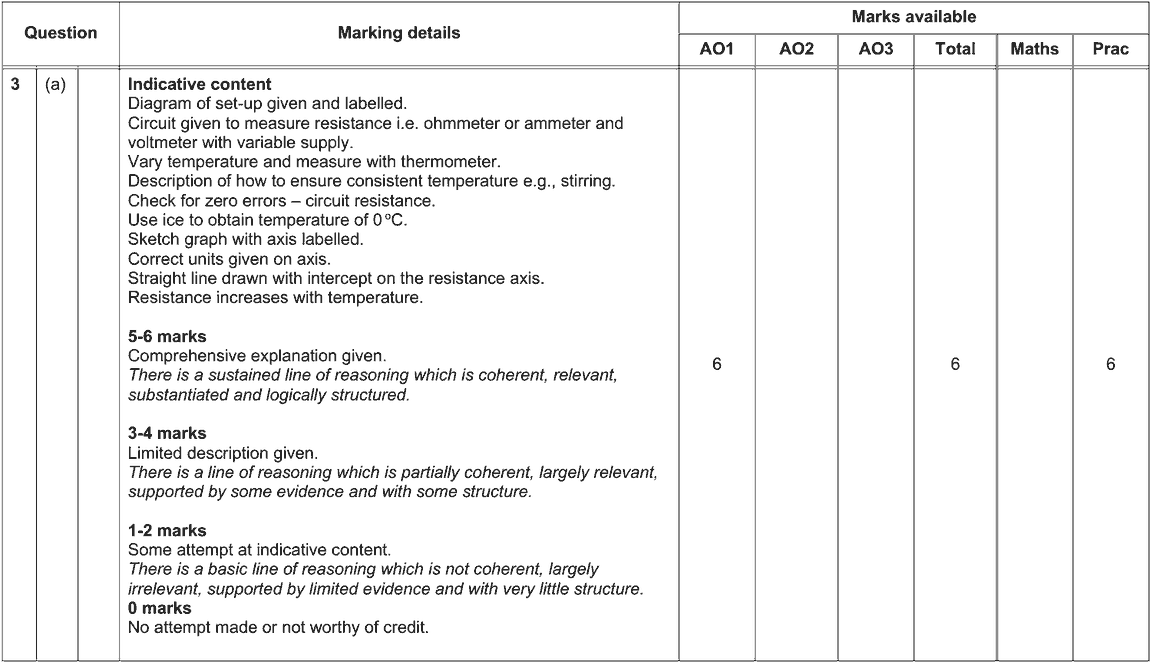
3. (a) Ada investigates the variation of resistance with temperature over the range 0 ºC to 100 ºC for a copper wire. Describe the apparatus and how Ada would use it to obtain accurate results in the investigation. Also, describe the expected relationship of resistance with temperature. [6 QER]
June 2025 · AS Component 2 · Q3(b) 3 marks AO1=1, AO2=2 Calculation conduction of electricity
Earlier part of question 3 that this part usesEarlier part of June 2025 Component 2 question 3
(b) An aluminium wire with a cross-sectional area of 2.0 × 10⁻⁷ m2 carries a current of 1.4 A. Each aluminium atom contributes three free electrons, and there are 6.0 × 1028 atoms per m3 of aluminium. Calculate the mean drift velocity of the free electrons in the wire. [3]
June 2025 · AS Component 2 · Q3(c)(i) 1 mark AO1=1 Definition resistance
Earlier part of question 3 that this part usesEarlier part of June 2025 Component 2 question 3
(c) Superconductivity is an effect shown by several metals. (i) State what is meant by superconductivity. [1]
June 2025 · AS Component 2 · Q3(c)(ii) 3 marks AO1=1, AO2=2 Short answer resistance
Earlier parts of question 3 that this part usesEarlier part of June 2025 Component 2 question 3Earlier part of June 2025 Component 2 question 3
(ii) State one example of an application of a superconductor. Give an advantage and a disadvantage of using a superconductor instead of a conventional conductor, such as aluminium. [3]
June 2025 · AS Component 2 · Q4(a) 2 marks AO1=1, AO2=1 Calculation refraction of light
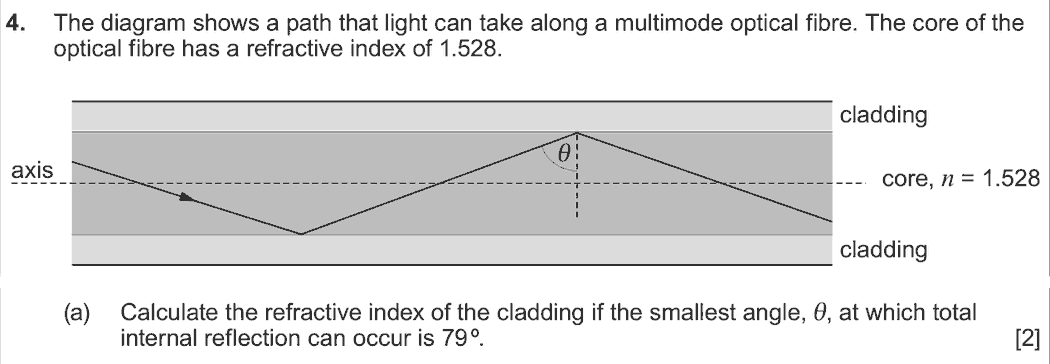
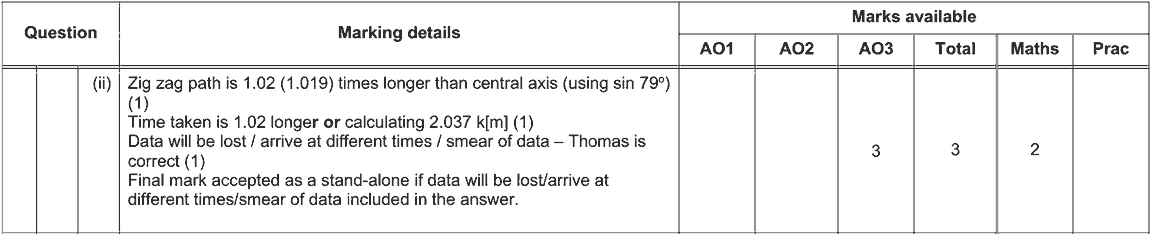
4. The diagram shows a path that light can take along a multimode optical fibre. The core of the optical fibre has a refractive index of 1.528. cladding θ axis core, n = 1.528 cladding (a) Calculate the refractive index of the cladding if the smallest angle, θ, at which total internal reflection can occur is 79 º. [2]
June 2025 · AS Component 2 · Q4(b)(i) 3 marks AO1=1, AO2=2 Calculation refraction of light
Earlier part of question 4 that this part usesEarlier part of June 2025 Component 2 question 4
(b) The length of the optical fibre is 2.0 km. (i) Calculate the time taken for light to travel straight along the axis of the fibre from one end to the other. [3]
June 2025 · AS Component 2 · Q4(b)(ii) 3 marks AO3=3 Calculation refraction of light
Earlier parts of question 4 that this part usesEarlier part of June 2025 Component 2 question 4Earlier part of June 2025 Component 2 question 4
(ii) Thomas states that the light takes a greater amount of time to travel along the zigzag path (when θ = 79 º) than along the axis. Thomas claims that this causes problems for sending data through the fibre. Using a suitable calculation, evaluate whether Thomas is correct. [3]
June 2025 · AS Component 2 · Q5(a) 2 marks AO1=2 Definition resistance
5. (a) ‘The pd measured between two points in an electrical circuit is 1.6 V.’ Explain what is meant by this statement. [2]
June 2025 · AS Component 2 · Q5(b)(i) 3 marks AO1=1, AO2=2 Show that dc circuits
Earlier part of question 5 that this part usesEarlier part of June 2025 Component 2 question 5
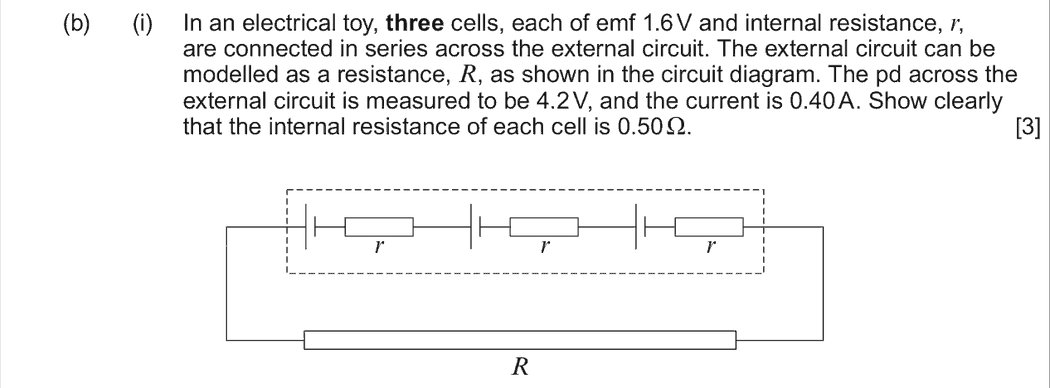
(b) (i) In an electrical toy, three cells, each of emf 1.6 V and internal resistance, r, are connected in series across the external circuit. The external circuit can be modelled as a resistance, R, as shown in the circuit diagram. The pd across the external circuit is measured to be 4.2 V, and the current is 0.40 A. Show clearly that the internal resistance of each cell is 0.50 Ω. [3] r r r R
June 2025 · AS Component 2 · Q5(b)(ii) 3 marks AO2=3 Calculation dc circuits
Earlier parts of question 5 that this part usesEarlier part of June 2025 Component 2 question 5Earlier part of June 2025 Component 2 question 5
(ii) Calculate the current in the circuit if one of the cells is connected the wrong way round. [3]
June 2025 · AS Component 2 · Q5(c) 3 marks AO2=3 Calculation dc circuits
Earlier parts of question 5 that this part usesEarlier part of June 2025 Component 2 question 5Earlier part of June 2025 Component 2 question 5
(c) A different toy uses cells of the same type as in part (a). The external circuit of the toy requires a current of 0.44 A and a pd of 6.9 V. Determine the number of cells required to operate the toy. [3]


June 2025 · AS Component 2 · Q6(a)(i) 3 marks AO1=1, AO2=2 Practical and data analysis resistance
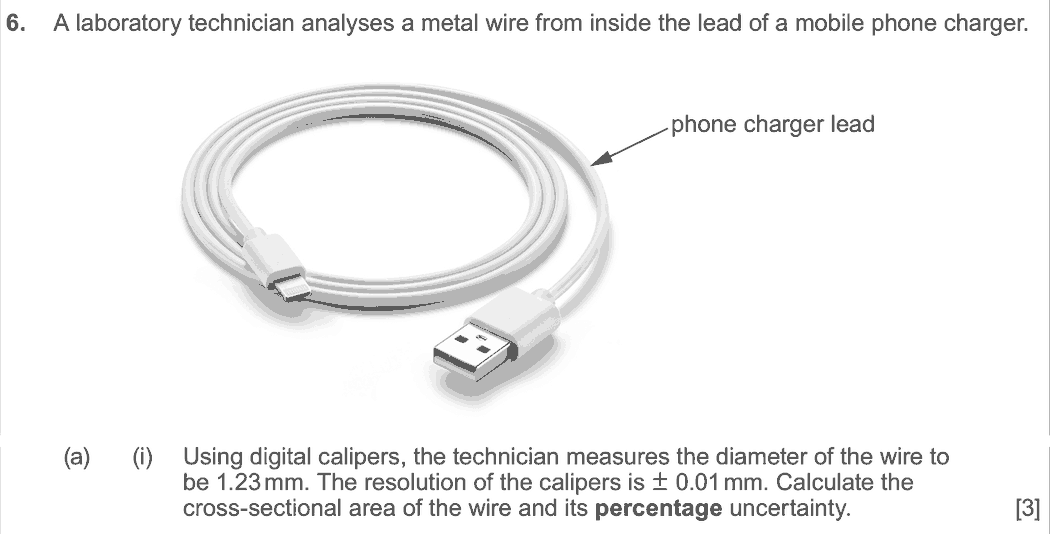
6. A laboratory technician analyses a metal wire from inside the lead of a mobile phone charger. phone charger lead (a) (i) Using digital calipers, the technician measures the diameter of the wire to be 1.23 mm. The resolution of the calipers is ± 0.01 mm. Calculate the cross-sectional area of the wire and its percentage uncertainty. [3]
June 2025 · AS Component 2 · Q6(a)(ii) 6 marks AO3=6 Practical and data analysis resistance
Earlier part of question 6 that this part usesEarlier part of June 2025 Component 2 question 6
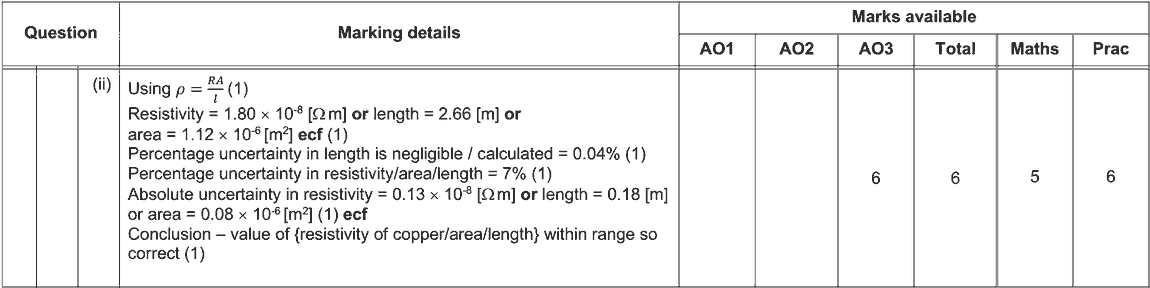
(ii) The technician believes that the wire could be made of copper based on the following data. • The resistance across the ends of the wire is 0.038 Ω ± 5%. • The length of the wire is 2.500 ± 0.001 m. • The resistivity of copper is 1.7 × 10⁻⁸ Ω m. Evaluate whether the technician is correct. [6]
June 2025 · AS Component 2 · Q6(b) 2 marks AO3=2 Short answer resistance
Earlier part of question 6 that this part usesEarlier part of June 2025 Component 2 question 6
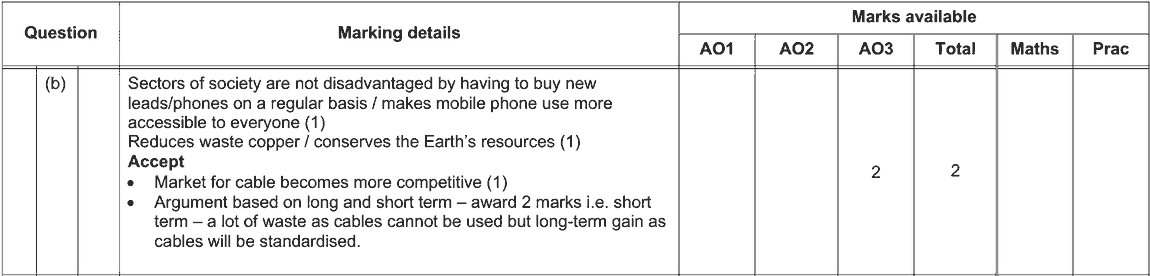
(b) A mobile phone company used to change the type of connector for use on its charging cables every five years. Following new regulations, all mobile phone companies must now use the same connector type. Discuss the implications of the new regulations. [2]
June 2025 · AS Component 2 · Q7(a)(i) 3 marks AO1=1, AO2=2 Calculation photons
7. The light power output of a green light laser of wavelength 550 nm is 2.5 mW. (a) (i) Calculate the number of photons emitted per second by the laser. [3]
June 2025 · AS Component 2 · Q7(a)(ii) 2 marks AO1=1, AO2=1 Explanation photons
Earlier part of question 7 that this part usesEarlier part of June 2025 Component 2 question 7
(ii) Explain why the number of photons per second will be less if a laser with the same power output is used that emits blue light. [2]
June 2025 · AS Component 2 · Q7(b)(i) 3 marks AO2=3 Calculation conduction of electricityphotons
Earlier part of question 7 that this part usesEarlier part of June 2025 Component 2 question 7
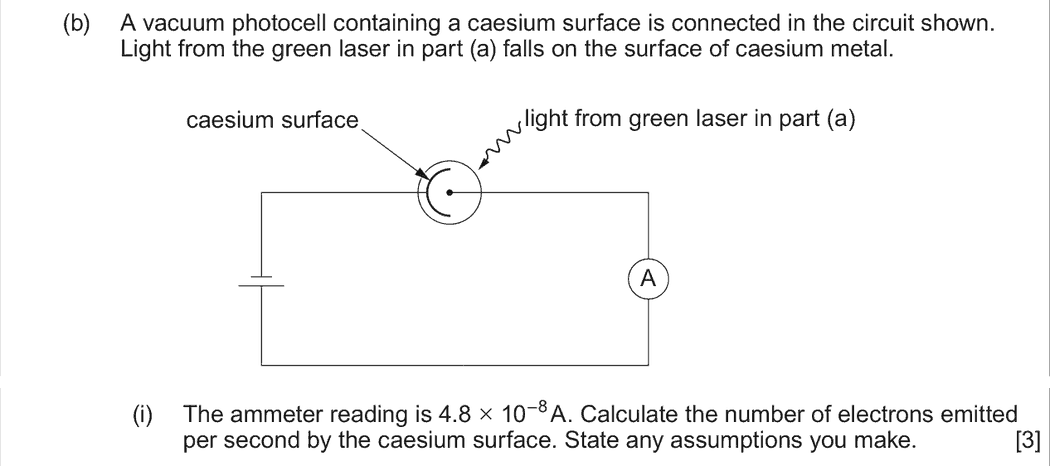
(b) A vacuum photocell containing a caesium surface is connected in the circuit shown. Light from the green laser in part (a) falls on the surface of caesium metal. caesium surface light from green laser in part (a) A (i) The ammeter reading is 4.8 × 10⁻⁸ A. Calculate the number of electrons emitted per second by the caesium surface. State any assumptions you make. [3]
June 2025 · AS Component 2 · Q7(b)(ii) 1 mark AO3=1 Calculation photons
Earlier parts of question 7 that this part usesEarlier part of June 2025 Component 2 question 7Earlier part of June 2025 Component 2 question 7
(ii) Joanna states that the probability of an individual photon causing the emission of an electron is very low if light from the green laser in part (a) is used. Evaluate whether Joanna is correct. [1]
June 2025 · AS Component 2 · Q7(b)(iii) 3 marks AO2=3 Practical and data analysis photons
Earlier parts of question 7 that this part usesEarlier part of June 2025 Component 2 question 7Earlier part of June 2025 Component 2 question 7
(iii) Explain how the circuit needs to be changed to measure the stopping potential, Vs, of the emitted electrons from the caesium surface. [3]

Work with an Eduqas physics tutor

Want a paper marked and gone through with you? Message us.

Prefer email? Send an enquiry

If you are under 18, please include a parent's contact details. Enquiries go to enquiries@physicsaleveltutor.com and are deleted once handled. All tutoring is online.