
June 2017: AS Component 2

75 marks · 30 question parts · Paper, mark scheme and report on Eduqas's site · Have the Data Booklet beside you

Question by question

QTopicMarksAOType
1(a) The nature of waves 2AO1=2Definition

1(b) The nature of waves 1AO1=1Short answer
1(c)(i) The nature of waves 1AO2=1Calculation
1(c)(ii) The nature of waves 3AO3=3Calculation
2(a) Refraction of light 2AO2=2Calculation
2(b)(i) Refraction of light 2AO2=2Calculation
2(b)(ii) Refraction of light 2AO2=2Explanation
2(c) Refraction of light 2AO2=2Calculation
3(a) d.c. circuits, Resistance 3AO1=1,AO2=2Diagram or graph
3(b)(i) d.c. circuits 2AO1=2Definition
3(b)(ii) Resistance 3AO1=1,AO2=2Calculation
3(b)(iii) d.c. circuits 3AO1=1,AO2=2Calculation
3(c) d.c. circuits, Resistance 2AO3=2Explanation
4(a) Conduction of electricity 4AO1=1,AO2=3Calculation
4(b) Conduction of electricity 3AO3=3Explanation
4(c)(i) Resistance 1AO1=1Definition
4(c)(ii) Resistance 4AO2=4Explanation
5(a)(i) Wave properties: diffraction, interference and stationary waves 1AO1=1Definition
5(a)(ii) Wave properties: diffraction, interference and stationary waves 3AO2=3Explanation
5(b)(i) Wave properties: diffraction, interference and stationary waves 4AO3=4Calculation
5(b)(ii) Wave properties: diffraction, interference and stationary waves 2AO2=2Calculation
5(c) Wave properties: diffraction, interference and stationary waves 2AO1=2Explanation
5(d)(i) Photons 2AO1=1,AO2=1Explanation
5(d)(ii) Photons, Wave properties: diffraction, interference and stationary waves 2AO1=1,AO3=1Short answer
6(a) Photons 6AO1=6Extended response
6(b) Photons 2AO3=2Short answer
7(a)(i) Lasers 1AO1=1Definition
7(a)(ii) Lasers 2AO1=2Explanation
7(b) Photons 3AO1=2,AO2=1Calculation
7(c) Dynamics: forces and momentum 5AO2=5Calculation

The questions

1(a)1(b)1(c)(i)1(c)(ii)2(a)2(b)(i)2(b)(ii)2(c)3(a)3(b)(i)3(b)(ii)3(b)(iii)3(c)4(a)4(b)4(c)(i)4(c)(ii)5(a)(i)5(a)(ii)5(b)(i)5(b)(ii)5(c)5(d)(i)5(d)(ii)6(a)6(b)7(a)(i)7(a)(ii)7(b)7(c)
June 2017 · AS Component 2 · Q1(a) 2 marks AO1=2 Definition nature of waves
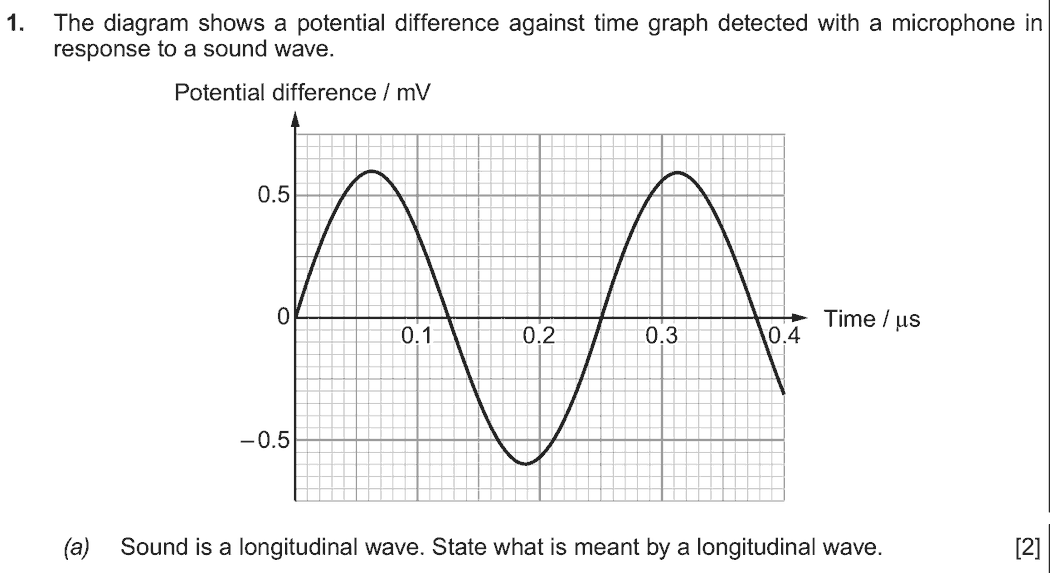
1. The diagram shows a potential difference against time graph detected with a microphone in response to a sound wave. Potential difference / mV 0.5 0 Time / μs 0.1 0.2 0.3 0.4 – 0.5 (a) Sound is a longitudinal wave. State what is meant by a longitudinal wave. [2]
June 2017 · AS Component 2 · Q1(b) 1 mark AO1=1 Short answer nature of waves
Earlier part of question 1 that this part usesEarlier part of June 2017 Component 2 question 1
(b) Determine the amplitude of the signal shown. [1]
June 2017 · AS Component 2 · Q1(c)(i) 1 mark AO2=1 Calculation nature of waves
Earlier part of question 1 that this part usesEarlier part of June 2017 Component 2 question 1
(c) (i) In order to probe muscle tissue in the human body, ultrasound is used with a wavelength of 0.40 mm and a speed in muscle of 1 580 m s–1. Calculate the frequency of this ultrasound. [1]
June 2017 · AS Component 2 · Q1(c)(ii) 3 marks AO3=3 Calculation nature of waves
Earlier parts of question 1 that this part usesEarlier part of June 2017 Component 2 question 1Earlier part of June 2017 Component 2 question 1
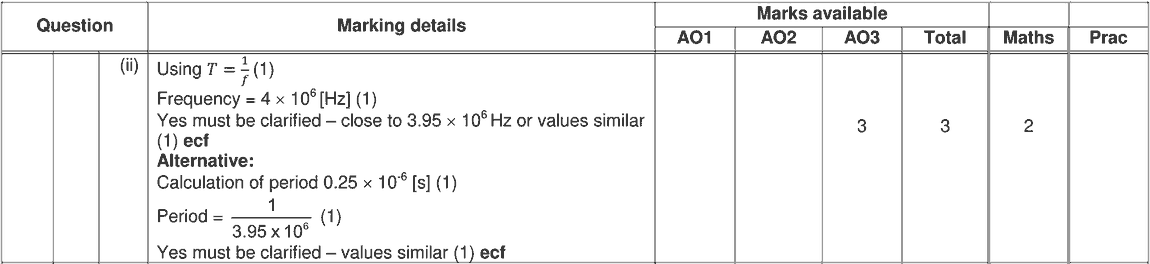
(ii) Evaluate whether the sound wave detected by the microphone as shown above can be used to probe muscle tissue. [3]
June 2017 · AS Component 2 · Q2(a) 2 marks AO2=2 Calculation refraction of light
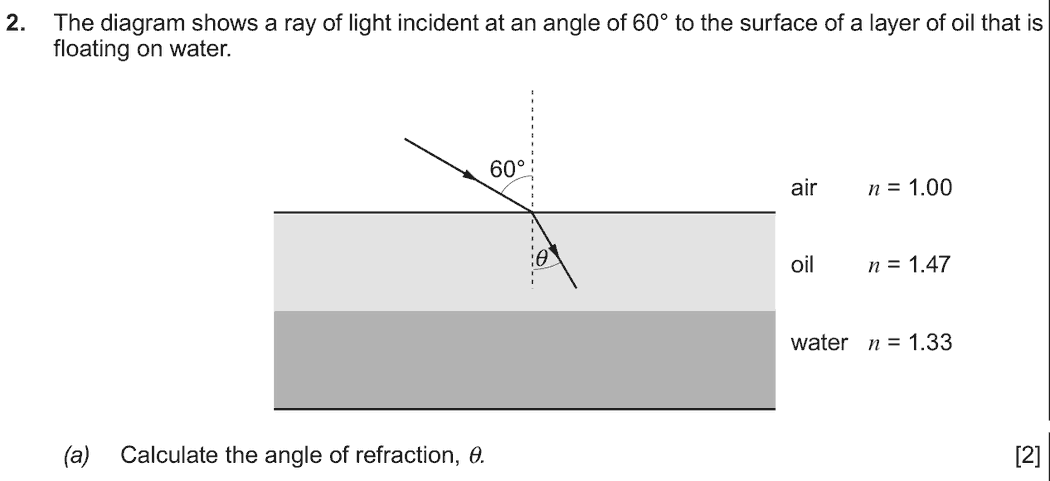
2. The diagram shows a ray of light incident at an angle of 60° to the surface of a layer of oil that is floating on water. 60° air n = 1.00 θ oil n = 1.47 water n = 1.33 (a) Calculate the angle of refraction, θ. [2]
June 2017 · AS Component 2 · Q2(b)(i) 2 marks AO2=2 Calculation refraction of light
Earlier part of question 2 that this part usesEarlier part of June 2017 Component 2 question 2
(b) (i) Calculate the critical angle for a ray of light travelling from oil to water. [2]
June 2017 · AS Component 2 · Q2(b)(ii) 2 marks AO2=2 Explanation refraction of light
Earlier parts of question 2 that this part usesEarlier part of June 2017 Component 2 question 2Earlier part of June 2017 Component 2 question 2
(ii) State and explain what happens to the ray of light in the diagram above when it reaches the boundary with the water. [2]
June 2017 · AS Component 2 · Q2(c) 2 marks AO2=2 Calculation refraction of light
Earlier part of question 2 that this part usesEarlier part of June 2017 Component 2 question 2
(c) Determine the speed of the light in the oil. [2]
June 2017 · AS Component 2 · Q3(a) 3 marks AO1=1, AO2=2 Diagram or graph dc circuitsresistance
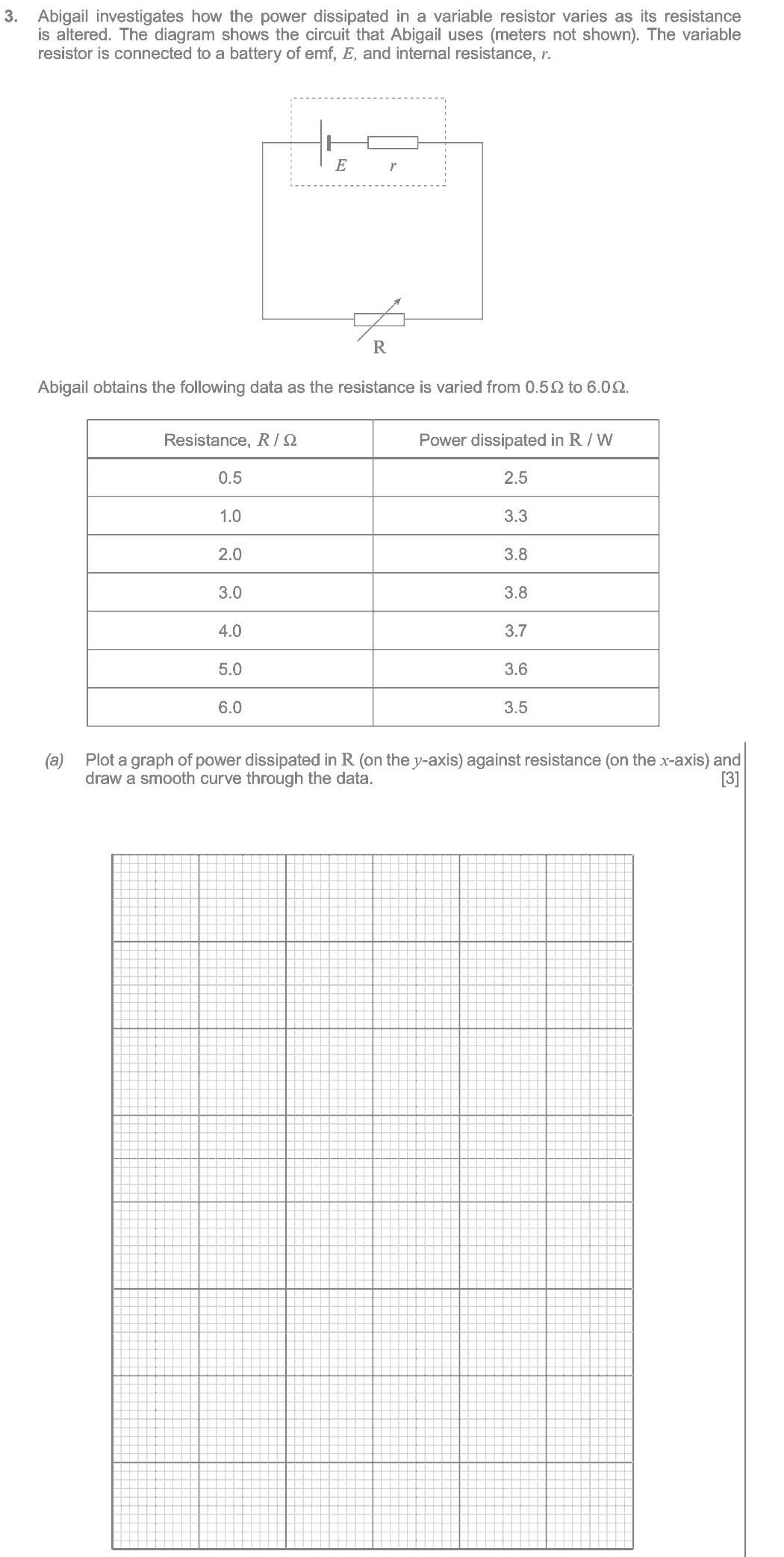
3. Abigail investigates how the power dissipated in a variable resistor varies as its resistance is altered. The diagram shows the circuit that Abigail uses (meters not shown). The variable resistor is connected to a battery of emf, E, and internal resistance, r. E r R Abigail obtains the following data as the resistance is varied from 0.5 Ω to 6.0 Ω. Resistance, R / Ω Power dissipated in R / W 0.5 2.5 1.0 3.3 2.0 3.8 3.0 3.8 4.0 3.7 5.0 3.6 6.0 3.5 (a) Plot a graph of power dissipated in R (on the y-axis) against resistance (on the x-axis) and draw a smooth curve through the data. [3]
June 2017 · AS Component 2 · Q3(b)(i) 2 marks AO1=2 Definition dc circuits
Earlier part of question 3 that this part usesEarlier part of June 2017 Component 2 question 3
(b) The emf of the battery is 6.0 V and the resistance, R, is now set at 4.5 Ω. (i) State what is meant by an emf of 6.0 V. [2]
June 2017 · AS Component 2 · Q3(b)(ii) 3 marks AO1=1, AO2=2 Calculation resistance
Earlier parts of question 3 that this part usesEarlier part of June 2017 Component 2 question 3Earlier part of June 2017 Component 2 question 3
(ii) Calculate the current through the battery using data from your graph. [3]
June 2017 · AS Component 2 · Q3(b)(iii) 3 marks AO1=1, AO2=2 Calculation dc circuits
Earlier parts of question 3 that this part usesEarlier part of June 2017 Component 2 question 3Earlier part of June 2017 Component 2 question 3
(iii) Calculate the internal resistance, r, of the battery. [3]
June 2017 · AS Component 2 · Q3(c) 2 marks AO3=2 Explanation dc circuitsresistance
Earlier part of question 3 that this part usesEarlier part of June 2017 Component 2 question 3
(c) Abigail repeats the experiment but with a battery of the same emf but smaller internal resistance. Explain how the graph would change. [2]
June 2017 · AS Component 2 · Q4(a) 4 marks AO1=1, AO2=3 Calculation conduction of electricity
4. (a) Calculate the mean drift velocity of the free electrons in a wire, which has a diameter of 0.50 mm and carries a current of 2.8 A. Assume each aluminium atom contributes 3 free electrons, and there are 6.0 × 1028 atoms per m3 of aluminium. [4]
June 2017 · AS Component 2 · Q4(b) 3 marks AO3=3 Explanation conduction of electricity
Earlier part of question 4 that this part usesEarlier part of June 2017 Component 2 question 4
(b) The wire is thinner in a small section as shown below. Paula claims that within the thinner section the mean drift velocity of the free electrons will be greater. Evaluate whether she is correct. [3]
June 2017 · AS Component 2 · Q4(c)(i) 1 mark AO1=1 Definition resistance
Earlier part of question 4 that this part usesEarlier part of June 2017 Component 2 question 4
(c) (i) State what is meant by a superconductor. [1]
June 2017 · AS Component 2 · Q4(c)(ii) 4 marks AO2=4 Explanation resistance
Earlier parts of question 4 that this part usesEarlier part of June 2017 Component 2 question 4Earlier part of June 2017 Component 2 question 4
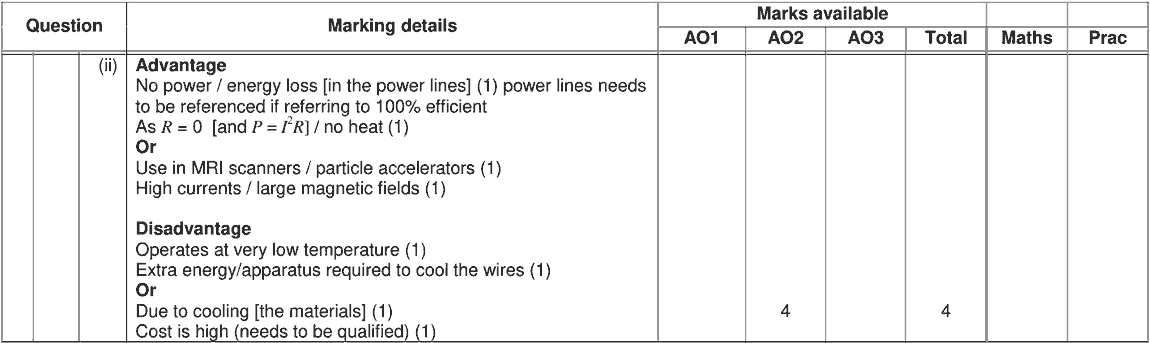
(ii) State and explain one advantage and one disadvantage of using superconductors to carry large currents. [4] Advantage: Disadvantage:
June 2017 · AS Component 2 · Q5(a)(i) 1 mark AO1=1 Definition wave properties
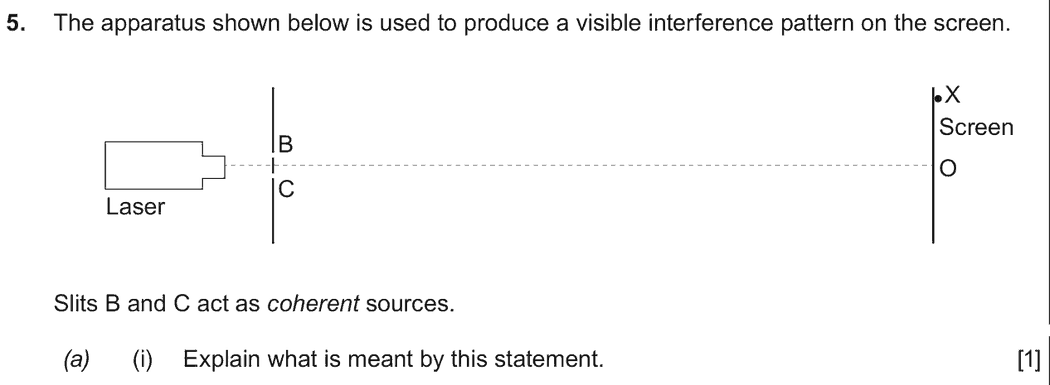
5. The apparatus shown below is used to produce a visible interference pattern on the screen. X Screen B O C Laser Slits B and C act as coherent sources. (a) (i) Explain what is meant by this statement. [1]
June 2017 · AS Component 2 · Q5(a)(ii) 3 marks AO2=3 Explanation wave properties
Earlier part of question 5 that this part usesEarlier part of June 2017 Component 2 question 5
(ii) Explain why destructive interference is observed at certain points on the screen. [3]
June 2017 · AS Component 2 · Q5(b)(i) 4 marks AO3=4 Calculation wave properties
Earlier part of question 5 that this part usesEarlier part of June 2017 Component 2 question 5
(b) (i) The separation of the slits, B and C is 0.090 mm and the perpendicular distance between the slits and the screen is 3.60 m. The slits are illuminated with light of wavelength 4.4 × 10⁻⁷ m. A point X on the screen is 52.8 mm away from the central bright fringe at O. Brian states that a bright fringe will be formed at X. Evaluate whether or not he is correct. [4]
June 2017 · AS Component 2 · Q5(b)(ii) 2 marks AO2=2 Calculation wave properties
Earlier parts of question 5 that this part usesEarlier part of June 2017 Component 2 question 5Earlier part of June 2017 Component 2 question 5
(ii) Determine the distance from X to the next dark fringe formed. [2]
June 2017 · AS Component 2 · Q5(c) 2 marks AO1=2 Explanation wave properties
Earlier part of question 5 that this part usesEarlier part of June 2017 Component 2 question 5
(c) Explain the historical significance of this experiment. [2]
June 2017 · AS Component 2 · Q5(d)(i) 2 marks AO1=1, AO2=1 Explanation photons
Earlier part of question 5 that this part usesEarlier part of June 2017 Component 2 question 5
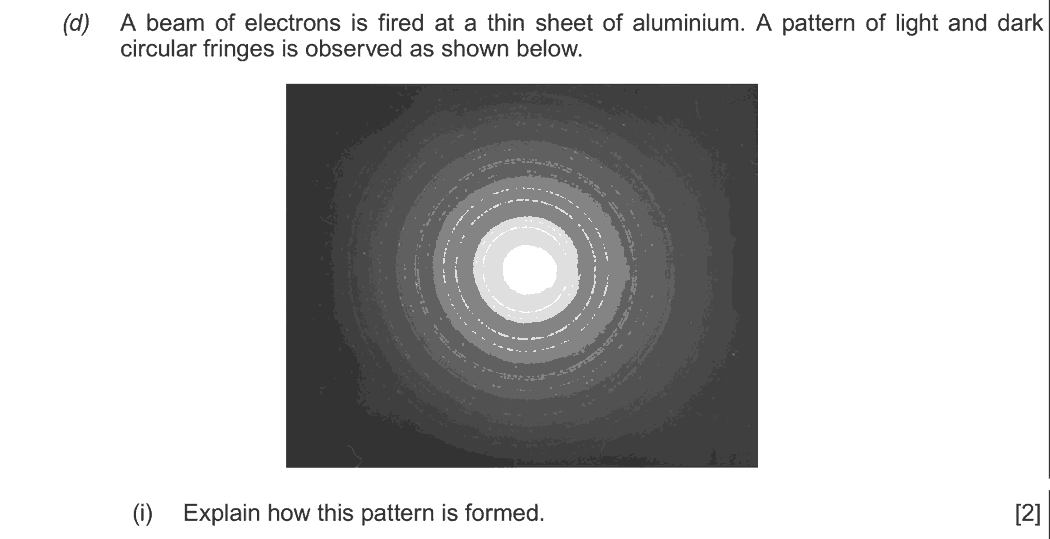
(d) A beam of electrons is fired at a thin sheet of aluminium. A pattern of light and dark circular fringes is observed as shown below. (i) Explain how this pattern is formed. [2]
June 2017 · AS Component 2 · Q5(d)(ii) 2 marks AO1=1, AO3=1 Short answer photonswave properties
Earlier parts of question 5 that this part usesEarlier part of June 2017 Component 2 question 5Earlier part of June 2017 Component 2 question 5
(ii) The thin sheet of aluminium is replaced with a foil of copper. The distance between the copper atoms is smaller than in aluminium. Describe how you expect the pattern to change. [2]
June 2017 · AS Component 2 · Q6(a) 6 marks AO1=6 6-mark extended response photons
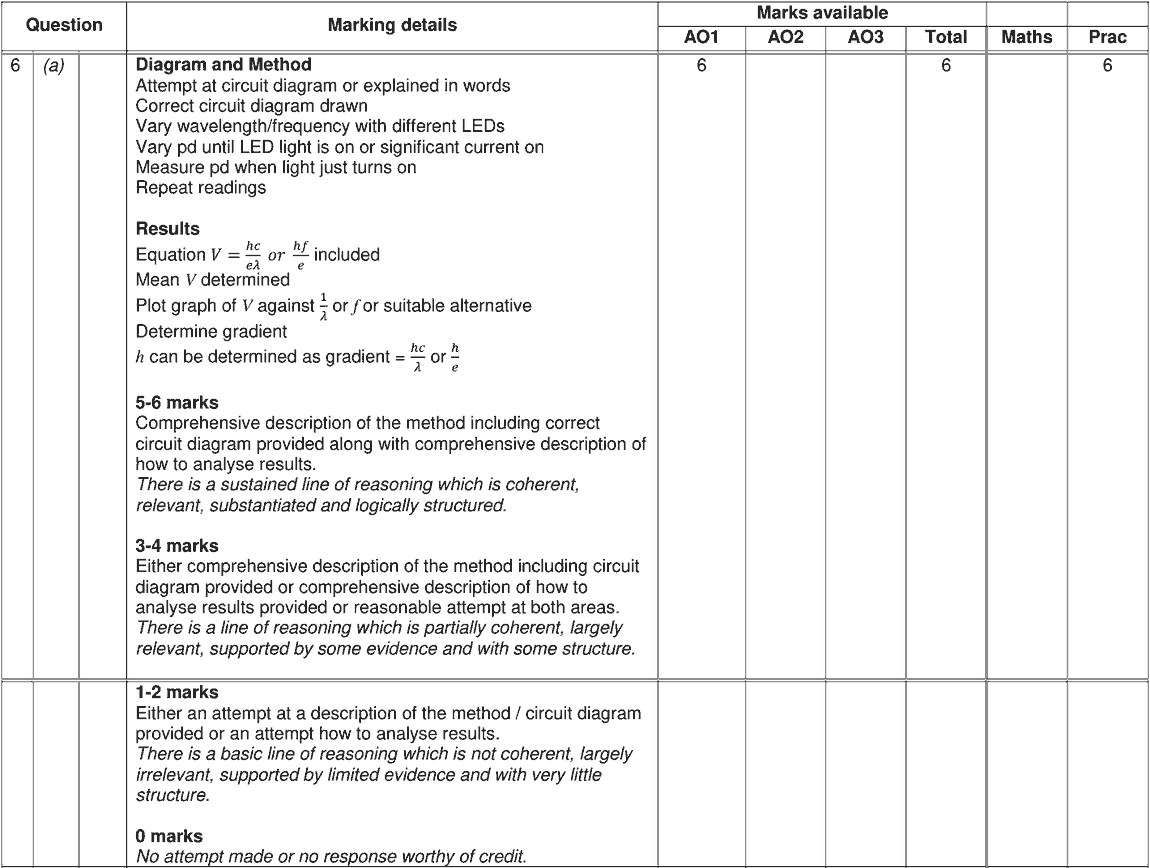
6. (a) Describe an experiment using a range of LEDs to determine the Planck constant. [6 QER]
June 2017 · AS Component 2 · Q6(b) 2 marks AO3=2 Short answer photons
Earlier part of question 6 that this part usesEarlier part of June 2017 Component 2 question 6
(b) A university research group uses a new experimental method to determine a value for the Planck constant that is higher than the accepted value of 6.63 × 10⁻³⁴J s. Explain how other scientists would attempt to confirm this result. [2]
June 2017 · AS Component 2 · Q7(a)(i) 1 mark AO1=1 Definition lasers
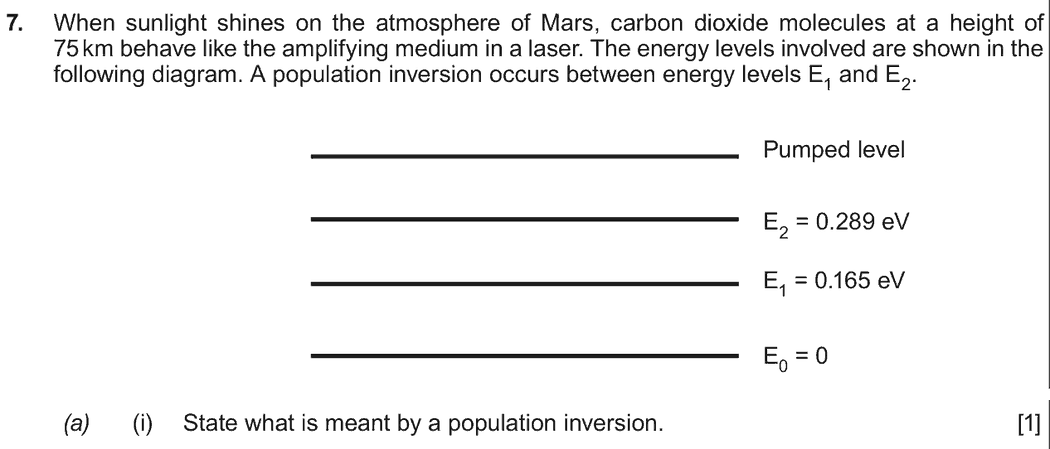
7. When sunlight shines on the atmosphere of Mars, carbon dioxide molecules at a height of 75 km behave like the amplifying medium in a laser. The energy levels involved are shown in the following diagram. A population inversion occurs between energy levels E1 and E2. Pumped level E2 = 0.289 eV E1 = 0.165 eV E0 = 0 (a) (i) State what is meant by a population inversion. [1]
June 2017 · AS Component 2 · Q7(a)(ii) 2 marks AO1=2 Explanation lasers
Earlier part of question 7 that this part usesEarlier part of June 2017 Component 2 question 7
(ii) Explain why a population inversion is needed for laser action. [2]
June 2017 · AS Component 2 · Q7(b) 3 marks AO1=2, AO2=1 Calculation photons
Earlier part of question 7 that this part usesEarlier part of June 2017 Component 2 question 7
(b) Calculate the output wavelength of this naturally occurring laser and determine the region of the electromagnetic spectrum in which it lies. [3]
June 2017 · AS Component 2 · Q7(c) 5 marks AO2=5 Calculation dynamics
Earlier part of question 7 that this part usesEarlier part of June 2017 Component 2 question 7
(c) The Llanesco crater is on the surface of Mars and has a cross-sectional area of 2 290 km2. Carbon dioxide molecules in the Mars atmosphere collide with the surface and give rise to a surface pressure of 600 Pa. The mass of a carbon dioxide molecule is 7.3 × 10⁻²⁶ kg and the perpendicular component of the speed of the molecules to the surface is 550 m s–1 before and after they collide with the surface. Calculate the number of carbon dioxide molecules that collide with the Llanesco crater in 1 s. [5]

Work with an Eduqas physics tutor

Want a paper marked and gone through with you? Message us.

Prefer email? Send an enquiry

If you are under 18, please include a parent's contact details. Enquiries go to enquiries@physicsaleveltutor.com and are deleted once handled. All tutoring is online.