Examiner's comment
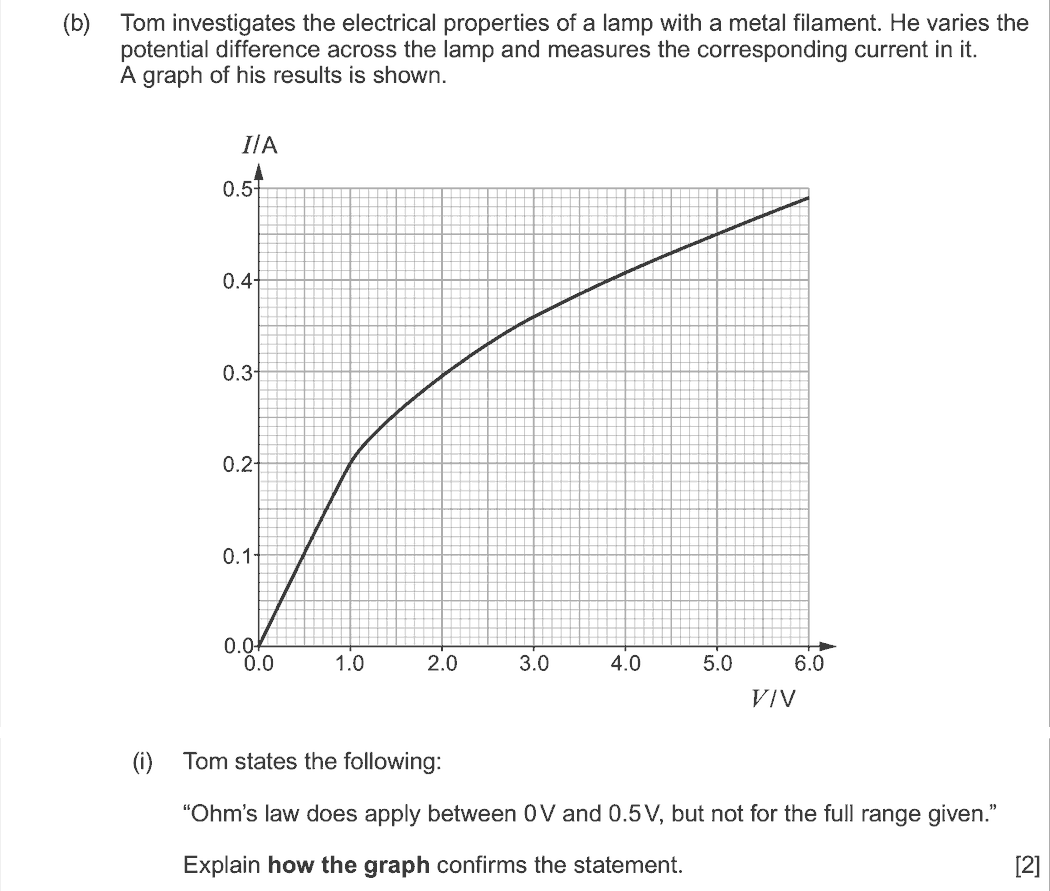
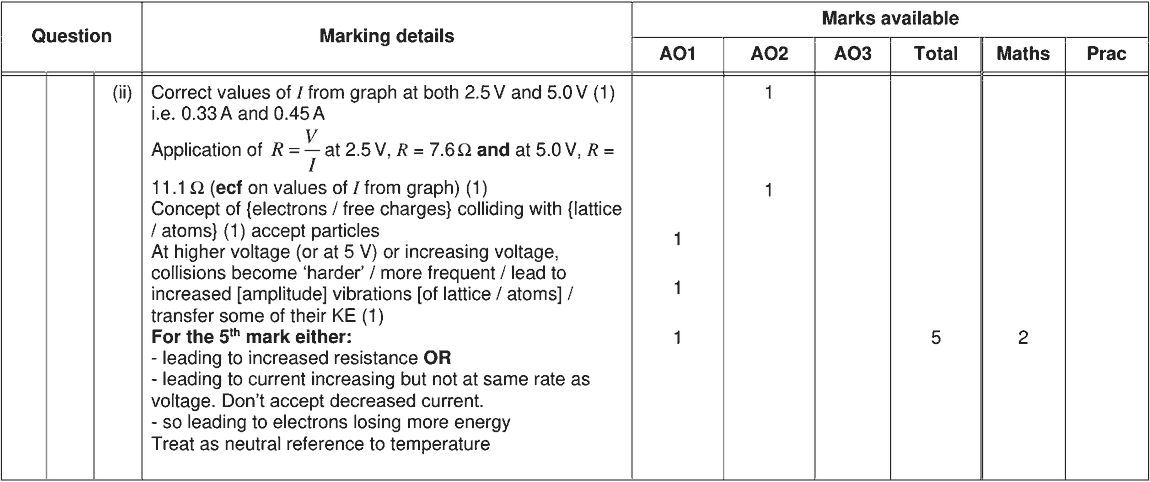
Many candidates used appropriate calculations, by taking pairs of readings from the graph, to show the difference in resistance at the different voltages. A minority, however, took tangents at the given voltages, which is an invalid approach and was deducted one mark. Regardless of their approach to the calculation part of the question, many correct responses were seen for the explanation part. In summary, to gain the three marks, candidates were required to: • refer to ‘collisions’ between electrons (or free charges) and atoms (or equivalent) • explain that at higher voltages the collisions became more frequent (or ‘harder’) or equivalent • explain that this would lead to resistance increasing. Referring to ‘electrons colliding with themselves’ or not specifying what electrons collided with were common reasons for candidates losing marks.
Notes from the mark scheme and report
- Answer: 7.6 Ω at 2.5 V and 11.1 Ω at 5.0 V (I = 0.33 A and 0.45 A, R = V/I, not a tangent). Free electrons collide with the lattice ions (1)
- at higher pd the collisions are more frequent or more energetic and the ions vibrate with larger amplitude (1)
- so resistance increases (1)
- must say what the electrons collide with
- Scheme columns: Maths 2
Skills: Graphskills Reading, plotting or sketching graphs; gradients, intercepts and areas; Mathsmarks The mark scheme's Maths column gives this part at least one mark for mathematical skills