June 2017: Component 1

100 marks · 37 question parts · Paper, mark scheme and report on Eduqas's site · Have the Data Booklet beside you

Question by question

QTopicMarksAOType
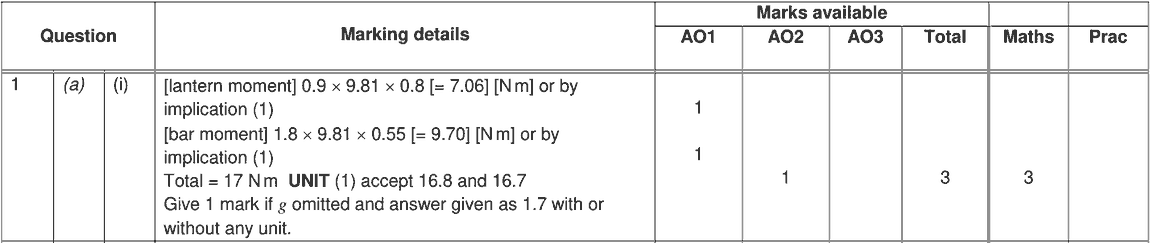
1(a)(i) Basic physics: units, vectors and moments 3AO1=2,AO2=1Calculation
1(a)(ii) Basic physics: units, vectors and moments 2AO3=2Calculation
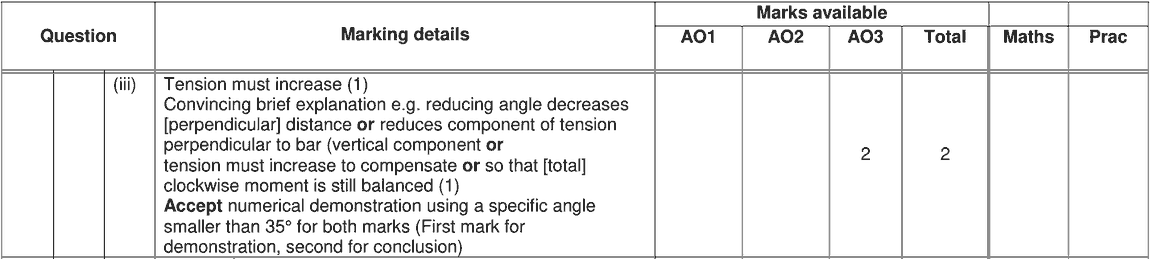
1(a)(iii) Basic physics: units, vectors and moments 2AO3=2Explanation
1(b) Circular motion 1AO2=1Calculation
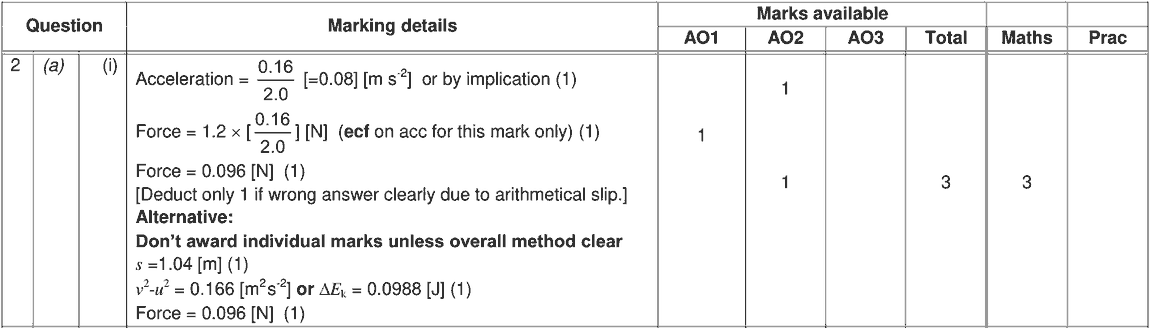
2(a)(i) Dynamics: forces and momentum, Kinematics 3AO1=1,AO2=2Calculation
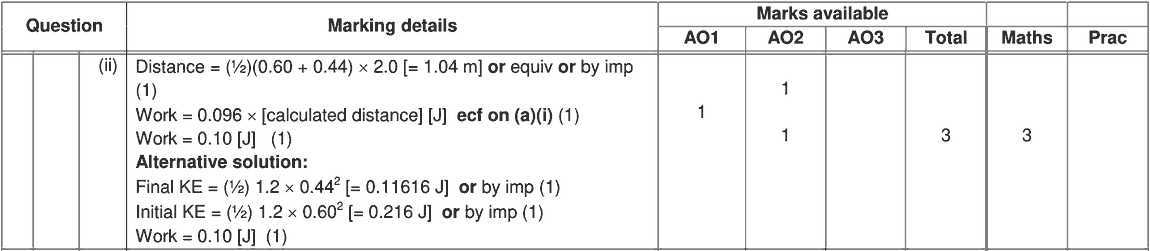
2(a)(ii) Energy concepts, Kinematics 3AO1=1,AO2=2Calculation
2(a)(iii) Dynamics: forces and momentum 4AO1=2,AO2=2Calculation
2(a)(iv) Dynamics: forces and momentum, Energy concepts 3AO3=3Calculation
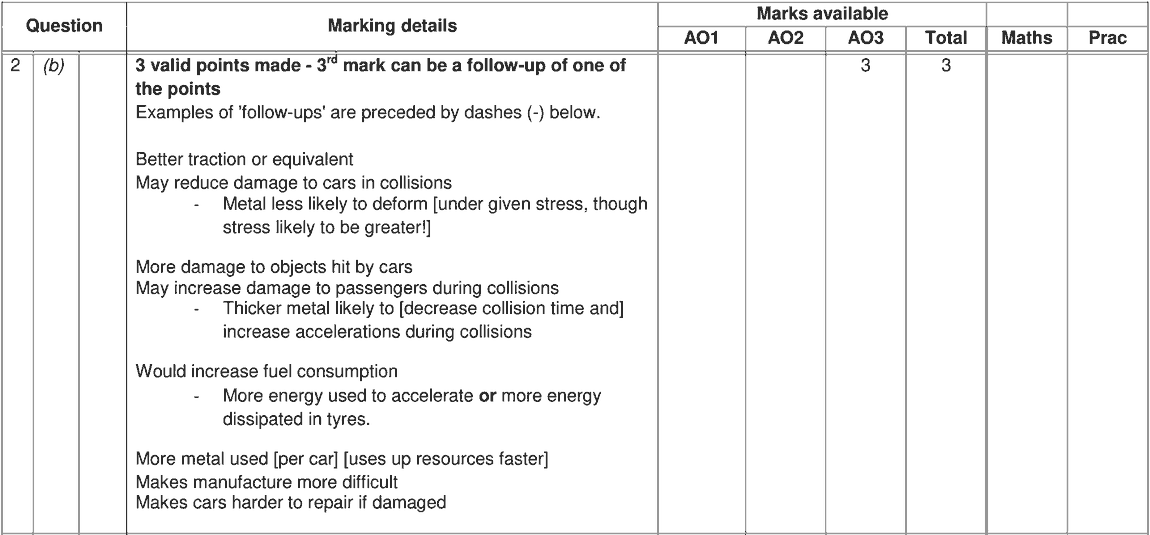
2(b) Dynamics: forces and momentum, Energy concepts 3AO3=3Explanation
3(a)(i) Basic physics: units, vectors and moments 2AO1=1,AO2=1Show that
3(a)(ii) Circular motion 2AO3=2Explanation
3(b)(i) Circular motion 3AO2=3Show that
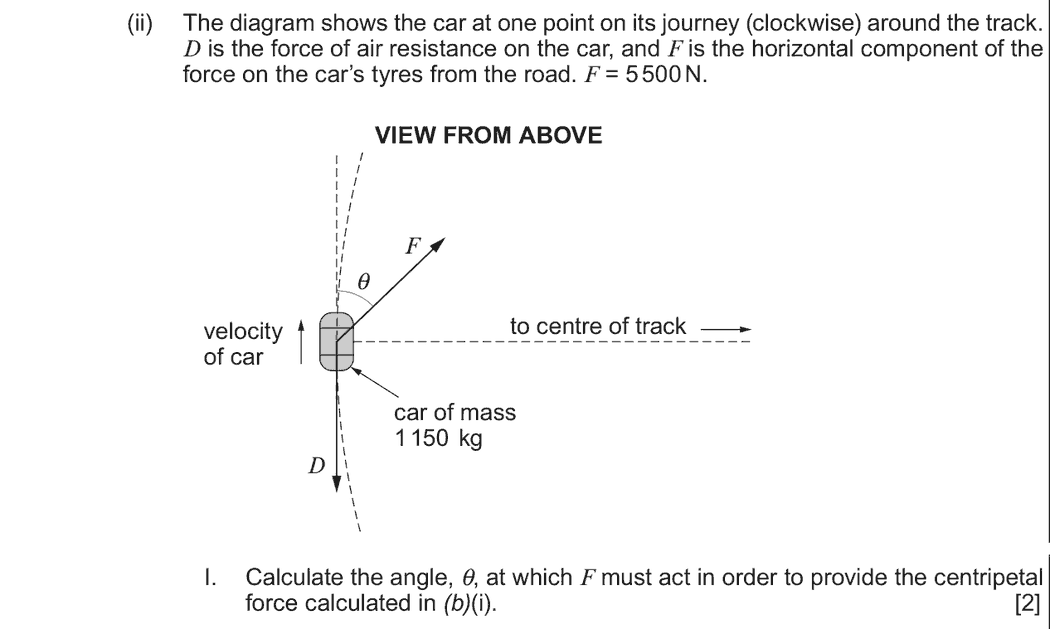
3(b)(ii)I Circular motion, Basic physics: units, vectors and moments 2Calculation
3(b)(ii)II Basic physics: units, vectors and moments 3Calculation
4(a) Vibrations: simple harmonic motion 2AO1=2Short answer
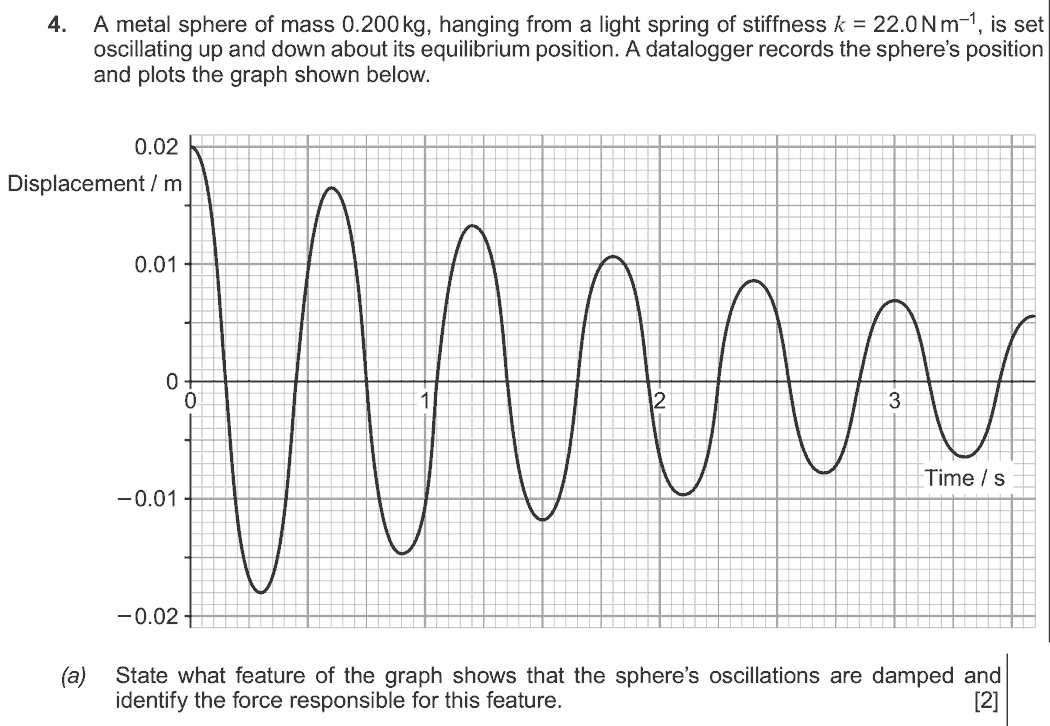
4(b) Vibrations: simple harmonic motion 4AO3=4Calculation
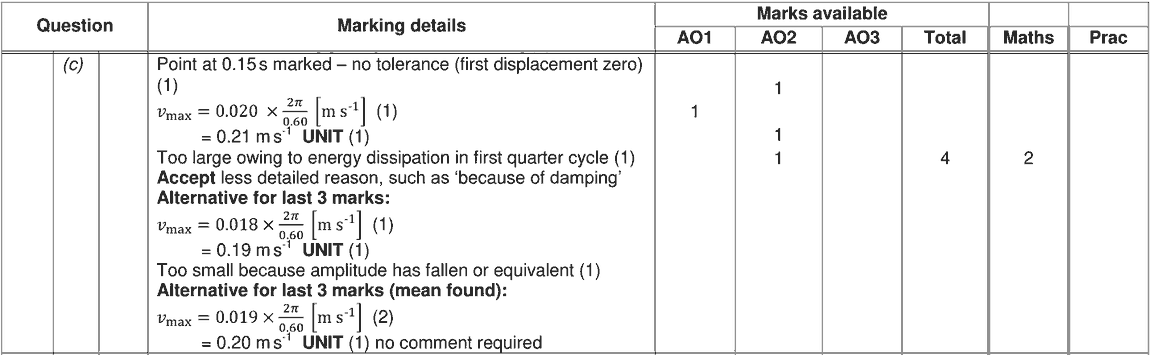
4(c) Vibrations: simple harmonic motion 4AO1=1,AO2=3Calculation
4(d) Vibrations: simple harmonic motion 2AO2=2Calculation
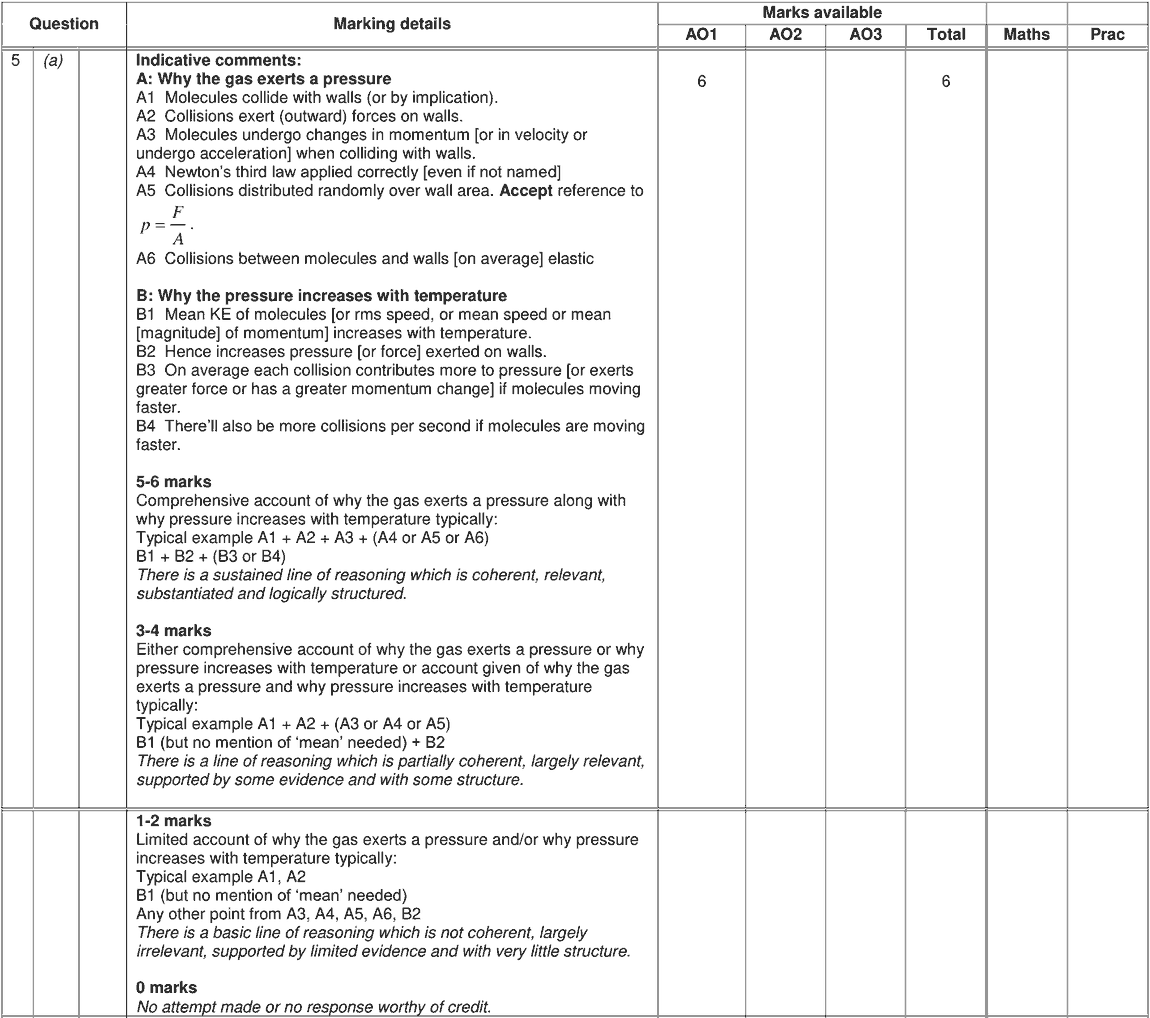
5(a) Kinetic theory 6AO1=6Extended response
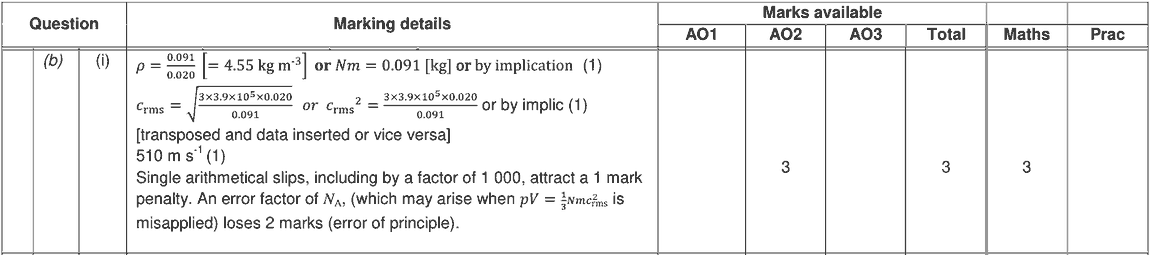
5(b)(i) Kinetic theory 3AO2=3Calculation
5(b)(ii) Kinetic theory 3AO2=3Calculation
6(a)(i) Thermal physics 2AO1=2Practical and data analysis
6(a)(ii) Thermal physics 2AO3=2Practical and data analysis
6(a)(iii) Thermal physics 4AO2=4Practical and data analysis
6(a)(iv) Thermal physics 2AO2=2Show that
6(a)(v) Thermal physics 5AO1=2,AO2=3Practical and data analysis
6(b)(i) Thermal physics 3AO1=2,AO2=1Calculation
6(b)(ii) Thermal physics 2AO3=2Explanation
7(a) Wave properties: diffraction, interference and stationary waves, Comprehension: the Component 1 article questions 2AO1=2Diagram or graph
7(b) Wave properties: diffraction, interference and stationary waves, The nature of waves, Comprehension: the Component 1 article questions 2AO2=2Calculation
7(c) The nature of waves, Comprehension: the Component 1 article questions 4AO1=4Explanation
7(d)(i) The nature of waves, Comprehension: the Component 1 article questions 1AO2=1Show that
7(d)(ii) The nature of waves, Comprehension: the Component 1 article questions 2AO1=1,AO2=1Calculation
7(e) Dynamics: forces and momentum, Comprehension: the Component 1 article questions 3AO3=3Explanation
7(f) Magnetic fields, Comprehension: the Component 1 article questions 2AO3=2Calculation
7(g)(i) Kinematics, Comprehension: the Component 1 article questions 1AO2=1Calculation
7(g)(ii) Kinematics, Comprehension: the Component 1 article questions 3AO2=3Diagram or graph

The questions

1(a)(i)1(a)(ii)1(a)(iii)1(b)2(a)(i)2(a)(ii)2(a)(iii)2(a)(iv)2(b)3(a)(i)3(a)(ii)3(b)(i)3(b)(ii)I3(b)(ii)II4(a)4(b)4(c)4(d)5(a)5(b)(i)5(b)(ii)6(a)(i)6(a)(ii)6(a)(iii)6(a)(iv)6(a)(v)6(b)(i)6(b)(ii)7(a)7(b)7(c)7(d)(i)7(d)(ii)7(e)7(f)7(g)(i)7(g)(ii)
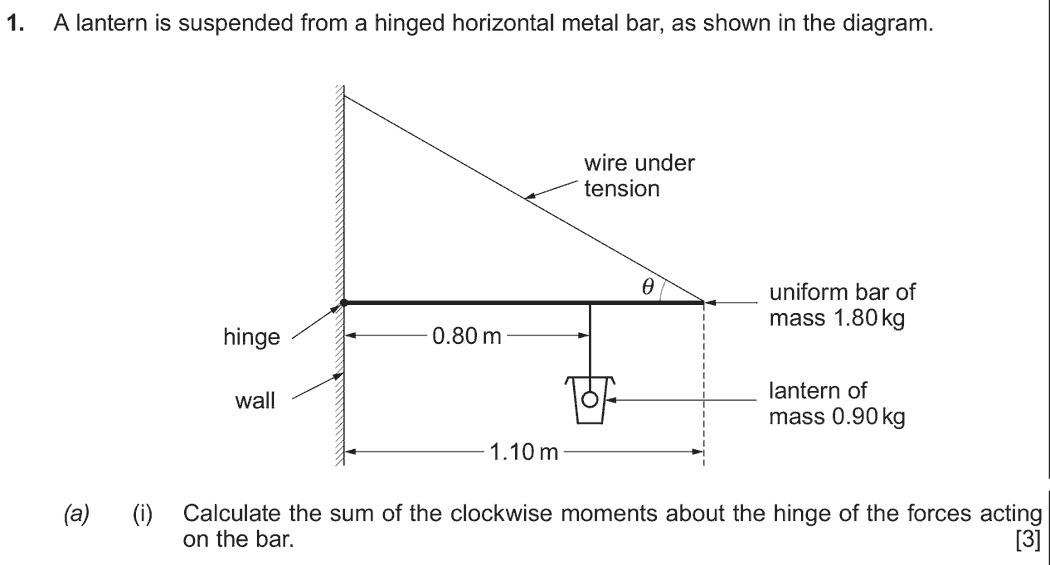
June 2017 · Component 1 · Q1(a)(i) 3 marks AO1=2, AO2=1 Calculation basic physics
1. A lantern is suspended from a hinged horizontal metal bar, as shown in the diagram. wire under tension θ uniform bar of mass 1.80 kg hinge 0.80 m lantern of wall mass 0.90 kg 1.10 m (a) (i) Calculate the sum of the clockwise moments about the hinge of the forces acting on the bar. [3]
June 2017 · Component 1 · Q1(a)(ii) 2 marks AO3=2 Calculation basic physics
Earlier part of question 1 that this part usesEarlier part of June 2017 Component 1 question 1
(ii) For an angle, θ, of 35°, calculate the tension in the wire. [2]
June 2017 · Component 1 · Q1(a)(iii) 2 marks AO3=2 Explanation basic physics
Earlier part of question 1 that this part usesEarlier part of June 2017 Component 1 question 1
(iii) Discuss the effect, if any, on the tension of making the angle θ smaller (by using a shorter wire and attaching it to a lower point on the wall). [2]
June 2017 · Component 1 · Q1(b) 1 mark AO2=1 Calculation circular motion
Earlier part of question 1 that this part usesEarlier part of June 2017 Component 1 question 1
(b) A physics student, Sundeep, calculates that if the wire breaks, then, 0.10 s after it breaks, the angular velocity of the bar about the hinge would be 1.3 rad s–1. Calculate the speed of the tip of the bar (right hand end) when it has this angular velocity. [1]
June 2017 · Component 1 · Q2(a)(i) 3 marks AO1=1, AO2=2 Calculation dynamicskinematics
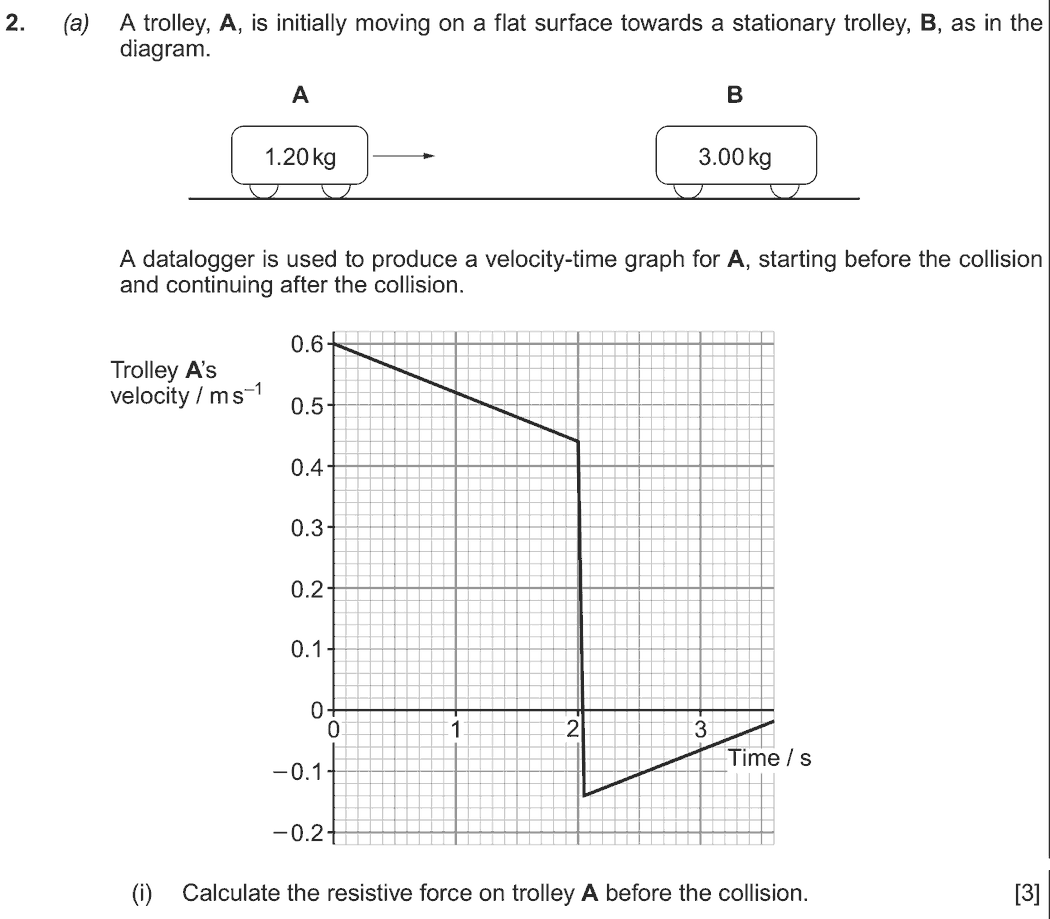
2. (a) A trolley, A, is initially moving on a flat surface towards a stationary trolley, B, as in the diagram. A B 1.20 kg 3.00 kg A datalogger is used to produce a velocity-time graph for A, starting before the collision and continuing after the collision. 0.6 Trolley A’s velocity / m s–1 0.5 0.4 0.3 0.2 0.1 0 0 1 2 3 _ Time / s 0.1 _ 0.2 (i) Calculate the resistive force on trolley A before the collision. [3]
June 2017 · Component 1 · Q2(a)(ii) 3 marks AO1=1, AO2=2 Calculation energy conceptskinematics
Earlier part of question 2 that this part usesEarlier part of June 2017 Component 1 question 2
(ii) Calculate the work done by this resistive force between time t = 0 and time t = 2.0 s. [3]
June 2017 · Component 1 · Q2(a)(iii) 4 marks AO1=2, AO2=2 Calculation dynamics
Earlier part of question 2 that this part usesEarlier part of June 2017 Component 1 question 2
(iii) Determine the velocity of trolley B immediately after the collision. [Ignore the effects of resistive forces during the collision.] [4]
June 2017 · Component 1 · Q2(a)(iv) 3 marks AO3=3 Calculation dynamicsenergy concepts
Earlier part of question 2 that this part usesEarlier part of June 2017 Component 1 question 2
(iv) Jasmine suggests that this is an elastic collision. Determine whether or not she is right, showing your working clearly. [3]
June 2017 · Component 1 · Q2(b) 3 marks AO3=3 Explanation dynamicsenergy concepts
Earlier part of question 2 that this part usesEarlier part of June 2017 Component 1 question 2
(b) It is suggested that cars should be made of thicker metal. Discuss whether this is a good suggestion. You may discuss environmental as well as safety issues. [3]
June 2017 · Component 1 · Q3(a)(i) 2 marks AO1=1, AO2=1 Show that basic physics
3. (a) The magnitude of the acceleration of a body travelling at speed v in a circle of radius r is given by: v 2 a = r (i) Show clearly that this equation is homogeneous in terms of units. [2]
June 2017 · Component 1 · Q3(a)(ii) 2 marks AO3=2 Explanation circular motion
Earlier part of question 3 that this part usesEarlier part of June 2017 Component 1 question 3
(ii) A teacher claims that the equation gives a ‘sensible’ value for the centripetal acceleration as r becomes extremely large. Justify her claim. [2]
June 2017 · Component 1 · Q3(b)(i) 3 marks AO2=3 Show that circular motion
Earlier part of question 3 that this part usesEarlier part of June 2017 Component 1 question 3
(b) A car of mass 1 150 kg moving at constant speed takes 52 s to complete a lap of a flat circular track of radius 200 m. (i) Show that the magnitude of the centripetal force on the car is approximately 3 400 N. [3]
June 2017 · Component 1 · Q3(b)(ii)I 2 marks Calculation circular motionbasic physics
Earlier parts of question 3 that this part usesEarlier part of June 2017 Component 1 question 3Earlier part of June 2017 Component 1 question 3
(ii) The diagram shows the car at one point on its journey (clockwise) around the track. D is the force of air resistance on the car, and F is the horizontal component of the force on the car’s tyres from the road. F = 5 500 N. VIEW FROM ABOVE F θ velocity to centre of track of car car of mass 1 150 kg D I. Calculate the angle, θ, at which F must act in order to provide the centripetal force calculated in (b)(i). [2]
June 2017 · Component 1 · Q3(b)(ii)II 3 marks Calculation basic physics
Earlier parts of question 3 that this part usesEarlier part of June 2017 Component 1 question 3Earlier part of June 2017 Component 1 question 3Earlier part of June 2017 Component 1 question 3
II. Calculate D, giving your reasoning. [3]
June 2017 · Component 1 · Q4(a) 2 marks AO1=2 Short answer vibrations
4. A metal sphere of mass 0.200 kg, hanging from a light spring of stiffness k = 22.0 N m–1, is set oscillating up and down about its equilibrium position. A datalogger records the sphere’s position and plots the graph shown below. 0.02 Displacement / m 0.01 0 0 21 2 3 Time / s _ 0.01 _ 0.02 (a) State what feature of the graph shows that the sphere’s oscillations are damped and identify the force responsible for this feature. [2]
June 2017 · Component 1 · Q4(b) 4 marks AO3=4 Calculation vibrations
Earlier part of question 4 that this part usesEarlier part of June 2017 Component 1 question 4
(b) Evaluate whether or not ordinary simple harmonic motion theory predicts the actual periodic time as shown on the graph convincingly. [4]
June 2017 · Component 1 · Q4(c) 4 marks AO1=1, AO2=3 Calculation vibrations
Earlier part of question 4 that this part usesEarlier part of June 2017 Component 1 question 4
(c) Mark with a small circle the point on the graph where the sphere’s speed is the greatest. Use shm theory to calculate a value for this speed and explain whether this value is likely to be too high or too low. [4]
June 2017 · Component 1 · Q4(d) 2 marks AO2=2 Calculation vibrations
Earlier part of question 4 that this part usesEarlier part of June 2017 Component 1 question 4
(d) The amplitude, A, (in m) of the oscillations at time t is given by the equation: e–λ t A = 0.020 Determine the value of λ. [2]
June 2017 · Component 1 · Q5(a) 6 marks AO1=6 6-mark extended response kinetic theory
5. (a) Explain, in terms of molecules, how a gas exerts a pressure on the walls of its container, and why this pressure increases with temperature. [6 QER]
June 2017 · Component 1 · Q5(b)(i) 3 marks AO2=3 Calculation kinetic theory
Earlier part of question 5 that this part usesEarlier part of June 2017 Component 1 question 5
(b) A cylinder of volume 0.020 m3 contains 0.091 kg of nitrogen gas (relative molecular mass = 28) at a pressure of 3.9 × 10⁵ Pa. Calculate: (i) the rms speed of the molecules; [3]
June 2017 · Component 1 · Q5(b)(ii) 3 marks AO2=3 Calculation kinetic theory
Earlier parts of question 5 that this part usesEarlier part of June 2017 Component 1 question 5Earlier part of June 2017 Component 1 question 5
(ii) the temperature of the gas. [3]
June 2017 · Component 1 · Q6(a)(i) 2 marks AO1=2 Practical and data analysis thermal physics
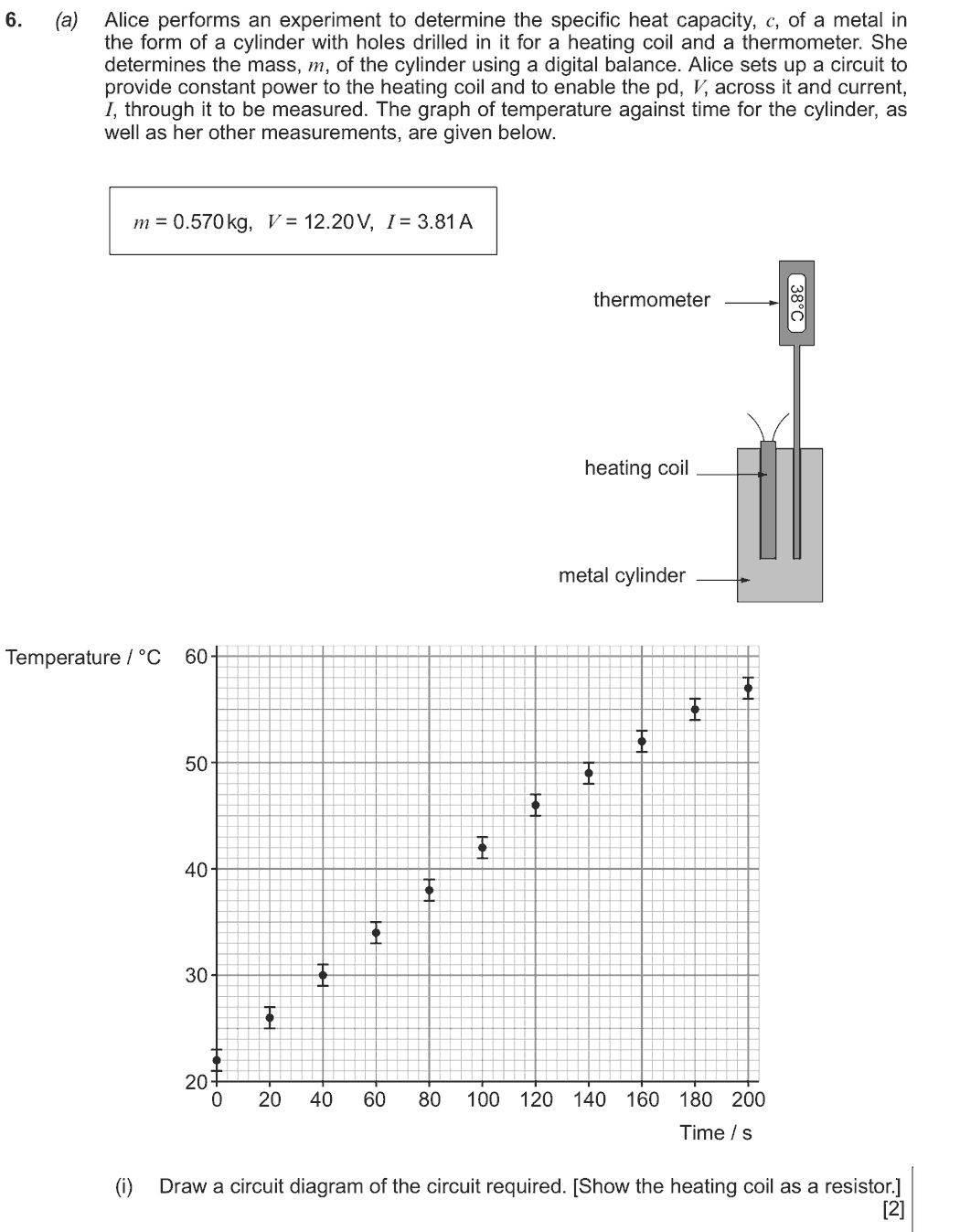
6. (a) Alice performs an experiment to determine the specific heat capacity, c, of a metal in the form of a cylinder with holes drilled in it for a heating coil and a thermometer. She determines the mass, m, of the cylinder using a digital balance. Alice sets up a circuit to provide constant power to the heating coil and to enable the pd, V, across it and current, I, through it to be measured. The graph of temperature against time for the cylinder, as well as her other measurements, are given below. m = 0.570 kg, V = 12.20 V, I = 3.81 A thermometer 38°C heating coil metal cylinder Temperature / °C 60 50 40 30 20 0 20 40 60 80 100 120 140 160 180 200 Time / s (i) Draw a circuit diagram of the circuit required. [Show the heating coil as a resistor.] [2]
June 2017 · Component 1 · Q6(a)(ii) 2 marks AO3=2 Practical and data analysis thermal physics
Earlier part of question 6 that this part usesEarlier part of June 2017 Component 1 question 6
(ii) Suggest why the points for the highest temperatures show significant deviations from the trend of the points at lower temperatures, and what could have been done to reduce the deviation. [2]
June 2017 · Component 1 · Q6(a)(iii) 4 marks AO2=4 Practical and data analysis thermal physics
Earlier part of question 6 that this part usesEarlier part of June 2017 Component 1 question 6
(iii) Using an appropriate portion of the graph, determine the maximum gradient and the minimum gradient. [4]
June 2017 · Component 1 · Q6(a)(iv) 2 marks AO2=2 Show that thermal physics
Earlier part of question 6 that this part usesEarlier part of June 2017 Component 1 question 6
(iv) Show clearly that the graph gradient should be: VI [2] gradient = mc
June 2017 · Component 1 · Q6(a)(v) 5 marks AO1=2, AO2=3 Practical and data analysis thermal physics
Earlier part of question 6 that this part usesEarlier part of June 2017 Component 1 question 6
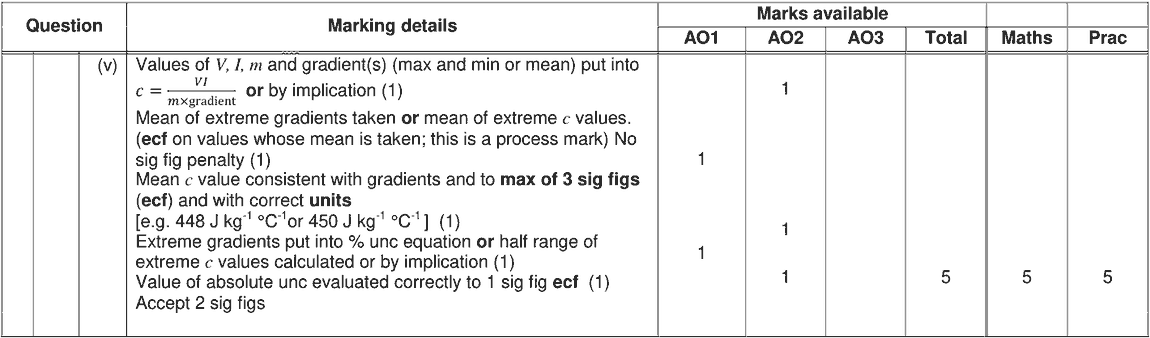
(v) Hence determine a value for the specific heat capacity of the metal of the cylinder, together with its absolute uncertainty. Assume that the percentage uncertainties in m, V and I are negligible. [5]
June 2017 · Component 1 · Q6(b)(i) 3 marks AO1=2, AO2=1 Calculation thermal physics
Earlier part of question 6 that this part usesEarlier part of June 2017 Component 1 question 6
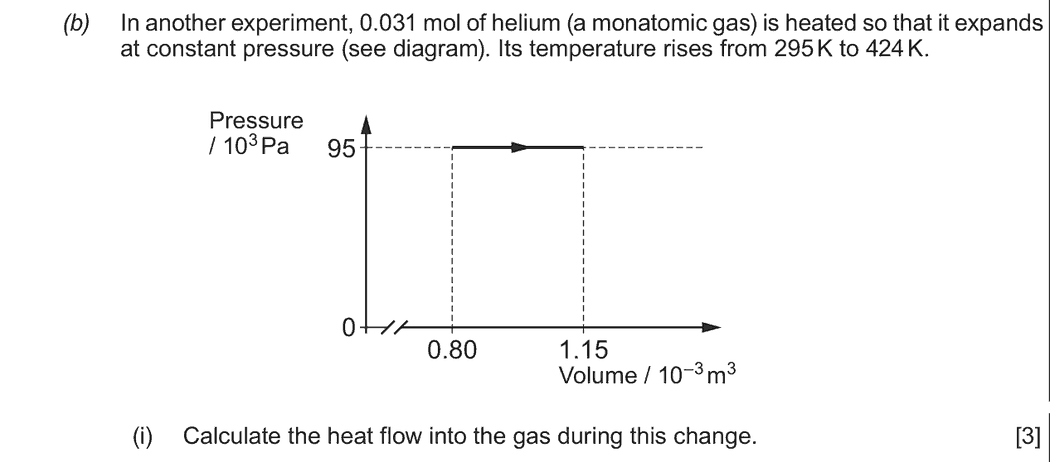
(b) In another experiment, 0.031 mol of helium (a monatomic gas) is heated so that it expands at constant pressure (see diagram). Its temperature rises from 295 K to 424 K. Pressure / 103 Pa 95 0 0.80 1.15 Volume / 10–3 m3 (i) Calculate the heat flow into the gas during this change. [3]
June 2017 · Component 1 · Q6(b)(ii) 2 marks AO3=2 Explanation thermal physics
Earlier parts of question 6 that this part usesEarlier part of June 2017 Component 1 question 6Earlier part of June 2017 Component 1 question 6
(ii) Discuss whether or not this amount of heat would be needed in all circumstances to raise the temperature of 0.031 mol of helium from 295 K to 424 K. [2]
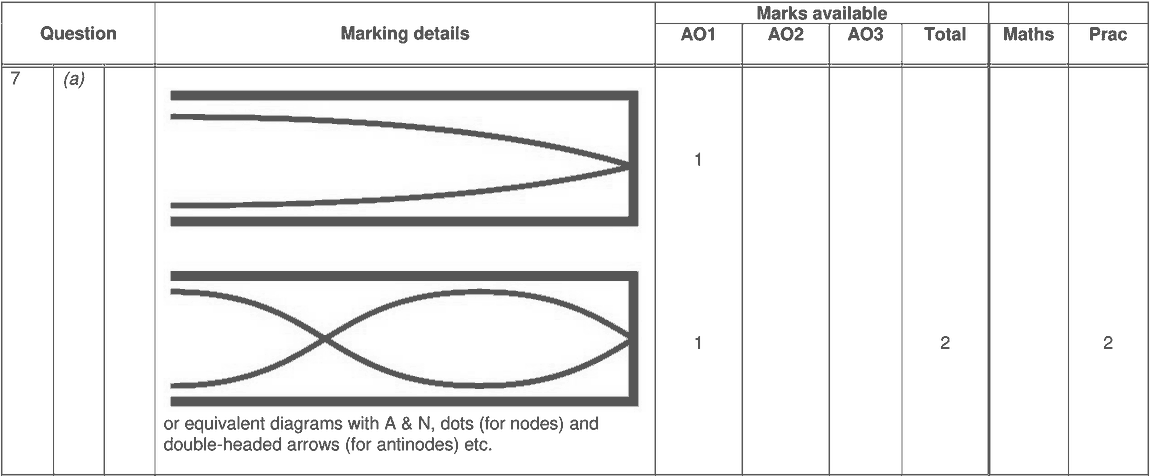
June 2017 · Component 1 · Q7(a) 2 marks AO1=2 Diagram or graph wave propertiescomprehension
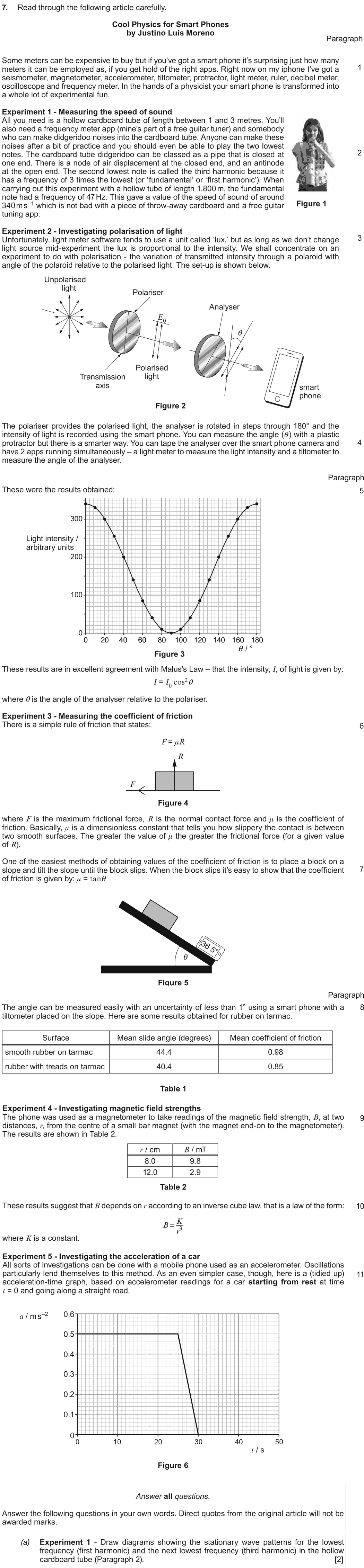
7. Read through the following article carefully. Cool Physics for Smart Phones by Justino Luis Moreno Paragraph Some meters can be expensive to buy but if you’ve got a smart phone it’s surprising just how many meters it can be employed as, if you get hold of the right apps. Right now on my iphone I’ve got a 1 seismometer, magnetometer, accelerometer, tiltometer, protractor, light meter, ruler, decibel meter, oscilloscope and frequency meter. In the hands of a physicist your smart phone is transformed into a whole lot of experimental fun. Experiment 1 - Measuring the speed of sound All you need is a hollow cardboard tube of length between 1 and 3 metres. You’ll also need a frequency meter app (mine’s part of a free guitar tuner) and somebody who can make didgeridoo noises into the cardboard tube. Anyone can make these noises after a bit of practice and you should even be able to play the two lowest notes. The cardboard tube didgeridoo can be classed as a pipe that is closed at 2 one end. There is a node of air displacement at the closed end, and an antinode at the open end. The second lowest note is called the third harmonic because it has a frequency of 3 times the lowest (or ‘fundamental’ or ‘first harmonic’). When carrying out this experiment with a hollow tube of length 1.800 m, the fundamental note had a frequency of 47 Hz. This gave a value of the speed of sound of around 340 m s–1 which is not bad with a piece of throw-away cardboard and a free guitar Figure 1 tuning app. Experiment 2 - Investigating polarisation of light Unfortunately, light meter software tends to use a unit called ‘lux,’ but as long as we don’t change 3 light source mid-experiment the lux is proportional to the intensity. We shall concentrate on an experiment to do with polarisation - the variation of transmitted intensity through a polaroid with angle of the polaroid relative to the polarised light. The set-up is shown below. Unpolarised light Polariser Analyser E0 θ Polarised Transmission light axis smart phone Figure 2 The polariser provides the polarised light, the analyser is rotated in steps through 180° and the intensity of light is recorded using the smart phone. You can measure the angle (θ ) with a plastic protractor but there is a smarter way. You can tape the analyser over the smart phone camera and 4 have 2 apps running simultaneously – a light meter to measure the light intensity and a tiltometer to measure the angle of the analyser. These were the results obtained: 5 300 Light intensity / arbitrary units 200 100 0 0 0 20 20 40 40 60 60 80 80 100 100 120 120 140 140 160 160 180 180 θ / ° Figure 3 These results are in excellent agreement with Malus’s Law – that the intensity, I, of light is given by: I = I0 cos2 θ where θ is the angle of the analyser relative to the polariser. Experiment 3 - Measuring the coefficient of friction There is a simple rule of friction that states: 6 F = μR R F Figure 4 where F is the maximum frictional force, R is the normal contact force and μ is the coefficient of friction. Basically, μ is a dimensionless constant that tells you how slippery the contact is between two smooth surfaces. The greater the value of μ the greater the frictional force (for a given value of R). One of the easiest methods of obtaining values of the coefficient of friction is to place a block on a slope and tilt the slope until the block slips. When the block slips it’s easy to show that the coefficient 7 of friction is given by: μ = tanθ 36.5° θ Figure 5 Paragraph The angle can be measured easily with an uncertainty of less than 1° using a smart phone with a 8 tiltometer placed on the slope. Here are some results obtained for rubber on tarmac. Surface Mean slide angle (degrees) Mean coefficient of friction smooth rubber on tarmac 44.4 0.98 rubber with treads on tarmac 40.4 0.85 Table 1 Experiment 4 - Investigating magnetic field strengths The phone was used as a magnetometer to take readings of the magnetic field strength, B, at two 9 distances, r, from the centre of a small bar magnet (with the magnet end-on to the magnetometer). The results are shown in Table 2. r / cm B / mT 8.0 9.8 12.0 2.9 Table 2 These results suggest that B depends on r according to an inverse cube law, that is a law of the form: 10 K B = r3 where K is a constant. Experiment 5 - Investigating the acceleration of a car All sorts of investigations can be done with a mobile phone used as an accelerometer. Oscillations particularly lend themselves to this method. As an even simpler case, though, here is a (tidied up) 11 acceleration-time graph, based on accelerometer readings for a car starting from rest at time t = 0 and going along a straight road. / m s–2 0.6 a 0.5 0.4 0.3 0.2 0.1 0 0 10 20 30 40 50 t / s Figure 6 Answer the following questions in your own words. Direct quotes from the original article will not be awarded marks. (a) Experiment 1 - Draw diagrams showing the stationary wave patterns for the lowest frequency (first harmonic) and the next lowest frequency (third harmonic) in the hollow cardboard tube (Paragraph 2). [2]


June 2017 · Component 1 · Q7(b) 2 marks AO2=2 Calculation wave propertiesnature of wavescomprehension
Earlier part of question 7 that this part usesEarlier part of June 2017 Component 1 question 7
(b) Experiment 1 - Calculate the frequency and wavelength for the third harmonic in the 1.800 m tube (Paragraph 2). [2]
June 2017 · Component 1 · Q7(c) 4 marks AO1=4 Explanation nature of wavescomprehension
Earlier part of question 7 that this part usesEarlier part of June 2017 Component 1 question 7
(c) Experiment 2 - Explain qualitatively why the variation in light intensity detected by the smart phone is as shown in Figure 3 (see Paragraphs 4 & 5 and Figure 2 also). Do not refer to Malus’s law or the cos2 θ dependency. [4]
June 2017 · Component 1 · Q7(d)(i) 1 mark AO2=1 Show that nature of wavescomprehension
Earlier part of question 7 that this part usesEarlier part of June 2017 Component 1 question 7
(d) Experiment 2 - In paragraph 5 it is claimed that the results plotted in Figure 3 are in excellent agreement with the law I = I0 cos2θ . (i) Show clearly that for these results, using the arbitrary units of the graph scale, I0 = 340. [1]
June 2017 · Component 1 · Q7(d)(ii) 2 marks AO1=1, AO2=1 Calculation nature of wavescomprehension
Earlier parts of question 7 that this part usesEarlier part of June 2017 Component 1 question 7Earlier part of June 2017 Component 1 question 7
(ii) Check whether or not the point plotted in Figure 3 for θ = 140° is in agreement with the law I = I0 cos2θ. Show all steps in your working. [2]
June 2017 · Component 1 · Q7(e) 3 marks AO3=3 Explanation dynamicscomprehension
Earlier part of question 7 that this part usesEarlier part of June 2017 Component 1 question 7
(e) Experiment 3 - Some textbooks claim that “rubber tyres have patterns of grooves or tread: these patterns increase the roughness and give better grip.” Evaluate whether the data in Table 1 (Paragraph 8) disproves this theory or whether this result is due to experimental uncertainty. [3]
June 2017 · Component 1 · Q7(f) 2 marks AO3=2 Calculation magnetic fieldscomprehension
Earlier part of question 7 that this part usesEarlier part of June 2017 Component 1 question 7
(f) Experiment 4 - According to the writer, the results in Table 2 (Paragraph 9) suggest that B depends on r according to an inverse cube law, that is a law of the form: K B = (Paragraph 10) r3 Justify this statement. [2]
June 2017 · Component 1 · Q7(g)(i) 1 mark AO2=1 Calculation kinematicscomprehension
Earlier part of question 7 that this part usesEarlier part of June 2017 Component 1 question 7
(g) Experiment 5 (i) For the car, starting from rest, whose acceleration-time graph is given in Figure 6, calculate the velocity at t = 25 s. [1]
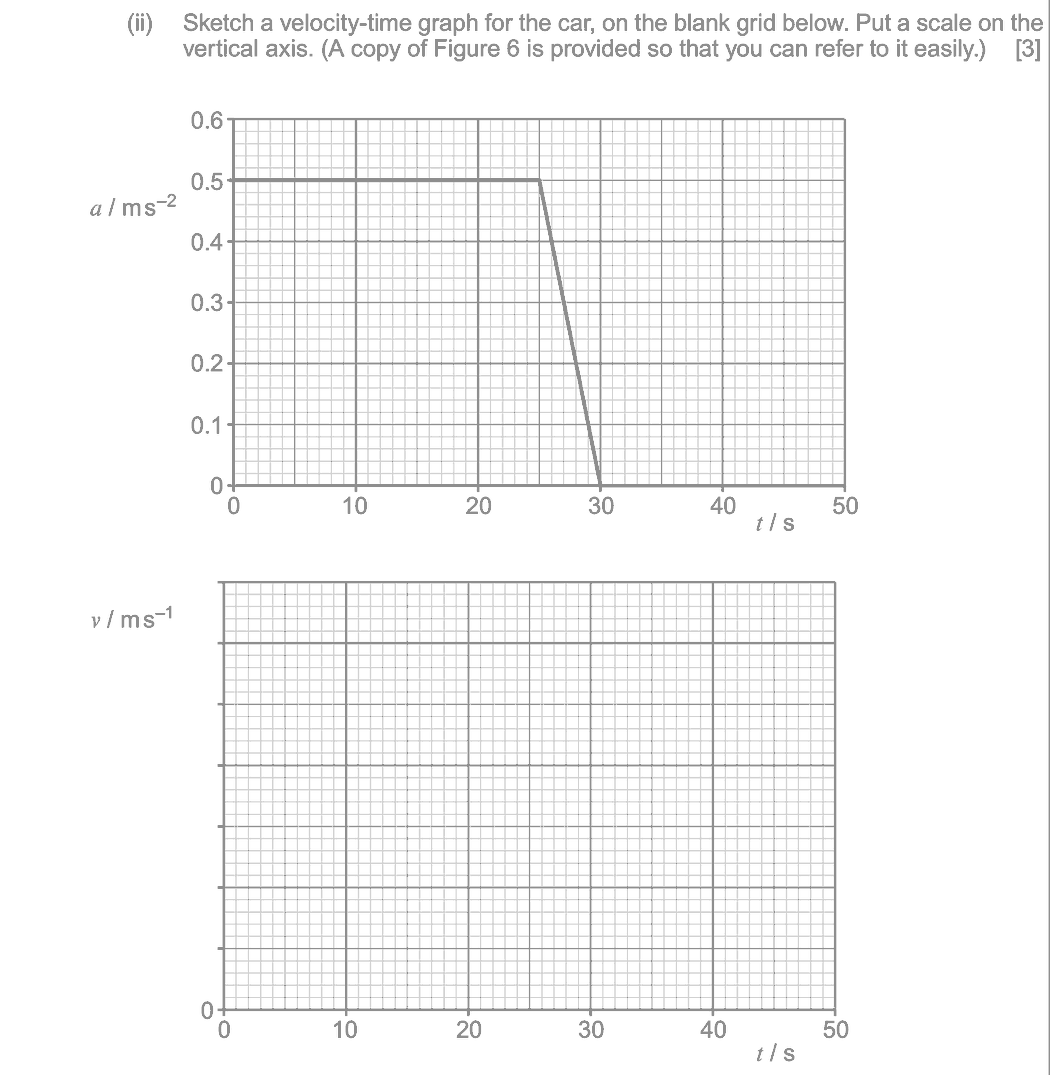
June 2017 · Component 1 · Q7(g)(ii) 3 marks AO2=3 Diagram or graph kinematicscomprehension
Earlier parts of question 7 that this part usesEarlier part of June 2017 Component 1 question 7Earlier part of June 2017 Component 1 question 7
(ii) Sketch a velocity-time graph for the car, on the blank grid below. Put a scale on the vertical axis. (A copy of Figure 6 is provided so that you can refer to it easily.) [3] 0.6 0.5 a / m s–2 0.4 0.3 0.2 0.1 0 0 10 20 30 40 50 t / s v / m s–1 0 0 10 20 30 40 50 t / s

Work with an Eduqas physics tutor

Want a paper marked and gone through with you? Message us.

Prefer email? Send an enquiry

If you are under 18, please include a parent's contact details. Enquiries go to enquiries@physicsaleveltutor.com and are deleted once handled. All tutoring is online.