June 2017: Component 2

100 marks · 41 question parts · Paper, mark scheme and report on Eduqas's site · Have the Data Booklet beside you

Question by question

QTopicMarksAOType
1(a) Resistance 1AO1=1Definition
1(b) d.c. circuits, Resistance 3AO1=1,AO2=2Calculation
1(c)(i) d.c. circuits 2AO2=2Explanation
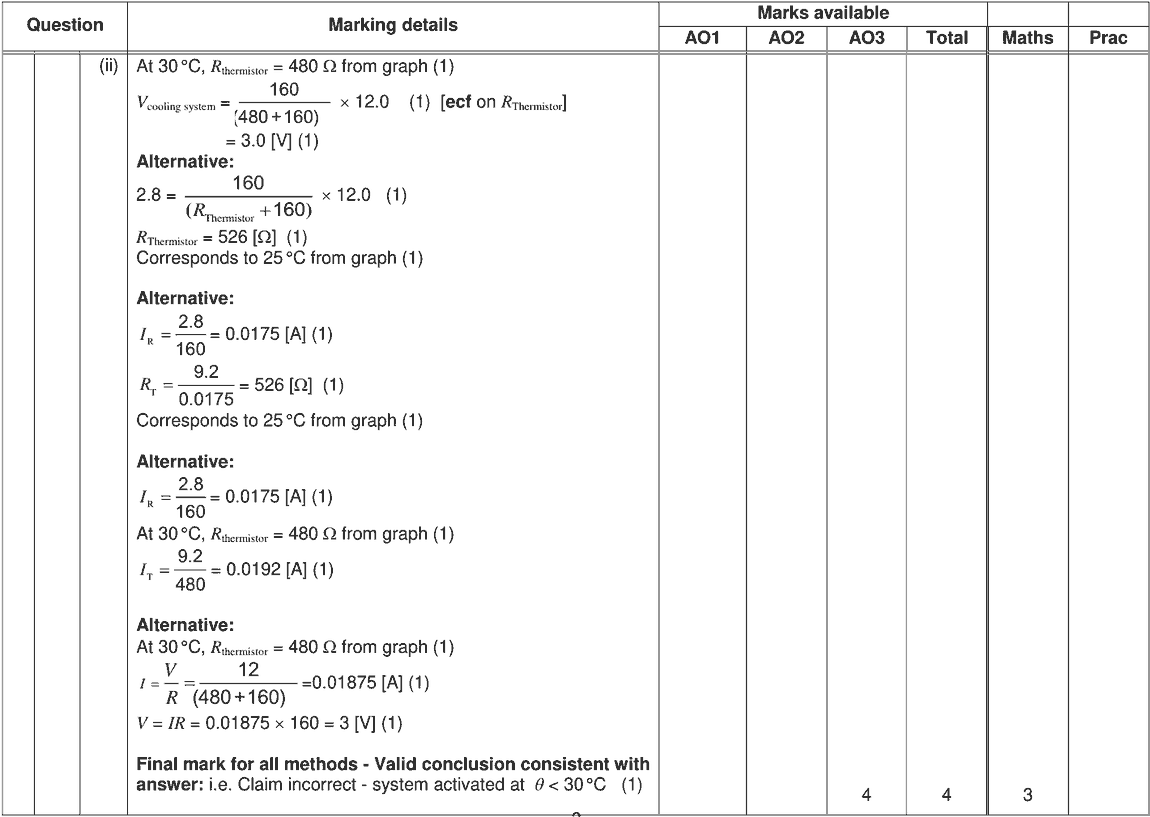
1(c)(ii) d.c. circuits, Resistance 4AO3=4Calculation
1(d) d.c. circuits 2AO3=2Explanation
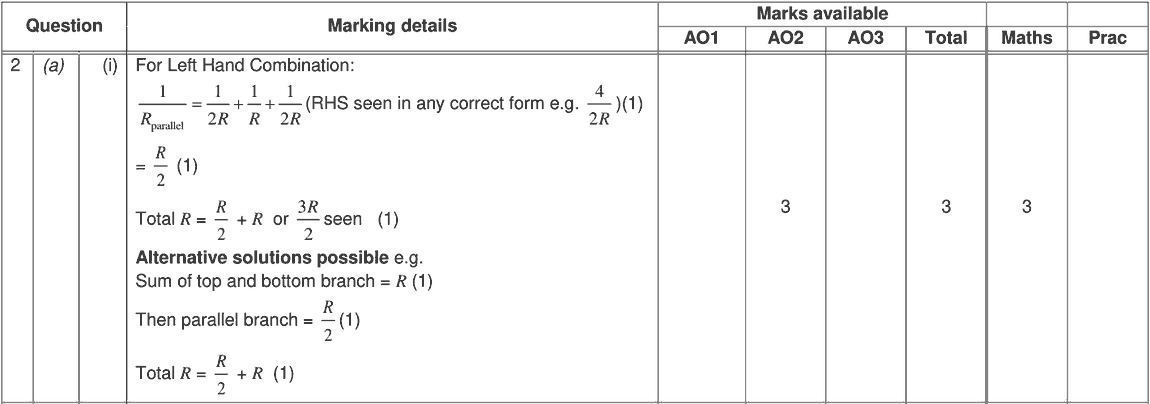
2(a)(i) d.c. circuits 3AO2=3Calculation
2(a)(ii) Resistance, d.c. circuits 2AO2=2Short answer
2(b) Resistance 2AO1=1,AO2=1Calculation
2(c)(i) Conduction of electricity 1AO1=1Definition
2(c)(ii) Conduction of electricity, d.c. circuits 3AO1=2,AO2=1Short answer
2(c)(iii) Resistance 3AO2=3Calculation
3(a) Capacitance 2AO2=2Explanation
3(b)(i) Resistance 1AO2=1Show that
3(b)(ii) Capacitance 2AO3=2Practical and data analysis
3(b)(iii) Capacitance 1AO2=1Practical and data analysis
3(b)(iv) Capacitance 2AO2=2Show that
3(b)(v) Capacitance 4AO1=1,AO2=3Practical and data analysis
3(b)(vi) Capacitance 3AO3=3Practical and data analysis
4(a) Capacitance, Electrostatic and gravitational fields of force 1AO1=1Diagram or graph
4(b)(i) Capacitance, Electrostatic and gravitational fields of force 2AO1=1,AO2=1Calculation
4(b)(ii) Electrostatic and gravitational fields of force, Resistance 2AO1=1,AO2=1Calculation
4(b)(iii) Kinematics, Dynamics: forces and momentum 3AO1=1,AO2=2Calculation
4(c) Capacitance, Electrostatic and gravitational fields of force 2AO3=2Explanation
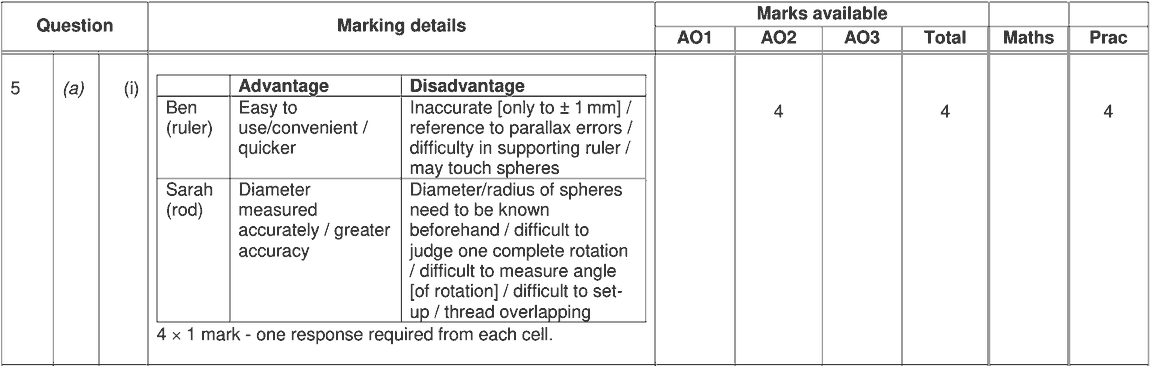
5(a)(i) Electrostatic and gravitational fields of force 4AO2=4Practical and data analysis
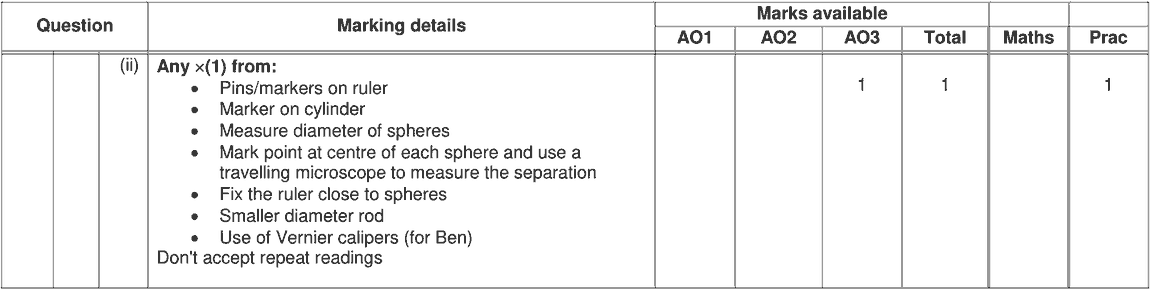
5(a)(ii) Electrostatic and gravitational fields of force 1AO3=1Practical and data analysis
5(b)(i) Electrostatic and gravitational fields of force 3AO1=1,AO2=2Show that
5(b)(ii) Conduction of electricity 2AO3=2Show that
5(b)(iii) Conduction of electricity 1AO2=1Calculation
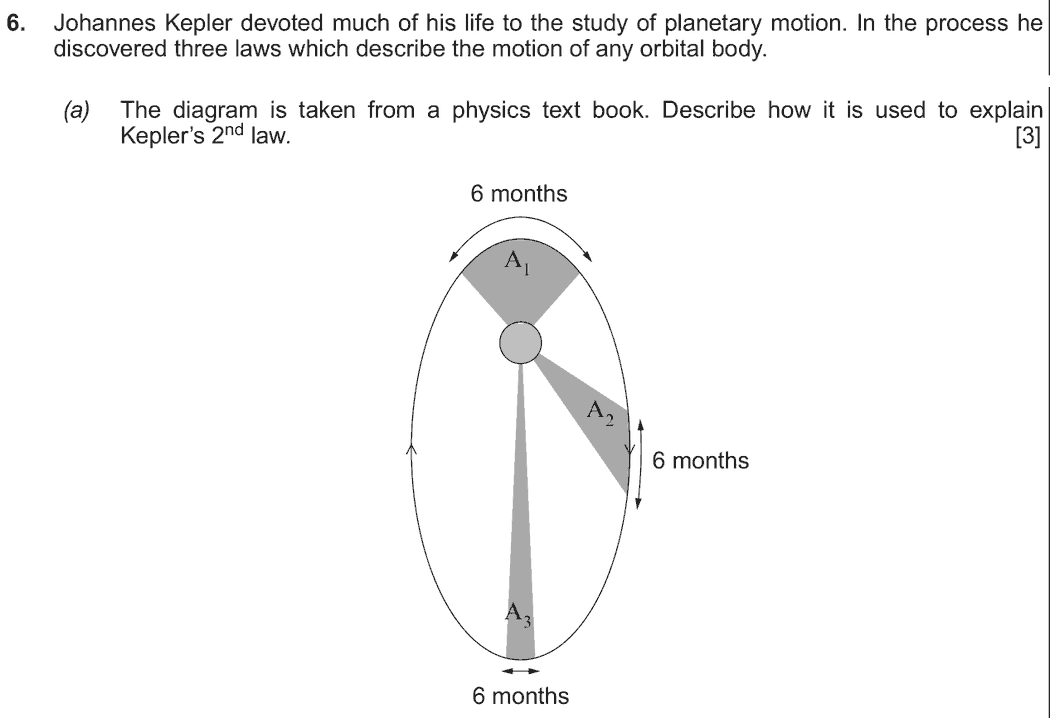
6(a) Orbits and the wider universe 3AO1=3Explanation
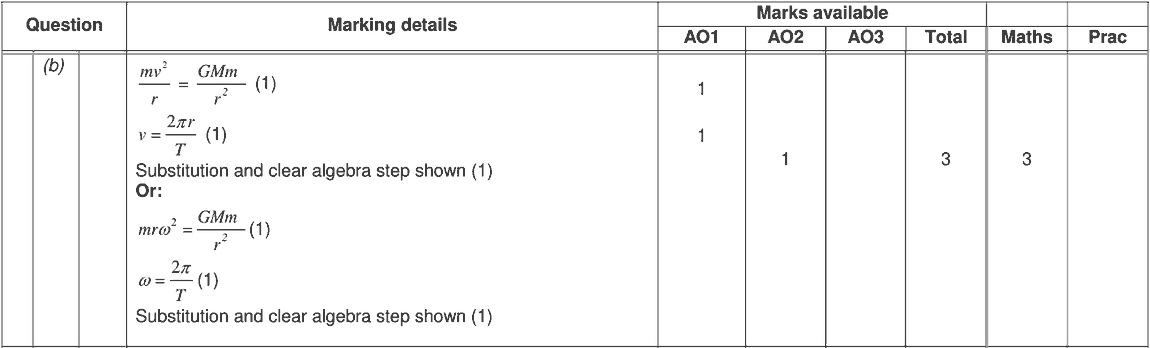
6(b) Orbits and the wider universe 3AO1=2,AO2=1Show that
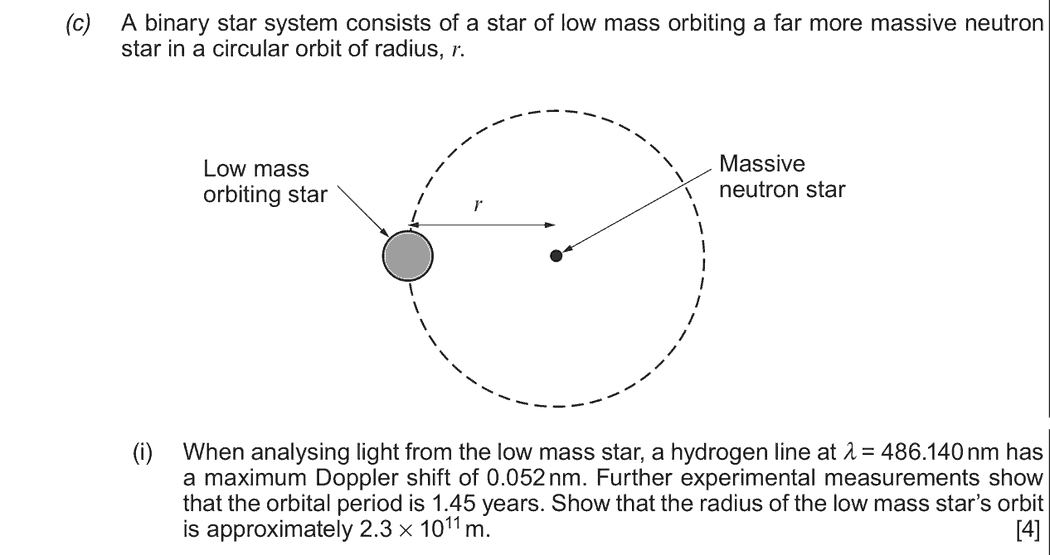
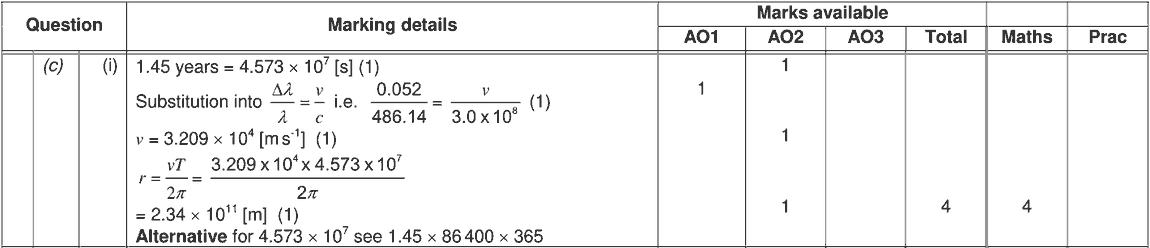
6(c)(i) Orbits and the wider universe 4AO1=1,AO2=3Show that
6(c)(ii) Orbits and the wider universe 4AO3=4Calculation
7(a)(i) Electrostatic and gravitational fields of force 2AO1=2Explanation
7(a)(ii)I Electrostatic and gravitational fields of force 2AO1=2Short answer
7(a)(ii)II Electrostatic and gravitational fields of force 2AO2=2Calculation
7(a)(iii) Electrostatic and gravitational fields of force, Energy concepts 4AO1=1,AO2=3Calculation
7(b) Electrostatic and gravitational fields of force 2AO3=2Short answer
8(a) Solids under stress 6AO1=6Extended response
8(b)(i) Solids under stress 3AO3=3Practical and data analysis
8(b)(ii) Solids under stress 2AO2=2Calculation
8(b)(iii) Solids under stress 1AO1=1Diagram or graph

The questions

1(a)1(b)1(c)(i)1(c)(ii)1(d)2(a)(i)2(a)(ii)2(b)2(c)(i)2(c)(ii)2(c)(iii)3(a)3(b)(i)3(b)(ii)3(b)(iii)3(b)(iv)3(b)(v)3(b)(vi)4(a)4(b)(i)4(b)(ii)4(b)(iii)4(c)5(a)(i)5(a)(ii)5(b)(i)5(b)(ii)5(b)(iii)6(a)6(b)6(c)(i)6(c)(ii)7(a)(i)7(a)(ii)I7(a)(ii)II7(a)(iii)7(b)8(a)8(b)(i)8(b)(ii)8(b)(iii)
June 2017 · Component 2 · Q1(a) 1 mark AO1=1 Definition resistance
1. (a) Define the potential difference across two points in an electric circuit. [1]
June 2017 · Component 2 · Q1(b) 3 marks AO1=1, AO2=2 Calculation dc circuitsresistance
Earlier part of question 1 that this part usesEarlier part of June 2017 Component 2 question 1
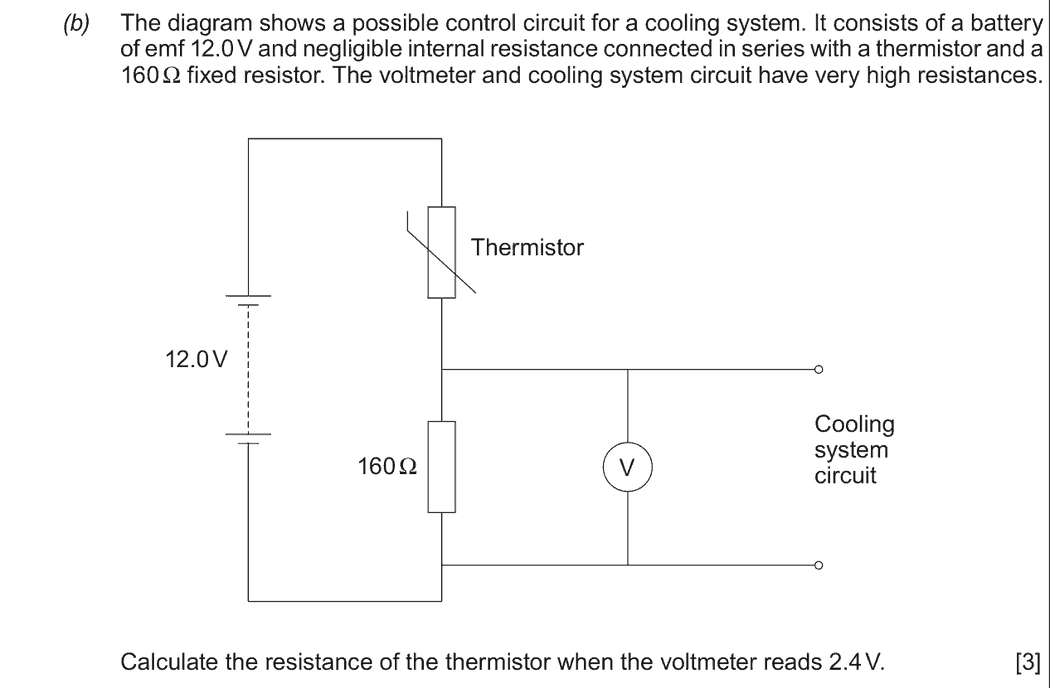
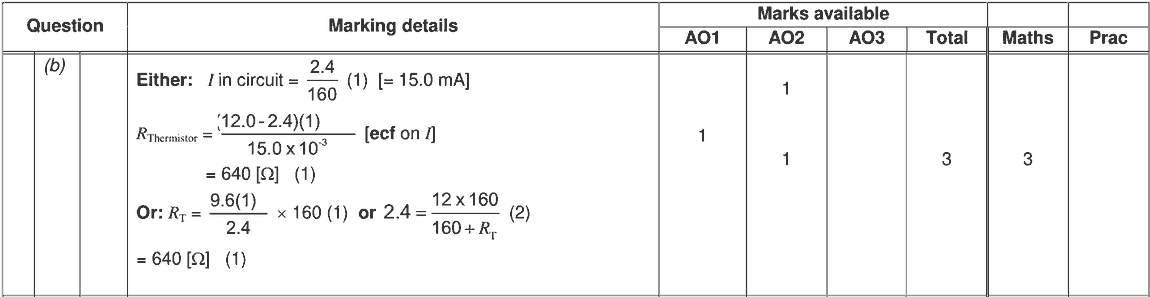
(b) The diagram shows a possible control circuit for a cooling system. It consists of a battery of emf 12.0 V and negligible internal resistance connected in series with a thermistor and a 160 Ω fixed resistor. The voltmeter and cooling system circuit have very high resistances. Thermistor 12.0 V Cooling system 160 Ω V circuit Calculate the resistance of the thermistor when the voltmeter reads 2.4 V. [3]
June 2017 · Component 2 · Q1(c)(i) 2 marks AO2=2 Explanation dc circuits
Earlier parts of question 1 that this part usesEarlier part of June 2017 Component 2 question 1Earlier part of June 2017 Component 2 question 1
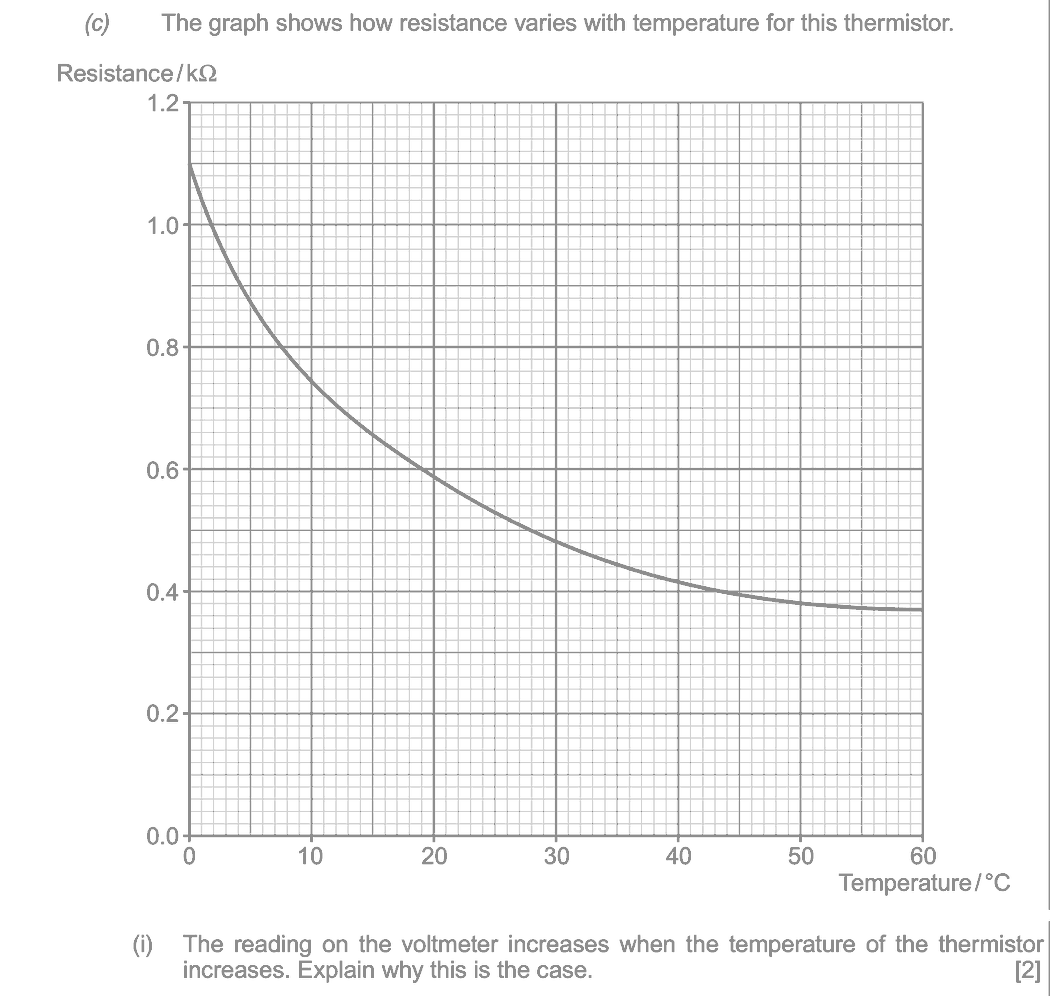
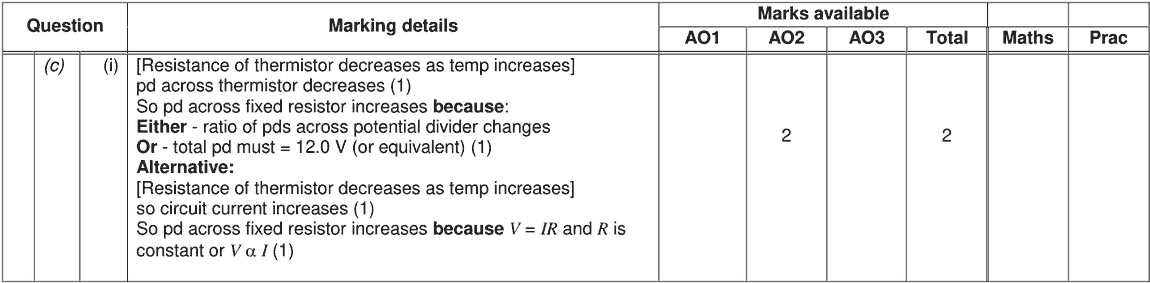
(c) The graph shows how resistance varies with temperature for this thermistor. Resistance / kΩ 1.2 1.0 0.8 0.6 0.4 0.2 0.0 0 10 20 30 40 50 60 Temperature / °C (i) The reading on the voltmeter increases when the temperature of the thermistor increases. Explain why this is the case. [2]
June 2017 · Component 2 · Q1(c)(ii) 4 marks AO3=4 Calculation dc circuitsresistance
Earlier parts of question 1 that this part usesEarlier part of June 2017 Component 2 question 1Earlier part of June 2017 Component 2 question 1Earlier part of June 2017 Component 2 question 1
(ii) The cooling system can only be activated when the voltage across the 160 Ω resistor rises above 2.8 V. An engineer suggests that this thermistor and resistor combination is suitable to use in a car cooling system and should activate when the temperature reaches 30 °C. Check this claim. [4]
June 2017 · Component 2 · Q1(d) 2 marks AO3=2 Explanation dc circuits
Earlier parts of question 1 that this part usesEarlier part of June 2017 Component 2 question 1Earlier part of June 2017 Component 2 question 1Earlier part of June 2017 Component 2 question 1
(d) The arrangement can also be used as a basis for a thermometer. By considering the shape of the graph on page 3 discuss whether this thermistor arrangement would be more effective at measuring changes in temperature between 0 °C and 10 °C or between 50 °C and 60 °C. [2]
June 2017 · Component 2 · Q2(a)(i) 3 marks AO2=3 Calculation dc circuits
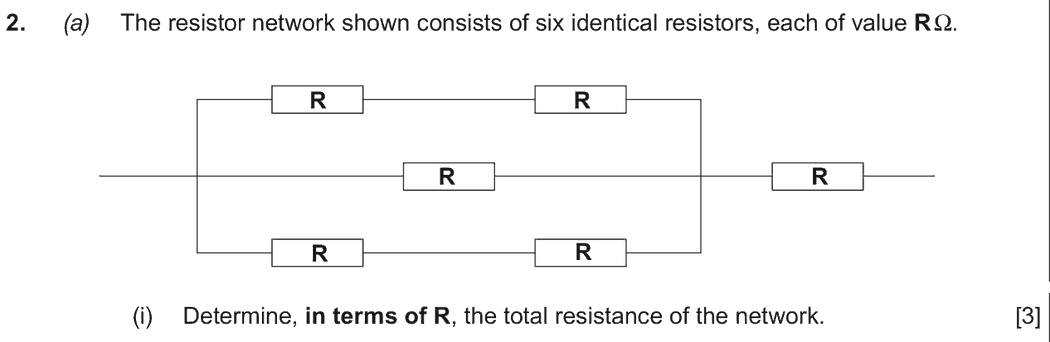
2. (a) The resistor network shown consists of six identical resistors, each of value R Ω. R R R R R R (i) Determine, in terms of R, the total resistance of the network. [3]
June 2017 · Component 2 · Q2(a)(ii) 2 marks AO2=2 Short answer resistancedc circuits
Earlier part of question 2 that this part usesEarlier part of June 2017 Component 2 question 2
(ii) Draw a circle around the resistor which dissipates the greatest power when a pd is applied across the arrangement. Explain your answer. [2]
June 2017 · Component 2 · Q2(b) 2 marks AO1=1, AO2=1 Calculation resistance
Earlier part of question 2 that this part usesEarlier part of June 2017 Component 2 question 2
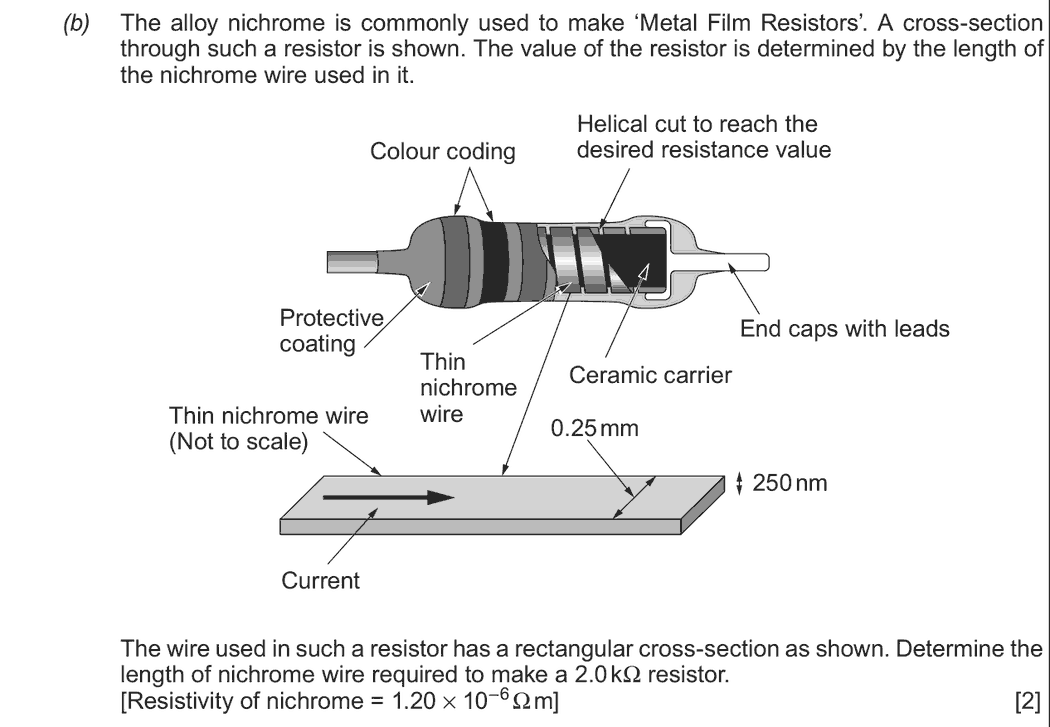
(b) The alloy nichrome is commonly used to make ‘Metal Film Resistors’. A cross-section through such a resistor is shown. The value of the resistor is determined by the length of the nichrome wire used in it. Helical cut to reach the Colour coding desired resistance value Protective End caps with leads coating Thin Ceramic carrier nichrome Thin nichrome wire wire 0.25 mm (Not to scale) 250 nm Current The wire used in such a resistor has a rectangular cross-section as shown. Determine the length of nichrome wire required to make a 2.0 kΩ resistor. [Resistivity of nichrome = 1.20 × 10⁻⁶ Ω m] [2]
June 2017 · Component 2 · Q2(c)(i) 1 mark AO1=1 Definition conduction of electricity
Earlier parts of question 2 that this part usesEarlier part of June 2017 Component 2 question 2Earlier part of June 2017 Component 2 question 2
(c) The current I through a wire is related to the drift velocity, v, of free electrons through the wire by the equation: I = nAve (i) State the meaning of n. [1]
June 2017 · Component 2 · Q2(c)(ii) 3 marks AO1=2, AO2=1 Short answer conduction of electricitydc circuits
Earlier parts of question 2 that this part usesEarlier part of June 2017 Component 2 question 2Earlier part of June 2017 Component 2 question 2Earlier part of June 2017 Component 2 question 2
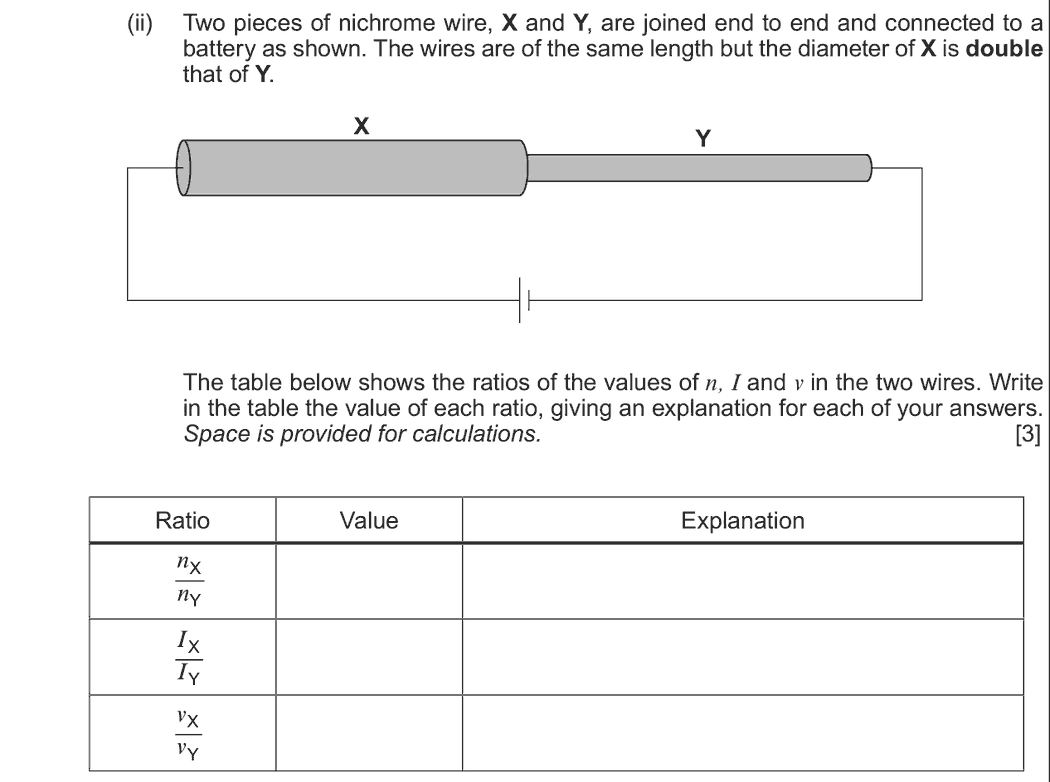
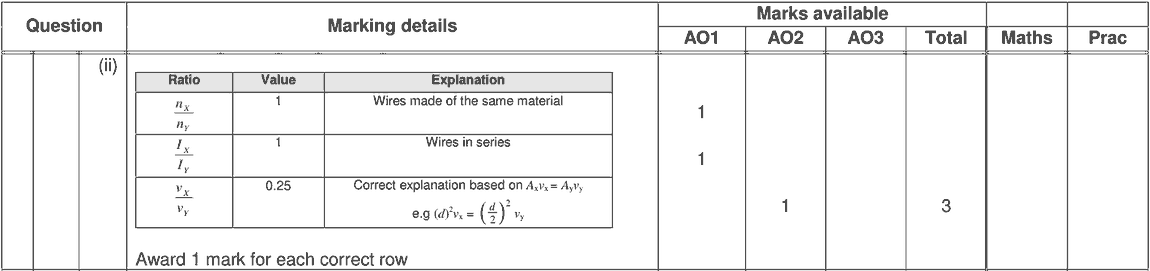
(ii) Two pieces of nichrome wire, X and Y, are joined end to end and connected to a battery as shown. The wires are of the same length but the diameter of X is double that of Y. X Y The table below shows the ratios of the values of n, I and v in the two wires. Write in the table the value of each ratio, giving an explanation for each of your answers. Space is provided for calculations. [3] Ratio Value Explanation n X n Y I X I Y v X v Y
June 2017 · Component 2 · Q2(c)(iii) 3 marks AO2=3 Calculation resistance
Earlier parts of question 2 that this part usesEarlier part of June 2017 Component 2 question 2Earlier part of June 2017 Component 2 question 2Earlier part of June 2017 Component 2 question 2Earlier part of June 2017 Component 2 question 2
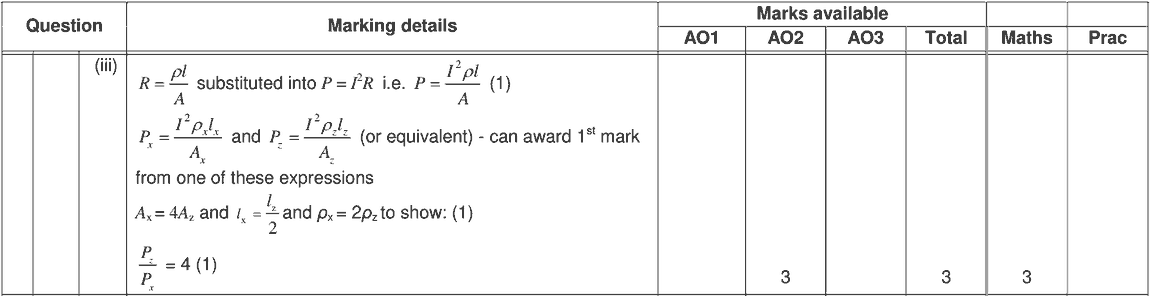
(iii) Wire Y is replaced with another wire Z of the same cross-sectional area as Y but double the length and made of a material with resistivity half that of X. Calculate the ratio: Power dissipated in wire Z Power dissipated in wire X [3]
June 2017 · Component 2 · Q3(a) 2 marks AO2=2 Explanation capacitance
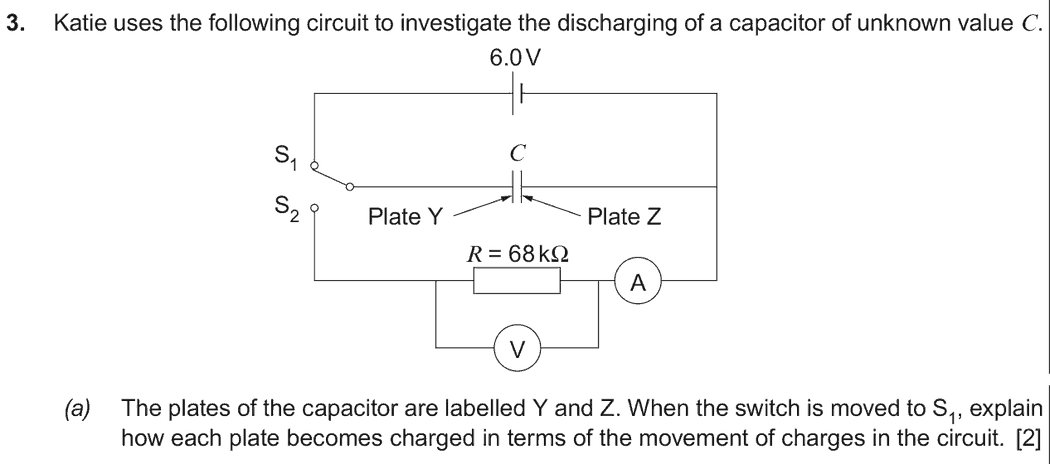
3. Katie uses the following circuit to investigate the discharging of a capacitor of unknown value C. 6.0 V S1 C S2 Plate Y Plate Z R = 68 kΩ A V (a) The plates of the capacitor are labelled Y and Z. When the switch is moved to S1, explain how each plate becomes charged in terms of the movement of charges in the circuit. [2]
June 2017 · Component 2 · Q3(b)(i) 1 mark AO2=1 Show that resistance
Earlier part of question 3 that this part usesEarlier part of June 2017 Component 2 question 3
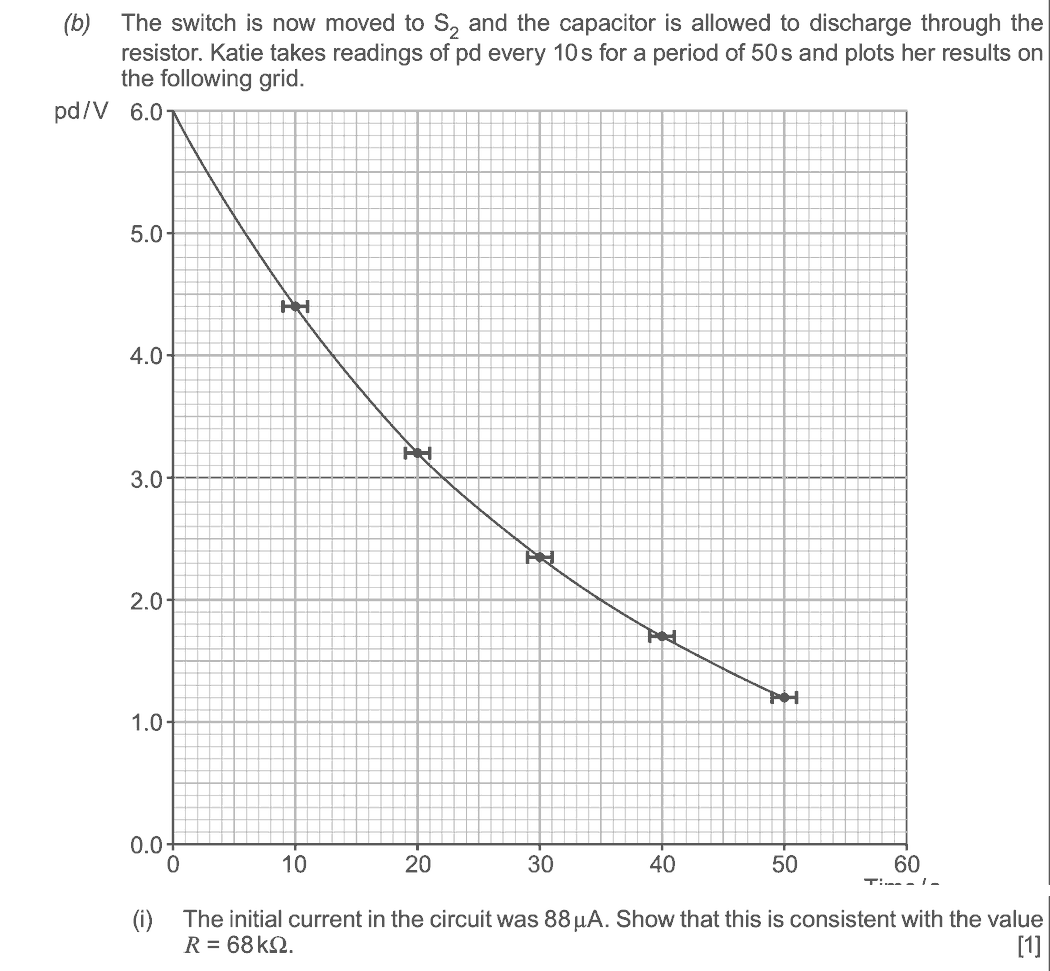
(b) The switch is now moved to S2 and the capacitor is allowed to discharge through the resistor. Katie takes readings of pd every 10 s for a period of 50 s and plots her results on the following grid. pd / V 6.0 5.0 4.0 3.0 2.0 1.0 0.0 0 10 20 30 40 50 60 Time / s (i) The initial current in the circuit was 88 μA. Show that this is consistent with the value R = 68 kΩ. [1]
June 2017 · Component 2 · Q3(b)(ii) 2 marks AO3=2 Practical and data analysis capacitance
Earlier parts of question 3 that this part usesEarlier part of June 2017 Component 2 question 3Earlier part of June 2017 Component 2 question 3
(ii) Katie took single readings of pd. She used a voltmeter with a resolution of 0.01 V. Explain why it was not appropriate to include error bars when plotting pd. [2]
June 2017 · Component 2 · Q3(b)(iii) 1 mark AO2=1 Practical and data analysis capacitance
Earlier parts of question 3 that this part usesEarlier part of June 2017 Component 2 question 3Earlier part of June 2017 Component 2 question 3
(iii) She uses a stopwatch of resolution 1 second. State how this is represented on the graph. [1]
June 2017 · Component 2 · Q3(b)(iv) 2 marks AO2=2 Show that capacitance
Earlier parts of question 3 that this part usesEarlier part of June 2017 Component 2 question 3Earlier part of June 2017 Component 2 question 3
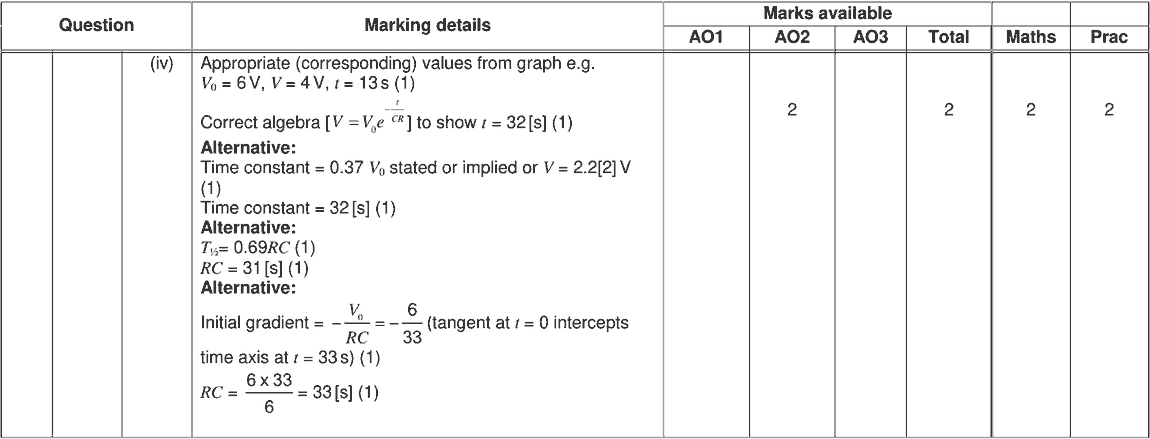
(iv) Show that the time constant of the circuit is approximately 30 s. [2]
June 2017 · Component 2 · Q3(b)(v) 4 marks AO1=1, AO2=3 Practical and data analysis capacitance
Earlier parts of question 3 that this part usesEarlier part of June 2017 Component 2 question 3Earlier part of June 2017 Component 2 question 3
(v) The resistor manufacturer states that the resistors are accurate to ± 3% of their given values. Use this information to calculate C along with its absolute uncertainty. [Take the absolute uncertainty in the time constant as being the same as the absolute uncertainty in the readings of time.] [4]
June 2017 · Component 2 · Q3(b)(vi) 3 marks AO3=3 Practical and data analysis capacitance
Earlier parts of question 3 that this part usesEarlier part of June 2017 Component 2 question 3Earlier part of June 2017 Component 2 question 3
(vi) Determine a value for pd at a time t = 55 s and state whether this is consistent with the trend shown by the graph. [3]
June 2017 · Component 2 · Q4(a) 1 mark AO1=1 Diagram or graph capacitanceelectrostatic and gravitational fields
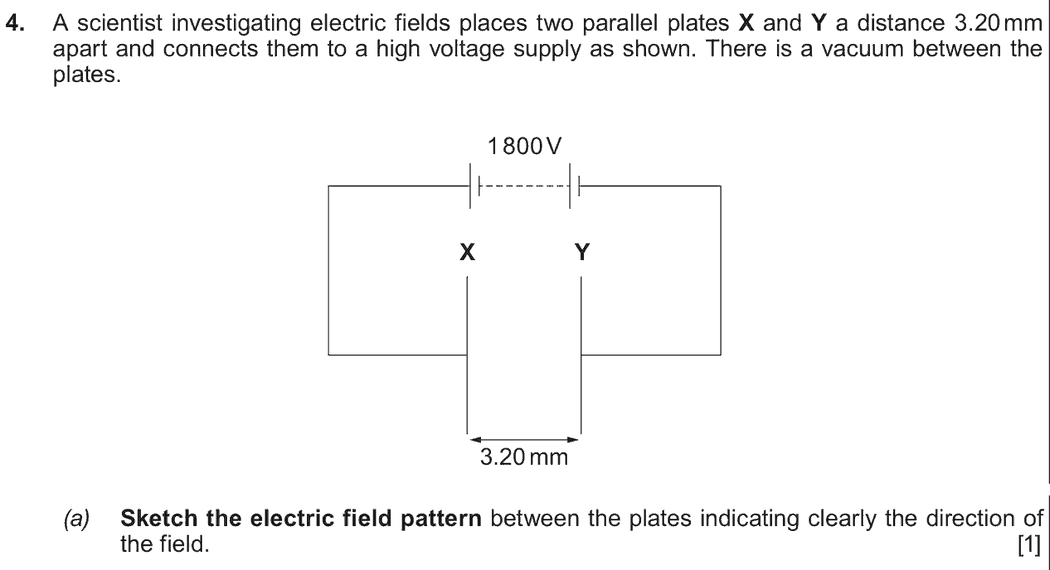
4. A scientist investigating electric fields places two parallel plates X and Y a distance 3.20 mm apart and connects them to a high voltage supply as shown. There is a vacuum between the plates. 1 800 V X Y 3.20mm (a) Sketch the electric field pattern between the plates indicating clearly the direction of the field. [1]
June 2017 · Component 2 · Q4(b)(i) 2 marks AO1=1, AO2=1 Calculation capacitanceelectrostatic and gravitational fields
Earlier part of question 4 that this part usesEarlier part of June 2017 Component 2 question 4
(b) Electrons are accelerated from plate Y to plate X. Calculate: (i) the force on an electron; [2]
June 2017 · Component 2 · Q4(b)(ii) 2 marks AO1=1, AO2=1 Calculation electrostatic and gravitational fieldsresistance
Earlier parts of question 4 that this part usesEarlier part of June 2017 Component 2 question 4Earlier part of June 2017 Component 2 question 4
(ii) the gain in kinetic energy of an electron as it travels from Y to X; [2]
June 2017 · Component 2 · Q4(b)(iii) 3 marks AO1=1, AO2=2 Calculation kinematicsdynamics
Earlier parts of question 4 that this part usesEarlier part of June 2017 Component 2 question 4Earlier part of June 2017 Component 2 question 4
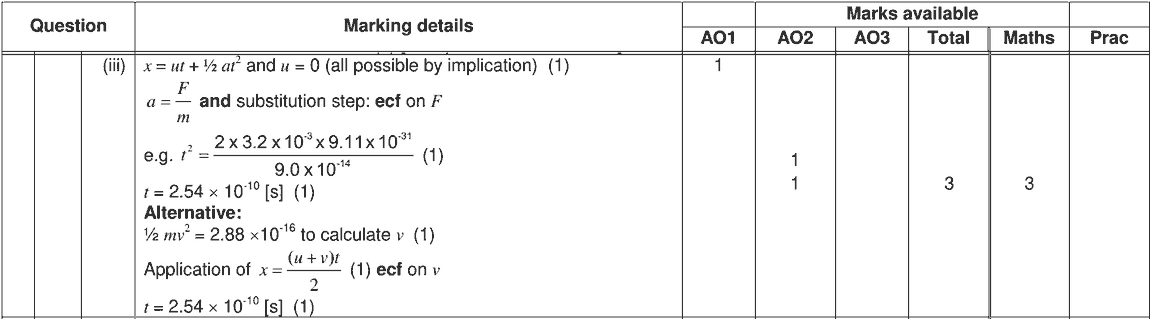
(iii) the time it takes for an electron to travel from Y to X. Assume the electron starts from rest at plate Y. [3]
June 2017 · Component 2 · Q4(c) 2 marks AO3=2 Explanation capacitanceelectrostatic and gravitational fields
Earlier part of question 4 that this part usesEarlier part of June 2017 Component 2 question 4
(c) The separation between the plates is now halved but the pd is unchanged. The scientist believes that the gain in kinetic energy of an electron travelling (from rest) from Y to X will be unchanged. Verify this claim. [2]
June 2017 · Component 2 · Q5(a)(i) 4 marks AO2=4 Practical and data analysis electrostatic and gravitational fields
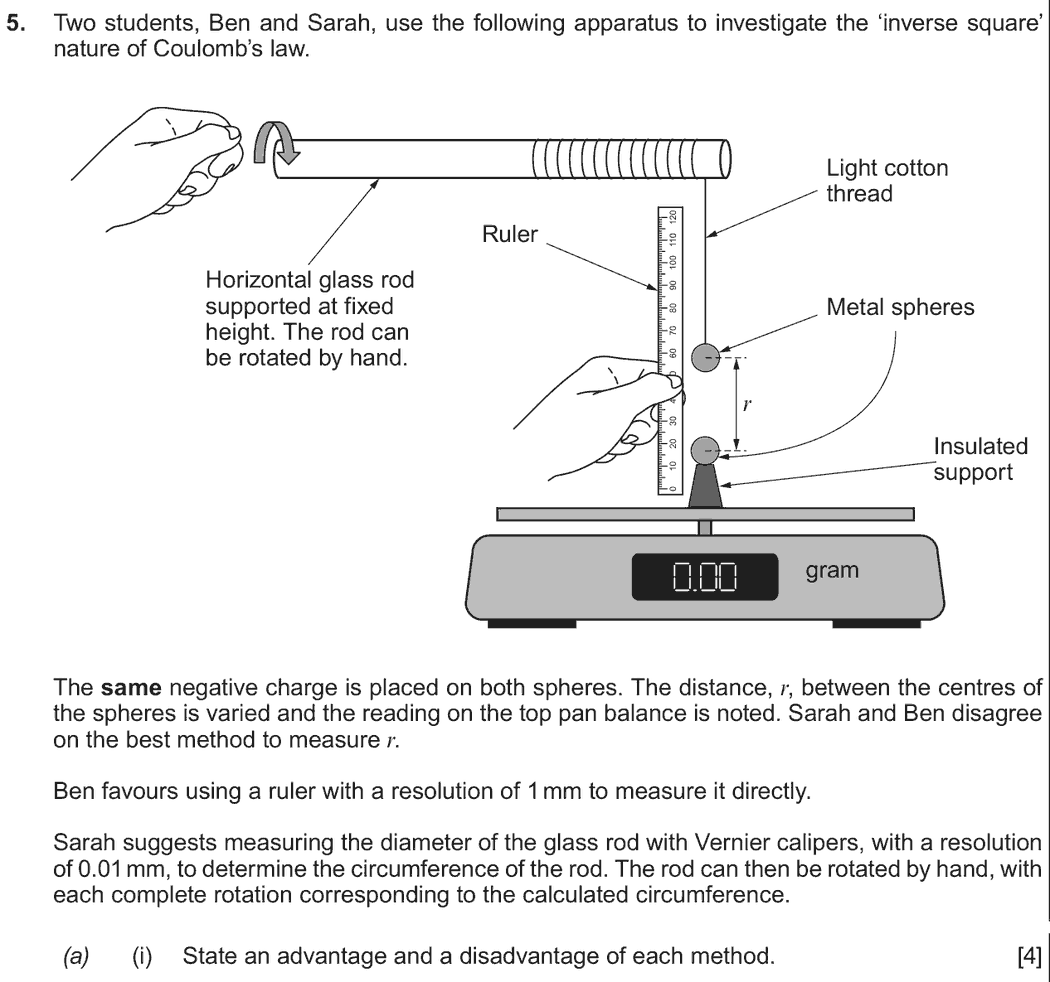
5. Two students, Ben and Sarah, use the following apparatus to investigate the ‘inverse square’ nature of Coulomb’s law. Light cotton thread Ruler Horizontal glass rod supported at fixed Metal spheres height. The rod can be rotated by hand. r Insulated support gram The same negative charge is placed on both spheres. The distance, r, between the centres of the spheres is varied and the reading on the top pan balance is noted. Sarah and Ben disagree on the best method to measure r. Ben favours using a ruler with a resolution of 1 mm to measure it directly. Sarah suggests measuring the diameter of the glass rod with Vernier calipers, with a resolution of 0.01 mm, to determine the circumference of the rod. The rod can then be rotated by hand, with each complete rotation corresponding to the calculated circumference. (a) (i) State an advantage and a disadvantage of each method. [4]
June 2017 · Component 2 · Q5(a)(ii) 1 mark AO3=1 Practical and data analysis electrostatic and gravitational fields
Earlier part of question 5 that this part usesEarlier part of June 2017 Component 2 question 5
(ii) Suggest an improvement to one of the techniques which would increase the accuracy of measuring r. [1]
June 2017 · Component 2 · Q5(b)(i) 3 marks AO1=1, AO2=2 Show that electrostatic and gravitational fields
Earlier part of question 5 that this part usesEarlier part of June 2017 Component 2 question 5
(b) When r = 20 mm, the reading on the top pan balance is 0.01 gram. (i) Show that the value of Q1Q2, the product of the charges on the spheres, when r = 20 mm is approximately 4.4 × 10⁻¹⁸ C2. [3]
June 2017 · Component 2 · Q5(b)(ii) 2 marks AO3=2 Show that conduction of electricity
Earlier parts of question 5 that this part usesEarlier part of June 2017 Component 2 question 5Earlier part of June 2017 Component 2 question 5
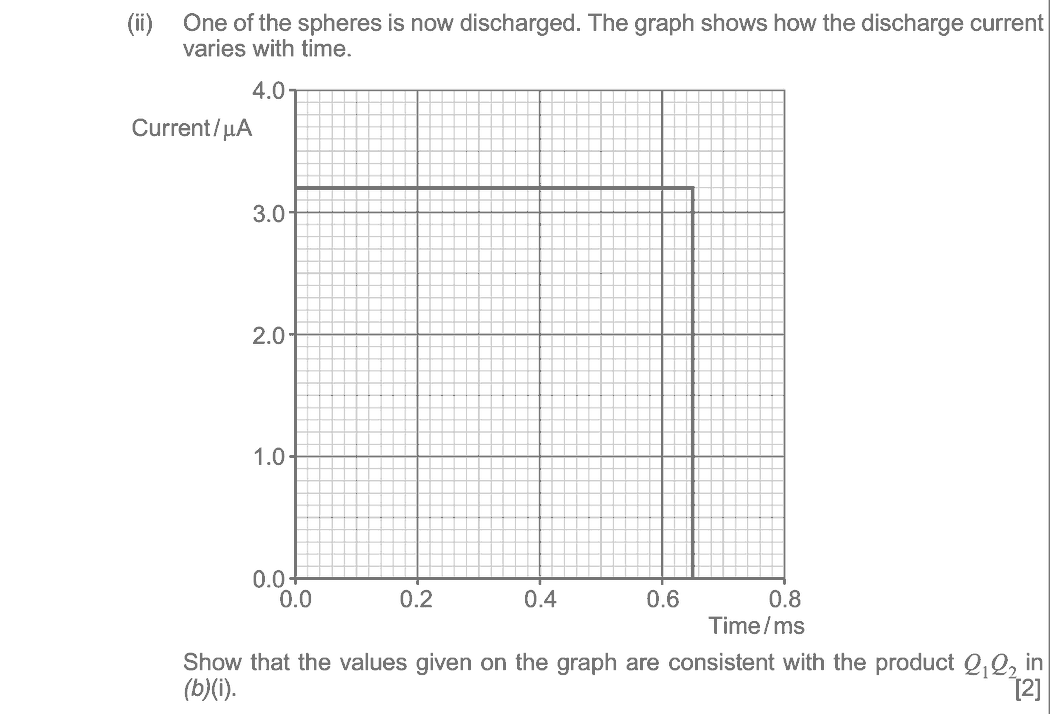
(ii) One of the spheres is now discharged. The graph shows how the discharge current varies with time. 4.0 Current / μA 3.0 2.0 1.0 0.0 0.0 0.2 0.4 0.6 0.8 Time / ms Show that the values given on the graph are consistent with the product Q1Q2 in (b)(i). [2]
June 2017 · Component 2 · Q5(b)(iii) 1 mark AO2=1 Calculation conduction of electricity
Earlier parts of question 5 that this part usesEarlier part of June 2017 Component 2 question 5Earlier part of June 2017 Component 2 question 5Earlier part of June 2017 Component 2 question 5
(iii) Hence, estimate the number of electrons on one sphere when the reading on the balance is 0.01 gram and r = 20 mm. [1]
June 2017 · Component 2 · Q6(a) 3 marks AO1=3 Explanation orbits and the wider universe
6. Johannes Kepler devoted much of his life to the study of planetary motion. In the process he discovered three laws which describe the motion of any orbital body. (a) The diagram is taken from a physics text book. Describe how it is used to explain Kepler’s 2nd law. [3] 6 months A1 A2 6 months A3 6 months
June 2017 · Component 2 · Q6(b) 3 marks AO1=2, AO2=1 Show that orbits and the wider universe
Earlier part of question 6 that this part usesEarlier part of June 2017 Component 2 question 6
(b) Use a formula for centripetal acceleration and Newton’s law of gravitation to show that, for a planet in circular orbit of radius, r, around a star of mass, M: 4 π 2 r 3 T 2 = GM where T is the period of the planet’s orbit. [3]
June 2017 · Component 2 · Q6(c)(i) 4 marks AO1=1, AO2=3 Show that orbits and the wider universe
Earlier part of question 6 that this part usesEarlier part of June 2017 Component 2 question 6
(c) A binary star system consists of a star of low mass orbiting a far more massive neutron star in a circular orbit of radius, r. Low mass Massive orbiting star neutron star r (i) When analysing light from the low mass star, a hydrogen line at λ = 486.140 nm has a maximum Doppler shift of 0.052 nm. Further experimental measurements show that the orbital period is 1.45 years. Show that the radius of the low mass star’s orbit is approximately 2.3 × 10¹¹ m. [4]
June 2017 · Component 2 · Q6(c)(ii) 4 marks AO3=4 Calculation orbits and the wider universe
Earlier parts of question 6 that this part usesEarlier part of June 2017 Component 2 question 6Earlier part of June 2017 Component 2 question 6
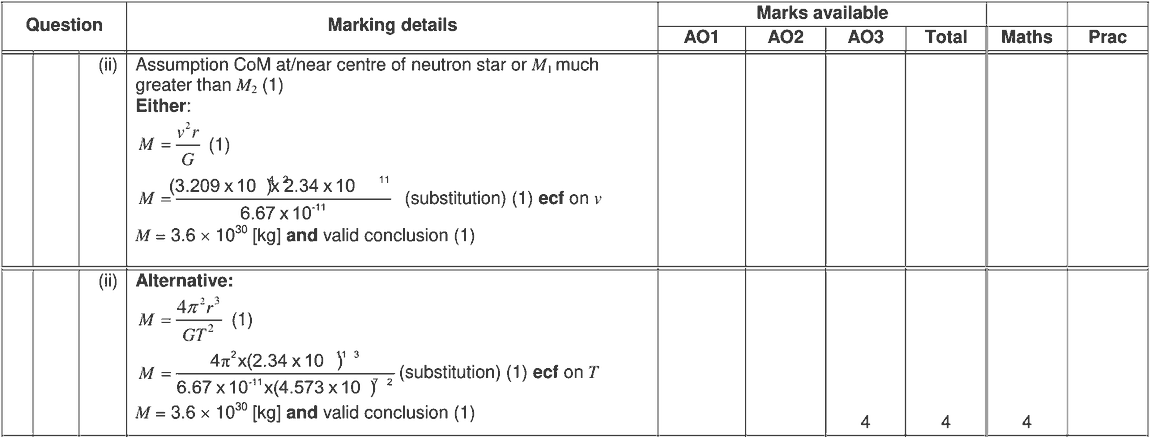
(ii) Astronomers believe that the mass of the neutron star is 1.8 times the mass of the Sun. Determine whether or not this is correct, stating any assumption you make. [Mass of Sun = 2.0 × 1030 kg] [4]
June 2017 · Component 2 · Q7(a)(i) 2 marks AO1=2 Explanation electrostatic and gravitational fields
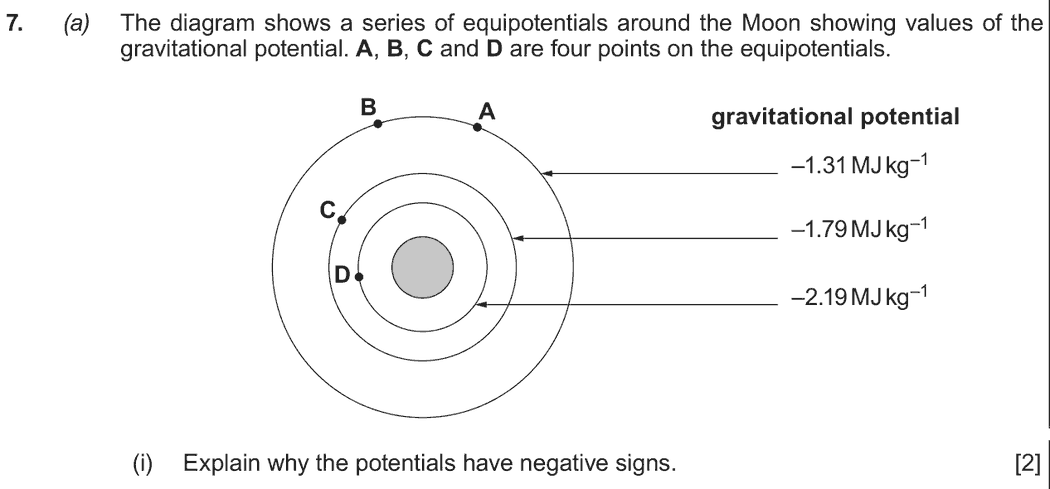
7. (a) The diagram shows a series of equipotentials around the Moon showing values of the gravitational potential. A, B, C and D are four points on the equipotentials. B A gravitational potential –1.31 MJ kg–1 C –1.79 MJ kg–1 D –2.19 MJ kg–1 (i) Explain why the potentials have negative signs. [2]
June 2017 · Component 2 · Q7(a)(ii)I 2 marks AO1=2 Short answer electrostatic and gravitational fields
Earlier part of question 7 that this part usesEarlier part of June 2017 Component 2 question 7
(ii) A spacecraft of mass 300 kg orbits the Moon. Determine, showing your reasoning, the changes in the gravitational potential energy of the spacecraft when it moves from: I. A to B; [2]
June 2017 · Component 2 · Q7(a)(ii)II 2 marks AO2=2 Calculation electrostatic and gravitational fields
Earlier parts of question 7 that this part usesEarlier part of June 2017 Component 2 question 7Earlier part of June 2017 Component 2 question 7
II. B to C. [2]
June 2017 · Component 2 · Q7(a)(iii) 4 marks AO1=1, AO2=3 Calculation electrostatic and gravitational fieldsenergy concepts
Earlier part of question 7 that this part usesEarlier part of June 2017 Component 2 question 7
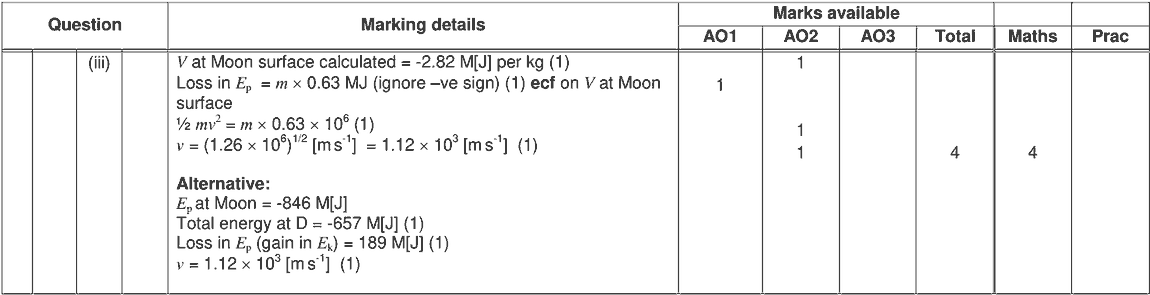
(iii) The spacecraft is now directed from point D towards the Moon’s surface with an initial speed of 0 m s–1 in this direction. Calculate the speed at which the spacecraft impacts with the Moon’s surface. [Mass of Moon = 7.35 × 10²² kg. Radius of Moon = 1 740 km] [4]
June 2017 · Component 2 · Q7(b) 2 marks AO3=2 Short answer electrostatic and gravitational fields
Earlier part of question 7 that this part usesEarlier part of June 2017 Component 2 question 7
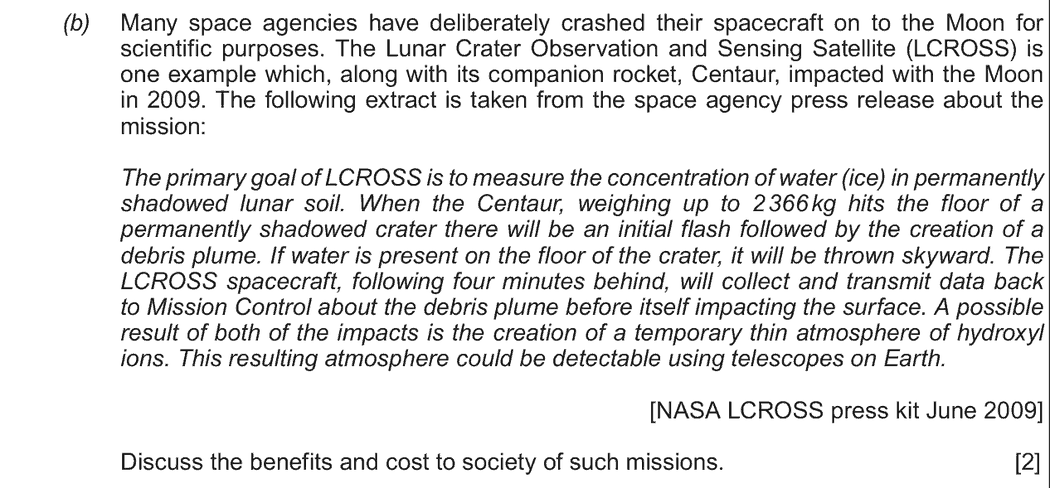
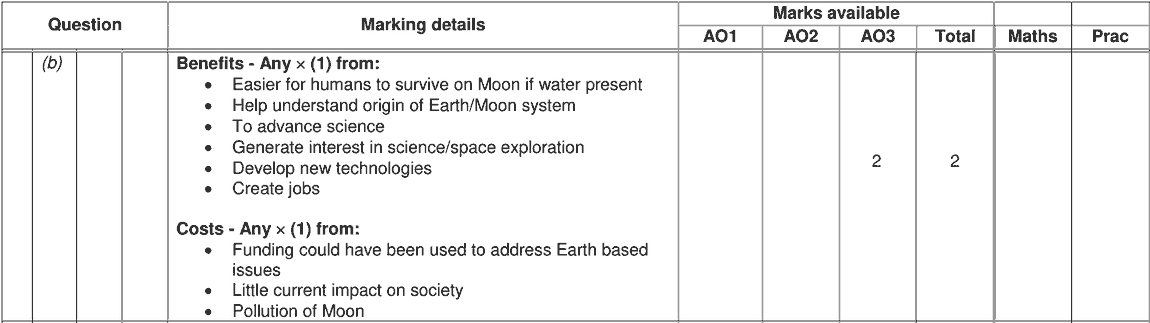
(b) Many space agencies have deliberately crashed their spacecraft on to the Moon for scientific purposes. The Lunar Crater Observation and Sensing Satellite (LCROSS) is one example which, along with its companion rocket, Centaur, impacted with the Moon in 2009. The following extract is taken from the space agency press release about the mission: The primary goal of LCROSS is to measure the concentration of water (ice) in permanently shadowed lunar soil. When the Centaur, weighing up to 2 366 kg hits the floor of a permanently shadowed crater there will be an initial flash followed by the creation of a debris plume. If water is present on the floor of the crater, it will be thrown skyward. The LCROSS spacecraft, following four minutes behind, will collect and transmit data back to Mission Control about the debris plume before itself impacting the surface. A possible result of both of the impacts is the creation of a temporary thin atmosphere of hydroxyl ions. This resulting atmosphere could be detectable using telescopes on Earth. [NASA LCROSS press kit June 2009] Discuss the benefits and cost to society of such missions. [2]
June 2017 · Component 2 · Q8(a) 6 marks AO1=6 6-mark extended response solids under stress
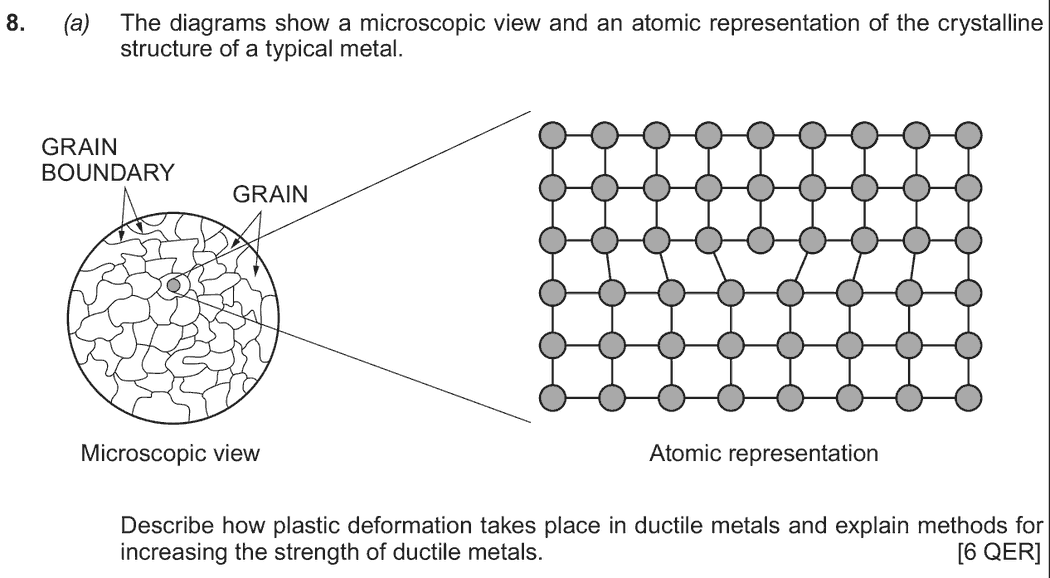
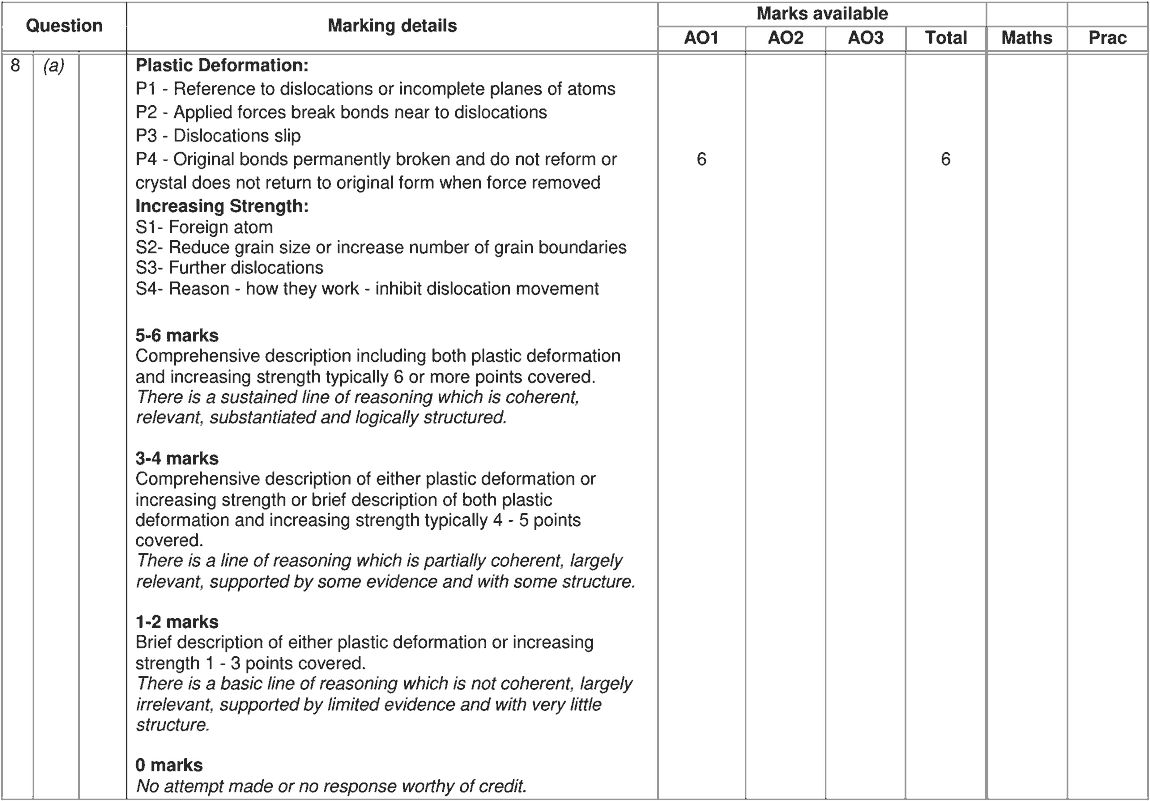
8. (a) The diagrams show a microscopic view and an atomic representation of the crystalline structure of a typical metal. GRAIN BOUNDARY GRAIN Microscopic view Atomic representation Describe how plastic deformation takes place in ductile metals and explain methods for increasing the strength of ductile metals. [6 QER]
June 2017 · Component 2 · Q8(b)(i) 3 marks AO3=3 Practical and data analysis solids under stress
Earlier part of question 8 that this part usesEarlier part of June 2017 Component 2 question 8
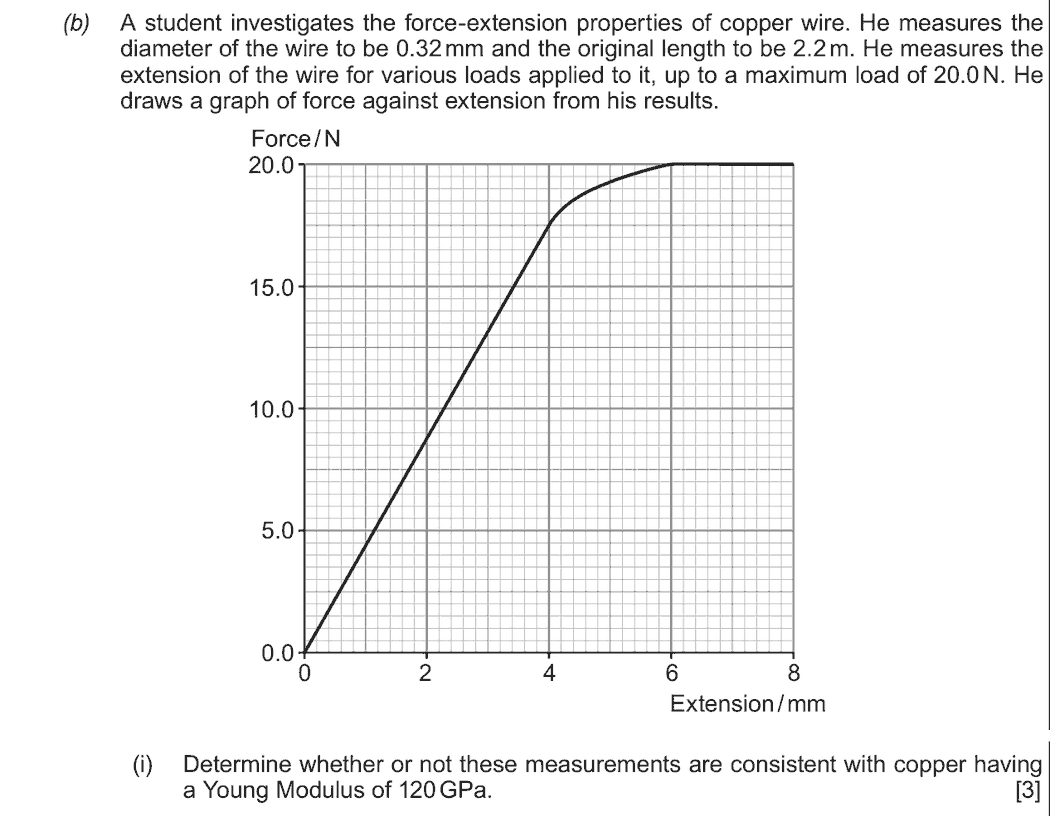
(b) A student investigates the force-extension properties of copper wire. He measures the diameter of the wire to be 0.32 mm and the original length to be 2.2 m. He measures the extension of the wire for various loads applied to it, up to a maximum load of 20.0 N. He draws a graph of force against extension from his results. Force / N 20.0 15.0 10.0 5.0 0.0 0 2 4 6 8 Extension / mm (i) Determine whether or not these measurements are consistent with copper having a Young Modulus of 120 GPa. [3]
June 2017 · Component 2 · Q8(b)(ii) 2 marks AO2=2 Calculation solids under stress
Earlier parts of question 8 that this part usesEarlier part of June 2017 Component 2 question 8Earlier part of June 2017 Component 2 question 8
(ii) Estimate the work needed to produce a strain of 0.2% in the wire. [2]
June 2017 · Component 2 · Q8(b)(iii) 1 mark AO1=1 Diagram or graph solids under stress
Earlier parts of question 8 that this part usesEarlier part of June 2017 Component 2 question 8Earlier part of June 2017 Component 2 question 8
(iii) Sketch a line on the graph to show the possible behaviour of the wire when the 20 N force is removed. [Assume the wire has been stretched beyond its elastic limit.] [1]

Work with an Eduqas physics tutor

Want a paper marked and gone through with you? Message us.

Prefer email? Send an enquiry

If you are under 18, please include a parent's contact details. Enquiries go to enquiries@physicsaleveltutor.com and are deleted once handled. All tutoring is online.