June 2018: Component 2

100 marks · 39 question parts · Paper, mark scheme and report on Eduqas's site · Have the Data Booklet beside you

Question by question

QTopicMarksAOType
1(a)(i) d.c. circuits 2AO1=2Explanation
1(a)(ii) d.c. circuits 3AO1=1,AO2=2Calculation
1(b) d.c. circuits 2AO2=2Explanation
2(a)(i) Conduction of electricity 1AO1=1Definition
2(a)(ii) Resistance 2AO1=1,AO2=1Show that
2(b)(i) d.c. circuits, Resistance 2AO2=2Show that
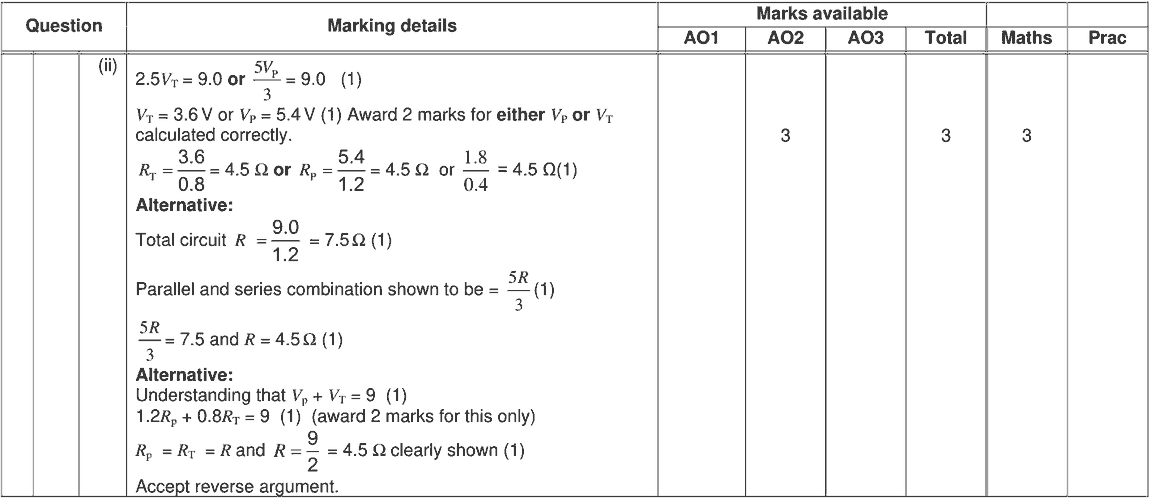
2(b)(ii) d.c. circuits, Resistance 3AO2=3Show that
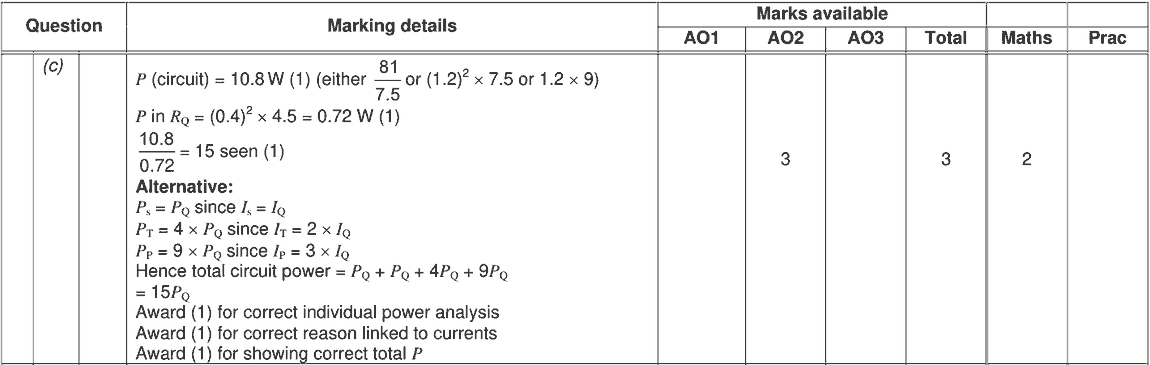
2(c) Resistance 3AO2=3Show that
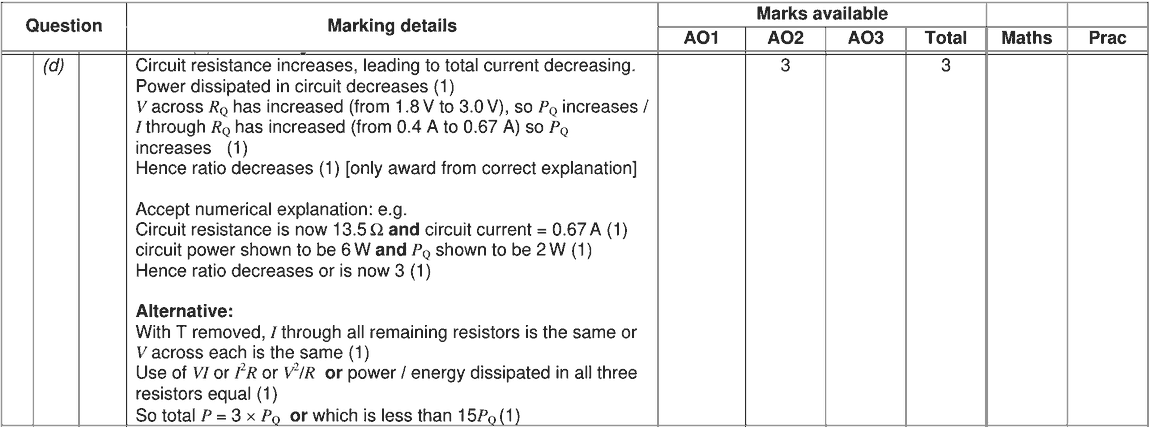
2(d) Resistance, d.c. circuits 3AO2=3Explanation
3(a) Solids under stress 2AO3=2Practical and data analysis
3(b) Solids under stress 3AO2=3Practical and data analysis
3(c) Solids under stress 2AO1=1,AO2=1Practical and data analysis
3(d)(i)I Solids under stress 1AO2=1Diagram or graph
3(d)(i)II Solids under stress 3AO2=3Practical and data analysis
3(d)(ii) Solids under stress 2AO2=2Practical and data analysis
3(e) Solids under stress 5AO3=5Practical and data analysis
3(f) Solids under stress 2AO3=2Practical and data analysis
4(a)(i) Orbits and the wider universe 4AO1=4Show that
4(a)(ii) Orbits and the wider universe 2AO2=2Show that
4(b)(i) Orbits and the wider universe 1AO1=1Short answer
4(b)(ii) Orbits and the wider universe 3AO1=1,AO2=2Calculation
4(c) Orbits and the wider universe 3AO1=1,AO2=2Calculation
5 Orbits and the wider universe 6AO1=6Extended response
6(a) Capacitance 1AO1=1Definition
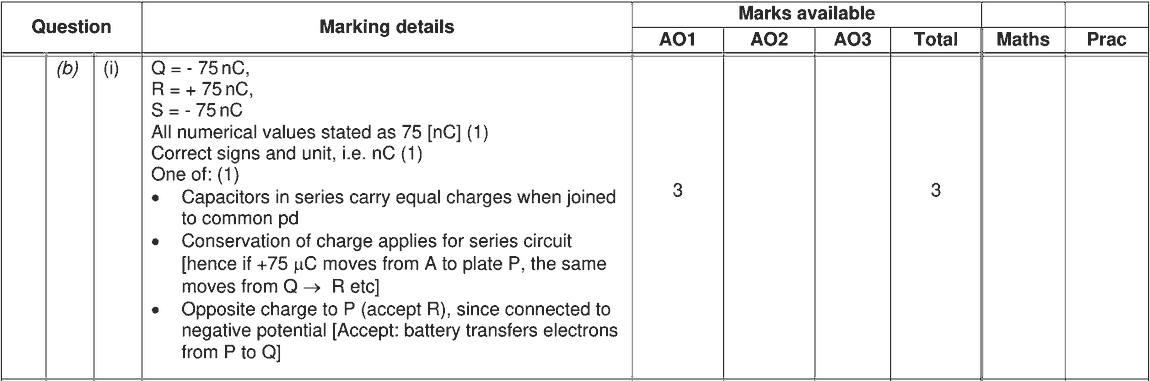
6(b)(i) Capacitance 3AO1=3Short answer
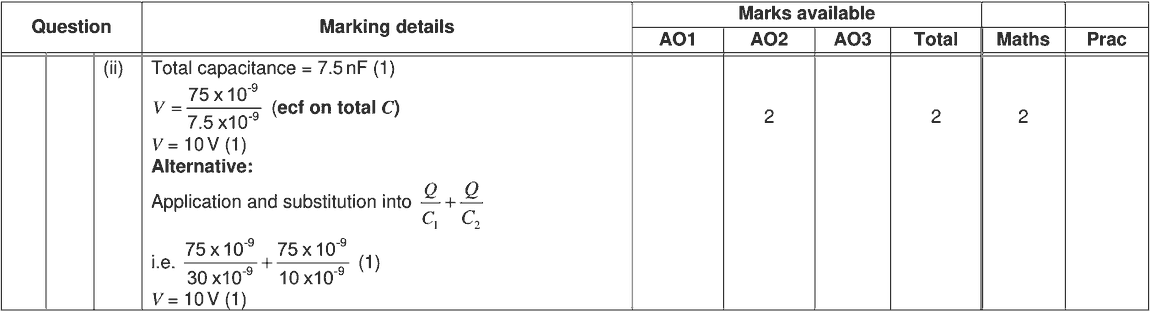
6(b)(ii) Capacitance 2AO2=2Calculation
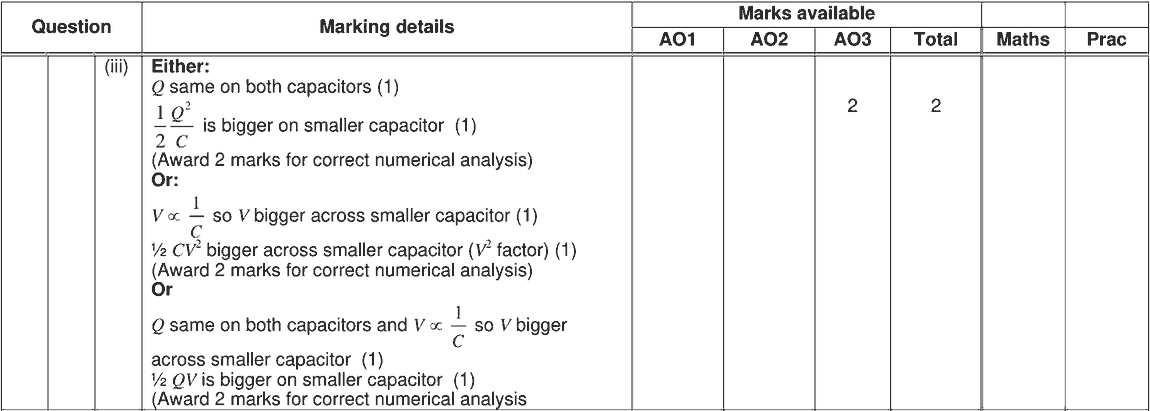
6(b)(iii) Capacitance 2AO3=2Explanation
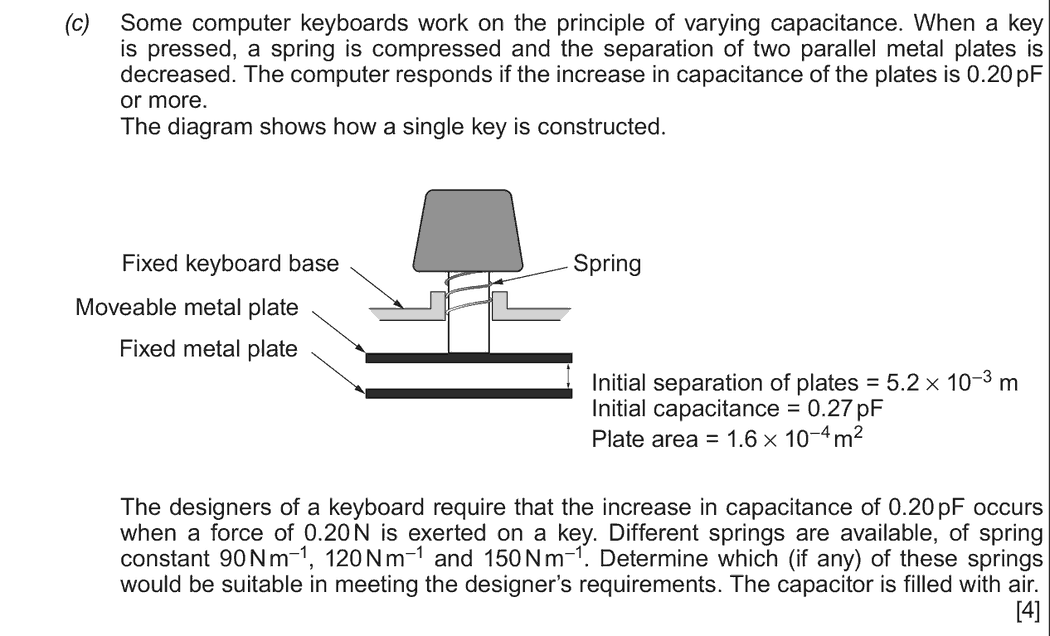
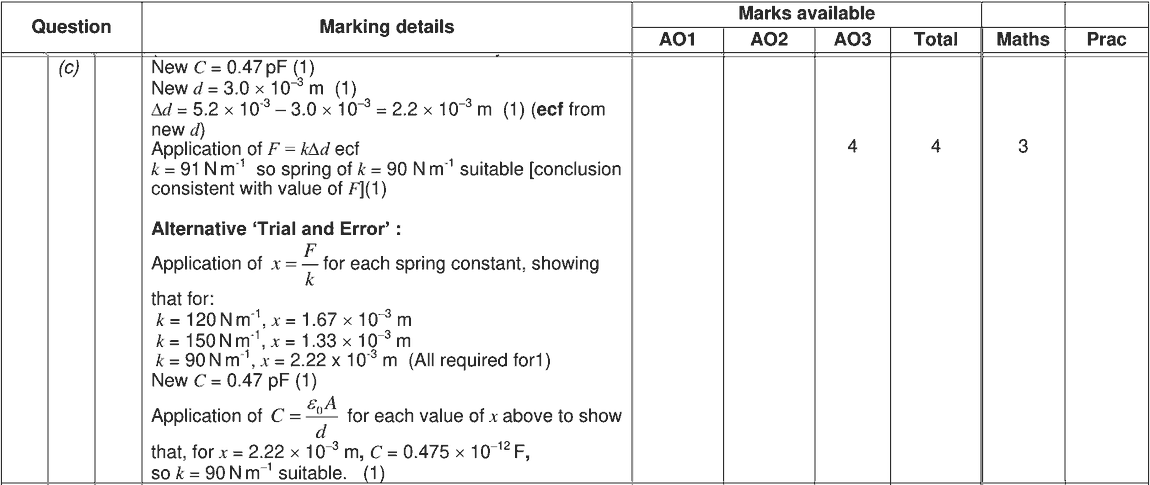
6(c) Capacitance, Solids under stress 4AO3=4Calculation
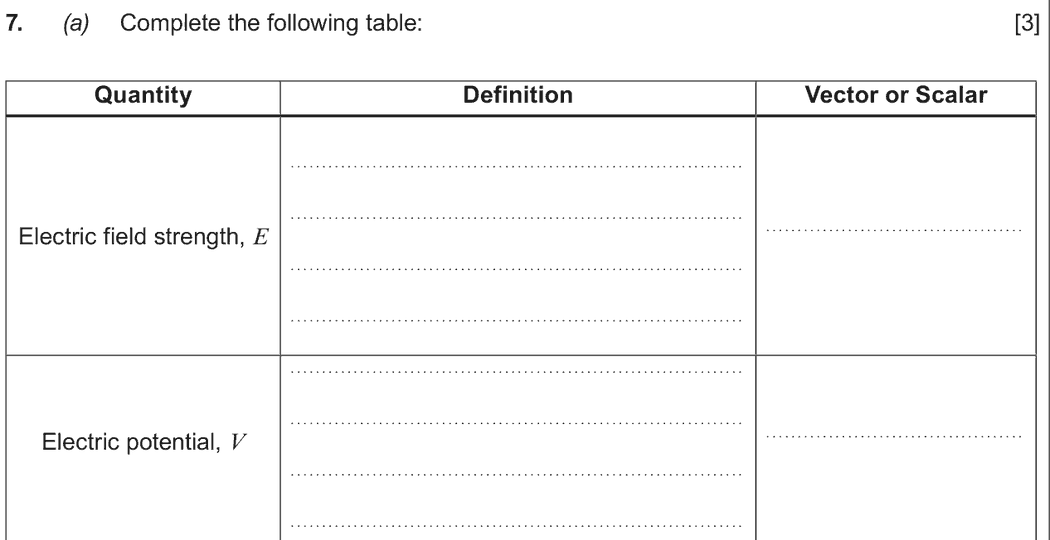
7(a) Electrostatic and gravitational fields of force 3AO1=3Definition
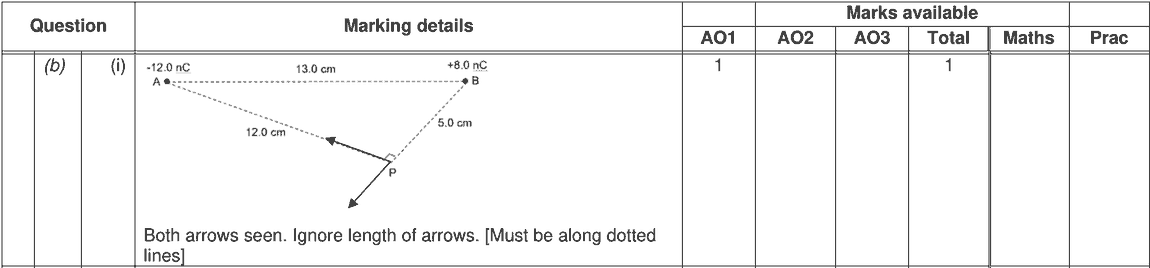
7(b)(i) Electrostatic and gravitational fields of force 1AO1=1Diagram or graph
7(b)(ii) Electrostatic and gravitational fields of force, Basic physics: units, vectors and moments 1AO2=1Diagram or graph
7(b)(iii) Electrostatic and gravitational fields of force 4AO2=4Calculation
7(c)(i) Electrostatic and gravitational fields of force 2AO2=2Show that
7(c)(ii) Electrostatic and gravitational fields of force 2AO1=1,AO2=1Calculation
7(d) Photons 3AO1=1,AO2=2Explanation
8(a)(i) Using radiation to investigate stars 3AO3=3Calculation
8(a)(ii) Using radiation to investigate stars 2AO1=1,AO2=1Show that
8(b) Using radiation to investigate stars 5AO3=5Calculation
8(c) Using radiation to investigate stars 2AO3=2Short answer

The questions

1(a)(i)1(a)(ii)1(b)2(a)(i)2(a)(ii)2(b)(i)2(b)(ii)2(c)2(d)3(a)3(b)3(c)3(d)(i)I3(d)(i)II3(d)(ii)3(e)3(f)4(a)(i)4(a)(ii)4(b)(i)4(b)(ii)4(c)56(a)6(b)(i)6(b)(ii)6(b)(iii)6(c)7(a)7(b)(i)7(b)(ii)7(b)(iii)7(c)(i)7(c)(ii)7(d)8(a)(i)8(a)(ii)8(b)8(c)
June 2018 · Component 2 · Q1(a)(i) 2 marks AO1=2 Explanation dc circuits
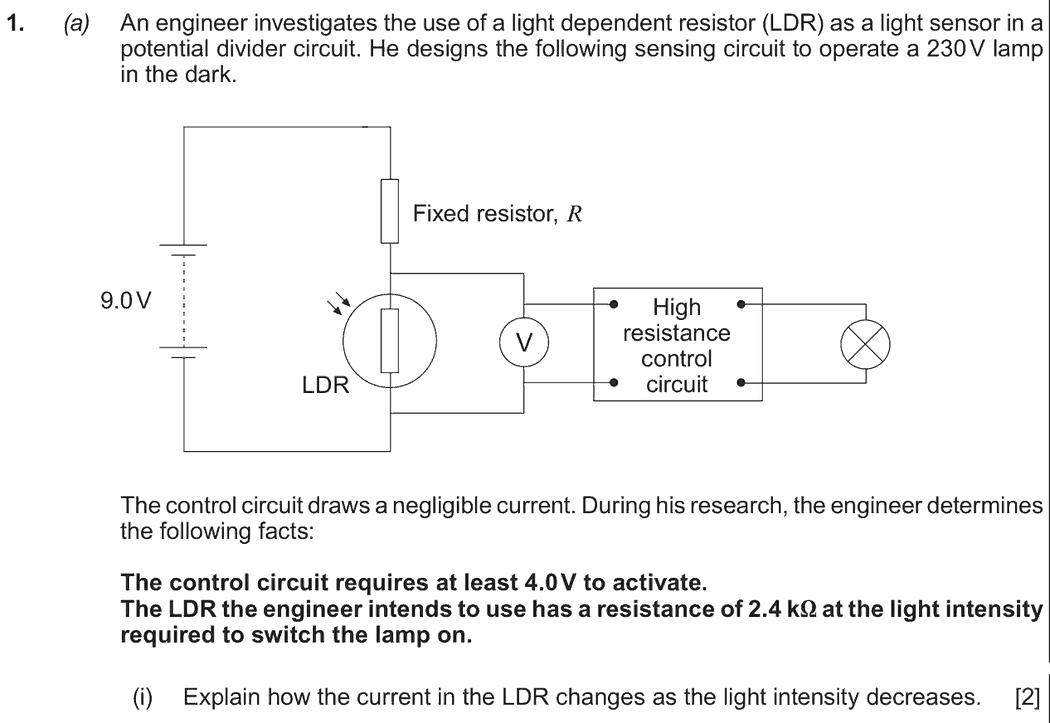
1. (a) An engineer investigates the use of a light dependent resistor (LDR) as a light sensor in a potential divider circuit. He designs the following sensing circuit to operate a 230 V lamp in the dark. Fixed resistor, R 9.0 V High resistance V control LDR circuit The control circuit draws a negligible current. During his research, the engineer determines the following facts: The control circuit requires at least 4.0 V to activate. The LDR the engineer intends to use has a resistance of 2.4 kΩ at the light intensity required to switch the lamp on. (i) Explain how the current in the LDR changes as the light intensity decreases. [2]
June 2018 · Component 2 · Q1(a)(ii) 3 marks AO1=1, AO2=2 Calculation dc circuits
Earlier part of question 1 that this part usesEarlier part of June 2018 Component 2 question 1
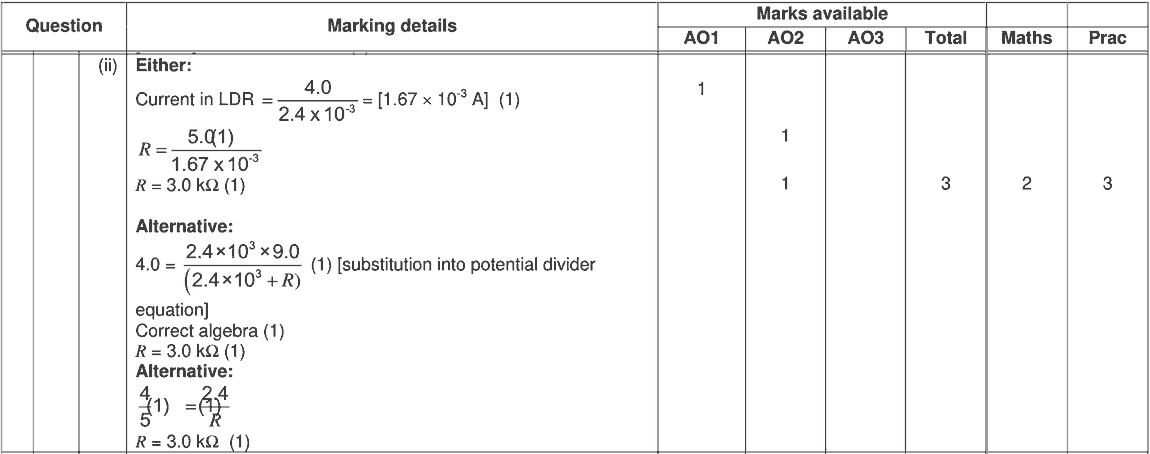
(ii) Determine a suitable value for the fixed resistor R, which would allow the lamp to be switched on. [3]
June 2018 · Component 2 · Q1(b) 2 marks AO2=2 Explanation dc circuits
Earlier part of question 1 that this part usesEarlier part of June 2018 Component 2 question 1
(b) When installing the circuit, the engineer made the mistake of placing the lamp near to the LDR. The engineer noted that, when in the dark, the lamp kept turning on and off repeatedly rather than staying on. Explain why this was the case. [2]
June 2018 · Component 2 · Q2(a)(i) 1 mark AO1=1 Definition conduction of electricity
2. (a) (i) State what is meant by electric current. [1]
June 2018 · Component 2 · Q2(a)(ii) 2 marks AO1=1, AO2=1 Show that resistance
Earlier part of question 2 that this part usesEarlier part of June 2018 Component 2 question 2
(ii) Show that the unit of resistance, the ohm (Ω), can be expressed as: [2] J s C–2
June 2018 · Component 2 · Q2(b)(i) 2 marks AO2=2 Show that dc circuitsresistance
Earlier part of question 2 that this part usesEarlier part of June 2018 Component 2 question 2
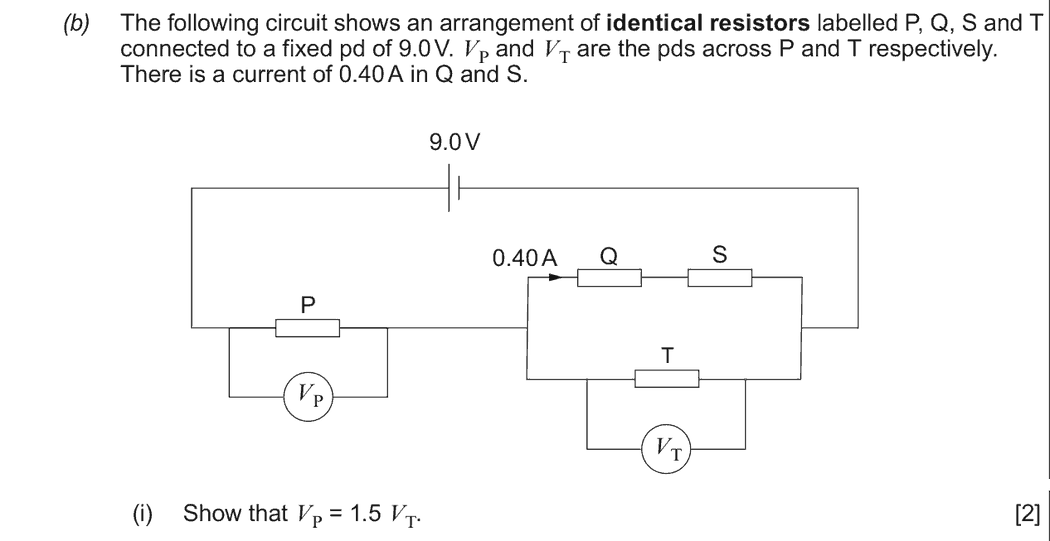
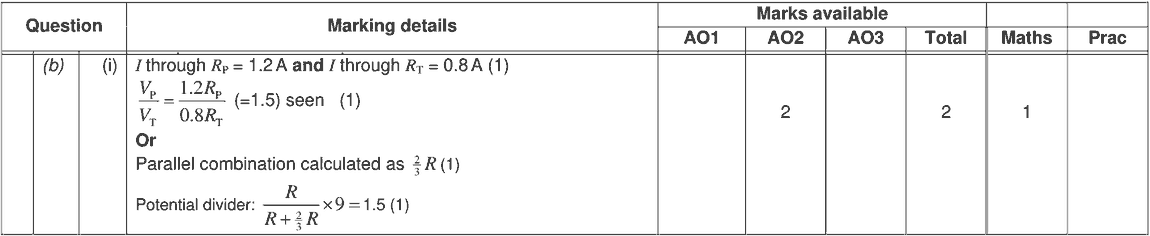
(b) The following circuit shows an arrangement of identical resistors labelled P, Q, S and T connected to a fixed pd of 9.0 V. VP and VT are the pds across P and T respectively. There is a current of 0.40 A in Q and S. 9.0 V 0.40 A Q S P T VP VT (i) Show that VP = 1.5 VT. [2]
June 2018 · Component 2 · Q2(b)(ii) 3 marks AO2=3 Show that dc circuitsresistance
Earlier parts of question 2 that this part usesEarlier part of June 2018 Component 2 question 2Earlier part of June 2018 Component 2 question 2
(ii) Hence or otherwise show that the values given in the diagram are consistent with the resistance of each resistor being 4.5 Ω. [3]
June 2018 · Component 2 · Q2(c) 3 marks AO2=3 Show that resistance
Earlier parts of question 2 that this part usesEarlier part of June 2018 Component 2 question 2Earlier part of June 2018 Component 2 question 2
(c) Show that the total energy dissipated per second in the whole circuit is 15 times more than the energy dissipated per second in resistor Q. [3]
June 2018 · Component 2 · Q2(d) 3 marks AO2=3 Explanation resistancedc circuits
Earlier parts of question 2 that this part usesEarlier part of June 2018 Component 2 question 2Earlier part of June 2018 Component 2 question 2
(d) Resistor T is now removed from the circuit. Explain the effect this will have on the ratio calculated in part (c). [3]
June 2018 · Component 2 · Q3(a) 2 marks AO3=2 Practical and data analysis Easy solids under stress
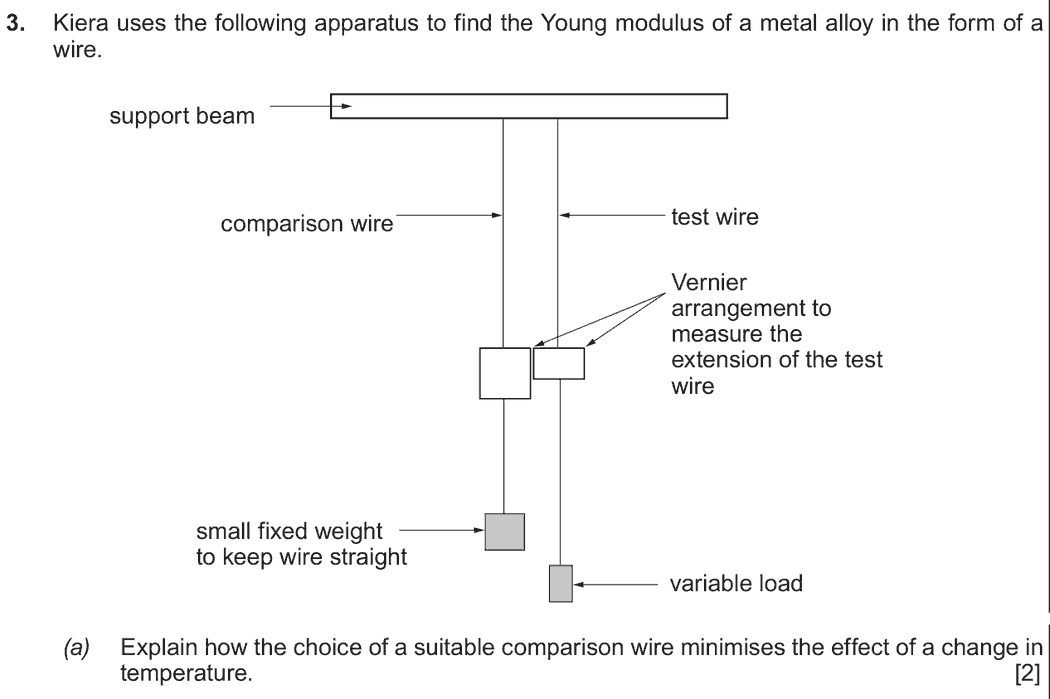
3. Kiera uses the following apparatus to find the Young modulus of a metal alloy in the form of a wire. support beam comparison wire test wire Vernier arrangement to measure the extension of the test wire small fixed weight to keep wire straight variable load (a) Explain how the choice of a suitable comparison wire minimises the effect of a change in temperature. [2]
June 2018 · Component 2 · Q3(b) 3 marks AO2=3 Practical and data analysis Easy solids under stress
Earlier part of question 3 that this part usesEarlier part of June 2018 Component 2 question 3
(b) Kiera uses a micrometer of resolution 0.01 mm to measure the mean diameter of the wire. She determines the mean diameter to be 0.16 mm. Calculate the cross-sectional area of the wire in m2, along with its percentage uncertainty. [3]
June 2018 · Component 2 · Q3(c) 2 marks AO1=1, AO2=1 Practical and data analysis Easy solids under stress
Earlier part of question 3 that this part usesEarlier part of June 2018 Component 2 question 3
(c) Kiera then uses a metre ruler with a resolution of 1 mm to measure the initial length of the wire. She determines the length to be 1.680 m. Show, with an appropriate calculation, that the percentage uncertainty in this reading can be considered negligible. [2]
June 2018 · Component 2 · Q3(d)(i)I 1 mark AO2=1 Diagram or graph Easy solids under stress
Earlier part of question 3 that this part usesEarlier part of June 2018 Component 2 question 3
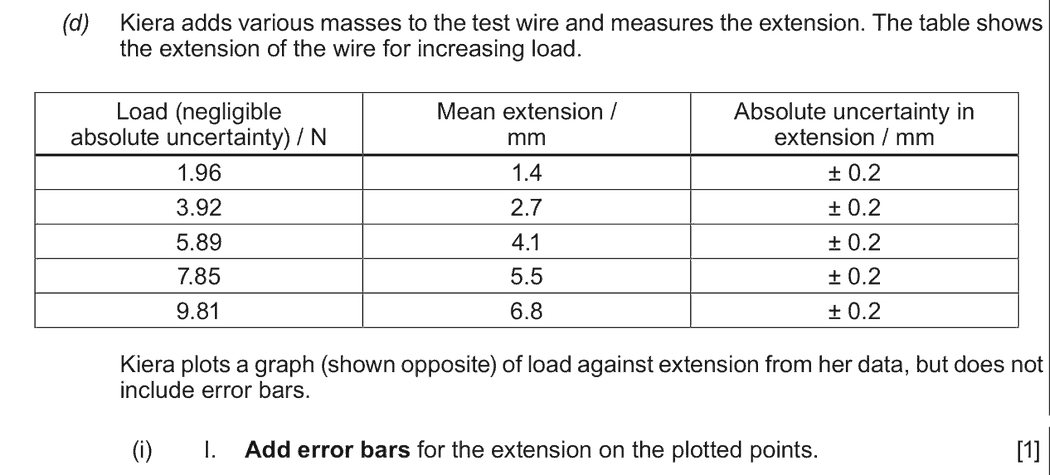
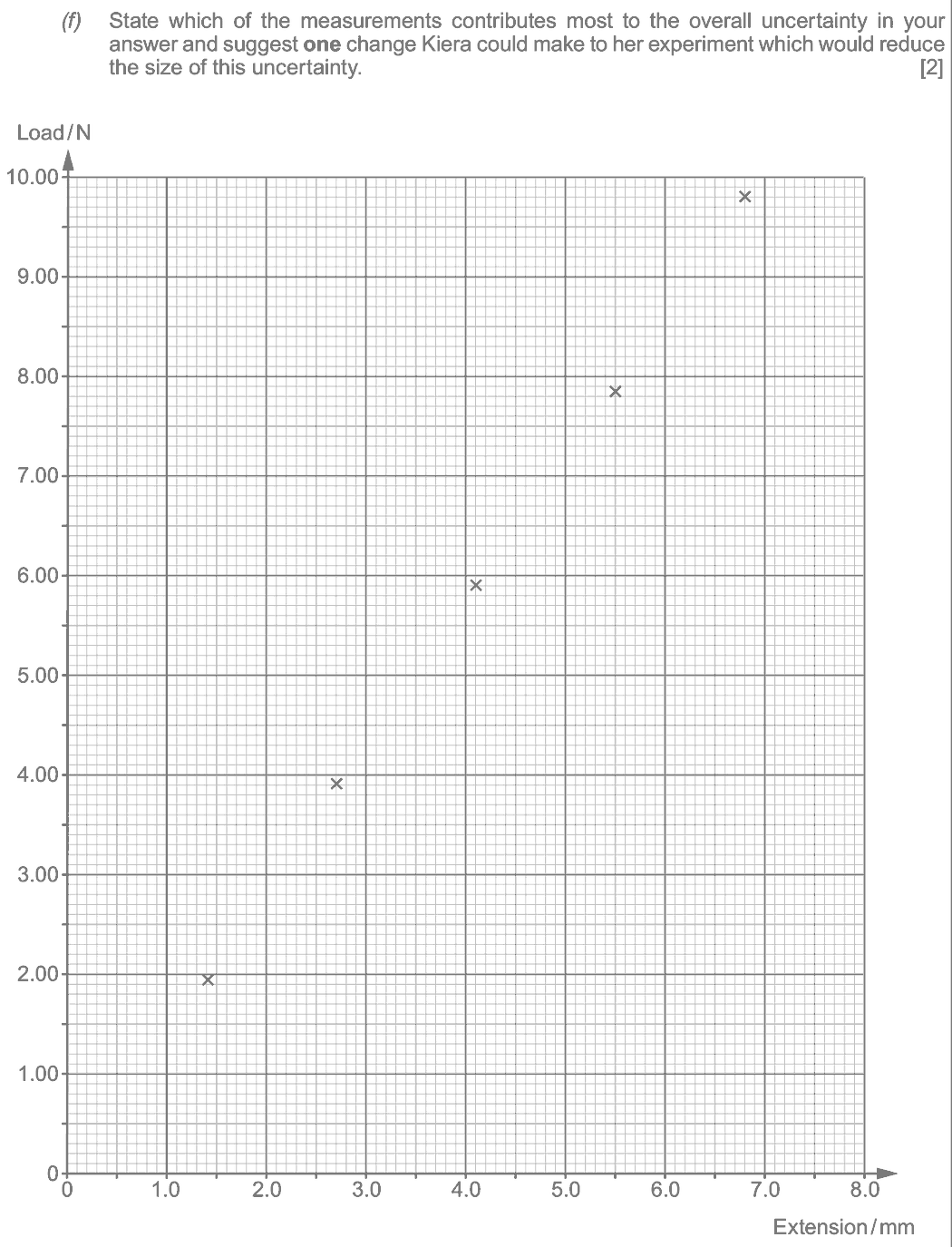
(d) Kiera adds various masses to the test wire and measures the extension. The table shows the extension of the wire for increasing load. Load (negligible Mean extension / Absolute uncertainty in absolute uncertainty) / N mm extension / mm 1.96 1.4 ± 0.2 3.92 2.7 ± 0.2 5.89 4.1 ± 0.2 7.85 5.5 ± 0.2 9.81 6.8 ± 0.2 Kiera plots a graph (shown opposite) of load against extension from her data, but does not include error bars. (i) I. Add error bars for the extension on the plotted points. [1]
June 2018 · Component 2 · Q3(d)(i)II 3 marks AO2=3 Practical and data analysis Easy solids under stress
Earlier parts of question 3 that this part usesEarlier part of June 2018 Component 2 question 3Earlier part of June 2018 Component 2 question 3
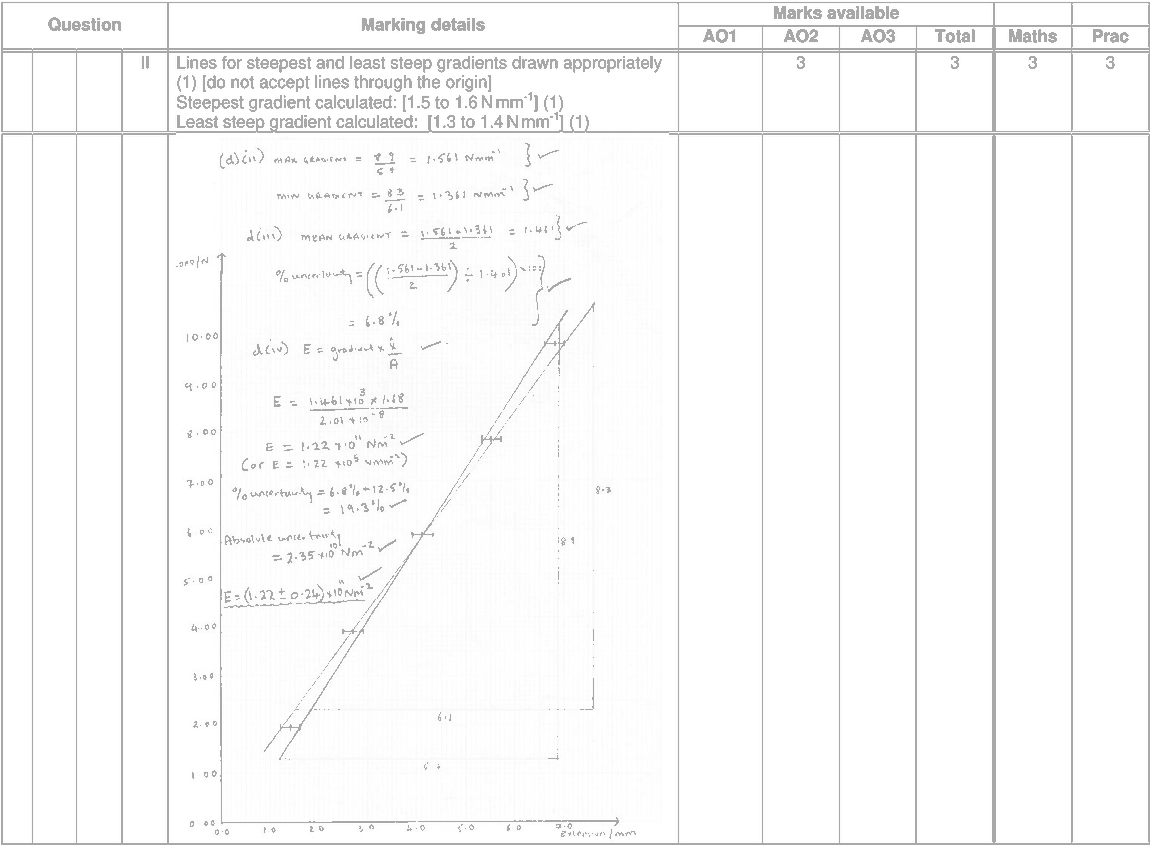
II. Draw lines of maximum gradient and minimum gradient and determine the gradients of both lines. [3]
June 2018 · Component 2 · Q3(d)(ii) 2 marks AO2=2 Practical and data analysis Easy solids under stress
Earlier parts of question 3 that this part usesEarlier part of June 2018 Component 2 question 3Earlier part of June 2018 Component 2 question 3
(ii) Hence, calculate the mean gradient and the percentage uncertainty in its value. [2]
June 2018 · Component 2 · Q3(e) 5 marks AO3=5 Practical and data analysis Easy solids under stress
Earlier parts of question 3 that this part usesEarlier part of June 2018 Component 2 question 3Earlier part of June 2018 Component 2 question 3
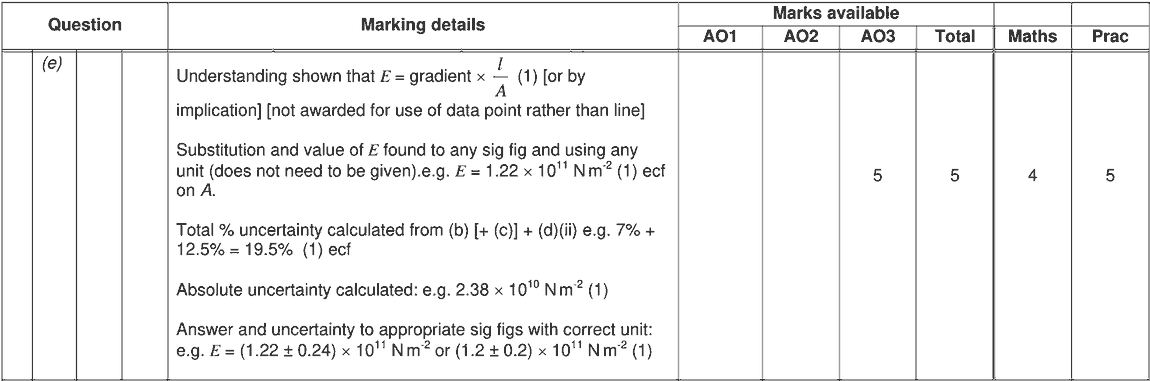
(e) Determine the Young modulus of the metal alloy, along with its absolute uncertainty. Give your answer to an appropriate number of significant figures. [5]
June 2018 · Component 2 · Q3(f) 2 marks AO3=2 Practical and data analysis Easy solids under stress
Earlier parts of question 3 that this part usesEarlier part of June 2018 Component 2 question 3Earlier part of June 2018 Component 2 question 3
(f) State which of the measurements contributes most to the overall uncertainty in your answer and suggest one change Kiera could make to her experiment which would reduce the size of this uncertainty. [2] Load / N 10.00 9.00 8.00 7.00 6.00 5.00 4.00 3.00 2.00 1.00 0 0 1.0 2.0 3.0 4.0 5.0 6.0 7.0 8.0 Extension / mm
June 2018 · Component 2 · Q4(a)(i) 4 marks AO1=4 Show that orbits and the wider universe
4. (a) (i) Use the Principle of Conservation of Energy to show that the critical density, ρc, of the universe is given by: [4] 3H0 2 ρc = 8πG
June 2018 · Component 2 · Q4(a)(ii) 2 marks AO2=2 Show that orbits and the wider universe
Earlier part of question 4 that this part usesEarlier part of June 2018 Component 2 question 4
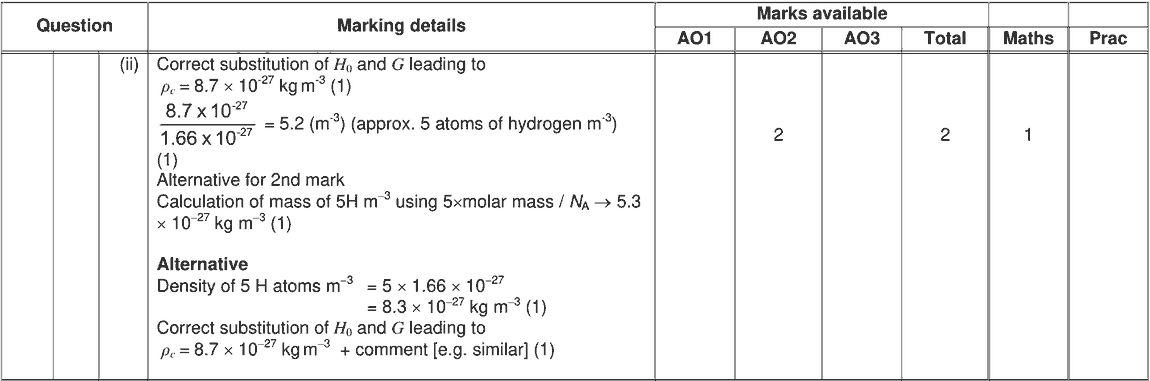
(ii) Use the above equation to show that the critical density of the universe corresponds to approximately 5 atoms of hydrogen per m3. [2]
June 2018 · Component 2 · Q4(b)(i) 1 mark AO1=1 Short answer orbits and the wider universe
Earlier part of question 4 that this part usesEarlier part of June 2018 Component 2 question 4
(b) Astronomers analysing the wavelengths of the dark lines from the line spectrum of a distant galaxy note that they are increased by 16 % compared with their normal wavelengths. (i) State why there is an increase in wavelength. [1]
June 2018 · Component 2 · Q4(b)(ii) 3 marks AO1=1, AO2=2 Calculation orbits and the wider universe
Earlier parts of question 4 that this part usesEarlier part of June 2018 Component 2 question 4Earlier part of June 2018 Component 2 question 4
(ii) Calculate the distance of the galaxy from Earth. [3]
June 2018 · Component 2 · Q4(c) 3 marks AO1=1, AO2=2 Calculation orbits and the wider universe
Earlier part of question 4 that this part usesEarlier part of June 2018 Component 2 question 4
(c) Stating an assumption, estimate the age of the universe in years. [3]
June 2018 · Component 2 · Q5 6 marks AO1=6 6-mark extended response orbits and the wider universe
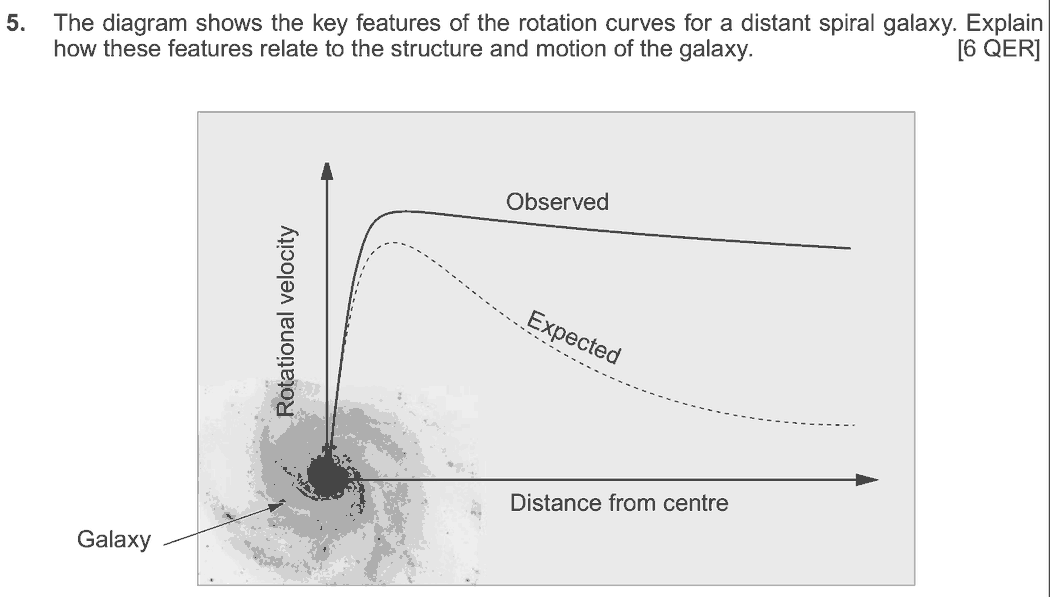
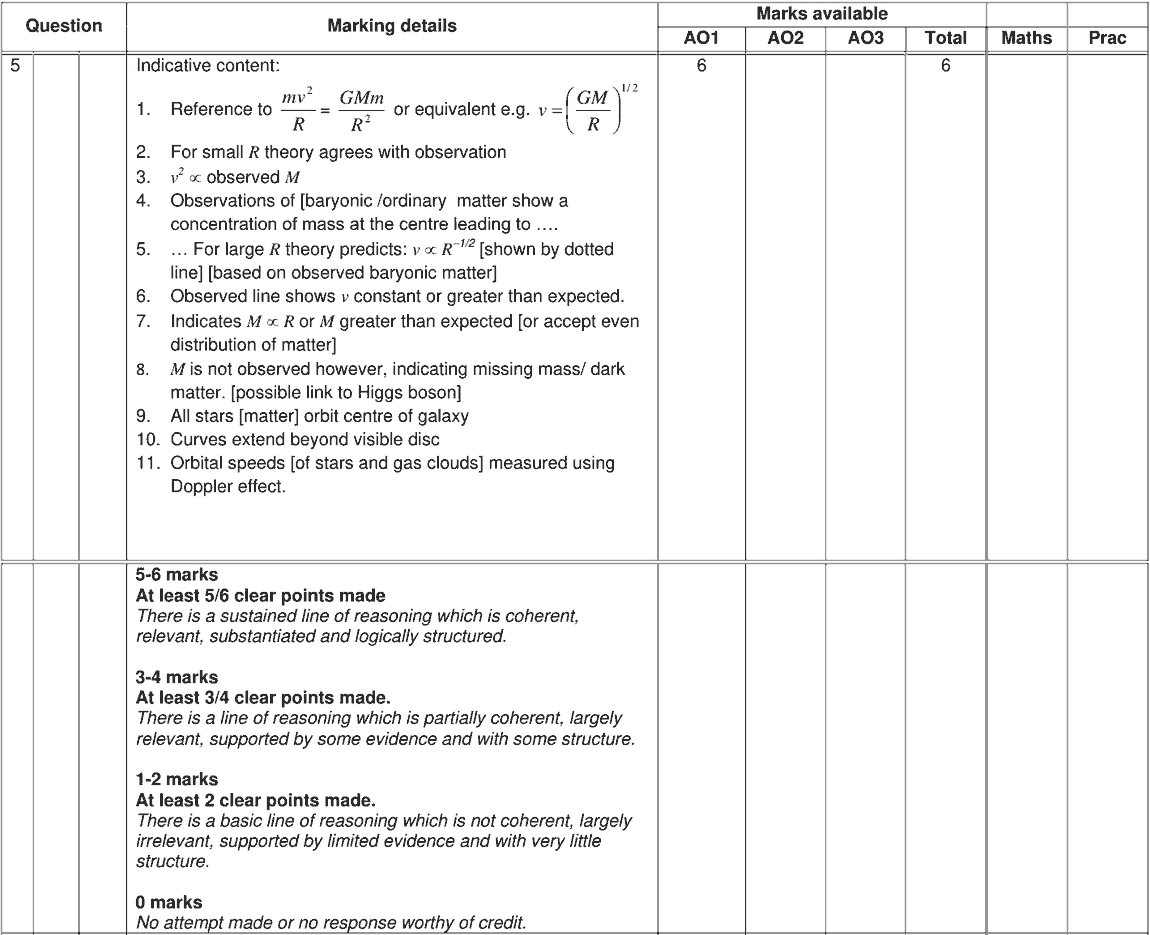
5. The diagram shows the key features of the rotation curves for a distant spiral galaxy. Explain how these features relate to the structure and motion of the galaxy. [6 QER] Observed velocity Expected Rotational Distance from centre Galaxy
June 2018 · Component 2 · Q6(a) 1 mark AO1=1 Definition capacitance
6. (a) Define the capacitance of a capacitor. [1]
June 2018 · Component 2 · Q6(b)(i) 3 marks AO1=3 Short answer capacitance
Earlier part of question 6 that this part usesEarlier part of June 2018 Component 2 question 6
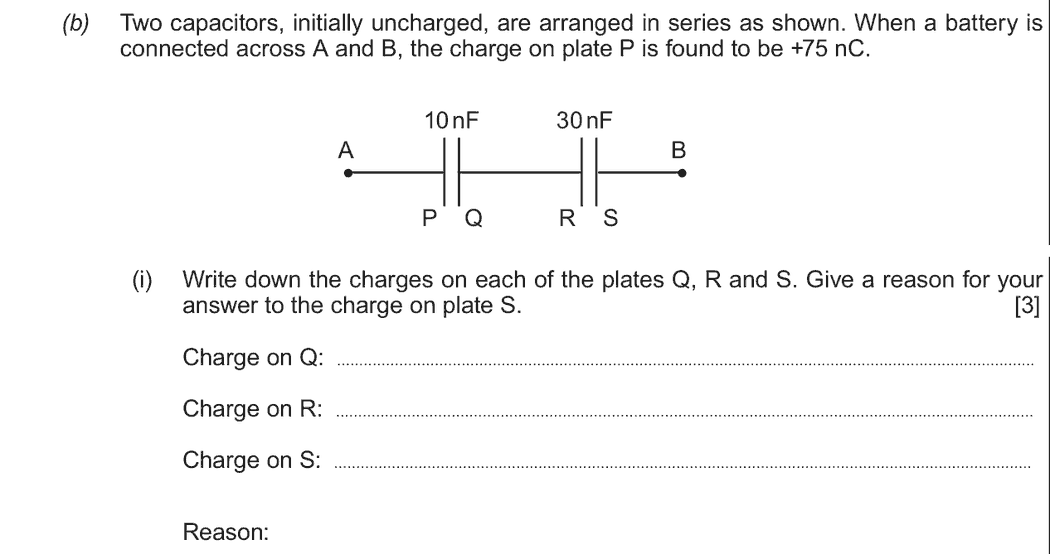
(b) Two capacitors, initially uncharged, are arranged in series as shown. When a battery is connected across A and B, the charge on plate P is found to be +75 nC. 10 nF 30 nF A B P Q R S (i) Write down the charges on each of the plates Q, R and S. Give a reason for your answer to the charge on plate S. [3] Charge on Q: Charge on R: Charge on S: Reason:
June 2018 · Component 2 · Q6(b)(ii) 2 marks AO2=2 Calculation capacitance
Earlier parts of question 6 that this part usesEarlier part of June 2018 Component 2 question 6Earlier part of June 2018 Component 2 question 6
(ii) Calculate the pd across A and B. [2]
June 2018 · Component 2 · Q6(b)(iii) 2 marks AO3=2 Explanation capacitance
Earlier parts of question 6 that this part usesEarlier part of June 2018 Component 2 question 6Earlier part of June 2018 Component 2 question 6
(iii) A Physics student makes the following comment: For capacitors in series, a capacitor of higher capacitance stores more energy than a capacitor of smaller capacitance. By considering this combination of capacitors, investigate whether or not the student is correct. [2]
June 2018 · Component 2 · Q6(c) 4 marks AO3=4 Calculation capacitancesolids under stress
Earlier parts of question 6 that this part usesEarlier part of June 2018 Component 2 question 6Earlier part of June 2018 Component 2 question 6
(c) Some computer keyboards work on the principle of varying capacitance. When a key is pressed, a spring is compressed and the separation of two parallel metal plates is decreased. The computer responds if the increase in capacitance of the plates is 0.20 pF or more. The diagram shows how a single key is constructed. Fixed keyboard base Spring Moveable metal plate Fixed metal plate Initial separation of plates = 5.2 × 10⁻³ m Initial capacitance = 0.27 pF Plate area = 1.6 × 10⁻⁴ m2 The designers of a keyboard require that the increase in capacitance of 0.20 pF occurs when a force of 0.20 N is exerted on a key. Different springs are available, of spring constant 90 N m–1, 120 N m–1 and 150 N m–1. Determine which (if any) of these springs would be suitable in meeting the designer’s requirements. The capacitor is filled with air. [4]
June 2018 · Component 2 · Q7(a) 3 marks AO1=3 Definition electrostatic and gravitational fields
7. (a) Complete the following table: [3] Quantity Definition Vector or Scalar Electric field strength, E Electric potential, V
June 2018 · Component 2 · Q7(b)(i) 1 mark AO1=1 Diagram or graph electrostatic and gravitational fields
Earlier part of question 7 that this part usesEarlier part of June 2018 Component 2 question 7
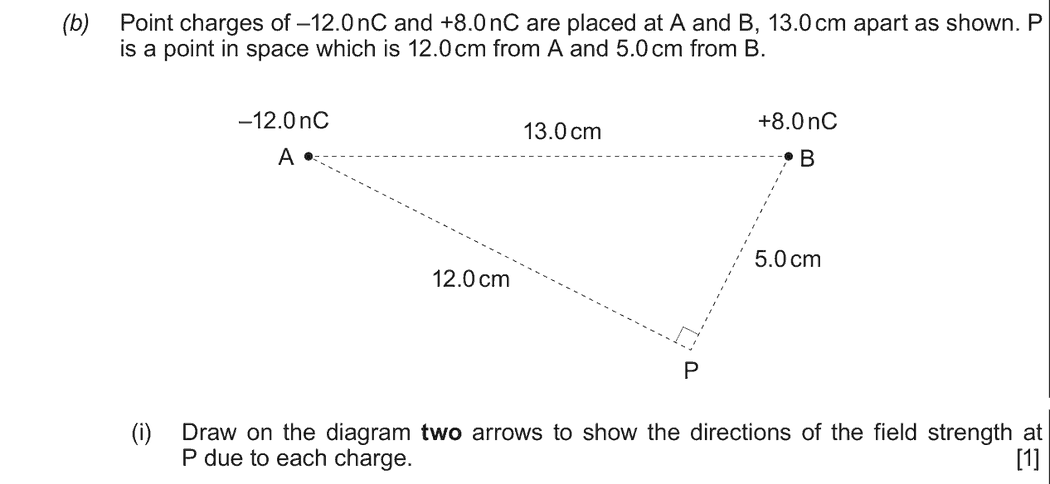
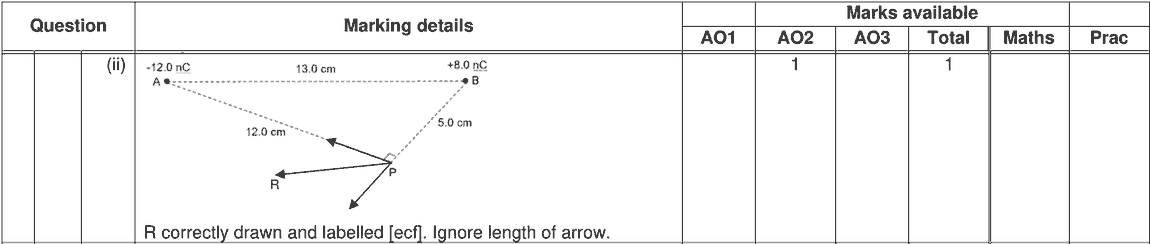
(b) Point charges of –12.0 nC and +8.0 nC are placed at A and B, 13.0 cm apart as shown. P is a point in space which is 12.0 cm from A and 5.0 cm from B. –12.0 nC +8.0 nC 13.0 cm A B 5.0 cm 12.0 cm P (i) Draw on the diagram two arrows to show the directions of the field strength at P due to each charge. [1]
June 2018 · Component 2 · Q7(b)(ii) 1 mark AO2=1 Diagram or graph electrostatic and gravitational fieldsbasic physics
Earlier parts of question 7 that this part usesEarlier part of June 2018 Component 2 question 7Earlier part of June 2018 Component 2 question 7
(ii) Hence draw on the diagram one arrow to represent the direction of the resultant field strength at P. Label this arrow R. [1]
June 2018 · Component 2 · Q7(b)(iii) 4 marks AO2=4 Calculation electrostatic and gravitational fields
Earlier parts of question 7 that this part usesEarlier part of June 2018 Component 2 question 7Earlier part of June 2018 Component 2 question 7
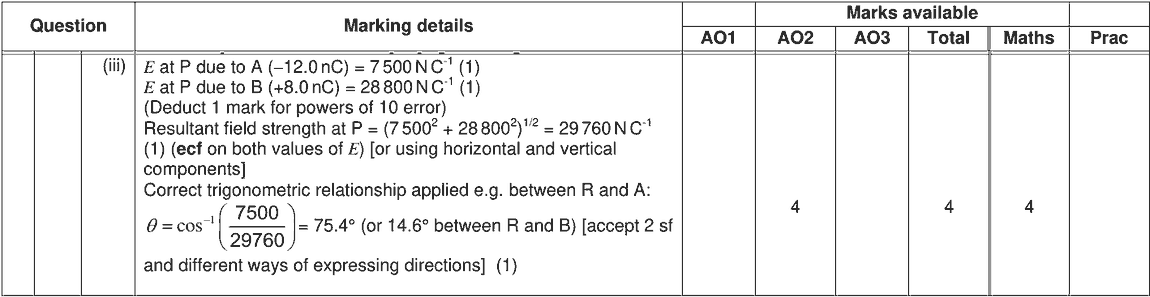
(iii) Calculate the magnitude and direction of the electric field strength at P. [4]
June 2018 · Component 2 · Q7(c)(i) 2 marks AO2=2 Show that electrostatic and gravitational fields
Earlier parts of question 7 that this part usesEarlier part of June 2018 Component 2 question 7Earlier part of June 2018 Component 2 question 7
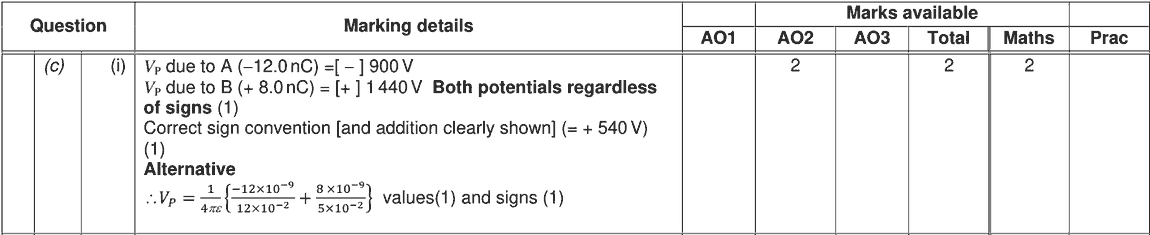
(c) (i) Show that the potential at P is + 540 V. [2]
June 2018 · Component 2 · Q7(c)(ii) 2 marks AO1=1, AO2=1 Calculation electrostatic and gravitational fields
Earlier parts of question 7 that this part usesEarlier part of June 2018 Component 2 question 7Earlier part of June 2018 Component 2 question 7Earlier part of June 2018 Component 2 question 7
(ii) Calculate the gain in kinetic energy in joules of an electron as it moves from infinity to P. [2]
June 2018 · Component 2 · Q7(d) 3 marks AO1=1, AO2=2 Explanation photons
Earlier parts of question 7 that this part usesEarlier part of June 2018 Component 2 question 7Earlier part of June 2018 Component 2 question 7
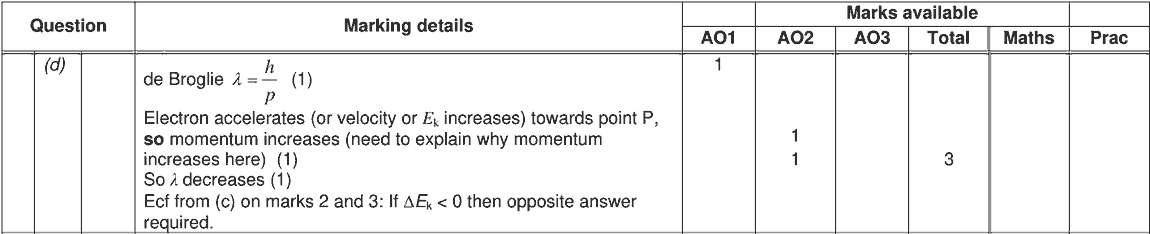
(d) Without calculation, explain how the de Broglie wavelength of the electron changes as it moves towards P. [3]
June 2018 · Component 2 · Q8(a)(i) 3 marks AO3=3 Calculation radiation and stars
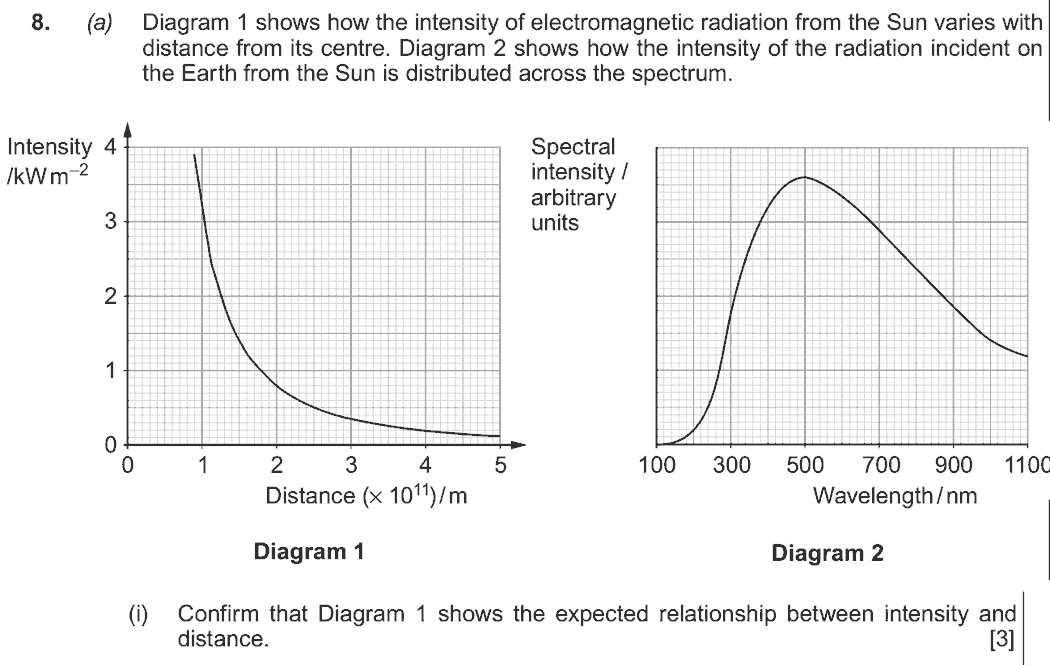
8. (a) Diagram 1 shows how the intensity of electromagnetic radiation from the Sun varies with distance from its centre. Diagram 2 shows how the intensity of the radiation incident on the Earth from the Sun is distributed across the spectrum. Intensity 4 Spectral /kW m–2 intensity / arbitrary 3 units 2 1 0 0 1 2 3 4 5 100 300 500 700 900 1100 Distance (× 1011) / m Wavelength / nm Diagram 1 Diagram 2 (i) Confirm that Diagram 1 shows the expected relationship between intensity and distance. [3]
June 2018 · Component 2 · Q8(a)(ii) 2 marks AO1=1, AO2=1 Show that radiation and stars
Earlier part of question 8 that this part usesEarlier part of June 2018 Component 2 question 8
(ii) Use Diagram 1 to show that the Sun’s luminosity is about 4 × 1026 W. [2]
June 2018 · Component 2 · Q8(b) 5 marks AO3=5 Calculation radiation and stars
Earlier part of question 8 that this part usesEarlier part of June 2018 Component 2 question 8
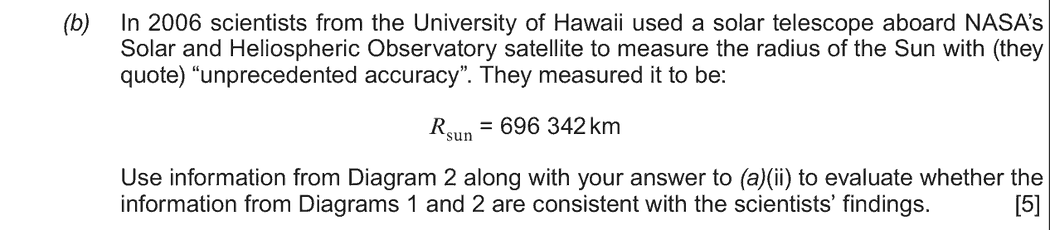
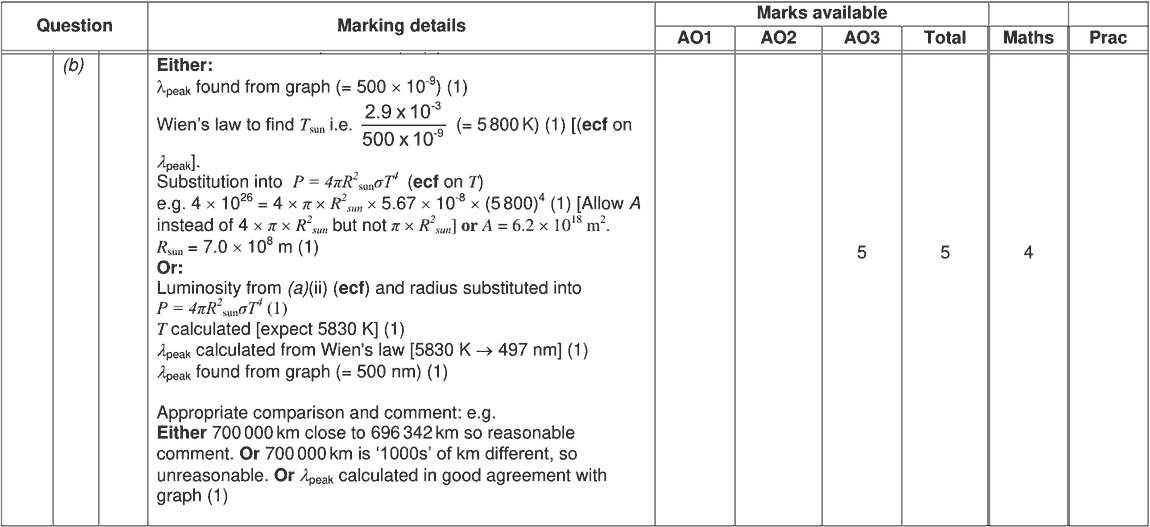
(b) In 2006 scientists from the University of Hawaii used a solar telescope aboard NASA’s Solar and Heliospheric Observatory satellite to measure the radius of the Sun with (they quote) “unprecedented accuracy”. They measured it to be: Rsun = 696 342 km Use information from Diagram 2 along with your answer to (a)(ii) to evaluate whether the information from Diagrams 1 and 2 are consistent with the scientists’ findings. [5]
June 2018 · Component 2 · Q8(c) 2 marks AO3=2 Short answer radiation and stars
Earlier part of question 8 that this part usesEarlier part of June 2018 Component 2 question 8
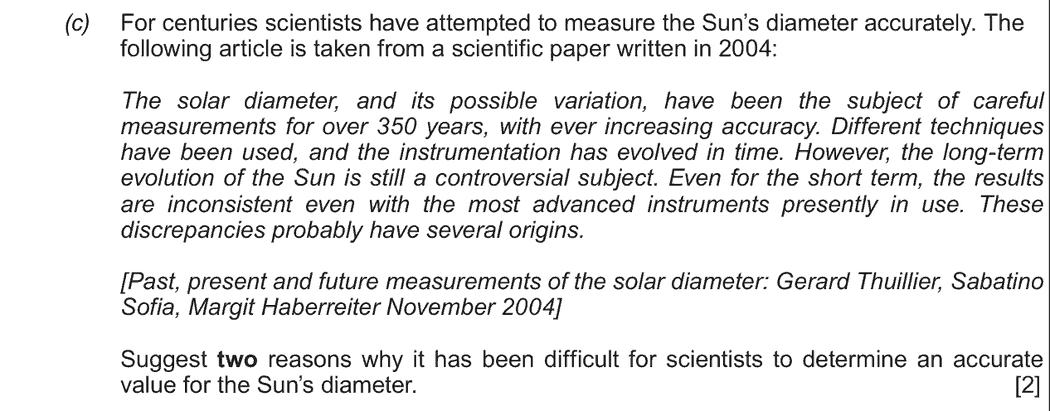
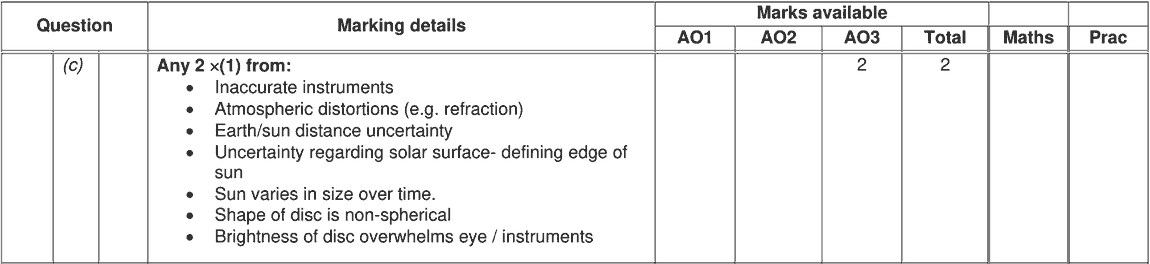
(c) For centuries scientists have attempted to measure the Sun’s diameter accurately. The following article is taken from a scientific paper written in 2004: The solar diameter, and its possible variation, have been the subject of careful measurements for over 350 years, with ever increasing accuracy. Different techniques have been used, and the instrumentation has evolved in time. However, the long-term evolution of the Sun is still a controversial subject. Even for the short term, the results are inconsistent even with the most advanced instruments presently in use. These discrepancies probably have several origins. [Past, present and future measurements of the solar diameter: Gerard Thuillier, Sabatino Sofia, Margit Haberreiter November 2004] Suggest two reasons why it has been difficult for scientists to determine an accurate value for the Sun’s diameter. [2]

Work with an Eduqas physics tutor

Want a paper marked and gone through with you? Message us.

Prefer email? Send an enquiry

If you are under 18, please include a parent's contact details. Enquiries go to enquiries@physicsaleveltutor.com and are deleted once handled. All tutoring is online.