June 2019: Component 2

100 marks · 37 question parts · Paper, mark scheme and report on Eduqas's site · Have the Data Booklet beside you

Question by question

QTopicMarksAOType
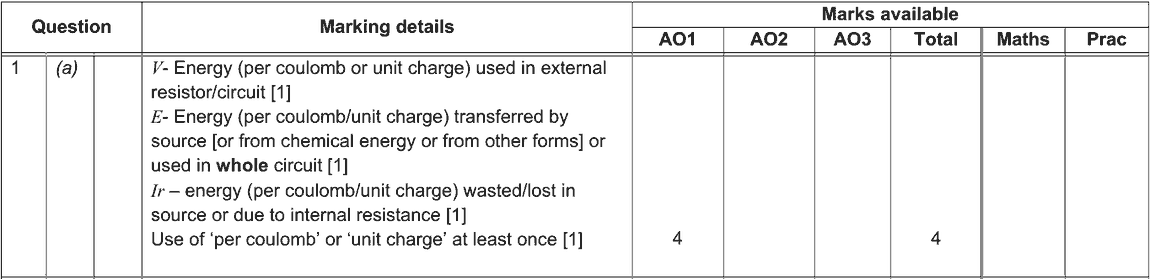
1(a) d.c. circuits 4AO1=4Explanation
1(b)(i) d.c. circuits 3AO2=3Calculation
1(b)(ii) Resistance 2AO1=1,AO2=1Calculation
1(c) d.c. circuits 4AO3=4Calculation
2(a) Resistance 1AO3=1Practical and data analysis
2(b) Resistance 2AO2=2Show that
2(c) Resistance 3AO2=3Practical and data analysis
2(d) Resistance 5AO2=5Practical and data analysis
2(e)(i) Resistance 4AO1=2,AO2=2Practical and data analysis
2(e)(ii) Resistance 1AO1=1Short answer
2(f) Resistance 1AO3=1Practical and data analysis
3(a) Capacitance 2AO1=2Short answer
3(b)(i) Capacitance 3AO1=2,AO2=1Calculation
3(b)(ii) Capacitance 2AO1=1,AO2=1Explanation
3(b)(iii) Capacitance 1AO2=1Calculation
3(b)(iv) Capacitance 2AO1=1,AO2=1Calculation
3(c) Capacitance, Thermal physics 5AO3=5Calculation
4(a) Resistance 6AO1=6Extended response
4(b) Resistance 3AO3=3Short answer
5(a)(i) Solids under stress 3AO2=3Show that
5(a)(ii) Solids under stress 1AO2=1Diagram or graph
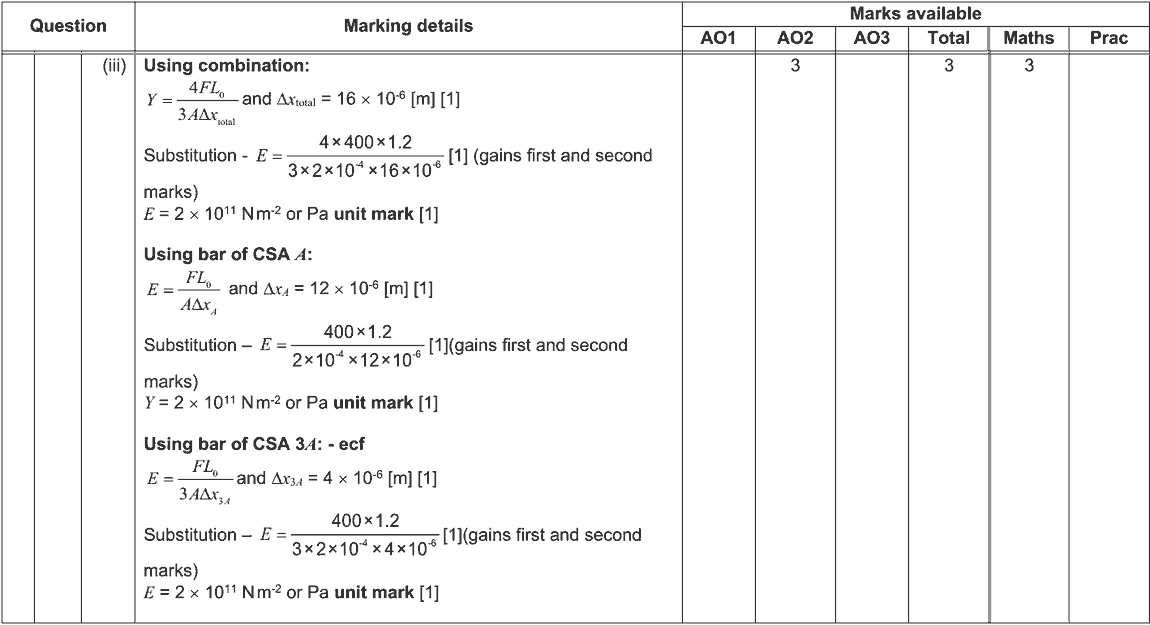
5(a)(iii) Solids under stress 3AO2=3Calculation
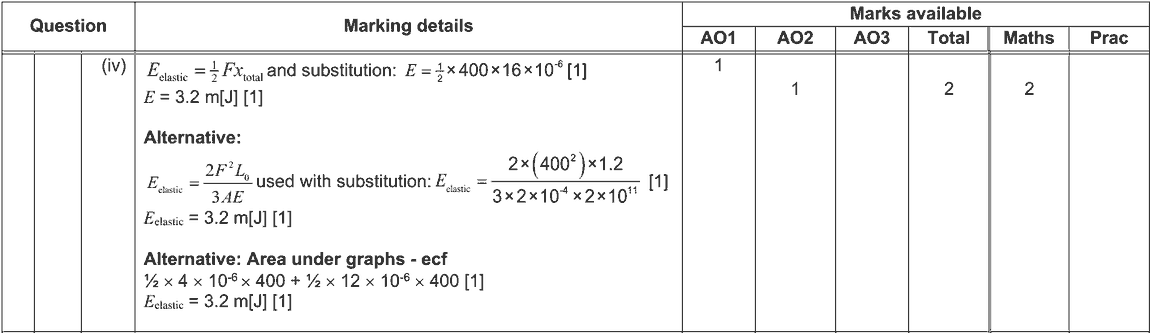
5(a)(iv) Solids under stress 2AO1=1,AO2=1Calculation
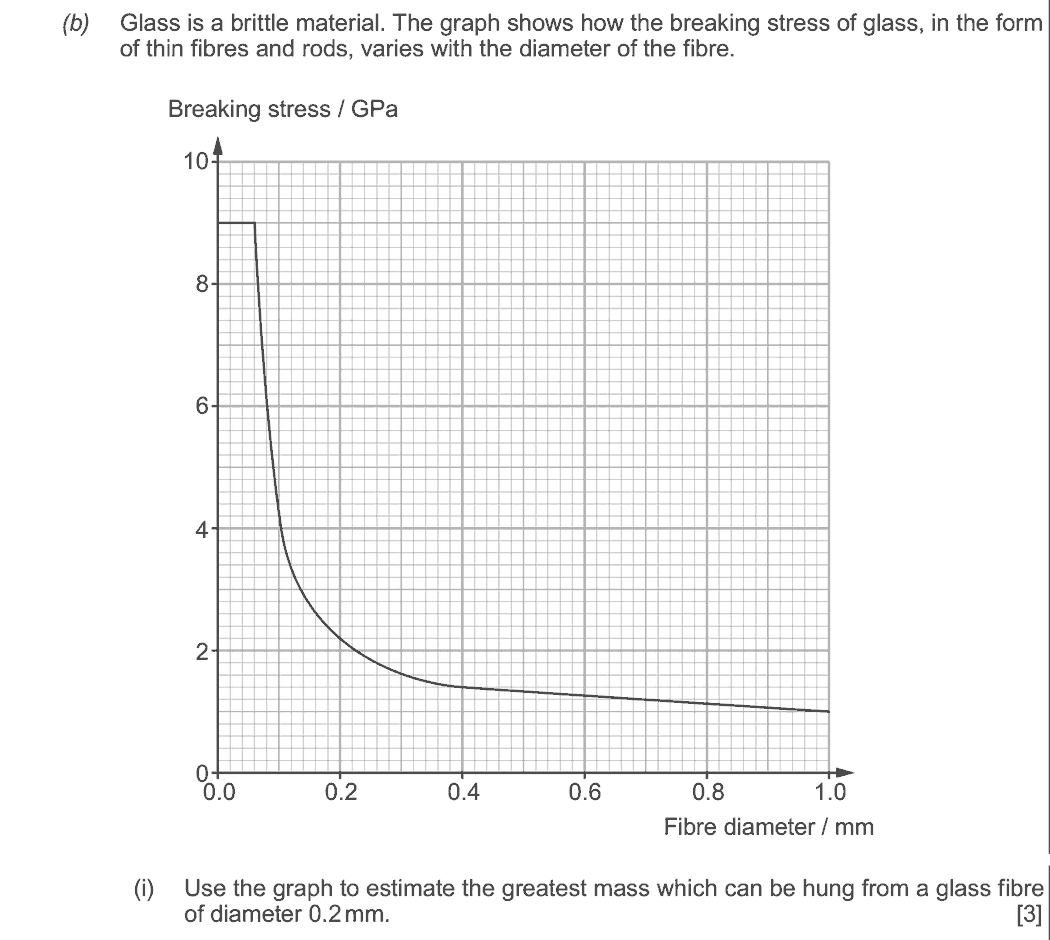
5(b)(i) Solids under stress 3AO2=3Calculation
5(b)(ii) Solids under stress 2AO1=2Explanation
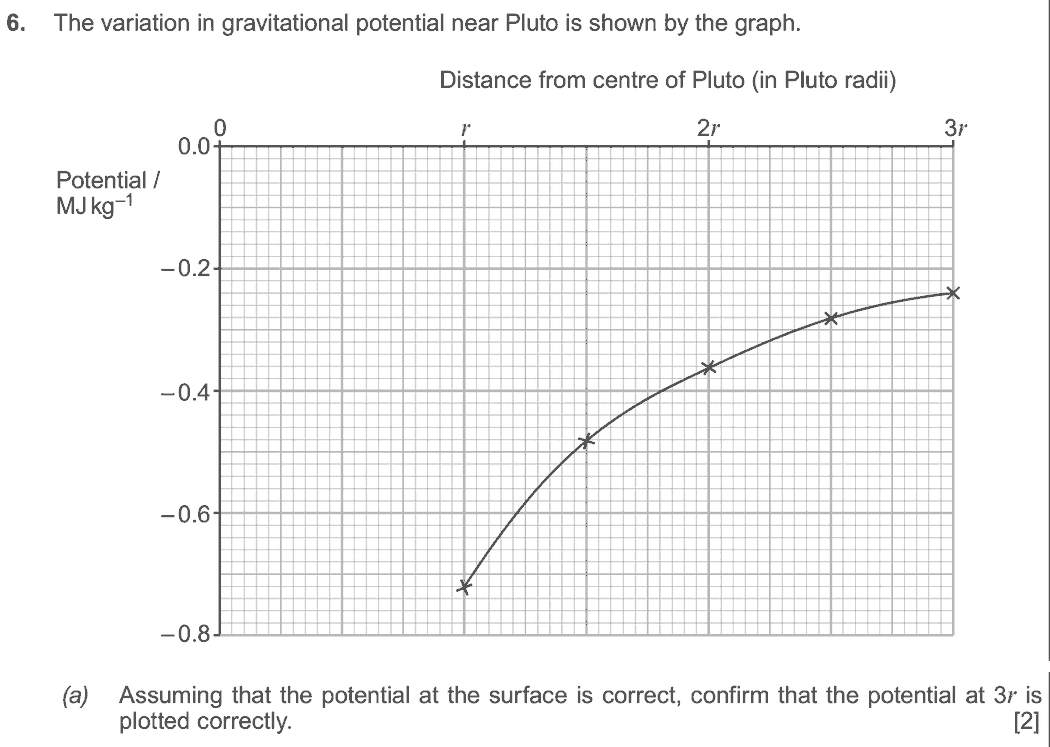
6(a) Electrostatic and gravitational fields of force 2AO3=2Calculation
6(b)(i) Electrostatic and gravitational fields of force 2AO1=1,AO2=1Calculation
6(b)(ii) Electrostatic and gravitational fields of force, Energy concepts 3AO2=3Calculation
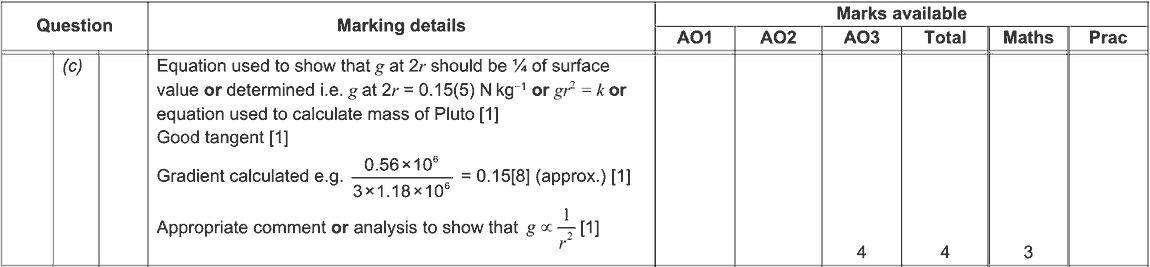
6(c) Electrostatic and gravitational fields of force 4AO3=4Show that
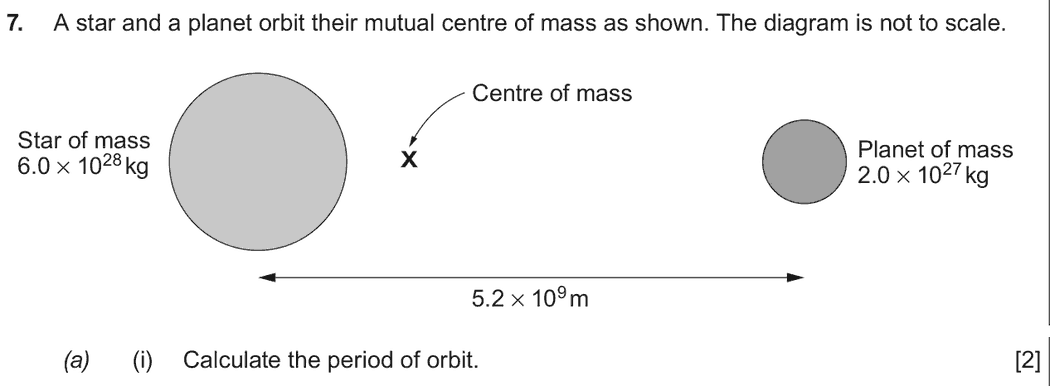
7(a)(i) Orbits and the wider universe 2AO1=1,AO2=1Calculation
7(a)(ii) Orbits and the wider universe 2AO1=1,AO2=1Calculation
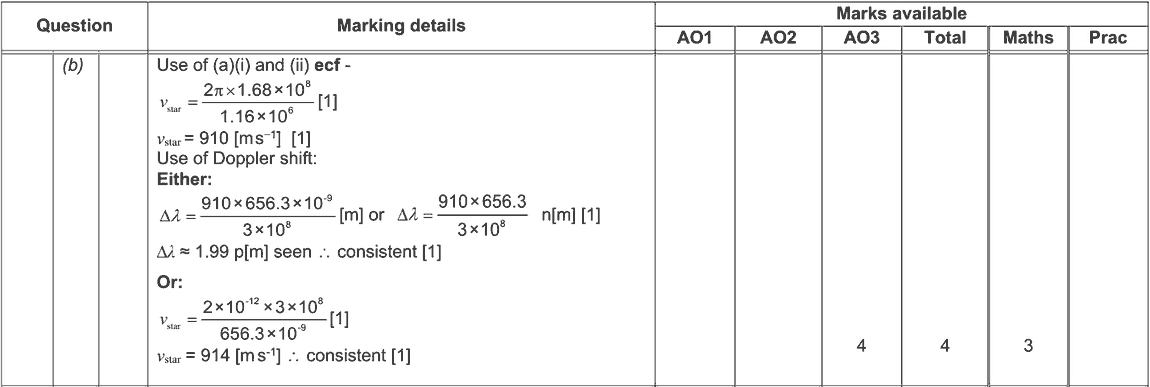
7(b) Orbits and the wider universe 4AO3=4Calculation
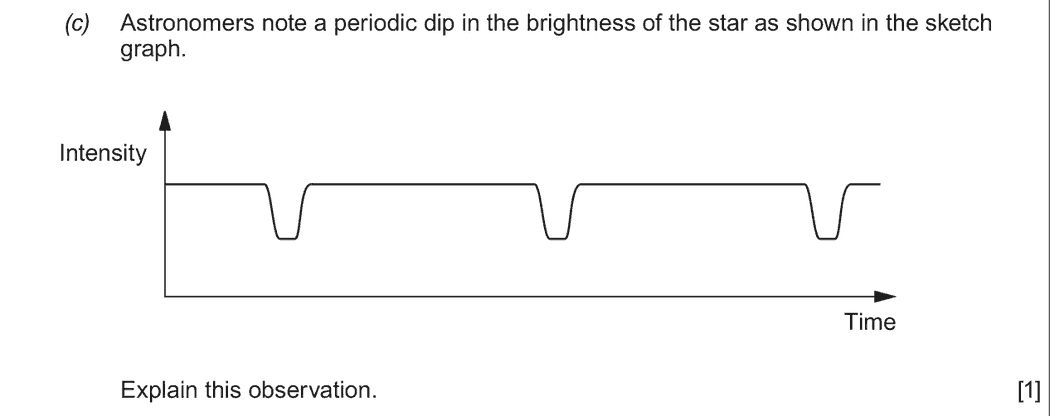
7(c) Orbits and the wider universe 1AO3=1Short answer
8(a) Electrostatic and gravitational fields of force 2AO1=2Short answer
8(b)(i) Capacitance, Electrostatic and gravitational fields of force 3AO1=1,AO2=2Show that
8(b)(ii) Dynamics: forces and momentum, Basic physics: units, vectors and moments 3AO1=1,AO2=2Diagram or graph
8(c) Kinematics, Dynamics: forces and momentum 4AO2=4Calculation

The questions

1(a)1(b)(i)1(b)(ii)1(c)2(a)2(b)2(c)2(d)2(e)(i)2(e)(ii)2(f)3(a)3(b)(i)3(b)(ii)3(b)(iii)3(b)(iv)3(c)4(a)4(b)5(a)(i)5(a)(ii)5(a)(iii)5(a)(iv)5(b)(i)5(b)(ii)6(a)6(b)(i)6(b)(ii)6(c)7(a)(i)7(a)(ii)7(b)7(c)8(a)8(b)(i)8(b)(ii)8(c)
June 2019 · Component 2 · Q1(a) 4 marks AO1=4 Explanation dc circuits
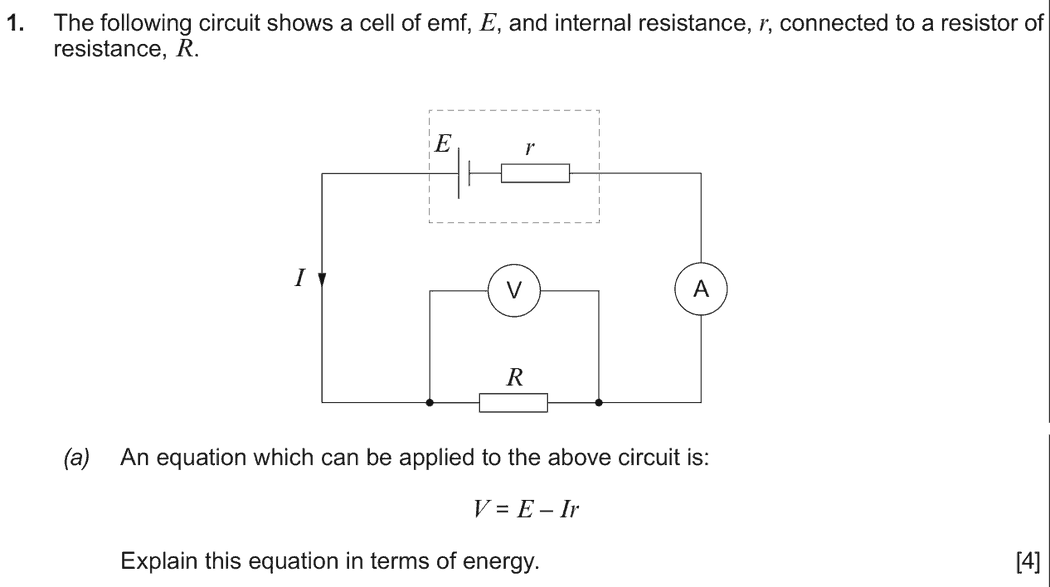
1. The following circuit shows a cell of emf, E, and internal resistance, r, connected to a resistor of resistance, R. E r I V A R (a) An equation which can be applied to the above circuit is: V = E – Ir Explain this equation in terms of energy. [4]
June 2019 · Component 2 · Q1(b)(i) 3 marks AO2=3 Calculation dc circuits
Earlier part of question 1 that this part usesEarlier part of June 2019 Component 2 question 1
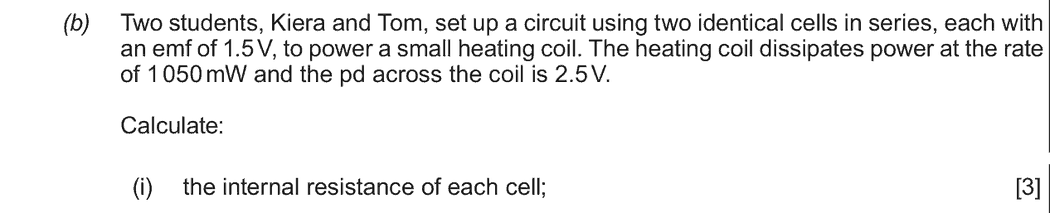
(b) Two students, Kiera and Tom, set up a circuit using two identical cells in series, each with an emf of 1.5 V, to power a small heating coil. The heating coil dissipates power at the rate of 1 050 mW and the pd across the coil is 2.5 V. Calculate: (i) the internal resistance of each cell; [3]
June 2019 · Component 2 · Q1(b)(ii) 2 marks AO1=1, AO2=1 Calculation resistance
Earlier parts of question 1 that this part usesEarlier part of June 2019 Component 2 question 1Earlier part of June 2019 Component 2 question 1
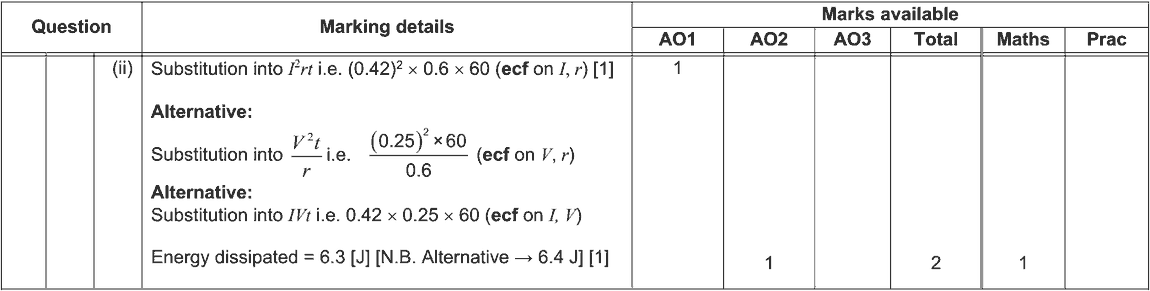
(ii) the energy dissipated in each cell in one minute. [2]
June 2019 · Component 2 · Q1(c) 4 marks AO3=4 Calculation dc circuits
Earlier part of question 1 that this part usesEarlier part of June 2019 Component 2 question 1
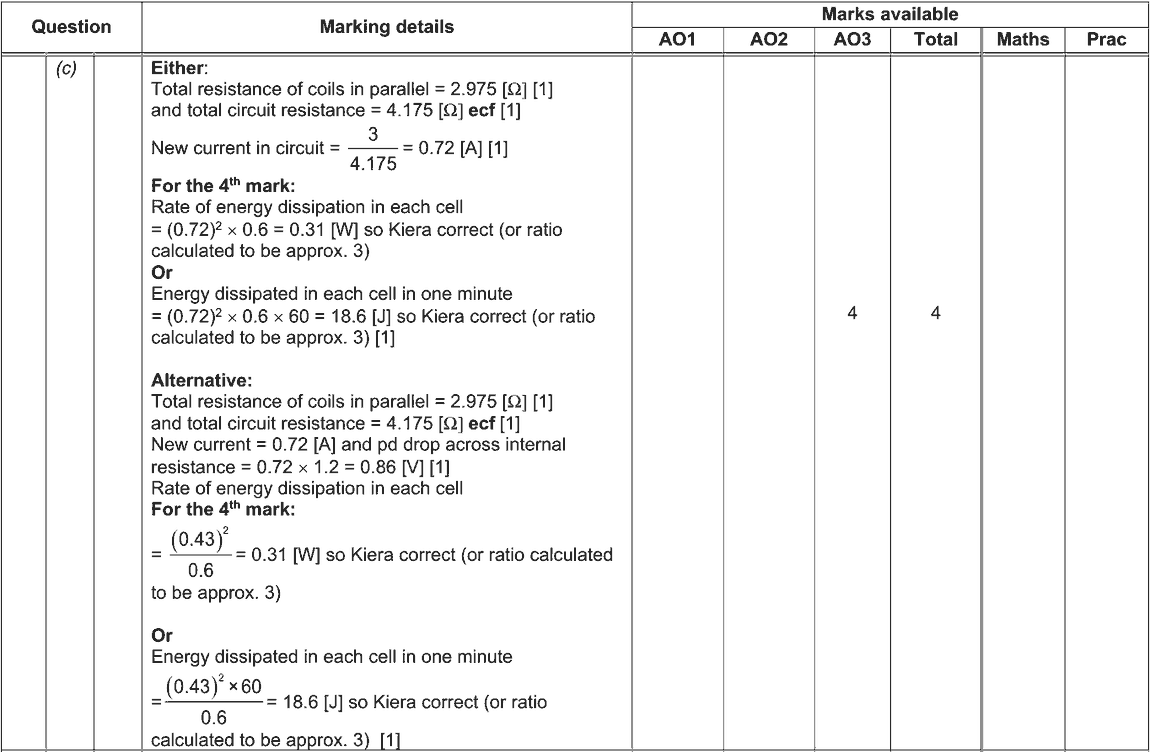
(c) The students note that the cells get hot when the heater is switched on for long periods. Tom believes that adding an identical heating coil in parallel with the original would halve the energy dissipated in each cell. Kiera disagrees. She believes that the energy dissipated would increase by a factor of 3 if a coil is added in parallel. Investigate whether Kiera or Tom or neither of them is correct. [4]
June 2019 · Component 2 · Q2(a) 1 mark AO3=1 Practical and data analysis resistance
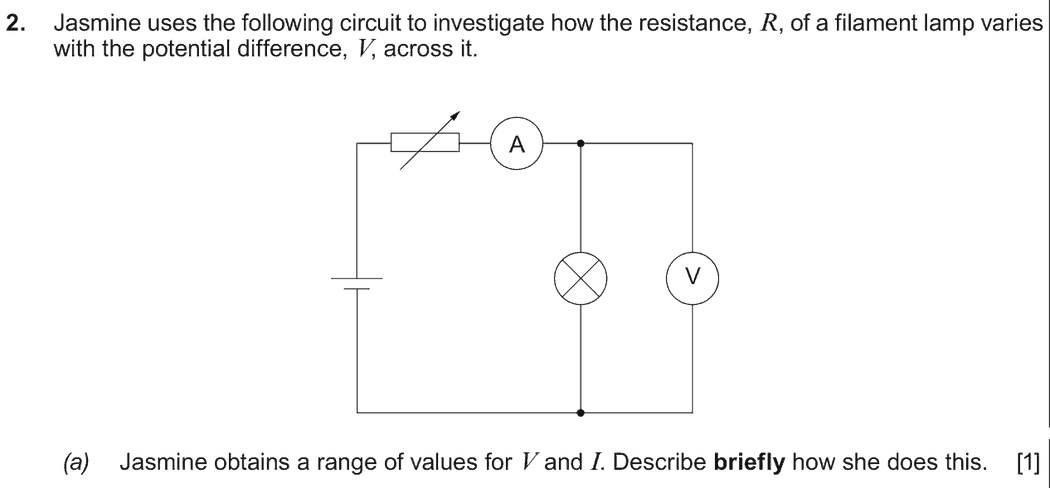
2. Jasmine uses the following circuit to investigate how the resistance, R, of a filament lamp varies with the potential difference, V, across it. A V (a) Jasmine obtains a range of values for V and I. Describe briefly how she does this. [1]

June 2019 · Component 2 · Q2(b) 2 marks AO2=2 Show that resistance
Earlier part of question 2 that this part usesEarlier part of June 2019 Component 2 question 2
(b) The relationship between R and V can be expressed as: R = kV n where k and n are unknown constants. By taking logs of both sides of the equation, show how it can be written in the form y = mx + c. [2]
June 2019 · Component 2 · Q2(c) 3 marks AO2=3 Practical and data analysis resistance
Earlier part of question 2 that this part usesEarlier part of June 2019 Component 2 question 2
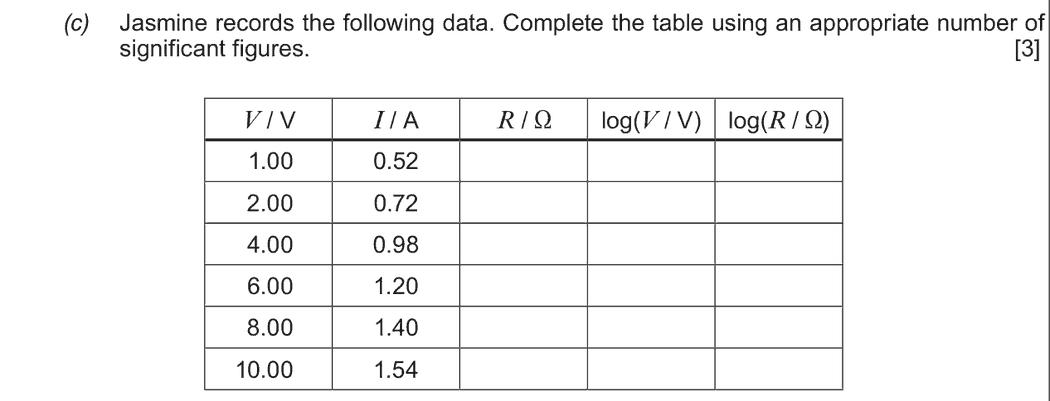
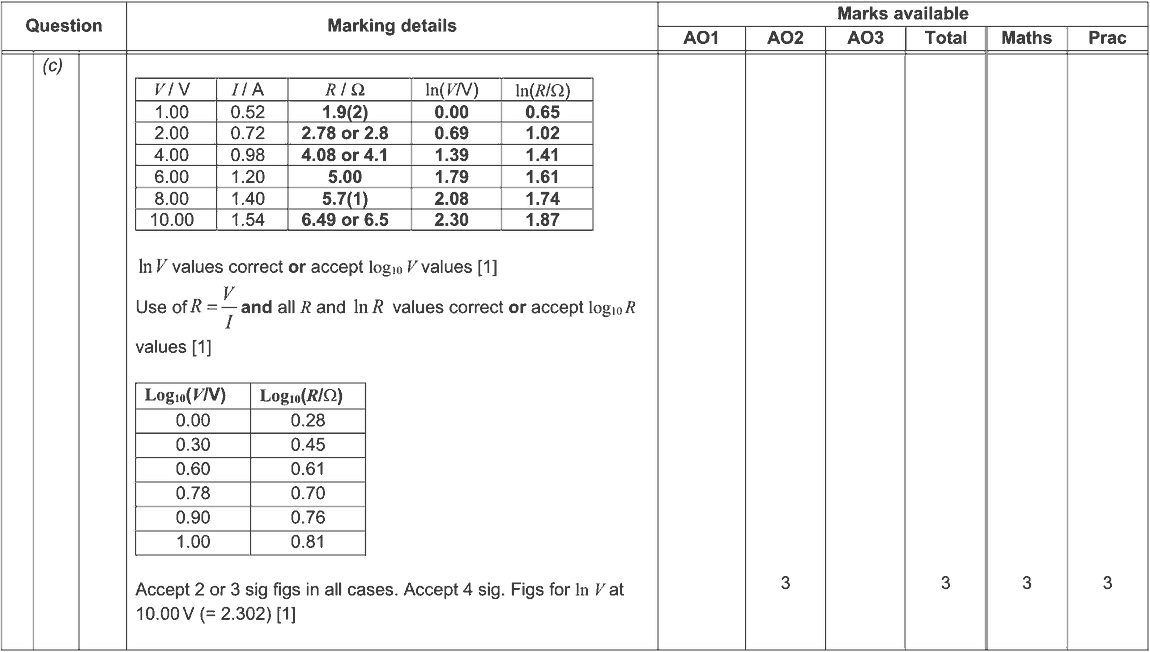
(c) Jasmine records the following data. Complete the table using an appropriate number of significant figures. [3] V / V I / A R / Ω log(V / V) log(R / Ω) 1.00 0.52 2.00 0.72 4.00 0.98 6.00 1.20 8.00 1.40 10.00 1.54
June 2019 · Component 2 · Q2(d) 5 marks AO2=5 Practical and data analysis resistance
Earlier parts of question 2 that this part usesEarlier part of June 2019 Component 2 question 2Earlier part of June 2019 Component 2 question 2
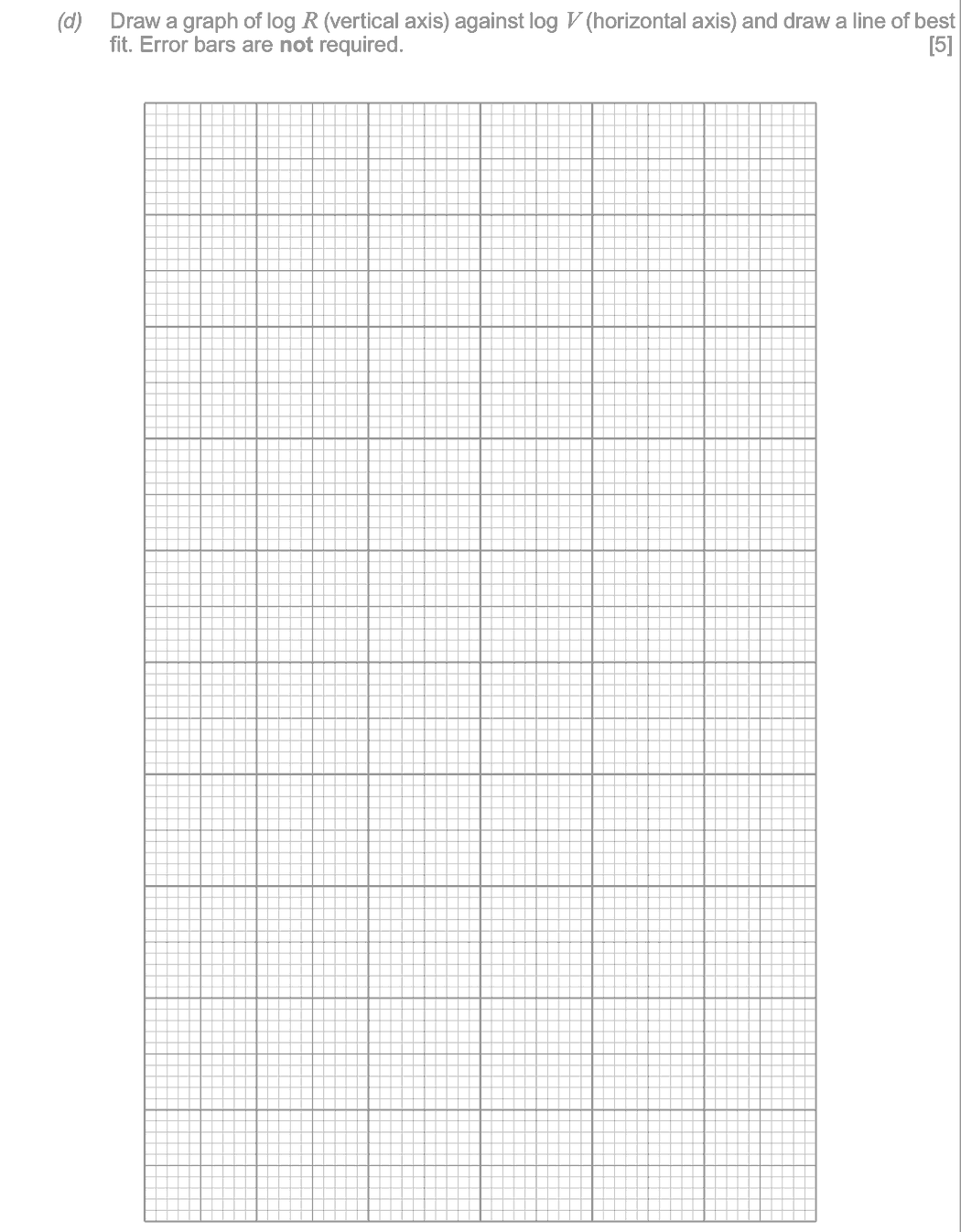
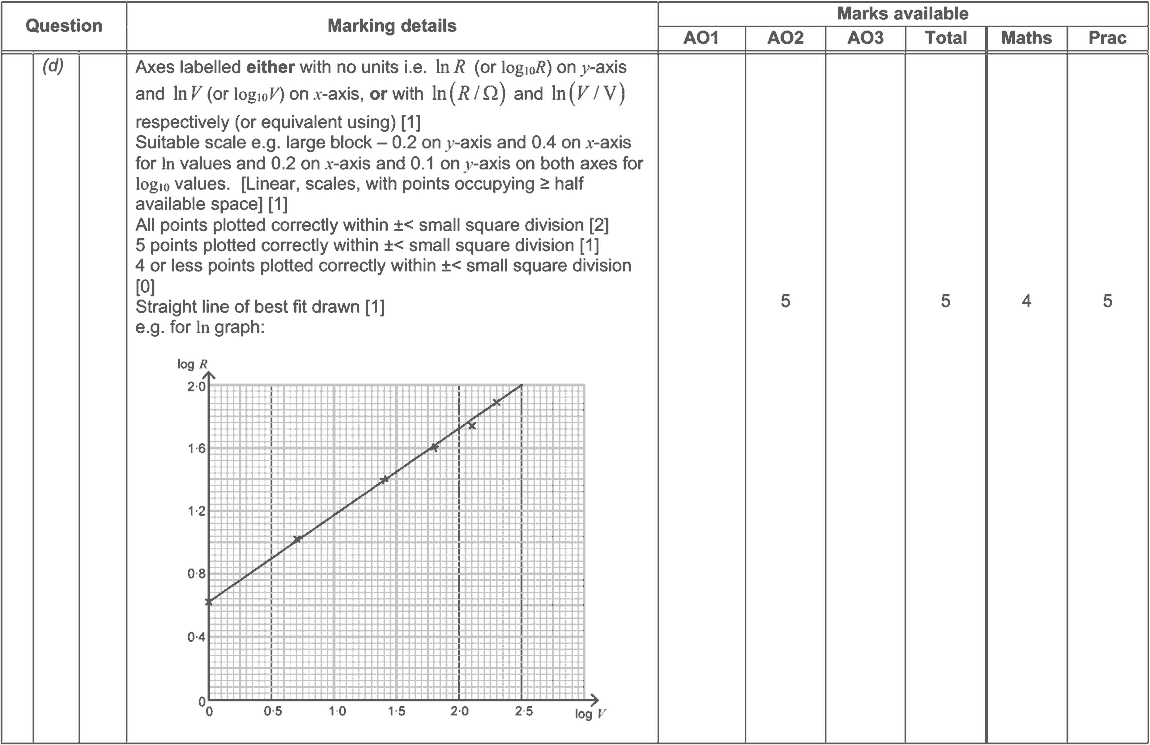
(d) Draw a graph of log R (vertical axis) against log V (horizontal axis) and draw a line of best fit. Error bars are not required. [5]
June 2019 · Component 2 · Q2(e)(i) 4 marks AO1=2, AO2=2 Practical and data analysis resistance
Earlier parts of question 2 that this part usesEarlier part of June 2019 Component 2 question 2Earlier part of June 2019 Component 2 question 2Earlier part of June 2019 Component 2 question 2
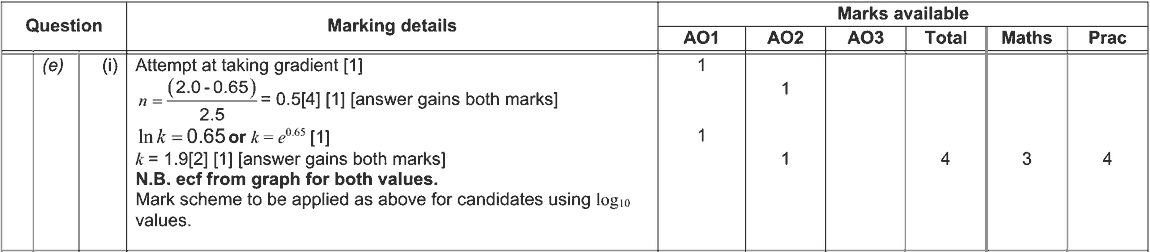
(e) (i) Use your graph to determine suitable values for k and n. [4]
June 2019 · Component 2 · Q2(e)(ii) 1 mark AO1=1 Short answer resistance
Earlier parts of question 2 that this part usesEarlier part of June 2019 Component 2 question 2Earlier part of June 2019 Component 2 question 2Earlier part of June 2019 Component 2 question 2Earlier part of June 2019 Component 2 question 2
(ii) Hence, write down an equation showing the relationship between R and V for this filament lamp. [1]
June 2019 · Component 2 · Q2(f) 1 mark AO3=1 Practical and data analysis resistance
Earlier parts of question 2 that this part usesEarlier part of June 2019 Component 2 question 2Earlier part of June 2019 Component 2 question 2Earlier part of June 2019 Component 2 question 2
(f) Comment on the quality of Jasmine’s results. [1]
June 2019 · Component 2 · Q3(a) 2 marks AO1=2 Short answer capacitance
3. (a) Two parallel plate capacitors, X and Y, have equal plate areas. The capacitance of X is greater than the capacitance of Y. Suggest two possible reasons for the difference. [2]
June 2019 · Component 2 · Q3(b)(i) 3 marks AO1=2, AO2=1 Calculation capacitance
Earlier part of question 3 that this part usesEarlier part of June 2019 Component 2 question 3
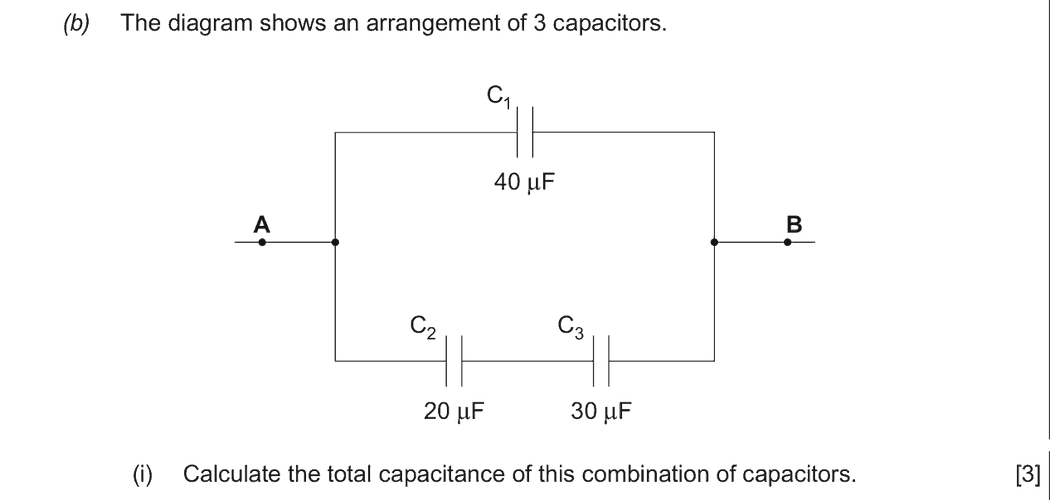
(b) The diagram shows an arrangement of 3 capacitors. C1 40 μF A B C2 C3 20 μF 30 μF (i) Calculate the total capacitance of this combination of capacitors. [3]
June 2019 · Component 2 · Q3(b)(ii) 2 marks AO1=1, AO2=1 Explanation capacitance
Earlier parts of question 3 that this part usesEarlier part of June 2019 Component 2 question 3Earlier part of June 2019 Component 2 question 3
(ii) Explain why: pd across C2 = 1.5 × pd across C3. [2]
June 2019 · Component 2 · Q3(b)(iii) 1 mark AO2=1 Calculation capacitance
Earlier parts of question 3 that this part usesEarlier part of June 2019 Component 2 question 3Earlier part of June 2019 Component 2 question 3
(iii) Hence, calculate the pd across C3 given that 100 V is applied between A and B. [1]
June 2019 · Component 2 · Q3(b)(iv) 2 marks AO1=1, AO2=1 Calculation capacitance
Earlier parts of question 3 that this part usesEarlier part of June 2019 Component 2 question 3Earlier part of June 2019 Component 2 question 3
(iv) Explain which of the three capacitors stores the greatest charge, and calculate the size of this charge. [2]
June 2019 · Component 2 · Q3(c) 5 marks AO3=5 Calculation capacitancethermal physics
Earlier parts of question 3 that this part usesEarlier part of June 2019 Component 2 question 3Earlier part of June 2019 Component 2 question 3
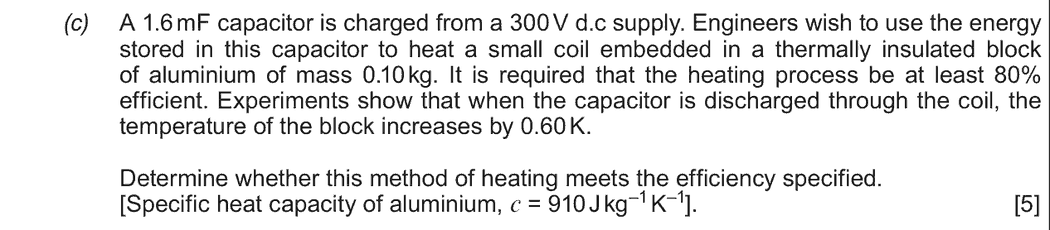
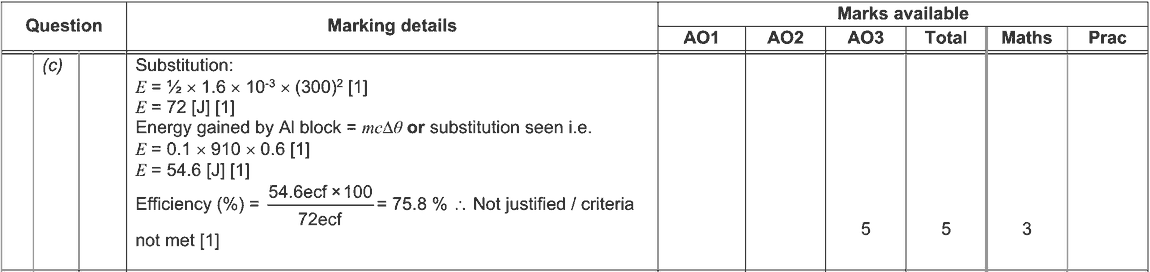
(c) A 1.6 mF capacitor is charged from a 300 V d.c supply. Engineers wish to use the energy stored in this capacitor to heat a small coil embedded in a thermally insulated block of aluminium of mass 0.10 kg. It is required that the heating process be at least 80% efficient. Experiments show that when the capacitor is discharged through the coil, the temperature of the block increases by 0.60 K. Determine whether this method of heating meets the efficiency specified. [Specific heat capacity of aluminium, c = 910 J kg–1 K–1]. [5]
June 2019 · Component 2 · Q4(a) 6 marks AO1=6 6-mark extended response resistance
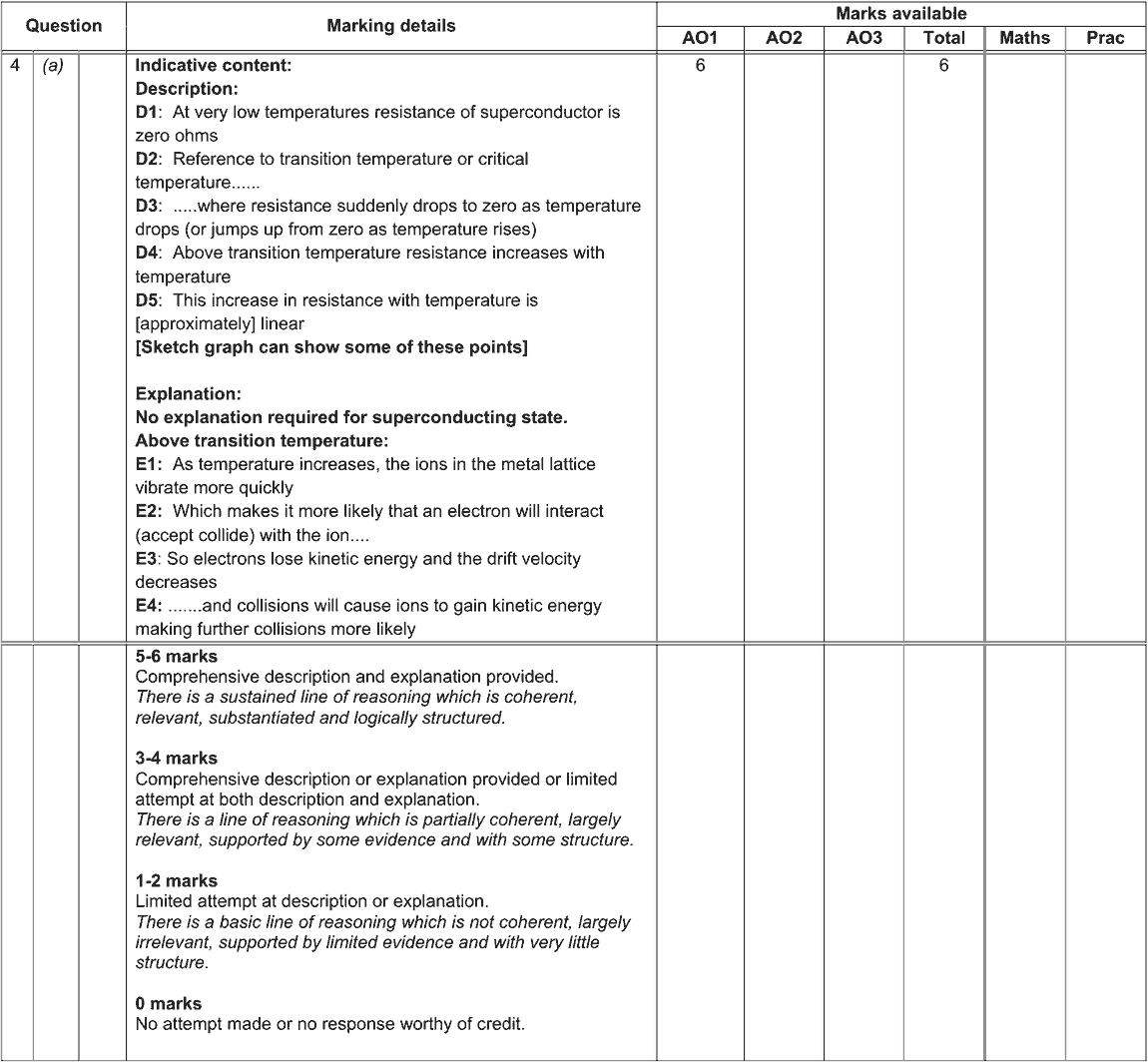
4. (a) Describe how the resistance of a metal varies between 0 K and 1 000 K. [Assume that the metal is superconducting below a certain temperature.] Account for this variation in resistance at higher temperatures. [6 QER]
June 2019 · Component 2 · Q4(b) 3 marks AO3=3 Short answer resistance
Earlier part of question 4 that this part usesEarlier part of June 2019 Component 2 question 4
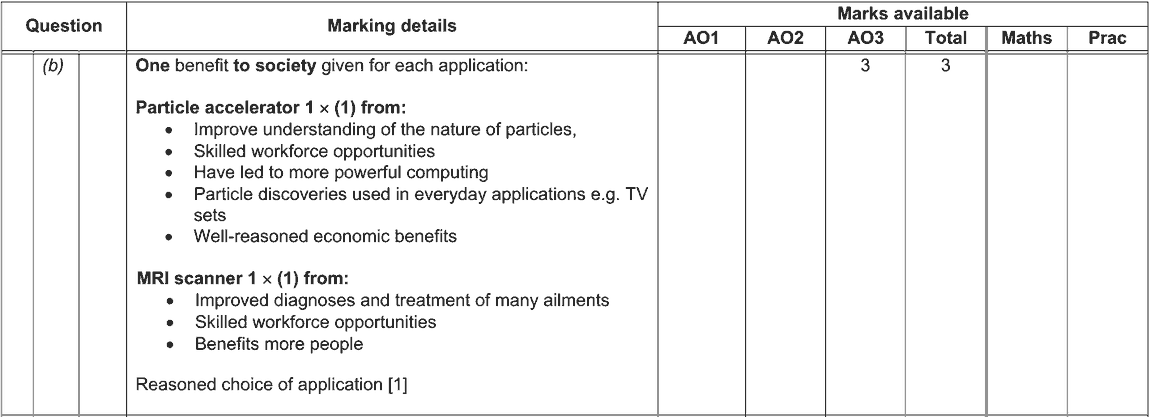
(b) Superconductors are used in MRI scanners and particle accelerators. Consider which of these two applications has been of greater benefit to society. [3]
June 2019 · Component 2 · Q5(a)(i) 3 marks AO2=3 Show that solids under stress
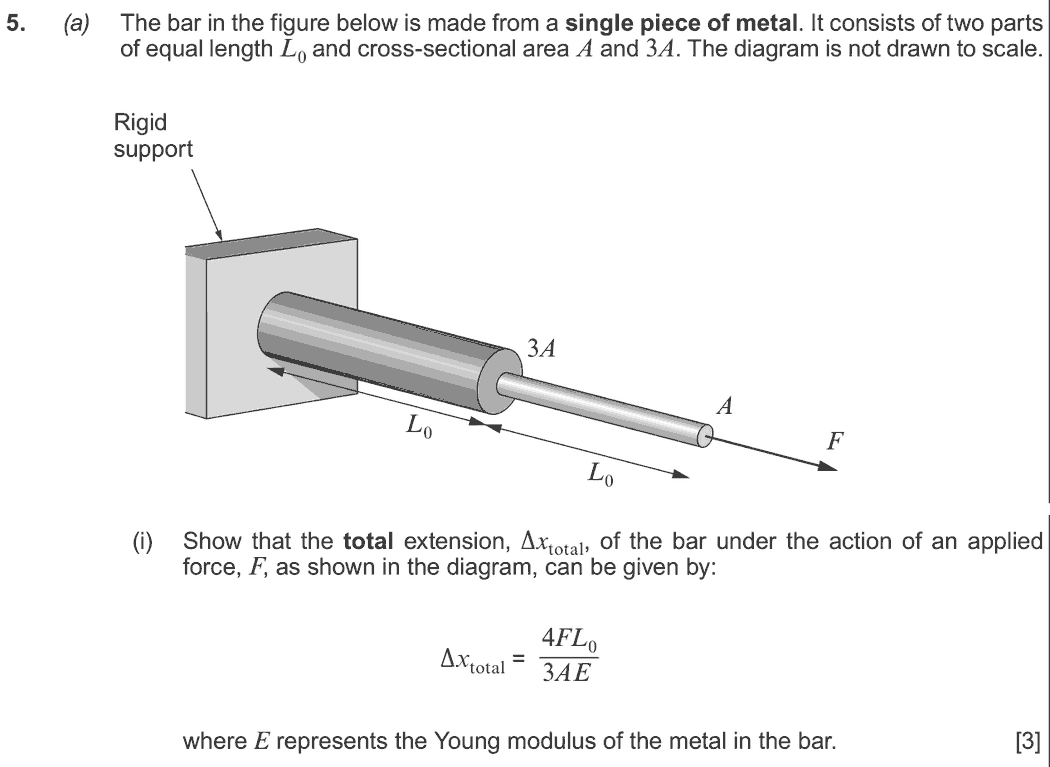
5. (a) The bar in the figure below is made from a single piece of metal. It consists of two parts of equal length L0 and cross-sectional area A and 3A. The diagram is not drawn to scale. Rigid support 3A A L0 F L0 (i) Show that the total extension, Δxtotal, of the bar under the action of an applied force, F, as shown in the diagram, can be given by: 4FL0 Δxtotal = 3AE where E represents the Young modulus of the metal in the bar. [3]
June 2019 · Component 2 · Q5(a)(ii) 1 mark AO2=1 Diagram or graph solids under stress
Earlier part of question 5 that this part usesEarlier part of June 2019 Component 2 question 5
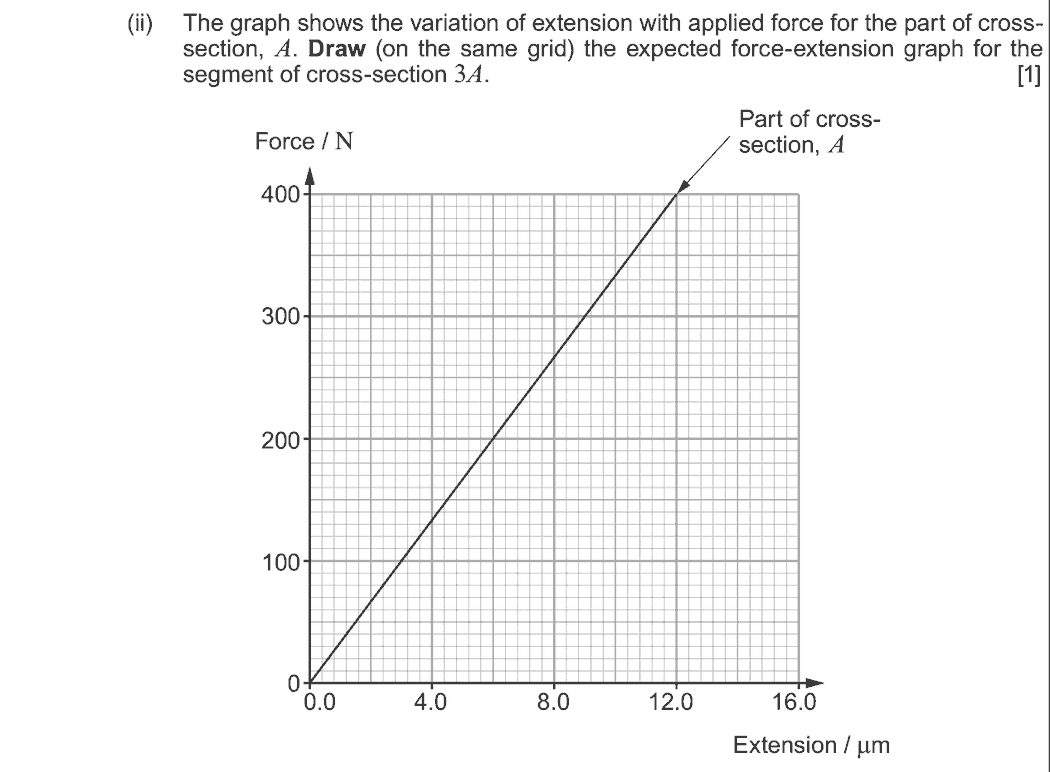
(ii) The graph shows the variation of extension with applied force for the part of cross- section, A. Draw (on the same grid) the expected force-extension graph for the segment of cross-section 3A. [1] Part of cross- Force / N section, A 400 300 200 100 0 0.0 4.0 8.0 12.0 16.0 Extension / μm
June 2019 · Component 2 · Q5(a)(iii) 3 marks AO2=3 Calculation solids under stress
Earlier parts of question 5 that this part usesEarlier part of June 2019 Component 2 question 5Earlier part of June 2019 Component 2 question 5
(iii) Determine the Young modulus of the metal in the bar given that L0 = 1.2 m and A = 2.0 × 10⁻⁴ m2. [3]
June 2019 · Component 2 · Q5(a)(iv) 2 marks AO1=1, AO2=1 Calculation solids under stress
Earlier parts of question 5 that this part usesEarlier part of June 2019 Component 2 question 5Earlier part of June 2019 Component 2 question 5
(iv) Calculate the elastic potential energy stored in the whole bar when F = 400 N. [2]
June 2019 · Component 2 · Q5(b)(i) 3 marks AO2=3 Calculation solids under stress
Earlier parts of question 5 that this part usesEarlier part of June 2019 Component 2 question 5Earlier part of June 2019 Component 2 question 5
(b) Glass is a brittle material. The graph shows how the breaking stress of glass, in the form of thin fibres and rods, varies with the diameter of the fibre. Breaking stress / GPa 10 8 6 4 2 0 0.0 0.2 0.4 0.6 0.8 1.0 Fibre diameter / mm (i) Use the graph to estimate the greatest mass which can be hung from a glass fibre of diameter 0.2 mm. [3]
June 2019 · Component 2 · Q5(b)(ii) 2 marks AO1=2 Explanation solids under stress
Earlier parts of question 5 that this part usesEarlier part of June 2019 Component 2 question 5Earlier part of June 2019 Component 2 question 5Earlier part of June 2019 Component 2 question 5
(ii) Explain the term brittle fracture as it applies to glass and give a reason why very thin fibres have a greater breaking stress than thicker ones. [2]
June 2019 · Component 2 · Q6(a) 2 marks AO3=2 Calculation electrostatic and gravitational fields
6. The variation in gravitational potential near Pluto is shown by the graph. Distance from centre of Pluto (in Pluto radii) 0 r 2r 3r 0.0 Potential / MJ kg–1 – 0.2 – 0.4 – 0.6 – 0.8 (a) Assuming that the potential at the surface is correct, confirm that the potential at 3r is plotted correctly. [2]
June 2019 · Component 2 · Q6(b)(i) 2 marks AO1=1, AO2=1 Calculation electrostatic and gravitational fields
Earlier part of question 6 that this part usesEarlier part of June 2019 Component 2 question 6
(b) (i) Calculate the gravitational potential energy of a spacecraft of mass 600 kg at rest on the surface. [2]
June 2019 · Component 2 · Q6(b)(ii) 3 marks AO2=3 Calculation electrostatic and gravitational fieldsenergy concepts
Earlier parts of question 6 that this part usesEarlier part of June 2019 Component 2 question 6Earlier part of June 2019 Component 2 question 6
(ii) ‘Escape velocity’ is defined as the minimum velocity required for a body to escape from the gravitational influence of a massive body. Calculate the ‘escape velocity’ of the spacecraft. [3]
June 2019 · Component 2 · Q6(c) 4 marks AO3=4 Show that electrostatic and gravitational fields
Earlier part of question 6 that this part usesEarlier part of June 2019 Component 2 question 6
(c) The radius of Pluto is 1.18 × 10⁶ m and the gravitational field strength at the surface is 0.62 N kg–1. Using this information and by drawing a suitable tangent show that the gravitational field strength at 2r agrees with the theoretical value given by: ∝1 g [4] r2
June 2019 · Component 2 · Q7(a)(i) 2 marks AO1=1, AO2=1 Calculation orbits and the wider universe
7. A star and a planet orbit their mutual centre of mass as shown. The diagram is not to scale. Centre of mass Star of mass Planet of mass 6.0 × 1028 kg X 2.0 × 1027 kg 5.2 × 10⁹ m (a) (i) Calculate the period of orbit. [2]
June 2019 · Component 2 · Q7(a)(ii) 2 marks AO1=1, AO2=1 Calculation orbits and the wider universe
Earlier part of question 7 that this part usesEarlier part of June 2019 Component 2 question 7
(ii) Calculate the distance of the centre of mass from the centre of the star. [2]
June 2019 · Component 2 · Q7(b) 4 marks AO3=4 Calculation orbits and the wider universe
Earlier part of question 7 that this part usesEarlier part of June 2019 Component 2 question 7
(b) The centre of mass of this star-planet system is at rest relative to the Earth and the system is viewed ‘edge-on’. When analysing light of wavelength 656.3 nm from the star, astronomers measure a maximum red shift of 2.0 pm. Determine whether this shift is (approximately) consistent with your answers to (a)(i) and (ii). [4]
June 2019 · Component 2 · Q7(c) 1 mark AO3=1 Short answer orbits and the wider universe
Earlier part of question 7 that this part usesEarlier part of June 2019 Component 2 question 7
(c) Astronomers note a periodic dip in the brightness of the star as shown in the sketch graph. Intensity Time Explain this observation. [1]
June 2019 · Component 2 · Q8(a) 2 marks AO1=2 Short answer electrostatic and gravitational fields
8. (a) State one similarity and one difference between gravitational and electric fields. [2]
June 2019 · Component 2 · Q8(b)(i) 3 marks AO1=1, AO2=2 Show that capacitanceelectrostatic and gravitational fields
Earlier part of question 8 that this part usesEarlier part of June 2019 Component 2 question 8
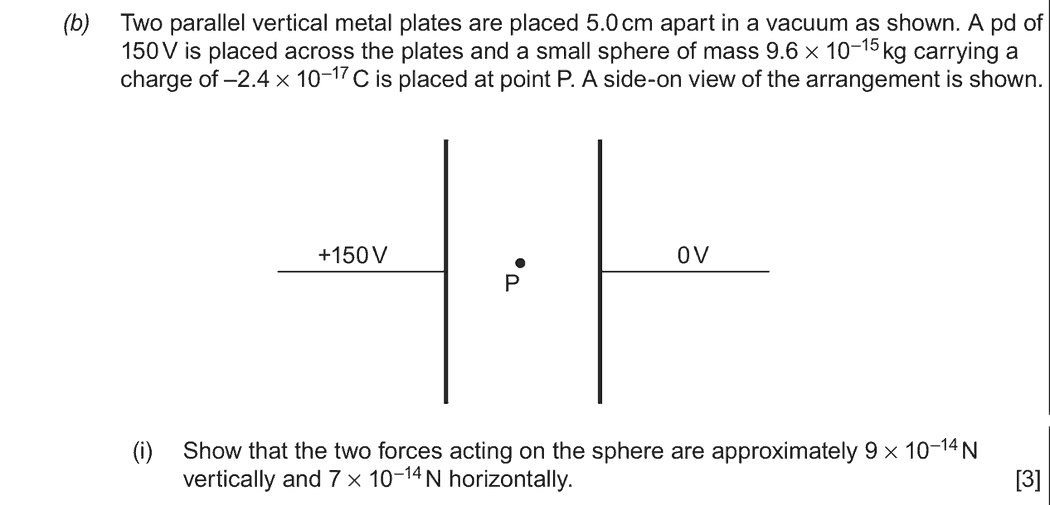
(b) Two parallel vertical metal plates are placed 5.0 cm apart in a vacuum as shown. A pd of 150 V is placed across the plates and a small sphere of mass 9.6 × 10⁻¹⁵ kg carrying a charge of –2.4 × 10⁻¹⁷ C is placed at point P. A side-on view of the arrangement is shown. +150 V 0 V P (i) Show that the two forces acting on the sphere are approximately 9 × 10–14 N vertically and 7 × 10–14 N horizontally. [3]
June 2019 · Component 2 · Q8(b)(ii) 3 marks AO1=1, AO2=2 Diagram or graph dynamicsbasic physics
Earlier parts of question 8 that this part usesEarlier part of June 2019 Component 2 question 8Earlier part of June 2019 Component 2 question 8
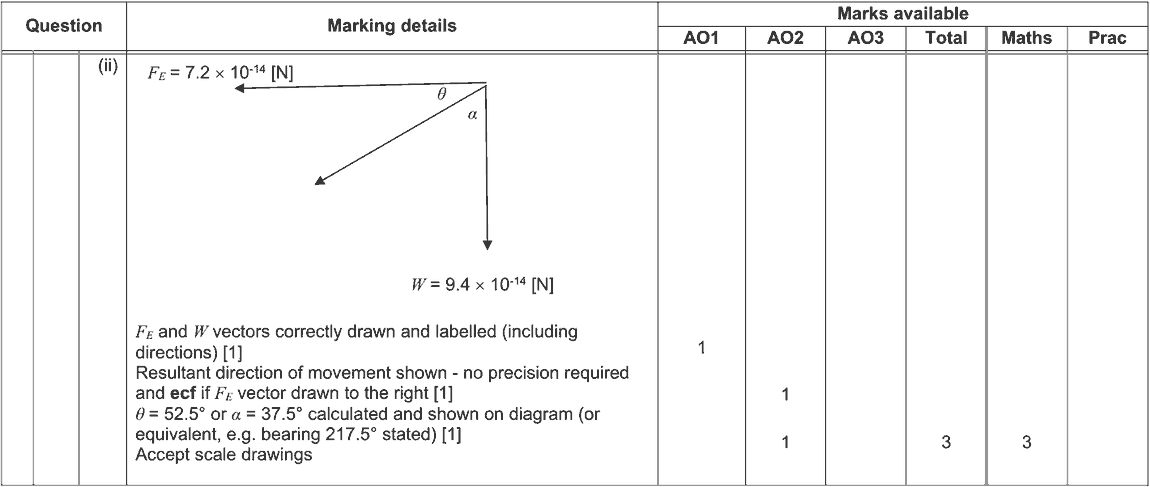
(ii) Draw, in the space below, a free body diagram for the sphere, showing the magnitude and direction of the two forces acting on it. Determine the direction with which the sphere will move away from P and include this on your diagram. [3]
June 2019 · Component 2 · Q8(c) 4 marks AO2=4 Calculation kinematicsdynamics
Earlier parts of question 8 that this part usesEarlier part of June 2019 Component 2 question 8Earlier part of June 2019 Component 2 question 8
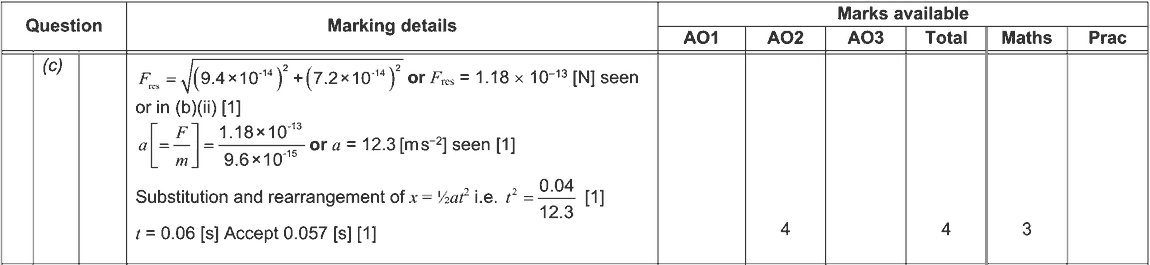
(c) Calculate the time taken for the sphere to travel a distance of 2.0 cm. [4]

Work with an Eduqas physics tutor

Want a paper marked and gone through with you? Message us.

Prefer email? Send an enquiry

If you are under 18, please include a parent's contact details. Enquiries go to enquiries@physicsaleveltutor.com and are deleted once handled. All tutoring is online.