June 2022: Component 2

100 marks · 38 question parts · Paper, mark scheme and report on Eduqas's site · Have the Data Booklet beside you

Question by question

QTopicMarksAOType
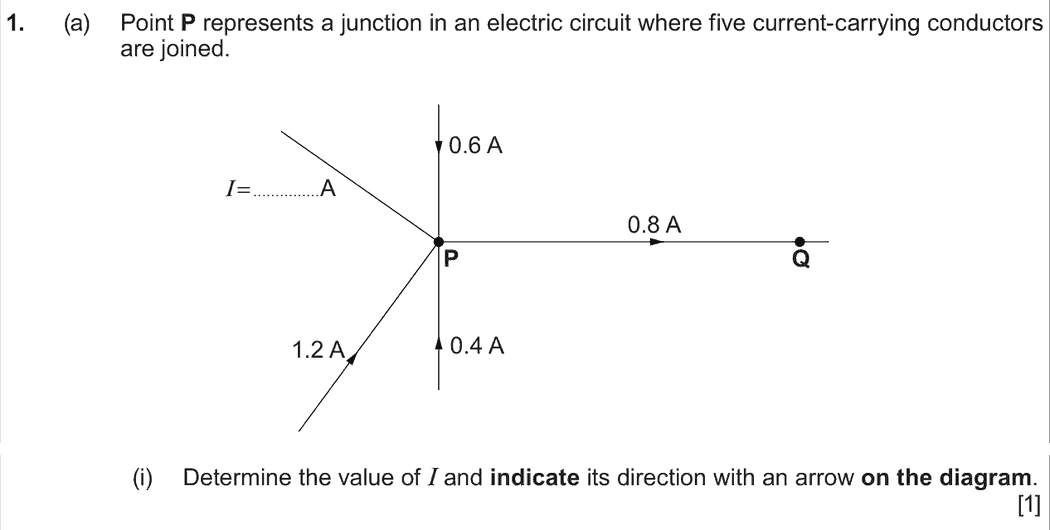
1(a)(i) d.c. circuits 1AO2=1Short answer
1(a)(ii) Conduction of electricity 1AO2=1Calculation
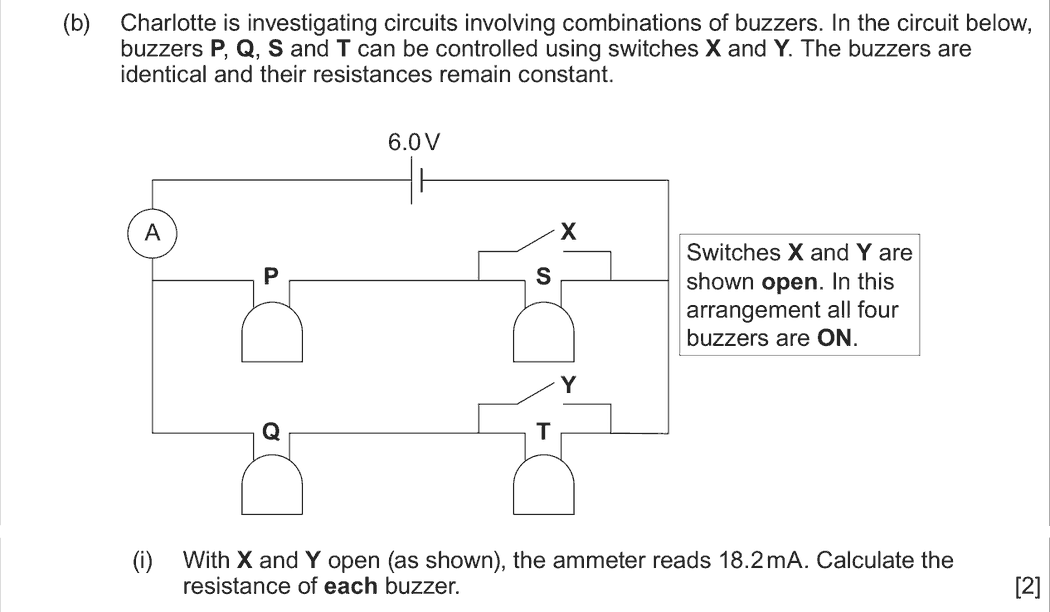
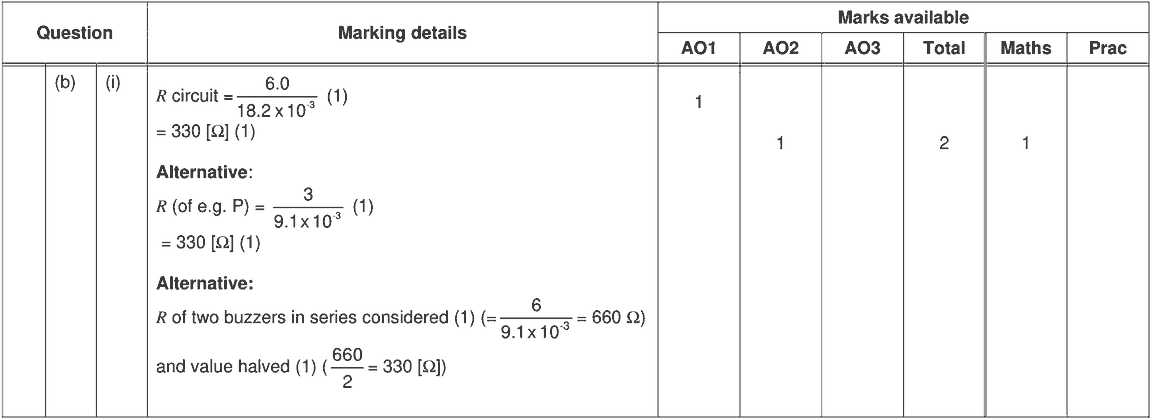
1(b)(i) d.c. circuits, Resistance 2AO1=1,AO2=1Calculation
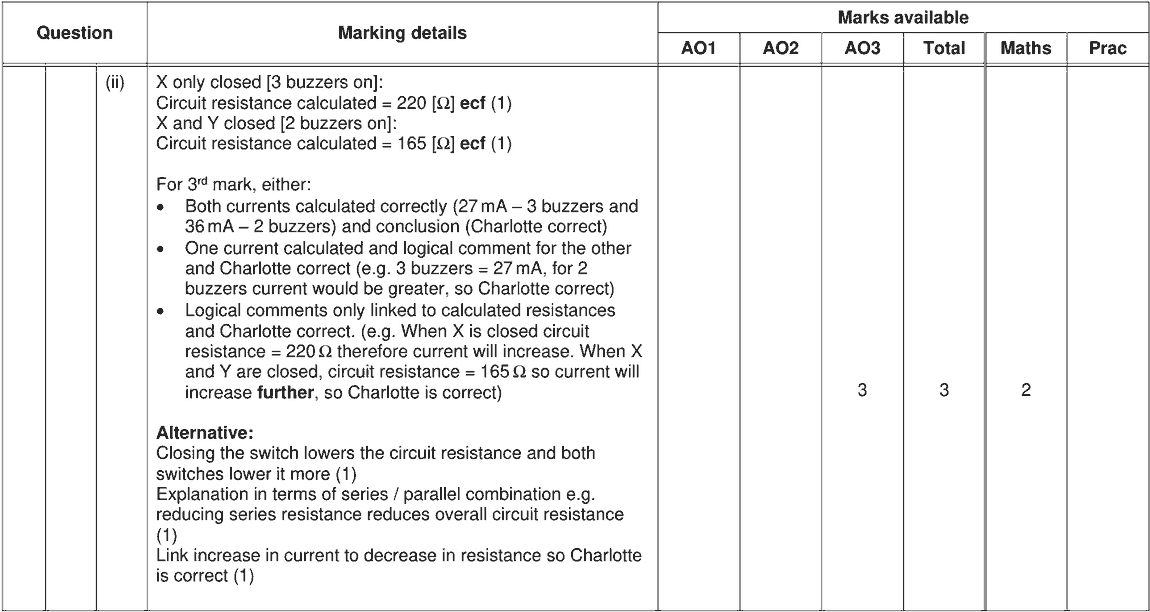
1(b)(ii) d.c. circuits, Resistance 3AO3=3Calculation
1(b)(iii) Resistance 3AO1=2,AO2=1Show that
2(a) Resistance 6AO1=6Extended response
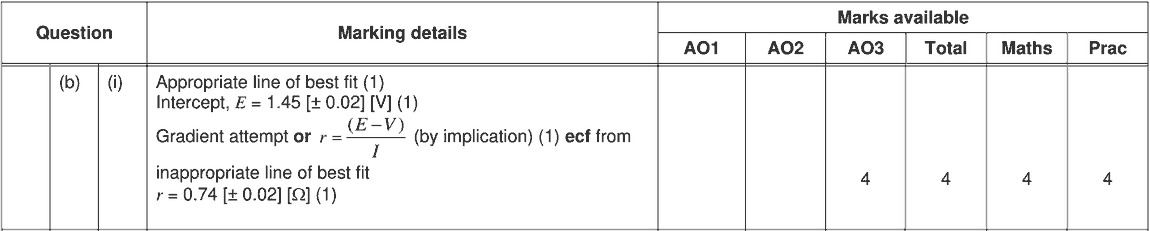
2(b)(i) d.c. circuits 4AO3=4Practical and data analysis
2(b)(ii) d.c. circuits 1AO3=1Practical and data analysis
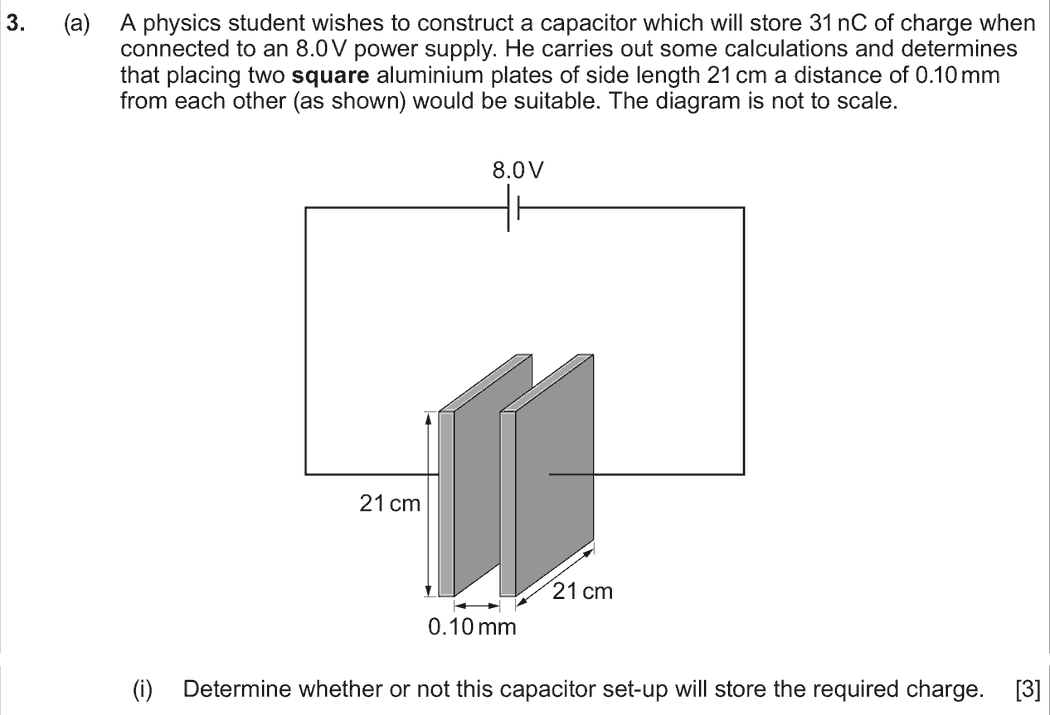
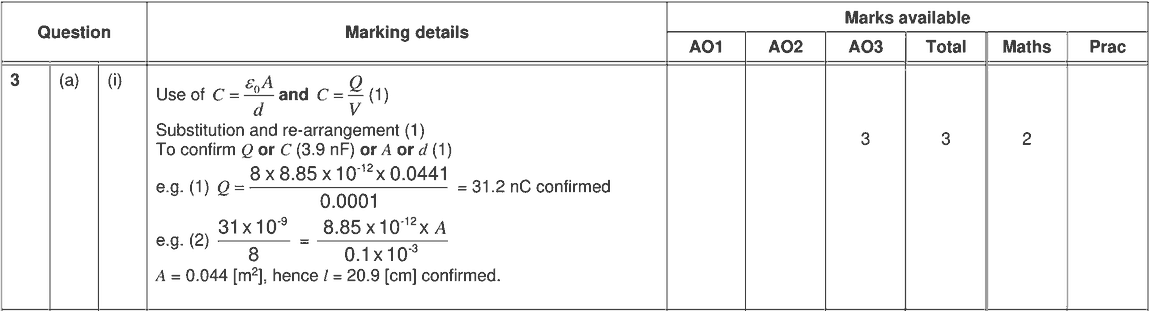
3(a)(i) Capacitance 3AO3=3Calculation
3(a)(ii) Capacitance 1AO1=1Short answer
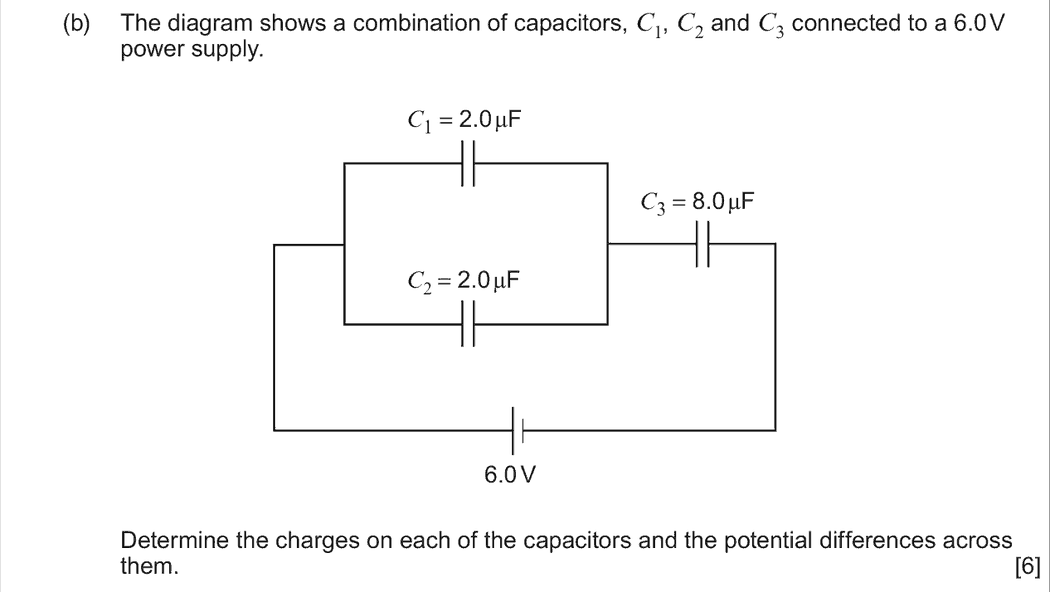
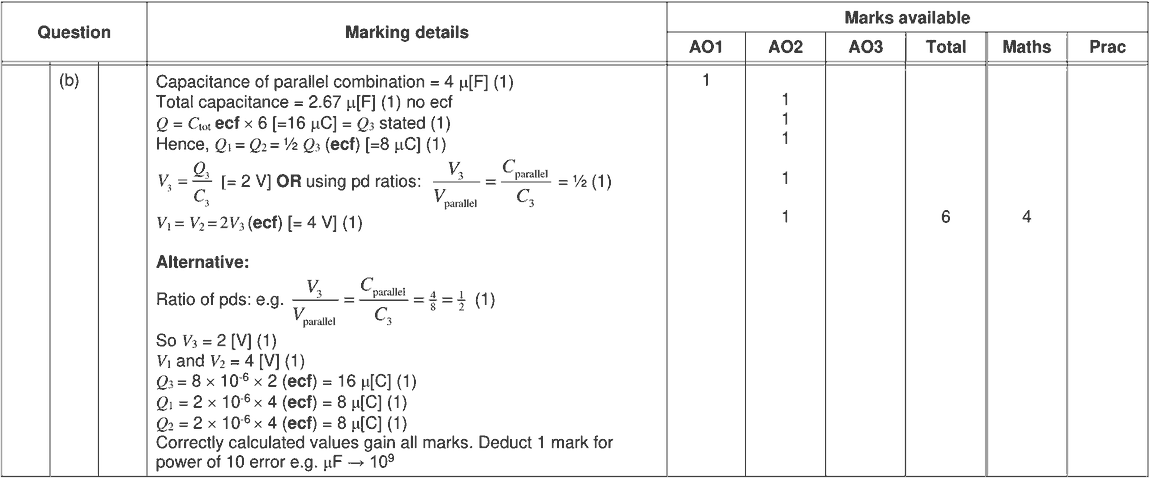
3(b) Capacitance 6AO1=1,AO2=5Calculation
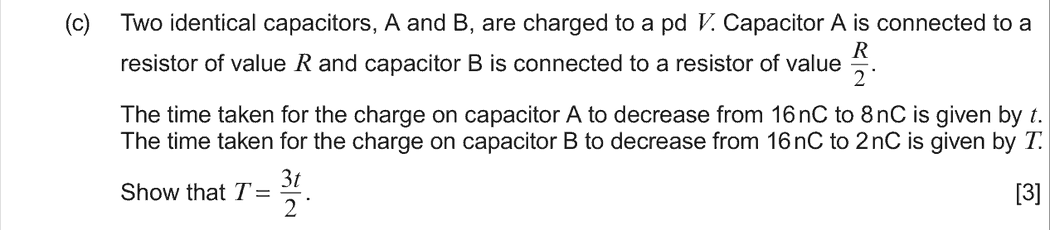
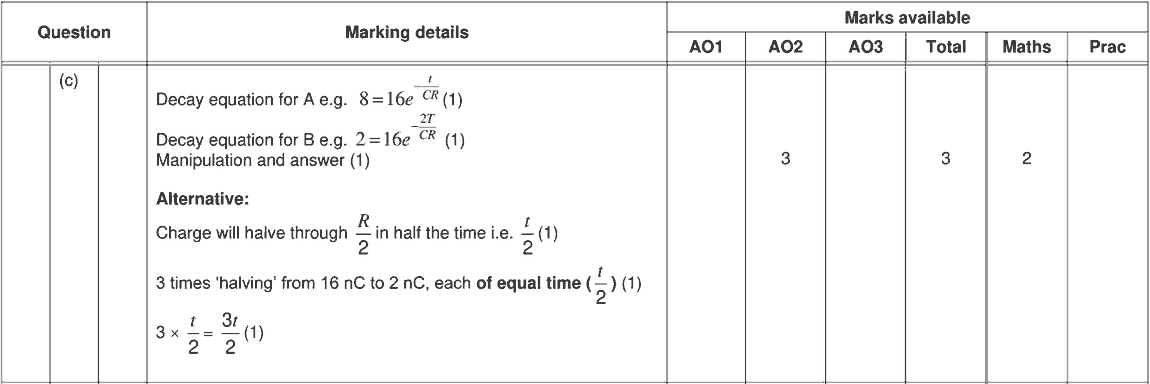
3(c) Capacitance 3AO2=3Show that
4(a) Solids under stress 2AO1=2Explanation
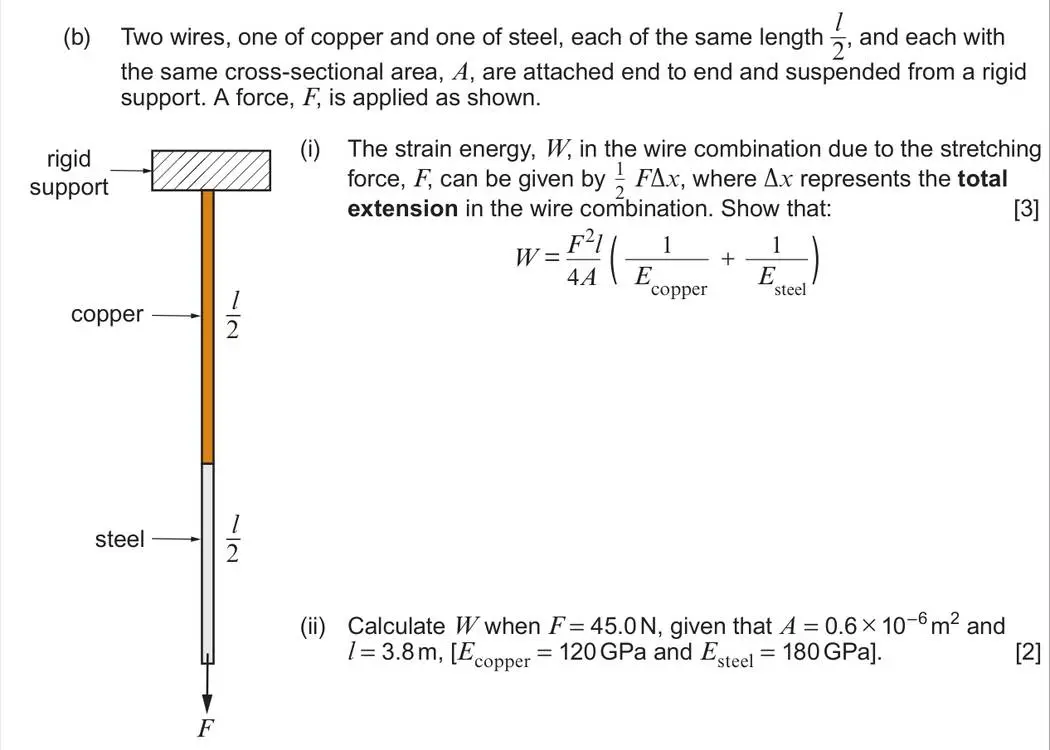
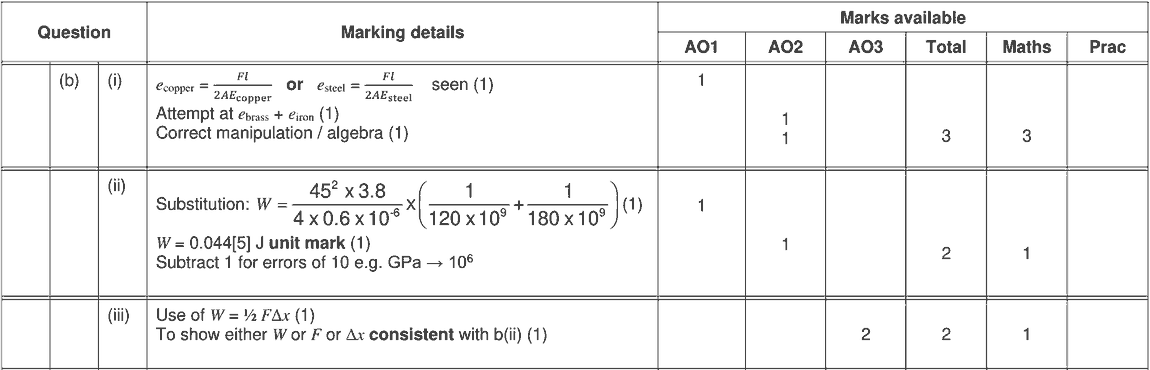
4(b) Solids under stress 5Calculation
4(b)(iii) Solids under stress 2AO3=2Calculation
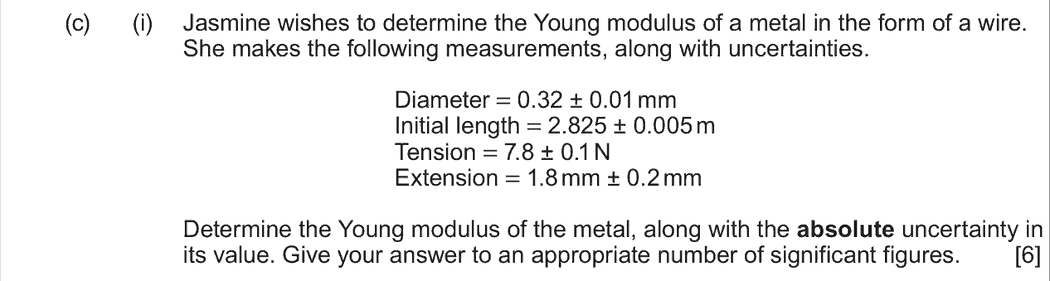
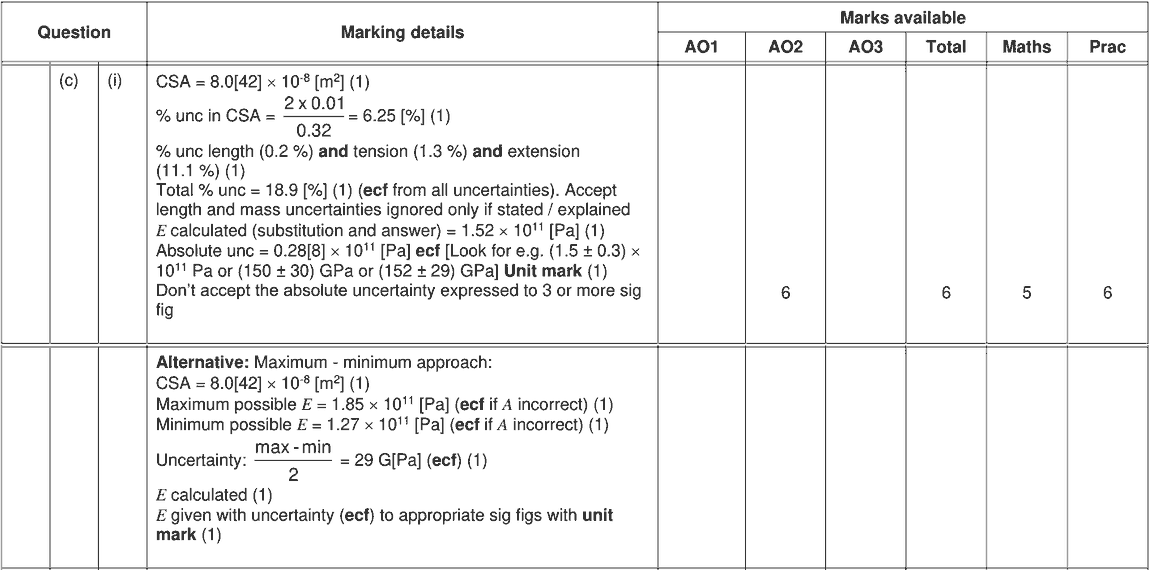
4(c)(i) Solids under stress 6AO2=6Practical and data analysis
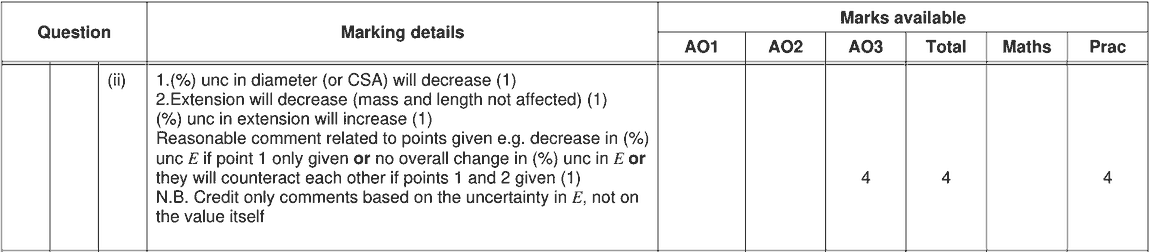
4(c)(ii) Solids under stress 4AO3=4Practical and data analysis
5(a) Electrostatic and gravitational fields of force 1AO1=1Definition
5(b)(i) Electrostatic and gravitational fields of force 3AO1=2,AO2=1Calculation
5(b)(ii) Electrostatic and gravitational fields of force, Resistance 2AO1=1,AO2=1Calculation
5(b)(iii) Electrostatic and gravitational fields of force 2AO3=2Calculation
5(c)(i) Magnetic fields 1AO1=1Short answer
5(c)(ii) Magnetic fields, Capacitance 2AO2=2Show that
5(c)(iii) Magnetic fields 2AO1=1,AO2=1Calculation
5(c)(iv) Magnetic fields 2AO2=2Explanation
6(a) Using radiation to investigate stars 2AO1=2Explanation
6(b)(i) Using radiation to investigate stars 4AO1=1,AO2=3Calculation
6(b)(ii) Using radiation to investigate stars 2AO3=2Explanation
6(c) Using radiation to investigate stars 2AO3=2Short answer
7(a)(i) Orbits and the wider universe 2AO1=1,AO2=1Show that
7(a)(ii) Orbits and the wider universe 4AO2=4Calculation
7(b)(i) Orbits and the wider universe 2AO2=2Calculation
7(b)(ii) Orbits and the wider universe 2AO1=2Explanation
8(a) Electrostatic and gravitational fields of force 2AO1=1,AO2=1Show that
8(b)(i) Electrostatic and gravitational fields of force, Energy concepts 2AO1=1,AO2=1Show that
8(b)(ii) Electrostatic and gravitational fields of force 2AO2=2Calculation
8(c)(i) Kinetic theory 4AO1=1,AO2=3Show that
8(c)(ii) Kinetic theory 2AO3=2Explanation

The questions

1(a)(i)1(a)(ii)1(b)(i)1(b)(ii)1(b)(iii)2(a)2(b)(i)2(b)(ii)3(a)(i)3(a)(ii)3(b)3(c)4(a)4(b)4(b)(iii)4(c)(i)4(c)(ii)5(a)5(b)(i)5(b)(ii)5(b)(iii)5(c)(i)5(c)(ii)5(c)(iii)5(c)(iv)6(a)6(b)(i)6(b)(ii)6(c)7(a)(i)7(a)(ii)7(b)(i)7(b)(ii)8(a)8(b)(i)8(b)(ii)8(c)(i)8(c)(ii)
June 2022 · Component 2 · Q1(a)(i) 1 mark AO2=1 Short answer dc circuits
1. (a) Point P represents a junction in an electric circuit where five current-carrying conductors are joined. 0.6 A I= A 0.8 A P Q 1.2 A 0.4 A (i) Determine the value of I and indicate its direction with an arrow on the diagram. [1]
June 2022 · Component 2 · Q1(a)(ii) 1 mark AO2=1 Calculation conduction of electricity
Earlier part of question 1 that this part usesEarlier part of June 2022 Component 2 question 1
(ii) Calculate the number of electrons passing point Q in one second. [1]
June 2022 · Component 2 · Q1(b)(i) 2 marks AO1=1, AO2=1 Calculation dc circuitsresistance
Earlier part of question 1 that this part usesEarlier part of June 2022 Component 2 question 1
(b) Charlotte is investigating circuits involving combinations of buzzers. In the circuit below, buzzers P, Q, S and T can be controlled using switches X and Y. The buzzers are identical and their resistances remain constant. 6.0 V A X Switches X and Y are P S shown open. In this arrangement all four buzzers are ON. Y Q T (i) With X and Y open (as shown), the ammeter reads 18.2 mA. Calculate the resistance of each buzzer. [2]


June 2022 · Component 2 · Q1(b)(ii) 3 marks AO3=3 Calculation dc circuitsresistance
Earlier parts of question 1 that this part usesEarlier part of June 2022 Component 2 question 1Earlier part of June 2022 Component 2 question 1
(ii) Charlotte predicts that the ammeter reading increases when X is closed and increases further when X and Y are closed. Determine whether or not she is correct. [3]
June 2022 · Component 2 · Q1(b)(iii) 3 marks AO1=2, AO2=1 Show that resistance
Earlier parts of question 1 that this part usesEarlier part of June 2022 Component 2 question 1Earlier part of June 2022 Component 2 question 1
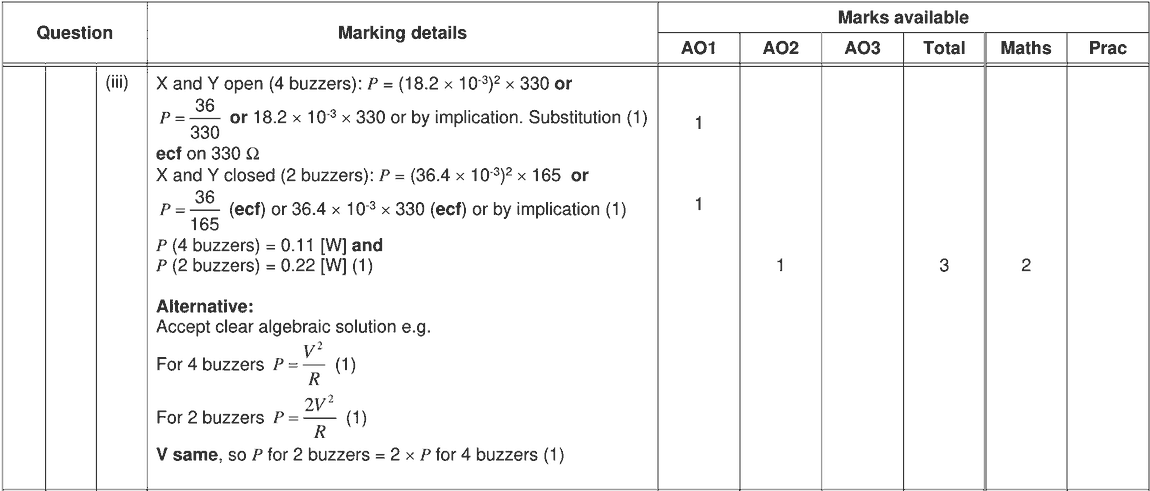
(iii) Charlotte uses a decibel meter to measure the loudness of the sound emitted by the buzzers. She records that the sound emitted is twice as loud when only two buzzers are operating compared to when all 4 buzzers are operating. By determining the power, show that Charlotte’s measurements are to be expected. [3]
June 2022 · Component 2 · Q2(a) 6 marks AO1=6 6-mark extended response resistance
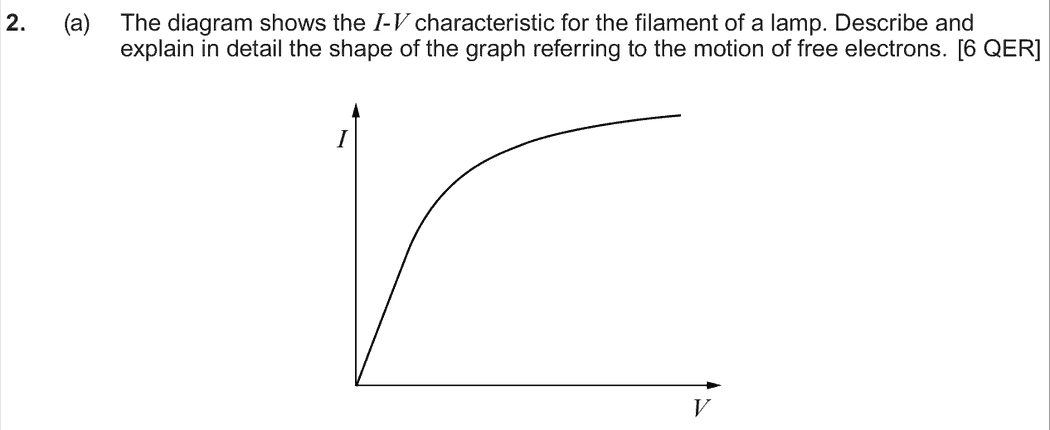
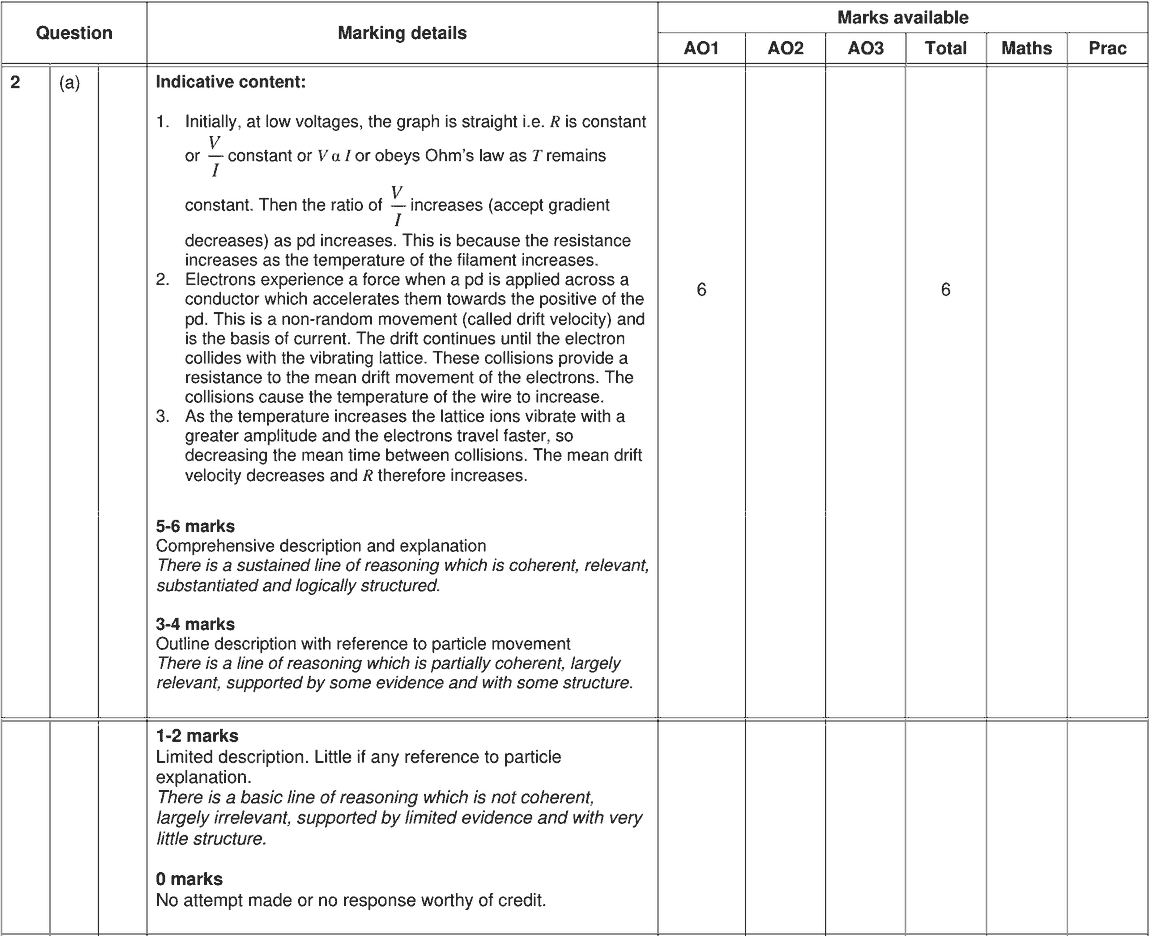
2. (a) The diagram shows the I-V characteristic for the filament of a lamp. Describe and explain in detail the shape of the graph referring to the motion of free electrons. [6 QER] I V
June 2022 · Component 2 · Q2(b)(i) 4 marks AO3=4 Practical and data analysis dc circuits
Earlier part of question 2 that this part usesEarlier part of June 2022 Component 2 question 2
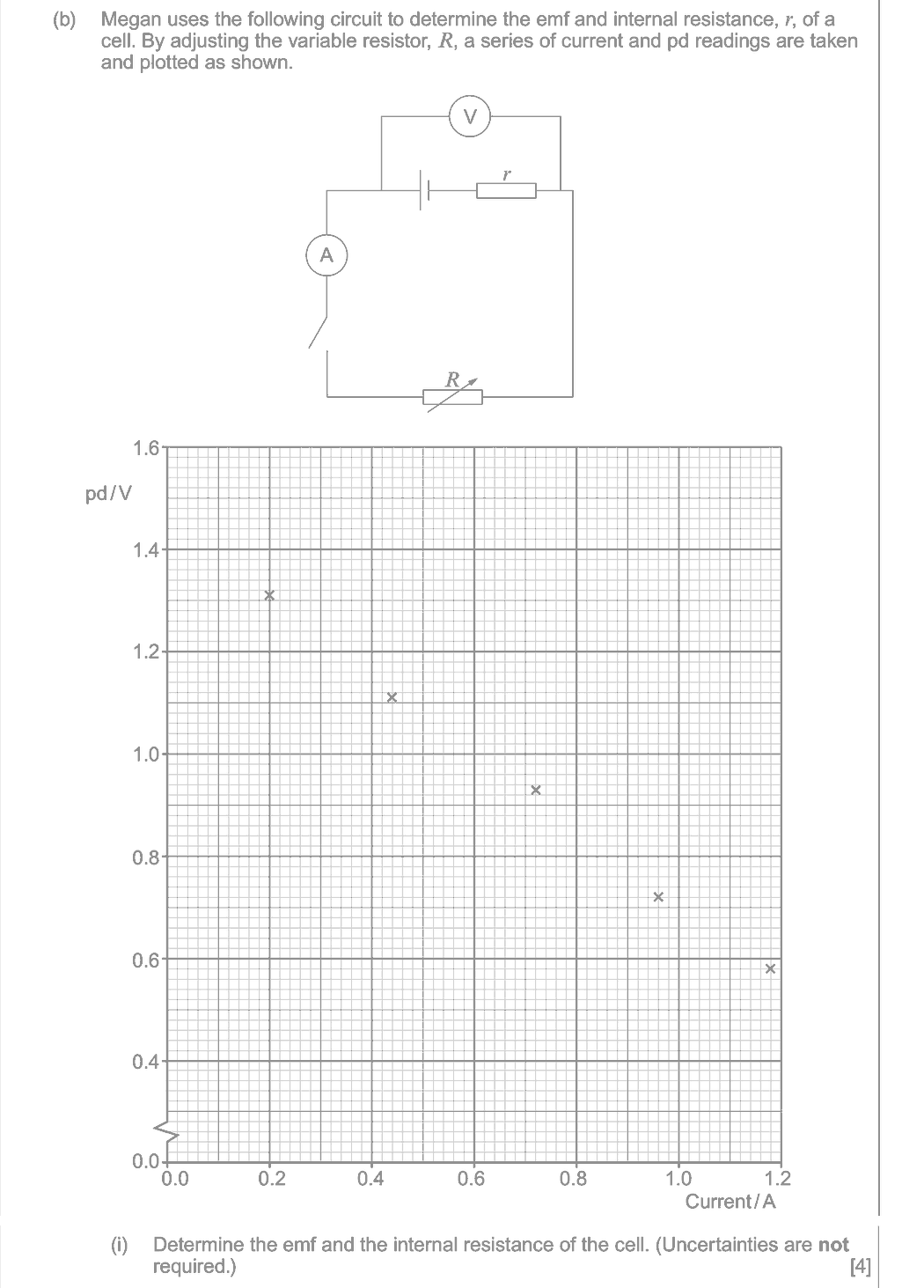
(b) Megan uses the following circuit to determine the emf and internal resistance, r, of a cell. By adjusting the variable resistor, R, a series of current and pd readings are taken and plotted as shown. V r A R 1.6 pd / V 1.4 1.2 1.0 0.8 0.6 0.4 0.0 0.0 0.2 0.4 0.6 0.8 1.0 1.2 Current / A (i) Determine the emf and the internal resistance of the cell. (Uncertainties are not required.) [4]
June 2022 · Component 2 · Q2(b)(ii) 1 mark AO3=1 Practical and data analysis dc circuits
Earlier parts of question 2 that this part usesEarlier part of June 2022 Component 2 question 2Earlier part of June 2022 Component 2 question 2
(ii) As part of her experimental write-up, Megan makes the following statement: Readings of V and I will be taken quickly with the switch closed. I will ensure the switch is open between readings. State the importance of this technique when carrying out this experiment. [1]
June 2022 · Component 2 · Q3(a)(i) 3 marks AO3=3 Calculation capacitance
3. (a) A physics student wishes to construct a capacitor which will store 31 nC of charge when connected to an 8.0 V power supply. He carries out some calculations and determines that placing two square aluminium plates of side length 21 cm a distance of 0.10 mm from each other (as shown) would be suitable. The diagram is not to scale. 8.0 V 21 cm 21 cm 0.10 mm (i) Determine whether or not this capacitor set-up will store the required charge. [3]
June 2022 · Component 2 · Q3(a)(ii) 1 mark AO1=1 Short answer capacitance
Earlier part of question 3 that this part usesEarlier part of June 2022 Component 2 question 3
(ii) State how the student could increase the charge stored without changing any of the dimensions of the capacitor, or the power supply to it. [1]
June 2022 · Component 2 · Q3(b) 6 marks AO1=1, AO2=5 Calculation capacitance
Earlier part of question 3 that this part usesEarlier part of June 2022 Component 2 question 3
(b) The diagram shows a combination of capacitors, C1, C2 and C3 connected to a 6.0 V power supply. C1 = 2.0 μF C3 = 8.0 μF C2 = 2.0 μF 6.0 V Determine the charges on each of the capacitors and the potential differences across them. [6]
June 2022 · Component 2 · Q3(c) 3 marks AO2=3 Show that capacitance
Earlier parts of question 3 that this part usesEarlier part of June 2022 Component 2 question 3Earlier part of June 2022 Component 2 question 3
(c) Two identical capacitors, A and B, are charged to a pd V. Capacitor A is connected to a R resistor of value R and capacitor B is connected to a resistor of value . 2 The time taken for the charge on capacitor A to decrease from 16 nC to 8 nC is given by t. The time taken for the charge on capacitor B to decrease from 16 nC to 2 nC is given by T. 3t Show that T = . [3] 2
June 2022 · Component 2 · Q4(a) 2 marks AO1=2 Explanation solids under stress
4. (a) In the production of steel alloy, atoms of carbon are added to iron. The resulting alloy is less ductile than pure iron. State the meaning of the term ductile, and describe, on an atomic scale, why the addition of carbon atoms can make steel less ductile than iron. [2]
June 2022 · Component 2 · Q4(b) 5 marks Calculation solids under stress
Earlier part of question 4 that this part usesEarlier part of June 2022 Component 2 question 4
l (b) Two wires, one of copper and one of steel, each of the same length 2, and each with the same cross-sectional area, A, are attached end to end and suspended from a rigid support. A force, F, is applied as shown. (i) The strain energy, W, in the wire combination due to the stretching rigid 1 FΔx, Δx force, F, can be given by where represents the total support 2 extension in the wire combination. Show that: [3] 2l ( ) F 1 1 W = + 4A Ecopper Esteel l copper 2 l steel 2 (ii) Calculate W when F = 45.0 N, given that A = 0.6 × 10–6 m2 and l = 3.8 m, [Ecopper = 120 GPa and Esteel = 180 GPa]. [2] F
June 2022 · Component 2 · Q4(b)(iii) 2 marks AO3=2 Calculation solids under stress
Earlier parts of question 4 that this part usesEarlier part of June 2022 Component 2 question 4Earlier part of June 2022 Component 2 question 4
(iii) A student measures the total extension of the combination to be approximately 2 mm when F = 45.0 N. Determine whether or not her measurement is consistent with your answer to (b)(ii). [2]
June 2022 · Component 2 · Q4(c)(i) 6 marks AO2=6 Practical and data analysis solids under stress
Earlier parts of question 4 that this part usesEarlier part of June 2022 Component 2 question 4Earlier part of June 2022 Component 2 question 4
(c) (i) Jasmine wishes to determine the Young modulus of a metal in the form of a wire. She makes the following measurements, along with uncertainties. Diameter = 0.32 ± 0.01 mm Initial length = 2.825 ± 0.005 m Tension = 7.8 ± 0.1 N Extension = 1.8 mm ± 0.2 mm Determine the Young modulus of the metal, along with the absolute uncertainty in its value. Give your answer to an appropriate number of significant figures. [6]
June 2022 · Component 2 · Q4(c)(ii) 4 marks AO3=4 Practical and data analysis solids under stress
Earlier parts of question 4 that this part usesEarlier part of June 2022 Component 2 question 4Earlier part of June 2022 Component 2 question 4Earlier part of June 2022 Component 2 question 4
(ii) Jasmine repeats her experiment by using a wire made of the same metal and original length, but with a larger diameter. Without further calculation, discuss how this change might affect the uncertainty in her result for the Young modulus. [4]
June 2022 · Component 2 · Q5(a) 1 mark AO1=1 Definition electrostatic and gravitational fields
5. (a) Define electric potential, VE, at a point in an electric field. [1]
June 2022 · Component 2 · Q5(b)(i) 3 marks AO1=2, AO2=1 Calculation electrostatic and gravitational fields
Earlier part of question 5 that this part usesEarlier part of June 2022 Component 2 question 5
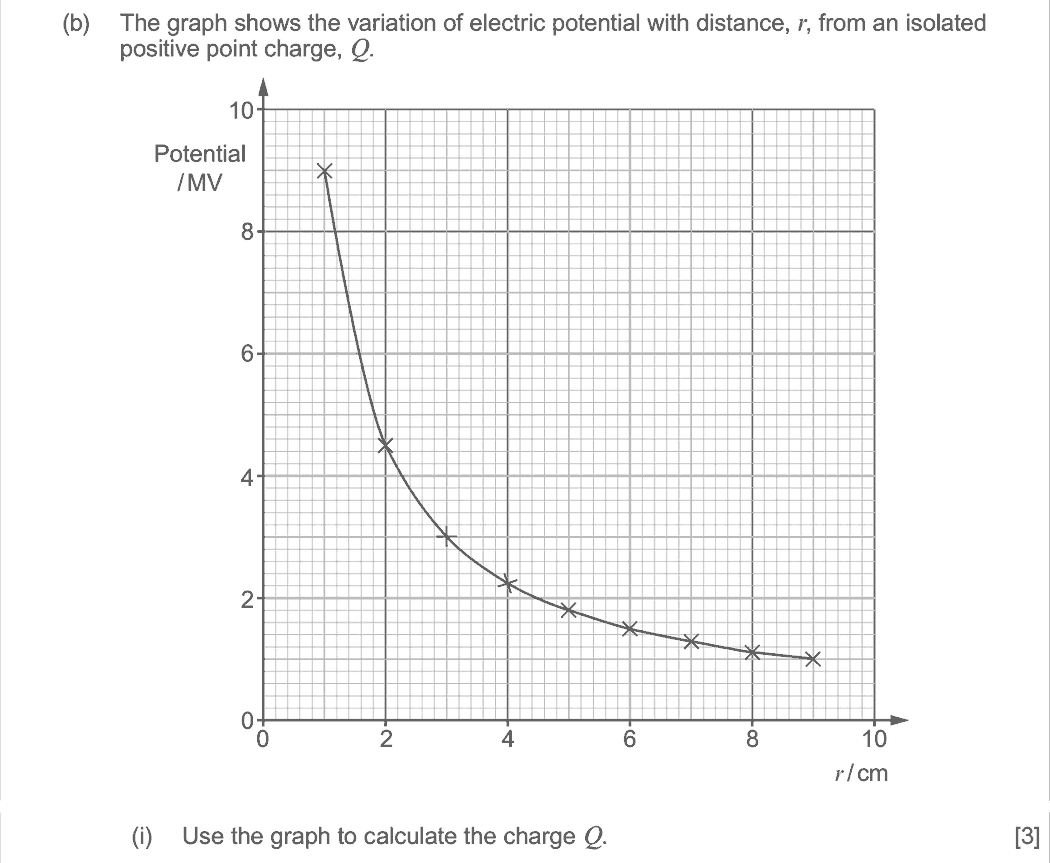
(b) The graph shows the variation of electric potential with distance, r, from an isolated positive point charge, Q. 10 Potential / MV 8 6 4 2 0 0 2 4 6 8 10 r / cm (i) Use the graph to calculate the charge Q. [3]
June 2022 · Component 2 · Q5(b)(ii) 2 marks AO1=1, AO2=1 Calculation electrostatic and gravitational fieldsresistance
Earlier parts of question 5 that this part usesEarlier part of June 2022 Component 2 question 5Earlier part of June 2022 Component 2 question 5
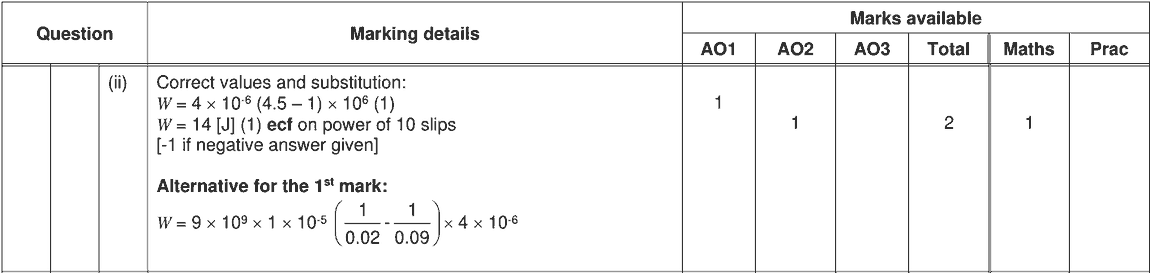
(ii) Calculate the work done to move a charge of +4.0 μC from 9.0 cm to 2.0 cm from the point charge. [2]
June 2022 · Component 2 · Q5(b)(iii) 2 marks AO3=2 Calculation electrostatic and gravitational fields
Earlier parts of question 5 that this part usesEarlier part of June 2022 Component 2 question 5Earlier part of June 2022 Component 2 question 5
(iii) The electric field strength at 3.0 cm from the charge is calculated to be 1.0 × 108 V m–1. Use the graph to confirm this value. [2]
June 2022 · Component 2 · Q5(c)(i) 1 mark AO1=1 Short answer magnetic fields
Earlier parts of question 5 that this part usesEarlier part of June 2022 Component 2 question 5Earlier part of June 2022 Component 2 question 5
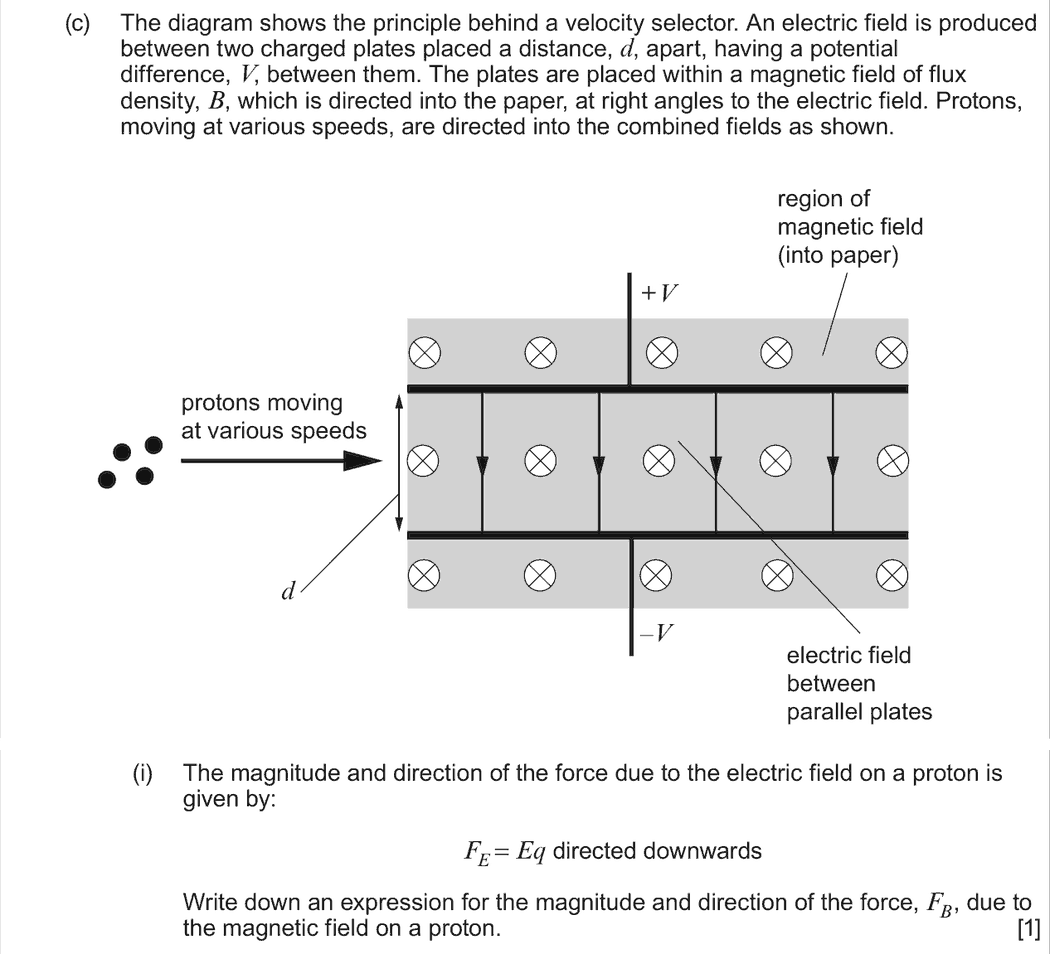
(c) The diagram shows the principle behind a velocity selector. An electric field is produced between two charged plates placed a distance, d, apart, having a potential difference, V, between them. The plates are placed within a magnetic field of flux density, B, which is directed into the paper, at right angles to the electric field. Protons, moving at various speeds, are directed into the combined fields as shown. region of magnetic field (into paper) +V protons moving at various speeds d –V electric field between parallel plates (i) The magnitude and direction of the force due to the electric field on a proton is given by: FE = Eq directed downwards Write down an expression for the magnitude and direction of the force, FB , due to the magnetic field on a proton. [1]
June 2022 · Component 2 · Q5(c)(ii) 2 marks AO2=2 Show that magnetic fieldscapacitance
Earlier parts of question 5 that this part usesEarlier part of June 2022 Component 2 question 5Earlier part of June 2022 Component 2 question 5Earlier part of June 2022 Component 2 question 5
(ii) Protons travel through the region of the combined fields in a straight line when FE = FB. Show that, under these conditions, the speed, v, of the protons can be given by: V v = [2] Bd
June 2022 · Component 2 · Q5(c)(iii) 2 marks AO1=1, AO2=1 Calculation magnetic fields
Earlier parts of question 5 that this part usesEarlier part of June 2022 Component 2 question 5Earlier part of June 2022 Component 2 question 5Earlier part of June 2022 Component 2 question 5
(iii) With B = 3.2 mT and d = 20 mm, determine the value of V, which would ‘select’ (allow) those protons with a speed of 6.0 × 106 m s–1 to travel through the fields undeflected. [2]
June 2022 · Component 2 · Q5(c)(iv) 2 marks AO2=2 Explanation magnetic fields
Earlier parts of question 5 that this part usesEarlier part of June 2022 Component 2 question 5Earlier part of June 2022 Component 2 question 5Earlier part of June 2022 Component 2 question 5
(iv) Describe and explain the motion of a proton travelling at less than 6.0 × 106 m s–1 through these fields. [2]
June 2022 · Component 2 · Q6(a) 2 marks AO1=2 Explanation radiation and stars
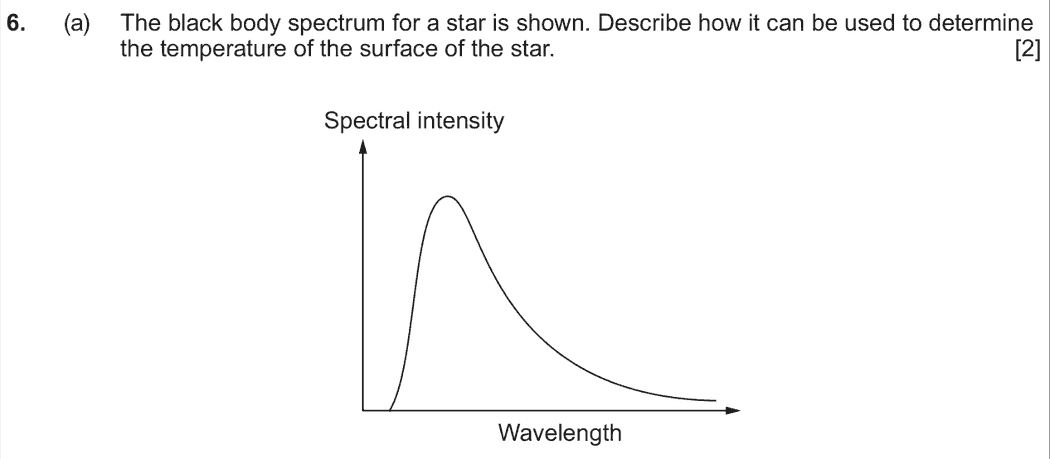
6. (a) The black body spectrum for a star is shown. Describe how it can be used to determine the temperature of the surface of the star. [2] Spectral intensity Wavelength
June 2022 · Component 2 · Q6(b)(i) 4 marks AO1=1, AO2=3 Calculation radiation and stars
Earlier part of question 6 that this part usesEarlier part of June 2022 Component 2 question 6
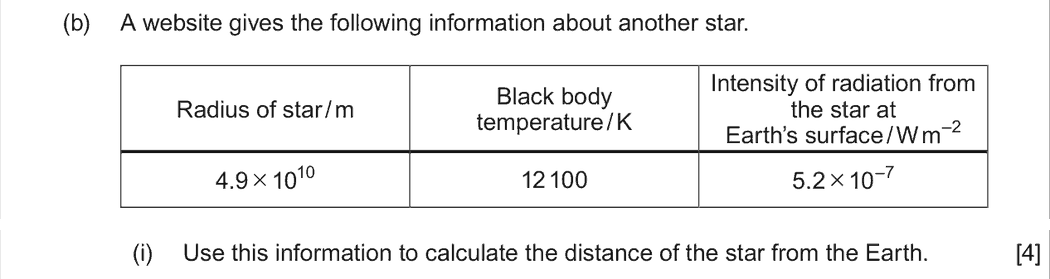
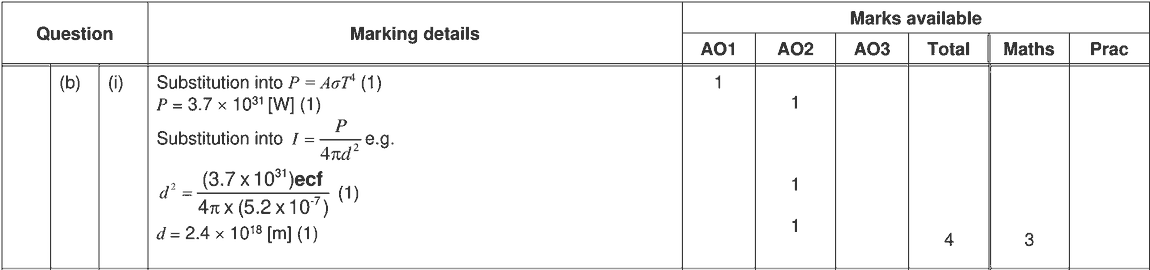
(b) A website gives the following information about another star. Intensity of radiation from Black body Radius of star / m the star at temperature / K Earth’s surface / W m–2 4.9 × 1010 12 100 5.2 × 10–7 (i) Use this information to calculate the distance of the star from the Earth. [4]
June 2022 · Component 2 · Q6(b)(ii) 2 marks AO3=2 Explanation radiation and stars
Earlier parts of question 6 that this part usesEarlier part of June 2022 Component 2 question 6Earlier part of June 2022 Component 2 question 6
(ii) The star is observed to be blue. Explain how the data supports this observation. [2]
June 2022 · Component 2 · Q6(c) 2 marks AO3=2 Short answer radiation and stars
Earlier part of question 6 that this part usesEarlier part of June 2022 Component 2 question 6
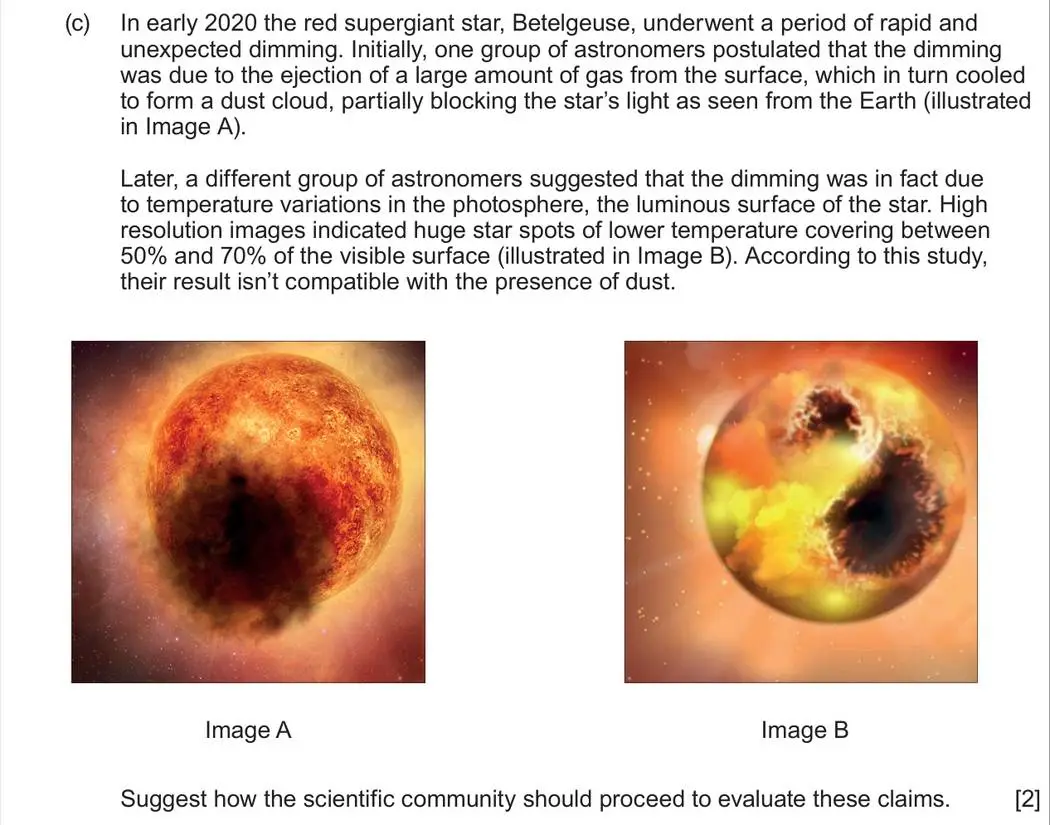
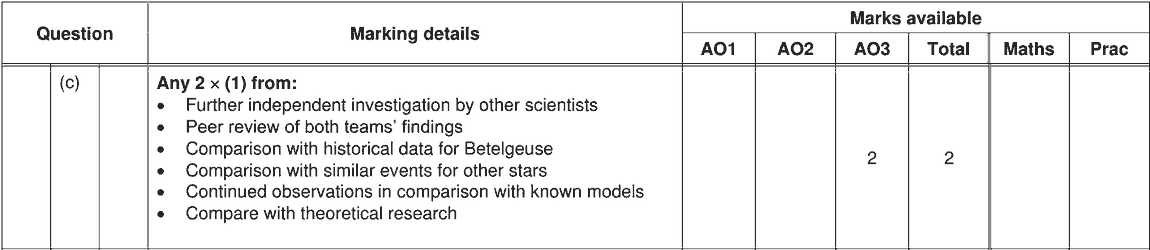
(c) In early 2020 the red supergiant star, Betelgeuse, underwent a period of rapid and unexpected dimming. Initially, one group of astronomers postulated that the dimming was due to the ejection of a large amount of gas from the surface, which in turn cooled to form a dust cloud, partially blocking the star’s light as seen from the Earth (illustrated in Image A). Later, a different group of astronomers suggested that the dimming was in fact due to temperature variations in the photosphere, the luminous surface of the star. High resolution images indicated huge star spots of lower temperature covering between 50% and 70% of the visible surface (illustrated in Image B). According to this study, their result isn’t compatible with the presence of dust. Image A Image B Suggest how the scientific community should proceed to evaluate these claims. [2]
June 2022 · Component 2 · Q7(a)(i) 2 marks AO1=1, AO2=1 Show that orbits and the wider universe
1 7. (a) (i) Stating an assumption, show that the age of the universe can be given by H0 where H0 is the Hubble constant. [2]
June 2022 · Component 2 · Q7(a)(ii) 4 marks AO2=4 Calculation orbits and the wider universe
Earlier part of question 7 that this part usesEarlier part of June 2022 Component 2 question 7
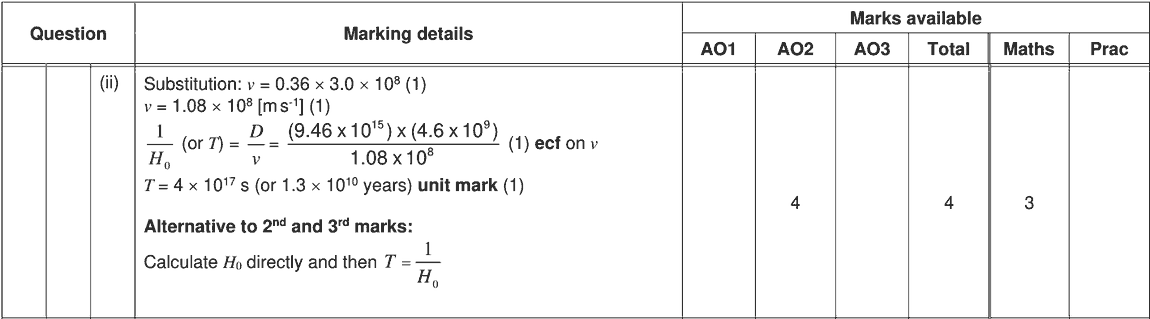
(ii) Quasars are extremely bright objects in the night sky. 3C48 is a quasar discovered in 1960 which is 4.60 × 109 light years from Earth and has a Δλ red shift, = 0.36. Use this information to estimate the age of the universe. [4] λ (1 light year = 9.46 × 1015 m.)
June 2022 · Component 2 · Q7(b)(i) 2 marks AO2=2 Calculation orbits and the wider universe
Earlier part of question 7 that this part usesEarlier part of June 2022 Component 2 question 7
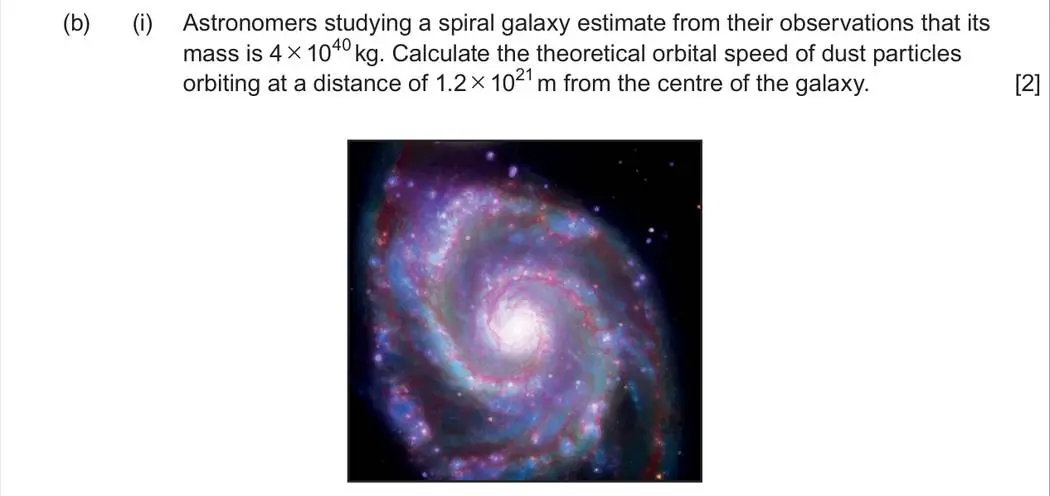
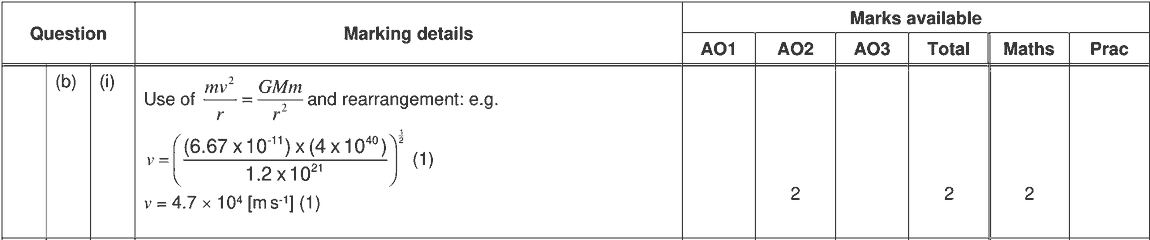
(b) (i) Astronomers studying a spiral galaxy estimate from their observations that its mass is 4 × 1040 kg. Calculate the theoretical orbital speed of dust particles orbiting at a distance of 1.2 × 1021 m from the centre of the galaxy. [2]
June 2022 · Component 2 · Q7(b)(ii) 2 marks AO1=2 Explanation orbits and the wider universe
Earlier parts of question 7 that this part usesEarlier part of June 2022 Component 2 question 7Earlier part of June 2022 Component 2 question 7
(ii) The measured velocity of the dust particles is found to be greater than the theoretical value calculated in (b)(i). Explain how astronomers account for this discrepancy. [2]
June 2022 · Component 2 · Q8(a) 2 marks AO1=1, AO2=1 Show that electrostatic and gravitational fields
8. (a) The gravitational field strength on the surface of the Moon is 1.62 N kg–1, and its radius is 1.74 × 106 m. Use this information to show that the mass of the Moon is approximately 7 × 1022 kg. [2]
June 2022 · Component 2 · Q8(b)(i) 2 marks AO1=1, AO2=1 Show that electrostatic and gravitational fieldsenergy concepts
Earlier part of question 8 that this part usesEarlier part of June 2022 Component 2 question 8
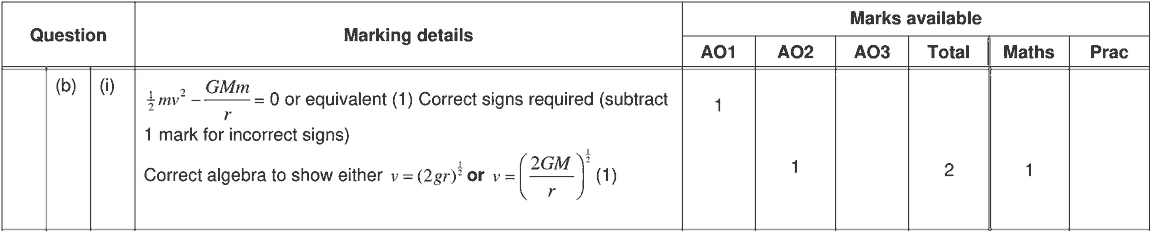
(b) An object’s escape velocity is the speed at which it needs to travel away from a body such as a planet or moon for it to break free from the gravitational pull of that body. (i) Use the principle of conservation of energy to derive an expression for the escape velocity, v, of a small body of mass, m, from a sphere of mass M and radius r. [2]
June 2022 · Component 2 · Q8(b)(ii) 2 marks AO2=2 Calculation electrostatic and gravitational fields
Earlier parts of question 8 that this part usesEarlier part of June 2022 Component 2 question 8Earlier part of June 2022 Component 2 question 8
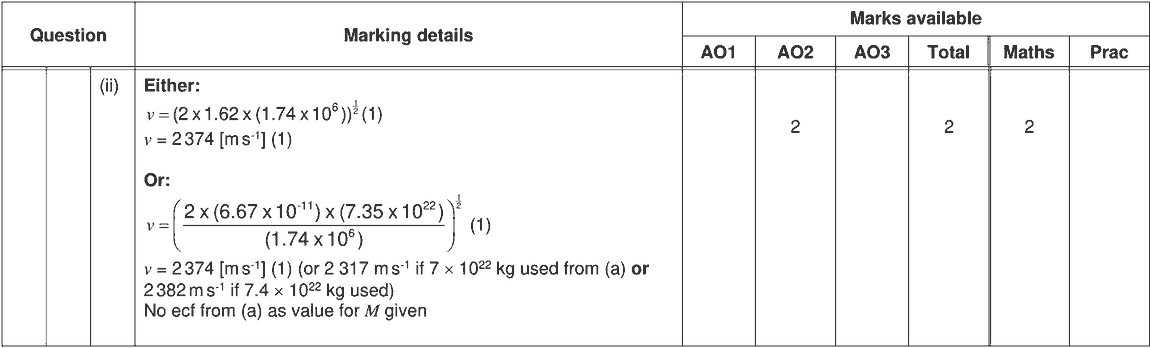
(ii) Hence, calculate the escape velocity from the Moon. [2]
June 2022 · Component 2 · Q8(c)(i) 4 marks AO1=1, AO2=3 Show that kinetic theory
Earlier part of question 8 that this part usesEarlier part of June 2022 Component 2 question 8
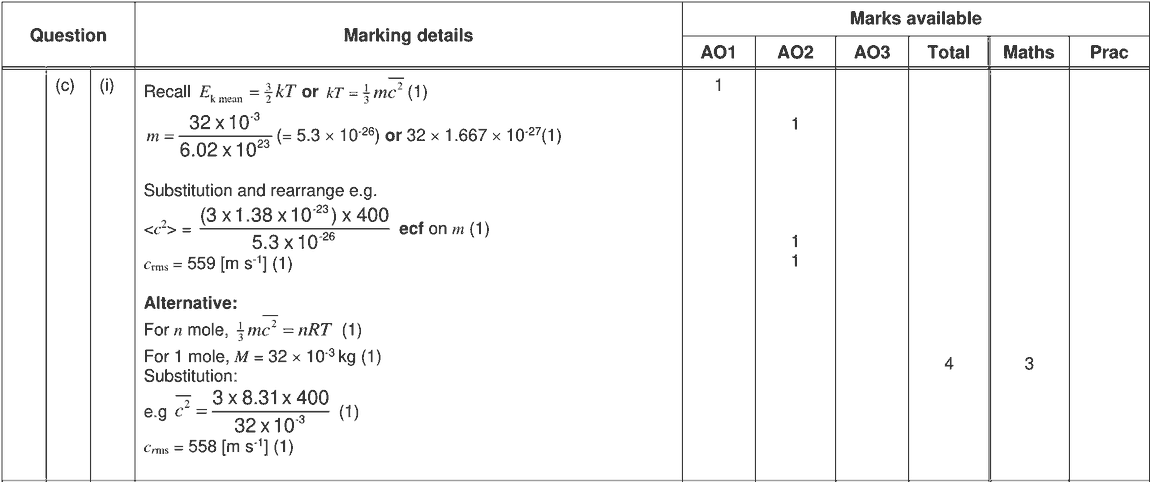
(c) (i) The Moon’s surface can reach a temperature as high as 400 K in direct sunlight. Show that the rms speed of oxygen molecules at this temperature is greater than 500 m s–1. (The relative molecular mass of oxygen is 32.) [4]
June 2022 · Component 2 · Q8(c)(ii) 2 marks AO3=2 Explanation kinetic theory
Earlier parts of question 8 that this part usesEarlier part of June 2022 Component 2 question 8Earlier part of June 2022 Component 2 question 8
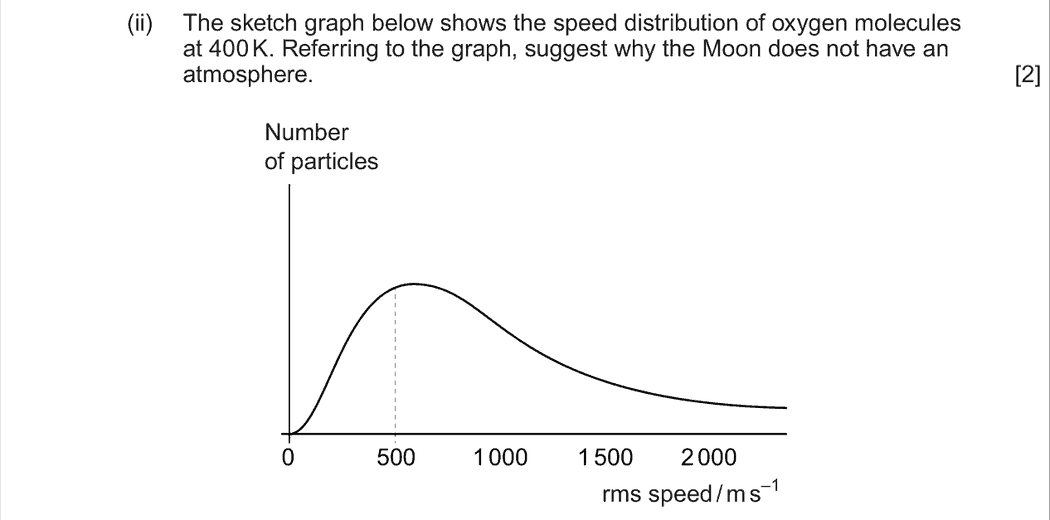
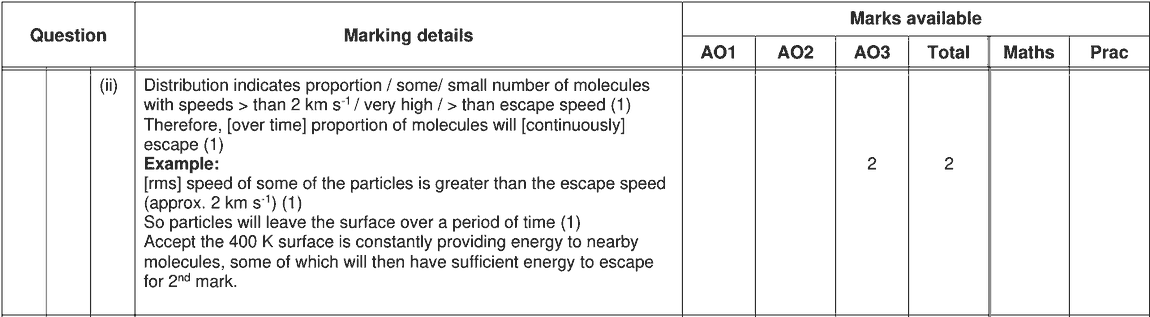
(ii) The sketch graph below shows the speed distribution of oxygen molecules at 400 K. Referring to the graph, suggest why the Moon does not have an atmosphere. [2] Number of particles 0 500 1 000 1 500 2 000 rms speed / m s–1

Work with an Eduqas physics tutor

Want a paper marked and gone through with you? Message us.

Prefer email? Send an enquiry

If you are under 18, please include a parent's contact details. Enquiries go to enquiries@physicsaleveltutor.com and are deleted once handled. All tutoring is online.