June 2024: Component 1

100 marks · 40 question parts · Paper, mark scheme and report on Eduqas's site · Have the Data Booklet beside you
Question by question

QTopicMarksAOType
1(a)(i) Basic physics: units, vectors and moments 1AO1=1Practical and data analysis
1(a)(ii) Basic physics: units, vectors and moments 1AO2=1Practical and data analysis
1(a)(iii) Basic physics: units, vectors and moments 2AO1=1,AO2=1Show that
1(b) Basic physics: units, vectors and moments 4AO3=4Practical and data analysis
2(a)(i) Kinematics 1AO1=1Show that
2(a)(ii) Kinematics 3AO1=1,AO2=2Show that
2(b) Kinematics 3AO3=3Explanation
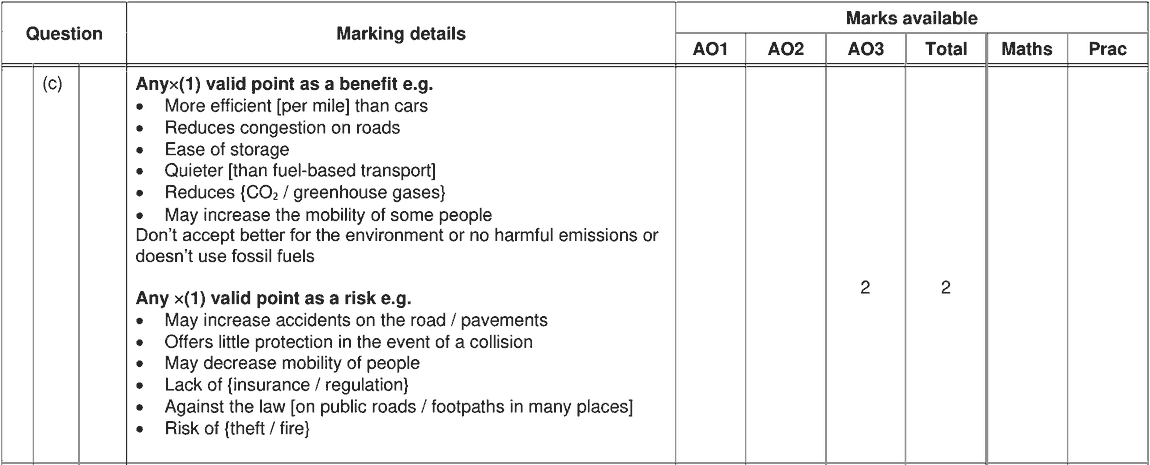
2(c) Kinematics 2AO3=2Short answer
3(a) Energy concepts 2AO1=2Definition
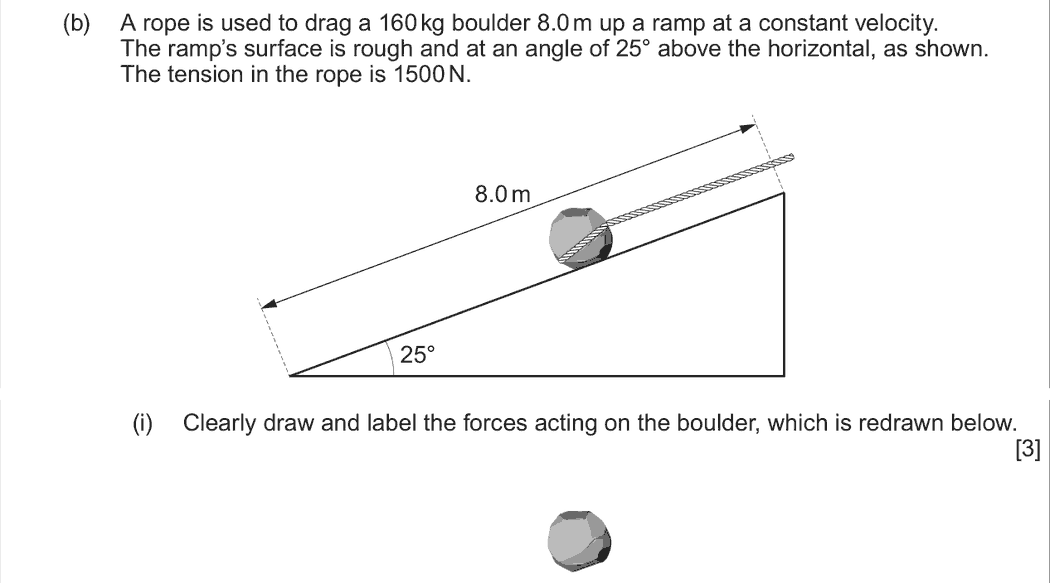
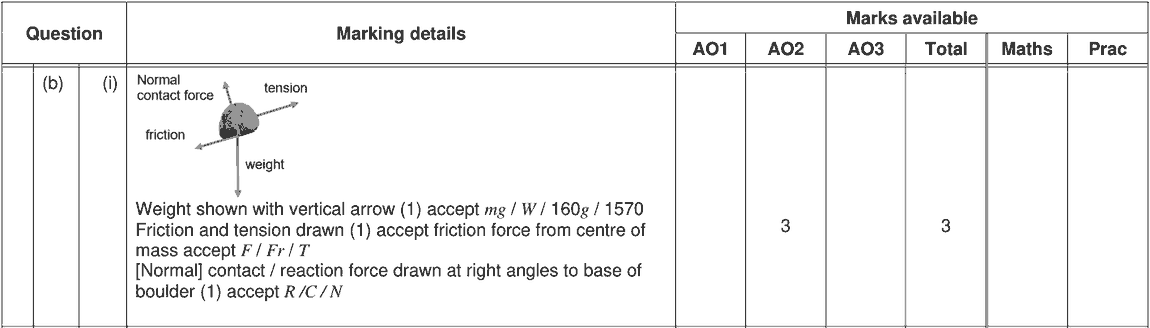
3(b)(i) Dynamics: forces and momentum 3AO2=3Diagram or graph
3(b)(ii) Energy concepts 1AO2=1Calculation
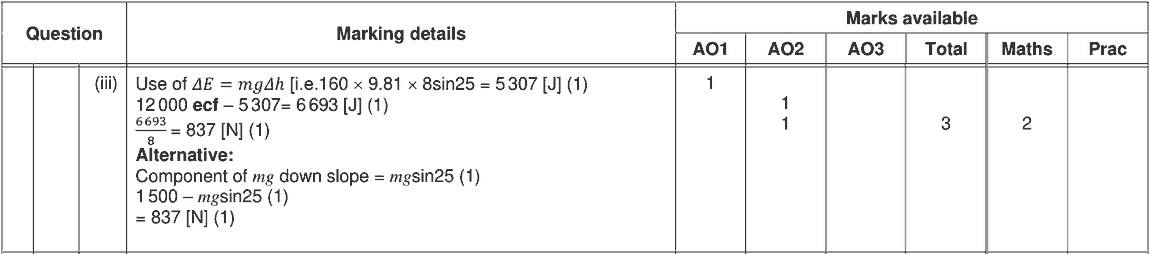
3(b)(iii) Energy concepts, Basic physics: units, vectors and moments 3AO1=1,AO2=2Calculation
3(c) Energy concepts 3AO1=1,AO2=2Calculation
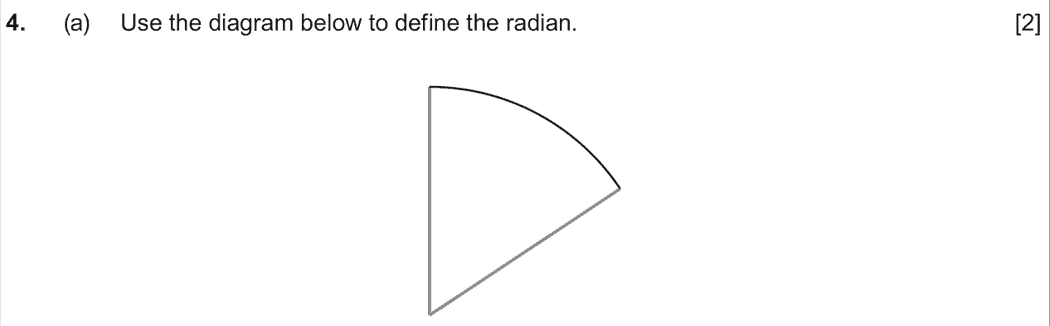
4(a) Circular motion 2AO1=2Definition
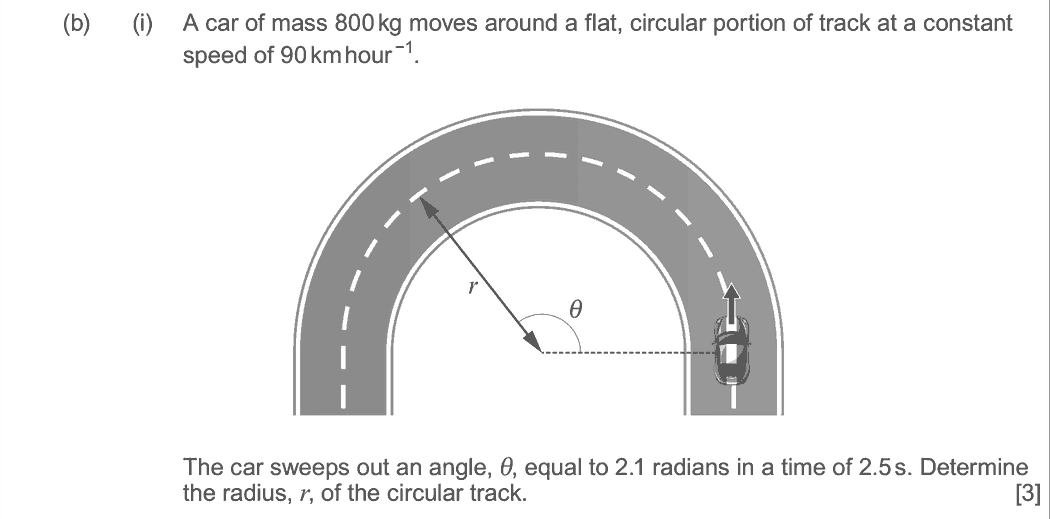
4(b)(i) Circular motion 3AO1=1,AO2=2Calculation
4(b)(ii) Magnetic fields, Circular motion 4AO1=1,AO2=3Calculation
4(b)(iii)I Circular motion 1AO2=1Short answer
4(b)(iii)II Circular motion 3AO3=3Calculation
5(a) Vibrations: simple harmonic motion 2AO1=2Definition
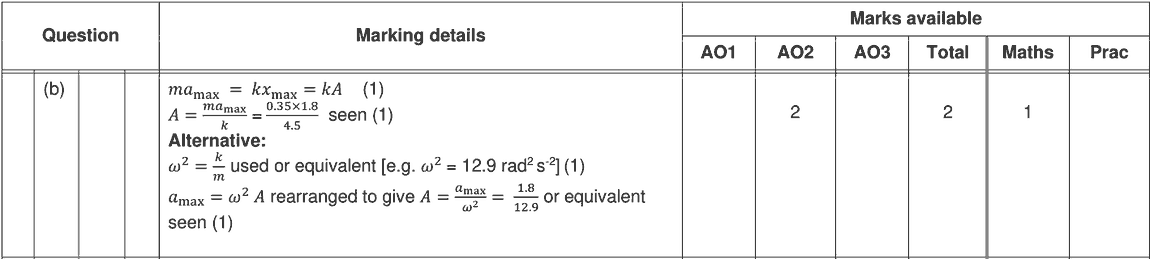
5(b) Vibrations: simple harmonic motion 2AO2=2Show that
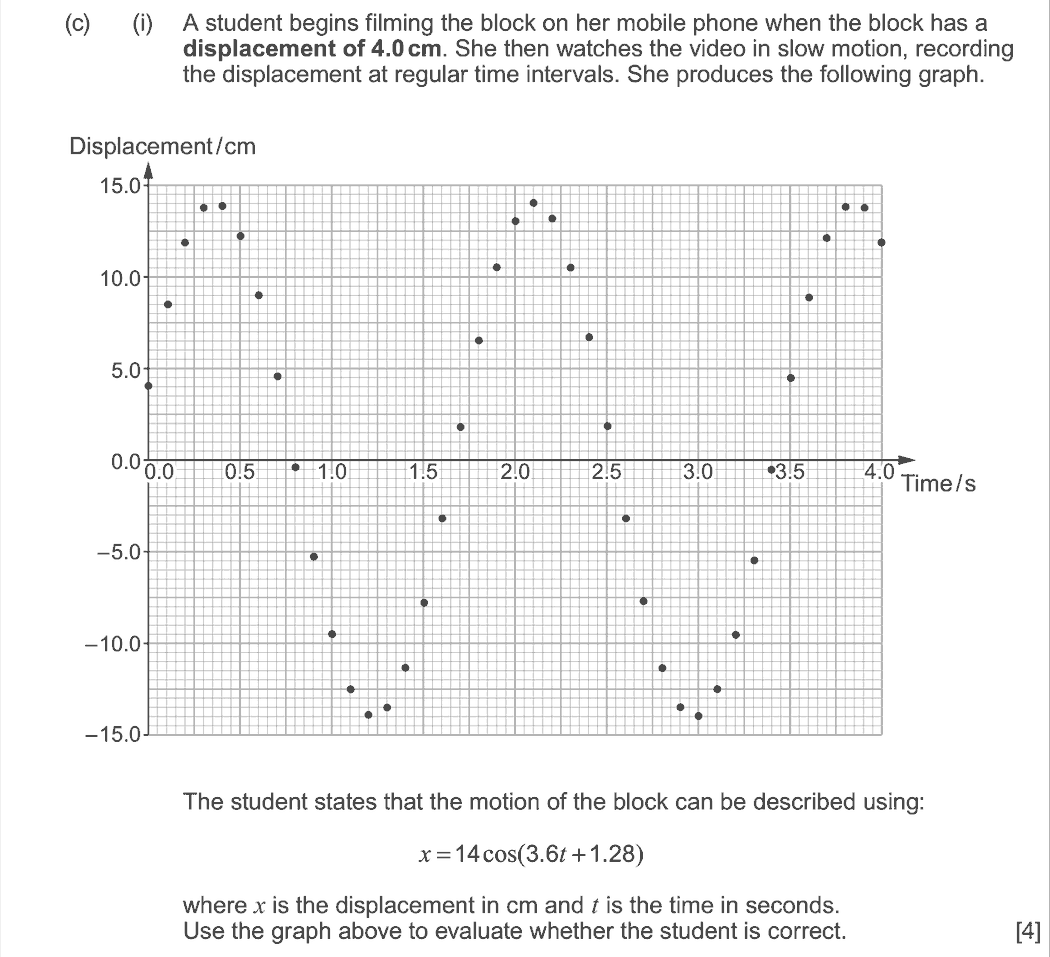
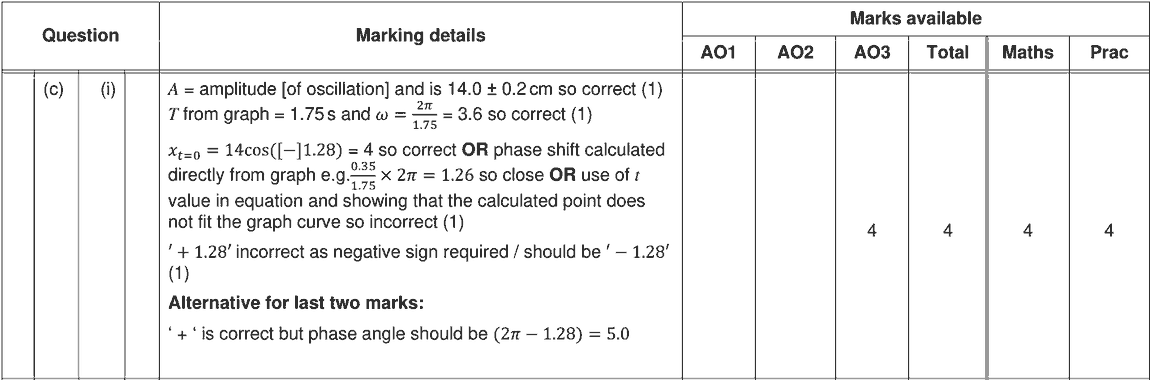
5(c)(i) Vibrations: simple harmonic motion 4AO3=4Practical and data analysis
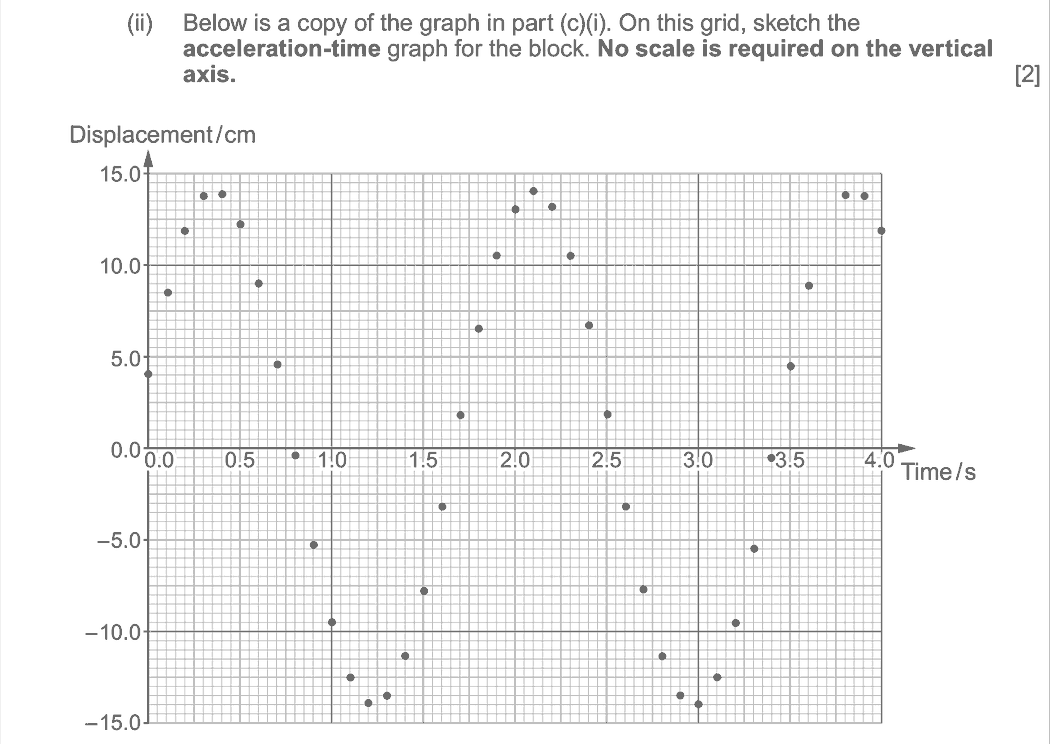
5(c)(ii) Vibrations: simple harmonic motion 2AO2=2Diagram or graph
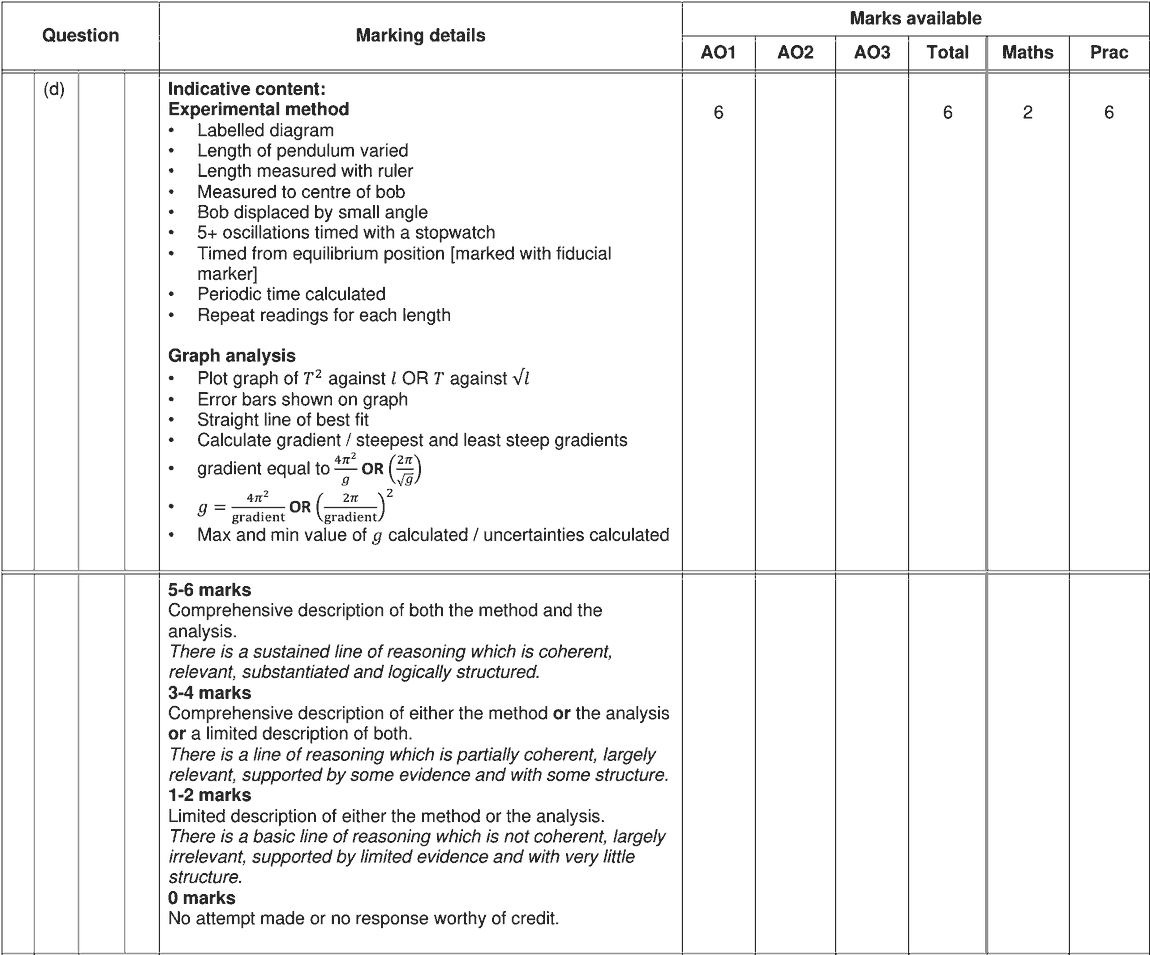
5(d) Vibrations: simple harmonic motion 6AO1=6Extended response
6(a) Kinetic theory 1AO1=1Definition
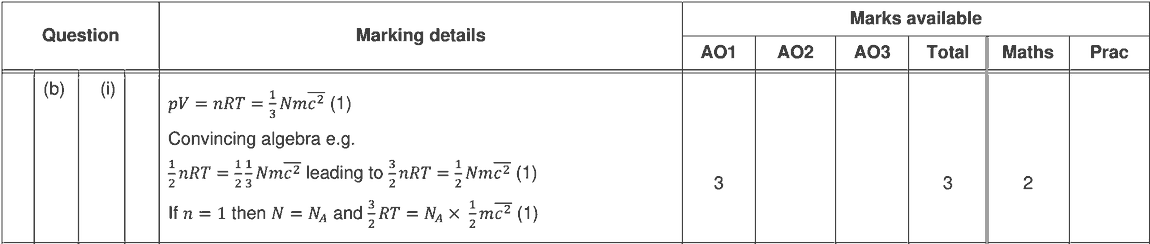
6(b)(i) Kinetic theory 3AO1=3Show that
6(b)(ii) Kinetic theory 3AO3=3Calculation
7(a) Kinetic theory 3AO1=1,AO2=2Calculation
7(b)(i) Thermal physics 1AO1=1Definition
7(b)(ii)I Thermal physics 2AO2=2Calculation
7(b)(ii)II Kinetic theory 2AO2=2Calculation
7(b)(iii) Kinetic theory 4AO2=4Explanation
7(c) Thermal physics 3AO2=3Explanation
8(a)(i) Wave properties: diffraction, interference and stationary waves, Comprehension: the Component 1 article questions 1AO1=1Diagram or graph
8(a)(ii) Wave properties: diffraction, interference and stationary waves, Comprehension: the Component 1 article questions 1AO2=1Short answer
8(b) Wave properties: diffraction, interference and stationary waves, Comprehension: the Component 1 article questions 2AO3=2Calculation
8(c) Comprehension: the Component 1 article questions 2AO3=2Calculation
8(d) The nature of waves, Comprehension: the Component 1 article questions 4AO1=1,AO2=3Explanation
8(e) The nature of waves, Comprehension: the Component 1 article questions 3AO1=1,AO2=2Calculation
8(f) Electromagnetic induction, Comprehension: the Component 1 article questions 5AO1=1,AO2=4Explanation
8(g) Electromagnetic induction, Comprehension: the Component 1 article questions 2AO3=2Explanation

The questions

1(a)(i)1(a)(ii)1(a)(iii)1(b)2(a)(i)2(a)(ii)2(b)2(c)3(a)3(b)(i)3(b)(ii)3(b)(iii)3(c)4(a)4(b)(i)4(b)(ii)4(b)(iii)I4(b)(iii)II5(a)5(b)5(c)(i)5(c)(ii)5(d)6(a)6(b)(i)6(b)(ii)7(a)7(b)(i)7(b)(ii)I7(b)(ii)II7(b)(iii)7(c)8(a)(i)8(a)(ii)8(b)8(c)8(d)8(e)8(f)8(g)
June 2024 · Component 1 · Q1(a)(i) 1 mark AO1=1 Practical and data analysis basic physics
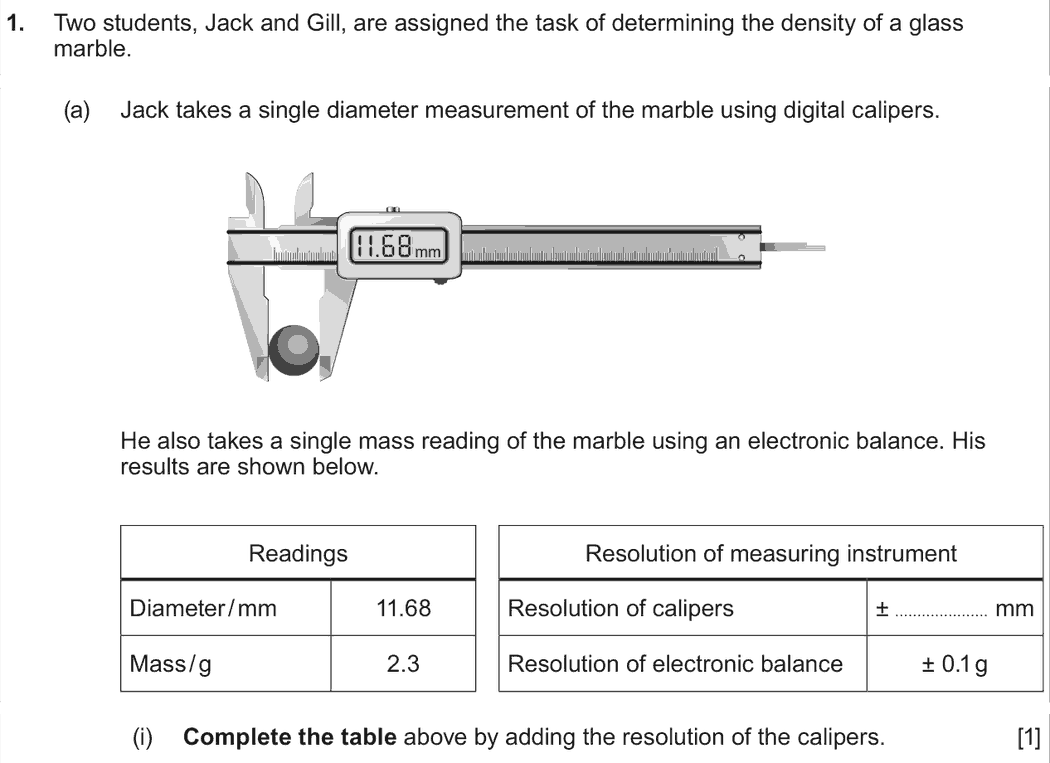
1. Two students, Jack and Gill, are assigned the task of determining the density of a glass marble. (a) Jack takes a single diameter measurement of the marble using digital calipers. mm He also takes a single mass reading of the marble using an electronic balance. His results are shown below. Readings Resolution of measuring instrument Diameter / mm 11.68 Resolution of calipers ± mm Mass / g 2.3 Resolution of electronic balance ± 0.1 g (i) Complete the table above by adding the resolution of the calipers. [1]
June 2024 · Component 1 · Q1(a)(ii) 1 mark AO2=1 Practical and data analysis basic physics
Earlier part of question 1 that this part usesEarlier part of June 2024 Component 1 question 1

(ii) After taking the measurements, Jack notices that when the jaws of the calipers are closed they read −0.04 mm. Suggest how Jack should allow for this discrepancy in the density calculation. [1]
June 2024 · Component 1 · Q1(a)(iii) 2 marks AO1=1, AO2=1 Show that basic physics
Earlier part of question 1 that this part usesEarlier part of June 2024 Component 1 question 1


(iii) Hence, show that the density of the marble is approximately 2.7 g cm–3. [2]
June 2024 · Component 1 · Q1(b) 4 marks AO3=4 Practical and data analysis basic physics
Earlier part of question 1 that this part usesEarlier part of June 2024 Component 1 question 1

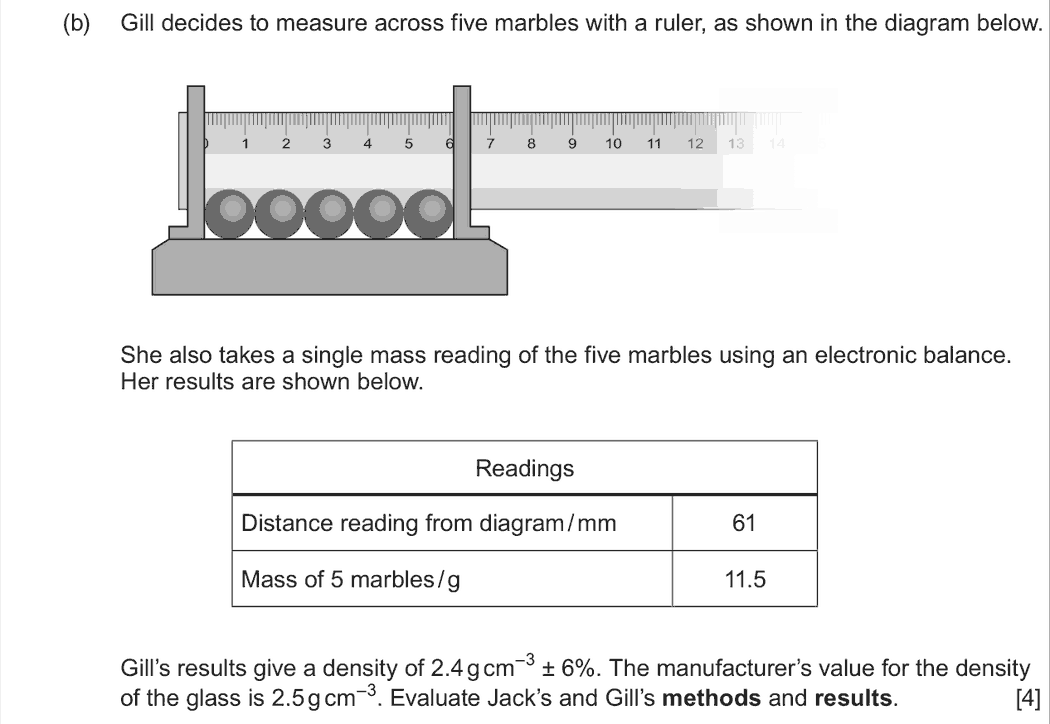
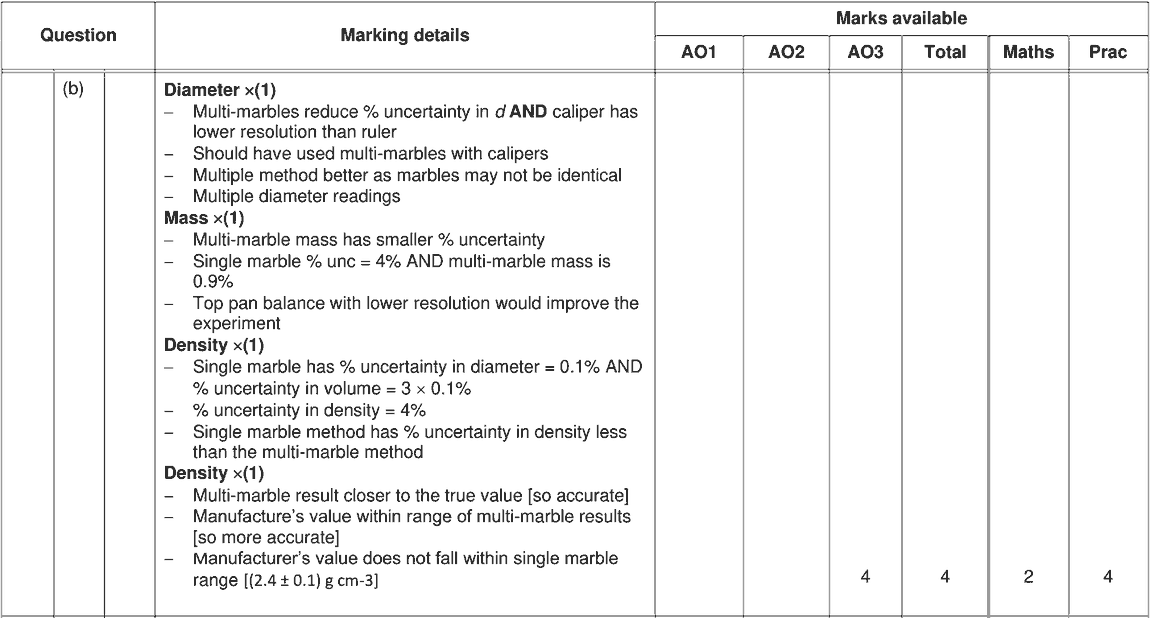
(b) Gill decides to measure across five marbles with a ruler, as shown in the diagram below. 0 1 2 3 4 5 6 7 8 9 10 11 12 13 14 15 16 1 She also takes a single mass reading of the five marbles using an electronic balance. Her results are shown below. Readings Distance reading from diagram / mm 61 Mass of 5 marbles / g 11.5 Gill’s results give a density of 2.4 g cm–3 ± 6%. The manufacturer’s value for the density of the glass is 2.5 g cm–3. Evaluate Jack’s and Gill’s methods and results. [4]

June 2024 · Component 1 · Q2(a)(i) 1 mark AO1=1 Show that Easy kinematics
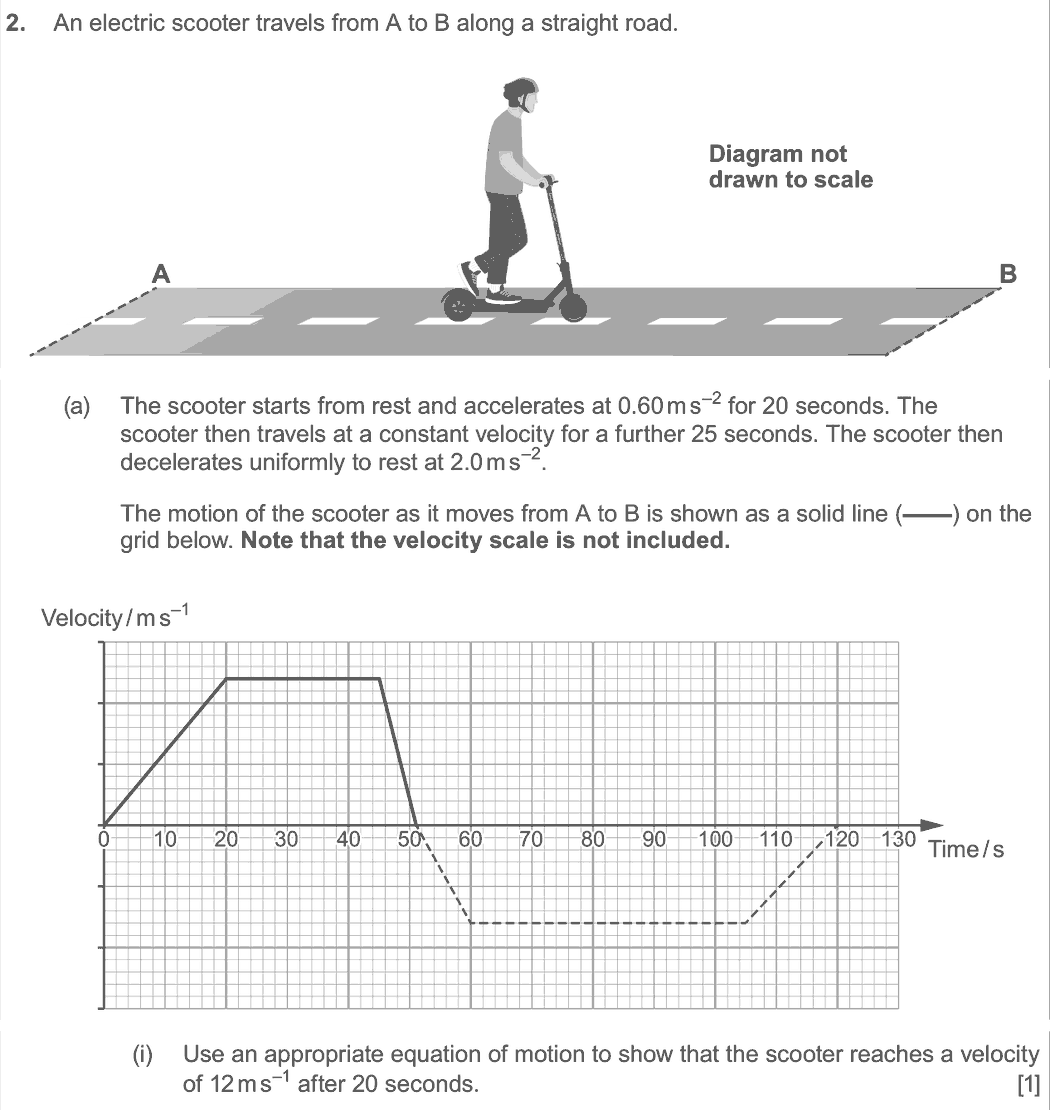
2. An electric scooter travels from A to B along a straight road. Diagram not drawn to scale A B (a) The scooter starts from rest and accelerates at 0.60 m s–2 for 20 seconds. The scooter then travels at a constant velocity for a further 25 seconds. The scooter then decelerates uniformly to rest at 2.0 m s–2. The motion of the scooter as it moves from A to B is shown as a solid line ( ) on the grid below. Note that the velocity scale is not included. Velocity / m s–1 0 0 10 10 20 20 30 30 40 40 50 50 60 60 70 70 80 80 90 90 100 100 110 110 120 120 130 130 Time / s (i) Use an appropriate equation of motion to show that the scooter reaches a velocity of 12 m s–1 after 20 seconds. [1]
June 2024 · Component 1 · Q2(a)(ii) 3 marks AO1=1, AO2=2 Show that Easy kinematics
Earlier part of question 2 that this part usesEarlier part of June 2024 Component 1 question 2
(ii) Show that the mean speed for the first 51 seconds is approximately 9 m s–1. [3]
June 2024 · Component 1 · Q2(b) 3 marks AO3=3 Explanation Easy kinematics
Earlier part of question 2 that this part usesEarlier part of June 2024 Component 1 question 2
(b) The dashed line ( ) on the grid represents the return journey from B to A. Charlie and Lola analyse the electric scooter’s motion over the entire journey (from A to B and back again). Charlie states that the mean speed is 9 m s–1. Lola states that the mean velocity is 0 m s–1. Discuss the validity of both these statements. [3]
June 2024 · Component 1 · Q2(c) 2 marks AO3=2 Short answer Easy kinematics
Earlier part of question 2 that this part usesEarlier part of June 2024 Component 1 question 2
(c) The development of the technology of electric scooters has seen them becoming more common on some city roads in the UK. State one benefit and one risk of using this form of transport. [2]
June 2024 · Component 1 · Q3(a) 2 marks AO1=2 Definition Easy energy concepts
3. (a) Define ‘work’. [2]
June 2024 · Component 1 · Q3(b)(i) 3 marks AO2=3 Diagram or graph Easy dynamics
Earlier part of question 3 that this part usesEarlier part of June 2024 Component 1 question 3
(b) A rope is used to drag a 160 kg boulder 8.0 m up a ramp at a constant velocity. The ramp’s surface is rough and at an angle of 25° above the horizontal, as shown. The tension in the rope is 1500 N. 8.0 m 25° (i) Clearly draw and label the forces acting on the boulder, which is redrawn below. [3]
June 2024 · Component 1 · Q3(b)(ii) 1 mark AO2=1 Calculation Easy energy concepts
Earlier parts of question 3 that this part usesEarlier part of June 2024 Component 1 question 3Earlier part of June 2024 Component 1 question 3
(ii) Calculate the work done moving the boulder through the distance of 8.0 m. [1]
June 2024 · Component 1 · Q3(b)(iii) 3 marks AO1=1, AO2=2 Calculation Easy energy conceptsbasic physics
Earlier parts of question 3 that this part usesEarlier part of June 2024 Component 1 question 3Earlier part of June 2024 Component 1 question 3
(iii) Determine the frictional force acting on the boulder. [3]
June 2024 · Component 1 · Q3(c) 3 marks AO1=1, AO2=2 Calculation Easy energy concepts
Earlier parts of question 3 that this part usesEarlier part of June 2024 Component 1 question 3Earlier part of June 2024 Component 1 question 3
(c) Determine the efficiency of the process and account for the wasted energy in terms of particles. [3]
June 2024 · Component 1 · Q4(a) 2 marks AO1=2 Definition Easy circular motion
4. (a) Use the diagram below to define the radian. [2]
June 2024 · Component 1 · Q4(b)(i) 3 marks AO1=1, AO2=2 Calculation Easy circular motion
Earlier part of question 4 that this part usesEarlier part of June 2024 Component 1 question 4
(b) (i) A car of mass 800 kg moves around a flat, circular portion of track at a constant speed of 90 km hour −1. r θ The car sweeps out an angle, θ, equal to 2.1 radians in a time of 2.5 s. Determine the radius, r, of the circular track. [3]
June 2024 · Component 1 · Q4(b)(ii) 4 marks AO1=1, AO2=3 Calculation Easy magnetic fieldscircular motion
Earlier parts of question 4 that this part usesEarlier part of June 2024 Component 1 question 4Earlier part of June 2024 Component 1 question 4
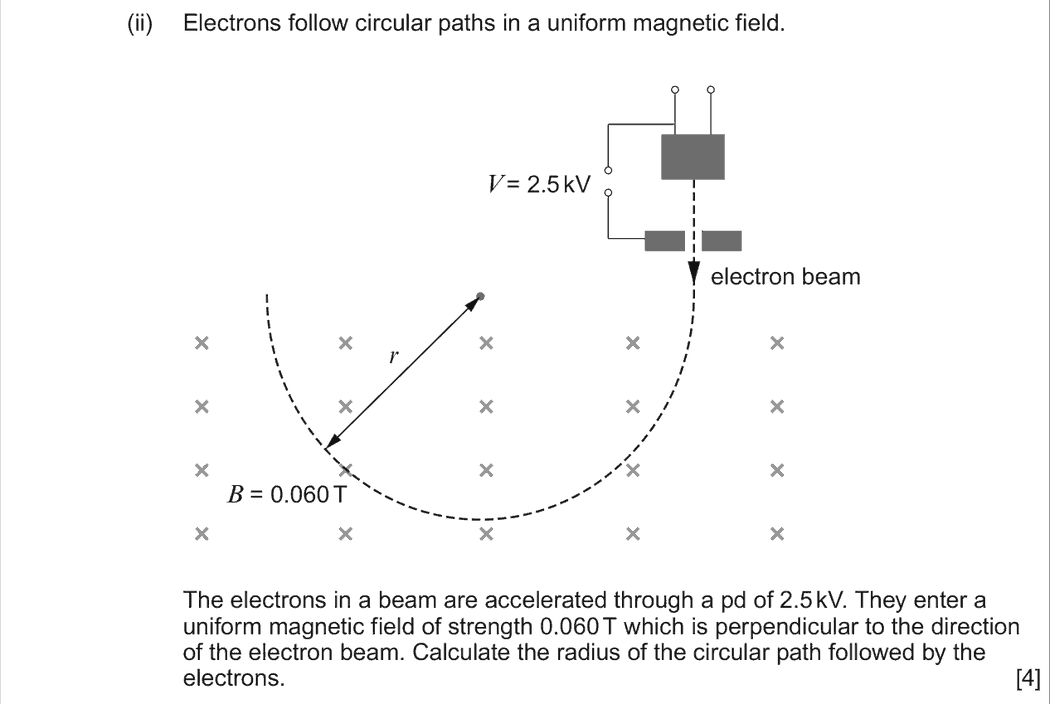
(ii) Electrons follow circular paths in a uniform magnetic field. V = 2.5 kV electron beam r B = 0.060 T The electrons in a beam are accelerated through a pd of 2.5 kV. They enter a uniform magnetic field of strength 0.060 T which is perpendicular to the direction of the electron beam. Calculate the radius of the circular path followed by the electrons. [4]
June 2024 · Component 1 · Q4(b)(iii)I 1 mark AO2=1 Short answer Easy circular motion
Earlier parts of question 4 that this part usesEarlier part of June 2024 Component 1 question 4Earlier part of June 2024 Component 1 question 4Earlier part of June 2024 Component 1 question 4
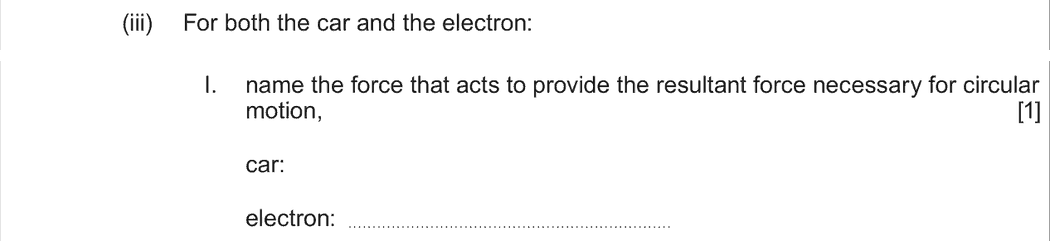
(iii) For both the car and the electron: I. name the force that acts to provide the resultant force necessary for circular motion, [1] car: electron:
June 2024 · Component 1 · Q4(b)(iii)II 3 marks AO3=3 Calculation Easy circular motion
Earlier parts of question 4 that this part usesEarlier part of June 2024 Component 1 question 4Earlier part of June 2024 Component 1 question 4Earlier part of June 2024 Component 1 question 4Earlier part of June 2024 Component 1 question 4
II. compare the magnitudes of the resultant forces. [3]
June 2024 · Component 1 · Q5(a) 2 marks AO1=2 Definition vibrations
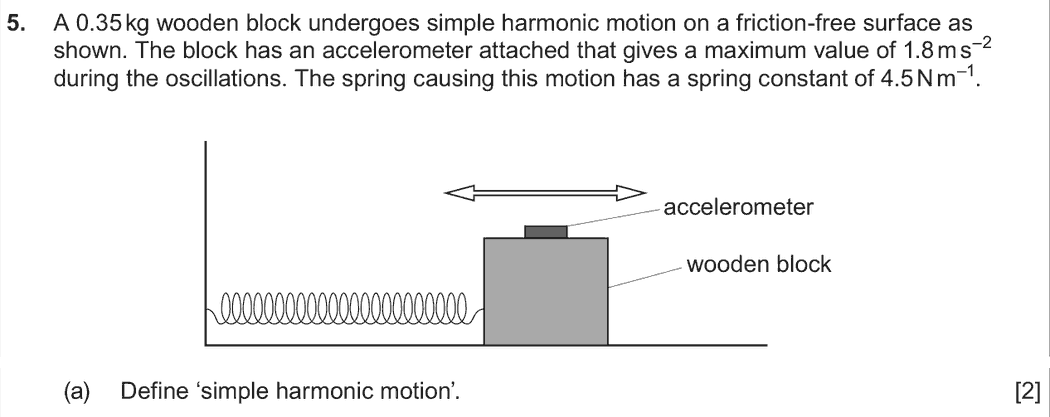
5. A 0.35 kg wooden block undergoes simple harmonic motion on a friction-free surface as shown. The block has an accelerometer attached that gives a maximum value of 1.8 m s–2 during the oscillations. The spring causing this motion has a spring constant of 4.5 N m–1. accelerometer wooden block (a) Define ‘simple harmonic motion’. [2]
June 2024 · Component 1 · Q5(b) 2 marks AO2=2 Show that vibrations
Earlier part of question 5 that this part usesEarlier part of June 2024 Component 1 question 5
(b) Show that the maximum displacement of the block is 14 cm. [2]
June 2024 · Component 1 · Q5(c)(i) 4 marks AO3=4 Practical and data analysis vibrations
Earlier part of question 5 that this part usesEarlier part of June 2024 Component 1 question 5
(c) (i) A student begins filming the block on her mobile phone when the block has a displacement of 4.0 cm. She then watches the video in slow motion, recording the displacement at regular time intervals. She produces the following graph. Displacement / cm 15.0 10.0 5.0 0.0 0.0 0.0 0.5 0.5 1.0 1.0 1.5 1.5 2.0 2.0 2.5 2.5 3.0 3.0 3.5 3.5 4.0 4.0 Time / s – 5.0 – 10.0 – 15.0 The student states that the motion of the block can be described using: x  14 cos( 3.6 t  1.28 ) where x is the displacement in cm and t is the time in seconds. Use the graph above to evaluate whether the student is correct. [4]
June 2024 · Component 1 · Q5(c)(ii) 2 marks AO2=2 Diagram or graph vibrations
Earlier parts of question 5 that this part usesEarlier part of June 2024 Component 1 question 5Earlier part of June 2024 Component 1 question 5
(ii) Below is a copy of the graph in part (c)(i). On this grid, sketch the acceleration-time graph for the block. No scale is required on the vertical axis. [2] Displacement / cm 15.0 10.0 5.0 0.0 0.0 0.0 0.5 0.5 1.0 1.0 1.5 1.5 2.0 2.0 2.5 2.5 3.0 3.0 3.5 3.5 4.0 4.0 Time / s – 5.0 – 10.0 – 15.0
June 2024 · Component 1 · Q5(d) 6 marks AO1=6 6-mark extended response vibrations
Earlier parts of question 5 that this part usesEarlier part of June 2024 Component 1 question 5Earlier part of June 2024 Component 1 question 5Earlier part of June 2024 Component 1 question 5
(d) The acceleration due to gravity, g, can be determined by conducting an experiment with a simple pendulum. Describe the experiment, including the graphical analysis that could be used to determine the value of g. [6 QER]
June 2024 · Component 1 · Q6(a) 1 mark AO1=1 Definition kinetic theory
6. (a) Define the ‘mole’. [1]
June 2024 · Component 1 · Q6(b)(i) 3 marks AO1=3 Show that kinetic theory
Earlier part of question 6 that this part usesEarlier part of June 2024 Component 1 question 6
1 (b) (i) Use the ideal gas equation and pV  Nmc 2 to show that, for one mole, the 3 3 total translational kinetic energy is given by RT . [3] 2
June 2024 · Component 1 · Q6(b)(ii) 3 marks AO3=3 Calculation kinetic theory
Earlier parts of question 6 that this part usesEarlier part of June 2024 Component 1 question 6Earlier part of June 2024 Component 1 question 6
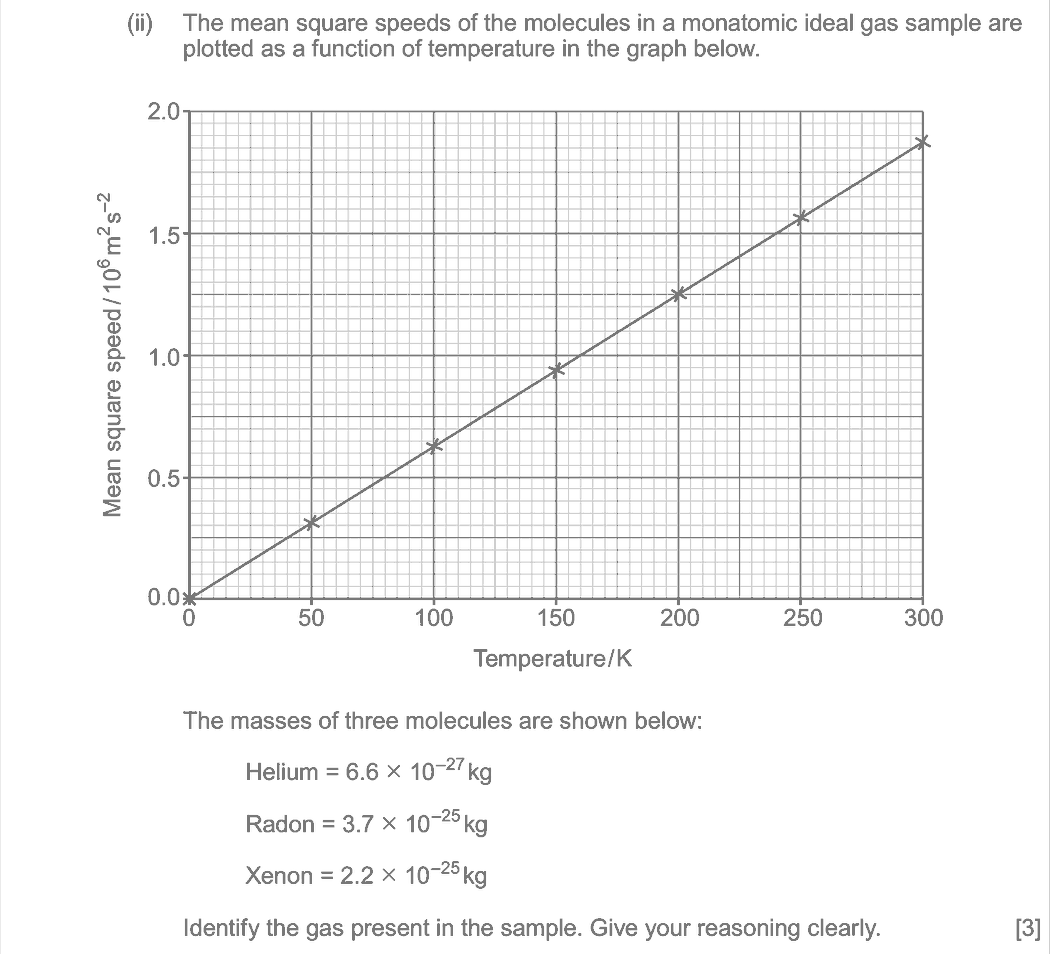
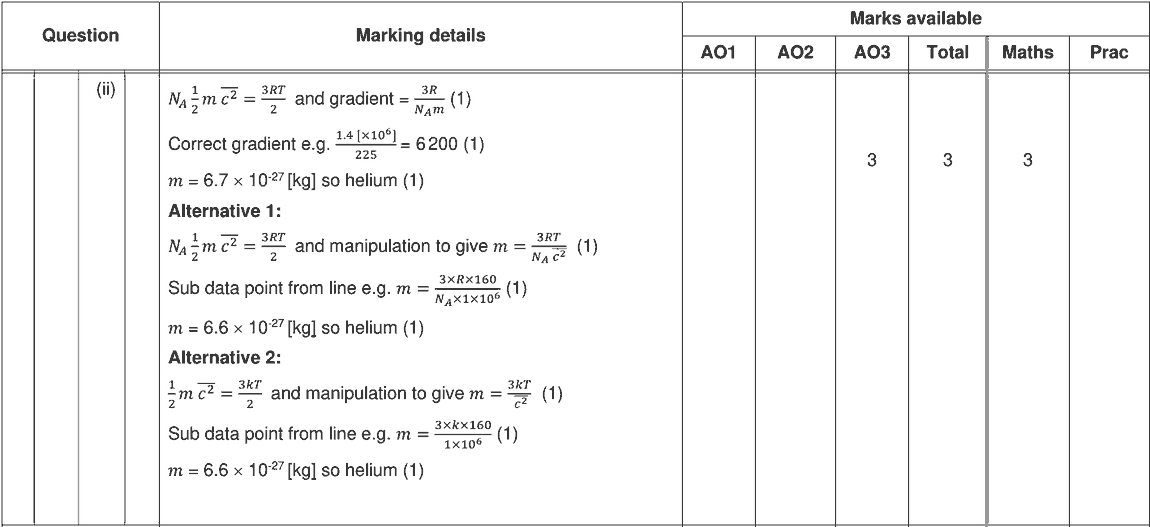
(ii) The mean square speeds of the molecules in a monatomic ideal gas sample are plotted as a function of temperature in the graph below. 2.0 s–2 m2 1.5 106 / speed 1.0 square Mean 0.5 0.0 0 50 100 150 200 250 300 Temperature / K The masses of three molecules are shown below: Helium = 6.6 × 10⁻²⁷ kg Radon = 3.7 × 10⁻²⁵ kg Xenon = 2.2 × 10⁻²⁵ kg Identify the gas present in the sample. Give your reasoning clearly. [3]
June 2024 · Component 1 · Q7(a) 3 marks AO1=1, AO2=2 Calculation kinetic theory
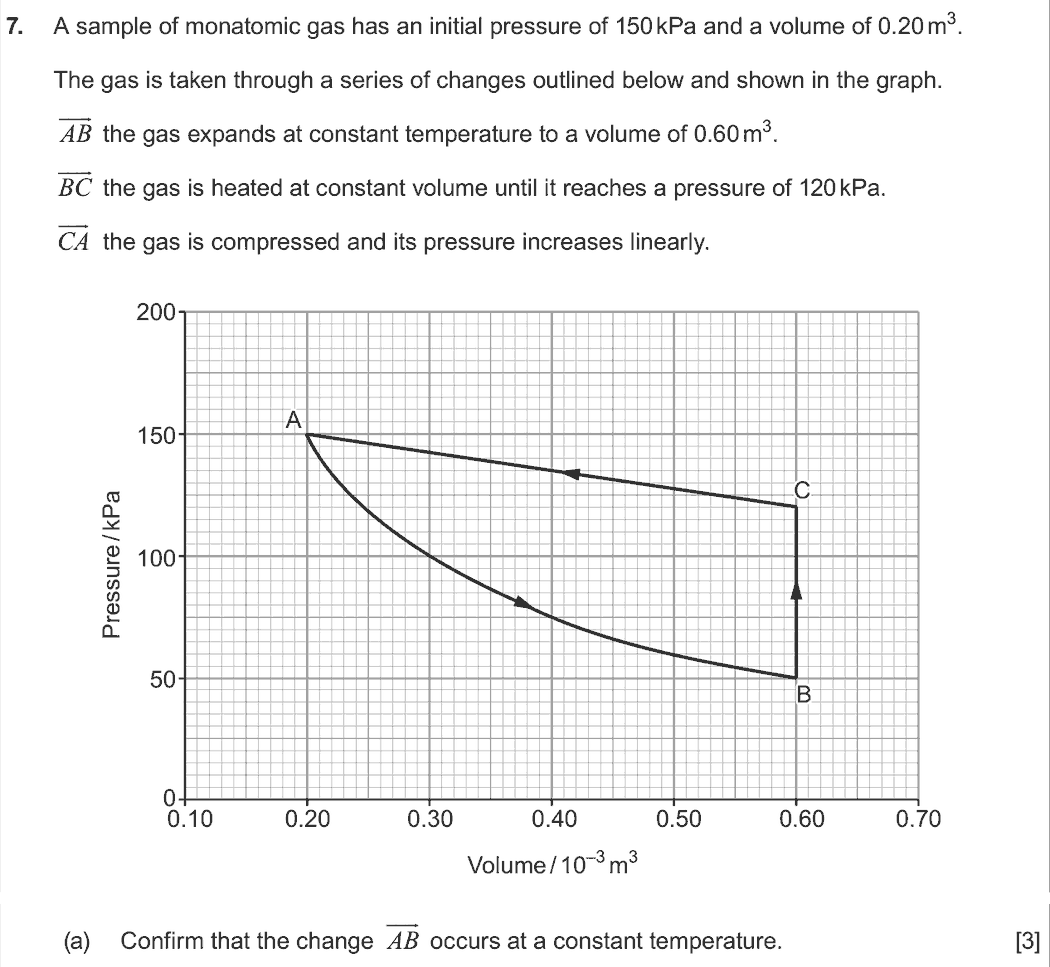
7. A sample of monatomic gas has an initial pressure of 150 kPa and a volume of 0.20 m3. The gas is taken through a series of changes outlined below and shown in the graph.  AB the gas expands at constant temperature to a volume of 0.60 m3.  BC the gas is heated at constant volume until it reaches a pressure of 120 kPa.  CA the gas is compressed and its pressure increases linearly. 200 A A 150 C C kPa / Pressure 100 50 B B 0 0.10 0.20 0.30 0.40 0.50 0.60 0.70 Volume / 10–3 m3  (a) Confirm that the change AB occurs at a constant temperature. [3]
June 2024 · Component 1 · Q7(b)(i) 1 mark AO1=1 Definition thermal physics
Earlier part of question 7 that this part usesEarlier part of June 2024 Component 1 question 7
(b) (i) State what is meant by the internal energy of an ideal gas. [1]
June 2024 · Component 1 · Q7(b)(ii)I 2 marks AO2=2 Calculation thermal physics
Earlier parts of question 7 that this part usesEarlier part of June 2024 Component 1 question 7Earlier part of June 2024 Component 1 question 7
(ii) I. Calculate the internal energy of the gas at B and C. [2]
June 2024 · Component 1 · Q7(b)(ii)II 2 marks AO2=2 Calculation kinetic theory
Earlier parts of question 7 that this part usesEarlier part of June 2024 Component 1 question 7Earlier part of June 2024 Component 1 question 7Earlier part of June 2024 Component 1 question 7
II. Hence, determine the following ratio: [2] crms at C crms at B
June 2024 · Component 1 · Q7(b)(iii) 4 marks AO2=4 Explanation kinetic theory
Earlier parts of question 7 that this part usesEarlier part of June 2024 Component 1 question 7Earlier part of June 2024 Component 1 question 7
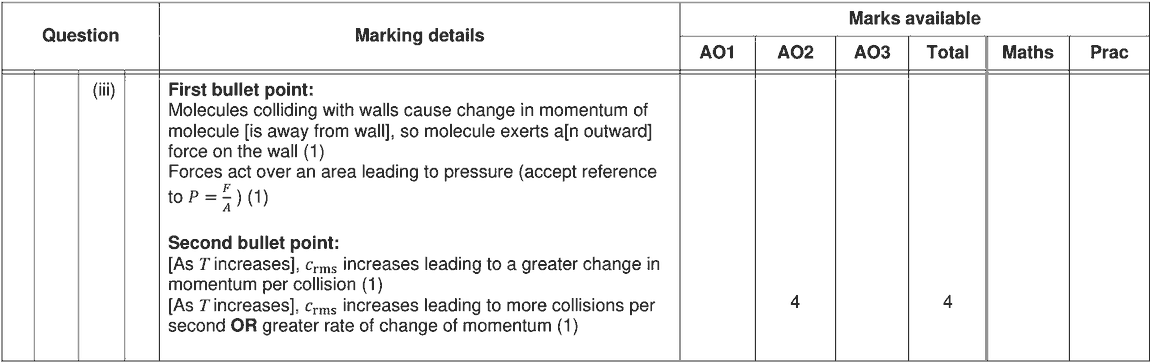
(iii) By considering the motion of the gas molecules, explain: • how a gas exerts a pressure on the walls of its container • why the pressure increases as temperature increases between B and C. [4]
June 2024 · Component 1 · Q7(c) 3 marks AO2=3 Explanation thermal physics
Earlier part of question 7 that this part usesEarlier part of June 2024 Component 1 question 7
 (c) For the whole cycle, ABCA , explain using the first law of thermodynamics, whether or not there is a net flow of heat into the system. [3]
June 2024 · Component 1 · Q8(a)(i) 1 mark AO1=1 Diagram or graph wave propertiescomprehension
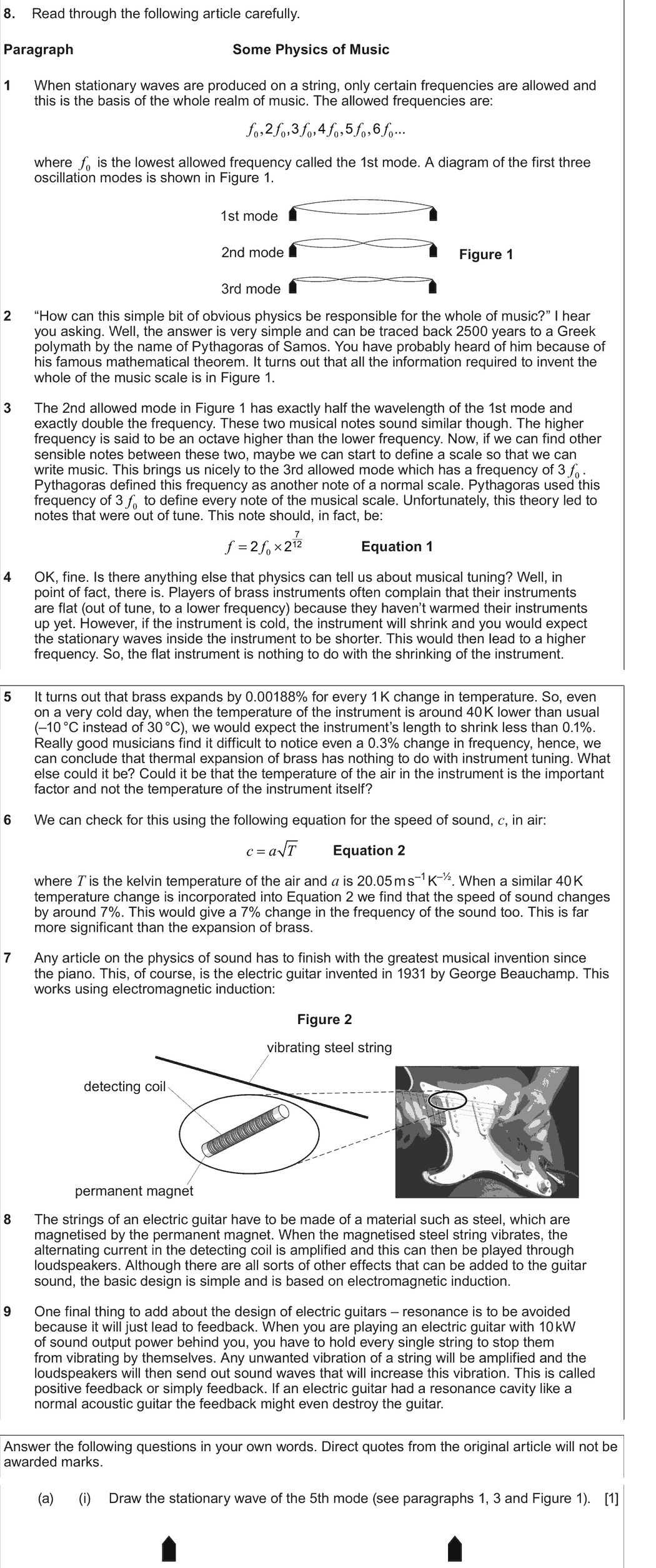
8. Read through the following article carefully. Paragraph Some Physics of Music 1 When stationary waves are produced on a string, only certain frequencies are allowed and this is the basis of the whole realm of music. The allowed frequencies are: f , 2 f , 3 f , 4 f , 5 f , 6 f ... 0 0 0 0 0 0 where 0f is the lowest allowed frequency called the 1st mode. A diagram of the first three oscillation modes is shown in Figure 1. 1st mode 2nd mode Figure 1 3rd mode 2 “How can this simple bit of obvious physics be responsible for the whole of music?” I hear you asking. Well, the answer is very simple and can be traced back 2500 years to a Greek polymath by the name of Pythagoras of Samos. You have probably heard of him because of his famous mathematical theorem. It turns out that all the information required to invent the whole of the music scale is in Figure 1. 3 The 2nd allowed mode in Figure 1 has exactly half the wavelength of the 1st mode and exactly double the frequency. These two musical notes sound similar though. The higher frequency is said to be an octave higher than the lower frequency. Now, if we can find other sensible notes between these two, maybe we can start to define a scale so that we can write music. This brings us nicely to the 3rd allowed mode which has a frequency of 3 0f . Pythagoras defined this frequency as another note of a normal scale. Pythagoras used this frequency of 3 0f to define every note of the musical scale. Unfortunately, this theory led to notes that were out of tune. This note should, in fact, be: 7 f  2 f  2 12 Equation 1 0 4 OK, fine. Is there anything else that physics can tell us about musical tuning? Well, in point of fact, there is. Players of brass instruments often complain that their instruments are flat (out of tune, to a lower frequency) because they haven’t warmed their instruments up yet. However, if the instrument is cold, the instrument will shrink and you would expect the stationary waves inside the instrument to be shorter. This would then lead to a higher frequency. So, the flat instrument is nothing to do with the shrinking of the instrument. 5 It turns out that brass expands by 0.00188% for every 1 K change in temperature. So, even on a very cold day, when the temperature of the instrument is around 40 K lower than usual (–10 °C instead of 30 °C), we would expect the instrument’s length to shrink less than 0.1%. Really good musicians find it difficult to notice even a 0.3% change in frequency, hence, we can conclude that thermal expansion of brass has nothing to do with instrument tuning. What else could it be? Could it be that the temperature of the air in the instrument is the important factor and not the temperature of the instrument itself? 6 We can check for this using the following equation for the speed of sound, c, in air: c  a T Equation 2 where T is the kelvin temperature of the air and a is 20.05 m s–1 K–½. When a similar 40 K temperature change is incorporated into Equation 2 we find that the speed of sound changes by around 7%. This would give a 7% change in the frequency of the sound too. This is far more significant than the expansion of brass. 7 Any article on the physics of sound has to finish with the greatest musical invention since the piano. This, of course, is the electric guitar invented in 1931 by George Beauchamp. This works using electromagnetic induction: Figure 2 vibrating steel string detecting coil permanent magnet 8 The strings of an electric guitar have to be made of a material such as steel, which are magnetised by the permanent magnet. When the magnetised steel string vibrates, the alternating current in the detecting coil is amplified and this can then be played through loudspeakers. Although there are all sorts of other effects that can be added to the guitar sound, the basic design is simple and is based on electromagnetic induction. 9 One final thing to add about the design of electric guitars – resonance is to be avoided because it will just lead to feedback. When you are playing an electric guitar with 10 kW of sound output power behind you, you have to hold every single string to stop them from vibrating by themselves. Any unwanted vibration of a string will be amplified and the loudspeakers will then send out sound waves that will increase this vibration. This is called positive feedback or simply feedback. If an electric guitar had a resonance cavity like a normal acoustic guitar the feedback might even destroy the guitar. Answer the following questions in your own words. Direct quotes from the original article will not be awarded marks. (a) (i) Draw the stationary wave of the 5th mode (see paragraphs 1, 3 and Figure 1). [1]
June 2024 · Component 1 · Q8(a)(ii) 1 mark AO2=1 Short answer wave propertiescomprehension
Earlier part of question 8 that this part usesEarlier part of June 2024 Component 1 question 8
(ii) If the wavelength of the first mode is λ0, state the wavelength of the 5th mode (see paragraph 1 and Figure 1). [1]
June 2024 · Component 1 · Q8(b) 2 marks AO3=2 Calculation wave propertiescomprehension
Earlier part of question 8 that this part usesEarlier part of June 2024 Component 1 question 8
7 (b) Discuss the difference between Pythagoras’ note 3 0f and f  2 f  2 12 0 (see paragraph 3 and Equation 1). [2]
June 2024 · Component 1 · Q8(c) 2 marks AO3=2 Calculation comprehension
Earlier part of question 8 that this part usesEarlier part of June 2024 Component 1 question 8
(c) The author claims that a 40 K temperature change leads to a less than 0.1% change in the length of a brass instrument. Determine whether this is true (see paragraph 5). [2]
June 2024 · Component 1 · Q8(d) 4 marks AO1=1, AO2=3 Explanation nature of wavescomprehension
Earlier part of question 8 that this part usesEarlier part of June 2024 Component 1 question 8
(d) Explain, in your own words, why the frequency produced by a brass instrument increases as temperature increases (see paragraphs 4–6 and Equation 2). [4]
June 2024 · Component 1 · Q8(e) 3 marks AO1=1, AO2=2 Calculation nature of wavescomprehension
Earlier part of question 8 that this part usesEarlier part of June 2024 Component 1 question 8
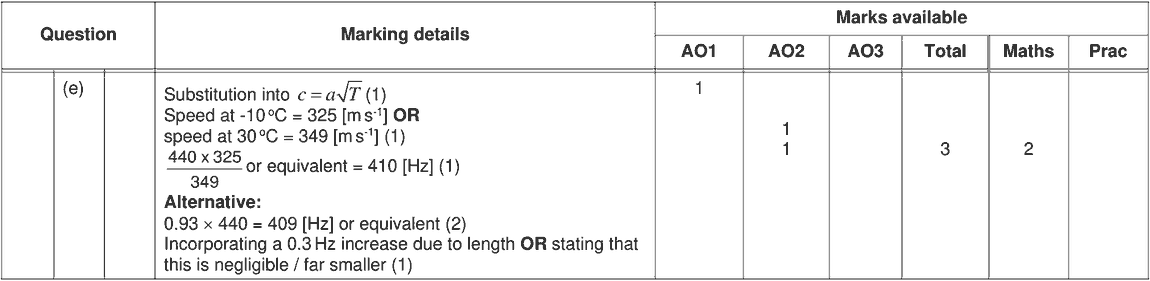
(e) A note produced by a brass instrument is 440 Hz when the instrument is at a temperature of 30 °C. Calculate the frequency of the note when it is produced at a temperature of –10 °C (see paragraphs 4–6 and Equation 2). [3]
June 2024 · Component 1 · Q8(f) 5 marks AO1=1, AO2=4 Explanation electromagnetic inductioncomprehension
Earlier part of question 8 that this part usesEarlier part of June 2024 Component 1 question 8
(f) Explain, in your own words, how an electric guitar produces a sound (see paragraphs 7–9 and Figure 2). [5]
June 2024 · Component 1 · Q8(g) 2 marks AO3=2 Explanation electromagnetic inductioncomprehension
Earlier part of question 8 that this part usesEarlier part of June 2024 Component 1 question 8
(g) Explain why an electric guitar will not work well with copper strings (see paragraphs 7–9 and Figure 2). [2]

Work with an Eduqas physics tutor

Want a paper marked and gone through with you? Message us.

Prefer email? Send an enquiry

If you are under 18, please include a parent's contact details. Enquiries go to enquiries@physicsaleveltutor.com and are deleted once handled. All tutoring is online.