June 2025: Component 2

100 marks · 36 question parts · Paper, mark scheme and report on Eduqas's site · Have the Data Booklet beside you
Question by question

QTopicMarksAOType
1(a)(i) Conduction of electricity 1AO1=1Short answer
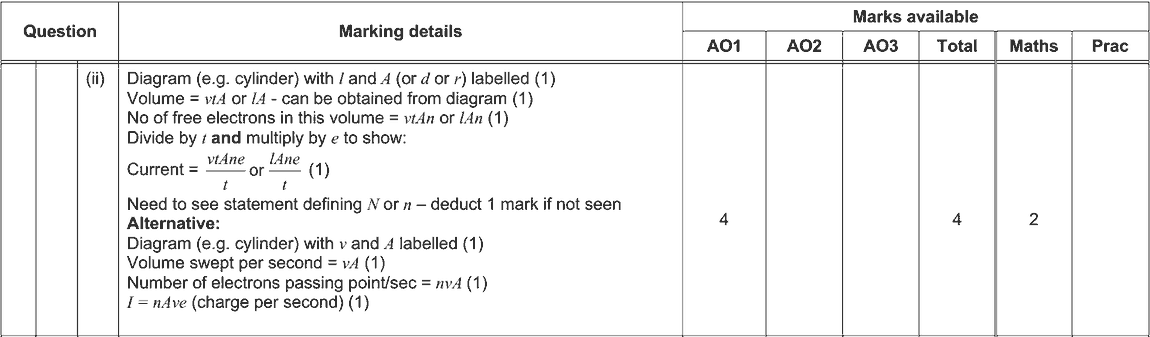
1(a)(ii) Conduction of electricity 4AO1=4Explanation
1(a)(iii) Conduction of electricity 2AO2=2Calculation
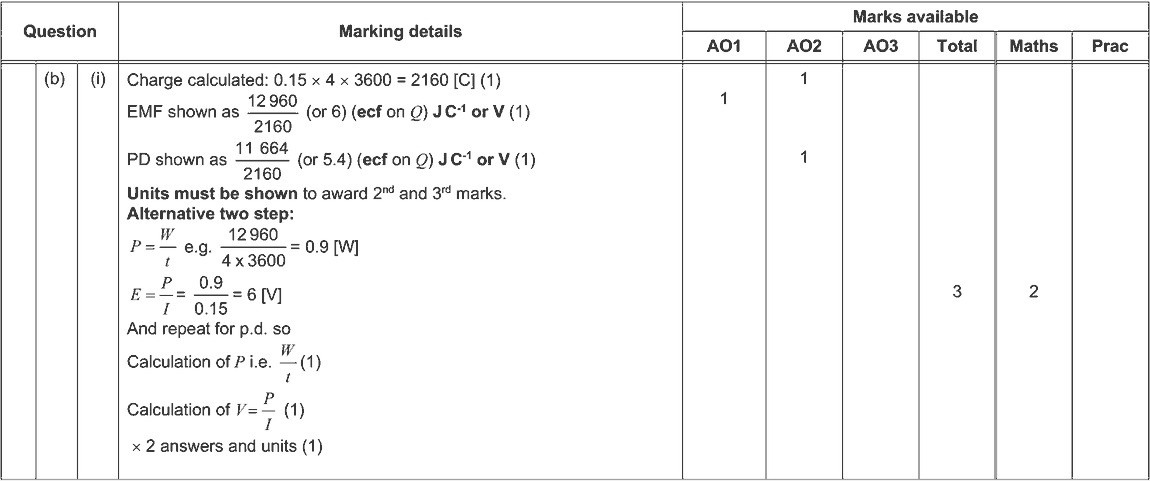
1(b)(i) d.c. circuits, Resistance 3AO1=1,AO2=2Calculation
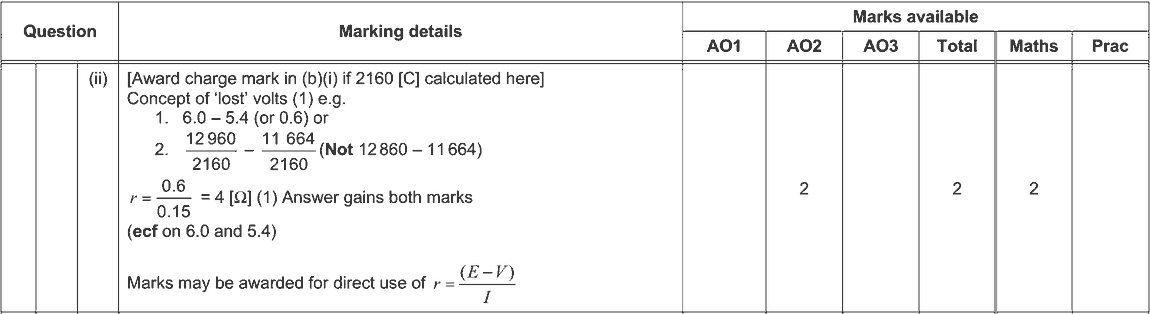
1(b)(ii) d.c. circuits 2AO2=2Calculation
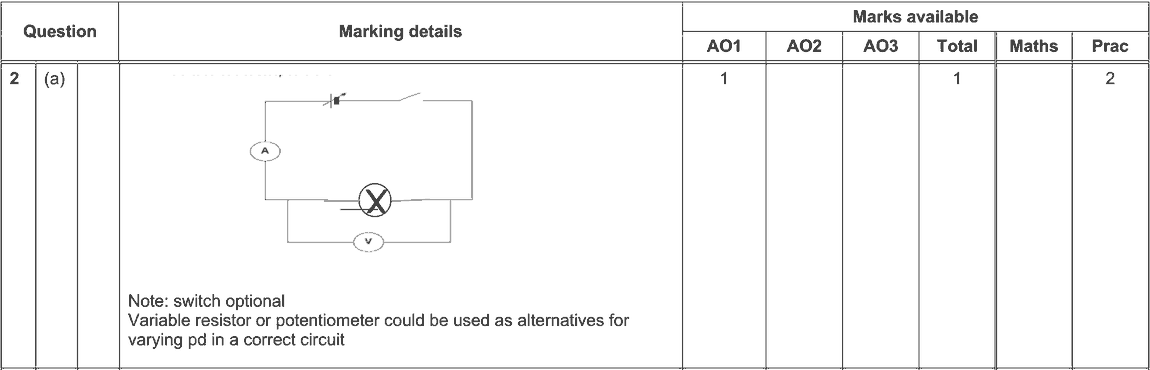
2(a) Resistance 1AO1=1Diagram or graph
2(b) Resistance 1AO2=1Short answer
2(c)(i) Resistance 6AO3=6Practical and data analysis
2(c)(ii) Resistance 2AO3=2Practical and data analysis
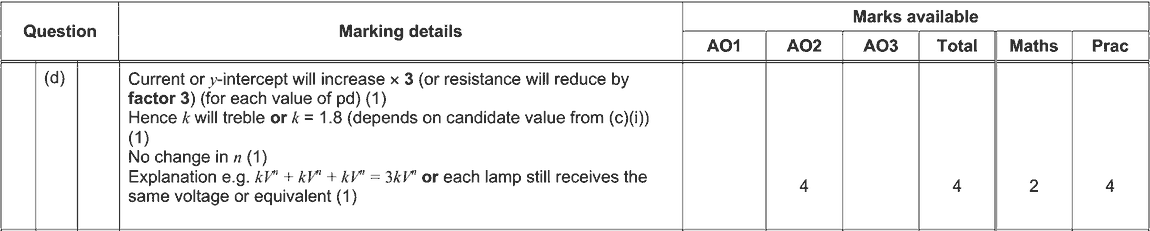
2(d) d.c. circuits 4AO2=4Practical and data analysis
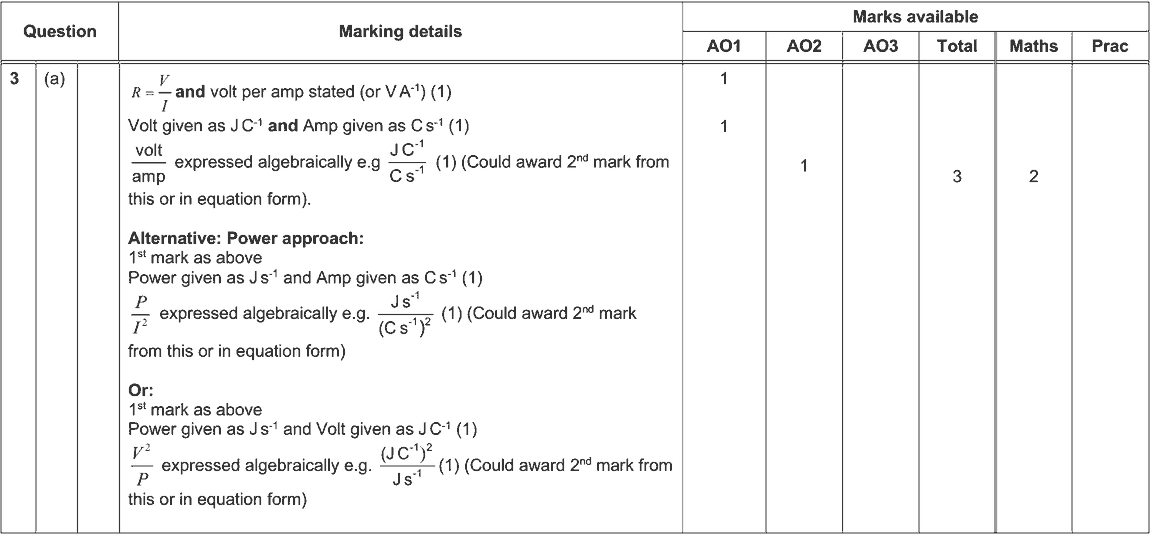
3(a) Resistance 3AO1=2,AO2=1Show that
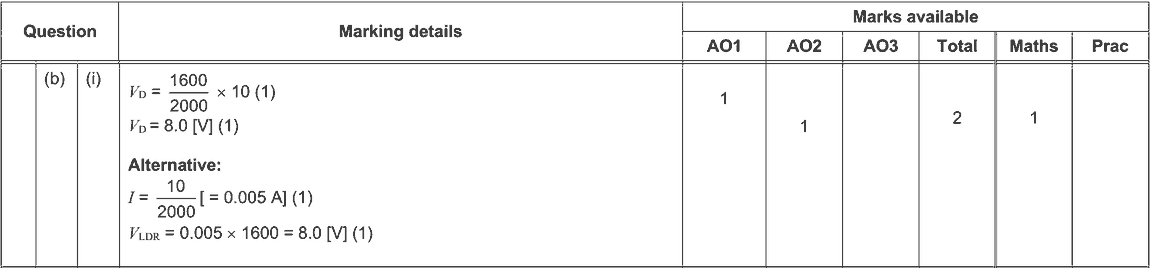
3(b)(i) d.c. circuits 2AO1=1,AO2=1Calculation
3(b)(ii) d.c. circuits 4AO1=2,AO2=2Show that
3(c) Resistance 3AO3=3Calculation
4(a) Capacitance 6AO1=4,AO2=2Extended response
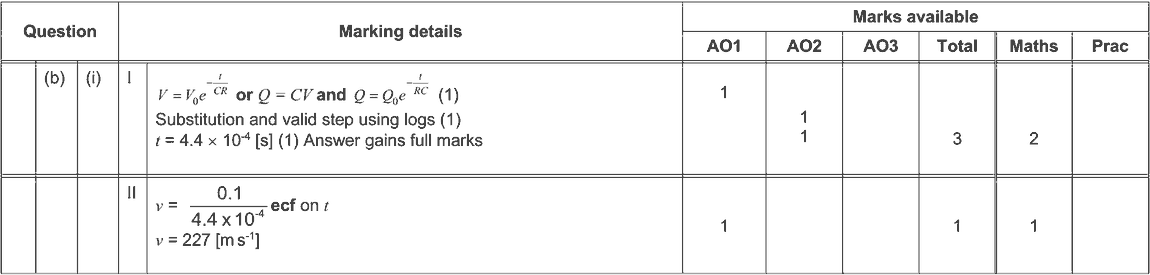
4(b)(i)I Capacitance 3Calculation
4(b)(i)II Kinematics 1Calculation
4(b)(ii) Dynamics: forces and momentum 3AO3=3Calculation
5(a) Solids under stress 3AO1=3Practical and data analysis
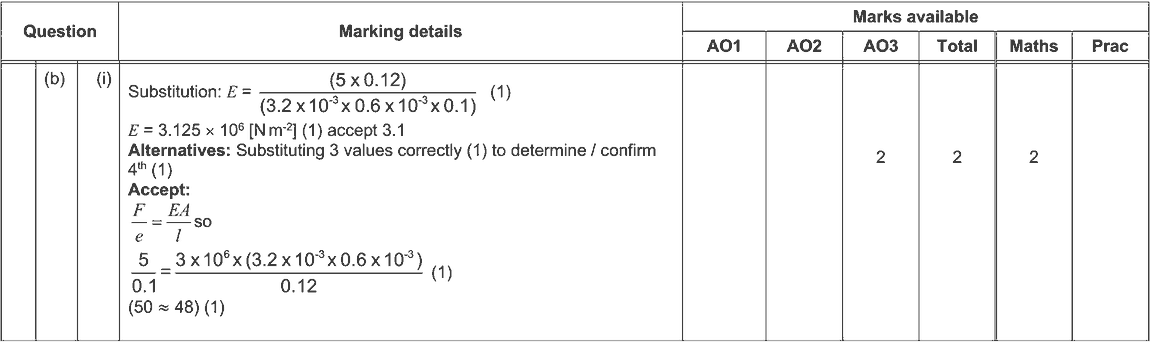
5(b)(i) Solids under stress 2AO3=2Show that
5(b)(ii) Solids under stress 2AO1=2Explanation
5(b)(iii) Solids under stress 3AO2=3Calculation
5(c) Solids under stress 3AO3=3Explanation
6(a) Electrostatic and gravitational fields of force 1AO1=1Definition
6(b)(i) Electrostatic and gravitational fields of force 3AO2=3Calculation
6(b)(ii) Electrostatic and gravitational fields of force 2AO2=2Explanation
6(b)(iii) Electrostatic and gravitational fields of force 4AO2=4Calculation
7(a) Orbits and the wider universe 3AO1=1,AO2=2Explanation
7(b)(i) Orbits and the wider universe 3AO1=1,AO2=2Show that
7(b)(ii) Orbits and the wider universe, Circular motion 3AO1=1,AO2=2Show that
7(b)(iii) Orbits and the wider universe 5AO1=1,AO2=4Calculation
7(c) Electrostatic and gravitational fields of force 4AO2=4Calculation
8(a)(i) Using radiation to investigate stars 1AO1=1Definition
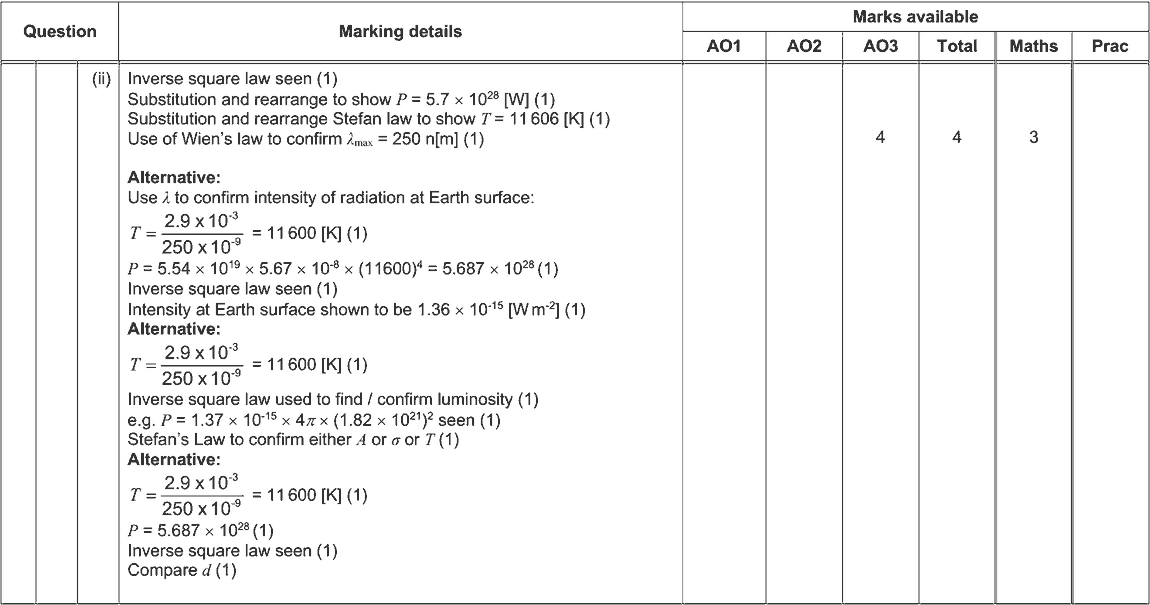
8(a)(ii) Using radiation to investigate stars 4AO3=4Calculation
8(b)(i) Using radiation to investigate stars 1AO1=1Definition
8(b)(ii) Using radiation to investigate stars 2AO3=2Short answer

The questions

1(a)(i)1(a)(ii)1(a)(iii)1(b)(i)1(b)(ii)2(a)2(b)2(c)(i)2(c)(ii)2(d)3(a)3(b)(i)3(b)(ii)3(c)4(a)4(b)(i)I4(b)(i)II4(b)(ii)5(a)5(b)(i)5(b)(ii)5(b)(iii)5(c)6(a)6(b)(i)6(b)(ii)6(b)(iii)7(a)7(b)(i)7(b)(ii)7(b)(iii)7(c)8(a)(i)8(a)(ii)8(b)(i)8(b)(ii)
June 2025 · Component 2 · Q1(a)(i) 1 mark AO1=1 Short answer conduction of electricity
1. (a) (i) ‘Copper is an electrical conductor.’ Explain what this statement means. [1]
June 2025 · Component 2 · Q1(a)(ii) 4 marks AO1=4 Explanation conduction of electricity
Earlier part of question 1 that this part usesEarlier part of June 2025 Component 2 question 1
(ii) Derive the equation I = nAve for the current in a wire when the drift velocity of the free electrons is v. Include a clearly labelled diagram. [4]
June 2025 · Component 2 · Q1(a)(iii) 2 marks AO2=2 Calculation conduction of electricity
Earlier part of question 1 that this part usesEarlier part of June 2025 Component 2 question 1
(iii) Two copper wires of diameter 0.20 mm and 0.30 mm are joined in series and a pd is applied. The drift velocity, v, of the free electrons in the wire of diameter 0.20 mm is 6.0 × 10⁻⁴ m s–1. Calculate the drift velocity in the wire of diameter 0.30 mm. [2]
June 2025 · Component 2 · Q1(b)(i) 3 marks AO1=1, AO2=2 Calculation dc circuitsresistance
Earlier part of question 1 that this part usesEarlier part of June 2025 Component 2 question 1
(b) A torch battery converts 12 960 J of chemical energy into electrical energy whilst supplying a current of 0.15 A for 4 hours. In this time, only 11 664 J of this energy is supplied to the bulb. (i) Calculate the emf of the battery and the pd across the bulb, including the units of both quantities. [3]
June 2025 · Component 2 · Q1(b)(ii) 2 marks AO2=2 Calculation dc circuits
Earlier parts of question 1 that this part usesEarlier part of June 2025 Component 2 question 1Earlier part of June 2025 Component 2 question 1
(ii) Hence or otherwise calculate the battery’s internal resistance. [2]
June 2025 · Component 2 · Q2(a) 1 mark AO1=1 Diagram or graph resistance
2. David investigates how the current, I, in a filament lamp varies with the potential difference, V, across it. (a) Sketch a circuit diagram of the apparatus David could use to obtain a range of readings of I and V. [1]
June 2025 · Component 2 · Q2(b) 1 mark AO2=1 Short answer resistance
Earlier part of question 2 that this part usesEarlier part of June 2025 Component 2 question 2
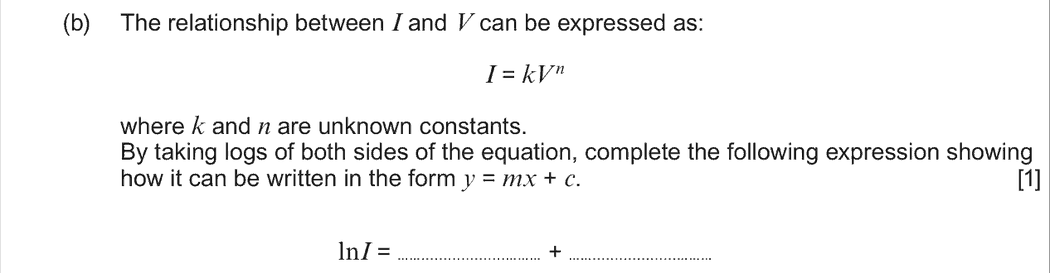
(b) The relationship between I and V can be expressed as: I = kV n where k and n are unknown constants. By taking logs of both sides of the equation, complete the following expression showing how it can be written in the form y = mx + c. [1] lnI = + …………… ……………
June 2025 · Component 2 · Q2(c)(i) 6 marks AO3=6 Practical and data analysis resistance
Earlier part of question 2 that this part usesEarlier part of June 2025 Component 2 question 2
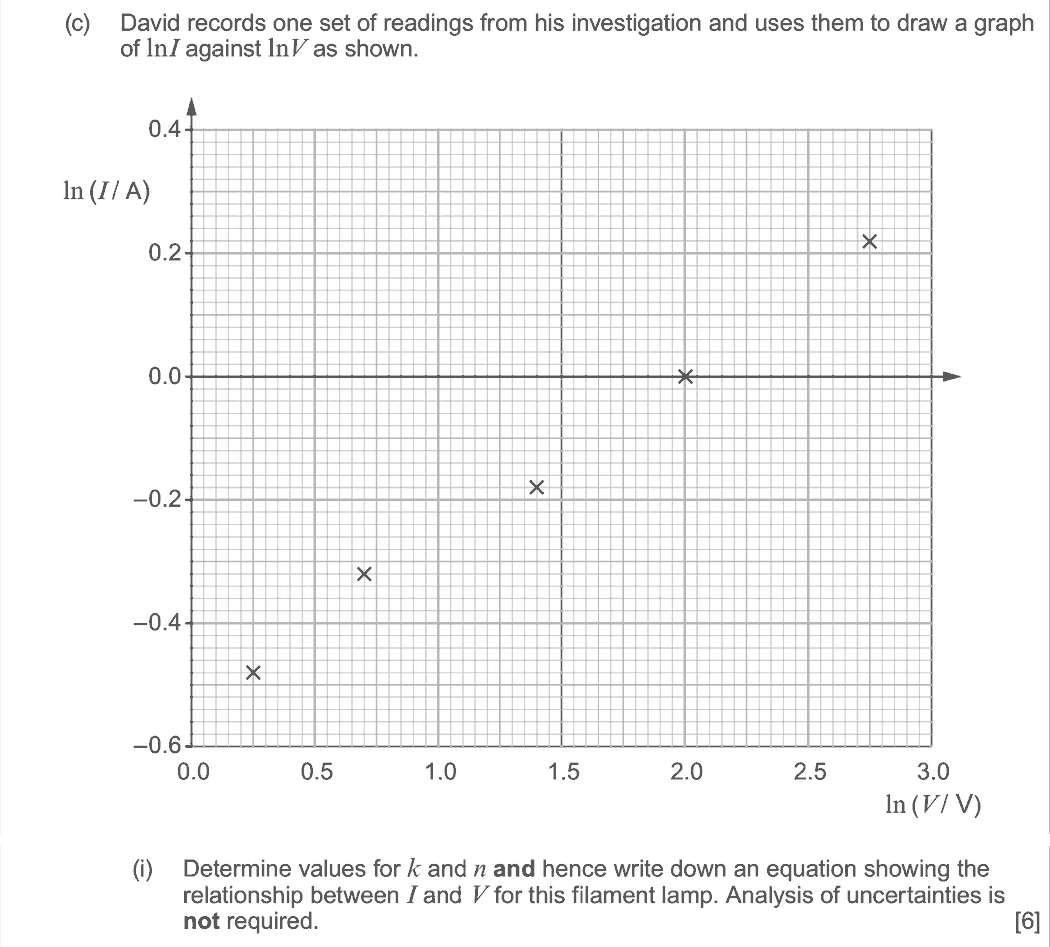
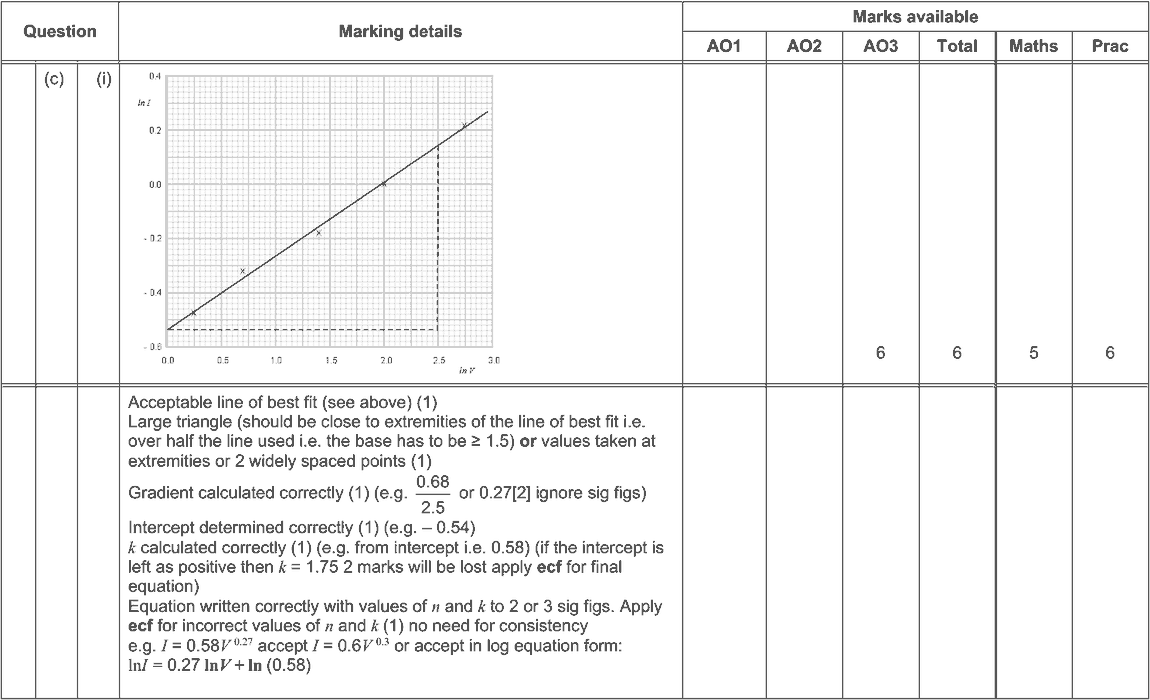
(c) David records one set of readings from his investigation and uses them to draw a graph of lnI against lnV as shown. 0.4 ln (I / A) 0.2 0.0 – 0.2 – 0.4 – 0.6 0.0 0.5 1.0 1.5 2.0 2.5 3.0 ln (V / V) (i) Determine values for k and n and hence write down an equation showing the relationship between I and V for this filament lamp. Analysis of uncertainties is not required. [6]
June 2025 · Component 2 · Q2(c)(ii) 2 marks AO3=2 Practical and data analysis resistance
Earlier parts of question 2 that this part usesEarlier part of June 2025 Component 2 question 2Earlier part of June 2025 Component 2 question 2
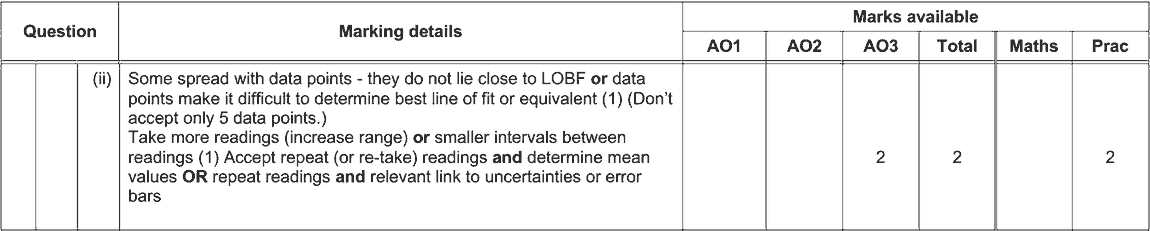
(ii) David’s teacher comments: “Your readings do not justify a high degree of confidence in the values for n and k.” State why the teacher is correct and what David should do to increase confidence in his results. [2]
June 2025 · Component 2 · Q2(d) 4 marks AO2=4 Practical and data analysis dc circuits
Earlier parts of question 2 that this part usesEarlier part of June 2025 Component 2 question 2Earlier part of June 2025 Component 2 question 2
(d) The experiment is repeated with 3 identical lamps connected in parallel. These lamps are identical to the one lamp used previously by David. Write down the values for n and k for this arrangement. Explain your answers. [4]
June 2025 · Component 2 · Q3(a) 3 marks AO1=2, AO2=1 Show that resistance
3. (a) Show that the unit of resistance, Ω, can be expressed in the following two ways. [3] V A–1 J s C–2
June 2025 · Component 2 · Q3(b)(i) 2 marks AO1=1, AO2=1 Calculation dc circuits
Earlier part of question 3 that this part usesEarlier part of June 2025 Component 2 question 3
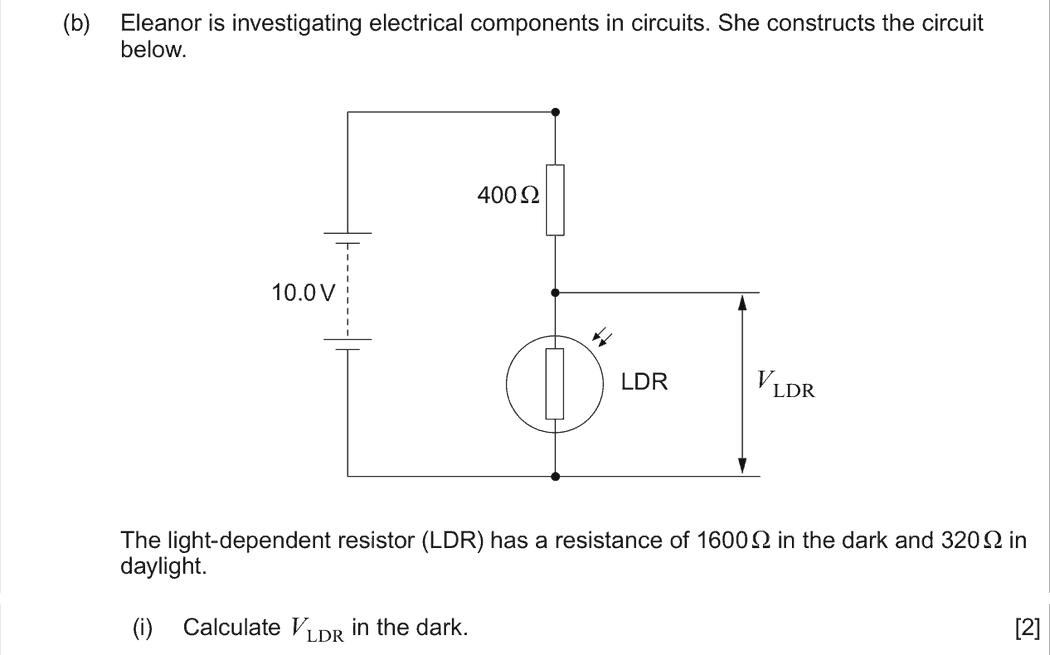
(b) Eleanor is investigating electrical components in circuits. She constructs the circuit below. 400 Ω 10.0 V LDR VLDR The light-dependent resistor (LDR) has a resistance of 1600 Ω in the dark and 320 Ω in daylight. (i) Calculate VLDR in the dark. [2]
June 2025 · Component 2 · Q3(b)(ii) 4 marks AO1=2, AO2=2 Show that dc circuits
Earlier parts of question 3 that this part usesEarlier part of June 2025 Component 2 question 3Earlier part of June 2025 Component 2 question 3
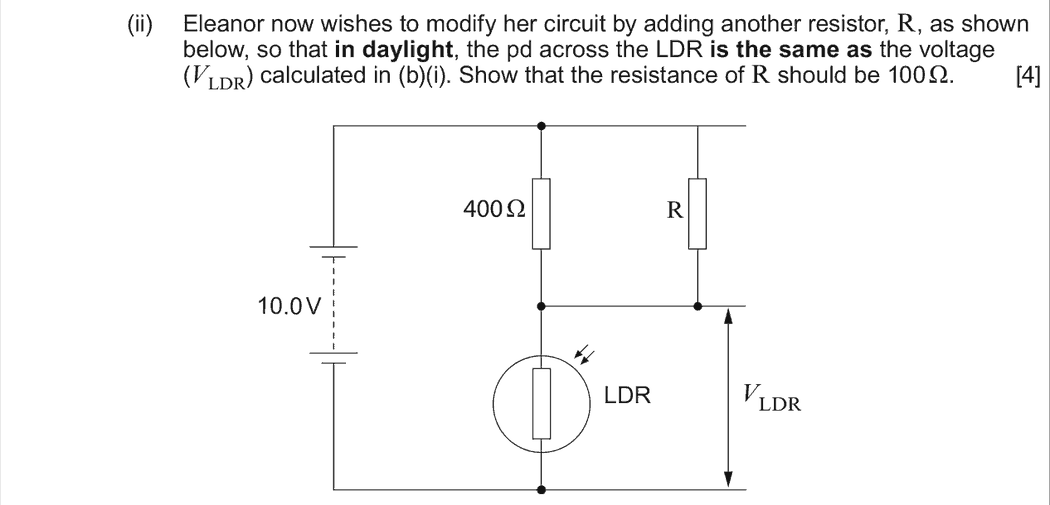
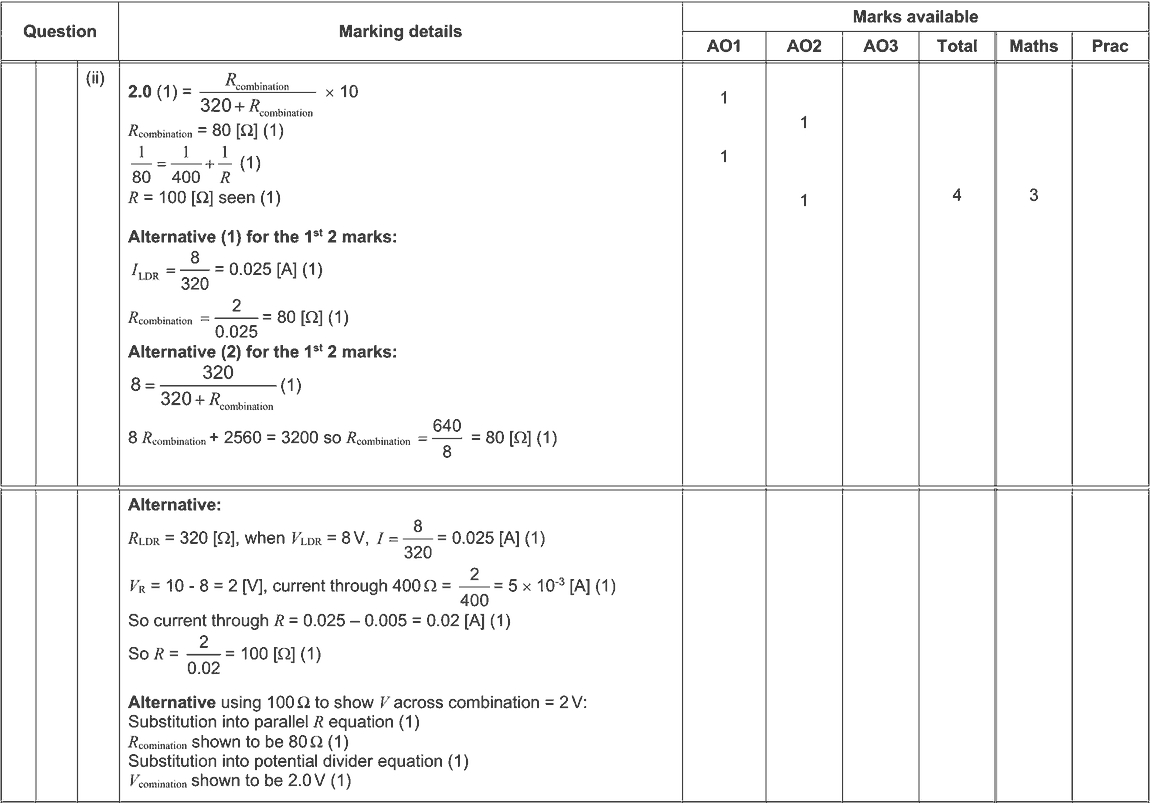
(ii) Eleanor now wishes to modify her circuit by adding another resistor, R, as shown below, so that in daylight, the pd across the LDR is the same as the voltage (VLDR) calculated in (b)(i). Show that the resistance of R should be 100 Ω. [4] 400 Ω R 10.0 V LDR VLDR
June 2025 · Component 2 · Q3(c) 3 marks AO3=3 Calculation resistance
Earlier parts of question 3 that this part usesEarlier part of June 2025 Component 2 question 3Earlier part of June 2025 Component 2 question 3Earlier part of June 2025 Component 2 question 3
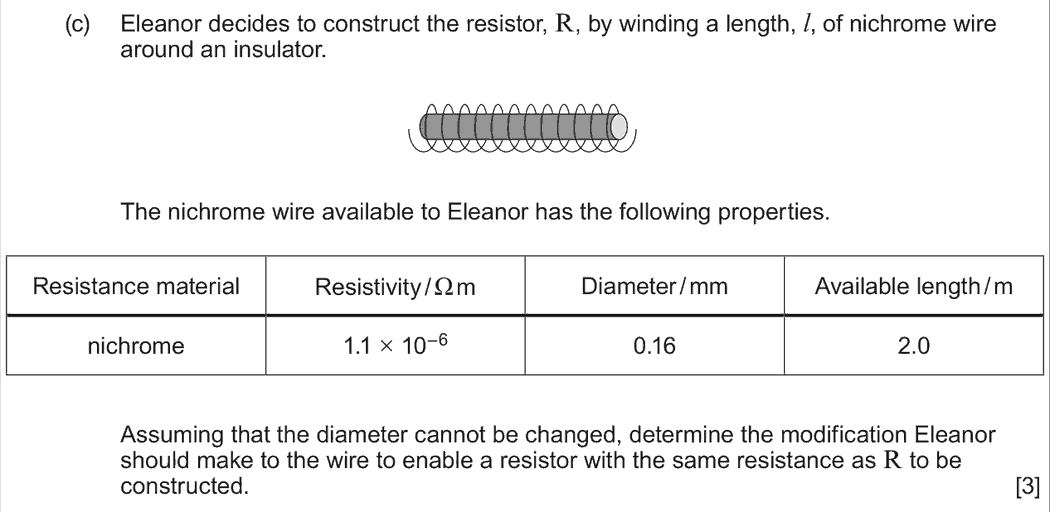
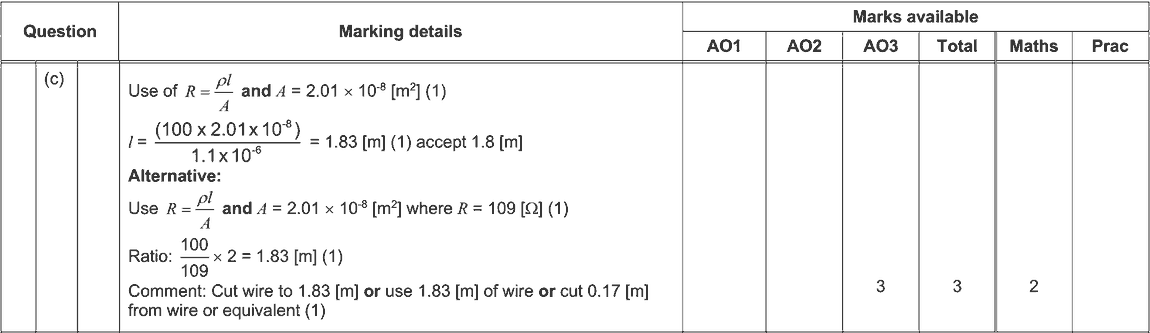
(c) Eleanor decides to construct the resistor, R, by winding a length, l, of nichrome wire around an insulator. The nichrome wire available to Eleanor has the following properties. Resistance material Resistivity / Ω m Diameter / mm Available length / m nichrome 1.1 × 10⁻⁶ 0.16 2.0 Assuming that the diameter cannot be changed, determine the modification Eleanor should make to the wire to enable a resistor with the same resistance as R to be constructed. [3]
June 2025 · Component 2 · Q4(a) 6 marks AO1=4, AO2=2 6-mark extended response capacitance
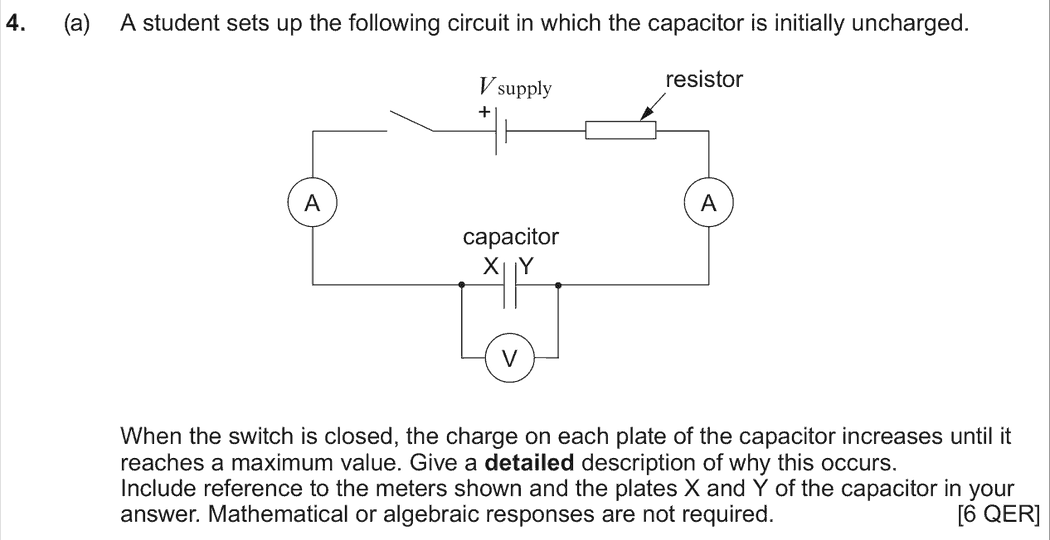
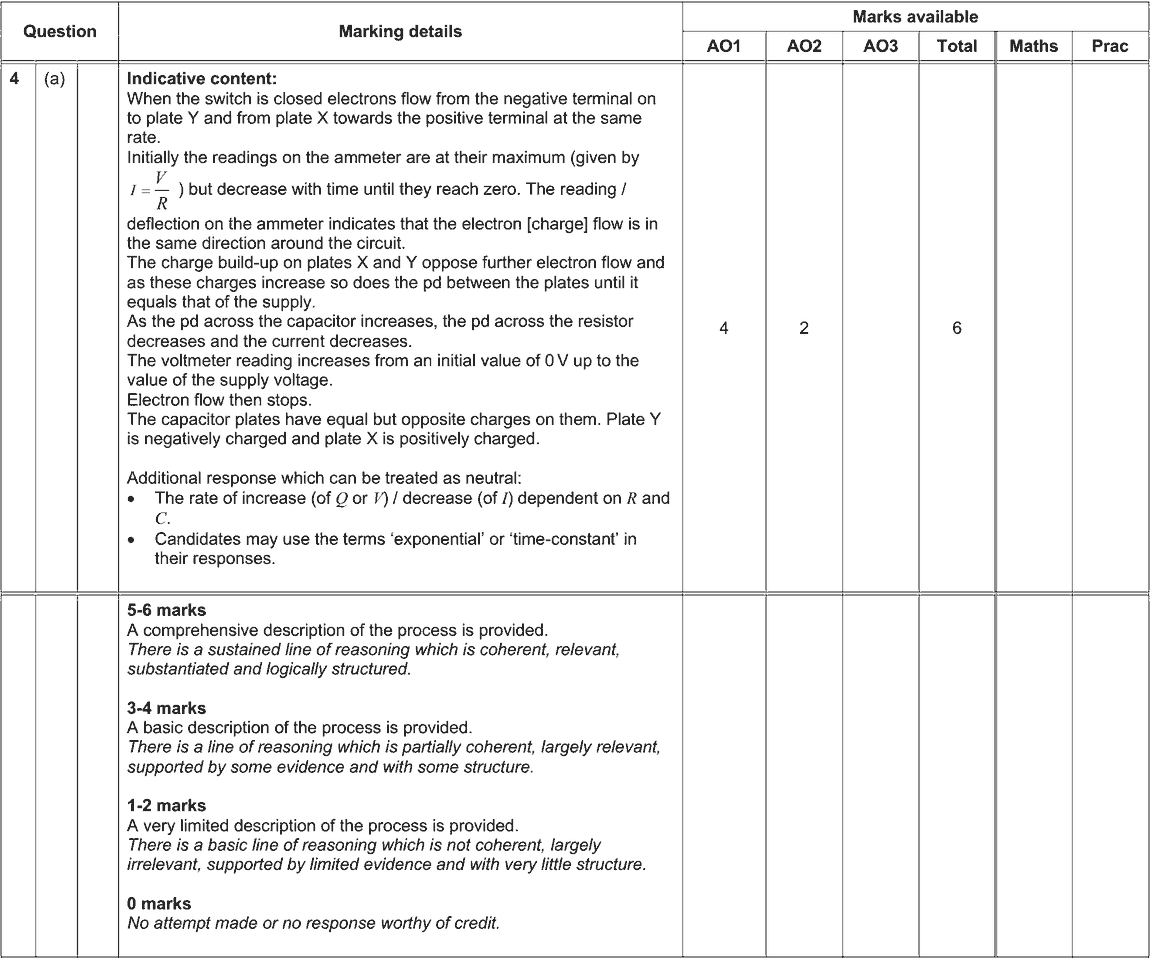
4. (a) A student sets up the following circuit in which the capacitor is initially uncharged. resistor V supply + A A capacitor X Y V When the switch is closed, the charge on each plate of the capacitor increases until it reaches a maximum value. Give a detailed description of why this occurs. Include reference to the meters shown and the plates X and Y of the capacitor in your answer. Mathematical or algebraic responses are not required. [6 QER]
June 2025 · Component 2 · Q4(b)(i)I 3 marks Calculation capacitance
Earlier part of question 4 that this part usesEarlier part of June 2025 Component 2 question 4
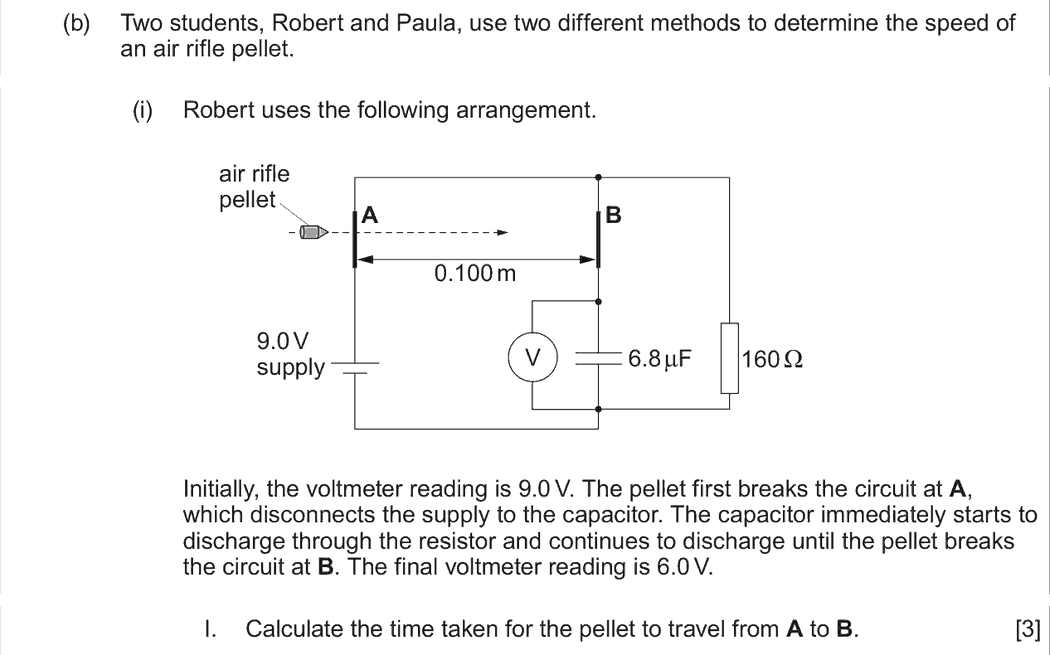
(b) Two students, Robert and Paula, use two different methods to determine the speed of an air rifle pellet. (i) Robert uses the following arrangement. air rifle pellet A B 0.100 m 9.0 V V 6.8 μF 160 Ω supply Initially, the voltmeter reading is 9.0 V. The pellet first breaks the circuit at A, which disconnects the supply to the capacitor. The capacitor immediately starts to discharge through the resistor and continues to discharge until the pellet breaks the circuit at B. The final voltmeter reading is 6.0 V. I. Calculate the time taken for the pellet to travel from A to B. [3]
June 2025 · Component 2 · Q4(b)(i)II 1 mark Calculation kinematics
Earlier parts of question 4 that this part usesEarlier part of June 2025 Component 2 question 4Earlier part of June 2025 Component 2 question 4
II. Hence determine the speed of the pellet. [1]
June 2025 · Component 2 · Q4(b)(ii) 3 marks AO3=3 Calculation dynamics
Earlier parts of question 4 that this part usesEarlier part of June 2025 Component 2 question 4Earlier part of June 2025 Component 2 question 4
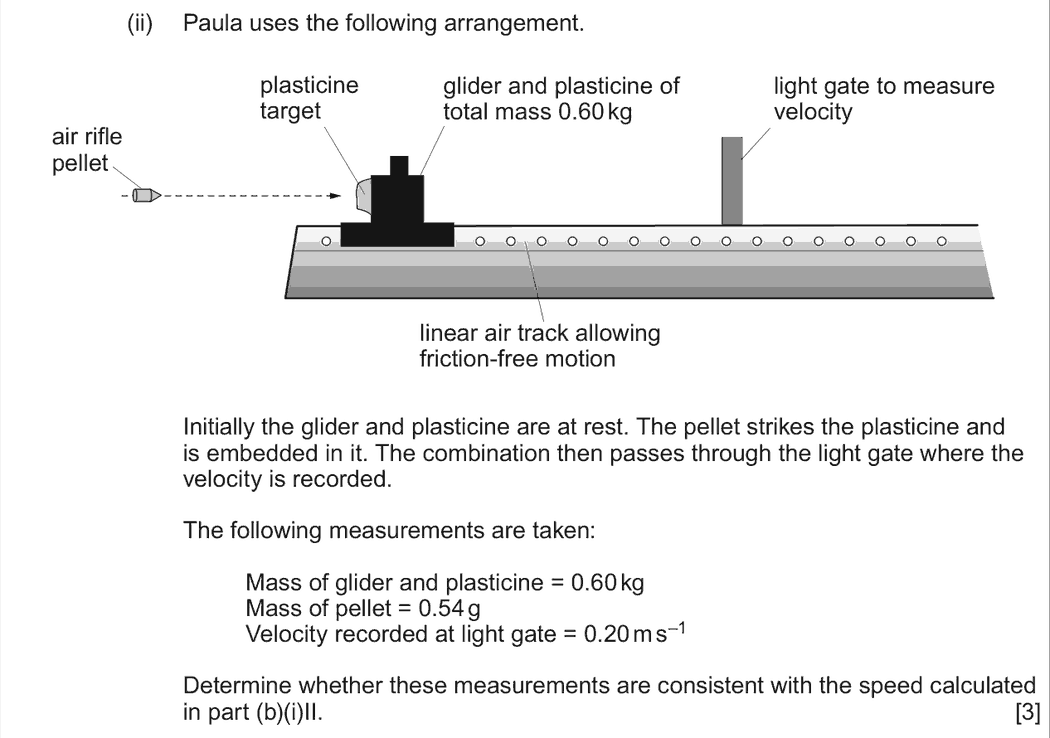
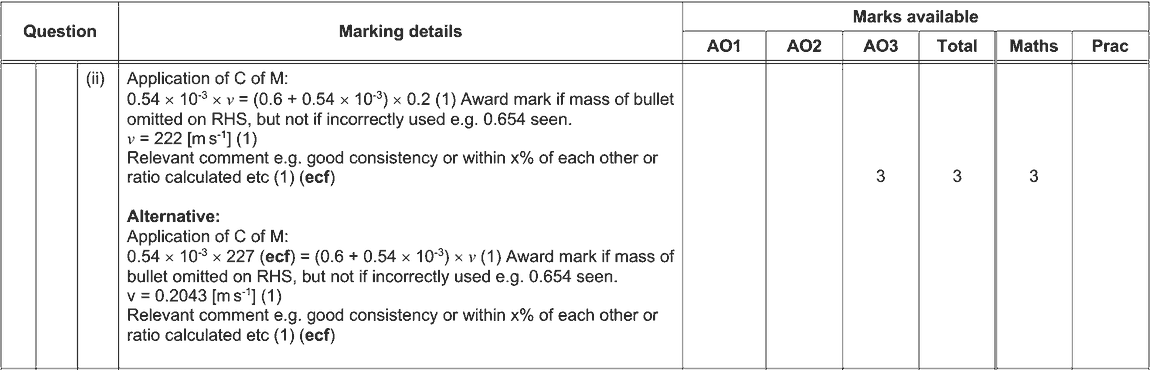
(ii) Paula uses the following arrangement. plasticine glider and plasticine of light gate to measure target total mass 0.60 kg velocity air rifle pellet linear air track allowing friction-free motion Initially the glider and plasticine are at rest. The pellet strikes the plasticine and is embedded in it. The combination then passes through the light gate where the velocity is recorded. The following measurements are taken: Mass of glider and plasticine = 0.60 kg Mass of pellet = 0.54 g Velocity recorded at light gate = 0.20 m s–1 Determine whether these measurements are consistent with the speed calculated in part (b)(i)II. [3]
June 2025 · Component 2 · Q5(a) 3 marks AO1=3 Practical and data analysis solids under stress
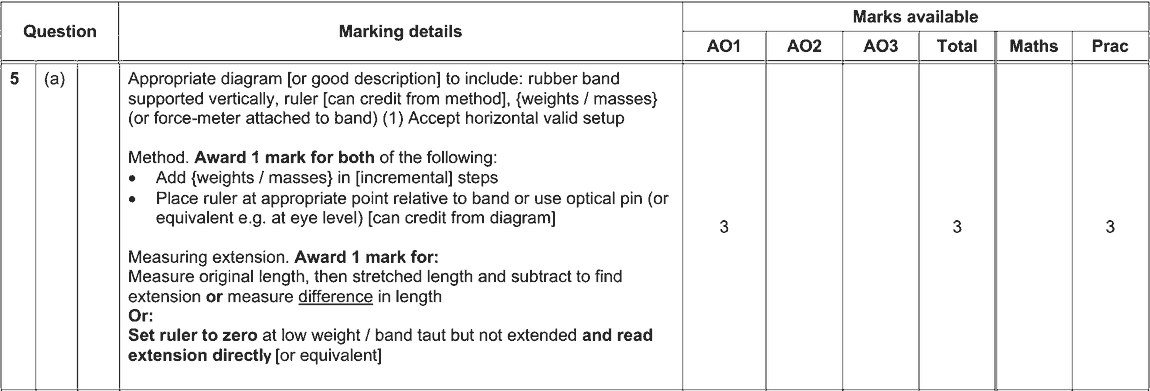
5. (a) Describe a method to investigate the force-extension properties of rubber in the form of an elastic band as it is loaded only. You should describe how the extension is accurately measured. [3]
June 2025 · Component 2 · Q5(b)(i) 2 marks AO3=2 Show that solids under stress
Earlier part of question 5 that this part usesEarlier part of June 2025 Component 2 question 5
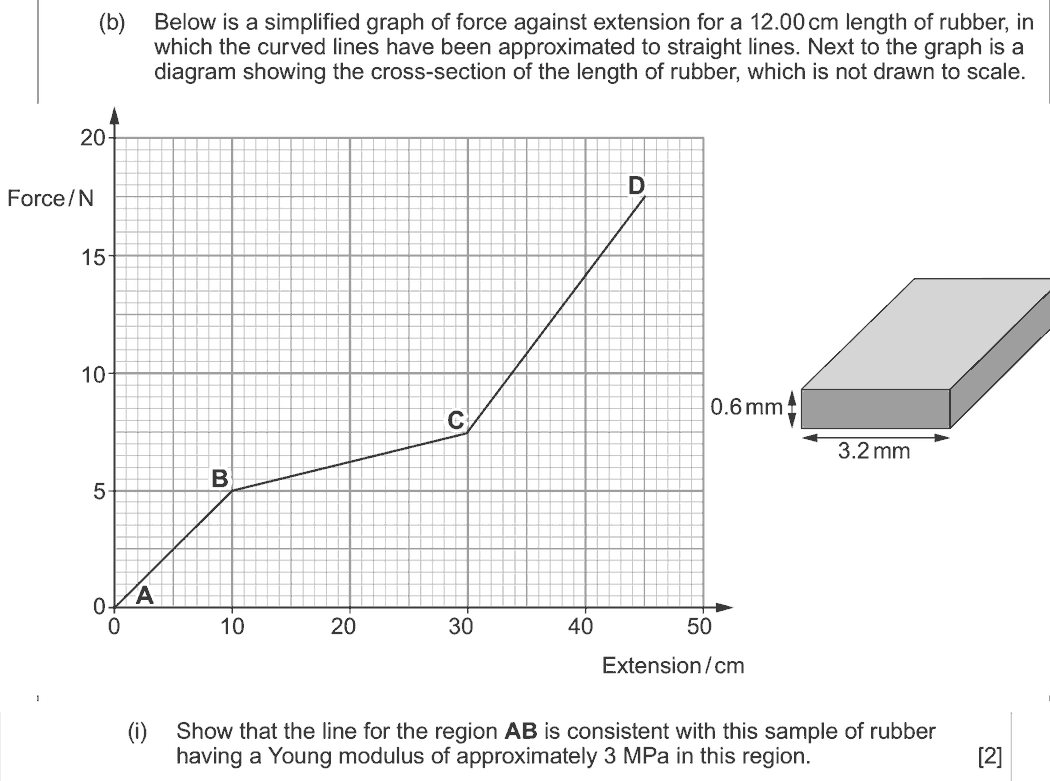
(b) Below is a simplified graph of force against extension for a 12.00 cm length of rubber, in which the curved lines have been approximated to straight lines. Next to the graph is a diagram showing the cross-section of the length of rubber, which is not drawn to scale. 20 D D Force / N 15 10 0.6 mm C 3.2 mm B 5 A 0 0 10 20 30 40 50 Extension / cm (i) Show that the line for the region AB is consistent with this sample of rubber having a Young modulus of approximately 3 MPa in this region. [2]
June 2025 · Component 2 · Q5(b)(ii) 2 marks AO1=2 Explanation solids under stress
Earlier parts of question 5 that this part usesEarlier part of June 2025 Component 2 question 5Earlier part of June 2025 Component 2 question 5
(ii) Briefly explain the changes in the molecular arrangement in the regions BC and CD. [2]
June 2025 · Component 2 · Q5(b)(iii) 3 marks AO2=3 Calculation solids under stress
Earlier parts of question 5 that this part usesEarlier part of June 2025 Component 2 question 5Earlier part of June 2025 Component 2 question 5
(iii) A student suggests that 1.5 times more work is done in stretching the rubber from C to D than from B to C. Determine whether the student is correct. [3]
June 2025 · Component 2 · Q5(c) 3 marks AO3=3 Explanation solids under stress
Earlier parts of question 5 that this part usesEarlier part of June 2025 Component 2 question 5Earlier part of June 2025 Component 2 question 5
(c) Explain how a car tyre manufacturer might use the term ‘hysteresis’ to advise drivers that driving with under-inflated tyres (tyres below the recommended pressure) is a bad idea. [3]
June 2025 · Component 2 · Q6(a) 1 mark AO1=1 Definition electrostatic and gravitational fields
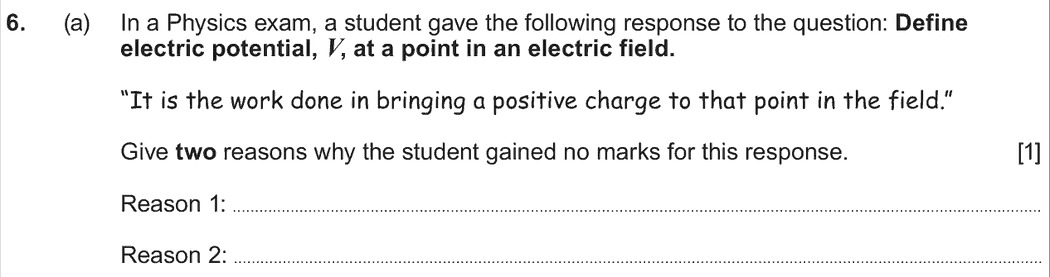
6. (a) In a Physics exam, a student gave the following response to the question: Define electric potential, V, at a point in an electric field. “It is the work done in bringing a positive charge to that point in the field.” Give two reasons why the student gained no marks for this response. [1] Reason 1: Reason 2:
June 2025 · Component 2 · Q6(b)(i) 3 marks AO2=3 Calculation electrostatic and gravitational fields
Earlier part of question 6 that this part usesEarlier part of June 2025 Component 2 question 6
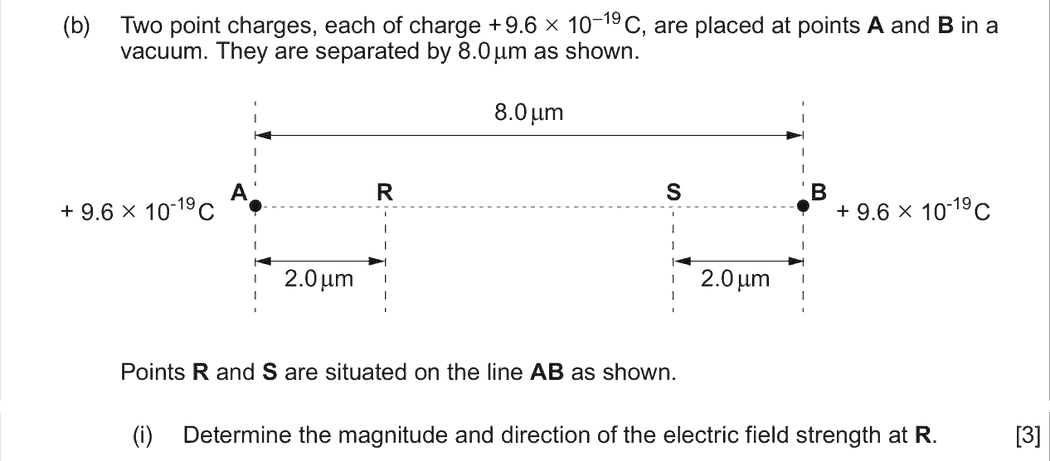
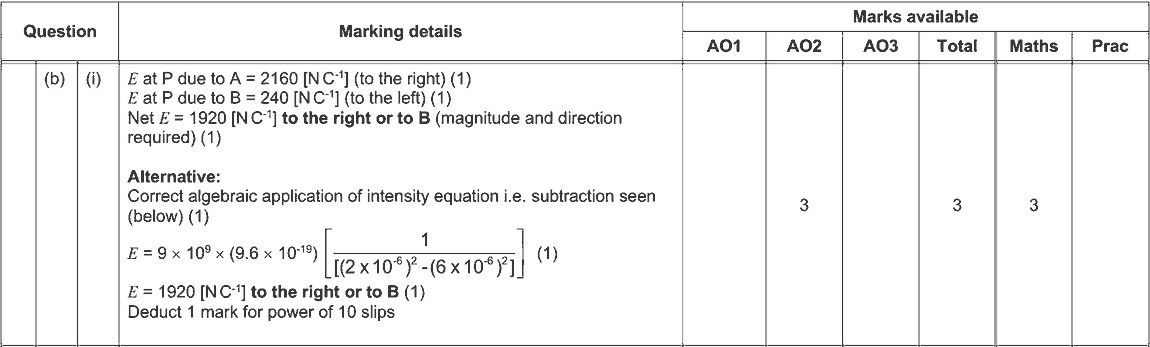
(b) Two point charges, each of charge + 9.6 × 10⁻¹⁹ C, are placed at points A and B in a vacuum. They are separated by 8.0 μm as shown. 8.0 μm A R S B + 9.6 × 10⁻¹⁹ C + 9.6 × 10⁻¹⁹ C 2.0 μm 2.0 μm Points R and S are situated on the line AB as shown. (i) Determine the magnitude and direction of the electric field strength at R. [3]
June 2025 · Component 2 · Q6(b)(ii) 2 marks AO2=2 Explanation electrostatic and gravitational fields
Earlier parts of question 6 that this part usesEarlier part of June 2025 Component 2 question 6Earlier part of June 2025 Component 2 question 6
(ii) A teacher states: “When a small test charge is moved between R and S, the net work done is zero.” Explain, without calculation, why the teacher is correct. [2]
June 2025 · Component 2 · Q6(b)(iii) 4 marks AO2=4 Calculation electrostatic and gravitational fields
Earlier parts of question 6 that this part usesEarlier part of June 2025 Component 2 question 6Earlier part of June 2025 Component 2 question 6
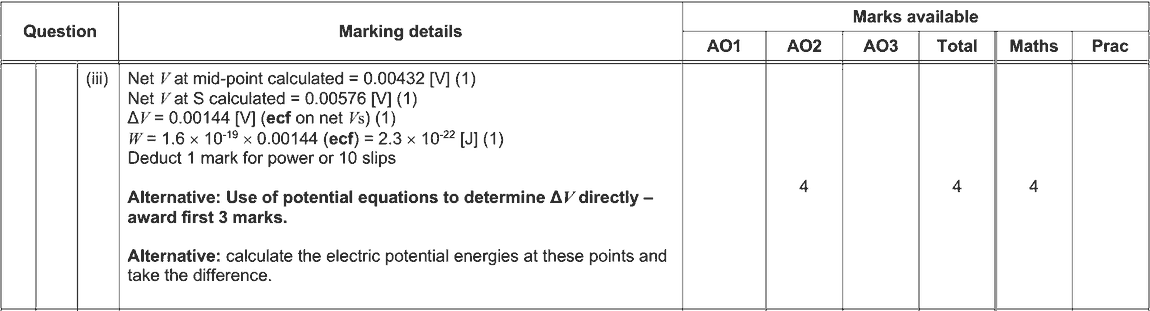
(iii) Calculate the work done in moving a proton from the mid-point of AB to point S. [4]
June 2025 · Component 2 · Q7(a) 3 marks AO1=1, AO2=2 Explanation orbits and the wider universe
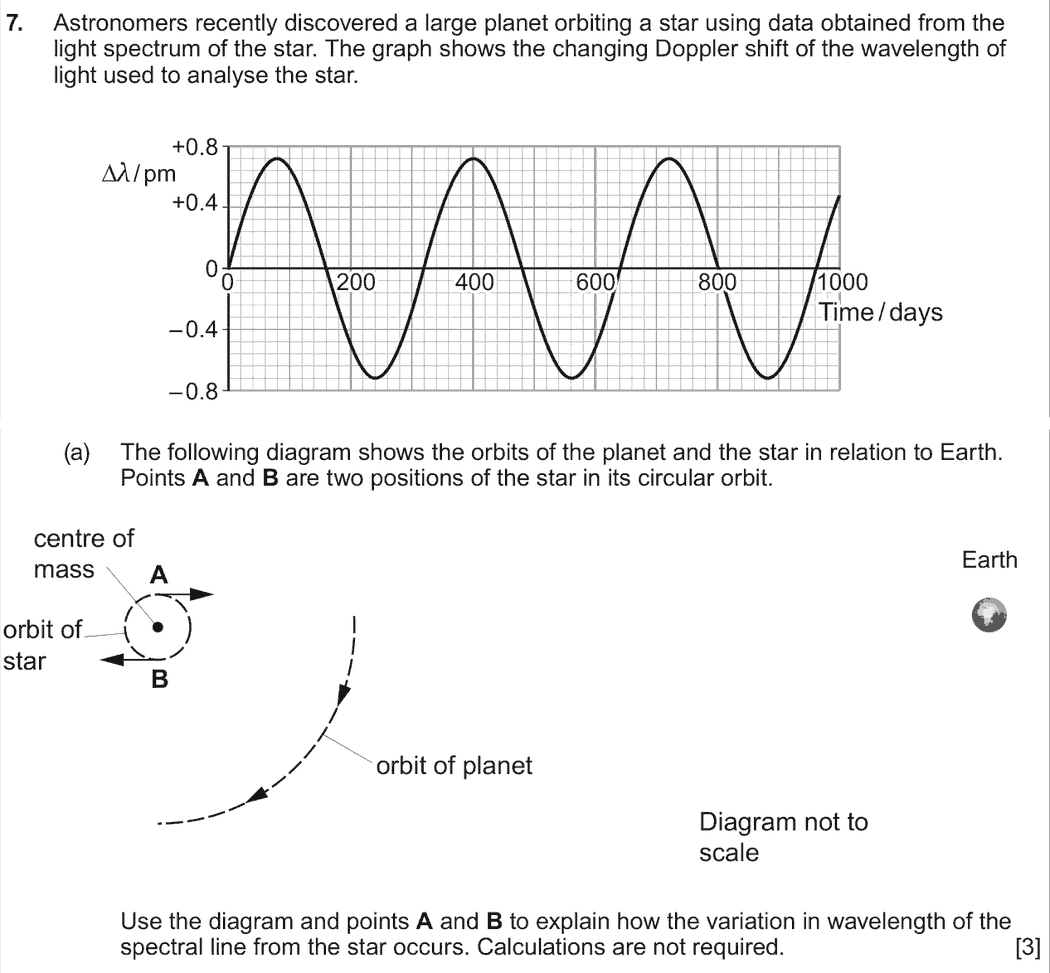
7. Astronomers recently discovered a large planet orbiting a star using data obtained from the light spectrum of the star. The graph shows the changing Doppler shift of the wavelength of light used to analyse the star. +0.8 ∆λ / pm +0.4 0 20 200 200 400 400 600 600 800 800 1000 1000 Time Time/ / days days – 0.4 – 0.8 (a) The following diagram shows the orbits of the planet and the star in relation to Earth. Points A and B are two positions of the star in its circular orbit. centre of Earth mass A orbit of star B orbit of planet Diagram not to scale Use the diagram and points A and B to explain how the variation in wavelength of the spectral line from the star occurs. Calculations are not required. [3]
June 2025 · Component 2 · Q7(b)(i) 3 marks AO1=1, AO2=2 Show that orbits and the wider universe
Earlier part of question 7 that this part usesEarlier part of June 2025 Component 2 question 7
(b) Use information from the graph to answer the following. (i) Show that the orbital speed of the star about the centre of mass is approximately 360 m s–1. The wavelength of light used to obtain the data is 598 nm. [3]
June 2025 · Component 2 · Q7(b)(ii) 3 marks AO1=1, AO2=2 Show that orbits and the wider universecircular motion
Earlier parts of question 7 that this part usesEarlier part of June 2025 Component 2 question 7Earlier part of June 2025 Component 2 question 7
(ii) Show that the radius of orbit of the star is approximately 1.6 × 10⁹ m. [3]
June 2025 · Component 2 · Q7(b)(iii) 5 marks AO1=1, AO2=4 Calculation orbits and the wider universe
Earlier parts of question 7 that this part usesEarlier part of June 2025 Component 2 question 7Earlier part of June 2025 Component 2 question 7
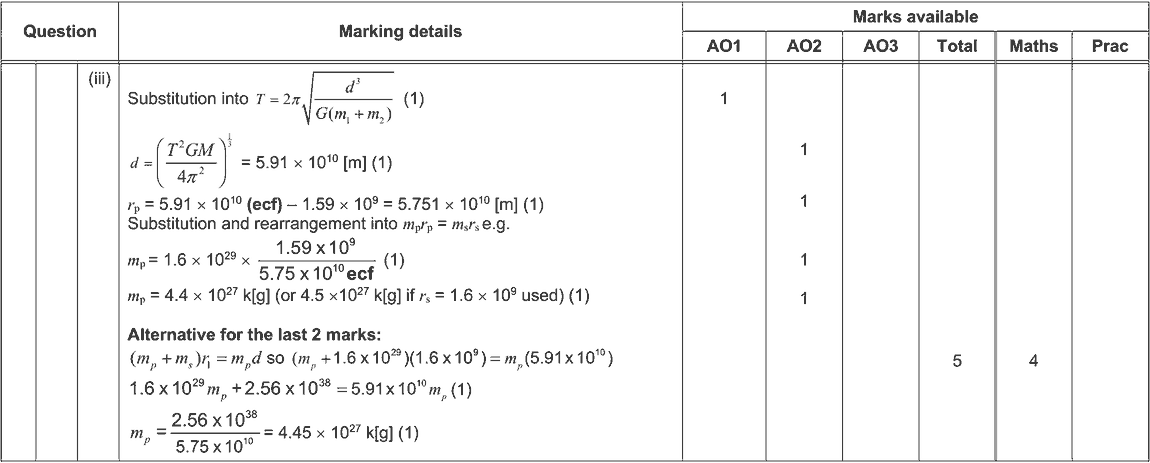
(iii) The mass of the star is 1.6 × 1029 kg. Assuming this is far greater than the mass of the planet, calculate the mass of the planet. [5]
June 2025 · Component 2 · Q7(c) 4 marks AO2=4 Calculation electrostatic and gravitational fields
Earlier part of question 7 that this part usesEarlier part of June 2025 Component 2 question 7
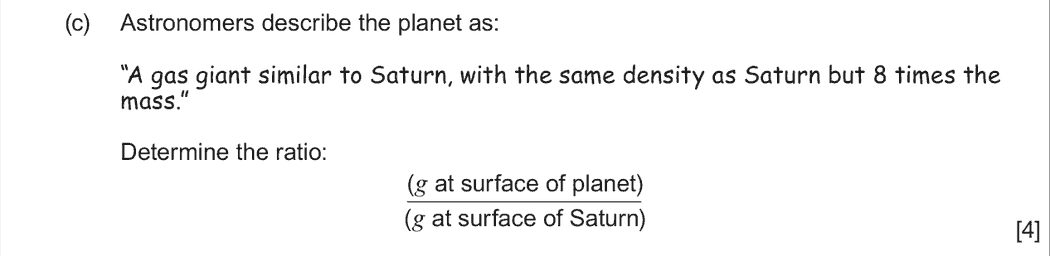
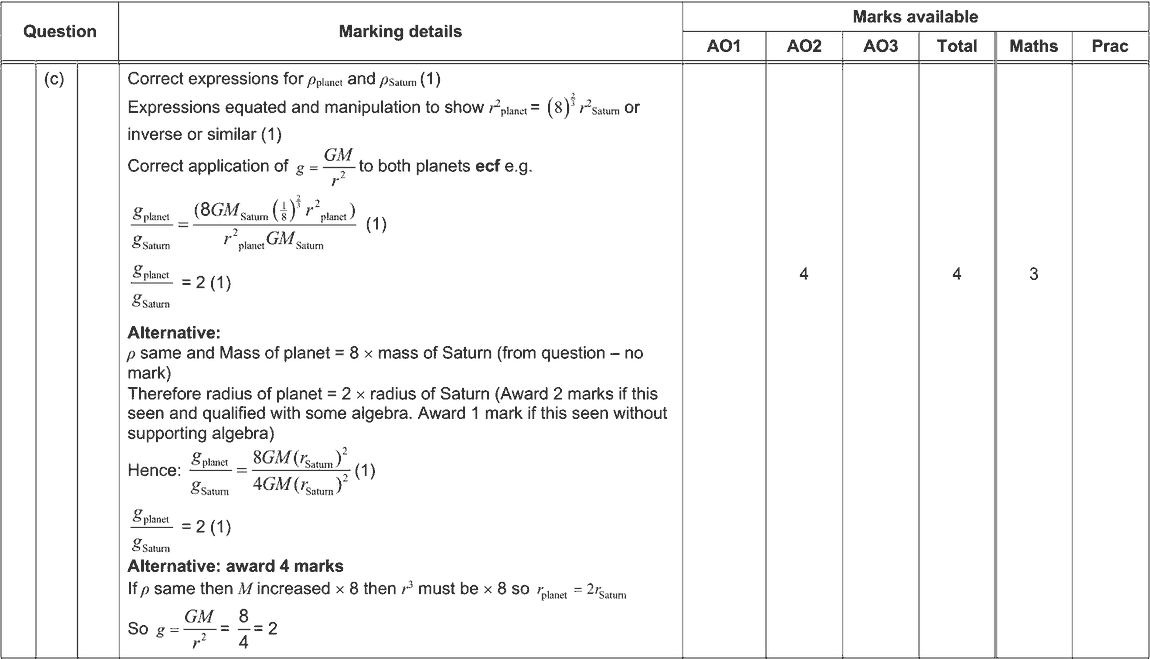
(c) Astronomers describe the planet as: “A gas giant similar to Saturn, with the same density as Saturn but 8 times the mass.” Determine the ratio: (g at surface of planet) (g at surface of Saturn) [4]
June 2025 · Component 2 · Q8(a)(i) 1 mark AO1=1 Definition radiation and stars
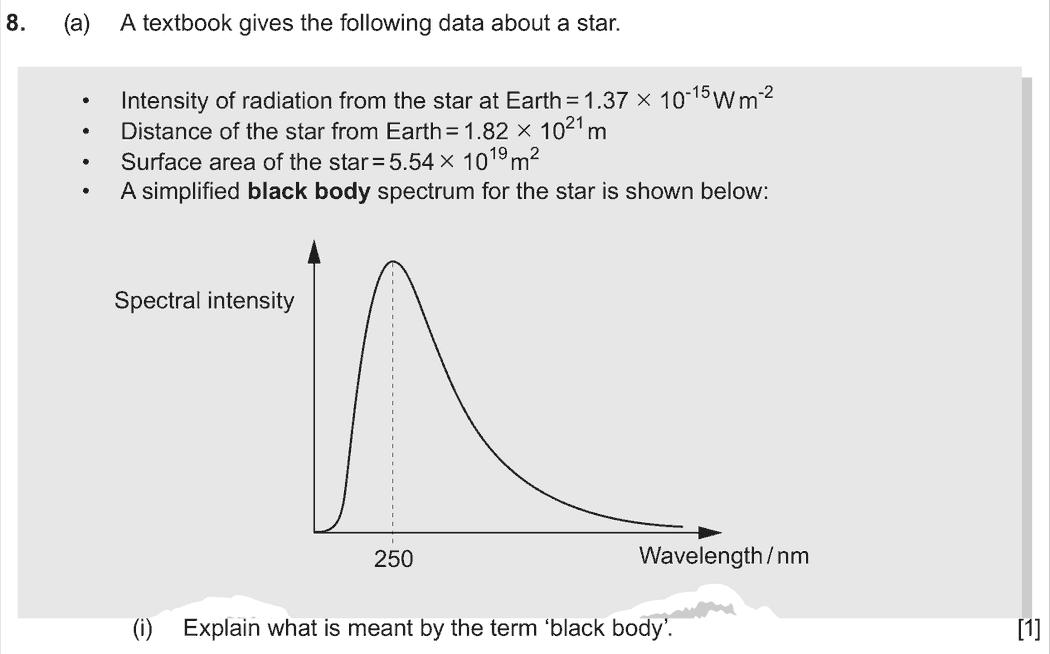
8. (a) A textbook gives the following data about a star. • Intensity of radiation from the star at Earth = 1.37 × 10⁻¹⁵ W m-2 • Distance of the star from Earth = 1.82 × 10²¹ m • Surface area of the star = 5.54 × 10¹⁹ m2 • A simplified black body spectrum for the star is shown below: Spectral intensity 250 Wavelength / nm (i) Explain what is meant by the term ‘black body’. [1]
June 2025 · Component 2 · Q8(a)(ii) 4 marks AO3=4 Calculation radiation and stars
Earlier part of question 8 that this part usesEarlier part of June 2025 Component 2 question 8
(ii) Determine whether the information given in the first three bullet points is consistent with the wavelength at peak intensity shown by the graph. [4]
June 2025 · Component 2 · Q8(b)(i) 1 mark AO1=1 Definition radiation and stars
Earlier part of question 8 that this part usesEarlier part of June 2025 Component 2 question 8
(b) (i) State what is meant by the term ‘multiwavelength astronomy’. [1]
June 2025 · Component 2 · Q8(b)(ii) 2 marks AO3=2 Short answer radiation and stars
Earlier parts of question 8 that this part usesEarlier part of June 2025 Component 2 question 8Earlier part of June 2025 Component 2 question 8
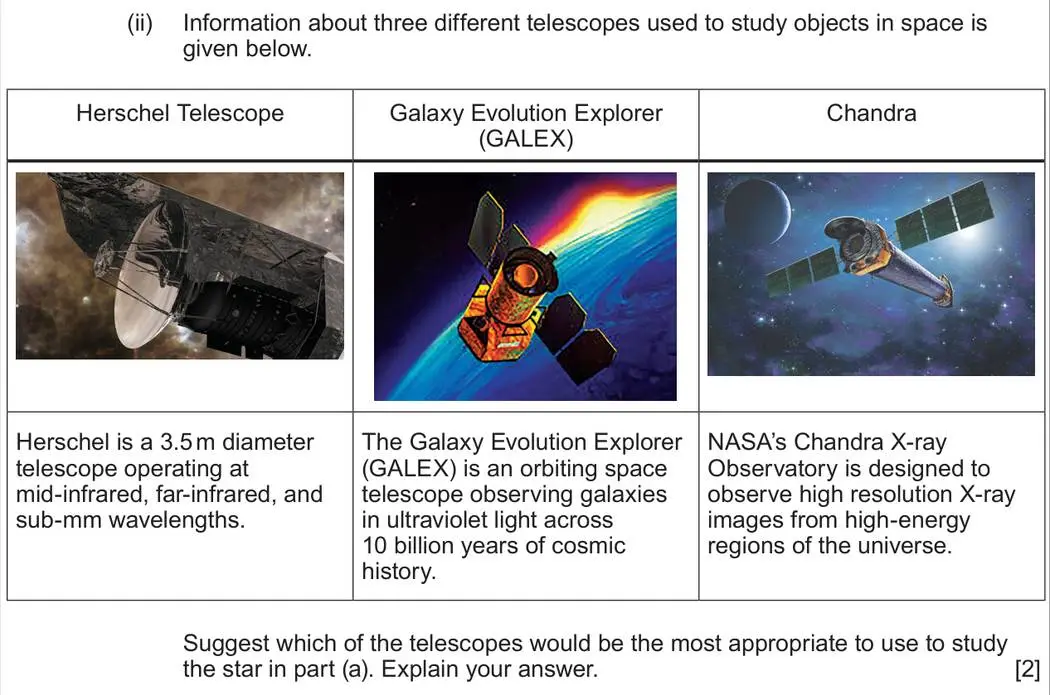
(ii) Information about three different telescopes used to study objects in space is given below. Herschel Telescope Galaxy Evolution Explorer Chandra (GALEX) Herschel is a 3.5 m diameter The Galaxy Evolution Explorer NASA’s Chandra X-ray telescope operating at (GALEX) is an orbiting space Observatory is designed to mid-infrared, far-infrared, and telescope observing galaxies observe high resolution X-ray sub-mm wavelengths. in ultraviolet light across images from high-energy 10 billion years of cosmic regions of the universe. history. Suggest which of the telescopes would be the most appropriate to use to study the star in part (a). Explain your answer. [2]

Work with an Eduqas physics tutor

Want a paper marked and gone through with you? Message us.

Prefer email? Send an enquiry

If you are under 18, please include a parent's contact details. Enquiries go to enquiries@physicsaleveltutor.com and are deleted once handled. All tutoring is online.