
October 2020: Component 1

100 marks · 42 question parts · Paper, mark scheme and report on Eduqas's site · Have the Data Booklet beside you

Question by question

QTopicMarksAOType
1(a)(i) Kinematics 1AO2=1Calculation
1(a)(ii) Kinematics 1AO2=1Calculation
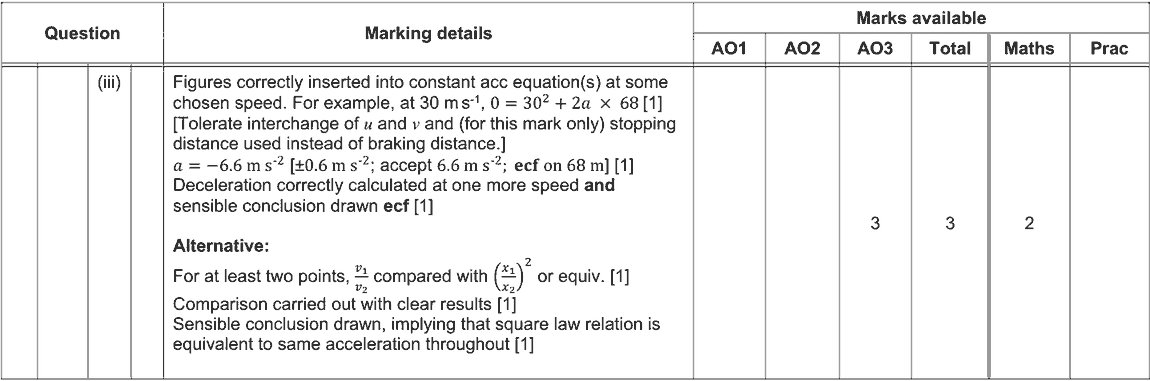
1(a)(iii) Kinematics 3AO3=3Calculation
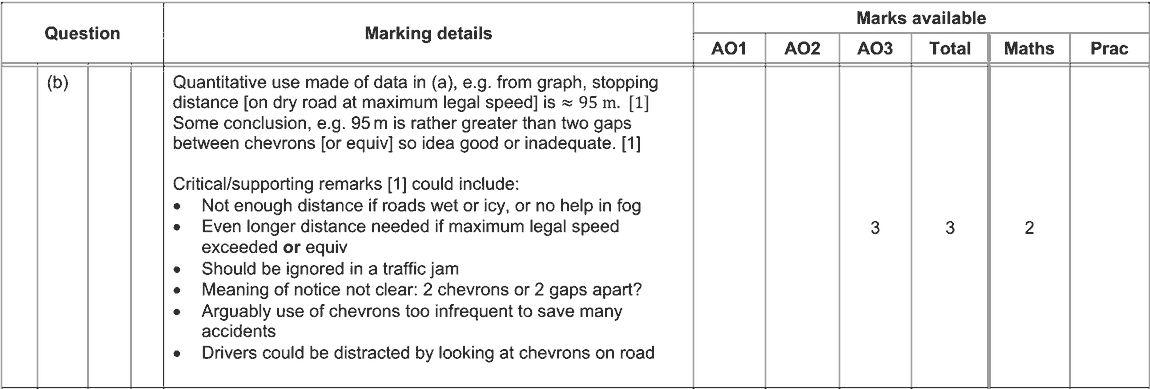
1(b) Kinematics 3AO3=3Explanation
2(a) Kinematics 1AO1=1Definition
2(b)(i) Circular motion 2AO1=1,AO2=1Show that
2(b)(ii) Circular motion 3AO1=2,AO2=1Calculation
2(b)(iii) Kinematics, Basic physics: units, vectors and moments 3AO2=3Calculation
2(c) Circular motion, Dynamics: forces and momentum 2AO3=2Explanation
3(a)(i) Vibrations: simple harmonic motion 2AO1=2Short answer
3(a)(ii) Vibrations: simple harmonic motion 1AO1=1Short answer
3(a)(iii) Vibrations: simple harmonic motion 3AO2=3Calculation
3(b)(i) Vibrations: simple harmonic motion 1AO3=1Practical and data analysis
3(b)(ii) Vibrations: simple harmonic motion 6AO3=6Practical and data analysis
3(c)(i) Vibrations: simple harmonic motion 1AO1=1Short answer
3(c)(ii) Vibrations: simple harmonic motion, Energy concepts 2AO1=2Explanation
3(d) Vibrations: simple harmonic motion 3AO1=3Explanation
4(a) Energy concepts 3AO2=3Show that
4(b) Energy concepts 3AO2=3Calculation
4(c) Energy concepts 2AO3=2Calculation
5(a)(i) Kinetic theory 2AO1=1,AO2=1Show that
5(a)(ii) Kinetic theory 2AO2=2Calculation
5(b)(i) Kinetic theory 3AO2=3Explanation
5(b)(ii) Dynamics: forces and momentum 2AO2=2Calculation
5(b)(iii) Dynamics: forces and momentum, Energy concepts 3AO2=3Calculation
5(b)(iv) Dynamics: forces and momentum 1AO1=1Short answer
5(b)(v) Photons 3AO3=3Calculation
6(a)(i) Thermal physics, Kinetic theory 3AO1=1,AO2=2Show that
6(a)(ii) Thermal physics 1AO1=1Short answer
6(b)(i) Kinetic theory 3AO2=3Calculation
6(b)(ii) Thermal physics 2AO2=2Calculation
6(b)(iii) Thermal physics 3AO1=1,AO2=2Calculation
7 Thermal physics 6AO1=6Extended response
8(a) Dynamics: forces and momentum, Comprehension: the Component 1 article questions 3AO1=3Explanation
8(b) Dynamics: forces and momentum, Comprehension: the Component 1 article questions 3AO2=3Explanation
8(c)(i) Basic physics: units, vectors and moments, Comprehension: the Component 1 article questions 1AO1=1Short answer
8(c)(ii) Kinematics, Comprehension: the Component 1 article questions 2AO2=2Practical and data analysis
8(d) Kinematics, Dynamics: forces and momentum, Comprehension: the Component 1 article questions 3AO2=3Explanation
8(e) Dynamics: forces and momentum, Comprehension: the Component 1 article questions 1AO2=1Show that
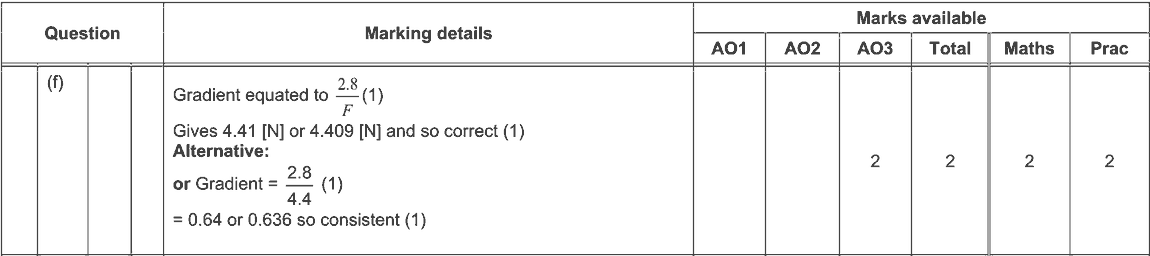
8(f) Dynamics: forces and momentum, Comprehension: the Component 1 article questions 2AO3=2Calculation
8(g)(i) Orbits and the wider universe, Comprehension: the Component 1 article questions 2AO1=2Definition
8(g)(ii) Orbits and the wider universe, Comprehension: the Component 1 article questions 3AO3=3Explanation

The questions

1(a)(i)1(a)(ii)1(a)(iii)1(b)2(a)2(b)(i)2(b)(ii)2(b)(iii)2(c)3(a)(i)3(a)(ii)3(a)(iii)3(b)(i)3(b)(ii)3(c)(i)3(c)(ii)3(d)4(a)4(b)4(c)5(a)(i)5(a)(ii)5(b)(i)5(b)(ii)5(b)(iii)5(b)(iv)5(b)(v)6(a)(i)6(a)(ii)6(b)(i)6(b)(ii)6(b)(iii)78(a)8(b)8(c)(i)8(c)(ii)8(d)8(e)8(f)8(g)(i)8(g)(ii)
October 2020 · Component 1 · Q1(a)(i) 1 mark AO2=1 Calculation kinematics
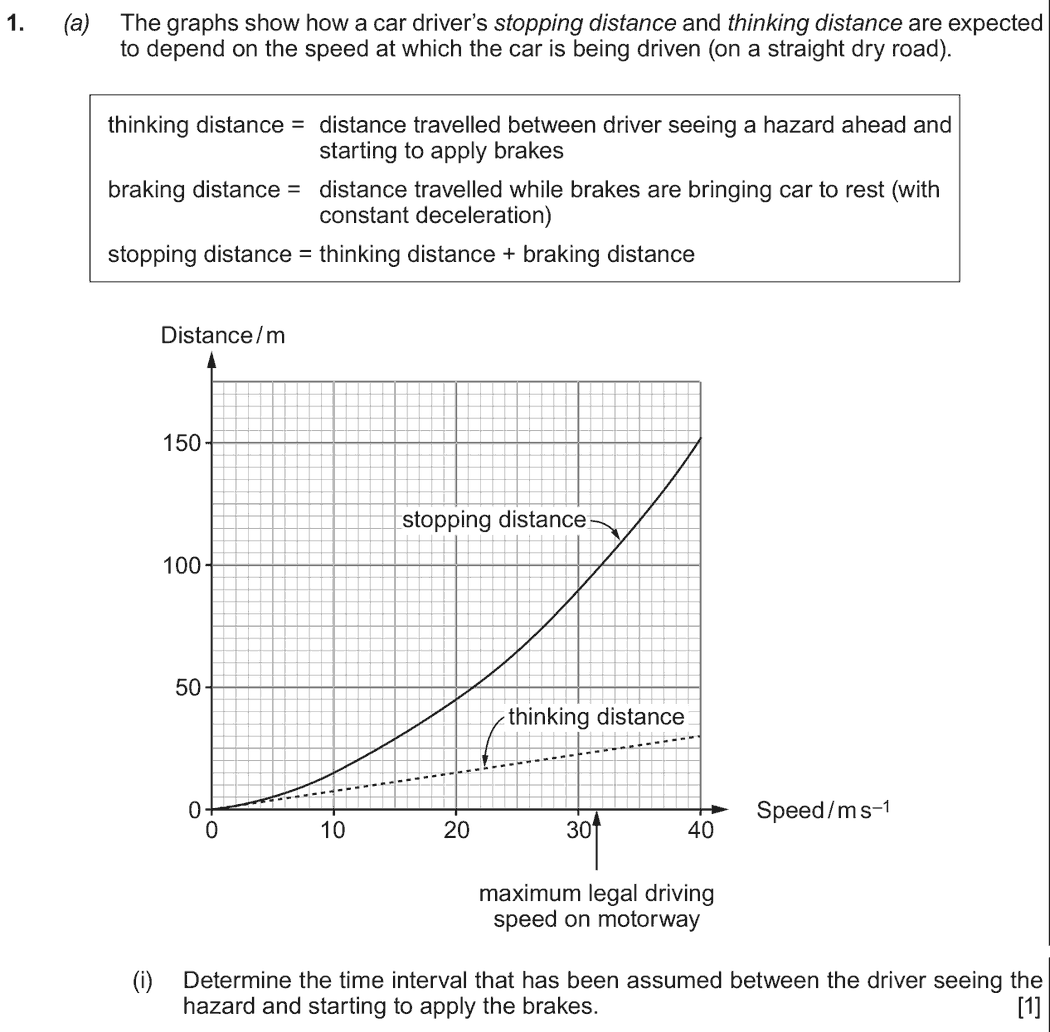
1. (a) The graphs show how a car driver’s stopping distance and thinking distance are expected to depend on the speed at which the car is being driven (on a straight dry road). thinking distance = distance travelled between driver seeing a hazard ahead and starting to apply brakes braking distance = distance travelled while brakes are bringing car to rest (with constant deceleration) stopping distance = thinking distance + braking distance Distance / m 150 stopping distance 100 50 thinking distance 0 Speed / m s–1 0 10 20 30 40 maximum legal driving speed on motorway (i) Determine the time interval that has been assumed between the driver seeing the hazard and starting to apply the brakes. [1]
October 2020 · Component 1 · Q1(a)(ii) 1 mark AO2=1 Calculation kinematics
Earlier part of question 1 that this part usesEarlier part of October 2020 Component 1 question 1
(ii) Determine the braking distance for a speed of 30 m s–1. [1]
October 2020 · Component 1 · Q1(a)(iii) 3 marks AO3=3 Calculation kinematics
Earlier part of question 1 that this part usesEarlier part of October 2020 Component 1 question 1
(iii) Evaluate whether or not a consistent value has been used for the car’s deceleration while the brakes are being applied. [3]
October 2020 · Component 1 · Q1(b) 3 marks AO3=3 Explanation kinematics
Earlier part of question 1 that this part usesEarlier part of October 2020 Component 1 question 1
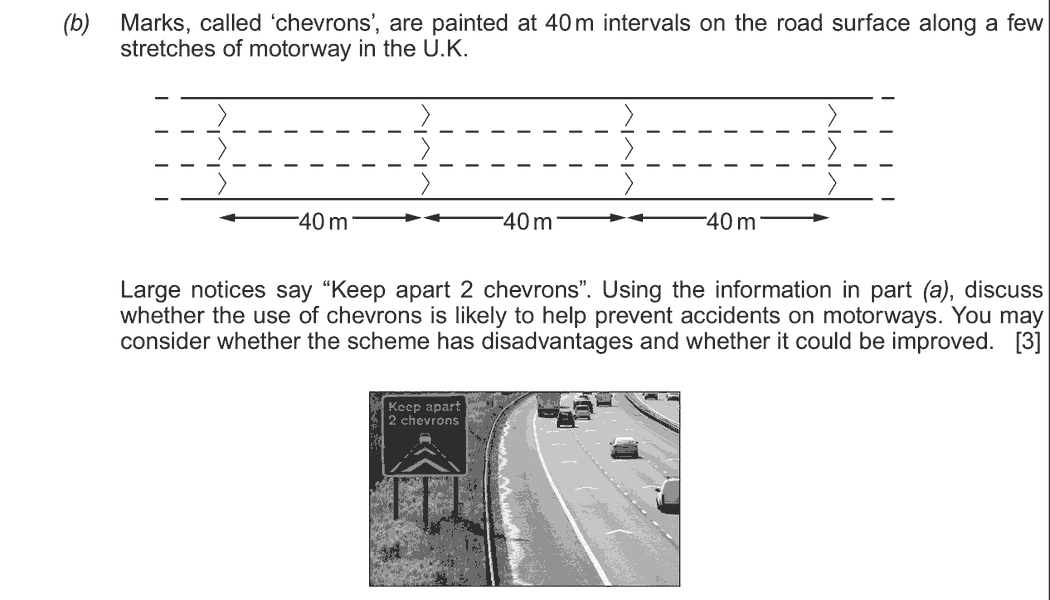
(b) Marks, called ‘chevrons’, are painted at 40 m intervals on the road surface along a few stretches of motorway in the U.K. 40 m 40 m 40 m Large notices say “Keep apart 2 chevrons”. Using the information in part (a), discuss whether the use of chevrons is likely to help prevent accidents on motorways. You may consider whether the scheme has disadvantages and whether it could be improved. [3]

October 2020 · Component 1 · Q2(a) 1 mark AO1=1 Definition kinematics
2. (a) State what is meant by a body’s mean acceleration over a period of time. [1]
October 2020 · Component 1 · Q2(b)(i) 2 marks AO1=1, AO2=1 Show that circular motion
Earlier part of question 2 that this part usesEarlier part of October 2020 Component 1 question 2
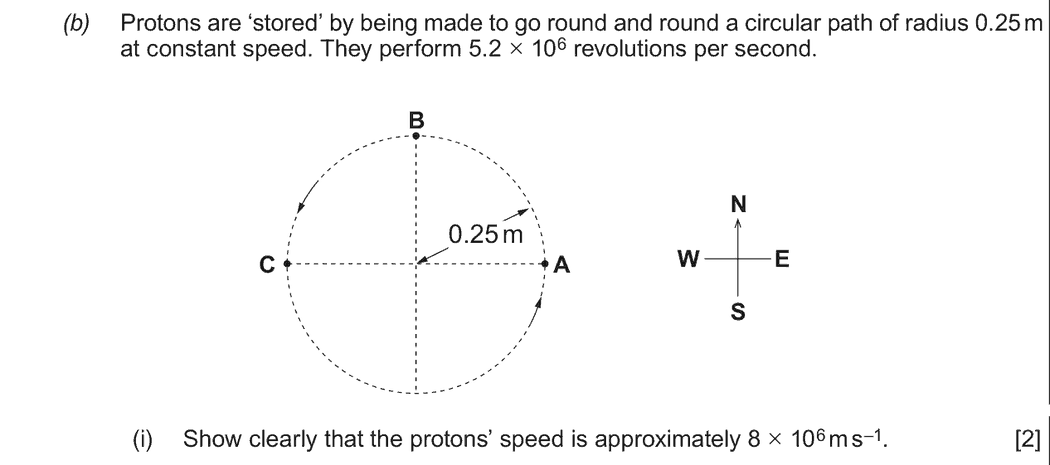
(b) Protons are ‘stored’ by being made to go round and round a circular path of radius 0.25 m at constant speed. They perform 5.2 × 10⁶ revolutions per second. B N 0.25 m C A W E S (i) Show clearly that the protons’ speed is approximately 8 × 10⁶ m s–1. [2]
October 2020 · Component 1 · Q2(b)(ii) 3 marks AO1=2, AO2=1 Calculation circular motion
Earlier parts of question 2 that this part usesEarlier part of October 2020 Component 1 question 2Earlier part of October 2020 Component 1 question 2
(ii) Determine the magnitude and direction of a proton’s acceleration at point B. [3]
October 2020 · Component 1 · Q2(b)(iii) 3 marks AO2=3 Calculation kinematicsbasic physics
Earlier parts of question 2 that this part usesEarlier part of October 2020 Component 1 question 2Earlier part of October 2020 Component 1 question 2
(iii) Calculate a proton’s mean acceleration over the semicircle ABC. [3]
October 2020 · Component 1 · Q2(c) 2 marks AO3=2 Explanation circular motiondynamics
Earlier parts of question 2 that this part usesEarlier part of October 2020 Component 1 question 2Earlier part of October 2020 Component 1 question 2
(c) Two students discuss the mean force on a proton over one revolution ABCA. Adam says that the mean force is the same as the force at B, because the force is the same all the way round. Brian says that the mean force is zero. Evaluate these opinions. [2]
October 2020 · Component 1 · Q3(a)(i) 2 marks AO1=2 Short answer vibrations
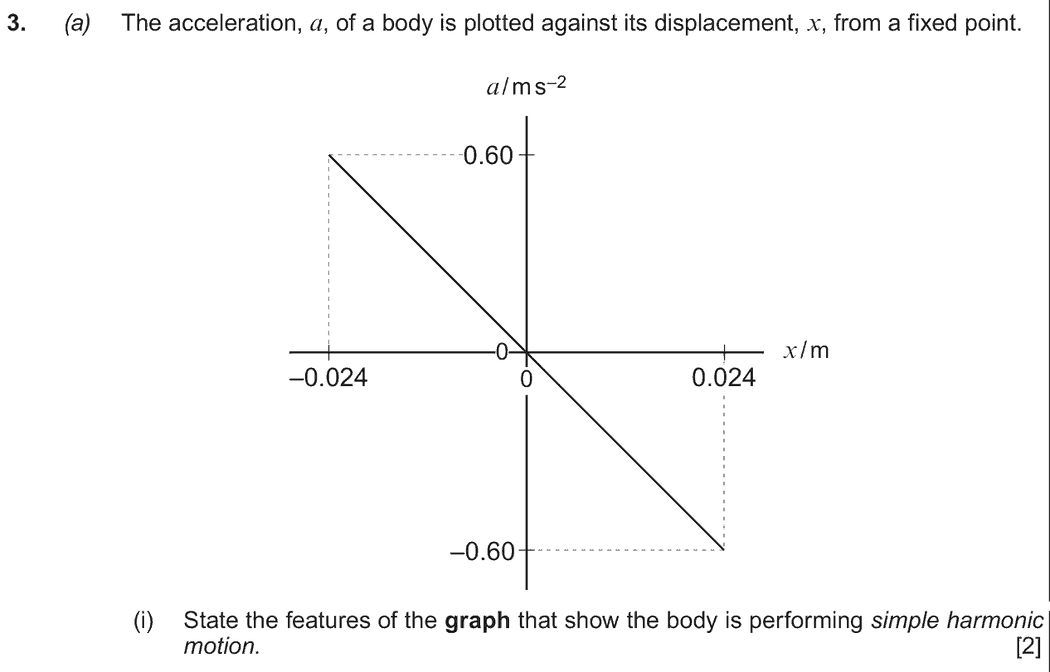
3. (a) The acceleration, a, of a body is plotted against its displacement, x, from a fixed point. a / m s–2 0.60 0 x / m –0.024 0 0.024 –0.60 (i) State the features of the graph that show the body is performing simple harmonic motion. [2]
October 2020 · Component 1 · Q3(a)(ii) 1 mark AO1=1 Short answer vibrations
Earlier part of question 3 that this part usesEarlier part of October 2020 Component 1 question 3
(ii) Determine the amplitude of the motion. [1]
October 2020 · Component 1 · Q3(a)(iii) 3 marks AO2=3 Calculation vibrations
Earlier part of question 3 that this part usesEarlier part of October 2020 Component 1 question 3
(iii) Calculate the periodic time of the motion. [3]
October 2020 · Component 1 · Q3(b)(i) 1 mark AO3=1 Practical and data analysis vibrations
Earlier part of question 3 that this part usesEarlier part of October 2020 Component 1 question 3
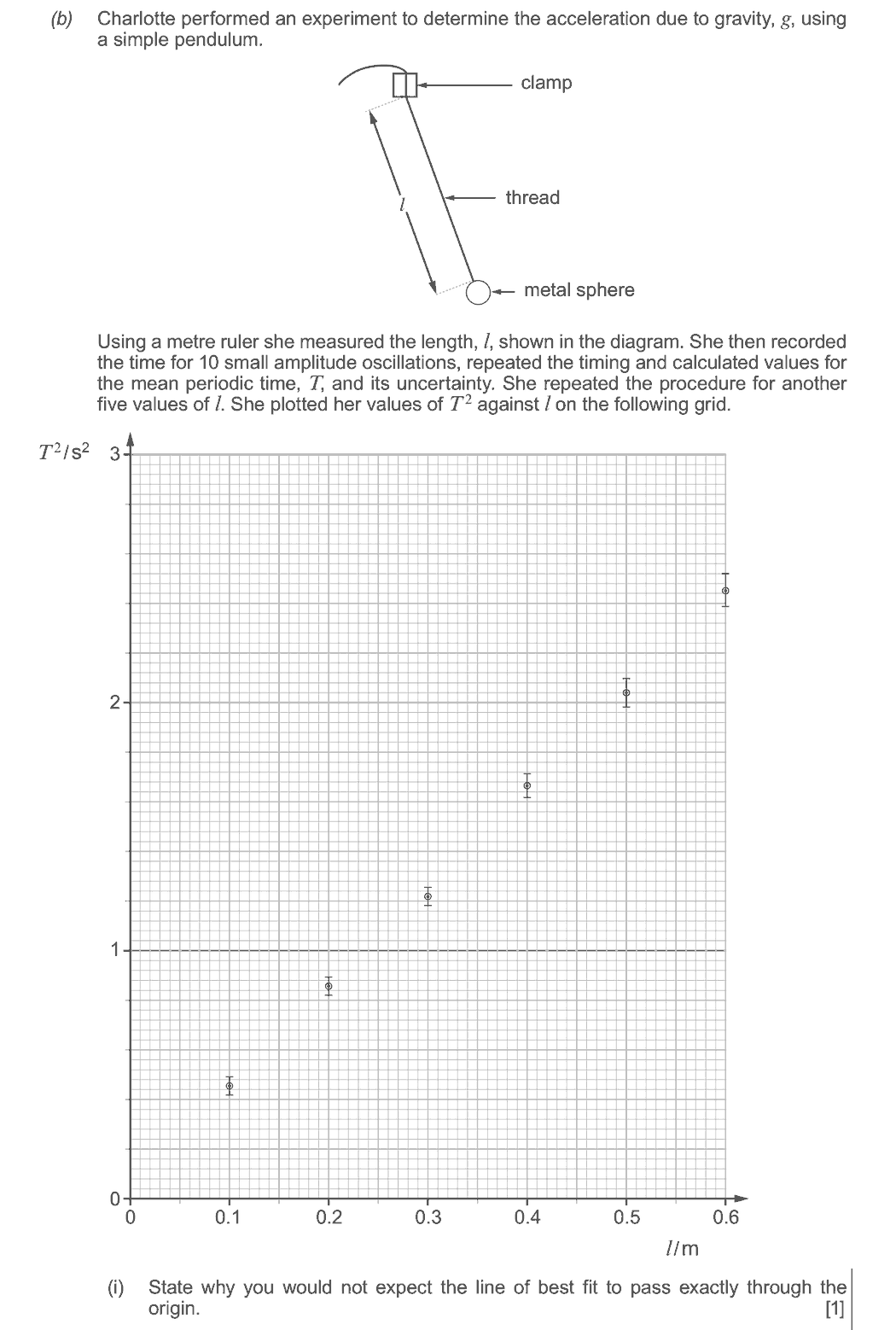
(b) Charlotte performed an experiment to determine the acceleration due to gravity, g, using a simple pendulum. clamp l thread metal sphere Using a metre ruler she measured the length, l, shown in the diagram. She then recorded the time for 10 small amplitude oscillations, repeated the timing and calculated values for the mean periodic time, T, and its uncertainty. She repeated the procedure for another five values of l. She plotted her values of T 2 against l on the following grid. T 2 / s2 3 2 1 0 0 0.1 0.2 0.3 0.4 0.5 0.6 l / m (i) State why you would not expect the line of best fit to pass exactly through the origin. [1]
October 2020 · Component 1 · Q3(b)(ii) 6 marks AO3=6 Practical and data analysis vibrations
Earlier parts of question 3 that this part usesEarlier part of October 2020 Component 1 question 3Earlier part of October 2020 Component 1 question 3
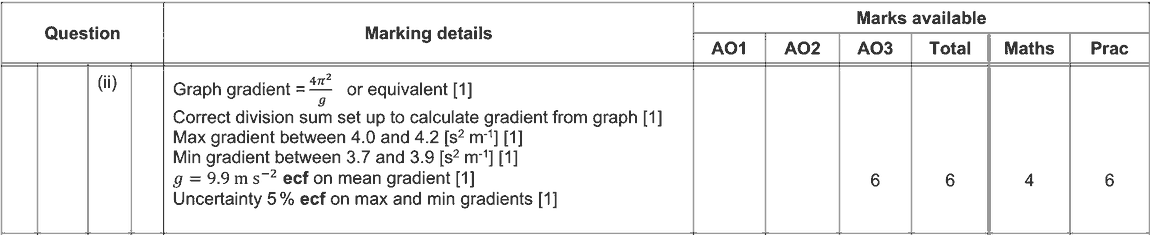
(ii) Determine a value for the acceleration due to gravity, g, together with its percentage uncertainty. Give your reasoning clearly. [6]
October 2020 · Component 1 · Q3(c)(i) 1 mark AO1=1 Short answer vibrations
Earlier parts of question 3 that this part usesEarlier part of October 2020 Component 1 question 3Earlier part of October 2020 Component 1 question 3
(c) A tennis ball attached by a spring to a fixed point is displaced vertically from its equilibrium position and released. It performs damped oscillations. (i) What observed feature of the oscillations shows them to be damped? [1]
October 2020 · Component 1 · Q3(c)(ii) 2 marks AO1=2 Explanation vibrationsenergy concepts
Earlier parts of question 3 that this part usesEarlier part of October 2020 Component 1 question 3Earlier part of October 2020 Component 1 question 3Earlier part of October 2020 Component 1 question 3
(ii) Explain in terms of forces how the damping comes about. [2]
October 2020 · Component 1 · Q3(d) 3 marks AO1=3 Explanation vibrations
Earlier parts of question 3 that this part usesEarlier part of October 2020 Component 1 question 3Earlier part of October 2020 Component 1 question 3
(d) Explain what is meant by critical damping, and state one application of critical damping (or of damping that is close to critical). [3]
October 2020 · Component 1 · Q4(a) 3 marks AO2=3 Show that energy concepts
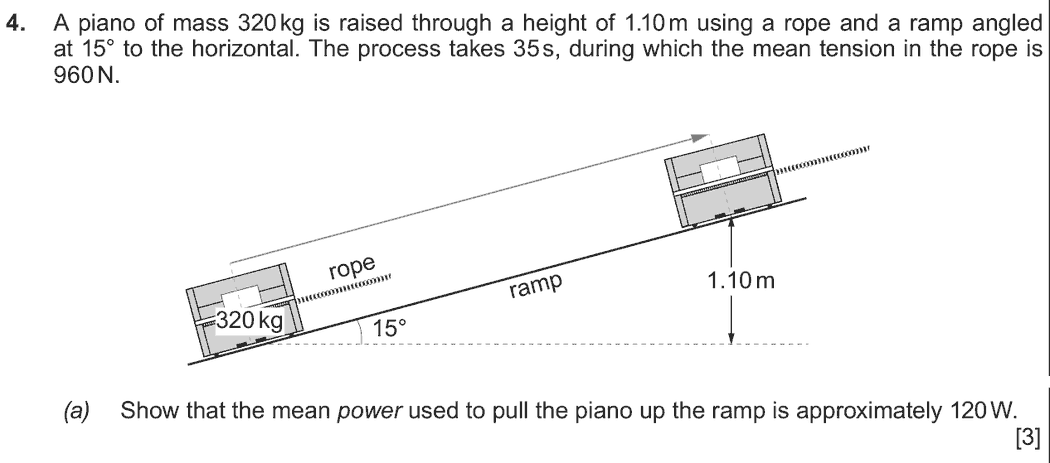
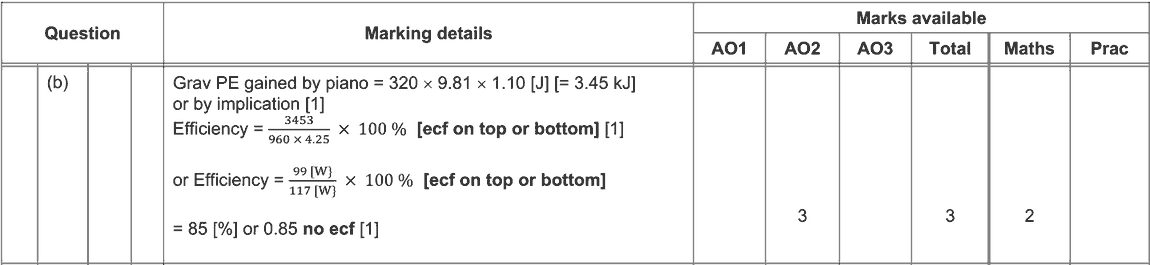
4. A piano of mass 320 kg is raised through a height of 1.10 m using a rope and a ramp angled at 15° to the horizontal. The process takes 35 s, during which the mean tension in the rope is 960 N. rope ramp 1.10 m 320 kg 15° (a) Show that the mean power used to pull the piano up the ramp is approximately 120 W. [3]
October 2020 · Component 1 · Q4(b) 3 marks AO2=3 Calculation energy concepts
Earlier part of question 4 that this part usesEarlier part of October 2020 Component 1 question 4
(b) Calculate the efficiency of the rope and ramp as a means of raising the piano through a height of 1.10 m. [3]
October 2020 · Component 1 · Q4(c) 2 marks AO3=2 Calculation energy concepts
Earlier part of question 4 that this part usesEarlier part of October 2020 Component 1 question 4
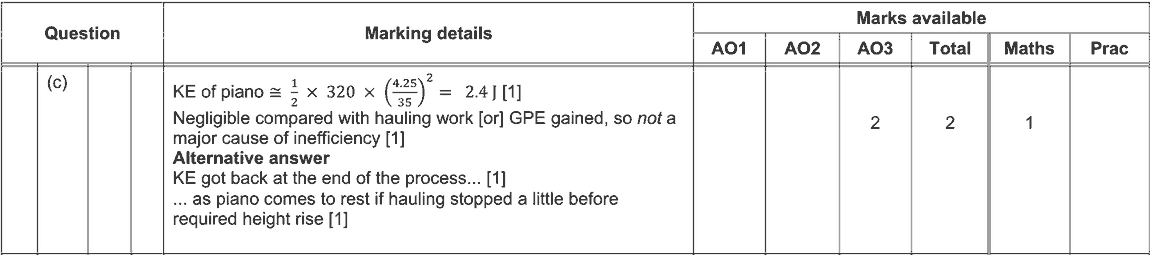
(c) Evaluate whether or not the kinetic energy given to the piano (at the beginning of the raising operation) is a major reason for inefficiency. [2]
October 2020 · Component 1 · Q5(a)(i) 2 marks AO1=1, AO2=1 Show that kinetic theory
5. (a) (i) Show that the mean kinetic energy of (monatomic) gas molecules at a temperature of 1 500 K is approximately 3 × 10–20 J. [2]
October 2020 · Component 1 · Q5(a)(ii) 2 marks AO2=2 Calculation kinetic theory
Earlier part of question 5 that this part usesEarlier part of October 2020 Component 1 question 5
(ii) At 1 500 K, sodium is a gas of monatomic molecules, each of mass 3.82 × 10⁻²⁶ kg. Calculate their rms speed. [2]
October 2020 · Component 1 · Q5(b)(i) 3 marks AO2=3 Explanation kinetic theory
Earlier part of question 5 that this part usesEarlier part of October 2020 Component 1 question 5
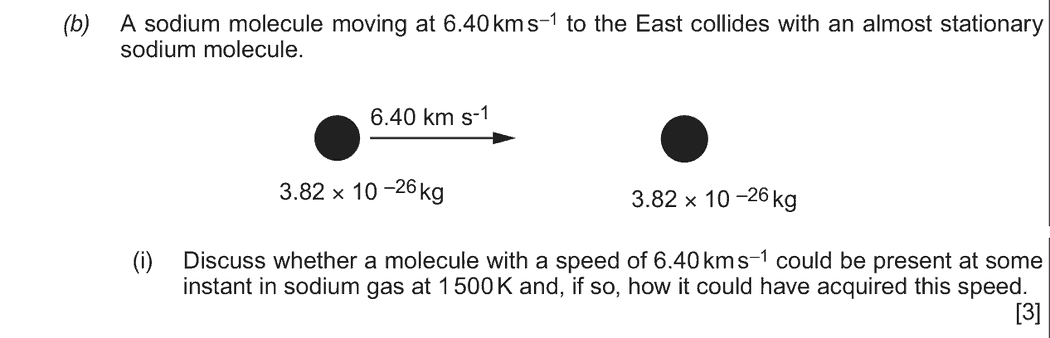
(b) A sodium molecule moving at 6.40 km s–1 to the East collides with an almost stationary sodium molecule. 6.40 km s-1 3.82 × 10 –26 kg 3.82 × 10 –26 kg (i) Discuss whether a molecule with a speed of 6.40 km s–1 could be present at some instant in sodium gas at 1 500 K and, if so, how it could have acquired this speed. [3]
October 2020 · Component 1 · Q5(b)(ii) 2 marks AO2=2 Calculation dynamics
Earlier parts of question 5 that this part usesEarlier part of October 2020 Component 1 question 5Earlier part of October 2020 Component 1 question 5
(ii) After the collision one of the two molecules is moving to the East at 4.39 km s–1. Calculate the speed and direction of motion of the other molecule. [2]
October 2020 · Component 1 · Q5(b)(iii) 3 marks AO2=3 Calculation dynamicsenergy concepts
Earlier parts of question 5 that this part usesEarlier part of October 2020 Component 1 question 5Earlier part of October 2020 Component 1 question 5
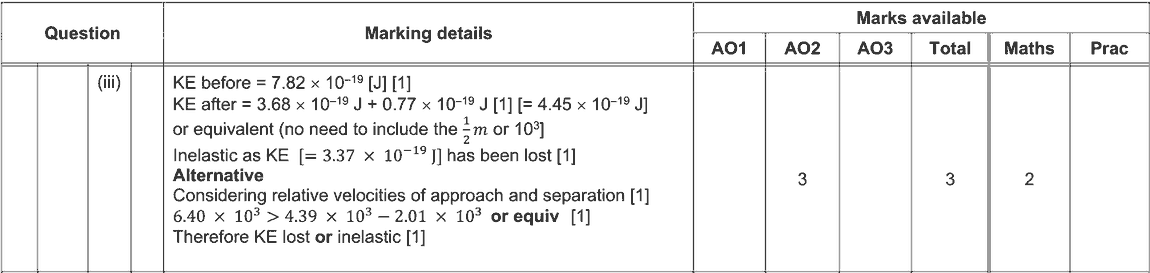
(iii) Determine whether or not the collision is elastic. [3]
October 2020 · Component 1 · Q5(b)(iv) 1 mark AO1=1 Short answer dynamics
Earlier parts of question 5 that this part usesEarlier part of October 2020 Component 1 question 5Earlier part of October 2020 Component 1 question 5
(iv) Explain how Newton’s 3rd law applies to the collision. [1]
October 2020 · Component 1 · Q5(b)(v) 3 marks AO3=3 Calculation photons
Earlier parts of question 5 that this part usesEarlier part of October 2020 Component 1 question 5Earlier part of October 2020 Component 1 question 5
(v) Soon after the collision in (b), one of the molecules gives out a photon of wavelength 589 nm. Evaluate whether or not the momentum of the photon significantly affects the molecule’s velocity. [3]
October 2020 · Component 1 · Q6(a)(i) 3 marks AO1=1, AO2=2 Show that thermal physicskinetic theory
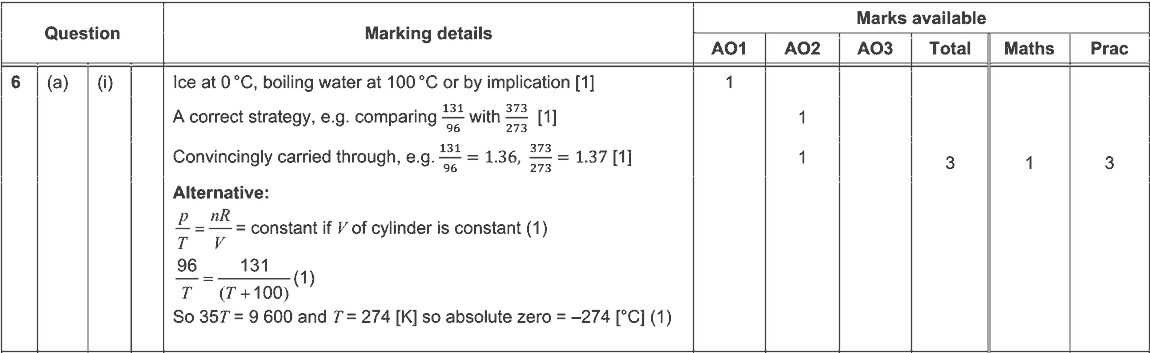
6. (a) (i) A cylinder of gas fitted with a pressure gauge is surrounded by melting ice. The gas pressure stabilises at 96 kPa. The cylinder is then surrounded instead by boiling water. The pressure stabilises at 131 kPa. Show that this is consistent with a value of –273 °C for the absolute zero of temperature. [3]
October 2020 · Component 1 · Q6(a)(ii) 1 mark AO1=1 Short answer thermal physics
Earlier part of question 6 that this part usesEarlier part of October 2020 Component 1 question 6
(ii) State the significance, in terms of molecules, of the absolute zero of temperature. [1]
October 2020 · Component 1 · Q6(b)(i) 3 marks AO2=3 Calculation kinetic theory
Earlier part of question 6 that this part usesEarlier part of October 2020 Component 1 question 6
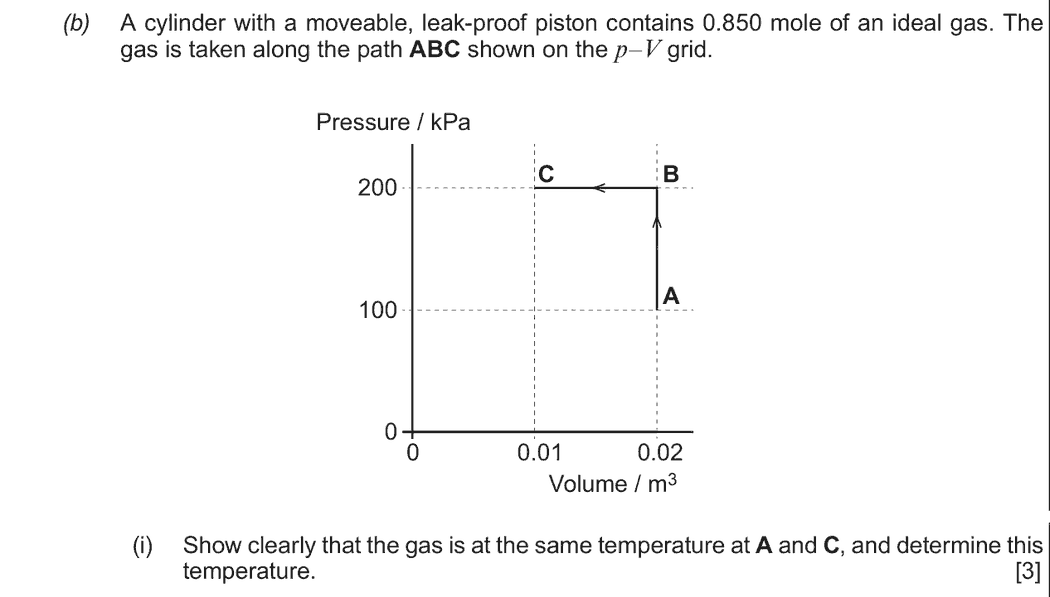
(b) A cylinder with a moveable, leak-proof piston contains 0.850 mole of an ideal gas. The gas is taken along the path ABC shown on the p–V grid. Pressure / kPa C B 200 A 100 0 0 0.01 0.02 Volume / m3 (i) Show clearly that the gas is at the same temperature at A and C, and determine this temperature. [3]
October 2020 · Component 1 · Q6(b)(ii) 2 marks AO2=2 Calculation thermal physics
Earlier parts of question 6 that this part usesEarlier part of October 2020 Component 1 question 6Earlier part of October 2020 Component 1 question 6
(ii) Calculate the work done on the gas over ABC. [2]
October 2020 · Component 1 · Q6(b)(iii) 3 marks AO1=1, AO2=2 Calculation thermal physics
Earlier parts of question 6 that this part usesEarlier part of October 2020 Component 1 question 6Earlier part of October 2020 Component 1 question 6
(iii) Determine the net heat flow over ABC, stating whether it is in or out of the system, and justifying your answer clearly in terms of the 1st law of thermodynamics. [3]
October 2020 · Component 1 · Q7 6 marks AO1=6 6-mark extended response thermal physics
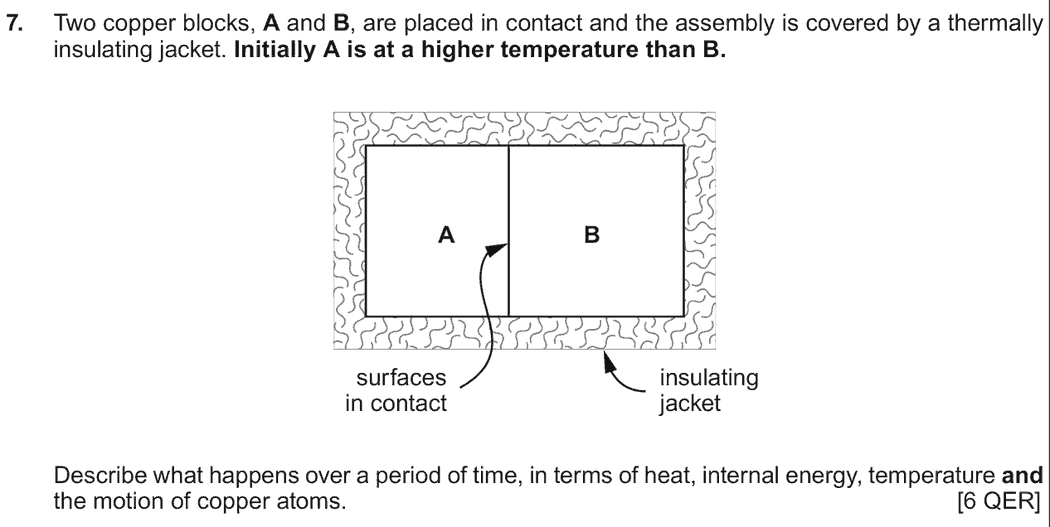
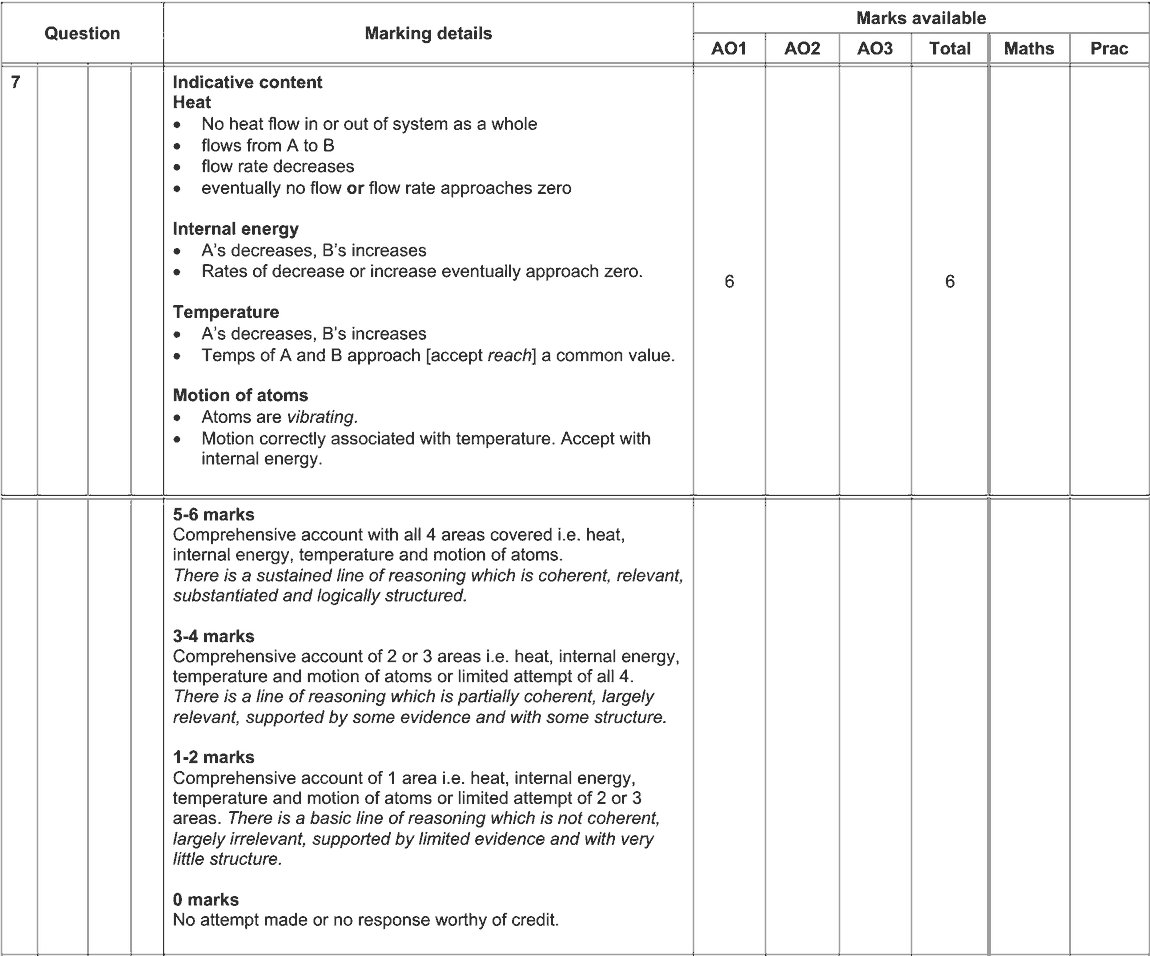
7. Two copper blocks, A and B, are placed in contact and the assembly is covered by a thermally insulating jacket. Initially A is at a higher temperature than B. A B surfaces insulating in contact jacket Describe what happens over a period of time, in terms of heat, internal energy, temperature and the motion of copper atoms. [6 QER]
October 2020 · Component 1 · Q8(a) 3 marks AO1=3 Explanation dynamicscomprehension
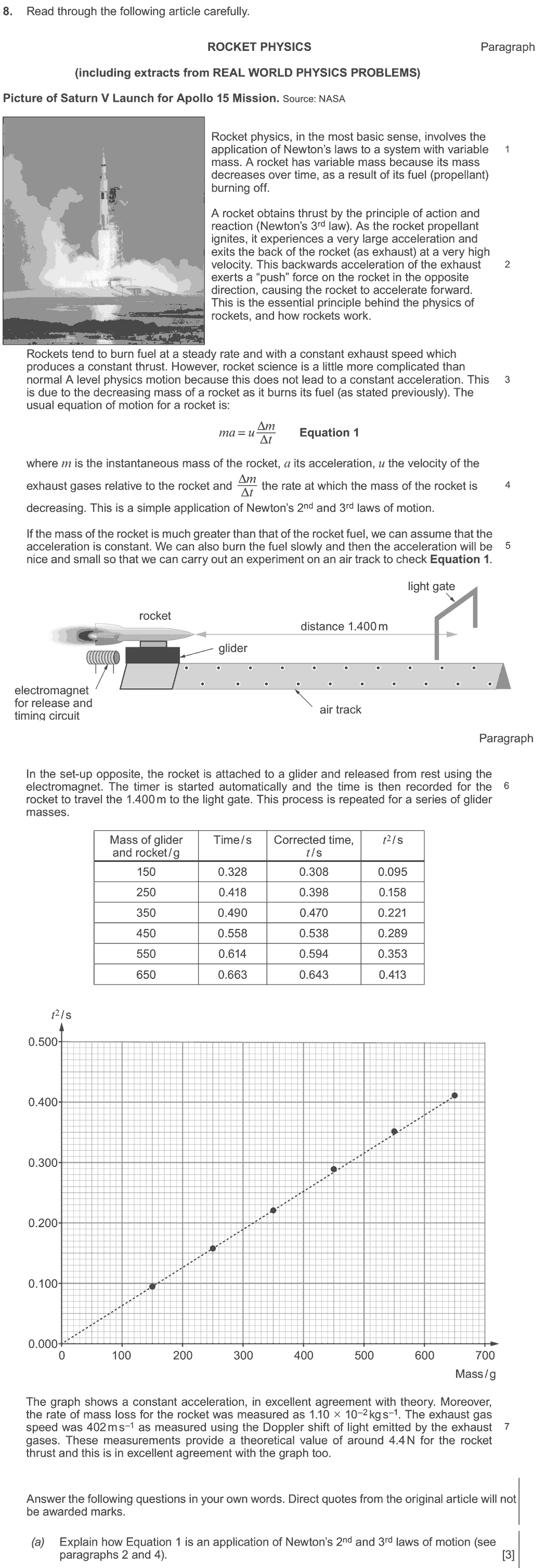
8. Read through the following article carefully. ROCKET PHYSICS Paragraph (including extracts from REAL WORLD PHYSICS PROBLEMS) Picture of Saturn V Launch for Apollo 15 Mission. Source: NASA Rocket physics, in the most basic sense, involves the application of Newton’s laws to a system with variable 1 mass. A rocket has variable mass because its mass decreases over time, as a result of its fuel (propellant) burning off. A rocket obtains thrust by the principle of action and reaction (Newton’s 3rd law). As the rocket propellant ignites, it experiences a very large acceleration and exits the back of the rocket (as exhaust) at a very high velocity. This backwards acceleration of the exhaust 2 exerts a “push” force on the rocket in the opposite direction, causing the rocket to accelerate forward. This is the essential principle behind the physics of rockets, and how rockets work. Rockets tend to burn fuel at a steady rate and with a constant exhaust speed which produces a constant thrust. However, rocket science is a little more complicated than normal A level physics motion because this does not lead to a constant acceleration. This 3 is due to the decreasing mass of a rocket as it burns its fuel (as stated previously). The usual equation of motion for a rocket is: Δm ma = u Equation 1 Δt where m is the instantaneous mass of the rocket, a its acceleration, u the velocity of the Δm exhaust gases relative to the rocket and the rate at which the mass of the rocket is 4 Δt decreasing. This is a simple application of Newton’s 2nd and 3rd laws of motion. If the mass of the rocket is much greater than that of the rocket fuel, we can assume that the acceleration is constant. We can also burn the fuel slowly and then the acceleration will be 5 nice and small so that we can carry out an experiment on an air track to check Equation 1. light gate rocket distance 1.400 m glider electromagnet for release and air track timing circuit Paragraph In the set-up opposite, the rocket is attached to a glider and released from rest using the electromagnet. The timer is started automatically and the time is then recorded for the 6 rocket to travel the 1.400 m to the light gate. This process is repeated for a series of glider masses. Mass of glider Time / s Corrected time, t2 / s and rocket / g t / s 150 0.328 0.308 0.095 250 0.418 0.398 0.158 350 0.490 0.470 0.221 450 0.558 0.538 0.289 550 0.614 0.594 0.353 650 0.663 0.643 0.413 t2 / s 0.500 0.400 0.300 0.200 0.100 0.000 0 100 200 300 400 500 600 700 Mass / g The graph shows a constant acceleration, in excellent agreement with theory. Moreover, the rate of mass loss for the rocket was measured as 1.10 × 10⁻² kg s–1. The exhaust gas speed was 402 m s–1 as measured using the Doppler shift of light emitted by the exhaust 7 gases. These measurements provide a theoretical value of around 4.4 N for the rocket thrust and this is in excellent agreement with the graph too. Answer the following questions in your own words. Direct quotes from the original article will not be awarded marks. (a) Explain how Equation 1 is an application of Newton’s 2nd and 3rd laws of motion (see paragraphs 2 and 4). [3]
October 2020 · Component 1 · Q8(b) 3 marks AO2=3 Explanation dynamicscomprehension
Earlier part of question 8 that this part usesEarlier part of October 2020 Component 1 question 8
(b) The author states in paragraph 5 that the acceleration is “constant” and “nice and small”. Explain why this is true (see paragraphs 3 and 5). [3]
October 2020 · Component 1 · Q8(c)(i) 1 mark AO1=1 Short answer basic physicscomprehension
Earlier part of question 8 that this part usesEarlier part of October 2020 Component 1 question 8
(c) (i) The author has made a mistake in the table and the graph with one of the units. Identify the mistake. [1]
October 2020 · Component 1 · Q8(c)(ii) 2 marks AO2=2 Practical and data analysis kinematicscomprehension
Earlier parts of question 8 that this part usesEarlier part of October 2020 Component 1 question 8Earlier part of October 2020 Component 1 question 8
(ii) Explain how the corrected time, t, was obtained from the time in the table and suggest why this correction was necessary. [2]
October 2020 · Component 1 · Q8(d) 3 marks AO2=3 Explanation kinematicsdynamicscomprehension
Earlier part of question 8 that this part usesEarlier part of October 2020 Component 1 question 8
(d) Use equations of uniformly accelerated motion to explain why a graph of t2 against mass 2.80 was plotted and why the gradient of this graph is expected to be (where F is the F resultant force in newtons acting on the glider and rocket). [3]
October 2020 · Component 1 · Q8(e) 1 mark AO2=1 Show that dynamicscomprehension
Earlier part of question 8 that this part usesEarlier part of October 2020 Component 1 question 8
(e) Show that a rate of mass loss of 1.10 × 10⁻² kg s–1 and an exhaust gas speed of 402 m s–1 produce a thrust of approximately 4.4 N (see paragraph 7). [1]
October 2020 · Component 1 · Q8(f) 2 marks AO3=2 Calculation dynamicscomprehension
Earlier part of question 8 that this part usesEarlier part of October 2020 Component 1 question 8
(f) The gradient of the graph is 0.635 in the correct SI unit. Use this to determine whether the force of 4.4 N to which the author refers is consistent with the graph (see paragraph 7 and the graph). [2]
October 2020 · Component 1 · Q8(g)(i) 2 marks AO1=2 Definition orbits and the wider universecomprehension
Earlier part of question 8 that this part usesEarlier part of October 2020 Component 1 question 8
(g) (i) State what is meant by Doppler shift (see paragraph 7). [2]
October 2020 · Component 1 · Q8(g)(ii) 3 marks AO3=3 Explanation orbits and the wider universecomprehension
Earlier parts of question 8 that this part usesEarlier part of October 2020 Component 1 question 8Earlier part of October 2020 Component 1 question 8
(ii) Describe how the exhaust gas speed might be measured “using the Doppler shift of light emitted by the exhaust gases” (see paragraph 7). [3]

Work with an Eduqas physics tutor

Want a paper marked and gone through with you? Message us.

Prefer email? Send an enquiry

If you are under 18, please include a parent's contact details. Enquiries go to enquiries@physicsaleveltutor.com and are deleted once handled. All tutoring is online.