October 2020: Component 2

100 marks · 36 question parts · Paper, mark scheme and report on Eduqas's site · Have the Data Booklet beside you

Question by question

QTopicMarksAOType
1(a) Conduction of electricity 3AO1=3Explanation
1(b)(i) Conduction of electricity 4AO1=4Show that
1(b)(ii) Conduction of electricity 3AO1=1,AO2=2Calculation
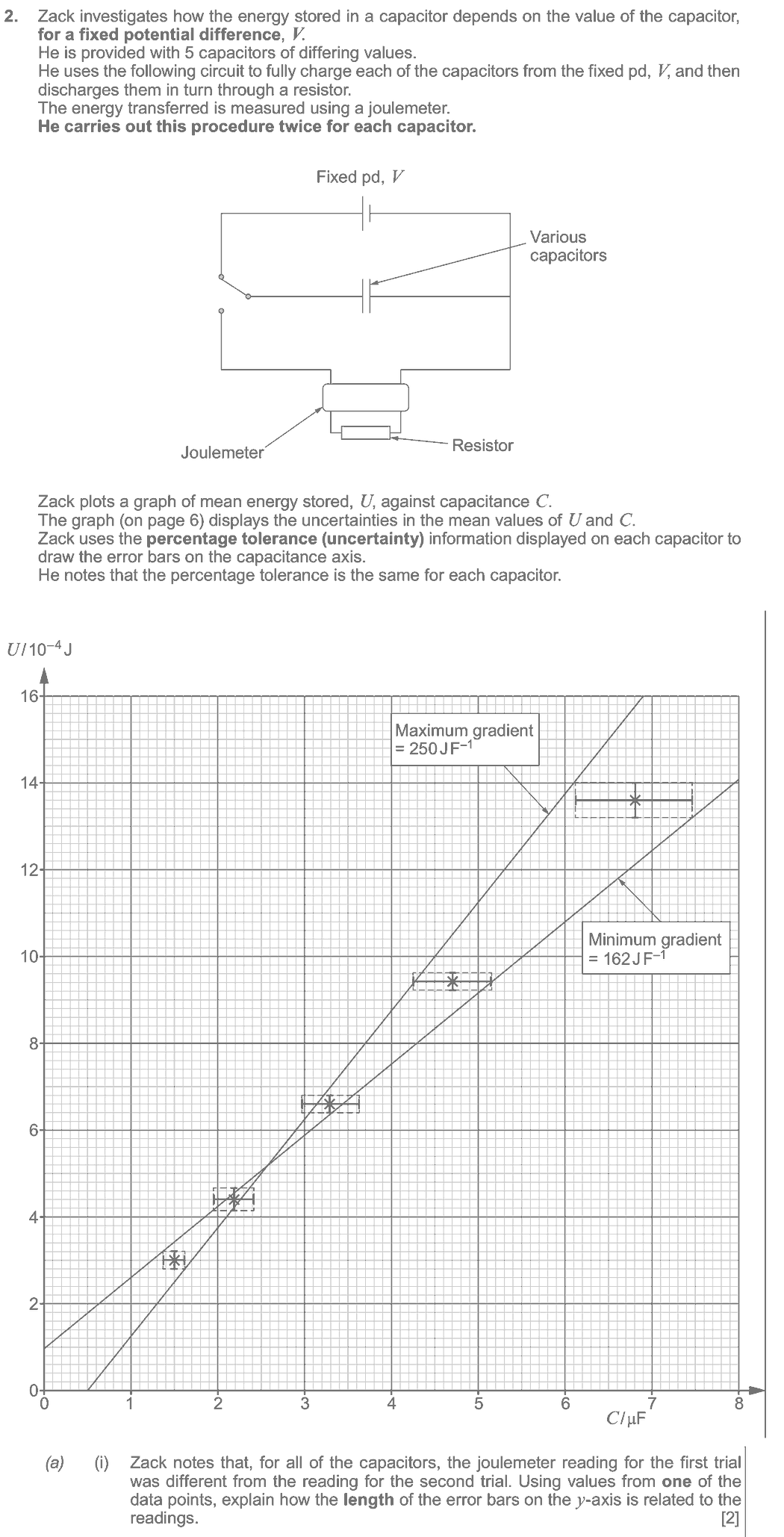
2(a)(i) Capacitance 2AO2=2Practical and data analysis
2(a)(ii) Capacitance 2AO2=2Practical and data analysis
2(b)(i) Capacitance 3AO2=3Practical and data analysis
2(b)(ii) Capacitance 3AO2=3Practical and data analysis
2(c) Capacitance 3AO3=3Calculation
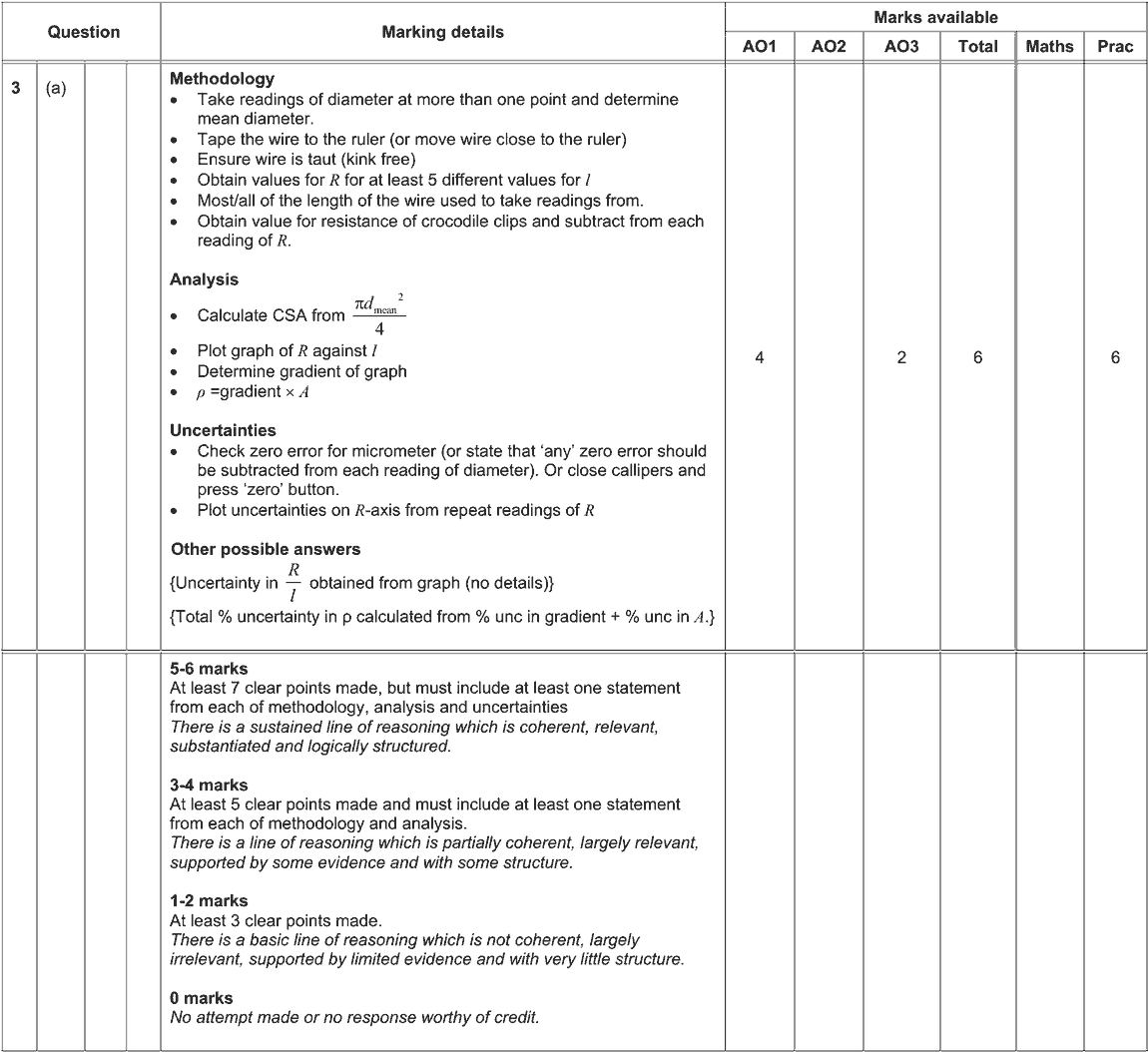
3(a) Resistance 6AO1=4,AO3=2Extended response
3(b) Resistance 4AO3=4Calculation
4(a) Solids under stress 3AO1=3Explanation
4(b)(i) Solids under stress 3AO1=2,AO2=1Explanation
4(b)(ii)I Solids under stress 2AO1=2Short answer
4(b)(ii)II Solids under stress 1AO1=1Diagram or graph
5(a)(i) Solids under stress 2AO2=2Show that
5(a)(ii) Solids under stress 3AO3=3Explanation
5(b)(i) Solids under stress 3AO2=3Show that
5(b)(ii) Solids under stress 2AO2=2Calculation
5(c)(i) Vibrations: simple harmonic motion 2AO1=1,AO2=1Calculation
5(c)(ii) Vibrations: simple harmonic motion, Circular motion 3AO1=1,AO2=2Calculation
5(c)(iii) Solids under stress, Vibrations: simple harmonic motion 4AO2=4Diagram or graph
6(a) Using radiation to investigate stars 2AO1=2Short answer
6(b)(i) Using radiation to investigate stars 3AO3=3Short answer
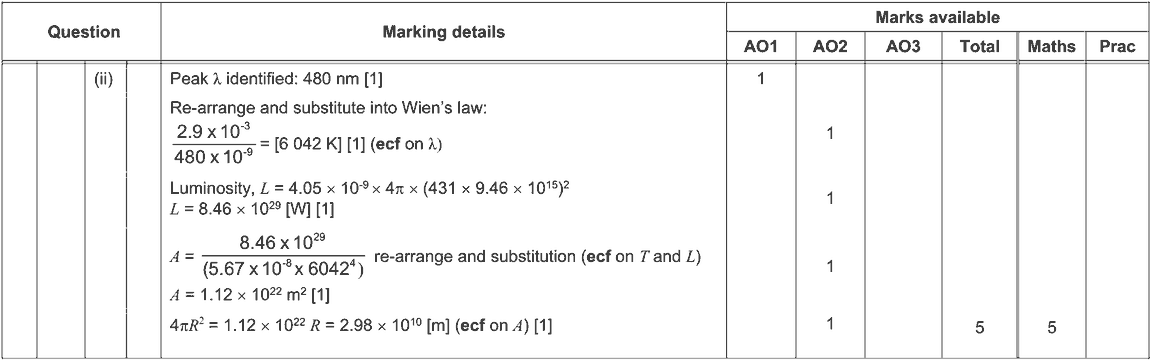
6(b)(ii) Using radiation to investigate stars 5AO1=1,AO2=4Calculation
6(c) Using radiation to investigate stars 3AO3=3Explanation
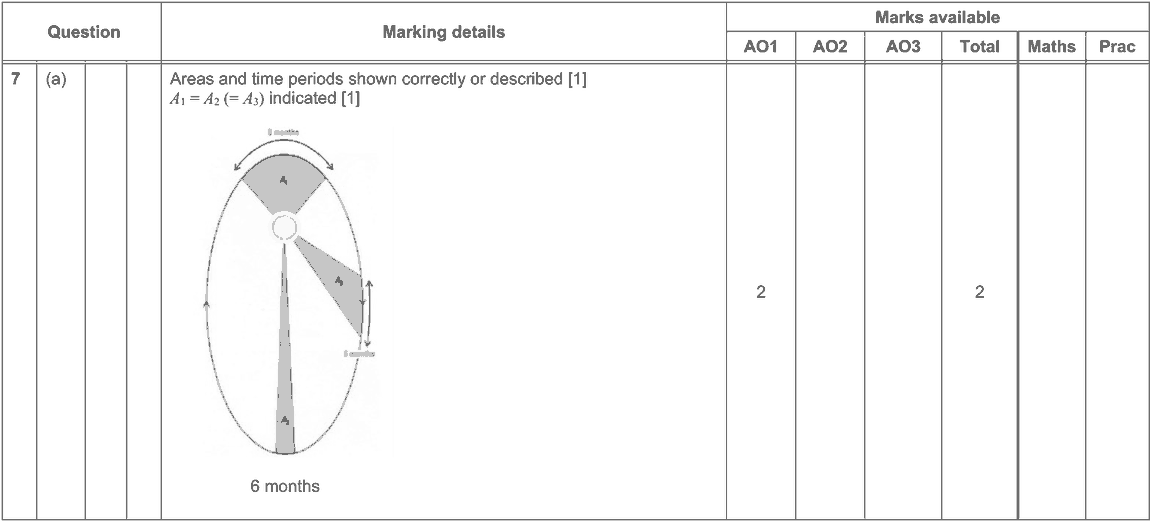
7(a) Orbits and the wider universe 2AO1=2Diagram or graph
7(b) Orbits and the wider universe 3AO1=1,AO2=2Show that
7(c)(i) Orbits and the wider universe 3AO2=3Show that
7(c)(ii)I Electrostatic and gravitational fields of force 2AO1=1,AO2=1Show that
7(c)(ii)II Electrostatic and gravitational fields of force 4AO3=4Calculation
7(c)(iii) Electrostatic and gravitational fields of force 1AO2=1Short answer
8(a) Orbits and the wider universe 2AO1=1,AO2=1Calculation
8(b) Orbits and the wider universe 3AO3=3Calculation
8(c)(i) Orbits and the wider universe 2AO2=2Calculation
8(c)(ii) Orbits and the wider universe 2Calculation
8(c)(iii) Kinetic theory 2AO2=2Calculation

The questions

1(a)1(b)(i)1(b)(ii)2(a)(i)2(a)(ii)2(b)(i)2(b)(ii)2(c)3(a)3(b)4(a)4(b)(i)4(b)(ii)I4(b)(ii)II5(a)(i)5(a)(ii)5(b)(i)5(b)(ii)5(c)(i)5(c)(ii)5(c)(iii)6(a)6(b)(i)6(b)(ii)6(c)7(a)7(b)7(c)(i)7(c)(ii)I7(c)(ii)II7(c)(iii)8(a)8(b)8(c)(i)8(c)(ii)8(c)(iii)
October 2020 · Component 2 · Q1(a) 3 marks AO1=3 Explanation conduction of electricity
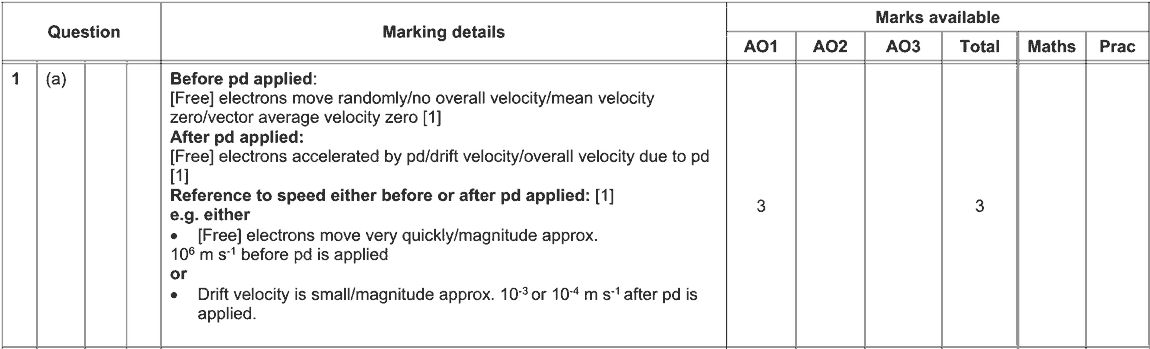
1. (a) Compare the movement of free electrons in a metal before and after a pd is applied to the metal. [3]
October 2020 · Component 2 · Q1(b)(i) 4 marks AO1=4 Show that conduction of electricity
Earlier part of question 1 that this part usesEarlier part of October 2020 Component 2 question 1
(b) (i) The current, I, in a wire of cross-sectional area, A, is given by the formula: I = nAve where n is the number of free electrons per unit volume and v is the drift velocity of these electrons. Derive the formula. Include a clearly labelled diagram. [4]
October 2020 · Component 2 · Q1(b)(ii) 3 marks AO1=1, AO2=2 Calculation conduction of electricity
Earlier parts of question 1 that this part usesEarlier part of October 2020 Component 2 question 1Earlier part of October 2020 Component 2 question 1
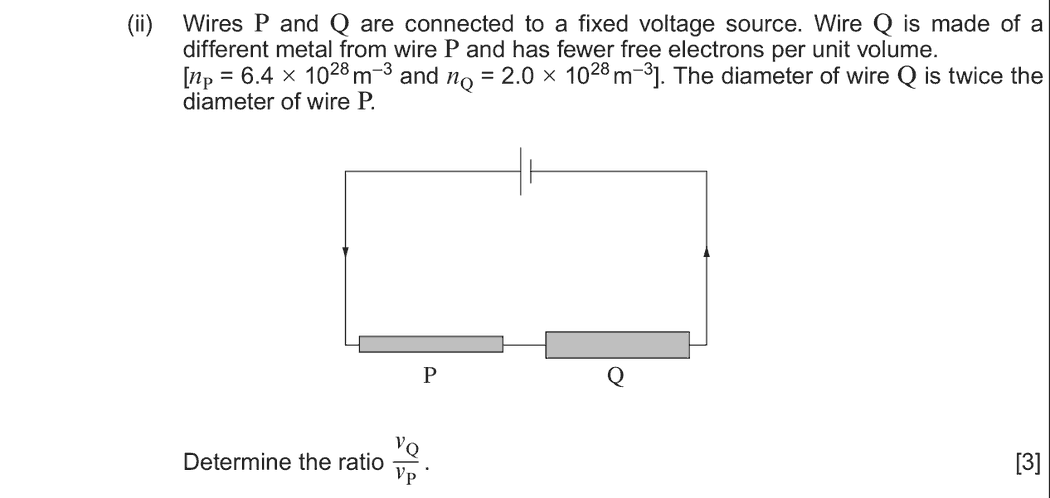
(ii) Wires P and Q are connected to a fixed voltage source. Wire Q is made of a different metal from wire P and has fewer free electrons per unit volume. [nP = 6.4 × 1028 m–3 and nQ = 2.0 × 1028 m–3]. The diameter of wire Q is twice the diameter of wire P. P Q vQ Determine the ratio . [3] vP

October 2020 · Component 2 · Q2(a)(i) 2 marks AO2=2 Practical and data analysis capacitance
2. Zack investigates how the energy stored in a capacitor depends on the value of the capacitor, for a fixed potential difference, V. He is provided with 5 capacitors of differing values. He uses the following circuit to fully charge each of the capacitors from the fixed pd, V, and then discharges them in turn through a resistor. The energy transferred is measured using a joulemeter. He carries out this procedure twice for each capacitor. Fixed pd, V Various capacitors Resistor Joulemeter Zack plots a graph of mean energy stored, U, against capacitance C. The graph (on page 6) displays the uncertainties in the mean values of U and C. Zack uses the percentage tolerance (uncertainty) information displayed on each capacitor to draw the error bars on the capacitance axis. He notes that the percentage tolerance is the same for each capacitor. U / 10–4 J 16 Maximum gradient = 250 J F–1 14 12 Minimum gradient 10 = 162 J F–1 8 6 4 2 0 0 1 2 3 4 5 6 7 8 C / μF (a) (i) Zack notes that, for all of the capacitors, the joulemeter reading for the first trial was different from the reading for the second trial. Using values from one of the data points, explain how the length of the error bars on the y-axis is related to the readings. [2]
October 2020 · Component 2 · Q2(a)(ii) 2 marks AO2=2 Practical and data analysis capacitance
Earlier part of question 2 that this part usesEarlier part of October 2020 Component 2 question 2
(ii) Determine the percentage tolerance of the capacitors. [2]
October 2020 · Component 2 · Q2(b)(i) 3 marks AO2=3 Practical and data analysis capacitance
Earlier part of question 2 that this part usesEarlier part of October 2020 Component 2 question 2
(b) (i) Using the values of the gradients given on the grid and an appropriate equation, determine the maximum and minimum values for V. [3]
October 2020 · Component 2 · Q2(b)(ii) 3 marks AO2=3 Practical and data analysis capacitance
Earlier parts of question 2 that this part usesEarlier part of October 2020 Component 2 question 2Earlier part of October 2020 Component 2 question 2
(ii) Hence determine the pd, V, along with its absolute uncertainty. [3]
October 2020 · Component 2 · Q2(c) 3 marks AO3=3 Calculation capacitance
Earlier part of question 2 that this part usesEarlier part of October 2020 Component 2 question 2
(c) Zack’s teacher suggests that he should carry out another experiment. Zack decides to discharge the 6.8 μF capacitor through a 5.6 MΩ resistor. He notes that it took 35 seconds for the pd across the capacitor to drop to 8.0 V. Determine whether or not these results are consistent with an initial value of V = 20.0 V. [3]
October 2020 · Component 2 · Q3(a) 6 marks AO1=4, AO3=2 6-mark extended response resistance
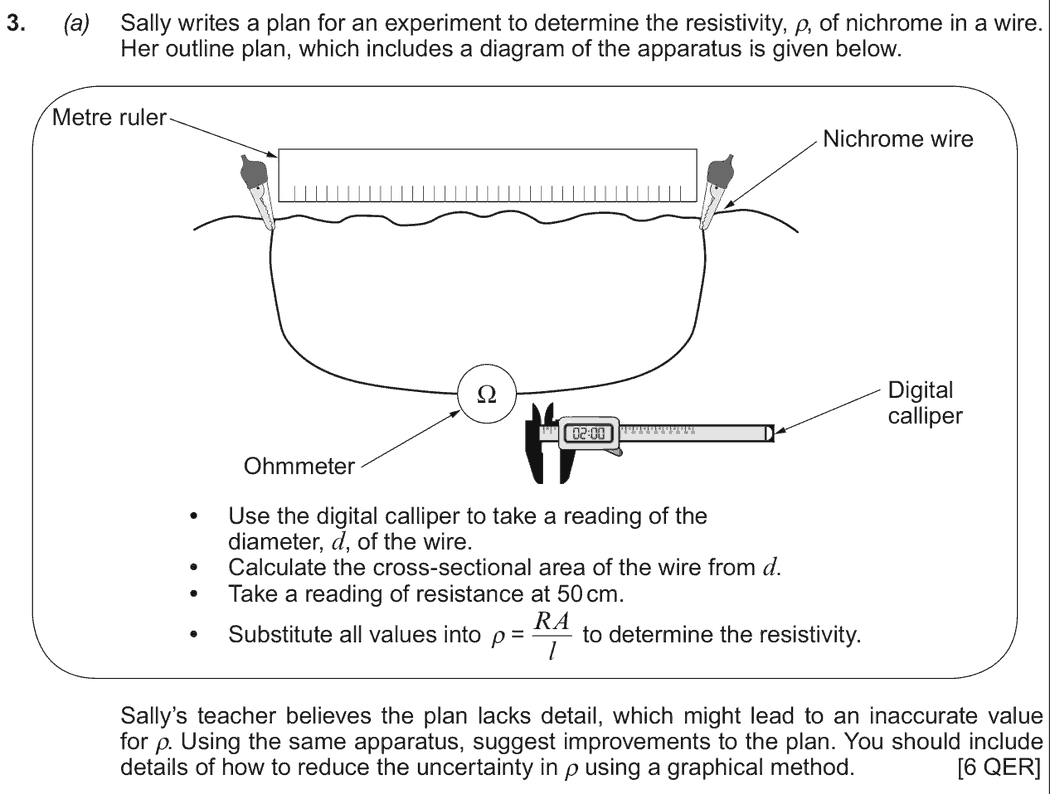
3. (a) Sally writes a plan for an experiment to determine the resistivity, ρ, of nichrome in a wire. Her outline plan, which includes a diagram of the apparatus is given below. Metre ruler Nichrome wire Ω Digital calliper 0 1 2 3 4 5 6 7 8 9 10 11 12 13 14 15 16 17 18 19 20 Ohmmeter • Use the digital calliper to take a reading of the diameter, d, of the wire. • Calculate the cross-sectional area of the wire from d. • Take a reading of resistance at 50 cm. RA • Substitute all values into ρ = to determine the resistivity. l Sally’s teacher believes the plan lacks detail, which might lead to an inaccurate value for ρ. Using the same apparatus, suggest improvements to the plan. You should include details of how to reduce the uncertainty in ρ using a graphical method. [6 QER]
October 2020 · Component 2 · Q3(b) 4 marks AO3=4 Calculation resistance
Earlier part of question 3 that this part usesEarlier part of October 2020 Component 2 question 3
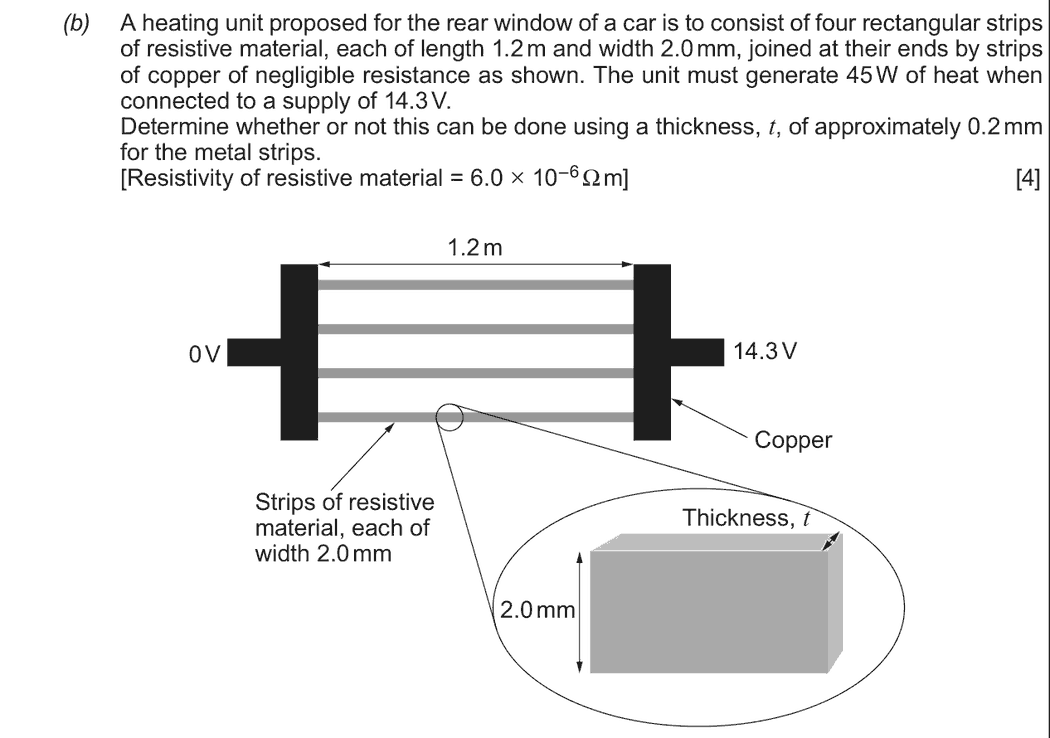
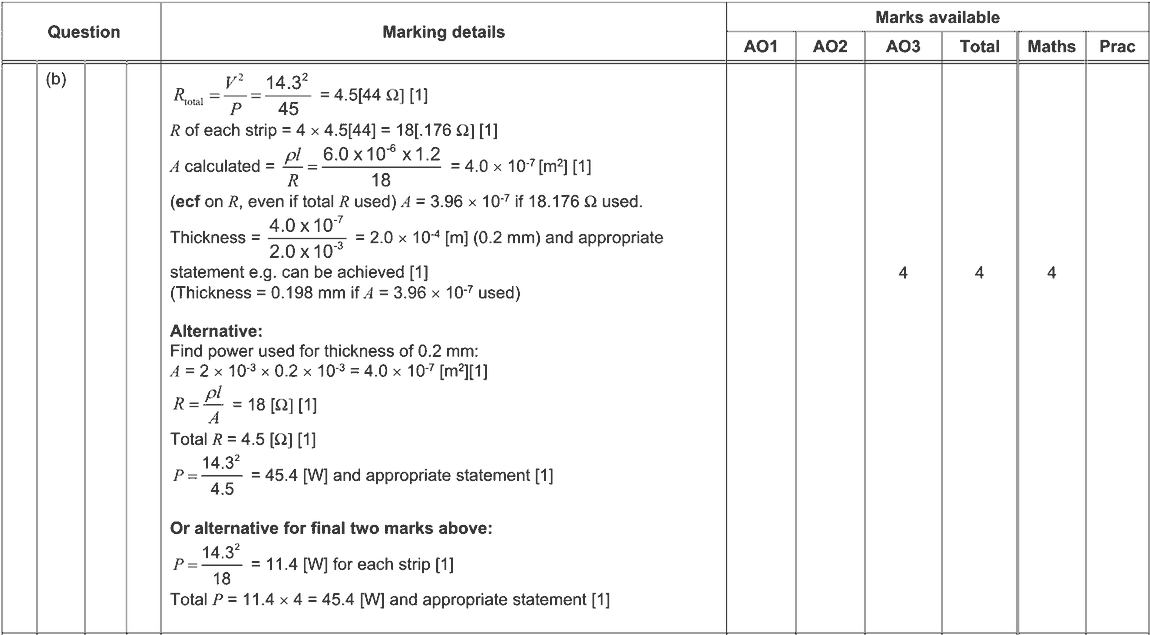
(b) A heating unit proposed for the rear window of a car is to consist of four rectangular strips of resistive material, each of length 1.2 m and width 2.0 mm, joined at their ends by strips of copper of negligible resistance as shown. The unit must generate 45 W of heat when connected to a supply of 14.3 V. Determine whether or not this can be done using a thickness, t, of approximately 0.2 mm for the metal strips. [Resistivity of resistive material = 6.0 × 10⁻⁶ Ω m] [4] 1.2 m 0 V 14.3 V Copper Strips of resistive Thickness, t material, each of width 2.0 mm 2.0 mm
October 2020 · Component 2 · Q4(a) 3 marks AO1=3 Explanation solids under stress
4. (a) Materials can be classified as being crystalline, amorphous or polymeric. Making reference to their microscopic structures explain what is meant by each of these terms. Give one example of each type of material. [3]
October 2020 · Component 2 · Q4(b)(i) 3 marks AO1=2, AO2=1 Explanation solids under stress
Earlier part of question 4 that this part usesEarlier part of October 2020 Component 2 question 4
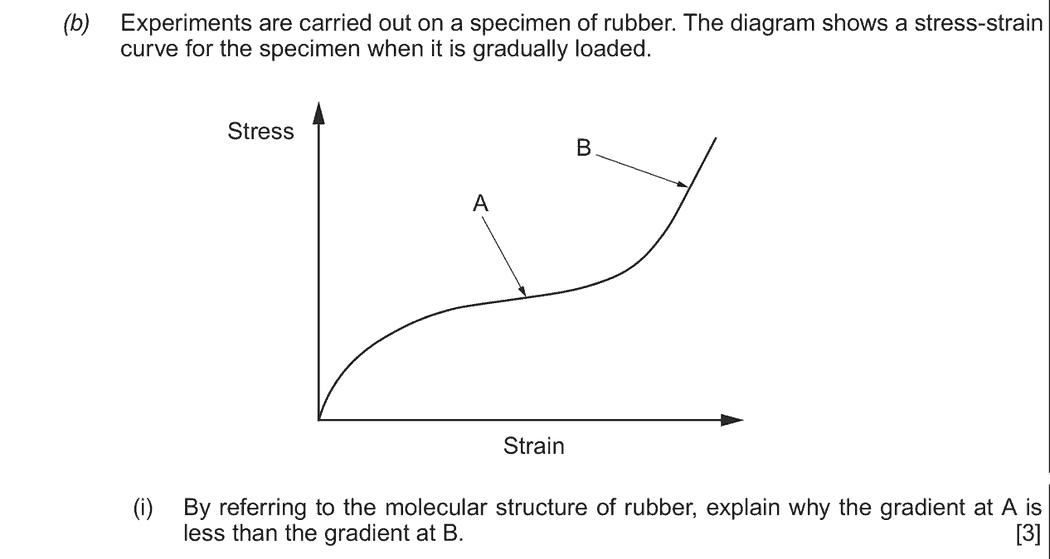
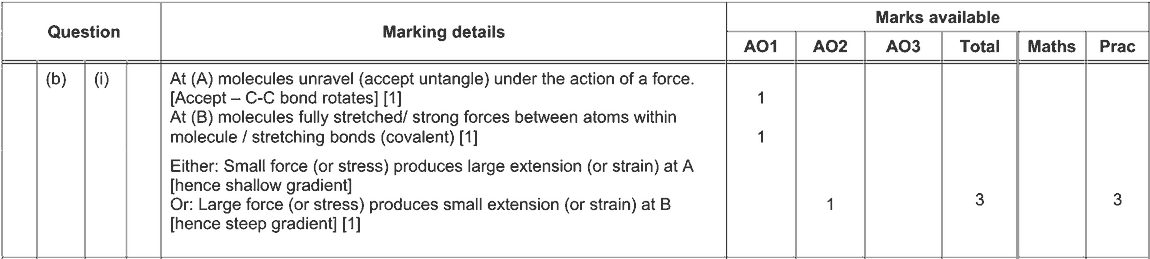
(b) Experiments are carried out on a specimen of rubber. The diagram shows a stress-strain curve for the specimen when it is gradually loaded. Stress B A Strain (i) By referring to the molecular structure of rubber, explain why the gradient at A is less than the gradient at B. [3]
October 2020 · Component 2 · Q4(b)(ii)I 2 marks AO1=2 Short answer solids under stress
Earlier parts of question 4 that this part usesEarlier part of October 2020 Component 2 question 4Earlier part of October 2020 Component 2 question 4
(ii) When the specimen is gradually unloaded, it is noted that the curve for unloading is different from the curve for loading. I. Name this phenomenon and account for it in terms of energy. [2]
October 2020 · Component 2 · Q4(b)(ii)II 1 mark AO1=1 Diagram or graph solids under stress
Earlier parts of question 4 that this part usesEarlier part of October 2020 Component 2 question 4Earlier part of October 2020 Component 2 question 4Earlier part of October 2020 Component 2 question 4
II. Sketch the curve for unloading on the graph opposite. [1]
October 2020 · Component 2 · Q5(a)(i) 2 marks AO2=2 Show that solids under stress
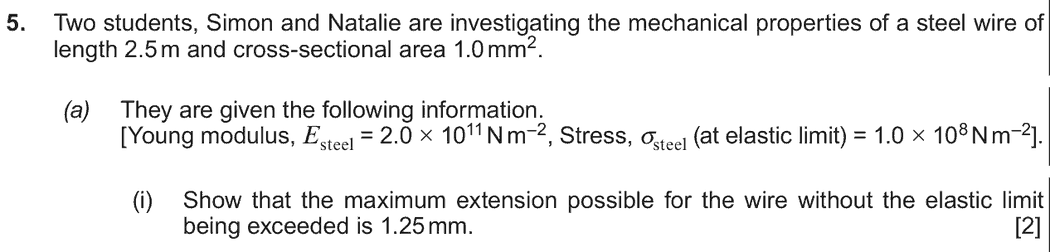
5. Two students, Simon and Natalie are investigating the mechanical properties of a steel wire of length 2.5 m and cross-sectional area 1.0 mm2. (a) They are given the following information. [Young modulus, Esteel = 2.0 × 10¹¹ N m–2, Stress, σsteel (at elastic limit) = 1.0 × 10⁸ N m–2]. (i) Show that the maximum extension possible for the wire without the elastic limit being exceeded is 1.25 mm. [2]
October 2020 · Component 2 · Q5(a)(ii) 3 marks AO3=3 Explanation solids under stress
Earlier part of question 5 that this part usesEarlier part of October 2020 Component 2 question 5
(ii) Simon believes that this maximum extension (1.25 mm) of the steel wire depends on the radius of the wire. Natalie disagrees. Discuss who is correct, explaining carefully how you arrive at your answer. [3]
October 2020 · Component 2 · Q5(b)(i) 3 marks AO2=3 Show that solids under stress
Earlier part of question 5 that this part usesEarlier part of October 2020 Component 2 question 5
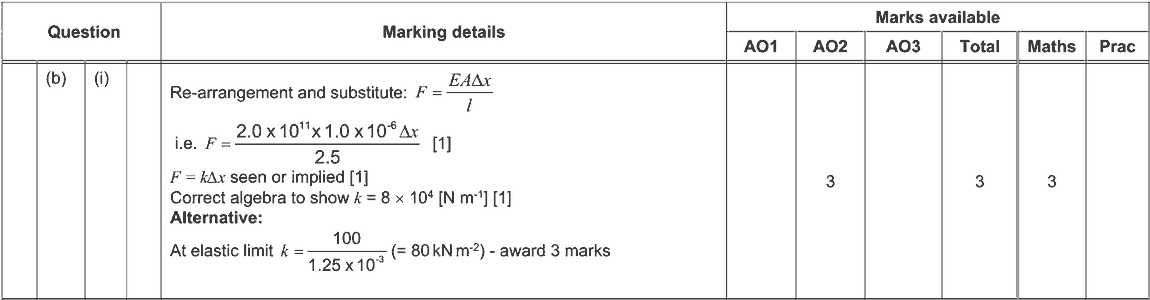
(b) Natalie suspends a mass, m, from the wire vertically. The wire can be considered to be weightless. (i) Show that the force per unit extension, k, of the wire is 80 kN m–1. [3]
October 2020 · Component 2 · Q5(b)(ii) 2 marks AO2=2 Calculation solids under stress
Earlier parts of question 5 that this part usesEarlier part of October 2020 Component 2 question 5Earlier part of October 2020 Component 2 question 5
(ii) Determine the mass, m, that causes an equilibrium extension of 1.0 mm. [2]
October 2020 · Component 2 · Q5(c)(i) 2 marks AO1=1, AO2=1 Calculation vibrations
Earlier part of question 5 that this part usesEarlier part of October 2020 Component 2 question 5
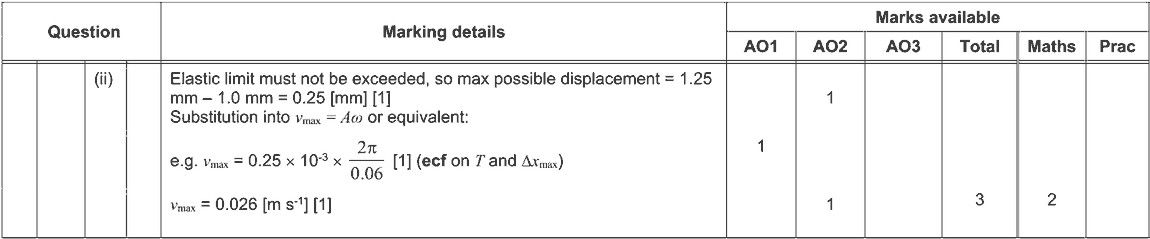
(c) This mass is given a small downward displacement and released from rest. The mass oscillates with simple harmonic motion (SHM) provided that the maximum extension of the wire never exceeds the elastic limit. (i) Calculate the period of this oscillation. [2]
October 2020 · Component 2 · Q5(c)(ii) 3 marks AO1=1, AO2=2 Calculation vibrationscircular motion
Earlier parts of question 5 that this part usesEarlier part of October 2020 Component 2 question 5Earlier part of October 2020 Component 2 question 5
(ii) Calculate the maximum possible velocity of the mass, m. [3]
October 2020 · Component 2 · Q5(c)(iii) 4 marks AO2=4 Diagram or graph solids under stressvibrations
Earlier parts of question 5 that this part usesEarlier part of October 2020 Component 2 question 5Earlier part of October 2020 Component 2 question 5
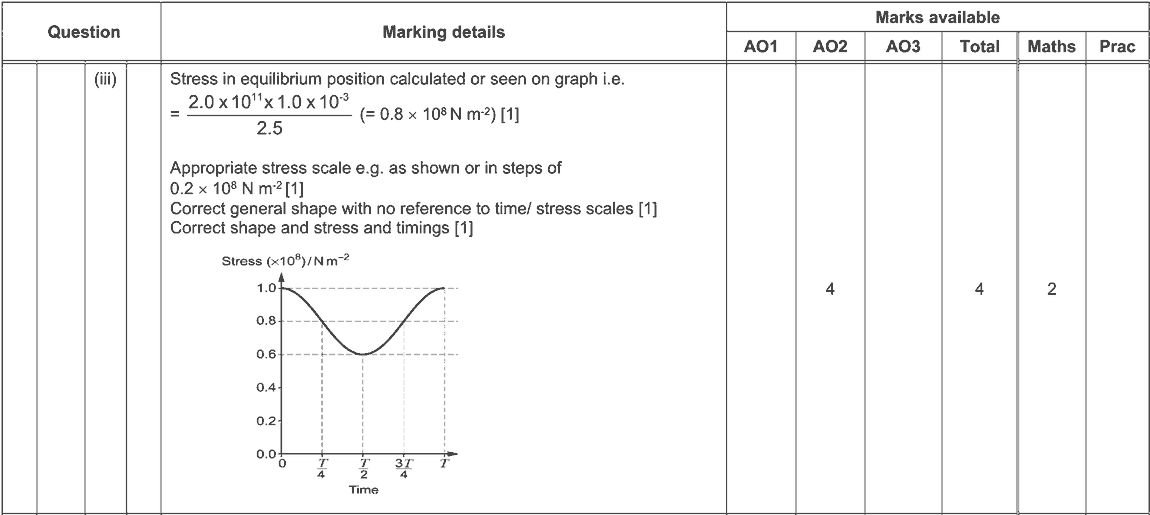
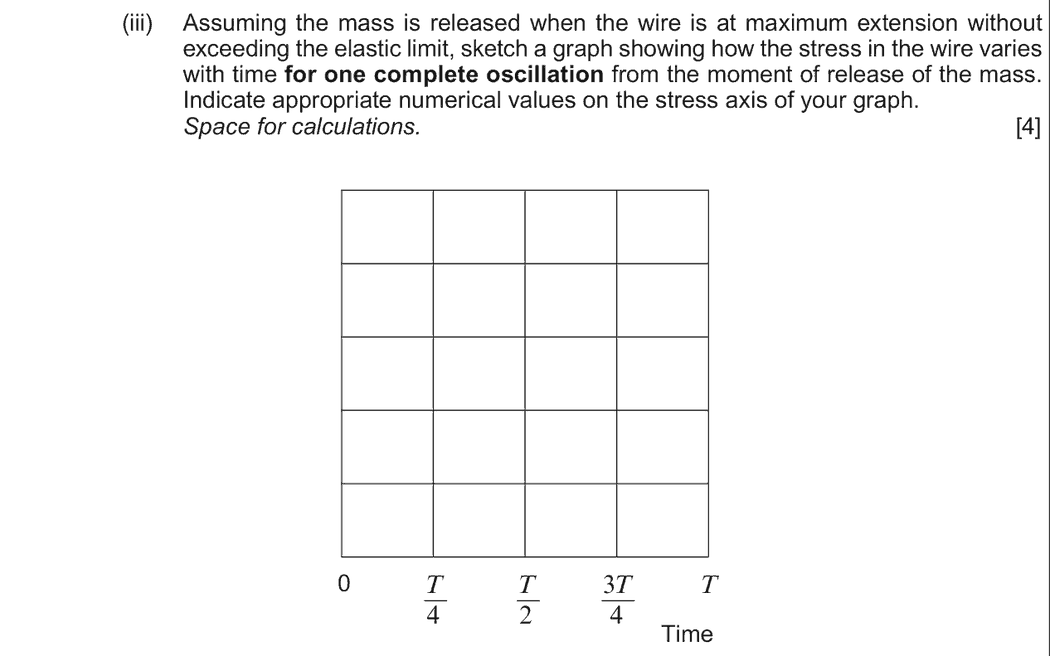
(iii) Assuming the mass is released when the wire is at maximum extension without exceeding the elastic limit, sketch a graph showing how the stress in the wire varies with time for one complete oscillation from the moment of release of the mass. Indicate appropriate numerical values on the stress axis of your graph. Space for calculations. [4] 0 T T 3T T 4 2 4 Time
October 2020 · Component 2 · Q6(a) 2 marks AO1=2 Short answer radiation and stars
6. (a) Describe the main features of the spectrum of a star and state where in the star they arise. [2]
October 2020 · Component 2 · Q6(b)(i) 3 marks AO3=3 Short answer radiation and stars
Earlier part of question 6 that this part usesEarlier part of October 2020 Component 2 question 6
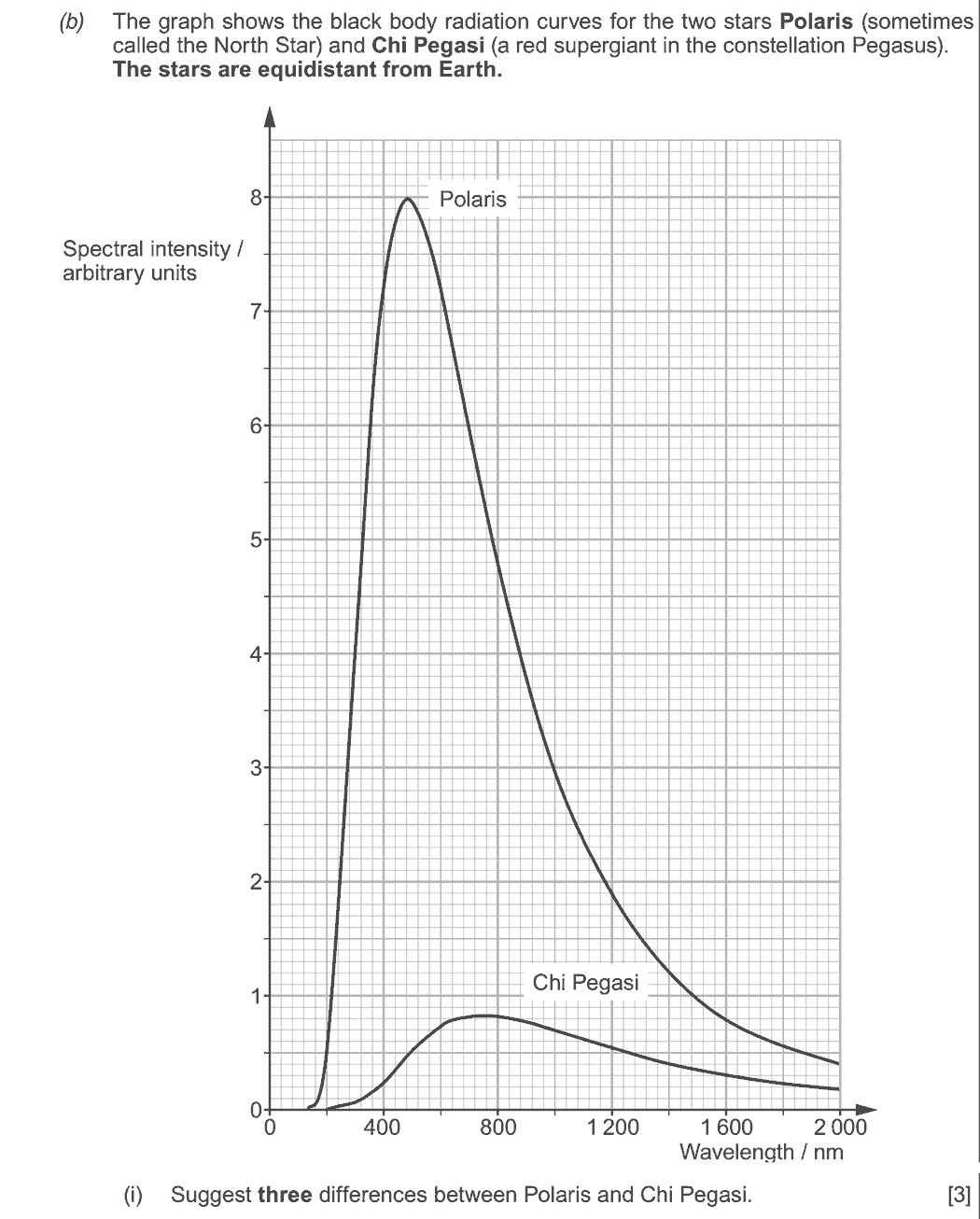
(b) The graph shows the black body radiation curves for the two stars Polaris (sometimes called the North Star) and Chi Pegasi (a red supergiant in the constellation Pegasus). The stars are equidistant from Earth. 8 Polaris Spectral intensity / arbitrary units 7 6 5 4 3 2 Chi Pegasi 1 0 0 400 800 1 200 1 600 2 000 Wavelength / nm (i) Suggest three differences between Polaris and Chi Pegasi. [3]
October 2020 · Component 2 · Q6(b)(ii) 5 marks AO1=1, AO2=4 Calculation radiation and stars
Earlier parts of question 6 that this part usesEarlier part of October 2020 Component 2 question 6Earlier part of October 2020 Component 2 question 6
(ii) Polaris is 431 light years from Earth and the intensity of radiation received on Earth from it is 4.05 × 10⁻⁹ W m–2. Use this information and the graph to calculate the radius of Polaris. [1 light year = 9.46 × 10¹⁵ m] [5]
October 2020 · Component 2 · Q6(c) 3 marks AO3=3 Explanation radiation and stars
Earlier parts of question 6 that this part usesEarlier part of October 2020 Component 2 question 6Earlier part of October 2020 Component 2 question 6
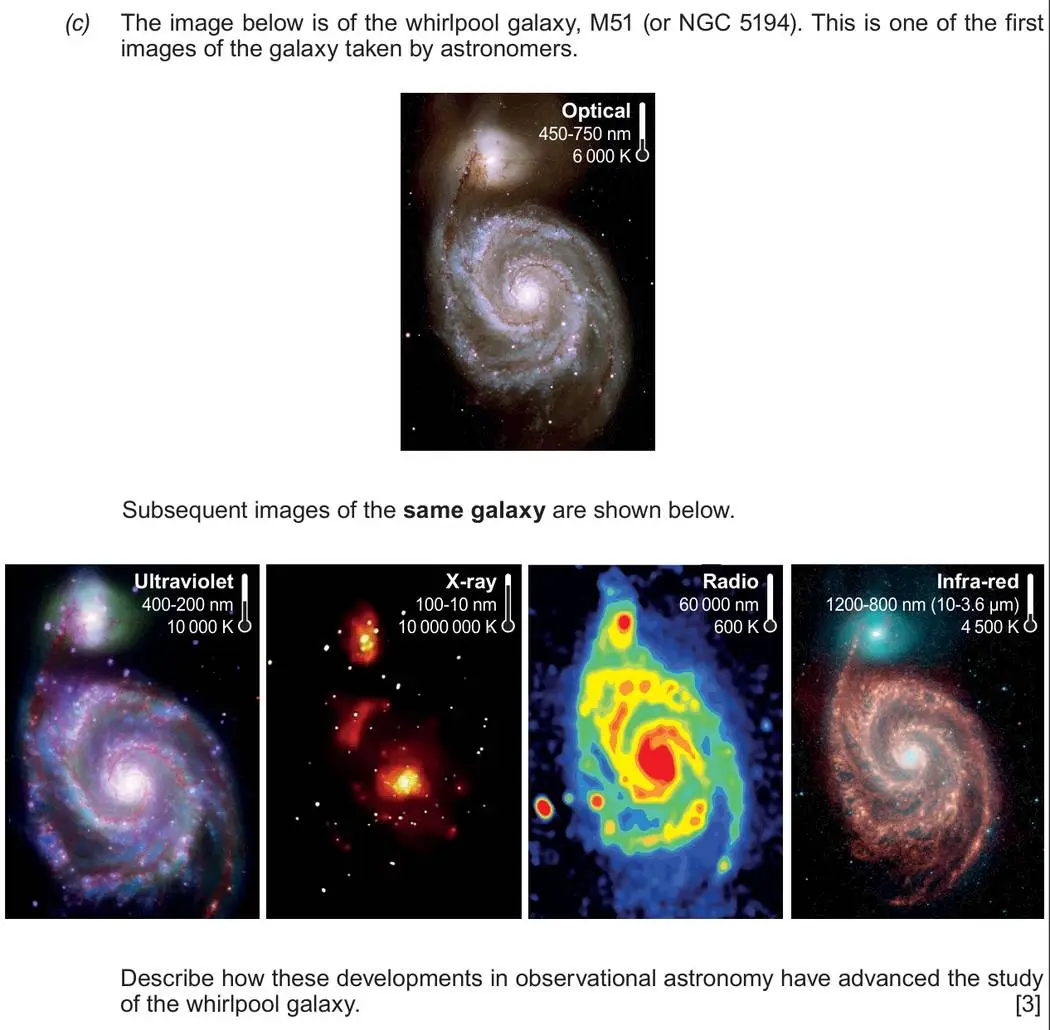
(c) The image below is of the whirlpool galaxy, M51 (or NGC 5194). This is one of the first images of the galaxy taken by astronomers. Optical 450-750 nm 6 000 K Subsequent images of the same galaxy are shown below. Ultraviolet X-ray Radio Infra-red 400-200 nm 100-10 nm 60 000 nm 1200-800 nm (10-3.6 µm) 10 000 K 10 000 000 K 600 K 4 500 K Describe how these developments in observational astronomy have advanced the study of the whirlpool galaxy. [3]
October 2020 · Component 2 · Q7(a) 2 marks AO1=2 Diagram or graph orbits and the wider universe
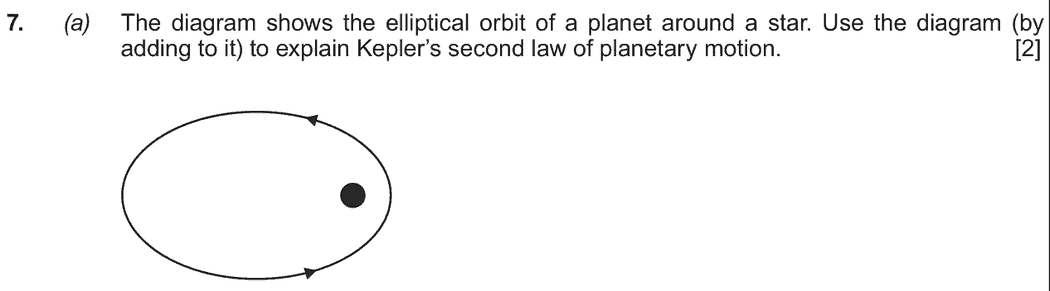
7. (a) The diagram shows the elliptical orbit of a planet around a star. Use the diagram (by adding to it) to explain Kepler’s second law of planetary motion. [2]
October 2020 · Component 2 · Q7(b) 3 marks AO1=1, AO2=2 Show that orbits and the wider universe
Earlier part of question 7 that this part usesEarlier part of October 2020 Component 2 question 7
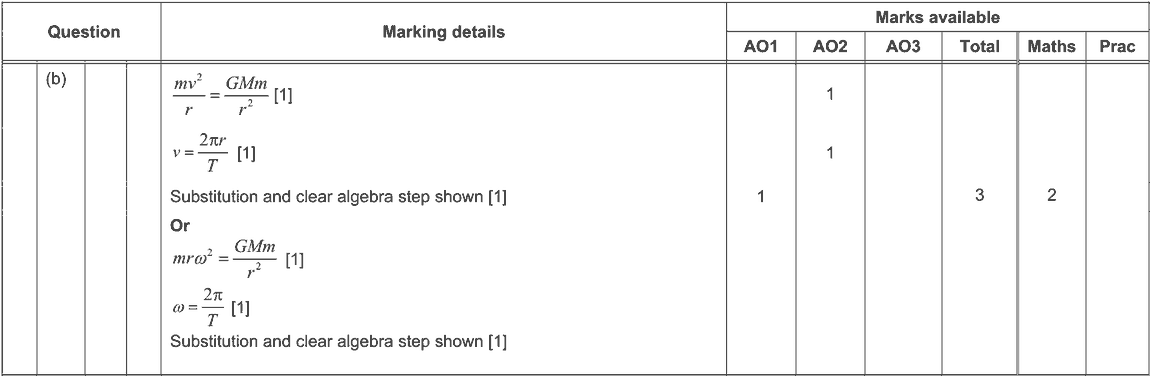
(b) Starting with Newton’s law of gravitation, show that for a circular orbit, the period of orbit, T, of a planet around a star is related to its distance, r, from the centre of the star by the relationship T 2 α r3. [Assume the mass of the planet is much less than the mass of the star.] [3]
October 2020 · Component 2 · Q7(c)(i) 3 marks AO2=3 Show that orbits and the wider universe
Earlier part of question 7 that this part usesEarlier part of October 2020 Component 2 question 7
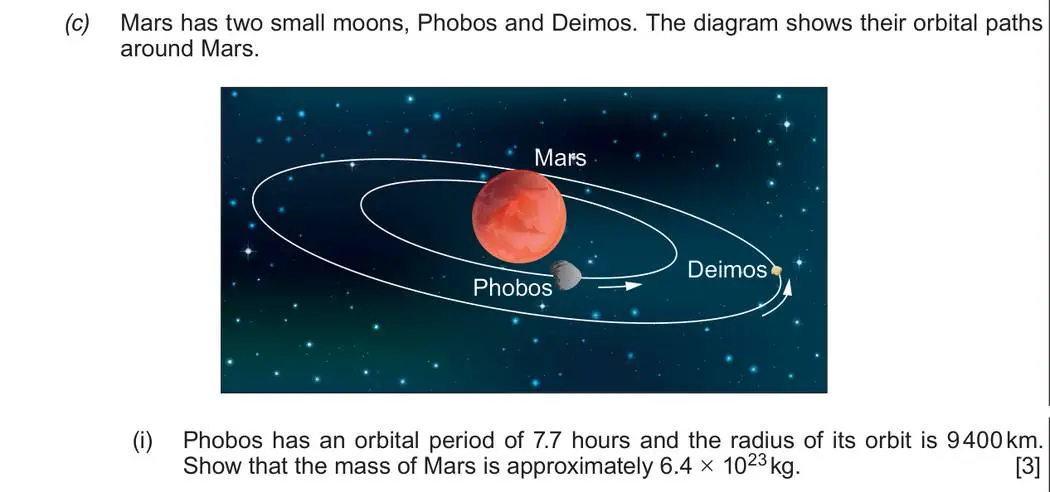
(c) Mars has two small moons, Phobos and Deimos. The diagram shows their orbital paths around Mars. Mars Deimos Phobos (i) Phobos has an orbital period of 7.7 hours and the radius of its orbit is 9 400 km. Show that the mass of Mars is approximately 6.4 × 10²³ kg. [3]
October 2020 · Component 2 · Q7(c)(ii)I 2 marks AO1=1, AO2=1 Show that electrostatic and gravitational fields
Earlier parts of question 7 that this part usesEarlier part of October 2020 Component 2 question 7Earlier part of October 2020 Component 2 question 7
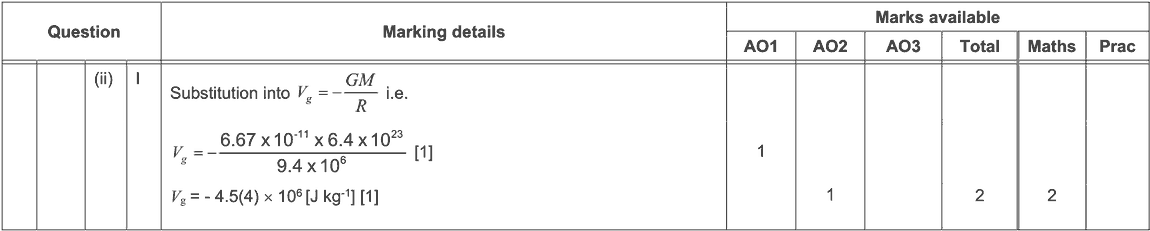
(ii) It is proposed to send a space-probe to study Phobos and Deimos. The first part of the mission will be to place the probe in orbit around Phobos. I. Show that the gravitational potential due to Mars at the Phobos orbit is approximately –4.5 MJ kg–1. [2]
October 2020 · Component 2 · Q7(c)(ii)II 4 marks AO3=4 Calculation electrostatic and gravitational fields
Earlier parts of question 7 that this part usesEarlier part of October 2020 Component 2 question 7Earlier part of October 2020 Component 2 question 7Earlier part of October 2020 Component 2 question 7
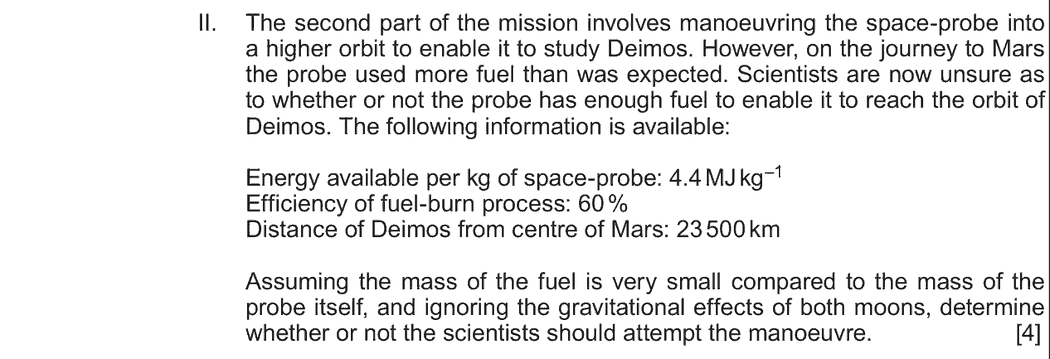
II. The second part of the mission involves manoeuvring the space-probe into a higher orbit to enable it to study Deimos. However, on the journey to Mars the probe used more fuel than was expected. Scientists are now unsure as to whether or not the probe has enough fuel to enable it to reach the orbit of Deimos. The following information is available: Energy available per kg of space-probe: 4.4 MJ kg–1 Efficiency of fuel-burn process: 60 % Distance of Deimos from centre of Mars: 23 500 km Assuming the mass of the fuel is very small compared to the mass of the probe itself, and ignoring the gravitational effects of both moons, determine whether or not the scientists should attempt the manoeuvre. [4]
October 2020 · Component 2 · Q7(c)(iii) 1 mark AO2=1 Short answer electrostatic and gravitational fields
Earlier parts of question 7 that this part usesEarlier part of October 2020 Component 2 question 7Earlier part of October 2020 Component 2 question 7
(iii) Explain why it is not possible to use the equation ∆Ep = mg∆h when determining the change in the gravitational potential energy of the probe as it moves between these orbits. [1]
October 2020 · Component 2 · Q8(a) 2 marks AO1=1, AO2=1 Calculation orbits and the wider universe
8. (a) Calculate the critical density of the universe giving appropriate units. [2]
October 2020 · Component 2 · Q8(b) 3 marks AO3=3 Calculation orbits and the wider universe
Earlier part of question 8 that this part usesEarlier part of October 2020 Component 2 question 8
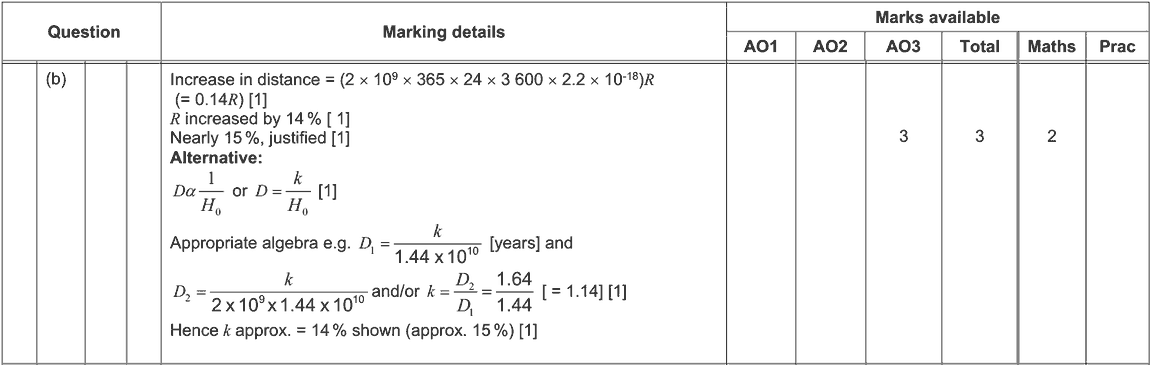
(b) An astronomer makes the following statement: Assuming that the rate of expansion of the universe is constant, two objects a distance R apart in space will increase their separation by nearly 15 % over a 2 billion year period. [1 billion = 1 × 10⁹ years] Justify this statement. [3]
October 2020 · Component 2 · Q8(c)(i) 2 marks AO2=2 Calculation orbits and the wider universe
Earlier part of question 8 that this part usesEarlier part of October 2020 Component 2 question 8
(c) A star in a distant galaxy shows a bright hydrogen emission line at 475 nm. The equivalent emission line on Earth has a wavelength of 410 nm. (i) Calculate the radial velocity of the star. [2]
October 2020 · Component 2 · Q8(c)(ii) 2 marks Calculation orbits and the wider universe
Earlier parts of question 8 that this part usesEarlier part of October 2020 Component 2 question 8Earlier part of October 2020 Component 2 question 8
(ii) Calculate the distance of the star from the Earth. [2]
October 2020 · Component 2 · Q8(c)(iii) 2 marks AO2=2 Calculation kinetic theory
Earlier parts of question 8 that this part usesEarlier part of October 2020 Component 2 question 8Earlier part of October 2020 Component 2 question 8
(iii) The temperature of the photosphere of the star is 7 100 K. Calculate the mean kinetic energy of particles in the photosphere. Give your answer in eV. [2]

Work with an Eduqas physics tutor

Want a paper marked and gone through with you? Message us.

Prefer email? Send an enquiry

If you are under 18, please include a parent's contact details. Enquiries go to enquiries@physicsaleveltutor.com and are deleted once handled. All tutoring is online.