June 2018: AS Paper 1

70 marks · 27 question parts · Paper, mark scheme and report on AQA's site · Have the data and formulae booklet beside you

Question by question

QTopicMarksAOType
1.1 Atomic structure and stable nuclei, Classification of particles, quarks and conservation laws 3Explanation
1.2 Classification of particles, quarks and conservation laws, Atomic structure and stable nuclei 3Explanation
1.3 Classification of particles, quarks and conservation laws 2Short answer
1.4 Classification of particles, quarks and conservation laws 1Short answer
1.5 Classification of particles, quarks and conservation laws 2Short answer
2.1 Work, energy, power and conservation of energy 2Calculation
2.2 Scalars, vectors and moments, Newton's laws of motion and momentum 3Explanation
2.3 Work, energy, power and conservation of energy 1Short answer
2.4 Newton's laws of motion and momentum 3Explanation
3.1 Excitation, energy levels and wave-particle duality 1Short answer
3.2 Excitation, energy levels and wave-particle duality 3Explanation
3.3 The photoelectric effect, Excitation, energy levels and wave-particle duality 3Calculation
3.4 The photoelectric effect, Excitation, energy levels and wave-particle duality 3Calculation
4.1 Scalars, vectors and moments 2Short answer
4.2 Scalars, vectors and moments 1Short answer
4.3 Scalars, vectors and moments 2Explanation
4.4 Scalars, vectors and moments 4Calculation
4.5 Materials, stress, strain and the Young modulus 3Calculation
5.1 Materials, stress, strain and the Young modulus 2Calculation
5.2 Materials, stress, strain and the Young modulus 1Calculation
5.3 Materials, stress, strain and the Young modulus 3Calculation
6.1 Circuits and potential dividers 4Calculation
6.2 Circuits and potential dividers 3Explanation
6.3 Circuits and potential dividers 3Calculation
7.1 Interference, diffraction and the diffraction grating 2Short answer
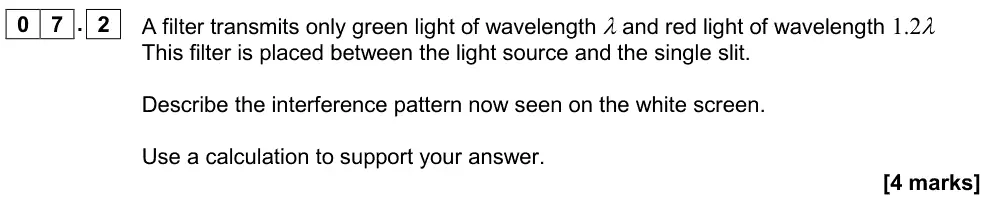
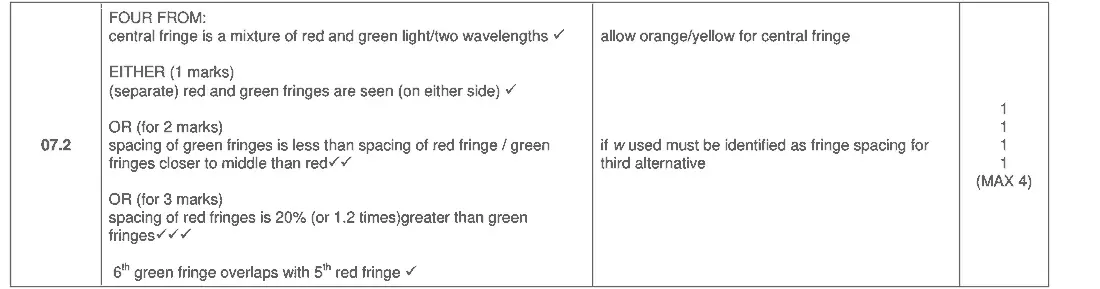
7.2 Interference, diffraction and the diffraction grating 4Explanation
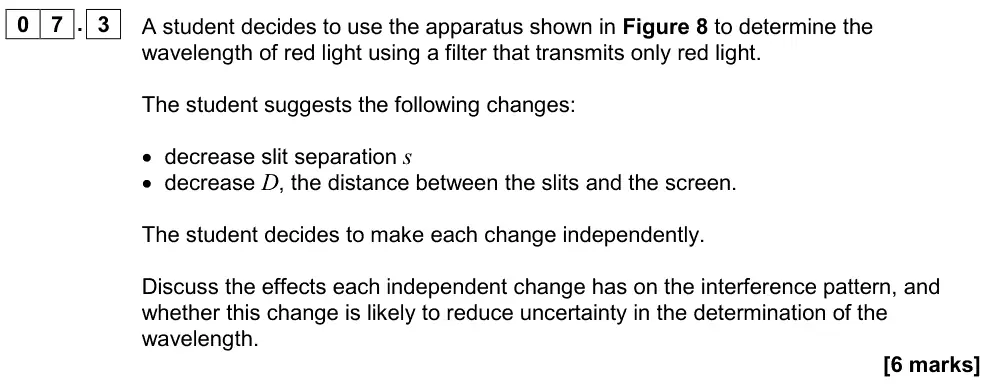
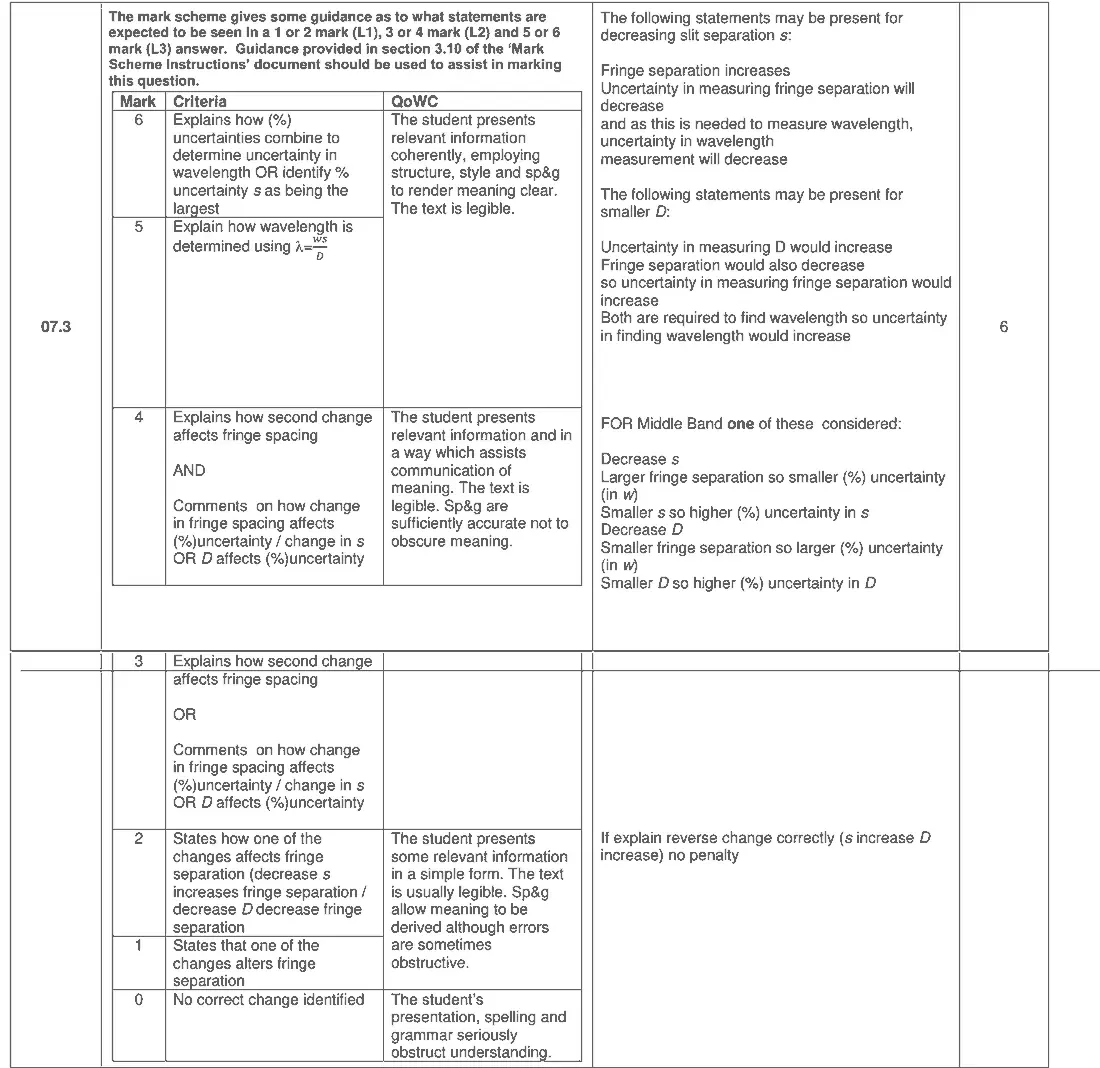
7.3 Interference, diffraction and the diffraction grating, Measurements, units and uncertainties 6Extended response

The questions

1.11.21.31.41.52.12.22.32.43.13.23.33.44.14.24.34.44.55.15.25.36.16.26.37.17.27.3
June 2018 · AS Paper 1 · Q1.1 3 marks Explanation atomic structure and stable nucleiclassification of particles and quarks
Describe the interaction that is responsible for keeping protons and neutrons together
in a stable nucleus.
You should include details of the properties of the interaction in your answer.
[3 marks]
June 2018 · AS Paper 1 · Q1.2 3 marks Explanation Hard classification of particles and quarksatomic structure and stable nuclei
Earlier part of question 1 that this part usesEarlier part of June 2018 Paper 1 question 1
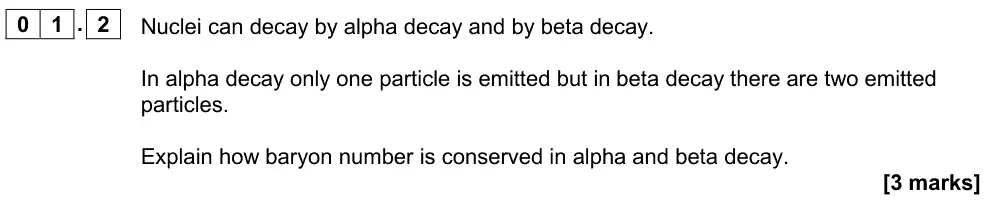
Nuclei can decay by alpha decay and by beta decay.
In alpha decay only one particle is emitted but in beta decay there are two emitted
particles.
Explain how baryon number is conserved in alpha and beta decay.
[3 marks]
June 2018 · AS Paper 1 · Q1.3 2 marks Short answer classification of particles and quarks
Earlier part of question 1 that this part usesEarlier part of June 2018 Paper 1 question 1
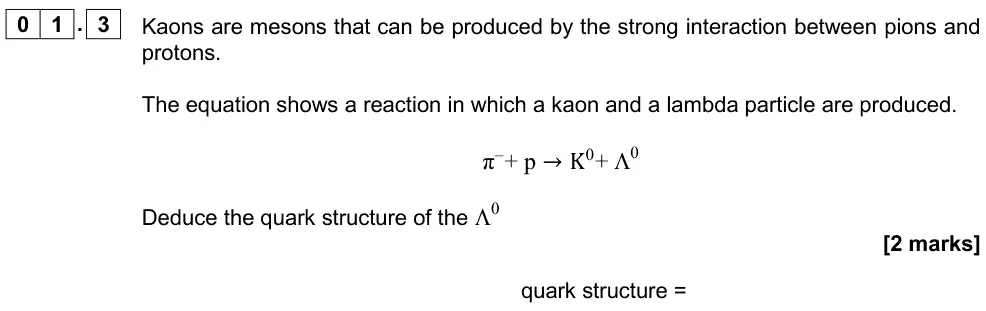
Kaons are mesons that can be produced by the strong interaction between pions and
protons.
The equation shows a reaction in which a kaon and a lambda particle are produced.
π–+ p →K0+ Λ0
Deduce the quark structure of the Λ0
[2 marks]
quark structure =
June 2018 · AS Paper 1 · Q1.4 1 mark Short answer classification of particles and quarks
Earlier part of question 1 that this part usesEarlier part of June 2018 Paper 1 question 1
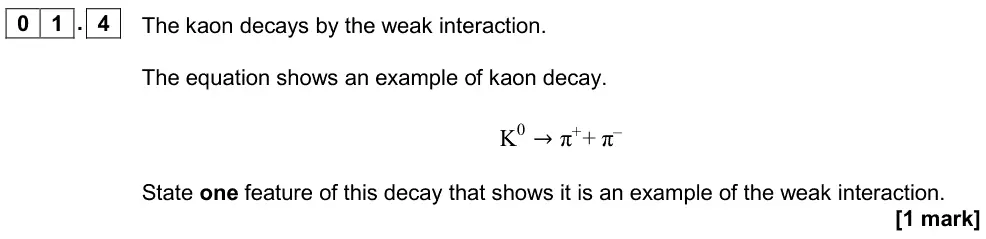
The kaon decays by the weak interaction.
The equation shows an example of kaon decay.
K0 →π++ π–
State one feature of this decay that shows it is an example of the weak interaction.
[1 mark]
June 2018 · AS Paper 1 · Q1.5 2 marks Short answer Hard classification of particles and quarks
Earlier part of question 1 that this part usesEarlier part of June 2018 Paper 1 question 1
There have been considerable advances in our understanding of particle physics over
the past 100 years.
Explain why it is necessary for many teams of scientists and engineers to collaborate
in order for these advances to be made.
[2 marks]
June 2018 · AS Paper 1 · Q2.1 2 marks Calculation work energy and power
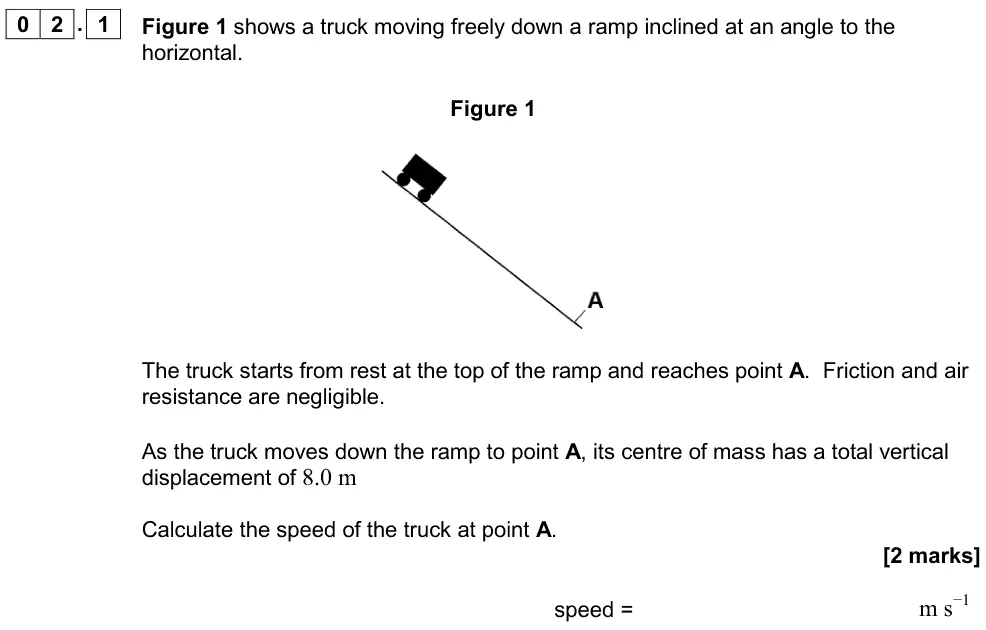
Figure 1 shows a truck moving freely down a ramp inclined at an angle to the
horizontal.
Figure 1
The truck starts from rest at the top of the ramp and reaches point A.  Friction and air
resistance are negligible.
As the truck moves down the ramp to point A, its centre of mass has a total vertical
displacement of 8.0 m
Calculate the speed of the truck at point A.
[2 marks]
speed =
m s−1
June 2018 · AS Paper 1 · Q2.2 3 marks Explanation Hard vectors and momentsnewtons laws and momentum
Earlier part of question 2 that this part usesEarlier part of June 2018 Paper 1 question 2
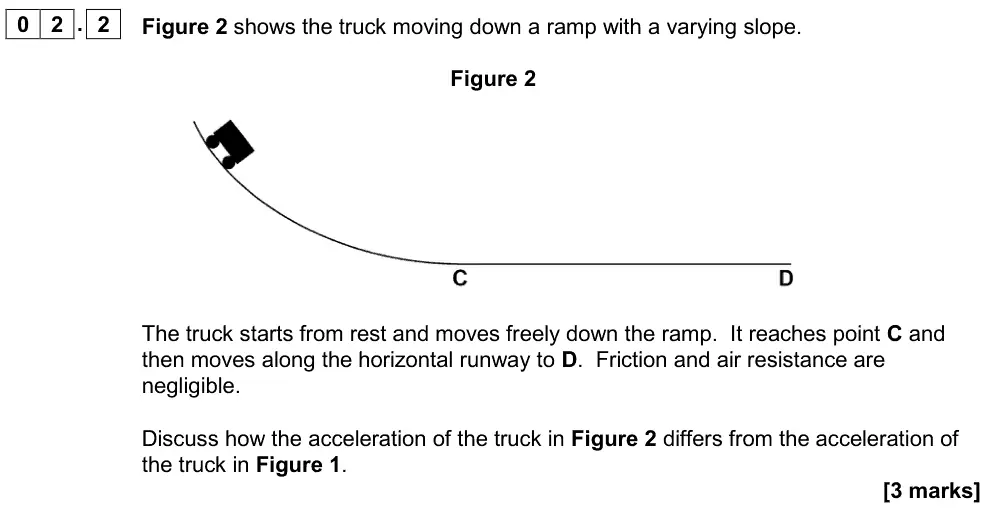
Figure 2 shows the truck moving down a ramp with a varying slope.
Figure 2
The truck starts from rest and moves freely down the ramp.  It reaches point C and
then moves along the horizontal runway to D.  Friction and air resistance are
negligible.
Discuss how the acceleration of the truck in Figure 2 differs from the acceleration of
the truck in Figure 1.
[3 marks]
June 2018 · AS Paper 1 · Q2.3 1 mark Short answer Hard work energy and power
Earlier part of question 2 that this part usesEarlier part of June 2018 Paper 1 question 2
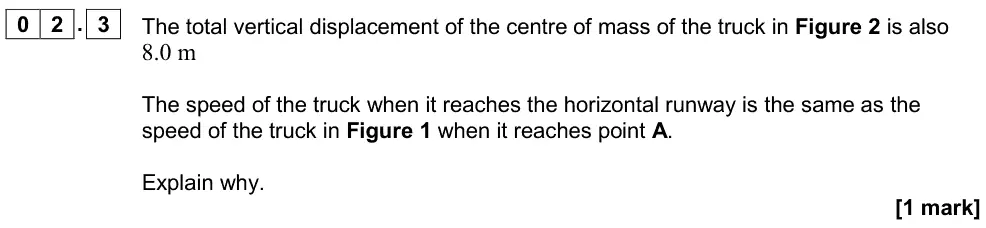
The total vertical displacement of the centre of mass of the truck in Figure 2 is also
8.0 m
The speed of the truck when it reaches the horizontal runway is the same as the
speed of the truck in Figure 1 when it reaches point A.
Explain why.
[1 mark]
June 2018 · AS Paper 1 · Q2.4 3 marks Explanation Hard newtons laws and momentum
Earlier part of question 2 that this part usesEarlier part of June 2018 Paper 1 question 2
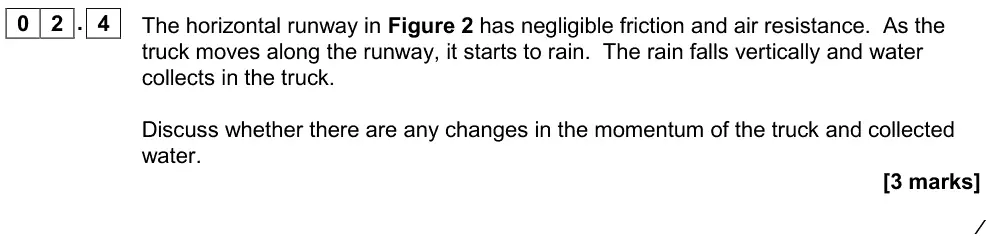
The horizontal runway in Figure 2 has negligible friction and air resistance.  As the
truck moves along the runway, it starts to rain.  The rain falls vertically and water
collects in the truck.
Discuss whether there are any changes in the momentum of the truck and collected
water.
[3 marks]
June 2018 · AS Paper 1 · Q3.1 1 mark Short answer Easy energy levels and wave particle duality
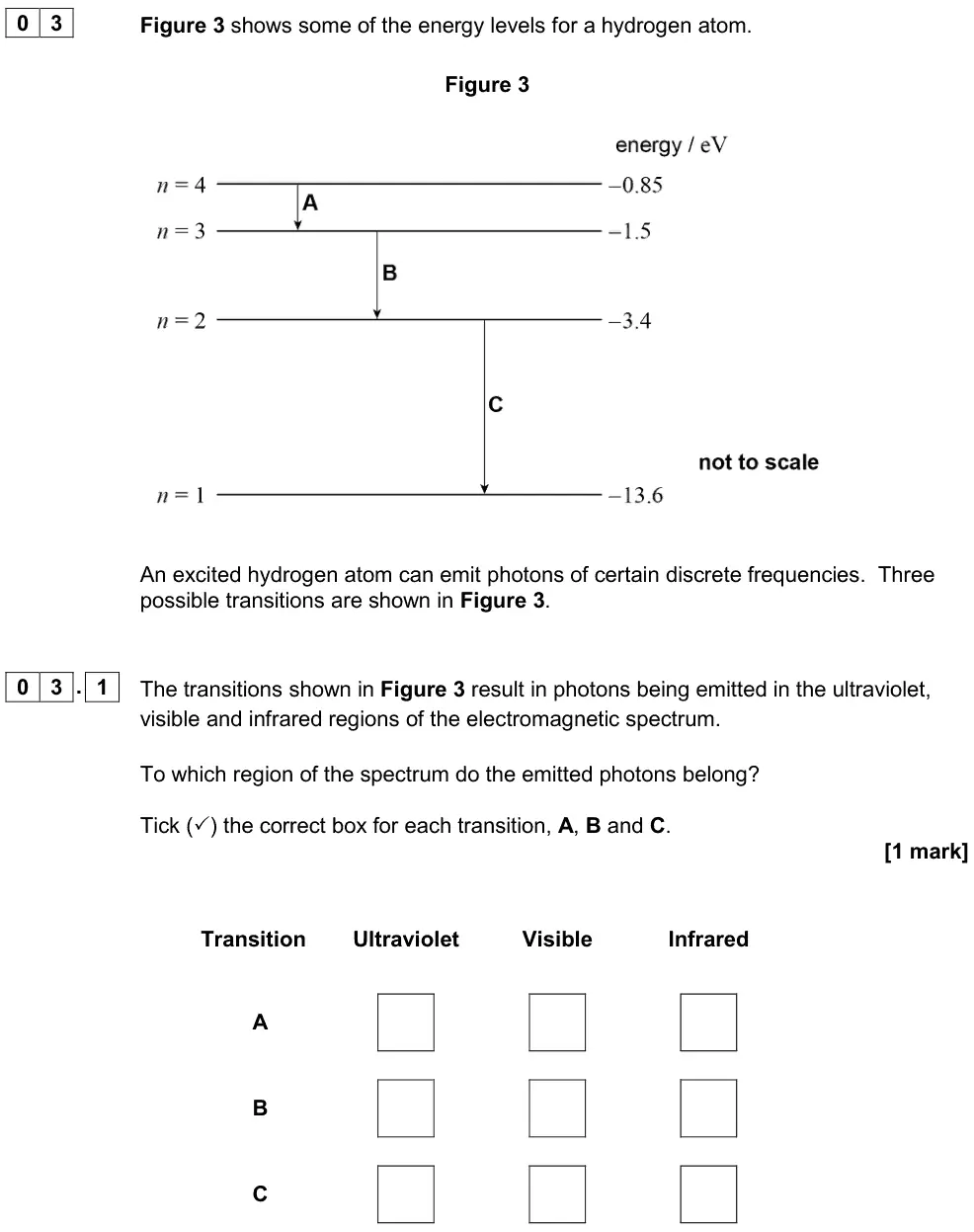
Figure 3 shows some of the energy levels for a hydrogen atom.
Figure 3
An excited hydrogen atom can emit photons of certain discrete frequencies.  Three
possible transitions are shown in Figure 3.
The transitions shown in Figure 3 result in photons being emitted in the ultraviolet,
visible and infrared regions of the electromagnetic spectrum.
To which region of the spectrum do the emitted photons belong?
Tick () the correct box for each transition, A, B and C.
[1 mark]
Transition
Ultraviolet
Visible
Infrared
A
B
C
June 2018 · AS Paper 1 · Q3.2 3 marks Explanation energy levels and wave particle duality
Earlier part of question 3 that this part usesEarlier part of June 2018 Paper 1 question 3
Two ways to excite a hydrogen atom are by collision with a free electron or by the
absorption of a photon.
Explain why, for a particular transition, the photon must have an exact amount of
energy whereas the free electron only needs a minimum amount of kinetic energy.
[3 marks]
June 2018 · AS Paper 1 · Q3.3 3 marks Calculation photoelectric effectenergy levels and wave particle duality
Earlier part of question 3 that this part usesEarlier part of June 2018 Paper 1 question 3
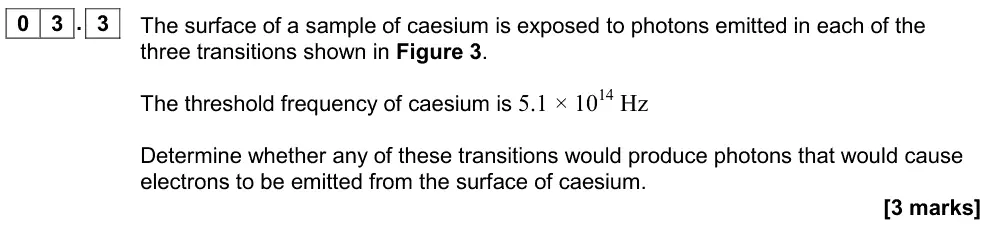
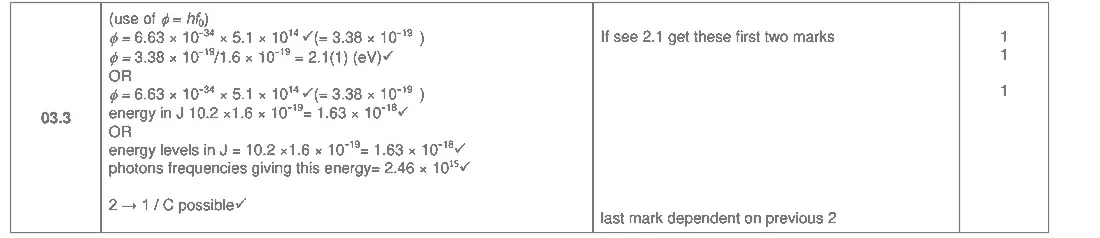
The surface of a sample of caesium is exposed to photons emitted in each of the
three transitions shown in Figure 3.

The threshold frequency of caesium is 5.1 × 10¹⁴ Hz
Determine whether any of these transitions would produce photons that would cause
electrons to be emitted from the surface of caesium.
[3 marks]
June 2018 · AS Paper 1 · Q3.4 3 marks Calculation photoelectric effectenergy levels and wave particle duality
Earlier part of question 3 that this part usesEarlier part of June 2018 Paper 1 question 3
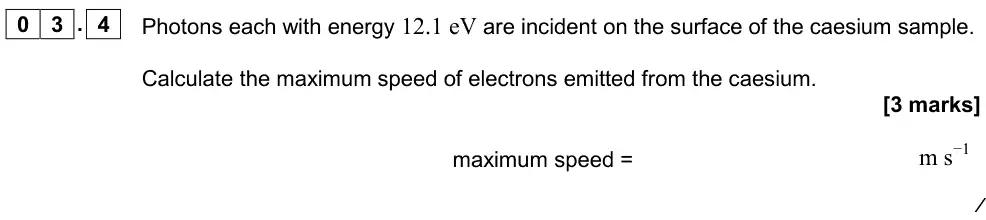
Photons each with energy 12.1 eV are incident on the surface of the caesium sample.
Calculate the maximum speed of electrons emitted from the caesium.
[3 marks]
maximum speed =
m s−1
June 2018 · AS Paper 1 · Q4.1 2 marks Short answer vectors and moments
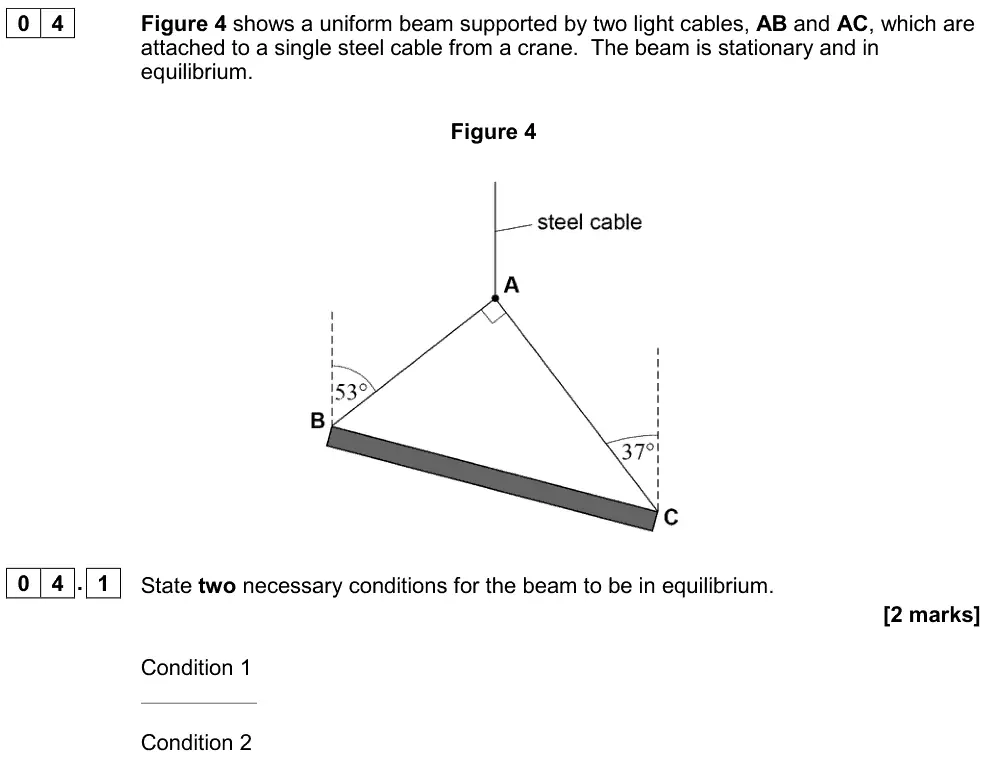
Figure 4 shows a uniform beam supported by two light cables, AB and AC, which are
attached to a single steel cable from a crane.  The beam is stationary and in
equilibrium.
Figure 4
State two necessary conditions for the beam to be in equilibrium.
[2 marks]
Condition 1
Condition 2
June 2018 · AS Paper 1 · Q4.2 1 mark Short answer vectors and moments
Earlier part of question 4 that this part usesEarlier part of June 2018 Paper 1 question 4
State what is meant by the centre of mass.
[1 mark]
June 2018 · AS Paper 1 · Q4.3 2 marks Explanation Hard vectors and moments
Earlier part of question 4 that this part usesEarlier part of June 2018 Paper 1 question 4
Explain why the centre of mass of the beam in Figure 4 must be vertically below A.
[2 marks]
June 2018 · AS Paper 1 · Q4.4 4 marks Calculation vectors and moments
Earlier part of question 4 that this part usesEarlier part of June 2018 Paper 1 question 4
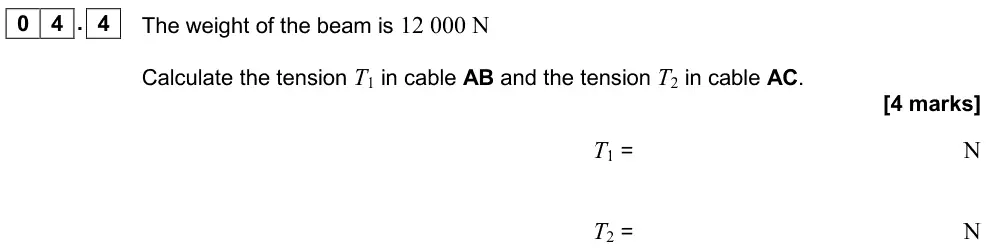
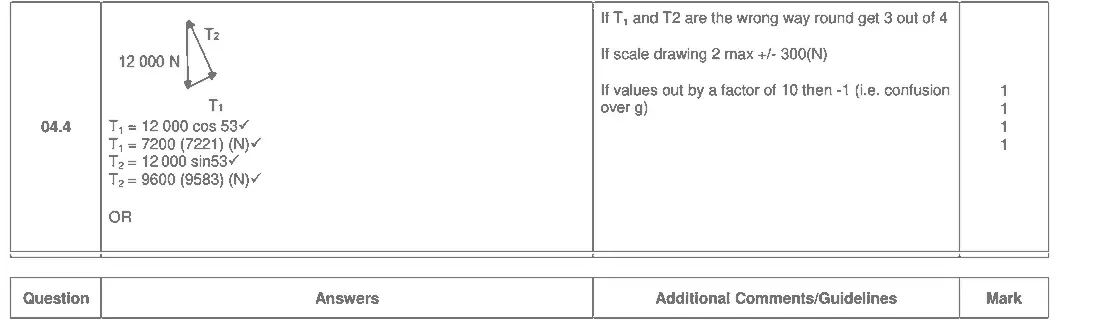
The weight of the beam is 12 000 N
Calculate the tension T1 in cable AB and the tension T2 in cable AC.
[4 marks]
T1 =
N
T2 =
N
June 2018 · AS Paper 1 · Q4.5 3 marks Calculation materials and young modulus
Earlier part of question 4 that this part usesEarlier part of June 2018 Paper 1 question 4
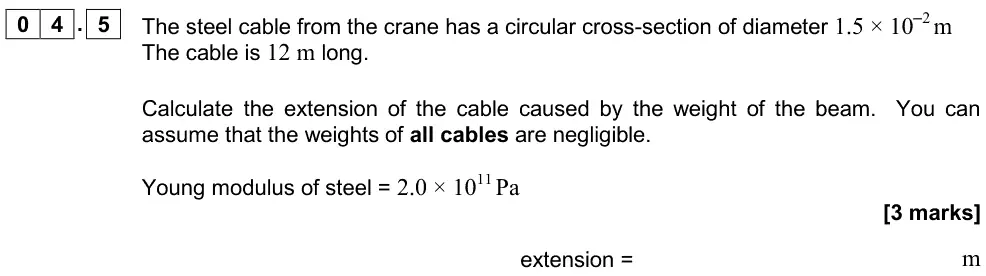
The steel cable from the crane has a circular cross-section of diameter 1.5 × 10⁻²
m
The cable is 12 m long.
Calculate the extension of the cable caused by the weight of the beam.  You can
assume that the weights of all cables are negligible.
Young modulus of steel = 2.0 × 10¹¹
Pa
[3 marks]
extension =
m
June 2018 · AS Paper 1 · Q5.1 2 marks Calculation Easy materials and young modulus
Calculate the weight of an ice cube that has volume 4.0 × 10⁻⁶ m3
density of ice = 920 kg m–3
[2 marks]
weight =
N
June 2018 · AS Paper 1 · Q5.2 1 mark Calculation materials and young modulus
Earlier part of question 5 that this part usesEarlier part of June 2018 Paper 1 question 5
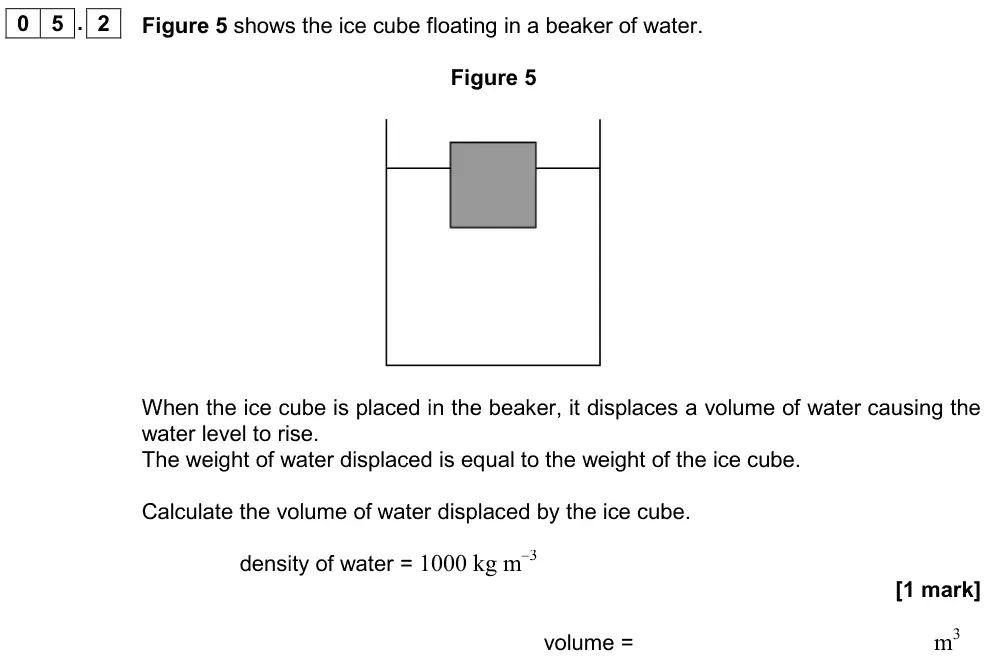
Figure 5 shows the ice cube floating in a beaker of water.
Figure 5
When the ice cube is placed in the beaker, it displaces a volume of water causing the
water level to rise.
The weight of water displaced is equal to the weight of the ice cube.
Calculate the volume of water displaced by the ice cube.
density of water = 1000 kg m–3
[1 mark]
volume =
m3
June 2018 · AS Paper 1 · Q5.3 3 marks Calculation Hard materials and young modulus
Earlier part of question 5 that this part usesEarlier part of June 2018 Paper 1 question 5
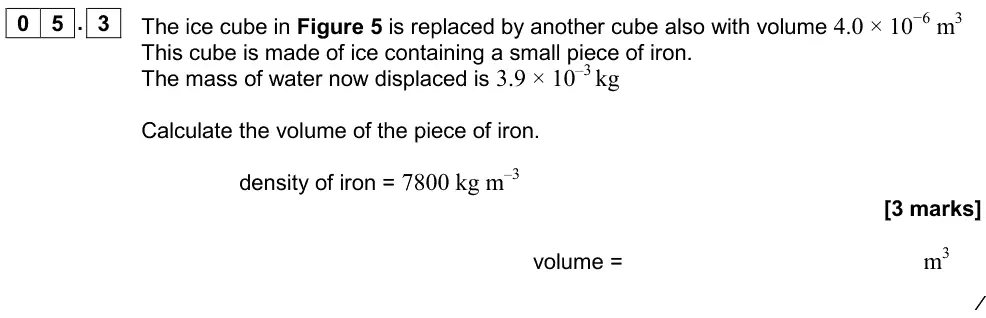
The ice cube in Figure 5 is replaced by another cube also with volume 4.0 × 10⁻⁶ m3
This cube is made of ice containing a small piece of iron.
The mass of water now displaced is 3.9 × 10⁻³ kg
Calculate the volume of the piece of iron.
density of iron = 7800 kg m–3
[3 marks]
volume =
m3
June 2018 · AS Paper 1 · Q6.1 4 marks Calculation Hard circuits and potential dividers
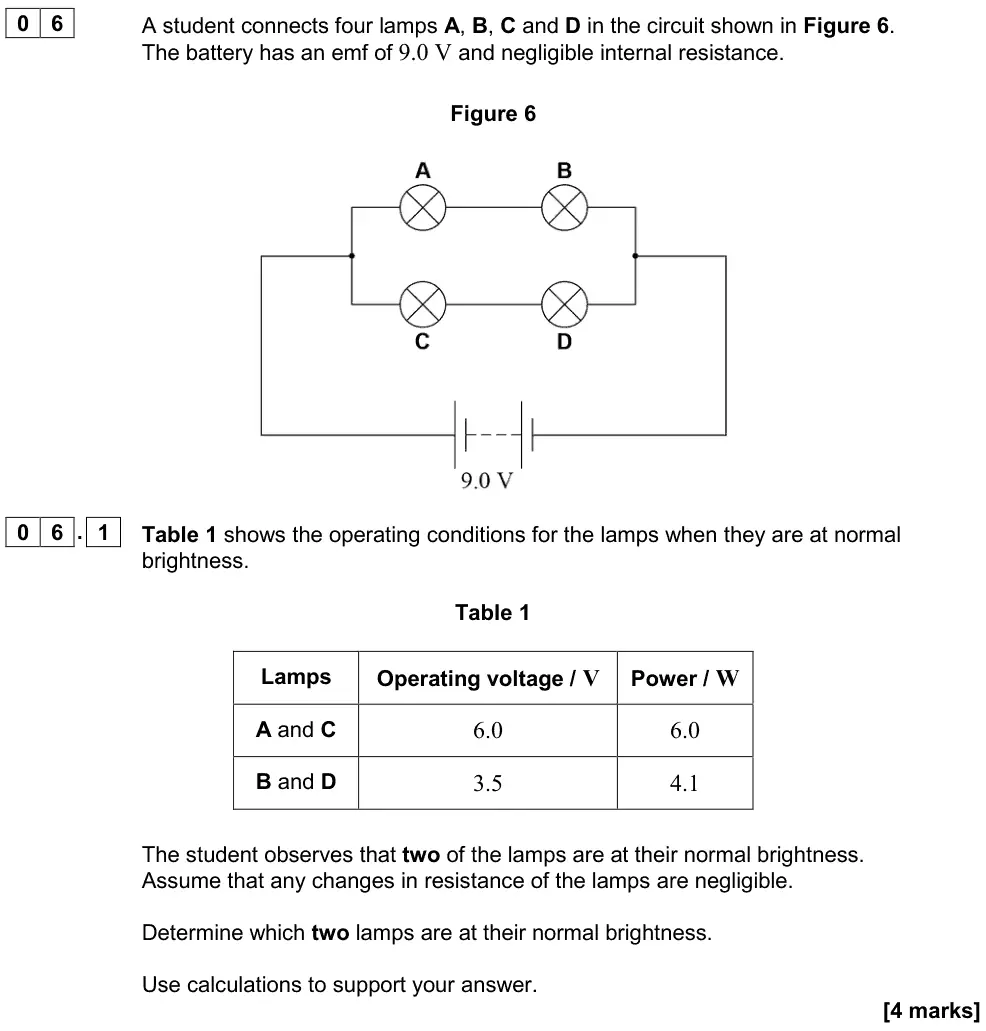
A student connects four lamps A, B, C and D in the circuit shown in Figure 6.
The battery has an emf of 9.0 V and negligible internal resistance.
Figure 6
Table 1 shows the operating conditions for the lamps when they are at normal
brightness.
Table 1
Lamps
Operating voltage / V
Power / W
A and C
6.0
6.0
B and D
3.5
4.1
The student observes that two of the lamps are at their normal brightness.
Assume that any changes in resistance of the lamps are negligible.
Determine which two lamps are at their normal brightness.
Use calculations to support your answer.
[4 marks]
June 2018 · AS Paper 1 · Q6.2 3 marks Explanation Hard circuits and potential dividers
Earlier part of question 6 that this part usesEarlier part of June 2018 Paper 1 question 6
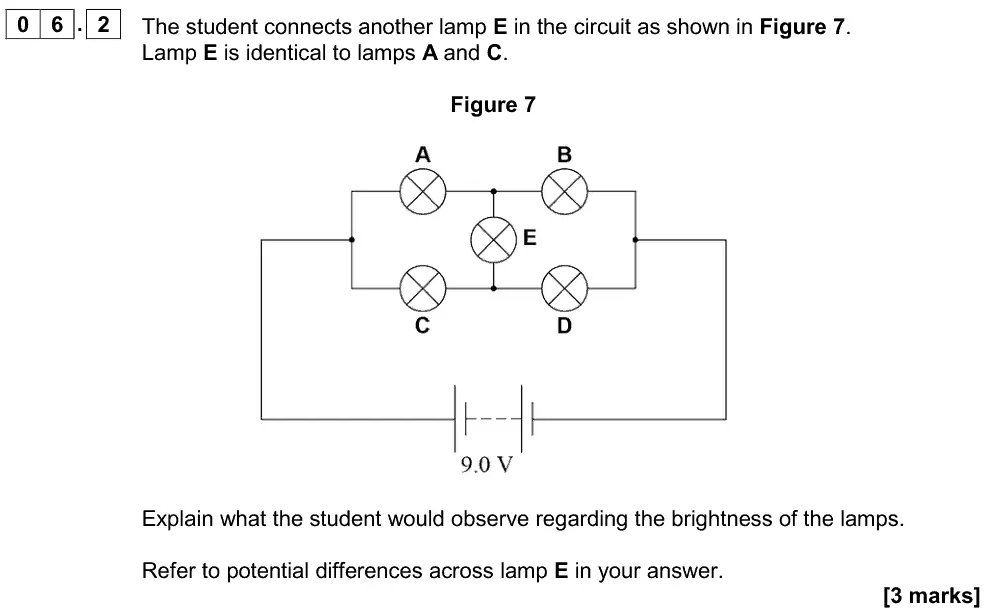
The student connects another lamp E in the circuit as shown in Figure 7.
Lamp E is identical to lamps A and C.
Figure 7
Explain what the student would observe regarding the brightness of the lamps.
Refer to potential differences across lamp E in your answer.
[3 marks]
June 2018 · AS Paper 1 · Q6.3 3 marks Calculation circuits and potential dividers
Earlier part of question 6 that this part usesEarlier part of June 2018 Paper 1 question 6
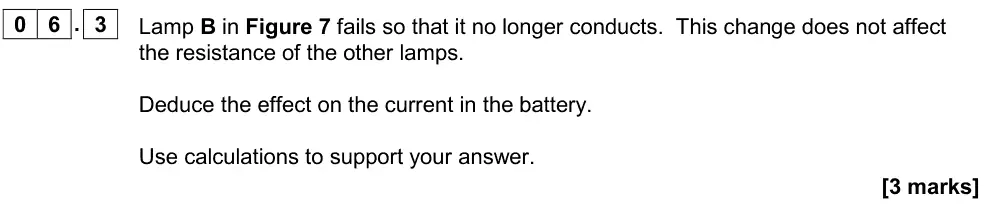
Lamp B in Figure 7 fails so that it no longer conducts.  This change does not affect
the resistance of the other lamps.
Deduce the effect on the current in the battery.
Use calculations to support your answer.
[3 marks]
June 2018 · AS Paper 1 · Q7.1 2 marks Short answer interference and diffraction
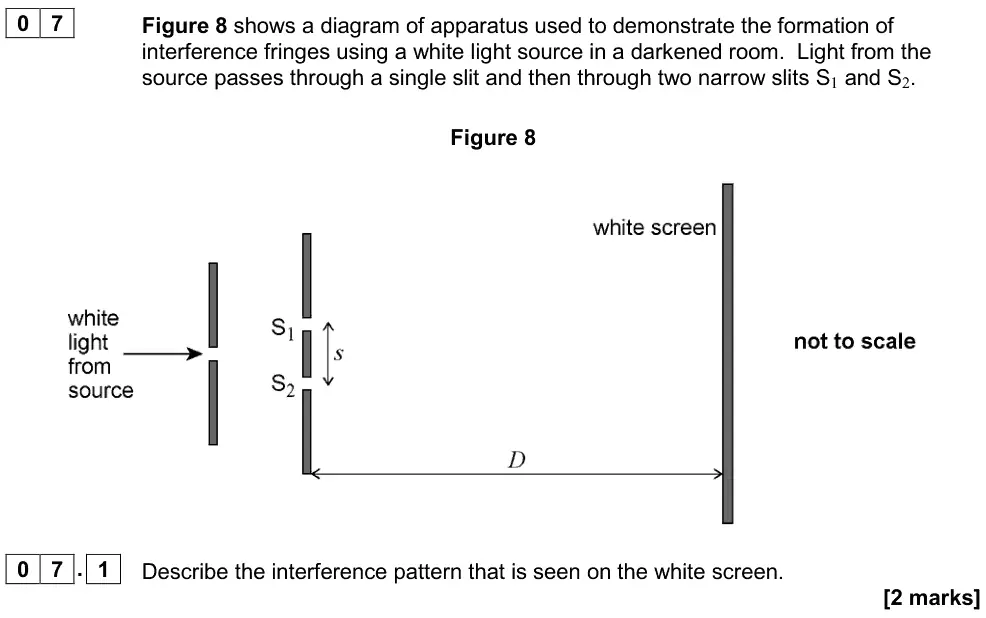
Figure 8 shows a diagram of apparatus used to demonstrate the formation of
interference fringes using a white light source in a darkened room.  Light from the
source passes through a single slit and then through two narrow slits S1 and S2.
Figure 8
Describe the interference pattern that is seen on the white screen.
[2 marks]
June 2018 · AS Paper 1 · Q7.2 4 marks Explanation interference and diffraction
Earlier part of question 7 that this part usesEarlier part of June 2018 Paper 1 question 7
A filter transmits only green light of wavelength  and red light of wavelength 1.2
This filter is placed between the light source and the single slit.
Describe the interference pattern now seen on the white screen.
Use a calculation to support your answer.
[4 marks]
June 2018 · AS Paper 1 · Q7.3 6 marks 6-mark extended response Hard interference and diffractionmeasurements and uncertainties
Earlier part of question 7 that this part usesEarlier part of June 2018 Paper 1 question 7
A student decides to use the apparatus shown in Figure 8 to determine the
wavelength of red light using a filter that transmits only red light.
The student suggests the following changes:
• decrease slit separation s
• decrease D, the distance between the slits and the screen.
The student decides to make each change independently.
Discuss the effects each independent change has on the interference pattern, and
whether this change is likely to reduce uncertainty in the determination of the
wavelength.
[6 marks]

Work with an AQA physics tutor

Want a paper marked and gone through with you? Message us.

Prefer email? Send an enquiry

If you are under 18, please include a parent's contact details. Enquiries go to enquiries@physicsaleveltutor.com and are deleted once handled. All tutoring is online.