June 2023: Component 2

100 marks · 39 question parts · Paper, mark scheme and report on Eduqas's site · Have the Data Booklet beside you

Question by question

QTopicMarksAOType
1(a) Resistance 1AO1=1Definition
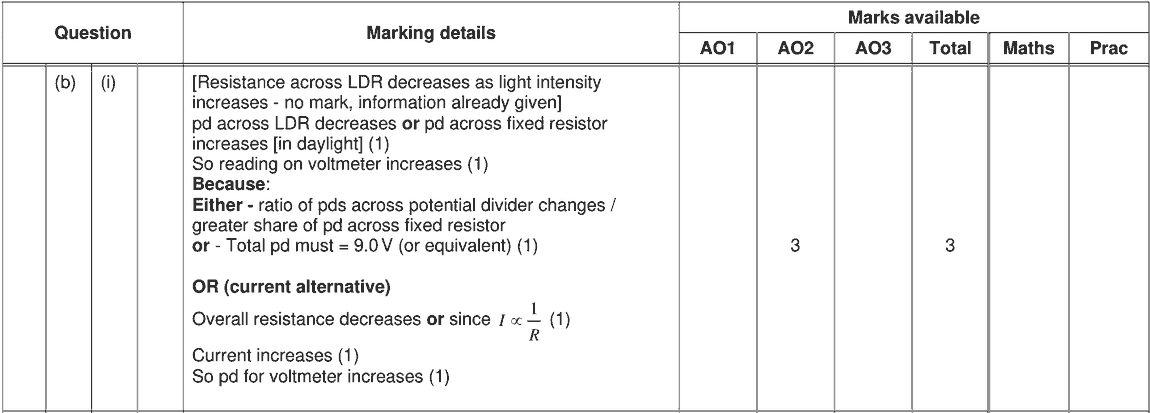
1(b)(i) d.c. circuits 3AO2=3Explanation
1(b)(ii) d.c. circuits 2AO1=1,AO2=1Calculation
1(b)(iii)I d.c. circuits 1AO3=1Diagram or graph
1(b)(iii)II d.c. circuits 2AO3=2Calculation
2(a) Resistance 1AO1=1Short answer
2(b)(i) Conduction of electricity 2AO1=1,AO2=1Show that
2(b)(ii) Conduction of electricity, Resistance 3AO2=3Show that
2(b)(iii) Conduction of electricity, Resistance 2AO1=1,AO2=1Calculation
2(c) Conduction of electricity, Resistance 2AO3=2Explanation
2(d) Resistance 2AO3=2Short answer
3(a) Capacitance 3AO1=3Practical and data analysis
3(b) Capacitance 2AO2=2Practical and data analysis
3(c)(i) Capacitance 3AO2=3Practical and data analysis
3(c)(ii) Capacitance 2AO2=2Practical and data analysis
3(d)(i) Capacitance 5AO3=5Practical and data analysis
3(d)(ii) Capacitance 2AO3=2Practical and data analysis
4(a)(i) Solids under stress 1AO2=1Diagram or graph
4(a)(ii) Solids under stress 2AO1=2Explanation
4(b)(i) Solids under stress 1AO2=1Short answer
4(b)(ii) Solids under stress 3AO1=2,AO2=1Explanation
4(c)(i) Solids under stress, Basic physics: units, vectors and moments 4AO1=1,AO2=3Show that
4(c)(ii) Solids under stress 2AO1=1,AO2=1Calculation
4(c)(iii) Solids under stress 2AO3=2Explanation
5(a) Electrostatic and gravitational fields of force 6AO1=3,AO2=3Extended response
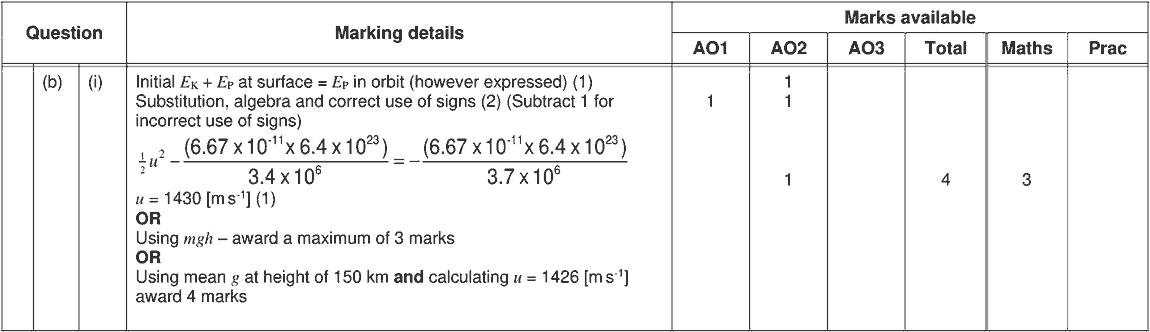
5(b)(i) Electrostatic and gravitational fields of force, Energy concepts 4AO1=1,AO2=3Calculation
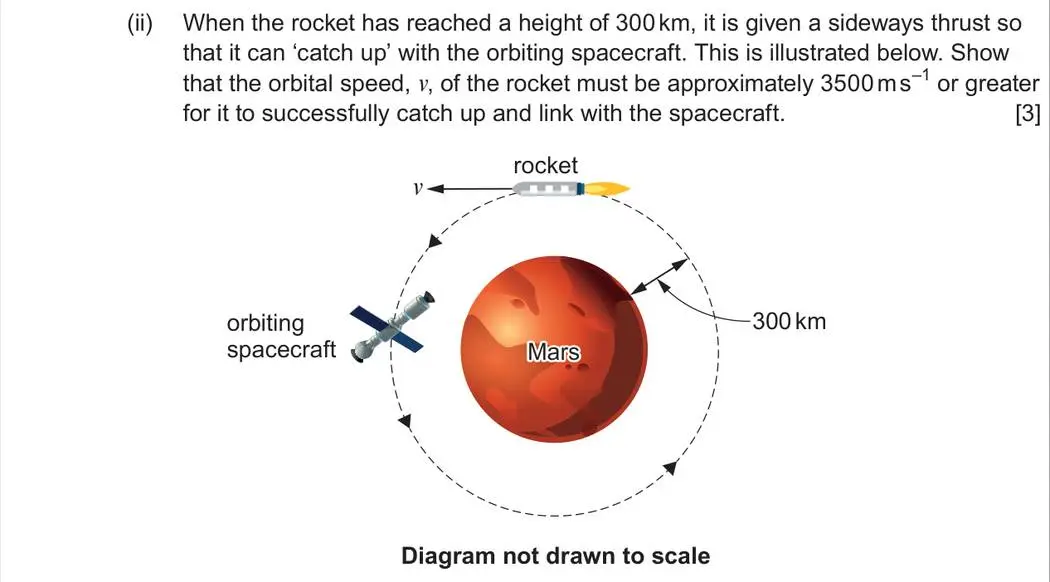
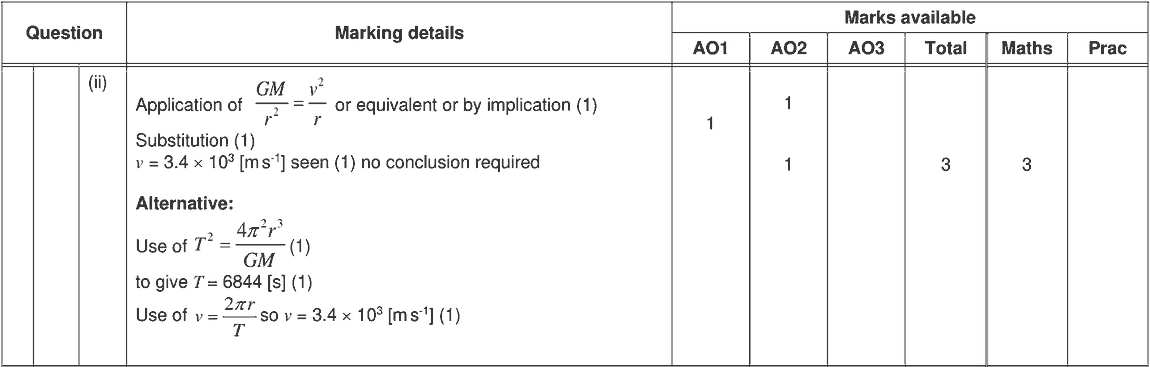
5(b)(ii) Orbits and the wider universe, Circular motion 3AO1=1,AO2=2Show that
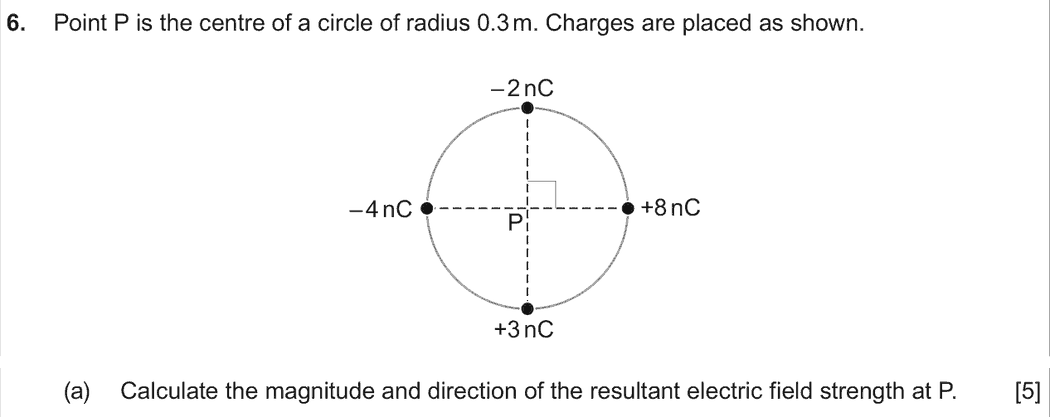
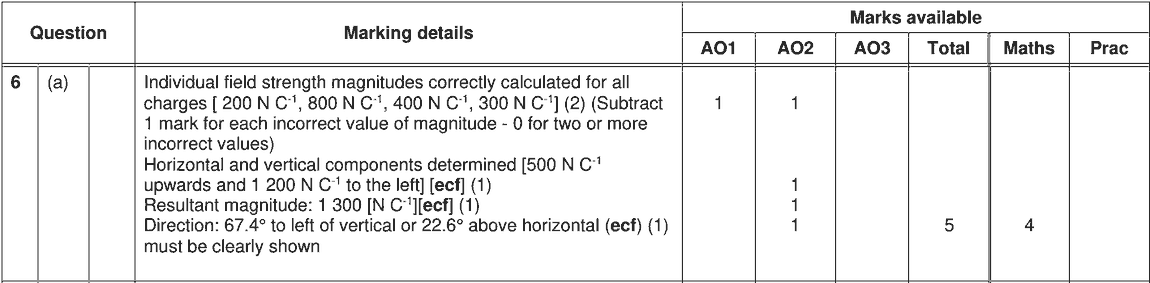
6(a) Electrostatic and gravitational fields of force 5AO1=1,AO2=4Calculation
6(b) Electrostatic and gravitational fields of force 3AO1=1,AO2=2Calculation
6(c) Electrostatic and gravitational fields of force 3AO3=3Calculation
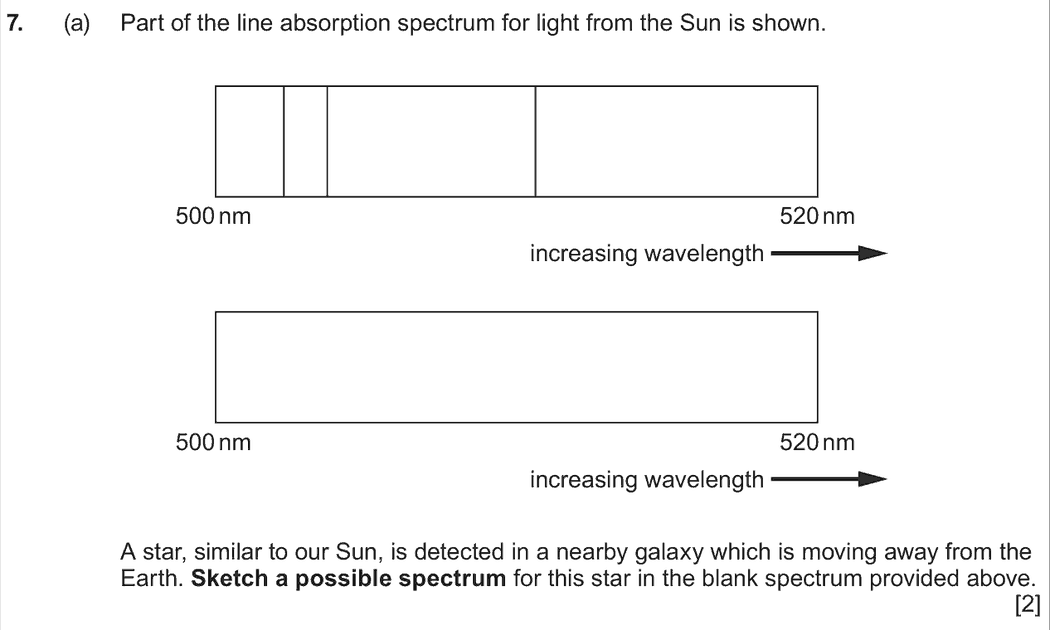
7(a) Orbits and the wider universe, Using radiation to investigate stars 2AO1=1,AO2=1Diagram or graph
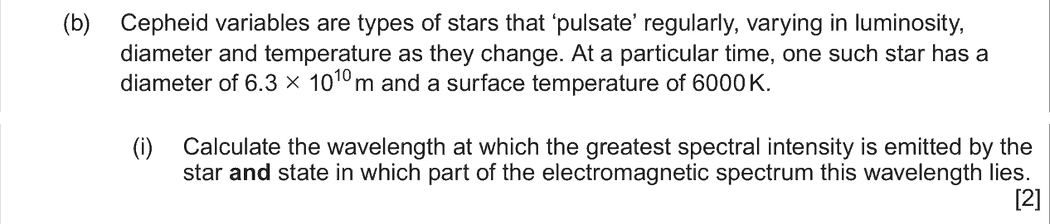
7(b)(i) Using radiation to investigate stars 2AO1=1,AO2=1Calculation
7(b)(ii) Using radiation to investigate stars 2AO1=1,AO2=1Calculation
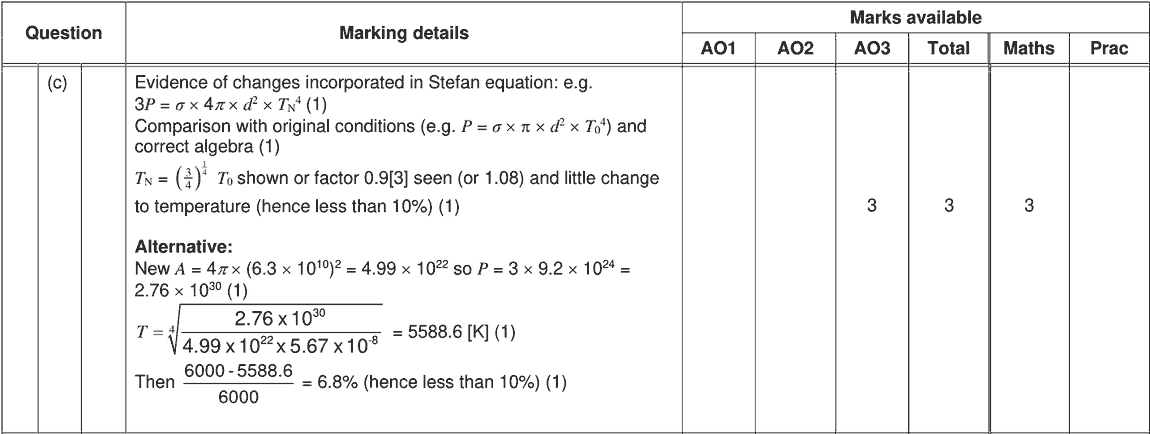
7(c) Using radiation to investigate stars 3AO3=3Show that
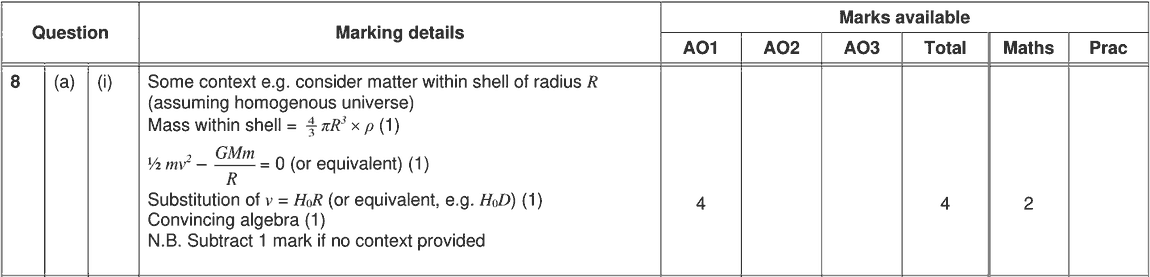
8(a)(i) Orbits and the wider universe 4AO1=4Show that
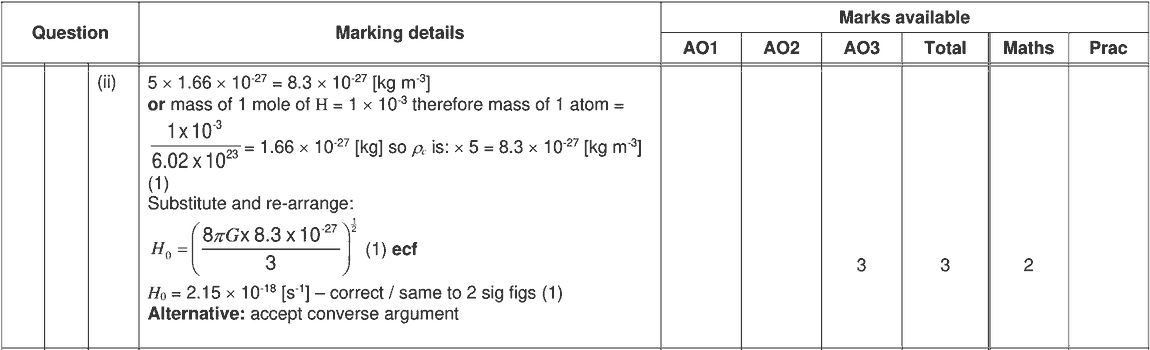
8(a)(ii) Orbits and the wider universe 3AO3=3Calculation
8(b)(i) Orbits and the wider universe 2AO1=1,AO2=1Show that
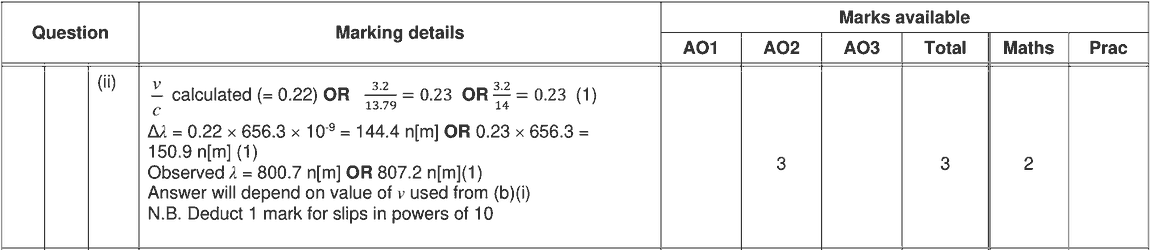
8(b)(ii) Orbits and the wider universe 3AO2=3Calculation
8(c) Using radiation to investigate stars 2AO1=1,AO2=1Explanation

The questions

1(a)1(b)(i)1(b)(ii)1(b)(iii)I1(b)(iii)II2(a)2(b)(i)2(b)(ii)2(b)(iii)2(c)2(d)3(a)3(b)3(c)(i)3(c)(ii)3(d)(i)3(d)(ii)4(a)(i)4(a)(ii)4(b)(i)4(b)(ii)4(c)(i)4(c)(ii)4(c)(iii)5(a)5(b)(i)5(b)(ii)6(a)6(b)6(c)7(a)7(b)(i)7(b)(ii)7(c)8(a)(i)8(a)(ii)8(b)(i)8(b)(ii)8(c)
June 2023 · Component 2 · Q1(a) 1 mark AO1=1 Definition resistance
1. (a) Define the potential difference between two points in an electric circuit. [1]
June 2023 · Component 2 · Q1(b)(i) 3 marks AO2=3 Explanation dc circuits
Earlier part of question 1 that this part usesEarlier part of June 2023 Component 2 question 1
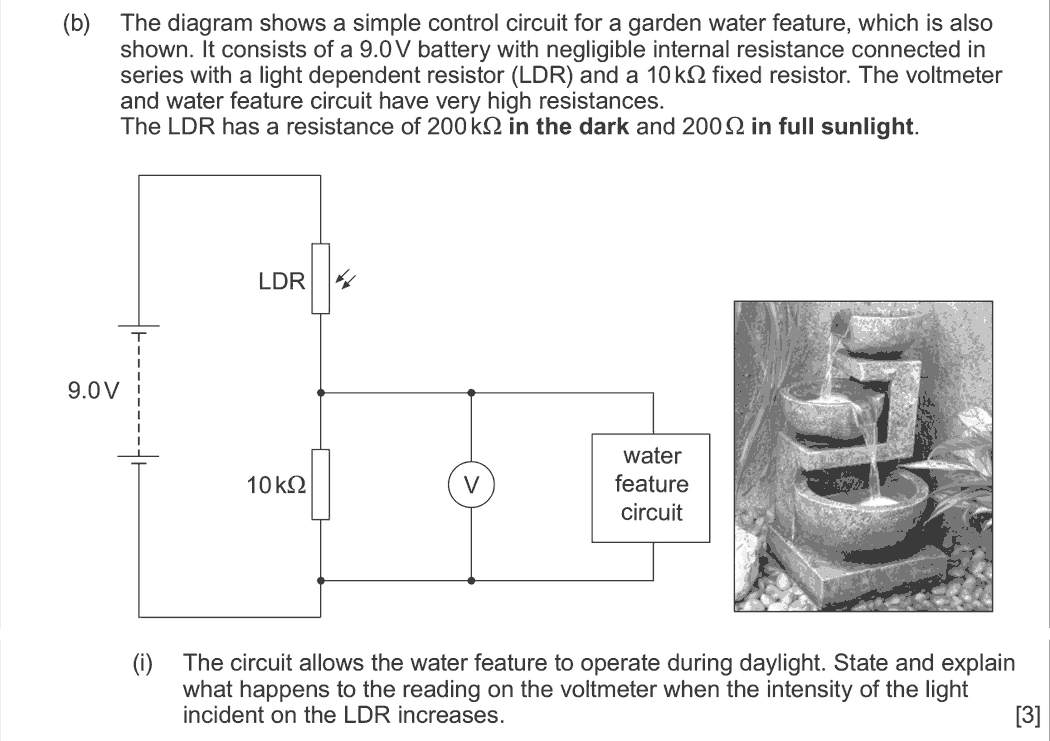
(b) The diagram shows a simple control circuit for a garden water feature, which is also shown. It consists of a 9.0 V battery with negligible internal resistance connected in series with a light dependent resistor (LDR) and a 10 kΩ fixed resistor. The voltmeter and water feature circuit have very high resistances. The LDR has a resistance of 200 kΩ in the dark and 200 Ω in full sunlight. LDR 9.0 V water 10 kΩ V feature circuit (i) The circuit allows the water feature to operate during daylight. State and explain what happens to the reading on the voltmeter when the intensity of the light incident on the LDR increases. [3]
June 2023 · Component 2 · Q1(b)(ii) 2 marks AO1=1, AO2=1 Calculation dc circuits
Earlier parts of question 1 that this part usesEarlier part of June 2023 Component 2 question 1Earlier part of June 2023 Component 2 question 1
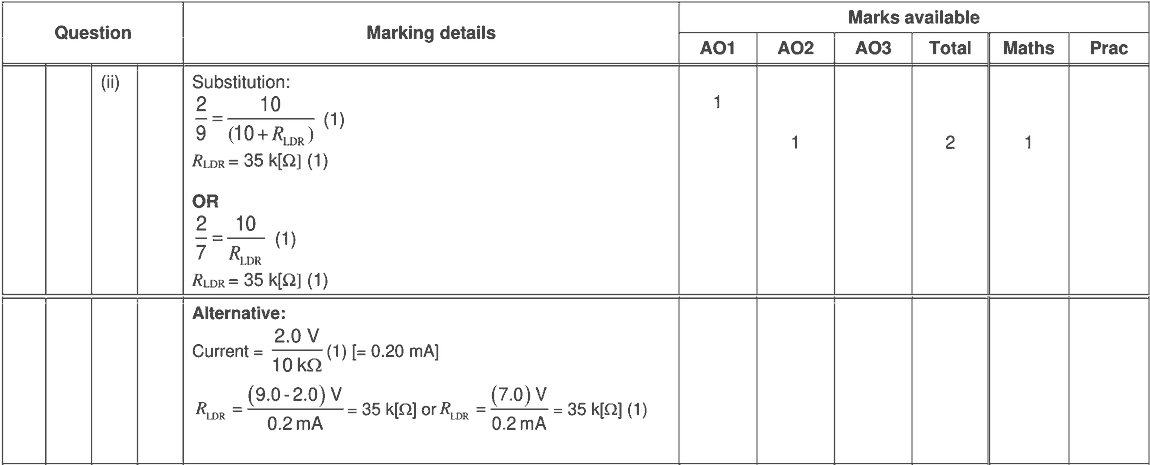
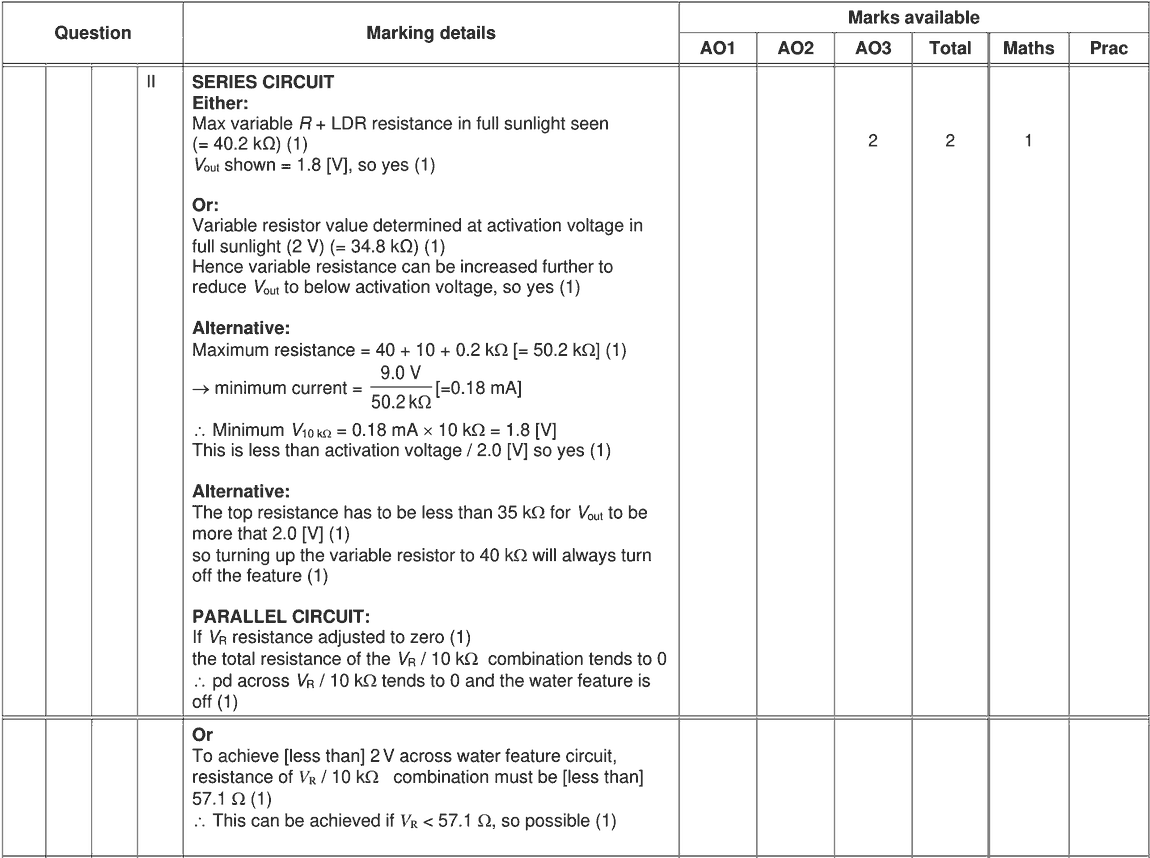
(ii) The water feature is activated when the reading on the voltmeter reaches 2.0 V. Calculate the resistance of the LDR at this activation point. [2]
June 2023 · Component 2 · Q1(b)(iii)I 1 mark AO3=1 Diagram or graph dc circuits
Earlier parts of question 1 that this part usesEarlier part of June 2023 Component 2 question 1Earlier part of June 2023 Component 2 question 1
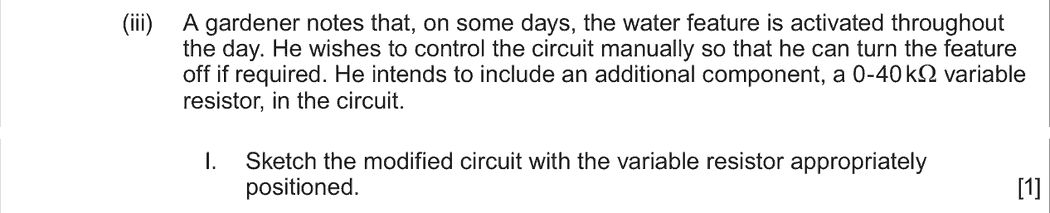
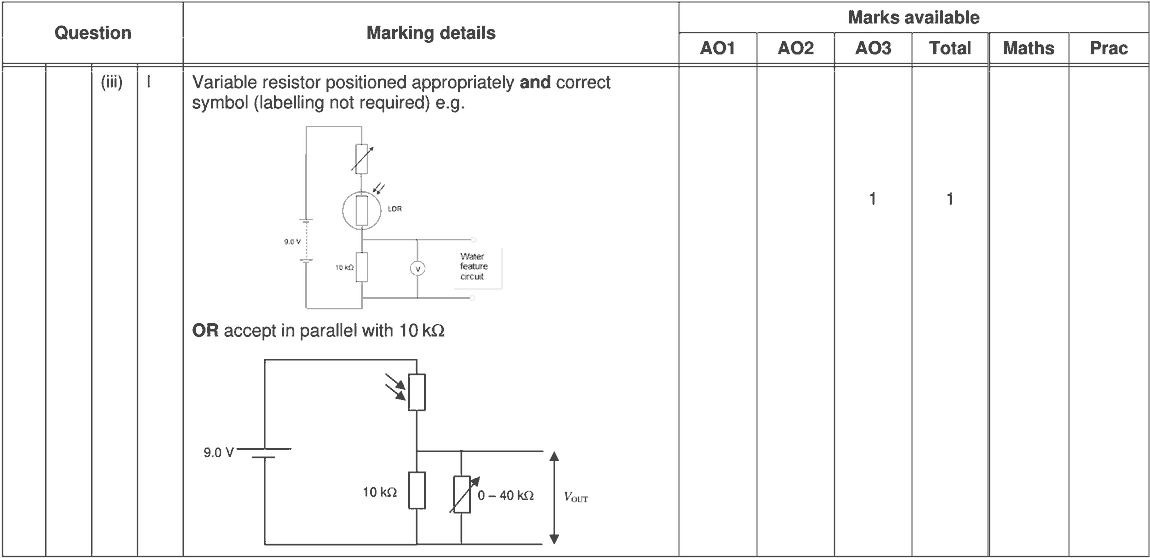
(iii) A gardener notes that, on some days, the water feature is activated throughout the day. He wishes to control the circuit manually so that he can turn the feature off if required. He intends to include an additional component, a 0-40 kΩ variable resistor, in the circuit. I. Sketch the modified circuit with the variable resistor appropriately positioned. [1]
June 2023 · Component 2 · Q1(b)(iii)II 2 marks AO3=2 Calculation dc circuits
Earlier parts of question 1 that this part usesEarlier part of June 2023 Component 2 question 1Earlier part of June 2023 Component 2 question 1Earlier part of June 2023 Component 2 question 1
II. Determine whether this modification will allow him to switch the water feature off in full sunlight. [2]
June 2023 · Component 2 · Q2(a) 1 mark AO1=1 Short answer resistance
2. (a) The size of a current in a wire, for a given pd, depends on its resistance. State, in terms of free electrons, how this resistance arises. [1]
June 2023 · Component 2 · Q2(b)(i) 2 marks AO1=1, AO2=1 Show that conduction of electricity
Earlier part of question 2 that this part usesEarlier part of June 2023 Component 2 question 2
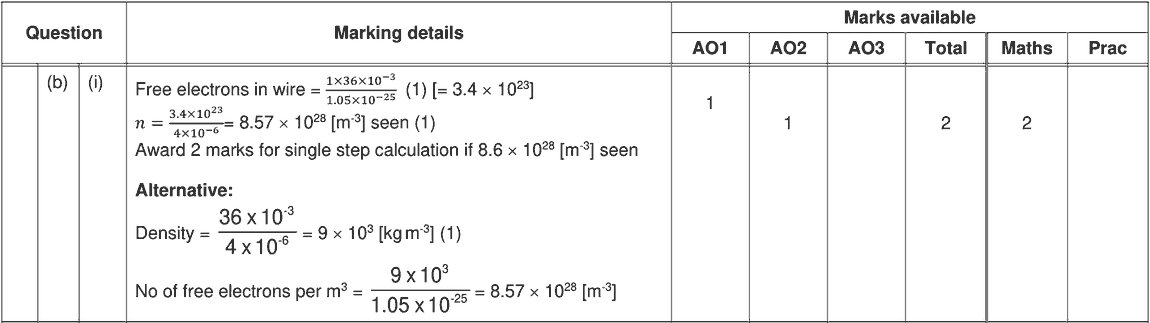
(b) (i) A 2.0 m length of copper wire has a mass of 36.0 g and a cross-sectional area, A, of 2.0 × 10⁻⁶ m2. Each copper atom has a mass of 1.05 × 10⁻²⁵ kg and contributes, on average, one free electron per atom. Show that the number of free electrons per unit volume, n, is approximately 9 × 1028 m–3. [2]
June 2023 · Component 2 · Q2(b)(ii) 3 marks AO2=3 Show that conduction of electricityresistance
Earlier parts of question 2 that this part usesEarlier part of June 2023 Component 2 question 2Earlier part of June 2023 Component 2 question 2
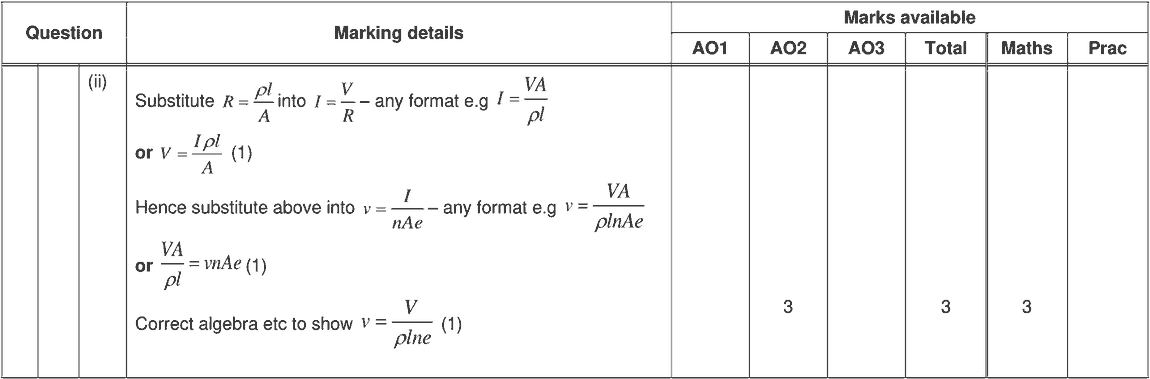
(ii) A pd, V, is applied across the wire. Show that the drift velocity, v, can be given by: V v = ρ lne where ρ is the resistivity of copper and l is the length of the wire. [3]
June 2023 · Component 2 · Q2(b)(iii) 2 marks AO1=1, AO2=1 Calculation conduction of electricityresistance
Earlier parts of question 2 that this part usesEarlier part of June 2023 Component 2 question 2Earlier part of June 2023 Component 2 question 2
(iii) Calculate v when a 1.2 V pd is applied across the wire. (Resistivity of copper, ρ = 1.7 × 10⁻⁸ Ω m) [2]
June 2023 · Component 2 · Q2(c) 2 marks AO3=2 Explanation conduction of electricityresistance
Earlier part of question 2 that this part usesEarlier part of June 2023 Component 2 question 2
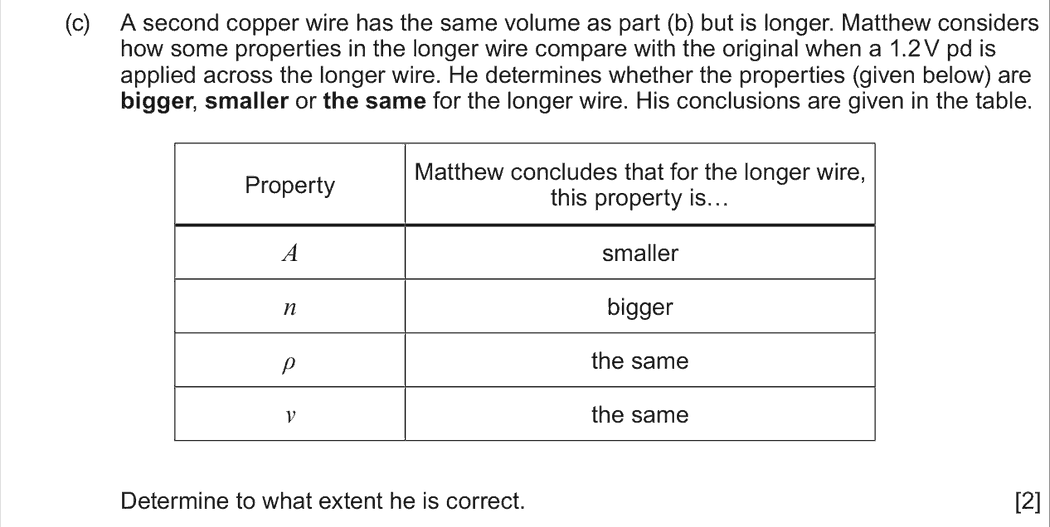
(c) A second copper wire has the same volume as part (b) but is longer. Matthew considers how some properties in the longer wire compare with the original when a 1.2 V pd is applied across the longer wire. He determines whether the properties (given below) are bigger, smaller or the same for the longer wire. His conclusions are given in the table. Matthew concludes that for the longer wire, Property this property is… A smaller n bigger ρ the same v the same Determine to what extent he is correct. [2]
June 2023 · Component 2 · Q2(d) 2 marks AO3=2 Short answer resistance
Earlier parts of question 2 that this part usesEarlier part of June 2023 Component 2 question 2Earlier part of June 2023 Component 2 question 2
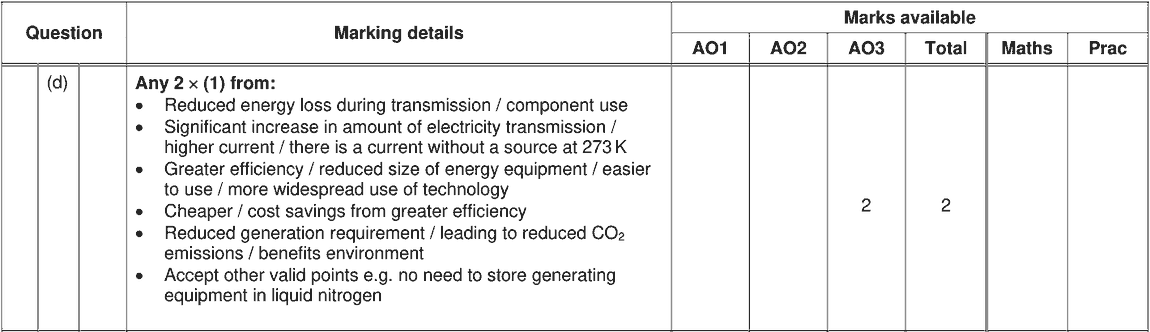
(d) Many scientists from around the world are searching for a superconducting material which has a critical temperature above 273 K. Discuss the benefits to society if this were achieved. [2]
June 2023 · Component 2 · Q3(a) 3 marks AO1=3 Practical and data analysis capacitance
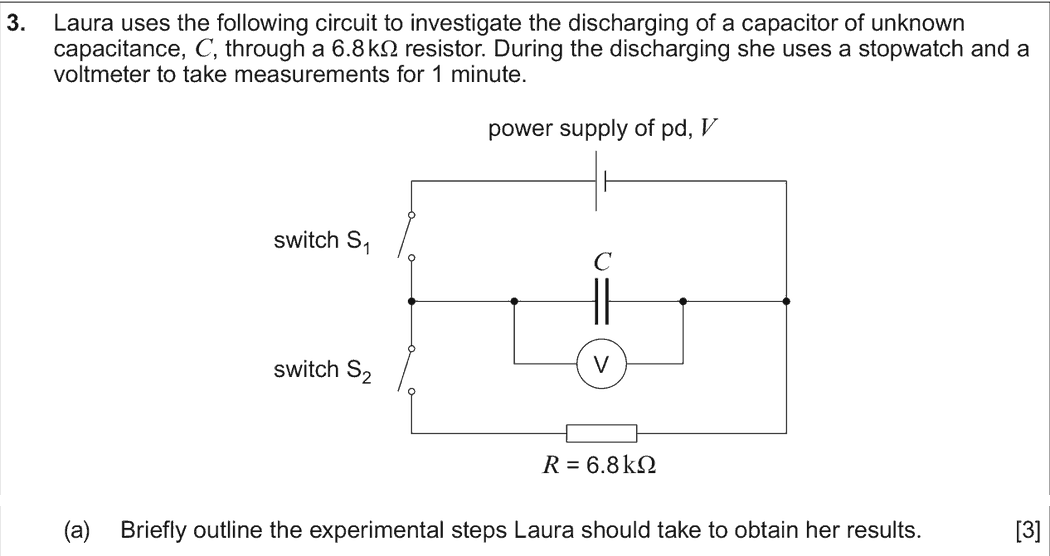
3. Laura uses the following circuit to investigate the discharging of a capacitor of unknown capacitance, C, through a 6.8 kΩ resistor. During the discharging she uses a stopwatch and a voltmeter to take measurements for 1 minute. power supply of pd, V switch S1 C switch S2 V R = 6.8 kΩ (a) Briefly outline the experimental steps Laura should take to obtain her results. [3]
June 2023 · Component 2 · Q3(b) 2 marks AO2=2 Practical and data analysis capacitance
Earlier part of question 3 that this part usesEarlier part of June 2023 Component 2 question 3
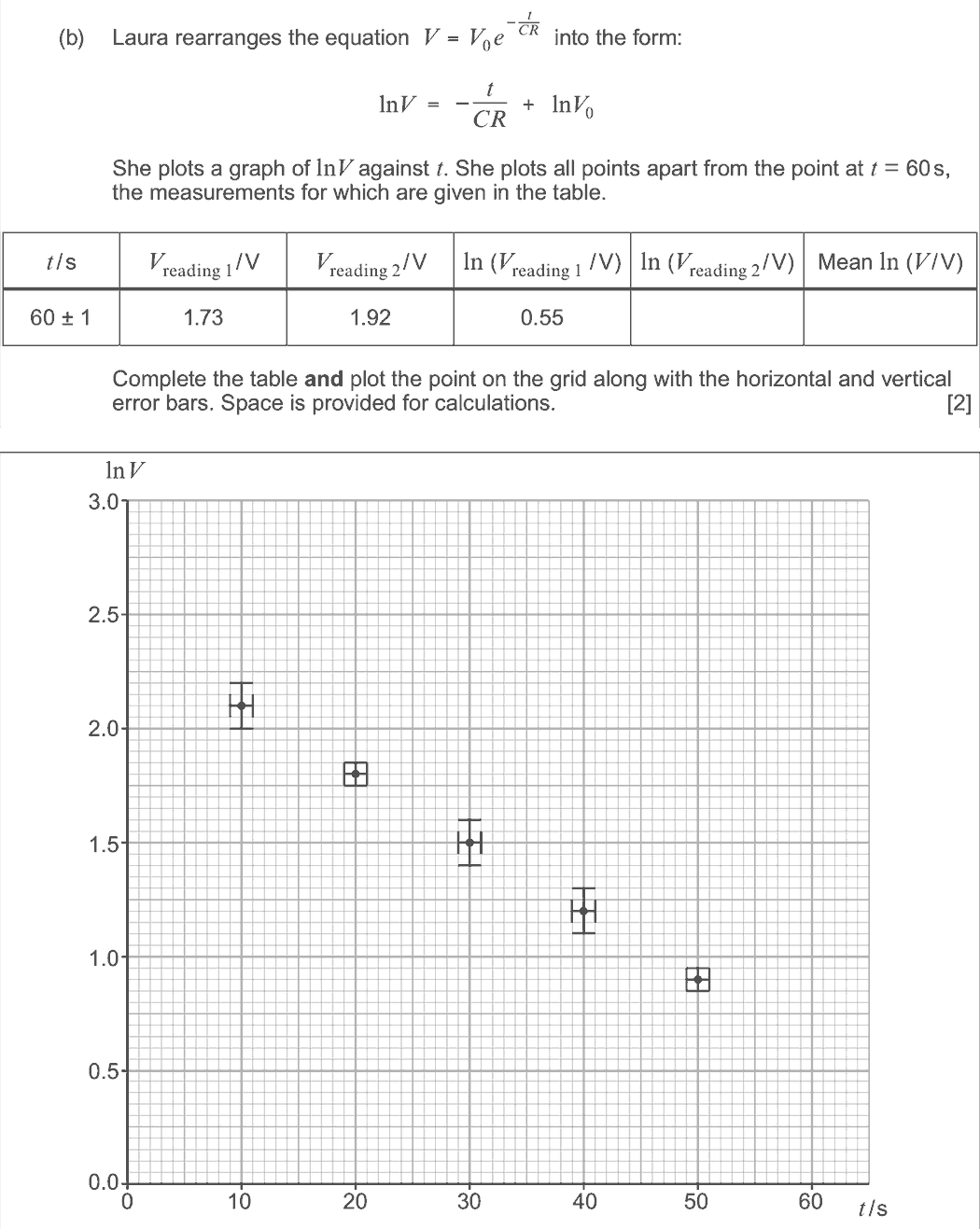
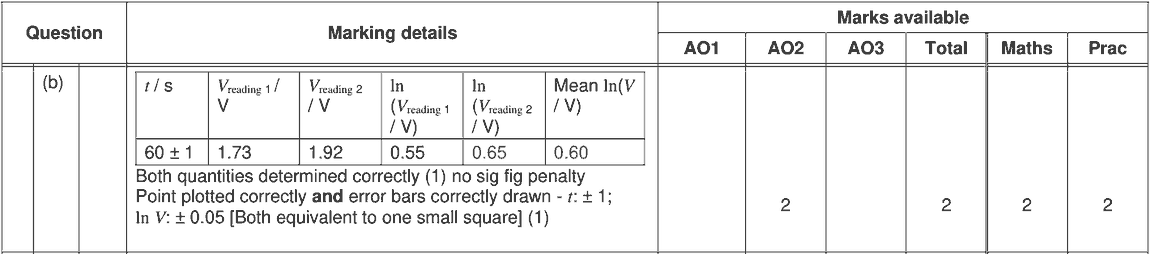
– t (b) Laura rearranges the equation V = V0 e CR into the form: t lnV = –CR + lnV0 She plots a graph of lnV against t. She plots all points apart from the point at t = 60 s, the measurements for which are given in the table. t / s Vreading 1 / V Vreading 2 / V ln (Vreading / V) ln (Vreading 2 / V) Mean ln (V / V) 1 60 ± 1 1.73 1.92 0.55 Complete the table and plot the point on the grid along with the horizontal and vertical error bars. Space is provided for calculations. [2] lnV 3.0 2.5 2.0 1.5 1.0 0.5 0.0 0 10 20 30 40 50 60 t / s
June 2023 · Component 2 · Q3(c)(i) 3 marks AO2=3 Practical and data analysis capacitance
Earlier parts of question 3 that this part usesEarlier part of June 2023 Component 2 question 3Earlier part of June 2023 Component 2 question 3
(c) (i) Draw lines of maximum and minimum gradients and determine the gradients of both lines. [3]
June 2023 · Component 2 · Q3(c)(ii) 2 marks AO2=2 Practical and data analysis capacitance
Earlier parts of question 3 that this part usesEarlier part of June 2023 Component 2 question 3Earlier part of June 2023 Component 2 question 3Earlier part of June 2023 Component 2 question 3
(ii) Hence calculate the mean gradient and the percentage uncertainty in its value. [2]
June 2023 · Component 2 · Q3(d)(i) 5 marks AO3=5 Practical and data analysis capacitance
Earlier parts of question 3 that this part usesEarlier part of June 2023 Component 2 question 3Earlier part of June 2023 Component 2 question 3
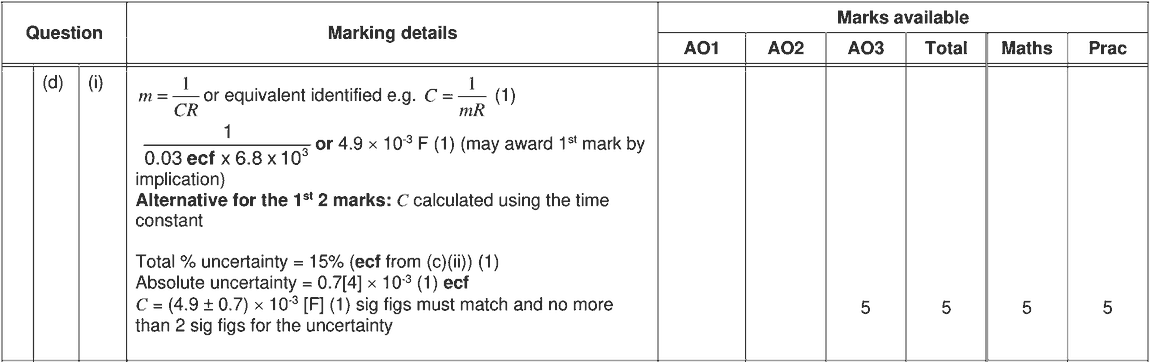
(d) (i) Determine a value for the capacitance, C, of the capacitor along with its absolute uncertainty. Assume that the resistor has a tolerance (uncertainty) of 5%. Give your answer to an appropriate number of significant figures. [5]
June 2023 · Component 2 · Q3(d)(ii) 2 marks AO3=2 Practical and data analysis capacitance
Earlier parts of question 3 that this part usesEarlier part of June 2023 Component 2 question 3Earlier part of June 2023 Component 2 question 3Earlier part of June 2023 Component 2 question 3
(ii) Determine the pd, V, of the power supply along with the absolute uncertainty in its value. [2]
June 2023 · Component 2 · Q4(a)(i) 1 mark AO2=1 Diagram or graph solids under stress
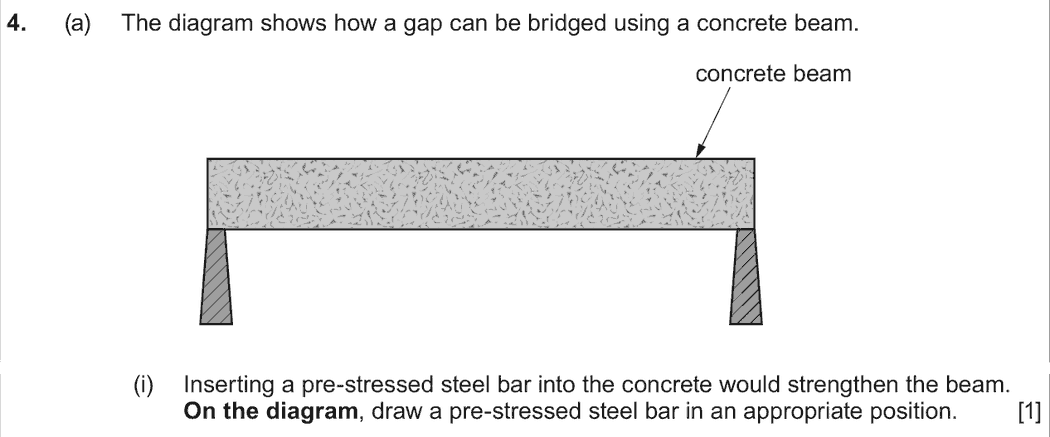
4. (a) The diagram shows how a gap can be bridged using a concrete beam. concrete beam (i) Inserting a pre-stressed steel bar into the concrete would strengthen the beam. On the diagram, draw a pre-stressed steel bar in an appropriate position. [1]
June 2023 · Component 2 · Q4(a)(ii) 2 marks AO1=2 Explanation solids under stress
Earlier part of question 4 that this part usesEarlier part of June 2023 Component 2 question 4
(ii) Explain how the steel bar strengthens the beam. [2] (σ )
June 2023 · Component 2 · Q4(b)(i) 1 mark AO2=1 Short answer solids under stress
Earlier part of question 4 that this part usesEarlier part of June 2023 Component 2 question 4
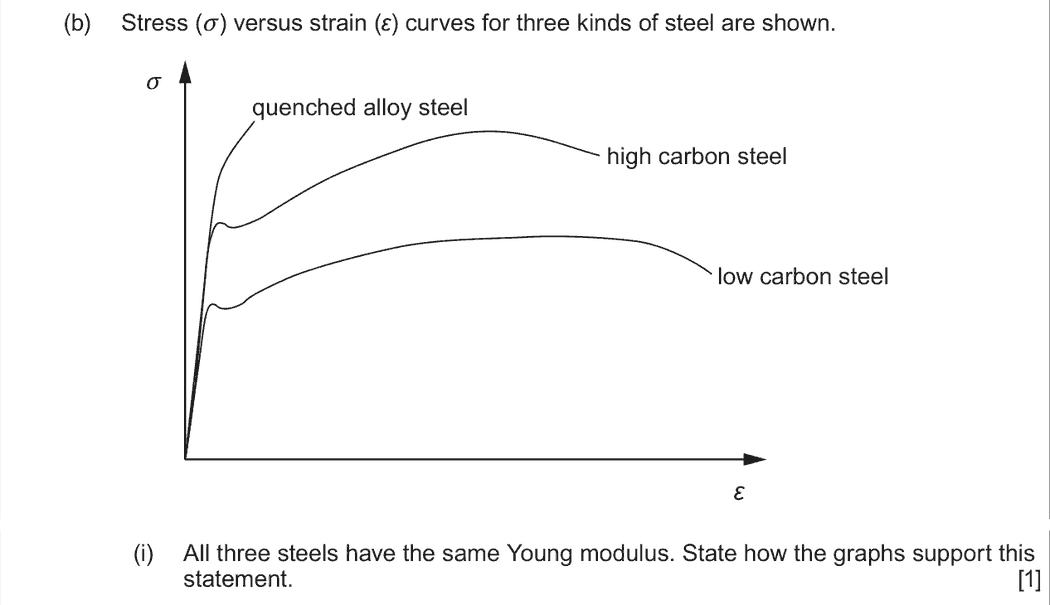
(b) Stress σ versus strain (ε) curves for three kinds of steel are shown. quenched alloy steel high carbon steel low carbon steel ε (i) All three steels have the same Young modulus. State how the graphs support this statement. [1]
June 2023 · Component 2 · Q4(b)(ii) 3 marks AO1=2, AO2=1 Explanation solids under stress
Earlier parts of question 4 that this part usesEarlier part of June 2023 Component 2 question 4Earlier part of June 2023 Component 2 question 4
(ii) Compare the physical properties of high carbon steel with low carbon steel and explain these properties in terms of their molecular structure. [3]
June 2023 · Component 2 · Q4(c)(i) 4 marks AO1=1, AO2=3 Show that solids under stressbasic physics
Earlier parts of question 4 that this part usesEarlier part of June 2023 Component 2 question 4Earlier part of June 2023 Component 2 question 4
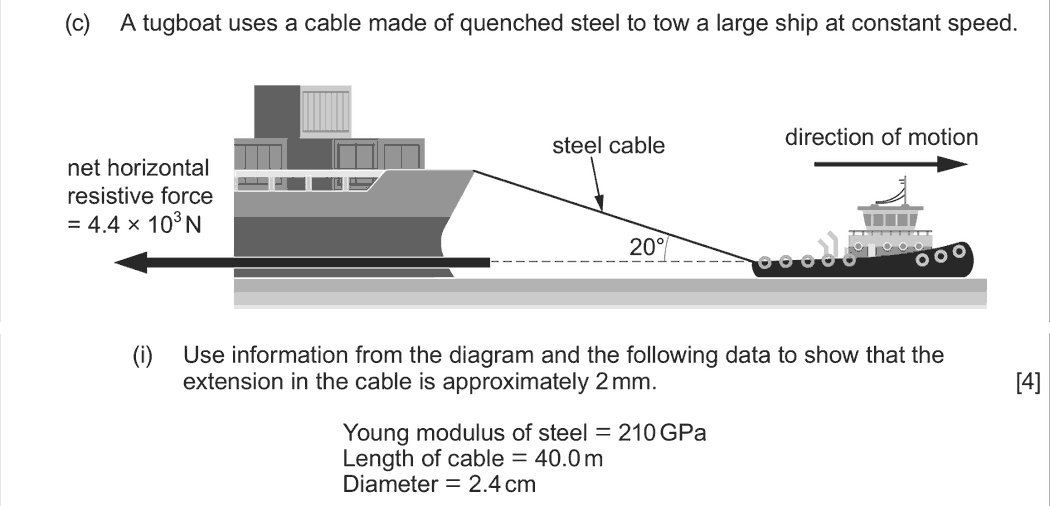
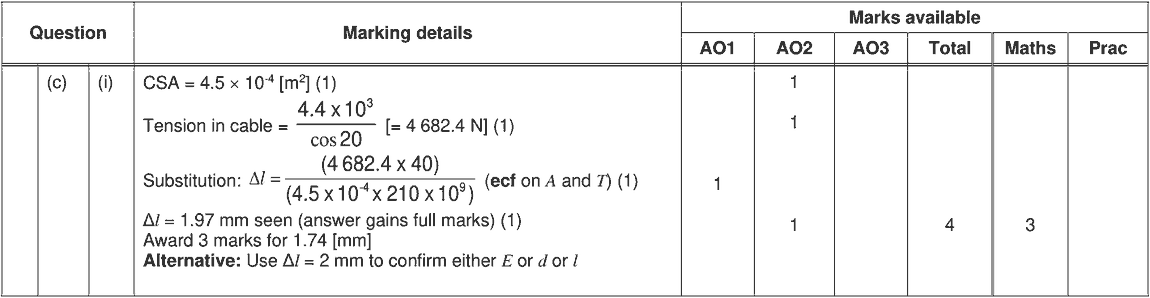
(c) A tugboat uses a cable made of quenched steel to tow a large ship at constant speed. direction of motion steel cable net horizontal resistive force = 4.4 × 10³ N 20° (i) Use information from the diagram and the following data to show that the extension in the cable is approximately 2 mm. [4] Young modulus of steel = 210 GPa Length of cable = 40.0 m Diameter = 2.4 cm
June 2023 · Component 2 · Q4(c)(ii) 2 marks AO1=1, AO2=1 Calculation solids under stress
Earlier parts of question 4 that this part usesEarlier part of June 2023 Component 2 question 4Earlier part of June 2023 Component 2 question 4Earlier part of June 2023 Component 2 question 4
(ii) Calculate the energy stored in the extended cable. [2]
June 2023 · Component 2 · Q4(c)(iii) 2 marks AO3=2 Explanation solids under stress
Earlier parts of question 4 that this part usesEarlier part of June 2023 Component 2 question 4Earlier part of June 2023 Component 2 question 4Earlier part of June 2023 Component 2 question 4
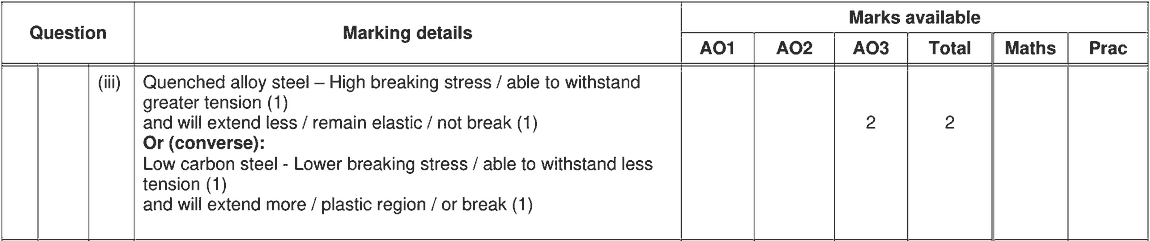
(iii) The tugboat operator decides to replace the quenched steel cable with a cable made from low carbon steel of the same length and diameter. Using the graphs in part (b) as guides, suggest why this may be a mistake. (No further calculations are required.) [2]
June 2023 · Component 2 · Q5(a) 6 marks AO1=3, AO2=3 6-mark extended response electrostatic and gravitational fields
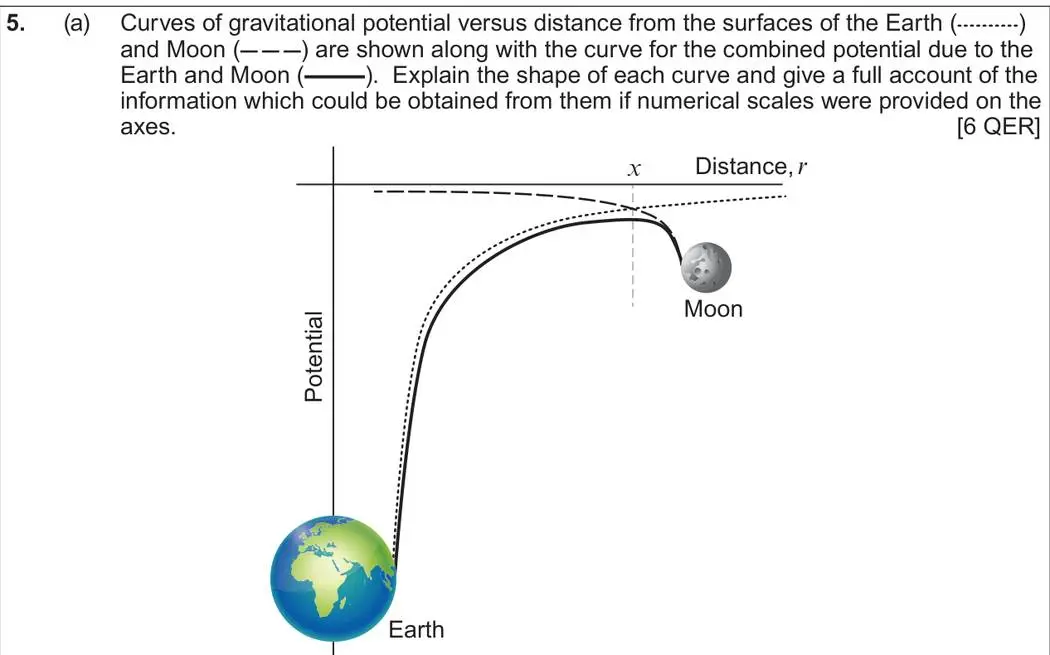
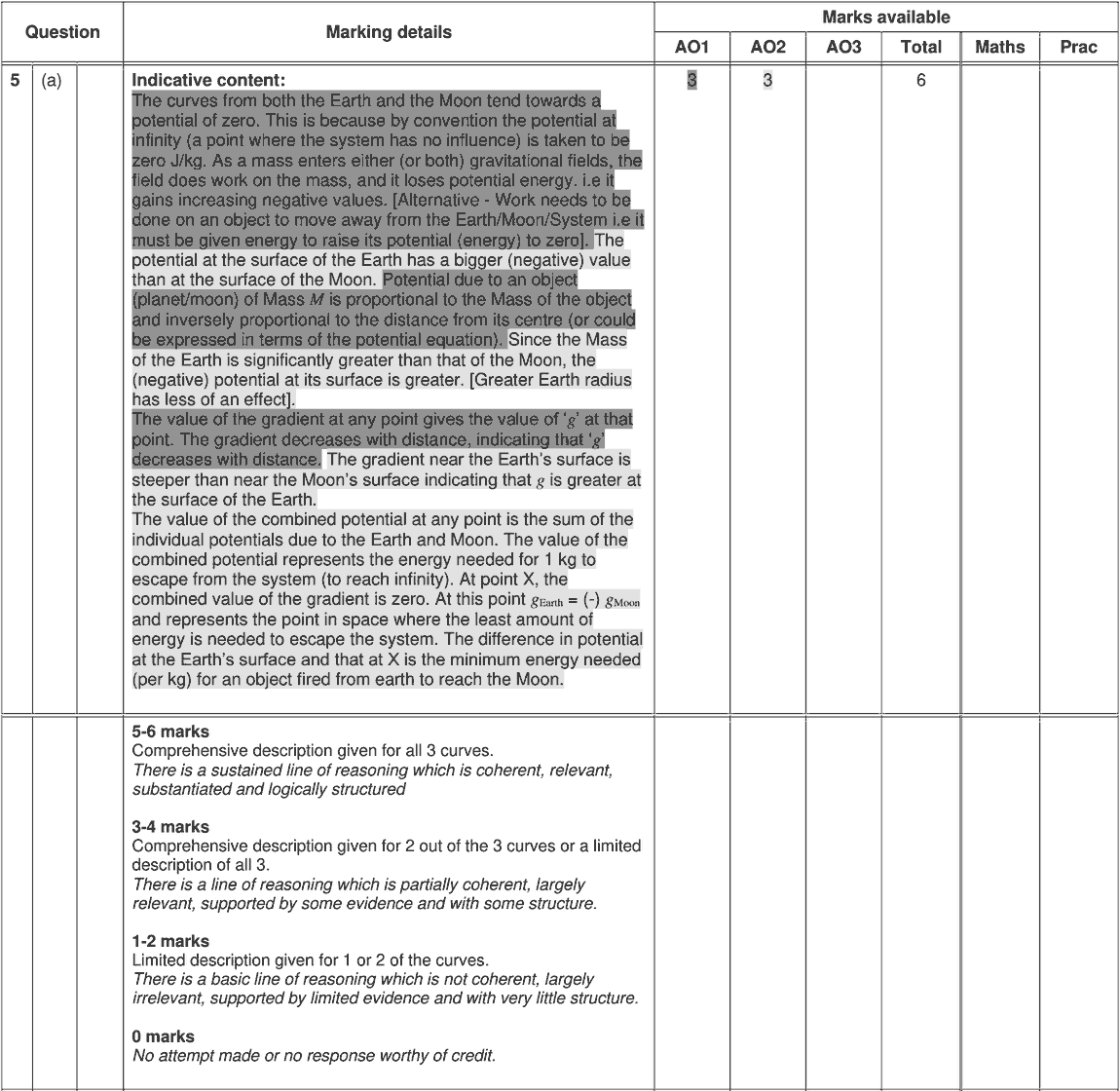
5. (a) Curves of gravitational potential versus distance from the surfaces of the Earth ( ) and Moon ( ) are shown along with the curve for the combined potential due to the Earth and Moon ( ). Explain the shape of each curve and give a full account of the information which could be obtained from them if numerical scales were provided on the axes. [6 QER] x Distance, r Moon Potential Earth
June 2023 · Component 2 · Q5(b)(i) 4 marks AO1=1, AO2=3 Calculation electrostatic and gravitational fieldsenergy concepts
Earlier part of question 5 that this part usesEarlier part of June 2023 Component 2 question 5
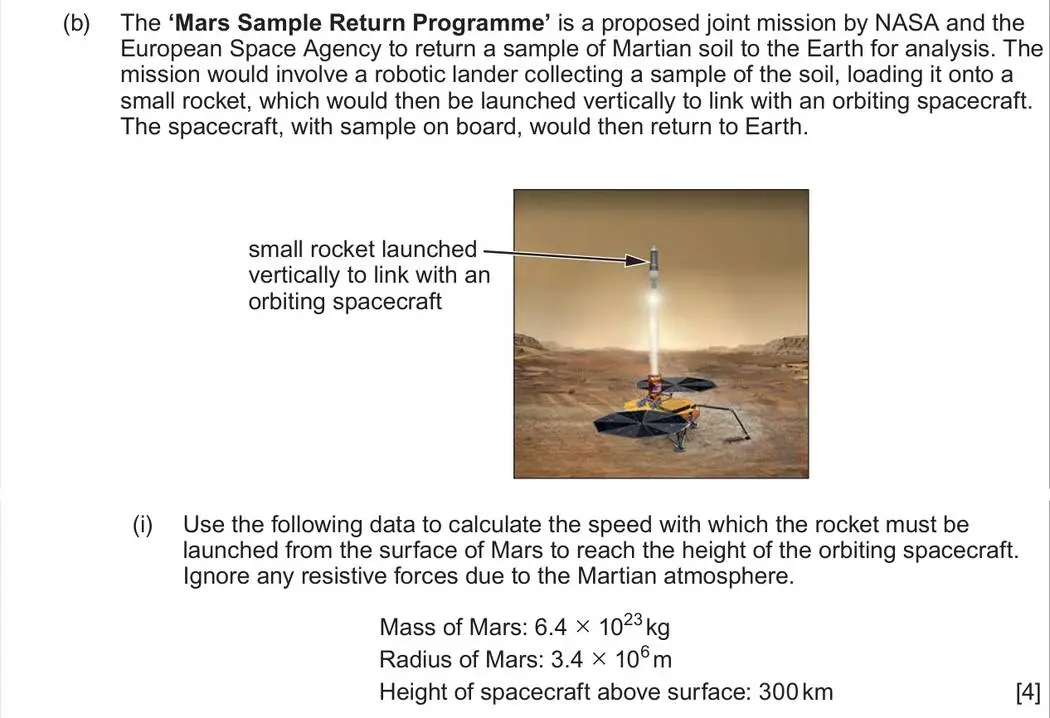
(b) The ‘Mars Sample Return Programme’ is a proposed joint mission by NASA and the European Space Agency to return a sample of Martian soil to the Earth for analysis. The mission would involve a robotic lander collecting a sample of the soil, loading it onto a small rocket, which would then be launched vertically to link with an orbiting spacecraft. The spacecraft, with sample on board, would then return to Earth. small rocket launched vertically to link with an orbiting spacecraft (i) Use the following data to calculate the speed with which the rocket must be launched from the surface of Mars to reach the height of the orbiting spacecraft. Ignore any resistive forces due to the Martian atmosphere. Mass of Mars: 6.4 × 10²³ kg Radius of Mars: 3.4 × 10⁶ m Height of spacecraft above surface: 300 km [4]

June 2023 · Component 2 · Q5(b)(ii) 3 marks AO1=1, AO2=2 Show that orbits and the wider universecircular motion
Earlier parts of question 5 that this part usesEarlier part of June 2023 Component 2 question 5Earlier part of June 2023 Component 2 question 5


(ii) When the rocket has reached a height of 300 km, it is given a sideways thrust so that it can ‘catch up’ with the orbiting spacecraft. This is illustrated below. Show that the orbital speed, v, of the rocket must be approximately 3500 m s–1 or greater for it to successfully catch up and link with the spacecraft. [3] rocket v orbiting 300 km spacecraft Mars Mars Diagram not drawn to scale
June 2023 · Component 2 · Q6(a) 5 marks AO1=1, AO2=4 Calculation electrostatic and gravitational fields
6. Point P is the centre of a circle of radius 0.3 m. Charges are placed as shown. – 2 nC – 4 nC +8 nC P +3 nC (a) Calculate the magnitude and direction of the resultant electric field strength at P. [5]
June 2023 · Component 2 · Q6(b) 3 marks AO1=1, AO2=2 Calculation electrostatic and gravitational fields
Earlier part of question 6 that this part usesEarlier part of June 2023 Component 2 question 6
(b) Calculate the potential at P. [3]
June 2023 · Component 2 · Q6(c) 3 marks AO3=3 Calculation electrostatic and gravitational fields
Earlier part of question 6 that this part usesEarlier part of June 2023 Component 2 question 6
(c) An electron released from rest from a point where the potential is +50 V follows a path that takes it through point P. John calculates that, at P, the electron’s speed is nearly 2% of the speed of light. Determine whether he is correct. [3]
June 2023 · Component 2 · Q7(a) 2 marks AO1=1, AO2=1 Diagram or graph orbits and the wider universeradiation and stars
7. (a) Part of the line absorption spectrum for light from the Sun is shown. 500 nm 520 nm increasing wavelength 500 nm 520 nm increasing wavelength A star, similar to our Sun, is detected in a nearby galaxy which is moving away from the Earth. Sketch a possible spectrum for this star in the blank spectrum provided above. [2]
June 2023 · Component 2 · Q7(b)(i) 2 marks AO1=1, AO2=1 Calculation radiation and stars
Earlier part of question 7 that this part usesEarlier part of June 2023 Component 2 question 7
(b) Cepheid variables are types of stars that ‘pulsate’ regularly, varying in luminosity, diameter and temperature as they change. At a particular time, one such star has a diameter of 6.3 × 10¹⁰ m and a surface temperature of 6000 K. (i) Calculate the wavelength at which the greatest spectral intensity is emitted by the star and state in which part of the electromagnetic spectrum this wavelength lies. [2]
June 2023 · Component 2 · Q7(b)(ii) 2 marks AO1=1, AO2=1 Calculation radiation and stars
Earlier parts of question 7 that this part usesEarlier part of June 2023 Component 2 question 7Earlier part of June 2023 Component 2 question 7
(ii) Calculate the star’s luminosity. [2]
June 2023 · Component 2 · Q7(c) 3 marks AO3=3 Show that radiation and stars
Earlier part of question 7 that this part usesEarlier part of June 2023 Component 2 question 7
(c) During the evolution of a star, its diameter doubles and its luminosity increases by a factor of three. Show that this change decreases the temperature by less than 10%. [3]
June 2023 · Component 2 · Q8(a)(i) 4 marks AO1=4 Show that orbits and the wider universe
8. (a) (i) Use the Principle of Conservation of Energy to show that the critical density, ρc, of the universe is given by: [4] 3H0 2 cρ = 8 π G
June 2023 · Component 2 · Q8(a)(ii) 3 marks AO3=3 Calculation orbits and the wider universe
Earlier part of question 8 that this part usesEarlier part of June 2023 Component 2 question 8
(ii) The critical density of the universe corresponds to about 5 atoms of hydrogen per m3. Evaluate whether this agrees with the value of the Hubble constant given in the Data Booklet. [3]
June 2023 · Component 2 · Q8(b)(i) 2 marks AO1=1, AO2=1 Show that orbits and the wider universe
Earlier part of question 8 that this part usesEarlier part of June 2023 Component 2 question 8
(b) The Comet galaxy is 3.2 × 10⁹ light years from Earth. (i) Show that the galaxy is receding at approximately 65 000 km s–1. [2] (1 light year = 9.5 × 10¹² km)
June 2023 · Component 2 · Q8(b)(ii) 3 marks AO2=3 Calculation orbits and the wider universe
Earlier parts of question 8 that this part usesEarlier part of June 2023 Component 2 question 8Earlier part of June 2023 Component 2 question 8
(ii) One of the lines in the hydrogen spectrum has a wavelength of 656.3 nm when measured in a laboratory on Earth. Calculate the wavelength of the same line in the observed spectrum of the Comet galaxy. [3]
June 2023 · Component 2 · Q8(c) 2 marks AO1=1, AO2=1 Explanation radiation and stars
Earlier part of question 8 that this part usesEarlier part of June 2023 Component 2 question 8
(c) The Hubble space telescope can detect a portion of the infra-red and ultraviolet spectrum, as well as the visible spectrum. It has been used to study the Comet galaxy. Explain why it is more useful to use the Hubble telescope than to attempt to study the galaxy using telescopes sensitive only to visible light. [2]

Work with an Eduqas physics tutor

Want a paper marked and gone through with you? Message us.

Prefer email? Send an enquiry

If you are under 18, please include a parent's contact details. Enquiries go to enquiries@physicsaleveltutor.com and are deleted once handled. All tutoring is online.