
June 2025: Component 1

100 marks · 36 question parts · Paper, mark scheme and report on Eduqas's site · Have the Data Booklet beside you

Question by question

QTopicMarksAOType
1(a) Basic physics: units, vectors and moments 2AO2=2Calculation
1(b) Kinematics 2AO1=2Short answer
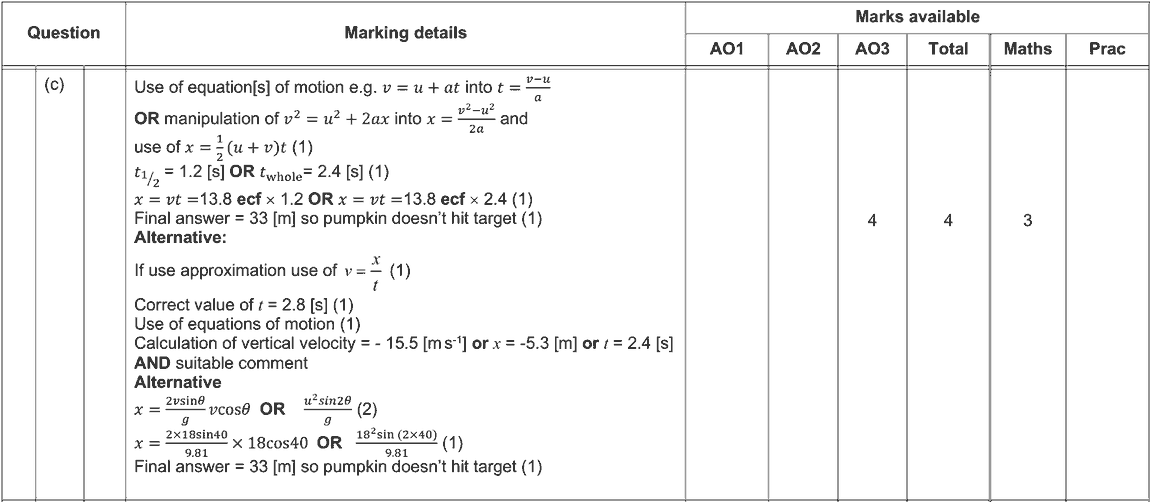
1(c) Kinematics 4AO3=4Calculation
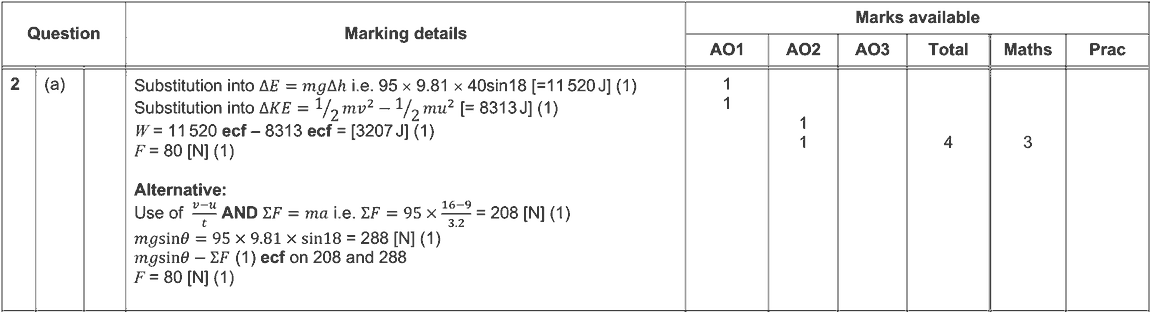
2(a) Energy concepts 4AO1=2,AO2=2Calculation
2(b)(i) Dynamics: forces and momentum 1AO1=1Definition
2(b)(ii) Dynamics: forces and momentum 2AO1=2Definition
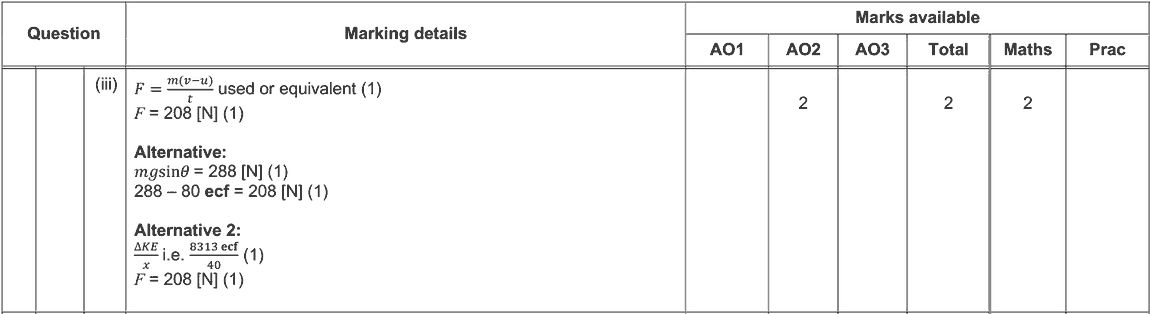
2(b)(iii) Dynamics: forces and momentum 2AO2=2Calculation
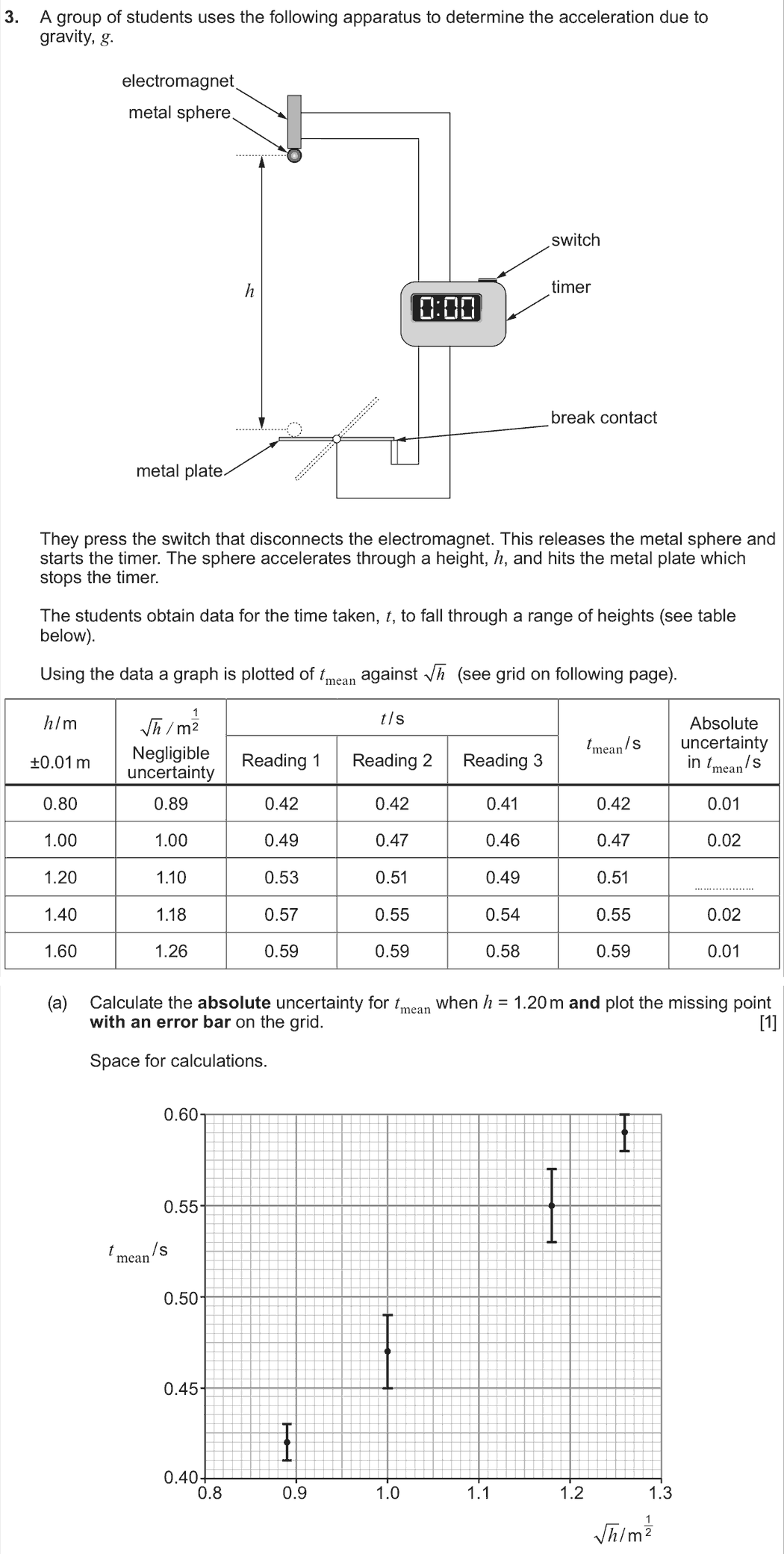
3(a) Kinematics 1AO2=1Practical and data analysis
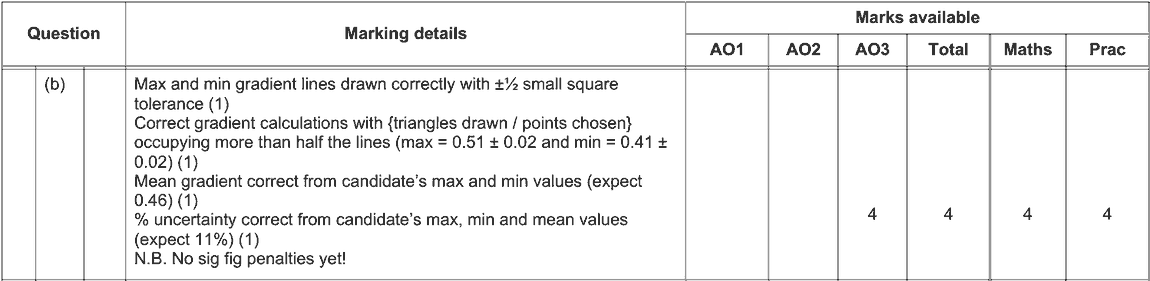
3(b) Kinematics 4AO3=4Practical and data analysis
3(c) Kinematics 3AO1=1,AO2=2Show that
3(d) Kinematics 4AO3=4Practical and data analysis
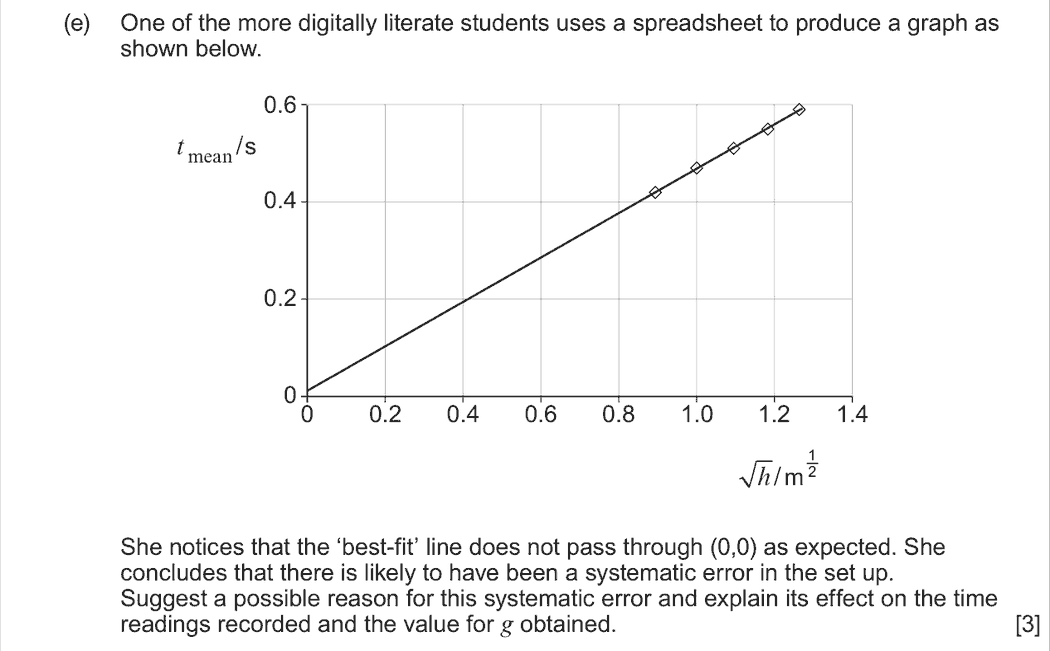
3(e) Kinematics 3AO3=3Practical and data analysis
4(a) Circular motion 1AO1=1Definition
4(b)(i) Circular motion 2AO2=2Show that
4(b)(ii) Circular motion 3AO1=2,AO2=1Calculation
4(c) Circular motion 2AO3=2Explanation
4(d) Vibrations: simple harmonic motion 6AO1=4,AO2=2Extended response
5(a)(i) Vibrations: simple harmonic motion 3AO1=2,AO2=1Diagram or graph
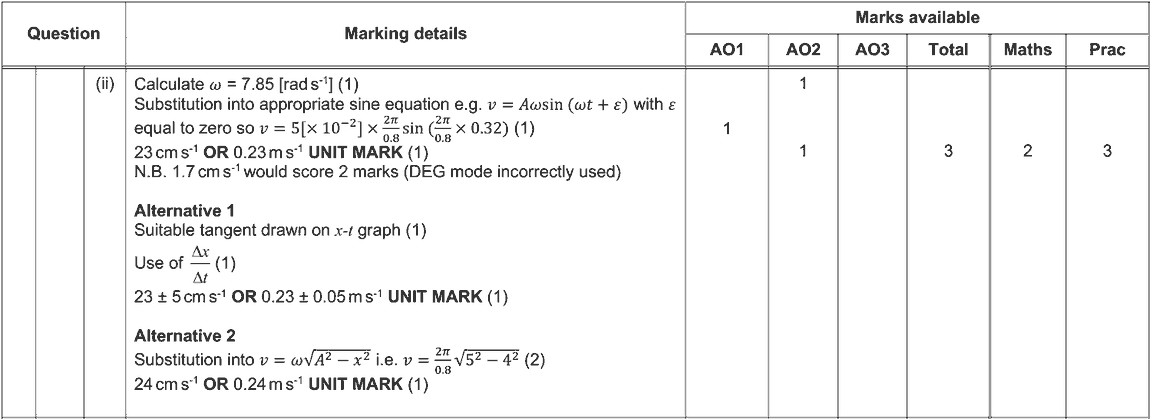
5(a)(ii) Vibrations: simple harmonic motion 3AO1=1,AO2=2Calculation
5(b)(i) Basic physics: units, vectors and moments 3AO1=2,AO2=1Show that
5(b)(ii) Vibrations: simple harmonic motion 2AO2=2Calculation
5(c)(i) Electrostatic and gravitational fields of force 2AO1=1,AO2=1Calculation
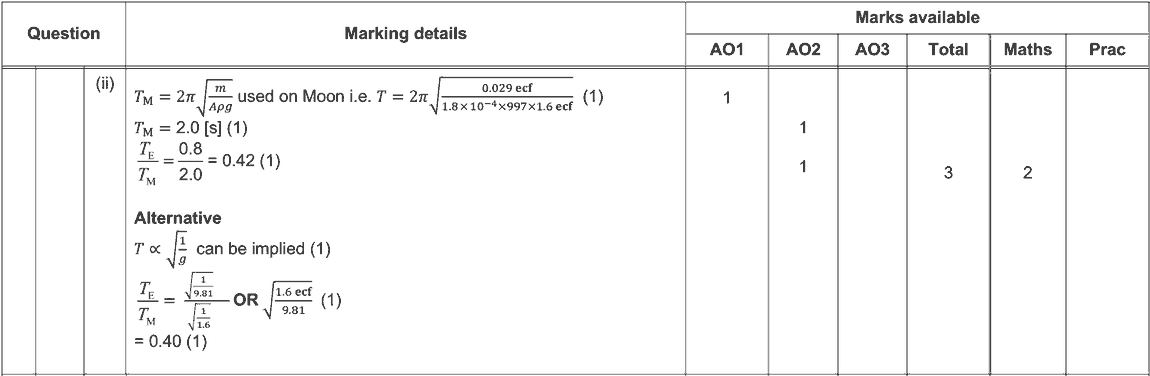
5(c)(ii) Vibrations: simple harmonic motion 3AO1=1,AO2=2Calculation
6(a) Kinetic theory 2AO2=2Calculation
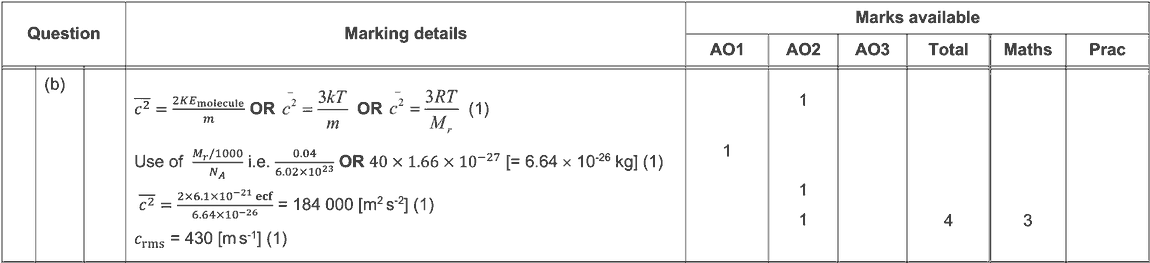
6(b) Kinetic theory 4AO1=1,AO2=3Calculation
6(c) Kinetic theory 3AO2=3Explanation
7(a) Thermal physics 3AO1=3Explanation
7(b) Thermal physics 4AO1=1,AO2=3Calculation
7(c) Thermal physics 2AO3=2Short answer
8(a) Nuclear energy, Comprehension: the Component 1 article questions 4AO2=4Show that
8(b) Electrostatic and gravitational fields of force, Comprehension: the Component 1 article questions 3AO3=3Calculation
8(c) Kinetic theory, Comprehension: the Component 1 article questions 3AO1=1,AO2=2Calculation
8(d) Energy concepts, Comprehension: the Component 1 article questions 3AO1=1,AO2=2Calculation
8(e) Dynamics: forces and momentum, Comprehension: the Component 1 article questions 2AO2=2Explanation
8(f) Energy concepts, Comprehension: the Component 1 article questions 2AO1=1,AO2=1Calculation
8(g) Energy concepts, Lasers, Comprehension: the Component 1 article questions 3AO3=3Calculation

The questions

1(a)1(b)1(c)2(a)2(b)(i)2(b)(ii)2(b)(iii)3(a)3(b)3(c)3(d)3(e)4(a)4(b)(i)4(b)(ii)4(c)4(d)5(a)(i)5(a)(ii)5(b)(i)5(b)(ii)5(c)(i)5(c)(ii)6(a)6(b)6(c)7(a)7(b)7(c)8(a)8(b)8(c)8(d)8(e)8(f)8(g)
June 2025 · Component 1 · Q1(a) 2 marks AO2=2 Calculation basic physics
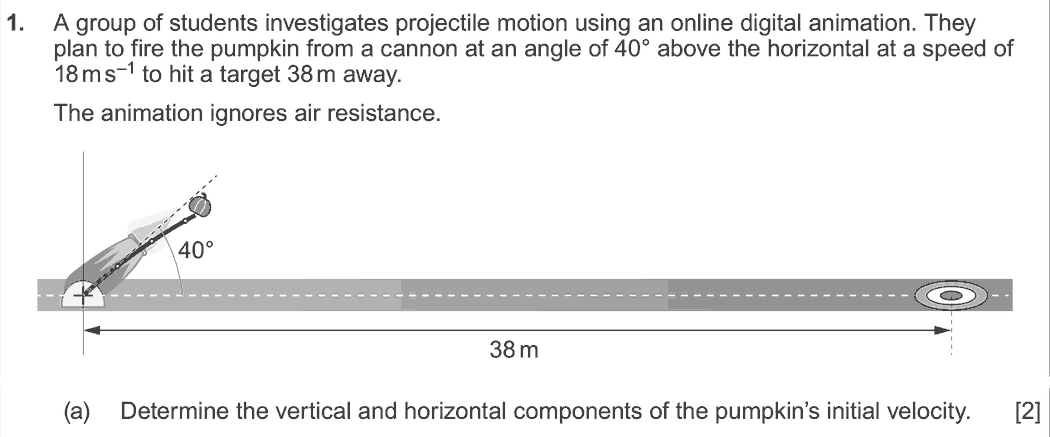
1. A group of students investigates projectile motion using an online digital animation. They plan to fire the pumpkin from a cannon at an angle of 40° above the horizontal at a speed of 18 m s–1 to hit a target 38 m away. The animation ignores air resistance. 40° 38 m (a) Determine the vertical and horizontal components of the pumpkin’s initial velocity. [2]
June 2025 · Component 1 · Q1(b) 2 marks AO1=2 Short answer kinematics
Earlier part of question 1 that this part usesEarlier part of June 2025 Component 1 question 1
(b) Describe the vertical and horizontal motion of the pumpkin during its flight. [2]
June 2025 · Component 1 · Q1(c) 4 marks AO3=4 Calculation kinematics
Earlier part of question 1 that this part usesEarlier part of June 2025 Component 1 question 1
(c) Evaluate whether the pumpkin hits the target. Show your reasoning. [4]
June 2025 · Component 1 · Q2(a) 4 marks AO1=2, AO2=2 Calculation energy concepts
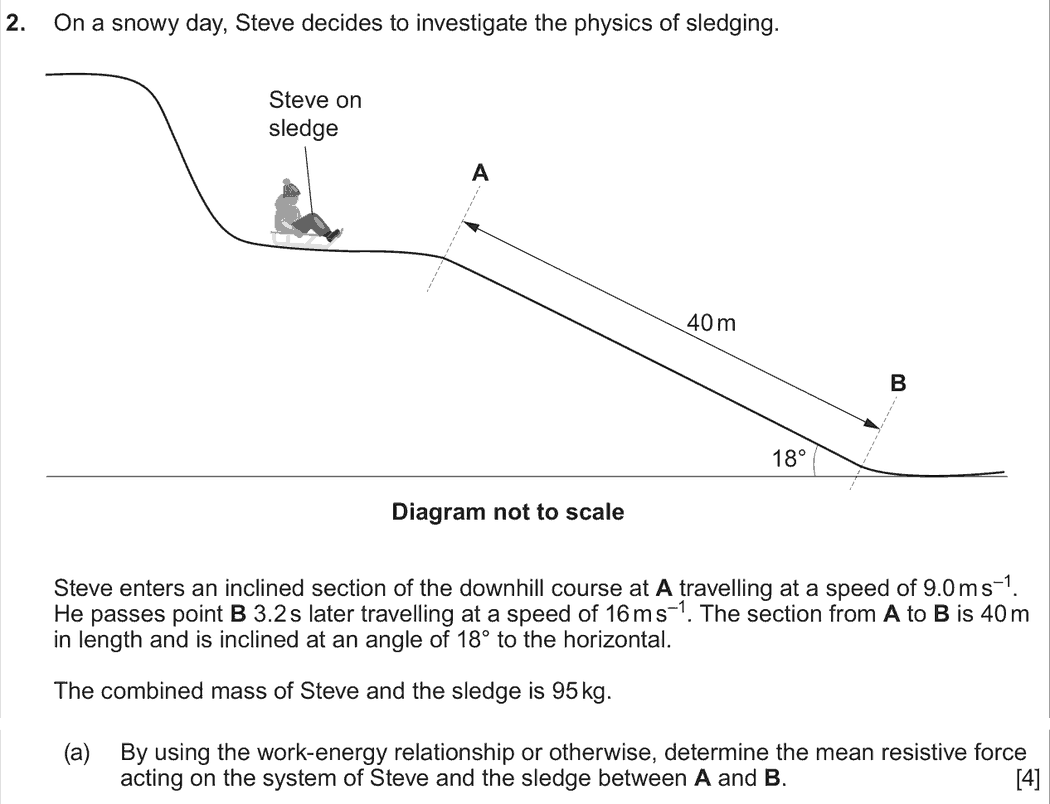
2. On a snowy day, Steve decides to investigate the physics of sledging. Steve on sledge A 40 m B 18° Diagram not to scale Steve enters an inclined section of the downhill course at A travelling at a speed of 9.0 m s–1. He passes point B 3.2 s later travelling at a speed of 16 m s–1. The section from A to B is 40 m in length and is inclined at an angle of 18° to the horizontal. The combined mass of Steve and the sledge is 95 kg. (a) By using the work-energy relationship or otherwise, determine the mean resistive force acting on the system of Steve and the sledge between A and B. [4]
June 2025 · Component 1 · Q2(b)(i) 1 mark AO1=1 Definition dynamics
Earlier part of question 2 that this part usesEarlier part of June 2025 Component 1 question 2
(b) (i) Define linear momentum. [1]
June 2025 · Component 1 · Q2(b)(ii) 2 marks AO1=2 Definition dynamics
Earlier parts of question 2 that this part usesEarlier part of June 2025 Component 1 question 2Earlier part of June 2025 Component 1 question 2
(ii) State Newton’s second law in terms of momentum. [2]
June 2025 · Component 1 · Q2(b)(iii) 2 marks AO2=2 Calculation dynamics
Earlier parts of question 2 that this part usesEarlier part of June 2025 Component 1 question 2Earlier part of June 2025 Component 1 question 2
(iii) Determine the mean resultant force acting on the system of Steve and the sledge between A and B. [2]
June 2025 · Component 1 · Q3(a) 1 mark AO2=1 Practical and data analysis kinematics
3. A group of students uses the following apparatus to determine the acceleration due to gravity, g. electromagnet metal sphere switch h timer break contact metal plate They press the switch that disconnects the electromagnet. This releases the metal sphere and starts the timer. The sphere accelerates through a height, h, and hits the metal plate which stops the timer. The students obtain data for the time taken, t, to fall through a range of heights (see table below). Using the data a graph is plotted of tmean against h (see grid on following page). 1 t / s h / m h / m Absolute 2 tmean / s uncertainty Negligible ±0.01 m Reading 1 Reading 2 Reading 3 in tmean / s uncertainty 0.80 0.89 0.42 0.42 0.41 0.42 0.01 1.00 1.00 0.49 0.47 0.46 0.47 0.02 1.20 1.10 0.53 0.51 0.49 0.51 ……… 1.40 1.18 0.57 0.55 0.54 0.55 0.02 1.60 1.26 0.59 0.59 0.58 0.59 0.01 (a) Calculate the absolute uncertainty for tmean when h = 1.20 m and plot the missing point with an error bar on the grid. [1] Space for calculations. 0.60 0.55 t / s mean 0.50 0.45 0.40 0.8 0.9 1.0 1.1 1.2 1.3 1 h / m 2
June 2025 · Component 1 · Q3(b) 4 marks AO3=4 Practical and data analysis kinematics
Earlier part of question 3 that this part usesEarlier part of June 2025 Component 1 question 3
(b) Draw lines of maximum and minimum gradient and determine the mean gradient along with its percentage uncertainty. [4]
June 2025 · Component 1 · Q3(c) 3 marks AO1=1, AO2=2 Show that kinematics
Earlier part of question 3 that this part usesEarlier part of June 2025 Component 1 question 3
(c) Use a suitable equation of motion for constant acceleration to show, in clear steps, that: 2h t  [3] g
June 2025 · Component 1 · Q3(d) 4 marks AO3=4 Practical and data analysis kinematics
Earlier part of question 3 that this part usesEarlier part of June 2025 Component 1 question 3
(d) Use your answer from (b) to calculate a value of g along with its absolute uncertainty. State your answers to a suitable number of significant figures. [4]
June 2025 · Component 1 · Q3(e) 3 marks AO3=3 Practical and data analysis kinematics
Earlier part of question 3 that this part usesEarlier part of June 2025 Component 1 question 3
(e) One of the more digitally literate students uses a spreadsheet to produce a graph as shown below. 0.6 t / s mean 0.4 0.2 0 0 0.2 0.4 0.6 0.8 1.0 1.2 1.4 1 h / m 2 She notices that the ‘best-fit’ line does not pass through (0,0) as expected. She concludes that there is likely to have been a systematic error in the set up. Suggest a possible reason for this systematic error and explain its effect on the time readings recorded and the value for g obtained. [3]
June 2025 · Component 1 · Q4(a) 1 mark AO1=1 Definition circular motion
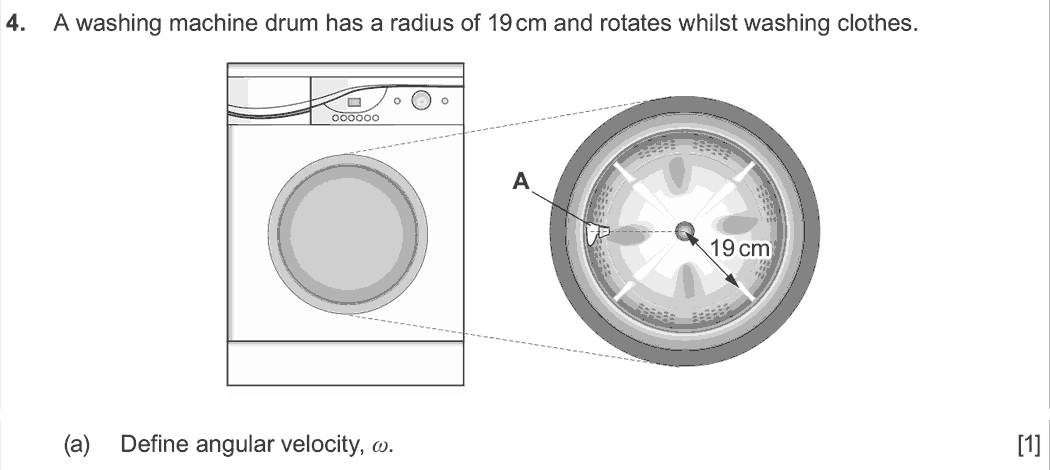
4. A washing machine drum has a radius of 19 cm and rotates whilst washing clothes. A 19 19 cm cm (a) Define angular velocity, ω. [1]
June 2025 · Component 1 · Q4(b)(i) 2 marks AO2=2 Show that circular motion
Earlier part of question 4 that this part usesEarlier part of June 2025 Component 1 question 4
(b) During part of the washing cycle, the drum rotates at 1400 revolutions per minute. (i) Show that the angular velocity of the drum is approximately 150 rad s–1. [2]
June 2025 · Component 1 · Q4(b)(ii) 3 marks AO1=2, AO2=1 Calculation circular motion
Earlier parts of question 4 that this part usesEarlier part of June 2025 Component 1 question 4Earlier part of June 2025 Component 1 question 4
(ii) A wet sock has a mass of 0.15 kg and rotates in contact with the drum. Determine the magnitude of the centripetal force on the sock and state its direction. [3]
June 2025 · Component 1 · Q4(c) 2 marks AO3=2 Explanation circular motion
Earlier part of question 4 that this part usesEarlier part of June 2025 Component 1 question 4
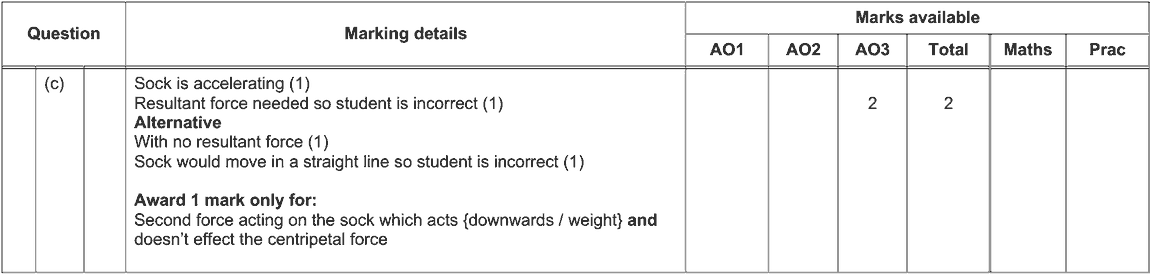
(c) A student considers the forces acting on the wet sock at position A. The student states, “There is a second force, acting outwards on the sock, to balance the centripetal force.” Explain whether the student is correct. [2]
June 2025 · Component 1 · Q4(d) 6 marks AO1=4, AO2=2 6-mark extended response vibrations
Earlier part of question 4 that this part usesEarlier part of June 2025 Component 1 question 4
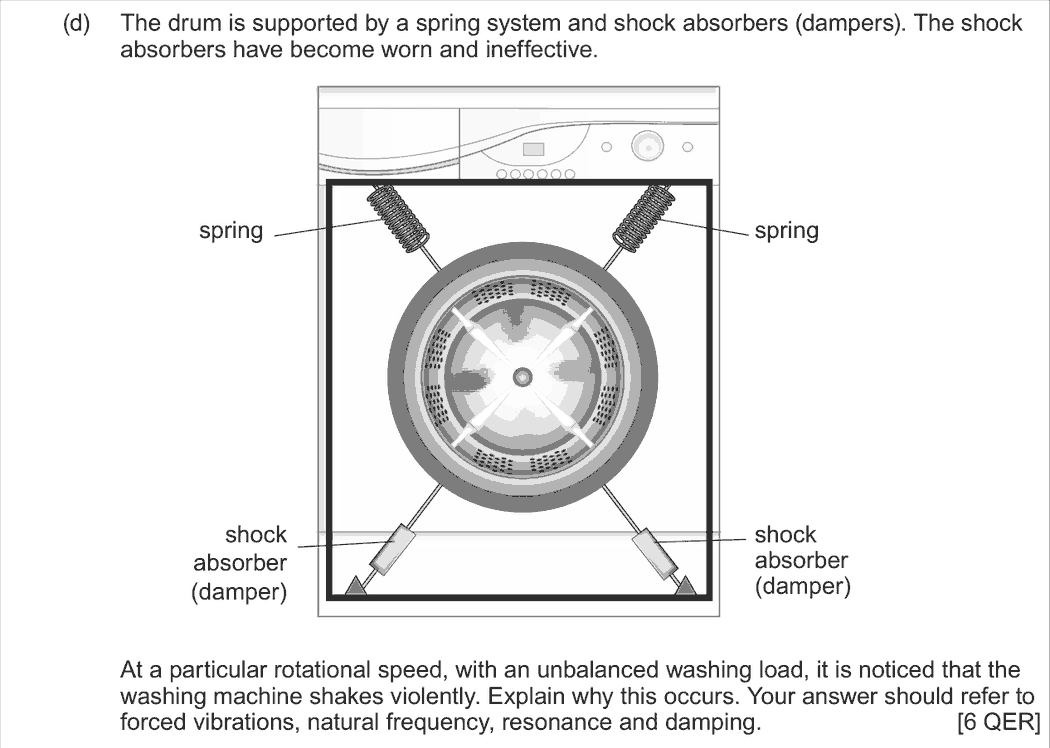
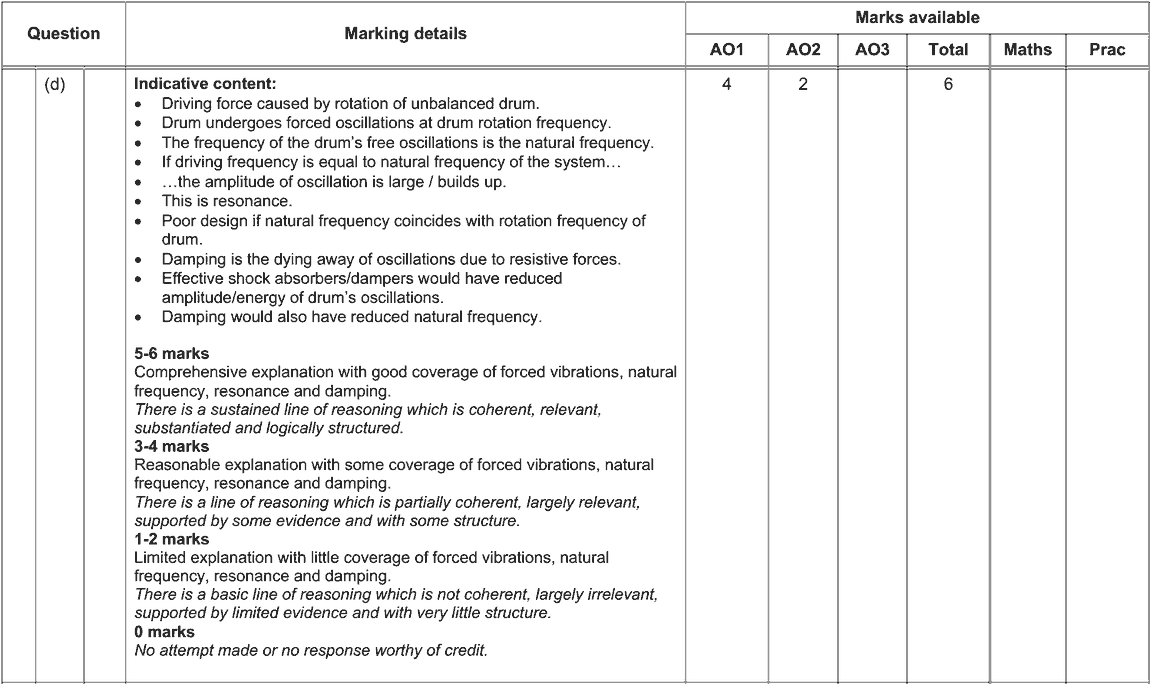
(d) The drum is supported by a spring system and shock absorbers (dampers). The shock absorbers have become worn and ineffective. spring spring shock shock absorber absorber (damper) (damper) At a particular rotational speed, with an unbalanced washing load, it is noticed that the washing machine shakes violently. Explain why this occurs. Your answer should refer to forced vibrations, natural frequency, resonance and damping. [6 QER]
June 2025 · Component 1 · Q5(a)(i) 3 marks AO1=2, AO2=1 Diagram or graph vibrations
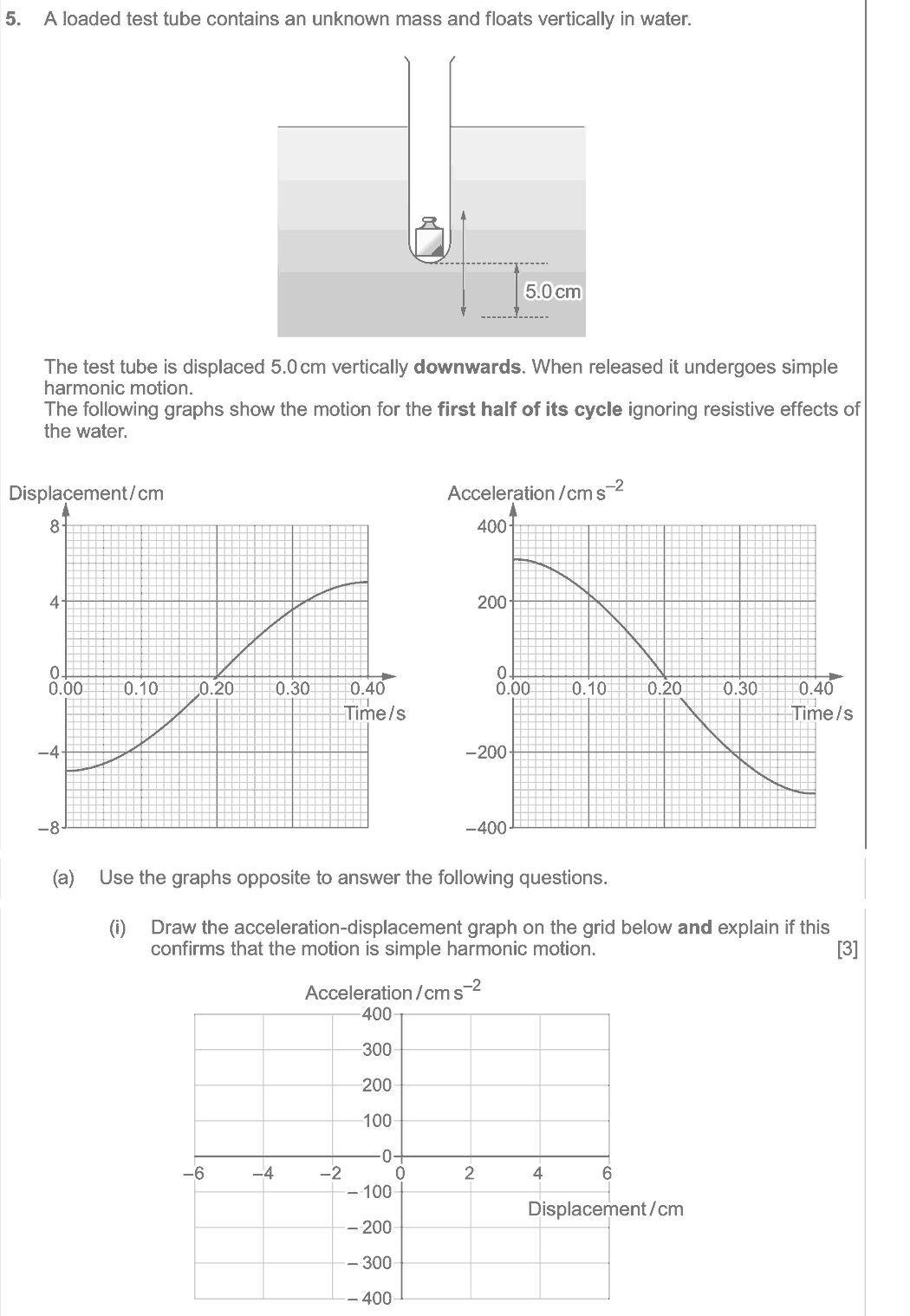
5. A loaded test tube contains an unknown mass and floats vertically in water. 5.0 5.0 cm cm The test tube is displaced 5.0 cm vertically downwards. When released it undergoes simple harmonic motion. The following graphs show the motion for the first half of its cycle ignoring resistive effects of the water. Displacement / cm Acceleration / cm s–2 8 400 4 200 0 0 0.00 0.10 0.20 0.30 0.40 0.00 0.10 0.20 0.30 0.40 Time Time / / s s Time Time / / s s – 4 – 200 – 8 – 400 (a) Use the graphs opposite to answer the following questions. (i) Draw the acceleration-displacement graph on the grid below and explain if this confirms that the motion is simple harmonic motion. [3] Acceleration / cm s–2 400 400 300 300 200 200 100 100 0 0 – – 6 6 – – 4 4 – – 2 2 0 0 2 2 4 4 6 6 – – 100 100 Displacement Displacement / / cm cm – – 200 200 – – 300 300 – – 400 400
June 2025 · Component 1 · Q5(a)(ii) 3 marks AO1=1, AO2=2 Calculation vibrations
Earlier part of question 5 that this part usesEarlier part of June 2025 Component 1 question 5
(ii) Calculate the velocity of the test tube 0.32 s after its release. [3]
June 2025 · Component 1 · Q5(b)(i) 3 marks AO1=2, AO2=1 Show that basic physics
Earlier part of question 5 that this part usesEarlier part of June 2025 Component 1 question 5
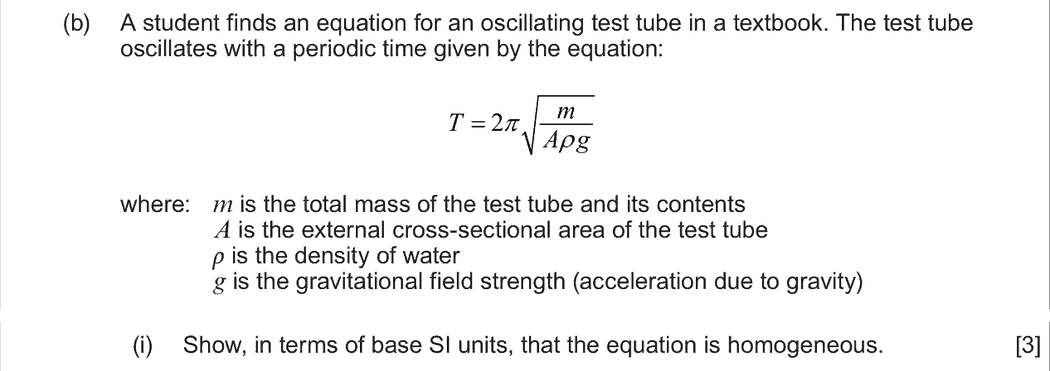
(b) A student finds an equation for an oscillating test tube in a textbook. The test tube oscillates with a periodic time given by the equation: m T  2 A  g where: m is the total mass of the test tube and its contents A is the external cross-sectional area of the test tube ρ is the density of water g is the gravitational field strength (acceleration due to gravity) (i) Show, in terms of base SI units, that the equation is homogeneous. [3]
June 2025 · Component 1 · Q5(b)(ii) 2 marks AO2=2 Calculation vibrations
Earlier parts of question 5 that this part usesEarlier part of June 2025 Component 1 question 5Earlier part of June 2025 Component 1 question 5
(ii) The test tube has a cross-sectional area of 1.8 × 10⁻⁴ m2 and the density of water is 997 kg m–3. Determine the mass of the loaded test tube. [2]
June 2025 · Component 1 · Q5(c)(i) 2 marks AO1=1, AO2=1 Calculation electrostatic and gravitational fields
Earlier part of question 5 that this part usesEarlier part of June 2025 Component 1 question 5
(c) In the future, the same experiment is planned to be repeated inside a lunar base. (i) Determine the gravitational field strength on the surface of the Moon. [2] Mass of Moon, MM = 7.4 × 10²² kg and radius of Moon, RM = 1740 km
June 2025 · Component 1 · Q5(c)(ii) 3 marks AO1=1, AO2=2 Calculation vibrations
Earlier parts of question 5 that this part usesEarlier part of June 2025 Component 1 question 5Earlier part of June 2025 Component 1 question 5
T (ii) Determine the ratio E for the loaded test tube where TE is its periodic time on T M Earth and TM is its periodic time on the Moon. [3]
June 2025 · Component 1 · Q6(a) 2 marks AO2=2 Calculation kinetic theory
6. The relative molecular mass of argon is 40. (a) Calculate the mean kinetic energy of argon molecules at a temperature of 20 °C. [2]
June 2025 · Component 1 · Q6(b) 4 marks AO1=1, AO2=3 Calculation kinetic theory
Earlier part of question 6 that this part usesEarlier part of June 2025 Component 1 question 6
(b) Determine the root mean square (rms) speed of argon molecules at this temperature. [4]
June 2025 · Component 1 · Q6(c) 3 marks AO2=3 Explanation kinetic theory
Earlier part of question 6 that this part usesEarlier part of June 2025 Component 1 question 6
(c) Neon has a relative molecular mass of 20. Without further calculations, compare the following properties of neon with that of argon at 20 °C: • mean molecular kinetic energy • rms speed of molecules. [3]
June 2025 · Component 1 · Q7(a) 3 marks AO1=3 Explanation thermal physics
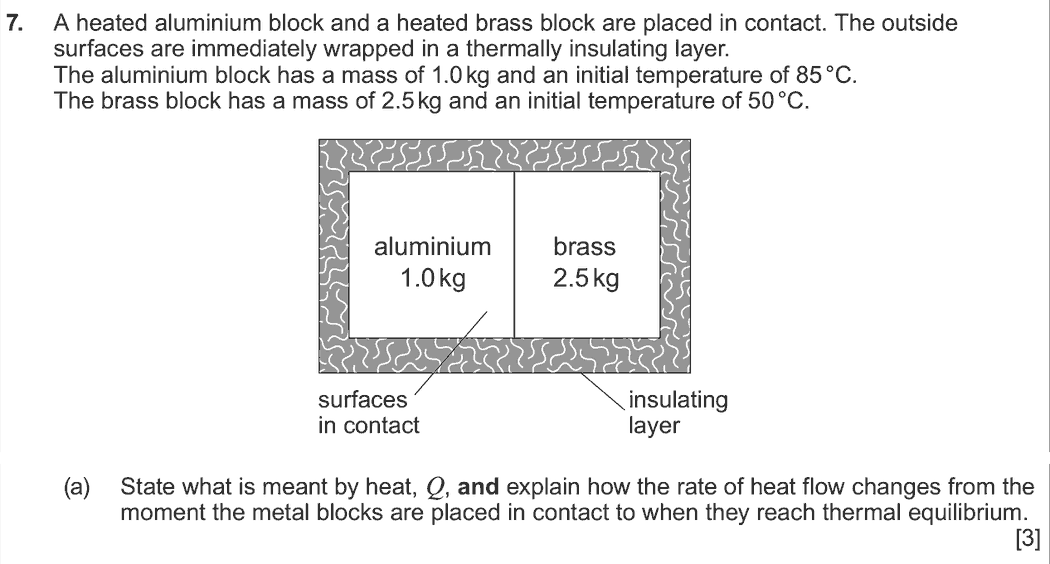
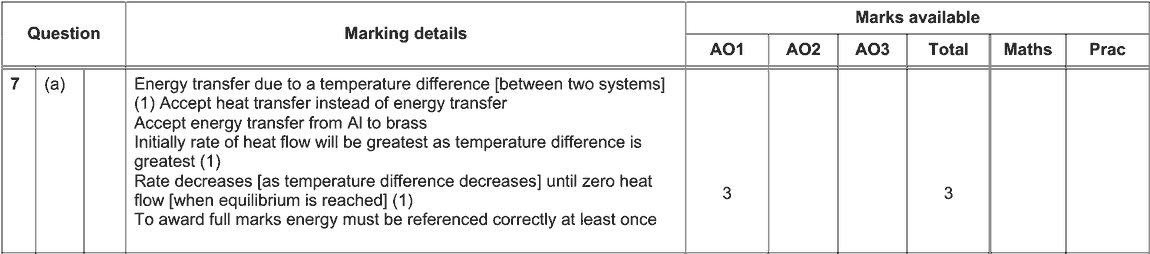
7. A heated aluminium block and a heated brass block are placed in contact. The outside surfaces are immediately wrapped in a thermally insulating layer. The aluminium block has a mass of 1.0 kg and an initial temperature of 85 °C. The brass block has a mass of 2.5 kg and an initial temperature of 50 °C. aluminium brass 1.0 kg 2.5 kg surfaces insulating in contact layer (a) State what is meant by heat, Q, and explain how the rate of heat flow changes from the moment the metal blocks are placed in contact to when they reach thermal equilibrium. [3]
June 2025 · Component 1 · Q7(b) 4 marks AO1=1, AO2=3 Calculation thermal physics
Earlier part of question 7 that this part usesEarlier part of June 2025 Component 1 question 7
(b) Determine the temperature of the blocks when they reach thermal equilibrium. [4] caluminium = 920 J kg–1 °C–1 cbrass = 400 J kg–1 °C–1
June 2025 · Component 1 · Q7(c) 2 marks AO3=2 Short answer thermal physics
Earlier part of question 7 that this part usesEarlier part of June 2025 Component 1 question 7
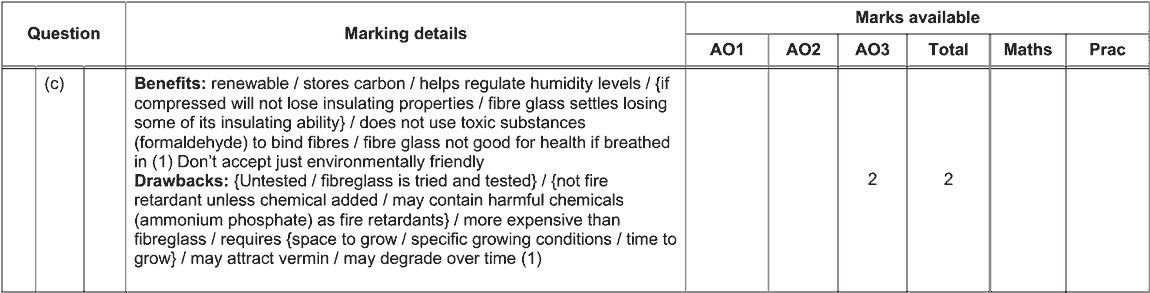
(c) The materials and construction phase of the building industry is responsible for more than 10% of all energy-related carbon emissions globally. Insulation manufacturers are trying to reduce their contributions by producing more plant-based materials. The hemp plant has a seed to maturity timescale of between 4 and 5 months and can be combined with other recycled biological materials in the production of insulation. Suggest one benefit and one drawback of plant-based insulation over the more widely used fibreglass. [2]
June 2025 · Component 1 · Q8(a) 4 marks AO2=4 Show that nuclear energycomprehension
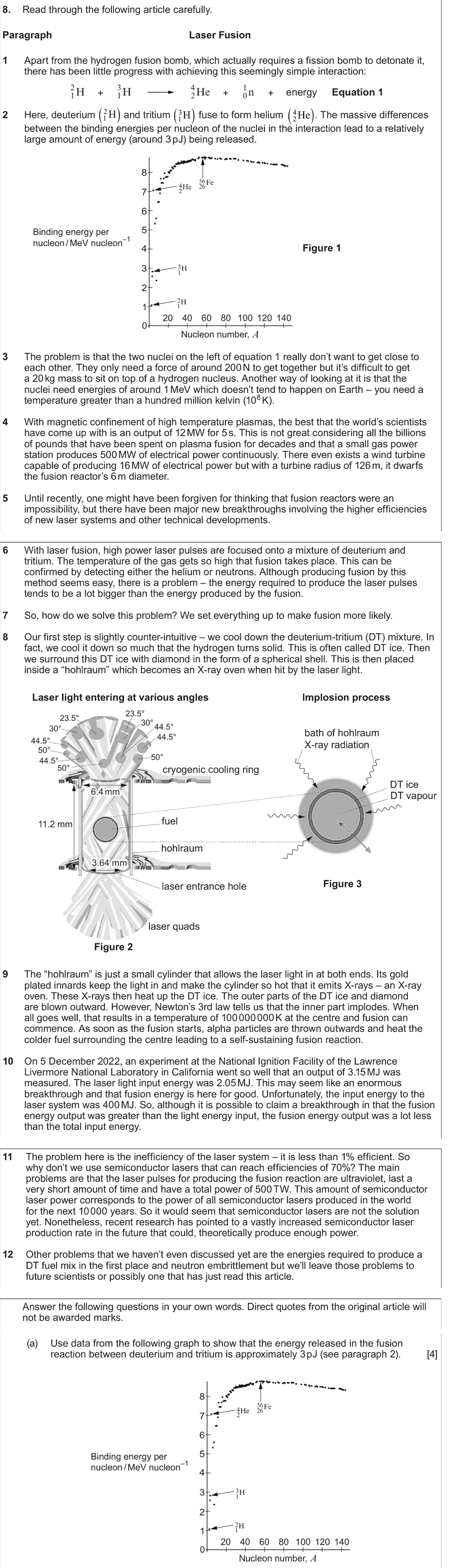
8. Read through the following article carefully. Paragraph Laser Fusion 1 Apart from the hydrogen fusion bomb, which actually requires a fission bomb to detonate it, there has been little progress with achieving this seemingly simple interaction: 2 1H 3 1H 4 2He 1 0n + + + energy Equation 1       2 Here, deuterium 2 H and tritium 1H 3 fuse to form helium 4 2He . The massive differences 1 between the binding energies per nucleon of the nuclei in the interaction lead to a relatively large amount of energy (around 3 pJ) being released. 8 56 26Fe 4 2He 7 6 Binding energy per 5 nucleon / MeV nucleon–1 4 Figure 1 3 3 1H 2 2 1H 1 20 40 60 80 100 120 140 0 Nucleon number, A 3 The problem is that the two nuclei on the left of equation 1 really don’t want to get close to each other. They only need a force of around 200 N to get together but it’s difficult to get a 20 kg mass to sit on top of a hydrogen nucleus. Another way of looking at it is that the nuclei need energies of around 1 MeV which doesn’t tend to happen on Earth – you need a temperature greater than a hundred million kelvin (108 K). 4 With magnetic confinement of high temperature plasmas, the best that the world’s scientists have come up with is an output of 12 MW for 5 s. This is not great considering all the billions of pounds that have been spent on plasma fusion for decades and that a small gas power station produces 500 MW of electrical power continuously. There even exists a wind turbine capable of producing 16 MW of electrical power but with a turbine radius of 126 m, it dwarfs the fusion reactor’s 6 m diameter. 5 Until recently, one might have been forgiven for thinking that fusion reactors were an impossibility, but there have been major new breakthroughs involving the higher efficiencies of new laser systems and other technical developments. 6 With laser fusion, high power laser pulses are focused onto a mixture of deuterium and tritium. The temperature of the gas gets so high that fusion takes place. This can be confirmed by detecting either the helium or neutrons. Although producing fusion by this method seems easy, there is a problem – the energy required to produce the laser pulses tends to be a lot bigger than the energy produced by the fusion. 7 So, how do we solve this problem? We set everything up to make fusion more likely. 8 Our first step is slightly counter-intuitive – we cool down the deuterium-tritium (DT) mixture. In fact, we cool it down so much that the hydrogen turns solid. This is often called DT ice. Then we surround this DT ice with diamond in the form of a spherical shell. This is then placed inside a “hohlraum” which becomes an X-ray oven when hit by the laser light. Laser light entering at various angles Implosion process 23.5° 23.5° 30° 30° 44.5° bath of hohlraum 44.5° 44.5° X-ray radiation 50° 50° 44.5° 50° cryogenic cooling ring DT ice 6.4 6.4 mm mm DT vapour fuel 11.2 mm hohlraum 3.64 3.64 mm mm laser entrance hole Figure 3 laser quads Figure 2 9 The “hohlraum” is just a small cylinder that allows the laser light in at both ends. Its gold plated innards keep the light in and make the cylinder so hot that it emits X-rays – an X-ray oven. These X-rays then heat up the DT ice. The outer parts of the DT ice and diamond are blown outward. However, Newton’s 3rd law tells us that the inner part implodes. When all goes well, that results in a temperature of 100 000 000 K at the centre and fusion can commence. As soon as the fusion starts, alpha particles are thrown outwards and heat the colder fuel surrounding the centre leading to a self-sustaining fusion reaction. 10 On 5 December 2022, an experiment at the National Ignition Facility of the Lawrence Livermore National Laboratory in California went so well that an output of 3.15 MJ was measured. The laser light input energy was 2.05 MJ. This may seem like an enormous breakthrough and that fusion energy is here for good. Unfortunately, the input energy to the laser system was 400 MJ. So, although it is possible to claim a breakthrough in that the fusion energy output was greater than the light energy input, the fusion energy output was a lot less than the total input energy. 11 The problem here is the inefficiency of the laser system – it is less than 1% efficient. So why don’t we use semiconductor lasers that can reach efficiencies of 70%? The main problems are that the laser pulses for producing the fusion reaction are ultraviolet, last a very short amount of time and have a total power of 500 TW. This amount of semiconductor laser power corresponds to the power of all semiconductor lasers produced in the world for the next 10 000 years. So it would seem that semiconductor lasers are not the solution yet. Nonetheless, recent research has pointed to a vastly increased semiconductor laser production rate in the future that could, theoretically produce enough power. 12 Other problems that we haven’t even discussed yet are the energies required to produce a DT fuel mix in the first place and neutron embrittlement but we’ll leave those problems to future scientists or possibly one that has just read this article. Answer the following questions in your own words. Direct quotes from the original article will not be awarded marks. (a) Use data from the following graph to show that the energy released in the fusion reaction between deuterium and tritium is approximately 3 pJ (see paragraph 2). [4] 8 56 26Fe 4 2He 7 6 Binding energy per 5 nucleon / MeV nucleon–1 4 3 3 1H 2 2 1H 1 20 40 60 80 100 120 140 0 Nucleon number, A

June 2025 · Component 1 · Q8(b) 3 marks AO3=3 Calculation electrostatic and gravitational fieldscomprehension
Earlier part of question 8 that this part usesEarlier part of June 2025 Component 1 question 8
(b) The author talks of a force of approximately 200 N between two positively charged hydrogen nuclei. Determine, with a suitable calculation, whether this corresponds to a nuclear diameter of approximately 1 fm (see paragraph 3). [3]
June 2025 · Component 1 · Q8(c) 3 marks AO1=1, AO2=2 Calculation kinetic theorycomprehension
Earlier part of question 8 that this part usesEarlier part of June 2025 Component 1 question 8
(c) Calculate the temperature when particles have a mean kinetic energy of 1 MeV. Determine whether this figure agrees with the numbers in paragraph 3. [3]
June 2025 · Component 1 · Q8(d) 3 marks AO1=1, AO2=2 Calculation energy conceptscomprehension
Earlier part of question 8 that this part usesEarlier part of June 2025 Component 1 question 8
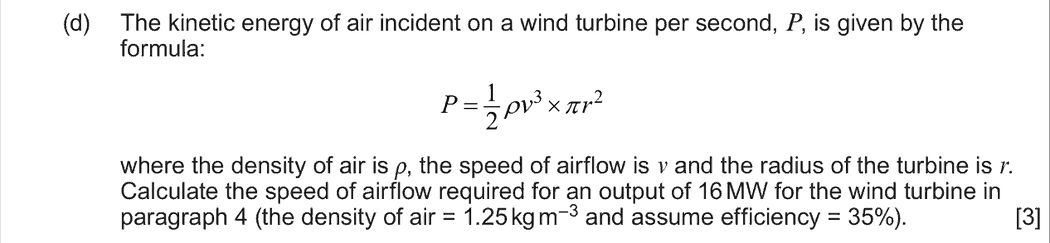
(d) The kinetic energy of air incident on a wind turbine per second, P, is given by the formula: 1 P   ν 3   r 2 2 where the density of air is ρ, the speed of airflow is v and the radius of the turbine is r. Calculate the speed of airflow required for an output of 16 MW for the wind turbine in paragraph 4 (the density of air = 1.25 kg m–3 and assume efficiency = 35%). [3]
June 2025 · Component 1 · Q8(e) 2 marks AO2=2 Explanation dynamicscomprehension
Earlier part of question 8 that this part usesEarlier part of June 2025 Component 1 question 8
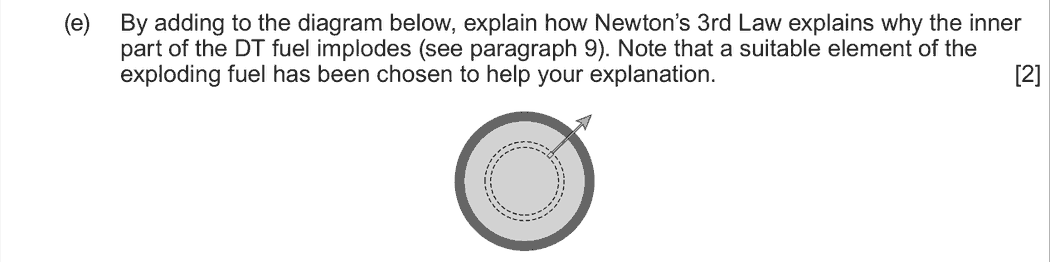
(e) By adding to the diagram below, explain how Newton’s 3rd Law explains why the inner part of the DT fuel implodes (see paragraph 9). Note that a suitable element of the exploding fuel has been chosen to help your explanation. [2]
June 2025 · Component 1 · Q8(f) 2 marks AO1=1, AO2=1 Calculation energy conceptscomprehension
Earlier part of question 8 that this part usesEarlier part of June 2025 Component 1 question 8
(f) In paragraph 11, the author states that the laser system “is less than 1% efficient”. Use figures from paragraph 10, to check this statement. [2]
June 2025 · Component 1 · Q8(g) 3 marks AO3=3 Calculation energy conceptslaserscomprehension
Earlier part of question 8 that this part usesEarlier part of June 2025 Component 1 question 8
(g) Assuming that approximately 2 billion semiconductor lasers are produced annually, each with a mean output power of 2 mW, determine whether 10 000 years is sufficient time to produce 500 TW of semiconductor laser power (see paragraph 11). [3] (1 billion = 109)

Work with an Eduqas physics tutor

Want a paper marked and gone through with you? Message us.

Prefer email? Send an enquiry

If you are under 18, please include a parent's contact details. Enquiries go to enquiries@physicsaleveltutor.com and are deleted once handled. All tutoring is online.