June 2025: Component 3

120 marks for each student (100 in Section A plus one 20-mark option; all four options are here) · 69 question parts · Paper, mark scheme and report on Eduqas's site · Have the Data Booklet beside you

Question by question

QTopicMarksAOType
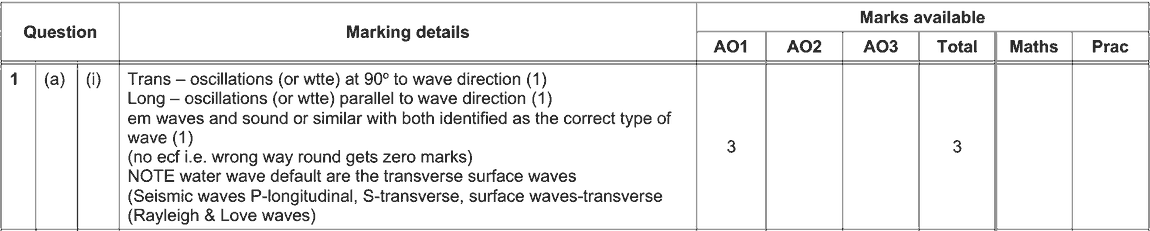
1(a)(i) The nature of waves 3AO1=3Definition
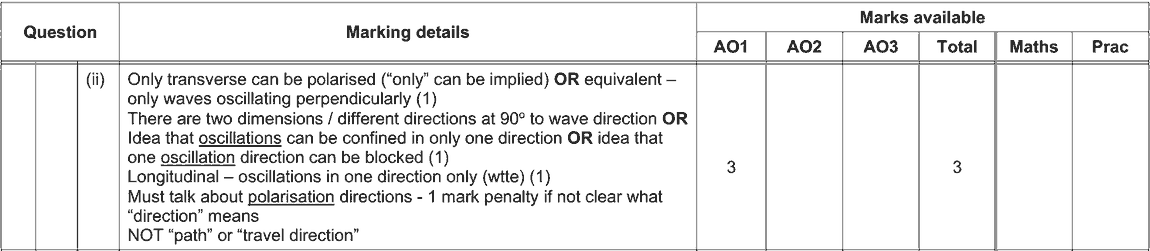
1(a)(ii) The nature of waves 3AO1=3Explanation
1(b)(i) The nature of waves 2AO2=2Calculation
1(b)(ii) The nature of waves 1AO2=1Diagram or graph
1(b)(iii) The nature of waves 1AO1=1Short answer
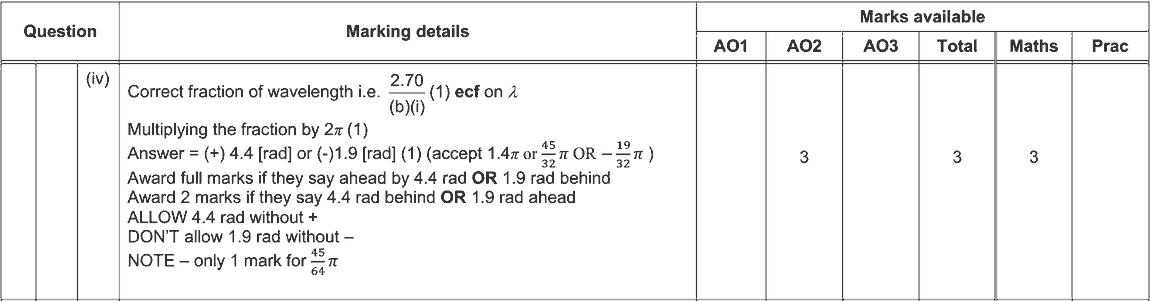
1(b)(iv) The nature of waves 3AO2=3Calculation
1(c)(i) The nature of waves, Vibrations: simple harmonic motion 3AO2=3Calculation
1(c)(ii) Vibrations: simple harmonic motion 2AO2=2Calculation
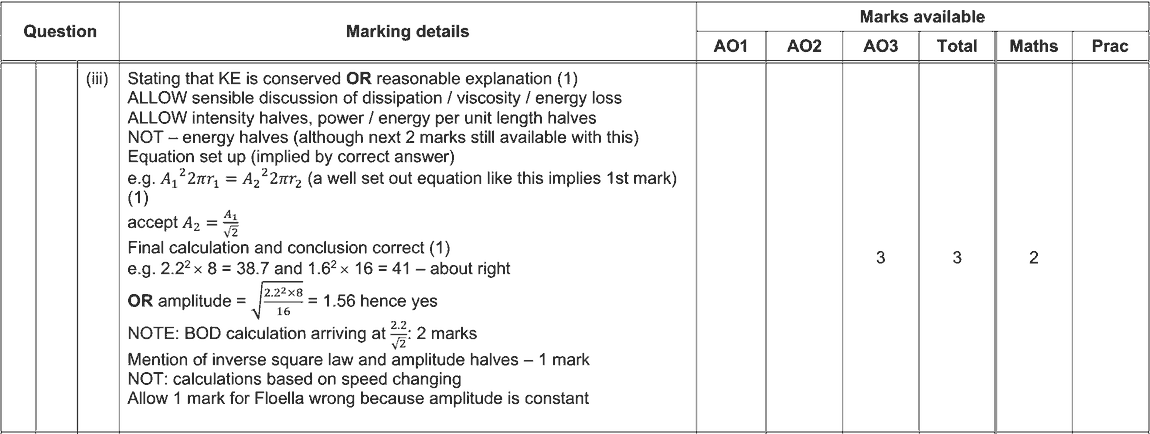
1(c)(iii) The nature of waves 3AO3=3Calculation
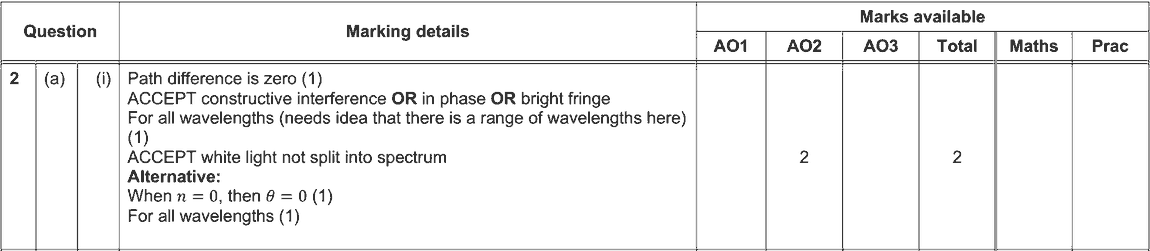
2(a)(i) Wave properties: diffraction, interference and stationary waves 2AO2=2Explanation
2(a)(ii) Wave properties: diffraction, interference and stationary waves 2AO2=2Explanation
2(b)(i) Wave properties: diffraction, interference and stationary waves 3AO2=3Calculation
2(b)(ii) Wave properties: diffraction, interference and stationary waves 3AO3=3Calculation
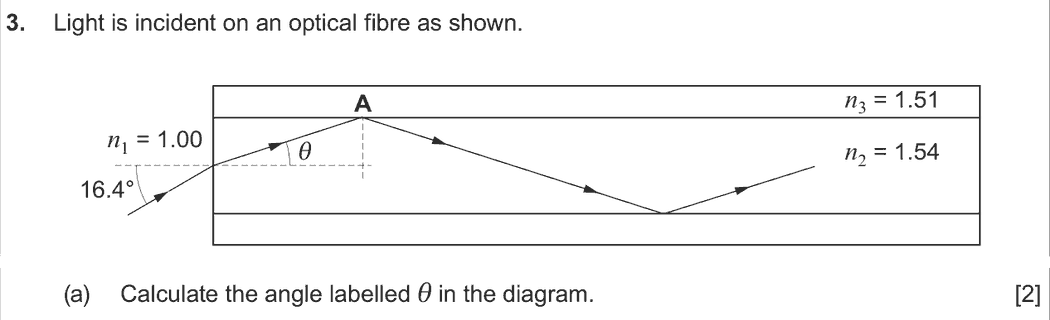
3(a) Refraction of light 2AO1=1,AO2=1Calculation
3(b) Refraction of light 4AO1=2,AO2=2Explanation
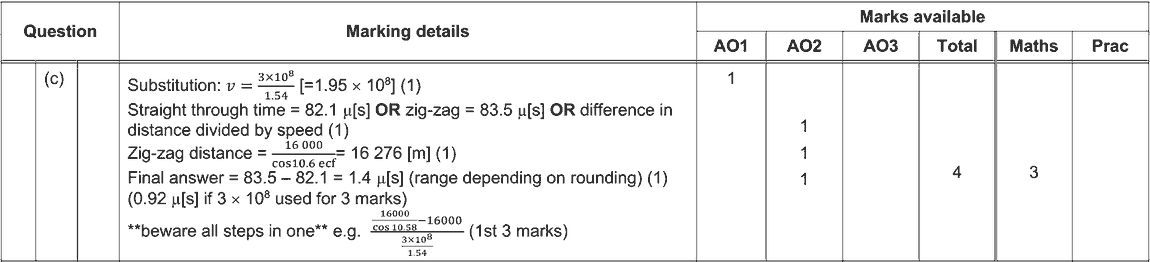
3(c) Refraction of light 4AO1=1,AO2=3Calculation
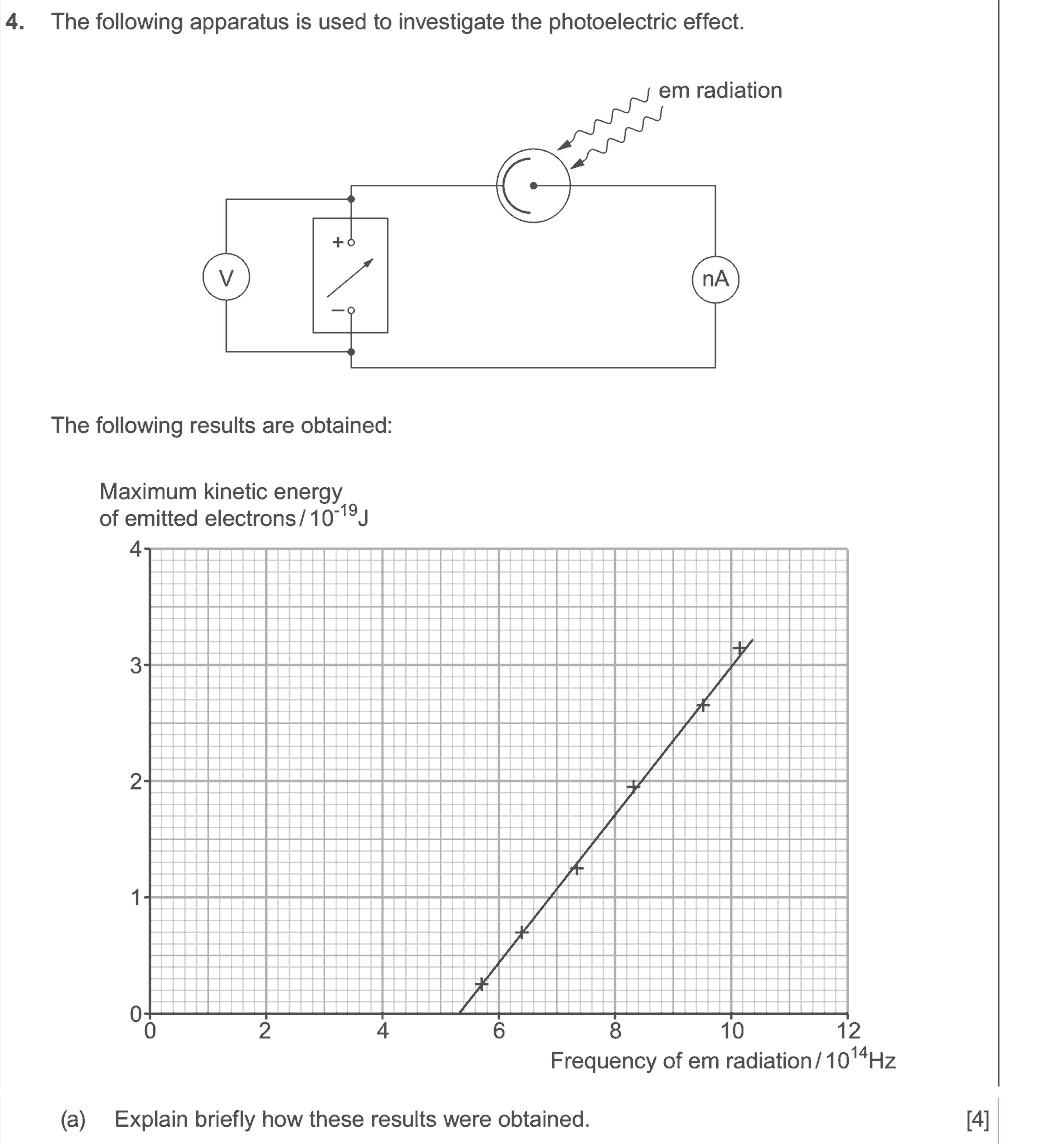
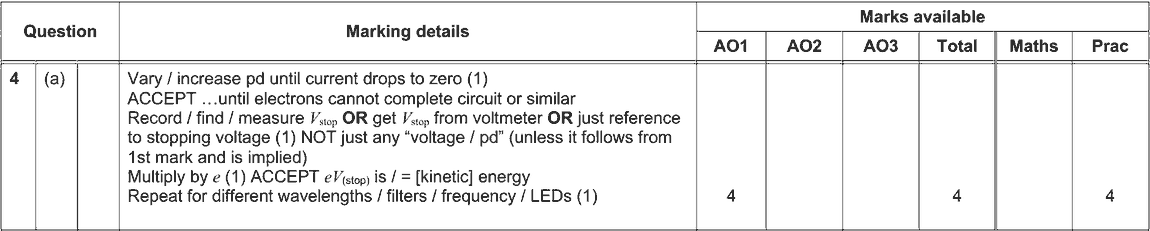
4(a) Photons 4AO1=4Practical and data analysis
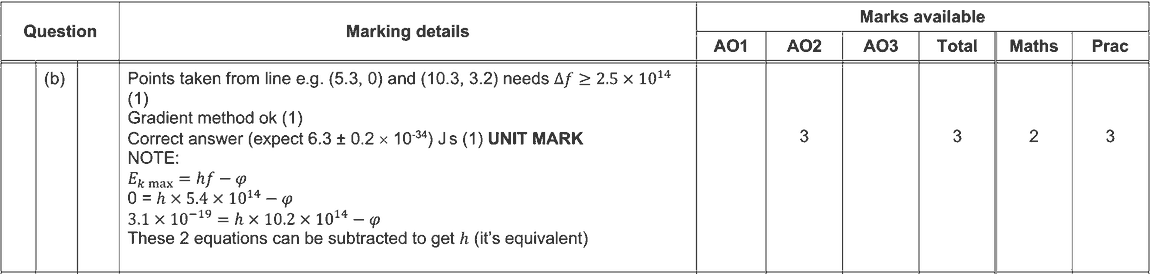
4(b) Photons 3AO2=3Calculation
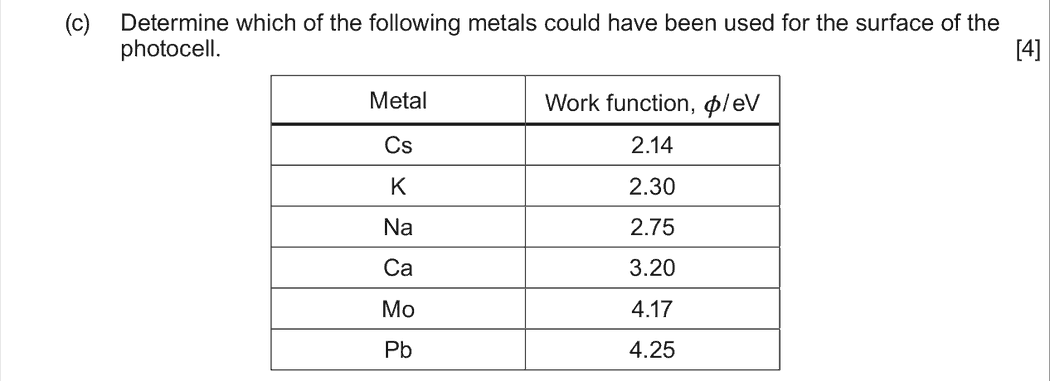
4(c) Photons 4AO3=4Calculation
5(a)(i) Nuclear decay 1AO1=1Definition
5(a)(ii) Nuclear decay 1AO1=1Definition
5(b)(i) Nuclear decay 1AO2=1Practical and data analysis
5(b)(ii) Nuclear decay 2AO2=2Practical and data analysis
5(b)(iii) Nuclear decay 2AO2=2Practical and data analysis
5(c)(i) Nuclear decay 2AO2=2Practical and data analysis
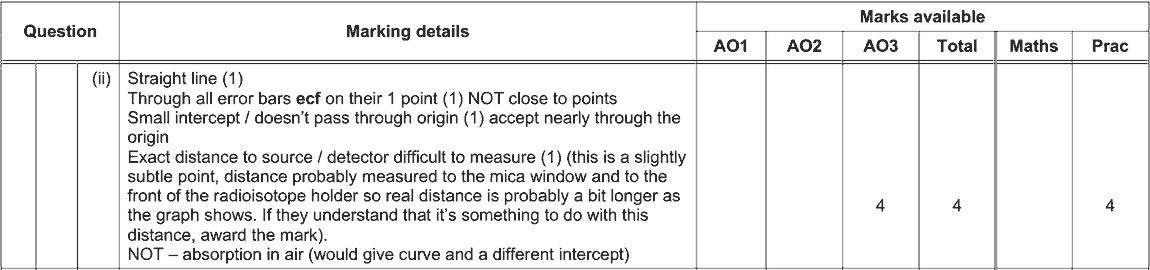
5(c)(ii) Nuclear decay 4AO3=4Practical and data analysis
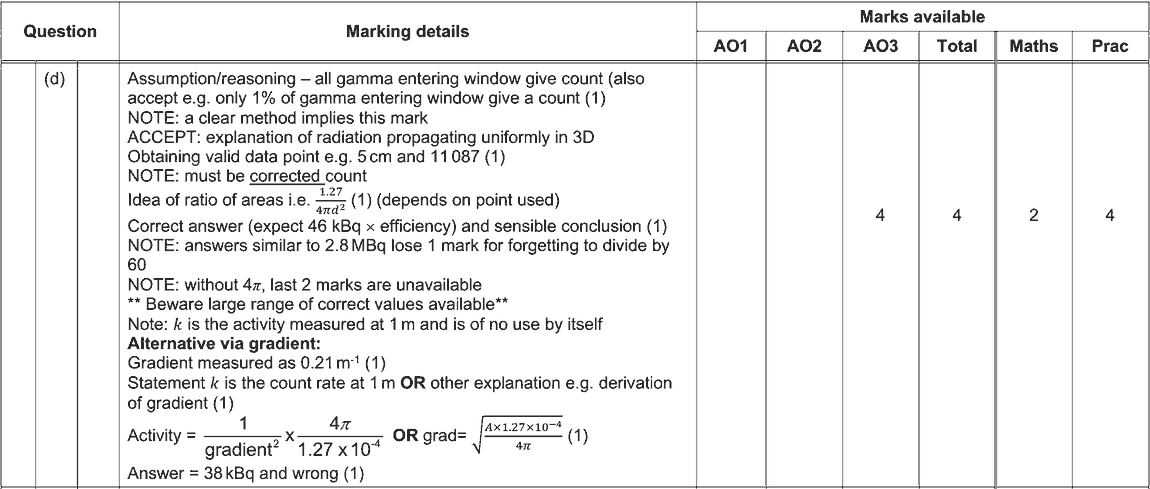
5(d) Nuclear decay 4AO3=4Practical and data analysis
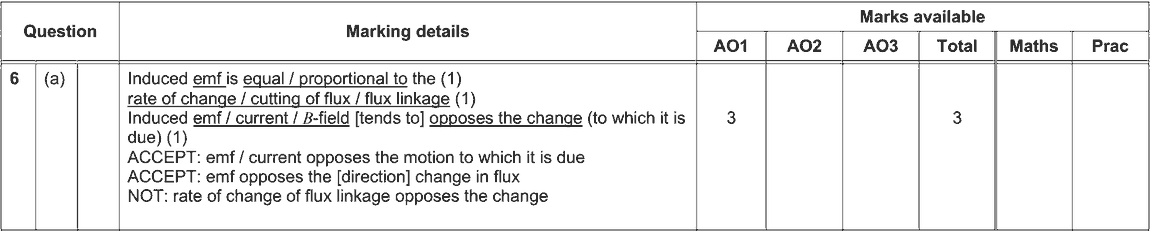
6(a) Electromagnetic induction 3AO1=3Definition
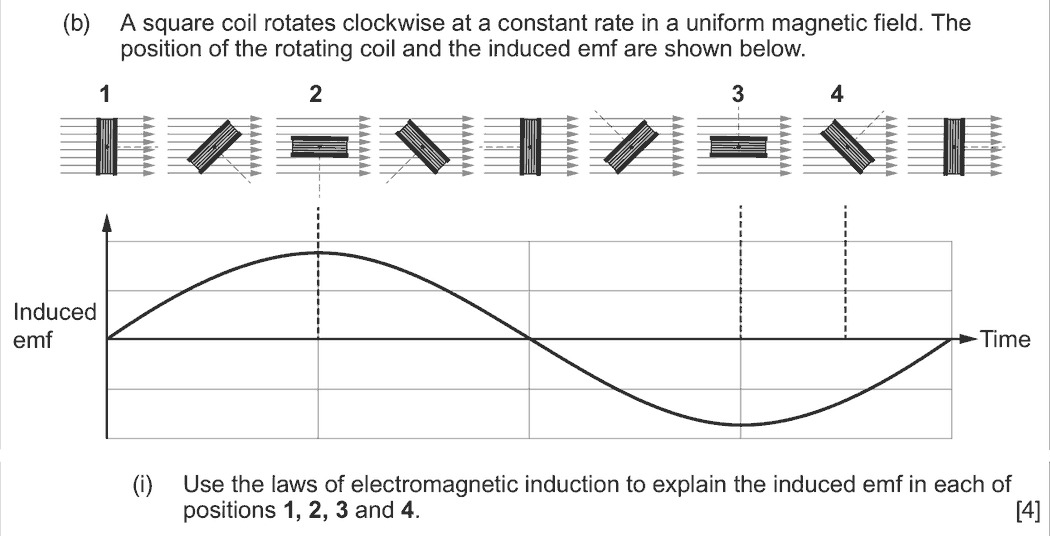
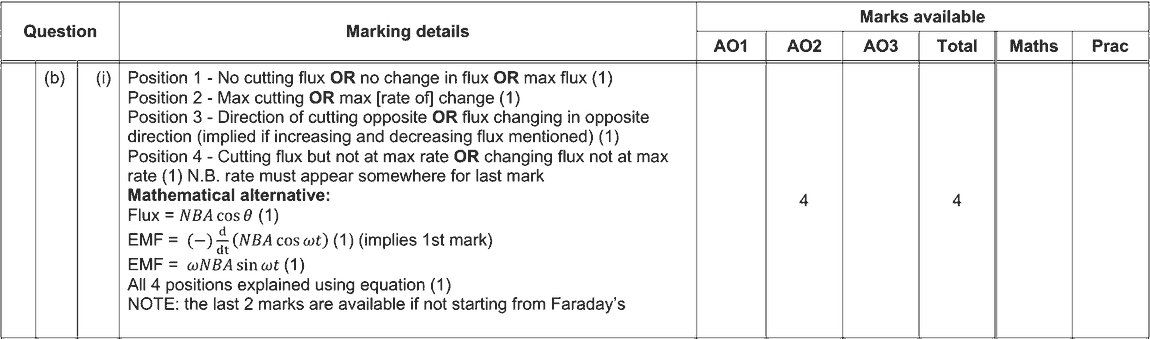
6(b)(i) Electromagnetic induction 4AO2=4Explanation
6(b)(ii) Electromagnetic induction 2AO2=2Explanation
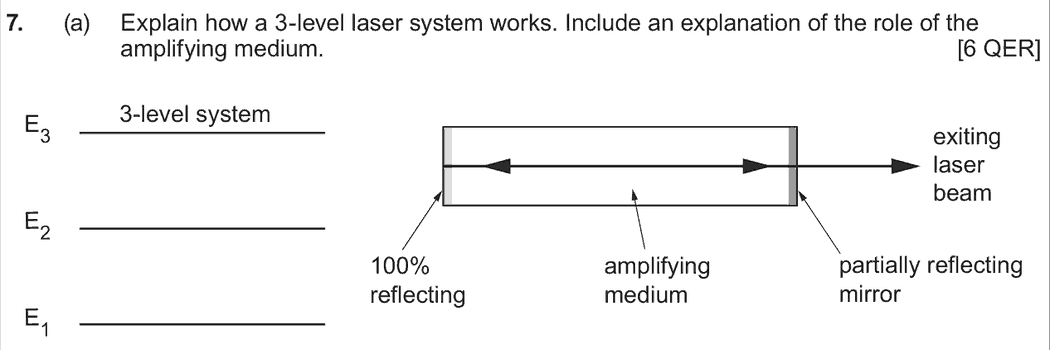
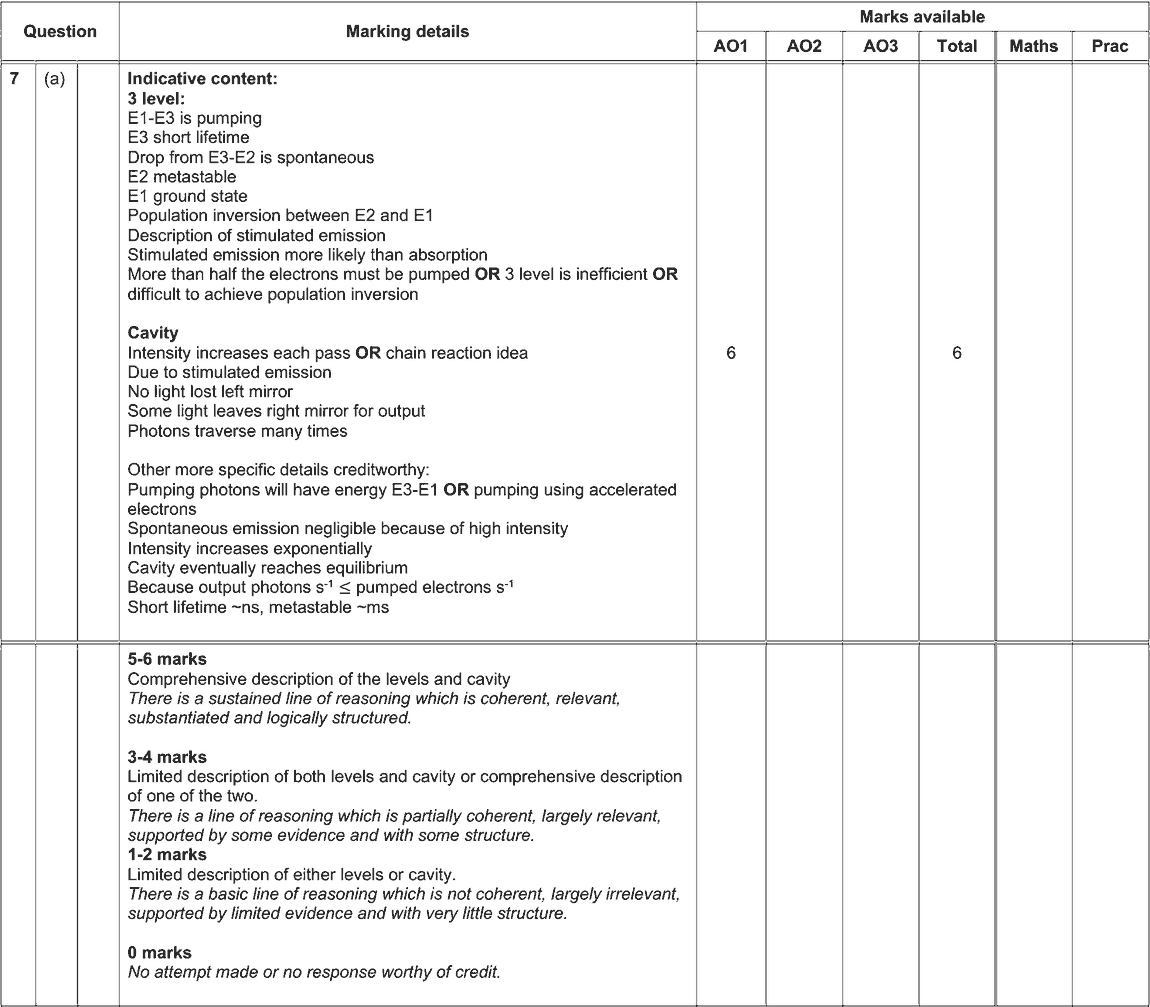
7(a) Lasers 6AO1=6Extended response
7(b) Lasers 2AO1=2Short answer
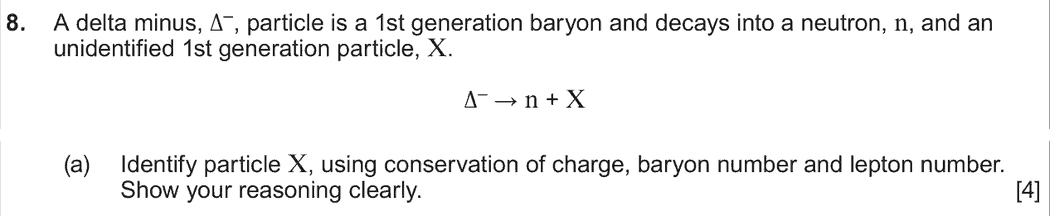
8(a) Particles and nuclear structure 4AO2=4Explanation
8(b) Particles and nuclear structure 1AO1=1Show that
8(c) Particles and nuclear structure 2AO1=1,AO2=1Explanation
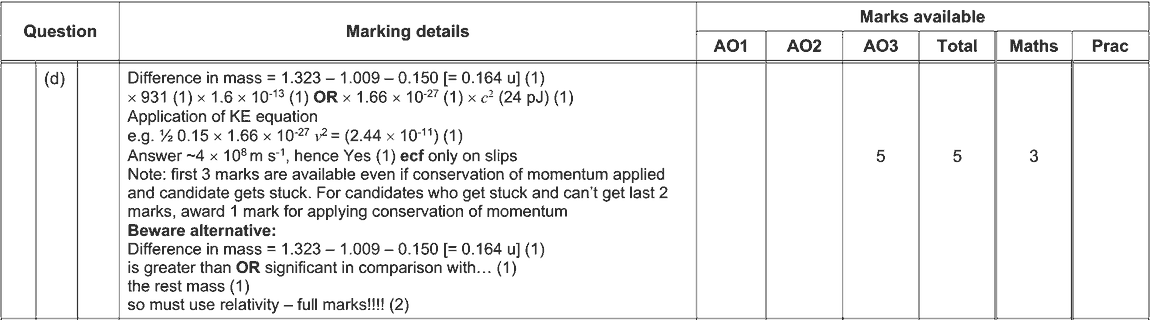
8(d) Nuclear energy 5AO3=5Calculation
8(e) Particles and nuclear structure 2AO3=2Short answer
9(a)(i) Alternating currents 2AO2=2Short answer
9(a)(ii) Alternating currents 1AO1=1Short answer
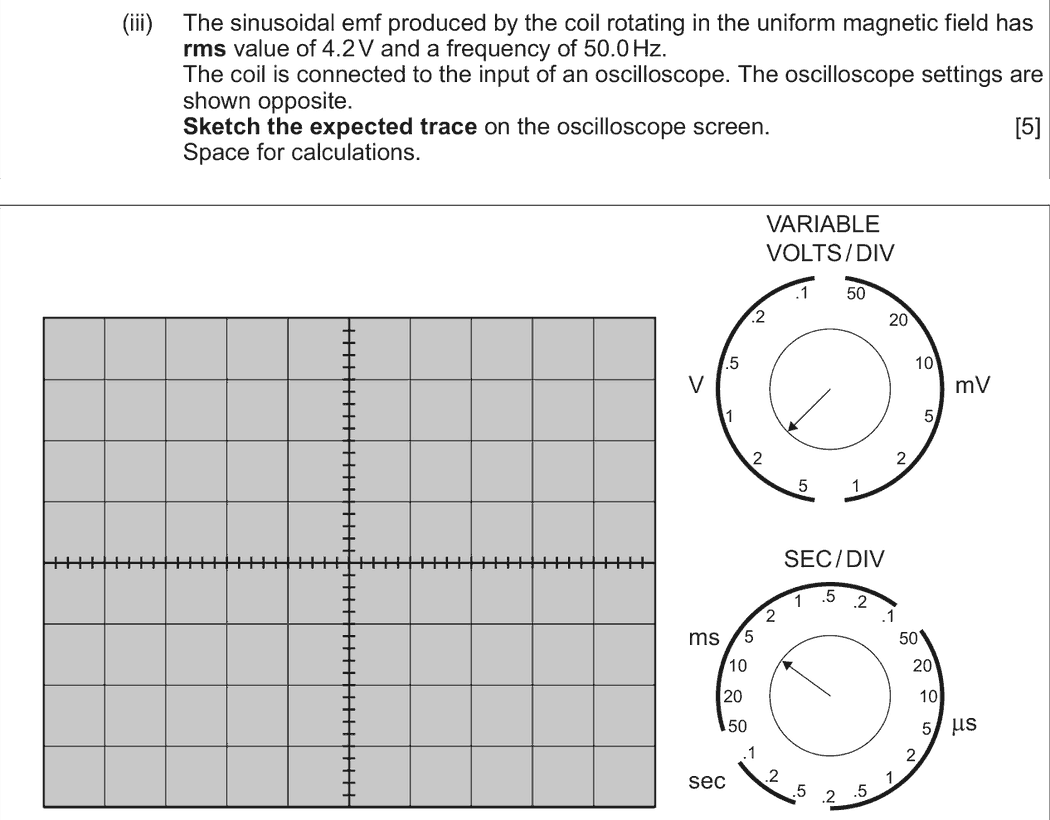
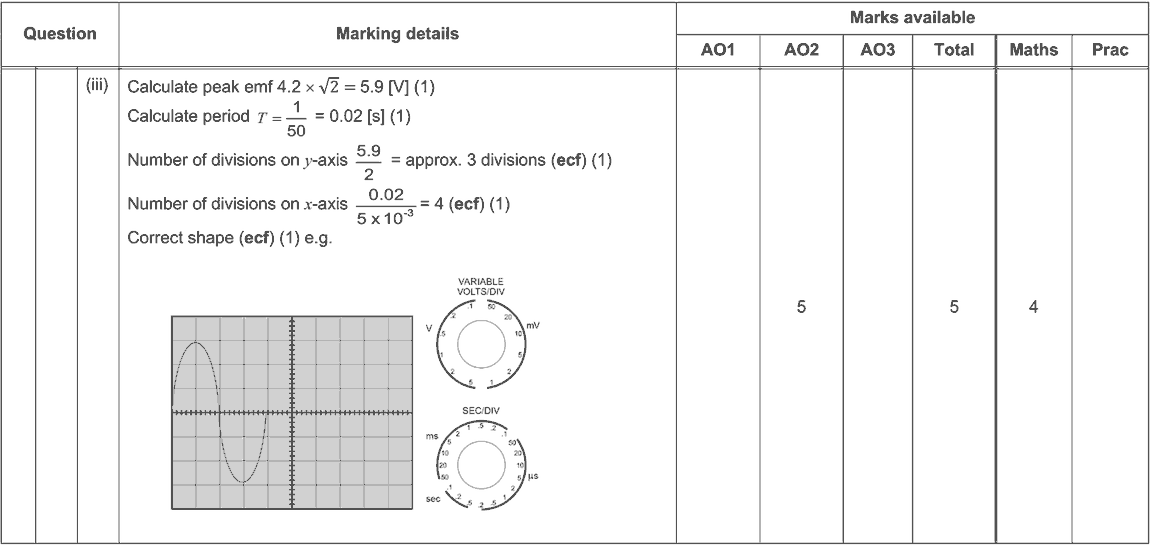
9(a)(iii) Alternating currents 5AO2=5Diagram or graph
9(b) Alternating currents 3AO1=1,AO3=2Explanation
9(c)(i) Alternating currents 1AO1=1Short answer
9(c)(ii) Alternating currents 4AO1=1,AO3=3Calculation
9(c)(iii) Alternating currents 3AO1=1,AO2=2Calculation
9(c)(iv) Alternating currents 1AO1=1Short answer
10(a)(i)I Medical physics 2AO2=2Calculation
10(a)(i)II Medical physics 2AO1=2Diagram or graph
10(a)(ii)I Medical physics 2AO2=2Show that
10(a)(ii)II Medical physics 3AO2=3Calculation
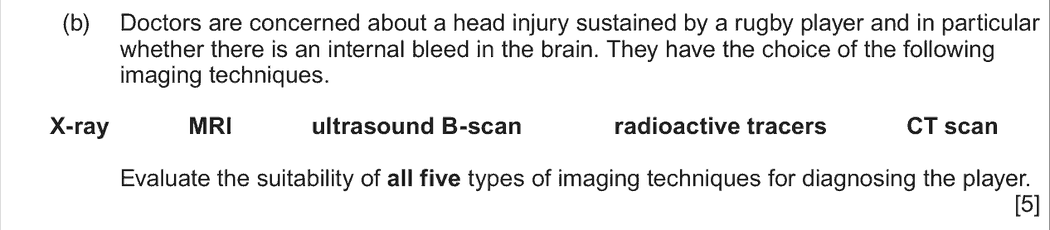
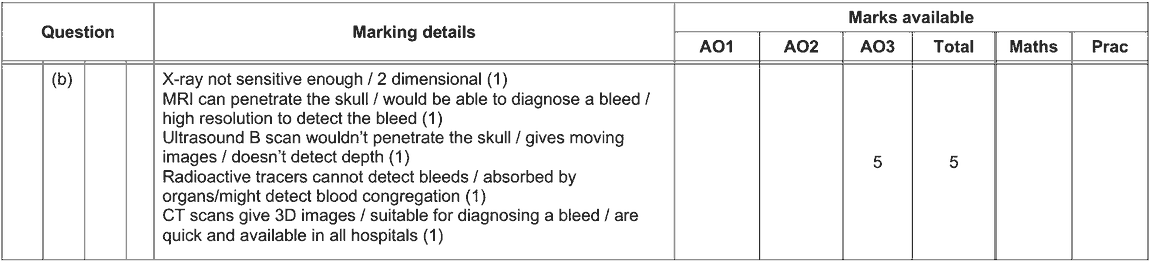
10(b) Medical physics 5AO3=5Explanation
10(c)(i) Medical physics 3AO1=3Explanation
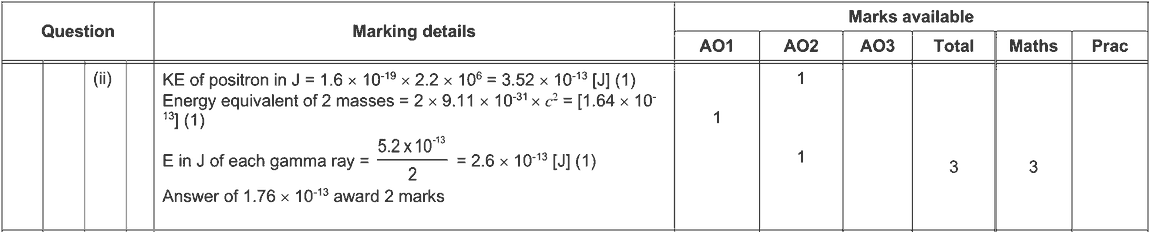
10(c)(ii) Medical physics 3AO1=1,AO2=2Calculation
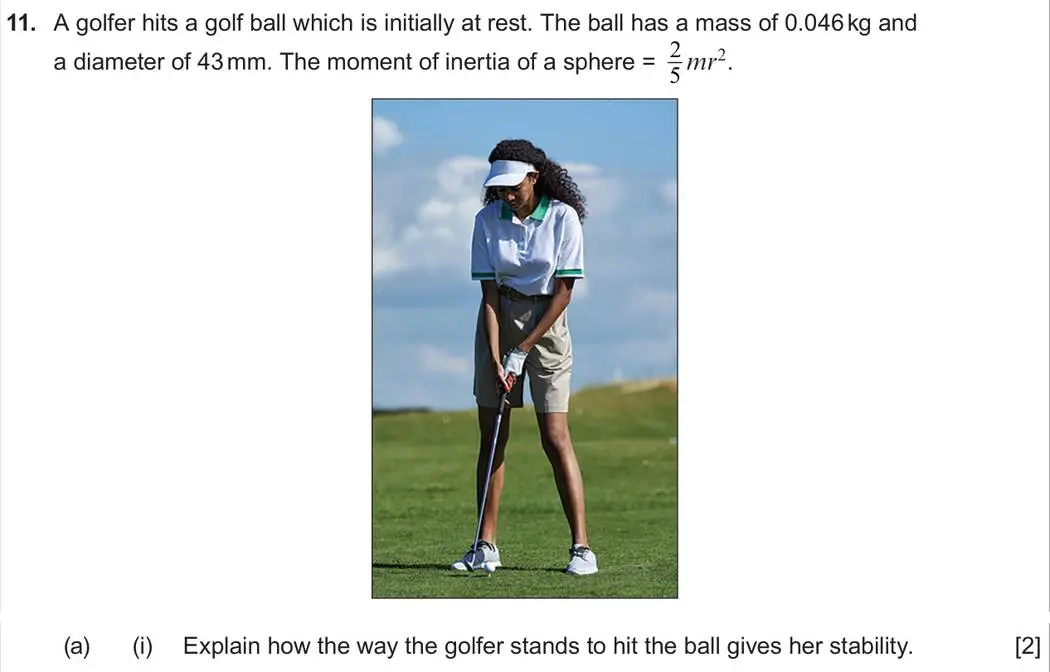
11(a)(i) The physics of sports 2AO1=1,AO2=1Explanation
11(a)(ii) The physics of sports 2AO1=2Definition
11(a)(iii) The physics of sports 3AO1=1,AO2=2Calculation
11(a)(iv) The physics of sports 2AO3=2Explanation
11(b)(i) The physics of sports 4AO2=4Calculation
11(b)(ii) The physics of sports 3AO3=3Calculation
11(c) The physics of sports 4AO1=2,AO2=2Explanation
12(a) Energy and the environment 1AO1=1Definition
12(b)(i) Energy and the environment 2AO2=2Calculation
12(b)(ii) Energy and the environment 3AO1=1,AO2=2Calculation
12(b)(iii) Energy and the environment 2AO2=2Calculation
12(c)(i) Energy and the environment 3AO1=1,AO2=2Calculation
12(c)(ii) Energy and the environment 3AO2=1,AO3=2Calculation
12(d)(i) Energy and the environment 1AO1=1Short answer
12(d)(ii) Energy and the environment 1AO1=1Short answer
12(d)(iii) Energy and the environment 1AO1=1Short answer
12(d)(iv) Energy and the environment 3AO3=3Explanation

The questions

1(a)(i)1(a)(ii)1(b)(i)1(b)(ii)1(b)(iii)1(b)(iv)1(c)(i)1(c)(ii)1(c)(iii)2(a)(i)2(a)(ii)2(b)(i)2(b)(ii)3(a)3(b)3(c)4(a)4(b)4(c)5(a)(i)5(a)(ii)5(b)(i)5(b)(ii)5(b)(iii)5(c)(i)5(c)(ii)5(d)6(a)6(b)(i)6(b)(ii)7(a)7(b)8(a)8(b)8(c)8(d)8(e)9(a)(i)9(a)(ii)9(a)(iii)9(b)9(c)(i)9(c)(ii)9(c)(iii)9(c)(iv)10(a)(i)I10(a)(i)II10(a)(ii)I10(a)(ii)II10(b)10(c)(i)10(c)(ii)11(a)(i)11(a)(ii)11(a)(iii)11(a)(iv)11(b)(i)11(b)(ii)11(c)12(a)12(b)(i)12(b)(ii)12(b)(iii)12(c)(i)12(c)(ii)12(d)(i)12(d)(ii)12(d)(iii)12(d)(iv)
June 2025 · Component 3 · Q1(a)(i) 3 marks AO1=3 Definition nature of waves
1. (a) (i) Define the terms ‘transverse wave’ and ‘longitudinal wave’. Give an example of each type of wave. [3]
June 2025 · Component 3 · Q1(a)(ii) 3 marks AO1=3 Explanation nature of waves
Earlier part of question 1 that this part usesEarlier part of June 2025 Component 3 question 1
(ii) Explain why only one of these two types of waves can be polarised and the other type cannot be polarised. [3]
June 2025 · Component 3 · Q1(b)(i) 2 marks AO2=2 Calculation nature of waves
Earlier part of question 1 that this part usesEarlier part of June 2025 Component 3 question 1
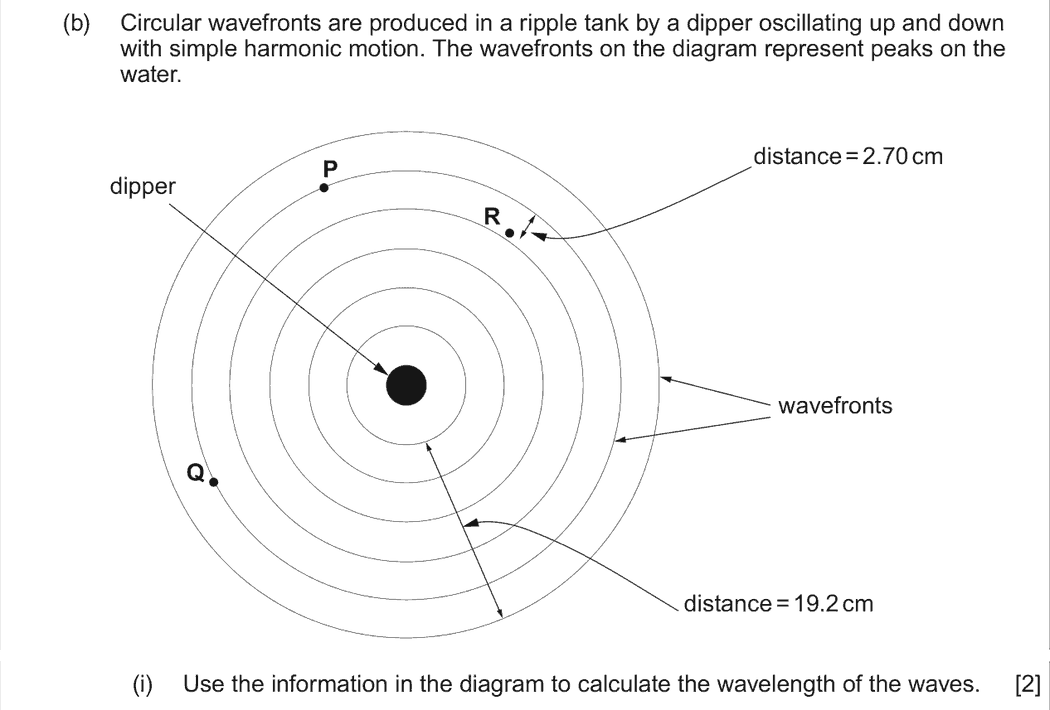
(b) Circular wavefronts are produced in a ripple tank by a dipper oscillating up and down with simple harmonic motion. The wavefronts on the diagram represent peaks on the water. distance = 2.70 cm P dipper R wavefronts Q distance = 19.2 cm (i) Use the information in the diagram to calculate the wavelength of the waves. [2]
June 2025 · Component 3 · Q1(b)(ii) 1 mark AO2=1 Diagram or graph nature of waves
Earlier parts of question 1 that this part usesEarlier part of June 2025 Component 3 question 1Earlier part of June 2025 Component 3 question 1
(ii) Draw an arrow on the diagram at Q to indicate the direction of wave travel. [1]
June 2025 · Component 3 · Q1(b)(iii) 1 mark AO1=1 Short answer nature of waves
Earlier parts of question 1 that this part usesEarlier part of June 2025 Component 3 question 1Earlier part of June 2025 Component 3 question 1
(iii) State the phase of point P relative to point Q. [1]
June 2025 · Component 3 · Q1(b)(iv) 3 marks AO2=3 Calculation nature of waves
Earlier parts of question 1 that this part usesEarlier part of June 2025 Component 3 question 1Earlier part of June 2025 Component 3 question 1
(iv) Calculate the phase of point R relative to point Q, giving your answer in radians. [3]
June 2025 · Component 3 · Q1(c)(i) 3 marks AO2=3 Calculation nature of wavesvibrations
Earlier parts of question 1 that this part usesEarlier part of June 2025 Component 3 question 1Earlier part of June 2025 Component 3 question 1
(c) The displacement, y, (in m) of oscillation of the wave at time, t, (in s) at a radius of 8.0 cm is given by: y = 2.2 × 10⁻³ cos 10.7t (i) Calculate the speed of propagation of the wave. [3]
June 2025 · Component 3 · Q1(c)(ii) 2 marks AO2=2 Calculation vibrations
Earlier parts of question 1 that this part usesEarlier part of June 2025 Component 3 question 1Earlier part of June 2025 Component 3 question 1Earlier part of June 2025 Component 3 question 1
(ii) Calculate the maximum speed of oscillation of the water surface at this radius. [2]
June 2025 · Component 3 · Q1(c)(iii) 3 marks AO3=3 Calculation nature of waves
Earlier parts of question 1 that this part usesEarlier part of June 2025 Component 3 question 1Earlier part of June 2025 Component 3 question 1Earlier part of June 2025 Component 3 question 1
(iii) Floella reads in a textbook that the energy carried by a wave is proportional to its amplitude squared. She states that, because the waves are spreading in circles, conservation of energy means that the amplitude at double this distance, (i.e. at 16.0 cm) will be approximately 1.6 mm. Determine whether Floella is correct. [3]
June 2025 · Component 3 · Q2(a)(i) 2 marks AO2=2 Explanation wave properties
2. A beam of white light is shone normally on a diffraction grating. The n = 0 order beam produces a bright white dot on a screen but the n = 1 order beam produces a spectrum of light. (a) (i) Explain why the n = 0 order beam produces a bright white dot. [2]
June 2025 · Component 3 · Q2(a)(ii) 2 marks AO2=2 Explanation wave properties
Earlier part of question 2 that this part usesEarlier part of June 2025 Component 3 question 2
(ii) Explain why the n = 1 order beam produces a spectrum. [2]
June 2025 · Component 3 · Q2(b)(i) 3 marks AO2=3 Calculation Easy wave properties
Earlier part of question 2 that this part usesEarlier part of June 2025 Component 3 question 2
(b) (i) Yellow light of wavelength 575 nm is seen in the n = 2 spectrum at an angle of 16.1°. Calculate the number of lines per mm in the diffraction grating. [3]
June 2025 · Component 3 · Q2(b)(ii) 3 marks AO3=3 Calculation wave properties
Earlier parts of question 2 that this part usesEarlier part of June 2025 Component 3 question 2Earlier part of June 2025 Component 3 question 2
(ii) Yousef states that it is impossible for any visible wavelength in the n = 2 spectrum to overlap with the n = 1 visible spectrum. Determine whether Yousef is correct. [3]
June 2025 · Component 3 · Q3(a) 2 marks AO1=1, AO2=1 Calculation refraction of light
3. Light is incident on an optical fibre as shown. A n3 = 1.51 n1 = 1.00 θ n2 = 1.54 16.4° (a) Calculate the angle labelled θ in the diagram. [2]
June 2025 · Component 3 · Q3(b) 4 marks AO1=2, AO2=2 Explanation refraction of light
Earlier part of question 3 that this part usesEarlier part of June 2025 Component 3 question 3
(b) Explain why total internal reflection occurs at A. Use calculations to support your answer. [4]
June 2025 · Component 3 · Q3(c) 4 marks AO1=1, AO2=3 Calculation refraction of light
Earlier part of question 3 that this part usesEarlier part of June 2025 Component 3 question 3
(c) The length of the optical fibre is 16.0 km. Calculate the time lag between pulses travelling along the central axis of the optical fibre and pulses travelling via the zig-zag path shown in the diagram. [4]
June 2025 · Component 3 · Q4(a) 4 marks AO1=4 Practical and data analysis photons
4. The following apparatus is used to investigate the photoelectric effect. em radiation + V nA _ The following results are obtained: Maximum kinetic energy of emitted electrons / 10-19J 4 3 2 1 0 0 2 4 6 8 10 12 Frequency of em radiation / 1014Hz (a) Explain briefly how these results were obtained. [4]
June 2025 · Component 3 · Q4(b) 3 marks AO2=3 Calculation photons
Earlier part of question 4 that this part usesEarlier part of June 2025 Component 3 question 4
(b) Use the graph to calculate a value for the Planck constant. [3]
June 2025 · Component 3 · Q4(c) 4 marks AO3=4 Calculation photons
Earlier part of question 4 that this part usesEarlier part of June 2025 Component 3 question 4
(c) Determine which of the following metals could have been used for the surface of the photocell. [4] Metal Work function, φ / eV Cs 2.14 K 2.30 Na 2.75 Ca 3.20 Mo 4.17 Pb 4.25
June 2025 · Component 3 · Q5(a)(i) 1 mark AO1=1 Definition nuclear decay
5. (a) The activity of a radioactive sample is measured in becquerel. (i) Explain what is meant by activity. [1]
June 2025 · Component 3 · Q5(a)(ii) 1 mark AO1=1 Definition nuclear decay
Earlier part of question 5 that this part usesEarlier part of June 2025 Component 3 question 5
(ii) Define the becquerel (Bq). [1]
June 2025 · Component 3 · Q5(b)(i) 1 mark AO2=1 Practical and data analysis nuclear decay
Earlier part of question 5 that this part usesEarlier part of June 2025 Component 3 question 5
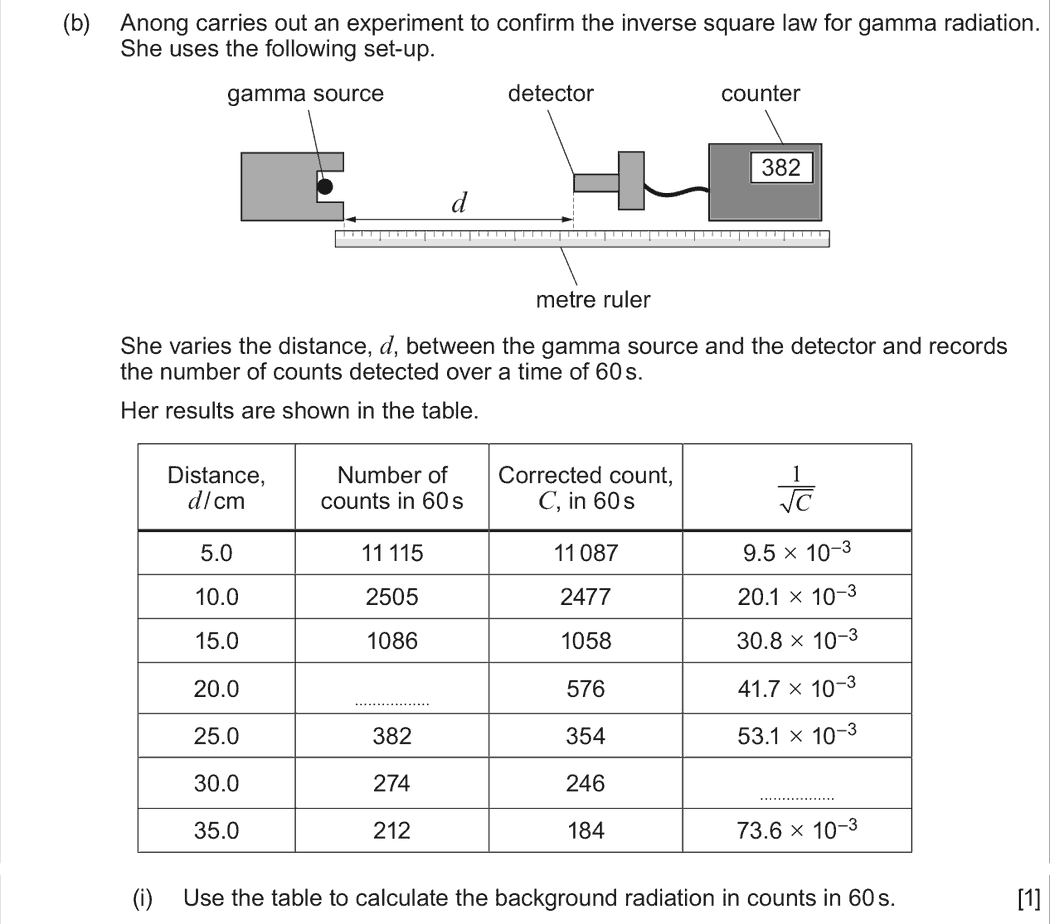
(b) Anong carries out an experiment to confirm the inverse square law for gamma radiation. She uses the following set-up. gamma source detector counter 382 d metre ruler She varies the distance, d, between the gamma source and the detector and records the number of counts detected over a time of 60 s. Her results are shown in the table. Distance, Number of Corrected count, 1 d / cm counts in 60 s C, in 60 s C 5.0 11 115 11 087 9.5 × 10⁻³ 10.0 2505 2477 20.1 × 10⁻³ 15.0 1086 1058 30.8 × 10⁻³ 20.0 576 41.7 × 10⁻³ 25.0 382 354 53.1 × 10⁻³ 30.0 274 246 35.0 212 184 73.6 × 10⁻³ (i) Use the table to calculate the background radiation in counts in 60 s. [1]
June 2025 · Component 3 · Q5(b)(ii) 2 marks AO2=2 Practical and data analysis nuclear decay
Earlier parts of question 5 that this part usesEarlier part of June 2025 Component 3 question 5Earlier part of June 2025 Component 3 question 5
(ii) Complete the table. [2]
June 2025 · Component 3 · Q5(b)(iii) 2 marks AO2=2 Practical and data analysis nuclear decay
Earlier parts of question 5 that this part usesEarlier part of June 2025 Component 3 question 5Earlier part of June 2025 Component 3 question 5
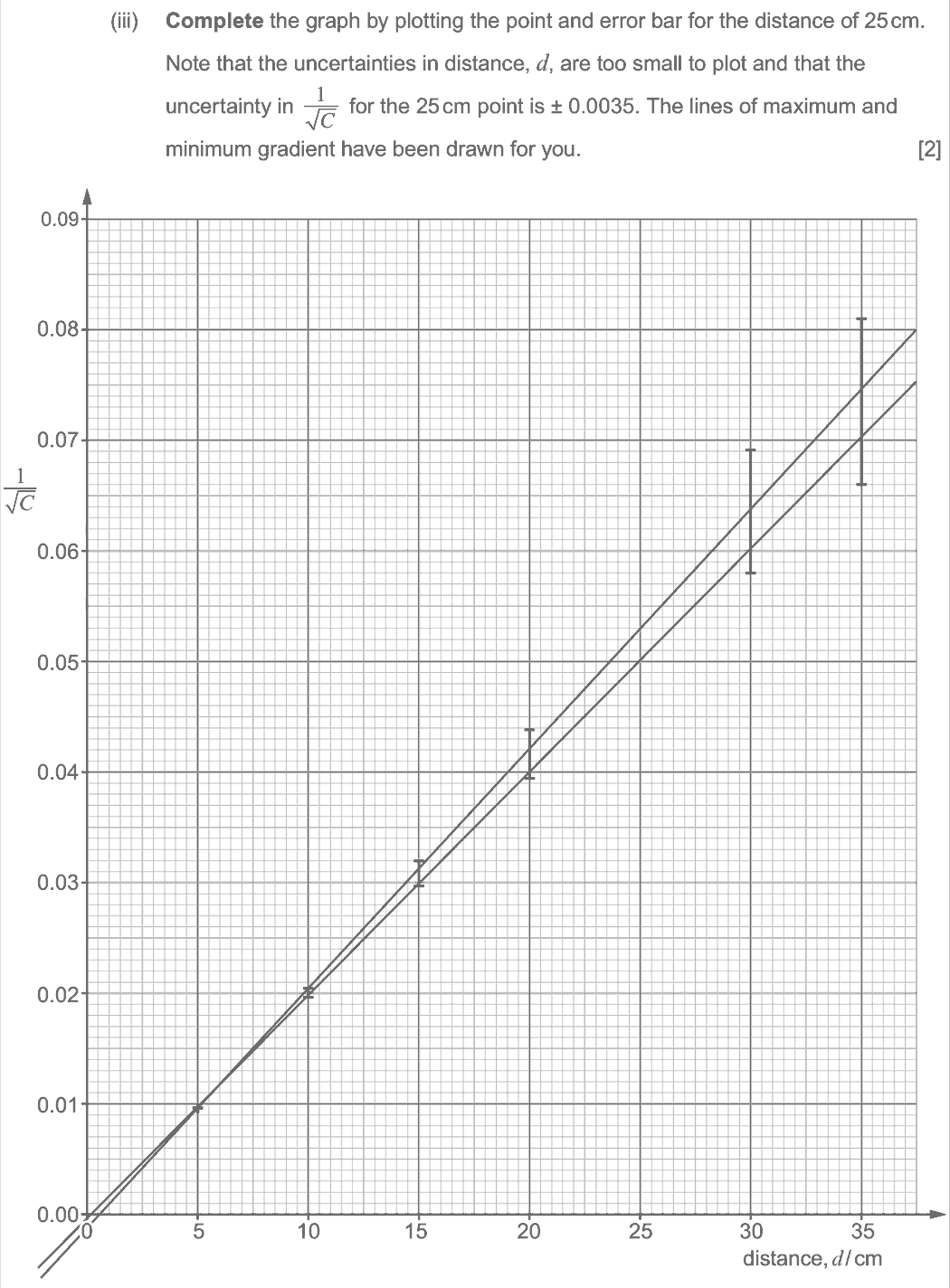
(iii) Complete the graph by plotting the point and error bar for the distance of 25 cm. Note that the uncertainties in distance, d, are too small to plot and that the 1 uncertainty in for the 25 cm point is ± 0.0035. The lines of maximum and C minimum gradient have been drawn for you. [2] 0.09 0.08 0.07 1 C 0.06 0.05 0.04 0.03 0.02 0.01 0.00 0 5 10 15 20 25 30 35 distance, d / cm
June 2025 · Component 3 · Q5(c)(i) 2 marks AO2=2 Practical and data analysis nuclear decay
Earlier parts of question 5 that this part usesEarlier part of June 2025 Component 3 question 5Earlier part of June 2025 Component 3 question 5Earlier part of June 2025 Component 3 question 5
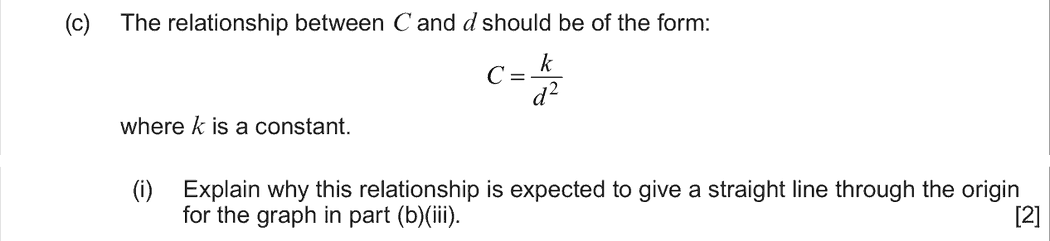
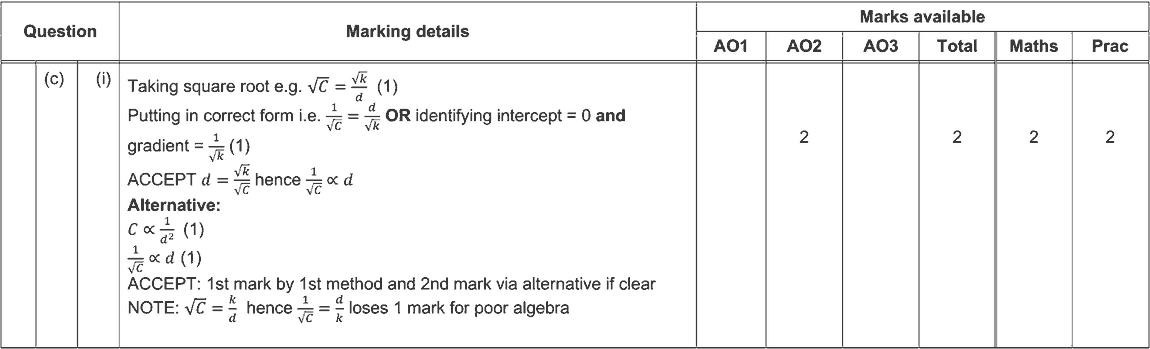
(c) The relationship between C and d should be of the form: k C  d 2 where k is a constant. (i) Explain why this relationship is expected to give a straight line through the origin for the graph in part (b)(iii). [2]
June 2025 · Component 3 · Q5(c)(ii) 4 marks AO3=4 Practical and data analysis nuclear decay
Earlier parts of question 5 that this part usesEarlier part of June 2025 Component 3 question 5Earlier part of June 2025 Component 3 question 5Earlier part of June 2025 Component 3 question 5Earlier part of June 2025 Component 3 question 5
(ii) Explain to what extent the graph in part (b)(iii) agrees with this theory. Where the graph disagrees with the theory, suggest a reason for this. [4]
June 2025 · Component 3 · Q5(d) 4 marks AO3=4 Practical and data analysis nuclear decay
Earlier parts of question 5 that this part usesEarlier part of June 2025 Component 3 question 5Earlier part of June 2025 Component 3 question 5Earlier part of June 2025 Component 3 question 5
(d) Anong calculates the area of the window of the detector as 1.27 cm2. She concludes that the activity of the gamma source must be around 18 000 Bq. Explaining your reasoning carefully, determine whether she is correct. [4]
June 2025 · Component 3 · Q6(a) 3 marks AO1=3 Definition electromagnetic induction
6. (a) State the two laws of electromagnetic induction: the laws of Faraday and Lenz. [3]
June 2025 · Component 3 · Q6(b)(i) 4 marks AO2=4 Explanation electromagnetic induction
Earlier part of question 6 that this part usesEarlier part of June 2025 Component 3 question 6
(b) A square coil rotates clockwise at a constant rate in a uniform magnetic field. The position of the rotating coil and the induced emf are shown below. 1 2 3 4 Induced emf Time (i) Use the laws of electromagnetic induction to explain the induced emf in each of positions 1, 2, 3 and 4. [4]
June 2025 · Component 3 · Q6(b)(ii) 2 marks AO2=2 Explanation electromagnetic induction
Earlier parts of question 6 that this part usesEarlier part of June 2025 Component 3 question 6Earlier part of June 2025 Component 3 question 6
(ii) Use the laws of electromagnetic induction to explain how the graph would change if the rotation rate were doubled. [2]
June 2025 · Component 3 · Q7(a) 6 marks AO1=6 6-mark extended response lasers
7. (a) Explain how a 3-level laser system works. Include an explanation of the role of the amplifying medium. [6 QER] 3-level system E3 exiting laser beam E2 100% amplifying partially reflecting reflecting medium mirror E1
June 2025 · Component 3 · Q7(b) 2 marks AO1=2 Short answer lasers
Earlier part of question 7 that this part usesEarlier part of June 2025 Component 3 question 7
(b) Semiconductor lasers are used in many applications because they are far more efficient than gas lasers. State one use and another advantage of semiconductor lasers. [2]
June 2025 · Component 3 · Q8(a) 4 marks AO2=4 Explanation particles and nuclear structure
8. A delta minus, ∆–, particle is a 1st generation baryon and decays into a neutron, n, and an unidentified 1st generation particle, X. ∆– → n + X (a) Identify particle X, using conservation of charge, baryon number and lepton number. Show your reasoning clearly. [4]
June 2025 · Component 3 · Q8(b) 1 mark AO1=1 Show that particles and nuclear structure
Earlier part of question 8 that this part usesEarlier part of June 2025 Component 3 question 8
(b) Show that the quark make-up of the ∆– is ddd. [1]
June 2025 · Component 3 · Q8(c) 2 marks AO1=1, AO2=1 Explanation particles and nuclear structure
Earlier part of question 8 that this part usesEarlier part of June 2025 Component 3 question 8
(c) Determine whether up and down quark numbers are conserved in this decay. [2]
June 2025 · Component 3 · Q8(d) 5 marks AO3=5 Calculation nuclear energy
Earlier part of question 8 that this part usesEarlier part of June 2025 Component 3 question 8
(d) The mass of the ∆– particle is 1.323 u, the mass of a neutron is 1.009 u, and the mass of particle X is 0.150 u. From Einstein’s Theory of Relativity, nothing can travel faster than light. Determine whether Einstein’s Theory of Relativity should be considered when calculating the speed of particle X after this decay. You may assume that particle X has far greater kinetic energy than the neutron. [5]
June 2025 · Component 3 · Q8(e) 2 marks AO3=2 Short answer particles and nuclear structure
Earlier part of question 8 that this part usesEarlier part of June 2025 Component 3 question 8
(e) On 10 August 2023, it was announced in a seminar that the magnetic moment of muons does not fit the standard model of particles. The magnetic moment of a muon should be exactly 2 but it has been measured as 2.002331841. Explain briefly how the scientific community should proceed. [2]
June 2025 · Component 3 · Q9(a)(i) 2 marks AO2=2 Short answer alternating currents
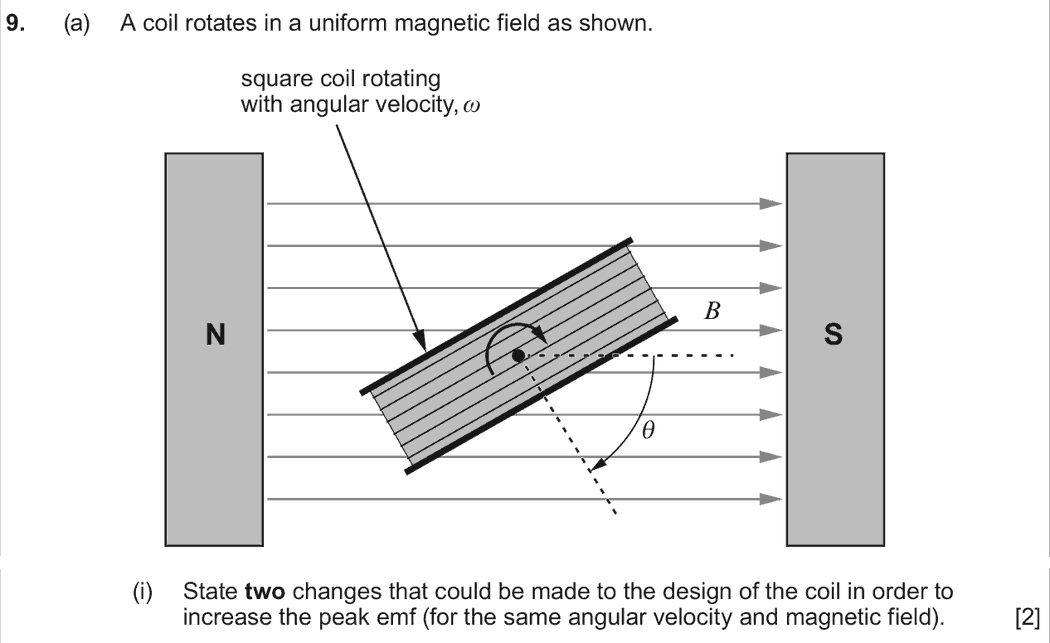
9. (a) A coil rotates in a uniform magnetic field as shown. square coil rotating with angular velocity, ω B N S θ (i) State two changes that could be made to the design of the coil in order to increase the peak emf (for the same angular velocity and magnetic field). [2]
June 2025 · Component 3 · Q9(a)(ii) 1 mark AO1=1 Short answer alternating currents
Earlier part of question 9 that this part usesEarlier part of June 2025 Component 3 question 9
(ii) Write an equation for the peak emf induced in a rotating coil. [1]
June 2025 · Component 3 · Q9(a)(iii) 5 marks AO2=5 Diagram or graph alternating currents
Earlier part of question 9 that this part usesEarlier part of June 2025 Component 3 question 9
(iii) The sinusoidal emf produced by the coil rotating in the uniform magnetic field has rms value of 4.2 V and a frequency of 50.0 Hz. The coil is connected to the input of an oscilloscope. The oscilloscope settings are shown opposite. Sketch the expected trace on the oscilloscope screen. [5] Space for calculations. VARIABLE VOLTS / DIV .1 50 .2 20 .5 10 V mV 1 5 2 2 5 1 SEC / DIV 1 .5 .2 2 .1 ms 5 50 10 20 20 10 μs 50 5 .1 2 sec .2 1 .5 .2 .5
June 2025 · Component 3 · Q9(b) 3 marks AO1=1, AO3=2 Explanation alternating currents
Earlier parts of question 9 that this part usesEarlier part of June 2025 Component 3 question 9Earlier part of June 2025 Component 3 question 9
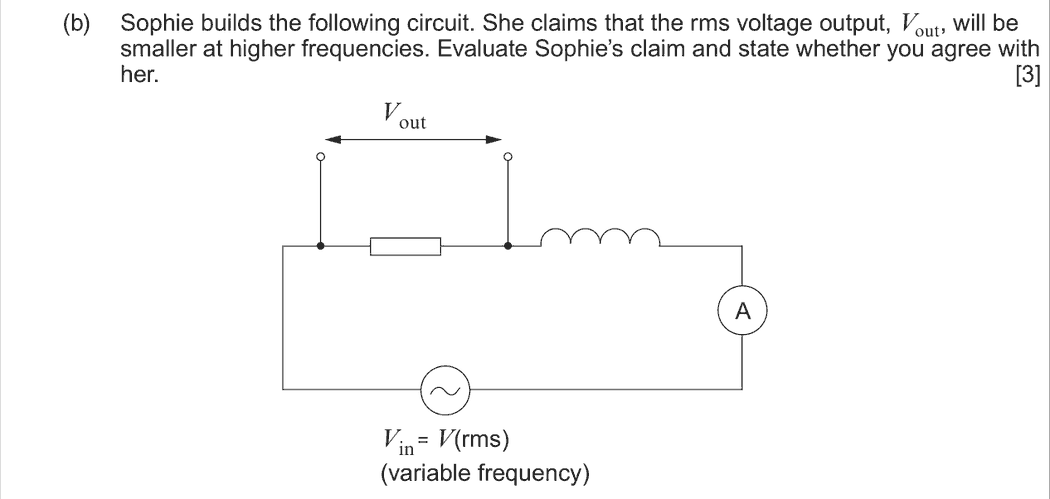
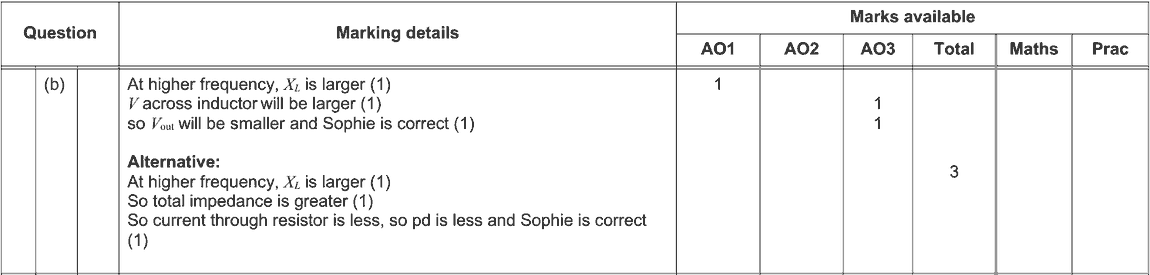
(b) Sophie builds the following circuit. She claims that the rms voltage output, Vout, will be smaller at higher frequencies. Evaluate Sophie’s claim and state whether you agree with her. [3] Vout A Vin = V(rms) (variable frequency)
June 2025 · Component 3 · Q9(c)(i) 1 mark AO1=1 Short answer alternating currents
Earlier parts of question 9 that this part usesEarlier part of June 2025 Component 3 question 9Earlier part of June 2025 Component 3 question 9Earlier part of June 2025 Component 3 question 9
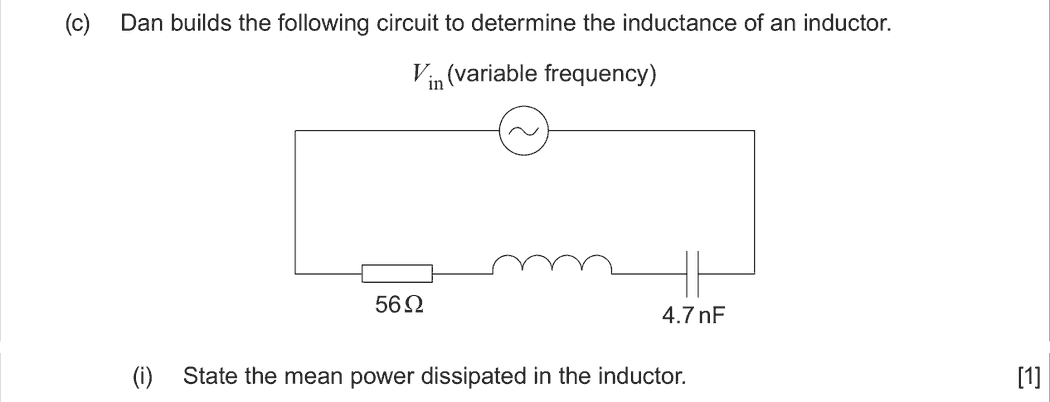
(c) Dan builds the following circuit to determine the inductance of an inductor. Vin (variable frequency) 56 Ω 4.7 nF (i) State the mean power dissipated in the inductor. [1]
June 2025 · Component 3 · Q9(c)(ii) 4 marks AO1=1, AO3=3 Calculation alternating currents
Earlier parts of question 9 that this part usesEarlier part of June 2025 Component 3 question 9Earlier part of June 2025 Component 3 question 9Earlier part of June 2025 Component 3 question 9Earlier part of June 2025 Component 3 question 9
(ii) When the frequency of Vin is equal to 15 kHz, the rms current is at its maximum. Determine the value of the inductance of the inductor. [4]
June 2025 · Component 3 · Q9(c)(iii) 3 marks AO1=1, AO2=2 Calculation alternating currents
Earlier parts of question 9 that this part usesEarlier part of June 2025 Component 3 question 9Earlier part of June 2025 Component 3 question 9Earlier part of June 2025 Component 3 question 9Earlier part of June 2025 Component 3 question 9
(iii) Calculate the Q factor of the circuit. [3]
June 2025 · Component 3 · Q9(c)(iv) 1 mark AO1=1 Short answer alternating currents
Earlier parts of question 9 that this part usesEarlier part of June 2025 Component 3 question 9Earlier part of June 2025 Component 3 question 9Earlier part of June 2025 Component 3 question 9Earlier part of June 2025 Component 3 question 9
(iv) State the effect of increasing the Q factor on the resonance curve. [1]
June 2025 · Component 3 · Q10(a)(i)I 2 marks AO2=2 Calculation medical physics
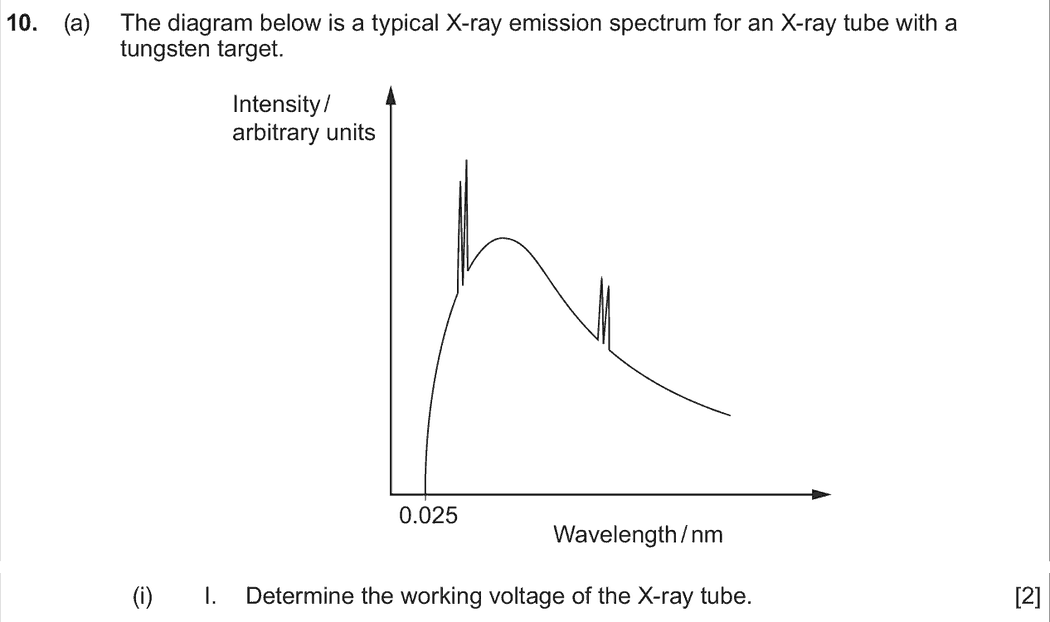
10. (a) The diagram below is a typical X-ray emission spectrum for an X-ray tube with a tungsten target. Intensity / arbitrary units 0.025 Wavelength / nm (i) I. Determine the working voltage of the X-ray tube. [2]
June 2025 · Component 3 · Q10(a)(i)II 2 marks AO1=2 Diagram or graph medical physics
Earlier part of question 10 that this part usesEarlier part of June 2025 Component 3 question 10
II. Draw on the diagram above the emission spectrum for an X–ray tube operating at a lower working voltage and using a different metal target. [2]
June 2025 · Component 3 · Q10(a)(ii)I 2 marks AO2=2 Show that medical physics
Earlier part of question 10 that this part usesEarlier part of June 2025 Component 3 question 10
(ii) I. When a beam of X-rays passes through bone, the X-rays are absorbed and the beam becomes attenuated. The thickness of bone needed to reduce the original intensity by 50% is known as the half-value thickness, x . 1 ln2 2 Show that: x  where µ is the attenuation coefficient. [2] 1  2
June 2025 · Component 3 · Q10(a)(ii)II 3 marks AO2=3 Calculation medical physics
Earlier parts of question 10 that this part usesEarlier part of June 2025 Component 3 question 10Earlier part of June 2025 Component 3 question 10
II. A beam of X-rays is used to detect a fracture in a piece of bone. If the half-value thickness for these X-rays is 1.4 cm, calculate the thickness of bone that reduces the incident intensity to 65% of its original value. [3]
June 2025 · Component 3 · Q10(b) 5 marks AO3=5 Explanation medical physics
Earlier part of question 10 that this part usesEarlier part of June 2025 Component 3 question 10
(b) Doctors are concerned about a head injury sustained by a rugby player and in particular whether there is an internal bleed in the brain. They have the choice of the following imaging techniques. X-ray MRI ultrasound B-scan radioactive tracers CT scan Evaluate the suitability of all five types of imaging techniques for diagnosing the player. [5]
June 2025 · Component 3 · Q10(c)(i) 3 marks AO1=3 Explanation medical physics
Earlier part of question 10 that this part usesEarlier part of June 2025 Component 3 question 10
(c) (i) Explain how a gamma camera detects the gamma rays given off by a technetium-99m source. [3]
June 2025 · Component 3 · Q10(c)(ii) 3 marks AO1=1, AO2=2 Calculation medical physics
Earlier parts of question 10 that this part usesEarlier part of June 2025 Component 3 question 10Earlier part of June 2025 Component 3 question 10
(ii) During a positron emission tomography (PET) scan, a positron of kinetic energy 2.2 MeV collides with a stationary electron and both are annihilated in the collision. As a consequence, two identical gamma rays are produced. Calculate the energy of each of the gamma rays produced in joules. [3]
June 2025 · Component 3 · Q11(a)(i) 2 marks AO1=1, AO2=1 Explanation physics of sports
11. A golfer hits a golf ball which is initially at rest. The ball has a mass of 0.046 kg and 2 a diameter of 43 mm. The moment of inertia of a sphere = mr2. 5 (a) (i) Explain how the way the golfer stands to hit the ball gives her stability. [2]
June 2025 · Component 3 · Q11(a)(ii) 2 marks AO1=2 Definition physics of sports
Earlier part of question 11 that this part usesEarlier part of June 2025 Component 3 question 11
(ii) Explain what is meant by the statement that “the coefficient of restitution between the club and the ball is 0.830”. [2]
June 2025 · Component 3 · Q11(a)(iii) 3 marks AO1=1, AO2=2 Calculation physics of sports
Earlier part of question 11 that this part usesEarlier part of June 2025 Component 3 question 11
(iii) After being hit, the ball spins with an angular velocity of 280 rad s–1. Calculate the torque exerted on the golf ball by the club if it is in contact with the ball for a time of 0.26 ms. [3]
June 2025 · Component 3 · Q11(a)(iv) 2 marks AO3=2 Explanation physics of sports
Earlier part of question 11 that this part usesEarlier part of June 2025 Component 3 question 11
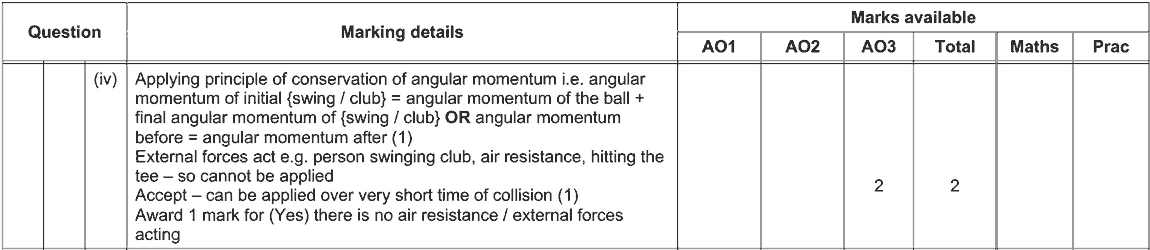
(iv) Discuss whether the principle of conservation of angular momentum can be applied to the system of the ball and the club when the golfer hits the ball. [2]
June 2025 · Component 3 · Q11(b)(i) 4 marks AO2=4 Calculation physics of sports
Earlier part of question 11 that this part usesEarlier part of June 2025 Component 3 question 11
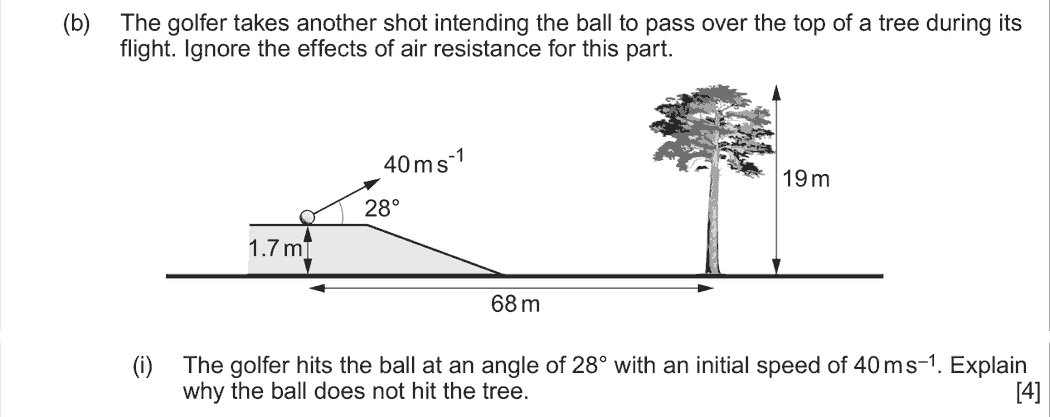
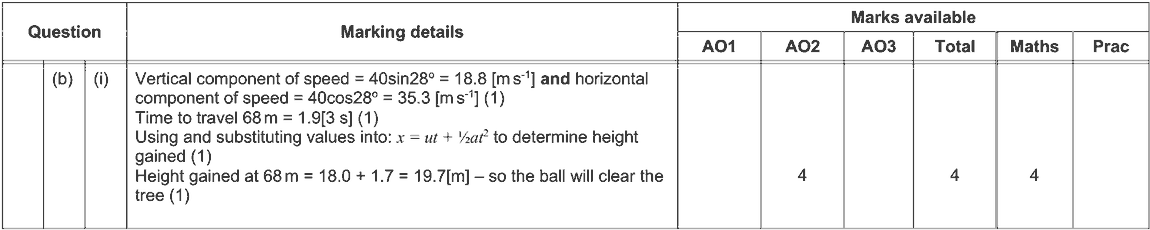
(b) The golfer takes another shot intending the ball to pass over the top of a tree during its flight. Ignore the effects of air resistance for this part. 40 m s-1 19 m 28° 1.7 m 68 m (i) The golfer hits the ball at an angle of 28° with an initial speed of 40 m s–1. Explain why the ball does not hit the tree. [4]
June 2025 · Component 3 · Q11(b)(ii) 3 marks AO3=3 Calculation physics of sports
Earlier parts of question 11 that this part usesEarlier part of June 2025 Component 3 question 11Earlier part of June 2025 Component 3 question 11
(ii) The ball spins with an angular velocity of 195 rad s–1 when travelling through the air. Evaluate whether the rotational kinetic energy can be considered negligible compared to the linear kinetic energy of the ball when the ball is at its maximum height. [3]
June 2025 · Component 3 · Q11(c) 4 marks AO1=2, AO2=2 Explanation physics of sports
Earlier parts of question 11 that this part usesEarlier part of June 2025 Component 3 question 11Earlier part of June 2025 Component 3 question 11
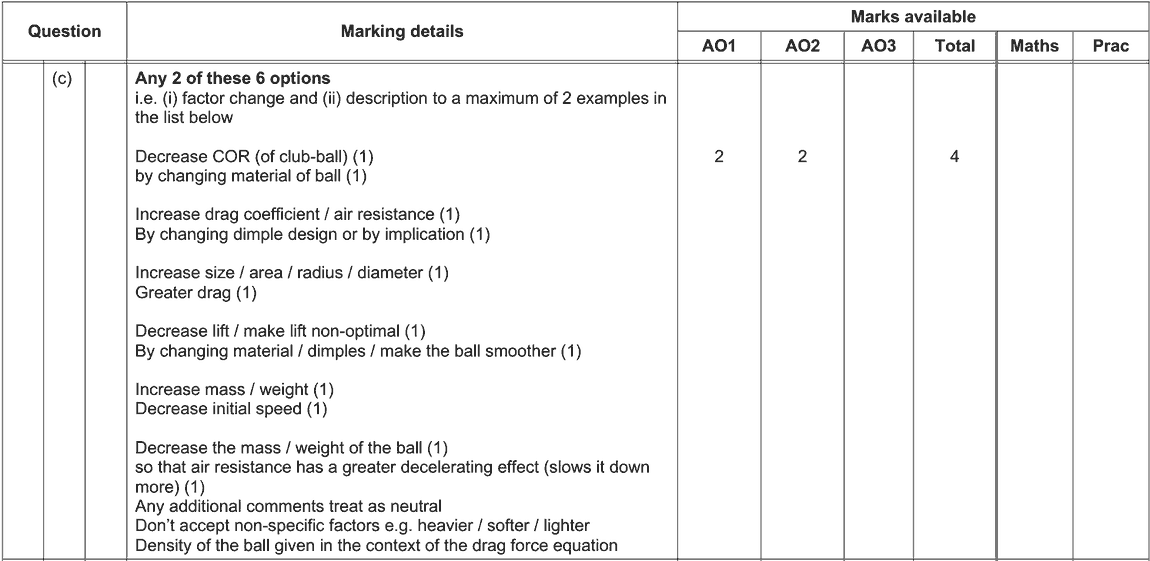
(c) Modern golf equipment leads to golf balls flying further. This means that many old golf courses are now too short. It has been proposed that the design of golf balls be changed to reduce their flight distance. Use physics to explain some changes that can be made to golf ball design to decrease their flight distance. [4]
June 2025 · Component 3 · Q12(a) 1 mark AO1=1 Definition energy and the environment
12. (a) Solar energy is a renewable energy source. State what is meant by ‘renewable energy source’. [1]
June 2025 · Component 3 · Q12(b)(i) 2 marks AO2=2 Calculation energy and the environment
Earlier part of question 12 that this part usesEarlier part of June 2025 Component 3 question 12
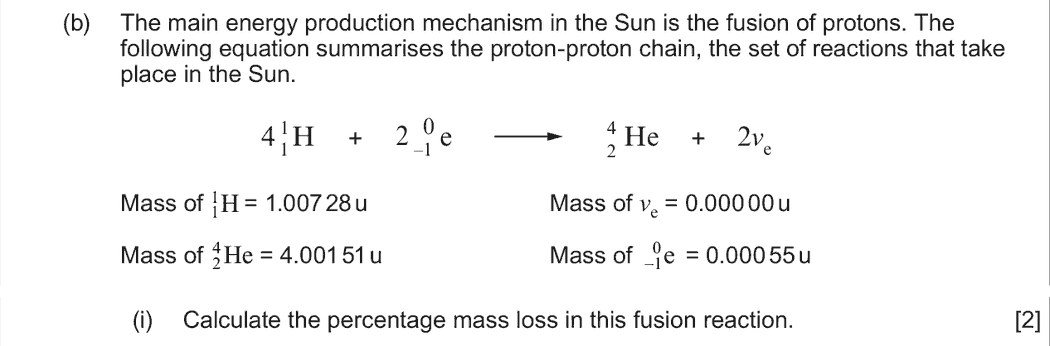
(b) The main energy production mechanism in the Sun is the fusion of protons. The following equation summarises the proton-proton chain, the set of reactions that take place in the Sun. 1 2 0 4 2ve 4 1H + e He + –1 2 Mass of 1 1H = 1.007 28 u Mass of ve = 0.000 00 u Mass of 4 2He = 4.001 51 u Mass of 0 1e = 0.000 55 u  (i) Calculate the percentage mass loss in this fusion reaction. [2]
June 2025 · Component 3 · Q12(b)(ii) 3 marks AO1=1, AO2=2 Calculation energy and the environment
Earlier parts of question 12 that this part usesEarlier part of June 2025 Component 3 question 12Earlier part of June 2025 Component 3 question 12
(ii) Define the solar constant and calculate its value. Power emitted by the Sun = 3.83 × 1026 W Distance from Sun to Earth = 1.50 × 10⁸ km [3]
June 2025 · Component 3 · Q12(b)(iii) 2 marks AO2=2 Calculation energy and the environment
Earlier parts of question 12 that this part usesEarlier part of June 2025 Component 3 question 12Earlier part of June 2025 Component 3 question 12
(iii) The UK government has set a target to increase the mean electrical power generated by solar photovoltaic cells to 70 GW by the year 2035. If the mean annual intensity of the solar radiation reaching the Earth’s surface is 342 W m–2 and the cells are 20% efficient, calculate the area of the cells required. [2]
June 2025 · Component 3 · Q12(c)(i) 3 marks AO1=1, AO2=2 Calculation energy and the environment
Earlier part of question 12 that this part usesEarlier part of June 2025 Component 3 question 12
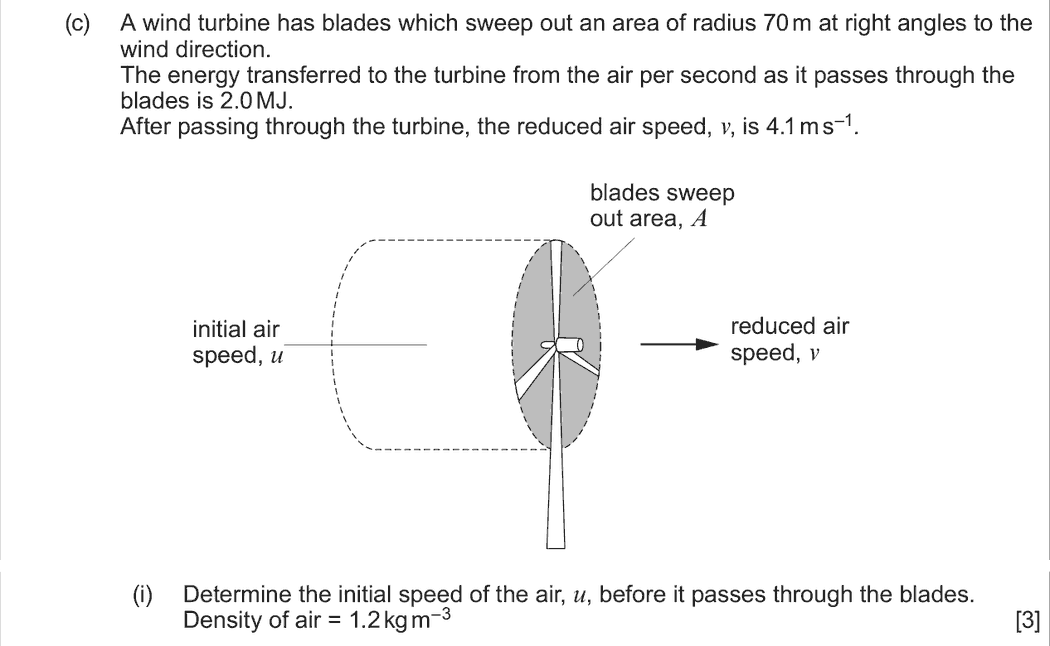
(c) A wind turbine has blades which sweep out an area of radius 70 m at right angles to the wind direction. The energy transferred to the turbine from the air per second as it passes through the blades is 2.0 MJ. After passing through the turbine, the reduced air speed, v, is 4.1 m s–1. blades sweep out area, A initial air reduced air speed, u speed, v (i) Determine the initial speed of the air, u, before it passes through the blades. Density of air = 1.2 kg m–3 [3]
June 2025 · Component 3 · Q12(c)(ii) 3 marks AO2=1, AO3=2 Calculation energy and the environment
Earlier parts of question 12 that this part usesEarlier part of June 2025 Component 3 question 12Earlier part of June 2025 Component 3 question 12
(ii) An energy company claims that it can build an underwater tidal turbine that can generate the same amount of electrical power as a wind turbine, but with blades 1 that are of the length. Evaluate this claim, stating any assumptions made. [3] 100 Density of sea water = 1025 kg m–3
June 2025 · Component 3 · Q12(d)(i) 1 mark AO1=1 Short answer energy and the environment
Earlier parts of question 12 that this part usesEarlier part of June 2025 Component 3 question 12Earlier part of June 2025 Component 3 question 12
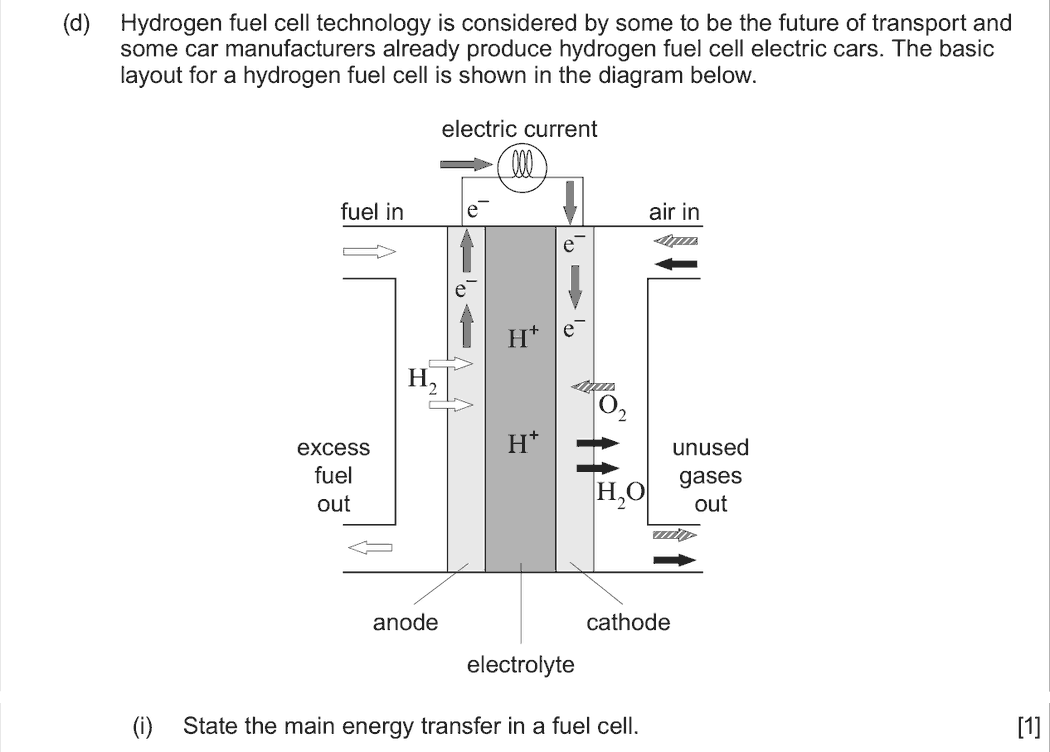
(d) Hydrogen fuel cell technology is considered by some to be the future of transport and some car manufacturers already produce hydrogen fuel cell electric cars. The basic layout for a hydrogen fuel cell is shown in the diagram below. electric current e– fuel in air in e– e– e– H+ H2 O2 H+ excess unused fuel gases H2O out out anode cathode electrolyte (i) State the main energy transfer in a fuel cell. [1]
June 2025 · Component 3 · Q12(d)(ii) 1 mark AO1=1 Short answer energy and the environment
Earlier parts of question 12 that this part usesEarlier part of June 2025 Component 3 question 12Earlier part of June 2025 Component 3 question 12Earlier part of June 2025 Component 3 question 12
(ii) Explain the purpose of the electrolyte. [1]
June 2025 · Component 3 · Q12(d)(iii) 1 mark AO1=1 Short answer energy and the environment
Earlier parts of question 12 that this part usesEarlier part of June 2025 Component 3 question 12Earlier part of June 2025 Component 3 question 12Earlier part of June 2025 Component 3 question 12
(iii) State the waste product. [1]
June 2025 · Component 3 · Q12(d)(iv) 3 marks AO3=3 Explanation energy and the environment
Earlier parts of question 12 that this part usesEarlier part of June 2025 Component 3 question 12Earlier part of June 2025 Component 3 question 12Earlier part of June 2025 Component 3 question 12
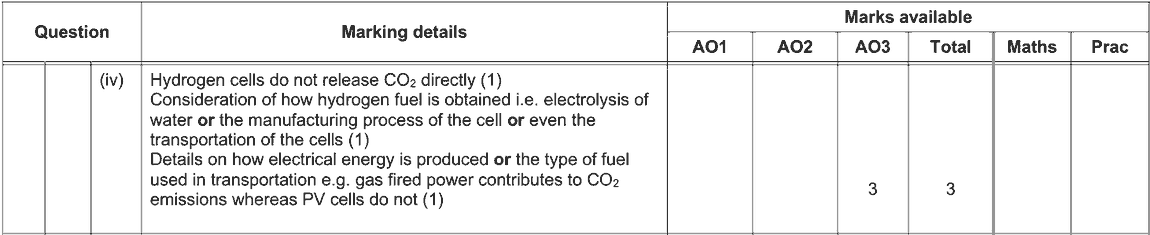
(iv) Some car manufacturers claim that the use of hydrogen fuel cells will not contribute any CO2 to the atmosphere. Evaluate this claim. [3]

Work with an Eduqas physics tutor

Want a paper marked and gone through with you? Message us.

Prefer email? Send an enquiry

If you are under 18, please include a parent's contact details. Enquiries go to enquiries@physicsaleveltutor.com and are deleted once handled. All tutoring is online.