October 2020: Component 3

120 marks for each student (100 in Section A plus one 20-mark option; all four options are here) · 67 question parts · Paper, mark scheme and report on Eduqas's site · Have the Data Booklet beside you

Question by question

QTopicMarksAOType
1(a) The nature of waves 2AO3=2Explanation
1(b)(i) Wave properties: diffraction, interference and stationary waves 3AO1=2,AO2=1Explanation
1(b)(ii) Photons 1AO1=1Short answer
1(b)(iii) Photons 1AO2=1Short answer
1(c) Wave properties: diffraction, interference and stationary waves 4AO2=4Diagram or graph
2(a) Photons 3AO1=1,AO2=2Calculation
2(b) Photons 3AO1=2,AO2=1Explanation
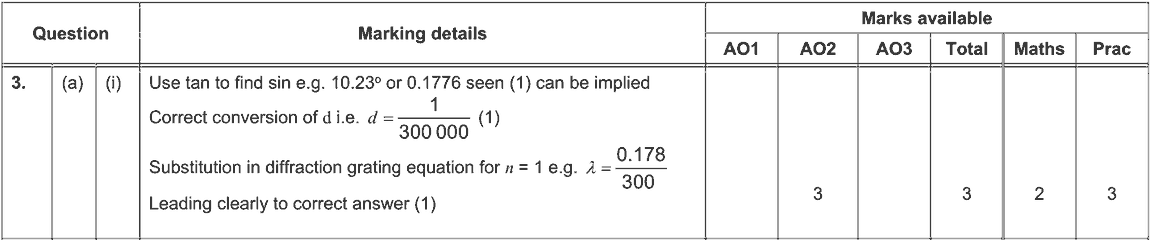
3(a)(i) Wave properties: diffraction, interference and stationary waves 3AO2=3Show that
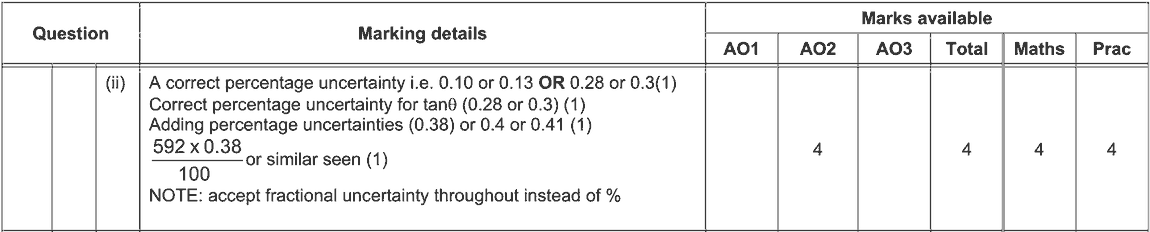
3(a)(ii) Wave properties: diffraction, interference and stationary waves 4AO2=4Practical and data analysis
3(b) Wave properties: diffraction, interference and stationary waves 2AO3=2Practical and data analysis
3(c) Wave properties: diffraction, interference and stationary waves 2AO3=2Practical and data analysis
4(a) Lasers 2AO1=2Definition
4(b) Lasers 2AO1=2Short answer
4(c) Lasers 3AO3=3Explanation
5(a)(i) Nuclear decay 3AO2=3Practical and data analysis
5(a)(ii) Nuclear decay 1AO2=1Diagram or graph
5(a)(iii) Nuclear decay 3AO2=3Practical and data analysis
5(a)(iv)I Nuclear decay 2AO2=2Show that
5(a)(iv)II Nuclear decay 3AO3=3Practical and data analysis
5(b) Nuclear decay 1AO1=1Short answer
5(c) Nuclear decay 3AO3=3Explanation
6 Particles and nuclear structure 6AO1=6Extended response
7(a) Nuclear decay 2AO1=1,AO2=1Short answer
7(b) Nuclear energy 5AO3=5Calculation
7(c)(i) Nuclear decay 4AO1=1,AO2=3Calculation
7(c)(ii) Nuclear decay 2AO2=2Calculation
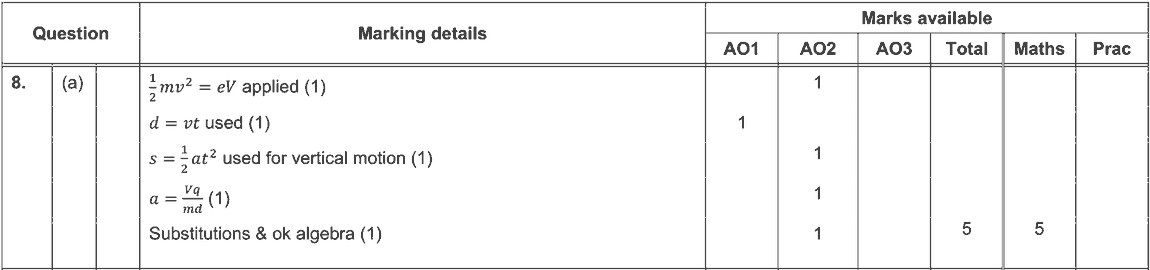
8(a) Magnetic fields 5AO1=1,AO2=4Show that
8(b) Magnetic fields 2AO3=2Explanation
9(a) Photons 5AO1=2,AO2=3Explanation
9(b) Electrostatic and gravitational fields of force 3AO1=1,AO2=2Calculation
10(a)(i) Magnetic fields 1AO1=1Calculation
10(a)(ii) Magnetic fields 2AO1=2Diagram or graph
10(a)(iii) Magnetic fields 1AO1=1Short answer
10(b)(i) Electromagnetic induction 3AO2=3Explanation
10(b)(ii) Electromagnetic induction 2AO1=1,AO2=1Explanation
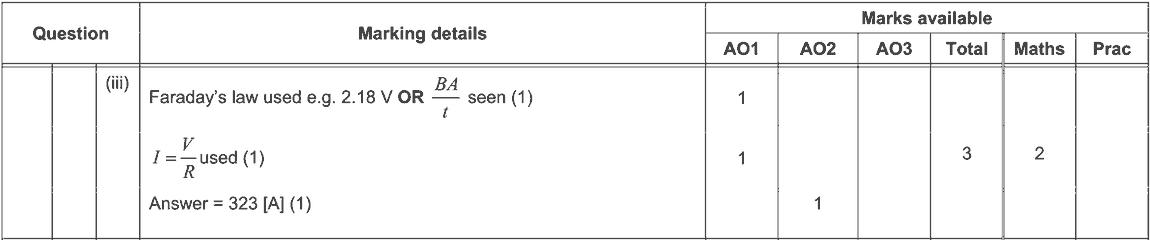
10(b)(iii) Electromagnetic induction 3AO1=2,AO2=1Calculation
10(b)(iv) Magnetic fields 3AO3=3Calculation
11(a) Alternating currents 3AO1=3Explanation
11(b)(i) Alternating currents 3AO1=2,AO2=1Show that
11(b)(ii) Alternating currents 3AO2=3Calculation
11(b)(iii) Alternating currents 1AO2=1Short answer
11(b)(iv) Alternating currents 3AO1=1,AO2=2Diagram or graph
11(b)(v) Alternating currents 2AO2=2Calculation
11(c) Alternating currents 5AO3=5Calculation
12(a)(i) Medical physics 1AO2=1Diagram or graph
12(a)(ii) Medical physics 2AO1=1,AO2=1Calculation
12(a)(iii) Medical physics 2AO1=1,AO2=1Calculation
12(a)(iv) Medical physics 1AO2=1Short answer
12(b)(i) Medical physics 2AO1=2Explanation
12(b)(ii) Medical physics 3AO2=3Calculation
12(c)(i) Medical physics 3AO3=3Explanation
12(c)(ii) Medical physics 2AO3=2Explanation
12(d) Medical physics 4AO1=2,AO2=2Calculation
13(a)(i) The physics of sports 2AO1=2Definition
13(a)(ii) The physics of sports 3AO1=1,AO2=2Calculation
13(b)(i) The physics of sports 5AO3=5Calculation
13(b)(ii) The physics of sports 2AO2=2Explanation
13(b)(iii) The physics of sports 2AO2=2Calculation
13(c)(i) The physics of sports 3AO1=3Explanation
13(c)(ii) The physics of sports 3AO2=3Calculation
14(a)(i) Energy and the environment 2AO1=1,AO2=1Calculation
14(a)(ii) Energy and the environment 3AO2=3Show that
14(a)(iii) Energy and the environment 3AO2=3Explanation
14(b)(i) Energy and the environment 3AO1=3Explanation
14(b)(ii) Energy and the environment 2AO2=2Calculation
14(c)(i) Energy and the environment 2AO1=2Definition
14(c)(ii) Energy and the environment 5AO3=5Calculation

The questions

1(a)1(b)(i)1(b)(ii)1(b)(iii)1(c)2(a)2(b)3(a)(i)3(a)(ii)3(b)3(c)4(a)4(b)4(c)5(a)(i)5(a)(ii)5(a)(iii)5(a)(iv)I5(a)(iv)II5(b)5(c)67(a)7(b)7(c)(i)7(c)(ii)8(a)8(b)9(a)9(b)10(a)(i)10(a)(ii)10(a)(iii)10(b)(i)10(b)(ii)10(b)(iii)10(b)(iv)11(a)11(b)(i)11(b)(ii)11(b)(iii)11(b)(iv)11(b)(v)11(c)12(a)(i)12(a)(ii)12(a)(iii)12(a)(iv)12(b)(i)12(b)(ii)12(c)(i)12(c)(ii)12(d)13(a)(i)13(a)(ii)13(b)(i)13(b)(ii)13(b)(iii)13(c)(i)13(c)(ii)14(a)(i)14(a)(ii)14(a)(iii)14(b)(i)14(b)(ii)14(c)(i)14(c)(ii)
October 2020 · Component 3 · Q1(a) 2 marks AO3=2 Explanation nature of waves
1. (a) Bruce throws a lump of coal towards Dani which she catches. Bruce claims that, because chemical energy is being transferred from himself to Dani, the lump of coal is a wave. Explain whether or not Bruce is correct. [2]
October 2020 · Component 3 · Q1(b)(i) 3 marks AO1=2, AO2=1 Explanation wave properties
Earlier part of question 1 that this part usesEarlier part of October 2020 Component 3 question 1
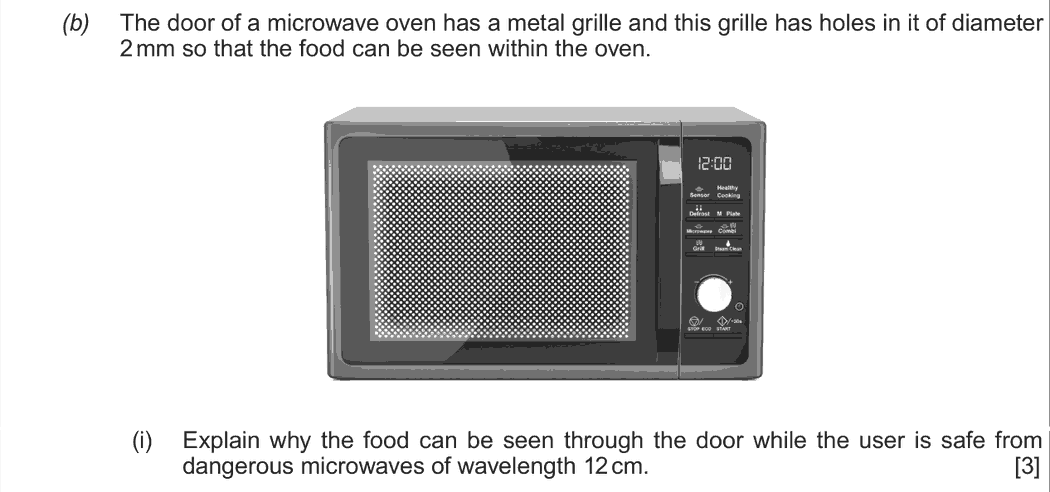
(b) The door of a microwave oven has a metal grille and this grille has holes in it of diameter 2 mm so that the food can be seen within the oven. (i) Explain why the food can be seen through the door while the user is safe from dangerous microwaves of wavelength 12 cm. [3]
October 2020 · Component 3 · Q1(b)(ii) 1 mark AO1=1 Short answer photons
Earlier parts of question 1 that this part usesEarlier part of October 2020 Component 3 question 1Earlier part of October 2020 Component 3 question 1
(ii) State or calculate a typical photon energy of visible light. [1]
October 2020 · Component 3 · Q1(b)(iii) 1 mark AO2=1 Short answer photons
Earlier parts of question 1 that this part usesEarlier part of October 2020 Component 3 question 1Earlier part of October 2020 Component 3 question 1
(iii) Explain whether or not a microwave photon has a greater or smaller energy than a visible photon. [1]
October 2020 · Component 3 · Q1(c) 4 marks AO2=4 Diagram or graph wave properties
Earlier parts of question 1 that this part usesEarlier part of October 2020 Component 3 question 1Earlier part of October 2020 Component 3 question 1
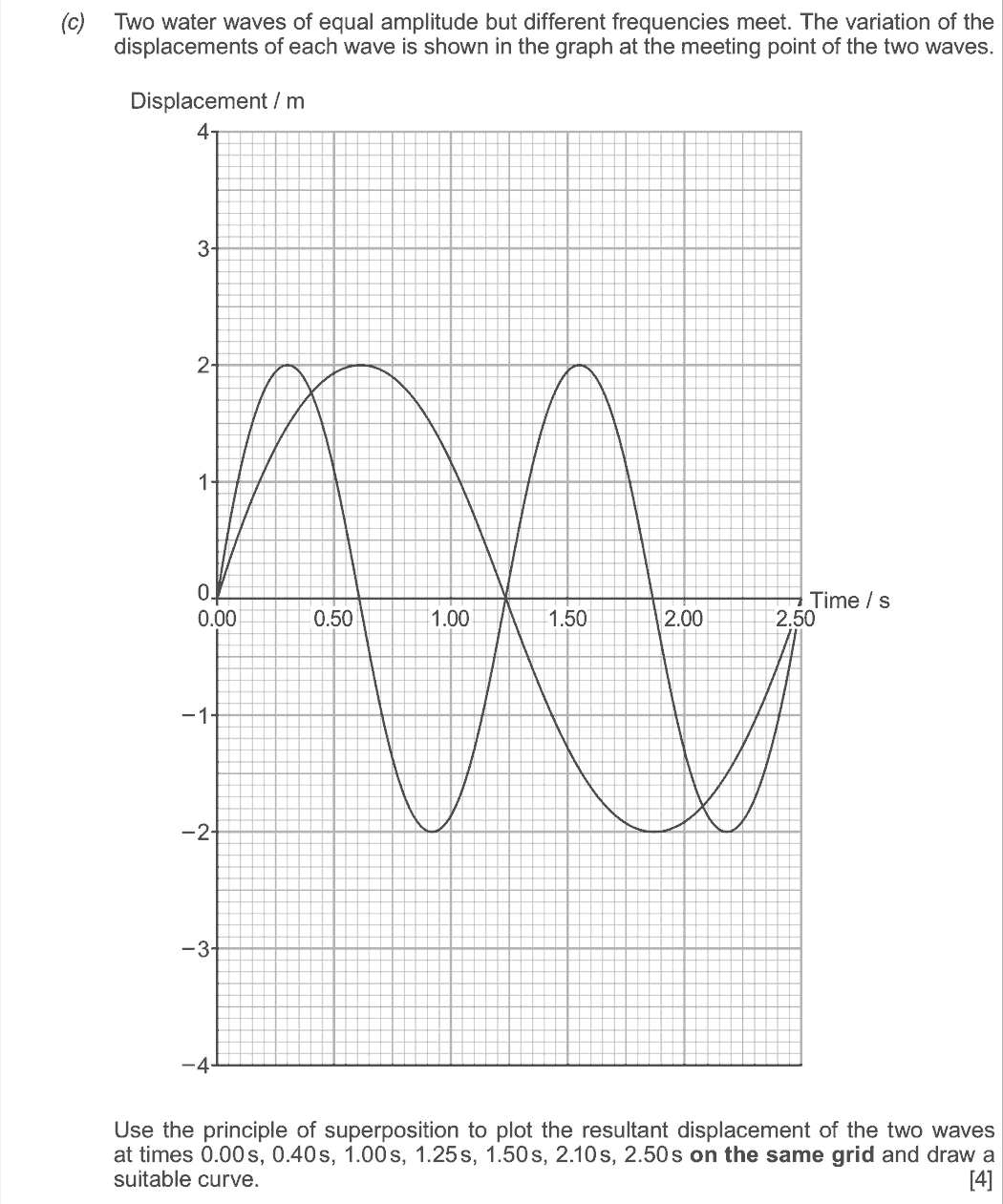
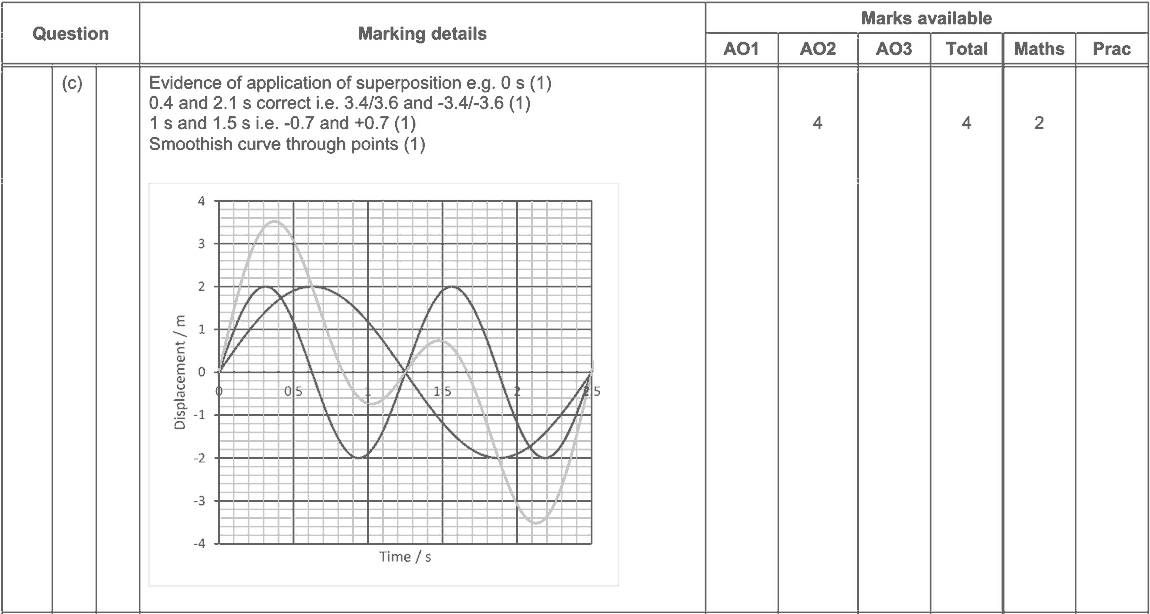
(c) Two water waves of equal amplitude but different frequencies meet. The variation of the displacements of each wave is shown in the graph at the meeting point of the two waves. Displacement / m 4 3 2 1 0 Time / s 0.00 0.50 1.00 1.50 2.00 2.50 –1 –2 –3 –4 Use the principle of superposition to plot the resultant displacement of the two waves at times 0.00 s, 0.40 s, 1.00 s, 1.25 s, 1.50 s, 2.10 s, 2.50 s on the same grid and draw a suitable curve. [4]
October 2020 · Component 3 · Q2(a) 3 marks AO1=1, AO2=2 Calculation photons
2. (a) Calculate the de Broglie wavelength of an electron accelerated by a pd of 2 200 V. [3]
October 2020 · Component 3 · Q2(b) 3 marks AO1=2, AO2=1 Explanation photons
Earlier part of question 2 that this part usesEarlier part of October 2020 Component 3 question 2
(b) Explain how electrons can be used in a laboratory to produce a diffraction pattern and the effect of increasing the pd on the diffraction pattern. [3]
October 2020 · Component 3 · Q3(a)(i) 3 marks AO2=3 Show that wave properties
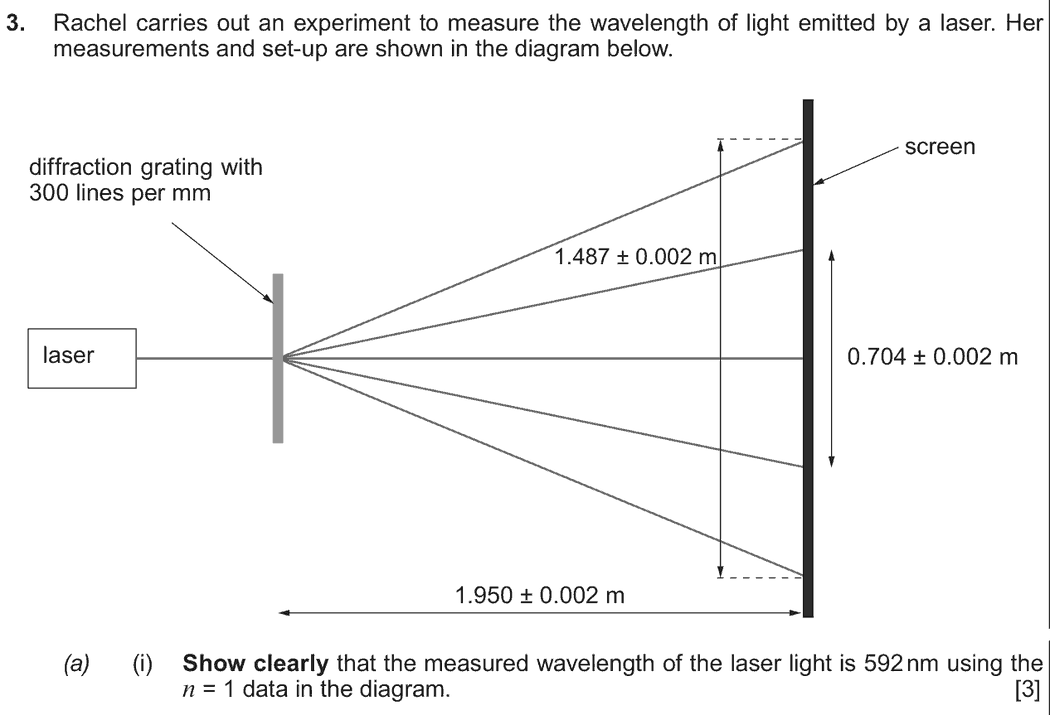
3. Rachel carries out an experiment to measure the wavelength of light emitted by a laser. Her measurements and set-up are shown in the diagram below. screen diffraction grating with 300 lines per mm 1.487 ± 0.002 m laser 0.704 ± 0.002 m 1.950 ± 0.002 m (a) (i) Show clearly that the measured wavelength of the laser light is 592 nm using the n = 1 data in the diagram. [3]
October 2020 · Component 3 · Q3(a)(ii) 4 marks AO2=4 Practical and data analysis wave properties
Earlier part of question 3 that this part usesEarlier part of October 2020 Component 3 question 3
(ii) Show clearly that the n = 1 data in the diagram leads to an uncertainty in the wavelength of ± 2 nm. You may assume that the manufacturer’s labelling of 300 lines per mm for the diffraction grating is exact and that tanθ ≈ sinθ ≈ θ. [4]
October 2020 · Component 3 · Q3(b) 2 marks AO3=2 Practical and data analysis wave properties
Earlier part of question 3 that this part usesEarlier part of October 2020 Component 3 question 3
(b) The manufacturer of the laser states that its wavelength is exactly 593.5 nm. The n = 2 data in the diagram lead to a measured laser wavelength of 594 ± 1 nm. Explain whether or not these values and the value from part (a) are all consistent. [2]
October 2020 · Component 3 · Q3(c) 2 marks AO3=2 Practical and data analysis wave properties
Earlier part of question 3 that this part usesEarlier part of October 2020 Component 3 question 3
(c) Explain why the n = 1 data (592 ± 2 nm) lead to a larger uncertainty than the n = 2 data (594 ± 1 nm). [2]
October 2020 · Component 3 · Q4(a) 2 marks AO1=2 Definition lasers
4. (a) Explain what is meant by stimulated emission of radiation. [2]
October 2020 · Component 3 · Q4(b) 2 marks AO1=2 Short answer lasers
Earlier part of question 4 that this part usesEarlier part of October 2020 Component 3 question 4
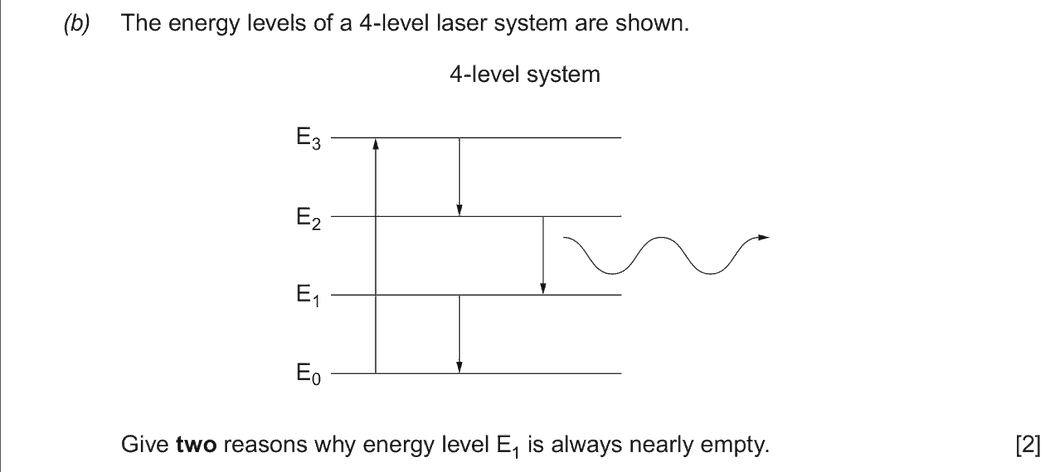
(b) The energy levels of a 4-level laser system are shown. 4-level system E3 E2 E1 E0 Give two reasons why energy level E1 is always nearly empty. [2]
October 2020 · Component 3 · Q4(c) 3 marks AO3=3 Explanation lasers
Earlier parts of question 4 that this part usesEarlier part of October 2020 Component 3 question 4Earlier part of October 2020 Component 3 question 4
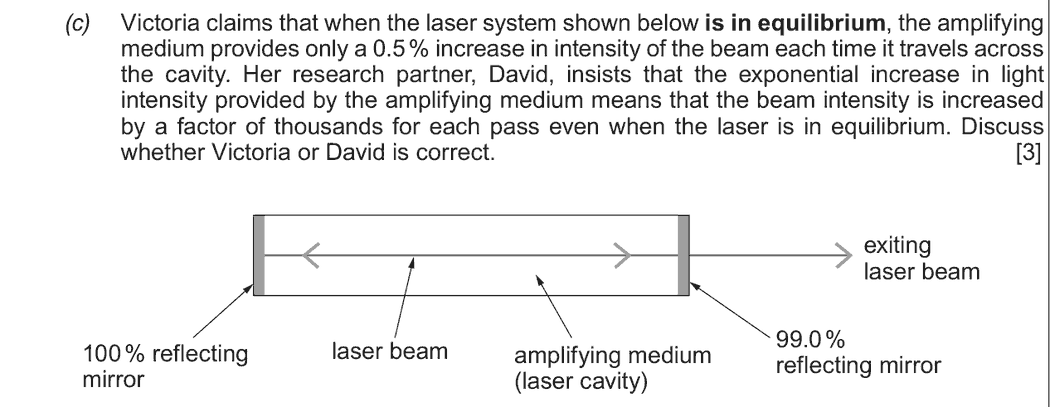
(c) Victoria claims that when the laser system shown below is in equilibrium, the amplifying medium provides only a 0.5 % increase in intensity of the beam each time it travels across the cavity. Her research partner, David, insists that the exponential increase in light intensity provided by the amplifying medium means that the beam intensity is increased by a factor of thousands for each pass even when the laser is in equilibrium. Discuss whether Victoria or David is correct. [3] exiting laser beam 99.0 % 100 % reflecting laser beam amplifying medium reflecting mirror mirror (laser cavity)
October 2020 · Component 3 · Q5(a)(i) 3 marks AO2=3 Practical and data analysis nuclear decay
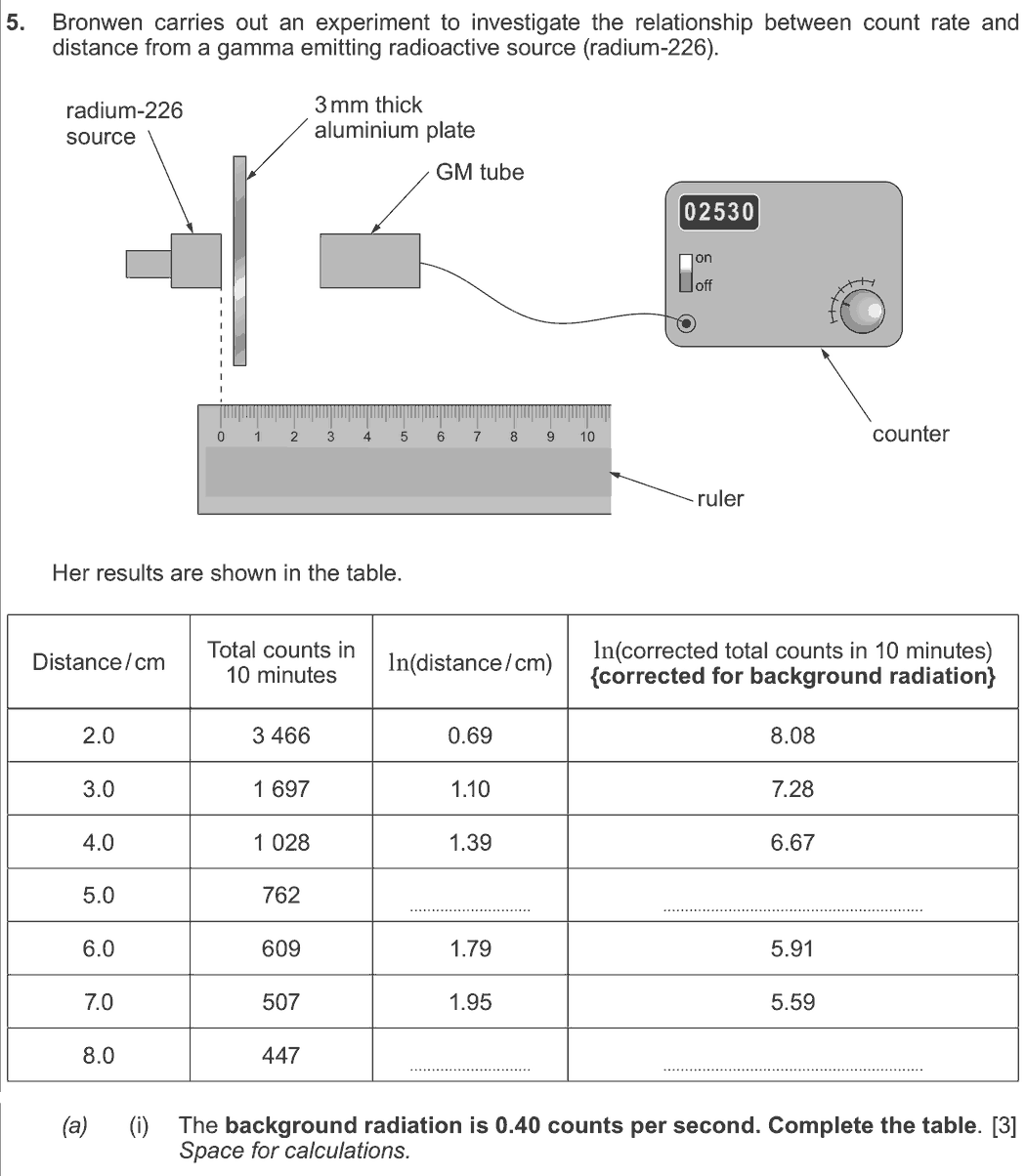
5. Bronwen carries out an experiment to investigate the relationship between count rate and distance from a gamma emitting radioactive source (radium-226). radium-226 3 mm thick source aluminium plate GM tube 02530 on off counter 0 1 2 3 4 5 6 7 8 9 10 ruler Her results are shown in the table. Total counts in ln(corrected total counts in 10 minutes) Distance / cm ln(distance / cm) 10 minutes {corrected for background radiation} 2.0 3 466 0.69 8.08 3.0 1 697 1.10 7.28 4.0 1 028 1.39 6.67 5.0 762 6.0 609 1.79 5.91 7.0 507 1.95 5.59 8.0 447 (a) (i) The background radiation is 0.40 counts per second. Complete the table. [3] Space for calculations.
October 2020 · Component 3 · Q5(a)(ii) 1 mark AO2=1 Diagram or graph nuclear decay
Earlier part of question 5 that this part usesEarlier part of October 2020 Component 3 question 5
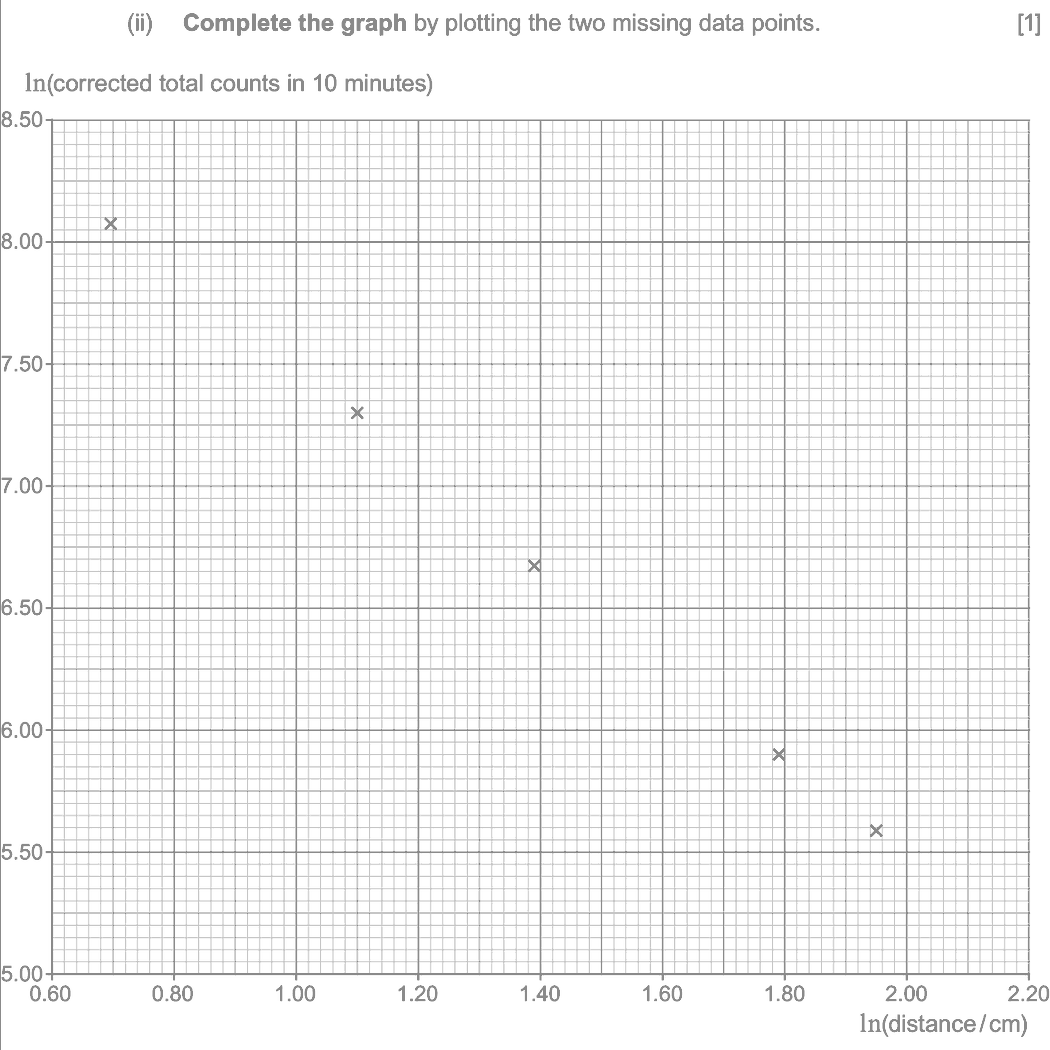
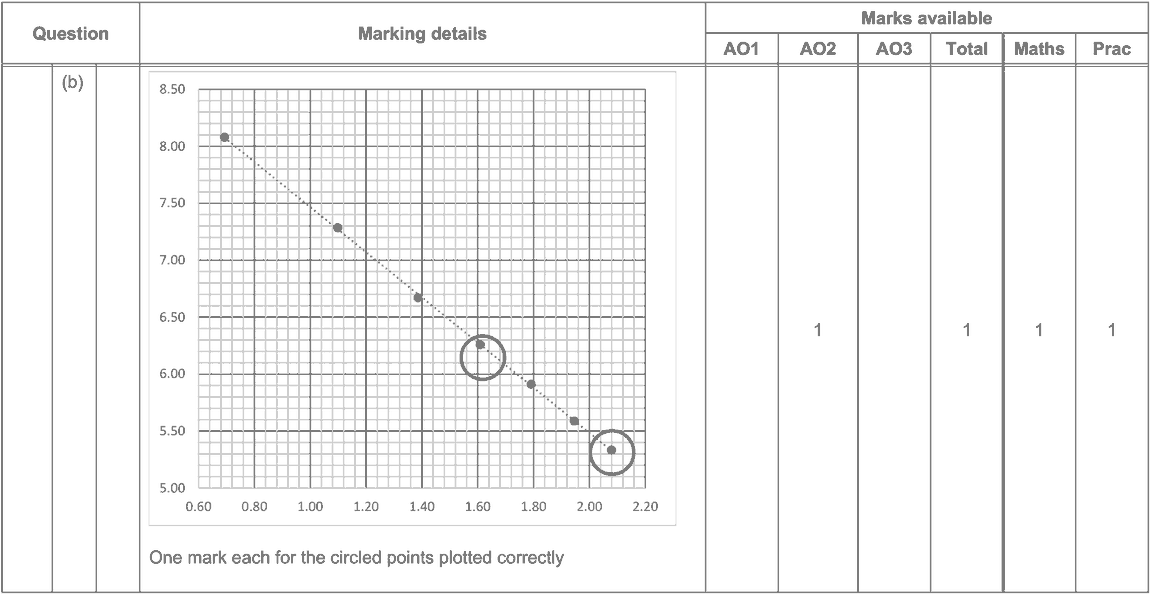
(ii) Complete the graph by plotting the two missing data points. [1] ln(corrected total counts in 10 minutes) 8.50 8.00 7.50 7.00 6.50 6.00 5.50 5.00 0.60 0.80 1.00 1.20 1.40 1.60 1.80 2.00 2.20 ln(distance / cm)
October 2020 · Component 3 · Q5(a)(iii) 3 marks AO2=3 Practical and data analysis nuclear decay
Earlier parts of question 5 that this part usesEarlier part of October 2020 Component 3 question 5Earlier part of October 2020 Component 3 question 5
(iii) Draw a line of best fit and calculate its gradient. [3]
October 2020 · Component 3 · Q5(a)(iv)I 2 marks AO2=2 Show that nuclear decay
Earlier parts of question 5 that this part usesEarlier part of October 2020 Component 3 question 5Earlier part of October 2020 Component 3 question 5
(iv) Theory suggests that: 1 count rate ∝ distance2 I. Show that the gradient of the graph should be –2. [2]
October 2020 · Component 3 · Q5(a)(iv)II 3 marks AO3=3 Practical and data analysis nuclear decay
Earlier parts of question 5 that this part usesEarlier part of October 2020 Component 3 question 5Earlier part of October 2020 Component 3 question 5Earlier part of October 2020 Component 3 question 5
II. Explain to what extent the results obtained in this experiment agree with theory. [3]
October 2020 · Component 3 · Q5(b) 1 mark AO1=1 Short answer nuclear decay
Earlier parts of question 5 that this part usesEarlier part of October 2020 Component 3 question 5Earlier part of October 2020 Component 3 question 5
(b) Radium-226 also emits other radiation. Suggest a reason for using a 3 mm aluminium plate between the source and the GM tube. [1]
October 2020 · Component 3 · Q5(c) 3 marks AO3=3 Explanation nuclear decay
Earlier parts of question 5 that this part usesEarlier part of October 2020 Component 3 question 5Earlier part of October 2020 Component 3 question 5
(c) In 1896, G. Brandes reported that large intensities of high energy X-rays produced a “blue-grey” glow within the eye. This was later confirmed by Willhelm Röntgen and other scientists. The mechanism for this “blue-grey” glow is still not fully understood. Discuss the ethics of reproducing this experiment to understand it better. [3]
October 2020 · Component 3 · Q6 6 marks AO1=6 6-mark extended response particles and nuclear structure
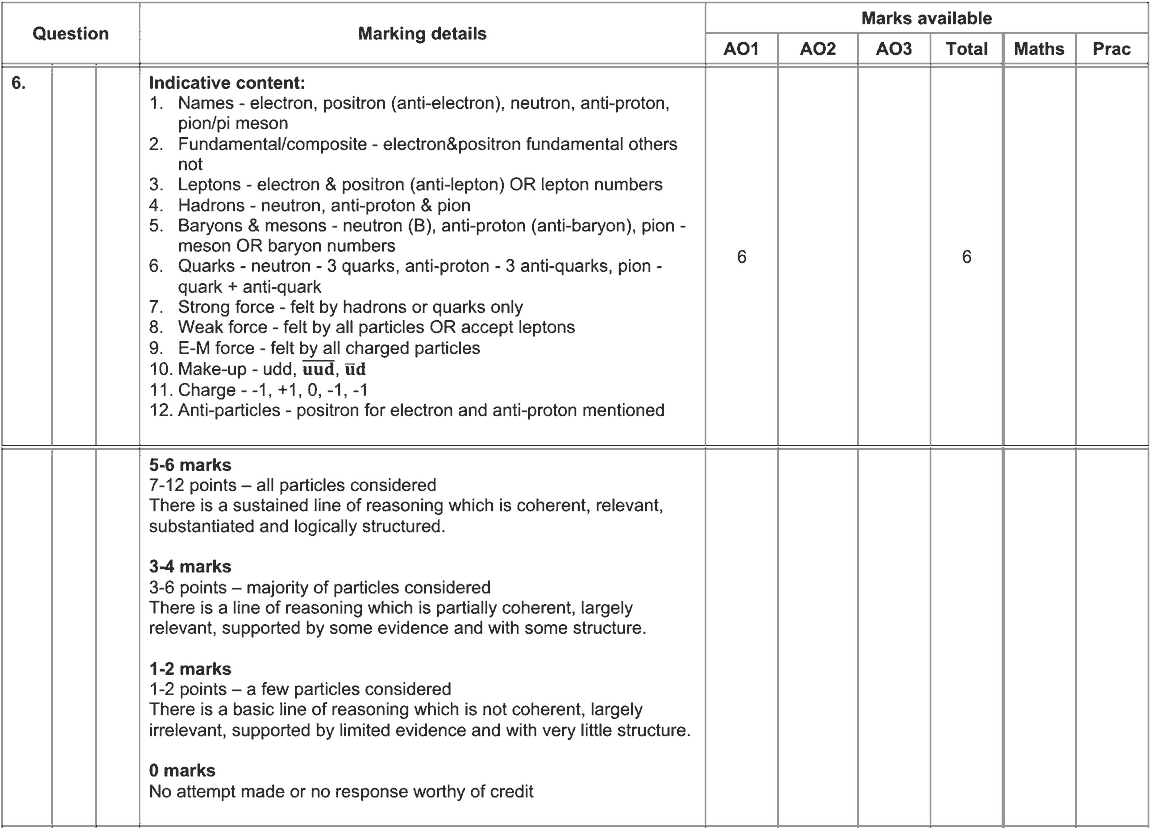
6. Discuss the make-up and properties of the following particles e−, e+, n, p, π− . [6 QER]
October 2020 · Component 3 · Q7(a) 2 marks AO1=1, AO2=1 Short answer nuclear decay
7. (a) The bismuth isotope ( 209 Bi) decays by alpha decay to an isotope of thallium (Tl). Fill in 83 the missing numbers for this decay. [2] 209 Bi Tl + He 83
October 2020 · Component 3 · Q7(b) 5 marks AO3=5 Calculation nuclear energy
Earlier part of question 7 that this part usesEarlier part of October 2020 Component 3 question 7
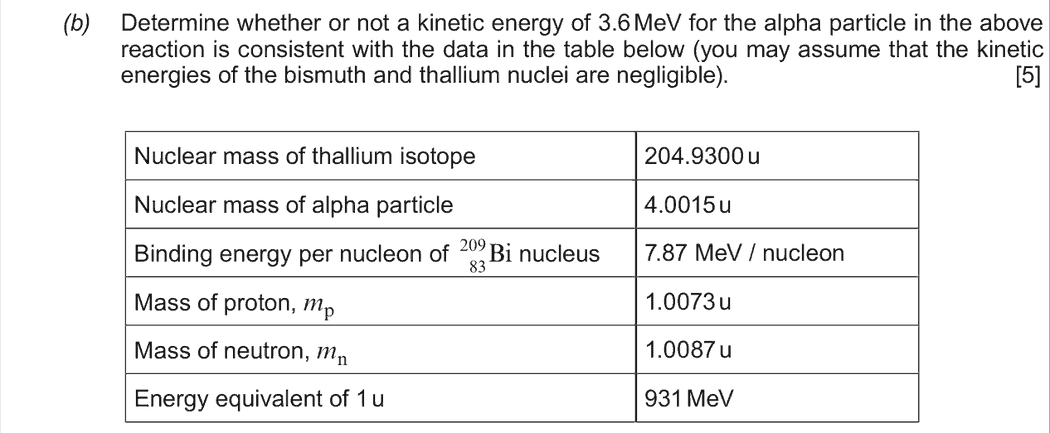
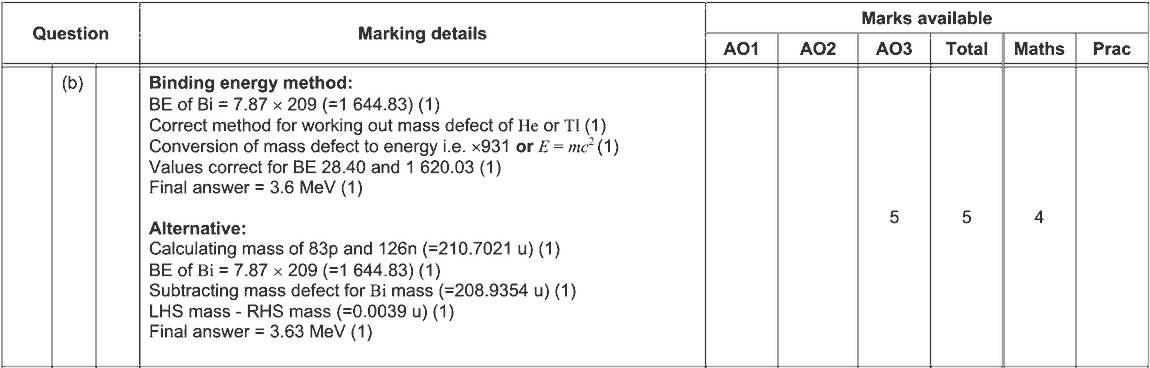
(b) Determine whether or not a kinetic energy of 3.6 MeV for the alpha particle in the above reaction is consistent with the data in the table below (you may assume that the kinetic energies of the bismuth and thallium nuclei are negligible). [5] Nuclear mass of thallium isotope 204.9300 u Nuclear mass of alpha particle 4.0015 u Binding energy per nucleon of 209 Bi nucleus 7.87 MeV / nucleon 83 Mass of proton, mp 1.0073 u Mass of neutron, mn 1.0087 u Energy equivalent of 1 u 931 MeV
October 2020 · Component 3 · Q7(c)(i) 4 marks AO1=1, AO2=3 Calculation nuclear decay
Earlier parts of question 7 that this part usesEarlier part of October 2020 Component 3 question 7Earlier part of October 2020 Component 3 question 7
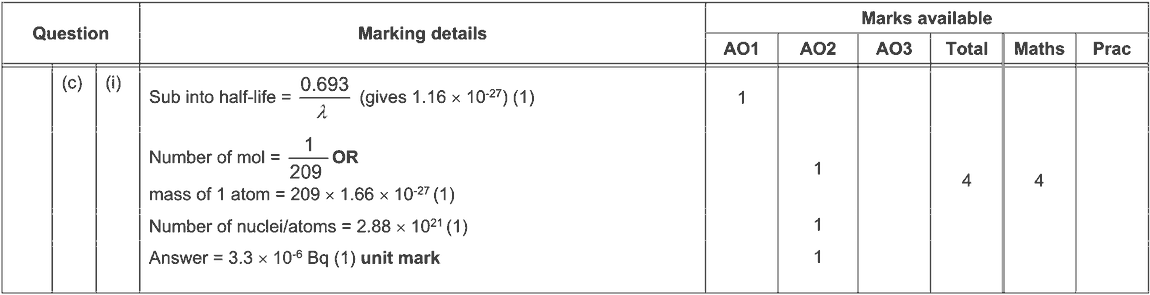
(c) (i) The half-life of 209 Bi is 1.9 × 10¹⁹ year. Calculate the activity of 1.00 gram of 83 209 Bi. [4] 83
October 2020 · Component 3 · Q7(c)(ii) 2 marks AO2=2 Calculation nuclear decay
Earlier parts of question 7 that this part usesEarlier part of October 2020 Component 3 question 7Earlier part of October 2020 Component 3 question 7Earlier part of October 2020 Component 3 question 7
(ii) Determine the number of nuclei in 1.00 gram of 209 Bi which will decay in 5 years. 83 [2]
October 2020 · Component 3 · Q8(a) 5 marks AO1=1, AO2=4 Show that magnetic fields
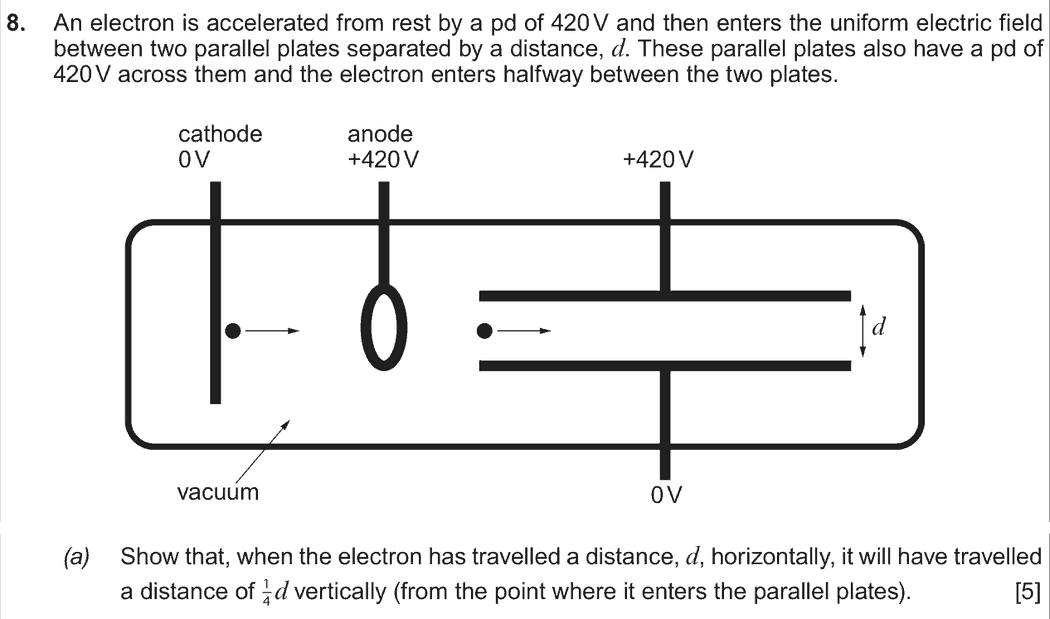
8. An electron is accelerated from rest by a pd of 420 V and then enters the uniform electric field between two parallel plates separated by a distance, d. These parallel plates also have a pd of 420 V across them and the electron enters halfway between the two plates. cathode anode 0 V +420 V +420 V d vacuum 0 V (a) Show that, when the electron has travelled a distance, d, horizontally, it will have travelled a distance of 1 d vertically (from the point where it enters the parallel plates). [5] 4
October 2020 · Component 3 · Q8(b) 2 marks AO3=2 Explanation magnetic fields
Earlier part of question 8 that this part usesEarlier part of October 2020 Component 3 question 8
(b) Explain whether or not an oxygen ion with charge –2e accelerated from rest in the above set-up instead of an electron would pass through the same point. [2]
October 2020 · Component 3 · Q9(a) 5 marks AO1=2, AO2=3 Explanation photons
9. (a) A sphere made of caesium is placed in space and illuminated by ultraviolet radiation of photon energy 10.3 eV. The work function of caesium is 2.1 eV. Explain in clear steps, using Einstein’s photoelectric equation (and other physics), why the maximum potential attainable by the caesium sphere is +8.2 V. [5]
October 2020 · Component 3 · Q9(b) 3 marks AO1=1, AO2=2 Calculation electrostatic and gravitational fields
Earlier part of question 9 that this part usesEarlier part of October 2020 Component 3 question 9
(b) Hence, calculate the maximum electric field strength around the caesium sphere given that its radius is 6.5 cm. [3]
October 2020 · Component 3 · Q10(a)(i) 1 mark AO1=1 Calculation magnetic fields
10. (a) (i) A long solenoid has 12 000 turns per metre and carries a current of 3.8 A. Calculate the magnetic flux density at its centre. [1]
October 2020 · Component 3 · Q10(a)(ii) 2 marks AO1=2 Diagram or graph magnetic fields
Earlier part of question 10 that this part usesEarlier part of October 2020 Component 3 question 10
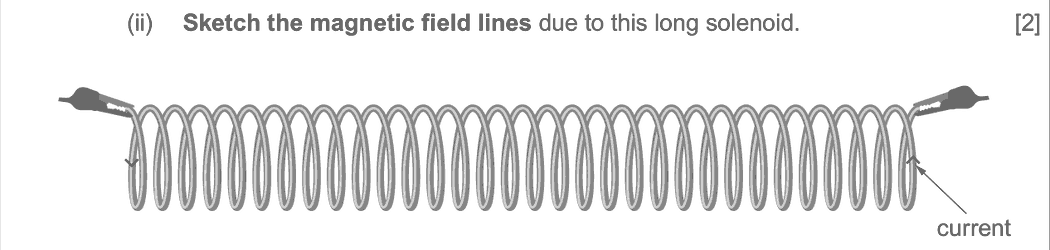
(ii) Sketch the magnetic field lines due to this long solenoid. [2] current
October 2020 · Component 3 · Q10(a)(iii) 1 mark AO1=1 Short answer magnetic fields
Earlier part of question 10 that this part usesEarlier part of October 2020 Component 3 question 10
(iii) State how the strength of the magnetic field produced by this solenoid can be increased greatly without increasing the current or changing the dimensions of the solenoid. [1]
October 2020 · Component 3 · Q10(b)(i) 3 marks AO2=3 Explanation electromagnetic induction
Earlier part of question 10 that this part usesEarlier part of October 2020 Component 3 question 10
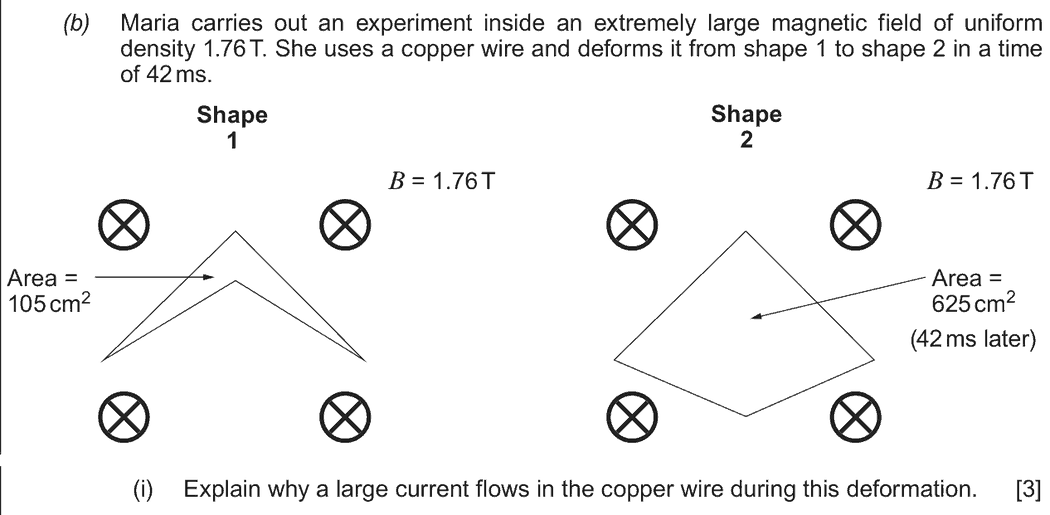
(b) Maria carries out an experiment inside an extremely large magnetic field of uniform density 1.76 T. She uses a copper wire and deforms it from shape 1 to shape 2 in a time of 42 ms. Shape Shape 1 2 B = 1.76 T B = 1.76 T Area = Area = 105 cm2 625 cm2 (42 ms later) (i) Explain why a large current flows in the copper wire during this deformation. [3]
October 2020 · Component 3 · Q10(b)(ii) 2 marks AO1=1, AO2=1 Explanation electromagnetic induction
Earlier parts of question 10 that this part usesEarlier part of October 2020 Component 3 question 10Earlier part of October 2020 Component 3 question 10
(ii) Explain how you can deduce that this current flows anticlockwise. [2]
October 2020 · Component 3 · Q10(b)(iii) 3 marks AO1=2, AO2=1 Calculation electromagnetic induction
Earlier parts of question 10 that this part usesEarlier part of October 2020 Component 3 question 10Earlier part of October 2020 Component 3 question 10
(iii) Calculate the mean current flowing in the copper wire given that its resistance is 6.75 × 10⁻³ Ω. [3]
October 2020 · Component 3 · Q10(b)(iv) 3 marks AO3=3 Calculation magnetic fields
Earlier parts of question 10 that this part usesEarlier part of October 2020 Component 3 question 10Earlier part of October 2020 Component 3 question 10
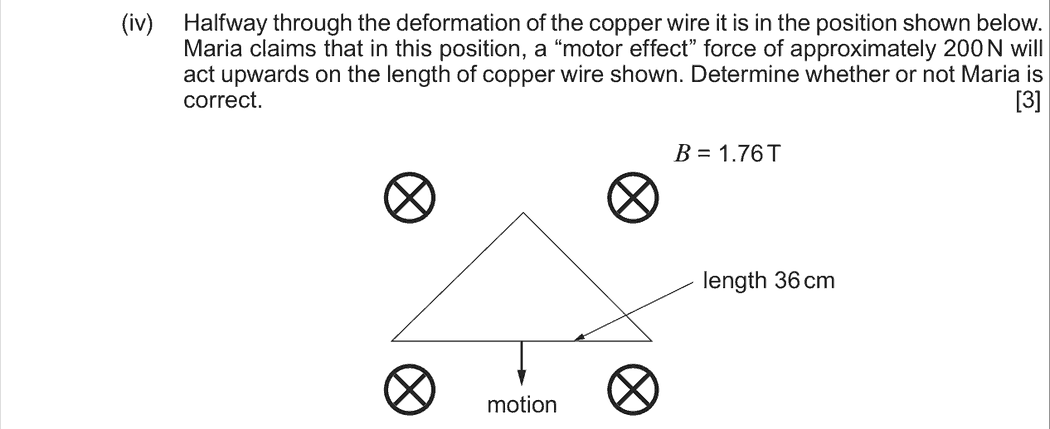
(iv) Halfway through the deformation of the copper wire it is in the position shown below. Maria claims that in this position, a “motor effect” force of approximately 200 N will act upwards on the length of copper wire shown. Determine whether or not Maria is correct. [3] B = 1.76 T length 36 cm motion
October 2020 · Component 3 · Q11(a) 3 marks AO1=3 Explanation alternating currents
11. (a) With the aid of a phasor diagram, explain why the impedance of an RCL circuit is given by: [3] ( ) 2 Z = XL −XC + R2
October 2020 · Component 3 · Q11(b)(i) 3 marks AO1=2, AO2=1 Show that alternating currents
Earlier part of question 11 that this part usesEarlier part of October 2020 Component 3 question 11
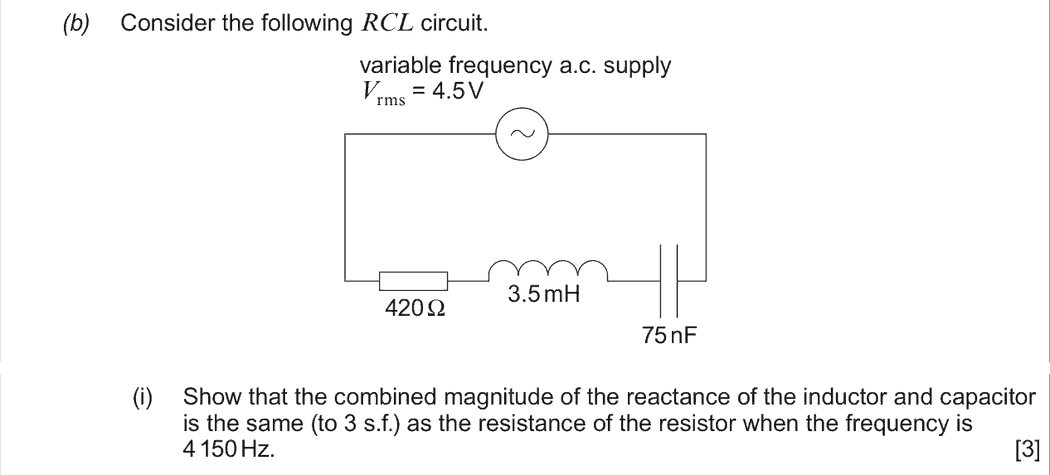
(b) Consider the following RCL circuit. variable frequency a.c. supply Vrms = 4.5 V 3.5 mH 420 Ω 75 nF (i) Show that the combined magnitude of the reactance of the inductor and capacitor is the same (to 3 s.f.) as the resistance of the resistor when the frequency is 4 150 Hz. [3]
October 2020 · Component 3 · Q11(b)(ii) 3 marks AO2=3 Calculation alternating currents
Earlier parts of question 11 that this part usesEarlier part of October 2020 Component 3 question 11Earlier part of October 2020 Component 3 question 11
(ii) Hence, calculate the rms current in the circuit when the frequency is 4 150 Hz. [3]
October 2020 · Component 3 · Q11(b)(iii) 1 mark AO2=1 Short answer alternating currents
Earlier parts of question 11 that this part usesEarlier part of October 2020 Component 3 question 11Earlier part of October 2020 Component 3 question 11
(iii) Calculate (or state) the phase angle between the applied pd and the current when the frequency is 4 150 Hz. [1]
October 2020 · Component 3 · Q11(b)(iv) 3 marks AO1=1, AO2=2 Diagram or graph alternating currents
Earlier parts of question 11 that this part usesEarlier part of October 2020 Component 3 question 11Earlier part of October 2020 Component 3 question 11
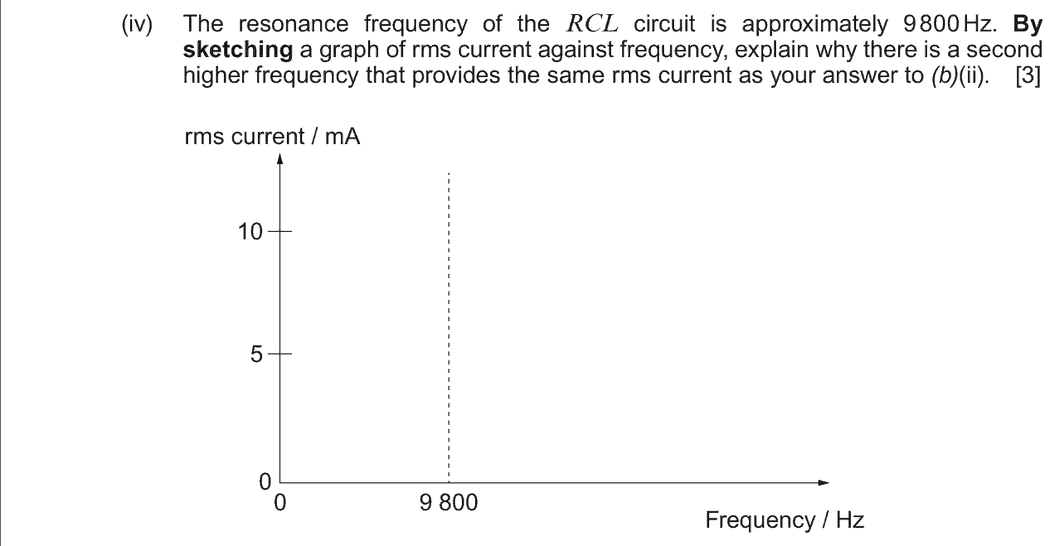
(iv) The resonance frequency of the RCL circuit is approximately 9 800 Hz. By sketching a graph of rms current against frequency, explain why there is a second higher frequency that provides the same rms current as your answer to (b)(ii). [3] rms current / mA 10 5 0 0 9 800 Frequency / Hz
October 2020 · Component 3 · Q11(b)(v) 2 marks AO2=2 Calculation alternating currents
Earlier parts of question 11 that this part usesEarlier part of October 2020 Component 3 question 11Earlier part of October 2020 Component 3 question 11Earlier part of October 2020 Component 3 question 11
(v) This second frequency occurs when the magnitude of the reactances of the inductor and capacitor are reversed from those in part (b)(i). Use this information to calculate this second frequency. [2]
October 2020 · Component 3 · Q11(c) 5 marks AO3=5 Calculation alternating currents
Earlier parts of question 11 that this part usesEarlier part of October 2020 Component 3 question 11Earlier part of October 2020 Component 3 question 11Earlier part of October 2020 Component 3 question 11
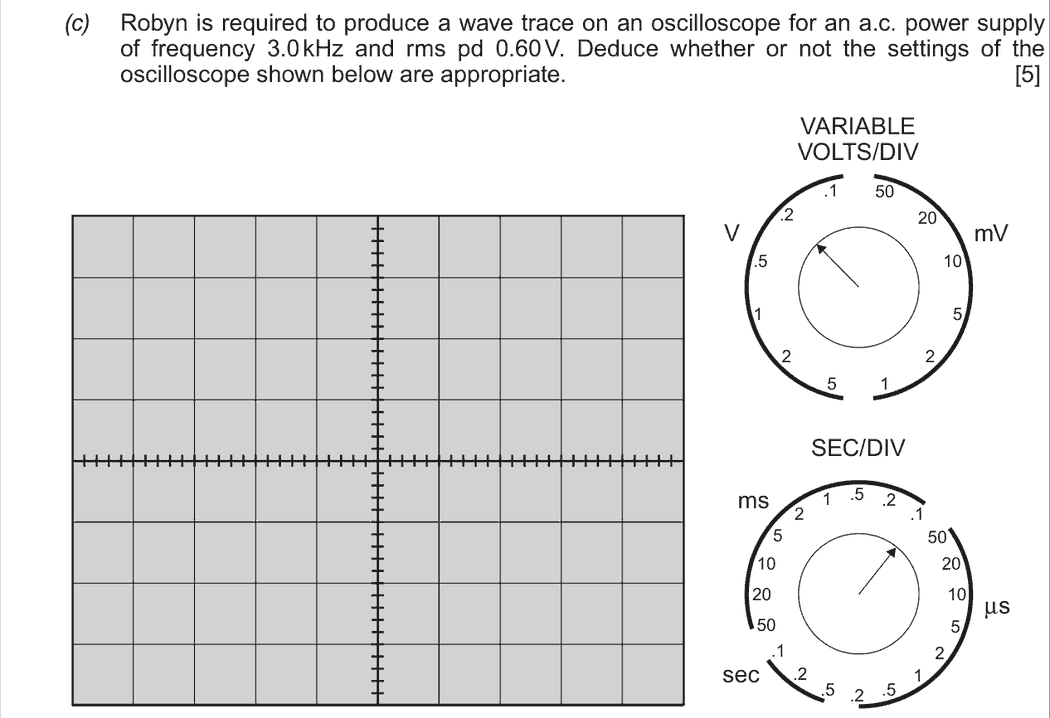
(c) Robyn is required to produce a wave trace on an oscilloscope for an a.c. power supply of frequency 3.0 kHz and rms pd 0.60 V. Deduce whether or not the settings of the oscilloscope shown below are appropriate. [5] VARIABLE VOLTS/DIV .1 50 .2 20 V mV .5 10 1 5 2 2 5 1 SEC/DIV ms 1 .5 .2 2 .1 5 50 10 20 20 10 μs 50 5 .1 2 sec .2 1 .5 .2 .5


October 2020 · Component 3 · Q12(a)(i) 1 mark AO2=1 Diagram or graph medical physics

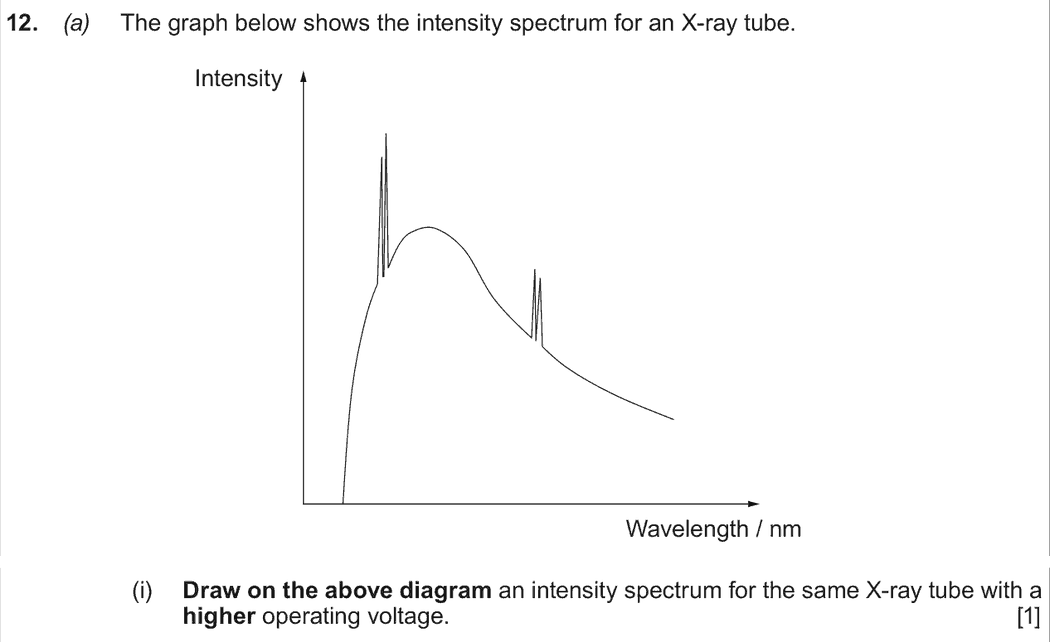
12. (a) The graph below shows the intensity spectrum for an X-ray tube. Intensity Wavelength / nm (i) Draw on the above diagram an intensity spectrum for the same X-ray tube with a higher operating voltage. [1]
October 2020 · Component 3 · Q12(a)(ii) 2 marks AO1=1, AO2=1 Calculation medical physics
Earlier part of question 12 that this part usesEarlier part of October 2020 Component 3 question 12
(ii) If the operating voltage of the tube is 30 000 V, determine the minimum wavelength of the X-rays produced. [2]
October 2020 · Component 3 · Q12(a)(iii) 2 marks AO1=1, AO2=1 Calculation medical physics
Earlier part of question 12 that this part usesEarlier part of October 2020 Component 3 question 12
(iii) If the anode current is 120 mA and the X-ray tube has an efficiency of 0.450 % calculate the rate of production of heat at the anode. [2]
October 2020 · Component 3 · Q12(a)(iv) 1 mark AO2=1 Short answer medical physics
Earlier part of question 12 that this part usesEarlier part of October 2020 Component 3 question 12
(iv) Explain whether it would be possible to reduce the minimum wavelength to zero. [1]
October 2020 · Component 3 · Q12(b)(i) 2 marks AO1=2 Explanation medical physics
Earlier part of question 12 that this part usesEarlier part of October 2020 Component 3 question 12
(b) (i) An ultrasound probe (A scan) can be used to determine the thickness of a lens in the human eye. Explain how a piezoelectric transducer can be used to produce ultrasound. [2]
October 2020 · Component 3 · Q12(b)(ii) 3 marks AO2=3 Calculation medical physics
Earlier parts of question 12 that this part usesEarlier part of October 2020 Component 3 question 12Earlier part of October 2020 Component 3 question 12
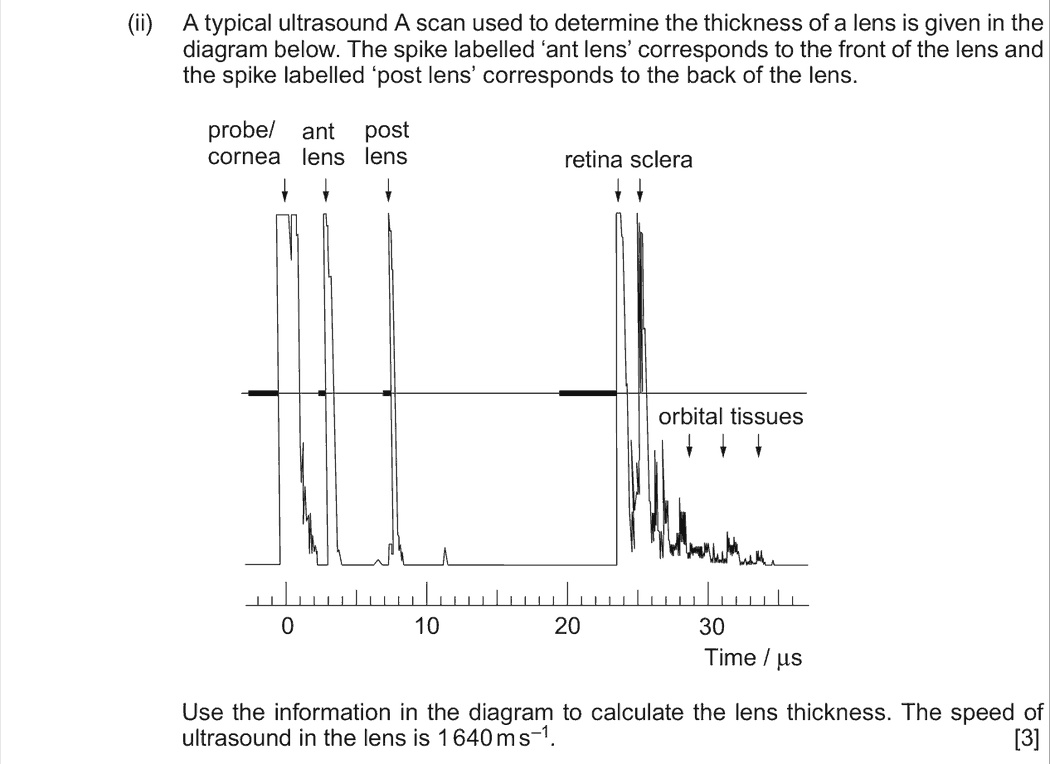
(ii) A typical ultrasound A scan used to determine the thickness of a lens is given in the diagram below. The spike labelled ‘ant lens’ corresponds to the front of the lens and the spike labelled ‘post lens’ corresponds to the back of the lens. probe/ ant post cornea lens lens retina sclera orbital tissues 0 10 20 30 Time / μs Use the information in the diagram to calculate the lens thickness. The speed of ultrasound in the lens is 1 640 m s–1. [3]
October 2020 · Component 3 · Q12(c)(i) 3 marks AO3=3 Explanation medical physics
Earlier parts of question 12 that this part usesEarlier part of October 2020 Component 3 question 12Earlier part of October 2020 Component 3 question 12
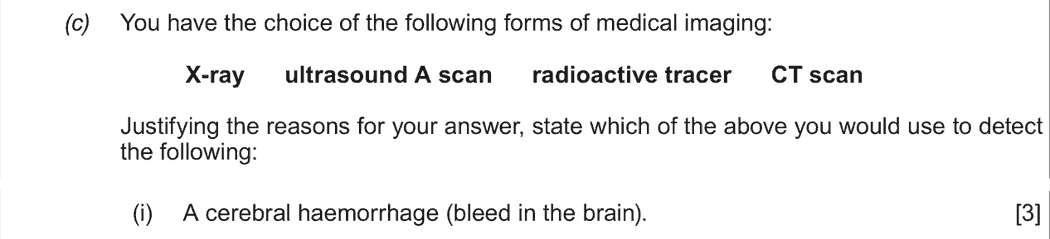
(c) You have the choice of the following forms of medical imaging: X-ray ultrasound A scan radioactive tracer CT scan Justifying the reasons for your answer, state which of the above you would use to detect the following: (i) A cerebral haemorrhage (bleed in the brain). [3]
October 2020 · Component 3 · Q12(c)(ii) 2 marks AO3=2 Explanation medical physics
Earlier parts of question 12 that this part usesEarlier part of October 2020 Component 3 question 12Earlier part of October 2020 Component 3 question 12Earlier part of October 2020 Component 3 question 12
(ii) An underactive thyroid gland. [2]
October 2020 · Component 3 · Q12(d) 4 marks AO1=2, AO2=2 Calculation medical physics
Earlier parts of question 12 that this part usesEarlier part of October 2020 Component 3 question 12Earlier part of October 2020 Component 3 question 12
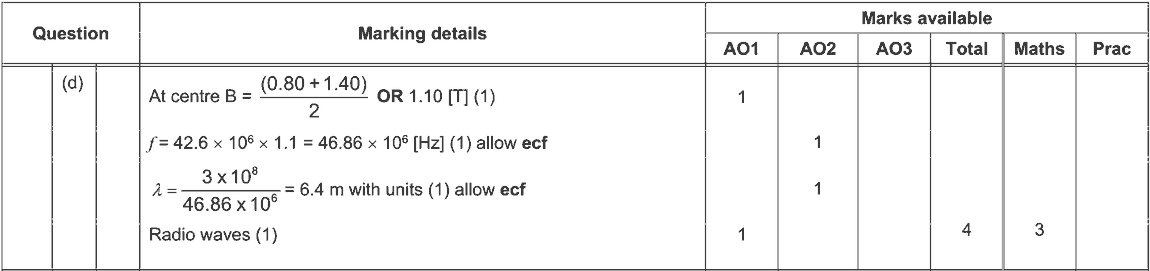
(d) An MRI (magnetic resonance imaging) scanner has a magnetic field that varies from 0.80 T to 1.40 T along its length. Calculate the wavelength of electromagnetic waves required to scan a slice halfway along its length and state which part of the electromagnetic spectrum they belong to. [4]
October 2020 · Component 3 · Q13(a)(i) 2 marks AO1=2 Definition physics of sports
13. (a) (i) Explain what is meant by the term moment of inertia of an object. [2]
October 2020 · Component 3 · Q13(a)(ii) 3 marks AO1=1, AO2=2 Calculation physics of sports
Earlier part of question 13 that this part usesEarlier part of October 2020 Component 3 question 13
(ii) Calculate the moment of inertia of a cricket ball which has a rotational kinetic energy of 1.47 J if it is spinning at a rate of 30 revolutions per second. [3]
October 2020 · Component 3 · Q13(b)(i) 5 marks AO3=5 Calculation physics of sports
Earlier part of question 13 that this part usesEarlier part of October 2020 Component 3 question 13
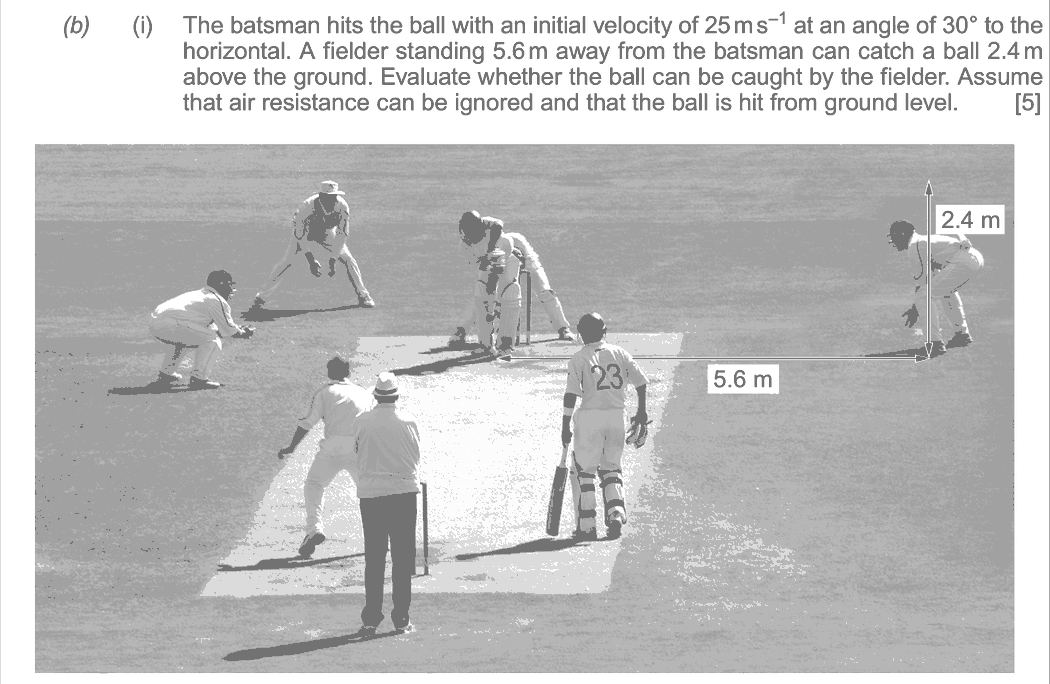
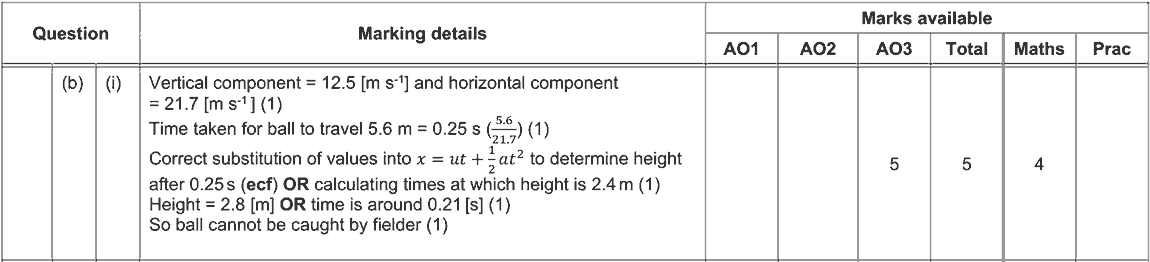
(b) (i) The batsman hits the ball with an initial velocity of 25 m s–1 at an angle of 30° to the horizontal. A fielder standing 5.6 m away from the batsman can catch a ball 2.4 m above the ground. Evaluate whether the ball can be caught by the fielder. Assume that air resistance can be ignored and that the ball is hit from ground level. [5] 2.4 m 5.6 m
October 2020 · Component 3 · Q13(b)(ii) 2 marks AO2=2 Explanation physics of sports
Earlier parts of question 13 that this part usesEarlier part of October 2020 Component 3 question 13Earlier part of October 2020 Component 3 question 13
(ii) Explain why a fielder will move his hands in the direction of motion of the cricket ball when catching. [2]
October 2020 · Component 3 · Q13(b)(iii) 2 marks AO2=2 Calculation physics of sports
Earlier parts of question 13 that this part usesEarlier part of October 2020 Component 3 question 13Earlier part of October 2020 Component 3 question 13
(iii) The coefficient of restitution between the pitch and the ball is 0.37. Determine the bounce height if the ball falls from a height of 2.35 m. [2]
October 2020 · Component 3 · Q13(c)(i) 3 marks AO1=3 Explanation physics of sports
Earlier parts of question 13 that this part usesEarlier part of October 2020 Component 3 question 13Earlier part of October 2020 Component 3 question 13
(c) For this part of the question, the interactions between the ball and the air need to be taken into account. (i) Explain why a spinning cricket ball will change direction when moving through the air. Your answer should include the forces acting on the ball during the flight and a diagram may be included. [3]
October 2020 · Component 3 · Q13(c)(ii) 3 marks AO2=3 Calculation physics of sports
Earlier parts of question 13 that this part usesEarlier part of October 2020 Component 3 question 13Earlier part of October 2020 Component 3 question 13Earlier part of October 2020 Component 3 question 13
(ii) Determine the drag force acting on a cricket ball of radius 3.6 cm during flight if the speed of the ball is 24.3 m s–1 and its drag coefficient is 0.76. Density of air = 1.3 kg m–3. [3]
October 2020 · Component 3 · Q14(a)(i) 2 marks AO1=1, AO2=1 Calculation energy and the environment
14. (a) (i) The total power emitted by the Sun is 3.8 × 1026 W. Calculate the intensity of radiation received at the upper atmosphere of planet Earth and state the name given to this value. The distance between the Earth and the Sun is 1.5 × 10¹¹ m. [2]
October 2020 · Component 3 · Q14(a)(ii) 3 marks AO2=3 Show that energy and the environment
Earlier part of question 14 that this part usesEarlier part of October 2020 Component 3 question 14
(ii) A student models the energy balance of planet Earth without its atmosphere. He calculates the theoretical power absorbed by the Earth to be 1.2 × 10¹⁷ W. Assuming the Earth to be in thermal equilibrium and to behave as a black body, show that the temperature of the Earth for this model is approximately 250 K. The radius of the Earth is 6.4 × 10⁶ m. [3]
October 2020 · Component 3 · Q14(a)(iii) 3 marks AO2=3 Explanation energy and the environment
Earlier part of question 14 that this part usesEarlier part of October 2020 Component 3 question 14
(iii) The actual mean surface temperature of the Earth is 287 K. Without calculation, account for this difference in temperature and explain how human activity has further contributed to this. [3]
October 2020 · Component 3 · Q14(b)(i) 3 marks AO1=3 Explanation energy and the environment
Earlier part of question 14 that this part usesEarlier part of October 2020 Component 3 question 14
(b) (i) State and explain the three conditions that are simultaneously required to produce a sustainable fusion reaction. [3]
October 2020 · Component 3 · Q14(b)(ii) 2 marks AO2=2 Calculation energy and the environment
Earlier parts of question 14 that this part usesEarlier part of October 2020 Component 3 question 14Earlier part of October 2020 Component 3 question 14
(ii) A fusion test reactor requires a triple product greater than 3.5 × 1028 s K m–3. The plasma has a volume of 70 m3 and contains 2.4 × 10²² particles. If a confinement time of 0.9 seconds is achieved, determine the minimum temperature necessary for this reaction. [2]
October 2020 · Component 3 · Q14(c)(i) 2 marks AO1=2 Definition energy and the environment
Earlier part of question 14 that this part usesEarlier part of October 2020 Component 3 question 14
(c) (i) A company manufactures thermal plasterboards using a composite of two different materials. One of the materials is known to have a thermal conductivity value of 0.030 W m–1 °C –1. Explain what the statement in italics means. [2]
October 2020 · Component 3 · Q14(c)(ii) 5 marks AO3=5 Calculation energy and the environment
Earlier parts of question 14 that this part usesEarlier part of October 2020 Component 3 question 14Earlier part of October 2020 Component 3 question 14
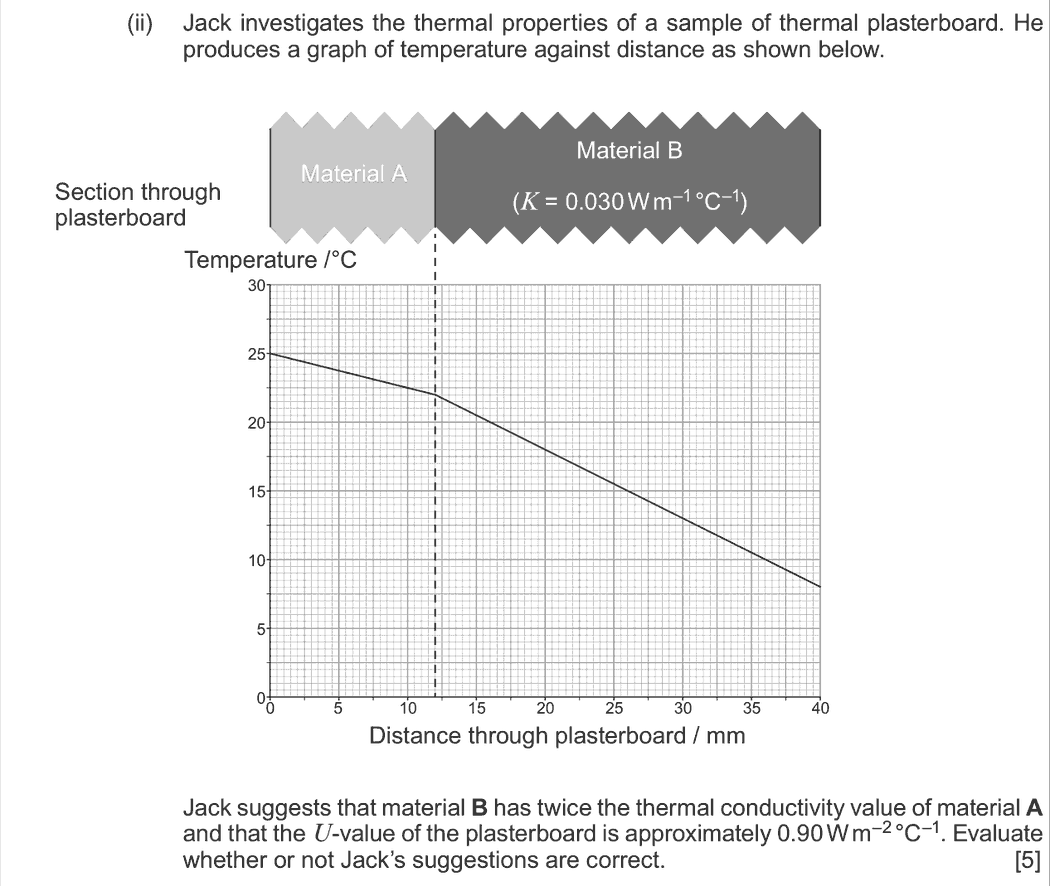
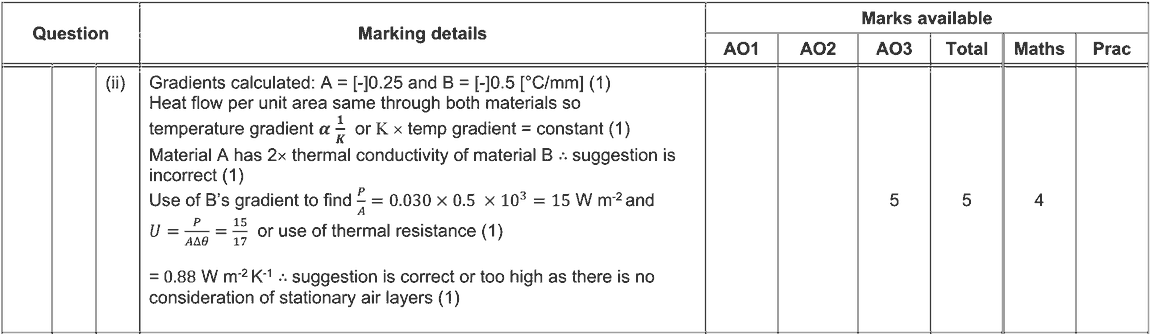
(ii) Jack investigates the thermal properties of a sample of thermal plasterboard. He produces a graph of temperature against distance as shown below. Material B Material A Section through (K = 0.030 W m–1 °C–1) plasterboard Temperature /°C 30 25 20 15 10 5 0 0 5 10 15 20 25 30 35 40 Distance through plasterboard / mm Jack suggests that material B has twice the thermal conductivity value of material A and that the U-value of the plasterboard is approximately 0.90 W m–2 °C–1. Evaluate whether or not Jack’s suggestions are correct. [5]

Work with an Eduqas physics tutor

Want a paper marked and gone through with you? Message us.

Prefer email? Send an enquiry

If you are under 18, please include a parent's contact details. Enquiries go to enquiries@physicsaleveltutor.com and are deleted once handled. All tutoring is online.