October 2021: Component 3

120 marks for each student (100 in Section A plus one 20-mark option; all four options are here) · 71 question parts · Paper, mark scheme and report on Eduqas's site · Have the Data Booklet beside you

Question by question

QTopicMarksAOType
1(a)(i) The nature of waves 3AO1=3Practical and data analysis
1(a)(ii) The nature of waves 2AO2=2Explanation
1(b) Wave properties: diffraction, interference and stationary waves 3AO2=3Explanation
1(c)(i) Wave properties: diffraction, interference and stationary waves 3AO1=1,AO2=2Calculation
1(c)(ii) Wave properties: diffraction, interference and stationary waves 2AO1=1,AO2=1Calculation
2(a) Wave properties: diffraction, interference and stationary waves 3AO1=3Diagram or graph
2(b)(i) Wave properties: diffraction, interference and stationary waves 2AO1=1,AO2=1Practical and data analysis
2(b)(ii) Wave properties: diffraction, interference and stationary waves 2AO2=2Practical and data analysis
2(b)(iii) Wave properties: diffraction, interference and stationary waves 2AO2=2Practical and data analysis
2(b)(iv) Wave properties: diffraction, interference and stationary waves 2AO3=2Practical and data analysis
2(b)(v) Wave properties: diffraction, interference and stationary waves 2AO1=1,AO2=1Practical and data analysis
2(b)(vi) Wave properties: diffraction, interference and stationary waves 2AO3=2Practical and data analysis
3(a) Refraction of light 3AO1=1,AO2=2Calculation
3(b) Refraction of light 3AO3=3Calculation
3(c)(i) Refraction of light 4AO1=1,AO2=3Calculation
3(c)(ii) Refraction of light 2AO2=2Calculation
4(a)(i) Dynamics: forces and momentum 2AO3=2Explanation
4(a)(ii) Magnetic fields 1AO1=1Short answer
4(b)(i) Magnetic fields 2AO2=2Practical and data analysis
4(b)(ii) Magnetic fields 3AO2=3Practical and data analysis
4(b)(iii) Magnetic fields 3AO3=3Practical and data analysis
4(b)(iv) Magnetic fields 4AO3=4Practical and data analysis
4(b)(v) Magnetic fields 2AO3=2Practical and data analysis
4(b)(vi) Magnetic fields 2AO3=2Practical and data analysis
5(a) Photons 6AO1=6Extended response
5(b) Photons 4AO2=4Calculation
6(a) Photons 3AO1=3Definition
6(b)(i) Photons 4AO1=1,AO2=3Calculation
6(b)(ii) Conduction of electricity, Photons 2AO2=2Calculation
6(c) Photons 3AO1=3Practical and data analysis
7(a) Particles and nuclear structure 3AO2=3Show that
7(b) Particles and nuclear structure 1AO1=1Short answer
7(c) Nuclear energy 2AO2=2Calculation
7(d) Particles and nuclear structure 2AO3=2Explanation
8(a) Electromagnetic induction 3AO1=3Definition
8(b)(i) Electromagnetic induction 2AO2=2Explanation
8(b)(ii) Electromagnetic induction 3AO2=3Calculation
8(c) Photons 3AO3=3Explanation
9(a)(i) Alternating currents 2AO1=2Short answer
9(a)(ii) Alternating currents 2AO1=2Explanation
9(a)(iii) Alternating currents 3AO2=3Calculation
9(b)(i) Alternating currents 1AO1=1Show that
9(b)(ii) Alternating currents 1AO2=1Short answer
9(b)(iii) Alternating currents 3AO1=1,AO2=2Show that
9(b)(iv) Alternating currents 3AO2=3Diagram or graph
9(c) Alternating currents 5AO3=5Calculation
10(a)(i) Medical physics 2AO1=1,AO2=1Calculation
10(a)(ii) Medical physics 2AO2=2Calculation
10(a)(iii) Medical physics 2AO2=2Calculation
10(b) Medical physics 2AO2=2Calculation
10(c)(i) Medical physics 2AO1=2Explanation
10(c)(ii) Medical physics 2AO2=2Calculation
10(d) Medical physics 3AO1=3Explanation
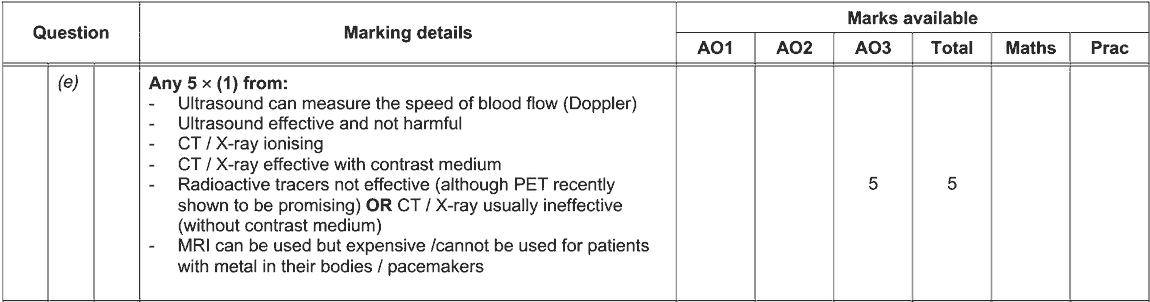
10(e) Medical physics 5AO3=5Explanation
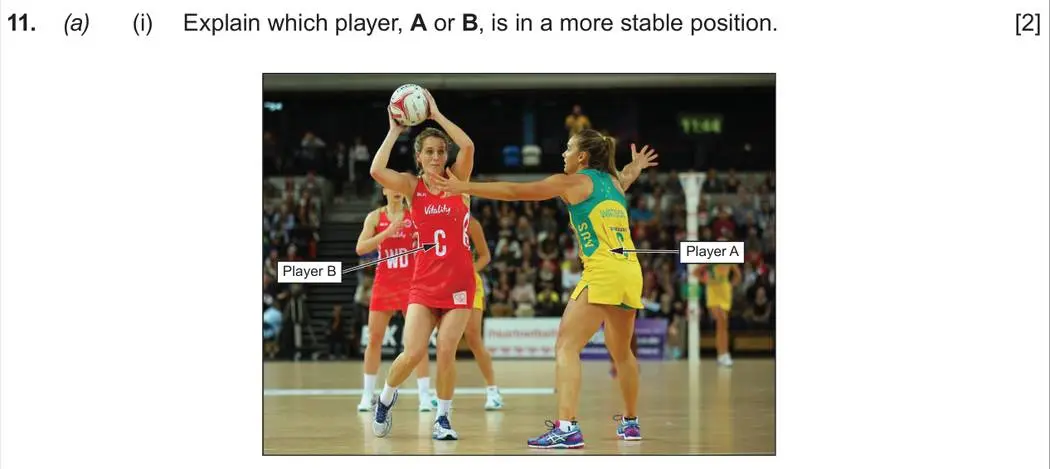
11(a)(i) The physics of sports 2AO1=2Explanation
11(a)(ii) The physics of sports 2AO1=2Definition
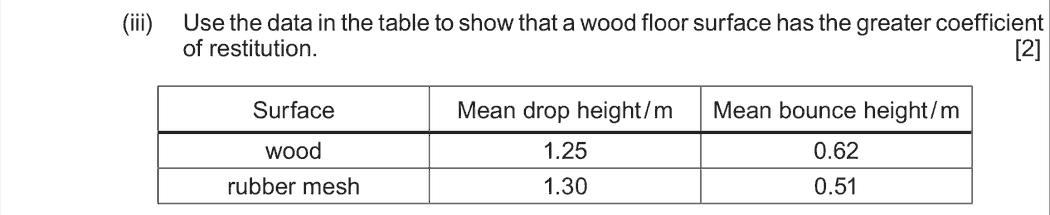
11(a)(iii) The physics of sports 2AO1=1,AO2=1Show that
11(b)(i) The physics of sports 3AO3=3Explanation
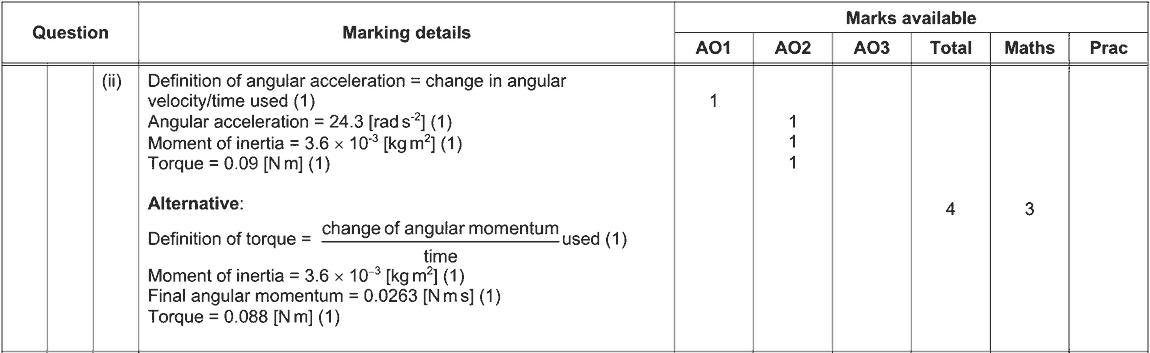
11(b)(ii) The physics of sports 4AO1=1,AO2=3Calculation
11(b)(iii) The physics of sports 3AO2=3Calculation
11(c)(i) The physics of sports 2AO2=2Calculation
11(c)(ii) The physics of sports 2AO3=2Calculation
12(a) Energy and the environment 3AO1=1,AO2=2Explanation
12(b)(i) Energy and the environment 2AO1=2Definition
12(b)(ii) Energy and the environment 3AO1=1,AO2=2Calculation
12(b)(iii) Energy and the environment 2AO3=2Explanation
12(c)(i) Energy and the environment 3AO1=1,AO2=2Calculation
12(c)(ii) Energy and the environment 2AO2=2Calculation
12(d)(i) Energy and the environment 1AO1=1Definition
12(d)(ii) Energy and the environment 3AO3=3Calculation
12(d)(iii) Energy and the environment 1AO2=1Short answer

The questions

1(a)(i)1(a)(ii)1(b)1(c)(i)1(c)(ii)2(a)2(b)(i)2(b)(ii)2(b)(iii)2(b)(iv)2(b)(v)2(b)(vi)3(a)3(b)3(c)(i)3(c)(ii)4(a)(i)4(a)(ii)4(b)(i)4(b)(ii)4(b)(iii)4(b)(iv)4(b)(v)4(b)(vi)5(a)5(b)6(a)6(b)(i)6(b)(ii)6(c)7(a)7(b)7(c)7(d)8(a)8(b)(i)8(b)(ii)8(c)9(a)(i)9(a)(ii)9(a)(iii)9(b)(i)9(b)(ii)9(b)(iii)9(b)(iv)9(c)10(a)(i)10(a)(ii)10(a)(iii)10(b)10(c)(i)10(c)(ii)10(d)10(e)11(a)(i)11(a)(ii)11(a)(iii)11(b)(i)11(b)(ii)11(b)(iii)11(c)(i)11(c)(ii)12(a)12(b)(i)12(b)(ii)12(b)(iii)12(c)(i)12(c)(ii)12(d)(i)12(d)(ii)12(d)(iii)
October 2021 · Component 3 · Q1(a)(i) 3 marks AO1=3 Practical and data analysis nature of waves
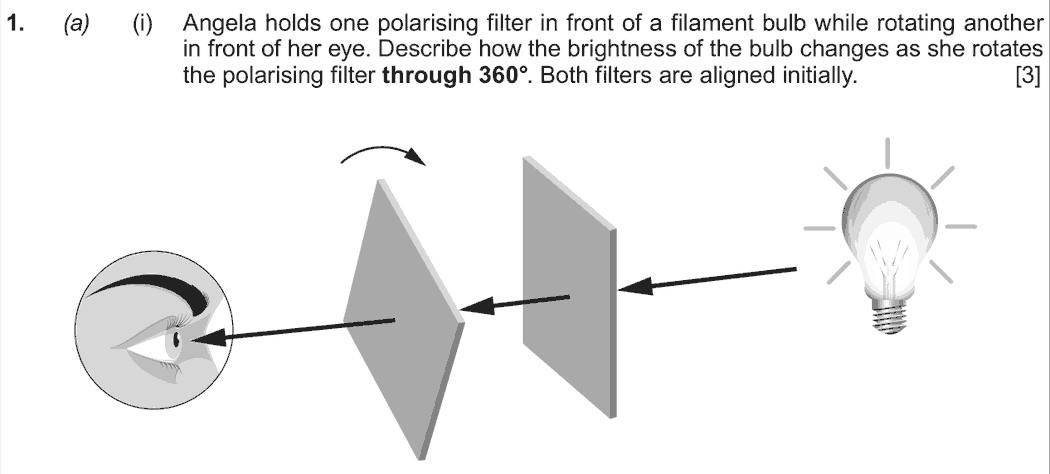
1. (a) (i) Angela holds one polarising filter in front of a filament bulb while rotating another in front of her eye. Describe how the brightness of the bulb changes as she rotates the polarising filter through 360°. Both filters are aligned initially. [3]
October 2021 · Component 3 · Q1(a)(ii) 2 marks AO2=2 Explanation nature of waves
Earlier part of question 1 that this part usesEarlier part of October 2021 Component 3 question 1
(ii) She now examines light from a source which is partially polarised (a mixture of polarised and unpolarised light) by rotating a single polarising filter. Describe and explain how her observations differ from those of part (a)(i). [2]
October 2021 · Component 3 · Q1(b) 3 marks AO2=3 Explanation wave properties
Earlier part of question 1 that this part usesEarlier part of October 2021 Component 3 question 1
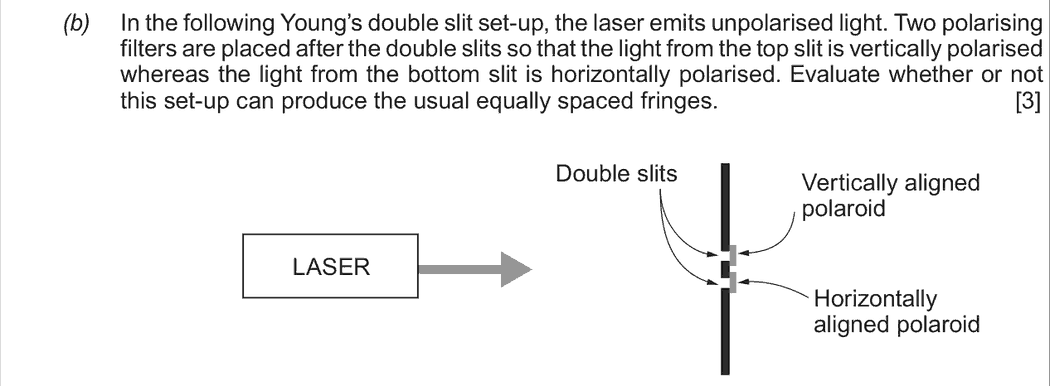
(b) In the following Young’s double slit set-up, the laser emits unpolarised light. Two polarising filters are placed after the double slits so that the light from the top slit is vertically polarised whereas the light from the bottom slit is horizontally polarised. Evaluate whether or not this set-up can produce the usual equally spaced fringes. [3] Double slits Vertically aligned polaroid LASER Horizontally aligned polaroid
October 2021 · Component 3 · Q1(c)(i) 3 marks AO1=1, AO2=2 Calculation wave properties
Earlier parts of question 1 that this part usesEarlier part of October 2021 Component 3 question 1Earlier part of October 2021 Component 3 question 1
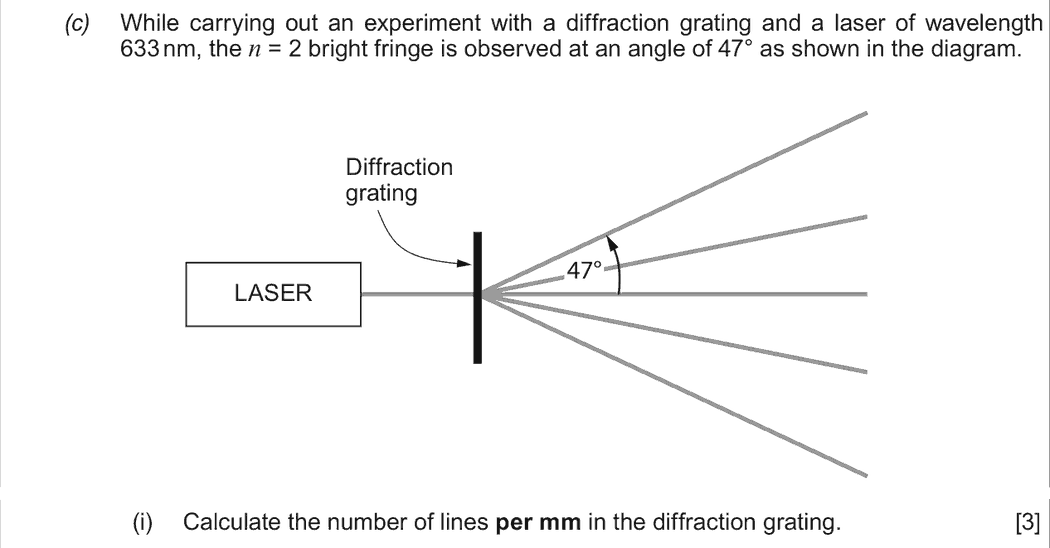
(c) While carrying out an experiment with a diffraction grating and a laser of wavelength 633 nm, the n = 2 bright fringe is observed at an angle of 47° as shown in the diagram. Diffraction grating 47° LASER (i) Calculate the number of lines per mm in the diffraction grating. [3]
October 2021 · Component 3 · Q1(c)(ii) 2 marks AO1=1, AO2=1 Calculation wave properties
Earlier parts of question 1 that this part usesEarlier part of October 2021 Component 3 question 1Earlier part of October 2021 Component 3 question 1Earlier part of October 2021 Component 3 question 1
(ii) Another laser is used and it is found that the n = 3 bright fringe is at exactly the same angle (47°) as the n = 2 line of the 633 nm laser. Calculate the wavelength of the laser. [2]
October 2021 · Component 3 · Q2(a) 3 marks AO1=3 Diagram or graph wave properties
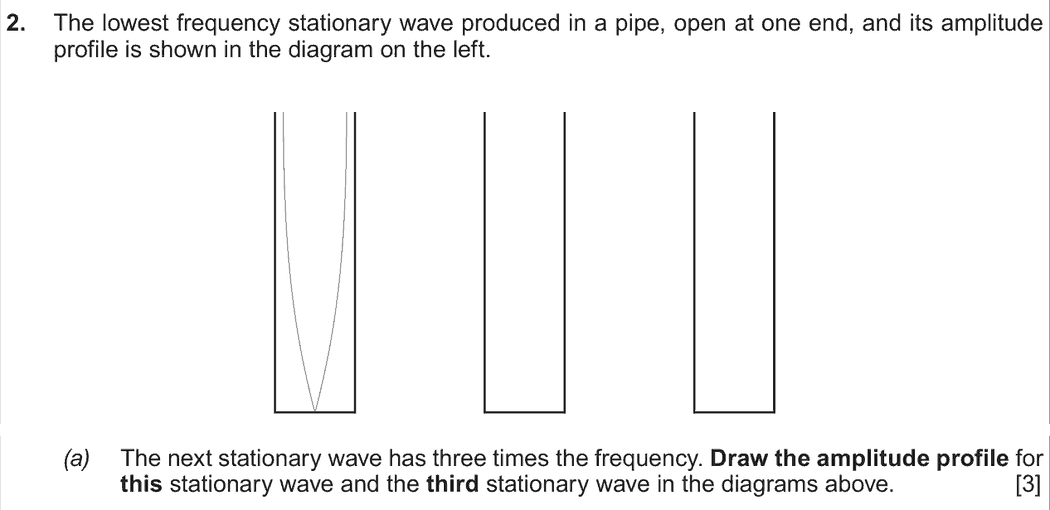
2. The lowest frequency stationary wave produced in a pipe, open at one end, and its amplitude profile is shown in the diagram on the left. (a) The next stationary wave has three times the frequency. Draw the amplitude profile for this stationary wave and the third stationary wave in the diagrams above. [3]
October 2021 · Component 3 · Q2(b)(i) 2 marks AO1=1, AO2=1 Practical and data analysis wave properties
Earlier part of question 2 that this part usesEarlier part of October 2021 Component 3 question 2
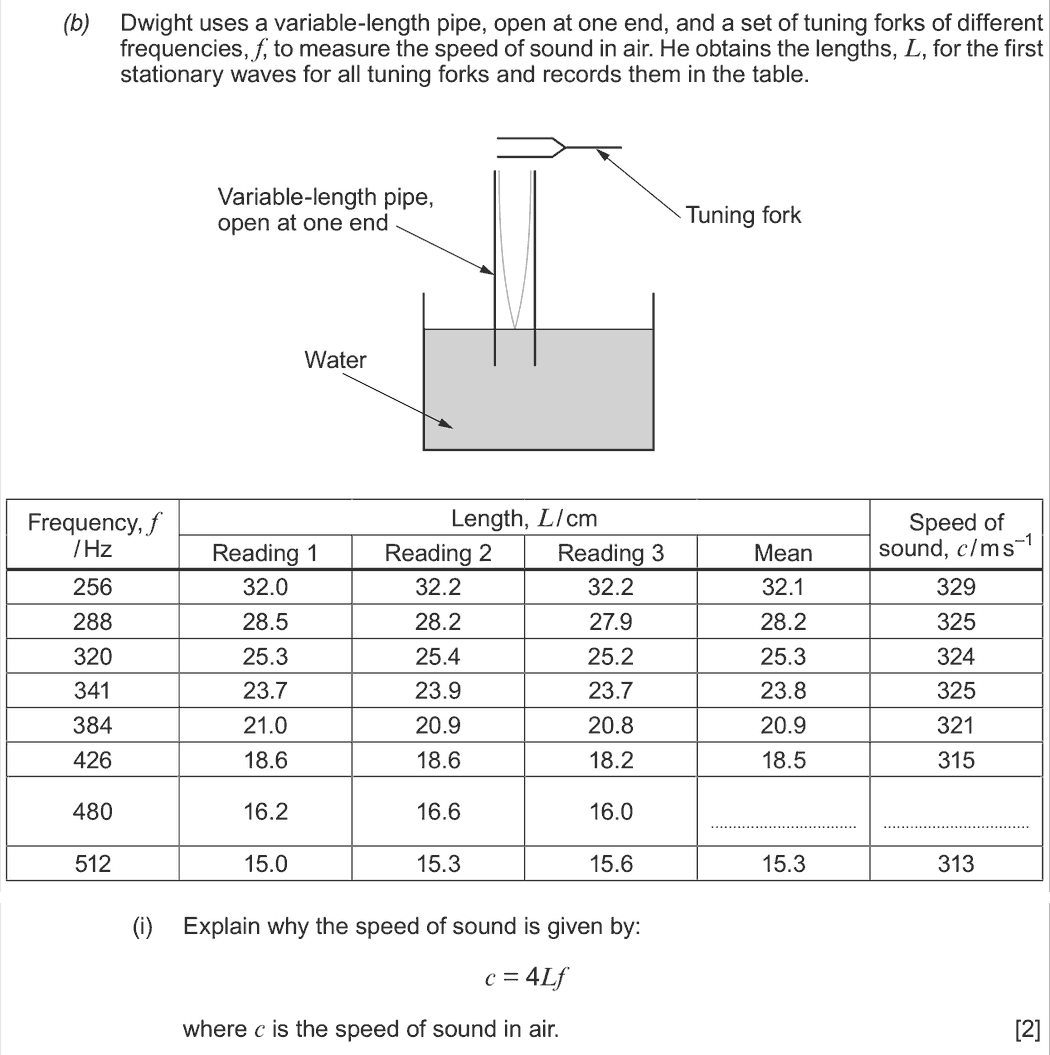
(b) Dwight uses a variable-length pipe, open at one end, and a set of tuning forks of different frequencies, f, to measure the speed of sound in air. He obtains the lengths, L, for the first stationary waves for all tuning forks and records them in the table. Variable-length pipe, Tuning fork open at one end Water Frequency, f Length, L / cm Speed of / Hz sound, c / m s–1 Reading 1 Reading 2 Reading 3 Mean 256 32.0 32.2 32.2 32.1 329 288 28.5 28.2 27.9 28.2 325 320 25.3 25.4 25.2 25.3 324 341 23.7 23.9 23.7 23.8 325 384 21.0 20.9 20.8 20.9 321 426 18.6 18.6 18.2 18.5 315 480 16.2 16.6 16.0 512 15.0 15.3 15.6 15.3 313 (i) Explain why the speed of sound is given by: c = 4Lf where c is the speed of sound in air. [2]
October 2021 · Component 3 · Q2(b)(ii) 2 marks AO2=2 Practical and data analysis wave properties
Earlier parts of question 2 that this part usesEarlier part of October 2021 Component 3 question 2Earlier part of October 2021 Component 3 question 2
(ii) Complete the table for the 480 Hz tuning fork. [2] Space for calculations.
October 2021 · Component 3 · Q2(b)(iii) 2 marks AO2=2 Practical and data analysis wave properties
Earlier parts of question 2 that this part usesEarlier part of October 2021 Component 3 question 2Earlier part of October 2021 Component 3 question 2
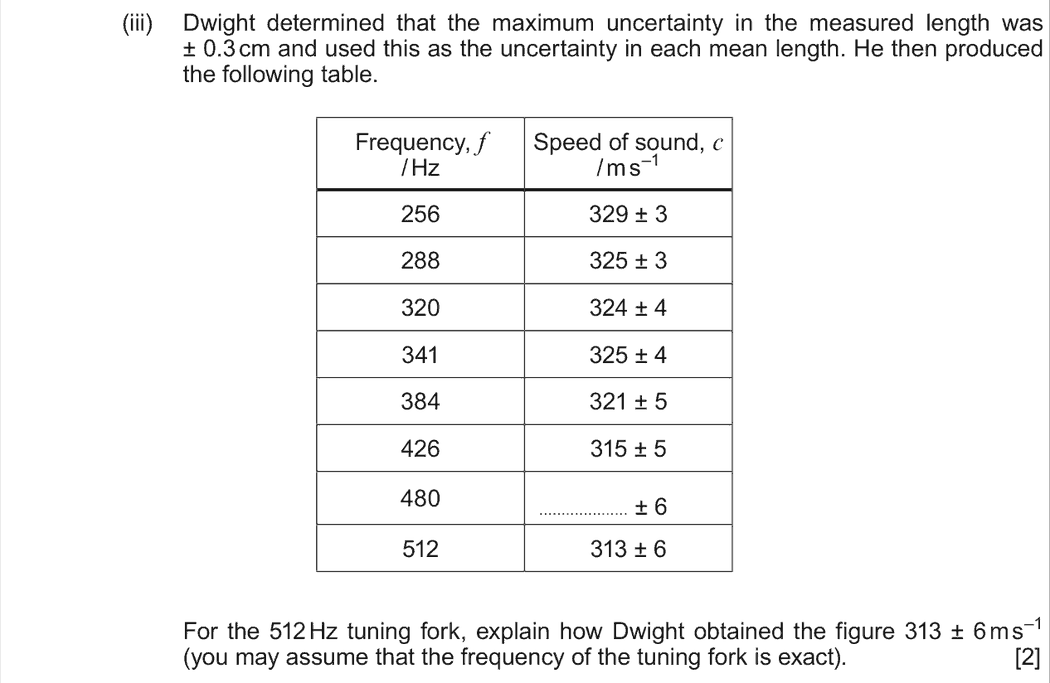
(iii) Dwight determined that the maximum uncertainty in the measured length was ± 0.3 cm and used this as the uncertainty in each mean length. He then produced the following table. Frequency, f Speed of sound, c / Hz / m s–1 256 329 ± 3 288 325 ± 3 320 324 ± 4 341 325 ± 4 384 321 ± 5 426 315 ± 5 480 ± 6 512 313 ± 6 For the 512 Hz tuning fork, explain how Dwight obtained the figure 313 ± 6 m s–1 (you may assume that the frequency of the tuning fork is exact). [2]
October 2021 · Component 3 · Q2(b)(iv) 2 marks AO3=2 Practical and data analysis wave properties
Earlier parts of question 2 that this part usesEarlier part of October 2021 Component 3 question 2Earlier part of October 2021 Component 3 question 2Earlier part of October 2021 Component 3 question 2
(iv) Dwight researches the speed of sound at 20 °C and finds that it should be 343 m s–1. He concludes that the values of the speed of sound in the table are inaccurate and that some systematic error is responsible. Discuss whether or not these data are inaccurate and actually show a systematic error. [2]
October 2021 · Component 3 · Q2(b)(v) 2 marks AO1=1, AO2=1 Practical and data analysis wave properties
Earlier parts of question 2 that this part usesEarlier part of October 2021 Component 3 question 2Earlier part of October 2021 Component 3 question 2Earlier part of October 2021 Component 3 question 2
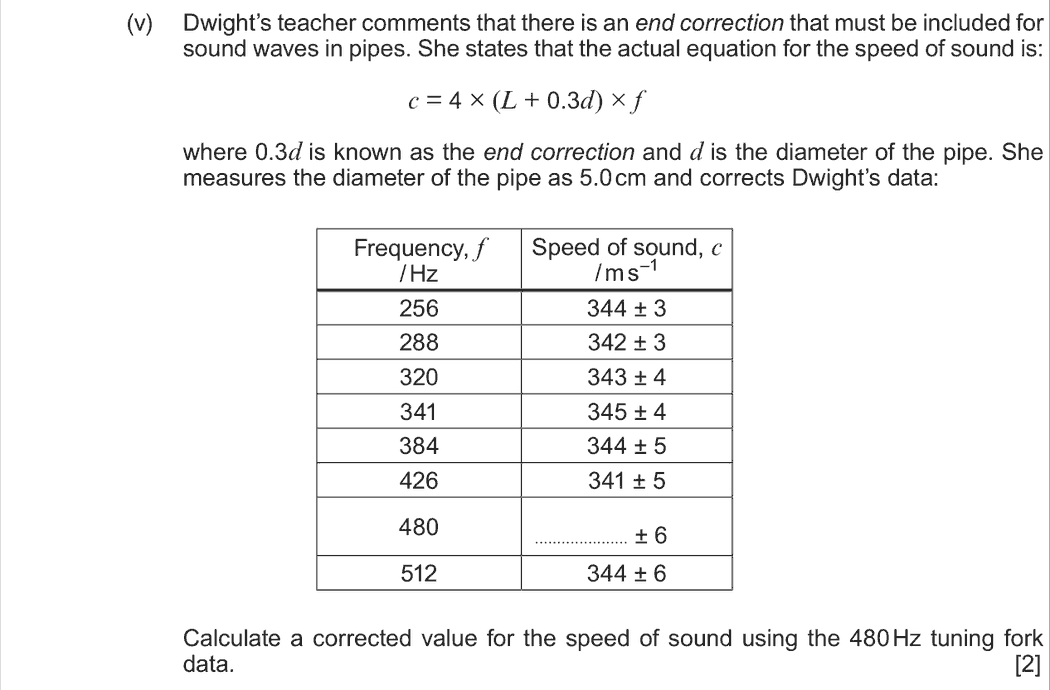
(v) Dwight’s teacher comments that there is an end correction that must be included for sound waves in pipes. She states that the actual equation for the speed of sound is: c = 4 × (L + 0.3d) × f where 0.3d is known as the end correction and d is the diameter of the pipe. She measures the diameter of the pipe as 5.0 cm and corrects Dwight’s data: Frequency, f Speed of sound, c / Hz / m s–1 256 344 ± 3 288 342 ± 3 320 343 ± 4 341 345 ± 4 384 344 ± 5 426 341 ± 5 480 ± 6 512 344 ± 6 Calculate a corrected value for the speed of sound using the 480 Hz tuning fork data. [2]
October 2021 · Component 3 · Q2(b)(vi) 2 marks AO3=2 Practical and data analysis wave properties
Earlier parts of question 2 that this part usesEarlier part of October 2021 Component 3 question 2Earlier part of October 2021 Component 3 question 2Earlier part of October 2021 Component 3 question 2Earlier part of October 2021 Component 3 question 2
(vi) Discuss to what extent the final values are accurate and consistent with the published value of 343 m s–1. [2]
October 2021 · Component 3 · Q3(a) 3 marks AO1=1, AO2=2 Calculation refraction of light
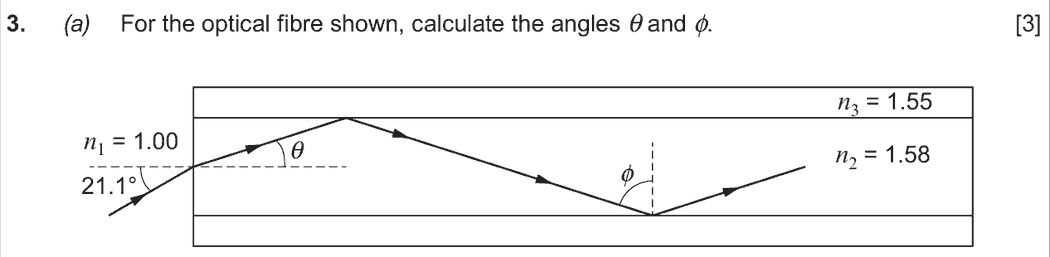
3. (a) For the optical fibre shown, calculate the angles θ and φ. [3] n3 = 1.55 n1 = 1.00 θ n2 = 1.58 φ 21.1°
October 2021 · Component 3 · Q3(b) 3 marks AO3=3 Calculation refraction of light
Earlier part of question 3 that this part usesEarlier part of October 2021 Component 3 question 3
(b) Hence, determine whether the ray shown will travel a long distance along the optical fibre without a rapid drop in intensity. [3]
October 2021 · Component 3 · Q3(c)(i) 4 marks AO1=1, AO2=3 Calculation refraction of light
Earlier part of question 3 that this part usesEarlier part of October 2021 Component 3 question 3
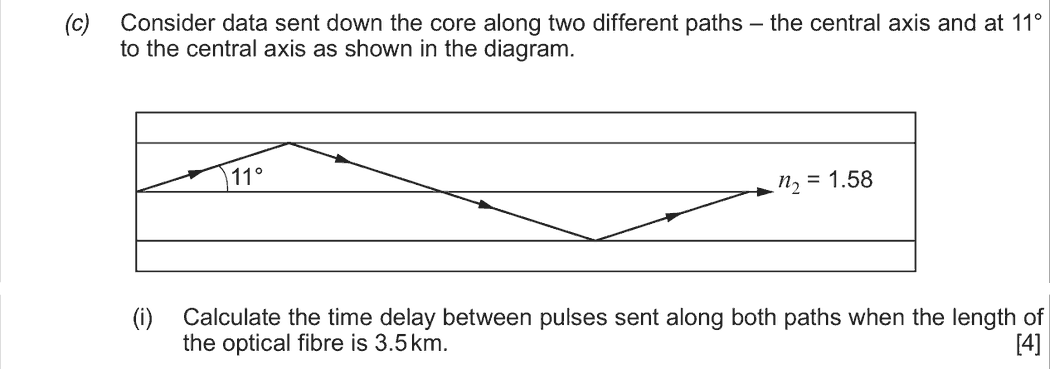
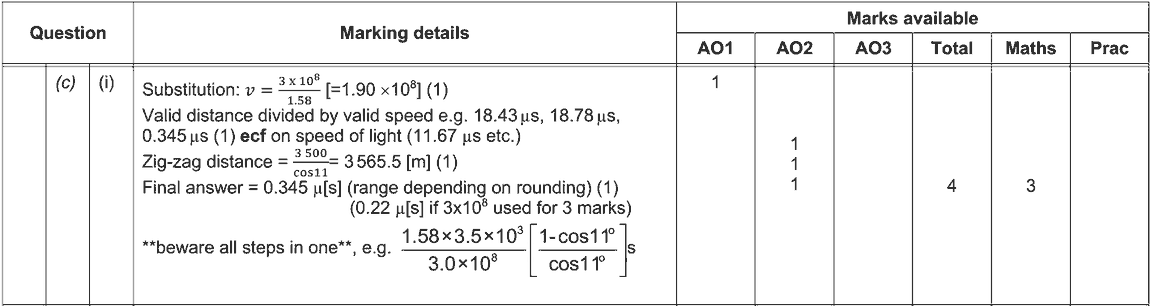
(c) Consider data sent down the core along two different paths – the central axis and at 11° to the central axis as shown in the diagram. 11° n2 = 1.58 (i) Calculate the time delay between pulses sent along both paths when the length of the optical fibre is 3.5 km. [4]
October 2021 · Component 3 · Q3(c)(ii) 2 marks AO2=2 Calculation refraction of light
Earlier parts of question 3 that this part usesEarlier part of October 2021 Component 3 question 3Earlier part of October 2021 Component 3 question 3
(ii) Hence, calculate the highest number of pulses per second that can be sent along the optical fibre without overlap, explaining your reasoning. [2]
October 2021 · Component 3 · Q4(a)(i) 2 marks AO3=2 Explanation dynamics
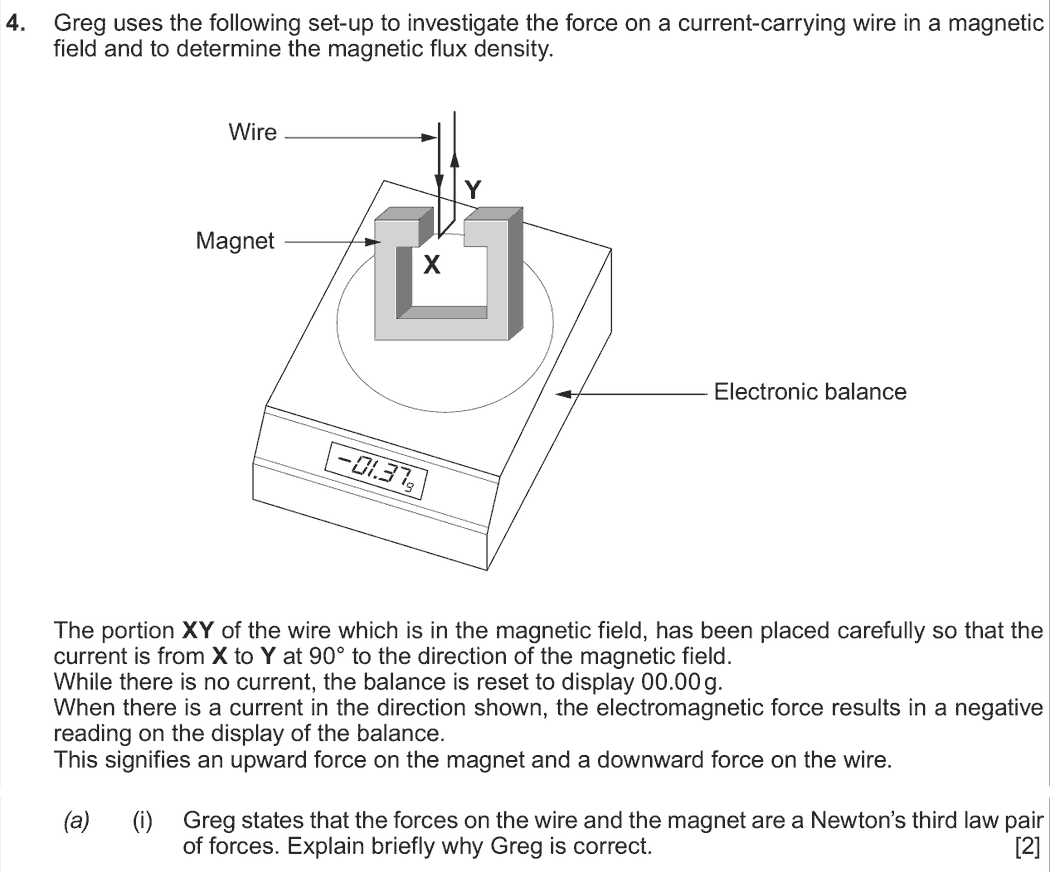
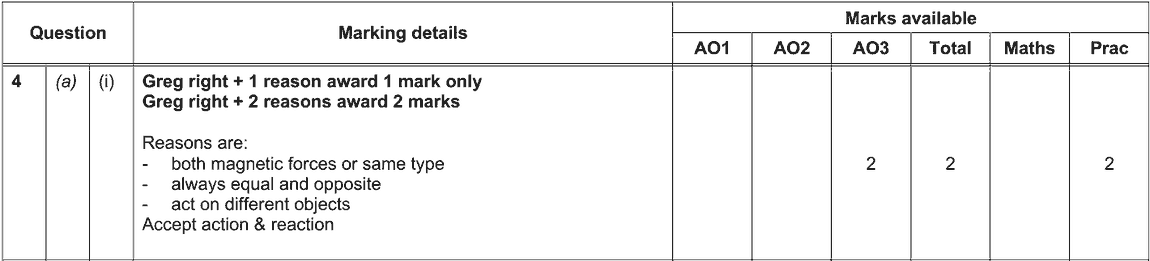
4. Greg uses the following set-up to investigate the force on a current-carrying wire in a magnetic field and to determine the magnetic flux density. Wire Y Magnet X Electronic balance The portion XY of the wire which is in the magnetic field, has been placed carefully so that the current is from X to Y at 90° to the direction of the magnetic field. While there is no current, the balance is reset to display 00.00 g. When there is a current in the direction shown, the electromagnetic force results in a negative reading on the display of the balance. This signifies an upward force on the magnet and a downward force on the wire. (a) (i) Greg states that the forces on the wire and the magnet are a Newton’s third law pair of forces. Explain briefly why Greg is correct. [2]
October 2021 · Component 3 · Q4(a)(ii) 1 mark AO1=1 Short answer magnetic fields
Earlier part of question 4 that this part usesEarlier part of October 2021 Component 3 question 4
(ii) The left pole of the magnet is a north pole. Explain how this is consistent with the information above, naming the rule that you used. [1]
October 2021 · Component 3 · Q4(b)(i) 2 marks AO2=2 Practical and data analysis magnetic fields
Earlier part of question 4 that this part usesEarlier part of October 2021 Component 3 question 4
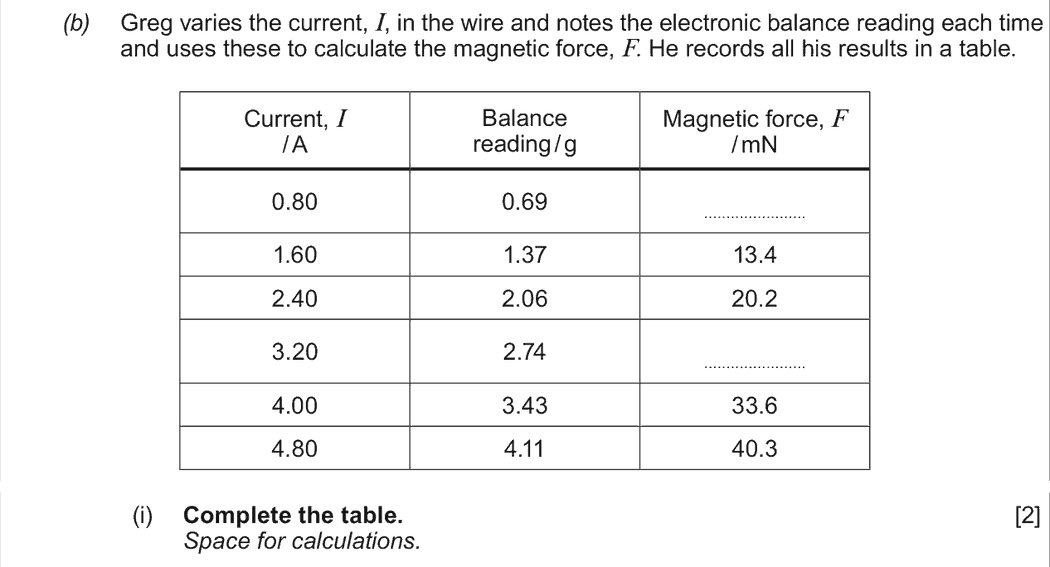
(b) Greg varies the current, I, in the wire and notes the electronic balance reading each time and uses these to calculate the magnetic force, F. He records all his results in a table. Current, I Balance Magnetic force, F / A reading / g / mN 0.80 0.69 1.60 1.37 13.4 2.40 2.06 20.2 3.20 2.74 4.00 3.43 33.6 4.80 4.11 40.3 (i) Complete the table. [2] Space for calculations.
October 2021 · Component 3 · Q4(b)(ii) 3 marks AO2=3 Practical and data analysis magnetic fields
Earlier parts of question 4 that this part usesEarlier part of October 2021 Component 3 question 4Earlier part of October 2021 Component 3 question 4
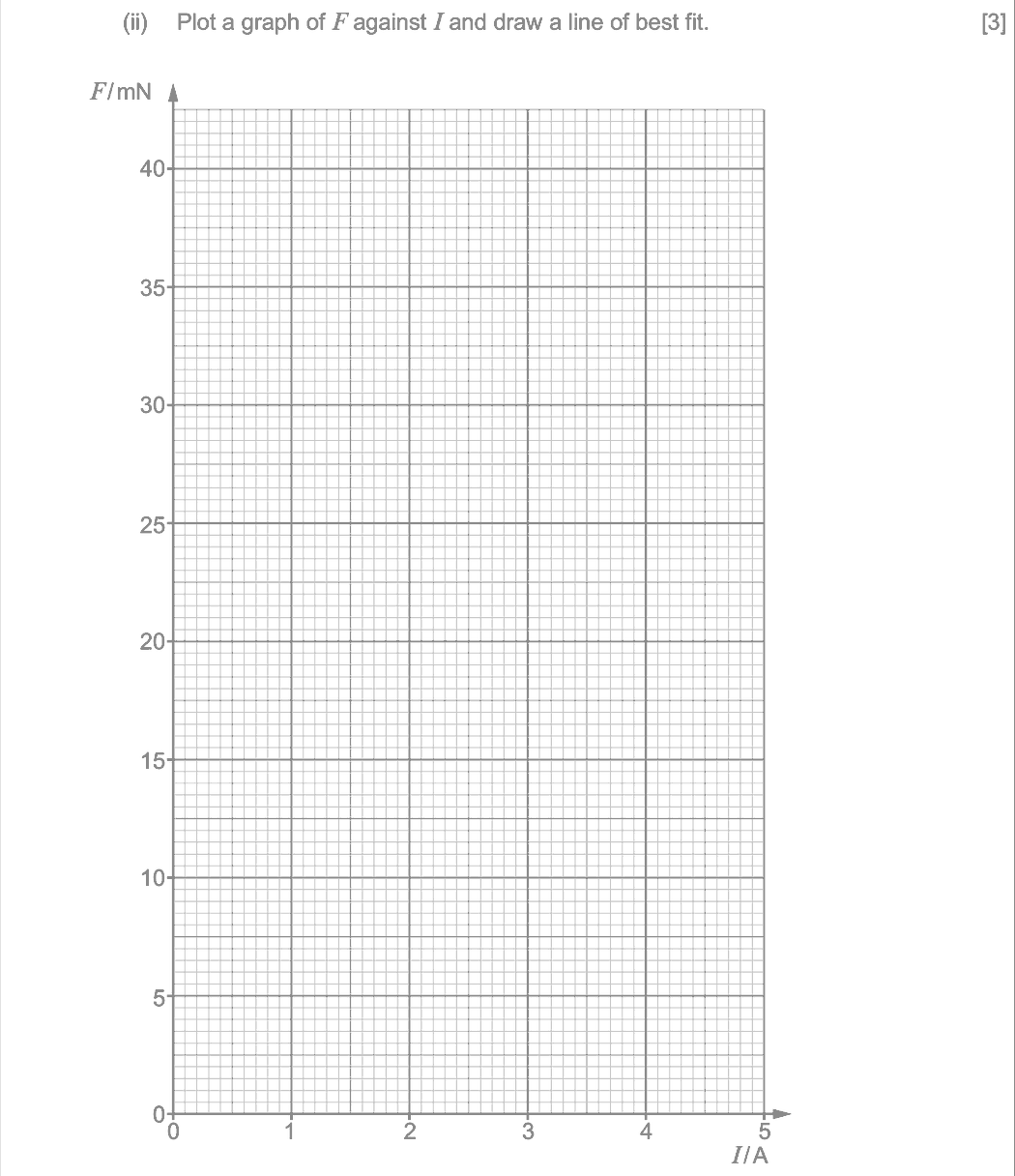
(ii) Plot a graph of F against I and draw a line of best fit. [3] F / mN 40 35 30 25 20 15 10 5 0 0 1 2 3 4 5 I / A
October 2021 · Component 3 · Q4(b)(iii) 3 marks AO3=3 Practical and data analysis magnetic fields
Earlier parts of question 4 that this part usesEarlier part of October 2021 Component 3 question 4Earlier part of October 2021 Component 3 question 4Earlier part of October 2021 Component 3 question 4
(iii) Explain to what extent the data show that the force is proportional to the current. [3]
October 2021 · Component 3 · Q4(b)(iv) 4 marks AO3=4 Practical and data analysis magnetic fields
Earlier parts of question 4 that this part usesEarlier part of October 2021 Component 3 question 4Earlier part of October 2021 Component 3 question 4Earlier part of October 2021 Component 3 question 4
(iv) The length of the portion XY of the wire is 5.0 cm. Determine the magnetic flux density, B, of the field between the poles of the magnet and quote it to an appropriate number of significant figures. [4]
October 2021 · Component 3 · Q4(b)(v) 2 marks AO3=2 Practical and data analysis magnetic fields
Earlier parts of question 4 that this part usesEarlier part of October 2021 Component 3 question 4Earlier part of October 2021 Component 3 question 4Earlier part of October 2021 Component 3 question 4
(v) Nancy claims that the forces on the vertical portions of the wire have not been considered in the answer to part (iv) and that the answer will be inaccurate because of this. Evaluate whether or not Nancy is correct. [2]
October 2021 · Component 3 · Q4(b)(vi) 2 marks AO3=2 Practical and data analysis magnetic fields
Earlier parts of question 4 that this part usesEarlier part of October 2021 Component 3 question 4Earlier part of October 2021 Component 3 question 4Earlier part of October 2021 Component 3 question 4
(vi) The value of the magnetic flux density in part (iv) is slightly inaccurate for another reason which has nothing to do with human error or meter inaccuracies. Discuss what might be the cause of this inaccuracy. [2]
October 2021 · Component 3 · Q5(a) 6 marks AO1=6 6-mark extended response photons
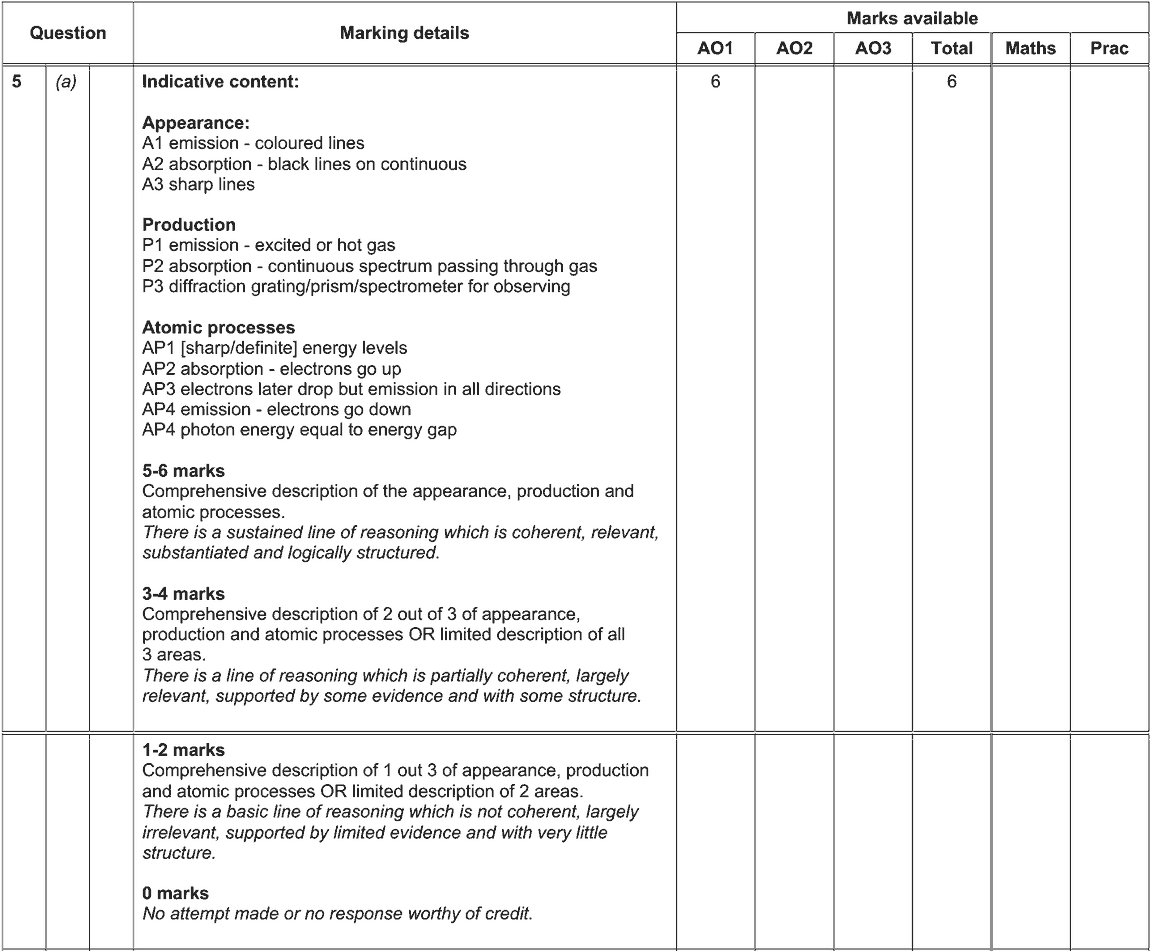
5. (a) Describe the appearance of line emission spectra and absorption spectra, how they can be produced and explain the atomic processes responsible for their production. [6 QER]
October 2021 · Component 3 · Q5(b) 4 marks AO2=4 Calculation photons
Earlier part of question 5 that this part usesEarlier part of October 2021 Component 3 question 5
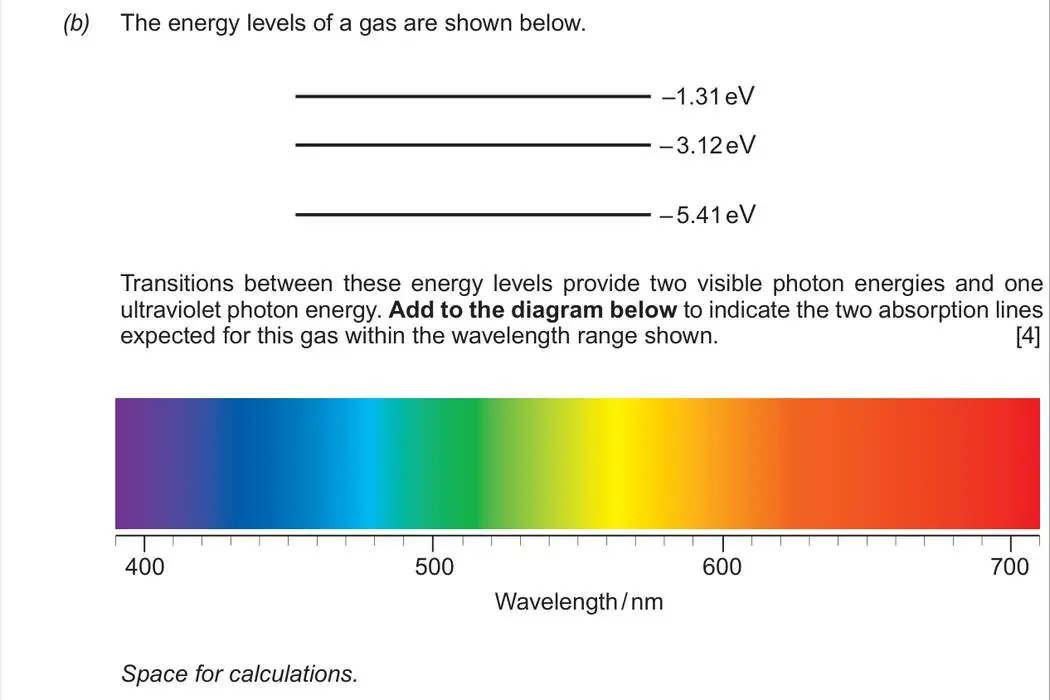
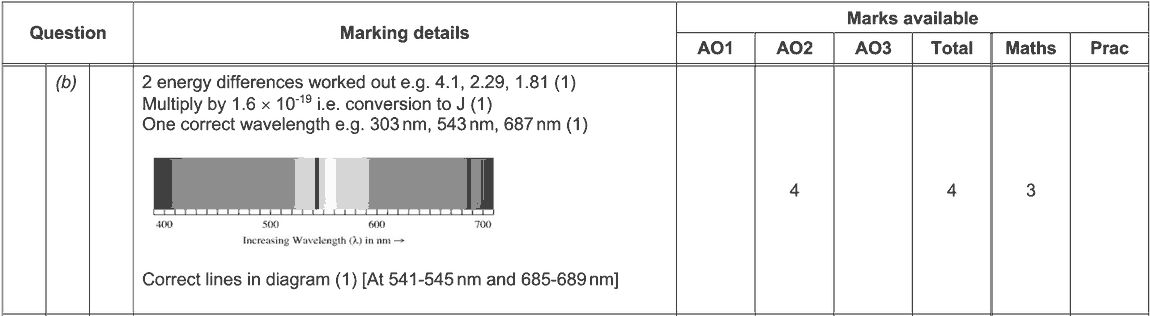
(b) The energy levels of a gas are shown below. –1.31 eV – 3.12 eV – 5.41 eV Transitions between these energy levels provide two visible photon energies and one ultraviolet photon energy. Add to the diagram below to indicate the two absorption lines expected for this gas within the wavelength range shown. [4] 400 500 600 700 Wavelength / nm Space for calculations.
October 2021 · Component 3 · Q6(a) 3 marks AO1=3 Definition photons
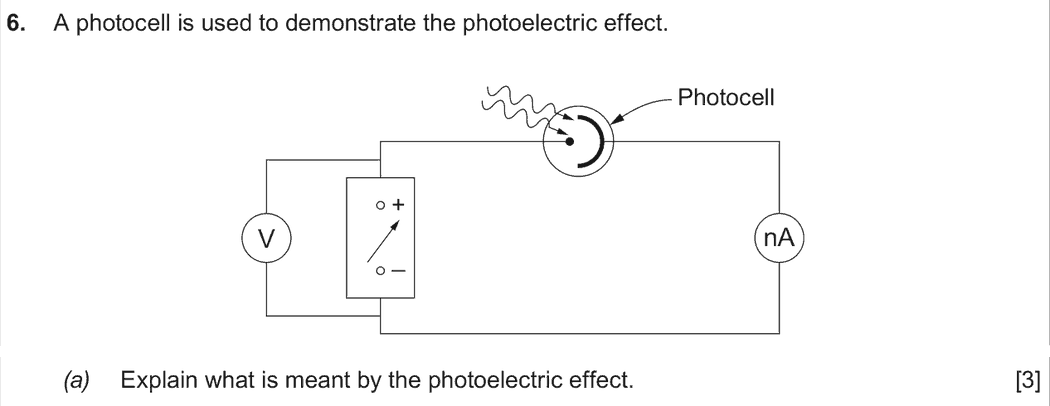
6. A photocell is used to demonstrate the photoelectric effect. Photocell + V nA _ (a) Explain what is meant by the photoelectric effect. [3]
October 2021 · Component 3 · Q6(b)(i) 4 marks AO1=1, AO2=3 Calculation photons
Earlier part of question 6 that this part usesEarlier part of October 2021 Component 3 question 6
(b) Light of frequency 655 THz and intensity 96.0 W m–2 is incident on the photocell which has an emitting surface area of 2.50 cm2. (i) Calculate the number of photons per second incident on the photocell. [4]
October 2021 · Component 3 · Q6(b)(ii) 2 marks AO2=2 Calculation conduction of electricityphotons
Earlier parts of question 6 that this part usesEarlier part of October 2021 Component 3 question 6Earlier part of October 2021 Component 3 question 6
(ii) Calculate the current, given that only 0.54 % of the incident photons lead to electrons that are collected at the anode. [2]
October 2021 · Component 3 · Q6(c) 3 marks AO1=3 Practical and data analysis photons
Earlier part of question 6 that this part usesEarlier part of October 2021 Component 3 question 6
(c) Explain how the maximum kinetic energy of electrons can be measured using this apparatus. [3]
October 2021 · Component 3 · Q7(a) 3 marks AO2=3 Show that particles and nuclear structure
7. The following is a nuclear reaction that is believed to take place in stars. 3He + 1H 4He + e + + ν 2 1 2 e (a) Show how conservation of baryon number, charge and lepton number apply to this reaction. [3]
October 2021 · Component 3 · Q7(b) 1 mark AO1=1 Short answer particles and nuclear structure
Earlier part of question 7 that this part usesEarlier part of October 2021 Component 3 question 7
(b) The electron neutrino indicates that this is a weak force interaction. State another clear indicator that this reaction is a weak force interaction. [1]
October 2021 · Component 3 · Q7(c) 2 marks AO2=2 Calculation nuclear energy
Earlier part of question 7 that this part usesEarlier part of October 2021 Component 3 question 7
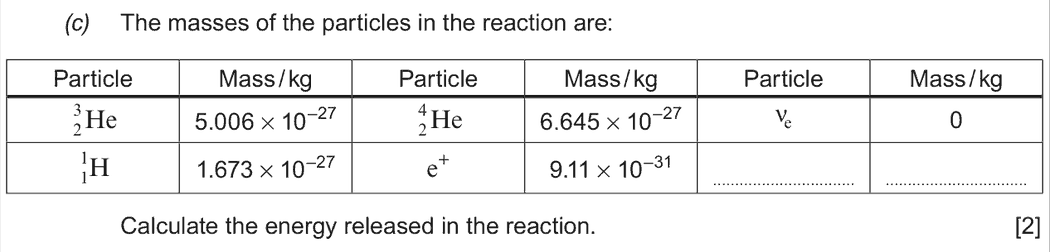
(c) The masses of the particles in the reaction are: Particle Mass / kg Particle Mass / kg Particle Mass / kg 3 2 He 10–27 4 2 He 10–27 νe 0 5.006 × 6.645 × 1 1H 1.673 × 10⁻²⁷ e+ 9.11 × 10⁻³¹ Calculate the energy released in the reaction. [2]
October 2021 · Component 3 · Q7(d) 2 marks AO3=2 Explanation particles and nuclear structure
Earlier part of question 7 that this part usesEarlier part of October 2021 Component 3 question 7
(d) Another more common nuclear reaction for 3 2 He in stars is: 3He + 3He 4He + 21 1H 2 2 2 Sophie claims that this is a strong nuclear force reaction. Determine whether or not Sophie is correct. [2]
October 2021 · Component 3 · Q8(a) 3 marks AO1=3 Definition electromagnetic induction
8. (a) State Faraday’s law and Lenz’s law of electromagnetic induction. [3]
October 2021 · Component 3 · Q8(b)(i) 2 marks AO2=2 Explanation electromagnetic induction
Earlier part of question 8 that this part usesEarlier part of October 2021 Component 3 question 8
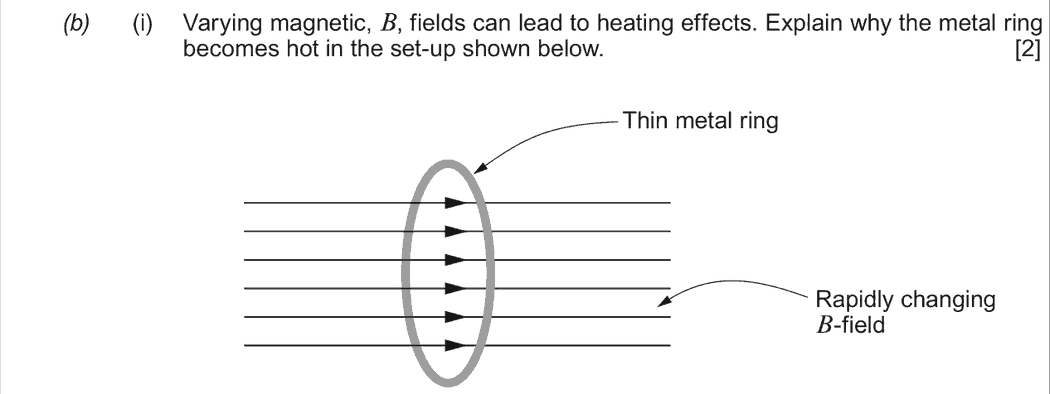
(b) (i) Varying magnetic, B, fields can lead to heating effects. Explain why the metal ring becomes hot in the set-up shown below. [2] Thin metal ring Rapidly changing B-field
October 2021 · Component 3 · Q8(b)(ii) 3 marks AO2=3 Calculation electromagnetic induction
Earlier parts of question 8 that this part usesEarlier part of October 2021 Component 3 question 8Earlier part of October 2021 Component 3 question 8
(ii) Calculate the current in the ring if the rate of change of the B-field is 67 T s–1, the ring has a radius of 7.0 cm and a resistance of 0.087 Ω. [3]
October 2021 · Component 3 · Q8(c) 3 marks AO3=3 Explanation photons
Earlier parts of question 8 that this part usesEarlier part of October 2021 Component 3 question 8Earlier part of October 2021 Component 3 question 8
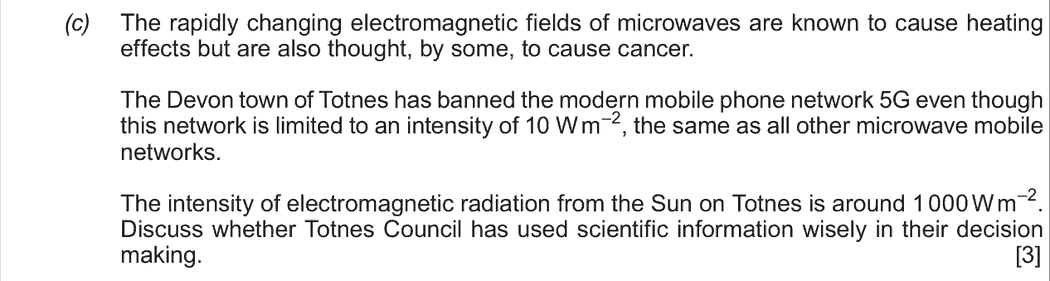
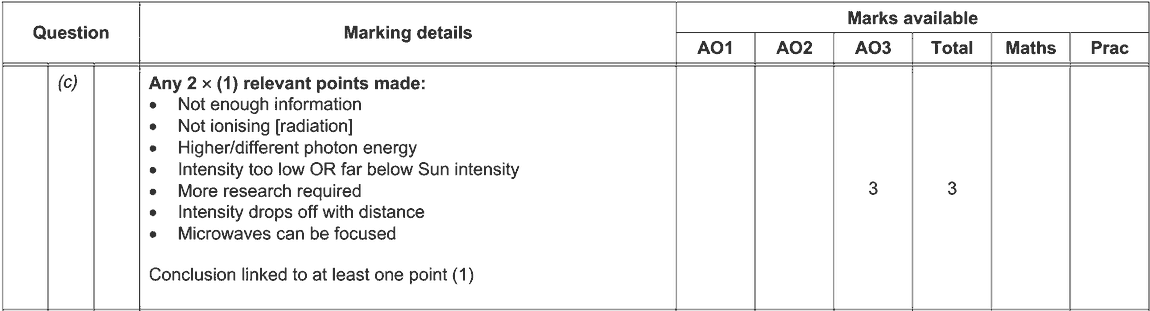
(c) The rapidly changing electromagnetic fields of microwaves are known to cause heating effects but are also thought, by some, to cause cancer. The Devon town of Totnes has banned the modern mobile phone network 5G even though this network is limited to an intensity of 10 W m–2, the same as all other microwave mobile networks. The intensity of electromagnetic radiation from the Sun on Totnes is around 1 000 W m–2. Discuss whether Totnes Council has used scientific information wisely in their decision making. [3]
October 2021 · Component 3 · Q9(a)(i) 2 marks AO1=2 Short answer alternating currents
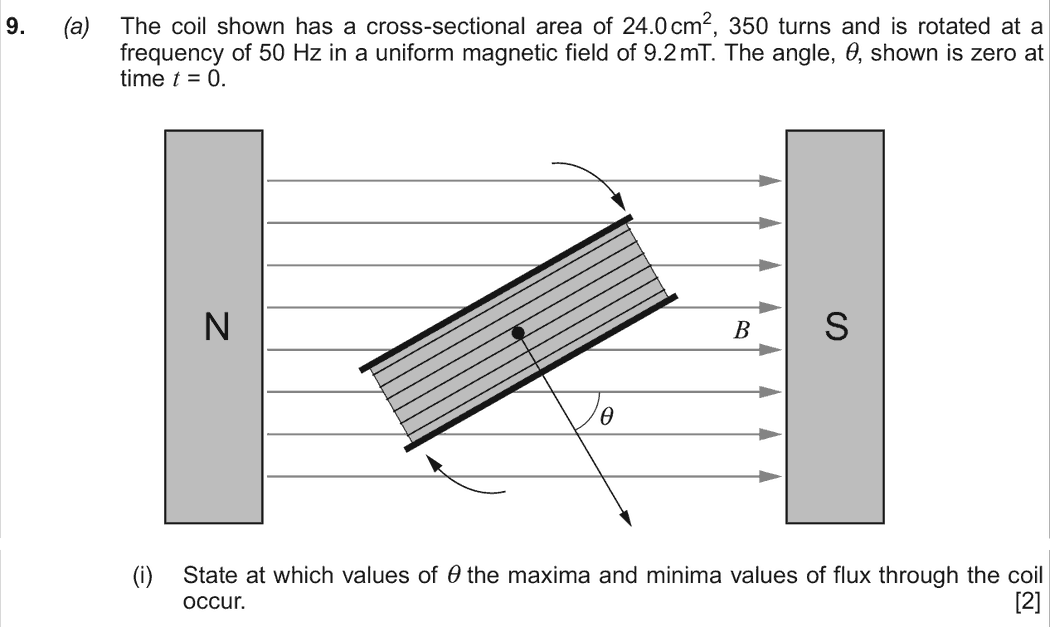
9. (a) The coil shown has a cross-sectional area of 24.0 cm2, 350 turns and is rotated at a frequency of 50 Hz in a uniform magnetic field of 9.2 mT. The angle, θ, shown is zero at time t = 0. N S B θ (i) State at which values of θ the maxima and minima values of flux through the coil occur. [2]
October 2021 · Component 3 · Q9(a)(ii) 2 marks AO1=2 Explanation alternating currents
Earlier part of question 9 that this part usesEarlier part of October 2021 Component 3 question 9
(ii) Explain at which value of θ the maximum induced emf occurs. [2]
October 2021 · Component 3 · Q9(a)(iii) 3 marks AO2=3 Calculation alternating currents
Earlier part of question 9 that this part usesEarlier part of October 2021 Component 3 question 9
(iii) Calculate the induced emf when t = 2.5 ms. [3]
October 2021 · Component 3 · Q9(b)(i) 1 mark AO1=1 Show that alternating currents
Earlier part of question 9 that this part usesEarlier part of October 2021 Component 3 question 9
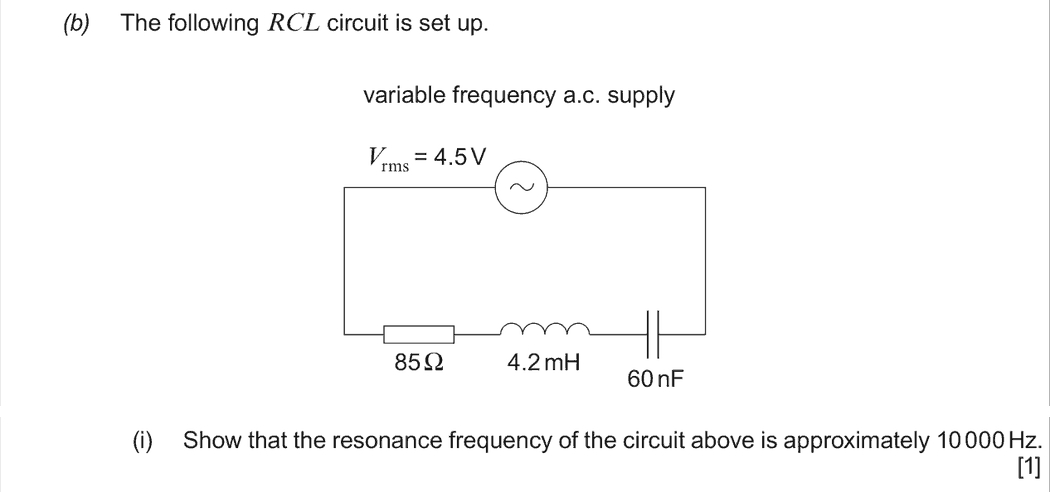
(b) The following RCL circuit is set up. variable frequency a.c. supply Vrms = 4.5 V 85 Ω 4.2 mH 60 nF (i) Show that the resonance frequency of the circuit above is approximately 10 000 Hz. [1]
October 2021 · Component 3 · Q9(b)(ii) 1 mark AO2=1 Short answer alternating currents
Earlier parts of question 9 that this part usesEarlier part of October 2021 Component 3 question 9Earlier part of October 2021 Component 3 question 9
(ii) Explain why the maximum rms current is approximately 50 mA. [1]
October 2021 · Component 3 · Q9(b)(iii) 3 marks AO1=1, AO2=2 Show that alternating currents
Earlier parts of question 9 that this part usesEarlier part of October 2021 Component 3 question 9Earlier part of October 2021 Component 3 question 9
(iii) Show that the rms current in the circuit is approximately 17 mA when the frequency is 16 kHz. [3]
October 2021 · Component 3 · Q9(b)(iv) 3 marks AO2=3 Diagram or graph alternating currents
Earlier parts of question 9 that this part usesEarlier part of October 2021 Component 3 question 9Earlier part of October 2021 Component 3 question 9
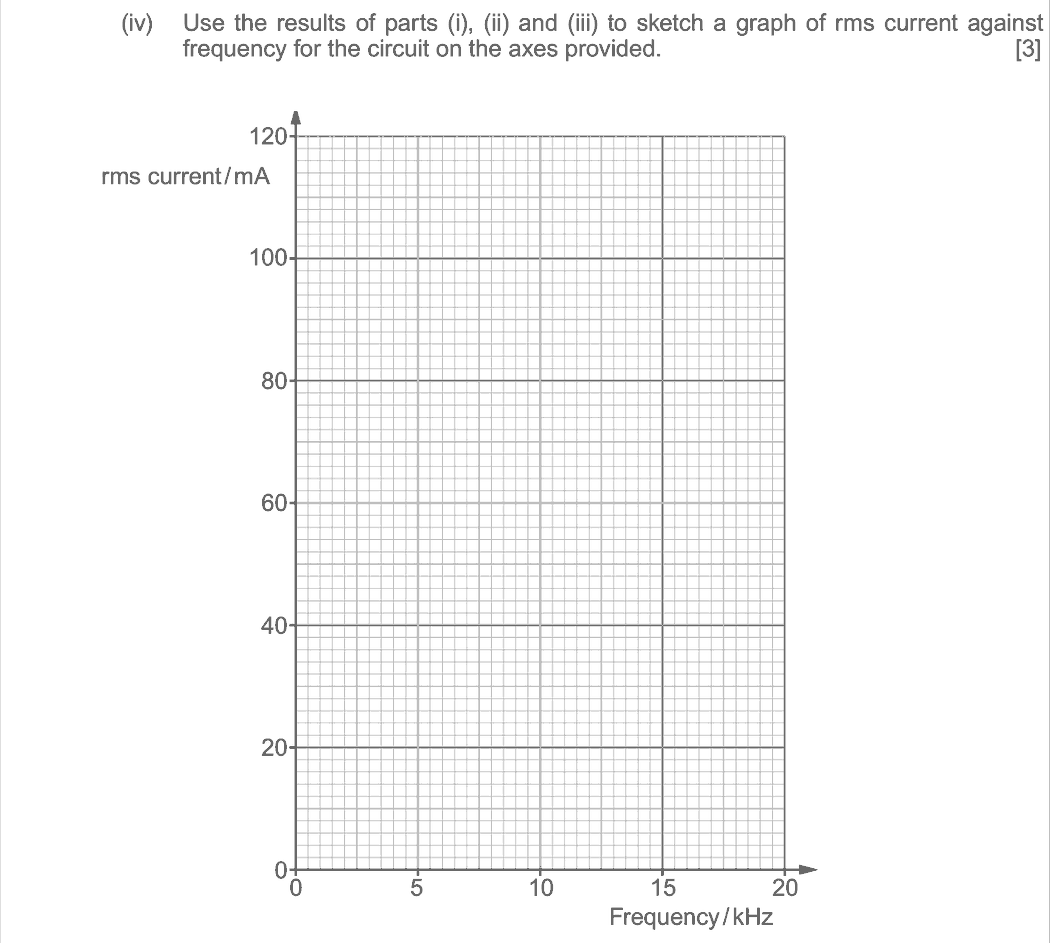
(iv) Use the results of parts (i), (ii) and (iii) to sketch a graph of rms current against frequency for the circuit on the axes provided. [3] 120 rms current / mA 100 80 60 40 20 0 0 5 10 15 20 Frequency / kHz
October 2021 · Component 3 · Q9(c) 5 marks AO3=5 Calculation alternating currents
Earlier parts of question 9 that this part usesEarlier part of October 2021 Component 3 question 9Earlier part of October 2021 Component 3 question 9Earlier part of October 2021 Component 3 question 9
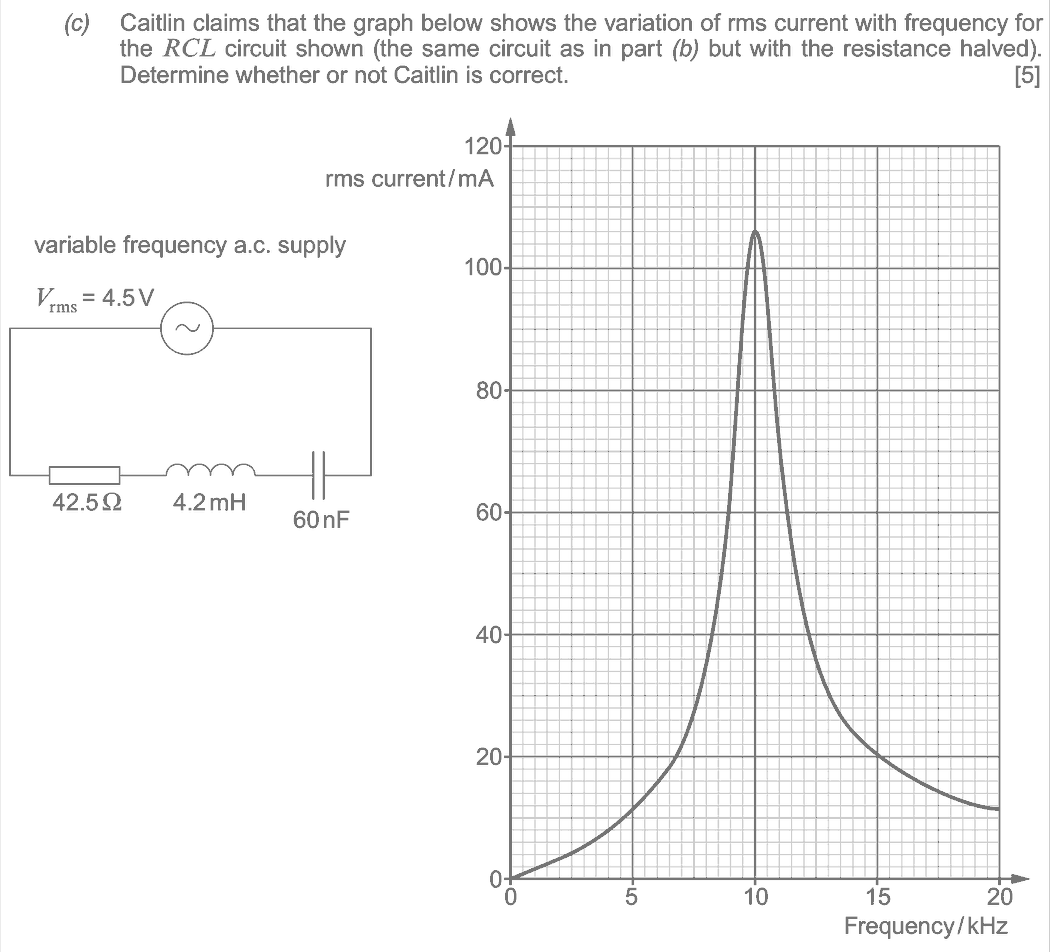
(c) Caitlin claims that the graph below shows the variation of rms current with frequency for the RCL circuit shown (the same circuit as in part (b) but with the resistance halved). Determine whether or not Caitlin is correct. [5] 120 rms current / mA variable frequency a.c. supply 100 Vrms = 4.5 V 80 42.5 Ω 4.2 mH 60 60 nF 40 20 0 0 5 10 15 20 Frequency / kHz
October 2021 · Component 3 · Q10(a)(i) 2 marks AO1=1, AO2=1 Calculation medical physics
10. (a) The electrons in an X-ray tube are accelerated by a pd of 45 kV. (i) Determine the kinetic energy in Joule with which an electron hits the target after accelerating through this voltage. [2]
October 2021 · Component 3 · Q10(a)(ii) 2 marks AO2=2 Calculation medical physics
Earlier part of question 10 that this part usesEarlier part of October 2021 Component 3 question 10
(ii) Determine the minimum wavelength of the X-rays. [2]
October 2021 · Component 3 · Q10(a)(iii) 2 marks AO2=2 Calculation medical physics
Earlier part of question 10 that this part usesEarlier part of October 2021 Component 3 question 10
(iii) The X-ray tube has an efficiency of 0.5 % and the anode current is 0.12 A. Calculate the power of the X-rays produced. [2]
October 2021 · Component 3 · Q10(b) 2 marks AO2=2 Calculation medical physics
Earlier part of question 10 that this part usesEarlier part of October 2021 Component 3 question 10
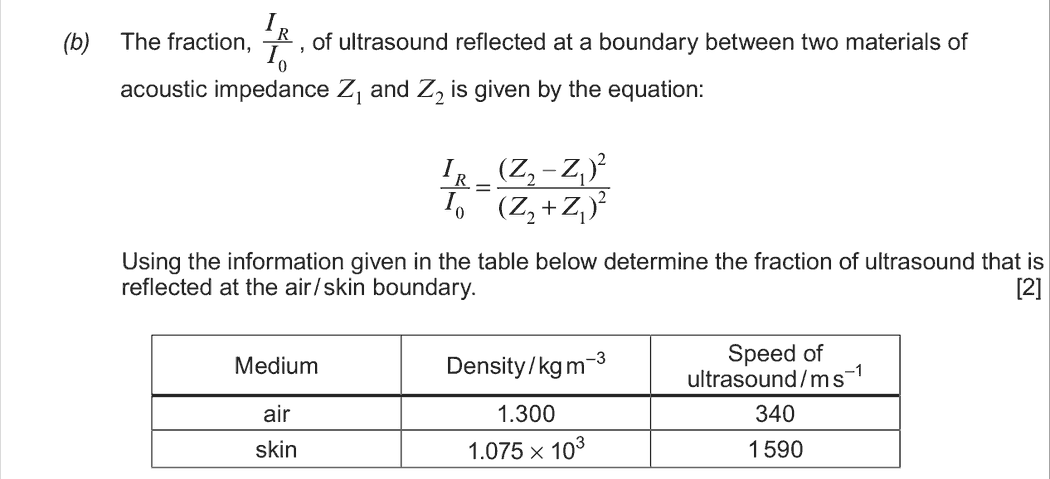
IR (b) The fraction, , of ultrasound reflected at a boundary between two materials of I0 acoustic impedance Z1 and Z2 is given by the equation: IR (Z2 – Z1)2 = I0 (Z2 + Z1)2 Using the information given in the table below determine the fraction of ultrasound that is reflected at the air / skin boundary. [2] Speed of Medium Density / kg m–3 ultrasound / m s–1 air 1.300 340 skin 1.075 × 10³ 1 590
October 2021 · Component 3 · Q10(c)(i) 2 marks AO1=2 Explanation medical physics
Earlier parts of question 10 that this part usesEarlier part of October 2021 Component 3 question 10Earlier part of October 2021 Component 3 question 10
(c) (i) A magnetic resonance image (MRI) scanner can be used to detect tumours in a patient’s body. Describe the effect a strong magnetic field has on hydrogen and how the hydrogen absorbs and emits radio waves. [2]
October 2021 · Component 3 · Q10(c)(ii) 2 marks AO2=2 Calculation medical physics
Earlier parts of question 10 that this part usesEarlier part of October 2021 Component 3 question 10Earlier part of October 2021 Component 3 question 10Earlier part of October 2021 Component 3 question 10
(ii) The MRI scanner has a magnetic field of 1.4 T. Determine the wavelength of electromagnetic radiation that should be used to detect the tumour. [2]
October 2021 · Component 3 · Q10(d) 3 marks AO1=3 Explanation medical physics
Earlier parts of question 10 that this part usesEarlier part of October 2021 Component 3 question 10Earlier part of October 2021 Component 3 question 10
(d) Explain how PET scanners work. [3]
October 2021 · Component 3 · Q10(e) 5 marks AO3=5 Explanation medical physics
Earlier parts of question 10 that this part usesEarlier part of October 2021 Component 3 question 10Earlier part of October 2021 Component 3 question 10
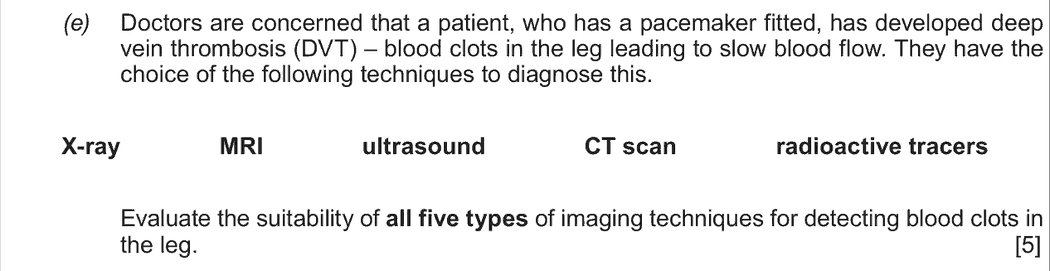
(e) Doctors are concerned that a patient, who has a pacemaker fitted, has developed deep vein thrombosis (DVT) – blood clots in the leg leading to slow blood flow. They have the choice of the following techniques to diagnose this. X-ray MRI ultrasound CT scan radioactive tracers Evaluate the suitability of all five types of imaging techniques for detecting blood clots in the leg. [5]
October 2021 · Component 3 · Q11(a)(i) 2 marks AO1=2 Explanation physics of sports
11. (a) (i) Explain which player, A or B, is in a more stable position. [2] Player A Player B
October 2021 · Component 3 · Q11(a)(ii) 2 marks AO1=2 Definition physics of sports
Earlier part of question 11 that this part usesEarlier part of October 2021 Component 3 question 11
(ii) Explain what is meant by the statement that the coefficient of restitution of a netball ball and the floor of the court is 0.8. [2]
October 2021 · Component 3 · Q11(a)(iii) 2 marks AO1=1, AO2=1 Show that physics of sports
Earlier part of question 11 that this part usesEarlier part of October 2021 Component 3 question 11
(iii) Use the data in the table to show that a wood floor surface has the greater coefficient of restitution. [2] Surface Mean drop height / m Mean bounce height / m wood 1.25 0.62 rubber mesh 1.30 0.51
October 2021 · Component 3 · Q11(b)(i) 3 marks AO3=3 Explanation physics of sports
Earlier part of question 11 that this part usesEarlier part of October 2021 Component 3 question 11
(b) (i) In a practice match a player applies spin to the ball when passing to a team-mate. A spectator suggests that applying spin has no effect on the flight of the ball. Explain whether the spectator is correct. [3]
October 2021 · Component 3 · Q11(b)(ii) 4 marks AO1=1, AO2=3 Calculation physics of sports
Earlier parts of question 11 that this part usesEarlier part of October 2021 Component 3 question 11Earlier part of October 2021 Component 3 question 11
(ii) Determine the torque applied to the ball to enable it to spin at a rate of 7.3 rad s–1 from rest in 0.3 s. The mass of the ball is 450 g and diameter 220 mm. The moment of inertia is given by the equation I = 2 3mr2. [4]
October 2021 · Component 3 · Q11(b)(iii) 3 marks AO2=3 Calculation physics of sports
Earlier parts of question 11 that this part usesEarlier part of October 2021 Component 3 question 11Earlier part of October 2021 Component 3 question 11
(iii) During a different pass of the ball; the rotational kinetic energy of the ball is 4.4 J. Determine the number of revolutions per second of the ball. [3]
October 2021 · Component 3 · Q11(c)(i) 2 marks AO2=2 Calculation physics of sports
Earlier part of question 11 that this part usesEarlier part of October 2021 Component 3 question 11
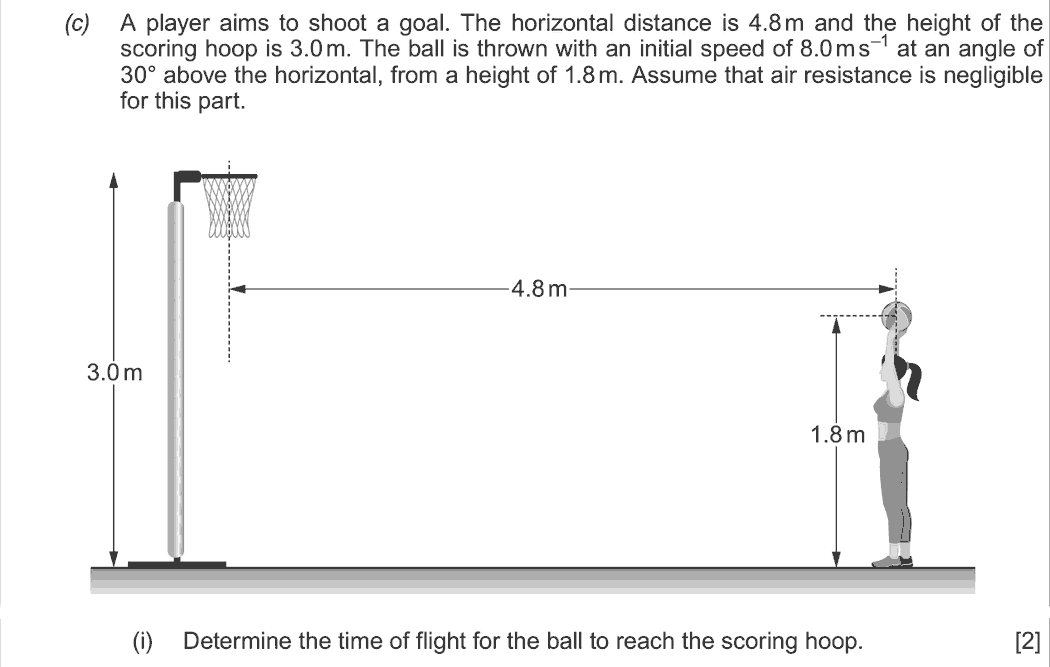
(c) A player aims to shoot a goal. The horizontal distance is 4.8 m and the height of the scoring hoop is 3.0 m. The ball is thrown with an initial speed of 8.0 m s–1 at an angle of 30° above the horizontal, from a height of 1.8 m. Assume that air resistance is negligible for this part. 4.8 m 3.0 m 1.8 m (i) Determine the time of flight for the ball to reach the scoring hoop. [2]
October 2021 · Component 3 · Q11(c)(ii) 2 marks AO3=2 Calculation physics of sports
Earlier parts of question 11 that this part usesEarlier part of October 2021 Component 3 question 11Earlier part of October 2021 Component 3 question 11
(ii) Evaluate whether or not a goal is scored. [2]
October 2021 · Component 3 · Q12(a) 3 marks AO1=1, AO2=2 Explanation energy and the environment
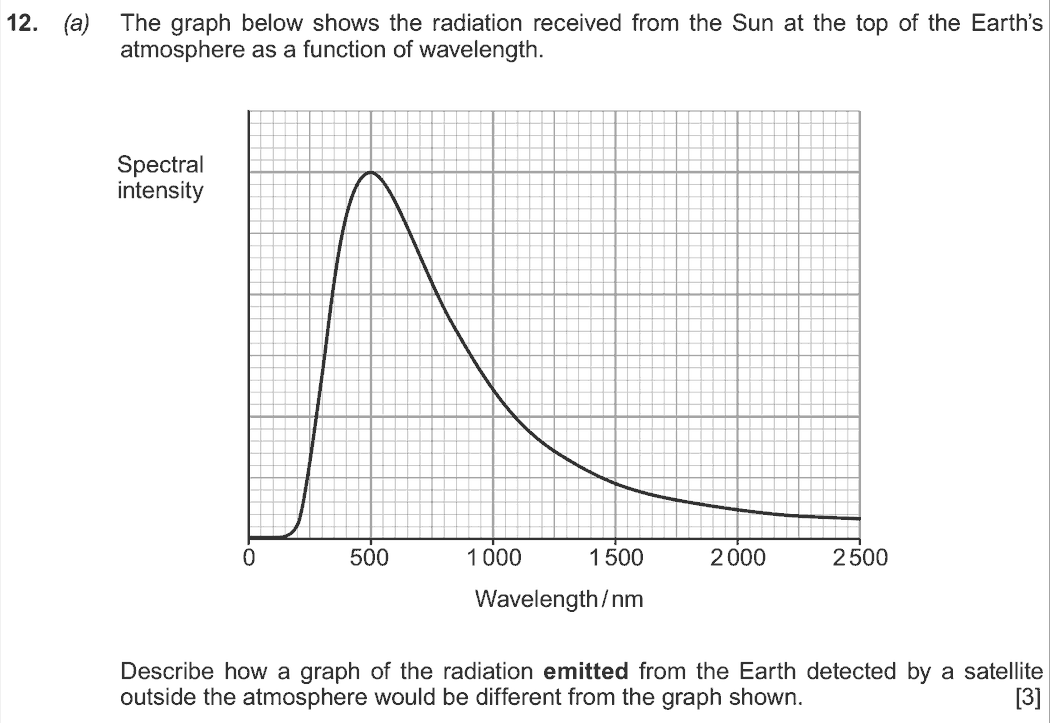
12. (a) The graph below shows the radiation received from the Sun at the top of the Earth’s atmosphere as a function of wavelength. Spectral intensity 0 500 1 000 1 500 2 000 2 500 Wavelength / nm Describe how a graph of the radiation emitted from the Earth detected by a satellite outside the atmosphere would be different from the graph shown. [3]
October 2021 · Component 3 · Q12(b)(i) 2 marks AO1=2 Definition energy and the environment
Earlier part of question 12 that this part usesEarlier part of October 2021 Component 3 question 12
(b) (i) State Archimedes’ principle. [2]
October 2021 · Component 3 · Q12(b)(ii) 3 marks AO1=1, AO2=2 Calculation energy and the environment
Earlier parts of question 12 that this part usesEarlier part of October 2021 Component 3 question 12Earlier part of October 2021 Component 3 question 12
(ii) Harry adds a block of ice to a measuring cylinder containing saltwater. This causes the measuring cylinder reading to increase by 100 cm3. The density of saltwater is 1 020 kg m–3 and the density of ice is 920 kg m–3. Determine the volume of the block of ice above the surface. [3]
October 2021 · Component 3 · Q12(b)(iii) 2 marks AO3=2 Explanation energy and the environment
Earlier parts of question 12 that this part usesEarlier part of October 2021 Component 3 question 12Earlier part of October 2021 Component 3 question 12
(iii) The block of ice is left to melt. Harry says the ice melting will dilute the saltwater, decreasing its density. He suggests that adding an identical cube of ice would now increase the measuring cylinder reading by more than 100 cm3. Evaluate whether or not Harry is correct. [2]
October 2021 · Component 3 · Q12(c)(i) 3 marks AO1=1, AO2=2 Calculation energy and the environment
Earlier part of question 12 that this part usesEarlier part of October 2021 Component 3 question 12
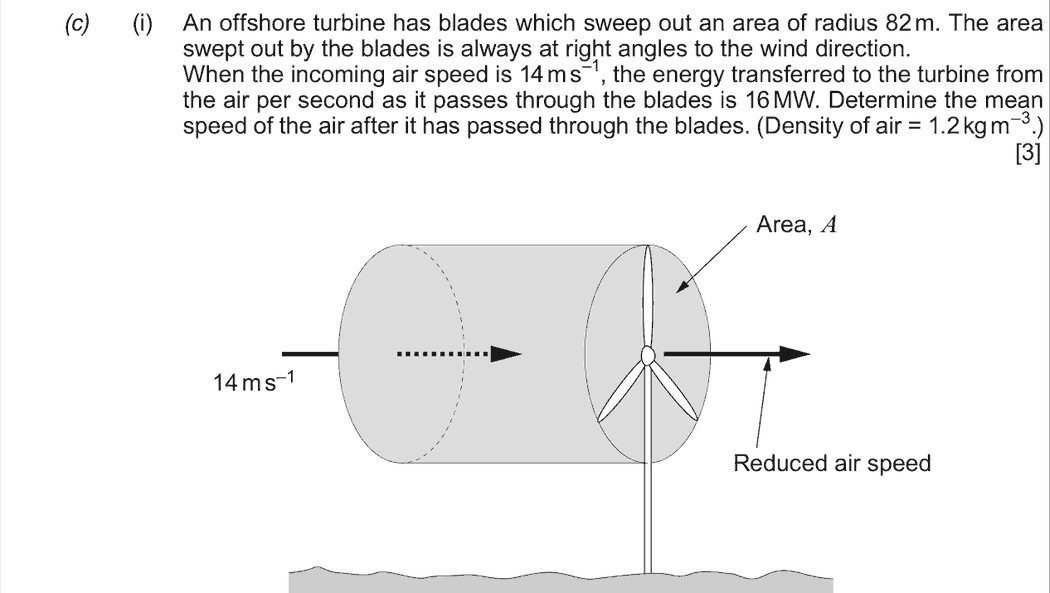
(c) (i) An offshore turbine has blades which sweep out an area of radius 82 m. The area swept out by the blades is always at right angles to the wind direction. When the incoming air speed is 14 m s–1, the energy transferred to the turbine from the air per second as it passes through the blades is 16 MW. Determine the mean speed of the air after it has passed through the blades. (Density of air = 1.2 kg m–3.) [3] Area, A 14 m s–1 Reduced air speed
October 2021 · Component 3 · Q12(c)(ii) 2 marks AO2=2 Calculation energy and the environment
Earlier parts of question 12 that this part usesEarlier part of October 2021 Component 3 question 12Earlier part of October 2021 Component 3 question 12
(ii) Under the above conditions the turbine can produce an electrical energy output of 210 MWh in 24 hours. Calculate the efficiency of the electricity production. [2]
October 2021 · Component 3 · Q12(d)(i) 1 mark AO1=1 Definition energy and the environment
Earlier parts of question 12 that this part usesEarlier part of October 2021 Component 3 question 12Earlier part of October 2021 Component 3 question 12
(d) (i) Define the U value of a building structure. [1]
October 2021 · Component 3 · Q12(d)(ii) 3 marks AO3=3 Calculation energy and the environment
Earlier parts of question 12 that this part usesEarlier part of October 2021 Component 3 question 12Earlier part of October 2021 Component 3 question 12Earlier part of October 2021 Component 3 question 12
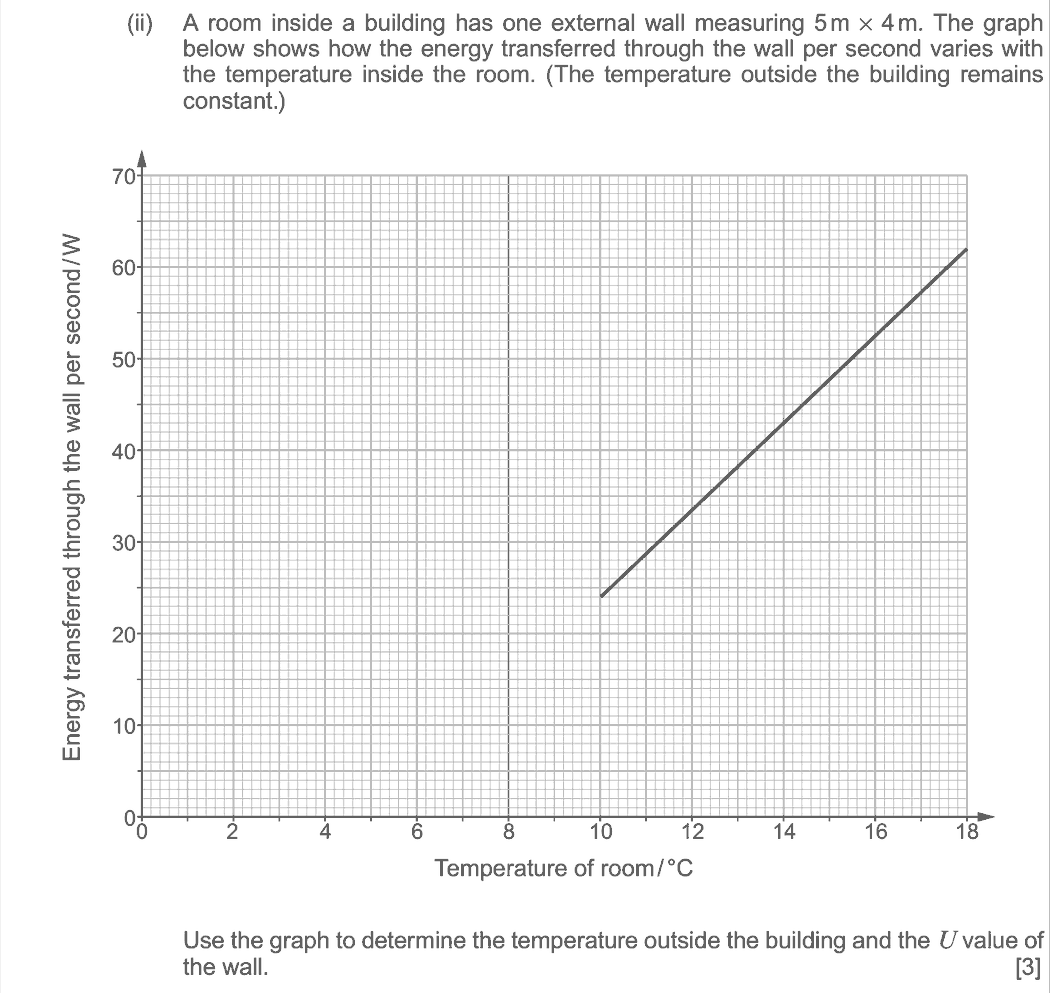
(ii) A room inside a building has one external wall measuring 5 m × 4 m. The graph below shows how the energy transferred through the wall per second varies with the temperature inside the room. (The temperature outside the building remains constant.) 70 second / W 60 per 50 wall the 40 through 30 transferred 20 Energy 10 0 0 2 4 6 8 10 12 14 16 18 Temperature of room / °C Use the graph to determine the temperature outside the building and the U value of the wall. [3]
October 2021 · Component 3 · Q12(d)(iii) 1 mark AO2=1 Short answer energy and the environment
Earlier parts of question 12 that this part usesEarlier part of October 2021 Component 3 question 12Earlier part of October 2021 Component 3 question 12Earlier part of October 2021 Component 3 question 12Earlier part of October 2021 Component 3 question 12
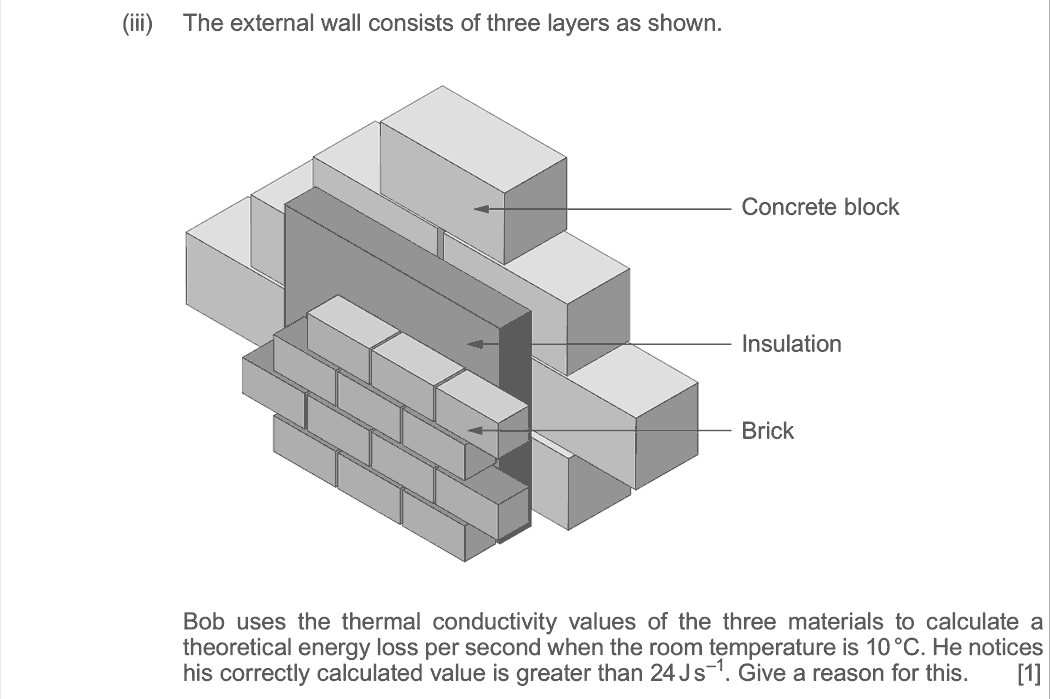
(iii) The external wall consists of three layers as shown. Concrete block Insulation Brick Bob uses the thermal conductivity values of the three materials to calculate a theoretical energy loss per second when the room temperature is 10 °C. He notices his correctly calculated value is greater than 24 J s–1. Give a reason for this. [1]

Work with an Eduqas physics tutor

Want a paper marked and gone through with you? Message us.

Prefer email? Send an enquiry

If you are under 18, please include a parent's contact details. Enquiries go to enquiries@physicsaleveltutor.com and are deleted once handled. All tutoring is online.