Mark scheme

Examiner's comment
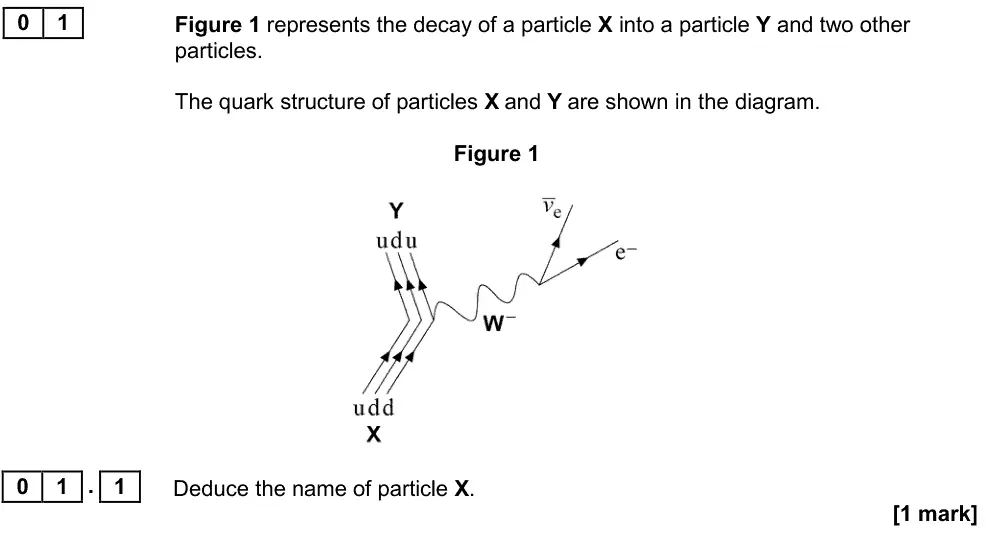
01.1 This was the most accessible question on the paper, with over 90% of students providing the correct answer.
Notes from the mark scheme and report
- Neutron (udd)
70 marks · 33 question parts · Paper, mark scheme and report on AQA's site · Have the data and formulae booklet beside you
01.1 This was the most accessible question on the paper, with over 90% of students providing the correct answer.

01.2 Although this was also correctly answered by the majority of students, there was some confusion concerning the word ‘interaction’, with ‘beta decay’ being a popular incorrect answer. Correct answers that included references to beta decay were credited with the mark.

01.3 Most students were familiar with the term ‘boson’ or gave the answer ‘exchange particle’. Other answers appeared to be the random naming of a familiar particle, such as pion, muon, etc.

01.4 This question proved to be more challenging with approximately half of the students only receiving one mark for failing to express their answers in terms of quarks. Other common errors included missing out the baryon number of the leptons (0) or the zero charge on the antineutrino. A surprisingly large number of students tried to answer using extended writing rather than using an equation approach such as the one provided in the mark scheme.

01.5 This straightforward piece of recall was provided by a large majority of students. There was no particular incorrect answer.

01.6 In this question students needed to provide a lot of information for the single mark available. Unsurprisingly, perhaps, this was one of the least accessible questions on the paper. Few students attempted to provide a reasoned answer based on conservation of electron and muon lepton numbers, i.e. conservation of muon lepton number requires a muon neutrino to be produced; conservation of charge suggests an electron is also produced; and conservation of electron lepton number requires the production of an electron antineutrino.
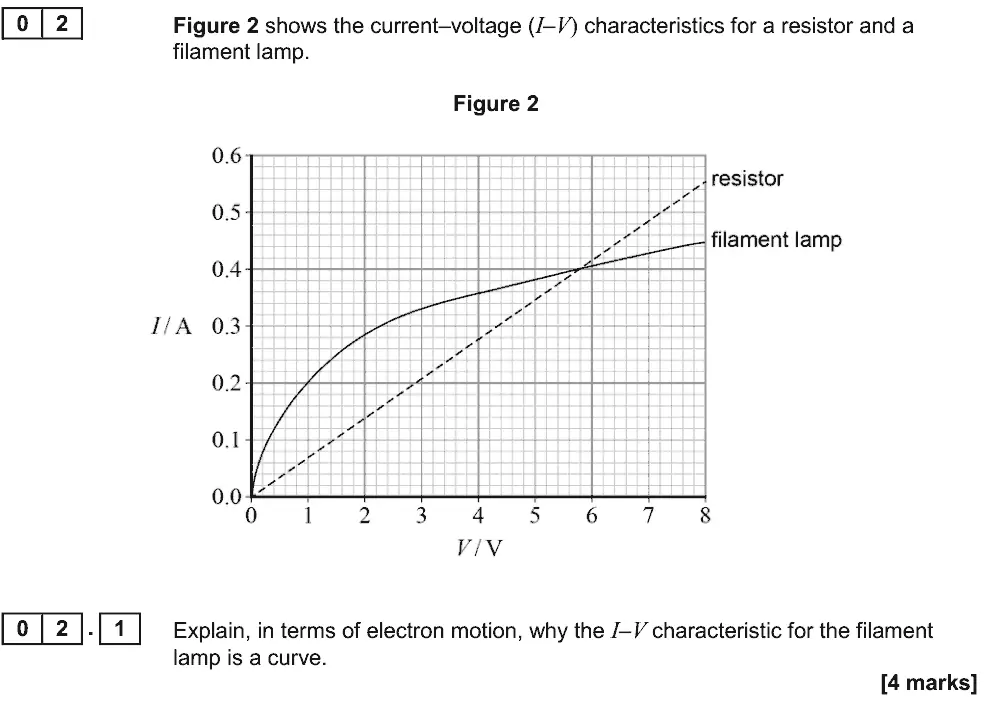
This question gave students the opportunity to demonstrate their skills reading graphs, as well as their knowledge and understanding of electricity. 02.1 Several misconceptions were clear in some of the answers to this question. Many students misinterpreted the graph as a V-I graph and, of the rest, many suggested that gradient is equal to 1/R: teachers are encouraged to emphasise that the value of V and I at the point (or 1/gradient of the line from the point to the origin) gives the resistance of the filament. Other problems were related to lack of detail or ambiguous terminology. Many students lost a mark for being unclear about ‘which particle moves more’, and the requirement for an increase in the rate of collisions (rather than just the collisions) also proved to be a hurdle to many. Many answers were seen that suggested students applied little more knowledge or understanding than that required at GCSE level. 02.2 This straightforward calculation was correctly performed by the large majority of students, suggesting that many who misinterpreted the axes in 02.1, were still able to use them correctly in this question. This is Paper 1 of the second series of the new AS specification. The paper consists of seven questions from across the AS specification. It makes use of a range of question styles, including multiple choice, short answer, single- and multi-step calculations, data analysis, and extended writing. In general, many students experienced difficulties by missing important details in both the questions and their answers. Calculations were often done well, but many students struggled with answers that required extended writing, particularly those involving some reasoning, such as 02.1, 03.5, 04.3, 05.3, 05.7 and 07.4.

02.2 This straightforward calculation was correctly performed by the large majority of students, suggesting that many who misinterpreted the axes in 02.1, were still able to use them correctly in this question.
Skills: MS3.1 Translate information between graphical, numerical and algebraic forms

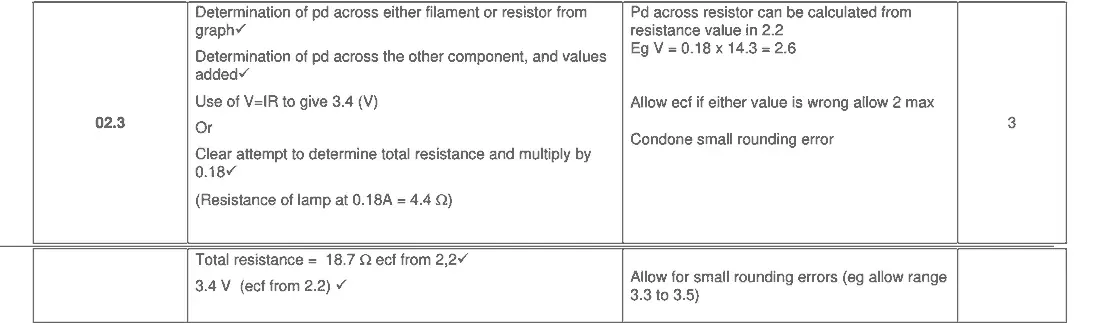
02.3 There were several different routes students could take to obtain the correct answer here, and all of them were given full credit. With many students not obtaining all three marks in what is a relatively straightforward calculation, it is suggested that teachers encourage students to sketch a small circuit diagram where one isn’t provided if it assists them in answering questions. The most straightforward, and rarely seen, method was to simply read the value of the pds for both components at 0.18 A, and add them together. Many students embarked on complex analyses that almost inevitably led to errors and marks being lost.
Skills: MS3.1 Translate information between graphical, numerical and algebraic forms; MS2.3 Substitute numerical values into algebraic equations using appropriate units for physical quantities

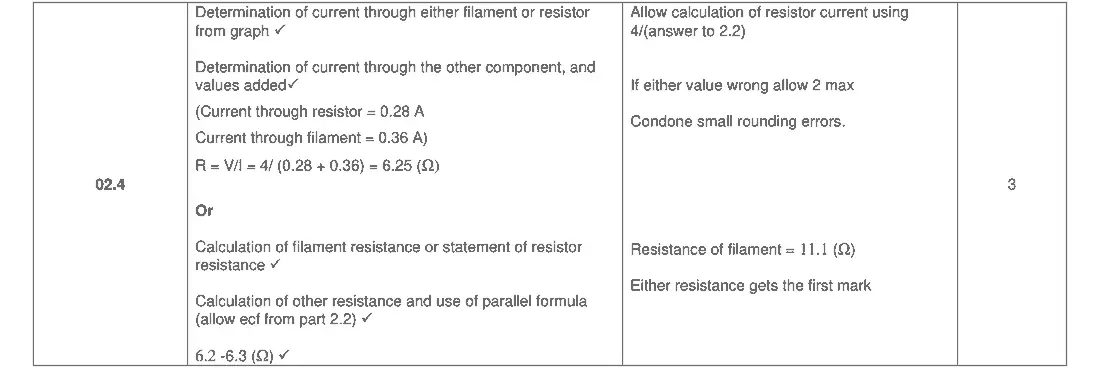
02.4 Many students have greater difficulties with parallel than series circuits and, again, the sketch of a simple circuit diagram would probably have assisted them here. The significant difference in performance between this and the previous question was seen in the award of 1 or zero marks: many more students were unable to make enough of an attempt to gain any credit. This was often due to an assumption that the 0.18 A current was still applicable here, with students then performing a simple V/I calculation for the wrong answer. Other common errors included difficulties adding resistances in parallel, a problem that would not have existed had these students realised that the total current could be obtained from the graph, and the resistance calculated from V/I.
Skills: MS3.1 Translate information between graphical, numerical and algebraic forms; MS2.3 Substitute numerical values into algebraic equations using appropriate units for physical quantities
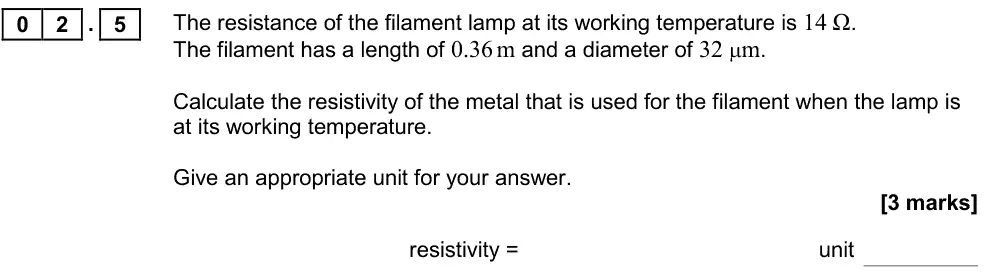
02.5 It was pleasing to note that this multi-step calculation was completed successfully by a large proportion of the students and that the correct unit was well known. Those who had difficulty tended to make power of ten errors or mistakenly use diameter for radius in the calculation of area, either of which still allowed for an ‘error carried forward’. It should be emphasised that a correct unit on its own was not credited, and that some working, and an answer, had to be seen.
Skills: MS4.3 Calculate areas of triangles, circumferences and areas of circles, surface areas and volumes of rectangular blocks, cylinders and spheres; MS2.3 Substitute numerical values into algebraic equations using appropriate units for physical quantities; MS0.1 Recognise and make use of appropriate units in calculations
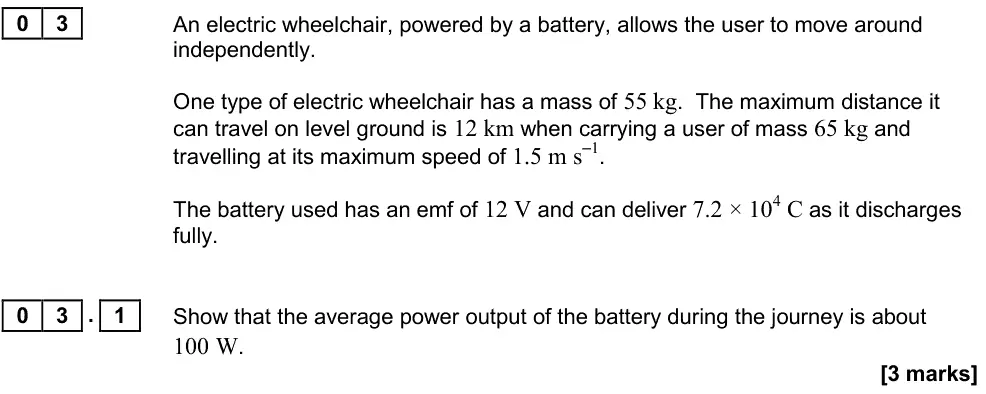
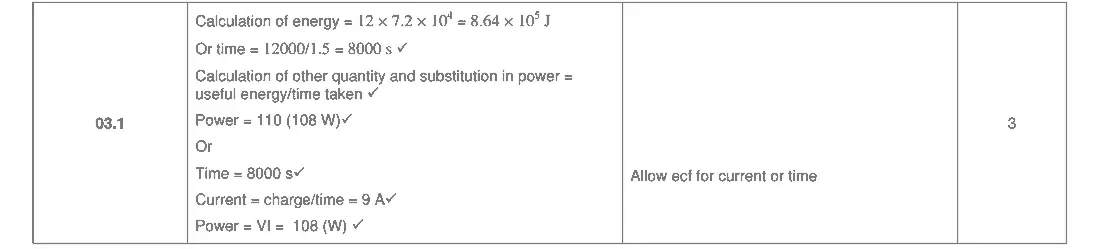
03.1 This was a fairly accessible question with more than half of the students gaining all three marks. There was more than one route students could choose to answer this question, with the calculation of the current proving to be a popular alternative. ‘Show that’ questions provide students with an answer that can be used later should they be unable to do the calculation. It has become relatively common to see students attempting to use the value to perform the calculation backwards. It was more common to see answers that manipulated the numbers in the stem to obtain 100W. Students should be reminded that examiners will only give credit to the final answer in a ‘show that’ calculation if it is given to at least one more significant figure than the value in the question. 03.2 Students were given full credit if they chose to use the value of 100 W from 03.1. Despite this, many students were unable to make at least some attempt at an answer, with over 10% making no attempt at all. It may be that many students were unfamiliar with questions that move from one area (such as electricity) to another (such as force), which could have led to the confusion of v (velocity) with V (pd) that was seen. Teachers should understand that this combination of topics within a question is a requirement of this specification, and the full A-level, that is certain to continue to appear in the examination papers. Errors were also seen in the answers that were provided. For example, asking for a ‘mean’ value of a quantity inevitably encourages some students to divide their answer by 2, an error that was seen a surprising number of times.
Skills: MS2.3 Substitute numerical values into algebraic equations using appropriate units for physical quantities
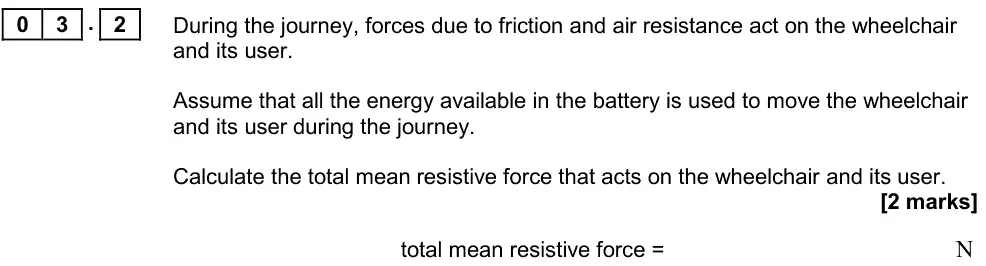
03.2 Students were given full credit if they chose to use the value of 100 W from 03.1. Despite this, many students were unable to make at least some attempt at an answer, with over 10% making no attempt at all. It may be that many students were unfamiliar with questions that move from one area (such as electricity) to another (such as force), which could have led to the confusion of v (velocity) with V (pd) that was seen. Teachers should understand that this combination of topics within a question is a requirement of this specification, and the full A-level, that is certain to continue to appear in the examination papers. Errors were also seen in the answers that were provided. For example, asking for a ‘mean’ value of a quantity inevitably encourages some students to divide their answer by 2, an error that was seen a surprising number of times. 03.4 The fact that a large number of students did not attempt this question is partly related to the need to use information from 03.2, which was not well answered. It could also suggest that students expect calculations involving speed (or velocity) to require the use of the “suvat” equations, for example, and that they are therefore confused when none of the familiar information is provided. However, it is acknowledged that this is a conceptually demanding question, requiring students to appreciate that, at the maximum speed, the driving force = the total friction/drag force for example, and then apply that to P=Fv.
Skills: MS2.3 Substitute numerical values into algebraic equations using appropriate units for physical quantities
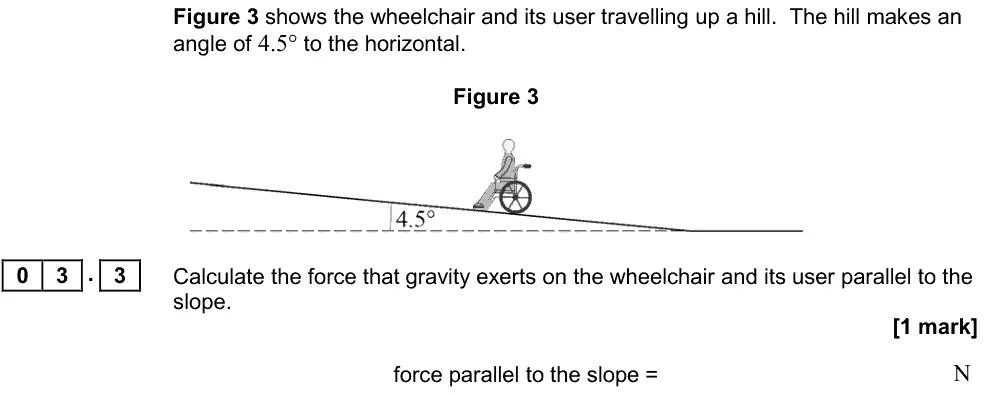
03.3 Again, it may have been the context of this question that meant that this relatively straightforward calculation was only correctly performed by a minority of students. It may also have been partly due to the fact that only one mark is available and yet there are several opportunities for error, such as missing out ‘g’ and using the wrong trigonometrical function.
Skills: MS4.5 Use sin, cos and tan in physical problems; MS2.3 Substitute numerical values into algebraic equations using appropriate units for physical quantities
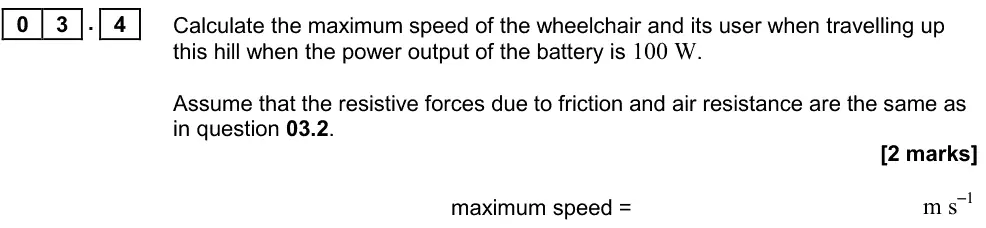
03.4 The fact that a large number of students did not attempt this question is partly related to the need to use information from 03.2, which was not well answered. It could also suggest that students expect calculations involving speed (or velocity) to require the use of the “suvat” equations, for example, and that they are therefore confused when none of the familiar information is provided. However, it is acknowledged that this is a conceptually demanding question, requiring students to appreciate that, at the maximum speed, the driving force = the total friction/drag force for example, and then apply that to P=Fv.
Skills: MS2.3 Substitute numerical values into algebraic equations using appropriate units for physical quantities
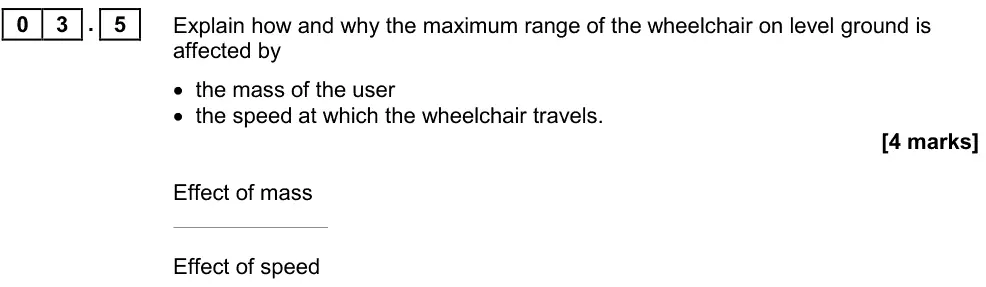
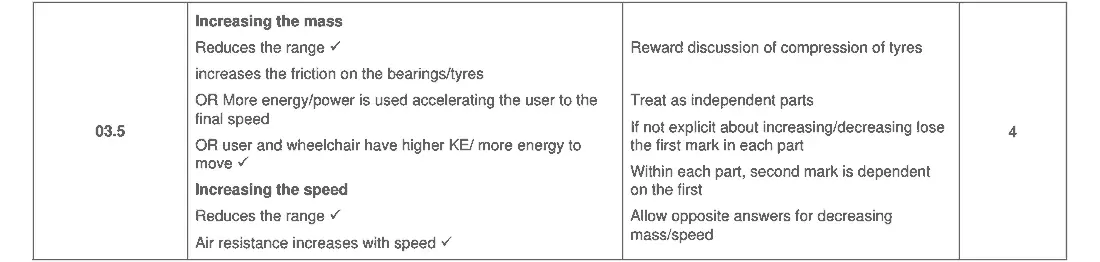
03.5 Another common feature of this new specification is the assessment of a student’s ability to reach a reasoned judgement. In this question students were required to decide which effect (increase or decrease) they were going to consider, and whether this would increase or decrease the range. This was a point missed by many students. Fully correct answers were rare, with many students failing to make the link between the speed and drag forces for example. This is Paper 1 of the second series of the new AS specification. The paper consists of seven questions from across the AS specification. It makes use of a range of question styles, including multiple choice, short answer, single- and multi-step calculations, data analysis, and extended writing. In general, many students experienced difficulties by missing important details in both the questions and their answers. Calculations were often done well, but many students struggled with answers that required extended writing, particularly those involving some reasoning, such as 02.1, 03.5, 04.3, 05.3, 05.7 and 07.4.
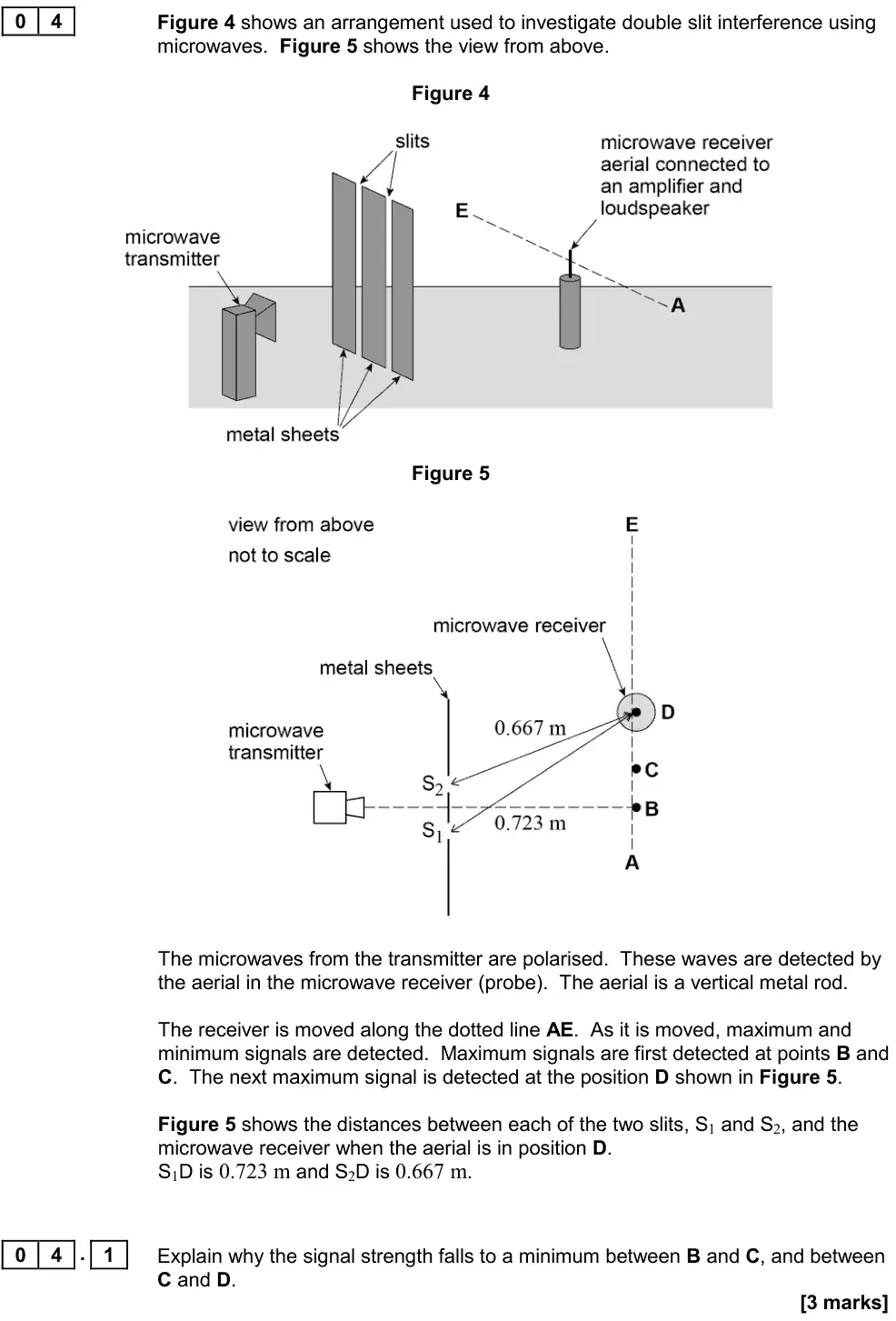
04.1 It was common to see answers referring to a simple line of sight issue related to the three metal plates, despite references to double slit interference in the stem. This may suggest that students fail to read the stem of a question with sufficient care, a problem that may be alleviated if students were in the habit of underlining key words as they read. Students who understood the context often lost marks by confusing path difference and phase difference. Being familiar with the difference, and relationship, between these two is fundamental to an understanding of interference in waves. 4.2 This is a fairly demanding multi-step problem that many found difficult. In order to answer this question, students were required to relate the data in the diagram to the path difference of the waves, specifically 2 x the wavelength. They also had to apply the wave equation to the answer they obtained. Those who managed to make some attempt at an answer commonly missed the double wavelength, or made an arithmetical error in the use of speed = frequency x wavelength.

04.1 It was common to see answers referring to a simple line of sight issue related to the three metal plates, despite references to double slit interference in the stem. This may suggest that students fail to read the stem of a question with sufficient care, a problem that may be alleviated if students were in the habit of underlining key words as they read. Students who understood the context often lost marks by confusing path difference and phase difference. Being familiar with the difference, and relationship, between these two is fundamental to an understanding of interference in waves. 4.2 This is a fairly demanding multi-step problem that many found difficult. In order to answer this question, students were required to relate the data in the diagram to the path difference of the waves, specifically 2 x the wavelength. They also had to apply the wave equation to the answer they obtained. Those who managed to make some attempt at an answer commonly missed the double wavelength, or made an arithmetical error in the use of speed = frequency x wavelength.
Skills: MS2.3 Substitute numerical values into algebraic equations using appropriate units for physical quantities

4.3 Many students suggested that total destructive interference cannot occur, without relating it to the different amplitudes of the waves due to their different path lengths. This is probably due to the fact that students commonly picture waves of equal amplitude interfering, irrespective of path length. Incorrect answers included suggestions that other sources of microwaves, including the CMBR, were to blame. This is Paper 1 of the second series of the new AS specification. The paper consists of seven questions from across the AS specification. It makes use of a range of question styles, including multiple choice, short answer, single- and multi-step calculations, data analysis, and extended writing. In general, many students experienced difficulties by missing important details in both the questions and their answers. Calculations were often done well, but many students struggled with answers that required extended writing, particularly those involving some reasoning, such as 02.1, 03.5, 04.3, 05.3, 05.7 and 07.4.

4.4 Most students were able to make an attempt to link the phenomenon described in this question to the polarisation of the waves. Some students interpreted the line AE as another sequence of slits and suggested that the microwaves were being blocked. Many had difficulties expressing their answer in terms of the orientation of the microwave and aerial, with some stating that the signal would increase as the aerial was aligned with the maxima.
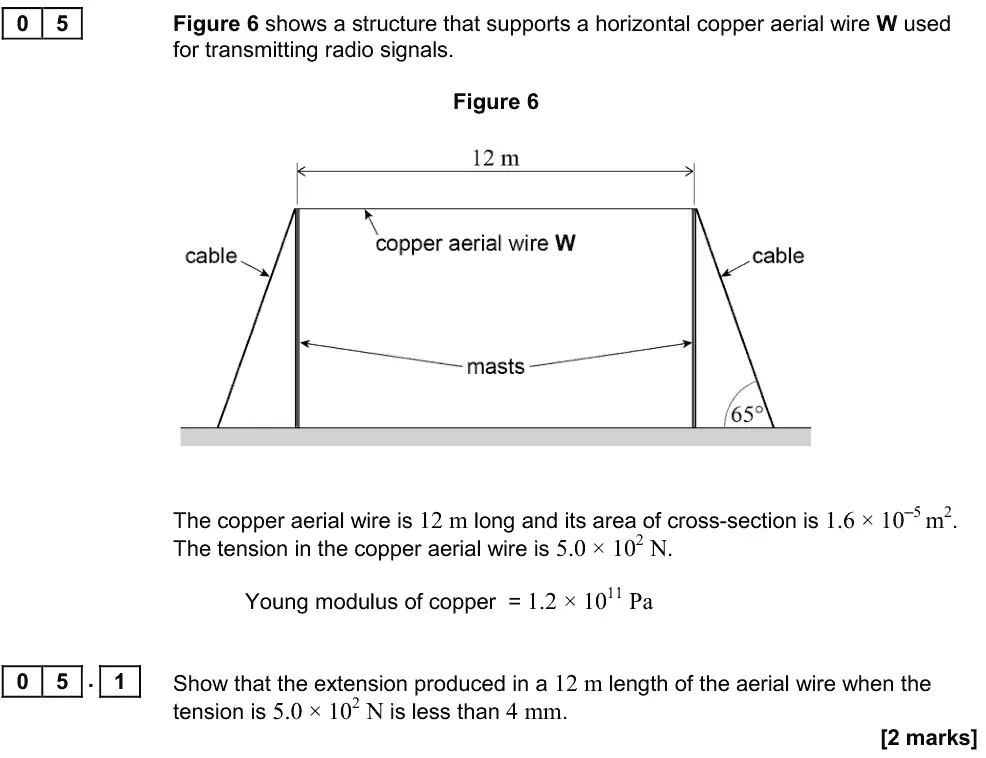
05.1 It is clear from the large proportion of students who obtained both marks for this question that the application of the Young modulus is well understood. This question was made even more accessible by providing the area, and by giving all the data in units that did not require conversion.
Skills: MS2.2 Change the subject of an equation, including non-linear equations; MS2.3 Substitute numerical values into algebraic equations using appropriate units for physical quantities

05.2 This one mark calculation was poorly answered, with few students being able to obtain the correct value for the tension. It may be that many students missed the relevant data or could not picture which forces were needed. It would doubtless have helped some students had they drawn the forces on the diagram provided.
Skills: MS4.5 Use sin, cos and tan in physical problems

05.3 It is clear that many students learn about the formation of standing waves in general terms and answers focusing on this were incomplete in several respects. In particular, many students missed out the initial formation of the wave, and many failed to adequately explain the reason for production of specific frequencies. Consequently it was common to see answers obtaining only 2 of the 4 marks. This is Paper 1 of the second series of the new AS specification. The paper consists of seven questions from across the AS specification. It makes use of a range of question styles, including multiple choice, short answer, single- and multi-step calculations, data analysis, and extended writing. In general, many students experienced difficulties by missing important details in both the questions and their answers. Calculations were often done well, but many students struggled with answers that required extended writing, particularly those involving some reasoning, such as 02.1, 03.5, 04.3, 05.3, 05.7 and 07.4.

05.4 This calculation proved to be very accessible with a large majority of students obtaining the single mark for it. 05.5 However, this calculation proved to be less accessible despite an error for the mass per unit length in 05.4 being carried forward. Credit was also given for students making it clear that the fundamental frequency had to be multiplied by 3.
Skills: MS2.3 Substitute numerical values into algebraic equations using appropriate units for physical quantities

05.5 However, this calculation proved to be less accessible despite an error for the mass per unit length in 05.4 being carried forward. Credit was also given for students making it clear that the fundamental frequency had to be multiplied by 3.
Skills: MS2.3 Substitute numerical values into algebraic equations using appropriate units for physical quantities
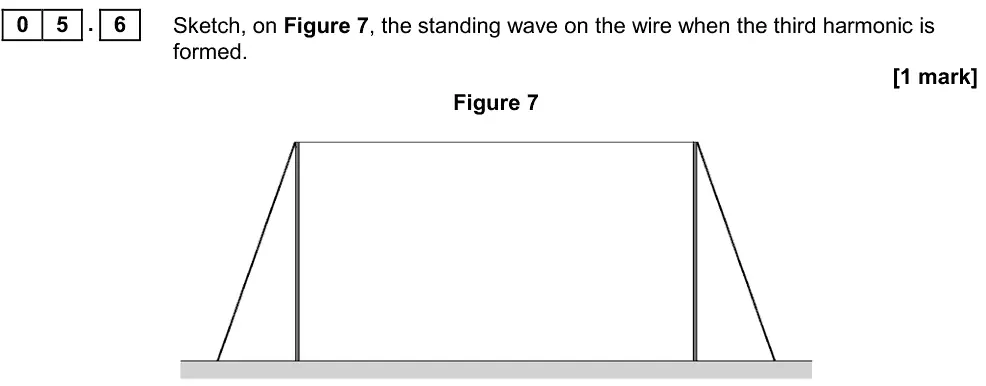
05.6 The drawing of three ‘loops’ was generally awarded the mark, unless the length of each loop was too unequal to be acceptable. 05.7 Whilst it was common to see answers that made some attempt to describe what happens to the wire if it is stretched too much, poor use of the correct terminology, such as failure to mention an elastic limit or equivalent, tended to limit the mark awarded to many answers.

05.6 The drawing of three ‘loops’ was generally awarded the mark, unless the length of each loop was too unequal to be acceptable. 05.7 Whilst it was common to see answers that made some attempt to describe what happens to the wire if it is stretched too much, poor use of the correct terminology, such as failure to mention an elastic limit or equivalent, tended to limit the mark awarded to many answers. This is Paper 1 of the second series of the new AS specification. The paper consists of seven questions from across the AS specification. It makes use of a range of question styles, including multiple choice, short answer, single- and multi-step calculations, data analysis, and extended writing. In general, many students experienced difficulties by missing important details in both the questions and their answers. Calculations were often done well, but many students struggled with answers that required extended writing, particularly those involving some reasoning, such as 02.1, 03.5, 04.3, 05.3, 05.7 and 07.4.
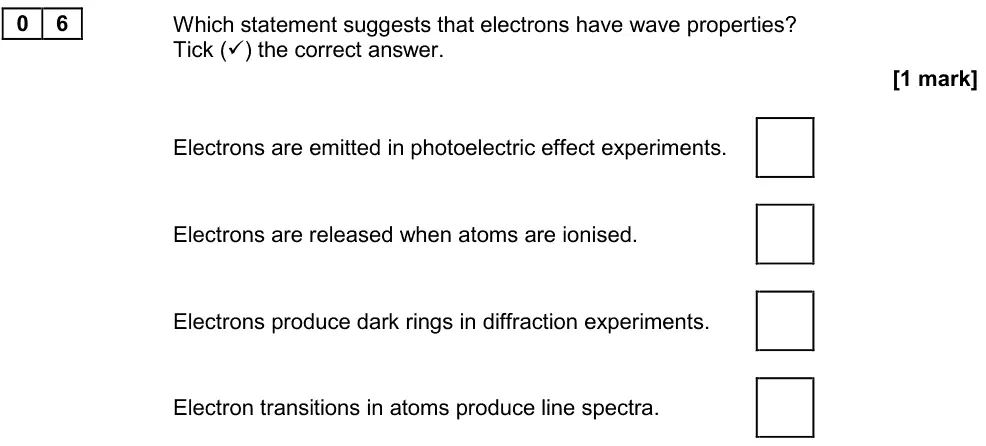
Students should be reminded to make it clear which answer they have chosen, and to avoid putting marks in more than one box. It was very accessible, with over 70% obtaining the mark.
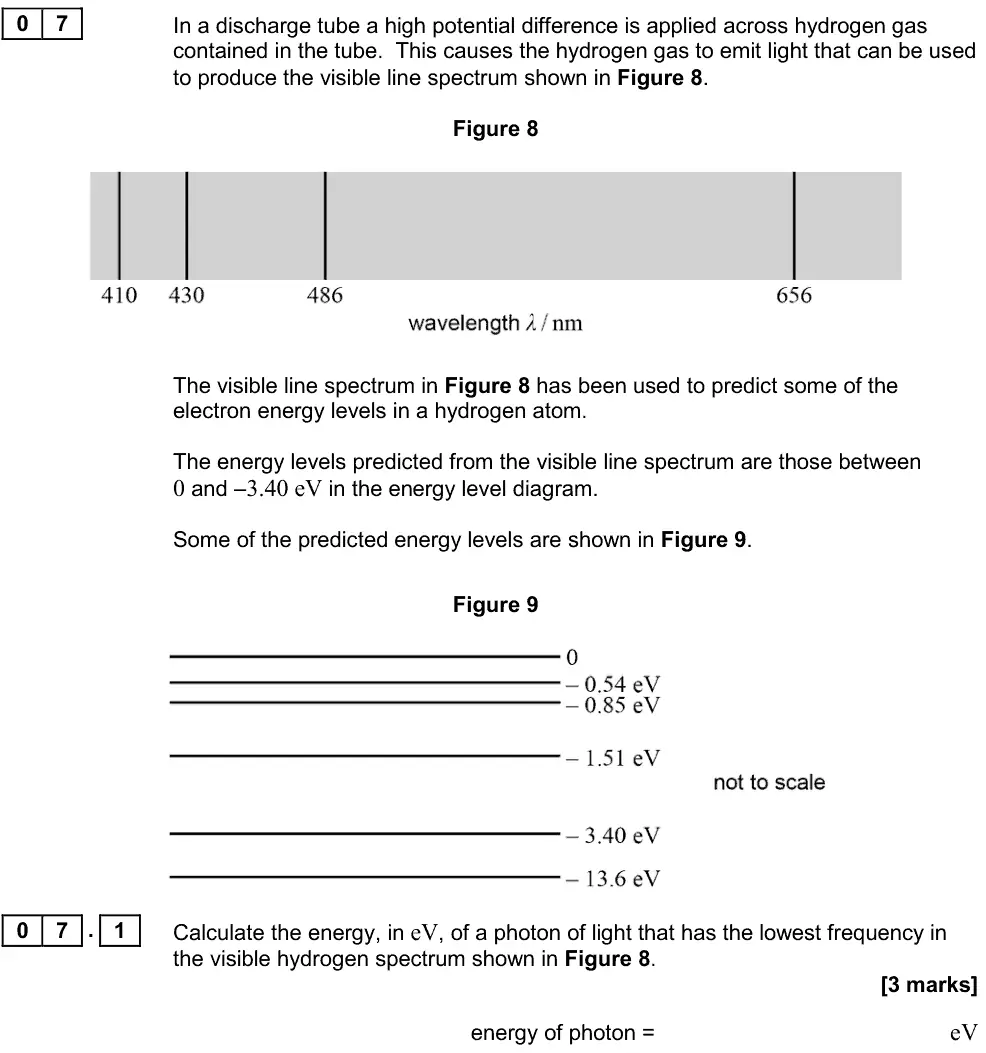
07.1 Difficulties choosing the correct wavelength proved to be an obstacle for many students. The award of the final mark was made without reference to the method. Some credit was also awarded for students who made an error calculating the energy. The conversion to eV proved difficult for some who decided to multiply rather than divide by the charge on the electron.
Skills: MS2.3 Substitute numerical values into algebraic equations using appropriate units for physical quantities; MS0.2 Recognise and use expressions in decimal and standard form

07.2 Many students found it difficult to describe the ‘free’ energy state and it is clear that this is not an idea that is commonly discussed. Furthermore, many students had difficulties interpreting an energy diagram with the zero at the top. It was common to see this energy level referred to as the ground state because of this.

07.3 Problems with the ‘upside-down’ scale persisted into this question, although a greater percentage of students was able to identify the ground state.

07.4 It was common to see the negative charge on the electron being given as the reason for negative energy values. Other answers failed to get the mark if they were poorly expressed so that it was unclear what was happening in terms of energy. This is Paper 1 of the second series of the new AS specification. The paper consists of seven questions from across the AS specification. It makes use of a range of question styles, including multiple choice, short answer, single- and multi-step calculations, data analysis, and extended writing. In general, many students experienced difficulties by missing important details in both the questions and their answers. Calculations were often done well, but many students struggled with answers that required extended writing, particularly those involving some reasoning, such as 02.1, 03.5, 04.3, 05.3, 05.7 and 07.4.
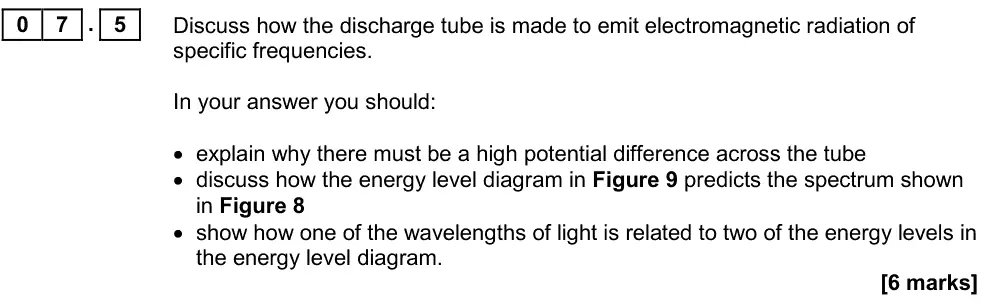
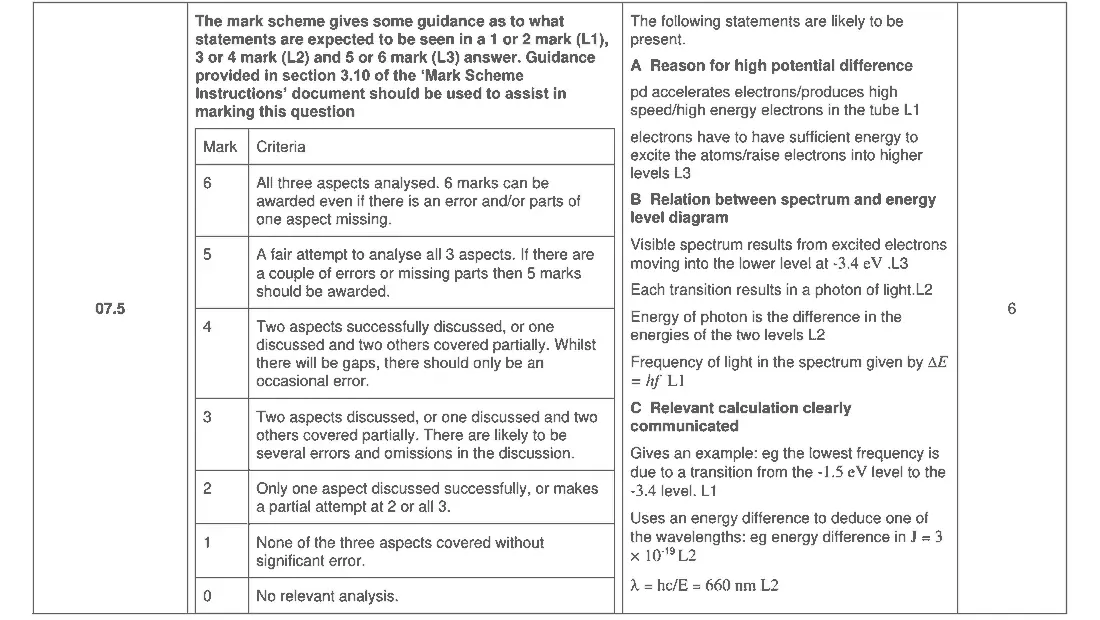
07.5 Despite the extended writing question being the last on the paper, there was no indication that students ran out of time or space. Generally, attempts to explain the reason for high potential difference were often vague so that electrons being accelerated and those within the atoms became confused. On the whole, better attempts were made to link the spectrum and energy level diagrams. Several students used previously analysed data to help answer the final part of this question. Common errors were seen with the introduction of the photoelectric effect or fluorescent tube into the answer.
Want a paper marked and gone through with you? Message us.