
June 2019: AS Paper 1

70 marks · 27 question parts · Paper, mark scheme and report on AQA's site · Have the data and formulae booklet beside you

Question by question

QTopicMarksAOType
1.1 Atomic structure and stable nuclei 2Calculation
1.2 Classification of particles, quarks and conservation laws 1Short answer
1.3 Atomic structure and stable nuclei 3Explanation
1.4 Atomic structure and stable nuclei, Particles, antiparticles and particle interactions 3Explanation
2.1 Circuits and potential dividers, Current, potential difference, I-V characteristics and resistivity 3Calculation
2.2 Current, potential difference, I-V characteristics and resistivity 2Calculation
2.3 Current, potential difference, I-V characteristics and resistivity, Circuits and potential dividers 4Calculation
3.1 Scalars, vectors and moments 4Show that
3.2 Newton's laws of motion and momentum 2Calculation
3.3 Materials, stress, strain and the Young modulus 4Show that
3.4 Materials, stress, strain and the Young modulus, Work, energy, power and conservation of energy 3Calculation
3.5 Work, energy, power and conservation of energy, Measurements, units and uncertainties 3Calculation
3.6 Work, energy, power and conservation of energy, Materials, stress, strain and the Young modulus 1Short answer
4.1 Refraction, total internal reflection and optical fibres 2Explanation
4.2 Refraction, total internal reflection and optical fibres 3Calculation
4.3 Refraction, total internal reflection and optical fibres 1Calculation
4.4 Refraction, total internal reflection and optical fibres 6Extended response
4.5 Refraction, total internal reflection and optical fibres 2Short answer
4.6 Progressive waves, longitudinal and transverse waves 2Short answer
5.1 Scalars, vectors and moments 1Short answer
5.2 Scalars, vectors and moments 2Explanation
5.3 Scalars, vectors and moments 4Calculation
5.4 Scalars, vectors and moments 2Explanation
6.1 Particles, antiparticles and particle interactions 2Short answer
6.2 Particles, antiparticles and particle interactions 2Short answer
6.3 Particles, antiparticles and particle interactions 3Calculation
6.4 Excitation, energy levels and wave-particle duality 3Explanation

The questions

1.11.21.31.42.12.22.33.13.23.33.43.53.64.14.24.34.44.54.65.15.25.35.46.16.26.36.4
June 2019 · AS Paper 1 · Q1.1 2 marks Calculation Easy atomic structure and stable nuclei
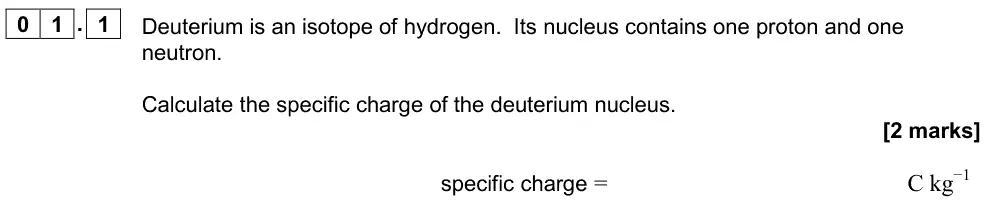
Deuterium is an isotope of hydrogen.  Its nucleus contains one proton and one
neutron.
Calculate the specific charge of the deuterium nucleus.
[2 marks]
specific charge =
C kg−1
June 2019 · AS Paper 1 · Q1.2 1 mark Short answer classification of particles and quarks
Earlier part of question 1 that this part usesEarlier part of June 2019 Paper 1 question 1
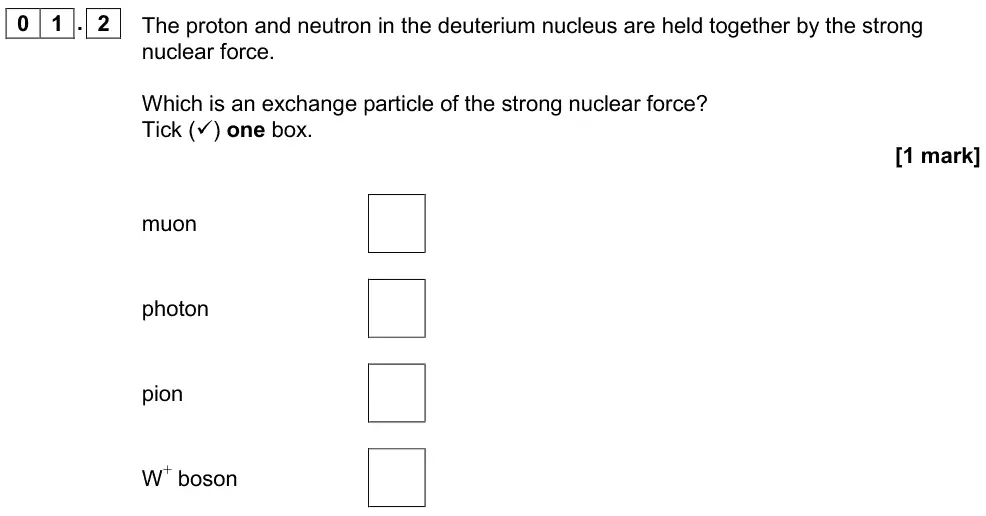
The proton and neutron in the deuterium nucleus are held together by the strong
nuclear force.
Which is an exchange particle of the strong nuclear force?
Tick () one box.
[1 mark]
muon
photon
pion
W+ boson
June 2019 · AS Paper 1 · Q1.3 3 marks Explanation atomic structure and stable nuclei
Earlier part of question 1 that this part usesEarlier part of June 2019 Paper 1 question 1
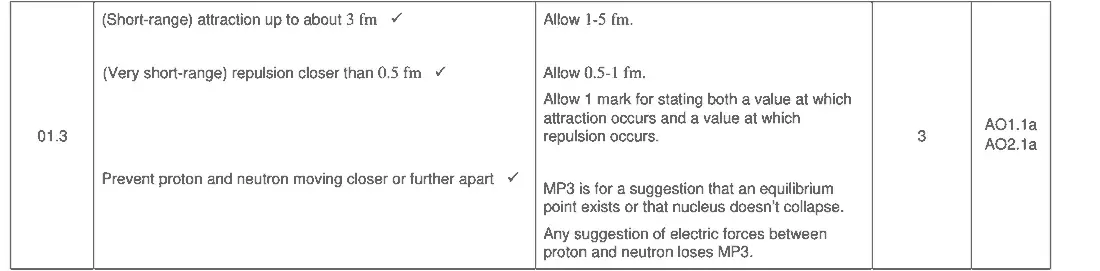
The deuterium nucleus is stable.
Describe how the variation of the strong nuclear force with distance contributes to the
stability of the deuterium nucleus.
[3 marks]
June 2019 · AS Paper 1 · Q1.4 3 marks Explanation atomic structure and stable nucleiparticles antiparticles and interactions
Earlier part of question 1 that this part usesEarlier part of June 2019 Paper 1 question 1
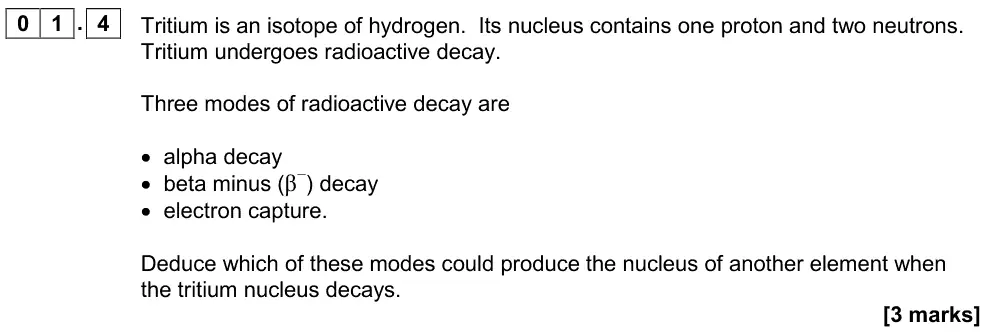
Tritium is an isotope of hydrogen.  Its nucleus contains one proton and two neutrons.
Tritium undergoes radioactive decay.
Three modes of radioactive decay are
• alpha decay
• beta minus (β−) decay
• electron capture.
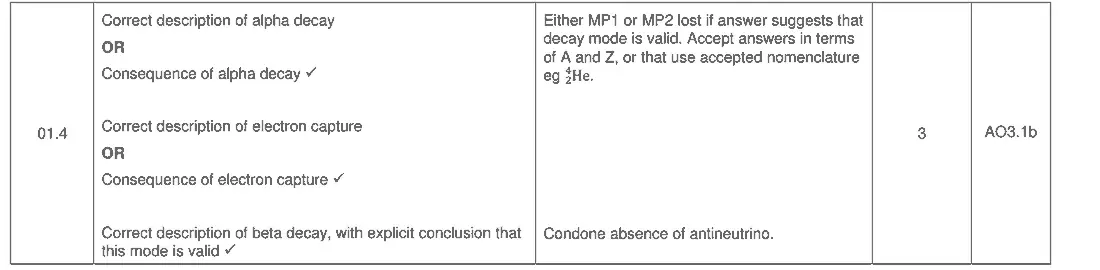
Deduce which of these modes could produce the nucleus of another element when
the tritium nucleus decays.
[3 marks]
June 2019 · AS Paper 1 · Q2.1 3 marks Calculation Easy circuits and potential dividerscurrent voltage and resistivity
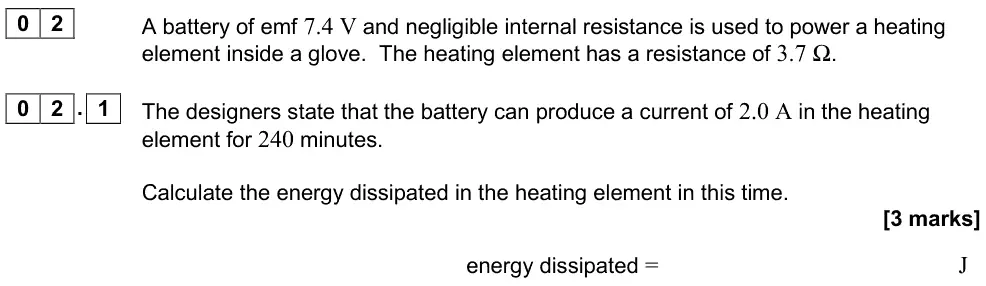
A battery of emf 7.4 V and negligible internal resistance is used to power a heating
element inside a glove.  The heating element has a resistance of 3.7 Ω.
The designers state that the battery can produce a current of 2.0 A in the heating
element for 240 minutes.
Calculate the energy dissipated in the heating element in this time.
[3 marks]
energy dissipated =
J
June 2019 · AS Paper 1 · Q2.2 2 marks Calculation current voltage and resistivity
Earlier part of question 2 that this part usesEarlier part of June 2019 Paper 1 question 2
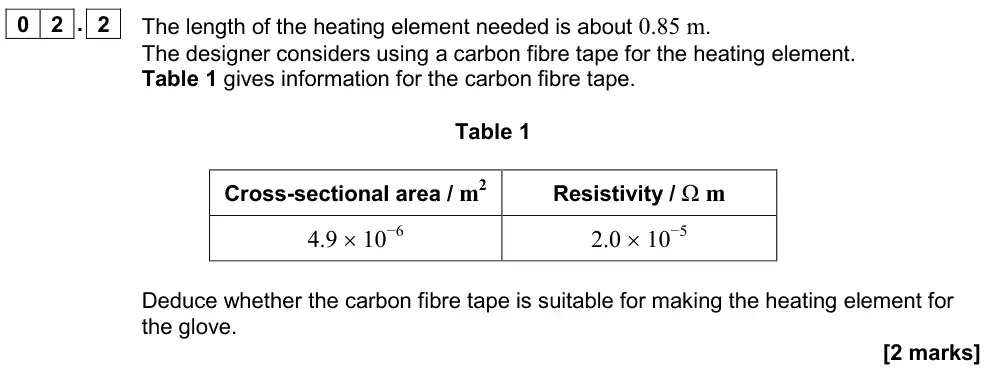
The length of the heating element needed is about 0.85 m.
The designer considers using a carbon fibre tape for the heating element.
Table 1 gives information for the carbon fibre tape.
Table 1
Cross-sectional area / m2
Resistivity / Ω m
4.9 × 10⁻⁶
2.0 × 10⁻⁵
Deduce whether the carbon fibre tape is suitable for making the heating element for
the glove.
[2 marks]
June 2019 · AS Paper 1 · Q2.3 4 marks Calculation current voltage and resistivitycircuits and potential dividers
Earlier part of question 2 that this part usesEarlier part of June 2019 Paper 1 question 2
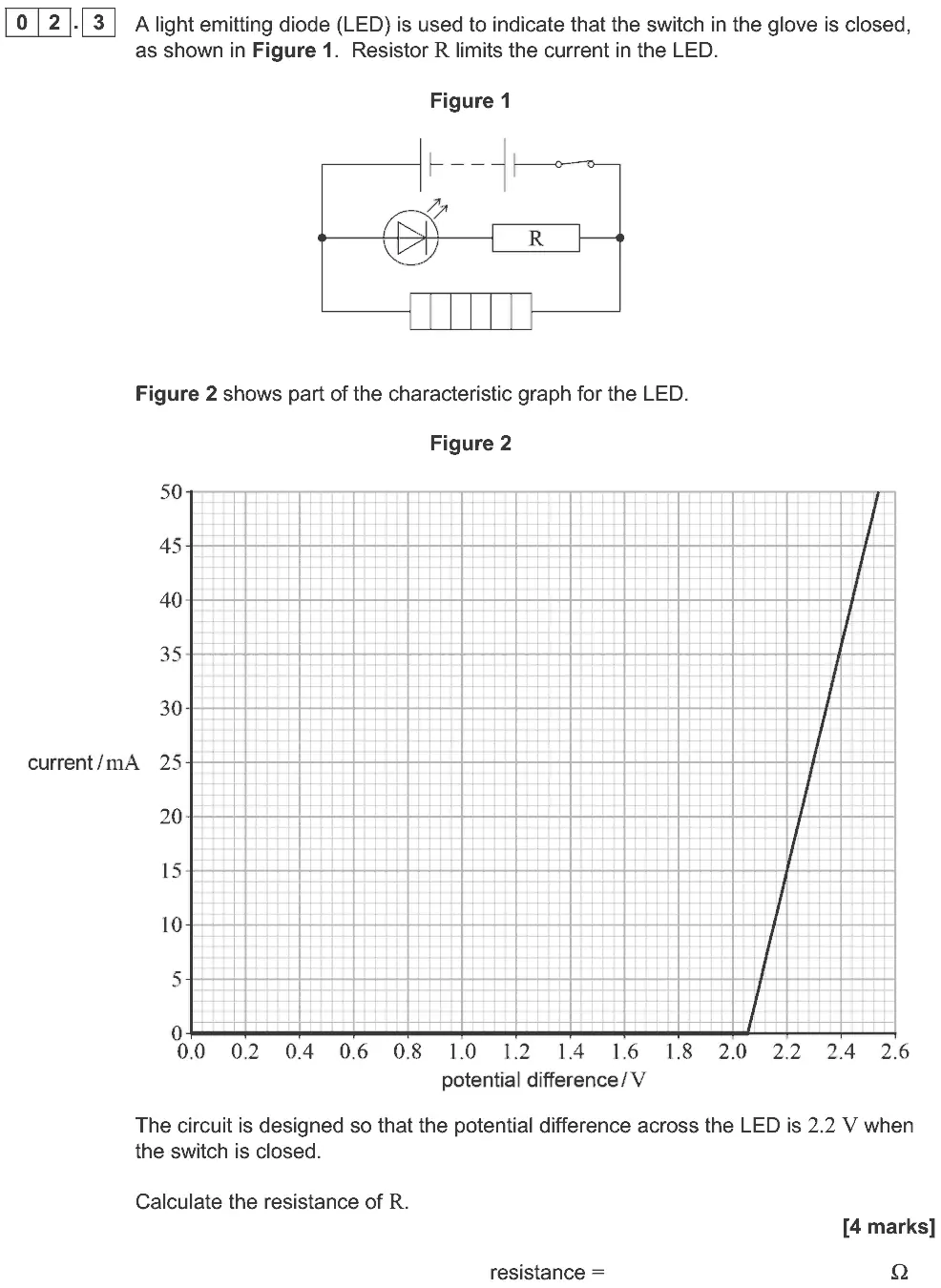
A light emitting diode (LED) is used to indicate that the switch in the glove is closed,
as shown in Figure 1.  Resistor R limits the current in the LED.
Figure 1
Figure 2 shows part of the characteristic graph for the LED.
Figure 2
The circuit is designed so that the potential difference across the LED is 2.2 V when
the switch is closed.
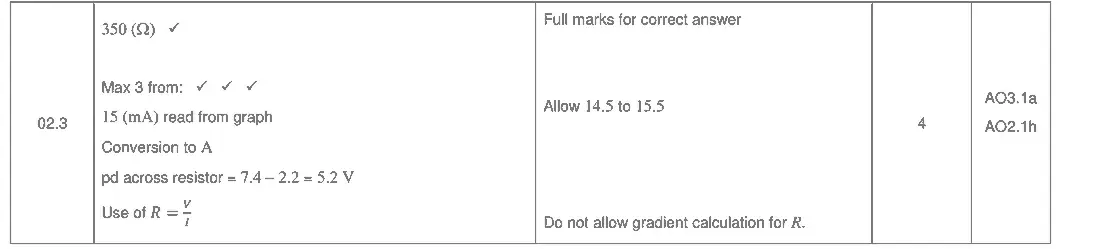
Calculate the resistance of R.
[4 marks]
resistance =
Ω
June 2019 · AS Paper 1 · Q3.1 4 marks Show that vectors and moments
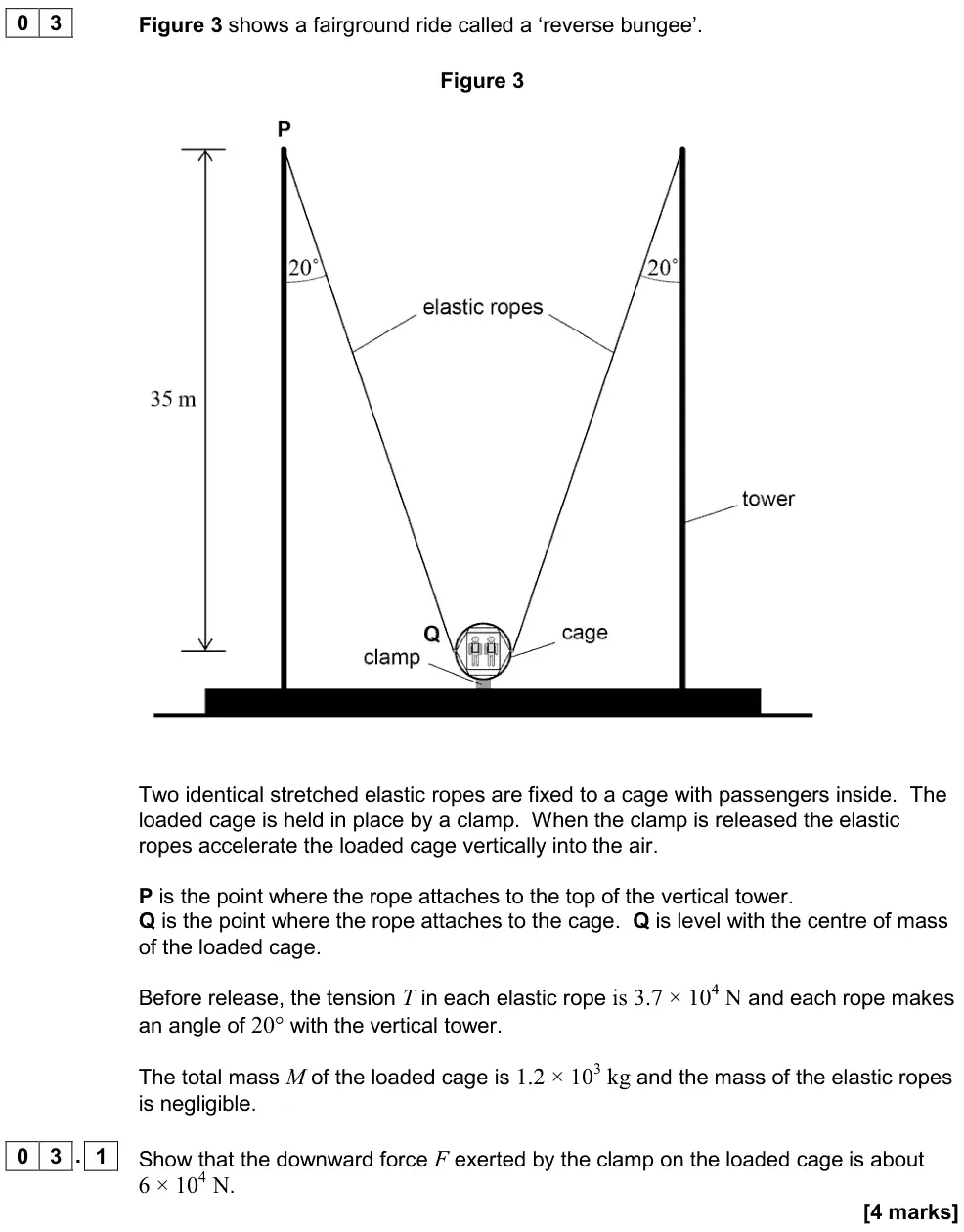
Figure 3 shows a fairground ride called a ‘reverse bungee’.
Figure 3
Two identical stretched elastic ropes are fixed to a cage with passengers inside.  The
loaded cage is held in place by a clamp.  When the clamp is released the elastic
ropes accelerate the loaded cage vertically into the air.
P is the point where the rope attaches to the top of the vertical tower.
Q is the point where the rope attaches to the cage.  Q is level with the centre of mass
of the loaded cage.
Before release, the tension T in each elastic rope is 3.7 × 10⁴ N and each rope makes
an angle of 20° with the vertical tower.
The total mass M of the loaded cage is 1.2 × 10³ kg and the mass of the elastic ropes
is negligible.
Show that the downward force F exerted by the clamp on the loaded cage is about
6 × 10⁴ N.
[4 marks]
June 2019 · AS Paper 1 · Q3.2 2 marks Calculation Easy newtons laws and momentum
Earlier part of question 3 that this part usesEarlier part of June 2019 Paper 1 question 3
Calculate the initial acceleration of the loaded cage when the clamp is released.
[2 marks]
acceleration =
m s–2
June 2019 · AS Paper 1 · Q3.3 4 marks Show that materials and young modulus
Earlier part of question 3 that this part usesEarlier part of June 2019 Paper 1 question 3
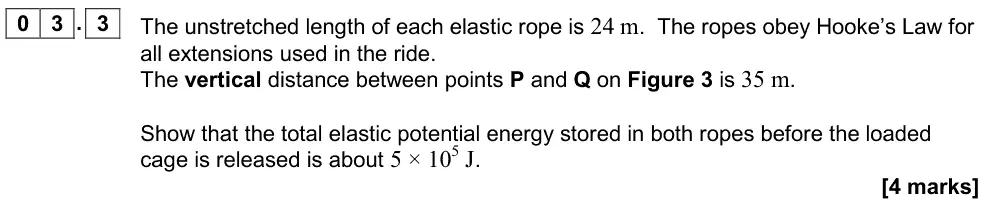
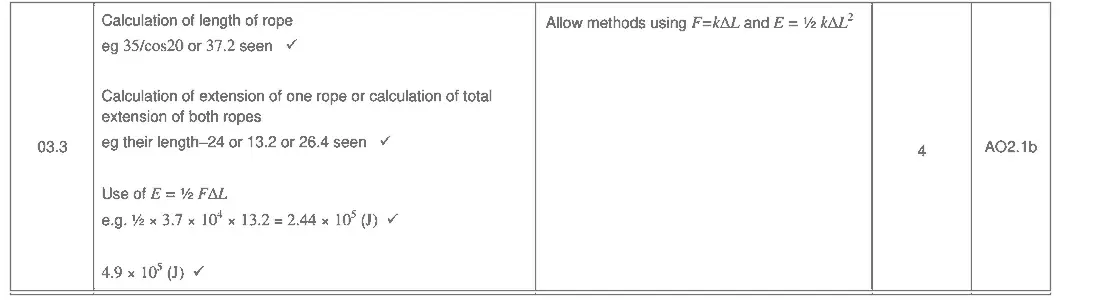
The unstretched length of each elastic rope is 24 m.  The ropes obey Hooke’s Law for
all extensions used in the ride.
The vertical distance between points P and Q on Figure 3 is 35 m.
Show that the total elastic potential energy stored in both ropes before the loaded
cage is released is about 5 × 10⁵ J.
[4 marks]
June 2019 · AS Paper 1 · Q3.4 3 marks Calculation Hard materials and young moduluswork energy and power
Earlier part of question 3 that this part usesEarlier part of June 2019 Paper 1 question 3
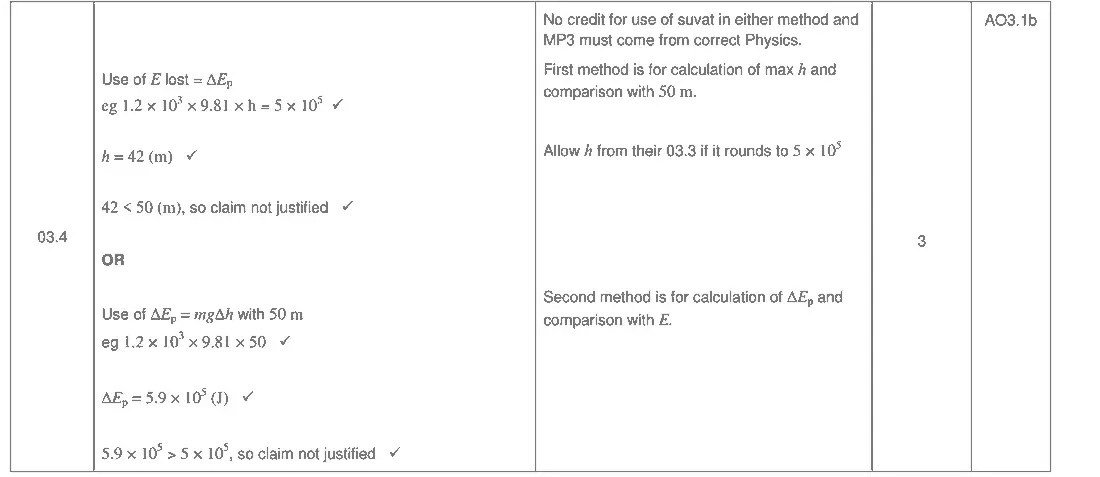
The designers of the ride claim that the loaded cage will reach a height of 50 m
above Q.
Deduce whether this claim is justified.
[3 marks]
June 2019 · AS Paper 1 · Q3.5 3 marks Calculation work energy and powermeasurements and uncertainties
Earlier part of question 3 that this part usesEarlier part of June 2019 Paper 1 question 3
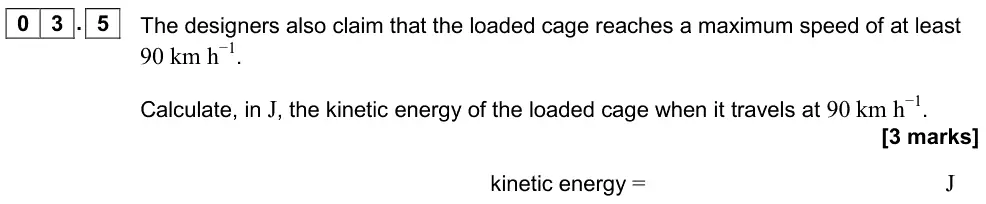
The designers also claim that the loaded cage reaches a maximum speed of at least
90 km h−1.
Calculate, in J, the kinetic energy of the loaded cage when it travels at 90 km h−1.
[3 marks]
kinetic energy =
J
June 2019 · AS Paper 1 · Q3.6 1 mark Short answer work energy and powermaterials and young modulus
Earlier part of question 3 that this part usesEarlier part of June 2019 Paper 1 question 3
Deduce without further calculation whether the maximum speed claim is justified.
[1 mark]
June 2019 · AS Paper 1 · Q4.1 2 marks Explanation refraction and optical fibres
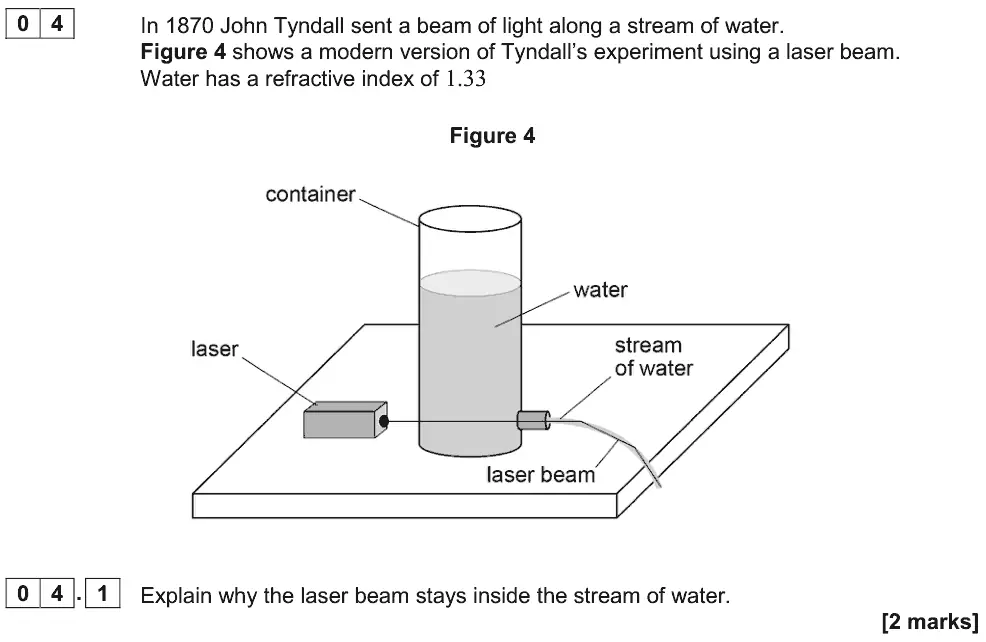
In 1870 John Tyndall sent a beam of light along a stream of water.
Figure 4 shows a modern version of Tyndall’s experiment using a laser beam.
Water has a refractive index of 1.33
Figure 4
Explain why the laser beam stays inside the stream of water.
[2 marks]
June 2019 · AS Paper 1 · Q4.2 3 marks Calculation refraction and optical fibres
Earlier part of question 4 that this part usesEarlier part of June 2019 Paper 1 question 4
Calculate the speed of the laser light in the water.
Give your answer to an appropriate number of significant figures.
[3 marks]
speed =
m s–1
June 2019 · AS Paper 1 · Q4.3 1 mark Calculation Easy refraction and optical fibres
Earlier part of question 4 that this part usesEarlier part of June 2019 Paper 1 question 4
Calculate the critical angle for the water−air boundary.
[1 mark]
critical angle =
degrees
June 2019 · AS Paper 1 · Q4.4 6 marks 6-mark extended response Hard refraction and optical fibres
Earlier part of question 4 that this part usesEarlier part of June 2019 Paper 1 question 4
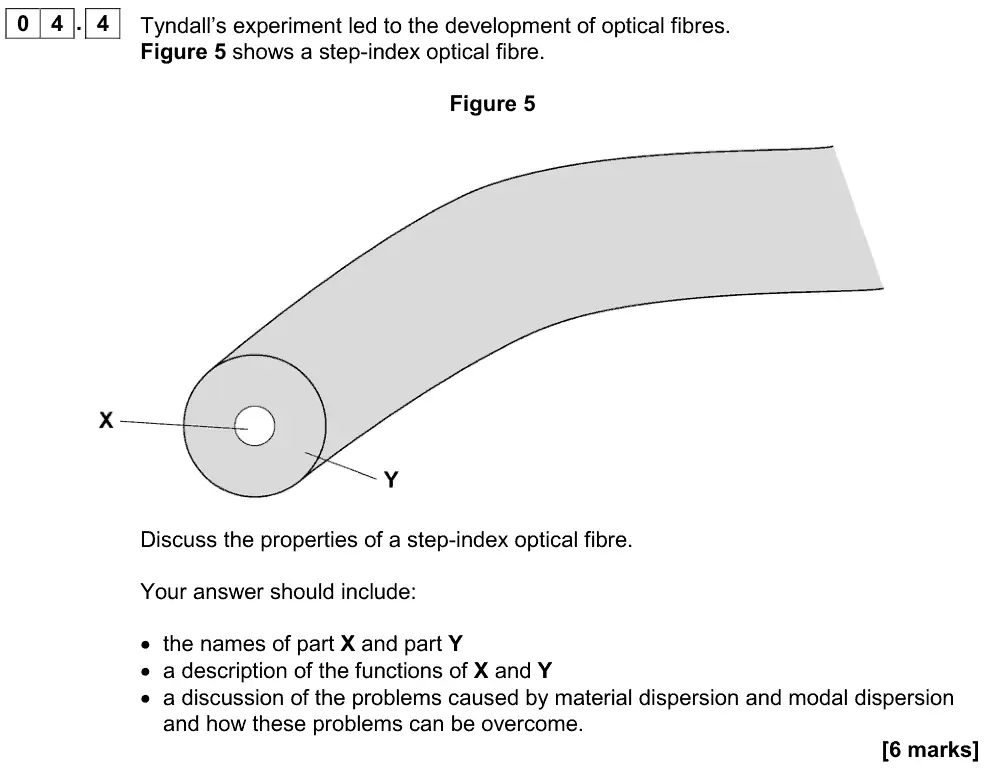
Tyndall’s experiment led to the development of optical fibres.
Figure 5 shows a step-index optical fibre.
Figure 5
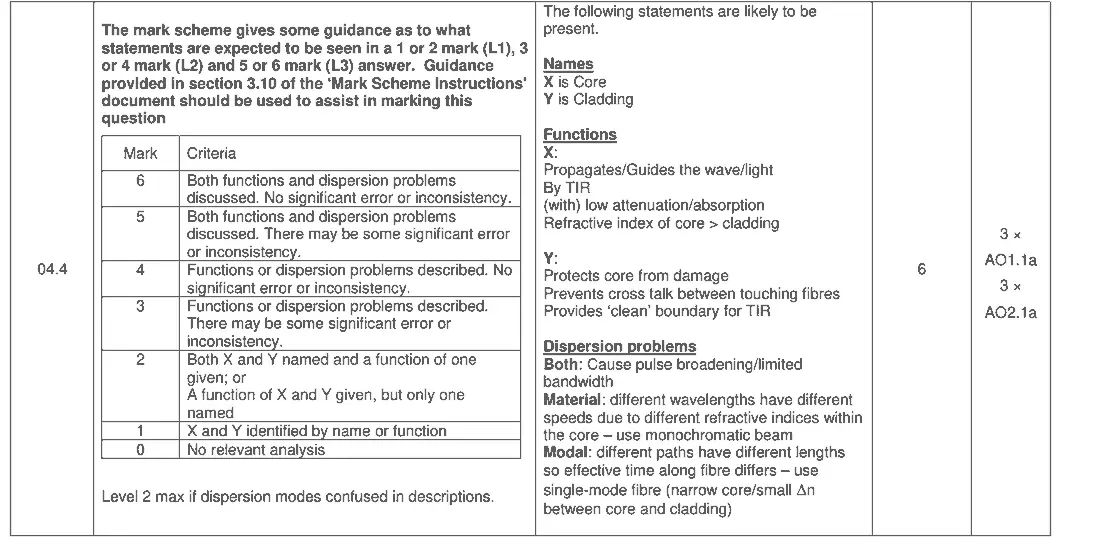
Discuss the properties of a step-index optical fibre.
Your answer should include:
• the names of part X and part Y
• a description of the functions of X and Y
• a discussion of the problems caused by material dispersion and modal dispersion
and how these problems can be overcome.
[6 marks]
June 2019 · AS Paper 1 · Q4.5 2 marks Short answer refraction and optical fibres
Earlier part of question 4 that this part usesEarlier part of June 2019 Paper 1 question 4
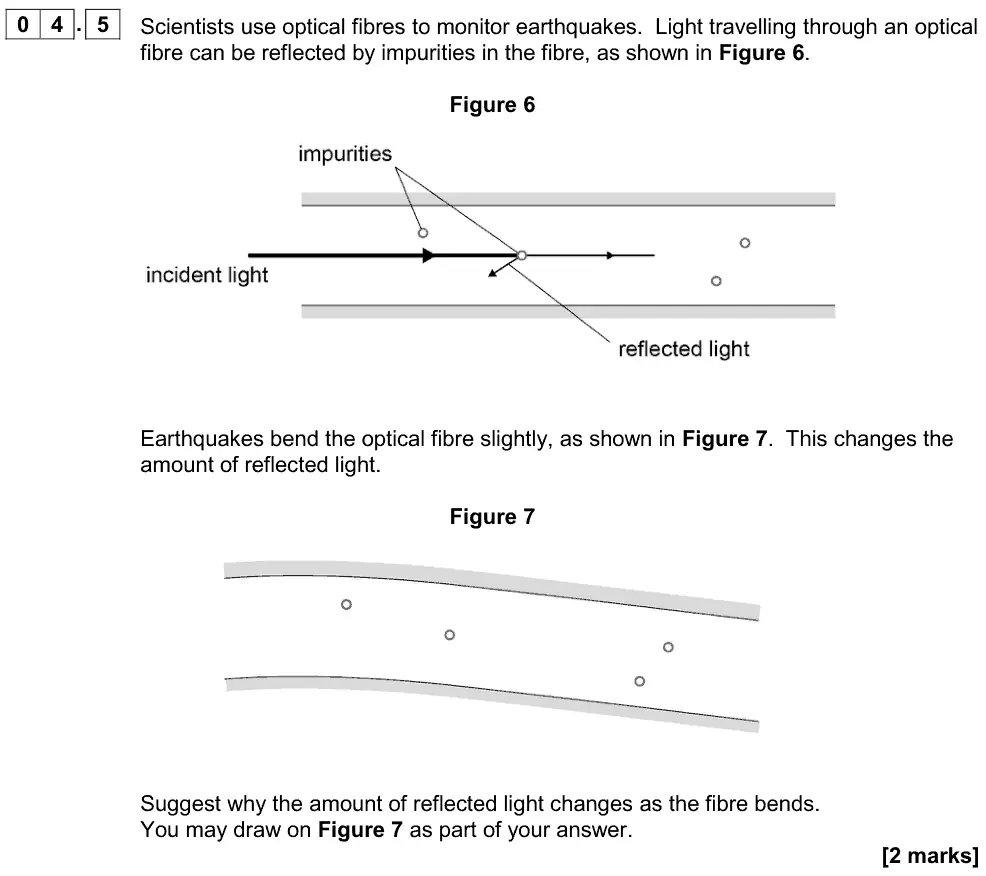
Scientists use optical fibres to monitor earthquakes.  Light travelling through an optical
fibre can be reflected by impurities in the fibre, as shown in Figure 6.
Figure 6
Earthquakes bend the optical fibre slightly, as shown in Figure 7.  This changes the
amount of reflected light.
Figure 7
Suggest why the amount of reflected light changes as the fibre bends.
You may draw on Figure 7 as part of your answer.
[2 marks]
June 2019 · AS Paper 1 · Q4.6 2 marks Short answer Hard progressive waves and polarisation
Earlier part of question 4 that this part usesEarlier part of June 2019 Paper 1 question 4
The waves caused by earthquakes can be longitudinal or transverse.
Describe the difference between longitudinal waves and transverse waves.
[2 marks]
June 2019 · AS Paper 1 · Q5.1 1 mark Short answer Easy vectors and moments
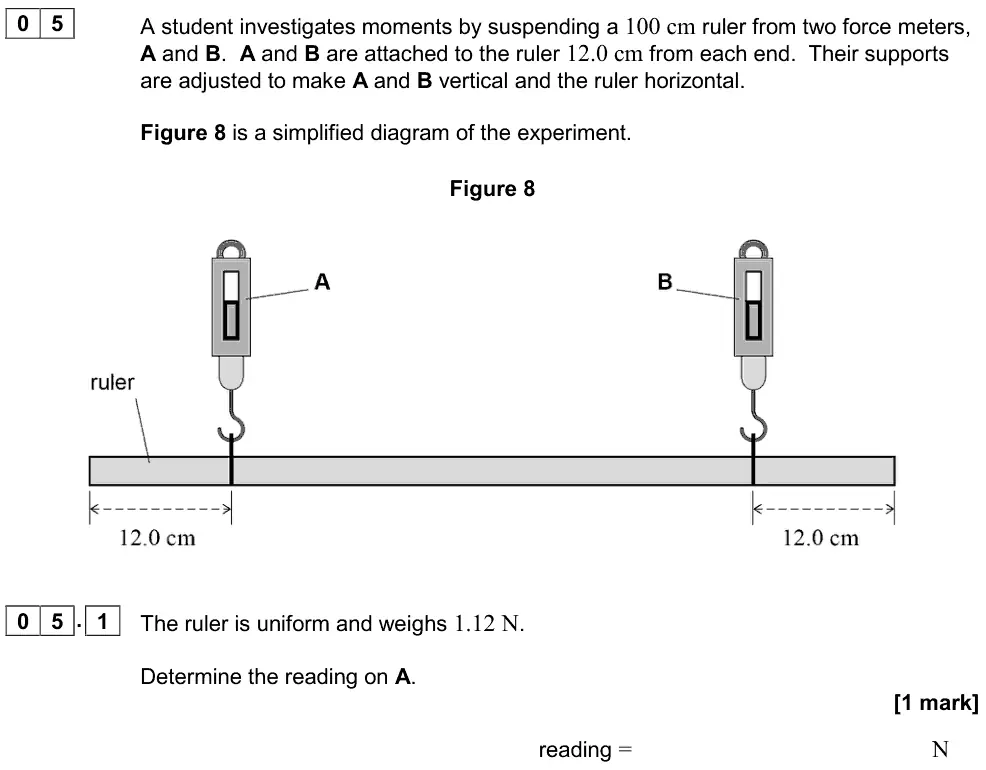
A student investigates moments by suspending a 100 cm ruler from two force meters,
A and B.  A and B are attached to the ruler 12.0 cm from each end.  Their supports
are adjusted to make A and B vertical and the ruler horizontal.
Figure 8 is a simplified diagram of the experiment.
Figure 8
The ruler is uniform and weighs 1.12 N.

Determine the reading on A.
[1 mark]
reading =
N
June 2019 · AS Paper 1 · Q5.2 2 marks Explanation Hard vectors and moments
Earlier part of question 5 that this part usesEarlier part of June 2019 Paper 1 question 5
The student suggests that the forces exerted on the ruler by A and B act as a couple.
Discuss whether his suggestion is correct.
[2 marks]
June 2019 · AS Paper 1 · Q5.3 4 marks Calculation Hard vectors and moments
Earlier part of question 5 that this part usesEarlier part of June 2019 Paper 1 question 5
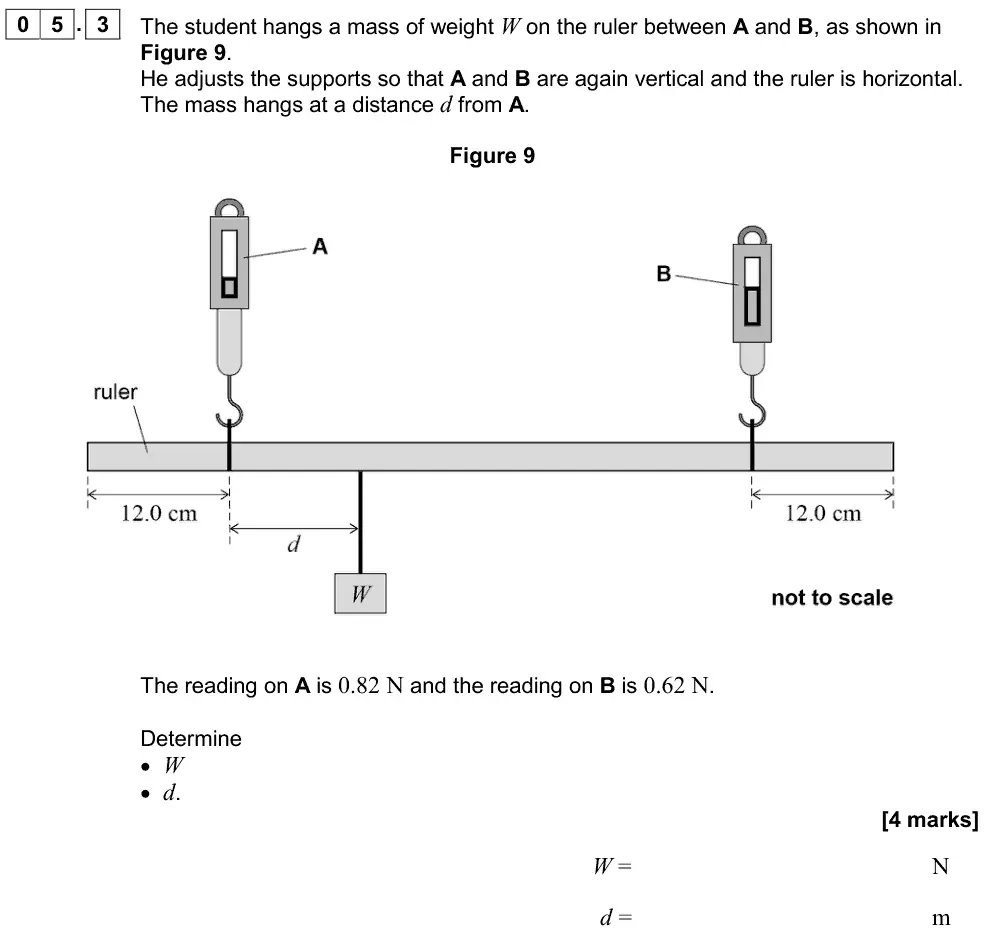
The student hangs a mass of weight W on the ruler between A and B, as shown in
Figure 9.
He adjusts the supports so that A and B are again vertical and the ruler is horizontal.
The mass hangs at a distance d from A.

Figure 9
The reading on A is 0.82 N and the reading on B is 0.62 N.
Determine
• W
• d.
[4 marks]
W =
N
d =
m
June 2019 · AS Paper 1 · Q5.4 2 marks Explanation vectors and moments
Earlier part of question 5 that this part usesEarlier part of June 2019 Paper 1 question 5
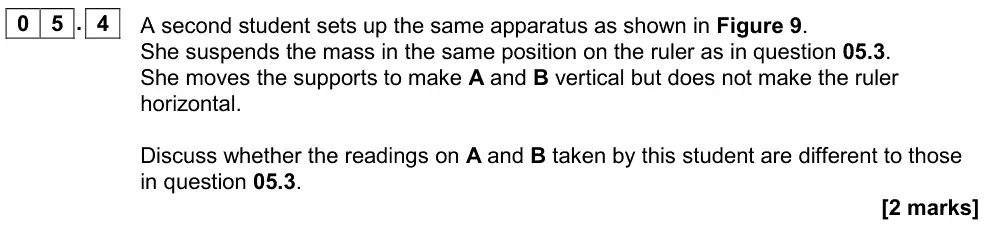
A second student sets up the same apparatus as shown in Figure 9.
She suspends the mass in the same position on the ruler as in question 05.3.
She moves the supports to make A and B vertical but does not make the ruler
horizontal.
Discuss whether the readings on A and B taken by this student are different to those
in question 05.3.
[2 marks]
June 2019 · AS Paper 1 · Q6.1 2 marks Short answer particles antiparticles and interactions
Scientists at CERN have produced atoms of antihydrogen.
An atom of antihydrogen contains the antiparticle of the proton and the antiparticle of
the electron.
State what is meant by an antiparticle.
[2 marks]
June 2019 · AS Paper 1 · Q6.2 2 marks Short answer particles antiparticles and interactions
Earlier part of question 6 that this part usesEarlier part of June 2019 Paper 1 question 6
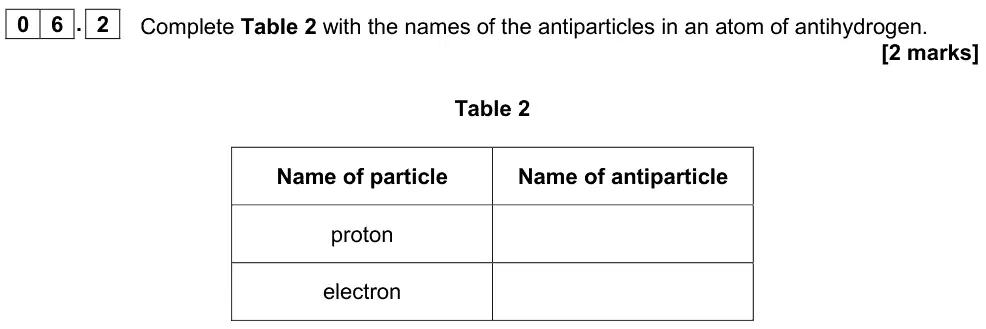
Complete Table 2 with the names of the antiparticles in an atom of antihydrogen.
[2 marks]
Table 2
Name of particle
Name of antiparticle
proton
electron
June 2019 · AS Paper 1 · Q6.3 3 marks Calculation particles antiparticles and interactions
Earlier part of question 6 that this part usesEarlier part of June 2019 Paper 1 question 6
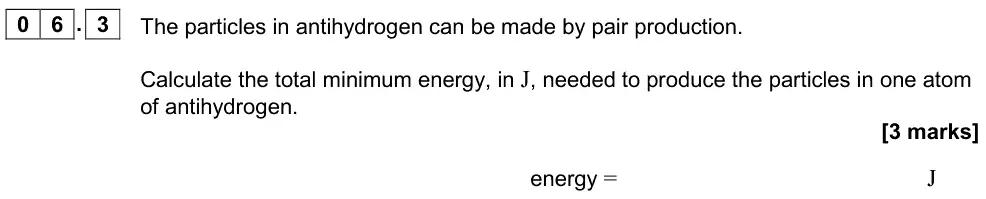
The particles in antihydrogen can be made by pair production.
Calculate the total minimum energy, in J, needed to produce the particles in one atom
of antihydrogen.
[3 marks]
energy =
J
June 2019 · AS Paper 1 · Q6.4 3 marks Explanation energy levels and wave particle duality
Earlier part of question 6 that this part usesEarlier part of June 2019 Paper 1 question 6
Line emission spectra of hydrogen and antihydrogen have been compared.
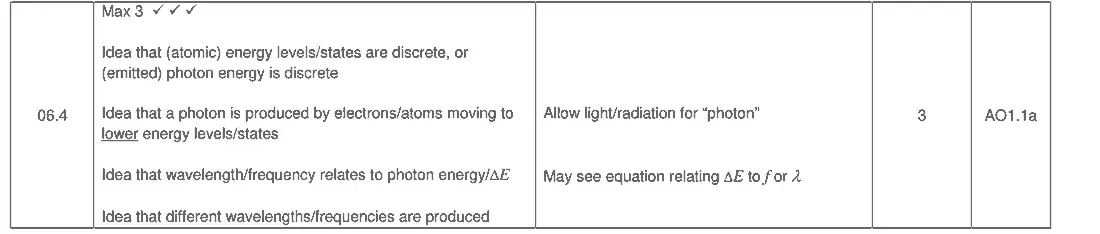
Explain in terms of energy changes how line emission spectra are produced.
[3 marks]

Work with an AQA physics tutor

Want a paper marked and gone through with you? Message us.

Prefer email? Send an enquiry

If you are under 18, please include a parent's contact details. Enquiries go to enquiries@physicsaleveltutor.com and are deleted once handled. All tutoring is online.