June 2023: AS Paper 1

70 marks · 27 question parts · Paper, mark scheme and report on AQA's site · Have the data and formulae booklet beside you

Question by question

QTopicMarksAOType
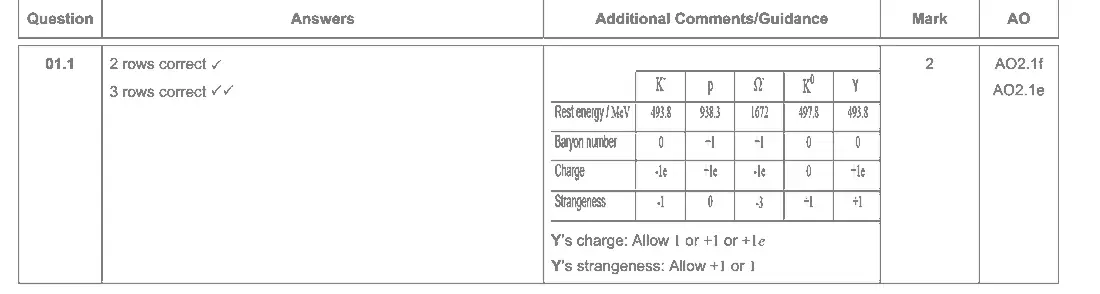
1.1 Classification of particles, quarks and conservation laws 2AO2=2Short answer
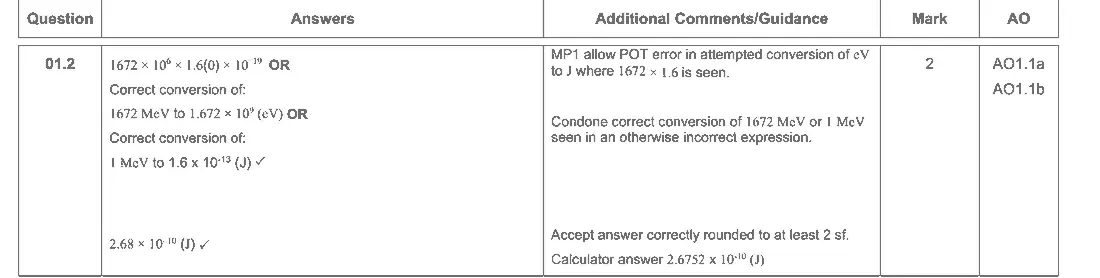
1.2 Particles, antiparticles and particle interactions, Excitation, energy levels and wave-particle duality 2AO1=2Calculation
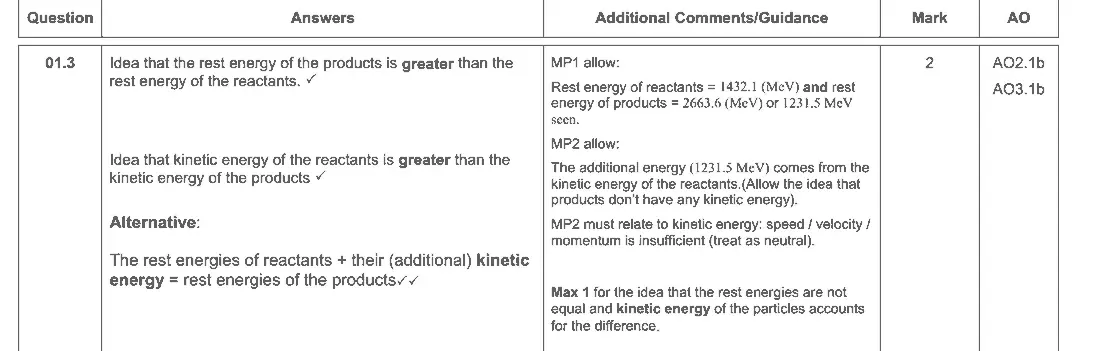
1.3 Classification of particles, quarks and conservation laws, Particles, antiparticles and particle interactions 2Explanation
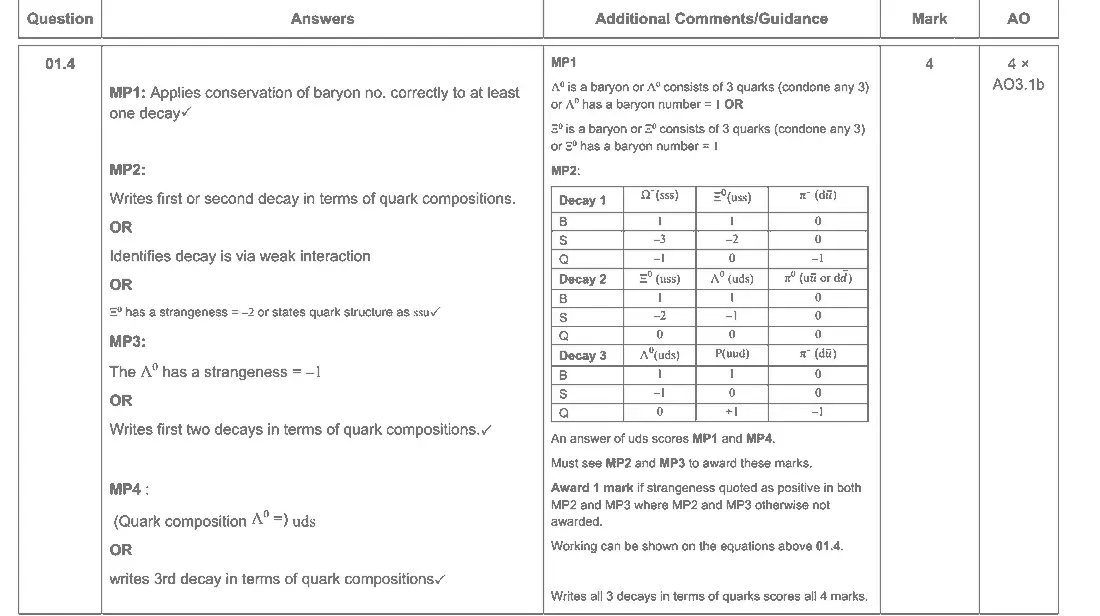
1.4 Classification of particles, quarks and conservation laws 4AO3=4Explanation
1.5 Particles, antiparticles and particle interactions 2Calculation
1.6 Classification of particles, quarks and conservation laws 1AO3=1Short answer
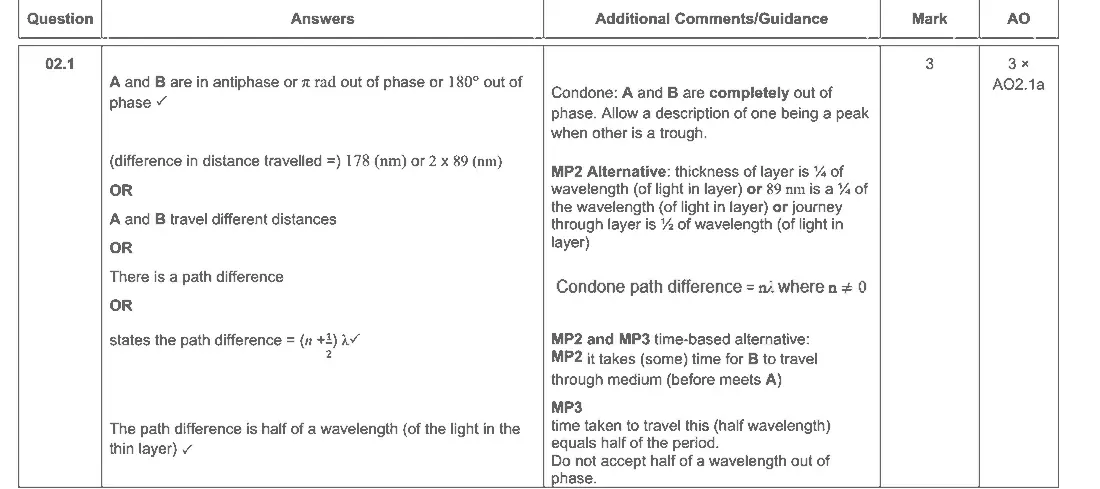
2.1 Progressive waves, longitudinal and transverse waves 3AO2=3Explanation
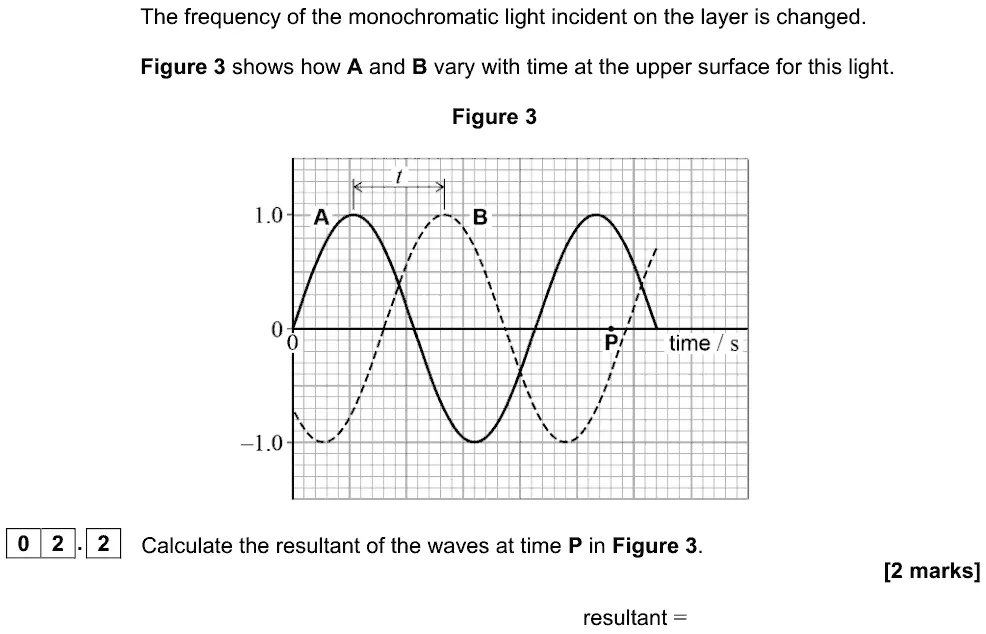
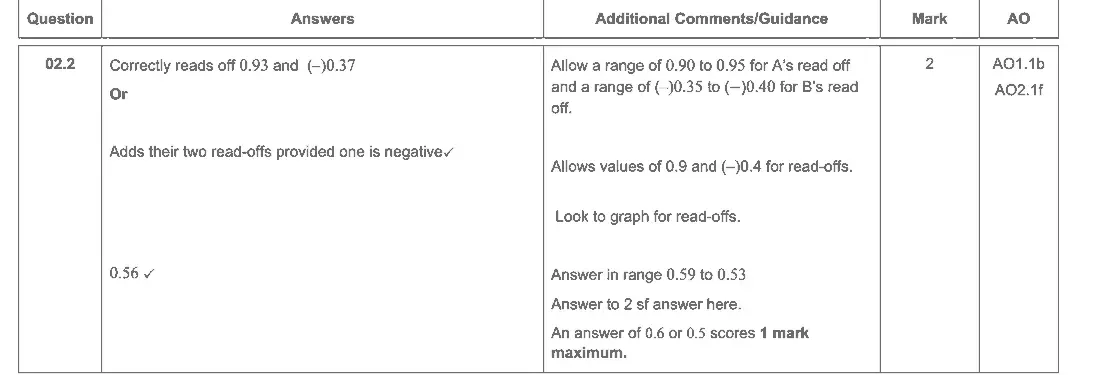
2.2 Progressive waves, longitudinal and transverse waves 2Calculation
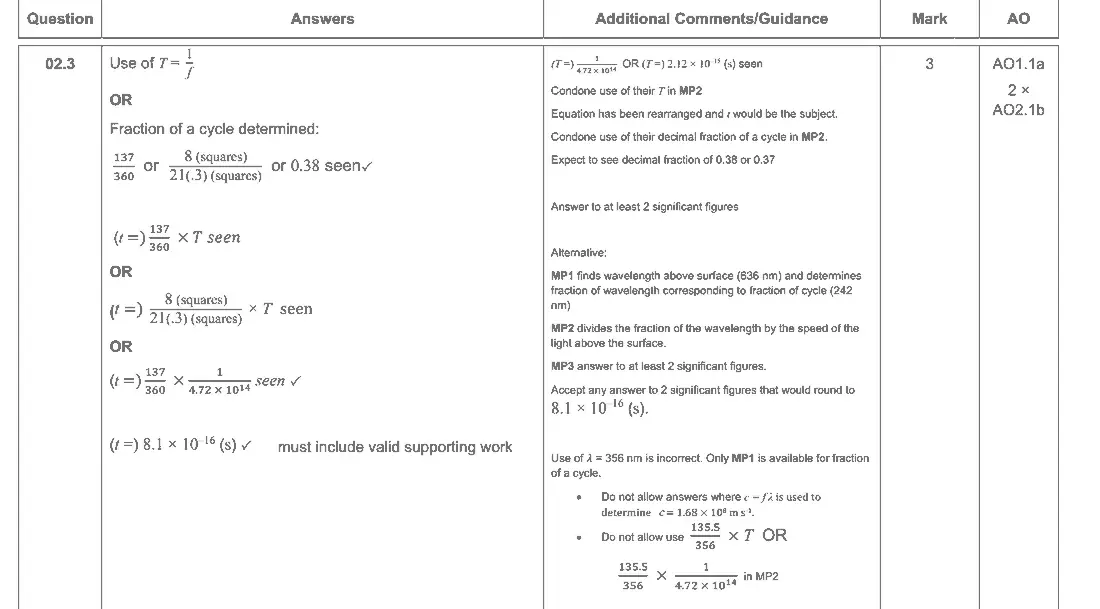
2.3 Progressive waves, longitudinal and transverse waves 3Show that
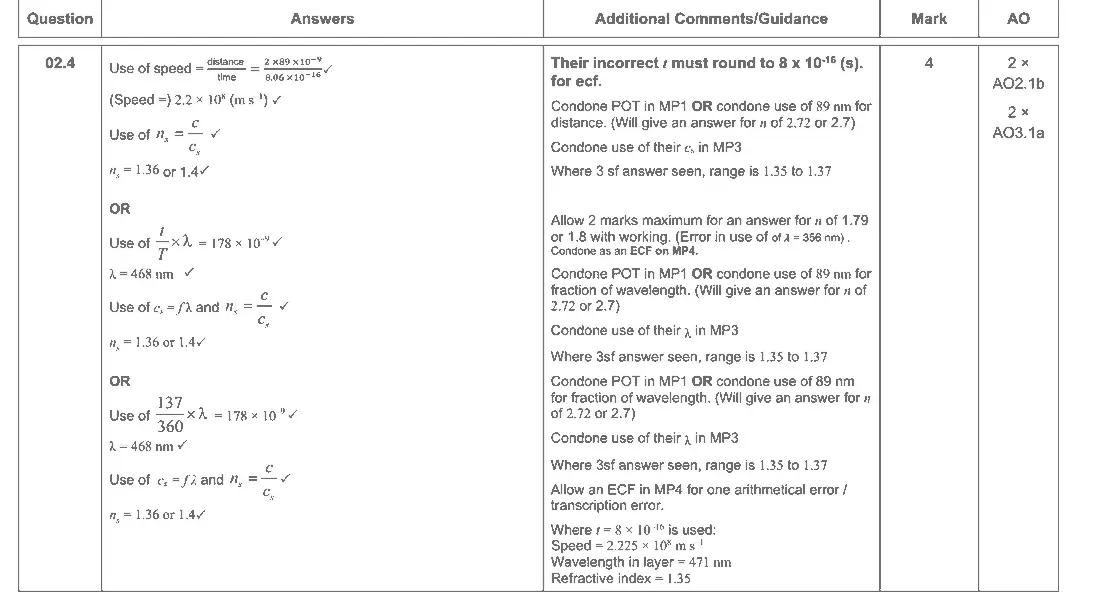
2.4 Refraction, total internal reflection and optical fibres, Progressive waves, longitudinal and transverse waves 4AO2=2,AO3=2Calculation
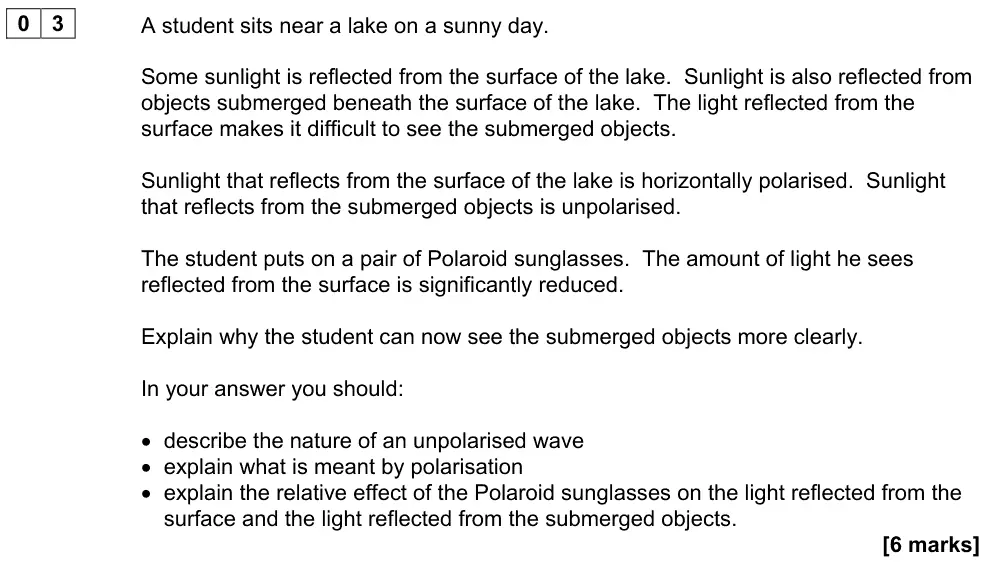
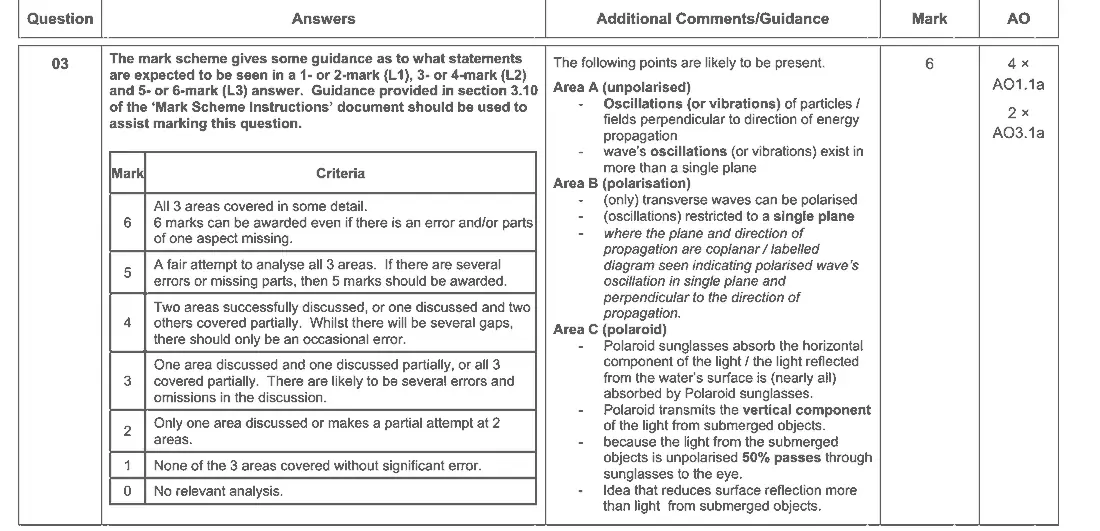
3 Progressive waves, longitudinal and transverse waves 6AO1=4,AO3=2Extended response
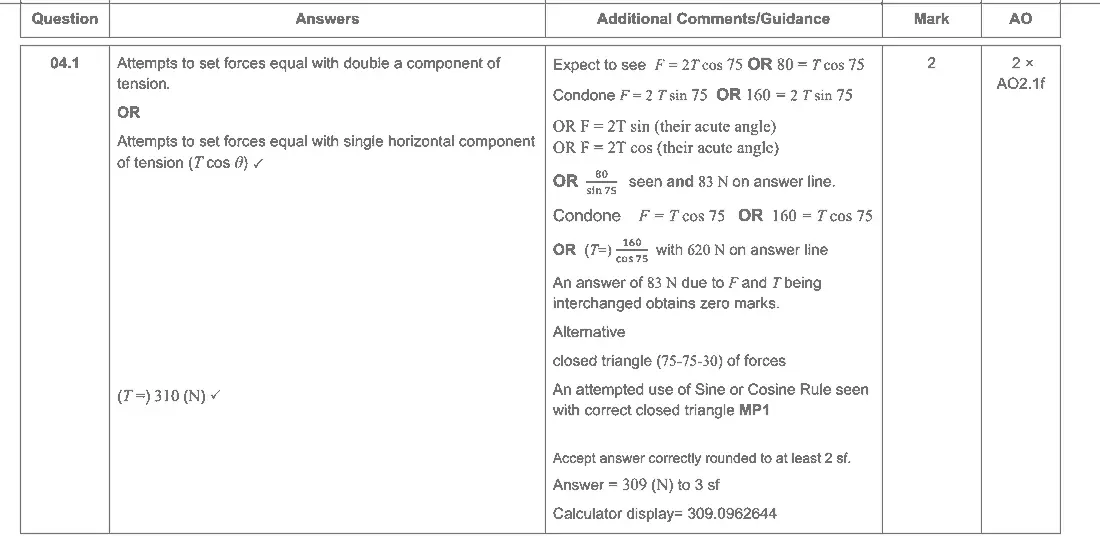
4.1 Scalars, vectors and moments 2AO2=2Calculation
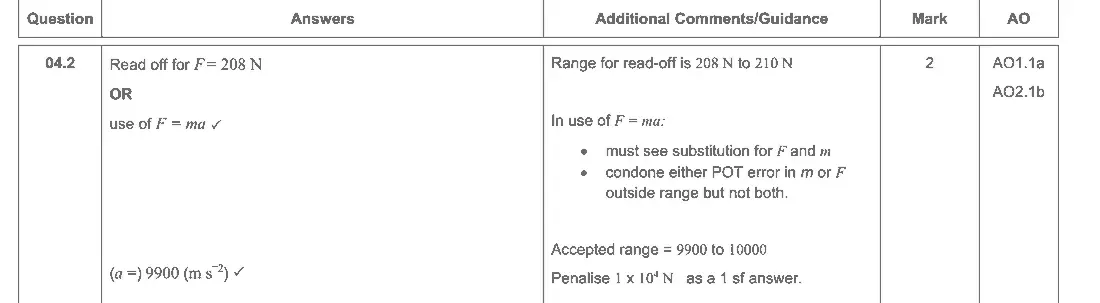
4.2 Newton's laws of motion and momentum 2Calculation
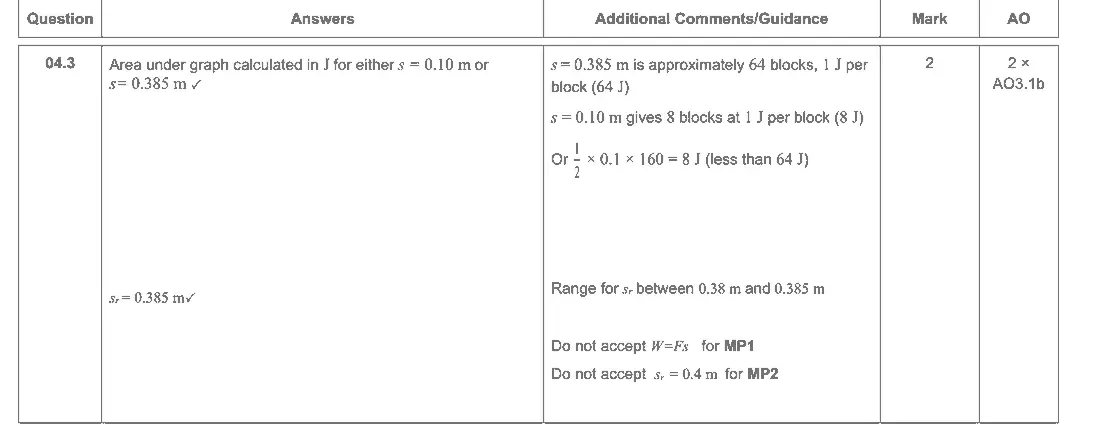
4.3 Work, energy, power and conservation of energy, Materials, stress, strain and the Young modulus 2AO3=2Calculation
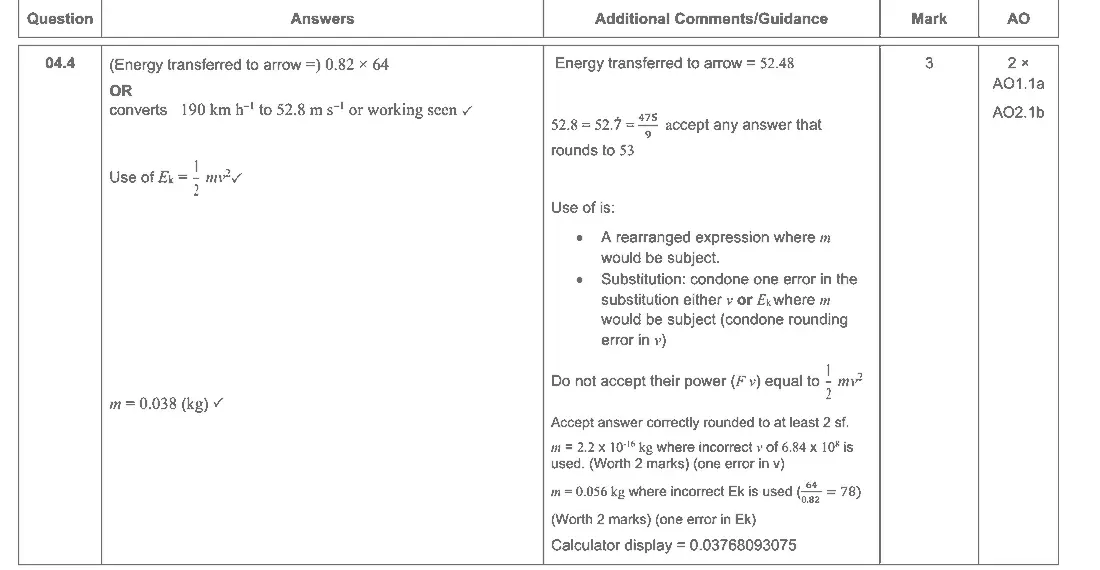
4.4 Work, energy, power and conservation of energy 3Calculation
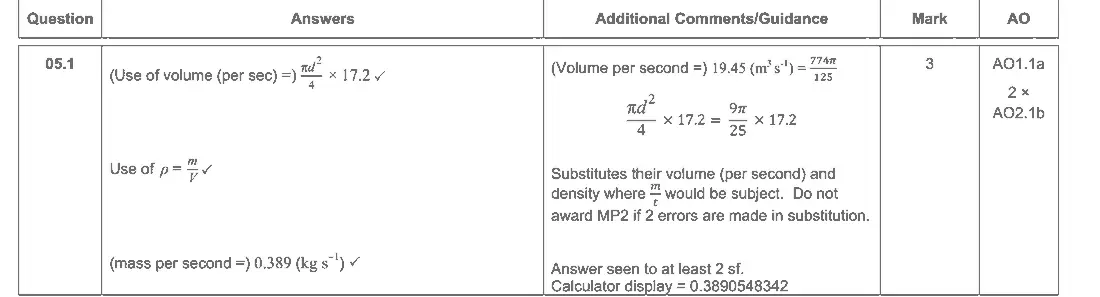
5.1 Materials, stress, strain and the Young modulus 3Show that
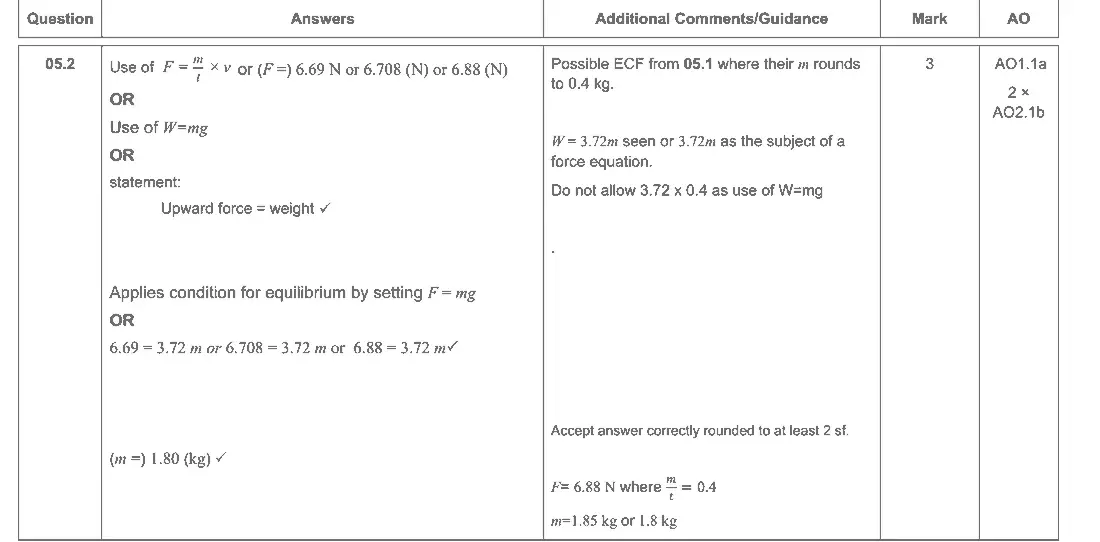
5.2 Newton's laws of motion and momentum 3Calculation
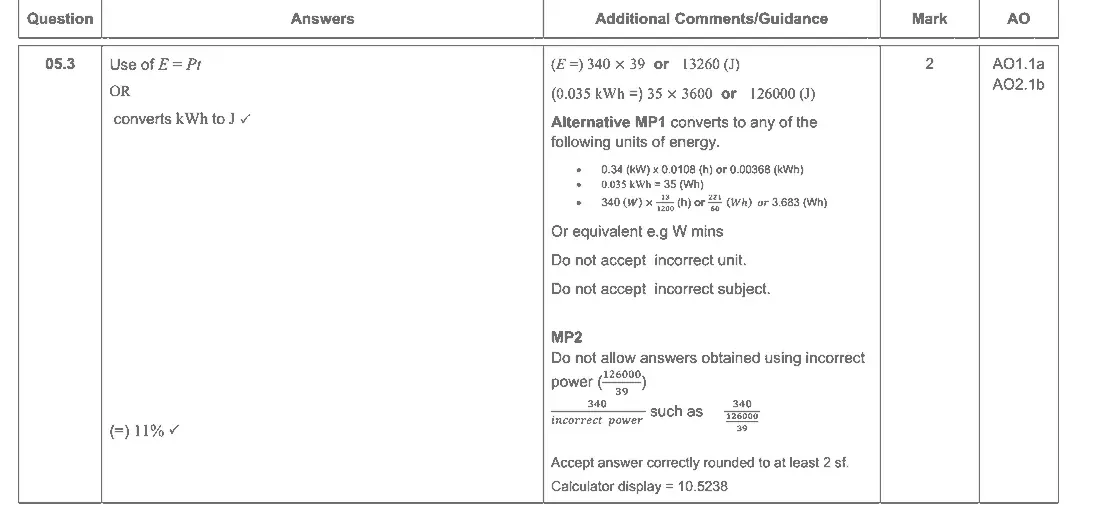
5.3 Work, energy, power and conservation of energy, Measurements, units and uncertainties 2Calculation
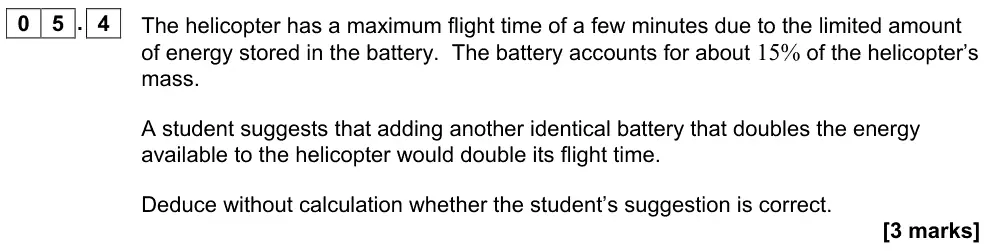
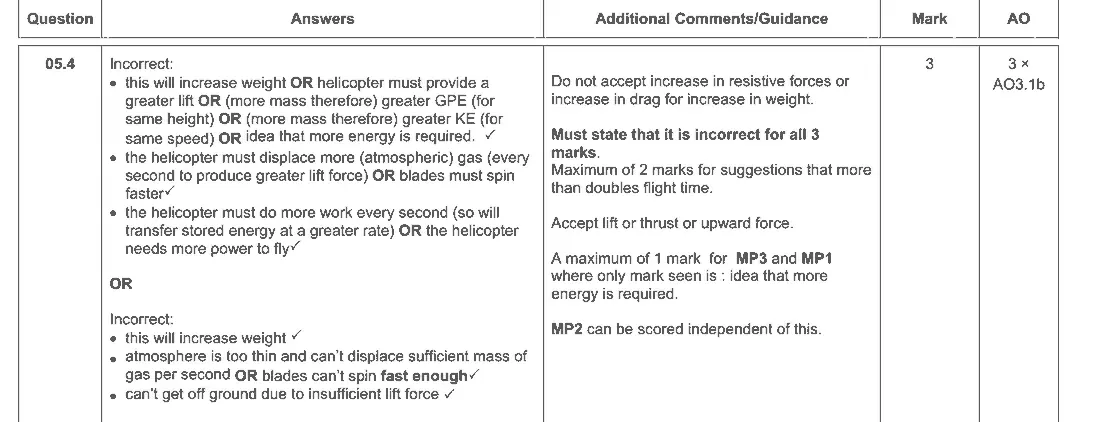
5.4 Work, energy, power and conservation of energy, Newton's laws of motion and momentum 3AO3=3Explanation
5.5 Motion along a straight line and projectile motion 2Calculation
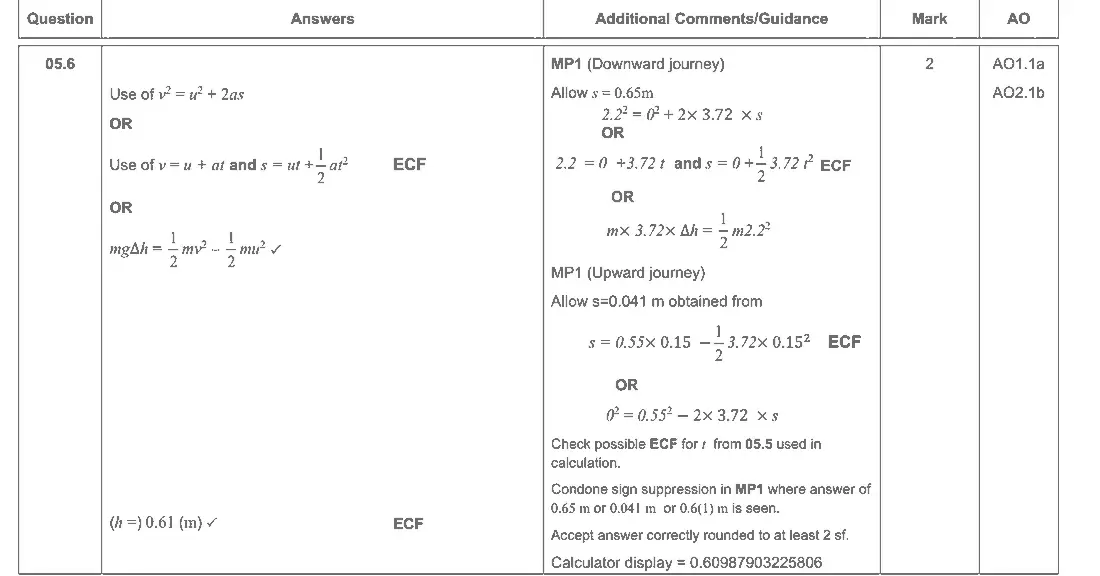
5.6 Motion along a straight line and projectile motion, Work, energy, power and conservation of energy 2Calculation
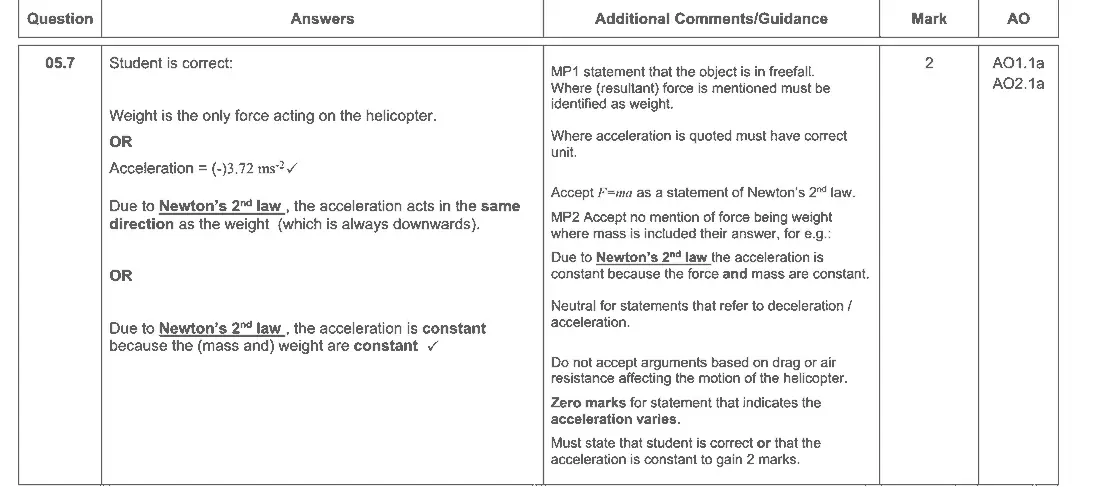
5.7 Newton's laws of motion and momentum, Motion along a straight line and projectile motion 2Explanation
6.1 Electromotive force and internal resistance 1AO1=1Short answer
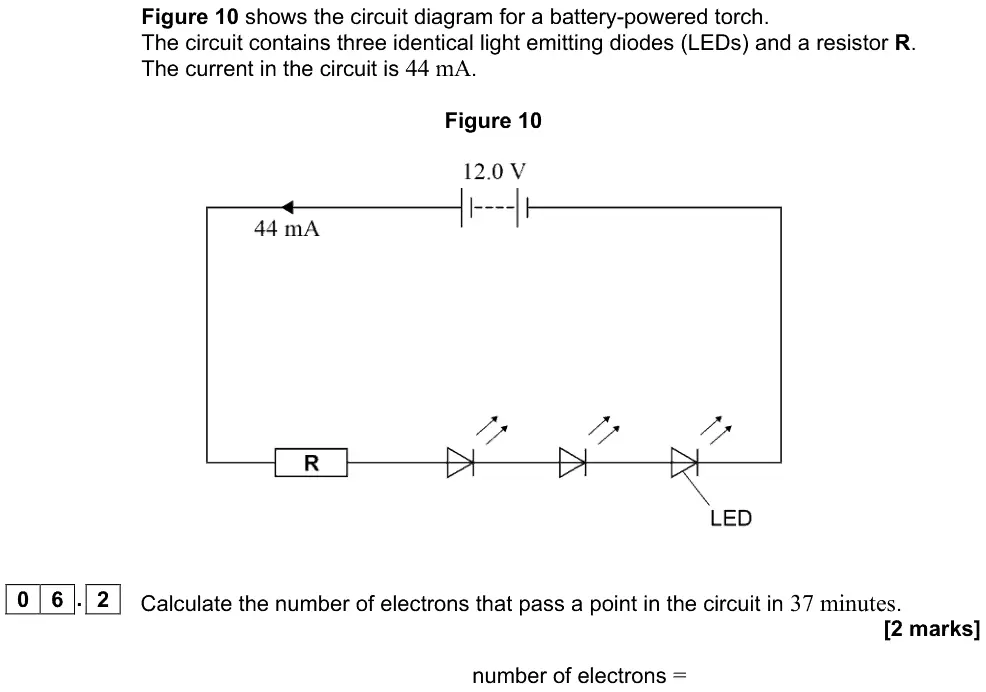
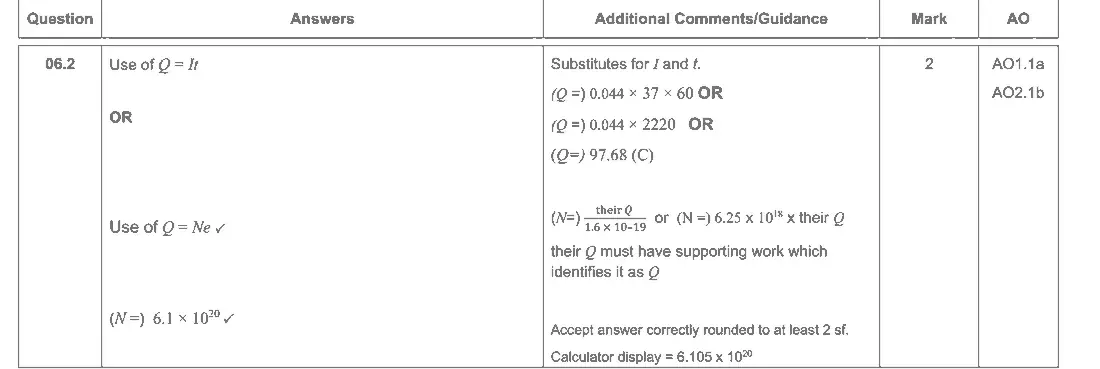
6.2 Current, potential difference, I-V characteristics and resistivity, Atomic structure and stable nuclei 2Calculation
6.3 Current, potential difference, I-V characteristics and resistivity, Circuits and potential dividers 3Calculation
6.4 Electromotive force and internal resistance, Circuits and potential dividers 4Calculation
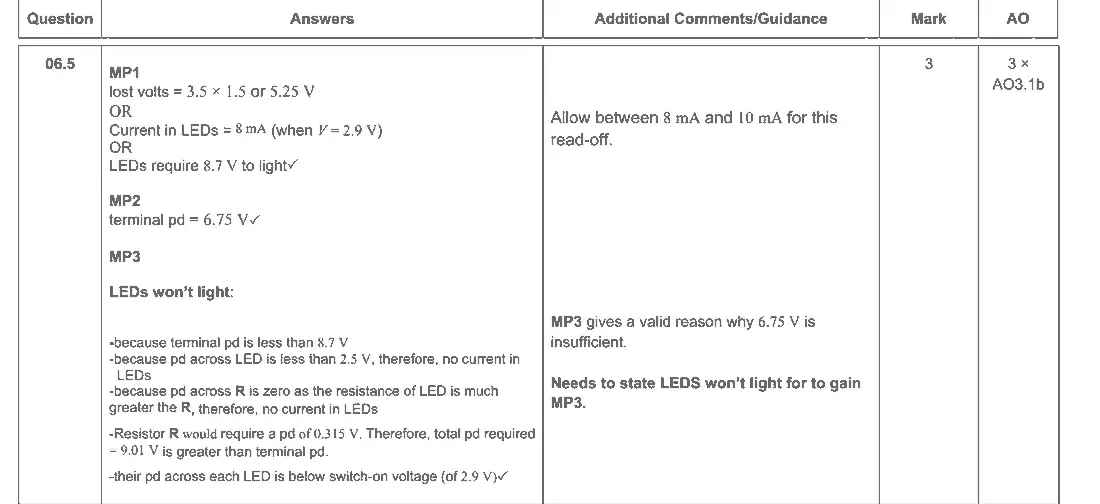
6.5 Electromotive force and internal resistance 3AO3=3Explanation

The questions

1.11.21.31.41.51.62.12.22.32.434.14.24.34.45.15.25.35.45.55.65.76.16.26.36.46.5
June 2023 · AS Paper 1 · Q1.1 2 marks AO2=2 Short answer Easy classification of particles and quarks
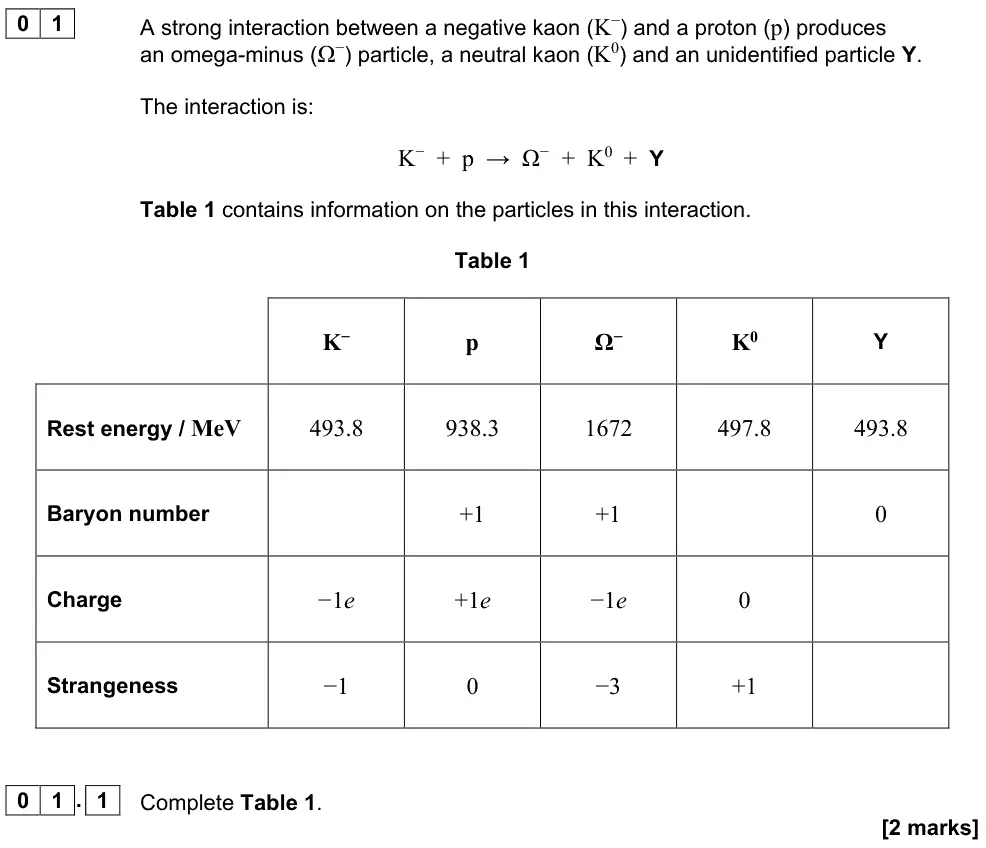
A strong interaction between a negative kaon (K−) and a proton (p) produces
an omega-minus (Ω−) particle, a neutral kaon (K0) and an unidentified particle Y.
The interaction is:
K−  +  p  →  Ω−  +  K0  +  Y
Table 1 contains information on the particles in this interaction.
Table 1
K−
p
Ω−
K0
Y
Rest energy / MeV
493.8
938.3
1672
497.8
493.8
Baryon number
+1
+1
0
Charge
−1e
+1e
−1e
0
Strangeness
−1
0
−3
+1
Complete Table 1.
[2 marks]
June 2023 · AS Paper 1 · Q1.2 2 marks AO1=2 Calculation particles antiparticles and interactionsenergy levels and wave particle duality
Earlier part of question 1 that this part usesEarlier part of June 2023 Paper 1 question 1
Calculate, in J, the rest energy of the Ω−.
[2 marks]
rest energy =
J
June 2023 · AS Paper 1 · Q1.3 2 marks Explanation classification of particles and quarksparticles antiparticles and interactions
Earlier part of question 1 that this part usesEarlier part of June 2023 Paper 1 question 1
Suggest how energy is conserved in this interaction.
Refer to the rest energies of the particles in Table 1.
[2 marks]
June 2023 · AS Paper 1 · Q1.4 4 marks AO3=4 Explanation Hard classification of particles and quarks
Earlier part of question 1 that this part usesEarlier part of June 2023 Paper 1 question 1
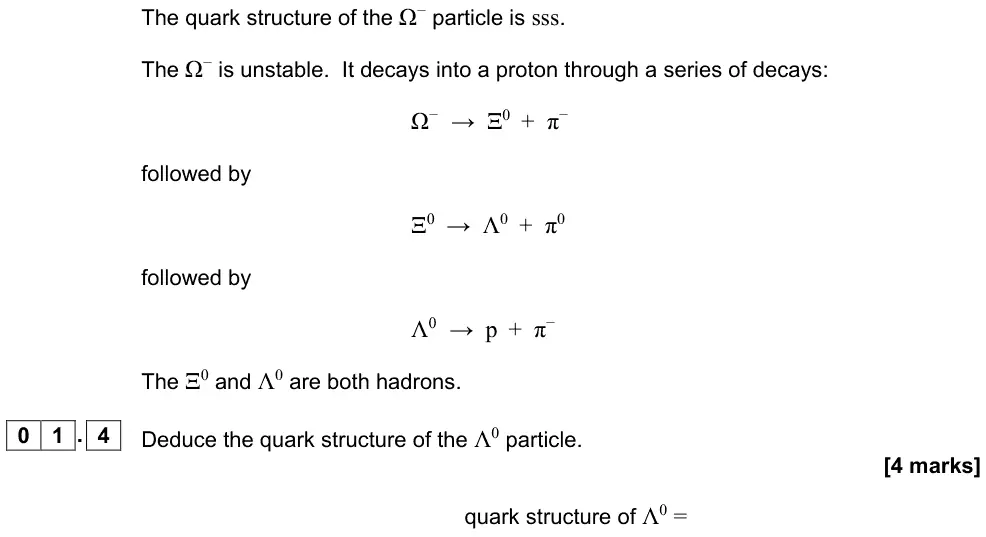
The quark structure of the Ω− particle is sss.
The Ω− is unstable.  It decays into a proton through a series of decays:
Ω−  →  Ξ0  +  π−
followed by
Ξ0  →  Λ0  +  π0
followed by
Λ0  →  p  +  π−
The Ξ0 and Λ0 are both hadrons.
Deduce the quark structure of the Λ0 particle.
[4 marks]
quark structure of Λ0 =
June 2023 · AS Paper 1 · Q1.5 2 marks Calculation Easy particles antiparticles and interactions
Earlier part of question 1 that this part usesEarlier part of June 2023 Paper 1 question 1
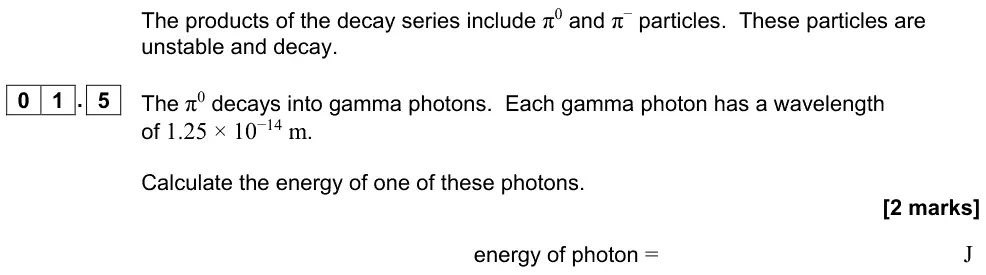
The products of the decay series include π0 and π− particles.  These particles are
unstable and decay.
The π0 decays into gamma photons.  Each gamma photon has a wavelength
of 1.25 × 10⁻¹⁴ m.
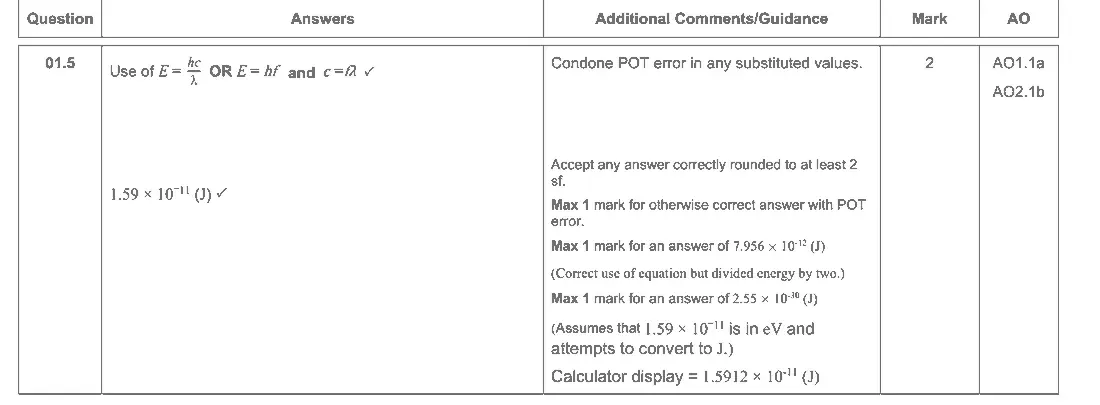
Calculate the energy of one of these photons.
[2 marks]
energy of photon =
J
June 2023 · AS Paper 1 · Q1.6 1 mark AO3=1 Short answer Easy classification of particles and quarks
Earlier part of question 1 that this part usesEarlier part of June 2023 Paper 1 question 1
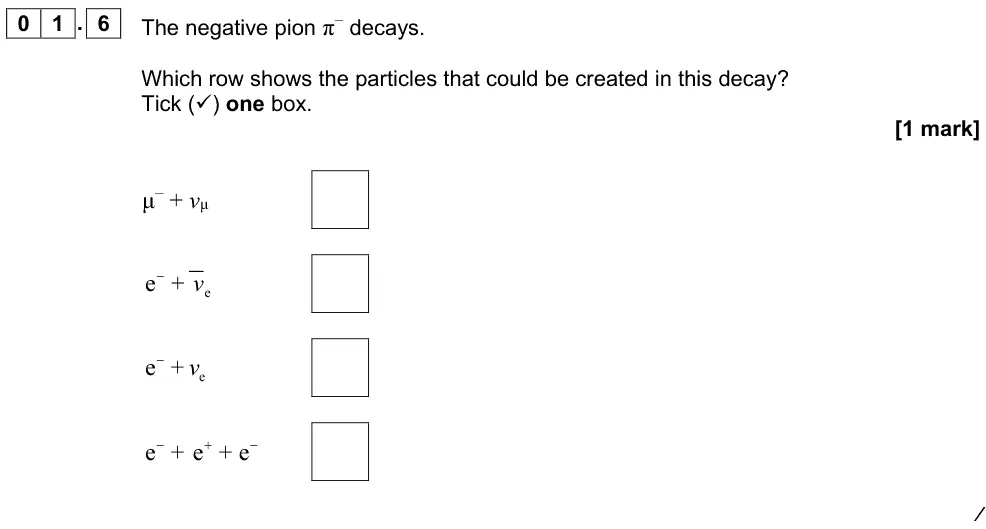
The negative pion π− decays.
Which row shows the particles that could be created in this decay?
Tick () one box.
[1 mark]
μ− + νμ
e
e + v
−
e
e + ν
−
e + e + e
−
+
−
June 2023 · AS Paper 1 · Q2.1 3 marks AO2=3 Explanation Hard progressive waves and polarisation
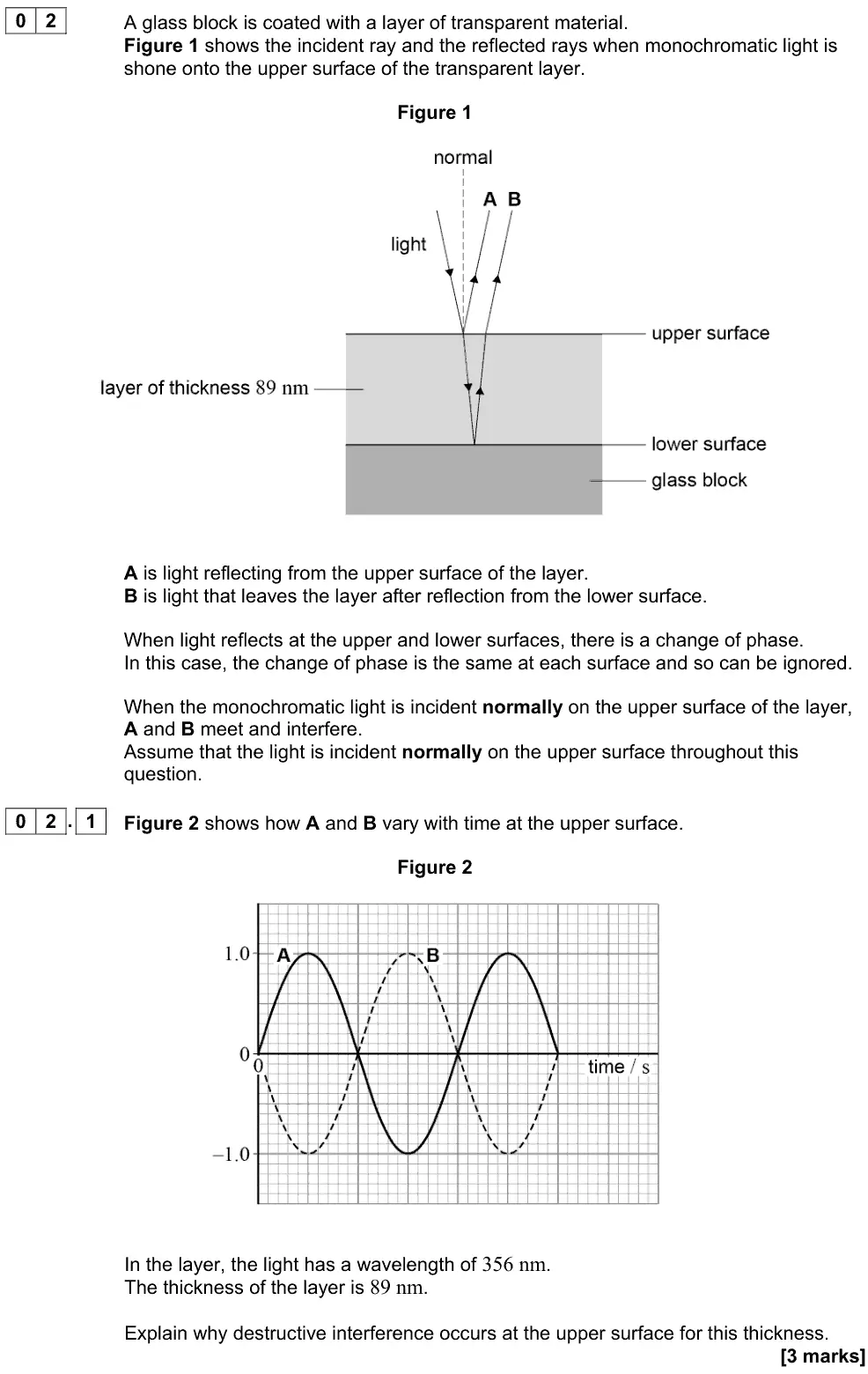
A glass block is coated with a layer of transparent material.
Figure 1 shows the incident ray and the reflected rays when monochromatic light is
shone onto the upper surface of the transparent layer.
Figure 1
A is light reflecting from the upper surface of the layer.
B is light that leaves the layer after reflection from the lower surface.
When light reflects at the upper and lower surfaces, there is a change of phase.
In this case, the change of phase is the same at each surface and so can be ignored.
When the monochromatic light is incident normally on the upper surface of the layer,
A and B meet and interfere.
Assume that the light is incident normally on the upper surface throughout this
question.
Figure 2 shows how A and B vary with time at the upper surface.
Figure 2
In the layer, the light has a wavelength of 356 nm.
The thickness of the layer is 89 nm.
Explain why destructive interference occurs at the upper surface for this thickness.

[3 marks]
June 2023 · AS Paper 1 · Q2.2 2 marks Calculation Hard progressive waves and polarisation

Earlier part of question 2 that this part usesEarlier part of June 2023 Paper 1 question 2
The frequency of the monochromatic light incident on the layer is changed.
Figure 3 shows how A and B vary with time at the upper surface for this light.
Figure 3
Calculate the resultant of the waves at time P in Figure 3.
[2 marks]
resultant =
June 2023 · AS Paper 1 · Q2.3 3 marks Show that Hard progressive waves and polarisation
Earlier part of question 2 that this part usesEarlier part of June 2023 Paper 1 question 2
The frequency of the light in Figure 3 is 4.72 × 10¹⁴ Hz.
The phase difference between A and B shown in Figure 3 is 137°.
Show that the time interval labelled t in Figure 3 is approximately 8 × 10⁻¹⁶ s.
[3 marks]
June 2023 · AS Paper 1 · Q2.4 4 marks AO2=2, AO3=2 Calculation Hard refraction and optical fibresprogressive waves and polarisation
Earlier part of question 2 that this part usesEarlier part of June 2023 Paper 1 question 2
89 nm is the minimum thickness that will produce a phase difference of 137° between
A and B.
Calculate the refractive index of the material of the layer.
[4 marks]
refractive index =
June 2023 · AS Paper 1 · Q3 6 marks AO1=4, AO3=2 6-mark extended response progressive waves and polarisation
A student sits near a lake on a sunny day.
Some sunlight is reflected from the surface of the lake.  Sunlight is also reflected from
objects submerged beneath the surface of the lake.  The light reflected from the
surface makes it difficult to see the submerged objects.
Sunlight that reflects from the surface of the lake is horizontally polarised.  Sunlight
that reflects from the submerged objects is unpolarised.
The student puts on a pair of Polaroid sunglasses.  The amount of light he sees
reflected from the surface is significantly reduced.
Explain why the student can now see the submerged objects more clearly.
In your answer you should:
• describe the nature of an unpolarised wave
• explain what is meant by polarisation
• explain the relative effect of the Polaroid sunglasses on the light reflected from the
surface and the light reflected from the submerged objects.
[6 marks]
June 2023 · AS Paper 1 · Q4.1 2 marks AO2=2 Calculation vectors and moments
Figure 4 shows an archer using a bow in a competition.
Figure 4
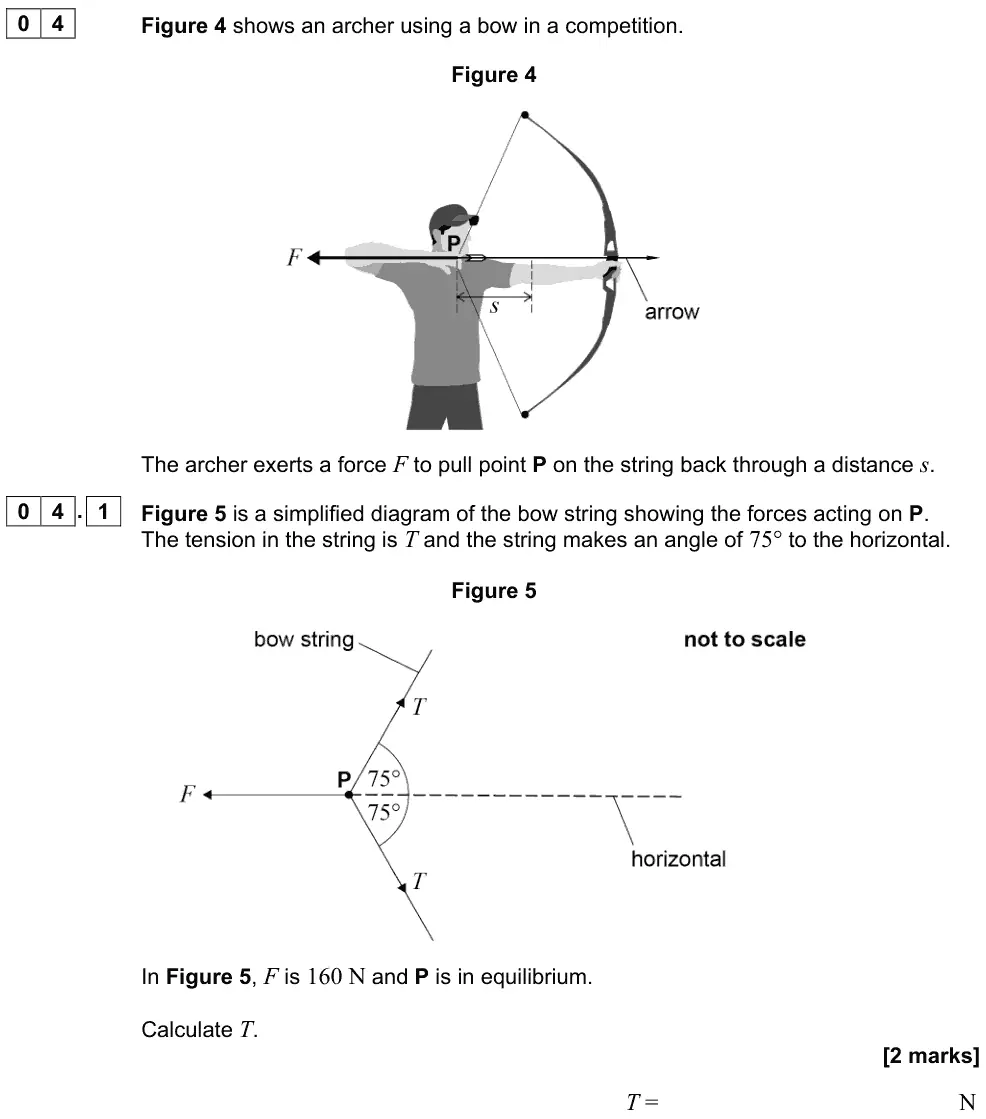
The archer exerts a force F to pull point P on the string back through a distance s.
Figure 5 is a simplified diagram of the bow string showing the forces acting on P.
The tension in the string is T and the string makes an angle of 75° to the horizontal.
Figure 5
In Figure 5, F is 160 N and P is in equilibrium.
Calculate T.
[2 marks]
T =
N
June 2023 · AS Paper 1 · Q4.2 2 marks Calculation newtons laws and momentum
Earlier part of question 4 that this part usesEarlier part of June 2023 Paper 1 question 4
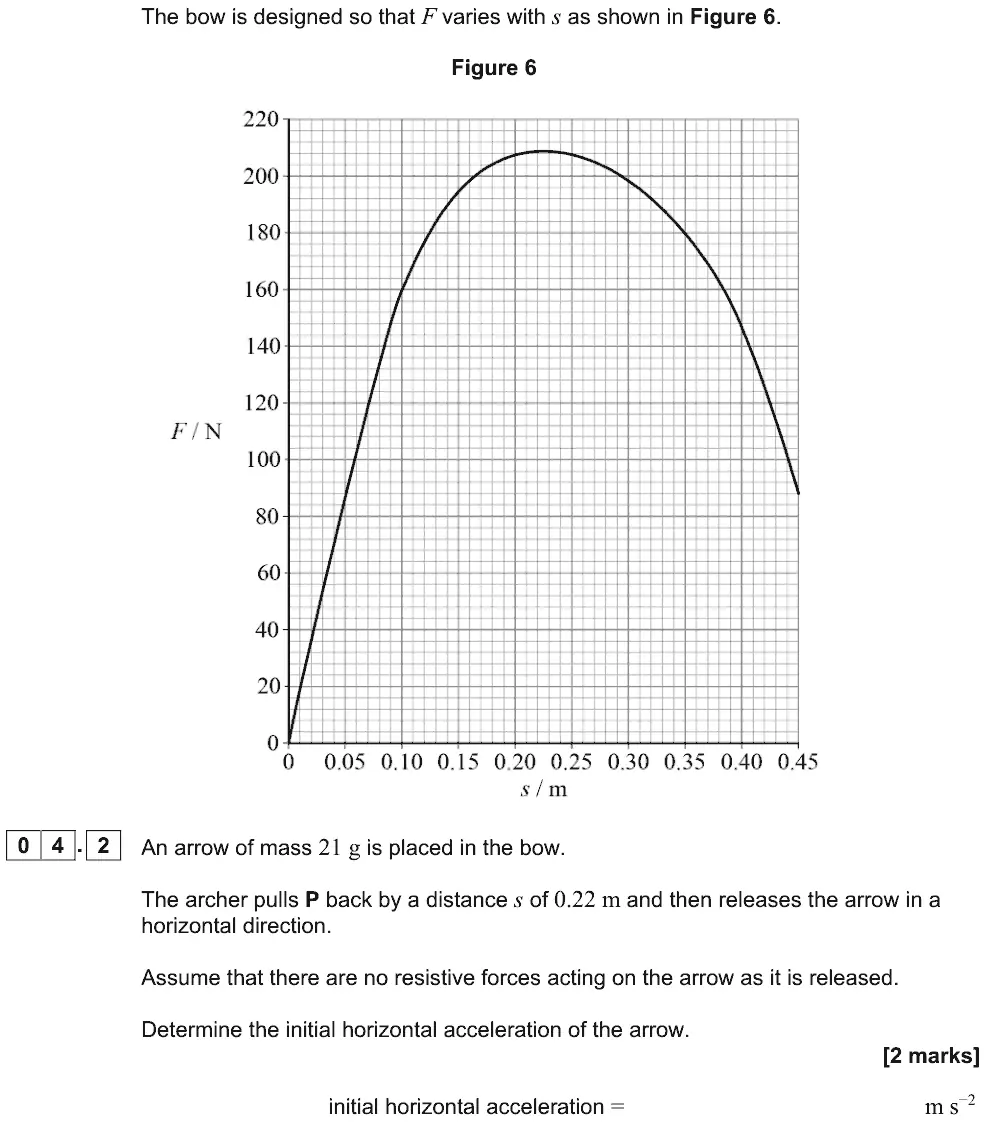
The bow is designed so that F varies with s as shown in Figure 6.
Figure 6
An arrow of mass 21 g is placed in the bow.
The archer pulls P back by a distance s of 0.22 m and then releases the arrow in a
horizontal direction.
Assume that there are no resistive forces acting on the arrow as it is released.
Determine the initial horizontal acceleration of the arrow.
[2 marks]
initial horizontal acceleration =
m s−2
June 2023 · AS Paper 1 · Q4.3 2 marks AO3=2 Calculation Hard work energy and powermaterials and young modulus
Earlier part of question 4 that this part usesEarlier part of June 2023 Paper 1 question 4
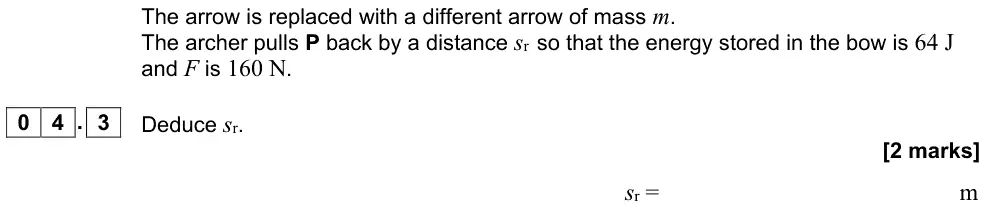
The arrow is replaced with a different arrow of mass m.
The archer pulls P back by a distance sr  so that the energy stored in the bow is 64 J
and F is 160 N.
Deduce sr.
[2 marks]
sr =
m
June 2023 · AS Paper 1 · Q4.4 3 marks Calculation work energy and power
Earlier part of question 4 that this part usesEarlier part of June 2023 Paper 1 question 4
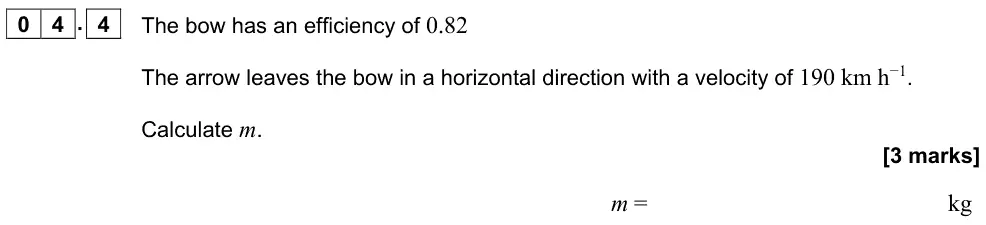
The bow has an efficiency of 0.82
The arrow leaves the bow in a horizontal direction with a velocity of 190 km h−1.
Calculate m.
[3 marks]
m =
kg
June 2023 · AS Paper 1 · Q5.1 3 marks Show that materials and young modulus
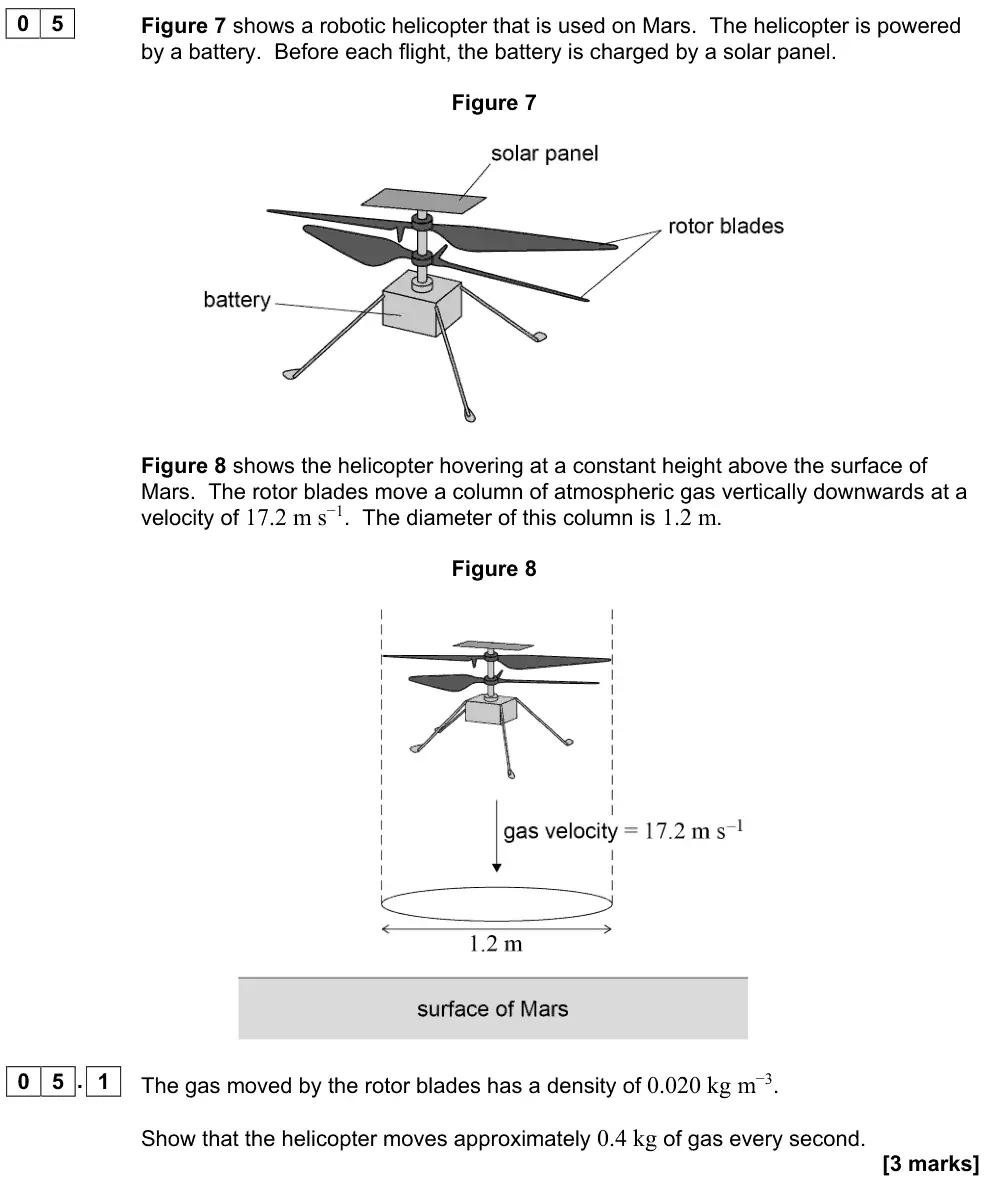
Figure 7 shows a robotic helicopter that is used on Mars.  The helicopter is powered
by a battery.  Before each flight, the battery is charged by a solar panel.
Figure 7
Figure 8 shows the helicopter hovering at a constant height above the surface of
Mars.  The rotor blades move a column of atmospheric gas vertically downwards at a
velocity of 17.2 m s−1.  The diameter of this column is 1.2 m.
Figure 8
The gas moved by the rotor blades has a density of 0.020 kg m−3.
Show that the helicopter moves approximately 0.4 kg of gas every second.
[3 marks]
June 2023 · AS Paper 1 · Q5.2 3 marks Calculation Hard newtons laws and momentum
Earlier part of question 5 that this part usesEarlier part of June 2023 Paper 1 question 5
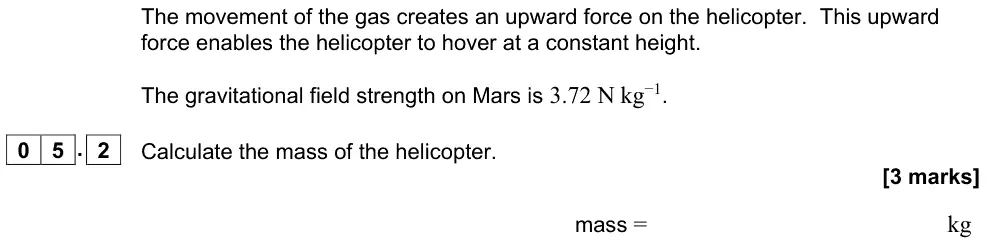
The movement of the gas creates an upward force on the helicopter.  This upward
force enables the helicopter to hover at a constant height.
The gravitational field strength on Mars is 3.72 N kg−1.
Calculate the mass of the helicopter.
[3 marks]
mass =
kg
June 2023 · AS Paper 1 · Q5.3 2 marks Calculation work energy and powermeasurements and uncertainties
Earlier part of question 5 that this part usesEarlier part of June 2023 Paper 1 question 5
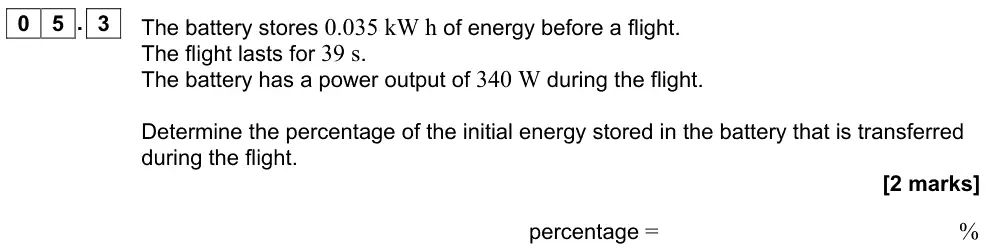
The battery stores 0.035 kW h of energy before a flight.
The flight lasts for 39 s.
The battery has a power output of 340 W during the flight.
Determine the percentage of the initial energy stored in the battery that is transferred
during the flight.
[2 marks]
percentage =
%
June 2023 · AS Paper 1 · Q5.4 3 marks AO3=3 Explanation Hard work energy and powernewtons laws and momentum
Earlier part of question 5 that this part usesEarlier part of June 2023 Paper 1 question 5
The helicopter has a maximum flight time of a few minutes due to the limited amount
of energy stored in the battery.  The battery accounts for about 15% of the helicopter’s
mass.
A student suggests that adding another identical battery that doubles the energy
available to the helicopter would double its flight time.
Deduce without calculation whether the student’s suggestion is correct.
[3 marks]
June 2023 · AS Paper 1 · Q5.5 2 marks Calculation motion and projectiles
Earlier part of question 5 that this part usesEarlier part of June 2023 Paper 1 question 5
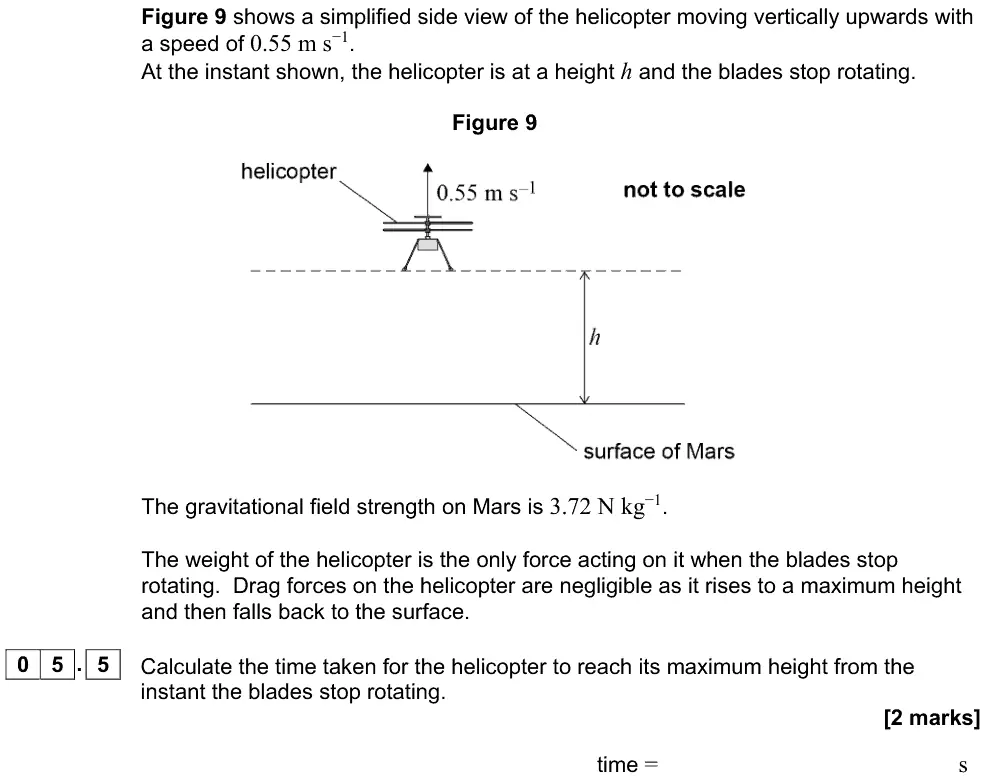
Figure 9 shows a simplified side view of the helicopter moving vertically upwards with
a speed of 0.55 m s−1.
At the instant shown, the helicopter is at a height h and the blades stop rotating.
Figure 9
The gravitational field strength on Mars is 3.72 N kg−1.
The weight of the helicopter is the only force acting on it when the blades stop
rotating.  Drag forces on the helicopter are negligible as it rises to a maximum height
and then falls back to the surface.
Calculate the time taken for the helicopter to reach its maximum height from the
instant the blades stop rotating.
[2 marks]
time =
s
June 2023 · AS Paper 1 · Q5.6 2 marks Calculation motion and projectileswork energy and power
Earlier part of question 5 that this part usesEarlier part of June 2023 Paper 1 question 5
When the helicopter makes contact with the surface it has a velocity of 2.2 m s−1.
Calculate h.
[2 marks]
h =
m
June 2023 · AS Paper 1 · Q5.7 2 marks Explanation newtons laws and momentummotion and projectiles
Earlier part of question 5 that this part usesEarlier part of June 2023 Paper 1 question 5
A student suggests that the acceleration of the helicopter is constant from the instant
the blades stop rotating until the helicopter makes contact with the surface.
Discuss this suggestion with reference to an appropriate Newton’s law of motion.
[2 marks]
June 2023 · AS Paper 1 · Q6.1 1 mark AO1=1 Short answer Hard emf and internal resistance
State what is meant by the emf (electromotive force) of a battery.
[1 mark]
June 2023 · AS Paper 1 · Q6.2 2 marks Calculation current voltage and resistivityatomic structure and stable nuclei
Earlier part of question 6 that this part usesEarlier part of June 2023 Paper 1 question 6
Figure 10 shows the circuit diagram for a battery-powered torch.
The circuit contains three identical light emitting diodes (LEDs) and a resistor R.
The current in the circuit is 44 mA.
Figure 10
Calculate the number of electrons that pass a point in the circuit in 37 minutes.
[2 marks]
number of electrons =
June 2023 · AS Paper 1 · Q6.3 3 marks Calculation Hard current voltage and resistivitycircuits and potential dividers
Earlier part of question 6 that this part usesEarlier part of June 2023 Paper 1 question 6
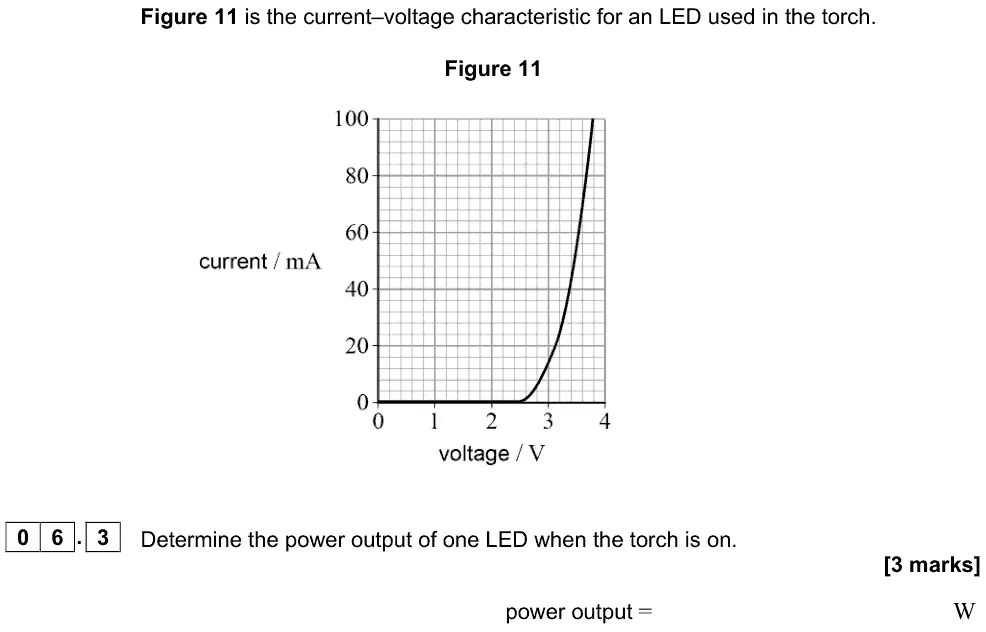
Figure 11 is the current–voltage characteristic for an LED used in the torch.
Figure 11
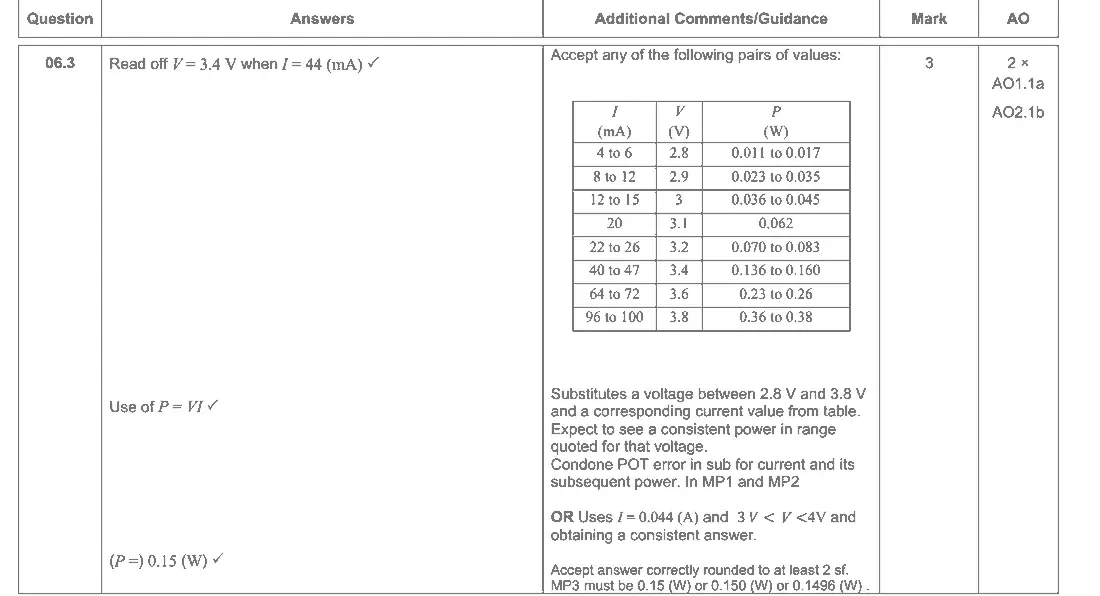
Determine the power output of one LED when the torch is on.
[3 marks]
power output =
W
June 2023 · AS Paper 1 · Q6.4 4 marks Calculation Hard emf and internal resistancecircuits and potential dividers
Earlier part of question 6 that this part usesEarlier part of June 2023 Paper 1 question 6
The battery has an emf of 12.0 V and an internal resistance of 1.5 Ω.
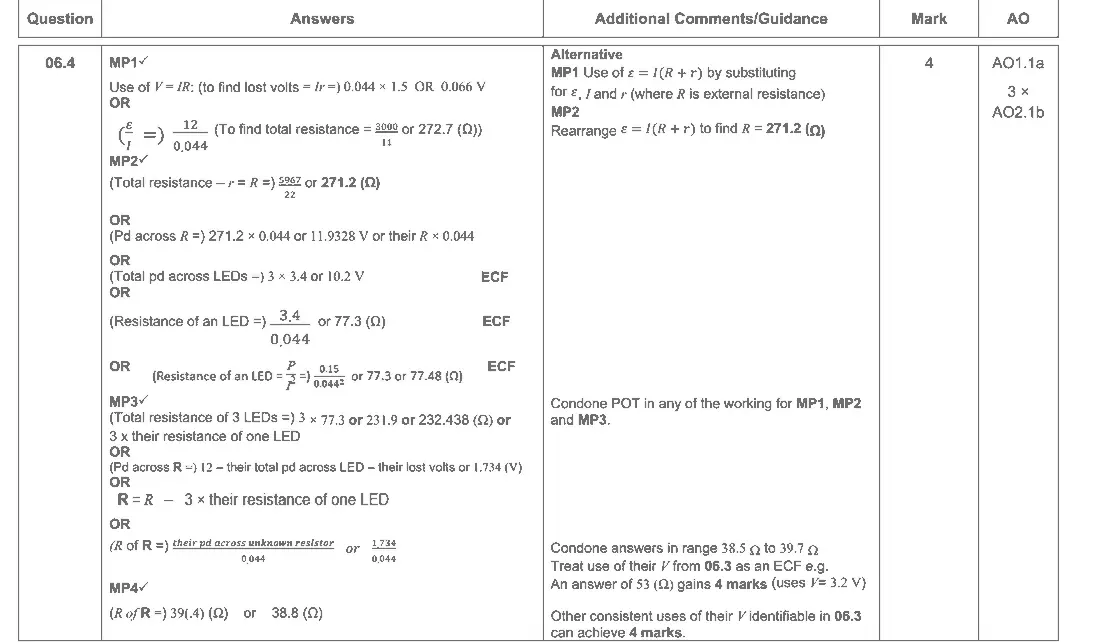
Determine the resistance of R in Figure 10.
[4 marks]
resistance =
Ω
June 2023 · AS Paper 1 · Q6.5 3 marks AO3=3 Explanation Hard emf and internal resistance
Earlier part of question 6 that this part usesEarlier part of June 2023 Paper 1 question 6
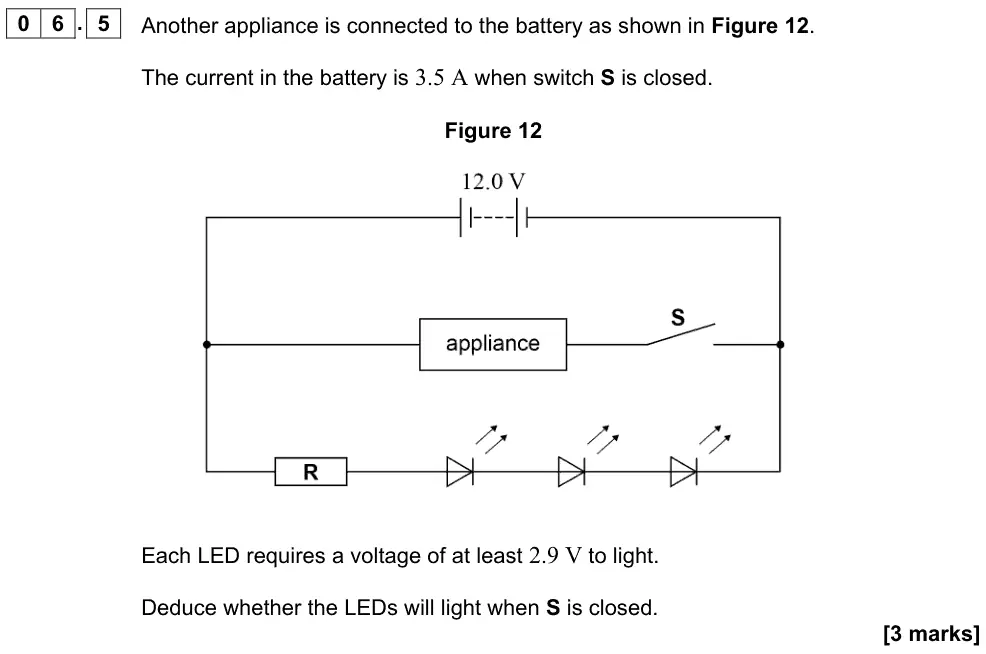
Another appliance is connected to the battery as shown in Figure 12.
The current in the battery is 3.5 A when switch S is closed.
Figure 12
Each LED requires a voltage of at least 2.9 V to light.
Deduce whether the LEDs will light when S is closed.
[3 marks]

Work with an AQA physics tutor

Want a paper marked and gone through with you? Message us.

Prefer email? Send an enquiry

If you are under 18, please include a parent's contact details. Enquiries go to enquiries@physicsaleveltutor.com and are deleted once handled. All tutoring is online.