June 2024: AS Paper 1

70 marks · 28 question parts · Paper, mark scheme and report on AQA's site · Have the data and formulae booklet beside you

Question by question

QTopicMarksAOType
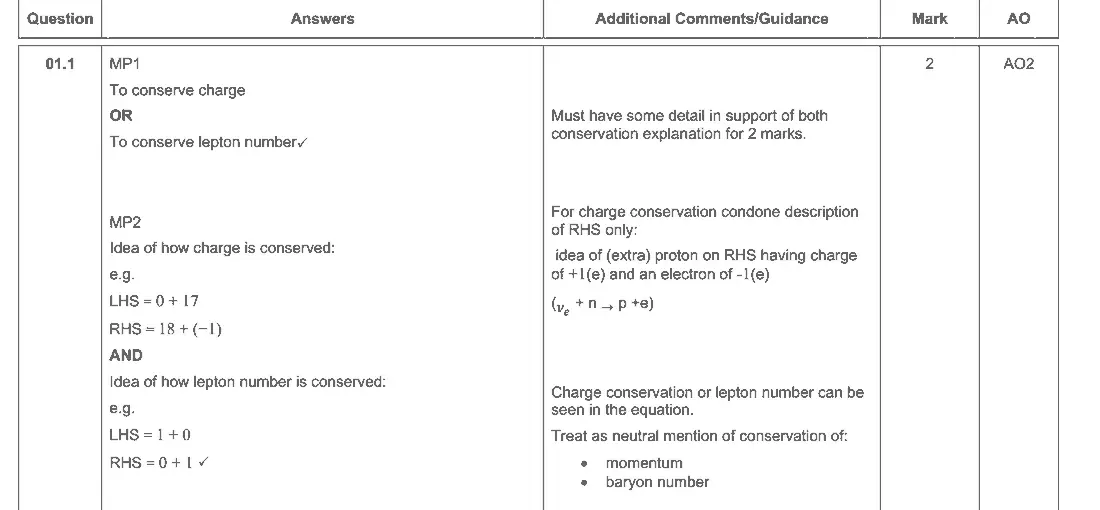
1.1 Classification of particles, quarks and conservation laws 2AO2=2Explanation
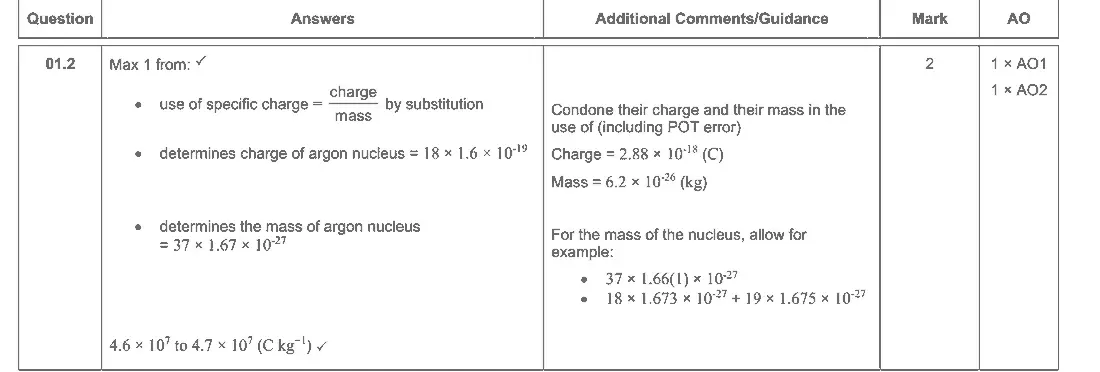
1.2 Atomic structure and stable nuclei 2AO1=1,AO2=1Calculation
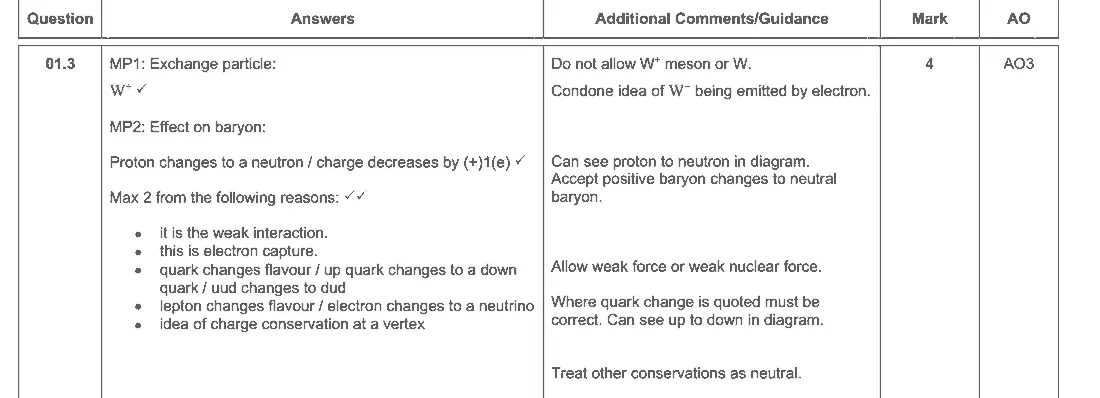
1.3 Particles, antiparticles and particle interactions, Classification of particles, quarks and conservation laws 4AO3=4Explanation
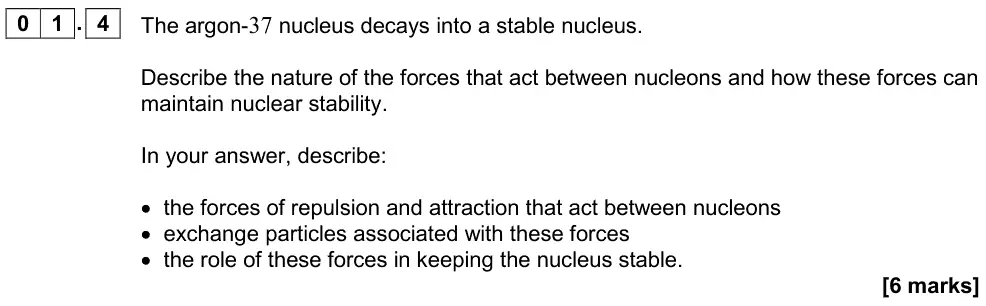
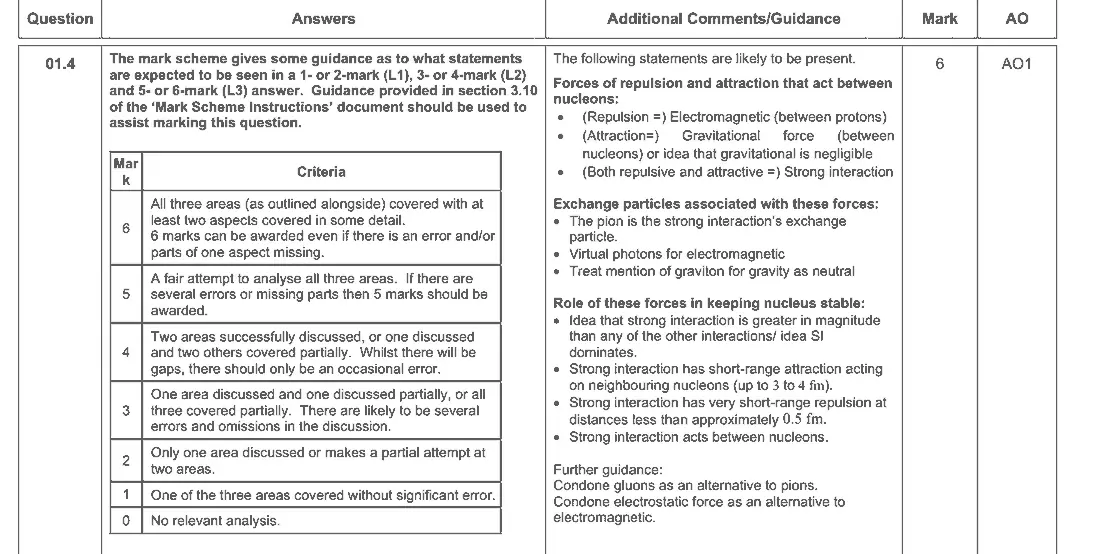
1.4 Atomic structure and stable nuclei, Particles, antiparticles and particle interactions 6AO1=6Extended response
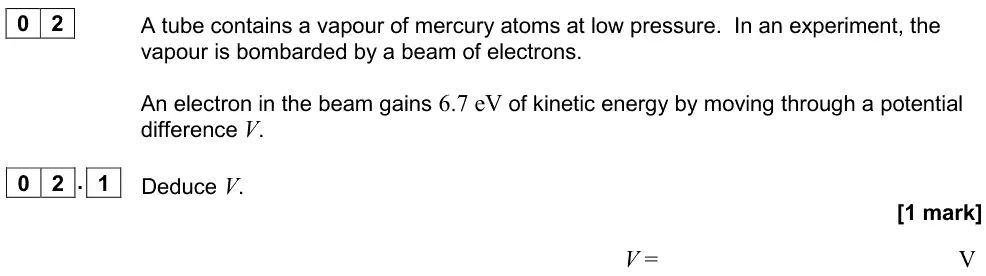
2.1 Excitation, energy levels and wave-particle duality, Current, potential difference, I-V characteristics and resistivity 1AO1=1Short answer
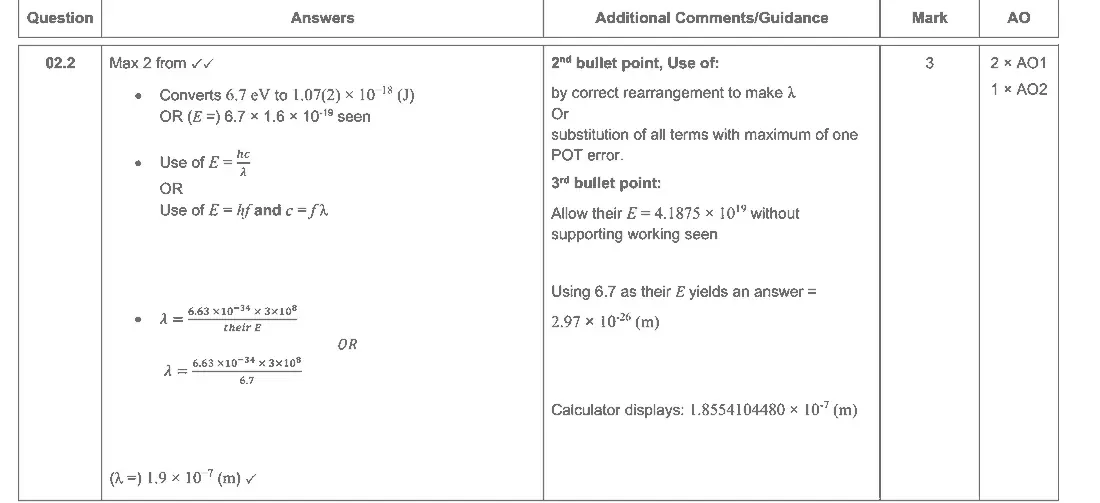
2.2 Particles, antiparticles and particle interactions, Excitation, energy levels and wave-particle duality 3AO1=2,AO2=1Calculation
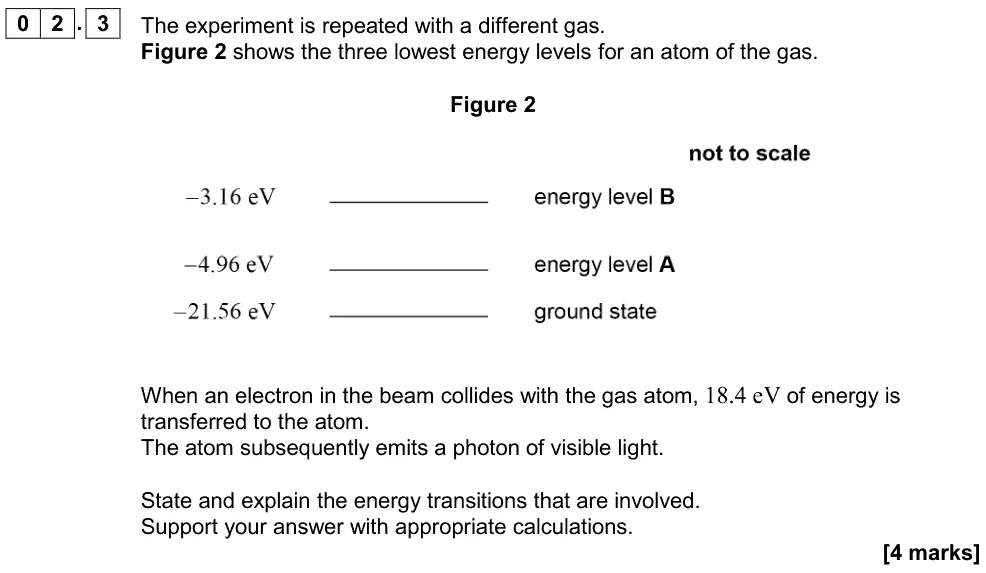
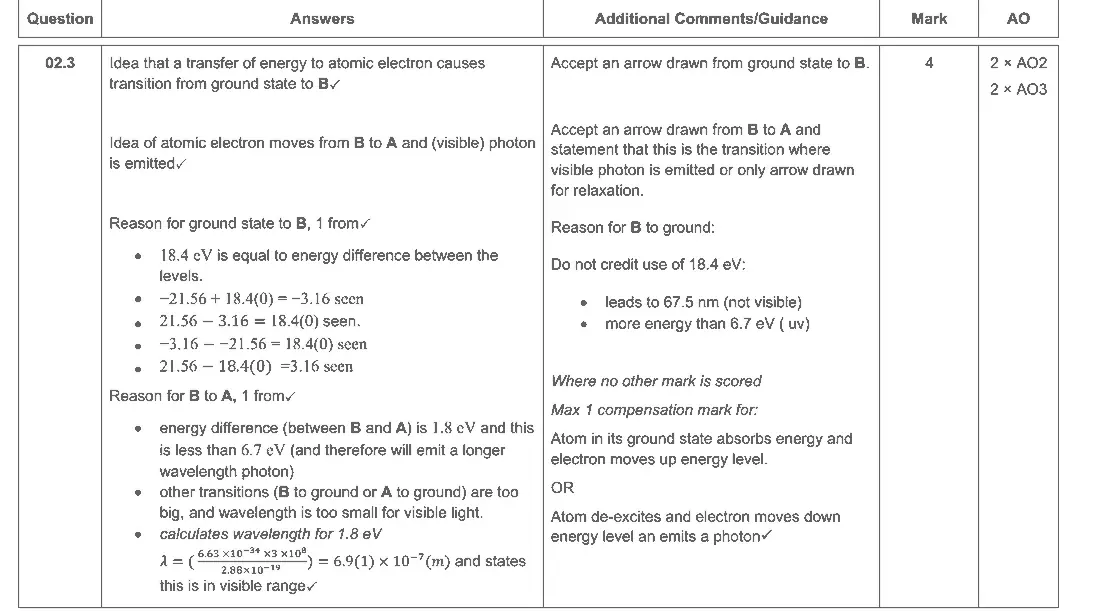
2.3 Excitation, energy levels and wave-particle duality 4AO2=2,AO3=2Explanation
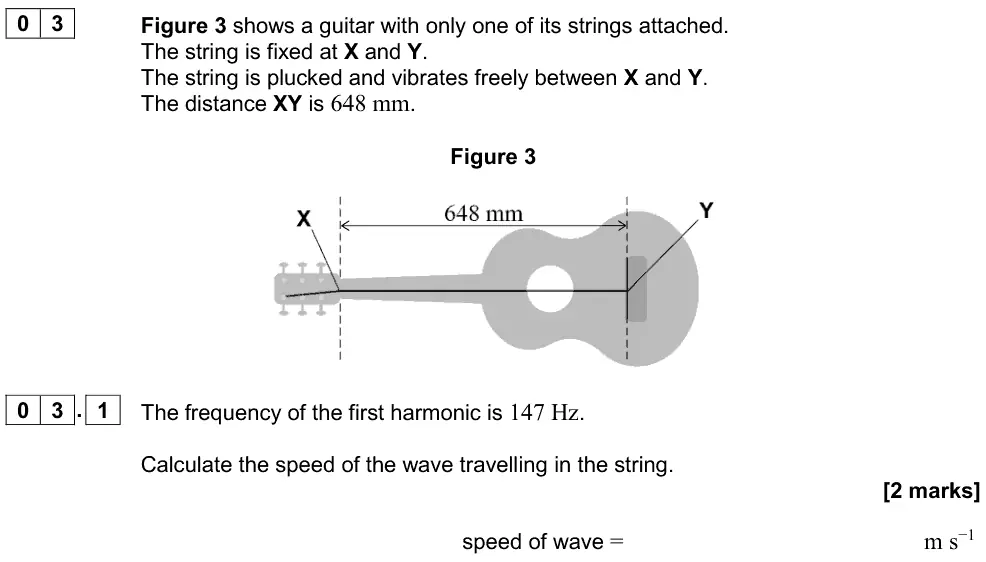
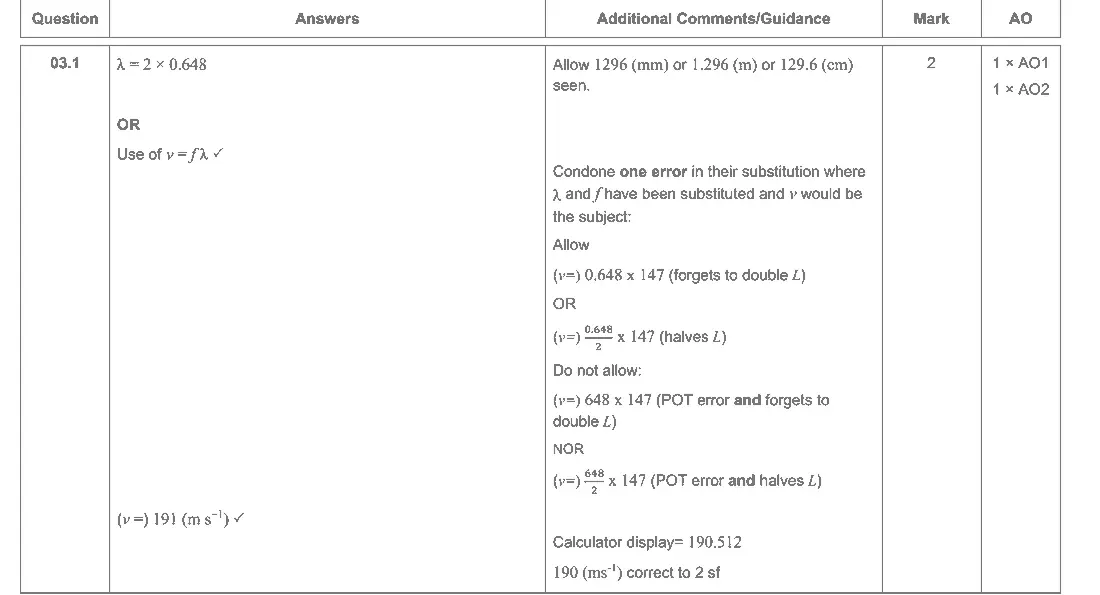
3.1 Progressive waves, longitudinal and transverse waves, Superposition and stationary waves 2AO1=1,AO2=1Calculation
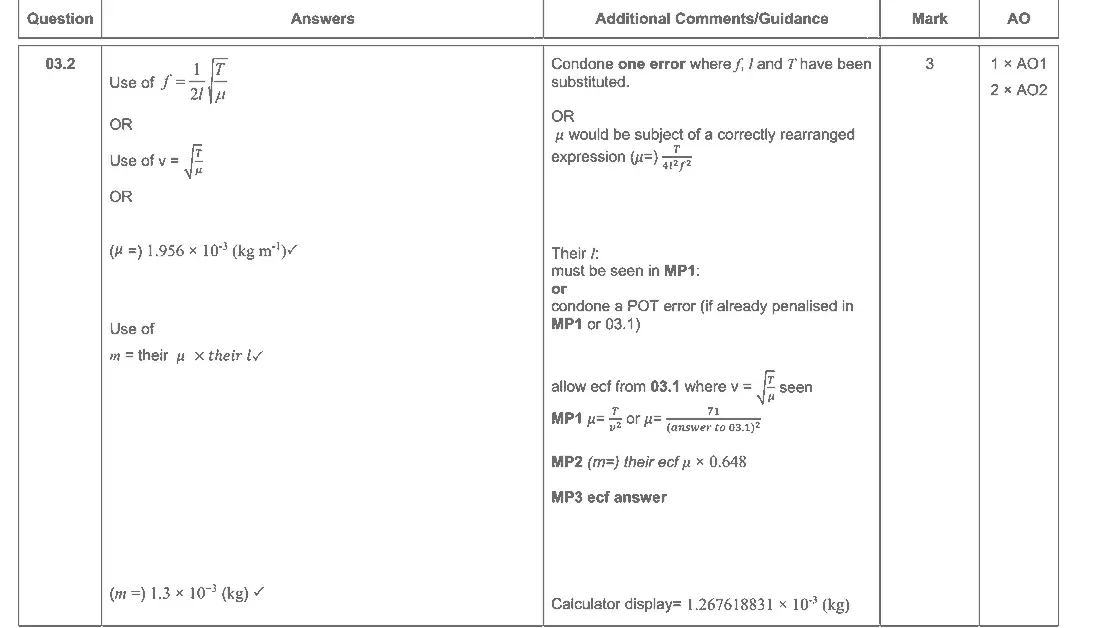
3.2 Superposition and stationary waves 3AO1=1,AO2=2Calculation
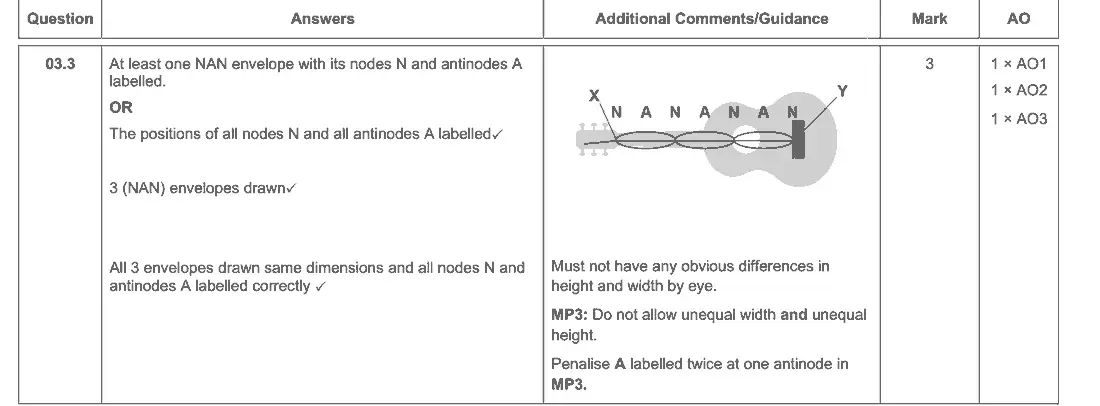
3.3 Superposition and stationary waves 3AO1=1,AO2=1,AO3=1Diagram or graph
3.4 Superposition and stationary waves 3AO3=3Explanation
4.1 Motion along a straight line and projectile motion 2AO1=1,AO2=1Calculation
4.2 Newton's laws of motion and momentum 2AO1=1,AO2=1Calculation
4.3 Scalars, vectors and moments 3AO2=2,AO3=1Calculation
4.4 Scalars, vectors and moments 1AO1=1Short answer
4.5 Scalars, vectors and moments 3AO1=1,AO2=1,AO3=1Calculation
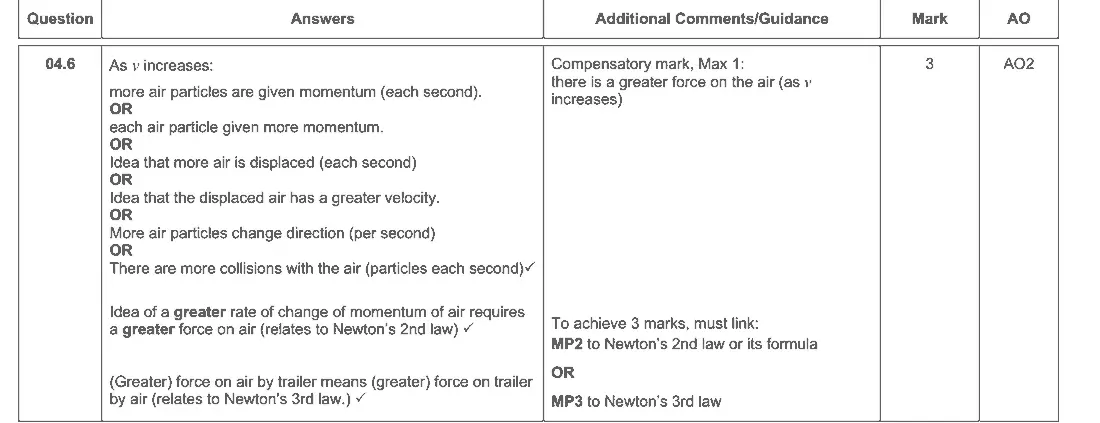
4.6 Newton's laws of motion and momentum 3AO2=3Explanation
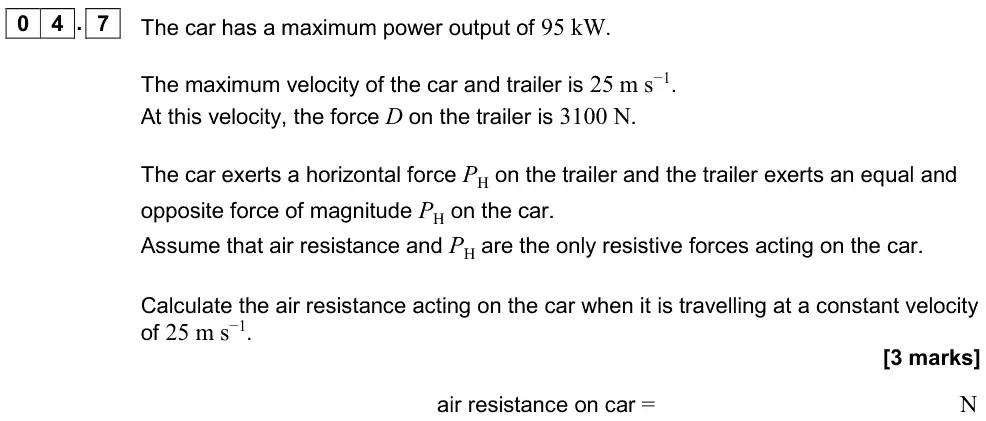
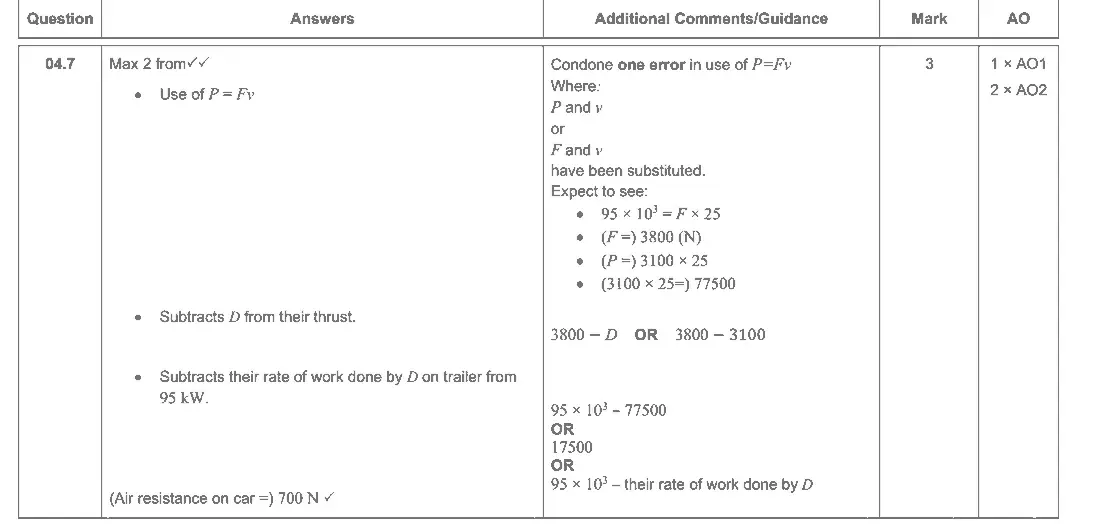
4.7 Work, energy, power and conservation of energy, Newton's laws of motion and momentum 3AO1=1,AO2=2Calculation
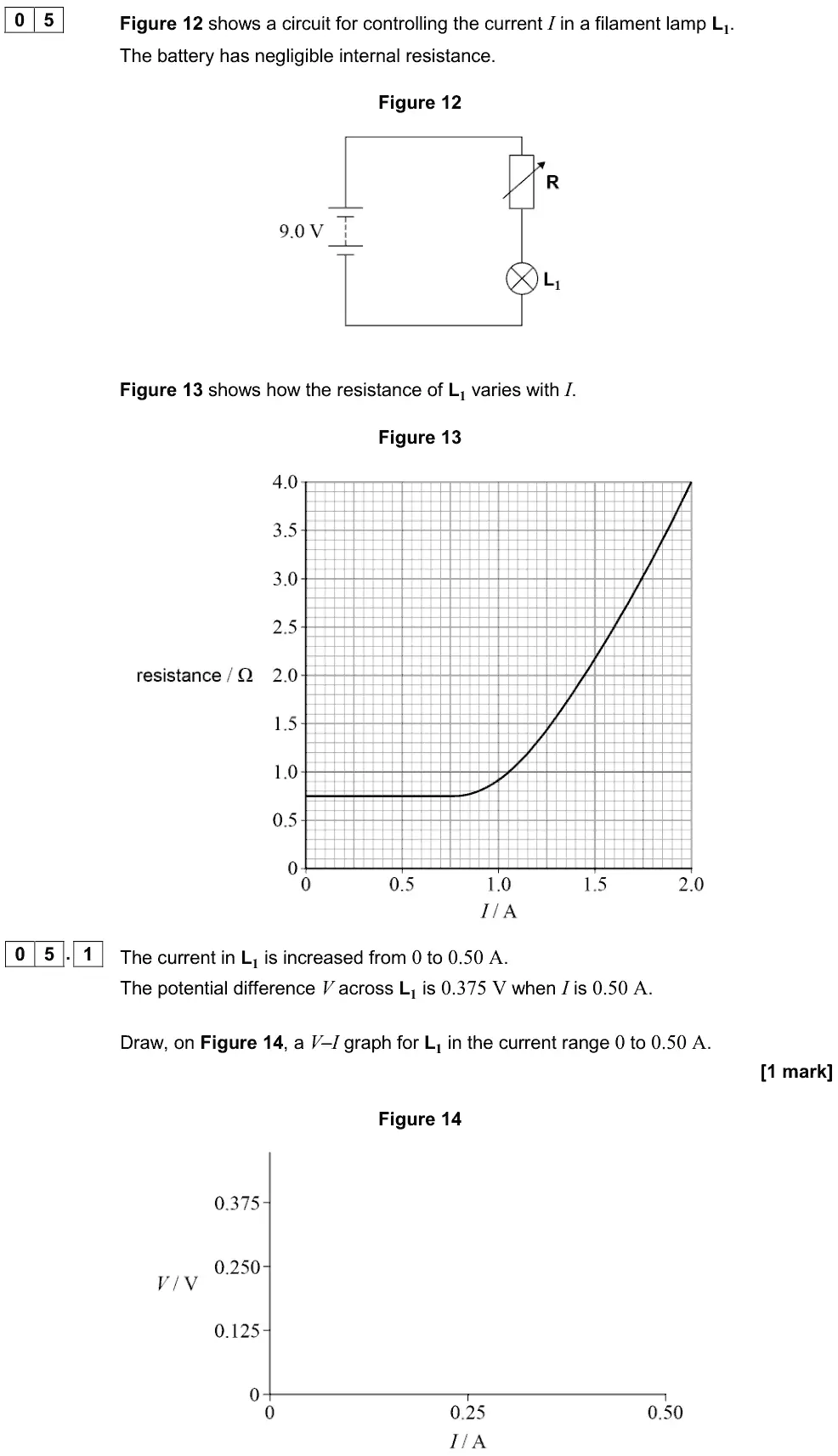
5.1 Current, potential difference, I-V characteristics and resistivity 1AO2=1Diagram or graph
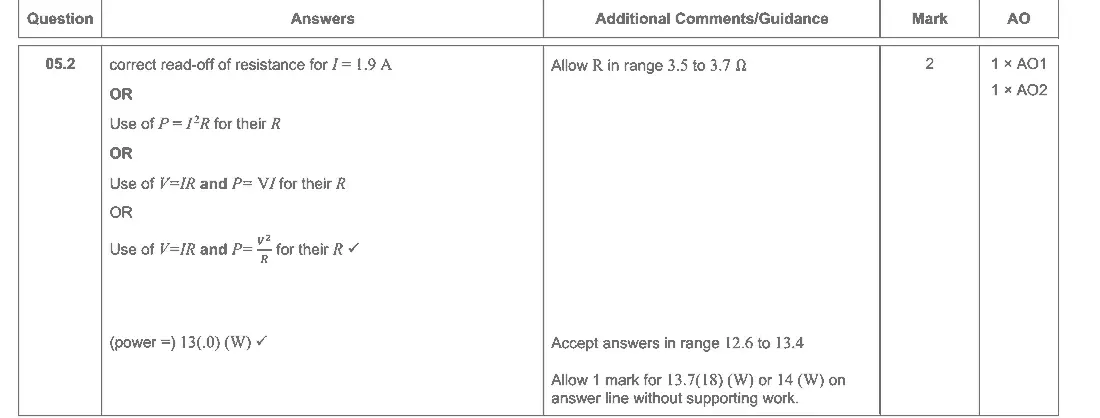
5.2 Circuits and potential dividers, Current, potential difference, I-V characteristics and resistivity 2AO1=1,AO2=1Calculation
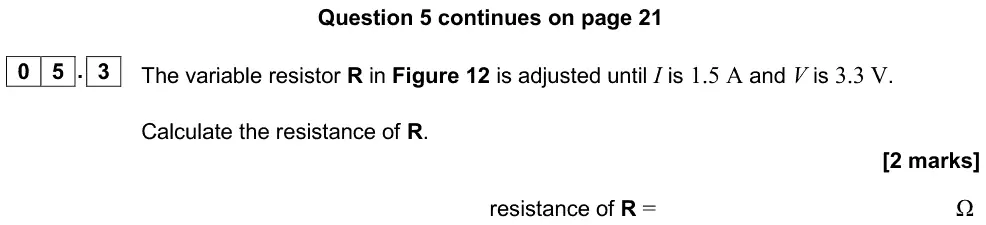
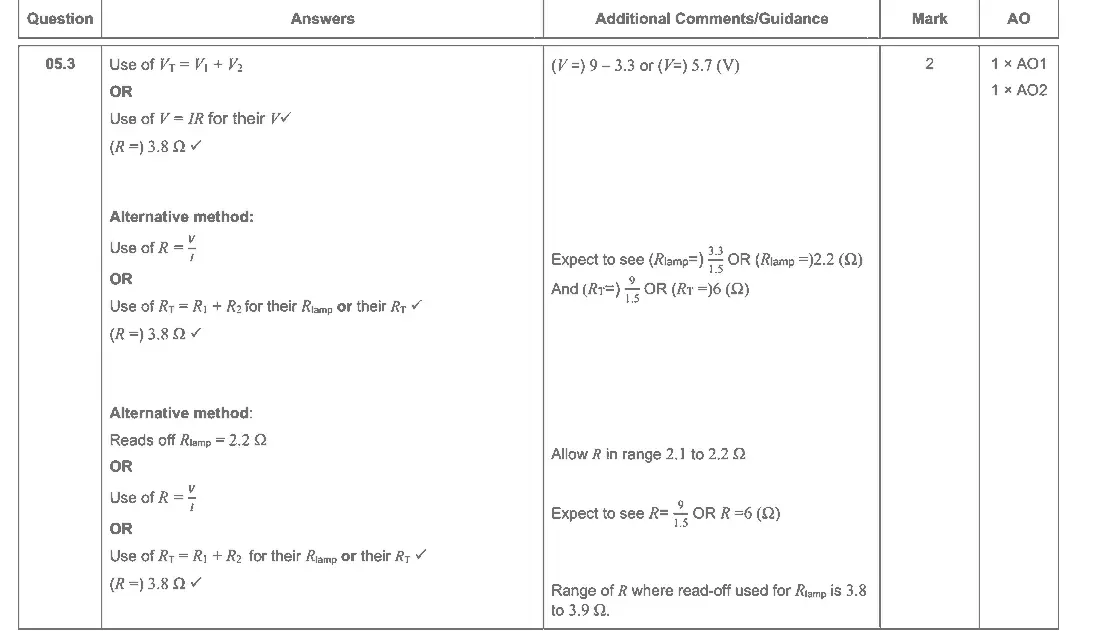
5.3 Circuits and potential dividers, Current, potential difference, I-V characteristics and resistivity 2AO1=1,AO2=1Calculation
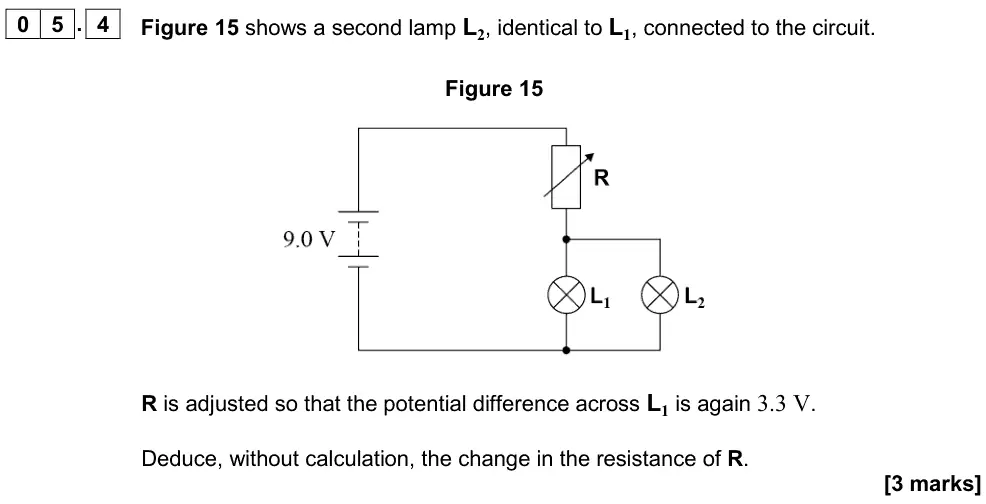
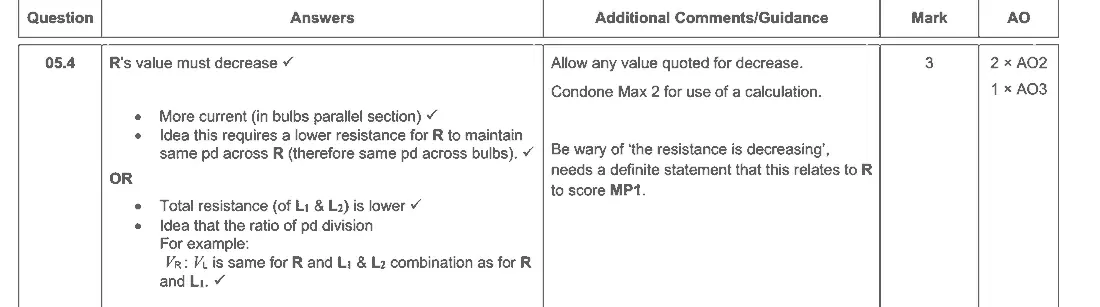
5.4 Circuits and potential dividers 3AO2=2,AO3=1Explanation
6.1 Motion along a straight line and projectile motion, Materials, stress, strain and the Young modulus 1AO3=1Short answer
6.2 Work, energy, power and conservation of energy 2AO1=1,AO2=1Calculation
6.3 Materials, stress, strain and the Young modulus, Work, energy, power and conservation of energy 3AO1=1,AO2=2Calculation
6.4 Materials, stress, strain and the Young modulus, Newton's laws of motion and momentum 2AO2=1,AO3=1Short answer
6.5 Materials, stress, strain and the Young modulus 1AO1=1Show that
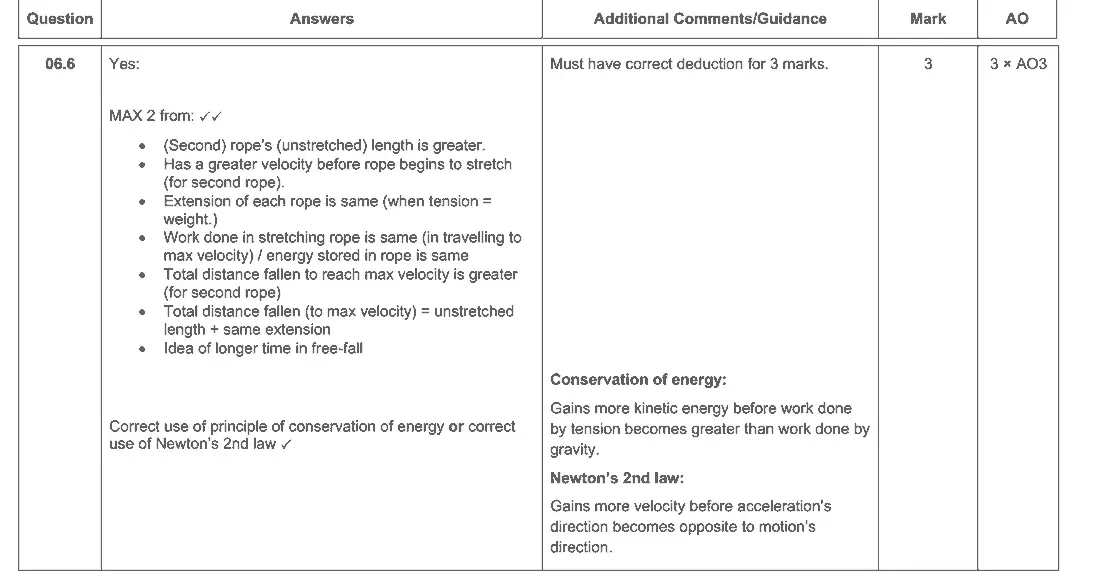
6.6 Materials, stress, strain and the Young modulus, Work, energy, power and conservation of energy 3AO3=3Explanation

The questions

1.11.21.31.42.12.22.33.13.23.33.44.14.24.34.44.54.64.75.15.25.35.46.16.26.36.46.56.6
June 2024 · AS Paper 1 · Q1.1 2 marks AO2=2 Explanation classification of particles and quarks
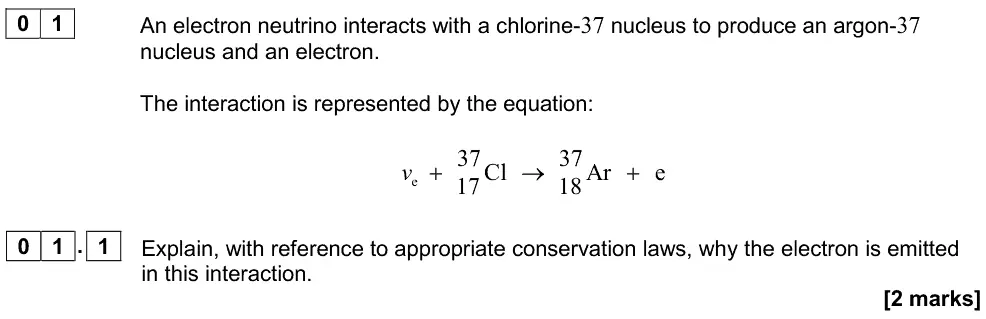
An electron neutrino interacts with a chlorine-37 nucleus to produce an argon-37
nucleus and an electron.
The interaction is represented by the equation:
e
37
37
Cl
Ar       e
17
18
v +
→
+
Explain, with reference to appropriate conservation laws, why the electron is emitted
in this interaction.
[2 marks]
June 2024 · AS Paper 1 · Q1.2 2 marks AO1=1, AO2=1 Calculation atomic structure and stable nuclei
Earlier part of question 1 that this part usesEarlier part of June 2024 Paper 1 question 1
Calculate the specific charge of the argon-37 nucleus.
[2 marks]
specific charge =
C kg−1
June 2024 · AS Paper 1 · Q1.3 4 marks AO3=4 Explanation particles antiparticles and interactionsclassification of particles and quarks
Earlier part of question 1 that this part usesEarlier part of June 2024 Paper 1 question 1
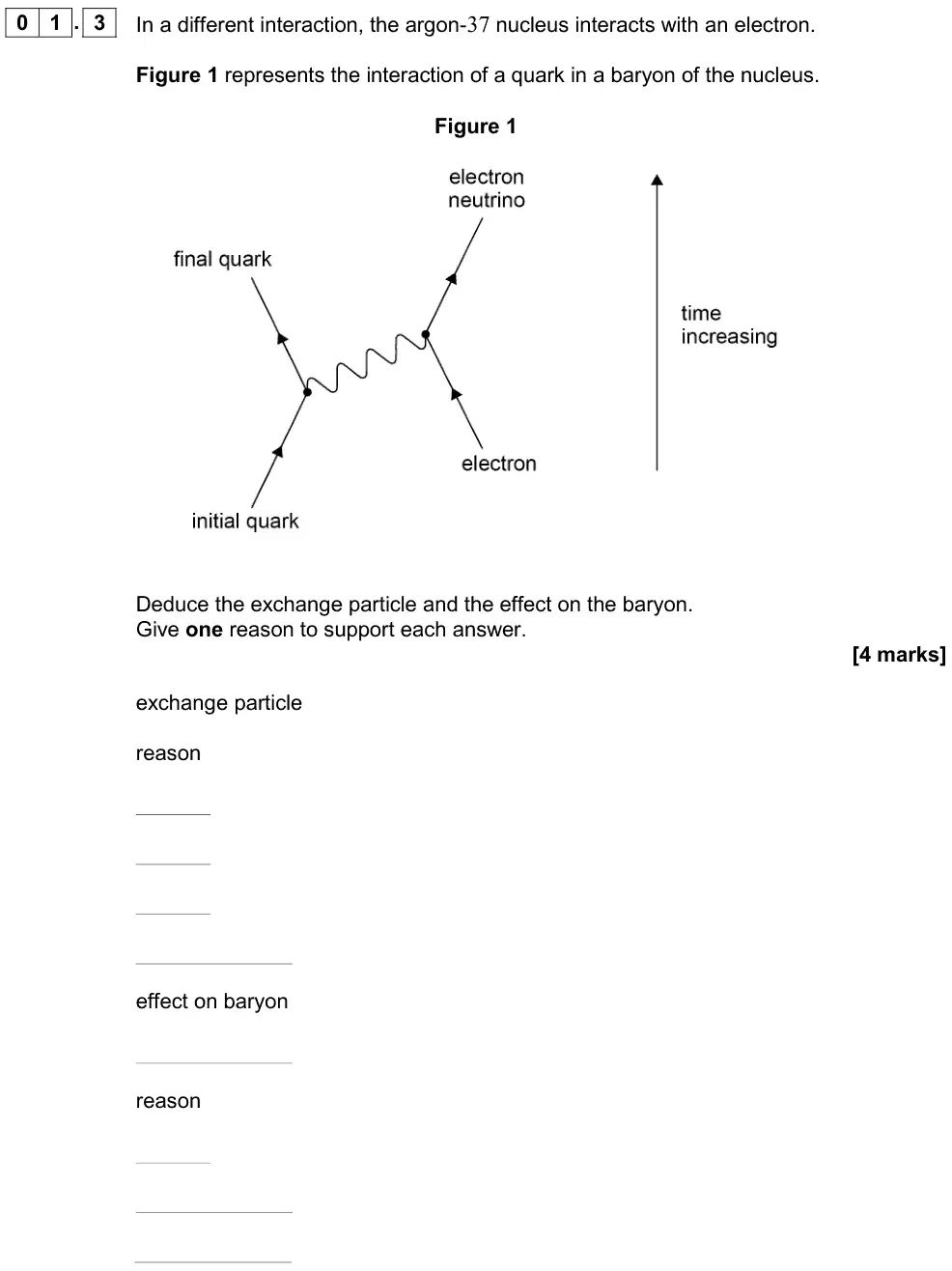
In a different interaction, the argon-37 nucleus interacts with an electron.
Figure 1 represents the interaction of a quark in a baryon of the nucleus.
Figure 1
Deduce the exchange particle and the effect on the baryon.
Give one reason to support each answer.
[4 marks]
exchange particle
reason
effect on baryon
reason
June 2024 · AS Paper 1 · Q1.4 6 marks AO1=6 6-mark extended response atomic structure and stable nucleiparticles antiparticles and interactions
Earlier part of question 1 that this part usesEarlier part of June 2024 Paper 1 question 1
The argon-37 nucleus decays into a stable nucleus.
Describe the nature of the forces that act between nucleons and how these forces can
maintain nuclear stability.
In your answer, describe:
• the forces of repulsion and attraction that act between nucleons
• exchange particles associated with these forces
• the role of these forces in keeping the nucleus stable.
[6 marks]
June 2024 · AS Paper 1 · Q2.1 1 mark AO1=1 Short answer energy levels and wave particle dualitycurrent voltage and resistivity
A tube contains a vapour of mercury atoms at low pressure.  In an experiment, the
vapour is bombarded by a beam of electrons.
An electron in the beam gains 6.7 eV of kinetic energy by moving through a potential
difference V.
Deduce V.
[1 mark]
V =
V
June 2024 · AS Paper 1 · Q2.2 3 marks AO1=2, AO2=1 Calculation particles antiparticles and interactionsenergy levels and wave particle duality
Earlier part of question 2 that this part usesEarlier part of June 2024 Paper 1 question 2
The electron collides with a mercury atom.  The atom subsequently emits a photon of
ultraviolet radiation with an energy of 6.7 eV.
Calculate the wavelength of the emitted photon of this ultraviolet radiation.
[3 marks]
wavelength =
m
June 2024 · AS Paper 1 · Q2.3 4 marks AO2=2, AO3=2 Explanation energy levels and wave particle duality
Earlier part of question 2 that this part usesEarlier part of June 2024 Paper 1 question 2
The experiment is repeated with a different gas.
Figure 2 shows the three lowest energy levels for an atom of the gas.
Figure 2
When an electron in the beam collides with the gas atom, 18.4 eV of energy is
transferred to the atom.
The atom subsequently emits a photon of visible light.
State and explain the energy transitions that are involved.
Support your answer with appropriate calculations.
[4 marks]
June 2024 · AS Paper 1 · Q3.1 2 marks AO1=1, AO2=1 Calculation progressive waves and polarisationstationary waves
Figure 3 shows a guitar with only one of its strings attached.
The string is fixed at X and Y.
The string is plucked and vibrates freely between X and Y.
The distance XY is 648 mm.
Figure 3
The frequency of the first harmonic is 147 Hz.
Calculate the speed of the wave travelling in the string.
[2 marks]
speed of wave =
m s−1
June 2024 · AS Paper 1 · Q3.2 3 marks AO1=1, AO2=2 Calculation stationary waves
Earlier part of question 3 that this part usesEarlier part of June 2024 Paper 1 question 3
The tension in the string is 71 N.
Calculate the mass of the string between X and Y.
[3 marks]
mass =
kg
June 2024 · AS Paper 1 · Q3.3 3 marks AO1=1, AO2=1, AO3=1 Diagram or graph Hard stationary waves
Earlier part of question 3 that this part usesEarlier part of June 2024 Paper 1 question 3
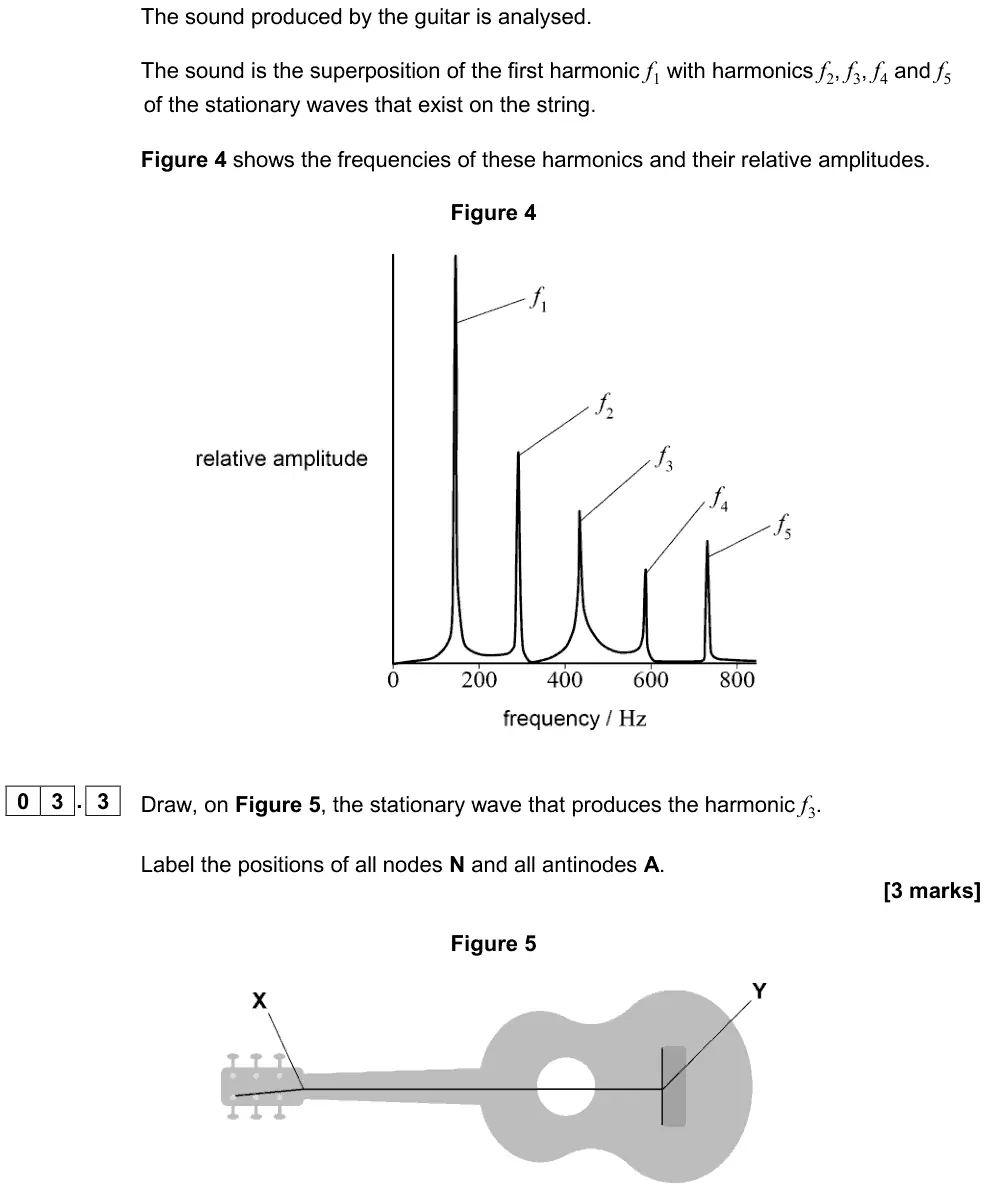
The sound produced by the guitar is analysed.
The sound is the superposition of the first harmonic f1 with harmonics f2, f3, f4 and f5
of the stationary waves that exist on the string.
Figure 4 shows the frequencies of these harmonics and their relative amplitudes.
Figure 4
Draw, on Figure 5, the stationary wave that produces the harmonic f3.
Label the positions of all nodes N and all antinodes A.
[3 marks]
Figure 5
June 2024 · AS Paper 1 · Q3.4 3 marks AO3=3 Explanation stationary waves
Earlier part of question 3 that this part usesEarlier part of June 2024 Paper 1 question 3
The string is vibrating freely.
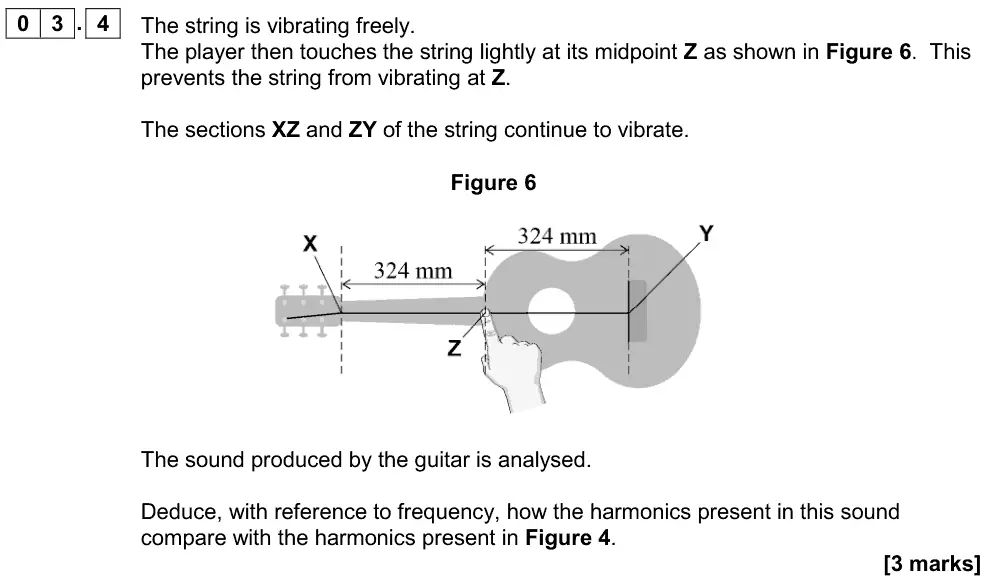
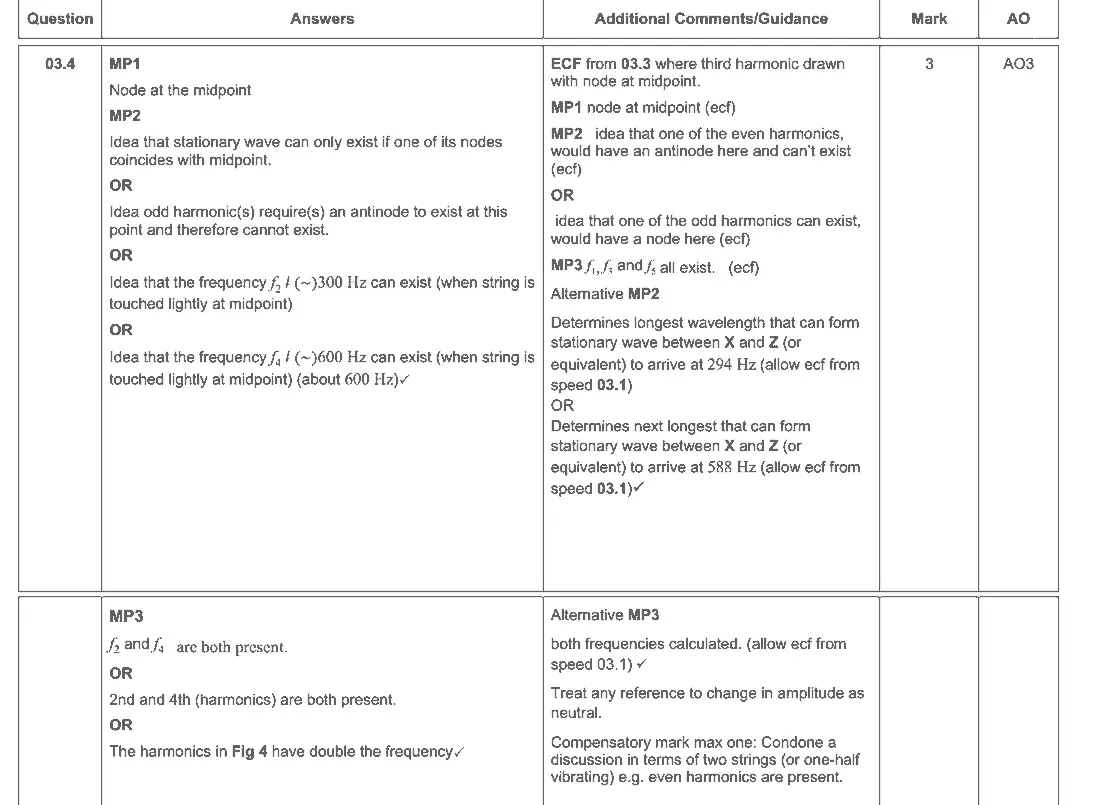
The player then touches the string lightly at its midpoint Z as shown in Figure 6.  This
prevents the string from vibrating at Z.
The sections XZ and ZY of the string continue to vibrate.
Figure 6
The sound produced by the guitar is analysed.
Deduce, with reference to frequency, how the harmonics present in this sound
compare with the harmonics present in Figure 4.
[3 marks]
June 2024 · AS Paper 1 · Q4.1 2 marks AO1=1, AO2=1 Calculation motion and projectiles
In this question, assume that all forces are coplanar.
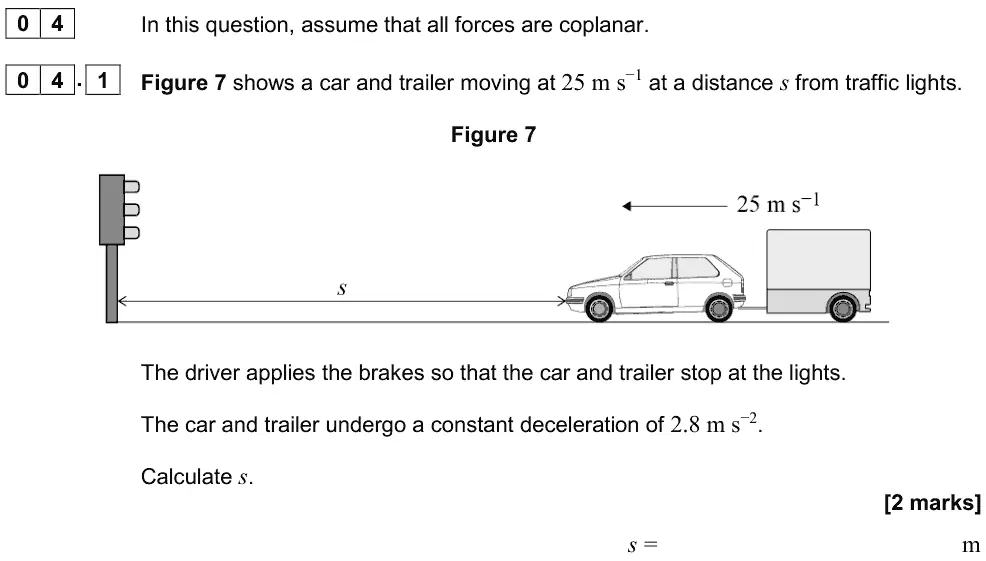
Figure 7 shows a car and trailer moving at 25 m s−1 at a distance s from traffic lights.
Figure 7
The driver applies the brakes so that the car and trailer stop at the lights.
The car and trailer undergo a constant deceleration of 2.8 m s−2.
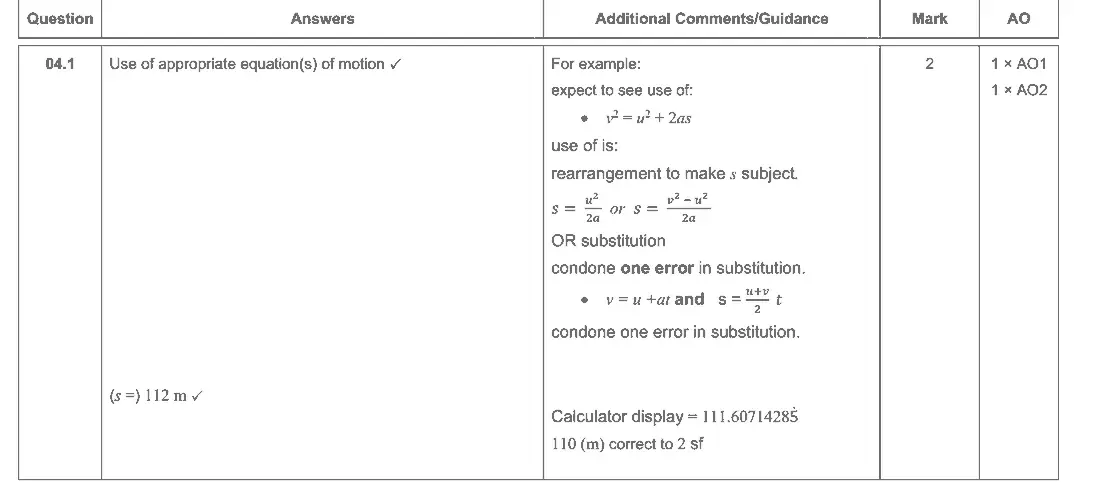
Calculate s.
[2 marks]
s =
m
June 2024 · AS Paper 1 · Q4.2 2 marks AO1=1, AO2=1 Calculation newtons laws and momentum
Earlier part of question 4 that this part usesEarlier part of June 2024 Paper 1 question 4
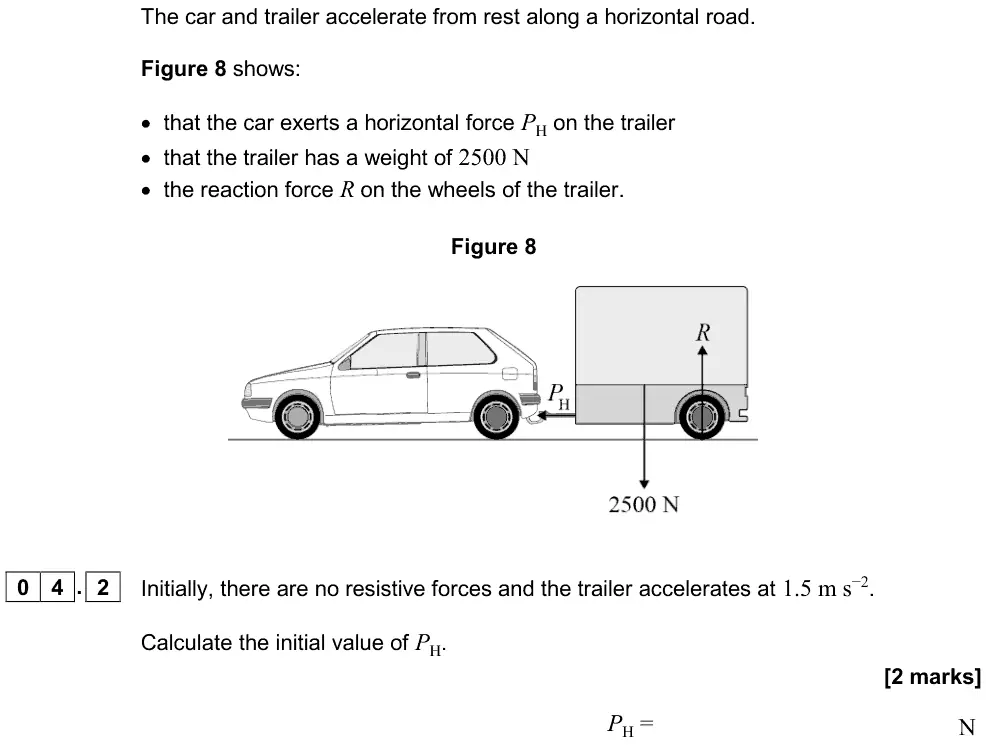
The car and trailer accelerate from rest along a horizontal road.
Figure 8 shows:
• that the car exerts a horizontal force PH on the trailer
• that the trailer has a weight of 2500 N
• the reaction force R on the wheels of the trailer.
Figure 8
Initially, there are no resistive forces and the trailer accelerates at 1.5 m s−2.
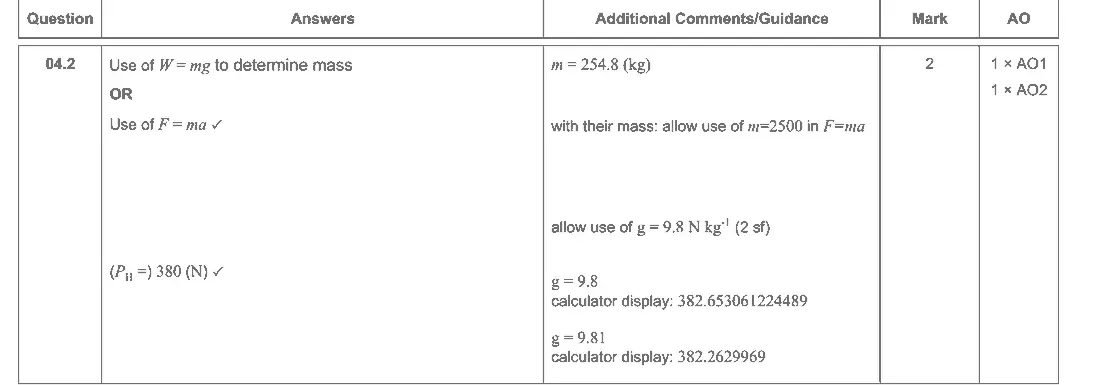
Calculate the initial value of PH.
[2 marks]
PH =
N
June 2024 · AS Paper 1 · Q4.3 3 marks AO2=2, AO3=1 Calculation vectors and moments
Earlier part of question 4 that this part usesEarlier part of June 2024 Paper 1 question 4
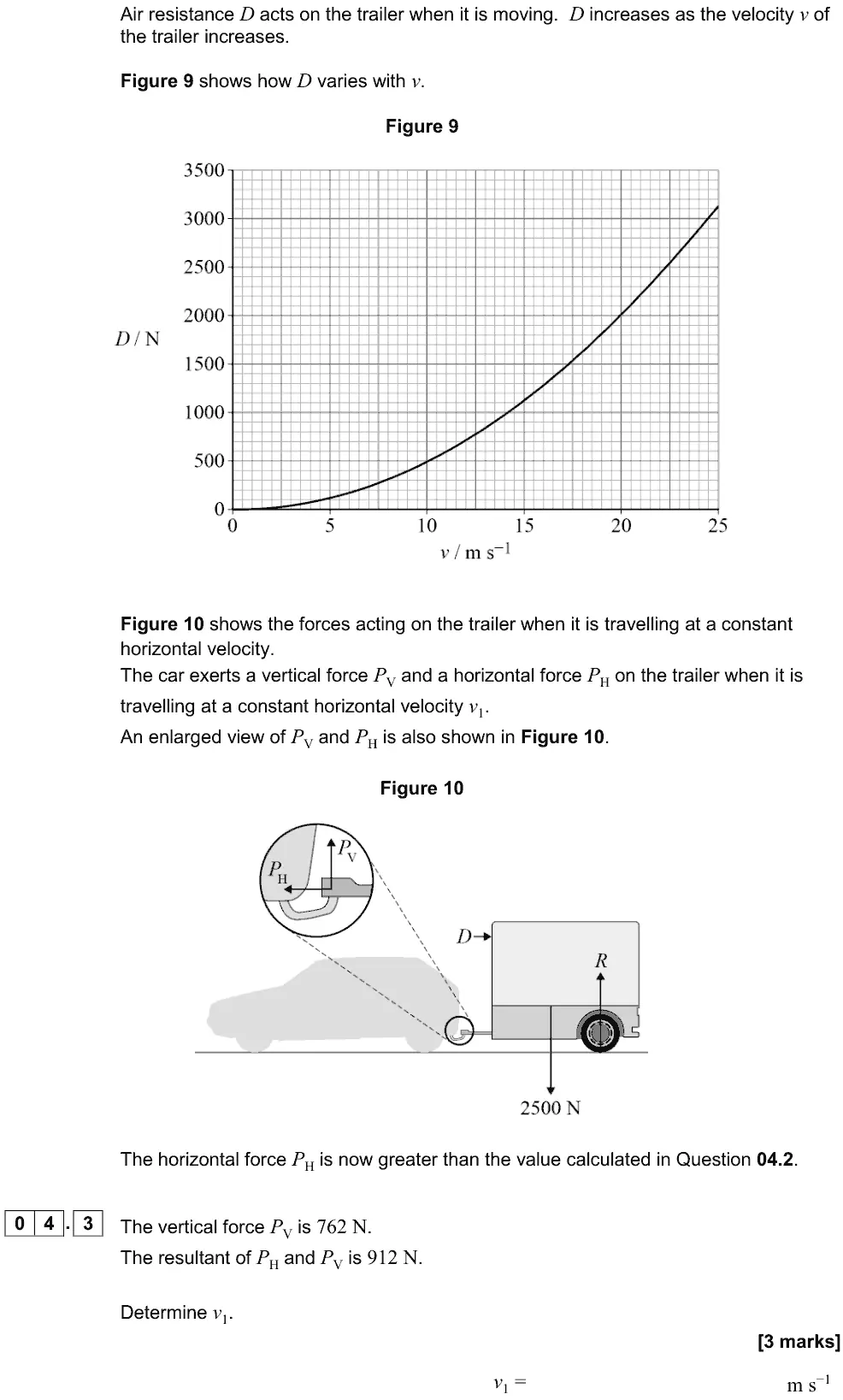
Air resistance D acts on the trailer when it is moving.  D increases as the velocity v of
the trailer increases.
Figure 9 shows how D varies with v.
Figure 9
Figure 10 shows the forces acting on the trailer when it is travelling at a constant
horizontal velocity.
The car exerts a vertical force PV and a horizontal force PH on the trailer when it is
travelling at a constant horizontal velocity v1.
An enlarged view of PV and PH is also shown in Figure 10.
Figure 10
The horizontal force PH is now greater than the value calculated in Question 04.2.
The vertical force PV is 762 N.
The resultant of PH and PV is 912 N.
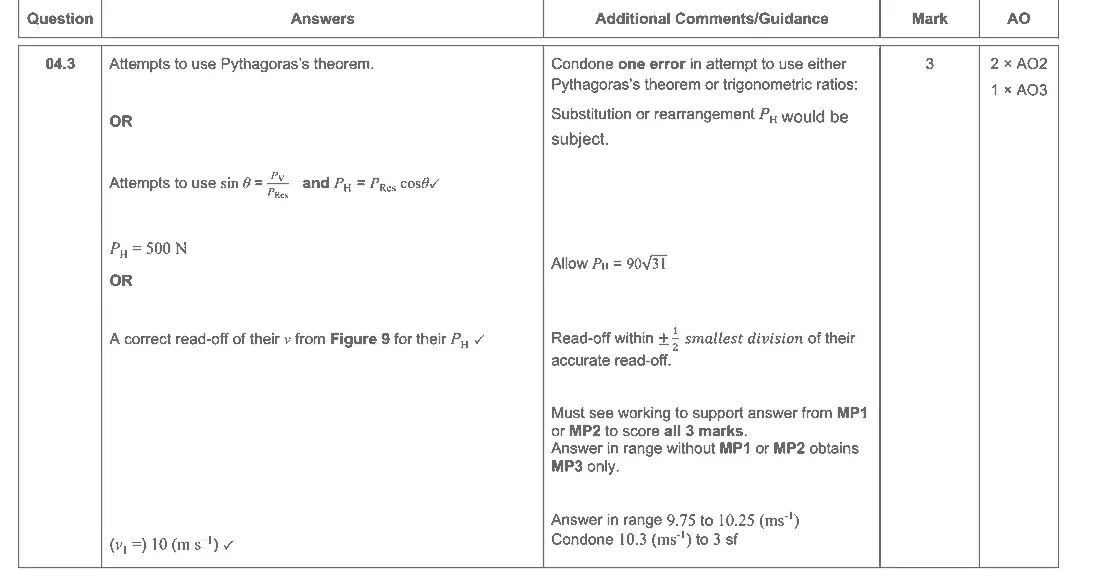
Determine v1.
[3 marks]
v1 =
m s−1
June 2024 · AS Paper 1 · Q4.4 1 mark AO1=1 Short answer vectors and moments
Earlier part of question 4 that this part usesEarlier part of June 2024 Paper 1 question 4
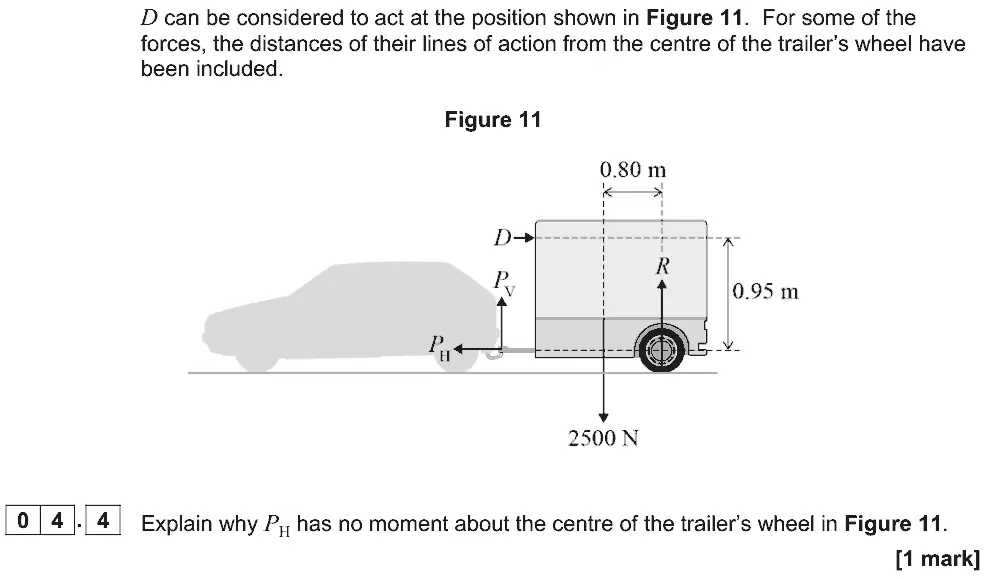
D can be considered to act at the position shown in Figure 11.  For some of the
forces, the distances of their lines of action from the centre of the trailer’s wheel have
been included.
Figure 11
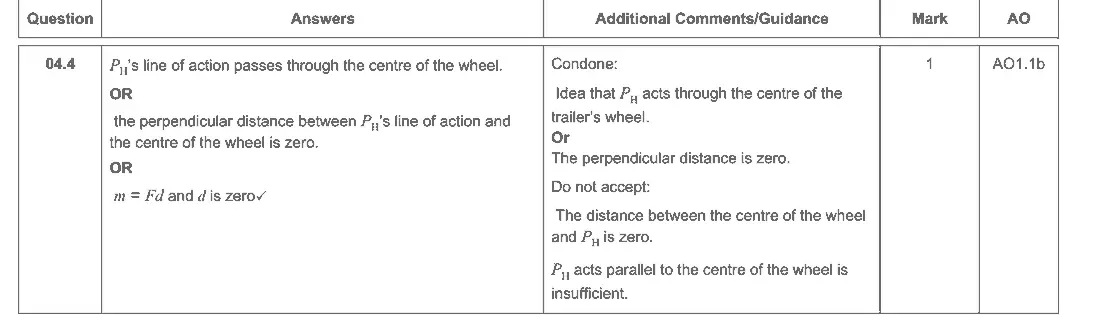
Explain why PH has no moment about the centre of the trailer’s wheel in Figure 11.
[1 mark]
June 2024 · AS Paper 1 · Q4.5 3 marks AO1=1, AO2=1, AO3=1 Calculation Hard vectors and moments
Earlier part of question 4 that this part usesEarlier part of June 2024 Paper 1 question 4
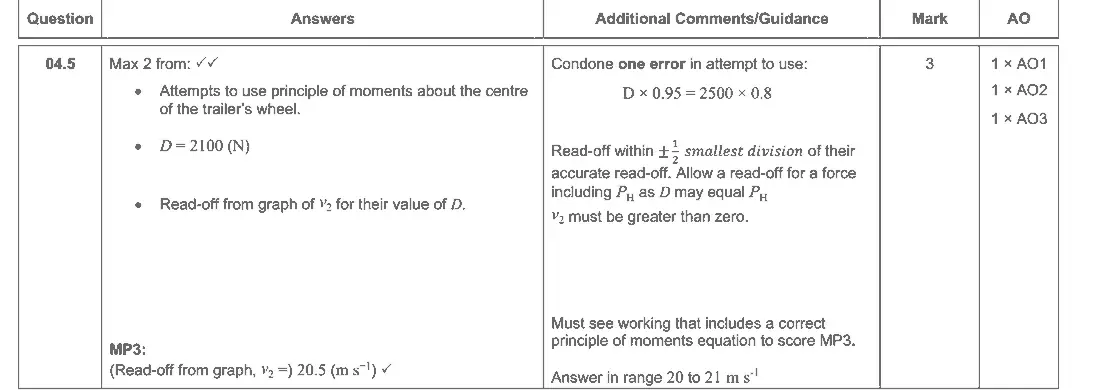
When the car and trailer travel with velocity v2, PV is zero.
Determine v2.
[3 marks]
v2 =
m s−1
June 2024 · AS Paper 1 · Q4.6 3 marks AO2=3 Explanation newtons laws and momentum
Earlier part of question 4 that this part usesEarlier part of June 2024 Paper 1 question 4
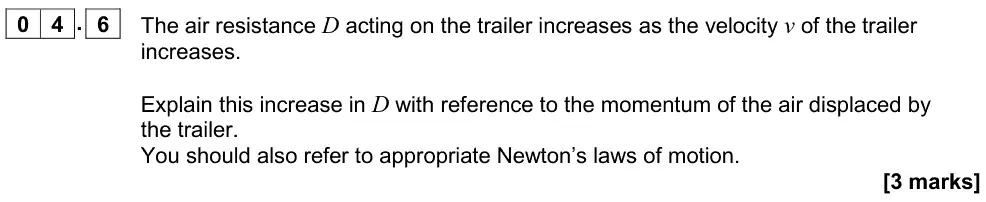
The air resistance D acting on the trailer increases as the velocity v of the trailer
increases.
Explain this increase in D with reference to the momentum of the air displaced by
the trailer.
You should also refer to appropriate Newton’s laws of motion.
[3 marks]
June 2024 · AS Paper 1 · Q4.7 3 marks AO1=1, AO2=2 Calculation work energy and powernewtons laws and momentum
Earlier part of question 4 that this part usesEarlier part of June 2024 Paper 1 question 4
The car has a maximum power output of 95 kW.
The maximum velocity of the car and trailer is 25 m s−1.
At this velocity, the force D on the trailer is 3100 N.
The car exerts a horizontal force PH on the trailer and the trailer exerts an equal and
opposite force of magnitude PH on the car.
Assume that air resistance and PH are the only resistive forces acting on the car.
Calculate the air resistance acting on the car when it is travelling at a constant velocity
of 25 m s−1.
[3 marks]
air resistance on car =
N
June 2024 · AS Paper 1 · Q5.1 1 mark AO2=1 Diagram or graph current voltage and resistivity
Figure 12 shows a circuit for controlling the current I in a filament lamp L1.
The battery has negligible internal resistance.
Figure 12
Figure 13 shows how the resistance of L1 varies with I.
Figure 13
The current in L1 is increased from 0 to 0.50 A.
The potential difference V across L1 is 0.375 V when I is 0.50 A.
Draw, on Figure 14, a V–I graph for L1 in the current range 0 to 0.50 A.
[1 mark]
Figure 14
June 2024 · AS Paper 1 · Q5.2 2 marks AO1=1, AO2=1 Calculation circuits and potential dividerscurrent voltage and resistivity
Earlier part of question 5 that this part usesEarlier part of June 2024 Paper 1 question 5
Calculate the power dissipated in L1 when I is 1.9 A.
[2 marks]
power dissipated =
W
June 2024 · AS Paper 1 · Q5.3 2 marks AO1=1, AO2=1 Calculation circuits and potential dividerscurrent voltage and resistivity
Earlier part of question 5 that this part usesEarlier part of June 2024 Paper 1 question 5
Question 5 continues on page 21
The variable resistor R in Figure 12 is adjusted until I is 1.5 A and V is 3.3 V.
Calculate the resistance of R.
[2 marks]
resistance of R =
Ω
June 2024 · AS Paper 1 · Q5.4 3 marks AO2=2, AO3=1 Explanation circuits and potential dividers
Earlier part of question 5 that this part usesEarlier part of June 2024 Paper 1 question 5
Figure 15 shows a second lamp L2, identical to L1, connected to the circuit.
Figure 15
R is adjusted so that the potential difference across L1 is again 3.3 V.
Deduce, without calculation, the change in the resistance of R.
[3 marks]
June 2024 · AS Paper 1 · Q6.1 1 mark AO3=1 Short answer motion and projectilesmaterials and young modulus
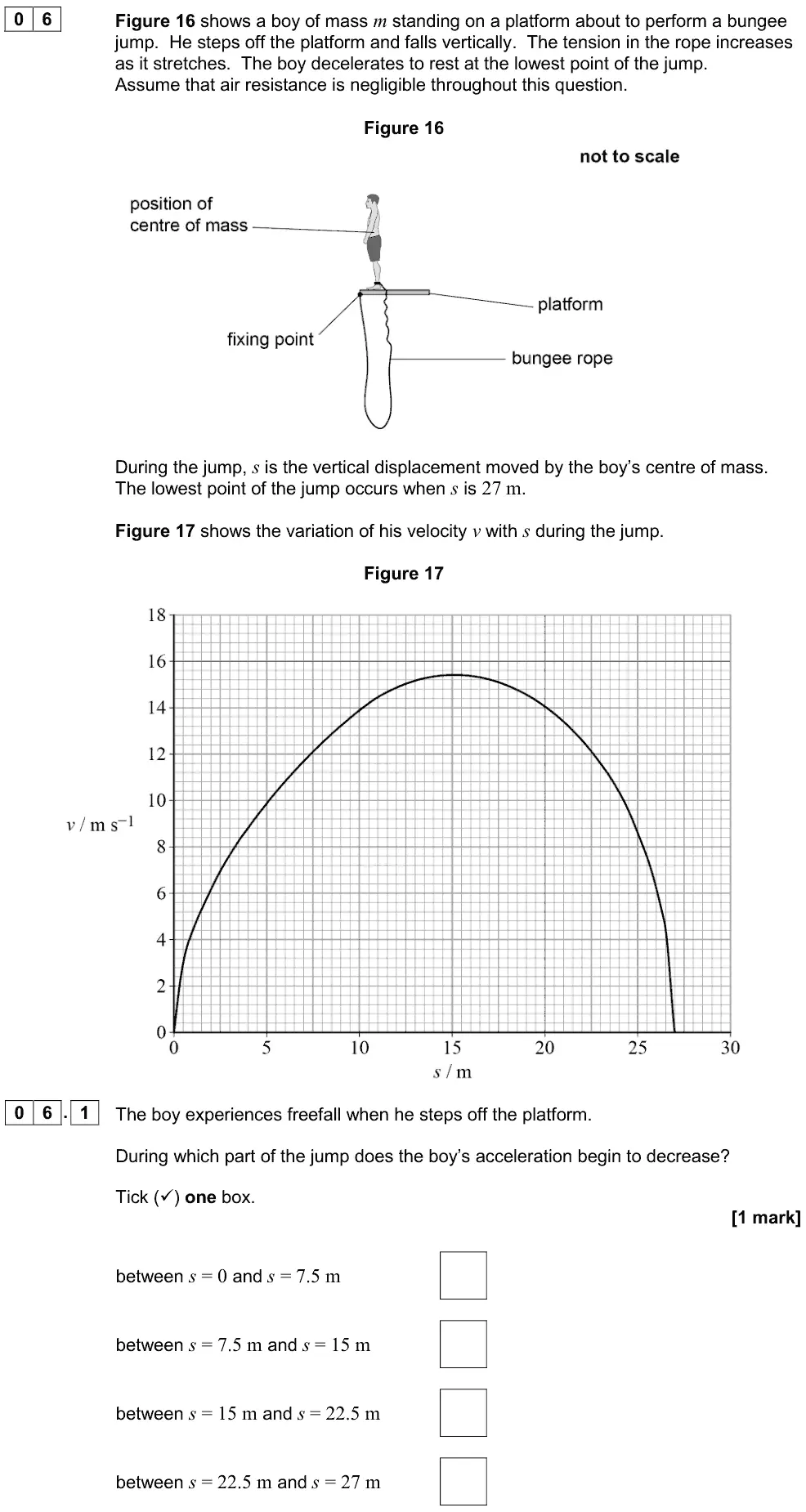
Figure 16 shows a boy of mass m standing on a platform about to perform a bungee
jump.  He steps off the platform and falls vertically.  The tension in the rope increases
as it stretches.  The boy decelerates to rest at the lowest point of the jump.
Assume that air resistance is negligible throughout this question.
Figure 16
During the jump, s is the vertical displacement moved by the boy’s centre of mass.
The lowest point of the jump occurs when s is 27 m.
Figure 17 shows the variation of his velocity v with s during the jump.
Figure 17
The boy experiences freefall when he steps off the platform.
During which part of the jump does the boy’s acceleration begin to decrease?
Tick () one box.
[1 mark]
between s = 0 and s = 7.5 m
between s = 7.5 m and s = 15 m
between s = 15 m and s = 22.5 m
between s = 22.5 m and s = 27 m
June 2024 · AS Paper 1 · Q6.2 2 marks AO1=1, AO2=1 Calculation work energy and power
Earlier part of question 6 that this part usesEarlier part of June 2024 Paper 1 question 6
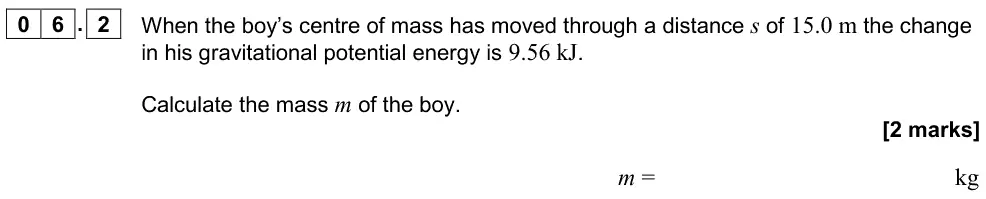
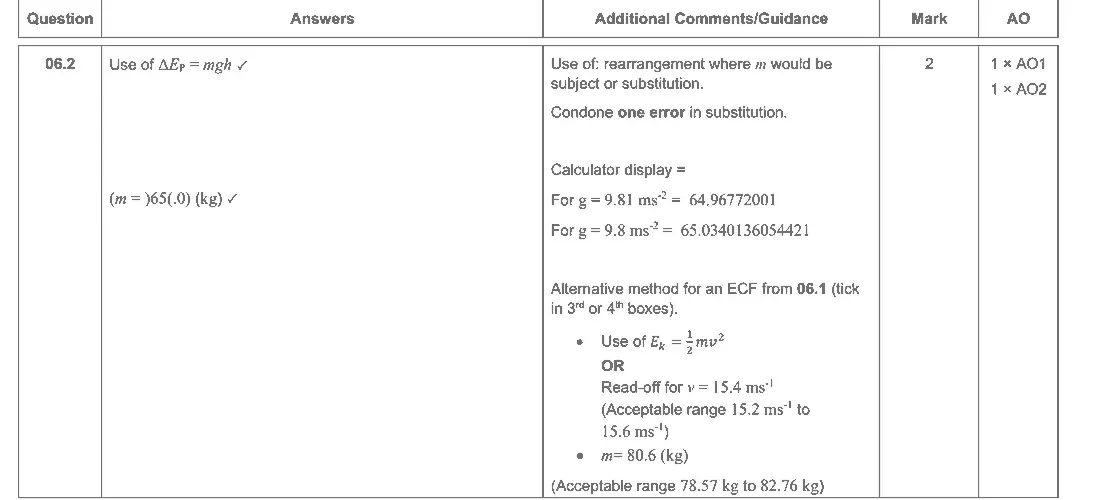
When the boy’s centre of mass has moved through a distance s of 15.0 m the change
in his gravitational potential energy is 9.56 kJ.
Calculate the mass m of the boy.
[2 marks]
m =
kg
June 2024 · AS Paper 1 · Q6.3 3 marks AO1=1, AO2=2 Calculation Hard materials and young moduluswork energy and power
Earlier part of question 6 that this part usesEarlier part of June 2024 Paper 1 question 6
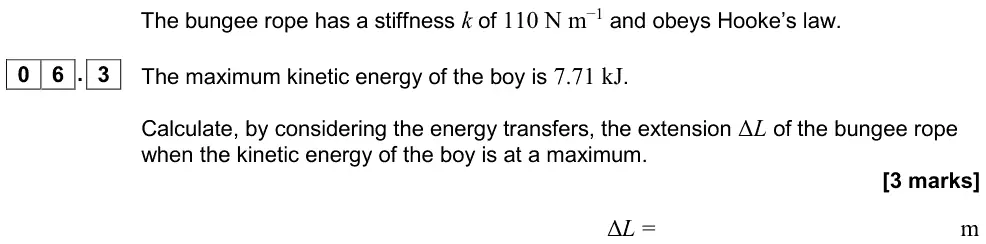
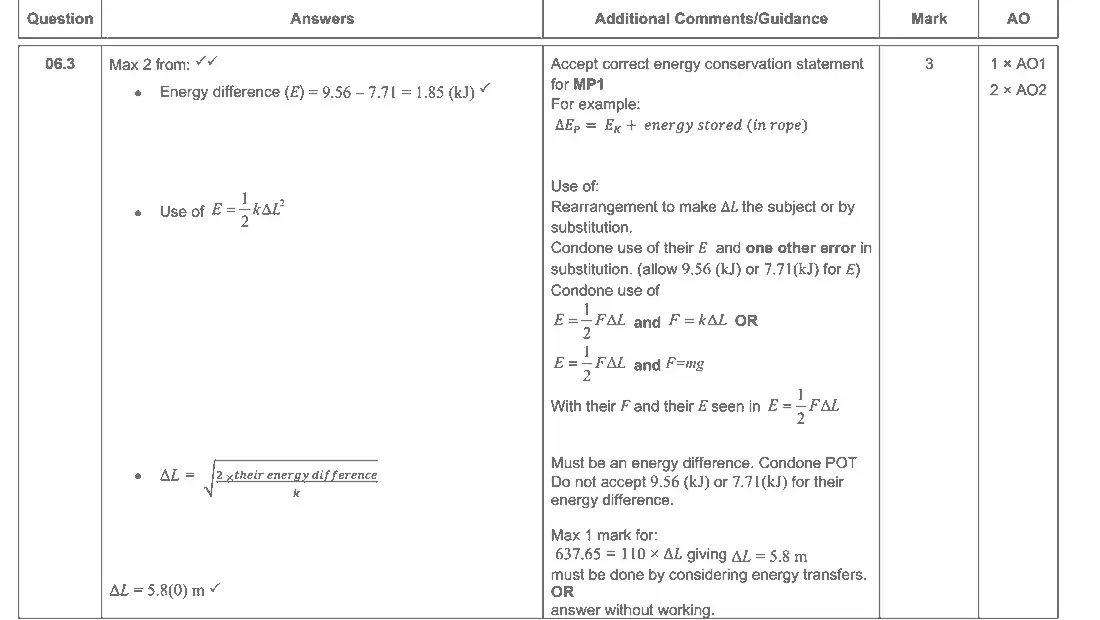
The bungee rope has a stiffness k of 110 N m−1 and obeys Hooke’s law.
The maximum kinetic energy of the boy is 7.71 kJ.
Calculate, by considering the energy transfers, the extension ΔL of the bungee rope
when the kinetic energy of the boy is at a maximum.
[3 marks]
ΔL =
m
June 2024 · AS Paper 1 · Q6.4 2 marks AO2=1, AO3=1 Short answer materials and young modulusnewtons laws and momentum
Earlier part of question 6 that this part usesEarlier part of June 2024 Paper 1 question 6
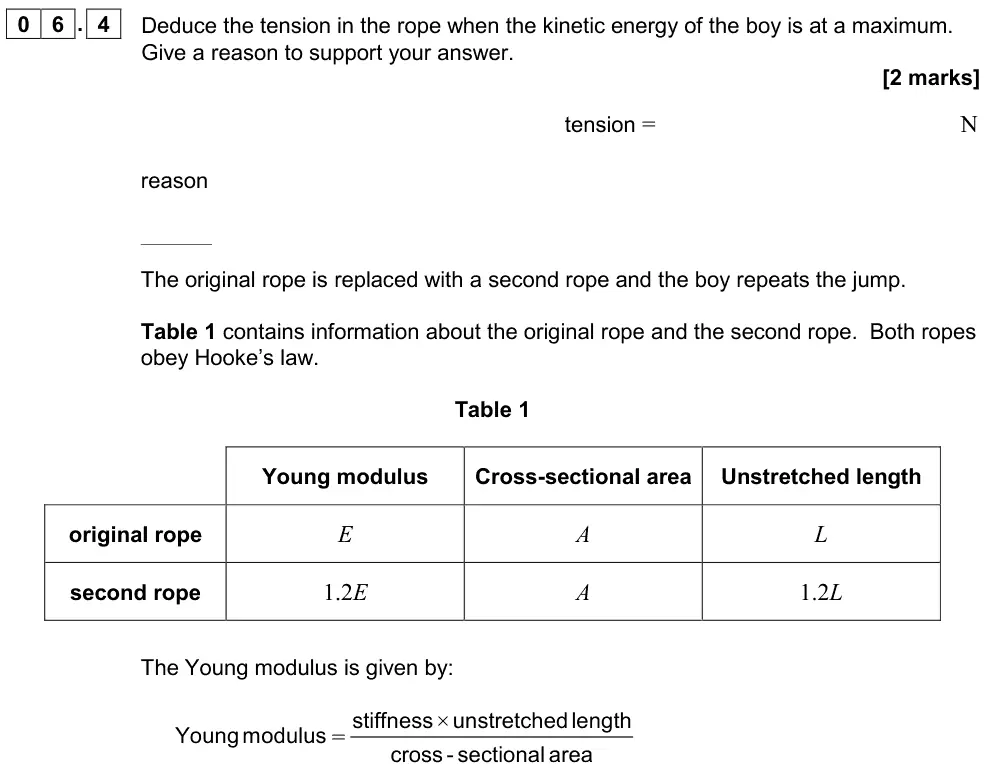
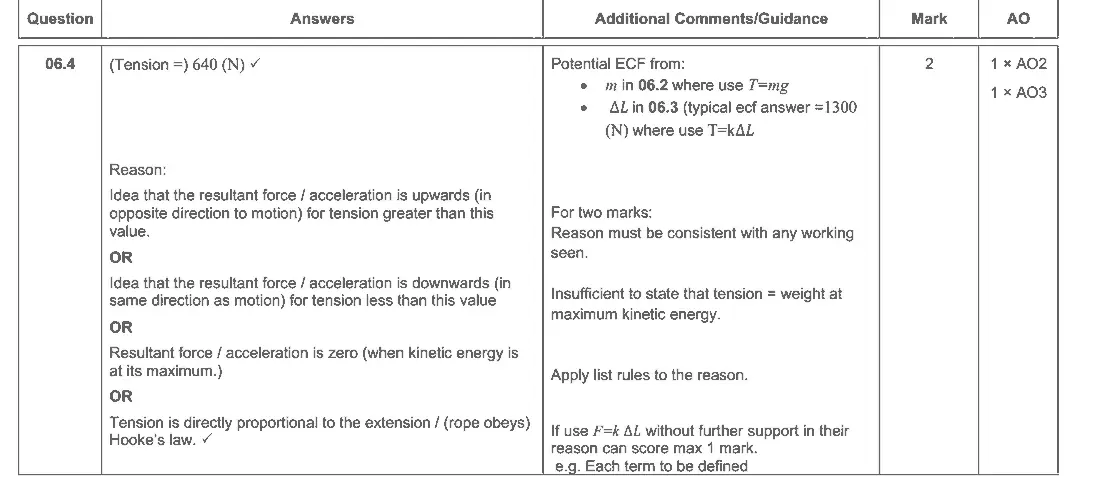
Deduce the tension in the rope when the kinetic energy of the boy is at a maximum.
Give a reason to support your answer.
[2 marks]
tension =
N
reason
The original rope is replaced with a second rope and the boy repeats the jump.
Table 1 contains information about the original rope and the second rope.  Both ropes
obey Hooke’s law.
Table 1
Young modulus
Cross-sectional area
Unstretched length
original rope
E
A
L
second rope
1.2E
A
1.2L
The Young modulus is given by:
×
= stiffness
a
unstretched length
Y
s
cross
o
- se
o
ct
u
io
g
n
l
a
d
l
m
u
u
are
n
June 2024 · AS Paper 1 · Q6.5 1 mark AO1=1 Show that materials and young modulus
Earlier part of question 6 that this part usesEarlier part of June 2024 Paper 1 question 6
Show that each rope has the same stiffness.
[1 mark]
June 2024 · AS Paper 1 · Q6.6 3 marks AO3=3 Explanation materials and young moduluswork energy and power
Earlier part of question 6 that this part usesEarlier part of June 2024 Paper 1 question 6
Deduce whether the boy’s maximum velocity is increased when using the
second rope.
[3 marks]

Work with an AQA physics tutor

Want a paper marked and gone through with you? Message us.

Prefer email? Send an enquiry

If you are under 18, please include a parent's contact details. Enquiries go to enquiries@physicsaleveltutor.com and are deleted once handled. All tutoring is online.