June 2017: Component 3

120 marks for each student (100 in Section A plus one 20-mark option; all four options are here) · 66 question parts · Paper, mark scheme and report on Eduqas's site · Have the Data Booklet beside you

Question by question

QTopicMarksAOType
1(a) Lasers 2AO1=2Short answer
1(b) Lasers 4AO1=2,AO2=2Explanation
1(c) Lasers 2AO2=2Explanation
2(a)(i) Particles and nuclear structure 3AO2=3Short answer
2(a)(ii) Particles and nuclear structure 2AO2=2Short answer
2(b)(i) Nuclear decay 3AO1=1,AO2=2Calculation
2(b)(ii) Nuclear decay 3AO1=1,AO2=2Calculation
2(b)(iii) Nuclear decay 3AO1=1,AO2=2Calculation
2(c) Nuclear decay, Particles and nuclear structure 3AO2=1,AO3=2Short answer
2(d) Orbits and the wider universe 3AO3=3Explanation
3(a) Nuclear energy 3AO1=1,AO2=2Calculation
3(b)(i) Nuclear energy 3AO2=3Calculation
3(b)(ii) Nuclear energy 3AO3=3Explanation
4(a) Magnetic fields 3AO1=1,AO2=2Show that
4(b) Resistance 3AO1=1,AO2=2Show that
4(c) Magnetic fields 2AO1=1,AO2=1Calculation
4(d) Magnetic fields 3AO3=3Calculation
5(a)(i) Electromagnetic induction 2AO1=1,AO2=1Explanation
5(a)(ii) Electromagnetic induction 1AO2=1Explanation
5(b) Electromagnetic induction 3AO1=1,AO2=2Show that
5(c)(i) Electromagnetic induction 4AO3=4Practical and data analysis
5(c)(ii) Electromagnetic induction 6AO2=3,AO3=3Practical and data analysis
6(a) Wave properties: diffraction, interference and stationary waves 3AO1=3Show that
6(b) Wave properties: diffraction, interference and stationary waves 4AO1=2,AO2=2Calculation
6(c) Wave properties: diffraction, interference and stationary waves 2AO2=2Calculation
7(a) Wave properties: diffraction, interference and stationary waves 4AO1=4Explanation
7(b)(i) Wave properties: diffraction, interference and stationary waves 1Diagram or graph
7(b)(ii) Wave properties: diffraction, interference and stationary waves 1Diagram or graph
7(c)(i) The nature of waves 2AO2=2Practical and data analysis
7(c)(ii) Wave properties: diffraction, interference and stationary waves 3AO3=3Practical and data analysis
8(a) Refraction of light 2AO1=2Diagram or graph
8(b)(i) Refraction of light 4AO2=4Practical and data analysis
8(b)(ii) Refraction of light 4AO3=4Practical and data analysis
9 Refraction of light 6AO1=6Extended response
10(a)(i) Alternating currents 2AO1=1,AO2=1Calculation
10(a)(ii) Alternating currents 2AO1=1,AO2=1Calculation
10(b) Alternating currents 5AO3=5Explanation
10(c)(i) Alternating currents 2AO1=2Calculation
10(c)(ii) Alternating currents 2AO1=1,AO2=1Show that
10(c)(iii) Alternating currents 4AO1=1,AO2=3Calculation
10(c)(iv) Alternating currents 3AO2=3Explanation
11(a) Medical physics 2AO1=2Short answer
11(b)(i) Medical physics 3AO1=1,AO2=2Show that
11(b)(ii) Medical physics 3AO2=3Calculation
11(b)(iii) Medical physics 3AO1=1,AO3=2Explanation
11(c) Medical physics 2AO1=2Explanation
11(d)(i) Medical physics 2AO2=2Calculation
11(d)(ii) Medical physics 3AO2=1,AO3=2Calculation
11(e) Medical physics 2AO2=1,AO3=1Calculation
12(a)(i) The physics of sports 3AO3=3Calculation
12(a)(ii) The physics of sports 2AO1=1,AO2=1Calculation
12(b)(i) The physics of sports 2AO1=2Definition
12(b)(ii) The physics of sports 3AO1=1,AO2=2Calculation
12(c)(i) The physics of sports 4AO1=1,AO2=1,AO3=2Explanation
12(c)(ii) The physics of sports 4AO1=1,AO2=3Calculation
12(c)(iii) The physics of sports 2AO2=2Calculation
13(a)(i) Energy and the environment 2AO3=2Calculation
13(a)(ii)I Energy and the environment 3Short answer
13(a)(ii)II Energy and the environment 2Short answer
13(b)(i) Energy and the environment 3AO1=1,AO2=2Calculation
13(b)(ii) Energy and the environment 2AO1=1,AO2=1Calculation
13(b)(iii) Energy and the environment 1AO1=1Short answer
13(c)(i) Energy and the environment 2AO2=2Calculation
13(c)(ii)I Energy and the environment 2Show that
13(c)(ii)II Energy and the environment 2Calculation
13(c)(ii)III Energy and the environment 1Explanation

The questions

1(a)1(b)1(c)2(a)(i)2(a)(ii)2(b)(i)2(b)(ii)2(b)(iii)2(c)2(d)3(a)3(b)(i)3(b)(ii)4(a)4(b)4(c)4(d)5(a)(i)5(a)(ii)5(b)5(c)(i)5(c)(ii)6(a)6(b)6(c)7(a)7(b)(i)7(b)(ii)7(c)(i)7(c)(ii)8(a)8(b)(i)8(b)(ii)910(a)(i)10(a)(ii)10(b)10(c)(i)10(c)(ii)10(c)(iii)10(c)(iv)11(a)11(b)(i)11(b)(ii)11(b)(iii)11(c)11(d)(i)11(d)(ii)11(e)12(a)(i)12(a)(ii)12(b)(i)12(b)(ii)12(c)(i)12(c)(ii)12(c)(iii)13(a)(i)13(a)(ii)I13(a)(ii)II13(b)(i)13(b)(ii)13(b)(iii)13(c)(i)13(c)(ii)I13(c)(ii)II13(c)(ii)III
June 2017 · Component 3 · Q1(a) 2 marks AO1=2 Short answer lasers
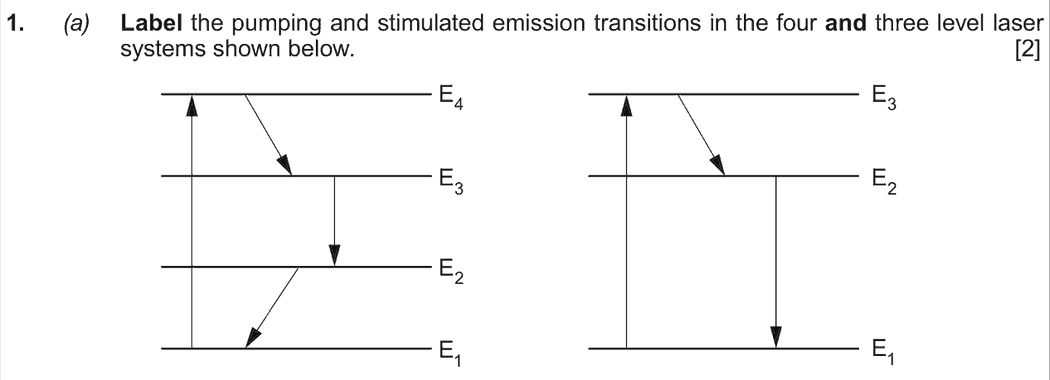
1. (a) Label the pumping and stimulated emission transitions in the four and three level laser systems shown below. [2] E4 E3 E3 E2 E2 E1 E1
June 2017 · Component 3 · Q1(b) 4 marks AO1=2, AO2=2 Explanation lasers
Earlier part of question 1 that this part usesEarlier part of June 2017 Component 3 question 1
(b) Explain why a population inversion can be achieved far more easily in a four level system than in a three level system. [4]
June 2017 · Component 3 · Q1(c) 2 marks AO2=2 Explanation lasers
Earlier part of question 1 that this part usesEarlier part of June 2017 Component 3 question 1
(c) Give two reasons why the top level (E4 in the four level system and E3 in the three level system) must have a short lifetime. [2]
June 2017 · Component 3 · Q2(a)(i) 3 marks AO2=3 Short answer particles and nuclear structure
2. (a) A carbon-14 nucleus decays as shown: 14 C 14 N + e– + ve 6 7 (i) Show how charge, baryon number and lepton number are conserved in this decay. [3]
June 2017 · Component 3 · Q2(a)(ii) 2 marks AO2=2 Short answer particles and nuclear structure
Earlier part of question 2 that this part usesEarlier part of June 2017 Component 3 question 2
(ii) Give two reasons why this must be a weak nuclear force interaction. [2]
June 2017 · Component 3 · Q2(b)(i) 3 marks AO1=1, AO2=2 Calculation nuclear decay
Earlier part of question 2 that this part usesEarlier part of June 2017 Component 3 question 2
(b) The decay constant of carbon-14 is 3.83 × 10⁻¹² s–1. (i) Calculate its half-life in years. [3]
June 2017 · Component 3 · Q2(b)(ii) 3 marks AO1=1, AO2=2 Calculation nuclear decay
Earlier parts of question 2 that this part usesEarlier part of June 2017 Component 3 question 2Earlier part of June 2017 Component 3 question 2
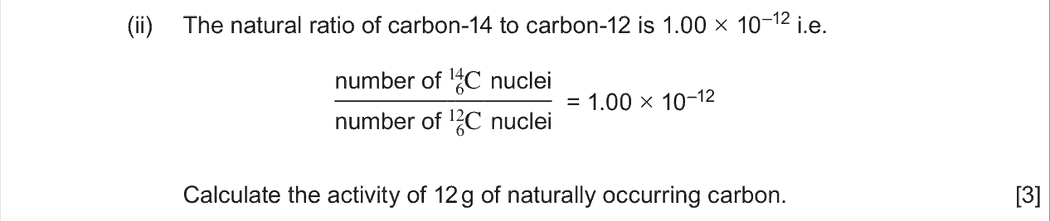
(ii) The natural ratio of carbon-14 to carbon-12 is 1.00 × 10⁻¹² i.e. number of 14 C nuclei 6 = 1.00 × 10⁻¹² number of 12 C nuclei 6 Calculate the activity of 12 g of naturally occurring carbon. [3]
June 2017 · Component 3 · Q2(b)(iii) 3 marks AO1=1, AO2=2 Calculation nuclear decay
Earlier parts of question 2 that this part usesEarlier part of June 2017 Component 3 question 2Earlier part of June 2017 Component 3 question 2
(iii) In an old tree found preserved in a peat bog in Ireland, much of the carbon-14 has decayed but the carbon-12 all remains. The ratio of carbon-14 to carbon-12 in this old tree has dropped to 0.34 × 10⁻¹². Calculate the age of the old tree. [3]
June 2017 · Component 3 · Q2(c) 3 marks AO2=1, AO3=2 Short answer nuclear decayparticles and nuclear structure
Earlier part of question 2 that this part usesEarlier part of June 2017 Component 3 question 2
(c) Carbon-11 (11 C) is proton rich and undergoes positron decay to a stable isotope of boron 6 (B). Complete the following decay equation for carbon-11. Space is provided should you require analysis of lepton number, baryon number and charge. [3] 11 C 6
June 2017 · Component 3 · Q2(d) 3 marks AO3=3 Explanation orbits and the wider universe
Earlier part of question 2 that this part usesEarlier part of June 2017 Component 3 question 2
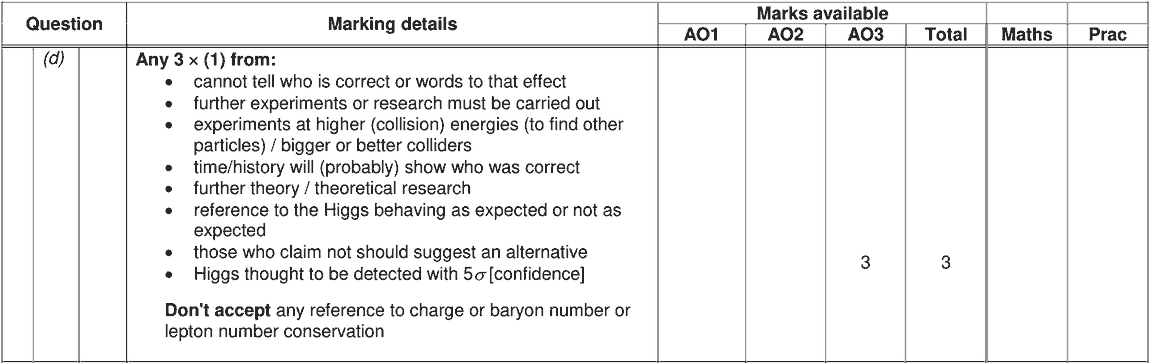
(d) On the 14 March 2013, the discovery of the Higgs boson was first announced by CERN. Some physicists were convinced that they had discovered the Higgs boson, others believed that there are many different types of Higgs bosons while others claim that this was just another particle and not the Higgs boson. Explain how it may or may not be decided which, if any, of these claims is correct. [3]
June 2017 · Component 3 · Q3(a) 3 marks AO1=1, AO2=2 Calculation nuclear energy
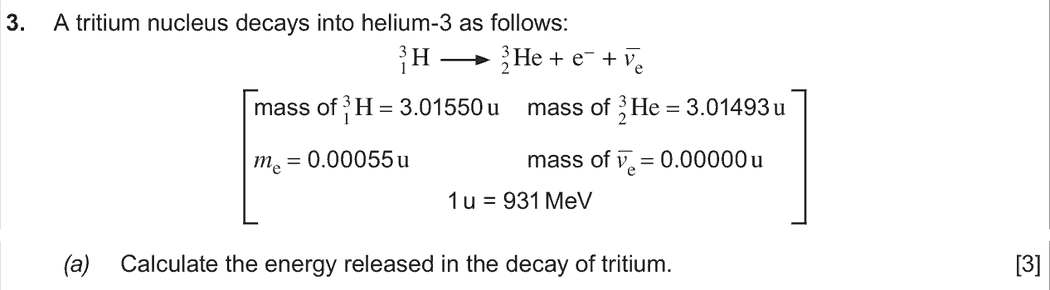
3. A tritium nucleus decays into helium-3 as follows: 3 H 3 He + e– + ve 1 2 mass of 3 H = 3.01550 u mass of 3 He = 3.01493 u 1 2 me = 0.00055 u mass of ve = 0.00000 u 1 u = 931 MeV (a) Calculate the energy released in the decay of tritium. [3]
June 2017 · Component 3 · Q3(b)(i) 3 marks AO2=3 Calculation nuclear energy
Earlier part of question 3 that this part usesEarlier part of June 2017 Component 3 question 3
(b) The mass of a proton is 1.00728 u and the mass of a neutron is 1.00866 u. (i) Calculate the binding energy per nucleon of a tritium nucleus. [3]
June 2017 · Component 3 · Q3(b)(ii) 3 marks AO3=3 Explanation nuclear energy
Earlier parts of question 3 that this part usesEarlier part of June 2017 Component 3 question 3Earlier part of June 2017 Component 3 question 3
(ii) The binding energy per nucleon of a helium-3 nucleus (i.e. 2.6 MeV/nucleon) is slightly lower than the answer to (b)(i). How does this show that binding energy per nucleon is not the only measure of stability? [3]
June 2017 · Component 3 · Q4(a) 3 marks AO1=1, AO2=2 Show that magnetic fields
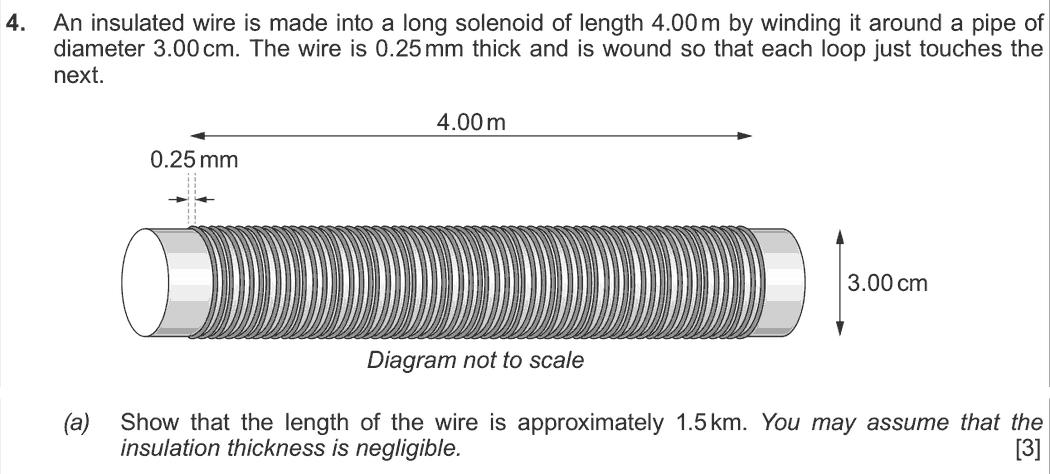
4. An insulated wire is made into a long solenoid of length 4.00 m by winding it around a pipe of diameter 3.00 cm. The wire is 0.25 mm thick and is wound so that each loop just touches the next. 4.00 m 0.25 mm 3.00 cm Diagram not to scale (a) Show that the length of the wire is approximately 1.5 km. You may assume that the insulation thickness is negligible. [3]
June 2017 · Component 3 · Q4(b) 3 marks AO1=1, AO2=2 Show that resistance
Earlier part of question 4 that this part usesEarlier part of June 2017 Component 3 question 4
(b) Show that a steady current of approximately 25 mA is carried in the wire when a pd of 12.0 V is applied across its ends. The resistivity of the wire is 1.59 × 10⁻⁸ Ω m. [3]
June 2017 · Component 3 · Q4(c) 2 marks AO1=1, AO2=1 Calculation magnetic fields
Earlier part of question 4 that this part usesEarlier part of June 2017 Component 3 question 4
(c) Calculate the magnetic field strength, B, inside the solenoid. [2]
June 2017 · Component 3 · Q4(d) 3 marks AO3=3 Calculation magnetic fields
Earlier part of question 4 that this part usesEarlier part of June 2017 Component 3 question 4
(d) Explain whether or not the solenoid could produce a magnetic field of 2 T. You should include a calculation to reinforce your answer. [3]
June 2017 · Component 3 · Q5(a)(i) 2 marks AO1=1, AO2=1 Explanation electromagnetic induction
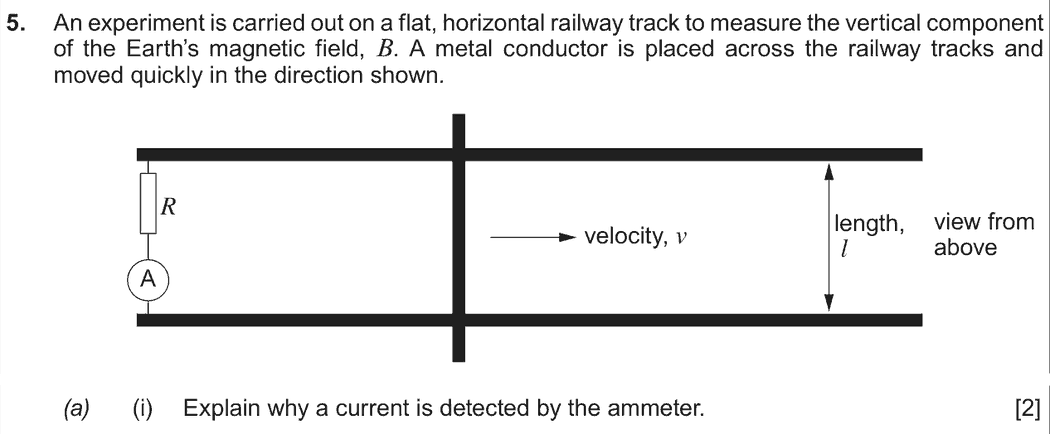
5. An experiment is carried out on a flat, horizontal railway track to measure the vertical component of the Earth’s magnetic field, B. A metal conductor is placed across the railway tracks and moved quickly in the direction shown. R length, view from velocity, v l above A (a) (i) Explain why a current is detected by the ammeter. [2]
June 2017 · Component 3 · Q5(a)(ii) 1 mark AO2=1 Explanation electromagnetic induction
Earlier part of question 5 that this part usesEarlier part of June 2017 Component 3 question 5
(ii) Explain why the current is independent of the horizontal component of the Earth's magnetic field. [1]
June 2017 · Component 3 · Q5(b) 3 marks AO1=1, AO2=2 Show that electromagnetic induction
Earlier part of question 5 that this part usesEarlier part of June 2017 Component 3 question 5
(b) Use Faraday's law to derive the expression for the current: [3] Bl I = v v R
June 2017 · Component 3 · Q5(c)(i) 4 marks AO3=4 Practical and data analysis electromagnetic induction
Earlier part of question 5 that this part usesEarlier part of June 2017 Component 3 question 5
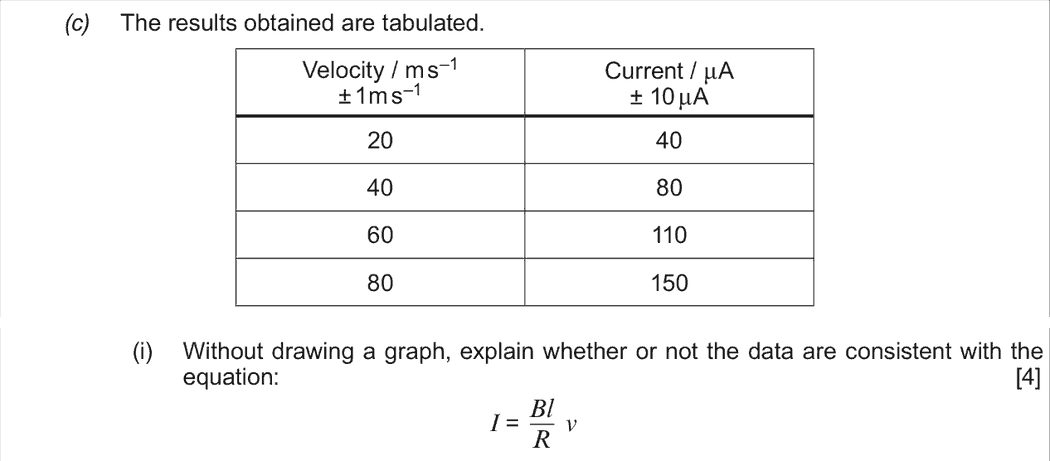
(c) The results obtained are tabulated. Velocity / m s–1 Current / μA ± 1 m s–1 ± 10 μA 20 40 40 80 60 110 80 150 (i) Without drawing a graph, explain whether or not the data are consistent with the equation: [4] Bl I = v R
June 2017 · Component 3 · Q5(c)(ii) 6 marks AO2=3, AO3=3 Practical and data analysis electromagnetic induction
Earlier parts of question 5 that this part usesEarlier part of June 2017 Component 3 question 5Earlier part of June 2017 Component 3 question 5
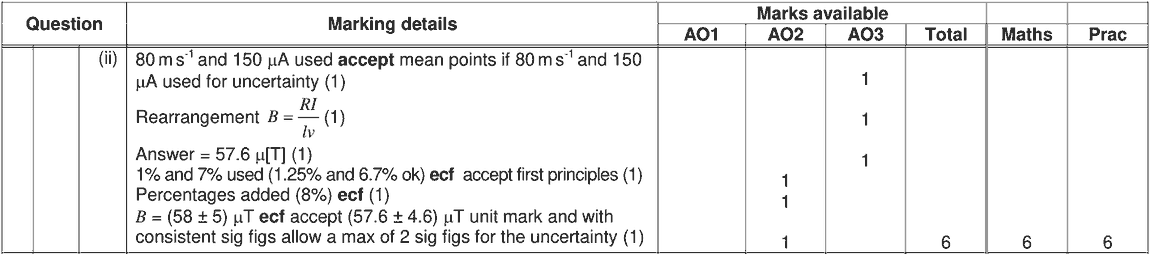
(ii) Use the data in the table with the smallest percentage uncertainties to calculate the vertical component of the Earth’s magnetic field, B, together with its absolute uncertainty (l =1.400 m, R = 43.0 Ω with negligible uncertainties). [6]
June 2017 · Component 3 · Q6(a) 3 marks AO1=3 Show that wave properties
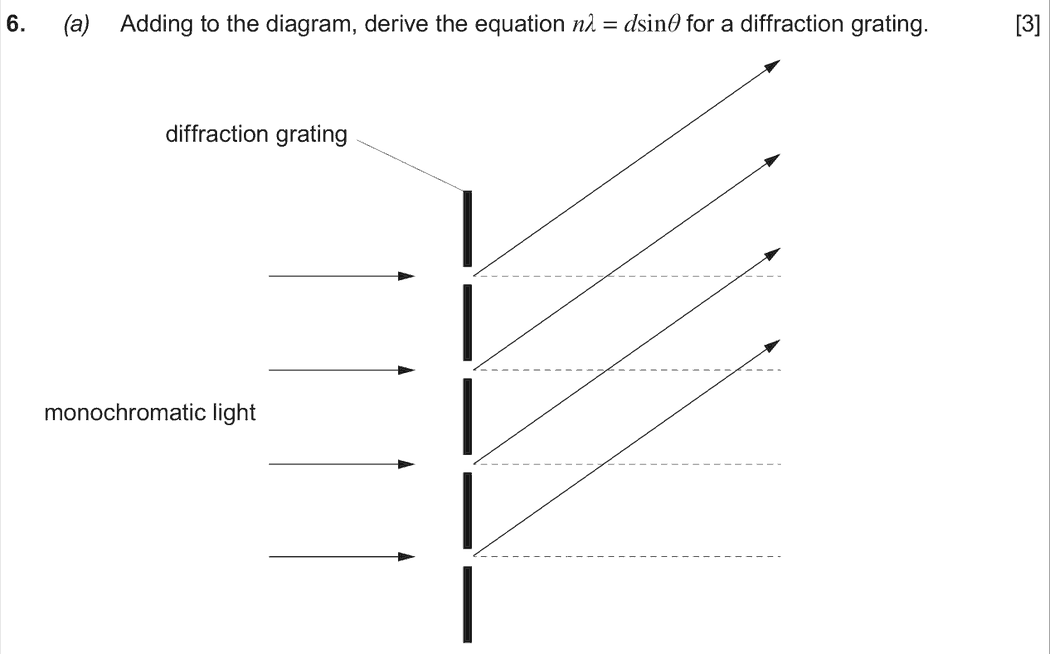
6. (a) Adding to the diagram, derive the equation nλ = dsinθ for a diffraction grating. [3] diffraction grating monochromatic light
June 2017 · Component 3 · Q6(b) 4 marks AO1=2, AO2=2 Calculation wave properties
Earlier part of question 6 that this part usesEarlier part of June 2017 Component 3 question 6
(b) A diffraction grating has 250 lines per mm and light of wavelength 532 nm is incident normally upon it. Calculate the angle between the first and second order light beams. [4]
June 2017 · Component 3 · Q6(c) 2 marks AO2=2 Calculation wave properties
Earlier part of question 6 that this part usesEarlier part of June 2017 Component 3 question 6
(c) Another diffraction grating has half the angle between the first and second order light beams when light of wavelength 532 nm is incident upon it. Estimate the number of lines per mm of this second diffraction grating. [2]
June 2017 · Component 3 · Q7(a) 4 marks AO1=4 Explanation wave properties
7. (a) Explain how two source interference patterns arise. [4]
June 2017 · Component 3 · Q7(b)(i) 1 mark Diagram or graph wave properties
Earlier part of question 7 that this part usesEarlier part of June 2017 Component 3 question 7
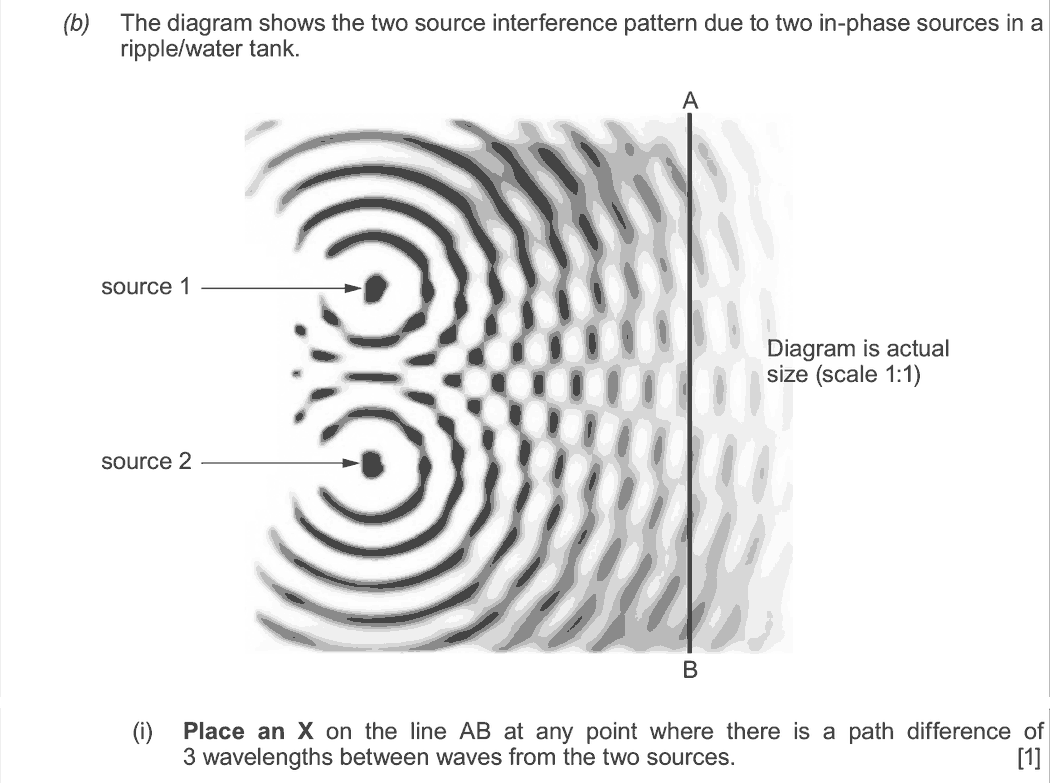
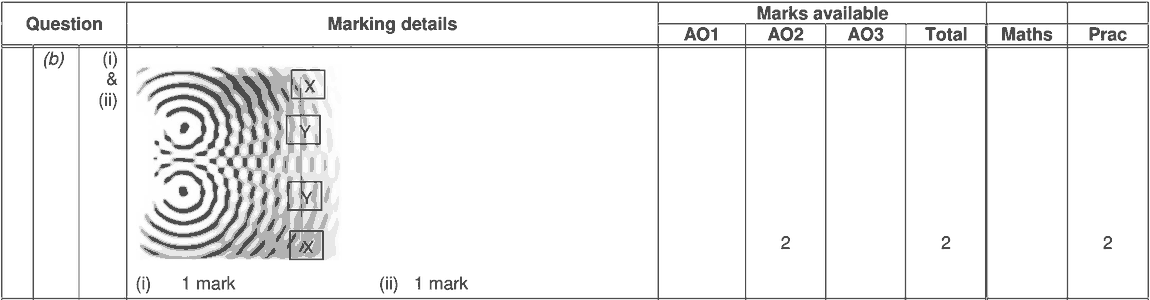
(b) The diagram shows the two source interference pattern due to two in-phase sources in a ripple/water tank. A source 1 Diagram is actual size (scale 1:1) source 2 B (i) Place an X on the line AB at any point where there is a path difference of 3 wavelengths between waves from the two sources. [1]
June 2017 · Component 3 · Q7(b)(ii) 1 mark Diagram or graph wave properties
Earlier parts of question 7 that this part usesEarlier part of June 2017 Component 3 question 7Earlier part of June 2017 Component 3 question 7
(ii) Place a Y on the line AB at any point where there is a path difference of 1.5 wavelengths between waves from the two sources. [1]
June 2017 · Component 3 · Q7(c)(i) 2 marks AO2=2 Practical and data analysis nature of waves
Earlier parts of question 7 that this part usesEarlier part of June 2017 Component 3 question 7Earlier part of June 2017 Component 3 question 7
(c) (i) The diagram is actual size. Measure the wavelength of the waves accurately by using the distance between wavefronts. [2]
June 2017 · Component 3 · Q7(c)(ii) 3 marks AO3=3 Practical and data analysis wave properties
Earlier parts of question 7 that this part usesEarlier part of June 2017 Component 3 question 7Earlier part of June 2017 Component 3 question 7Earlier part of June 2017 Component 3 question 7
aΔy (ii) Hence check whether or not the equation: λ = is a good approximation for the D given diagram. Show your working. [3]
June 2017 · Component 3 · Q8(a) 2 marks AO1=2 Diagram or graph refraction of light
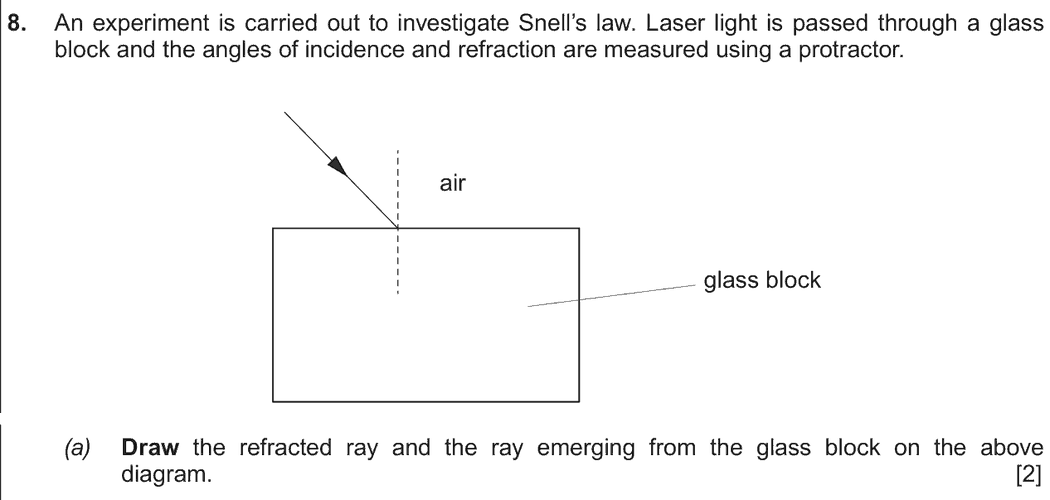
8. An experiment is carried out to investigate Snell’s law. Laser light is passed through a glass block and the angles of incidence and refraction are measured using a protractor. air glass block (a) Draw the refracted ray and the ray emerging from the glass block on the above diagram. [2]
June 2017 · Component 3 · Q8(b)(i) 4 marks AO2=4 Practical and data analysis refraction of light
Earlier part of question 8 that this part usesEarlier part of June 2017 Component 3 question 8
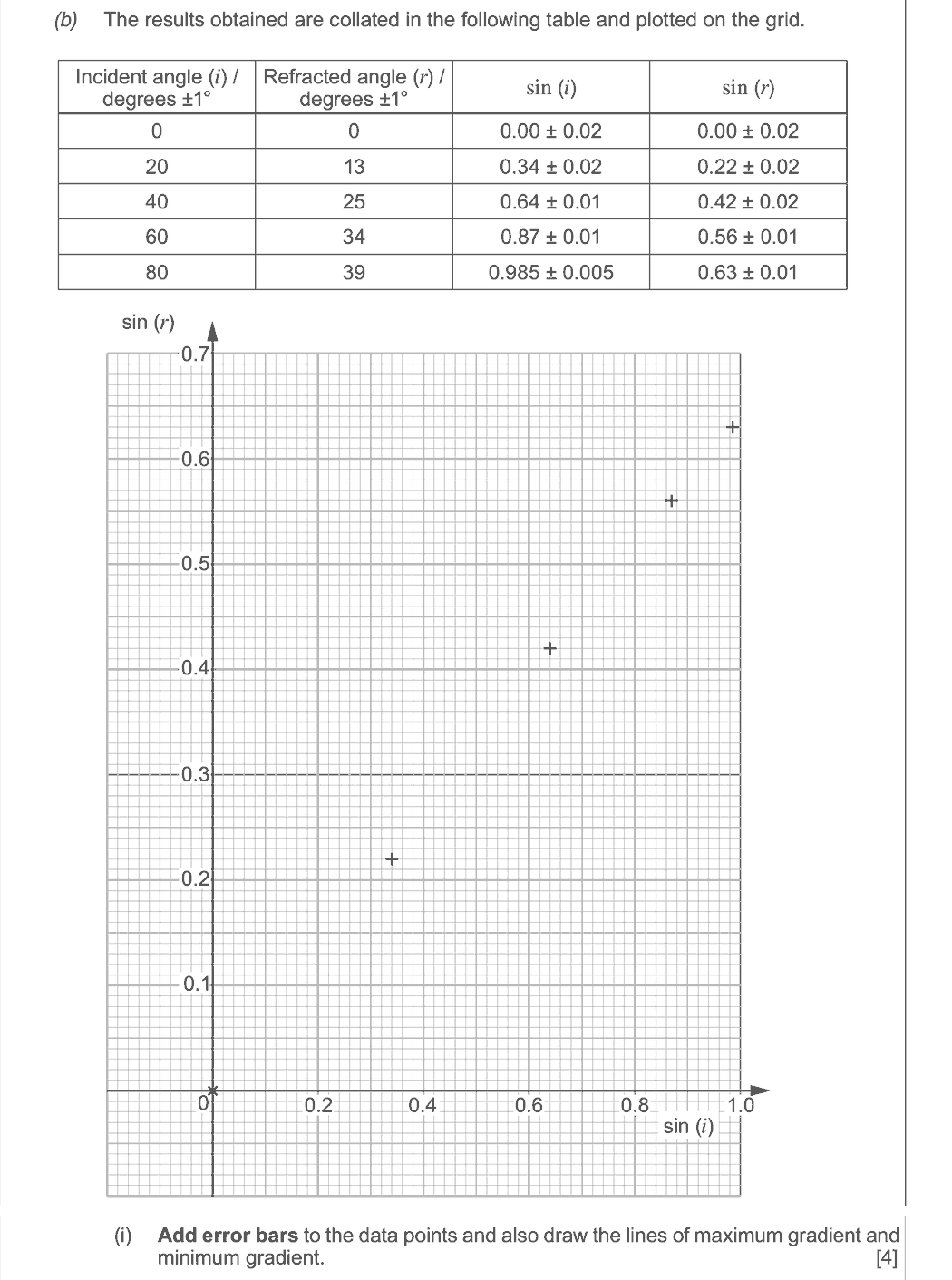
(b) The results obtained are collated in the following table and plotted on the grid. Incident angle (i) / Refracted angle (r) / sin (i) sin (r) degrees ±1° degrees ±1° 0 0 0.00 ± 0.02 0.00 ± 0.02 20 13 0.34 ± 0.02 0.22 ± 0.02 40 25 0.64 ± 0.01 0.42 ± 0.02 60 34 0.87 ± 0.01 0.56 ± 0.01 80 39 0.985 ± 0.005 0.63 ± 0.01 sin (r) 0.7 0.6 0.5 0.4 0.3 0.2 0.1 0 0.2 1 0.4 0.6 0.8 1.0 sin (i) (i) Add error bars to the data points and also draw the lines of maximum gradient and minimum gradient. [4]
June 2017 · Component 3 · Q8(b)(ii) 4 marks AO3=4 Practical and data analysis refraction of light
Earlier parts of question 8 that this part usesEarlier part of June 2017 Component 3 question 8Earlier part of June 2017 Component 3 question 8
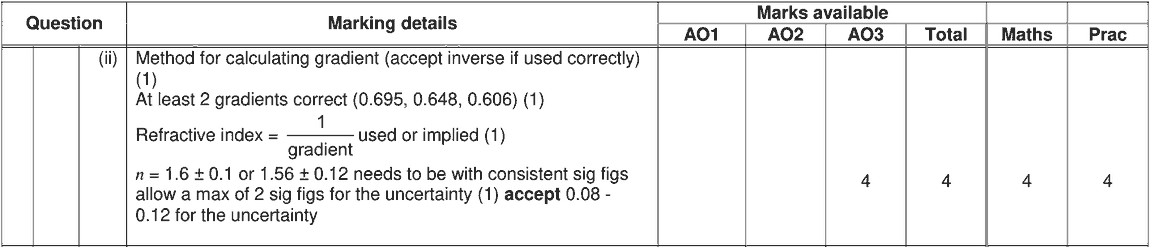
(ii) Determine the refractive index of the block along with a value for its absolute uncertainty, quoting your results to an appropriate number of significant figures. [4]
June 2017 · Component 3 · Q9 6 marks AO1=6 6-mark extended response refraction of light
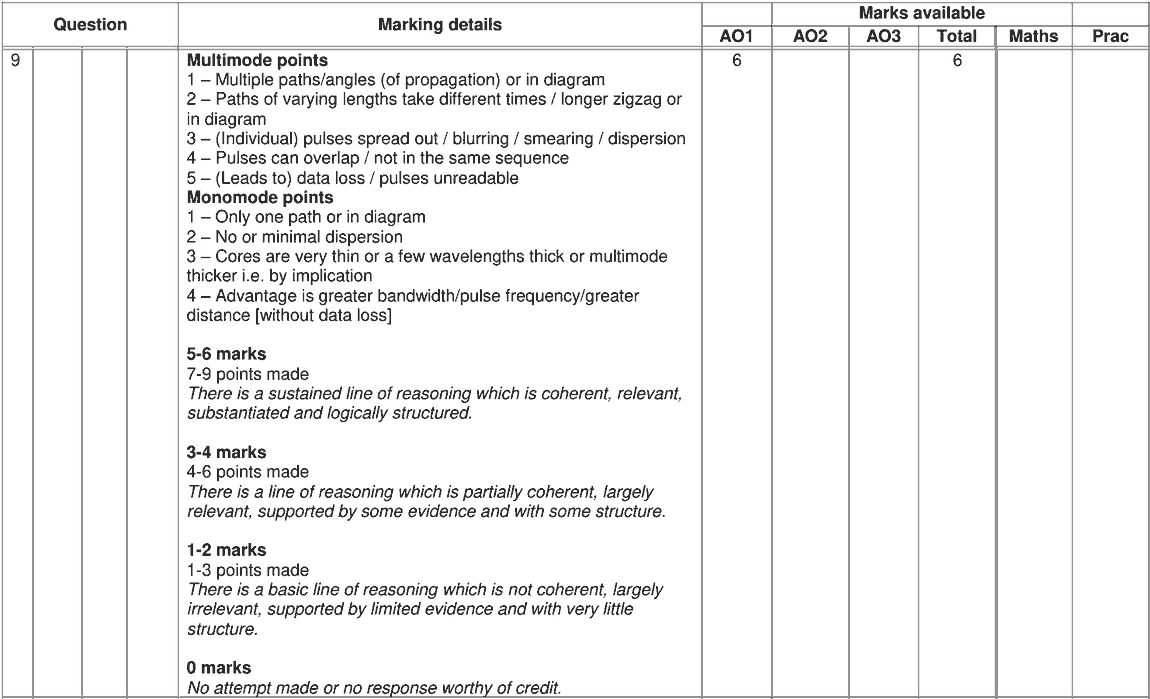
9. Explain the advantages of monomode optical fibres over multimode optical fibres when transmitting a rapid sequence of pulses. [6 QER]
June 2017 · Component 3 · Q10(a)(i) 2 marks AO1=1, AO2=1 Calculation alternating currents
10. (a) A 900 W toaster is supplied with a sinusoidally varying pd of peak pd 325 V. Calculate: (i) the rms current; [2]
June 2017 · Component 3 · Q10(a)(ii) 2 marks AO1=1, AO2=1 Calculation alternating currents
Earlier part of question 10 that this part usesEarlier part of June 2017 Component 3 question 10
(ii) the resistance of the toaster. [2]
June 2017 · Component 3 · Q10(b) 5 marks AO3=5 Explanation alternating currents
Earlier part of question 10 that this part usesEarlier part of June 2017 Component 3 question 10
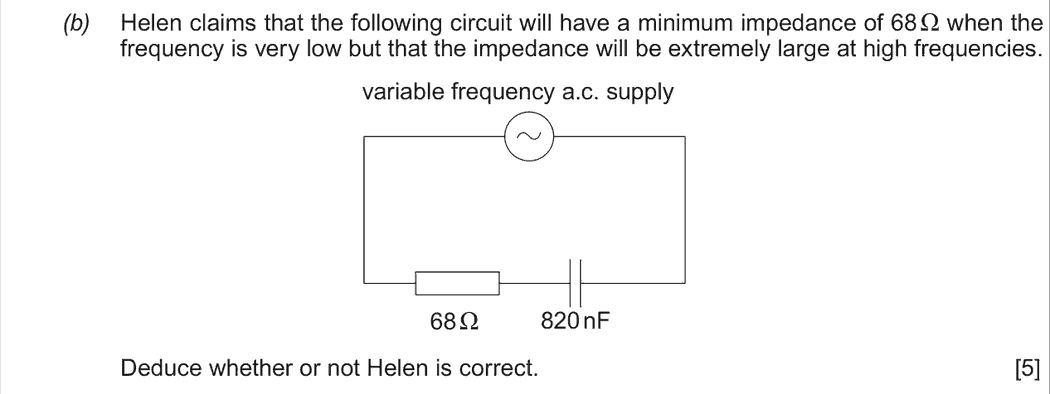
(b) Helen claims that the following circuit will have a minimum impedance of 68 Ω when the frequency is very low but that the impedance will be extremely large at high frequencies. variable frequency a.c. supply 68 Ω 820 nF Deduce whether or not Helen is correct. [5]
June 2017 · Component 3 · Q10(c)(i) 2 marks AO1=2 Calculation alternating currents
Earlier parts of question 10 that this part usesEarlier part of June 2017 Component 3 question 10Earlier part of June 2017 Component 3 question 10
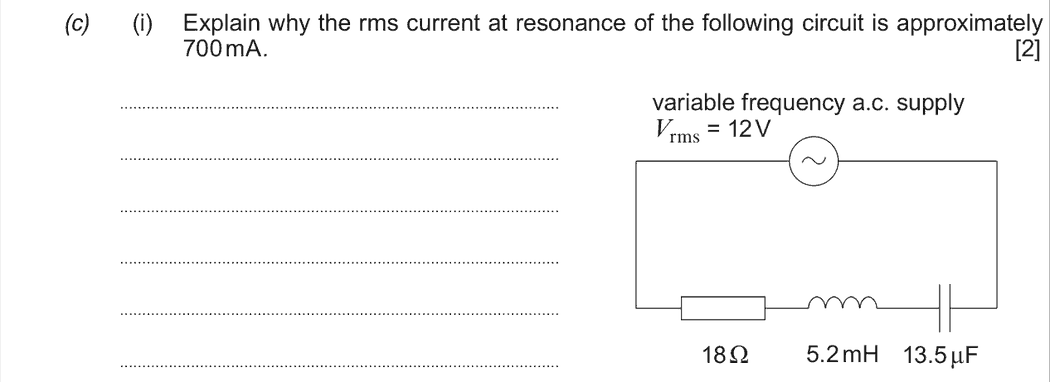
(c) (i) Explain why the rms current at resonance of the following circuit is approximately 700 mA. [2] variable frequency a.c. supply Vrms = 12 V 18 Ω 5.2 mH 13.5 μF
June 2017 · Component 3 · Q10(c)(ii) 2 marks AO1=1, AO2=1 Show that alternating currents
Earlier parts of question 10 that this part usesEarlier part of June 2017 Component 3 question 10Earlier part of June 2017 Component 3 question 10Earlier part of June 2017 Component 3 question 10
(ii) Show that the resonance frequency (f0) is approximately 600 Hz. [2]
June 2017 · Component 3 · Q10(c)(iii) 4 marks AO1=1, AO2=3 Calculation alternating currents
Earlier parts of question 10 that this part usesEarlier part of June 2017 Component 3 question 10Earlier part of June 2017 Component 3 question 10Earlier part of June 2017 Component 3 question 10
(iii) Calculate the rms current when the frequency of the supply is increased to 1.5 f0. [4]
June 2017 · Component 3 · Q10(c)(iv) 3 marks AO2=3 Explanation alternating currents
Earlier parts of question 10 that this part usesEarlier part of June 2017 Component 3 question 10Earlier part of June 2017 Component 3 question 10Earlier part of June 2017 Component 3 question 10
f0 (iv) Explain why the rms current is the same when the frequency is decreased to . 1.5 [3]
June 2017 · Component 3 · Q11(a) 2 marks AO1=2 Short answer medical physics
11. (a) Describe briefly how X-rays are produced in an X-ray tube. [2]
June 2017 · Component 3 · Q11(b)(i) 3 marks AO1=1, AO2=2 Show that medical physics
Earlier part of question 11 that this part usesEarlier part of June 2017 Component 3 question 11
(b) (i) When a beam of X-rays passes through bone the X-rays are absorbed and the beam becomes attenuated. The thickness of bone needed to reduce the original 1 n 2 intensity by 50 % is known as the half value thickness, x1 . Show that x = where 1 µ 2 2 µ is the attenuation coefficient. [3]
June 2017 · Component 3 · Q11(b)(ii) 3 marks AO2=3 Calculation medical physics
Earlier parts of question 11 that this part usesEarlier part of June 2017 Component 3 question 11Earlier part of June 2017 Component 3 question 11
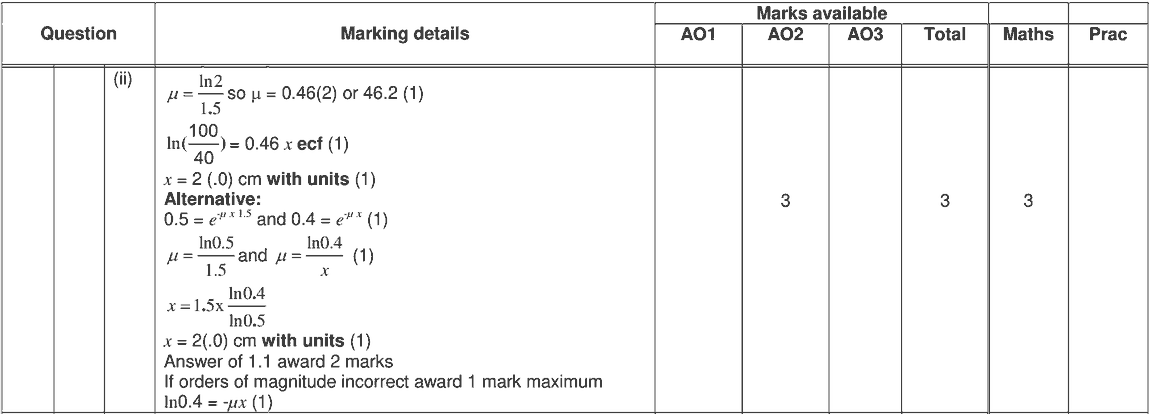
(ii) A beam of X-rays is used to detect a fracture in a bone. If the half value thickness for these X-rays in bone is 1.5 cm, calculate the thickness of bone that reduces the incident intensity by 60 % of the original intensity. [3]
June 2017 · Component 3 · Q11(b)(iii) 3 marks AO1=1, AO3=2 Explanation medical physics
Earlier parts of question 11 that this part usesEarlier part of June 2017 Component 3 question 11Earlier part of June 2017 Component 3 question 11
(iii) X-ray imaging is not suitable for diagnosing brain tumours. Explain why, and suggest a more suitable technique giving your reasons. [3]
June 2017 · Component 3 · Q11(c) 2 marks AO1=2 Explanation medical physics
Earlier part of question 11 that this part usesEarlier part of June 2017 Component 3 question 11
(c) An ultrasound probe can be used to check the development of an unborn baby. Explain how a piezoelectric transducer can be used to produce ultrasound. [2]
June 2017 · Component 3 · Q11(d)(i) 2 marks AO2=2 Calculation medical physics
Earlier part of question 11 that this part usesEarlier part of June 2017 Component 3 question 11
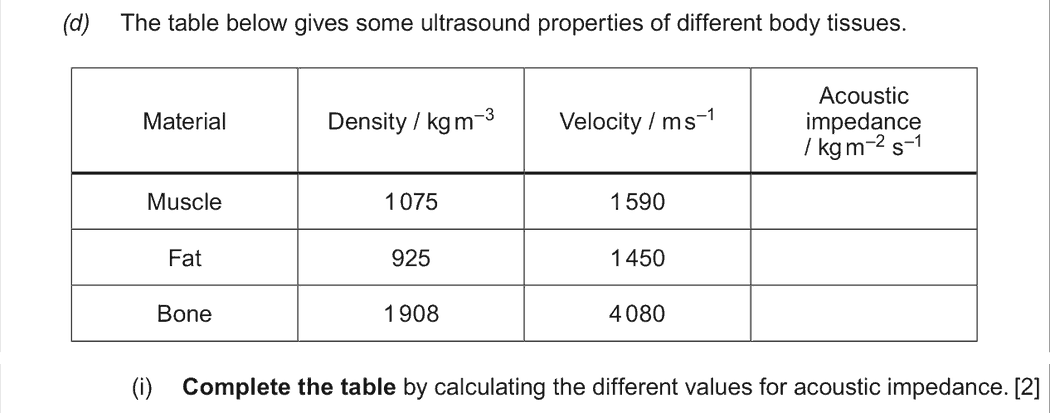
(d) The table below gives some ultrasound properties of different body tissues. Acoustic Material Density / kg m–3 Velocity / m s–1 impedance / kg m–2 s–1 Muscle 1 075 1 590 Fat 925 1 450 Bone 1 908 4 080 (i) Complete the table by calculating the different values for acoustic impedance. [2]
June 2017 · Component 3 · Q11(d)(ii) 3 marks AO2=1, AO3=2 Calculation medical physics
Earlier parts of question 11 that this part usesEarlier part of June 2017 Component 3 question 11Earlier part of June 2017 Component 3 question 11
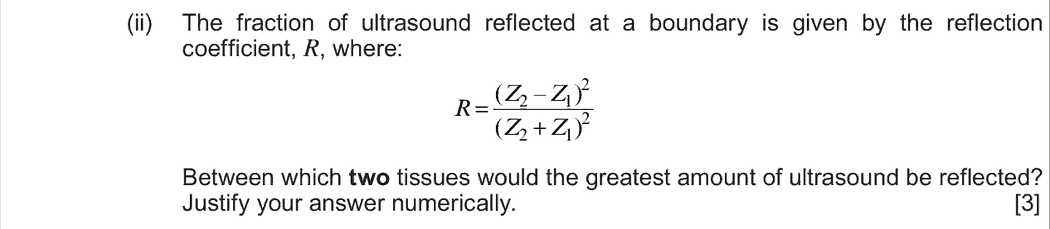
(ii) The fraction of ultrasound reflected at a boundary is given by the reflection coefficient, R, where: ( Z – Z ) 2 R = 2 1 ( Z + Z ) 2 2 1 Between which two tissues would the greatest amount of ultrasound be reflected? Justify your answer numerically. [3]
June 2017 · Component 3 · Q11(e) 2 marks AO2=1, AO3=1 Calculation medical physics
Earlier parts of question 11 that this part usesEarlier part of June 2017 Component 3 question 11Earlier part of June 2017 Component 3 question 11
(e) A typical MRI scanner operates with a Larmor frequency of 64 MHz. Calculate the magnetic field strength, B, that would be needed to provide this, and state which patients would not be able to undergo MRI scans. [2]
June 2017 · Component 3 · Q12(a)(i) 3 marks AO3=3 Calculation physics of sports
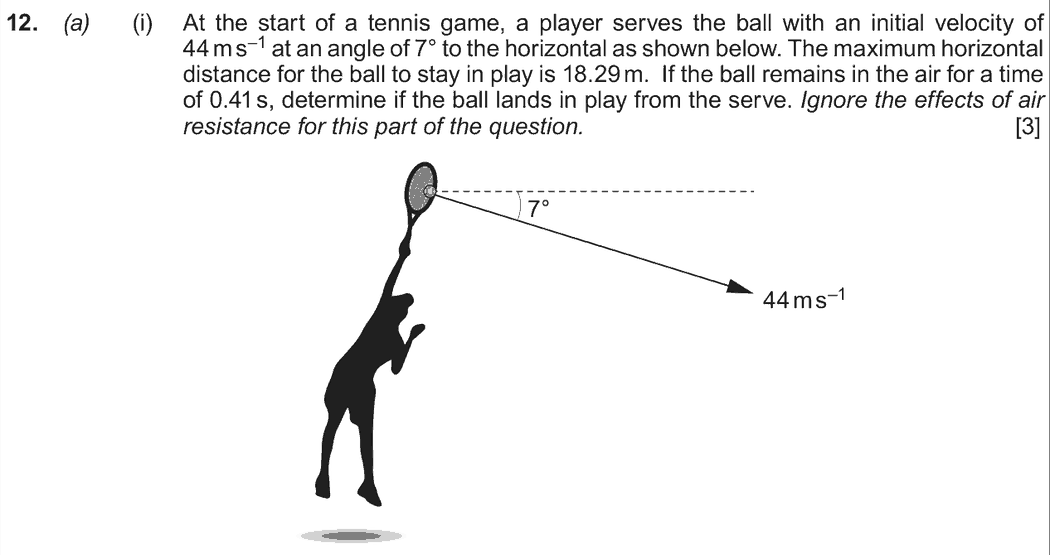
12. (a) (i) At the start of a tennis game, a player serves the ball with an initial velocity of 44 m s–1 at an angle of 7° to the horizontal as shown below. The maximum horizontal distance for the ball to stay in play is 18.29 m. If the ball remains in the air for a time of 0.41 s, determine if the ball lands in play from the serve. Ignore the effects of air resistance for this part of the question. [3] 7° 44 m s–1
June 2017 · Component 3 · Q12(a)(ii) 2 marks AO1=1, AO2=1 Calculation physics of sports
Earlier part of question 12 that this part usesEarlier part of June 2017 Component 3 question 12
(ii) The tennis ball has a mass of 0.056 kg and is momentarily at rest before being hit by the racquet. Determine the mean force exerted by the racquet on the ball if they remain in contact for a time of 6.0 ms. [2]
June 2017 · Component 3 · Q12(b)(i) 2 marks AO1=2 Definition physics of sports
Earlier part of question 12 that this part usesEarlier part of June 2017 Component 3 question 12
(b) (i) The coefficient of restitution between the ball and the floor is 0.74. Explain what this statement means. [2]
June 2017 · Component 3 · Q12(b)(ii) 3 marks AO1=1, AO2=2 Calculation physics of sports
Earlier parts of question 12 that this part usesEarlier part of June 2017 Component 3 question 12Earlier part of June 2017 Component 3 question 12
(ii) Determine the second bounce height of a tennis ball if the ball is dropped from a height of 1.95 m (the coefficient of restitution between the ball and the floor is 0.74). [3]
June 2017 · Component 3 · Q12(c)(i) 4 marks AO1=1, AO2=1, AO3=2 Explanation physics of sports
Earlier part of question 12 that this part usesEarlier part of June 2017 Component 3 question 12
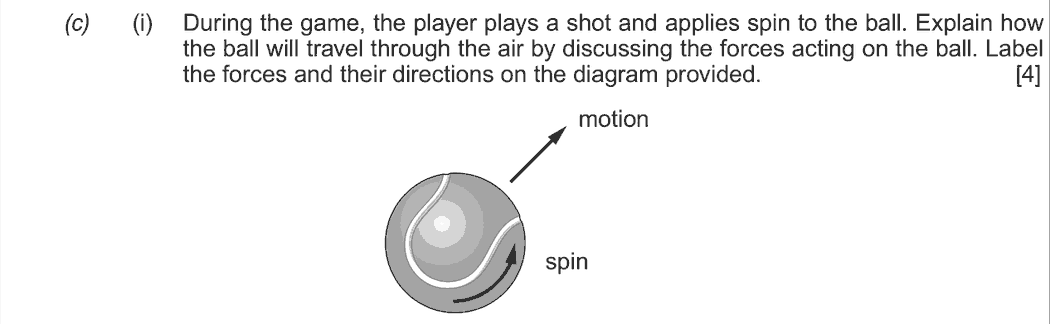
(c) (i) During the game, the player plays a shot and applies spin to the ball. Explain how the ball will travel through the air by discussing the forces acting on the ball. Label the forces and their directions on the diagram provided. [4] motion spin
June 2017 · Component 3 · Q12(c)(ii) 4 marks AO1=1, AO2=3 Calculation physics of sports
Earlier parts of question 12 that this part usesEarlier part of June 2017 Component 3 question 12Earlier part of June 2017 Component 3 question 12
(ii) The ball is hit with a velocity of 16.4 m s–1 and spins at a rate of 3 500 revolutions per minute. Determine the total kinetic energy of the ball if the diameter of the ball is 7.0 cm and its mass is 0.056 kg. Note: a tennis ball can be considered to be a thin spherical shell. [4]
June 2017 · Component 3 · Q12(c)(iii) 2 marks AO2=2 Calculation physics of sports
Earlier parts of question 12 that this part usesEarlier part of June 2017 Component 3 question 12Earlier part of June 2017 Component 3 question 12
(iii) Determine the drag force acting on the ball if the drag coefficient for a tennis ball is 0.53 and the density of air is 1.2 kg m–3. [2]
June 2017 · Component 3 · Q13(a)(i) 2 marks AO3=2 Calculation energy and the environment
13. (a) (i) Assuming that the Earth emits radiation as a black body at a temperature of 288 K, confirm that the peak wavelength of the radiation emitted by the Earth is in the infra-red part of the electromagnetic spectrum. [2]
June 2017 · Component 3 · Q13(a)(ii)I 3 marks Short answer energy and the environment
Earlier part of question 13 that this part usesEarlier part of June 2017 Component 3 question 13
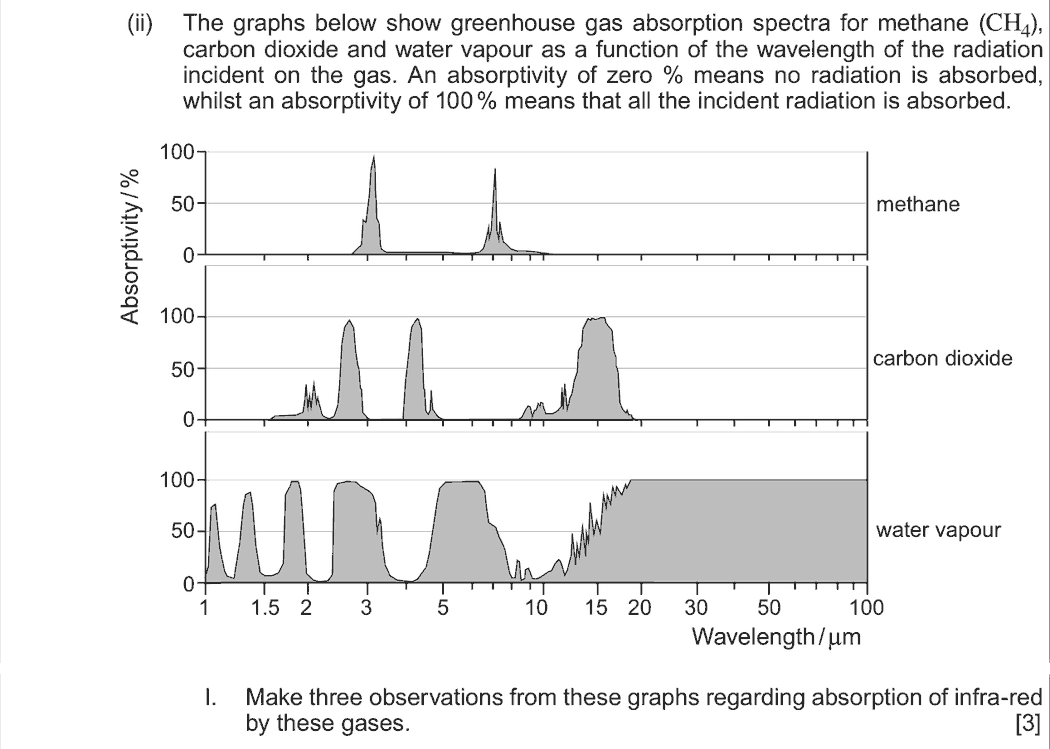
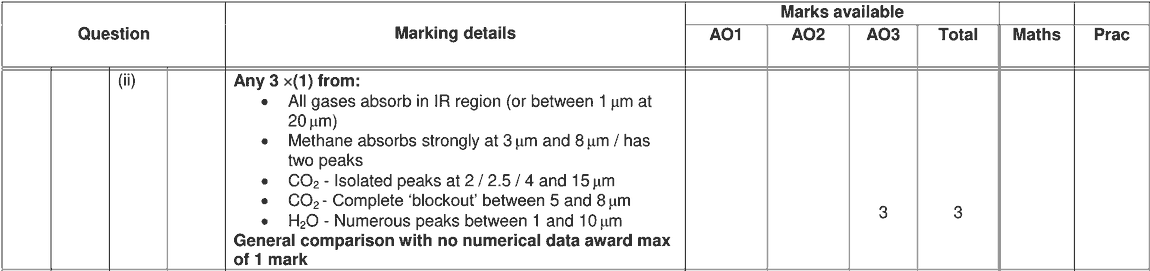
(ii) The graphs below show greenhouse gas absorption spectra for methane (CH4), carbon dioxide and water vapour as a function of the wavelength of the radiation incident on the gas. An absorptivity of zero % means no radiation is absorbed, whilst an absorptivity of 100 % means that all the incident radiation is absorbed. 100 Absorptivity / % 50 methane 0 100 carbon dioxide 50 0 100 50 water vapour 0 1 1.5 2 3 5 10 15 20 30 50 100 Wavelength / μm I. Make three observations from these graphs regarding absorption of infra-red by these gases. [3]
June 2017 · Component 3 · Q13(a)(ii)II 2 marks Short answer energy and the environment
Earlier parts of question 13 that this part usesEarlier part of June 2017 Component 3 question 13Earlier part of June 2017 Component 3 question 13
II. Studies show that the concentration levels of these gases in the atmosphere continue to increase. Choose two of these gases and give one reason as to why the concentration level is increasing for each of your choices. [2]



June 2017 · Component 3 · Q13(b)(i) 3 marks AO1=1, AO2=2 Calculation energy and the environment
Earlier parts of question 13 that this part usesEarlier part of June 2017 Component 3 question 13Earlier part of June 2017 Component 3 question 13
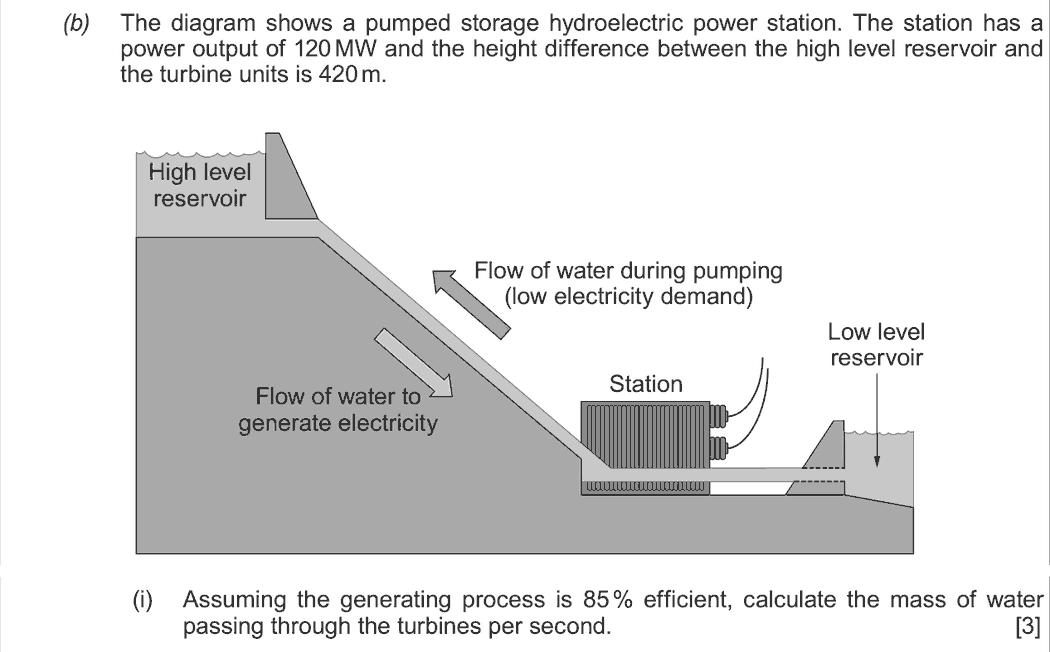
(b) The diagram shows a pumped storage hydroelectric power station. The station has a power output of 120 MW and the height difference between the high level reservoir and the turbine units is 420 m. High level reservoir Flow of water during pumping (low electricity demand) Low level reservoir Station Flow of water to generate electricity (i) Assuming the generating process is 85 % efficient, calculate the mass of water passing through the turbines per second. [3]
June 2017 · Component 3 · Q13(b)(ii) 2 marks AO1=1, AO2=1 Calculation energy and the environment
Earlier parts of question 13 that this part usesEarlier part of June 2017 Component 3 question 13Earlier part of June 2017 Component 3 question 13Earlier part of June 2017 Component 3 question 13
(ii) The power station has a mean annual output of 240 GWh of electrical energy. Calculate the mean time during which the power station is in use per day. Give your answer in hours. [2]
June 2017 · Component 3 · Q13(b)(iii) 1 mark AO1=1 Short answer energy and the environment
Earlier parts of question 13 that this part usesEarlier part of June 2017 Component 3 question 13Earlier part of June 2017 Component 3 question 13Earlier part of June 2017 Component 3 question 13
(iii) Without considering energy losses, give one reason why this power station would not be able to produce significantly more than 240 GWh of energy per year. [1]
June 2017 · Component 3 · Q13(c)(i) 2 marks AO2=2 Calculation energy and the environment
Earlier parts of question 13 that this part usesEarlier part of June 2017 Component 3 question 13Earlier part of June 2017 Component 3 question 13Earlier part of June 2017 Component 3 question 13
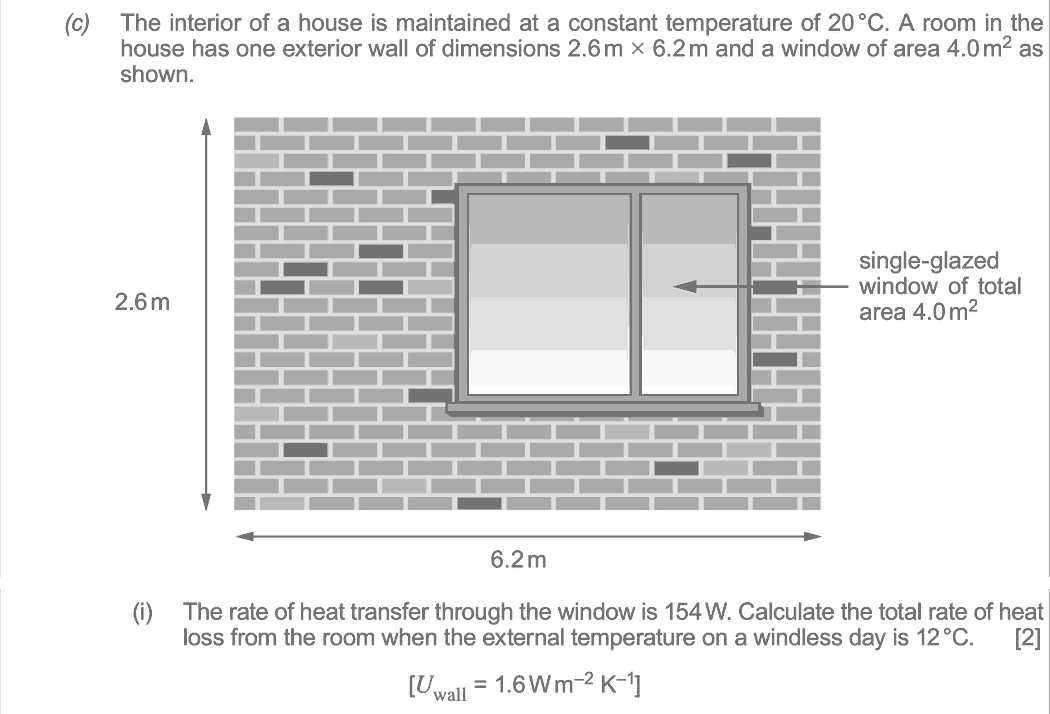
(c) The interior of a house is maintained at a constant temperature of 20 °C. A room in the house has one exterior wall of dimensions 2.6 m × 6.2 m and a window of area 4.0 m2 as shown. single-glazed window of total 2.6 m area 4.0 m2 6.2 m (i) The rate of heat transfer through the window is 154 W. Calculate the total rate of heat loss from the room when the external temperature on a windless day is 12 °C. [2] [Uwall = 1.6 W m–2 K–1]
June 2017 · Component 3 · Q13(c)(ii)I 2 marks Show that energy and the environment
Earlier parts of question 13 that this part usesEarlier part of June 2017 Component 3 question 13Earlier part of June 2017 Component 3 question 13Earlier part of June 2017 Component 3 question 13Earlier part of June 2017 Component 3 question 13
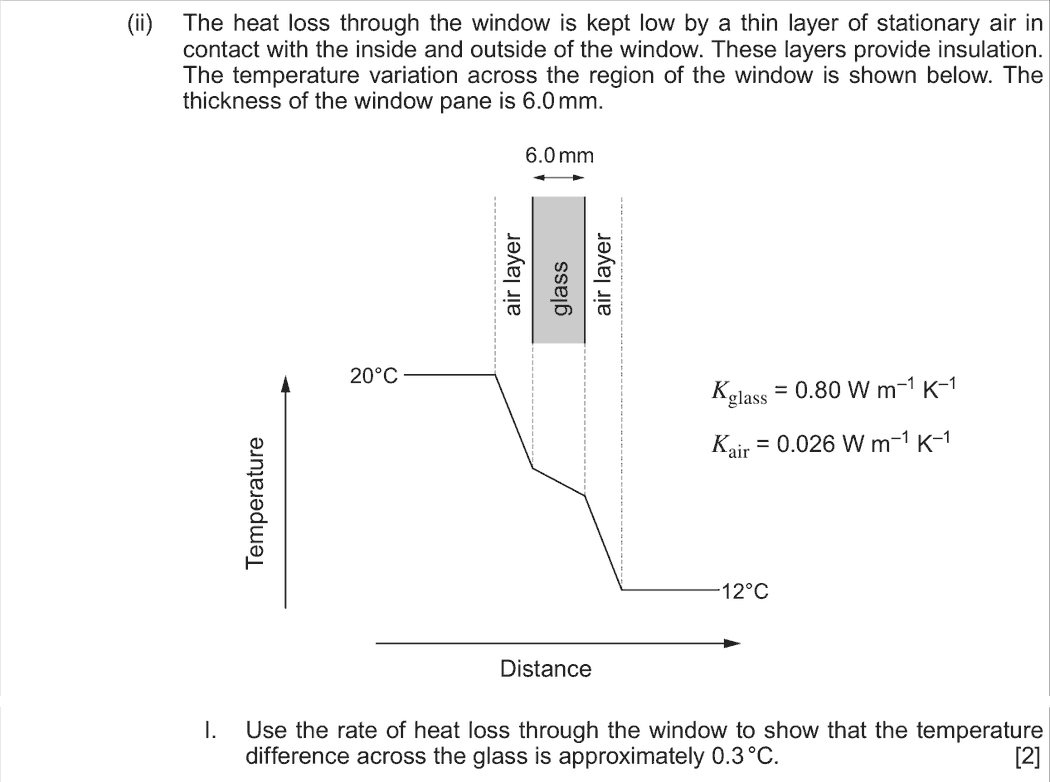
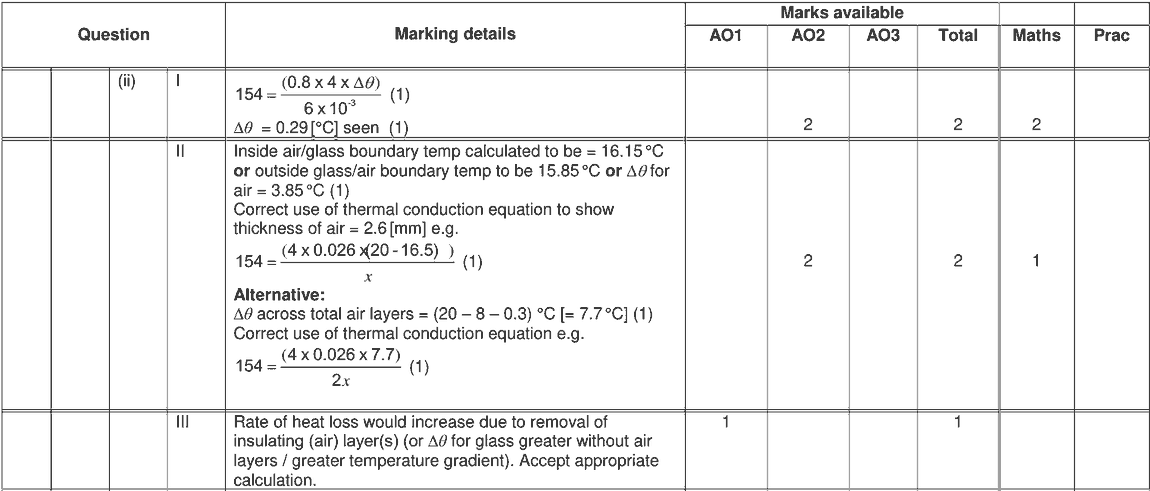
(ii) The heat loss through the window is kept low by a thin layer of stationary air in contact with the inside and outside of the window. These layers provide insulation. The temperature variation across the region of the window is shown below. The thickness of the window pane is 6.0 mm. 6.0 mm layer layer glass air air 20°C Kglass = 0.80 W m–1 K–1 Kair = 0.026 W m–1 K–1 Temperature 12°C Distance I. Use the rate of heat loss through the window to show that the temperature difference across the glass is approximately 0.3 °C. [2]
June 2017 · Component 3 · Q13(c)(ii)II 2 marks Calculation energy and the environment
Earlier parts of question 13 that this part usesEarlier part of June 2017 Component 3 question 13Earlier part of June 2017 Component 3 question 13Earlier part of June 2017 Component 3 question 13Earlier part of June 2017 Component 3 question 13Earlier part of June 2017 Component 3 question 13
II. Calculate the thickness of each of the layers of air. You should assume that the two layers of air have equal thickness. [2]
June 2017 · Component 3 · Q13(c)(ii)III 1 mark Explanation energy and the environment
Earlier parts of question 13 that this part usesEarlier part of June 2017 Component 3 question 13Earlier part of June 2017 Component 3 question 13Earlier part of June 2017 Component 3 question 13Earlier part of June 2017 Component 3 question 13Earlier part of June 2017 Component 3 question 13
III. Without calculation, explain how the rate of heat loss through the window would be different if it were a breezy day. [1]

Work with an Eduqas physics tutor

Want a paper marked and gone through with you? Message us.

Prefer email? Send an enquiry

If you are under 18, please include a parent's contact details. Enquiries go to enquiries@physicsaleveltutor.com and are deleted once handled. All tutoring is online.