
June 2019: Component 1

100 marks · 40 question parts · Paper, mark scheme and report on Eduqas's site · Have the Data Booklet beside you
Question by question

QTopicMarksAOType
1(a)(i) Kinematics 2AO1=2Explanation
1(a)(ii) Kinematics 3AO3=3Calculation
1(b) Kinematics, Basic physics: units, vectors and moments 4AO2=4Calculation
2(a) Basic physics: units, vectors and moments 1AO2=1Explanation
2(b) Energy concepts 2AO1=1,AO2=1Calculation
2(c) Energy concepts 3AO3=3Calculation
3(a) Dynamics: forces and momentum 2AO1=2Definition
3(b)(i) Dynamics: forces and momentum 3AO2=3Calculation
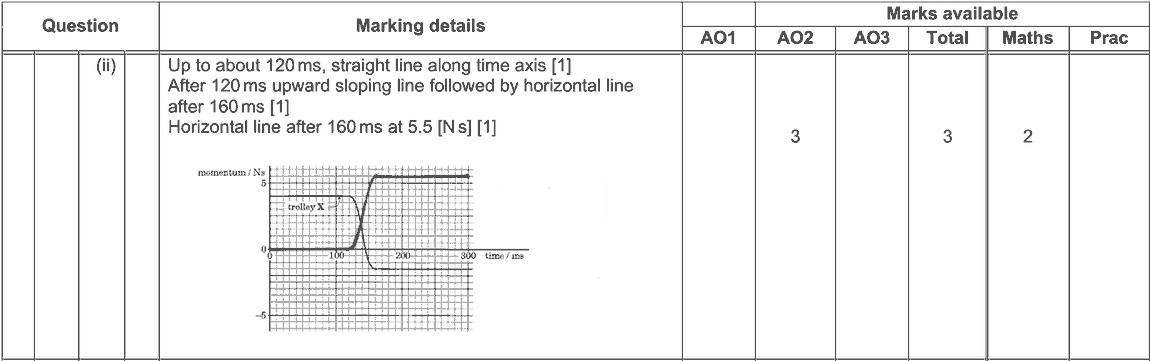
3(b)(ii) Dynamics: forces and momentum 3AO2=3Diagram or graph
3(b)(iii) Dynamics: forces and momentum 2AO2=2Calculation
4(a)(i)I Circular motion 2AO1=1,AO2=1Calculation
4(a)(i)II Circular motion 2AO1=1,AO2=1Calculation
4(a)(i)III Circular motion 2AO1=1,AO2=1Calculation
4(a)(ii)I Basic physics: units, vectors and moments 2AO2=2Calculation
4(a)(ii)II Circular motion 3AO3=3Calculation
4(b) Circular motion 3AO3=3Explanation
5(a) Vibrations: simple harmonic motion 2AO1=2Definition
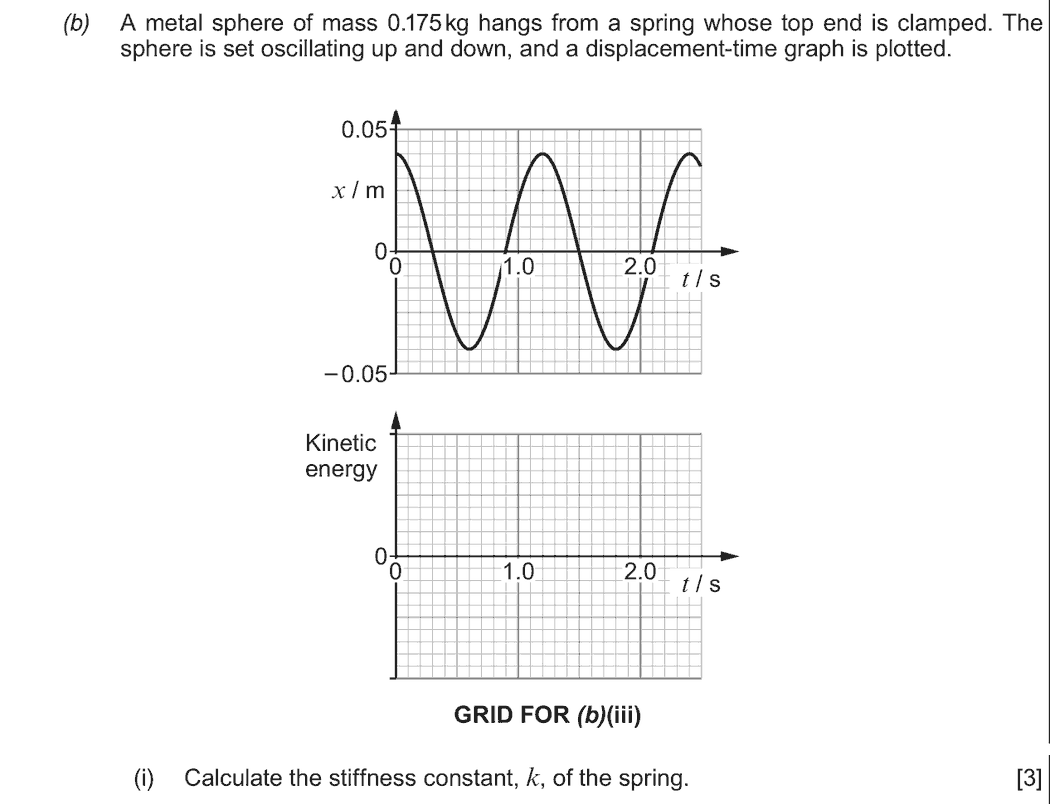
5(b)(i) Vibrations: simple harmonic motion 3AO2=3Calculation
5(b)(ii) Vibrations: simple harmonic motion 3AO1=2,AO2=1Calculation
5(b)(iii) Vibrations: simple harmonic motion 3AO1=2,AO2=1Diagram or graph
5(c) Vibrations: simple harmonic motion 5AO3=5Practical and data analysis
6(a)(i) Basic physics: units, vectors and moments 4AO1=1,AO2=3Practical and data analysis
6(a)(ii) Kinetic theory, Basic physics: units, vectors and moments 2AO2=2Calculation
6(b)(i)I Kinetic theory 3AO2=3Calculation
6(b)(i)II Kinetic theory 2AO1=1,AO3=1Explanation
6(b)(ii)I Kinetic theory 2AO1=1,AO2=1Show that
6(b)(ii)II Kinetic theory 2AO3=2Calculation
7(a) Thermal physics 2AO1=2Definition
7(b)(i) Thermal physics 2AO1=1,AO2=1Calculation
7(b)(ii) Thermal physics 6AO1=6Extended response
8(a) Comprehension: the Component 1 article questions 1AO2=1Short answer
8(b) Using radiation to investigate stars, Comprehension: the Component 1 article questions 1AO3=1Short answer
8(c) Using radiation to investigate stars, Comprehension: the Component 1 article questions 1AO2=1Short answer
8(d) Photons, Comprehension: the Component 1 article questions 3AO1=2,AO2=1Explanation
8(e) Nuclear energy, Electrostatic and gravitational fields of force, Comprehension: the Component 1 article questions 3AO2=3Explanation
8(f)(i) Using radiation to investigate stars, Comprehension: the Component 1 article questions 2AO1=1,AO2=1Show that
8(f)(ii) Using radiation to investigate stars, Photons, Comprehension: the Component 1 article questions 2AO3=2Explanation
8(g) Using radiation to investigate stars, Comprehension: the Component 1 article questions 2AO3=2Calculation
8(h) Nuclear energy, Energy concepts, Comprehension: the Component 1 article questions 4AO2=4Explanation
8(i) Comprehension: the Component 1 article questions 1AO1=1Short answer

The questions

1(a)(i)1(a)(ii)1(b)2(a)2(b)2(c)3(a)3(b)(i)3(b)(ii)3(b)(iii)4(a)(i)I4(a)(i)II4(a)(i)III4(a)(ii)I4(a)(ii)II4(b)5(a)5(b)(i)5(b)(ii)5(b)(iii)5(c)6(a)(i)6(a)(ii)6(b)(i)I6(b)(i)II6(b)(ii)I6(b)(ii)II7(a)7(b)(i)7(b)(ii)8(a)8(b)8(c)8(d)8(e)8(f)(i)8(f)(ii)8(g)8(h)8(i)
June 2019 · Component 1 · Q1(a)(i) 2 marks AO1=2 Explanation kinematics
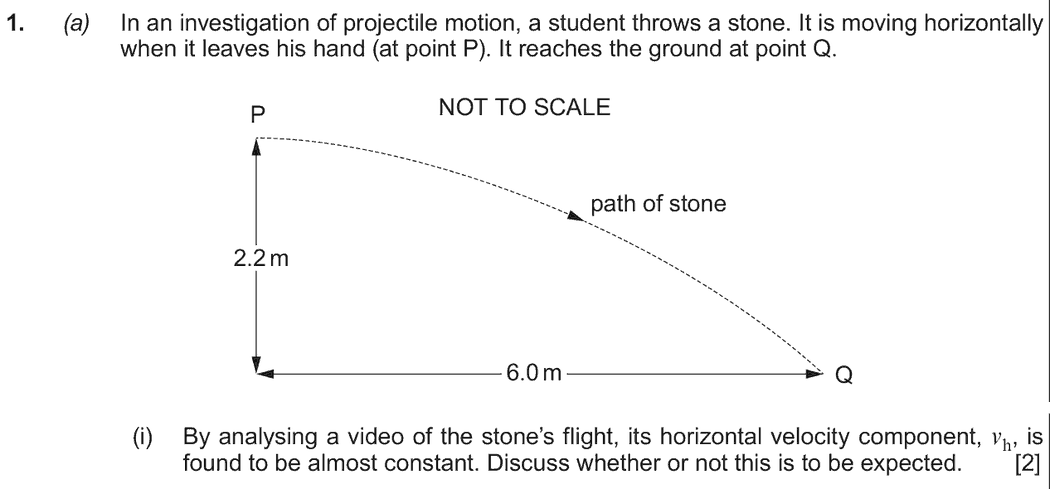
1. (a) In an investigation of projectile motion, a student throws a stone. It is moving horizontally when it leaves his hand (at point P). It reaches the ground at point Q. NOT TO SCALE P path of stone 2.2 m 6.0 m Q (i) By analysing a video of the stone’s flight, its horizontal velocity component, vh, is found to be almost constant. Discuss whether or not this is to be expected. [2]
June 2019 · Component 1 · Q1(a)(ii) 3 marks AO3=3 Calculation kinematics
Earlier part of question 1 that this part usesEarlier part of June 2019 Component 1 question 1
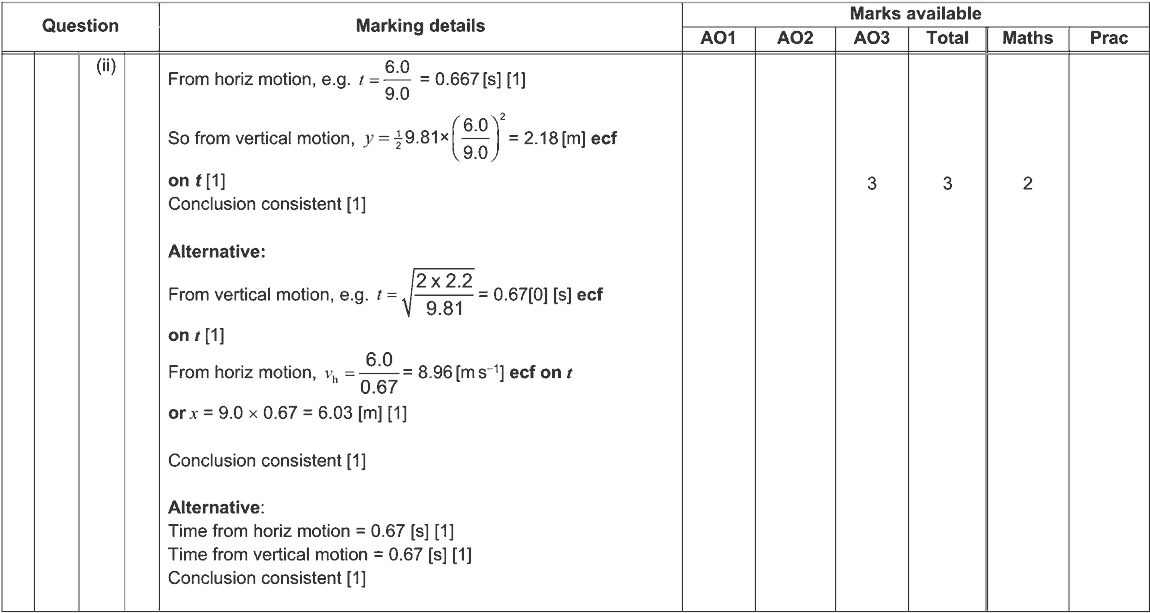
(ii) The approximate value of vh obtained from the video was 9.0 m s–1. Determine whether this value is consistent with the measured distances recorded in the diagram. Show your reasoning clearly. [3]
June 2019 · Component 1 · Q1(b) 4 marks AO2=4 Calculation kinematicsbasic physics
Earlier part of question 1 that this part usesEarlier part of June 2019 Component 1 question 1
(b) Calculate the magnitude and direction of the stone’s velocity just before it hits the ground. [4]
June 2019 · Component 1 · Q2(a) 1 mark AO2=1 Explanation basic physics
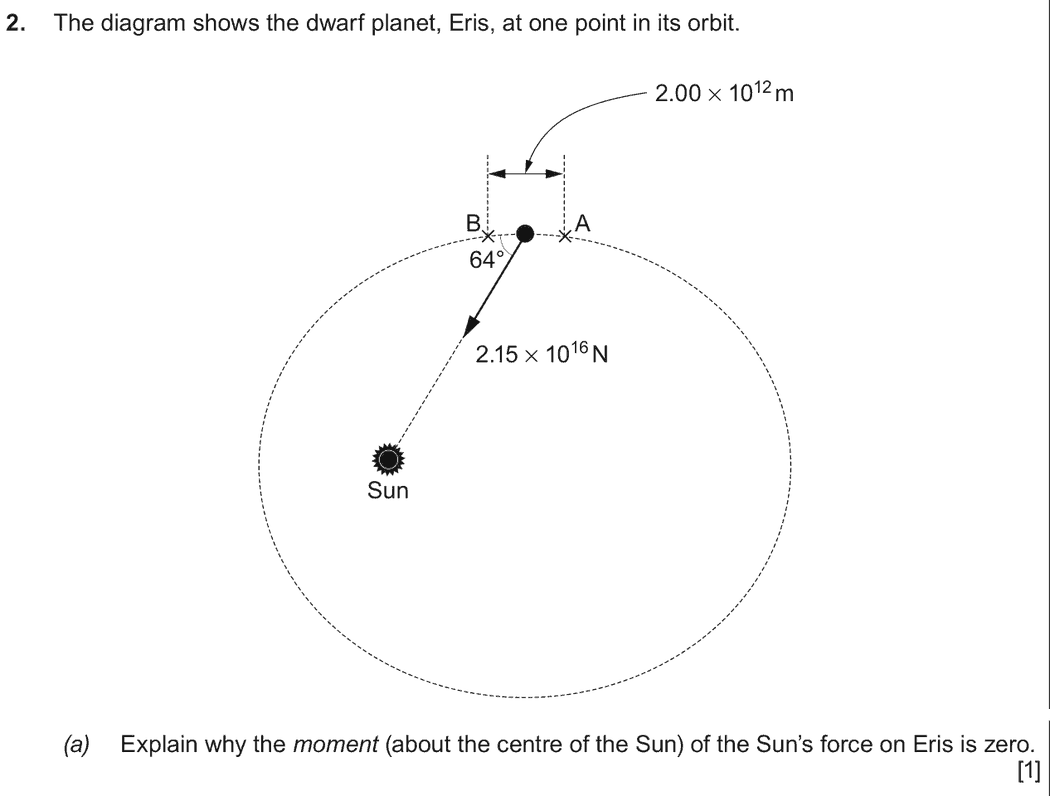
2. The diagram shows the dwarf planet, Eris, at one point in its orbit. 2.00 × 10¹² m B A 64° 2.15 × 10¹⁶ N Sun (a) Explain why the moment (about the centre of the Sun) of the Sun’s force on Eris is zero. [1]
June 2019 · Component 1 · Q2(b) 2 marks AO1=1, AO2=1 Calculation energy concepts
Earlier part of question 2 that this part usesEarlier part of June 2019 Component 1 question 2
(b) Calculate the work done by the Sun’s gravitational force on Eris as Eris moves from A to B. The mean values of the force and the angle at which it acts are shown on the diagram. [2]
June 2019 · Component 1 · Q2(c) 3 marks AO3=3 Calculation energy concepts
Earlier part of question 2 that this part usesEarlier part of June 2019 Component 1 question 2
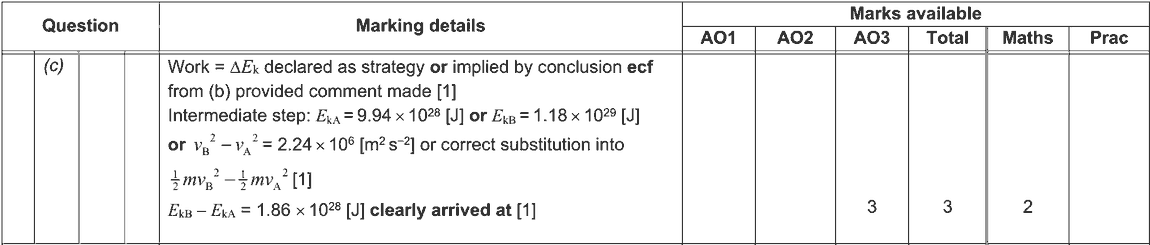
(c) Showing your reasoning clearly, determine whether your answer to (b) is consistent with these data: Mass of Eris = 1.66 × 10²² kg Speed of Eris at A = 3 460 m s–1 Speed of Eris at B = 3 770 m s–1 [3]
June 2019 · Component 1 · Q3(a) 2 marks AO1=2 Definition dynamics
3. (a) State the principle of conservation of momentum. [2]
June 2019 · Component 1 · Q3(b)(i) 3 marks AO2=3 Calculation dynamics
Earlier part of question 3 that this part usesEarlier part of June 2019 Component 1 question 3
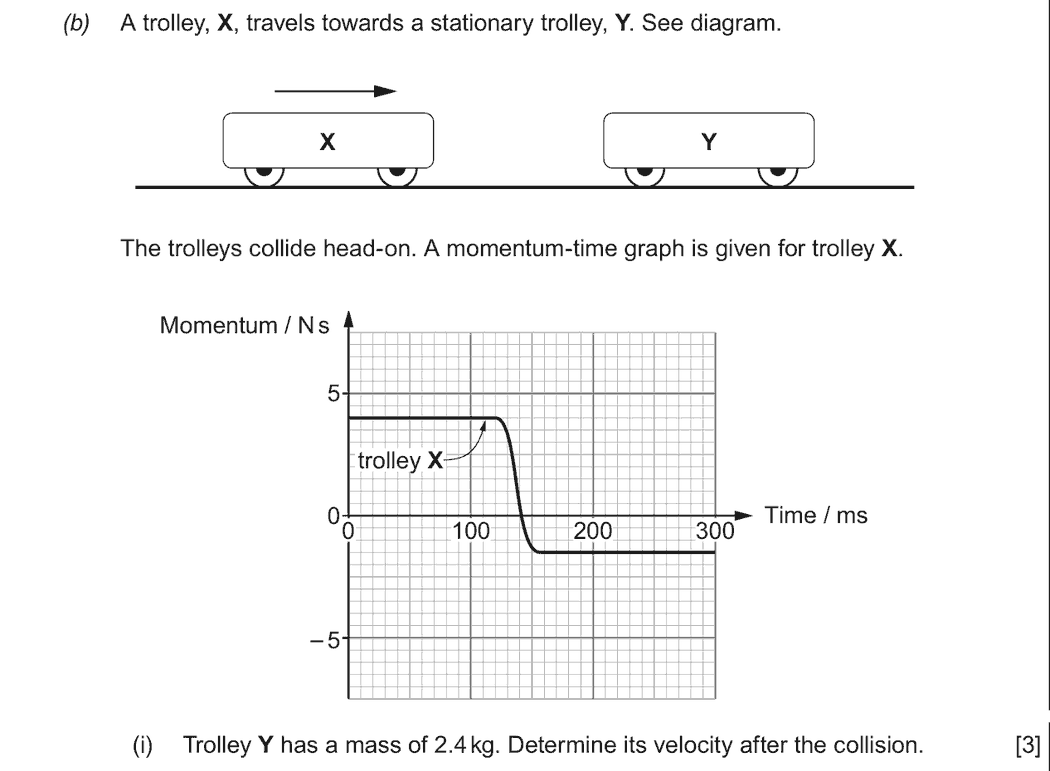
(b) A trolley, X, travels towards a stationary trolley, Y. See diagram. X Y The trolleys collide head-on. A momentum-time graph is given for trolley X. Momentum / N s 5 trolley X 0 Time / ms 0 100 200 300 – 5 (i) Trolley Y has a mass of 2.4 kg. Determine its velocity after the collision. [3]
June 2019 · Component 1 · Q3(b)(ii) 3 marks AO2=3 Diagram or graph dynamics
Earlier parts of question 3 that this part usesEarlier part of June 2019 Component 1 question 3Earlier part of June 2019 Component 1 question 3
(ii) Using the same graph grid (opposite) carefully sketch a graph of Y’s momentum between 0 and 300 ms. [3]
June 2019 · Component 1 · Q3(b)(iii) 2 marks AO2=2 Calculation dynamics
Earlier parts of question 3 that this part usesEarlier part of June 2019 Component 1 question 3Earlier part of June 2019 Component 1 question 3
(iii) Use the momentum-time graph for X to estimate the mean force on X during the collision. [2]
June 2019 · Component 1 · Q4(a)(i)I 2 marks AO1=1, AO2=1 Calculation circular motion
4. (a) A fairground ride rotates at a rate of 8.20 revolutions per minute. (i) Calculate: I. the angular velocity in radians per second; [2]
June 2019 · Component 1 · Q4(a)(i)II 2 marks AO1=1, AO2=1 Calculation circular motion
Earlier part of question 4 that this part usesEarlier part of June 2019 Component 1 question 4
II. the time taken to travel an arc of length 10.0 m for a point P on the ride at 3.80 m from the central axis around which the ride is rotating; [2]
June 2019 · Component 1 · Q4(a)(i)III 2 marks AO1=1, AO2=1 Calculation circular motion
Earlier part of question 4 that this part usesEarlier part of June 2019 Component 1 question 4
III. the acceleration of point P. [2]
June 2019 · Component 1 · Q4(a)(ii)I 2 marks AO2=2 Calculation basic physics
Earlier part of question 4 that this part usesEarlier part of June 2019 Component 1 question 4
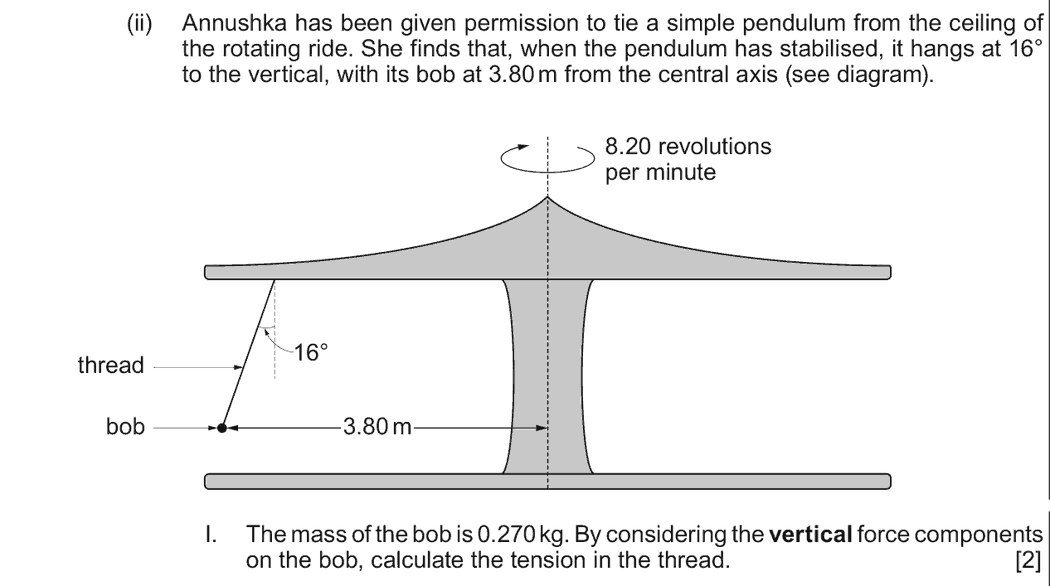
(ii) Annushka has been given permission to tie a simple pendulum from the ceiling of the rotating ride. She finds that, when the pendulum has stabilised, it hangs at 16° to the vertical, with its bob at 3.80 m from the central axis (see diagram). 8.20 revolutions per minute 16° thread bob 3.80 m I. The mass of the bob is 0.270 kg. By considering the vertical force components on the bob, calculate the tension in the thread. [2]
June 2019 · Component 1 · Q4(a)(ii)II 3 marks AO3=3 Calculation circular motion
Earlier parts of question 4 that this part usesEarlier part of June 2019 Component 1 question 4Earlier part of June 2019 Component 1 question 4
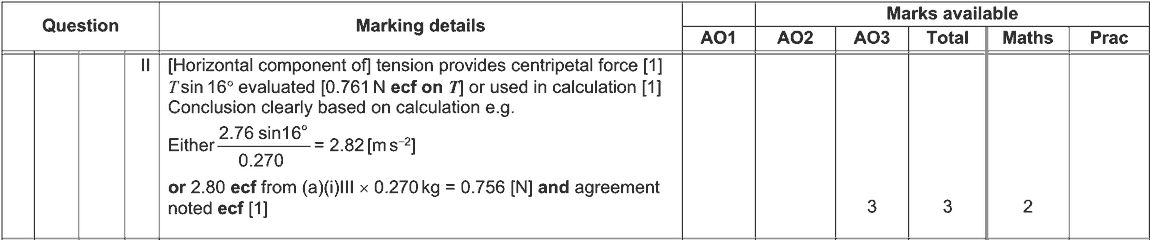
II. State what provides the centripetal force on the bob and show clearly whether or not this is consistent with the acceleration calculated in (a)(i)III. [3]
June 2019 · Component 1 · Q4(b) 3 marks AO3=3 Explanation circular motion
Earlier parts of question 4 that this part usesEarlier part of June 2019 Component 1 question 4Earlier part of June 2019 Component 1 question 4
(b) Discuss one way in which our knowledge of the magnitude of centripetal force has been applied in the design of roads or railways or a domestic appliance. [3]
June 2019 · Component 1 · Q5(a) 2 marks AO1=2 Definition vibrations
5. (a) Define simple harmonic motion. [2]
June 2019 · Component 1 · Q5(b)(i) 3 marks AO2=3 Calculation vibrations
Earlier part of question 5 that this part usesEarlier part of June 2019 Component 1 question 5
(b) A metal sphere of mass 0.175 kg hangs from a spring whose top end is clamped. The sphere is set oscillating up and down, and a displacement-time graph is plotted. 0.05 x / m 0 0 1.0 2.0 t / s – 0.05 Kinetic energy 0 0 1.0 2.0 t / s GRID FOR (b)(iii) (i) Calculate the stiffness constant, k, of the spring. [3]
June 2019 · Component 1 · Q5(b)(ii) 3 marks AO1=2, AO2=1 Calculation vibrations
Earlier parts of question 5 that this part usesEarlier part of June 2019 Component 1 question 5Earlier part of June 2019 Component 1 question 5
(ii) Calculate the maximum kinetic energy of the sphere. [3]
June 2019 · Component 1 · Q5(b)(iii) 3 marks AO1=2, AO2=1 Diagram or graph vibrations
Earlier parts of question 5 that this part usesEarlier part of June 2019 Component 1 question 5Earlier part of June 2019 Component 1 question 5
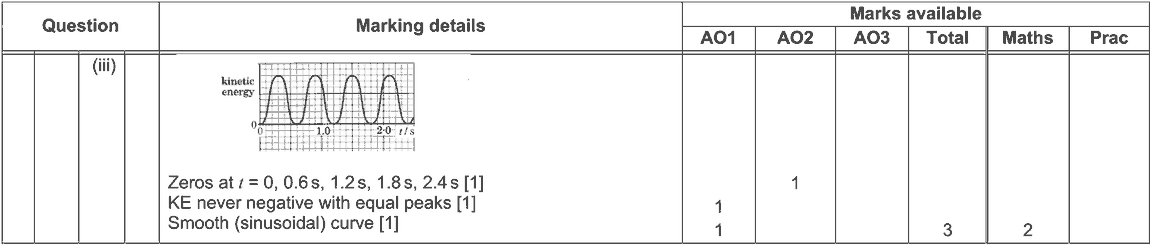
(iii) Carefully sketch a graph of the sphere’s kinetic energy against time on the axes provided on the opposite page. A vertical scale is not needed. [3]
June 2019 · Component 1 · Q5(c) 5 marks AO3=5 Practical and data analysis vibrations
Earlier parts of question 5 that this part usesEarlier part of June 2019 Component 1 question 5Earlier part of June 2019 Component 1 question 5
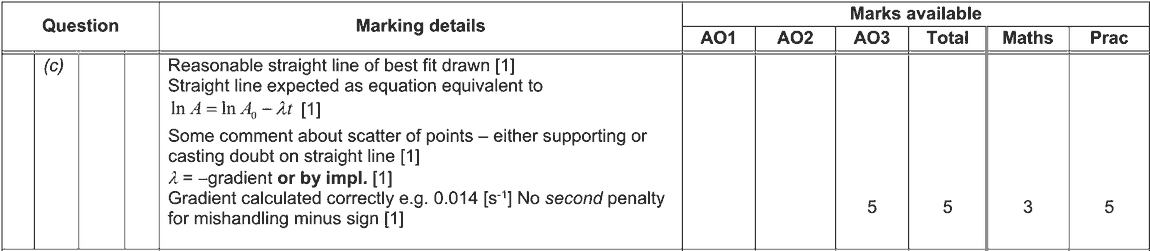
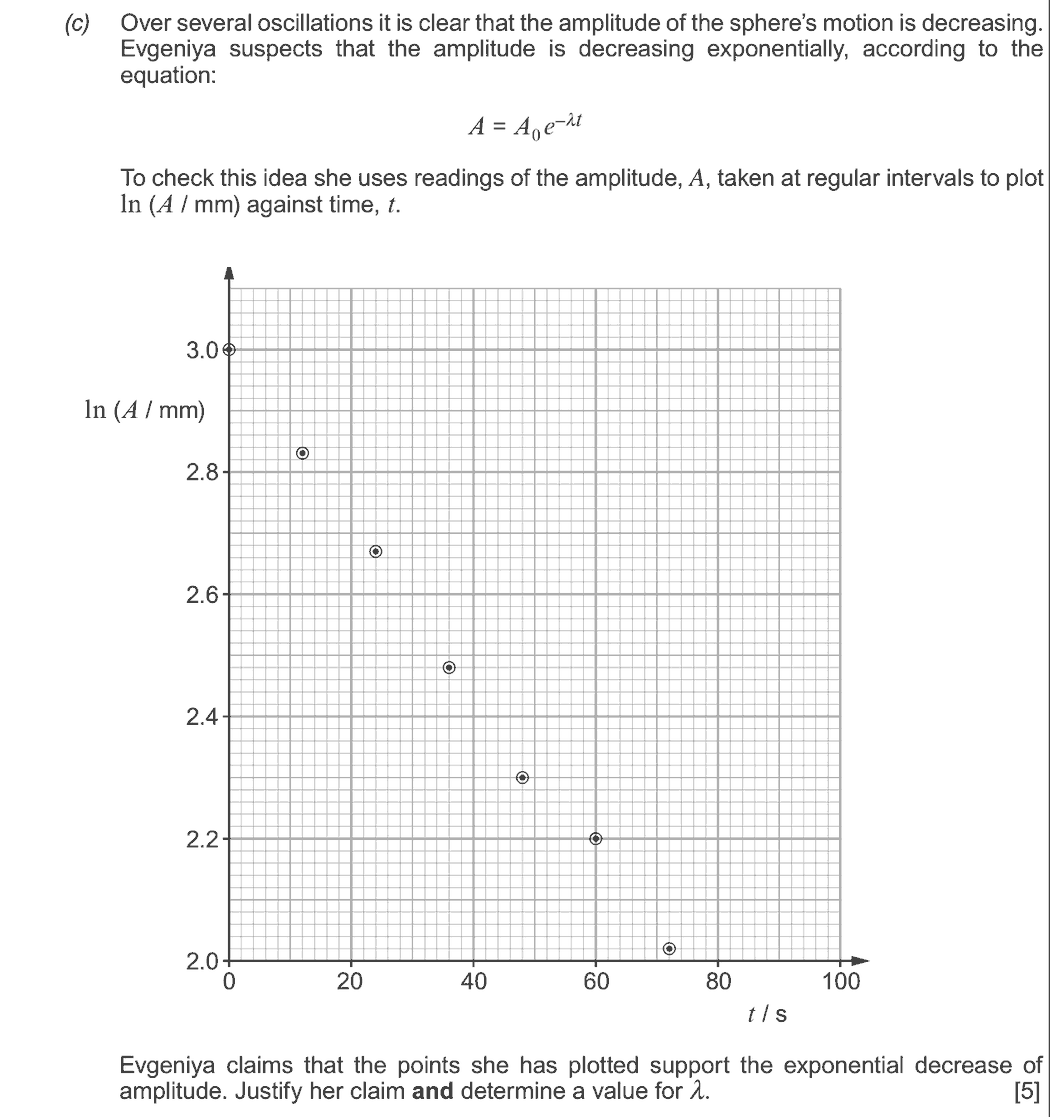
(c) Over several oscillations it is clear that the amplitude of the sphere’s motion is decreasing. Evgeniya suspects that the amplitude is decreasing exponentially, according to the equation: A = A0 e–λt To check this idea she uses readings of the amplitude, A, taken at regular intervals to plot ln (A / mm) against time, t. 3.0 ln (A / mm) 2.8 2.6 2.4 2.2 2.0 0 20 40 60 80 100 t / s Evgeniya claims that the points she has plotted support the exponential decrease of amplitude. Justify her claim and determine a value for λ. [5]
June 2019 · Component 1 · Q6(a)(i) 4 marks AO1=1, AO2=3 Practical and data analysis basic physics
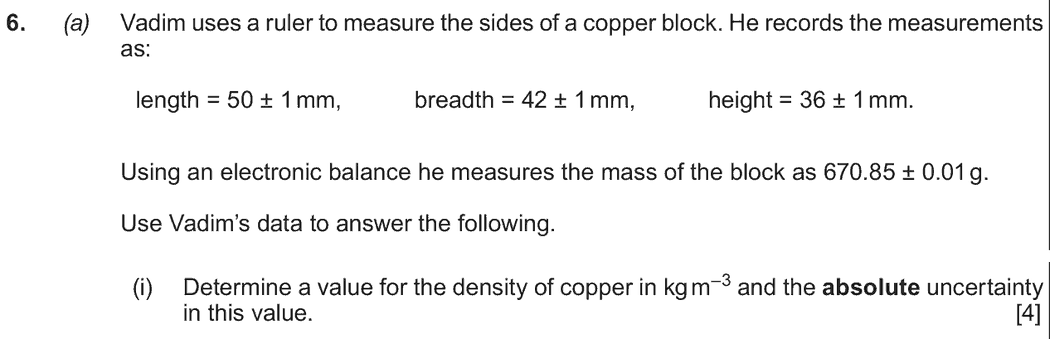
6. (a) Vadim uses a ruler to measure the sides of a copper block. He records the measurements as: length = 50 ± 1 mm, breadth = 42 ± 1 mm, height = 36 ± 1 mm. Using an electronic balance he measures the mass of the block as 670.85 ± 0.01 g. Use Vadim’s data to answer the following. (i) Determine a value for the density of copper in kg m–3 and the absolute uncertainty in this value. [4]
June 2019 · Component 1 · Q6(a)(ii) 2 marks AO2=2 Calculation kinetic theorybasic physics
Earlier part of question 6 that this part usesEarlier part of June 2019 Component 1 question 6
(ii) Determine the number of atoms per m3 of copper. The uncertainty is not required. The atomic mass of copper is 63.5 u. [2]
June 2019 · Component 1 · Q6(b)(i)I 3 marks AO2=3 Calculation kinetic theory
Earlier part of question 6 that this part usesEarlier part of June 2019 Component 1 question 6
(b) (i) I. Calculate the number of molecules per m3 for a gas (assumed to be ideal) at a temperature of 15 °C and a pressure of 101 kPa. [3]
June 2019 · Component 1 · Q6(b)(i)II 2 marks AO1=1, AO3=1 Explanation kinetic theory
Earlier parts of question 6 that this part usesEarlier part of June 2019 Component 1 question 6Earlier part of June 2019 Component 1 question 6
II. When asked why there are far fewer gas molecules per m3 than atoms per m3 in the copper block, a student replies, “Each molecule of the gas takes up much more space.” Discuss whether or not he is right. [2]
June 2019 · Component 1 · Q6(b)(ii)I 2 marks AO1=1, AO2=1 Show that kinetic theory
Earlier parts of question 6 that this part usesEarlier part of June 2019 Component 1 question 6Earlier part of June 2019 Component 1 question 6
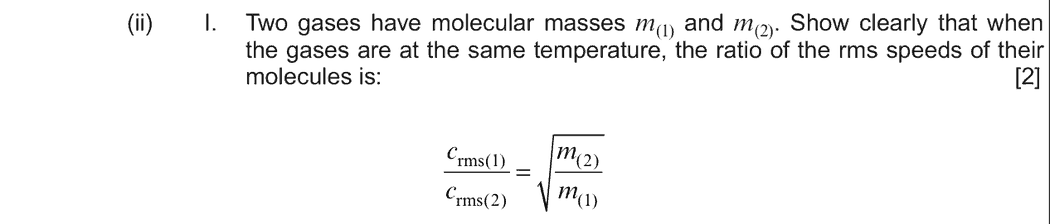
(ii) I. Two gases have molecular masses m(1) and m(2). Show clearly that when the gases are at the same temperature, the ratio of the rms speeds of their molecules is: [2] crms(1) m(2) = crms(2) m(1)
June 2019 · Component 1 · Q6(b)(ii)II 2 marks AO3=2 Calculation kinetic theory
Earlier parts of question 6 that this part usesEarlier part of June 2019 Component 1 question 6Earlier part of June 2019 Component 1 question 6Earlier part of June 2019 Component 1 question 6
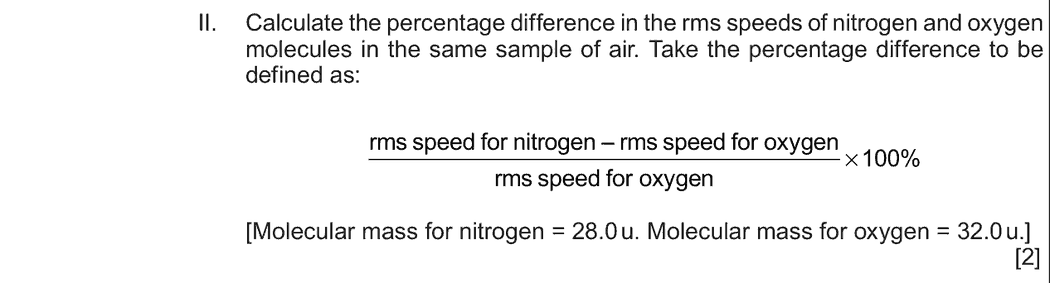
II. Calculate the percentage difference in the rms speeds of nitrogen and oxygen molecules in the same sample of air. Take the percentage difference to be defined as: rms speed for nitrogen – rms speed for oxygen ×100% rms speed for oxygen [Molecular mass for nitrogen = 28.0 u. Molecular mass for oxygen = 32.0 u.] [2]
June 2019 · Component 1 · Q7(a) 2 marks AO1=2 Definition thermal physics
7. (a) State what is meant by the heat, Q, entering a system. [2]
June 2019 · Component 1 · Q7(b)(i) 2 marks AO1=1, AO2=1 Calculation thermal physics
Earlier part of question 7 that this part usesEarlier part of June 2019 Component 1 question 7
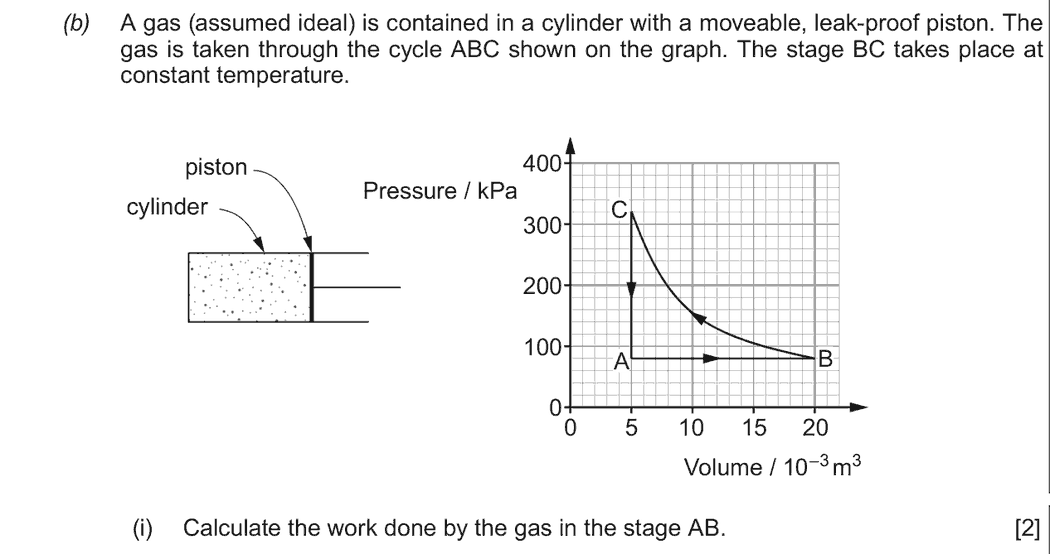
(b) A gas (assumed ideal) is contained in a cylinder with a moveable, leak-proof piston. The gas is taken through the cycle ABC shown on the graph. The stage BC takes place at constant temperature. piston 400 Pressure / kPa cylinder C 300 200 100 A B 0 0 5 10 15 20 Volume / 10–3 m3 (i) Calculate the work done by the gas in the stage AB. [2]
June 2019 · Component 1 · Q7(b)(ii) 6 marks AO1=6 6-mark extended response thermal physics
Earlier parts of question 7 that this part usesEarlier part of June 2019 Component 1 question 7Earlier part of June 2019 Component 1 question 7
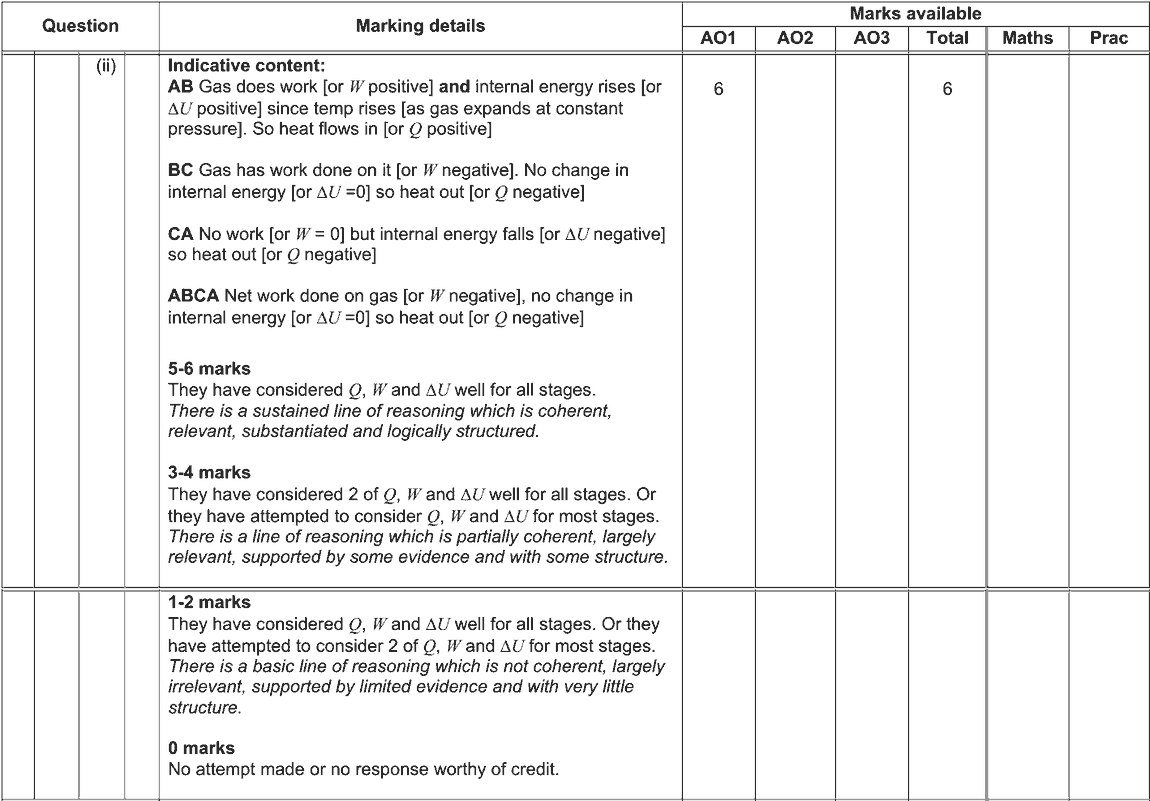
(ii) For each of the stages AB, BC and CA separately, and for the cycle as a whole, use the first law of thermodynamics to explain whether heat flows into the system or out of the system. Calculations are not required. [6 QER]
June 2019 · Component 1 · Q8(a) 1 mark AO2=1 Short answer comprehension
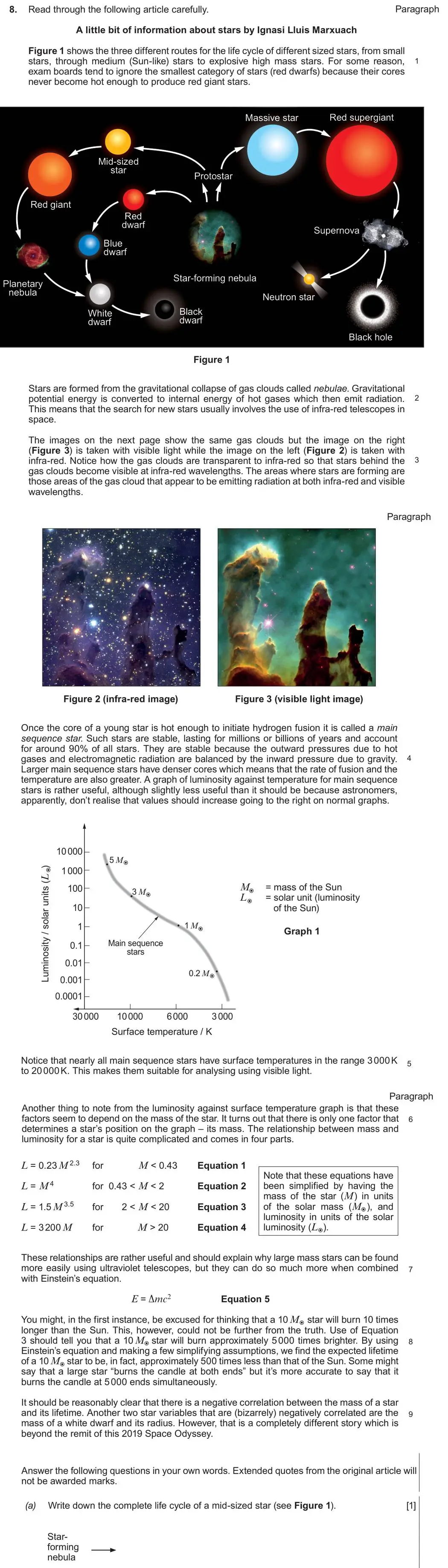
8. Read through the following article carefully. Paragraph A little bit of information about stars by Ignasi Lluis Marxuach Figure 1 shows the three different routes for the life cycle of different sized stars, from small stars, through medium (Sun-like) stars to explosive high mass stars. For some reason, 1 exam boards tend to ignore the smallest category of stars (red dwarfs) because their cores never become hot enough to produce red giant stars. Massive star Red supergiant Mid-sized star Protostar Red giant Red dwarf Supernova Blue dwarf Star-forming nebula Planetary nebula Neutron star White Black dwarf dwarf Black hole Figure 1 Stars are formed from the gravitational collapse of gas clouds called nebulae. Gravitational potential energy is converted to internal energy of hot gases which then emit radiation. 2 This means that the search for new stars usually involves the use of infra-red telescopes in space. The images on the next page show the same gas clouds but the image on the right (Figure 3) is taken with visible light while the image on the left (Figure 2) is taken with infra-red. Notice how the gas clouds are transparent to infra-red so that stars behind the 3 gas clouds become visible at infra-red wavelengths. The areas where stars are forming are those areas of the gas cloud that appear to be emitting radiation at both infra-red and visible wavelengths. Paragraph Figure 2 (infra-red image) Figure 3 (visible light image) Once the core of a young star is hot enough to initiate hydrogen fusion it is called a main sequence star. Such stars are stable, lasting for millions or billions of years and account for around 90% of all stars. They are stable because the outward pressures due to hot gases and electromagnetic radiation are balanced by the inward pressure due to gravity. 4 Larger main sequence stars have denser cores which means that the rate of fusion and the temperature are also greater. A graph of luminosity against temperature for main sequence stars is rather useful, although slightly less useful than it should be because astronomers, apparently, don’t realise that values should increase going to the right on normal graphs. 10 000 5 M ) 1 000 (L 100 M = mass of the Sun units 3 M L = solar unit (luminosity 10 of the Sun) solar 1 1 M Graph 1 / Luminosity 0.1 Main sequence stars 0.01 0.2 M 0.001 0.0001 30 000 10 000 6 000 3 000 Surface temperature / K Notice that nearly all main sequence stars have surface temperatures in the range 3 000 K 5 to 20 000 K. This makes them suitable for analysing using visible light. Paragraph Another thing to note from the luminosity against surface temperature graph is that these factors seem to depend on the mass of the star. It turns out that there is only one factor that 6 determines a star’s position on the graph – its mass. The relationship between mass and luminosity for a star is quite complicated and comes in four parts. L = 0.23 M 2.3 for M < 0.43 Equation 1 Note that these equations have L = M 4 for 0.43 < M < 2 Equation 2 been simplified by having the mass of the star (M) in units L = 1.5 M 3.5 for 2 < M < 20 Equation 3 of the solar mass (M ), and luminosity in units of the solar L = 3 200 M for M > 20 Equation 4 luminosity (L ). These relationships are rather useful and should explain why large mass stars can be found more easily using ultraviolet telescopes, but they can do so much more when combined 7 with Einstein’s equation. E = ∆mc2 Equation 5 You might, in the first instance, be excused for thinking that a 10 M star will burn 10 times longer than the Sun. This, however, could not be further from the truth. Use of Equation 3 should tell you that a 10 M star will burn approximately 5 000 times brighter. By using 8 Einstein’s equation and making a few simplifying assumptions, we find the expected lifetime of a 10 M star to be, in fact, approximately 500 times less than that of the Sun. Some might say that a large star “burns the candle at both ends” but it’s more accurate to say that it burns the candle at 5 000 ends simultaneously. It should be reasonably clear that there is a negative correlation between the mass of a star and its lifetime. Another two star variables that are (bizarrely) negatively correlated are the 9 mass of a white dwarf and its radius. However, that is a completely different story which is beyond the remit of this 2019 Space Odyssey. Answer the following questions in your own words. Extended quotes from the original article will not be awarded marks. (a) Write down the complete life cycle of a mid-sized star (see Figure 1). [1] Star- forming nebula
June 2019 · Component 1 · Q8(b) 1 mark AO3=1 Short answer radiation and starscomprehension
Earlier part of question 8 that this part usesEarlier part of June 2019 Component 1 question 8
(b) Suggest an advantage of placing telescopes in space to observe new stars (see Paragraph 2). [1]
June 2019 · Component 1 · Q8(c) 1 mark AO2=1 Short answer radiation and starscomprehension
Earlier part of question 8 that this part usesEarlier part of June 2019 Component 1 question 8
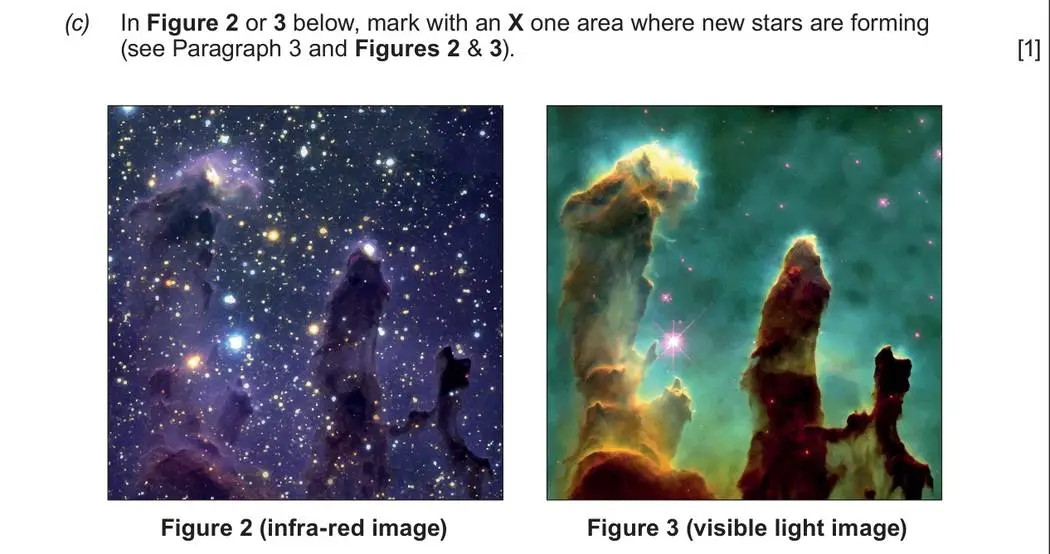
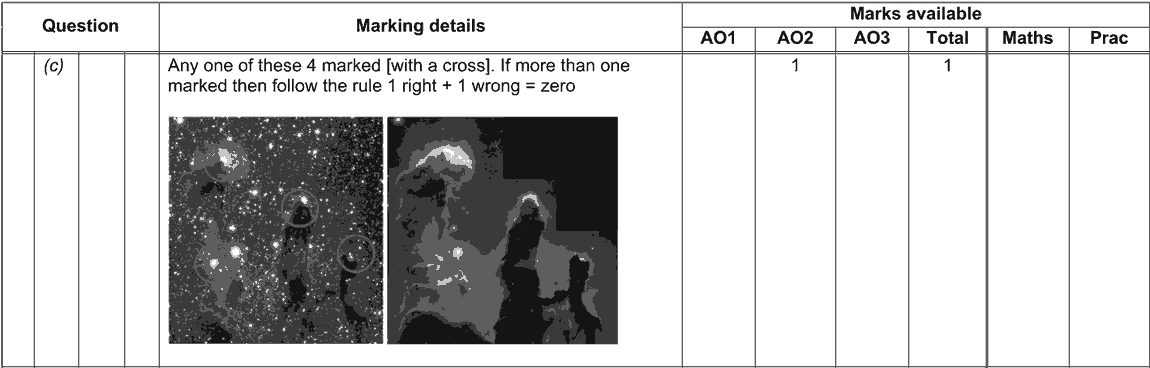
(c) In Figure 2 or 3 below, mark with an X one area where new stars are forming (see Paragraph 3 and Figures 2 & 3). [1] Figure 2 (infra-red image) Figure 3 (visible light image)
June 2019 · Component 1 · Q8(d) 3 marks AO1=2, AO2=1 Explanation photonscomprehension
Earlier parts of question 8 that this part usesEarlier part of June 2019 Component 1 question 8Earlier part of June 2019 Component 1 question 8
(d) Explain, using Newton’s 2nd law, how electromagnetic radiation exerts pressure inside a main sequence star (see Paragraph 4). [3]
June 2019 · Component 1 · Q8(e) 3 marks AO2=3 Explanation nuclear energyelectrostatic and gravitational fieldscomprehension
Earlier parts of question 8 that this part usesEarlier part of June 2019 Component 1 question 8Earlier part of June 2019 Component 1 question 8
(e) Explain why a more massive star has a higher density in its core and why this leads to a higher temperature (see Paragraph 4). [3]
June 2019 · Component 1 · Q8(f)(i) 2 marks AO1=1, AO2=1 Show that radiation and starscomprehension
Earlier parts of question 8 that this part usesEarlier part of June 2019 Component 1 question 8Earlier part of June 2019 Component 1 question 8
(f) (i) Show that the wavelength of maximum emission for the hottest main sequence stars is approximately 150 nm (see Paragraph 5 or Graph 1). [2]
June 2019 · Component 1 · Q8(f)(ii) 2 marks AO3=2 Explanation radiation and starsphotonscomprehension
Earlier parts of question 8 that this part usesEarlier part of June 2019 Component 1 question 8Earlier part of June 2019 Component 1 question 8Earlier part of June 2019 Component 1 question 8
(ii) Discuss whether or not it is appropriate to analyse the hottest main sequence stars using visible light when their wavelength of maximum emission is 150 nm (see Paragraph 5). [2]
June 2019 · Component 1 · Q8(g) 2 marks AO3=2 Calculation radiation and starscomprehension
Earlier parts of question 8 that this part usesEarlier part of June 2019 Component 1 question 8Earlier part of June 2019 Component 1 question 8
(g) Determine whether or not the star of mass 0.2 M is plotted at approximately the correct luminosity in Graph 1 (see Equations 1–4 and Graph 1). [2]
June 2019 · Component 1 · Q8(h) 4 marks AO2=4 Explanation nuclear energyenergy conceptscomprehension
Earlier parts of question 8 that this part usesEarlier part of June 2019 Component 1 question 8Earlier part of June 2019 Component 1 question 8
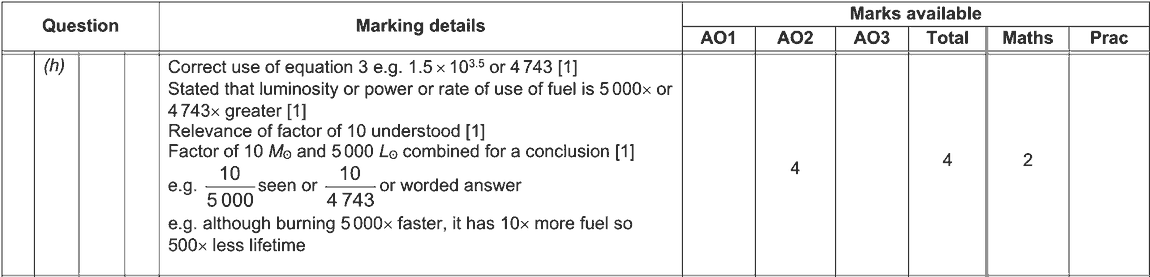
(h) Explain why a 10 M star has a lifetime that is 500 times shorter than that of the Sun, including any simplifying assumptions (see Paragraph 8 and Equations 1–5). [4]
June 2019 · Component 1 · Q8(i) 1 mark AO1=1 Short answer comprehension
Earlier parts of question 8 that this part usesEarlier part of June 2019 Component 1 question 8Earlier part of June 2019 Component 1 question 8
(i) Explain briefly what the author means when he states that a white dwarf’s mass and radius are negatively correlated (see Paragraph 9). [1]

Work with an Eduqas physics tutor

Want a paper marked and gone through with you? Message us.

Prefer email? Send an enquiry

If you are under 18, please include a parent's contact details. Enquiries go to enquiries@physicsaleveltutor.com and are deleted once handled. All tutoring is online.