June 2023: Component 3

120 marks for each student (100 in Section A plus one 20-mark option; all four options are here) · 65 question parts · Paper, mark scheme and report on Eduqas's site · Have the Data Booklet beside you

Question by question

QTopicMarksAOType
1(a) The nature of waves 2AO1=2Definition
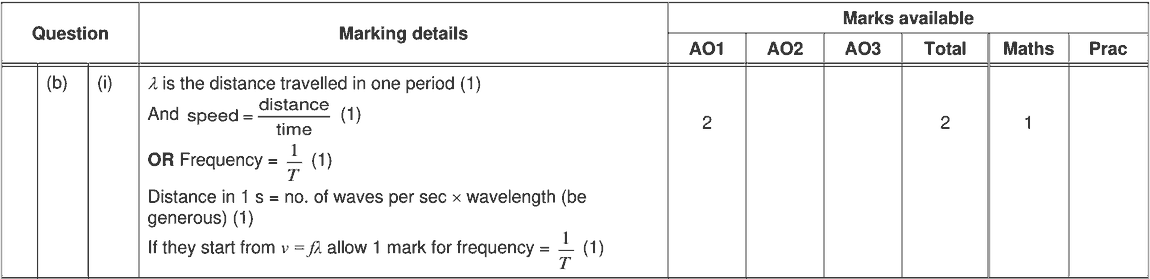
1(b)(i) The nature of waves 2AO1=2Explanation
1(b)(ii) The nature of waves 2AO2=2Calculation
1(b)(iii) The nature of waves 3AO1=1,AO2=2Calculation
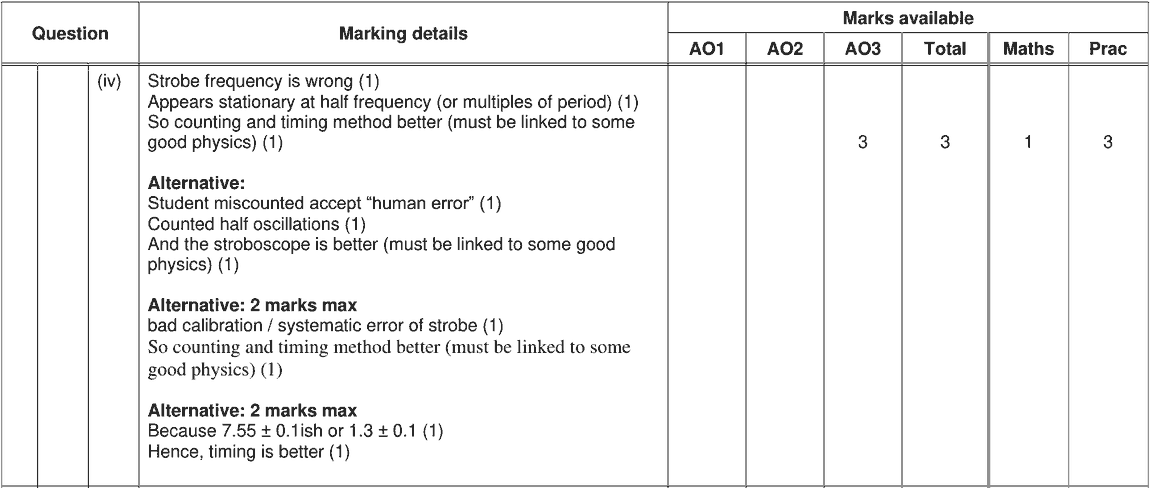
1(b)(iv) The nature of waves 3AO3=3Explanation
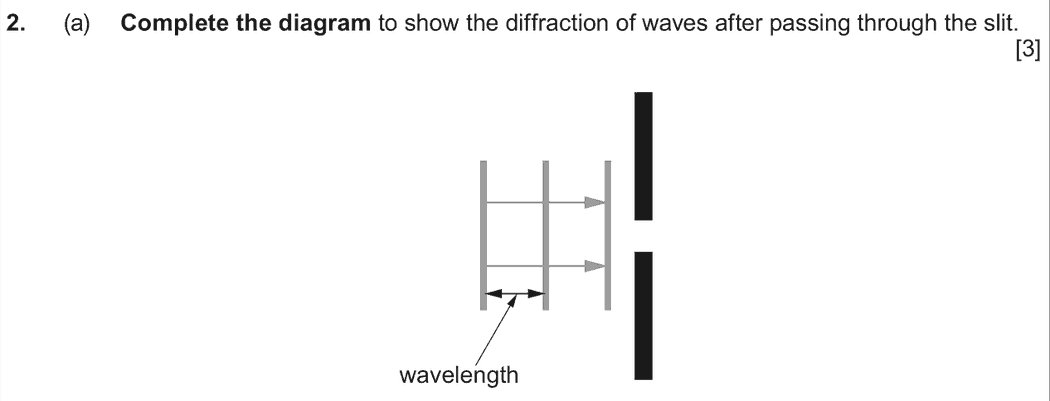
2(a) Wave properties: diffraction, interference and stationary waves 3AO1=3Diagram or graph
2(b) Wave properties: diffraction, interference and stationary waves 2AO2=2Explanation
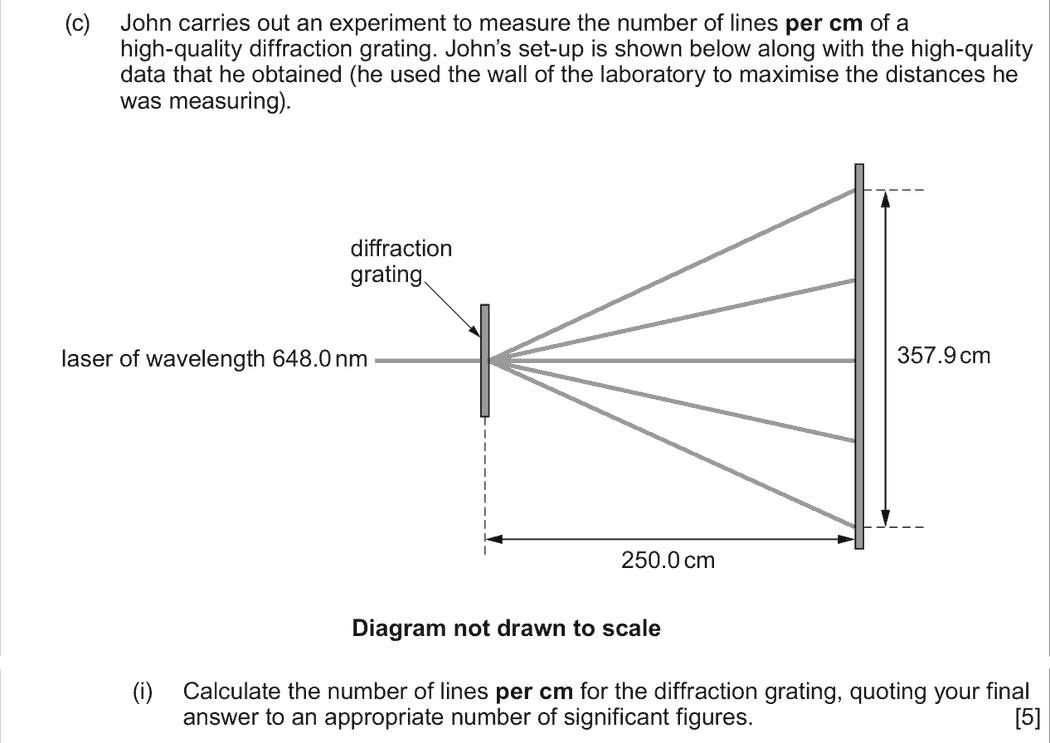
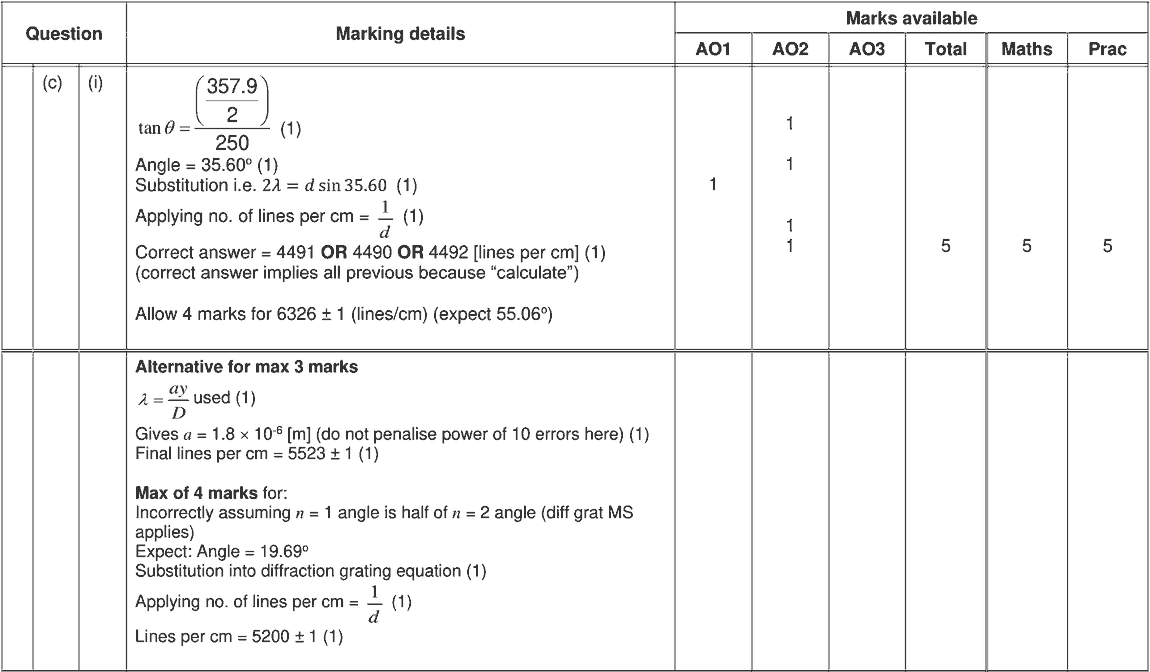
2(c)(i) Wave properties: diffraction, interference and stationary waves 5AO1=1,AO2=4Calculation
2(c)(ii) Wave properties: diffraction, interference and stationary waves 2AO3=2Practical and data analysis
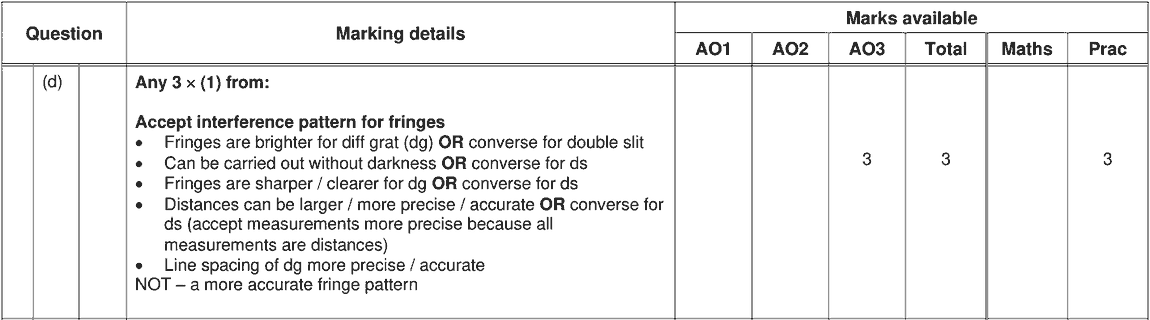
2(d) Wave properties: diffraction, interference and stationary waves 3AO3=3Explanation
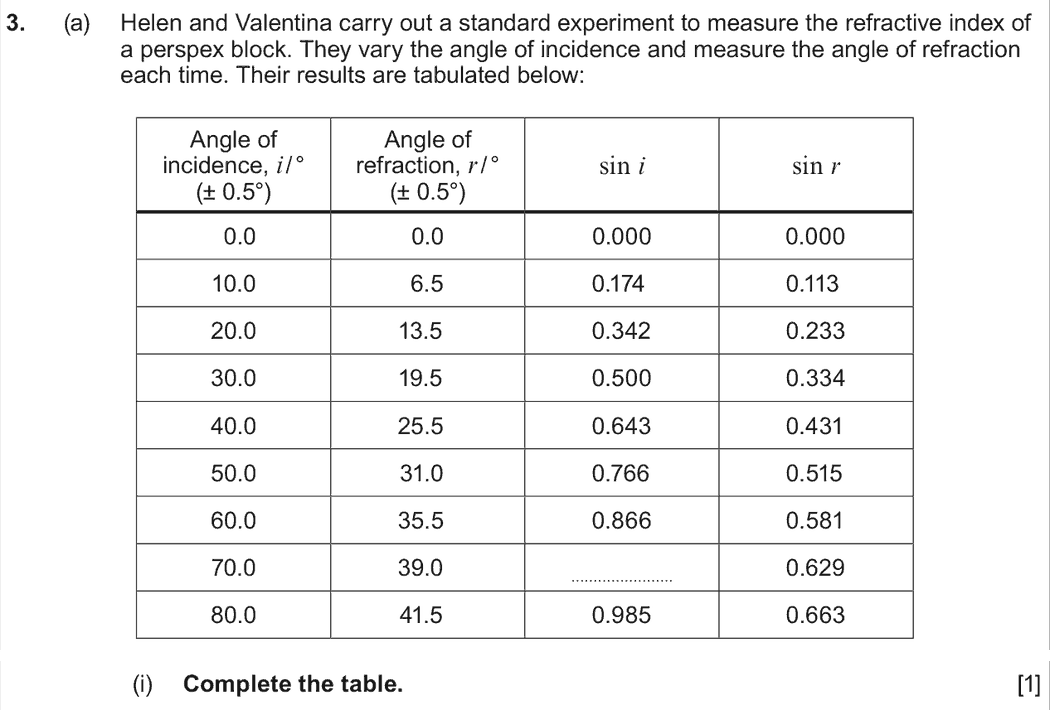
3(a)(i) Refraction of light 1AO2=1Short answer
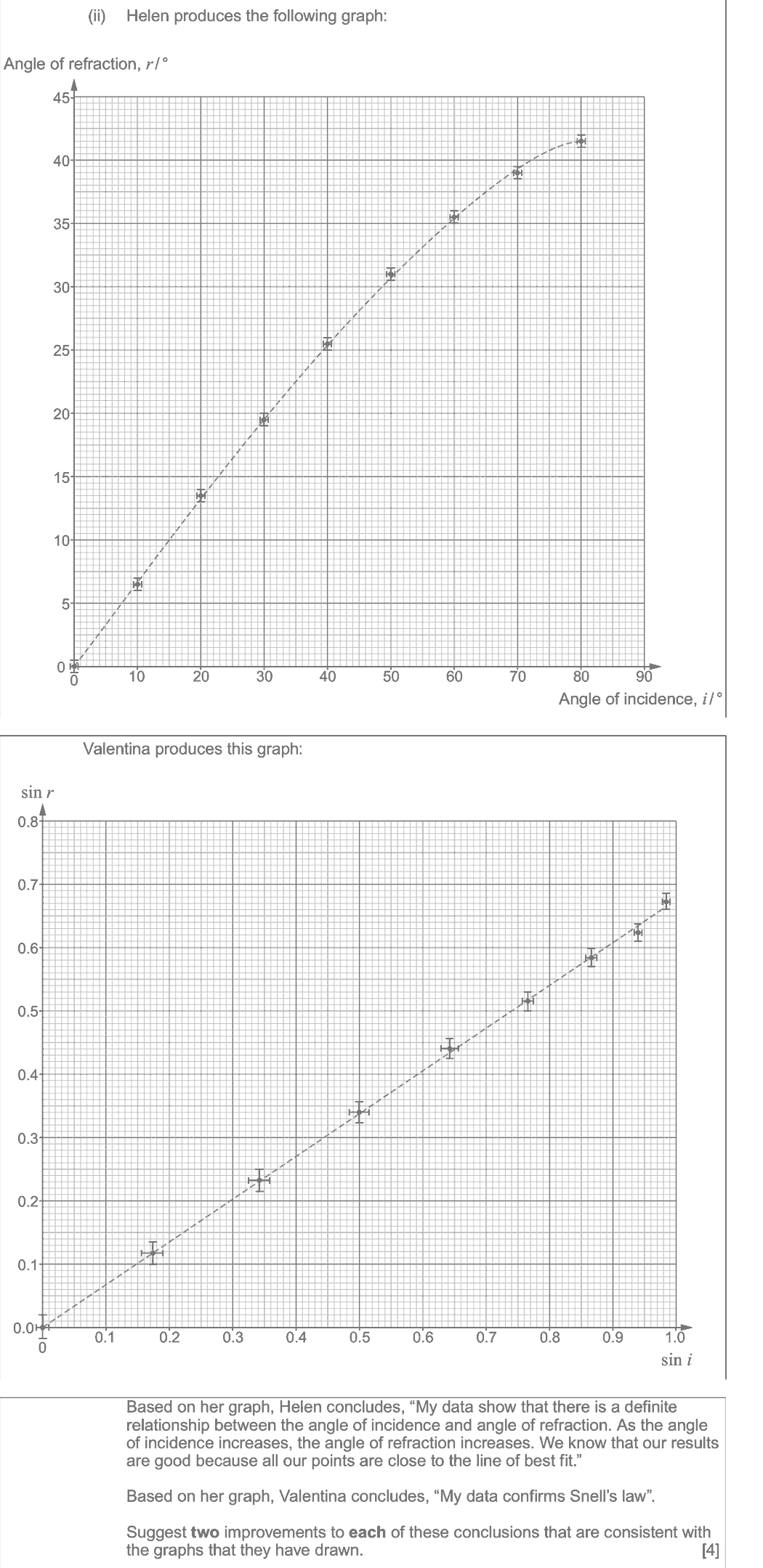
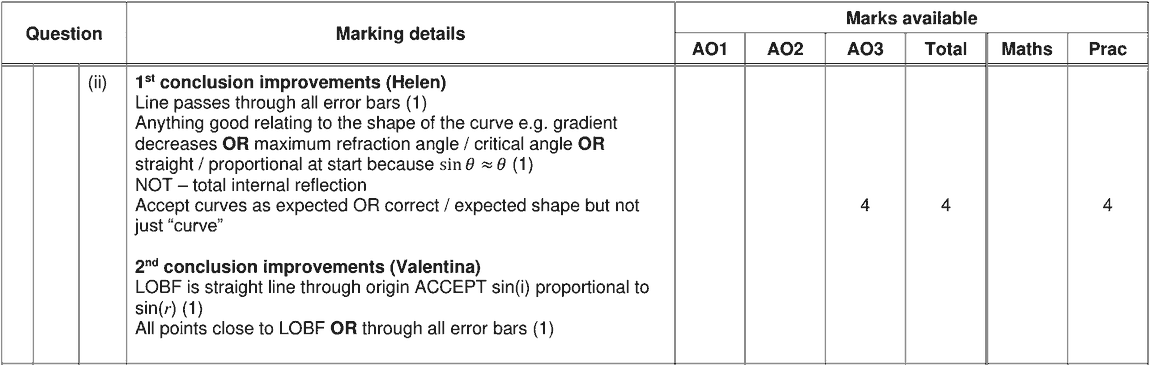
3(a)(ii) Refraction of light 4AO3=4Practical and data analysis
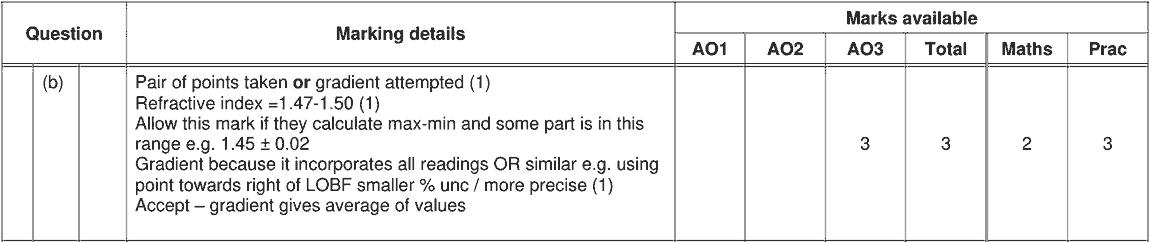
3(b) Refraction of light 3AO3=3Practical and data analysis
4(a)(i) Photons 1AO1=1Short answer
4(a)(ii) Photons 1AO1=1Short answer
4(b)(i) Photons 2AO1=2Definition
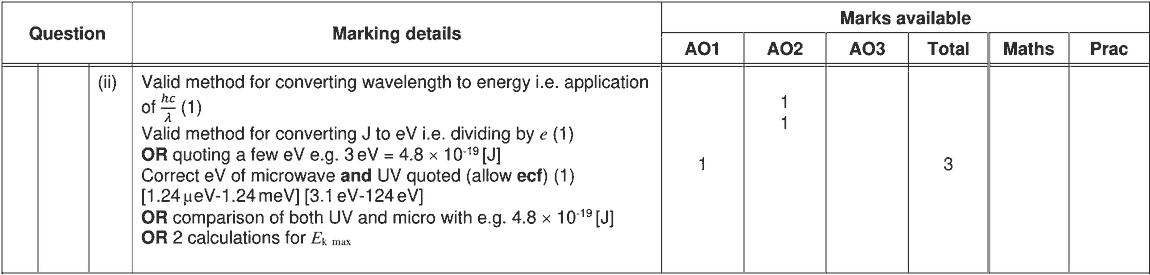
4(b)(ii) Photons 3AO1=1,AO2=2Calculation
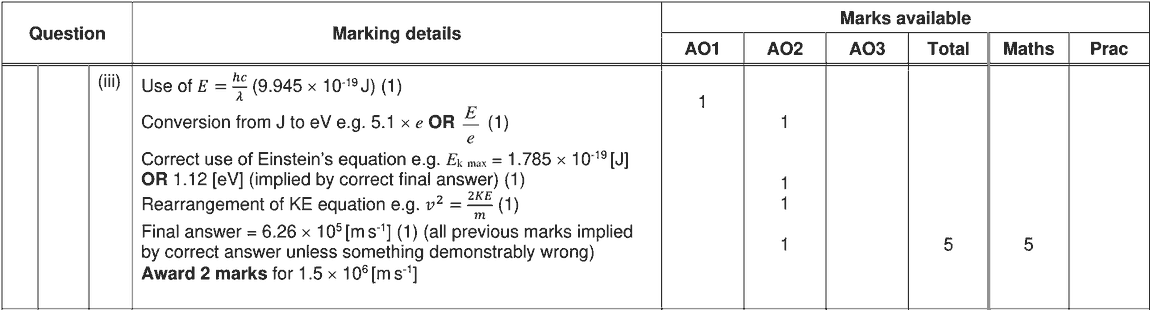
4(b)(iii) Photons 5AO1=1,AO2=4Calculation
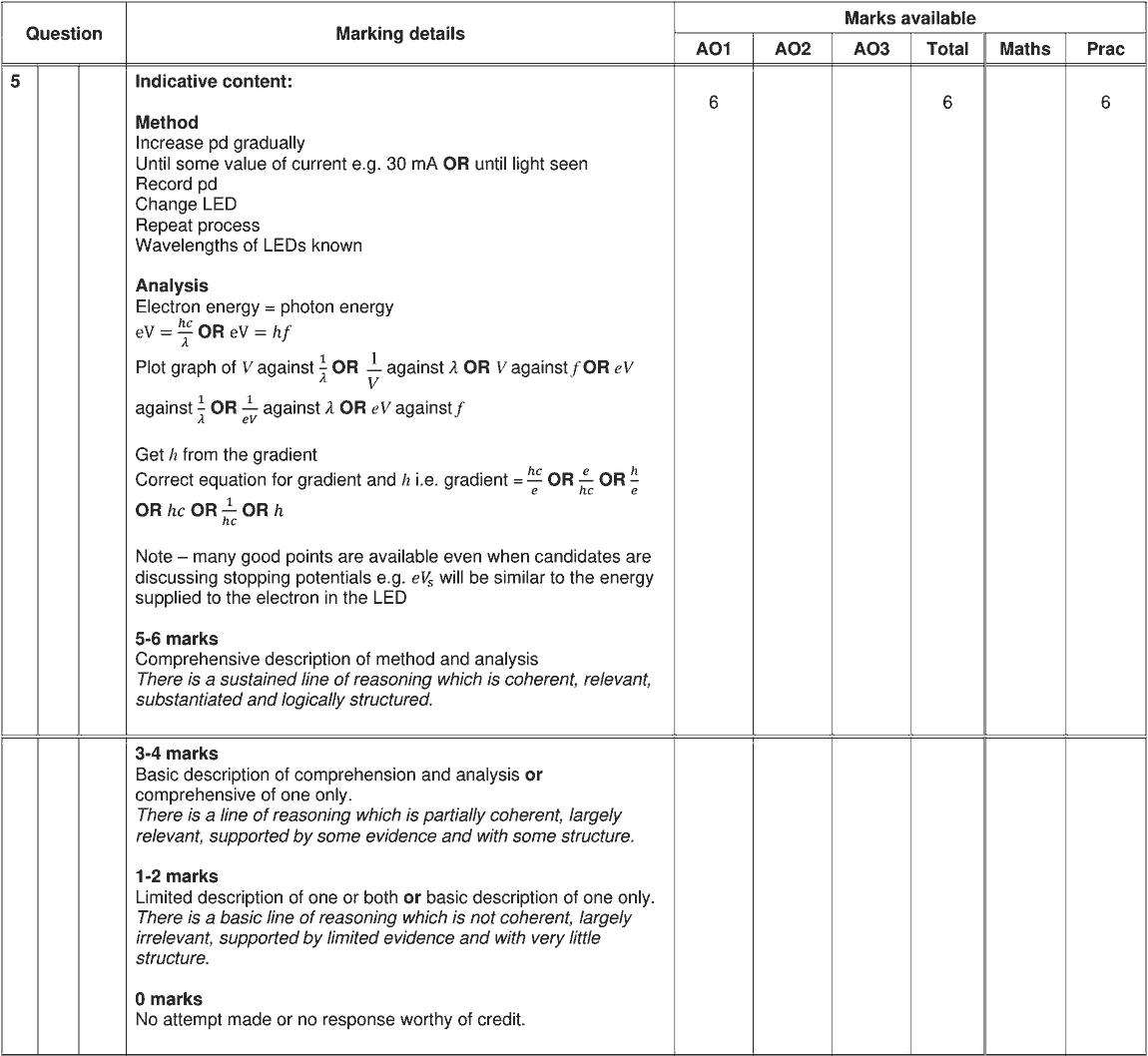
5 Photons 6AO1=6Extended response
6(a) Lasers 1AO1=1Definition
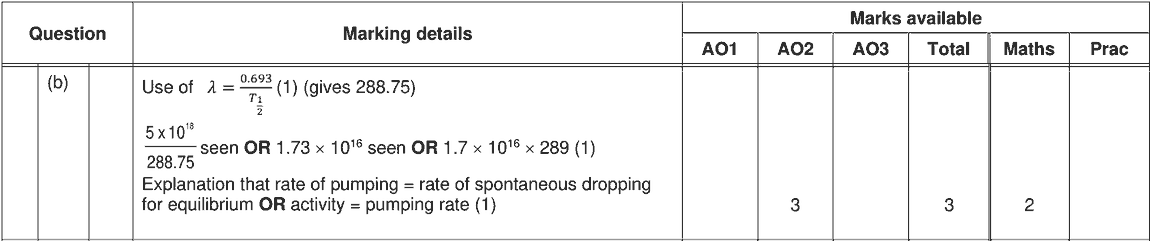
6(b) Nuclear decay 3AO2=3Calculation
6(c) Lasers 3AO1=2,AO2=1Explanation
7(a)(i) Nuclear decay 2AO2=2Short answer
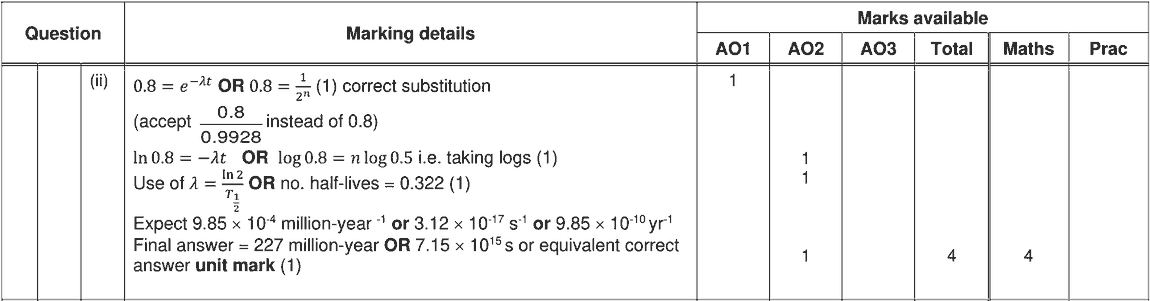
7(a)(ii) Nuclear decay 4AO1=1,AO2=3Calculation
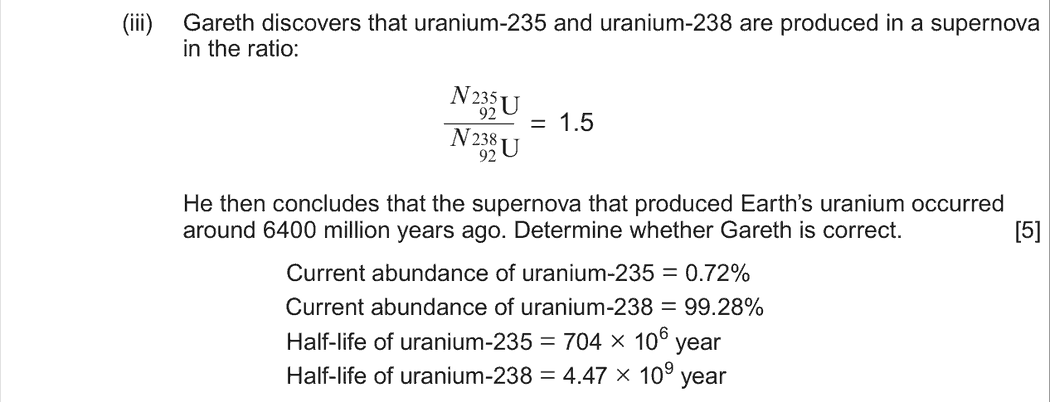
7(a)(iii) Nuclear decay 5AO3=5Calculation
7(b) Nuclear decay 3AO3=3Short answer
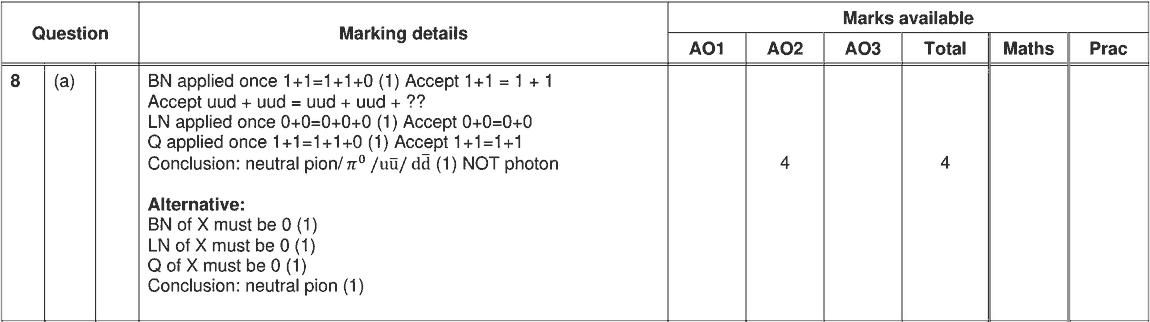
8(a) Particles and nuclear structure 4AO2=4Explanation
8(b) Nuclear energy 3AO2=3Calculation
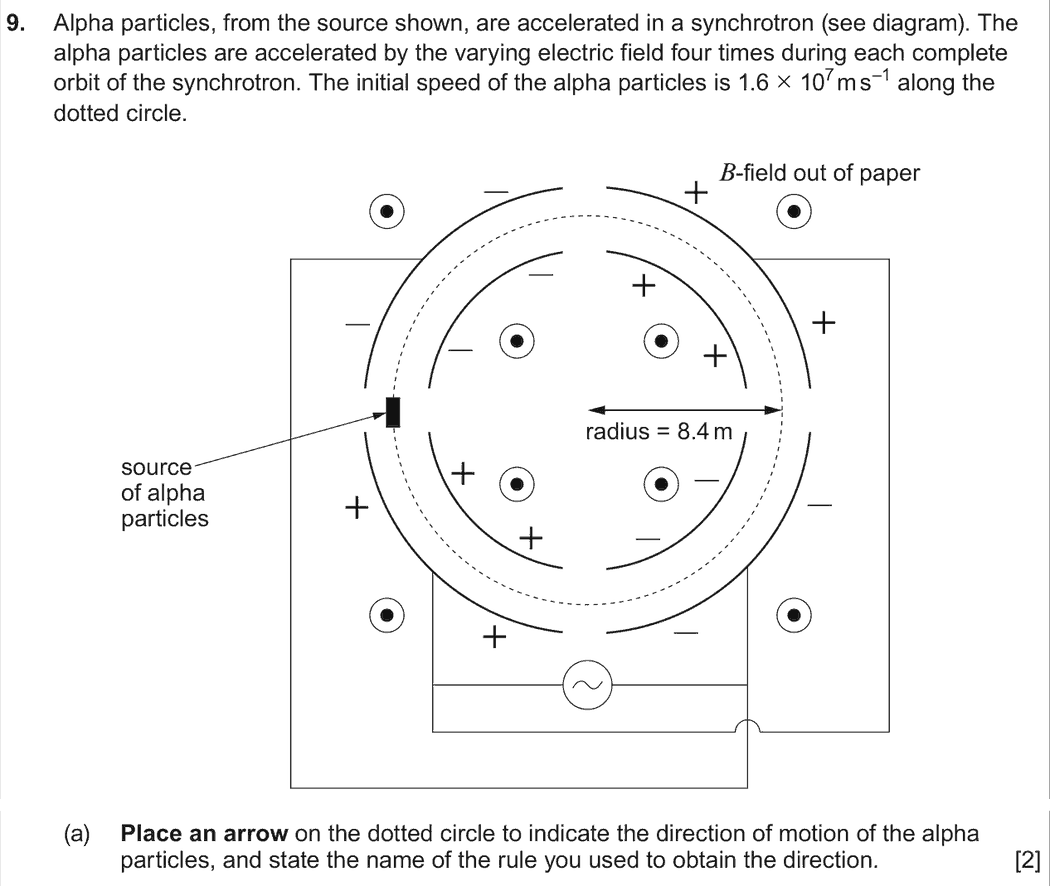
9(a) Magnetic fields 2AO1=1,AO2=1Short answer
9(b) Magnetic fields 3AO1=1,AO2=2Calculation
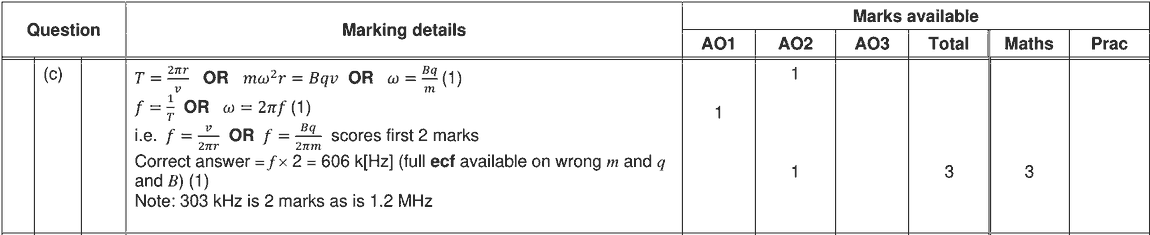
9(c) Magnetic fields 3AO1=1,AO2=2Calculation
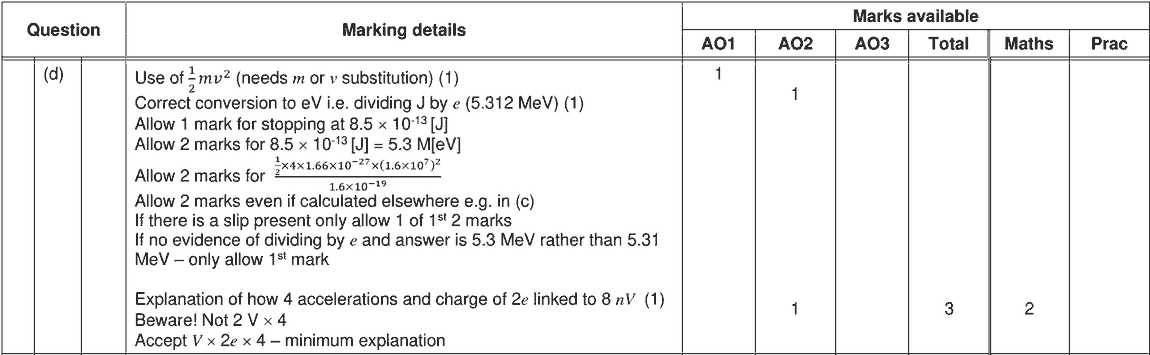
9(d) Magnetic fields, Energy concepts 3AO1=1,AO2=2Explanation
10(a)(i) Electromagnetic induction 1AO2=1Explanation
10(a)(ii) Electromagnetic induction 2AO1=1,AO2=1Explanation
10(a)(iii) Electromagnetic induction 3AO2=3Calculation
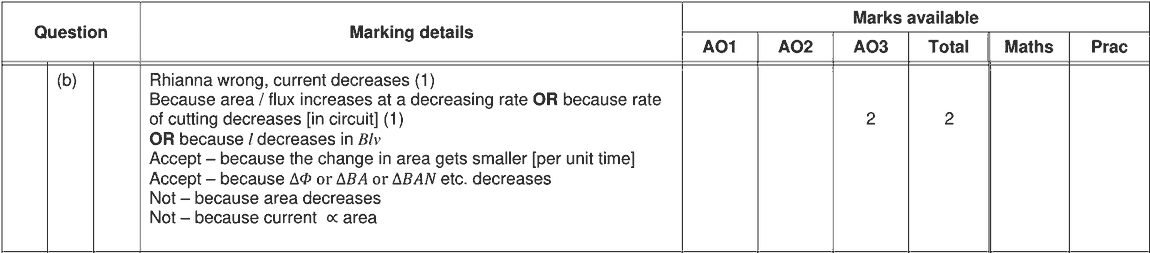
10(b) Electromagnetic induction 2AO3=2Explanation
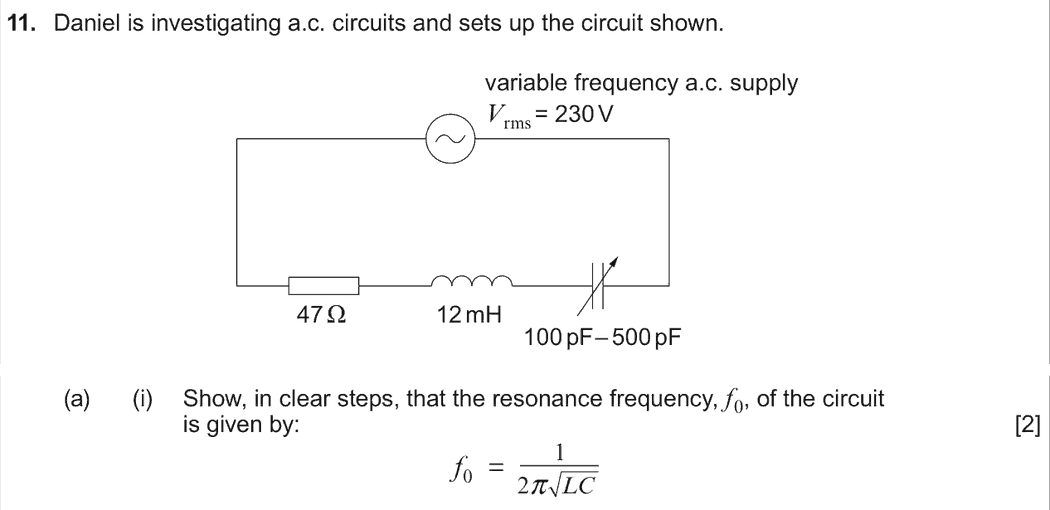
11(a)(i) Alternating currents 2AO1=1,AO2=1Show that
11(a)(ii) Alternating currents 2AO2=2Calculation
11(a)(iii) Alternating currents 2AO1=1,AO2=1Explanation
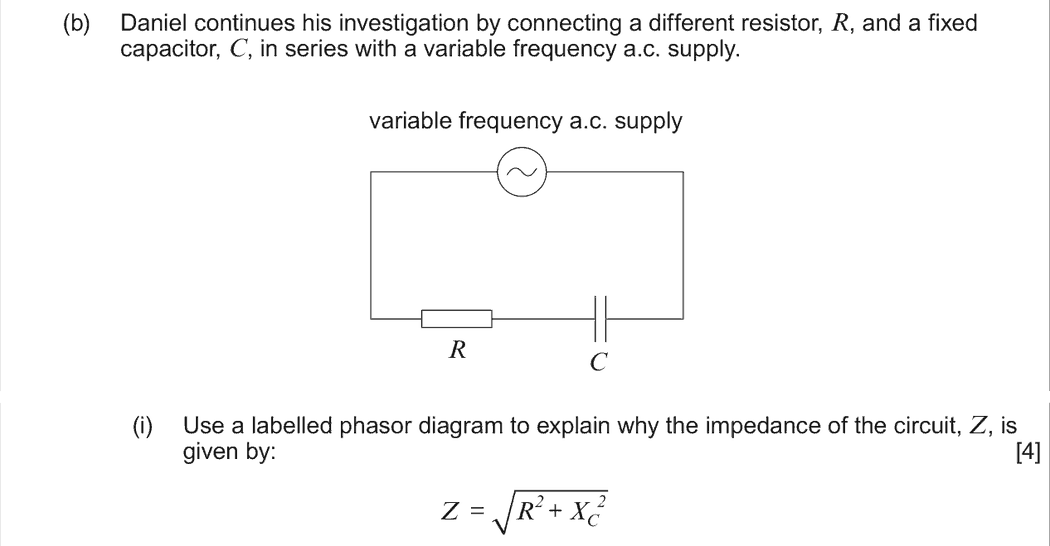
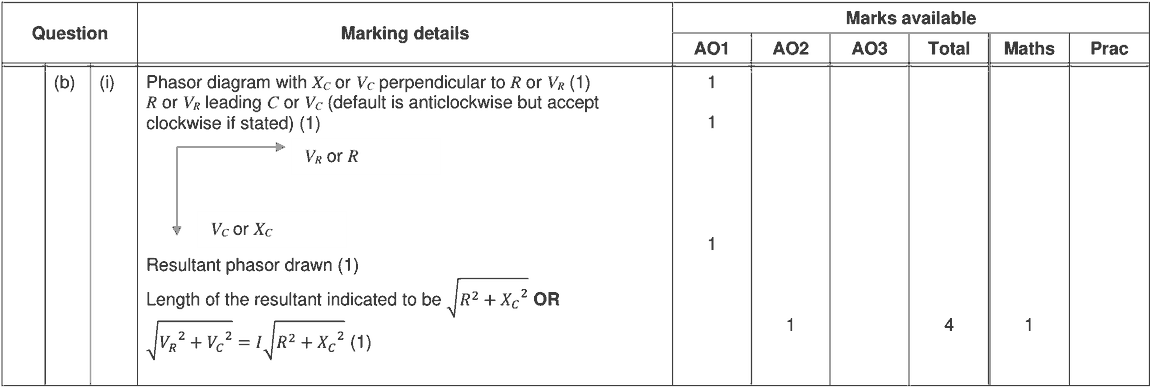
11(b)(i) Alternating currents 4AO1=3,AO2=1Diagram or graph
11(b)(ii) Alternating currents 2AO2=2Show that
11(b)(iii) Alternating currents 5AO3=5Calculation
11(b)(iv) Alternating currents 3AO1=1,AO2=2Explanation
12(a)(i) Medical physics 1AO2=1Calculation
12(a)(ii) Medical physics 3AO1=2,AO2=1Calculation
12(a)(iii) Medical physics 3AO2=3Diagram or graph
12(a)(iv) Medical physics 2AO2=2Explanation
12(b) Medical physics 5AO3=5Explanation
12(c) Medical physics 3AO1=1,AO2=2Calculation
12(d) Medical physics 3AO1=3Explanation
13(a) The physics of sports 3AO1=1,AO2=2Calculation
13(b) The physics of sports 2AO1=2Definition
13(c)(i) The physics of sports 3AO1=1,AO2=2Calculation
13(c)(ii) The physics of sports 3AO1=1,AO2=2Calculation
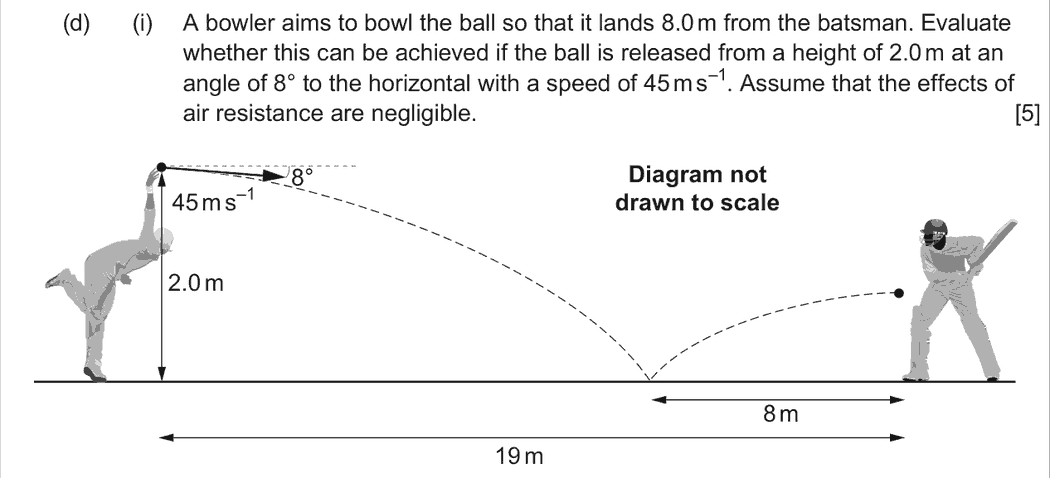
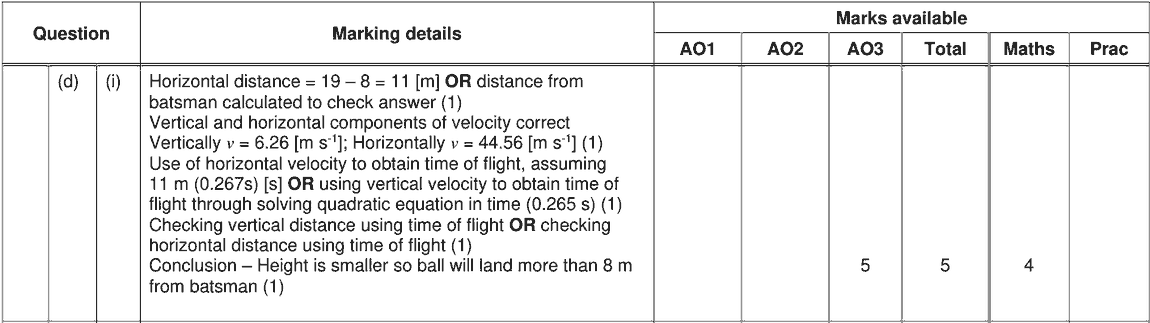
13(d)(i) The physics of sports 5AO3=5Calculation
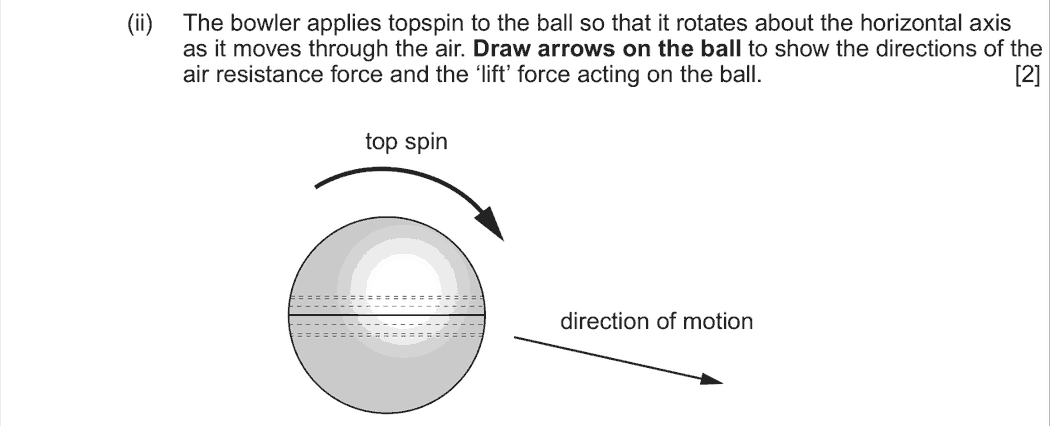
13(d)(ii) The physics of sports 2AO1=1,AO2=1Diagram or graph
13(d)(iii) The physics of sports 2AO2=2Explanation
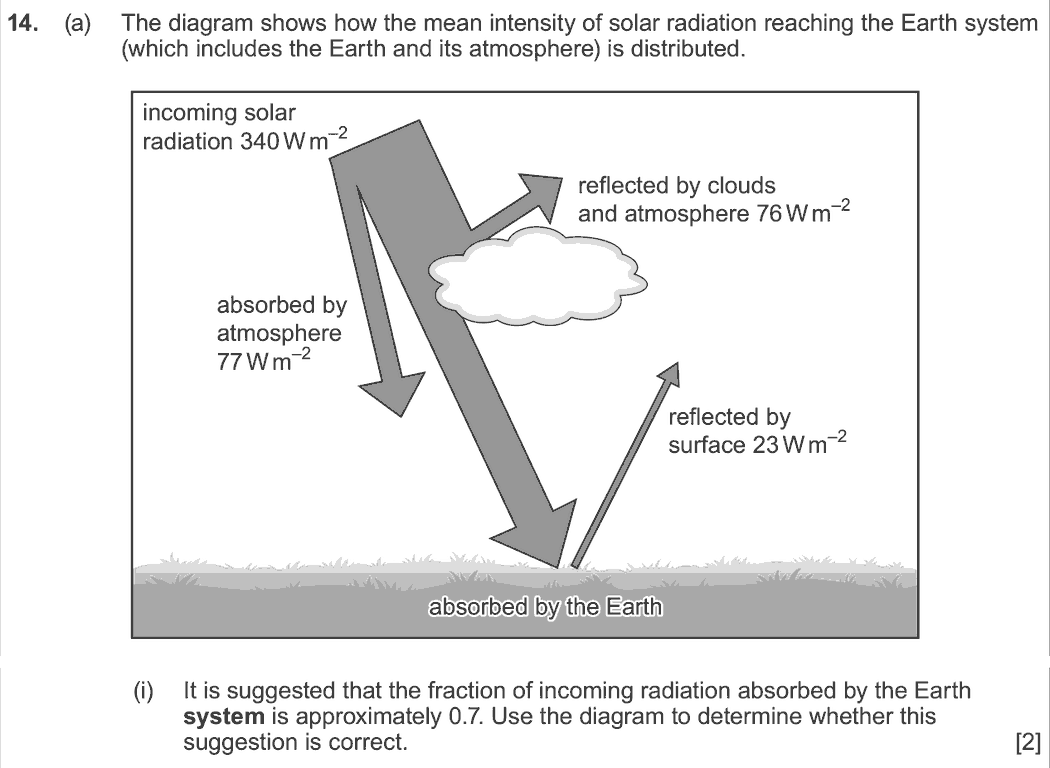
14(a)(i) Energy and the environment 2AO3=2Calculation
14(a)(ii) Energy and the environment 2AO1=2Explanation
14(a)(iii)I Energy and the environment 3AO2=3Explanation
14(a)(iii)II Energy and the environment 2AO2=2Explanation
14(b) Energy and the environment 4AO1=2,AO2=2Calculation
14(c)(i) Energy and the environment 2AO1=2Definition
14(c)(ii)I Energy and the environment 2AO2=2Show that
14(c)(ii)II Energy and the environment 3AO3=3Calculation

The questions

1(a)1(b)(i)1(b)(ii)1(b)(iii)1(b)(iv)2(a)2(b)2(c)(i)2(c)(ii)2(d)3(a)(i)3(a)(ii)3(b)4(a)(i)4(a)(ii)4(b)(i)4(b)(ii)4(b)(iii)56(a)6(b)6(c)7(a)(i)7(a)(ii)7(a)(iii)7(b)8(a)8(b)9(a)9(b)9(c)9(d)10(a)(i)10(a)(ii)10(a)(iii)10(b)11(a)(i)11(a)(ii)11(a)(iii)11(b)(i)11(b)(ii)11(b)(iii)11(b)(iv)12(a)(i)12(a)(ii)12(a)(iii)12(a)(iv)12(b)12(c)12(d)13(a)13(b)13(c)(i)13(c)(ii)13(d)(i)13(d)(ii)13(d)(iii)14(a)(i)14(a)(ii)14(a)(iii)I14(a)(iii)II14(b)14(c)(i)14(c)(ii)I14(c)(ii)II
June 2023 · Component 3 · Q1(a) 2 marks AO1=2 Definition nature of waves
1. (a) State what is meant by the wavelength of a sound wave. [2]
June 2023 · Component 3 · Q1(b)(i) 2 marks AO1=2 Explanation nature of waves
Earlier part of question 1 that this part usesEarlier part of June 2023 Component 3 question 1
(b) (i) Explain clearly why the speed, c, of a wave is given by: λ c = T where λ is the wavelength of the wave and T its period. [2]
June 2023 · Component 3 · Q1(b)(ii) 2 marks AO2=2 Calculation nature of waves
Earlier parts of question 1 that this part usesEarlier part of June 2023 Component 3 question 1Earlier part of June 2023 Component 3 question 1
(ii) A student carries out an experiment to measure the speed of sound by using the echo from a distant wall. She measures the distance to the wall as 90.0 m and the time for the echo to arrive back as 0.51 s. Calculate the speed of sound using the student’s data. [2]
June 2023 · Component 3 · Q1(b)(iii) 3 marks AO1=1, AO2=2 Calculation nature of waves
Earlier parts of question 1 that this part usesEarlier part of June 2023 Component 3 question 1Earlier part of June 2023 Component 3 question 1
(iii) Extending her investigation, the student measures the wavelength of low frequency sound waves generated by a loudspeaker. By looking directly at the slow-moving loudspeaker and using a stopwatch, she notices that the loudspeaker takes 7.55 s to complete 20 oscillations. Calculate the wavelength of the sound waves produced. [3]
June 2023 · Component 3 · Q1(b)(iv) 3 marks AO3=3 Explanation nature of waves
Earlier parts of question 1 that this part usesEarlier part of June 2023 Component 3 question 1Earlier part of June 2023 Component 3 question 1
(iv) The student uses a stroboscope to check the frequency of oscillation of the loudspeaker. She concludes that the frequency of the loudspeaker is 1.3 Hz because the loudspeaker appears stationary when the stroboscope flashes short pulses of light at a frequency of 1.3 Hz. Explain whether this method or that of part (iii) has produced the more accurate value of frequency on this occasion. [3]
June 2023 · Component 3 · Q2(a) 3 marks AO1=3 Diagram or graph wave properties
2. (a) Complete the diagram to show the diffraction of waves after passing through the slit. [3] wavelength
June 2023 · Component 3 · Q2(b) 2 marks AO2=2 Explanation wave properties
Earlier part of question 2 that this part usesEarlier part of June 2023 Component 3 question 2
(b) It is often stated that a diffraction grating should be called an interference grating because the pattern produced is usually called an interference pattern. Explain briefly the importance of diffraction in producing this interference pattern. [2]
June 2023 · Component 3 · Q2(c)(i) 5 marks AO1=1, AO2=4 Calculation wave properties
Earlier part of question 2 that this part usesEarlier part of June 2023 Component 3 question 2
(c) John carries out an experiment to measure the number of lines per cm of a high-quality diffraction grating. John’s set-up is shown below along with the high-quality data that he obtained (he used the wall of the laboratory to maximise the distances he was measuring). diffraction grating laser of wavelength 648.0 nm 357.9 cm 250.0 cm Diagram not drawn to scale (i) Calculate the number of lines per cm for the diffraction grating, quoting your final answer to an appropriate number of significant figures. [5]
June 2023 · Component 3 · Q2(c)(ii) 2 marks AO3=2 Practical and data analysis wave properties
Earlier parts of question 2 that this part usesEarlier part of June 2023 Component 3 question 2Earlier part of June 2023 Component 3 question 2
(ii) Explain why maximising the distances John was measuring improved the precision of the final answer. [2]
June 2023 · Component 3 · Q2(d) 3 marks AO3=3 Explanation wave properties
Earlier parts of question 2 that this part usesEarlier part of June 2023 Component 3 question 2Earlier part of June 2023 Component 3 question 2
(d) The unknown wavelength of a laser can be measured using a diffraction grating or a double slit. Kevin states that it is better to use a diffraction grating. Evaluate to what extent Kevin is correct. [3]
June 2023 · Component 3 · Q3(a)(i) 1 mark AO2=1 Short answer refraction of light
3. (a) Helen and Valentina carry out a standard experiment to measure the refractive index of a perspex block. They vary the angle of incidence and measure the angle of refraction each time. Their results are tabulated below: Angle of Angle of incidence, i / ° refraction, r / ° sin i sin r (± 0.5°) (± 0.5°) 0.0 0.0 0.000 0.000 10.0 6.5 0.174 0.113 20.0 13.5 0.342 0.233 30.0 19.5 0.500 0.334 40.0 25.5 0.643 0.431 50.0 31.0 0.766 0.515 60.0 35.5 0.866 0.581 70.0 39.0 0.629 80.0 41.5 0.985 0.663 (i) Complete the table. [1]
June 2023 · Component 3 · Q3(a)(ii) 4 marks AO3=4 Practical and data analysis refraction of light
Earlier part of question 3 that this part usesEarlier part of June 2023 Component 3 question 3
(ii) Helen produces the following graph: Angle of refraction, r / ° 45 40 35 30 25 20 15 10 5 0 0 10 20 30 40 50 60 70 80 90 Angle of incidence, i / ° Valentina produces this graph: sin r 0.8 0.7 0.6 0.5 0.4 0.3 0.2 0.1 0.0 0.1 0.2 0.3 0.4 0.5 0.6 0.7 0.8 0.9 1.0 0 sin i Based on her graph, Helen concludes, “My data show that there is a definite relationship between the angle of incidence and angle of refraction. As the angle of incidence increases, the angle of refraction increases. We know that our results are good because all our points are close to the line of best fit.” Based on her graph, Valentina concludes, “My data confirms Snell’s law”. Suggest two improvements to each of these conclusions that are consistent with the graphs that they have drawn. [4]
June 2023 · Component 3 · Q3(b) 3 marks AO3=3 Practical and data analysis refraction of light
Earlier parts of question 3 that this part usesEarlier part of June 2023 Component 3 question 3Earlier part of June 2023 Component 3 question 3
(b) Calculate the best value of the refractive index of the perspex block and explain why you chose this method. [3]
June 2023 · Component 3 · Q4(a)(i) 1 mark AO1=1 Short answer photons
4. (a) State a typical value for the wavelength of: (i) microwave radiation [1]
June 2023 · Component 3 · Q4(a)(ii) 1 mark AO1=1 Short answer photons
Earlier part of question 4 that this part usesEarlier part of June 2023 Component 3 question 4
(ii) ultraviolet radiation. [1]
June 2023 · Component 3 · Q4(b)(i) 2 marks AO1=2 Definition photons
Earlier part of question 4 that this part usesEarlier part of June 2023 Component 3 question 4
(b) (i) Define the work function for a metal surface. [2]
June 2023 · Component 3 · Q4(b)(ii) 3 marks AO1=1, AO2=2 Calculation photons
Earlier parts of question 4 that this part usesEarlier part of June 2023 Component 3 question 4Earlier part of June 2023 Component 3 question 4
(ii) Most metals have a work function of a few eV. Using your values from part (a), show that microwaves will not produce the photoelectric effect whereas ultraviolet radiation will. [3]
June 2023 · Component 3 · Q4(b)(iii) 5 marks AO1=1, AO2=4 Calculation photons
Earlier parts of question 4 that this part usesEarlier part of June 2023 Component 3 question 4Earlier part of June 2023 Component 3 question 4
(iii) Gold has a work function of 5.1 eV. Calculate the maximum speed of electrons emitted from a gold surface when irradiated by photons of wavelength 200 nm. [5]
June 2023 · Component 3 · Q5 6 marks AO1=6 6-mark extended response photons
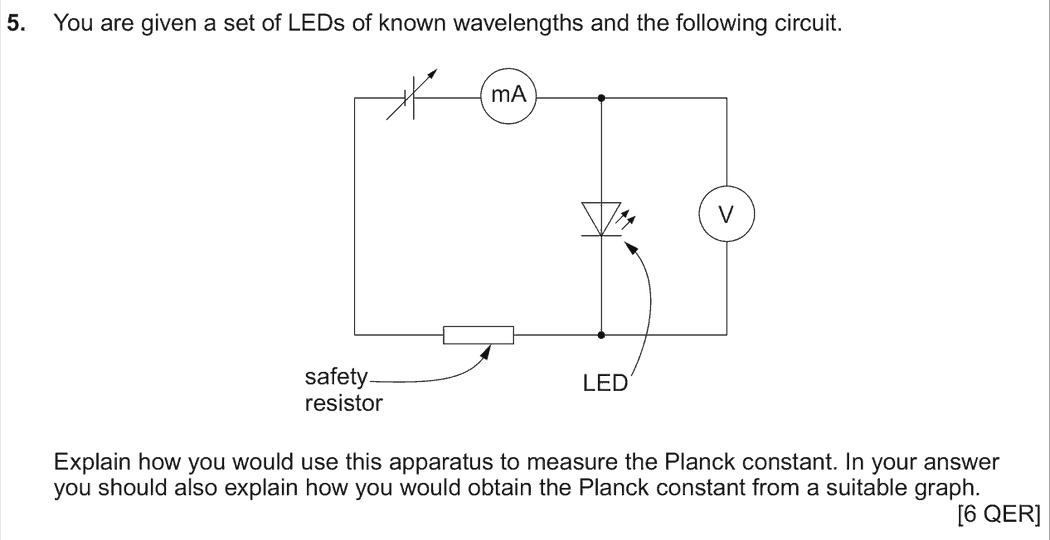
5. You are given a set of LEDs of known wavelengths and the following circuit. mA V safety LED resistor Explain how you would use this apparatus to measure the Planck constant. In your answer you should also explain how you would obtain the Planck constant from a suitable graph. [6 QER]
June 2023 · Component 3 · Q6(a) 1 mark AO1=1 Definition lasers
6. The metastable energy level of a laser system is (indirectly) pumped at a rate of 5 × 10¹⁸ electrons per second. (a) State what is meant by a metastable energy level. [1]
June 2023 · Component 3 · Q6(b) 3 marks AO2=3 Calculation nuclear decay
Earlier part of question 6 that this part usesEarlier part of June 2023 Component 3 question 6
(b) If the half-life of the metastable energy level is 2.4 ms, explain why the equilibrium number of electrons in the metastable energy level is approximately 1.7 × 10¹⁶ ∆ N (hint: use A = λ N or = – λ N ). [3] ∆ t
June 2023 · Component 3 · Q6(c) 3 marks AO1=2, AO2=1 Explanation lasers
Earlier part of question 6 that this part usesEarlier part of June 2023 Component 3 question 6
(c) Hence, explain why it is desirable for the metastable state in a laser system to have a long half-life. [3]
June 2023 · Component 3 · Q7(a)(i) 2 marks AO2=2 Short answer nuclear decay
7. (a) Naturally occurring uranium is composed of 99.28% of 238 92U and 0.72% of 235 92U. The lighter of the 2 isotopes (235 92U) decays via a chain of 7 alpha decays and 4 beta decays to an isotope of lead (Pb). (i) Calculate the proton number and nucleon number of the lead (Pb) isotope into which the uranium-235 decays. [2]
June 2023 · Component 3 · Q7(a)(ii) 4 marks AO1=1, AO2=3 Calculation nuclear decay
Earlier part of question 7 that this part usesEarlier part of June 2023 Component 3 question 7
(ii) When uranium-235 decays to lead, the longest half-life by far is the half-life of uranium-235, which is 704 million years (all other half-lives are tiny and negligible in comparison). A rock is discovered with 80.0% of the original uranium-235 remaining undecayed. Determine the age of the rock. [4]
June 2023 · Component 3 · Q7(a)(iii) 5 marks AO3=5 Calculation nuclear decay
Earlier part of question 7 that this part usesEarlier part of June 2023 Component 3 question 7
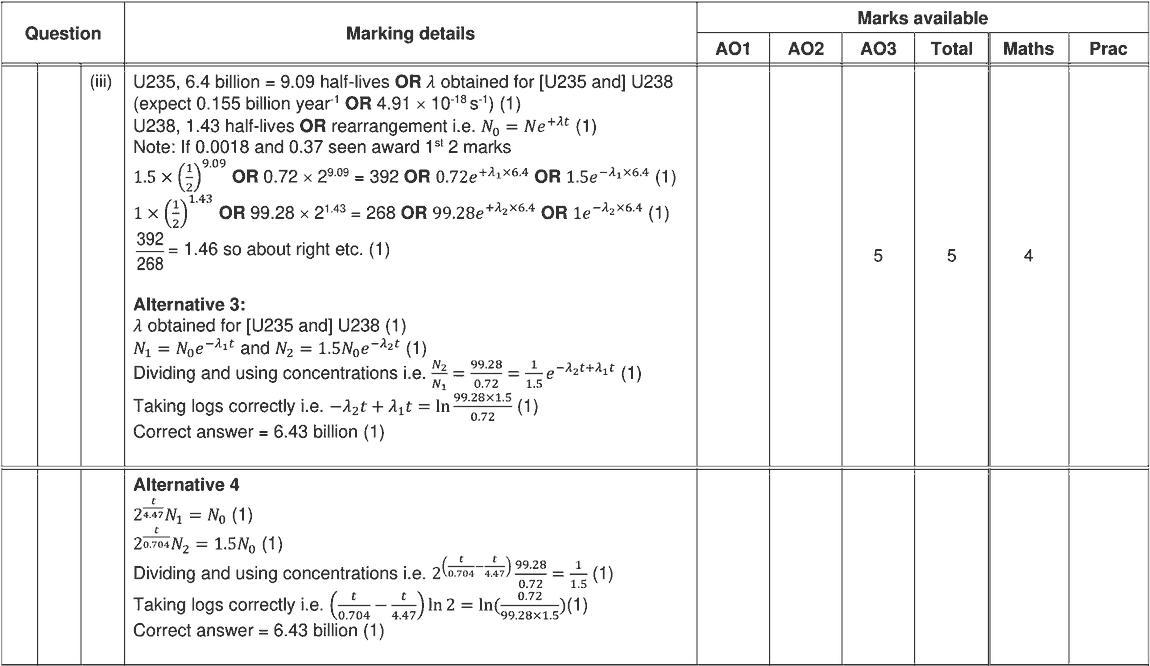
(iii) Gareth discovers that uranium-235 and uranium-238 are produced in a supernova in the ratio: N235U 92 = 1.5 N238U 92 He then concludes that the supernova that produced Earth’s uranium occurred around 6400 million years ago. Determine whether Gareth is correct. [5] Current abundance of uranium-235 = 0.72% Current abundance of uranium-238 = 99.28% Half-life of uranium-235 = 704 × 106 year Half-life of uranium-238 = 4.47 × 10⁹ year
June 2023 · Component 3 · Q7(b) 3 marks AO3=3 Short answer nuclear decay
Earlier parts of question 7 that this part usesEarlier part of June 2023 Component 3 question 7Earlier part of June 2023 Component 3 question 7
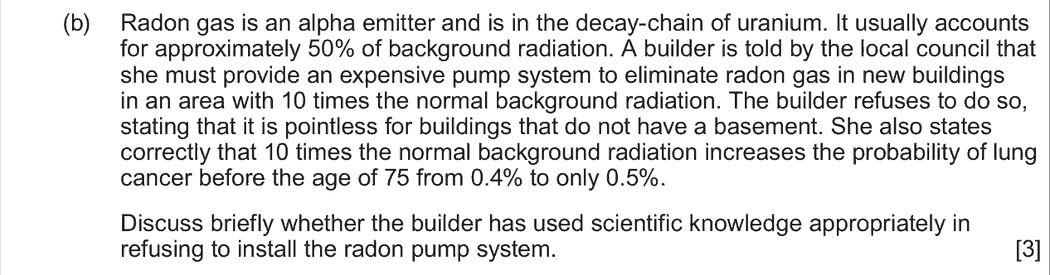
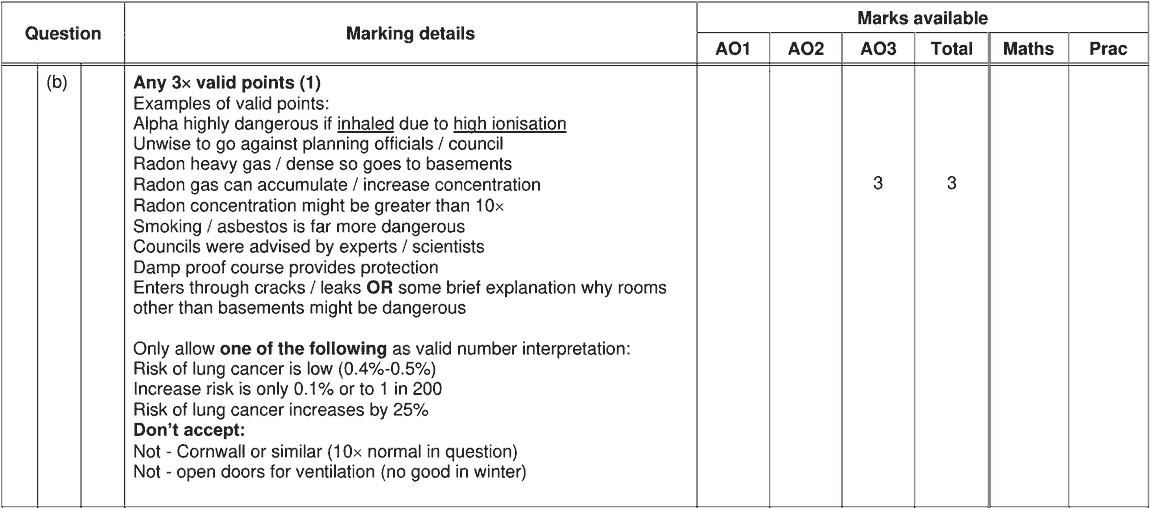
(b) Radon gas is an alpha emitter and is in the decay-chain of uranium. It usually accounts for approximately 50% of background radiation. A builder is told by the local council that she must provide an expensive pump system to eliminate radon gas in new buildings in an area with 10 times the normal background radiation. The builder refuses to do so, stating that it is pointless for buildings that do not have a basement. She also states correctly that 10 times the normal background radiation increases the probability of lung cancer before the age of 75 from 0.4% to only 0.5%. Discuss briefly whether the builder has used scientific knowledge appropriately in refusing to install the radon pump system. [3]
June 2023 · Component 3 · Q8(a) 4 marks AO2=4 Explanation particles and nuclear structure
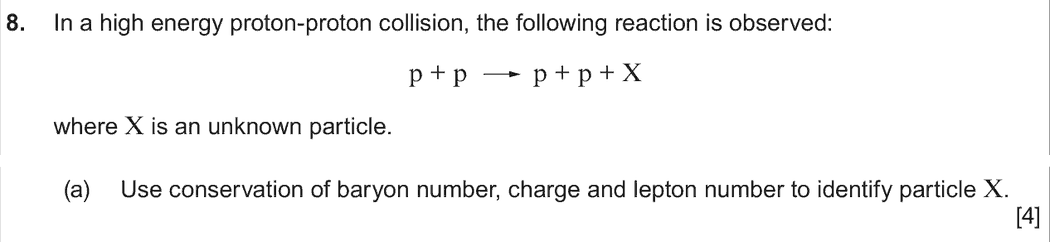
8. In a high energy proton-proton collision, the following reaction is observed: p + p p + p + X where X is an unknown particle. (a) Use conservation of baryon number, charge and lepton number to identify particle X. [4]
June 2023 · Component 3 · Q8(b) 3 marks AO2=3 Calculation nuclear energy
Earlier part of question 8 that this part usesEarlier part of June 2023 Component 3 question 8
(b) The unknown particle X is then seen to decay as follows: X γ + γ where each gamma photon has an energy of 67.5 MeV. Calculate the mass of particle X in kg. [3]
June 2023 · Component 3 · Q9(a) 2 marks AO1=1, AO2=1 Short answer magnetic fields
9. Alpha particles, from the source shown, are accelerated in a synchrotron (see diagram). The alpha particles are accelerated by the varying electric field four times during each complete orbit of the synchrotron. The initial speed of the alpha particles is 1.6 × 10⁷ m s–1 along the dotted circle. – B-field out of paper + – + – + – + radius = 8.4 m source + – of alpha – + particles – + – + (a) Place an arrow on the dotted circle to indicate the direction of motion of the alpha particles, and state the name of the rule you used to obtain the direction. [2]
June 2023 · Component 3 · Q9(b) 3 marks AO1=1, AO2=2 Calculation magnetic fields
Earlier part of question 9 that this part usesEarlier part of June 2023 Component 3 question 9
(b) Calculate the initial magnetic flux density of the synchrotron to ensure that the alpha particles (4 2 He) follow a circular path. [3]
June 2023 · Component 3 · Q9(c) 3 marks AO1=1, AO2=2 Calculation magnetic fields
Earlier part of question 9 that this part usesEarlier part of June 2023 Component 3 question 9
(c) Calculate the initial frequency of the pd supplied to the synchrotron. [3]
June 2023 · Component 3 · Q9(d) 3 marks AO1=1, AO2=2 Explanation magnetic fieldsenergy concepts
Earlier part of question 9 that this part usesEarlier part of June 2023 Component 3 question 9
(d) Explain why the kinetic energy (in eV) of the alpha particles in the synchrotron is: kinetic energy (in eV) = 5.3 × 10⁶ + (8 × n × V) where n is the number of orbits completed by the alpha particles and V is the pd of the synchrotron (in volt). [3]
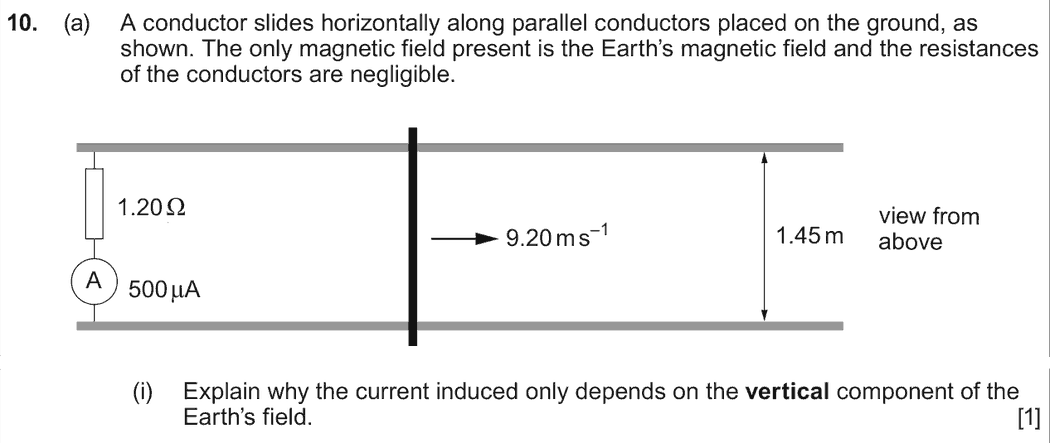
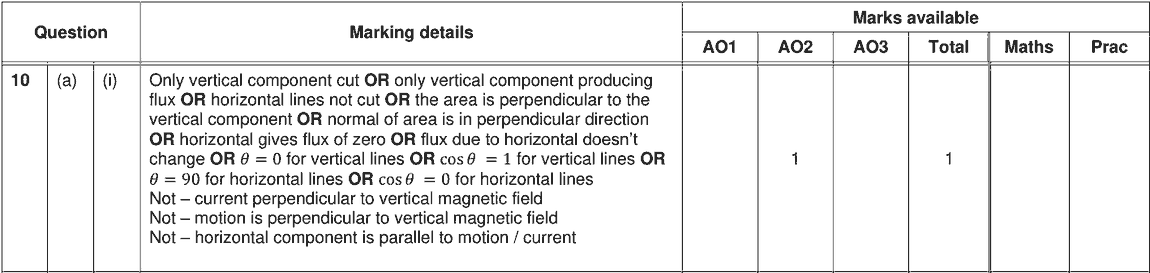
June 2023 · Component 3 · Q10(a)(i) 1 mark AO2=1 Explanation electromagnetic induction
10. (a) A conductor slides horizontally along parallel conductors placed on the ground, as shown. The only magnetic field present is the Earth’s magnetic field and the resistances of the conductors are negligible. 1.20 Ω view from 9.20 m s–1 1.45 m above A 500 μA (i) Explain why the current induced only depends on the vertical component of the Earth’s field. [1]
June 2023 · Component 3 · Q10(a)(ii) 2 marks AO1=1, AO2=1 Explanation electromagnetic induction
Earlier part of question 10 that this part usesEarlier part of June 2023 Component 3 question 10
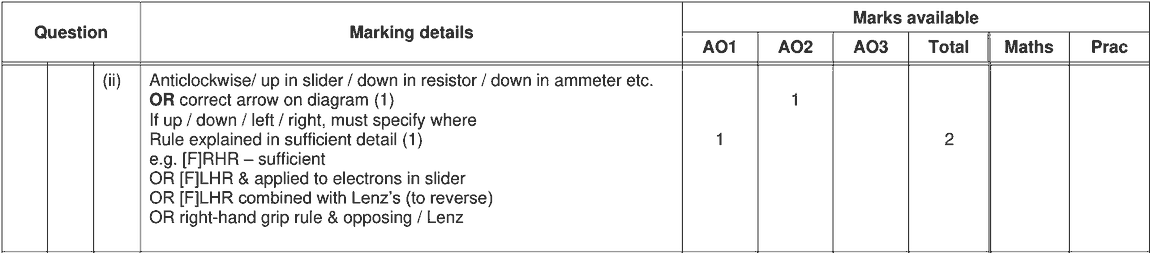
(ii) In the northern hemisphere, the vertical component of the Earth’s field is downwards. Explain the direction of the induced current in the circuit. [2]
June 2023 · Component 3 · Q10(a)(iii) 3 marks AO2=3 Calculation electromagnetic induction
Earlier part of question 10 that this part usesEarlier part of June 2023 Component 3 question 10
(iii) Calculate the vertical component of the Earth’s magnetic flux density. [3]
June 2023 · Component 3 · Q10(b) 2 marks AO3=2 Explanation electromagnetic induction
Earlier part of question 10 that this part usesEarlier part of June 2023 Component 3 question 10
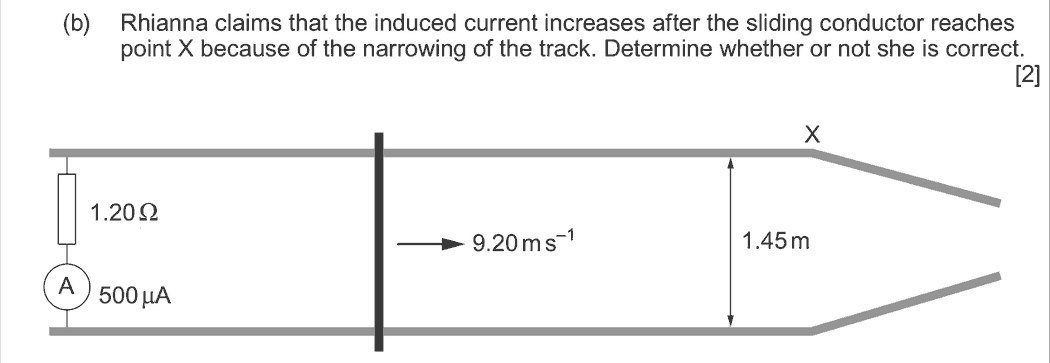
(b) Rhianna claims that the induced current increases after the sliding conductor reaches point X because of the narrowing of the track. Determine whether or not she is correct. [2] X 1.20 Ω 9.20 m s–1 1.45 m A 500 μA
June 2023 · Component 3 · Q11(a)(i) 2 marks AO1=1, AO2=1 Show that alternating currents
11. Daniel is investigating a.c. circuits and sets up the circuit shown. variable frequency a.c. supply Vrms = 230 V 47 Ω 12 mH 100 pF – 500 pF (a) (i) Show, in clear steps, that the resonance frequency, f0, of the circuit is given by: [2] 1 f0 = 2 π LC
June 2023 · Component 3 · Q11(a)(ii) 2 marks AO2=2 Calculation alternating currents
Earlier part of question 11 that this part usesEarlier part of June 2023 Component 3 question 11
(ii) Calculate the maximum possible resonance frequency for the circuit. [2]
June 2023 · Component 3 · Q11(a)(iii) 2 marks AO1=1, AO2=1 Explanation alternating currents
Earlier part of question 11 that this part usesEarlier part of June 2023 Component 3 question 11
(iii) Explain why the maximum rms current in this circuit is approximately 5 A. [2]
June 2023 · Component 3 · Q11(b)(i) 4 marks AO1=3, AO2=1 Diagram or graph alternating currents
Earlier part of question 11 that this part usesEarlier part of June 2023 Component 3 question 11
(b) Daniel continues his investigation by connecting a different resistor, R, and a fixed capacitor, C, in series with a variable frequency a.c. supply. variable frequency a.c. supply R C (i) Use a labelled phasor diagram to explain why the impedance of the circuit, Z, is given by: [4] Z = R 2 + XC 2
June 2023 · Component 3 · Q11(b)(ii) 2 marks AO2=2 Show that alternating currents
Earlier parts of question 11 that this part usesEarlier part of June 2023 Component 3 question 11Earlier part of June 2023 Component 3 question 11
(ii) Hence show that: [2] 1 Z 2 = + R 2 ω 2 C 2
June 2023 · Component 3 · Q11(b)(iii) 5 marks AO3=5 Calculation alternating currents
Earlier parts of question 11 that this part usesEarlier part of June 2023 Component 3 question 11Earlier part of June 2023 Component 3 question 11
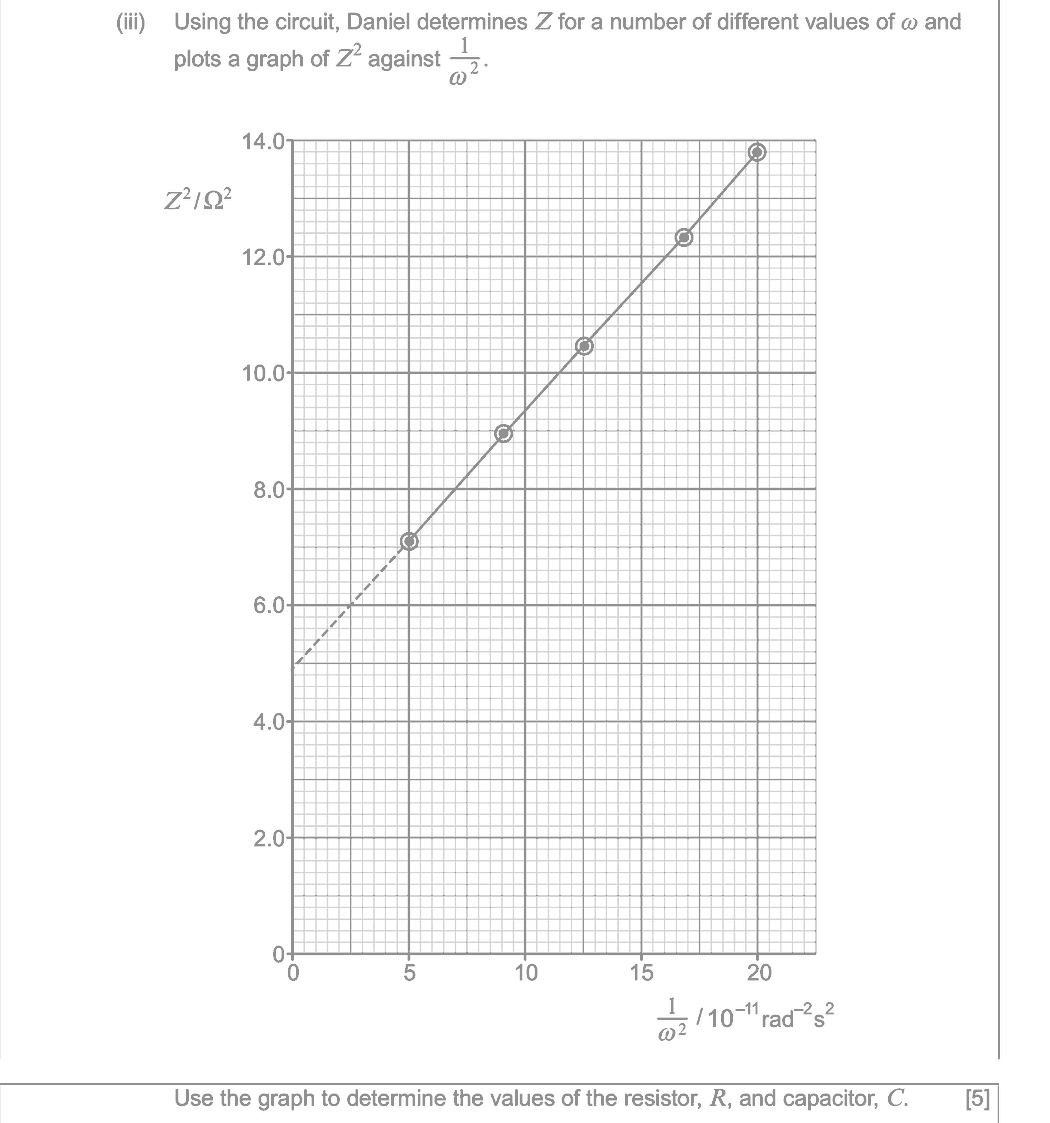
(iii) Using the circuit, Daniel determines Z for a number of different values of ω and 1 plots a graph of Z2 against . ω 2 14.0 Z 2 / Ω2 12.0 10.0 8.0 6.0 4.0 2.0 0 0 5 10 15 20 1 –11 rad–2 s2 / 10 ω 2 Use the graph to determine the values of the resistor, R, and capacitor, C. [5]
June 2023 · Component 3 · Q11(b)(iv) 3 marks AO1=1, AO2=2 Explanation alternating currents
Earlier parts of question 11 that this part usesEarlier part of June 2023 Component 3 question 11Earlier part of June 2023 Component 3 question 11Earlier part of June 2023 Component 3 question 11
(iv) While carrying out the investigation, Daniel notices that the pd across the resistor, VR, is small at low frequencies and approaches the supply pd at high frequencies. Explain why this happens. [3]
June 2023 · Component 3 · Q12(a)(i) 1 mark AO2=1 Calculation medical physics
12. (a) (i) An X-ray tube operating with a power of 7.5 kW has a current of 250 mA. Determine its operating voltage. [1]
June 2023 · Component 3 · Q12(a)(ii) 3 marks AO1=2, AO2=1 Calculation medical physics
Earlier part of question 12 that this part usesEarlier part of June 2023 Component 3 question 12
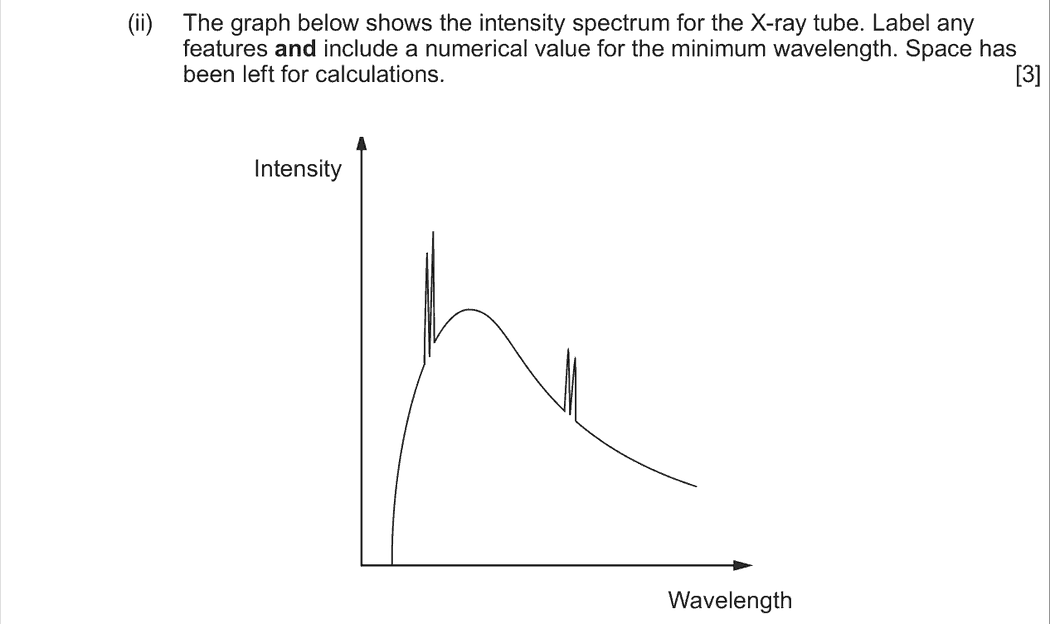
(ii) The graph below shows the intensity spectrum for the X-ray tube. Label any features and include a numerical value for the minimum wavelength. Space has been left for calculations. [3] Intensity Wavelength
June 2023 · Component 3 · Q12(a)(iii) 3 marks AO2=3 Diagram or graph medical physics
Earlier parts of question 12 that this part usesEarlier part of June 2023 Component 3 question 12Earlier part of June 2023 Component 3 question 12
(iii) On the diagram above, draw an intensity spectrum for the same X-ray tube with an operating voltage of 40 kV; again, include a numerical value for the minimum wavelength. [3]
June 2023 · Component 3 · Q12(a)(iv) 2 marks AO2=2 Explanation medical physics
Earlier parts of question 12 that this part usesEarlier part of June 2023 Component 3 question 12Earlier part of June 2023 Component 3 question 12
(iv) Discuss if it would be possible to reduce the minimum wavelength to zero. [2]
June 2023 · Component 3 · Q12(b) 5 marks AO3=5 Explanation medical physics
Earlier parts of question 12 that this part usesEarlier part of June 2023 Component 3 question 12Earlier part of June 2023 Component 3 question 12
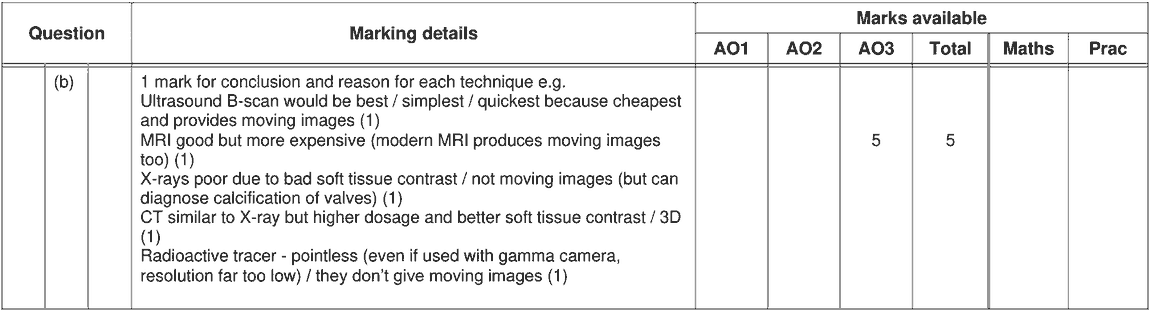
(b) Doctors are concerned that there is a faulty aortic valve in a patient’s heart. They have decided to investigate this further and have the choice of the following: X-ray MRI ultrasound B-scan radioactive tracers CT scan Evaluate the suitability of all five types of imaging techniques for diagnosing the patient. [5]
June 2023 · Component 3 · Q12(c) 3 marks AO1=1, AO2=2 Calculation medical physics
Earlier parts of question 12 that this part usesEarlier part of June 2023 Component 3 question 12Earlier part of June 2023 Component 3 question 12
(c) Doctors order further tests to examine the rate of blood flow around the body. To determine this, they use ultrasound at a wavelength of 0.45 mm and angle to the blood cells’ motion of 15°. Ultrasound travels through blood at a speed of 1400 m s–1. The received wavelength from the red blood cells was found to be shifted by 0.55 µm. Determine the speed of the blood flow. [3]

June 2023 · Component 3 · Q12(d) 3 marks AO1=3 Explanation medical physics

Earlier parts of question 12 that this part usesEarlier part of June 2023 Component 3 question 12Earlier part of June 2023 Component 3 question 12
(d) Explain the operation of PET scans; include which part of the electromagnetic spectrum they detect. [3]
June 2023 · Component 3 · Q13(a) 3 marks AO1=1, AO2=2 Calculation physics of sports
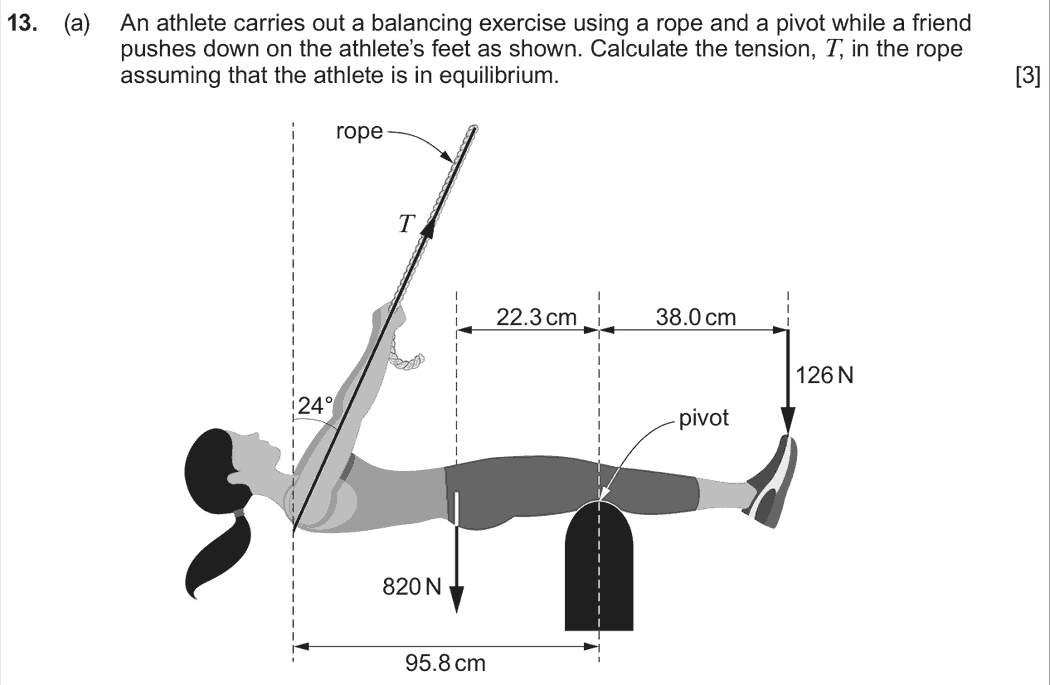
13. (a) An athlete carries out a balancing exercise using a rope and a pivot while a friend pushes down on the athlete’s feet as shown. Calculate the tension, T, in the rope assuming that the athlete is in equilibrium. [3] rope T 22.3 cm 38.0 cm 126 N 24° pivot 820 N 95.8 cm
June 2023 · Component 3 · Q13(b) 2 marks AO1=2 Definition physics of sports
Earlier part of question 13 that this part usesEarlier part of June 2023 Component 3 question 13
(b) State what is meant by the moment of inertia of an object. [2]
June 2023 · Component 3 · Q13(c)(i) 3 marks AO1=1, AO2=2 Calculation physics of sports
Earlier part of question 13 that this part usesEarlier part of June 2023 Component 3 question 13
(c) A cricket ball is rotating at 300 revolutions per minute. The moment of inertia of the ball 2 5 mr2 is given by the equation I = where its mass, m, is 0.159 kg and its radius, r, is 3.6 cm. (i) Calculate the angular momentum of the ball. [3]
June 2023 · Component 3 · Q13(c)(ii) 3 marks AO1=1, AO2=2 Calculation physics of sports
Earlier parts of question 13 that this part usesEarlier part of June 2023 Component 3 question 13Earlier part of June 2023 Component 3 question 13
(ii) The cricket ball is struck by a batsman and the ball acquires a linear speed of 30 m s–1 and an angular velocity of 210 rad s–1 (about its centre). A sports analyst states that the rotational kinetic energy acquired by the cricket ball is negligible compared with its linear kinetic energy. Show that this statement is correct on this occasion. [3]
June 2023 · Component 3 · Q13(d)(i) 5 marks AO3=5 Calculation physics of sports
Earlier part of question 13 that this part usesEarlier part of June 2023 Component 3 question 13
(d) (i) A bowler aims to bowl the ball so that it lands 8.0 m from the batsman. Evaluate whether this can be achieved if the ball is released from a height of 2.0 m at an angle of 8° to the horizontal with a speed of 45 m s–1. Assume that the effects of air resistance are negligible. [5] 8° Diagram not 45 m s–1 drawn to scale 2.0 m 8 m 19 m
June 2023 · Component 3 · Q13(d)(ii) 2 marks AO1=1, AO2=1 Diagram or graph physics of sports
Earlier parts of question 13 that this part usesEarlier part of June 2023 Component 3 question 13Earlier part of June 2023 Component 3 question 13
(ii) The bowler applies topspin to the ball so that it rotates about the horizontal axis as it moves through the air. Draw arrows on the ball to show the directions of the air resistance force and the ‘lift’ force acting on the ball. [2] top spin direction of motion
June 2023 · Component 3 · Q13(d)(iii) 2 marks AO2=2 Explanation physics of sports
Earlier parts of question 13 that this part usesEarlier part of June 2023 Component 3 question 13Earlier part of June 2023 Component 3 question 13Earlier part of June 2023 Component 3 question 13
(iii) Explain briefly what effect these forces have on the position where the ball lands. [2]
June 2023 · Component 3 · Q14(a)(i) 2 marks AO3=2 Calculation energy and the environment
14. (a) The diagram shows how the mean intensity of solar radiation reaching the Earth system (which includes the Earth and its atmosphere) is distributed. incoming solar radiation 340 W m–2 reflected by clouds and atmosphere 76 W m–2 absorbed by atmosphere 77 W m–2 reflected by surface 23 W m–2 absorbed absorbed by by the the Earth Earth (i) It is suggested that the fraction of incoming radiation absorbed by the Earth system is approximately 0.7. Use the diagram to determine whether this suggestion is correct. [2]
June 2023 · Component 3 · Q14(a)(ii) 2 marks AO1=2 Explanation energy and the environment
Earlier part of question 14 that this part usesEarlier part of June 2023 Component 3 question 14
(ii) State what is meant by the greenhouse effect. [2]
June 2023 · Component 3 · Q14(a)(iii)I 3 marks AO2=3 Explanation energy and the environment
Earlier part of question 14 that this part usesEarlier part of June 2023 Component 3 question 14
(iii) The Earth system emits 240 W m–2 of infra-red radiation into space. This is less than the solar radiation that is absorbed and has caused the temperature of the Earth system to increase. Researchers state this imbalance has approximately doubled since 2005. I. Explain how human activities are contributing to this change. [3]
June 2023 · Component 3 · Q14(a)(iii)II 2 marks AO2=2 Explanation energy and the environment
Earlier parts of question 14 that this part usesEarlier part of June 2023 Component 3 question 14Earlier part of June 2023 Component 3 question 14
II. Describe how an increase in the temperature of the Earth system may lead to further increases in this imbalance. [2]
June 2023 · Component 3 · Q14(b) 4 marks AO1=2, AO2=2 Calculation energy and the environment
Earlier part of question 14 that this part usesEarlier part of June 2023 Component 3 question 14
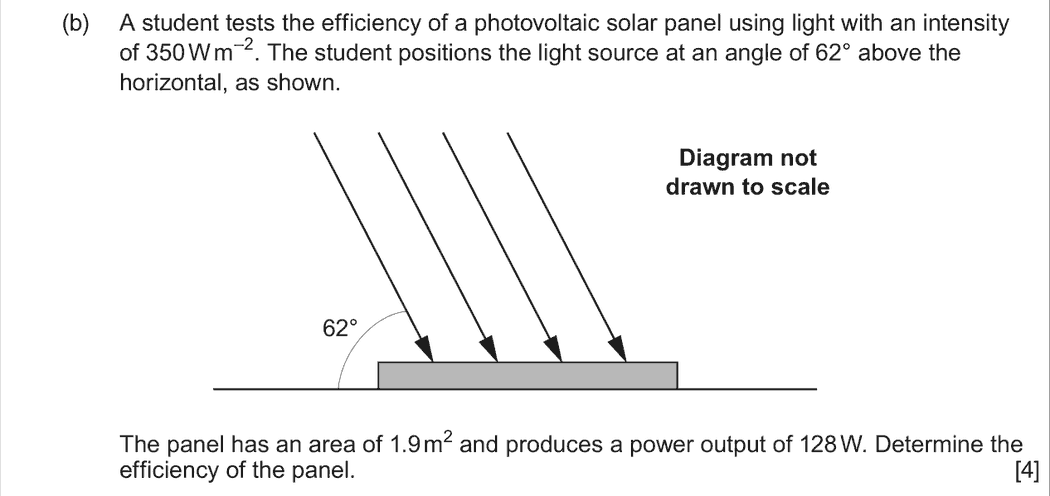
(b) A student tests the efficiency of a photovoltaic solar panel using light with an intensity of 350 W m–2. The student positions the light source at an angle of 62° above the horizontal, as shown. Diagram not drawn to scale 62° The panel has an area of 1.9 m2 and produces a power output of 128 W. Determine the efficiency of the panel. [4]
June 2023 · Component 3 · Q14(c)(i) 2 marks AO1=2 Definition energy and the environment
Earlier parts of question 14 that this part usesEarlier part of June 2023 Component 3 question 14Earlier part of June 2023 Component 3 question 14
(c) An uninsulated external wall has a U-value of 1.51 W m–2 K–1. (i) Explain what this statement means. [2]
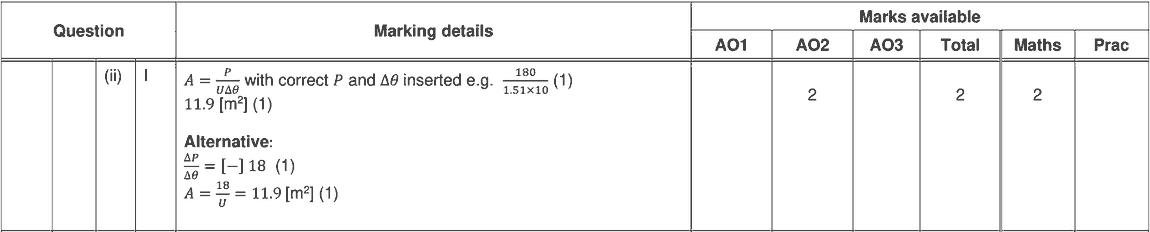
June 2023 · Component 3 · Q14(c)(ii)I 2 marks AO2=2 Show that energy and the environment
Earlier parts of question 14 that this part usesEarlier part of June 2023 Component 3 question 14Earlier part of June 2023 Component 3 question 14Earlier part of June 2023 Component 3 question 14
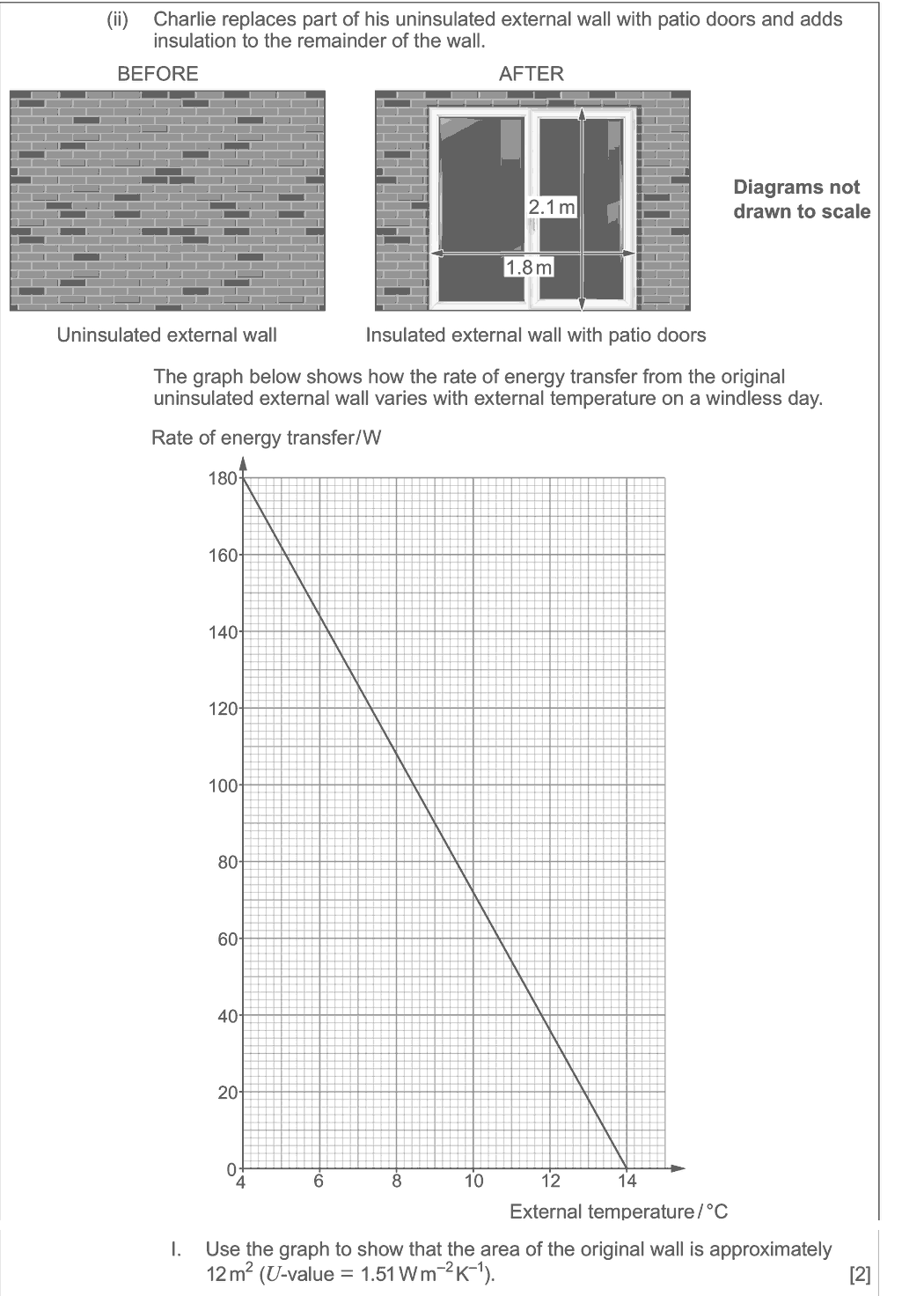
(ii) Charlie replaces part of his uninsulated external wall with patio doors and adds insulation to the remainder of the wall. BEFORE AFTER Diagrams not 2.1 m drawn to scale 1.8 m Uninsulated external wall Insulated external wall with patio doors The graph below shows how the rate of energy transfer from the original uninsulated external wall varies with external temperature on a windless day. Rate of energy transfer / W 180 160 140 120 100 80 60 40 20 0 4 6 8 10 12 14 External temperature / °C I. Use the graph to show that the area of the original wall is approximately 12 m2 (U-value = 1.51 W m–2 K–1). [2]
June 2023 · Component 3 · Q14(c)(ii)II 3 marks AO3=3 Calculation energy and the environment
Earlier parts of question 14 that this part usesEarlier part of June 2023 Component 3 question 14Earlier part of June 2023 Component 3 question 14Earlier part of June 2023 Component 3 question 14Earlier part of June 2023 Component 3 question 14
II. After the renovation, under the same windless conditions, the heat transfer from the insulated external wall with patio doors is found to be 65 W when the temperature difference between the inside and outside is 10 °C. The U-value of the patio doors is 1.34 W m–2 K–1. Charlie calculates the U-value of the insulated wall to be less than 0.2 W m–2 K–1. Determine whether Charlie is correct. [3]

Work with an Eduqas physics tutor

Want a paper marked and gone through with you? Message us.

Prefer email? Send an enquiry

If you are under 18, please include a parent's contact details. Enquiries go to enquiries@physicsaleveltutor.com and are deleted once handled. All tutoring is online.