June 2024: Component 3

120 marks for each student (100 in Section A plus one 20-mark option; all four options are here) · 61 question parts · Paper, mark scheme and report on Eduqas's site · Have the Data Booklet beside you

Question by question

QTopicMarksAOType
1(a) Wave properties: diffraction, interference and stationary waves, The nature of waves 4AO3=4Explanation

1(b) Wave properties: diffraction, interference and stationary waves, The nature of waves 3AO1=1,AO2=2Calculation
1(c) Wave properties: diffraction, interference and stationary waves 3AO1=1,AO2=2Calculation

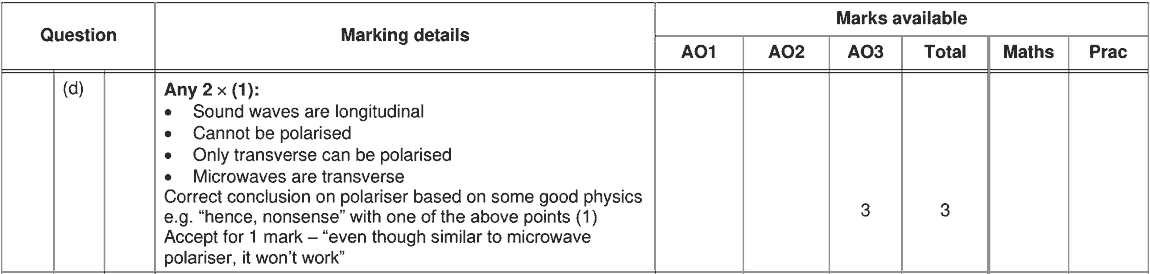
1(d) The nature of waves 3AO3=3Explanation
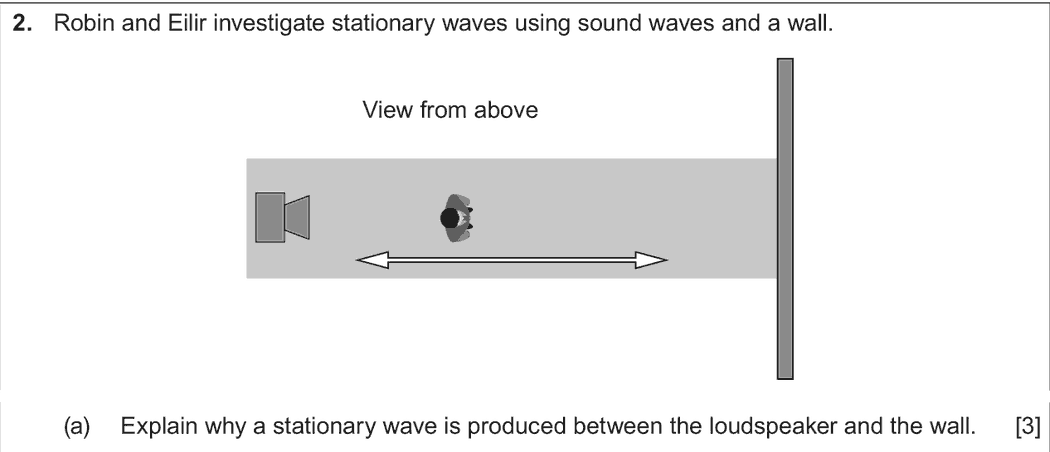
2(a) Wave properties: diffraction, interference and stationary waves 3AO2=3Explanation

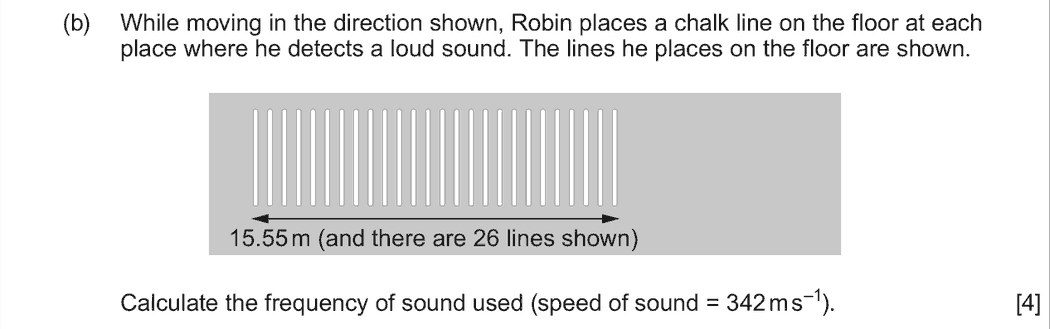
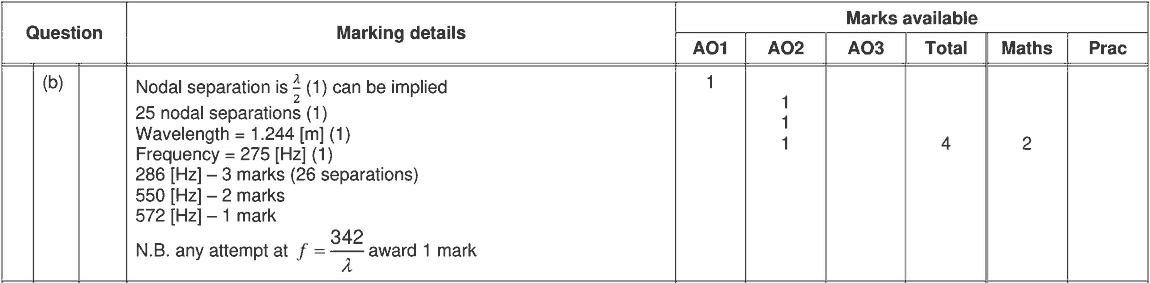
2(b) Wave properties: diffraction, interference and stationary waves, The nature of waves 4AO1=1,AO2=3Calculation
2(c) Wave properties: diffraction, interference and stationary waves 6AO1=6Extended response
3(a)(i) Refraction of light 2AO1=1,AO2=1Calculation
3(a)(ii) Refraction of light 3AO2=3Diagram or graph
3(b)(i) Refraction of light 3AO1=1,AO2=2Show that
3(b)(ii) Refraction of light 3AO1=3Explanation
3(b)(iii) Refraction of light 2AO1=2Explanation
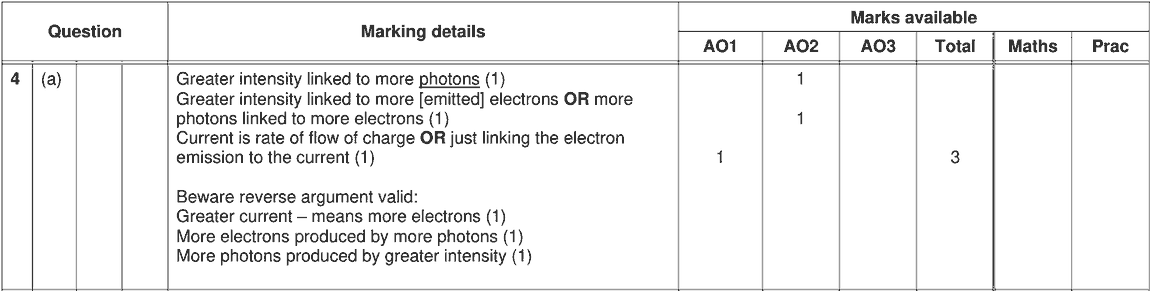
4(a) Photons 3AO1=1,AO2=2Explanation
4(b) Photons 2AO3=2Short answer
4(c)(i) Photons 3AO1=2,AO2=1Calculation
4(c)(ii) Photons 3AO2=3Calculation
4(d) Photons 3AO3=3Explanation
5(a) Nuclear decay 4AO1=4Practical and data analysis
5(b)(i) Nuclear decay 1AO2=1Practical and data analysis
5(b)(ii) Nuclear decay 3AO2=3Show that
5(c) Nuclear decay 6AO3=6Practical and data analysis
5(d)(i) Nuclear decay 2AO1=1,AO2=1Practical and data analysis
5(d)(ii) Nuclear decay 3AO3=3Practical and data analysis
5(d)(iii) Nuclear decay 2AO3=2Practical and data analysis
6 Particles and nuclear structure 5AO2=5Explanation
7(a) Magnetic fields 3AO1=1,AO2=2Calculation
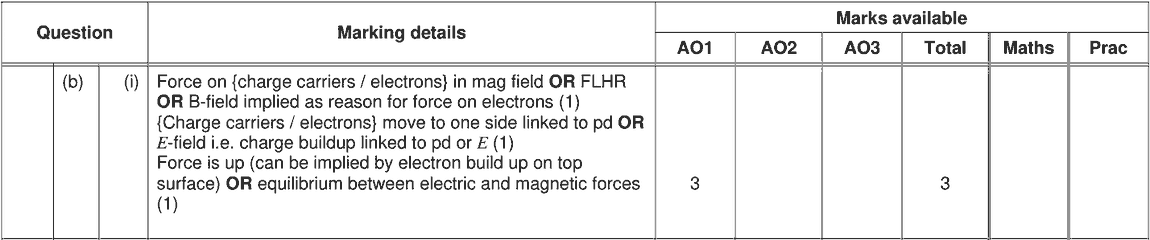
7(b)(i) Magnetic fields 3AO1=3Explanation
7(b)(ii) Magnetic fields 2AO2=2Calculation
7(b)(iii) Magnetic fields 2AO3=2Practical and data analysis
8(a) Electromagnetic induction 5AO2=5Explanation
8(b) Basic physics: units, vectors and moments 3AO1=1,AO2=2Calculation
8(c) Thermal physics, Energy concepts 3AO1=1,AO2=2Calculation
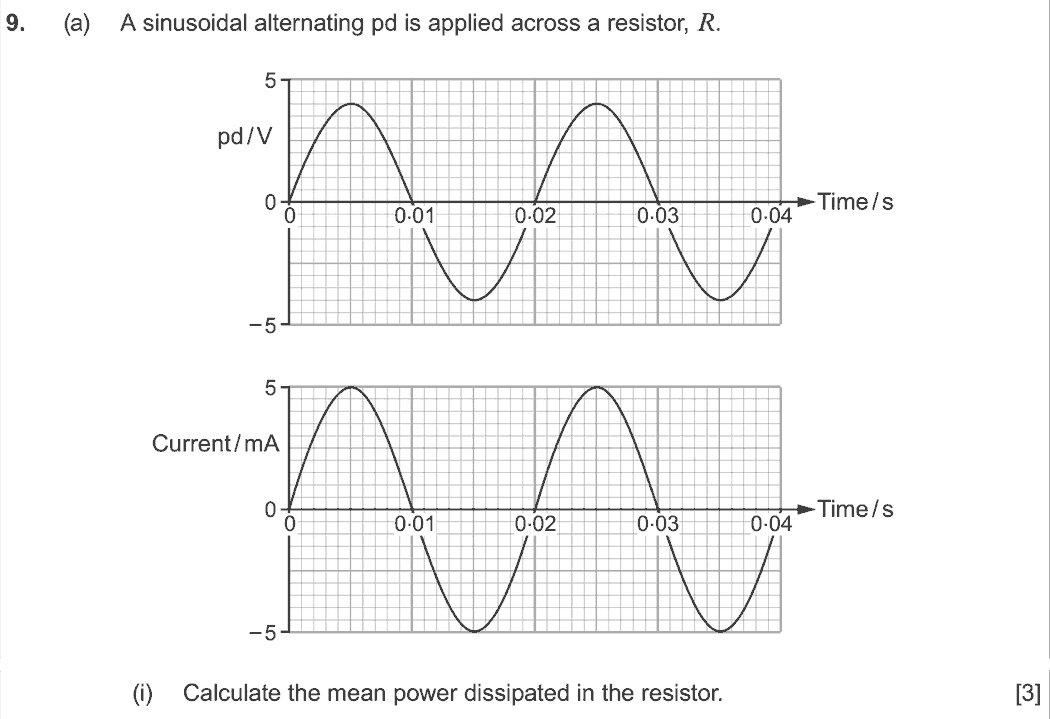
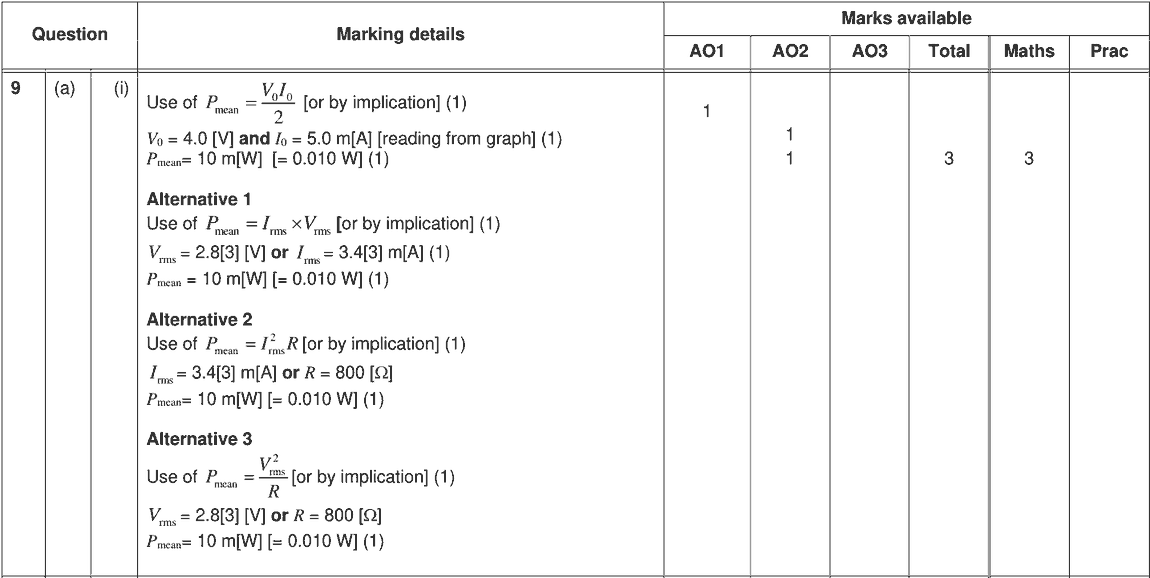
9(a)(i) Alternating currents 3AO1=1,AO2=2Calculation
9(a)(ii) Alternating currents 2AO1=1,AO2=1Calculation
9(a)(iii) Alternating currents 2AO1=1,AO2=1Calculation
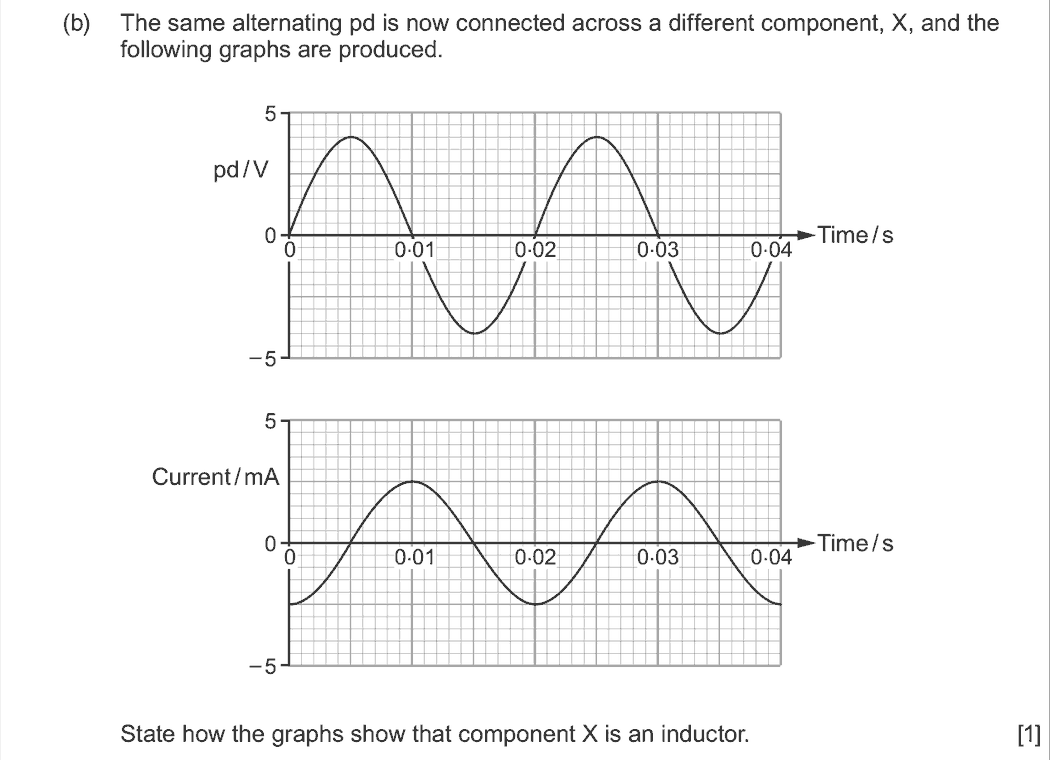
9(b) Alternating currents 1AO3=1Short answer
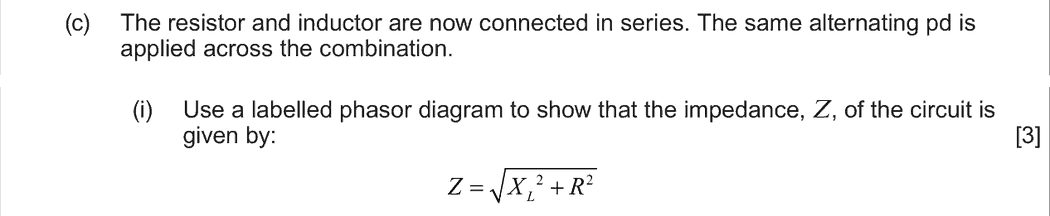
9(c)(i) Alternating currents 3AO1=3Diagram or graph
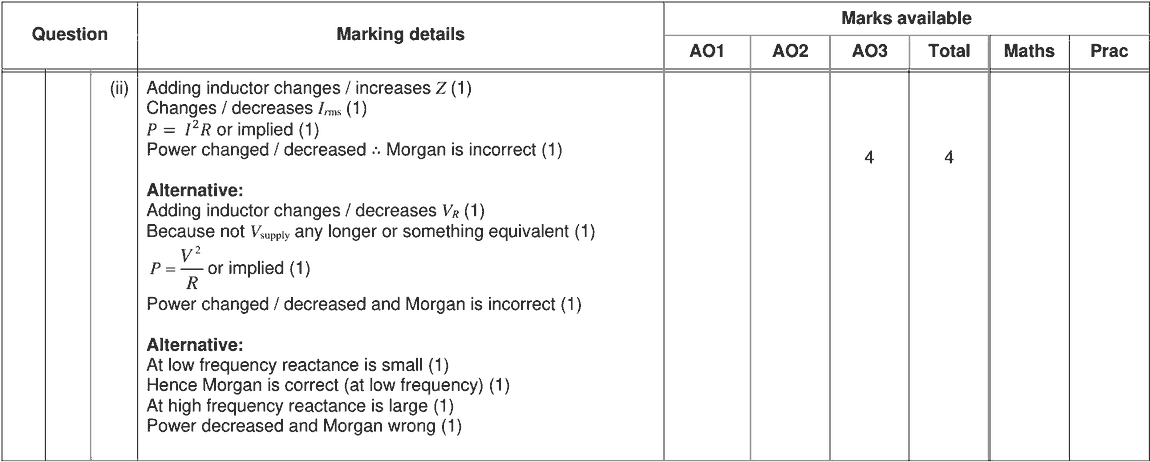
9(c)(ii) Alternating currents 4AO3=4Explanation
9(d)(i) Alternating currents 2AO2=2Calculation
9(d)(ii) Alternating currents 3AO2=3Calculation
10(a)(i) Medical physics 3AO1=3Explanation
10(a)(ii) Medical physics 2AO2=2Calculation
10(a)(iii) Medical physics 2AO1=1,AO2=1Calculation
10(a)(iv) Medical physics 2AO2=2Calculation
10(b) Medical physics 5AO3=5Explanation
10(c) Medical physics 2AO2=2Calculation
10(d)(i) Medical physics 2AO1=2Definition
10(d)(ii) Medical physics 2AO2=2Calculation
11(a)(i) The physics of sports 2AO1=2Short answer
11(a)(ii) The physics of sports 4AO1=1,AO2=3Calculation
11(a)(iii) The physics of sports 2AO1=1,AO2=1Calculation
11(b)(i) The physics of sports 3AO1=1,AO2=2Calculation
11(b)(ii) The physics of sports 5AO3=5Calculation
11(c) The physics of sports 4AO1=1,AO2=3Explanation
12(a)(i) Energy and the environment 2AO1=2Definition
12(a)(ii) Energy and the environment 3AO2=3Calculation
12(b)(i) Energy and the environment 4AO1=1,AO2=3Calculation
12(b)(ii) Energy and the environment 2AO2=2Explanation
12(b)(iii) Energy and the environment 1AO2=1Calculation
12(b)(iv) Energy and the environment 3AO1=3Explanation
12(c) Energy and the environment 5AO3=5Calculation

The questions

1(a)1(b)1(c)1(d)2(a)2(b)2(c)3(a)(i)3(a)(ii)3(b)(i)3(b)(ii)3(b)(iii)4(a)4(b)4(c)(i)4(c)(ii)4(d)5(a)5(b)(i)5(b)(ii)5(c)5(d)(i)5(d)(ii)5(d)(iii)67(a)7(b)(i)7(b)(ii)7(b)(iii)8(a)8(b)8(c)9(a)(i)9(a)(ii)9(a)(iii)9(b)9(c)(i)9(c)(ii)9(d)(i)9(d)(ii)10(a)(i)10(a)(ii)10(a)(iii)10(a)(iv)10(b)10(c)10(d)(i)10(d)(ii)11(a)(i)11(a)(ii)11(a)(iii)11(b)(i)11(b)(ii)11(c)12(a)(i)12(a)(ii)12(b)(i)12(b)(ii)12(b)(iii)12(b)(iv)12(c)
June 2024 · Component 3 · Q1(a) 4 marks AO3=4 Explanation wave propertiesnature of waves
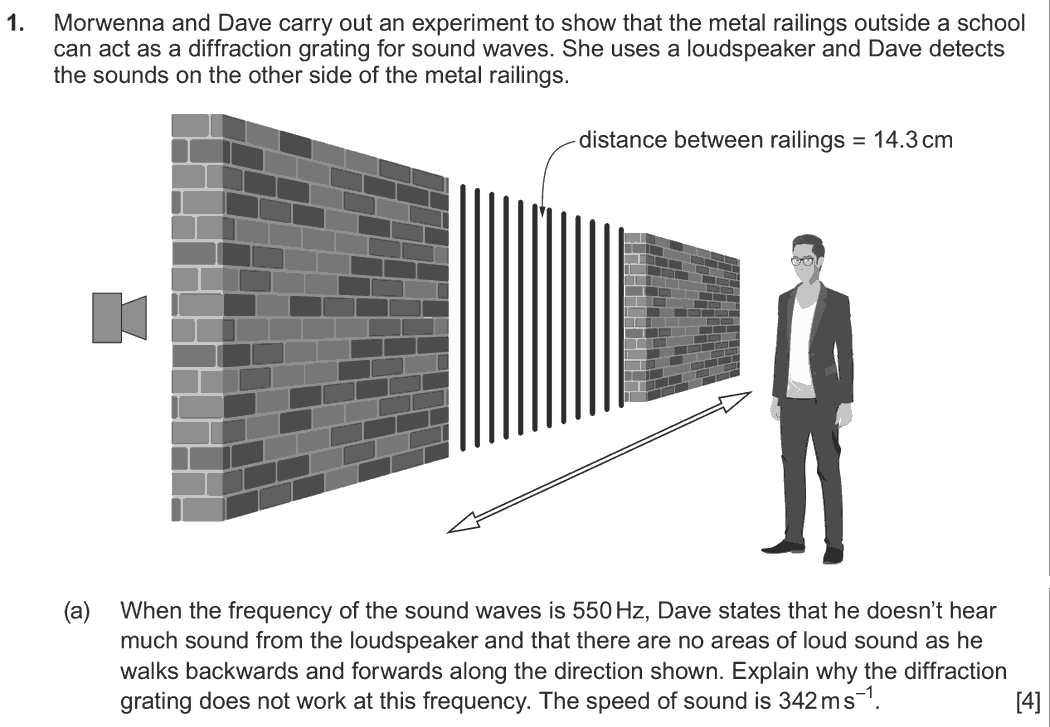
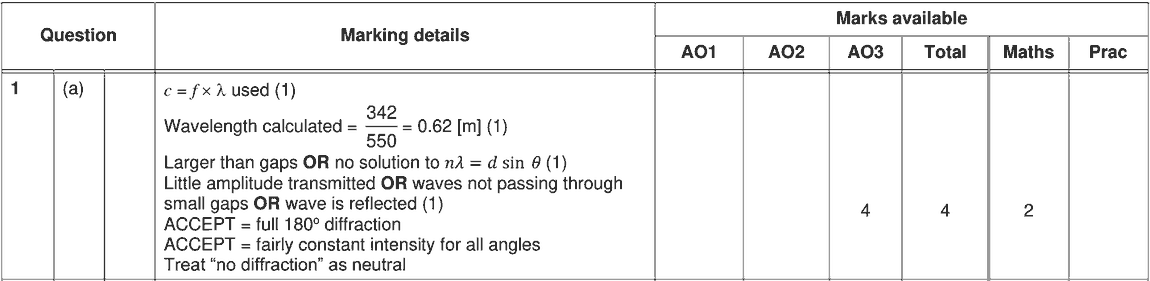
1. Morwenna and Dave carry out an experiment to show that the metal railings outside a school can act as a diffraction grating for sound waves. She uses a loudspeaker and Dave detects the sounds on the other side of the metal railings. distance between railings = 14.3 cm (a) When the frequency of the sound waves is 550 Hz, Dave states that he doesn’t hear much sound from the loudspeaker and that there are no areas of loud sound as he walks backwards and forwards along the direction shown. Explain why the diffraction grating does not work at this frequency. The speed of sound is 342 m s–1. [4]
June 2024 · Component 3 · Q1(b) 3 marks AO1=1, AO2=2 Calculation wave propertiesnature of waves
Earlier part of question 1 that this part usesEarlier part of June 2024 Component 3 question 1
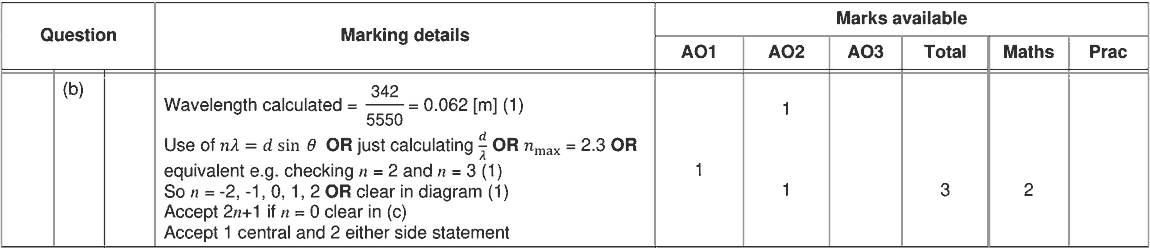
(b) Morwenna increases the frequency of the sound waves to 5500 Hz and Dave says that there are 5 directions of very loud sound on the other side of the metal railings. Using a calculation, explain why this is to be expected. [3]
June 2024 · Component 3 · Q1(c) 3 marks AO1=1, AO2=2 Calculation wave properties
Earlier part of question 1 that this part usesEarlier part of June 2024 Component 3 question 1
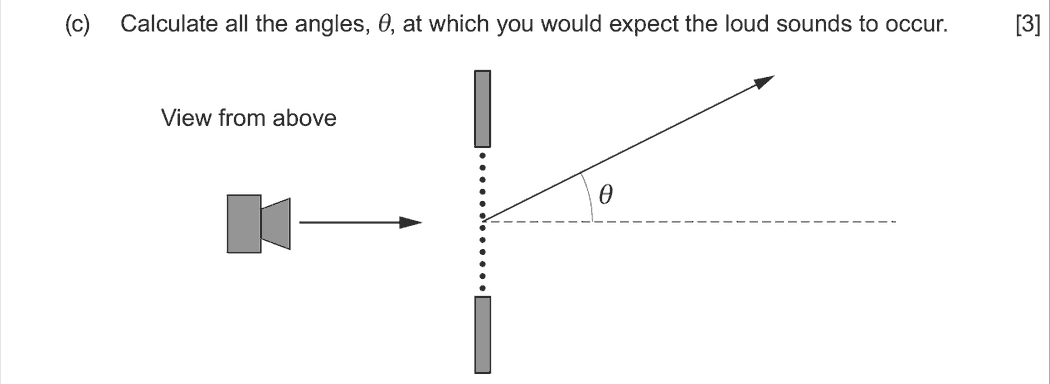
(c) Calculate all the angles, θ, at which you would expect the loud sounds to occur. [3] View from above θ
June 2024 · Component 3 · Q1(d) 3 marks AO3=3 Explanation nature of waves
Earlier parts of question 1 that this part usesEarlier part of June 2024 Component 3 question 1Earlier part of June 2024 Component 3 question 1
(d) Dave states, “The metal railings are very similar to a polariser for microwaves so the sound waves I’m detecting must be polarised.” Determine to what extent Dave’s statement is correct. [3]
June 2024 · Component 3 · Q2(a) 3 marks AO2=3 Explanation wave properties
2. Robin and Eilir investigate stationary waves using sound waves and a wall. View from above (a) Explain why a stationary wave is produced between the loudspeaker and the wall. [3]
June 2024 · Component 3 · Q2(b) 4 marks AO1=1, AO2=3 Calculation wave propertiesnature of waves
Earlier part of question 2 that this part usesEarlier part of June 2024 Component 3 question 2
(b) While moving in the direction shown, Robin places a chalk line on the floor at each place where he detects a loud sound. The lines he places on the floor are shown. 15.55 m (and there are 26 lines shown) Calculate the frequency of sound used (speed of sound = 342 m s–1). [4]
June 2024 · Component 3 · Q2(c) 6 marks AO1=6 6-mark extended response wave properties
Earlier part of question 2 that this part usesEarlier part of June 2024 Component 3 question 2
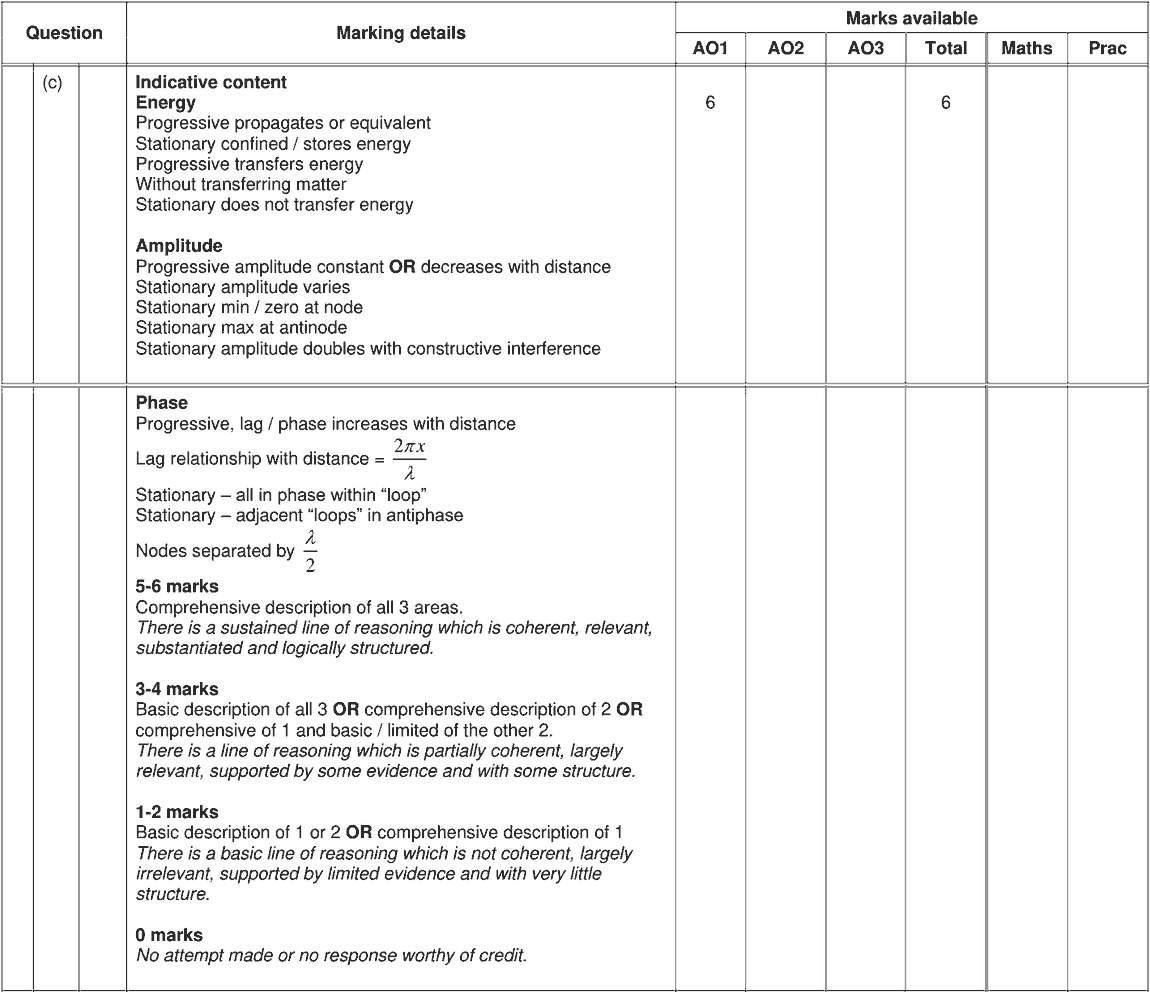
(c) State the differences between progressive and stationary waves. In your answer you should refer to amplitude, energy and phase. [6 QER]
June 2024 · Component 3 · Q3(a)(i) 2 marks AO1=1, AO2=1 Calculation refraction of light
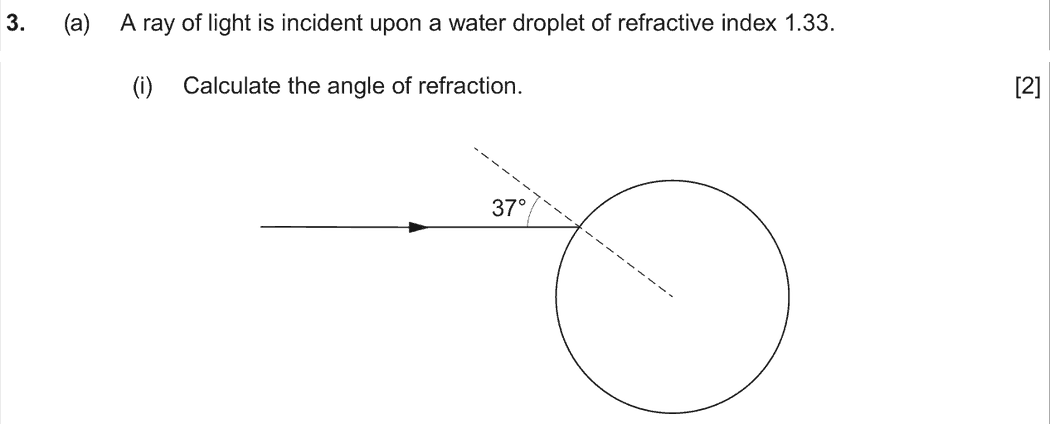
3. (a) A ray of light is incident upon a water droplet of refractive index 1.33. (i) Calculate the angle of refraction. [2] 37°
June 2024 · Component 3 · Q3(a)(ii) 3 marks AO2=3 Diagram or graph refraction of light
Earlier part of question 3 that this part usesEarlier part of June 2024 Component 3 question 3
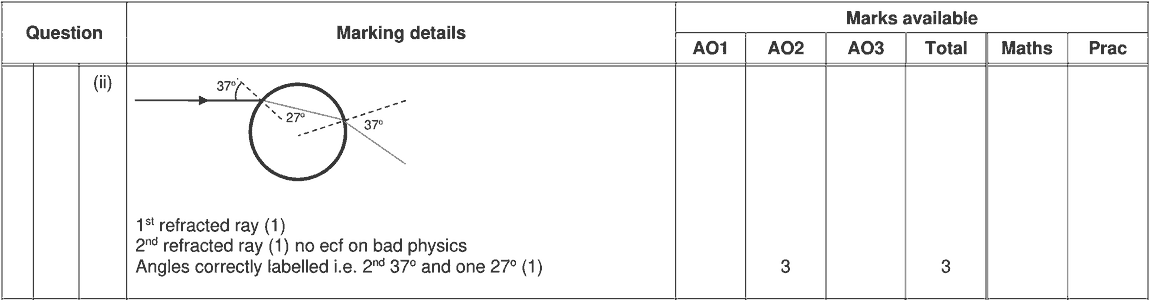
(ii) Complete the diagram above by showing the ray passing through the droplet and out of the other side. Label the angles with their values. [3]
June 2024 · Component 3 · Q3(b)(i) 3 marks AO1=1, AO2=2 Show that refraction of light
Earlier part of question 3 that this part usesEarlier part of June 2024 Component 3 question 3
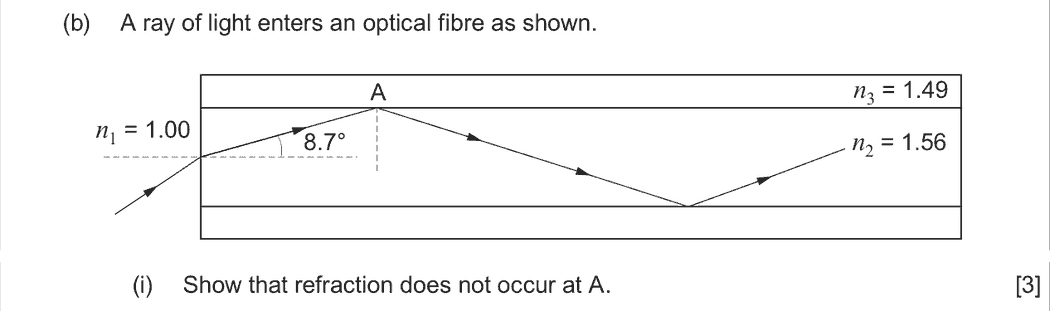
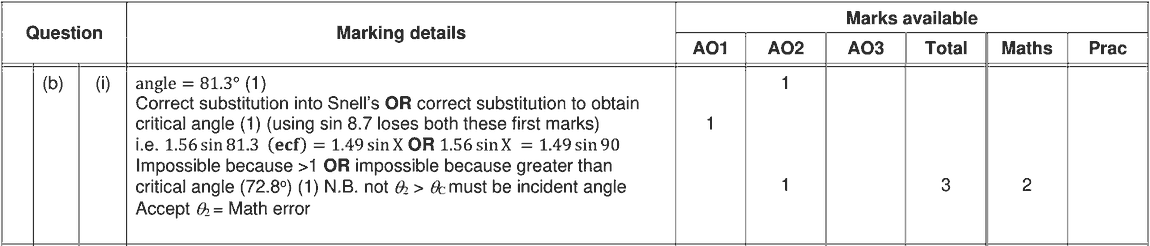
(b) A ray of light enters an optical fibre as shown. A n3 = 1.49 n1 = 1.00 8.7° n2 = 1.56 (i) Show that refraction does not occur at A. [3]
June 2024 · Component 3 · Q3(b)(ii) 3 marks AO1=3 Explanation refraction of light
Earlier parts of question 3 that this part usesEarlier part of June 2024 Component 3 question 3Earlier part of June 2024 Component 3 question 3
(ii) Explain how ‘multimode dispersion’ arises and outline the problem that it causes. [3]
June 2024 · Component 3 · Q3(b)(iii) 2 marks AO1=2 Explanation refraction of light
Earlier parts of question 3 that this part usesEarlier part of June 2024 Component 3 question 3Earlier part of June 2024 Component 3 question 3
(iii) Explain how the problem of ‘multimode dispersion’ is solved in practice. [2]
June 2024 · Component 3 · Q4(a) 3 marks AO1=1, AO2=2 Explanation photons
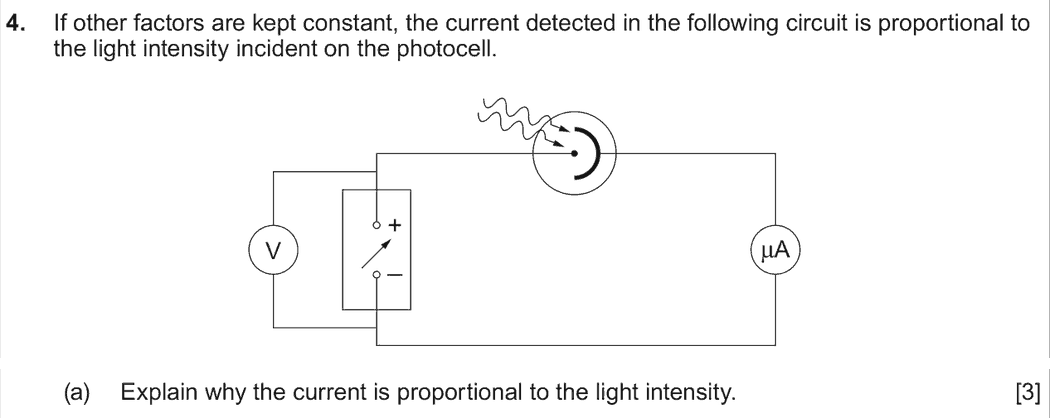
4. If other factors are kept constant, the current detected in the following circuit is proportional to the light intensity incident on the photocell. + V μA _ (a) Explain why the current is proportional to the light intensity. [3]
June 2024 · Component 3 · Q4(b) 2 marks AO3=2 Short answer photons
Earlier part of question 4 that this part usesEarlier part of June 2024 Component 3 question 4
(b) State the two factors that should be kept constant for the current to be proportional to the light intensity for this photocell. [2]
June 2024 · Component 3 · Q4(c)(i) 3 marks AO1=2, AO2=1 Calculation photons
Earlier part of question 4 that this part usesEarlier part of June 2024 Component 3 question 4
(c) Light of wavelength 410 nm is incident on the photocell. (i) Calculate the work function of the metal of the photocell, given that the maximum speed of the photoelectrons is 3.9 × 10⁵ m s–1. [3]
June 2024 · Component 3 · Q4(c)(ii) 3 marks AO2=3 Calculation photons
Earlier parts of question 4 that this part usesEarlier part of June 2024 Component 3 question 4Earlier part of June 2024 Component 3 question 4
(ii) The total light power incident on the photocell is 0.36 μW. Calculate the current in the circuit, stating any assumption that you make. [3]
June 2024 · Component 3 · Q4(d) 3 marks AO3=3 Explanation photons
Earlier part of question 4 that this part usesEarlier part of June 2024 Component 3 question 4
(d) The photoelectric effect is evidence of light behaving like particles. In 1802, Thomas Young carried out an experiment that was evidence of light behaving like a wave. In 1704, Newton had argued that light was made of particles whose size varied with colour. Explain how the scientific community has decided which of these theories to adopt. [3]
June 2024 · Component 3 · Q5(a) 4 marks AO1=4 Practical and data analysis nuclear decay
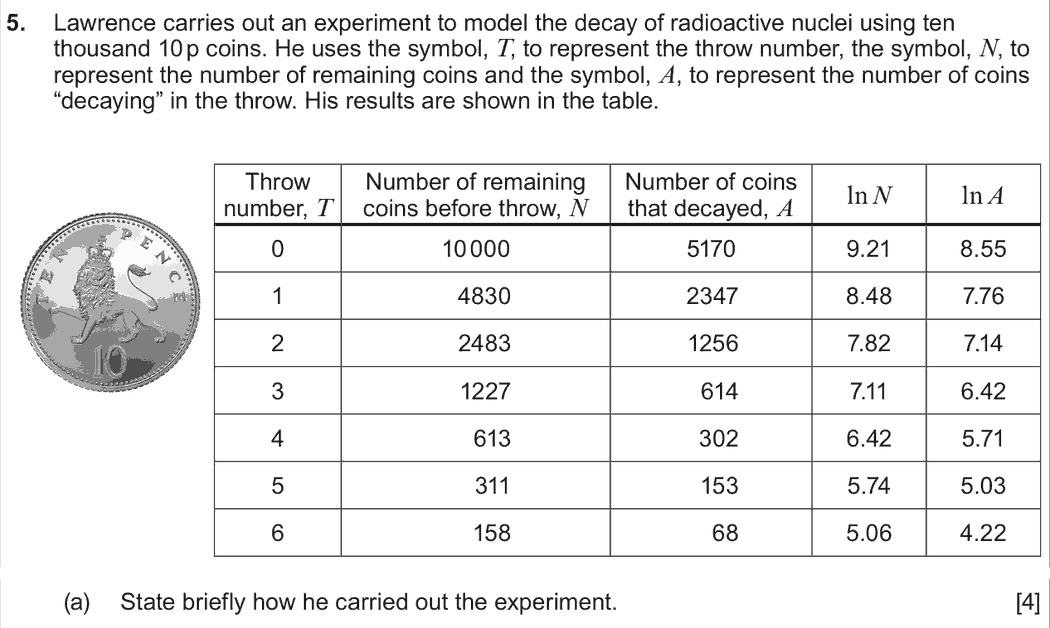
5. Lawrence carries out an experiment to model the decay of radioactive nuclei using ten thousand 10 p coins. He uses the symbol, T, to represent the throw number, the symbol, N, to represent the number of remaining coins and the symbol, A, to represent the number of coins “decaying” in the throw. His results are shown in the table. Throw Number of remaining Number of coins ln N ln A number, T coins before throw, N that decayed, A 0 10 000 5170 9.21 8.55 1 4830 2347 8.48 7.76 2 2483 1256 7.82 7.14 3 1227 614 7.11 6.42 4 613 302 6.42 5.71 5 311 153 5.74 5.03 6 158 68 5.06 4.22 (a) State briefly how he carried out the experiment. [4]
June 2024 · Component 3 · Q5(b)(i) 1 mark AO2=1 Practical and data analysis nuclear decay
Earlier part of question 5 that this part usesEarlier part of June 2024 Component 3 question 5
(b) (i) State what you would expect the half-life of the 10 p coins to be. [1]
June 2024 · Component 3 · Q5(b)(ii) 3 marks AO2=3 Show that nuclear decay
Earlier parts of question 5 that this part usesEarlier part of June 2024 Component 3 question 5Earlier part of June 2024 Component 3 question 5
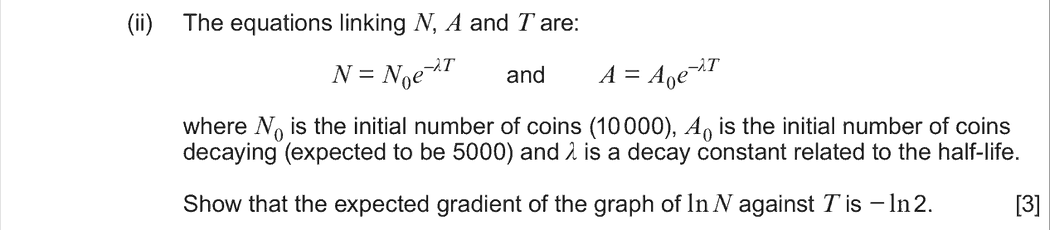
(ii) The equations linking N, A and T are: N = N0e–λT and A = A0e–λT where N0 is the initial number of coins (10 000), A0 is the initial number of coins decaying (expected to be 5000) and λ is a decay constant related to the half-life. Show that the expected gradient of the graph of ln N against T is − ln 2. [3]
June 2024 · Component 3 · Q5(c) 6 marks AO3=6 Practical and data analysis nuclear decay
Earlier part of question 5 that this part usesEarlier part of June 2024 Component 3 question 5
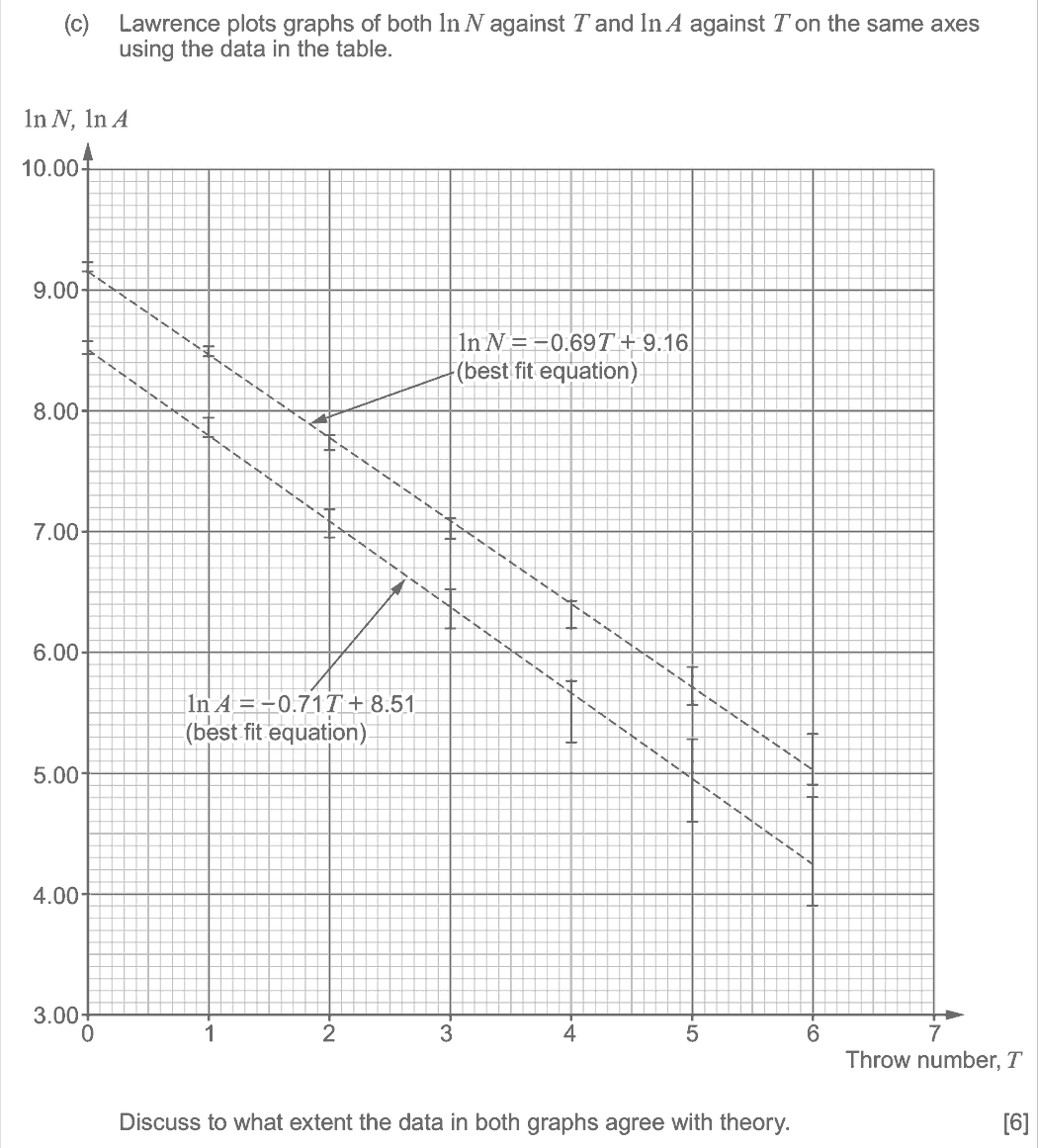
(c) Lawrence plots graphs of both ln N against T and ln A against T on the same axes using the data in the table. 1n N, 1n A 10.00 9.00 1n 1n N N = = – – 0.69T 0.69T + + 9.16 9.16 (best (best fit fit equation) equation) 8.00 7.00 6.00 1n 1n A A = = – – 0.71T 0.71T + + 8.51 8.51 (best (best fit fit equation) equation) 5.00 4.00 3.00 0 1 2 3 4 5 6 7 Throw number, T Discuss to what extent the data in both graphs agree with theory. [6]
June 2024 · Component 3 · Q5(d)(i) 2 marks AO1=1, AO2=1 Practical and data analysis nuclear decay
Earlier parts of question 5 that this part usesEarlier part of June 2024 Component 3 question 5Earlier part of June 2024 Component 3 question 5
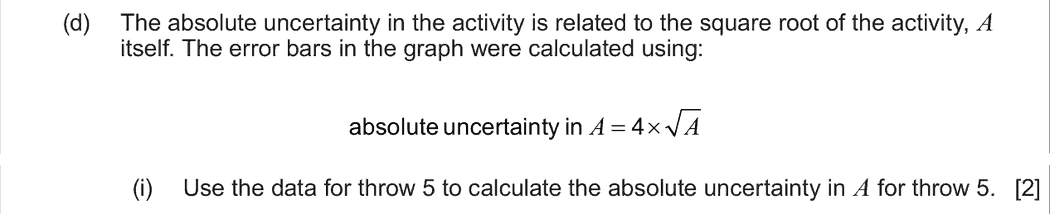
(d) The absolute uncertainty in the activity is related to the square root of the activity, A itself. The error bars in the graph were calculated using: absolute uncertainty in A  4  A (i) Use the data for throw 5 to calculate the absolute uncertainty in A for throw 5. [2]
June 2024 · Component 3 · Q5(d)(ii) 3 marks AO3=3 Practical and data analysis nuclear decay
Earlier parts of question 5 that this part usesEarlier part of June 2024 Component 3 question 5Earlier part of June 2024 Component 3 question 5Earlier part of June 2024 Component 3 question 5
(ii) Hence, determine whether the error bar for throw 5 is correct on the graph of ln A against T. [3]
June 2024 · Component 3 · Q5(d)(iii) 2 marks AO3=2 Practical and data analysis nuclear decay
Earlier parts of question 5 that this part usesEarlier part of June 2024 Component 3 question 5Earlier part of June 2024 Component 3 question 5Earlier part of June 2024 Component 3 question 5
(iii) The error bars gradually increase in size on the graph of ln A against T. Explain what would happen to the error bars if a graph of A against T were plotted. [2]
June 2024 · Component 3 · Q6 5 marks AO2=5 Explanation particles and nuclear structure
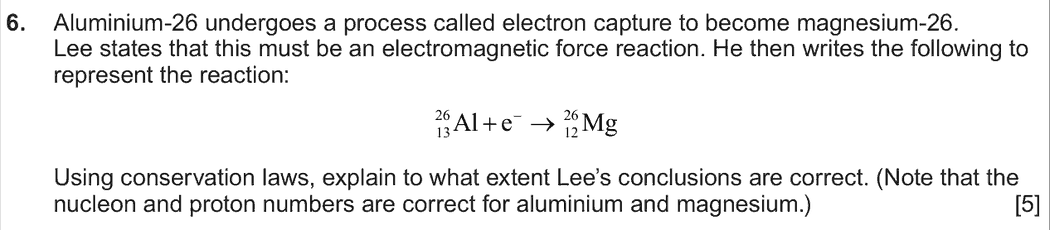
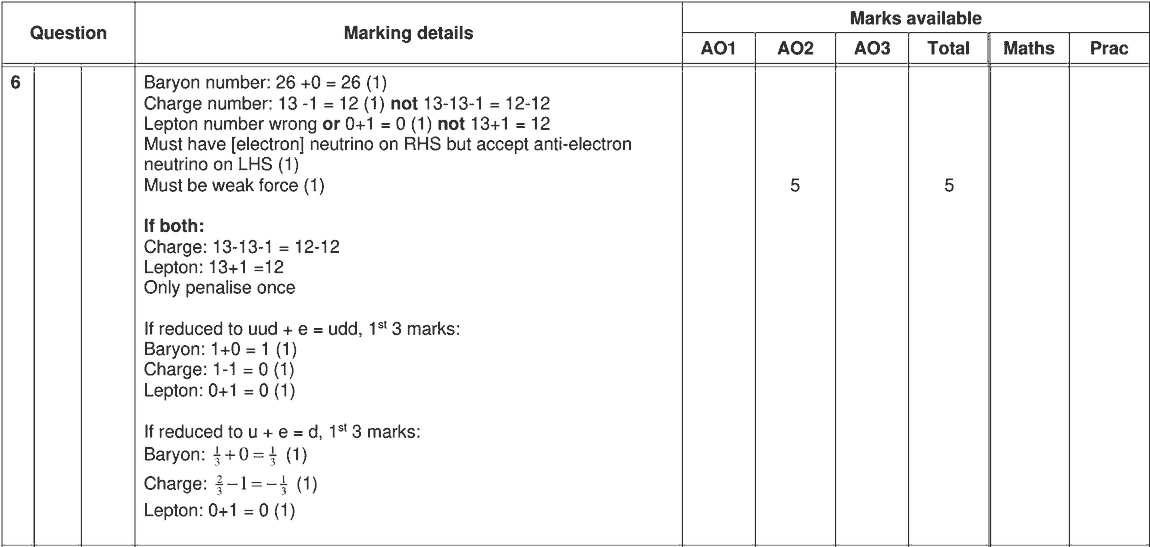
6. Aluminium-26 undergoes a process called electron capture to become magnesium-26. Lee states that this must be an electromagnetic force reaction. He then writes the following to represent the reaction: 26 Al  e   26 Mg 13 12 Using conservation laws, explain to what extent Lee’s conclusions are correct. (Note that the nucleon and proton numbers are correct for aluminium and magnesium.) [5]
June 2024 · Component 3 · Q7(a) 3 marks AO1=1, AO2=2 Calculation magnetic fields
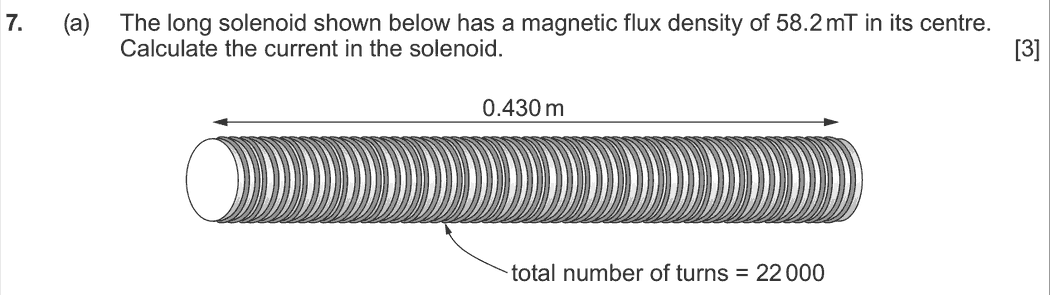
7. (a) The long solenoid shown below has a magnetic flux density of 58.2 mT in its centre. Calculate the current in the solenoid. [3] 0.430 m total number of turns = 22 000
June 2024 · Component 3 · Q7(b)(i) 3 marks AO1=3 Explanation magnetic fields
Earlier part of question 7 that this part usesEarlier part of June 2024 Component 3 question 7
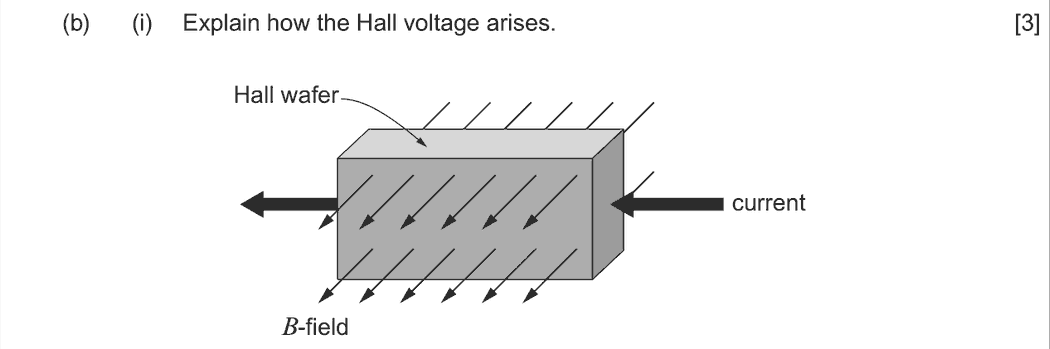
(b) (i) Explain how the Hall voltage arises. [3] Hall wafer current B-field
June 2024 · Component 3 · Q7(b)(ii) 2 marks AO2=2 Calculation magnetic fields
Earlier parts of question 7 that this part usesEarlier part of June 2024 Component 3 question 7Earlier part of June 2024 Component 3 question 7
(ii) The drift velocity of electrons in a Hall wafer is 13.0 cm s–1 and the width of the Hall wafer is 0.58 cm. Calculate the expected Hall voltage when this Hall wafer is placed in the long solenoid where the maximum magnetic flux density is 58.2 mT. [2]
June 2024 · Component 3 · Q7(b)(iii) 2 marks AO3=2 Practical and data analysis magnetic fields
Earlier parts of question 7 that this part usesEarlier part of June 2024 Component 3 question 7Earlier part of June 2024 Component 3 question 7
(iii) The actual measured Hall voltage is significantly below the value in (b)(ii) even though all values quoted are correct. Suggest what a competent experimental physicist should do to obtain the correct Hall voltage reading on the probe. [2]
June 2024 · Component 3 · Q8(a) 5 marks AO2=5 Explanation electromagnetic induction
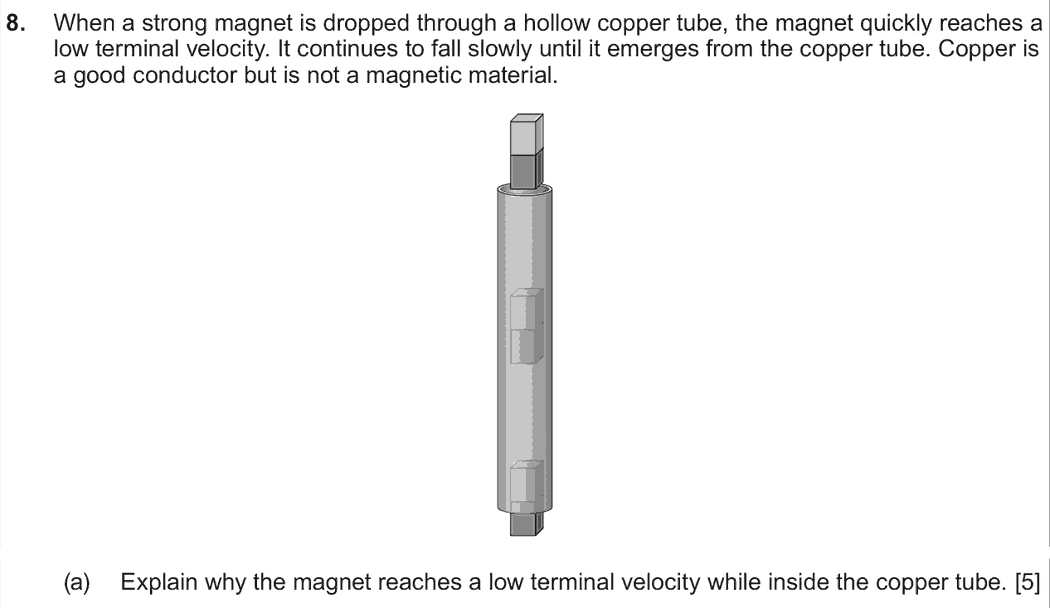
8. When a strong magnet is dropped through a hollow copper tube, the magnet quickly reaches a low terminal velocity. It continues to fall slowly until it emerges from the copper tube. Copper is a good conductor but is not a magnetic material. (a) Explain why the magnet reaches a low terminal velocity while inside the copper tube. [5]
June 2024 · Component 3 · Q8(b) 3 marks AO1=1, AO2=2 Calculation basic physics
Earlier part of question 8 that this part usesEarlier part of June 2024 Component 3 question 8
(b) The inner diameter of the copper tube is 1.50 cm, its outer diameter is 1.60 cm and its length is 1.205 m. Calculate the mass of the copper tube. Density of copper = 8960 kg m–3 [3]
June 2024 · Component 3 · Q8(c) 3 marks AO1=1, AO2=2 Calculation thermal physicsenergy concepts
Earlier part of question 8 that this part usesEarlier part of June 2024 Component 3 question 8
(c) The mass of the magnet is 325 g and the specific heat capacity of copper is 389 J K–1 kg–1. Calculate the rise in temperature of the copper tube when the magnet falls through it. [3]
June 2024 · Component 3 · Q9(a)(i) 3 marks AO1=1, AO2=2 Calculation alternating currents
9. (a) A sinusoidal alternating pd is applied across a resistor, R. 5 pd / V 0 Time / s 0 0.01 0.02 0.03 0.04 – 5 5 Current / mA 0 Time / s 0 0.01 0.02 0.03 0.04 – 5 (i) Calculate the mean power dissipated in the resistor. [3]
June 2024 · Component 3 · Q9(a)(ii) 2 marks AO1=1, AO2=1 Calculation alternating currents
Earlier part of question 9 that this part usesEarlier part of June 2024 Component 3 question 9
(ii) Calculate the energy dissipated per cycle in the resistor. [2]
June 2024 · Component 3 · Q9(a)(iii) 2 marks AO1=1, AO2=1 Calculation alternating currents
Earlier part of question 9 that this part usesEarlier part of June 2024 Component 3 question 9
(iii) Determine the number of times per second the instantaneous power dissipation in the resistor reaches a maximum. [2]
June 2024 · Component 3 · Q9(b) 1 mark AO3=1 Short answer alternating currents
Earlier part of question 9 that this part usesEarlier part of June 2024 Component 3 question 9
(b) The same alternating pd is now connected across a different component, X, and the following graphs are produced. 5 pd / V 0 Time / s 0 0.01 0.02 0.03 0.04 – 5 5 Current / mA 0 Time / s 0 0.01 0.02 0.03 0.04 – 5 State how the graphs show that component X is an inductor. [1]
June 2024 · Component 3 · Q9(c)(i) 3 marks AO1=3 Diagram or graph alternating currents
Earlier parts of question 9 that this part usesEarlier part of June 2024 Component 3 question 9Earlier part of June 2024 Component 3 question 9
(c) The resistor and inductor are now connected in series. The same alternating pd is applied across the combination. (i) Use a labelled phasor diagram to show that the impedance, Z, of the circuit is given by: [3] Z  X 2  R 2 L
June 2024 · Component 3 · Q9(c)(ii) 4 marks AO3=4 Explanation alternating currents
Earlier parts of question 9 that this part usesEarlier part of June 2024 Component 3 question 9Earlier part of June 2024 Component 3 question 9Earlier part of June 2024 Component 3 question 9
(ii) Morgan knows that no power is dissipated in an inductor with zero resistance. He therefore claims that adding the inductor will not affect the mean power dissipated in the circuit. Determine whether Morgan is correct. [4]
June 2024 · Component 3 · Q9(d)(i) 2 marks AO2=2 Calculation alternating currents
Earlier parts of question 9 that this part usesEarlier part of June 2024 Component 3 question 9Earlier part of June 2024 Component 3 question 9
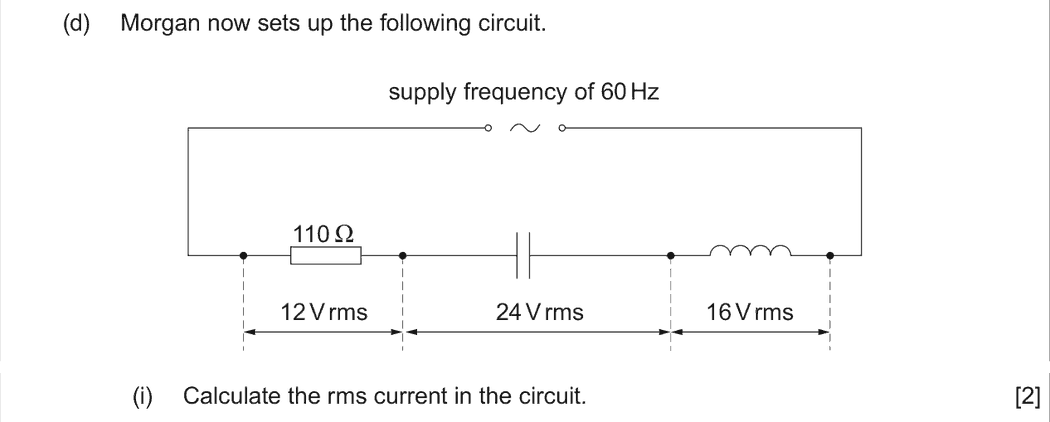
(d) Morgan now sets up the following circuit. supply frequency of 60 Hz 110 Ω 12 V rms 24 V rms 16 V rms (i) Calculate the rms current in the circuit. [2]
June 2024 · Component 3 · Q9(d)(ii) 3 marks AO2=3 Calculation alternating currents
Earlier parts of question 9 that this part usesEarlier part of June 2024 Component 3 question 9Earlier part of June 2024 Component 3 question 9Earlier part of June 2024 Component 3 question 9
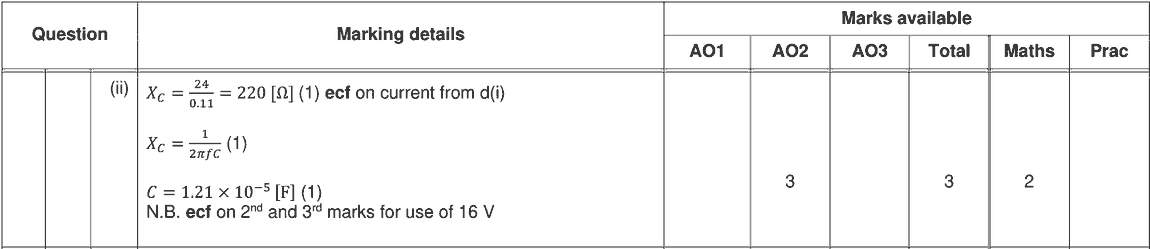
(ii) Hence, calculate the value of the capacitor. [3]
June 2024 · Component 3 · Q10(a)(i) 3 marks AO1=3 Explanation medical physics
10. (a) Electrons are accelerated in an X-ray tube. (i) Describe the energy changes that occur inside an X-ray tube. [3]
June 2024 · Component 3 · Q10(a)(ii) 2 marks AO2=2 Calculation medical physics
Earlier part of question 10 that this part usesEarlier part of June 2024 Component 3 question 10
(ii) Calculate the frequency of the X-rays at the cut-off wavelength of 48 pm. [2]
June 2024 · Component 3 · Q10(a)(iii) 2 marks AO1=1, AO2=1 Calculation medical physics
Earlier part of question 10 that this part usesEarlier part of June 2024 Component 3 question 10
(iii) The accelerating voltage is 25 kV. Use this value to determine the maximum energy of the X-ray photons in J. [2]
June 2024 · Component 3 · Q10(a)(iv) 2 marks AO2=2 Calculation medical physics
Earlier part of question 10 that this part usesEarlier part of June 2024 Component 3 question 10
(iv) Use the information above to obtain a value for the Planck constant, h. [2]
June 2024 · Component 3 · Q10(b) 5 marks AO3=5 Explanation medical physics
Earlier part of question 10 that this part usesEarlier part of June 2024 Component 3 question 10
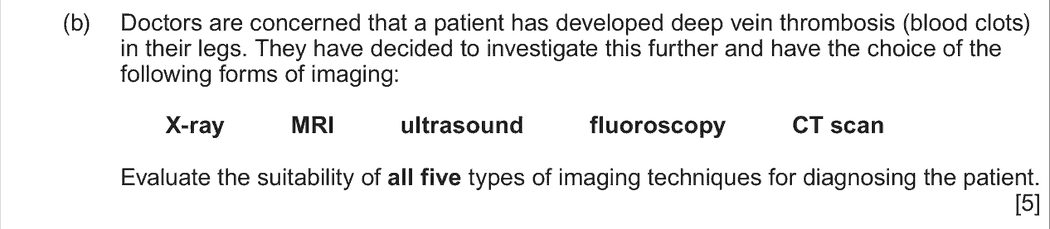
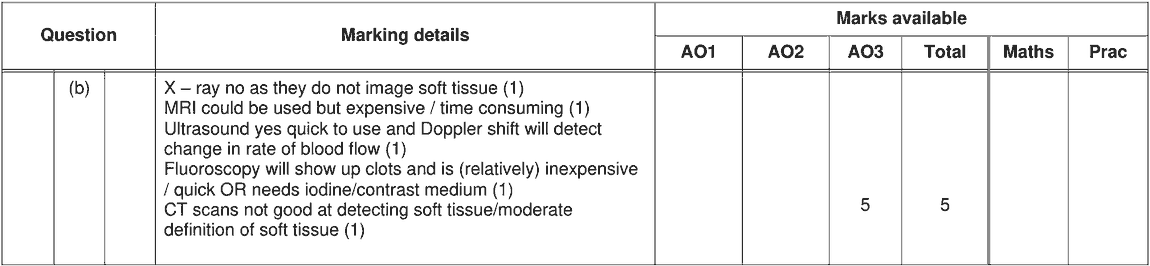
(b) Doctors are concerned that a patient has developed deep vein thrombosis (blood clots) in their legs. They have decided to investigate this further and have the choice of the following forms of imaging: X-ray MRI ultrasound fluoroscopy CT scan Evaluate the suitability of all five types of imaging techniques for diagnosing the patient. [5]
June 2024 · Component 3 · Q10(c) 2 marks AO2=2 Calculation medical physics
Earlier part of question 10 that this part usesEarlier part of June 2024 Component 3 question 10
(c) A small volume of Human serum albumin (HSA) labelled with iodine-125 of activity 160 Bq is injected into the bloodstream of a patient. A sample of 0.6 ml of blood is taken a few hours later and is found to have an activity of 0.020 Bq. Calculate the volume of blood in ml in the patient, stating any assumptions you make. [2] (The half-life of iodine-125 is several months.)
June 2024 · Component 3 · Q10(d)(i) 2 marks AO1=2 Definition medical physics
Earlier part of question 10 that this part usesEarlier part of June 2024 Component 3 question 10
(d) (i) Define ‘equivalent dose’ and ‘effective dose’. [2]
June 2024 · Component 3 · Q10(d)(ii) 2 marks AO2=2 Calculation medical physics
Earlier parts of question 10 that this part usesEarlier part of June 2024 Component 3 question 10Earlier part of June 2024 Component 3 question 10
(ii) The effective dose for alpha particles incident on the skin is 2.2 mSv and the equivalent dose is 0.22 Sv. Determine the tissue weighting factor, WT , for skin. [2]
June 2024 · Component 3 · Q11(a)(i) 2 marks AO1=2 Short answer physics of sports
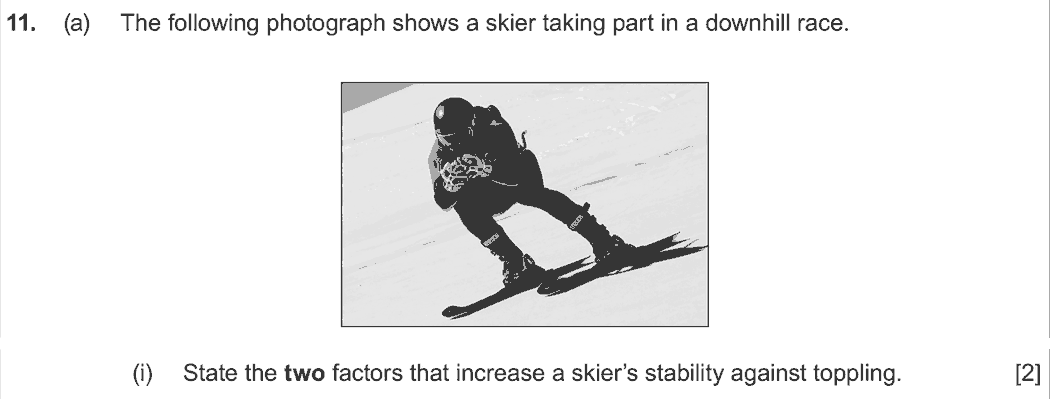
11. (a) The following photograph shows a skier taking part in a downhill race. (i) State the two factors that increase a skier’s stability against toppling. [2]
June 2024 · Component 3 · Q11(a)(ii) 4 marks AO1=1, AO2=3 Calculation physics of sports
Earlier part of question 11 that this part usesEarlier part of June 2024 Component 3 question 11
(ii) The speed of a downhill skier changes from u to 1.25 u. At the same time, the effective cross-sectional area of the skier changes from A to 0.85 A. Calculate how the drag force on the skier will change, stating any assumptions you make. [4]
June 2024 · Component 3 · Q11(a)(iii) 2 marks AO1=1, AO2=1 Calculation physics of sports
Earlier part of question 11 that this part usesEarlier part of June 2024 Component 3 question 11
(iii) A skier of mass 72 kg moving at a speed of 25 m s–1 crashes into a barrier and is brought to rest in a time of 0.89 s. Determine the force exerted on the skier by the barrier. [2]
June 2024 · Component 3 · Q11(b)(i) 3 marks AO1=1, AO2=2 Calculation physics of sports
Earlier part of question 11 that this part usesEarlier part of June 2024 Component 3 question 11
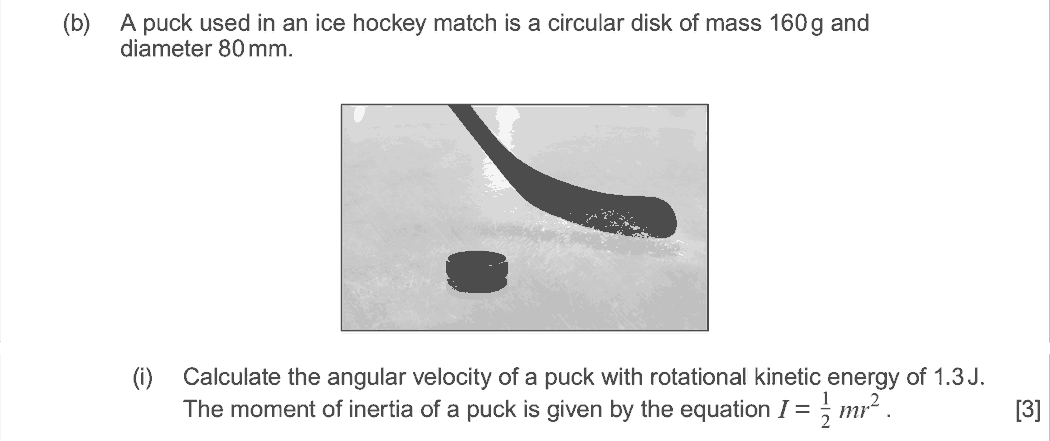
(b) A puck used in an ice hockey match is a circular disk of mass 160 g and diameter 80 mm. (i) Calculate the angular velocity of a puck with rotational kinetic energy of 1.3 J. 1 mr2 The moment of inertia of a puck is given by the equation I = . [3] 2
June 2024 · Component 3 · Q11(b)(ii) 5 marks AO3=5 Calculation physics of sports
Earlier parts of question 11 that this part usesEarlier part of June 2024 Component 3 question 11Earlier part of June 2024 Component 3 question 11
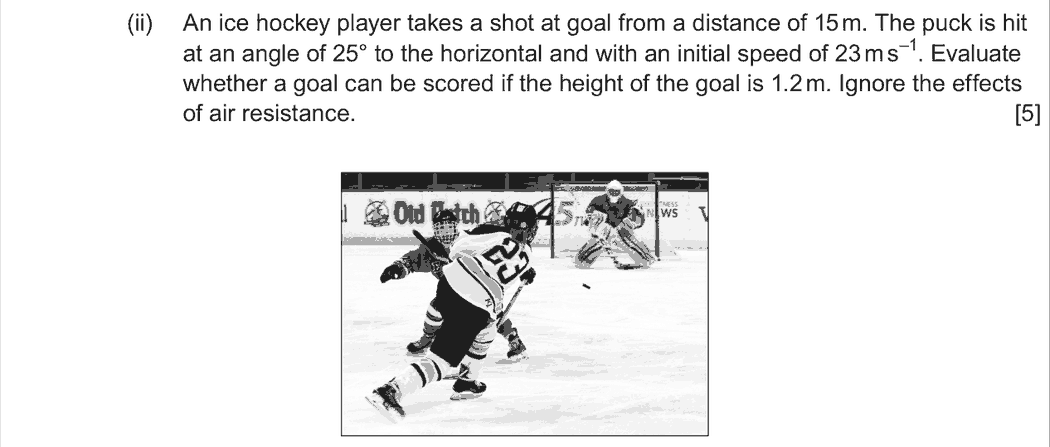
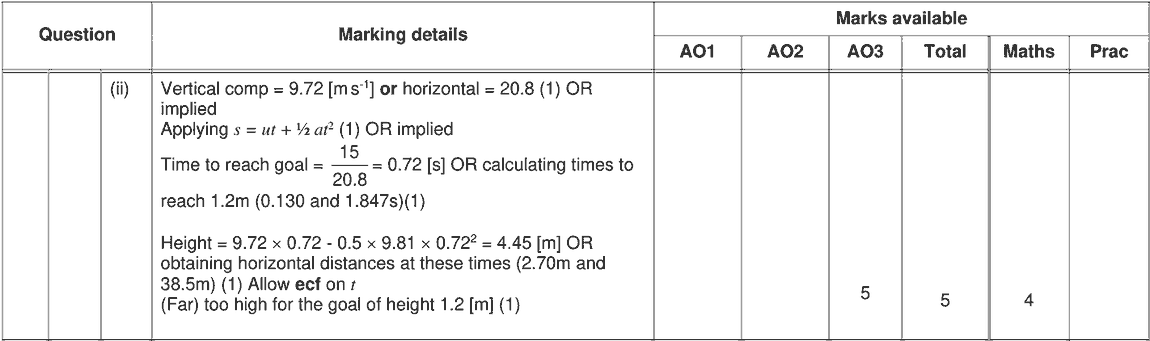
(ii) An ice hockey player takes a shot at goal from a distance of 15 m. The puck is hit at an angle of 25° to the horizontal and with an initial speed of 23 m s–1. Evaluate whether a goal can be scored if the height of the goal is 1.2 m. Ignore the effects of air resistance. [5]
June 2024 · Component 3 · Q11(c) 4 marks AO1=1, AO2=3 Explanation physics of sports
Earlier parts of question 11 that this part usesEarlier part of June 2024 Component 3 question 11Earlier part of June 2024 Component 3 question 11Earlier part of June 2024 Component 3 question 11
(c) An ice skater is rotating with both arms outstretched. His arms are now pulled in. Explain why the rate of rotation of the skater will increase. [4]
June 2024 · Component 3 · Q12(a)(i) 2 marks AO1=2 Definition energy and the environment
12. (a) (i) A student incorrectly writes the Archimedes principle as: ‘An object wholly immersed in a liquid experiences a force equal to the mass of the fluid dispersed by the object’. Write the correct version of this principle. [2]
June 2024 · Component 3 · Q12(a)(ii) 3 marks AO2=3 Calculation energy and the environment
Earlier part of question 12 that this part usesEarlier part of June 2024 Component 3 question 12
(ii) Ice has a density of 920 kg m–3. A freshwater iceberg floats in seawater of density 1020 kg m–3. Starting from the Archimedes principle, determine the fraction of the volume of the iceberg that will be below the surface. Show your reasoning clearly. [3]
June 2024 · Component 3 · Q12(b)(i) 4 marks AO1=1, AO2=3 Calculation energy and the environment
Earlier part of question 12 that this part usesEarlier part of June 2024 Component 3 question 12
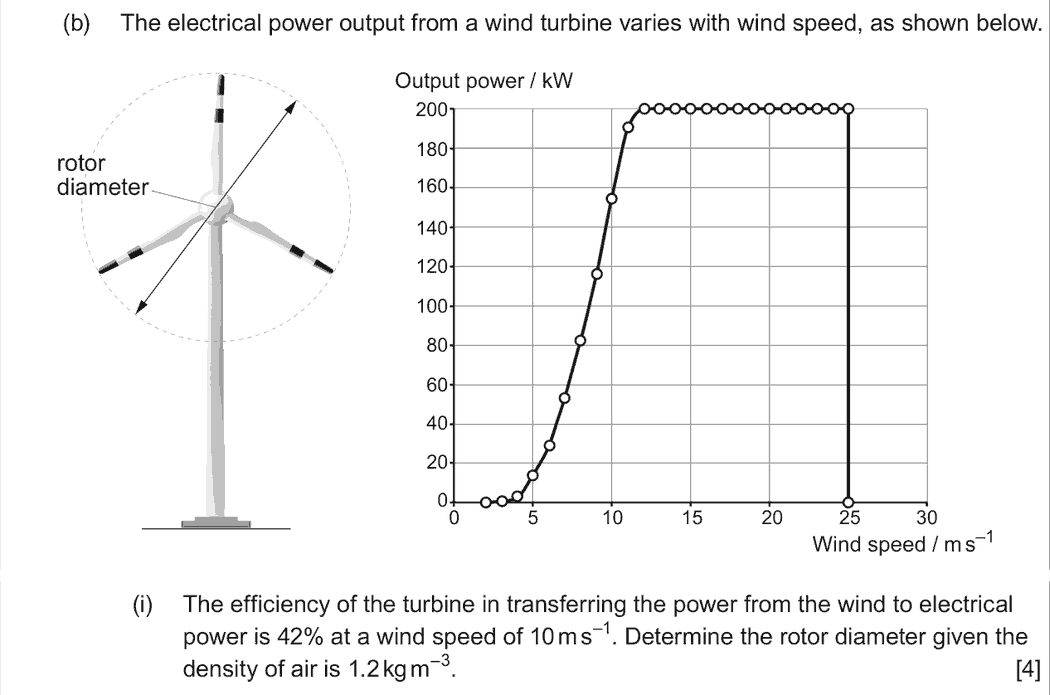
(b) The electrical power output from a wind turbine varies with wind speed, as shown below. Output power / kW 200 180 rotor diameter 160 140 120 100 80 60 40 20 0 0 5 10 15 20 25 30 Wind speed / m s–1 (i) The efficiency of the turbine in transferring the power from the wind to electrical power is 42% at a wind speed of 10 m s–1. Determine the rotor diameter given the density of air is 1.2 kg m–3. [4]
June 2024 · Component 3 · Q12(b)(ii) 2 marks AO2=2 Explanation energy and the environment
Earlier parts of question 12 that this part usesEarlier part of June 2024 Component 3 question 12Earlier part of June 2024 Component 3 question 12
(ii) Account for the low efficiency in transferring the maximum power from the wind to electrical power. [2]
June 2024 · Component 3 · Q12(b)(iii) 1 mark AO2=1 Calculation energy and the environment
Earlier parts of question 12 that this part usesEarlier part of June 2024 Component 3 question 12Earlier part of June 2024 Component 3 question 12
(iii) The UK-based JET laboratory produced 59 MW of electrical power for a few seconds through nuclear fusion. Calculate the number of wind turbines needed to produce this amount of power if they are operating at their maximum power output. [1]
June 2024 · Component 3 · Q12(b)(iv) 3 marks AO1=3 Explanation energy and the environment
Earlier parts of question 12 that this part usesEarlier part of June 2024 Component 3 question 12Earlier part of June 2024 Component 3 question 12
(iv) Explain briefly the difficulties associated with producing sustained nuclear fusion power. [3]
June 2024 · Component 3 · Q12(c) 5 marks AO3=5 Calculation energy and the environment
Earlier parts of question 12 that this part usesEarlier part of June 2024 Component 3 question 12Earlier part of June 2024 Component 3 question 12
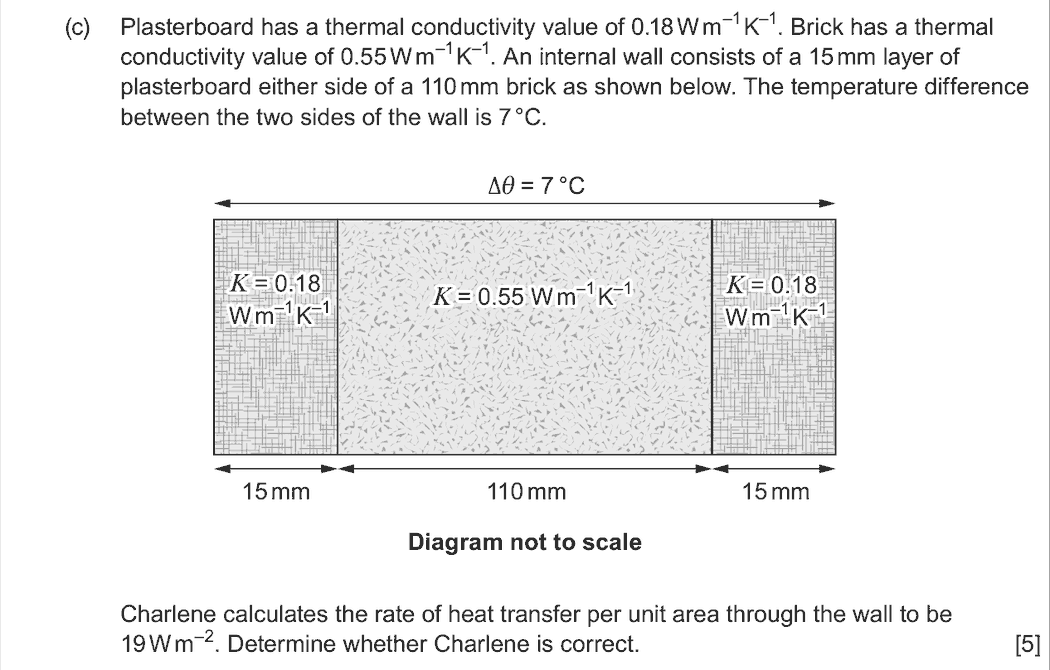
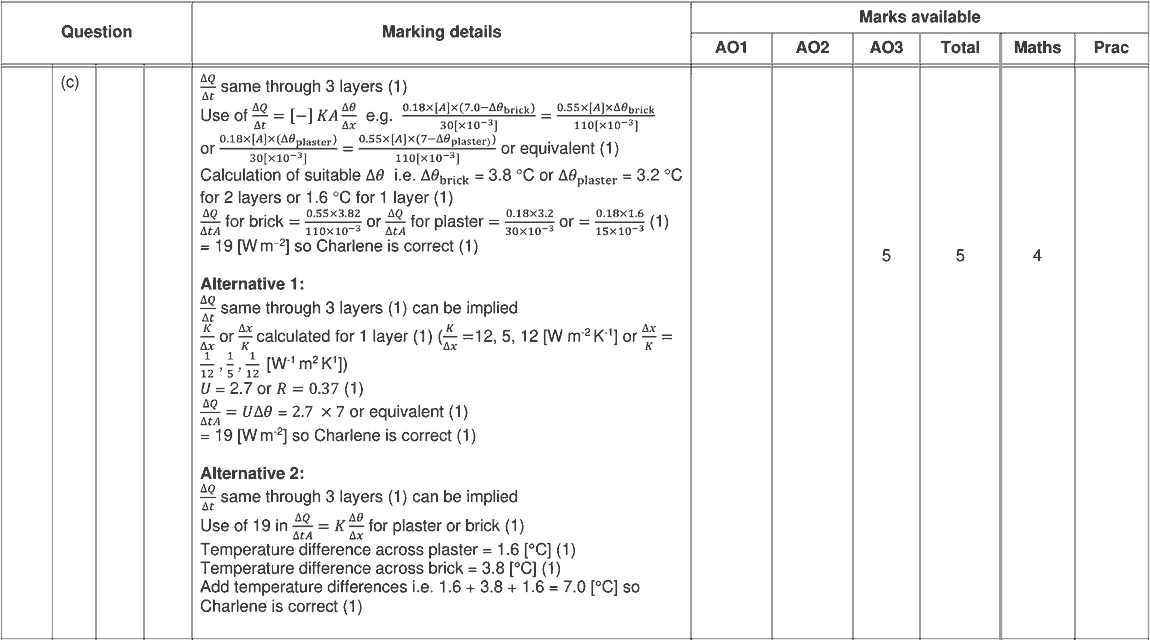
(c) Plasterboard has a thermal conductivity value of 0.18 W m–1 K–1. Brick has a thermal conductivity value of 0.55 W m–1 K–1. An internal wall consists of a 15 mm layer of plasterboard either side of a 110 mm brick as shown below. The temperature difference between the two sides of the wall is 7 °C. ∆θ = 7 °C K K = = 0.18 0.18 K K = = 0.18 0.18 K K = = 0.55 0.55 W W m–1 m–1 K–1 K–1 W W m–1 m–1 K–1 K–1 W W m–1 m–1 K–1 K–1 15 mm 110 mm 15 mm Diagram not to scale Charlene calculates the rate of heat transfer per unit area through the wall to be 19 W m–2. Determine whether Charlene is correct. [5]

Work with an Eduqas physics tutor

Want a paper marked and gone through with you? Message us.

Prefer email? Send an enquiry

If you are under 18, please include a parent's contact details. Enquiries go to enquiries@physicsaleveltutor.com and are deleted once handled. All tutoring is online.