June 2022: Paper 2

85 marks · 50 question parts · Paper, mark scheme and report on AQA's site · Have the data and formulae booklet beside you

Question by question

QTopicMarksAOType
1.1 Thermal energy transfer and ideal gases 2AO2=2Calculation
1.2 Thermal energy transfer and ideal gases 3AO1=1,AO3=2Calculation
2.1 Molecular kinetic theory 2AO1=2Short answer
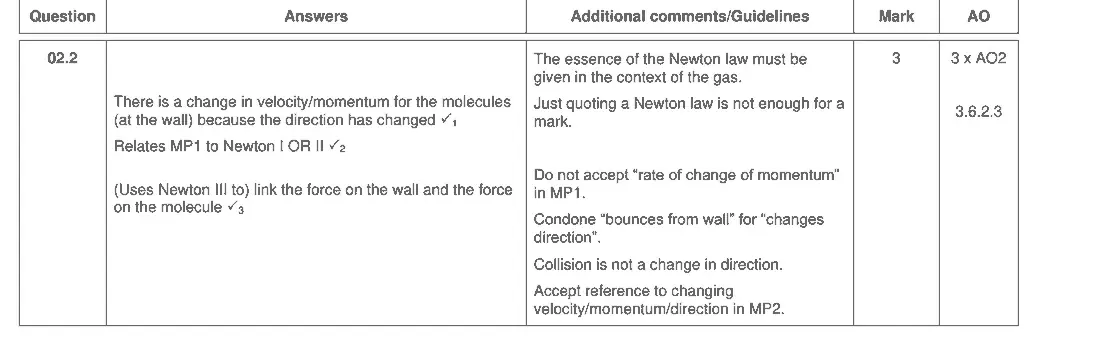
2.2 Molecular kinetic theory, Newton's laws of motion and momentum 3AO2=3Explanation
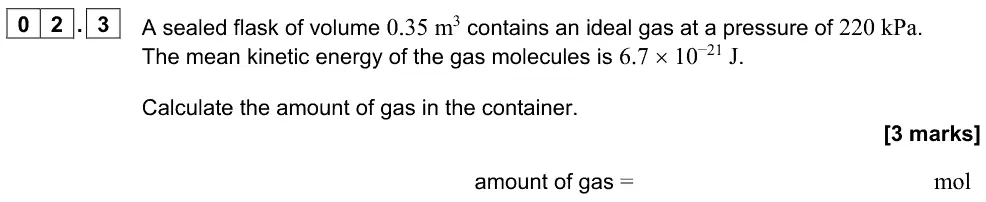
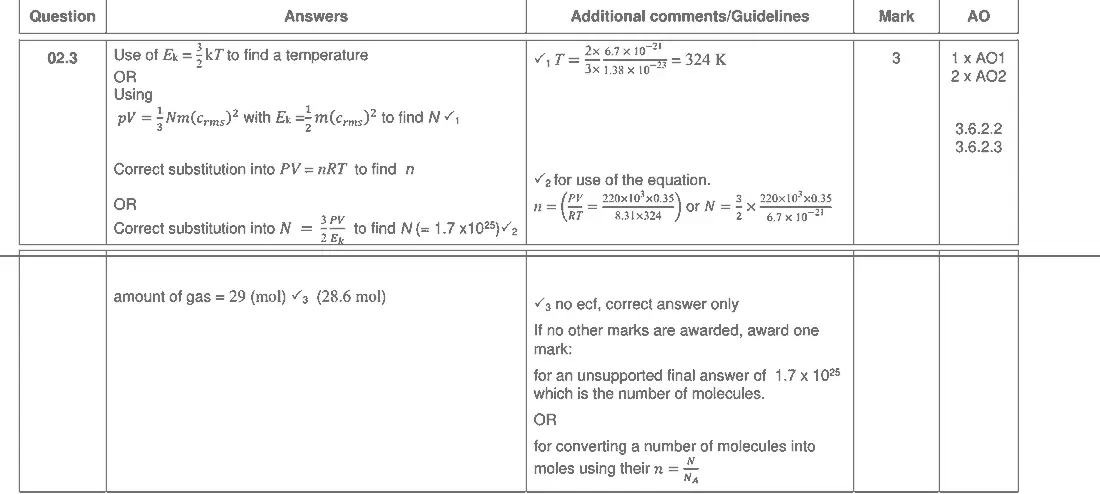
2.3 Molecular kinetic theory, Thermal energy transfer and ideal gases 3AO1=1,AO2=2Calculation
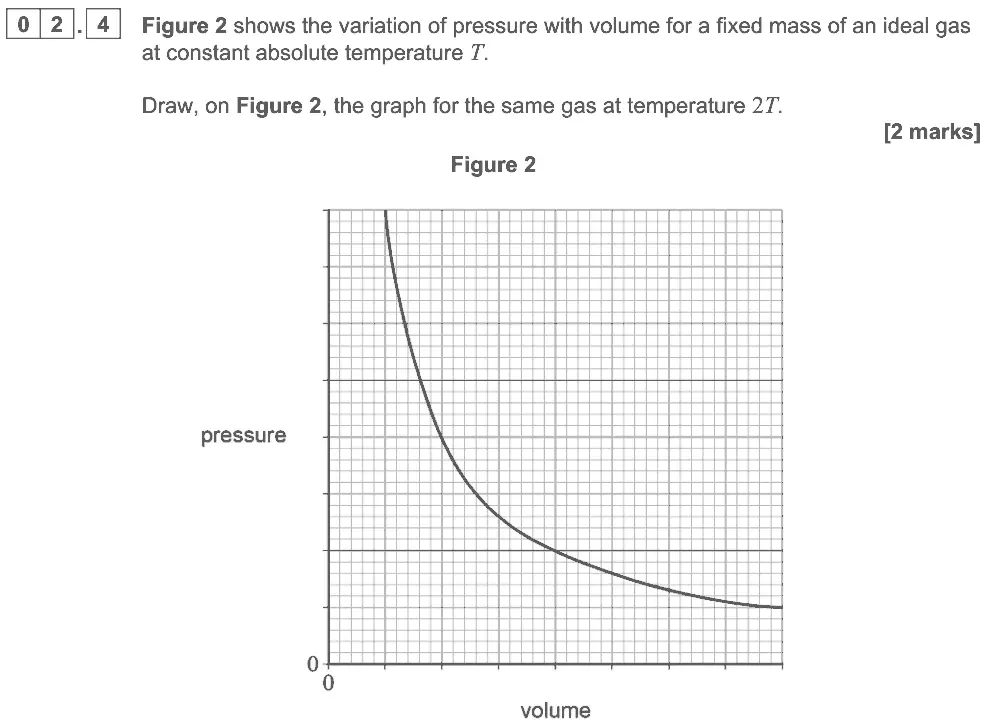
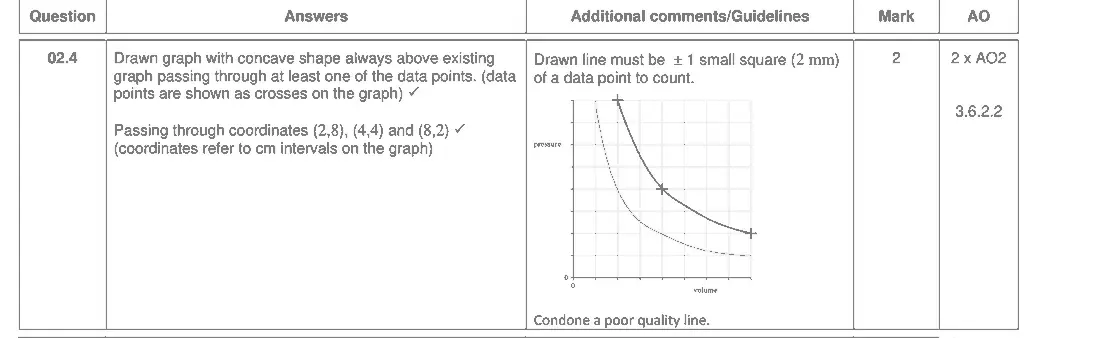
2.4 Thermal energy transfer and ideal gases 2AO2=2Diagram or graph
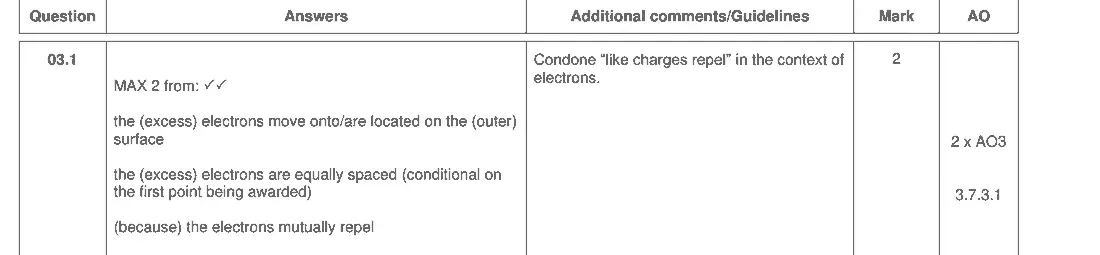
3.1 Electric fields and electric potential 2AO3=2Explanation
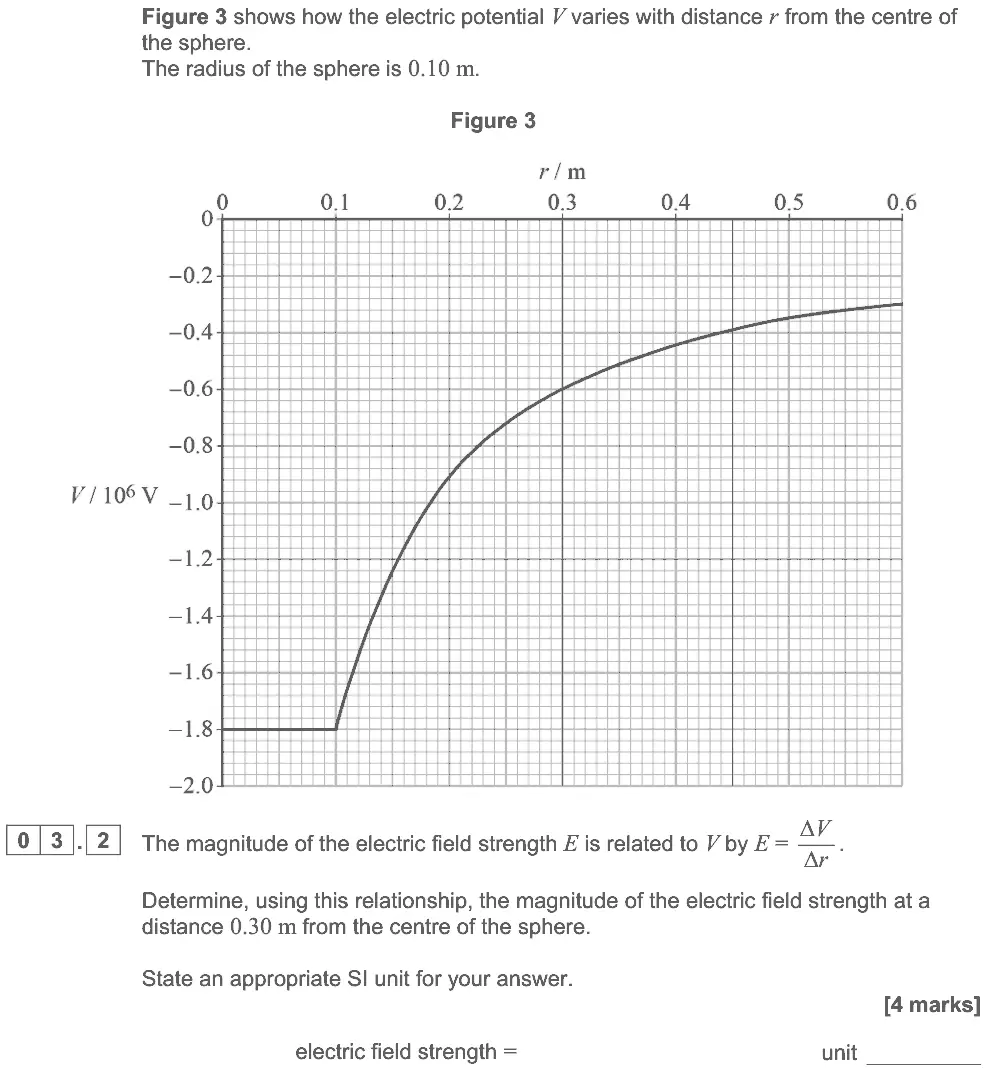
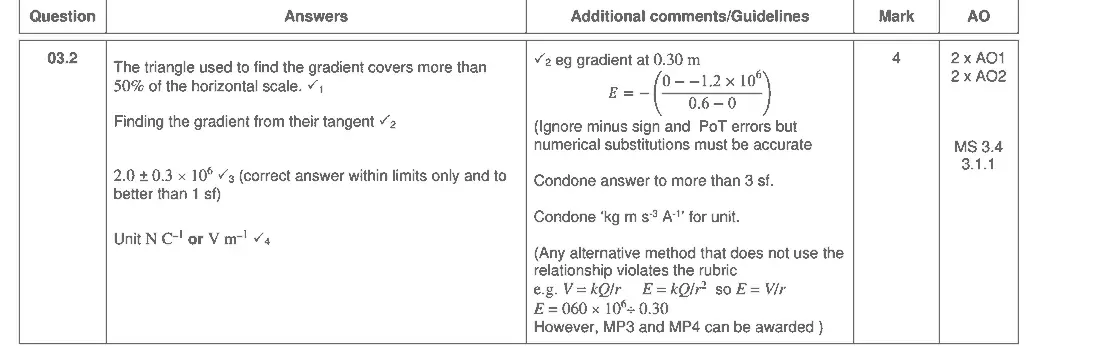
3.2 Electric fields and electric potential 4AO1=2,AO2=2Calculation
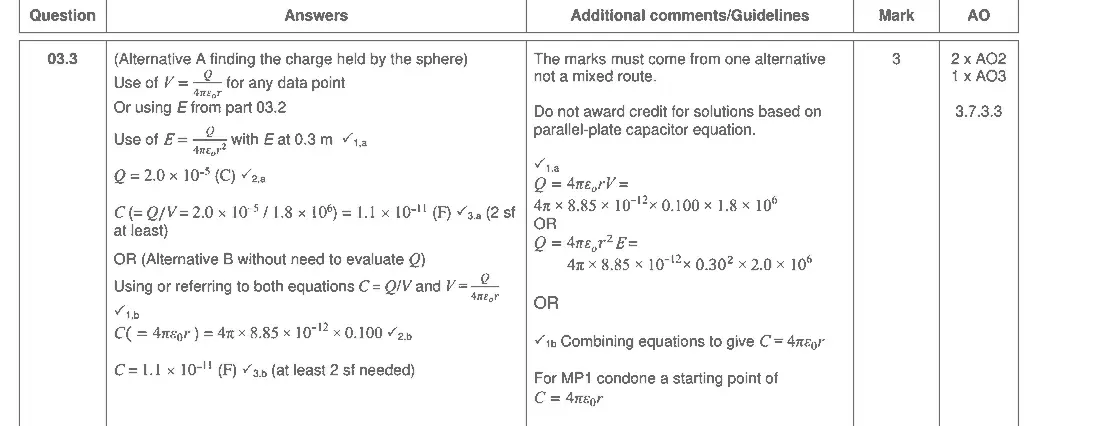
3.3 Electric fields and electric potential, Capacitance and capacitor charge and discharge 3AO2=2,AO3=1Show that
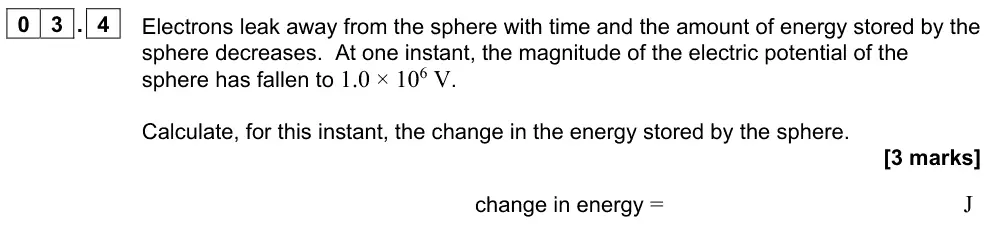
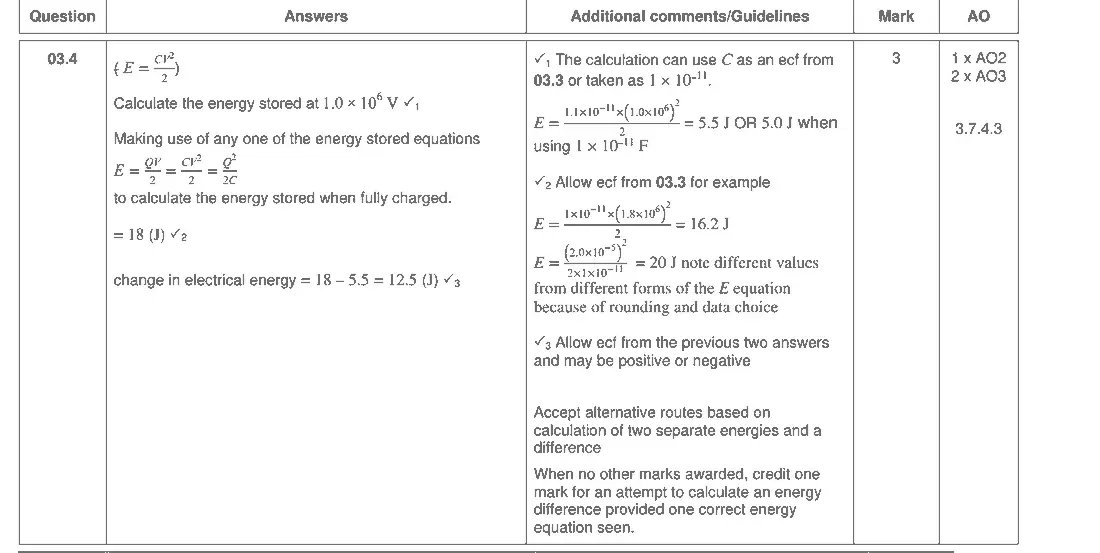
3.4 Capacitance and capacitor charge and discharge 3AO2=1,AO3=2Calculation
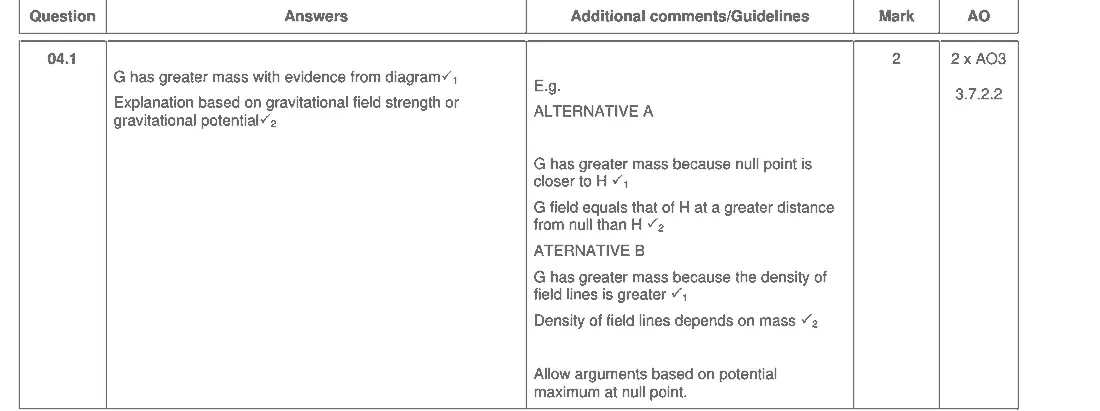
4.1 Gravitational fields and orbits 2AO3=2Explanation
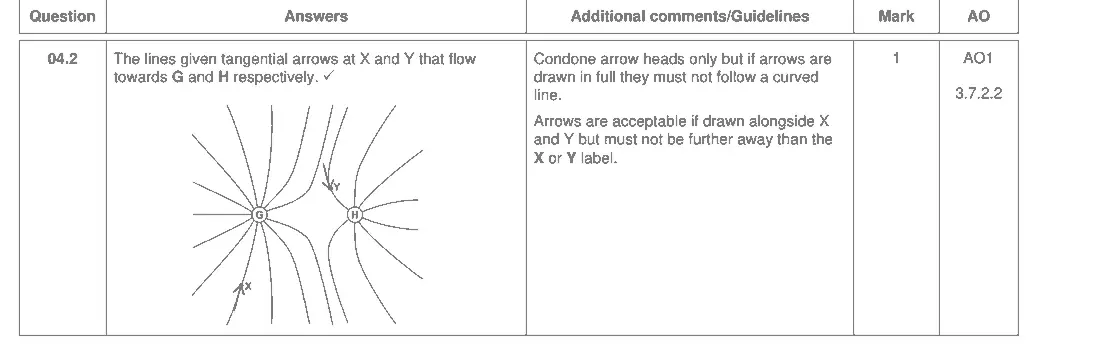
4.2 Gravitational fields and orbits 1AO1=1Diagram or graph
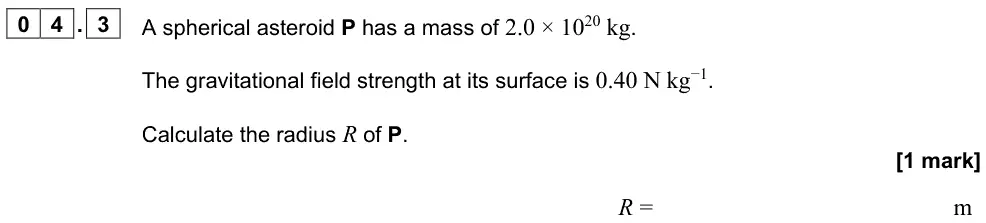
4.3 Gravitational fields and orbits 1AO2=1Calculation
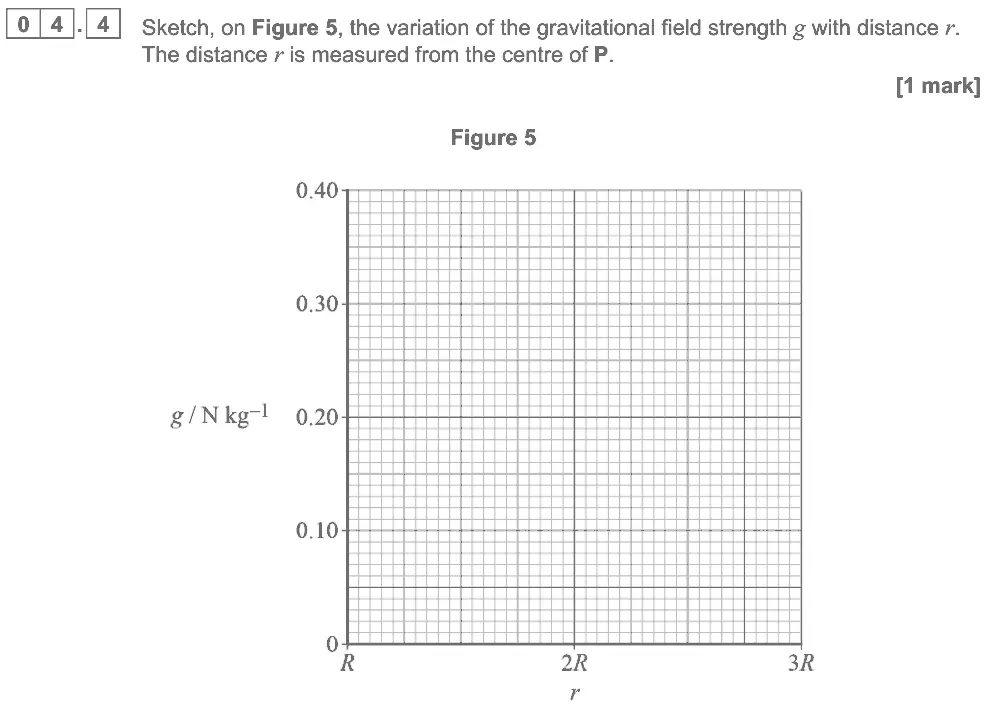
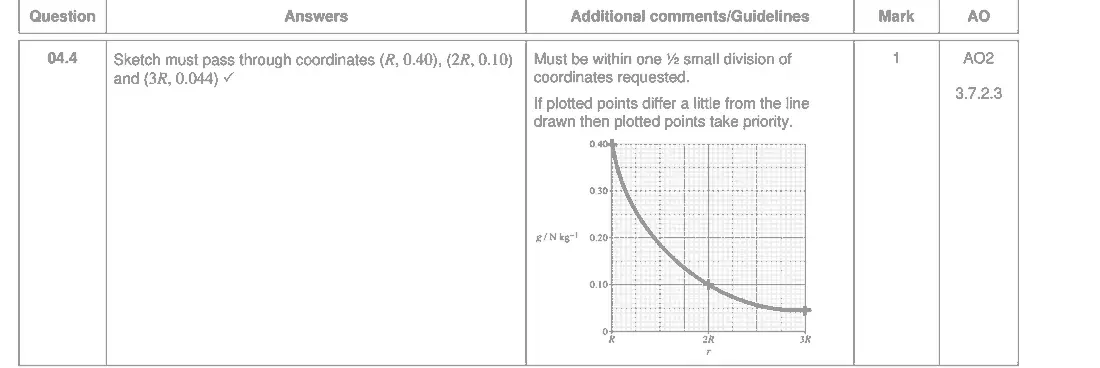
4.4 Gravitational fields and orbits 1AO2=1Diagram or graph
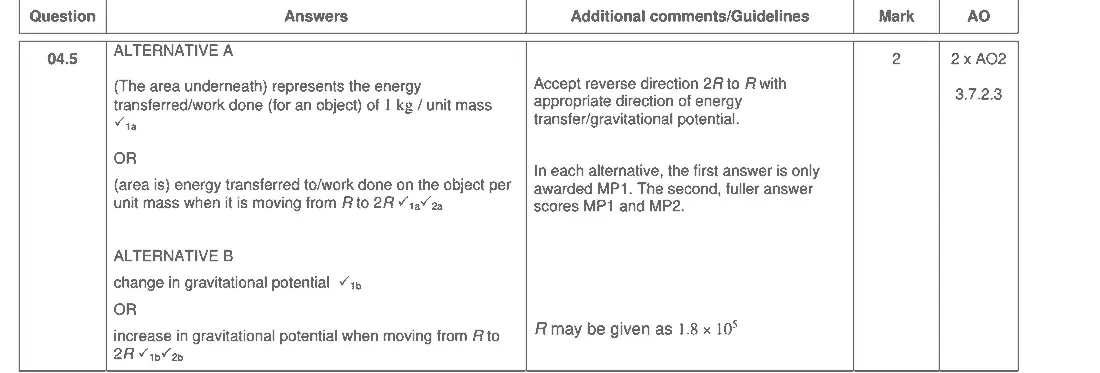
4.5 Gravitational fields and orbits 2AO2=2Explanation
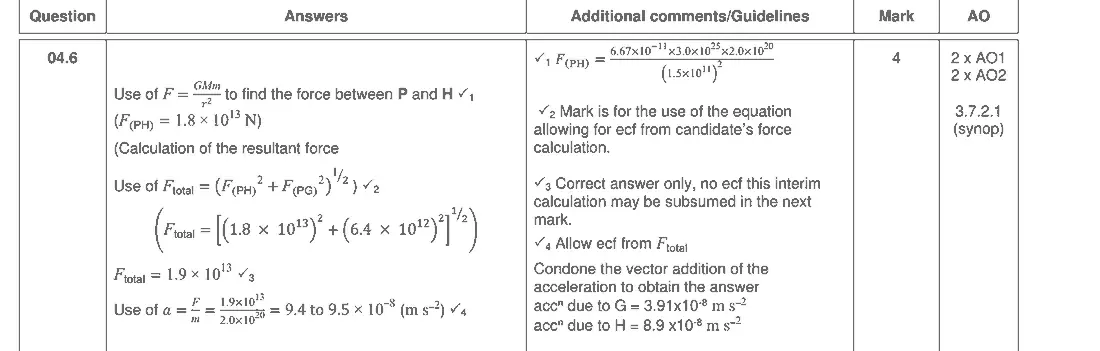
4.6 Gravitational fields and orbits, Scalars, vectors and moments 4AO1=2,AO2=2Calculation
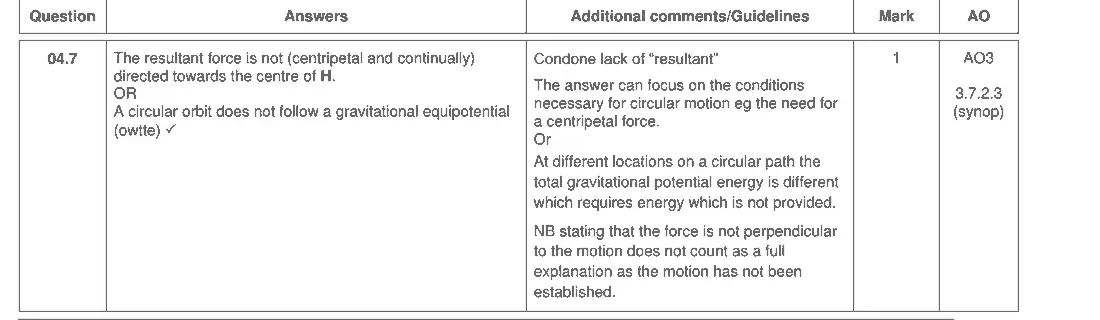
4.7 Circular motion, Gravitational fields and orbits 1AO3=1Explanation
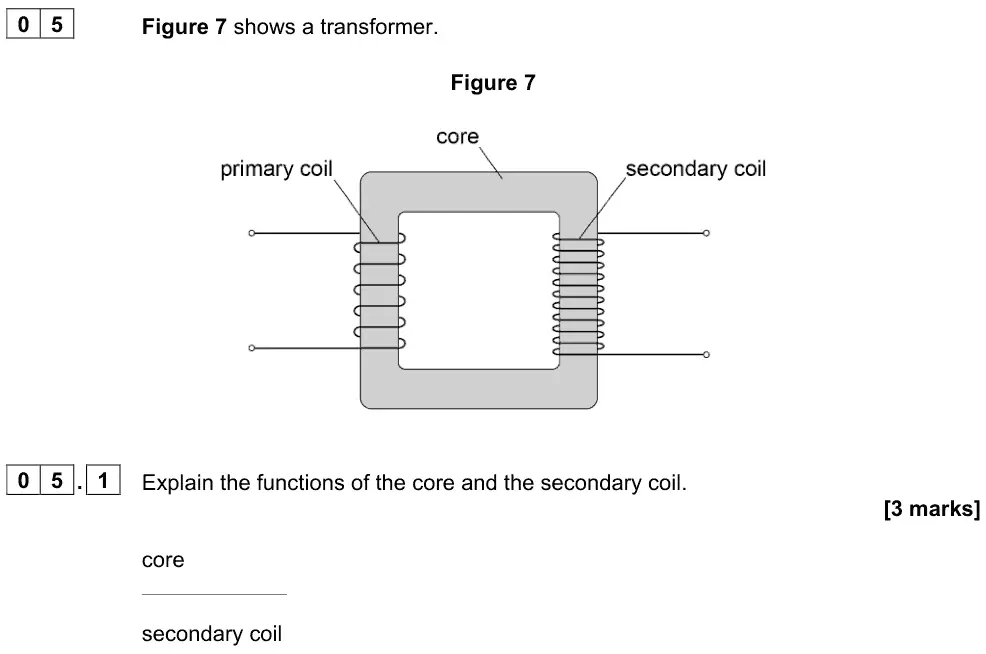
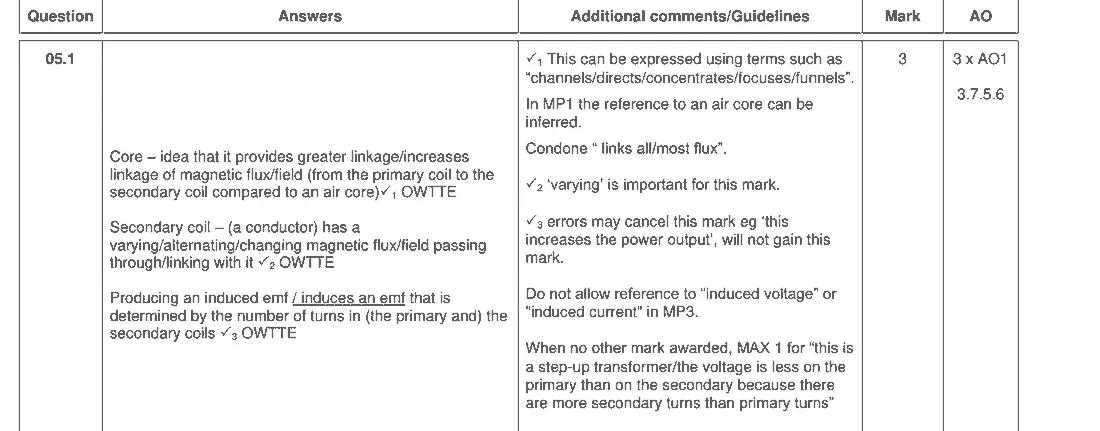
5.1 Electromagnetic induction, alternating currents and transformers 3AO1=3Explanation
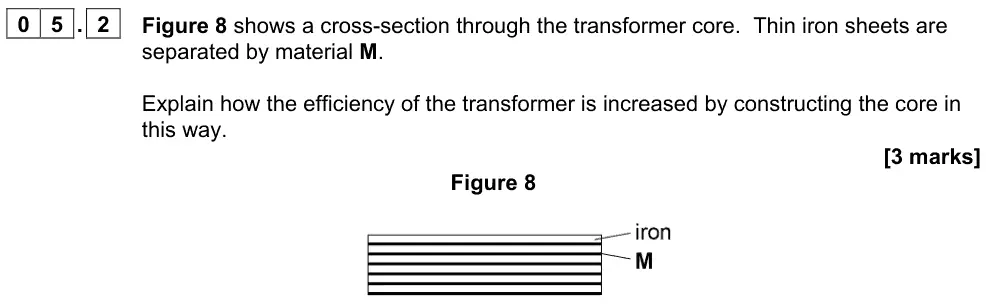
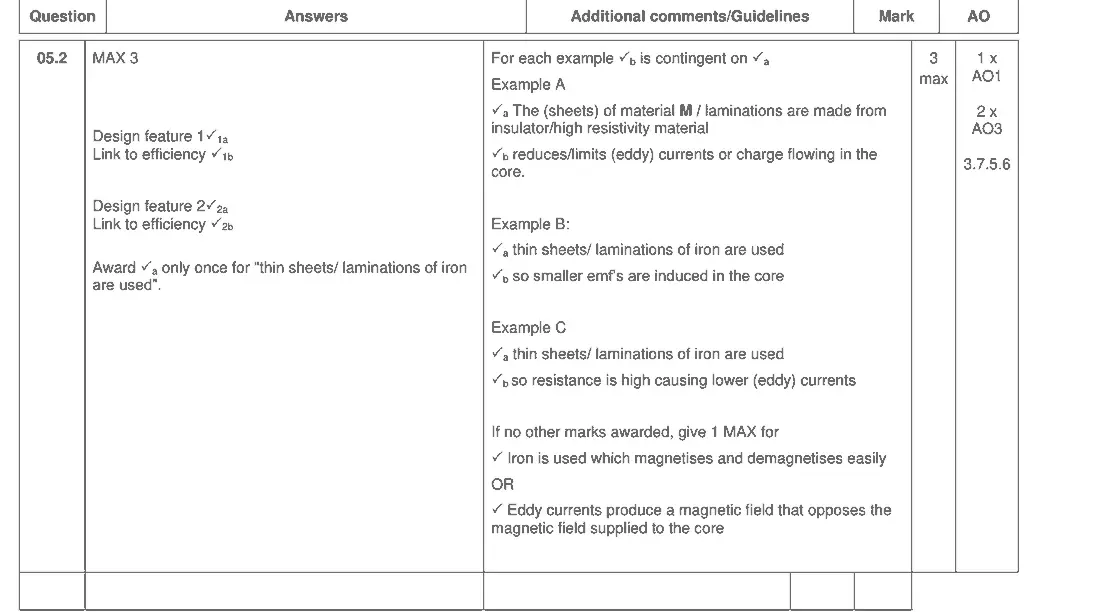
5.2 Electromagnetic induction, alternating currents and transformers 3AO1=1,AO3=2Explanation
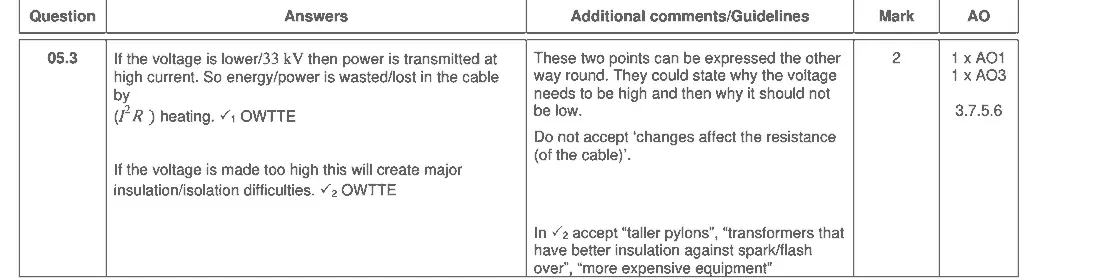
5.3 Electromagnetic induction, alternating currents and transformers 2AO1=1,AO3=1Explanation
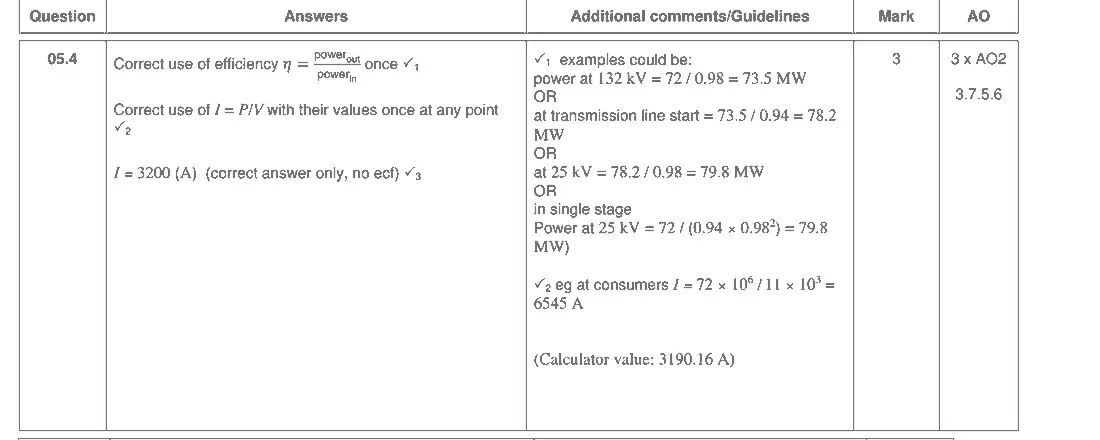
5.4 Electromagnetic induction, alternating currents and transformers 3AO2=3Calculation
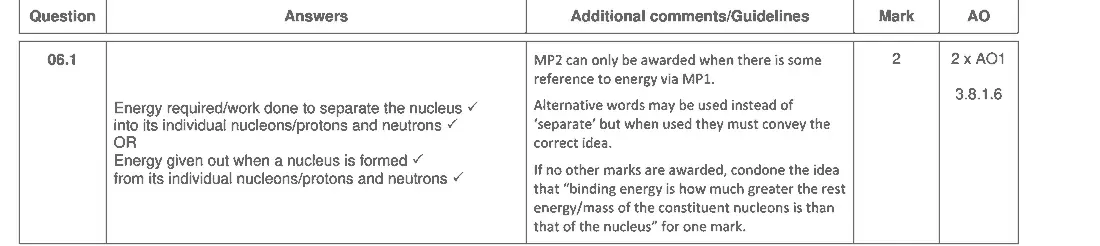
6.1 Mass and energy, binding energy, fission and safety 2AO1=2Short answer
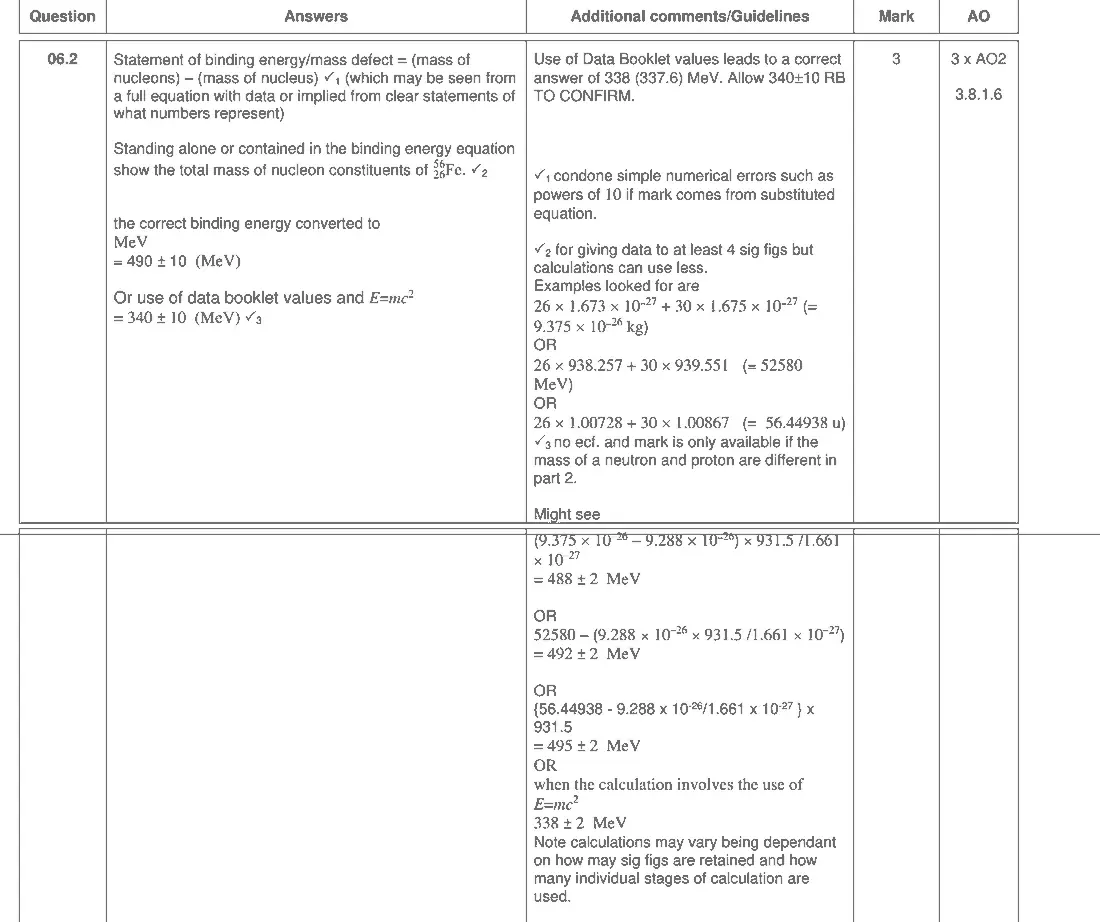
6.2 Mass and energy, binding energy, fission and safety 3AO2=3Calculation
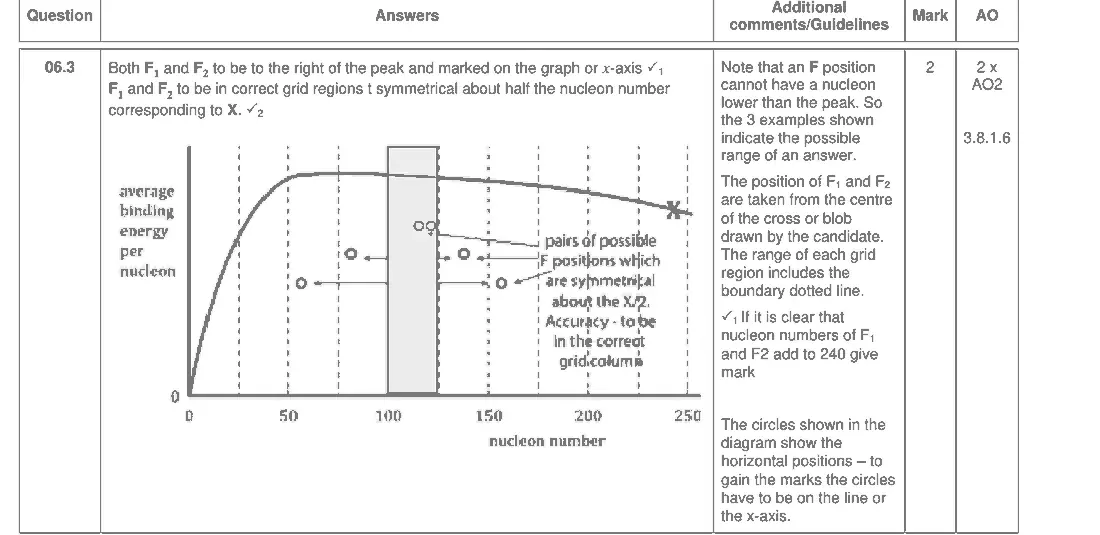
6.3 Mass and energy, binding energy, fission and safety 2AO2=2Diagram or graph
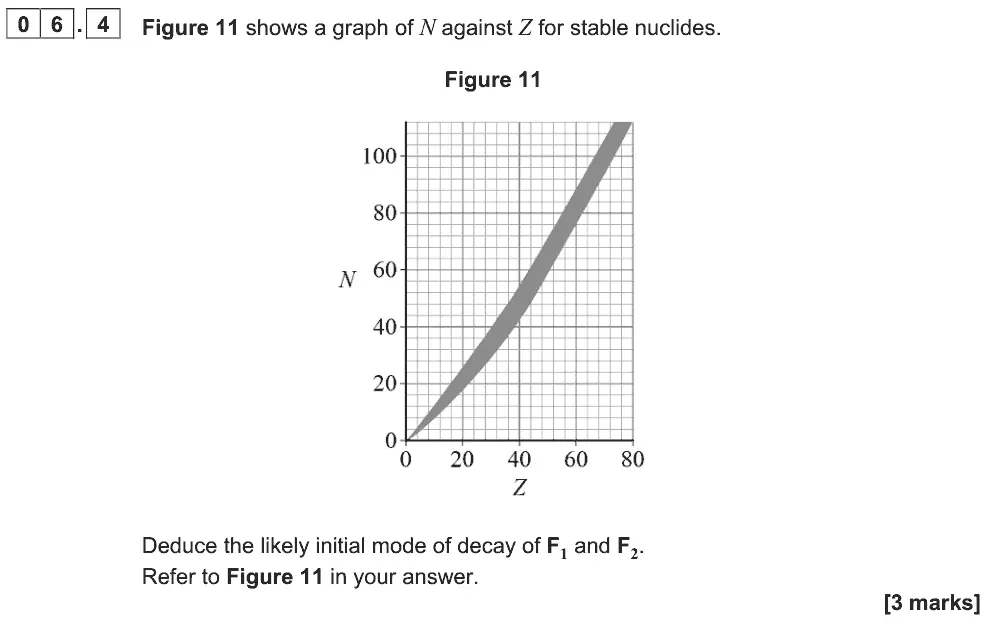
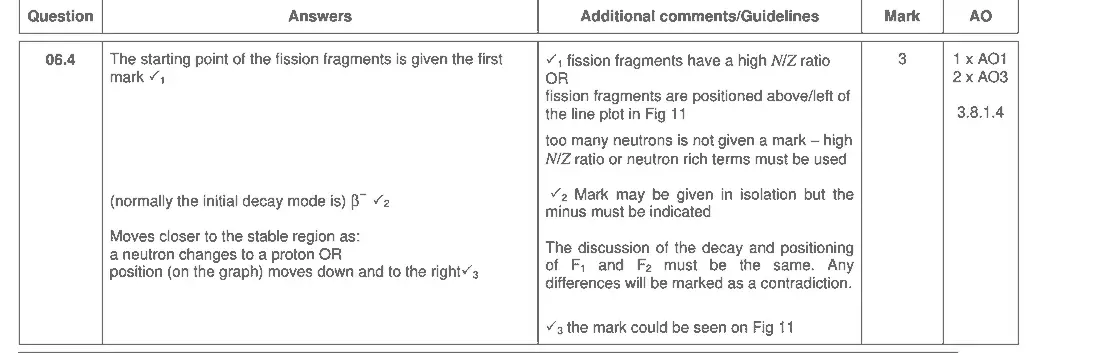
6.4 Radioactive decay, half-life and nuclear instability 3AO1=1,AO3=2Explanation
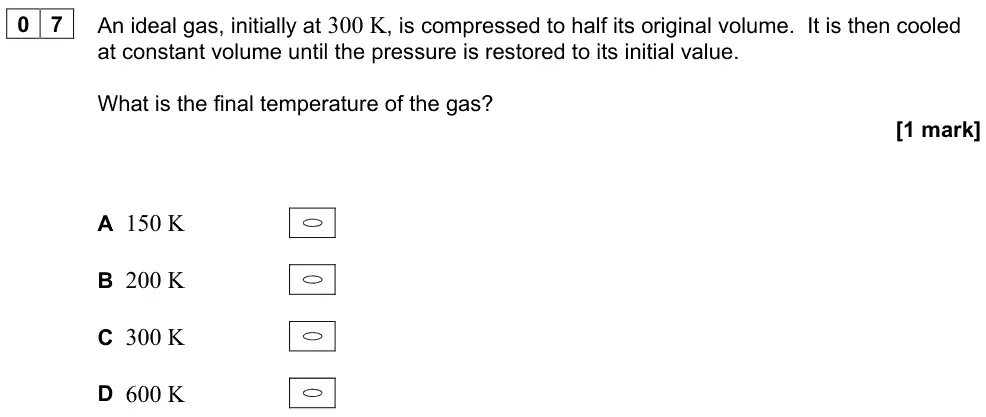
7 Thermal energy transfer and ideal gases 1AO2=1Multiple choice
8 Molecular kinetic theory, Thermal energy transfer and ideal gases 1AO2=1Multiple choice
9 Gravitational fields and orbits 1AO2=1Multiple choice
10 Circular motion 1AO1=1Multiple choice
11 Gravitational fields and orbits 1AO2=1Multiple choice
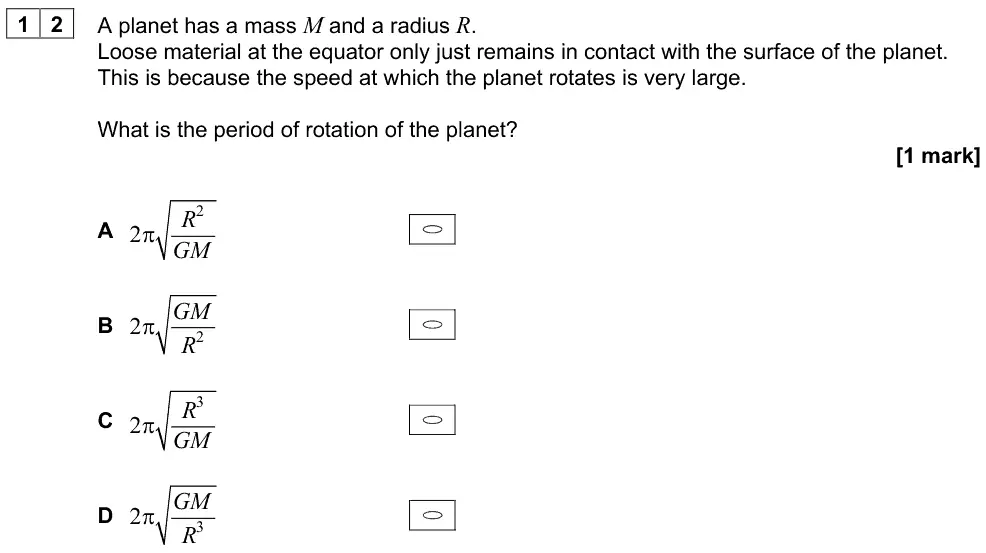
12 Circular motion, Gravitational fields and orbits 1AO2=1Multiple choice
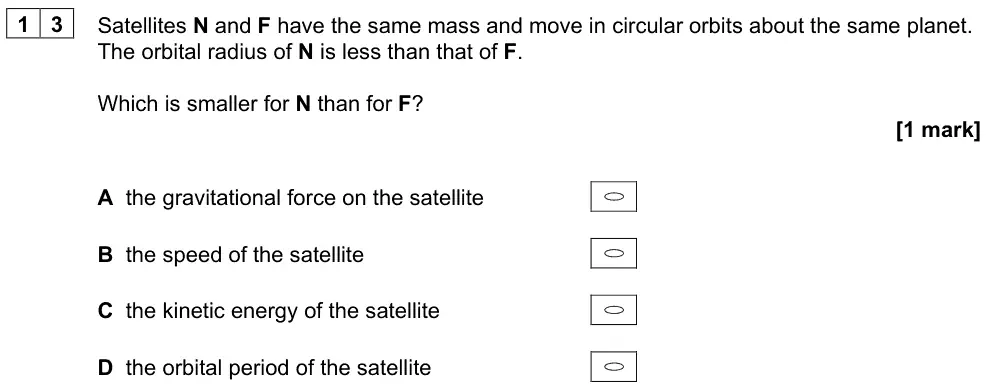
13 Gravitational fields and orbits 1AO2=1Multiple choice
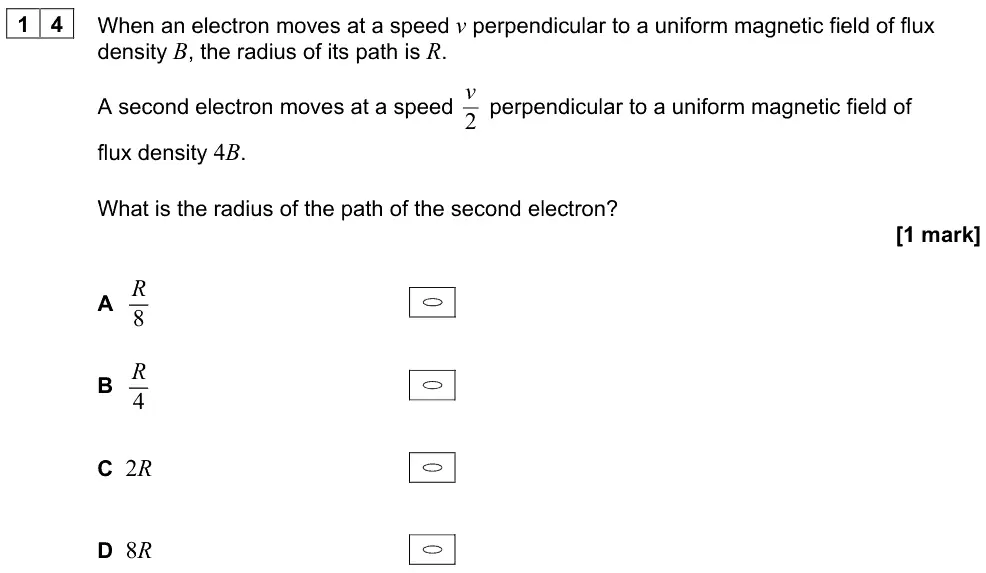
14 Magnetic flux density and moving charges in a magnetic field 1AO2=1Multiple choice
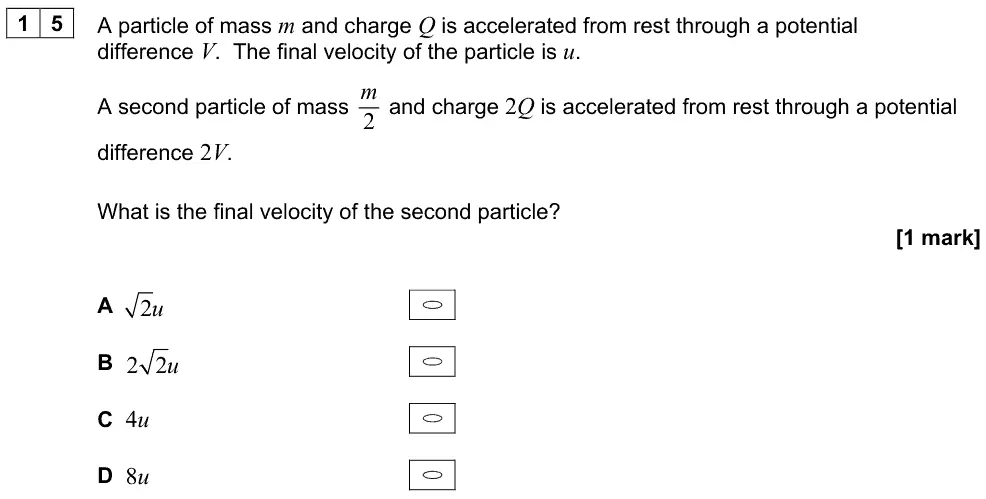
15 Electric fields and electric potential 1AO2=1Multiple choice
16 Electric fields and electric potential 1AO1=1Multiple choice
17 Capacitance and capacitor charge and discharge, Current, potential difference, I-V characteristics and resistivity 1AO2=1Multiple choice
18 Capacitance and capacitor charge and discharge 1AO2=1Multiple choice
19 Capacitance and capacitor charge and discharge 1AO2=1Multiple choice
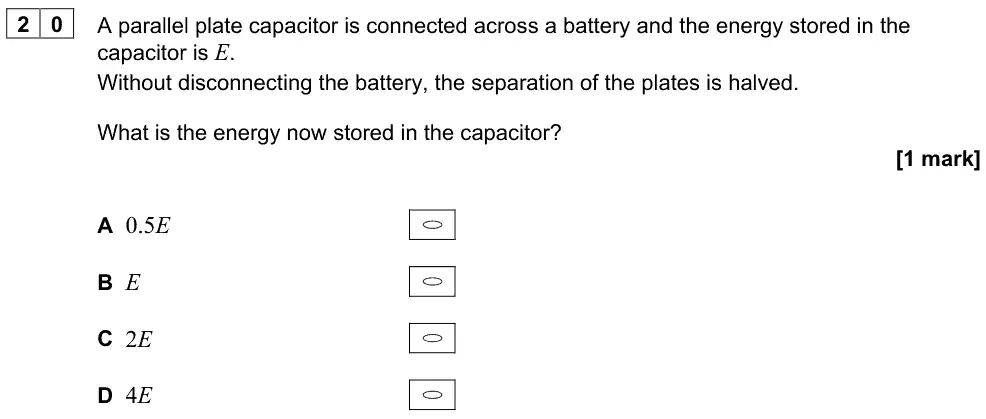
20 Capacitance and capacitor charge and discharge 1AO2=1Multiple choice
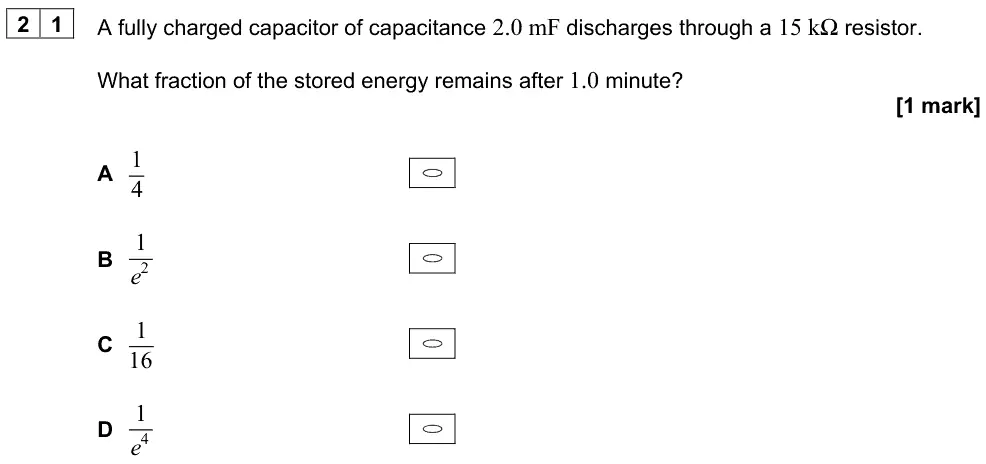
21 Capacitance and capacitor charge and discharge 1AO2=1Multiple choice
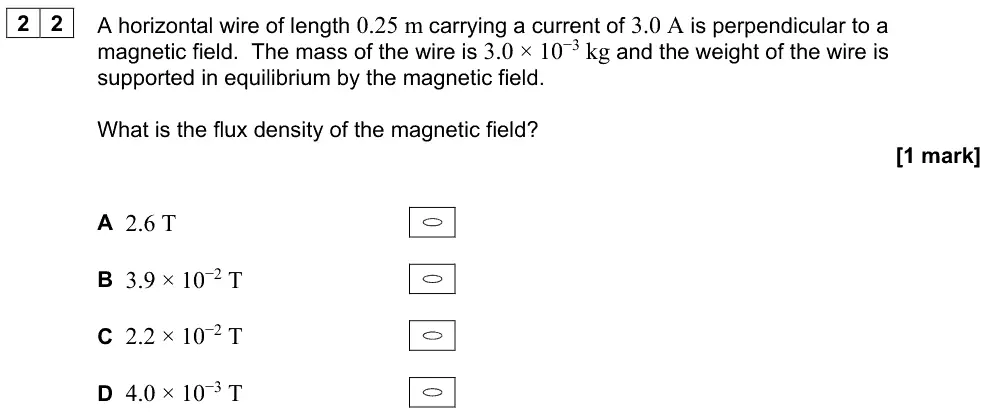
22 Magnetic flux density and moving charges in a magnetic field 1AO2=1Multiple choice
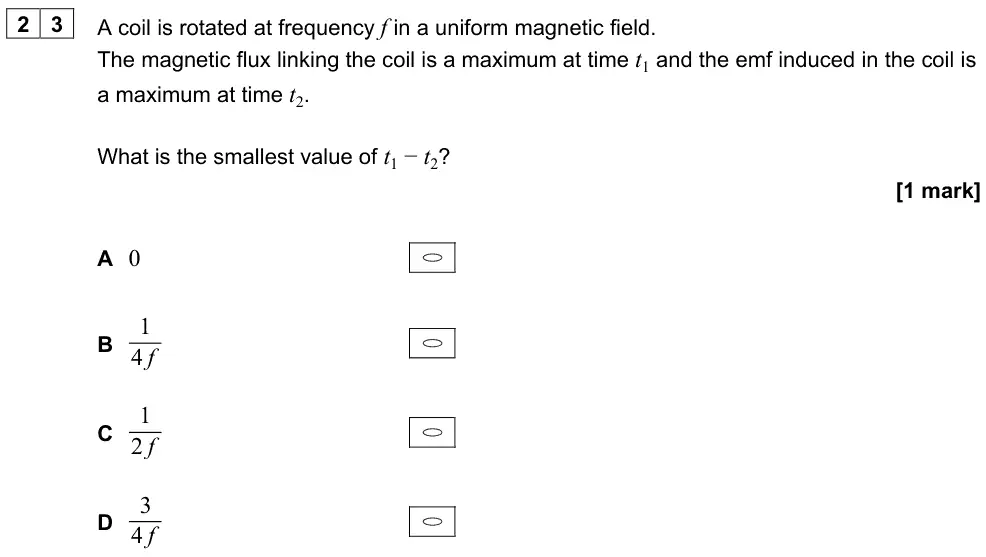
23 Electromagnetic induction, alternating currents and transformers 1AO2=1Multiple choice
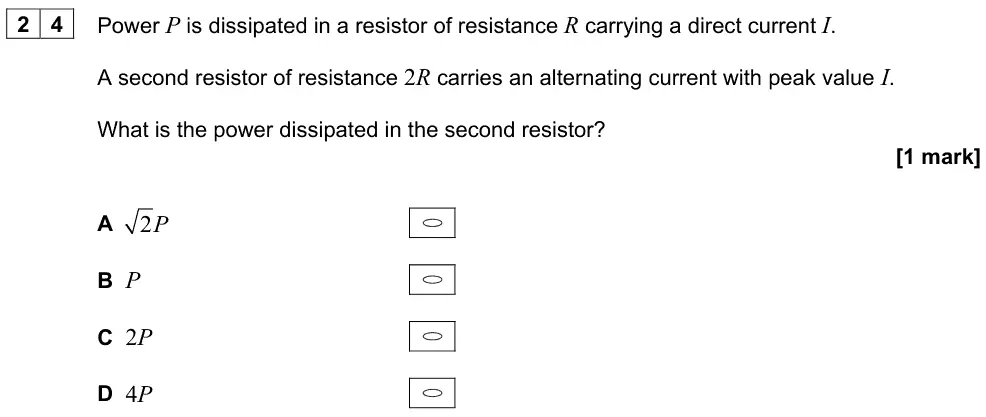
24 Electromagnetic induction, alternating currents and transformers 1AO2=1Multiple choice
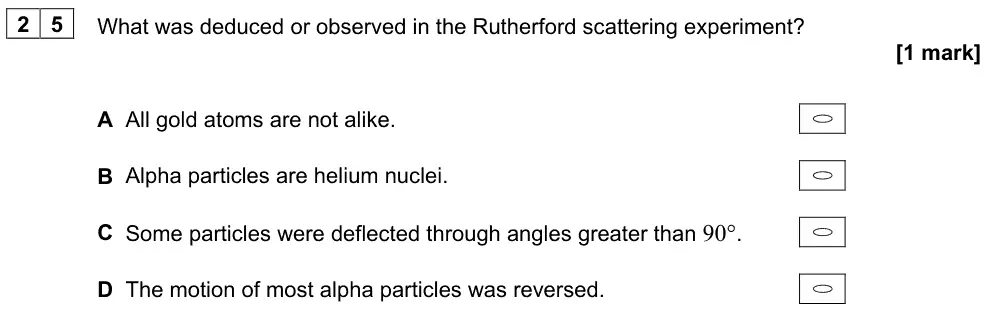
25 Rutherford scattering, alpha, beta and gamma radiation 1AO1=1Multiple choice
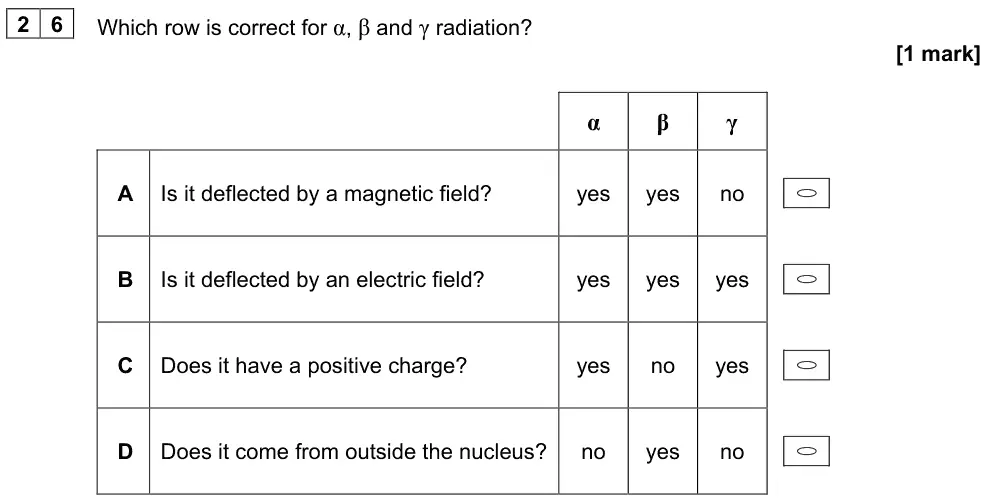
26 Rutherford scattering, alpha, beta and gamma radiation 1AO1=1Multiple choice
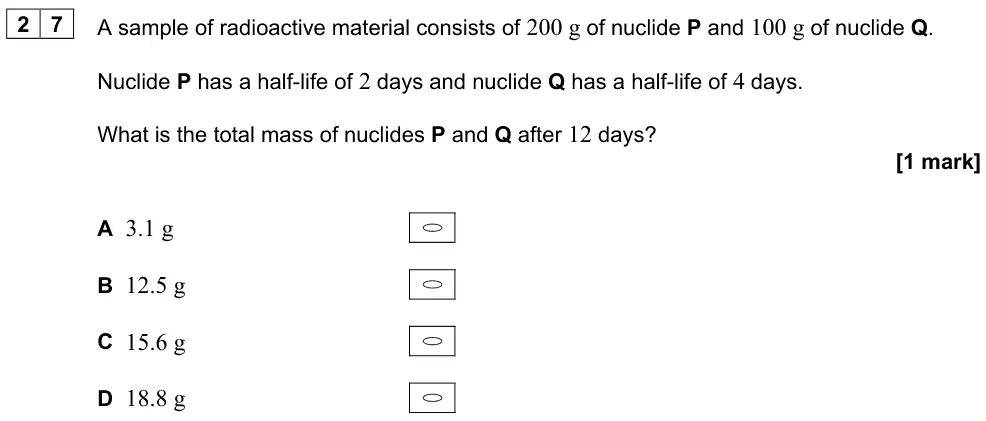
27 Radioactive decay, half-life and nuclear instability 1AO2=1Multiple choice
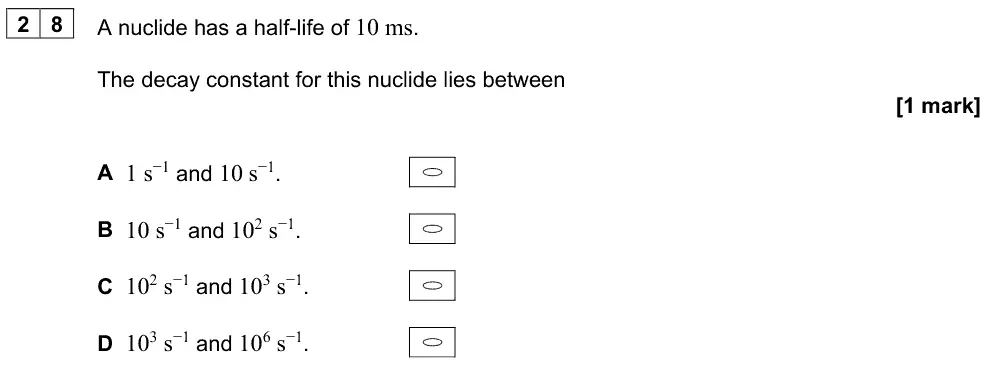
28 Radioactive decay, half-life and nuclear instability 1AO2=1Multiple choice
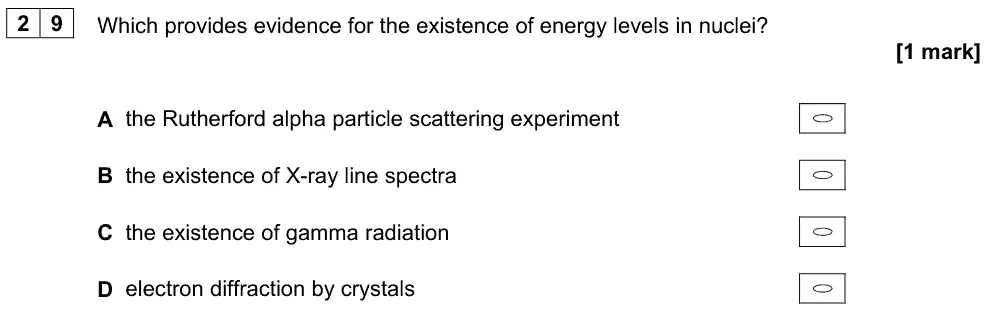
29 Radioactive decay, half-life and nuclear instability 1AO1=1Multiple choice
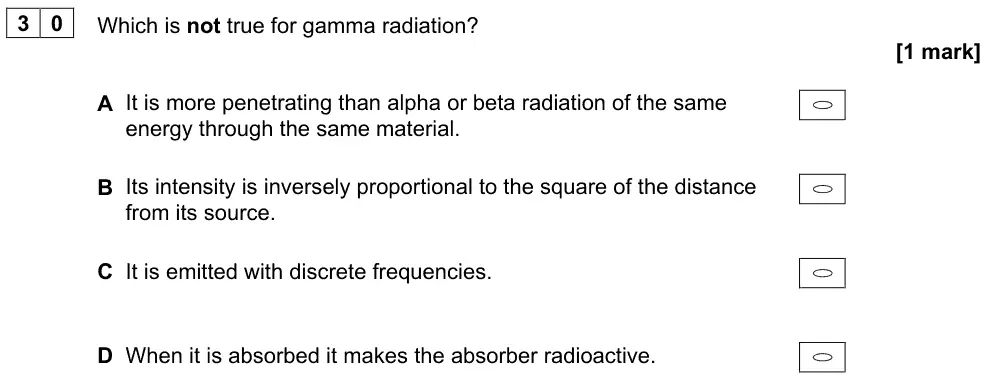
30 Rutherford scattering, alpha, beta and gamma radiation 1AO1=1Multiple choice
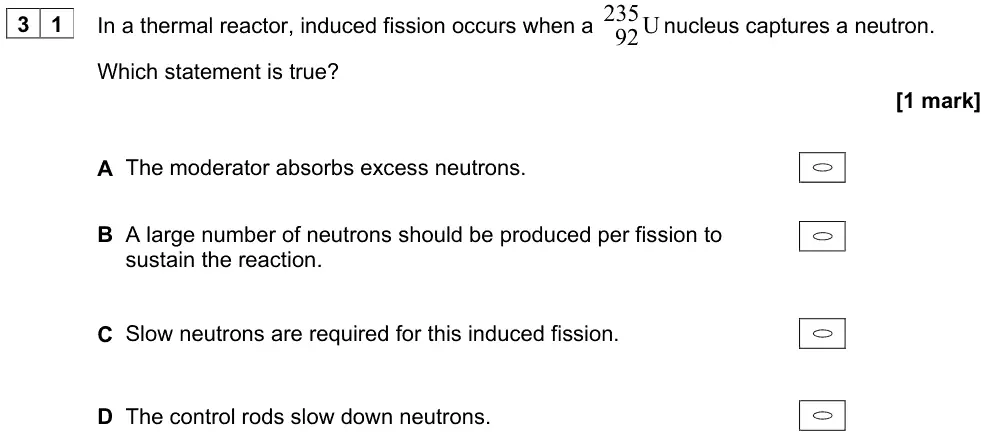
31 Mass and energy, binding energy, fission and safety 1AO1=1Multiple choice

The questions

1.11.22.12.22.32.43.13.23.33.44.14.24.34.44.54.64.75.15.25.35.46.16.26.36.478910111213141516171819202122232425262728293031
June 2022 · Paper 2 · Q1.1 2 marks AO2=2 Calculation thermal energy and ideal gases
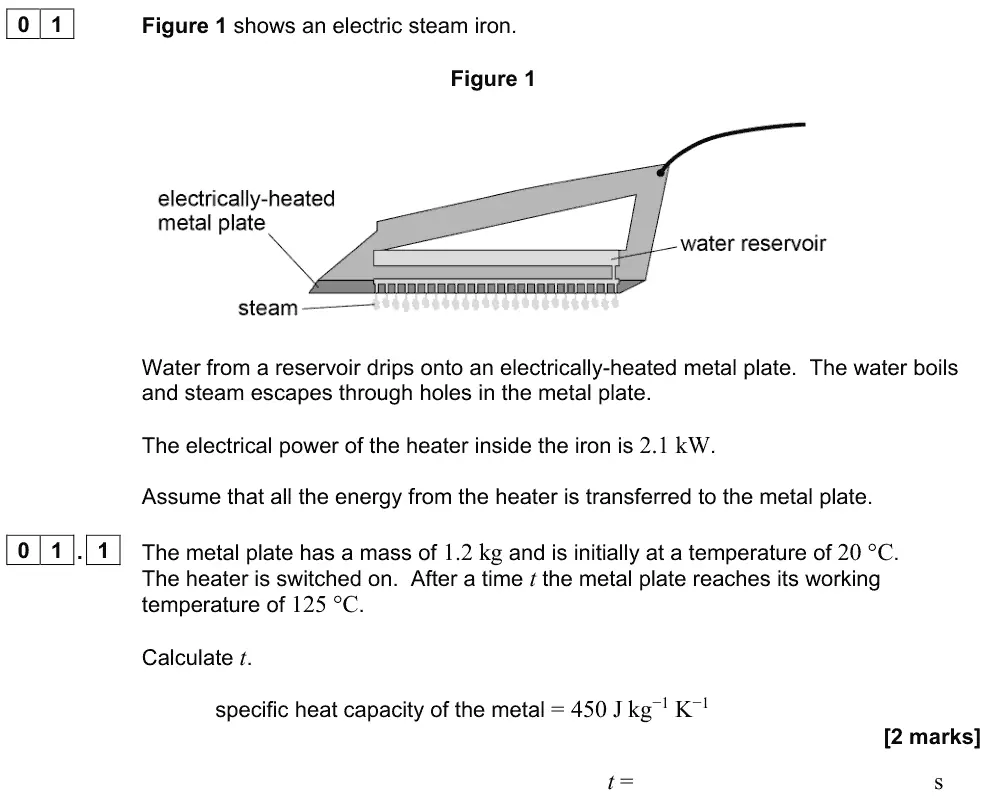
Figure 1 shows an electric steam iron.
Figure 1
Water from a reservoir drips onto an electrically-heated metal plate.  The water boils
and steam escapes through holes in the metal plate.
The electrical power of the heater inside the iron is 2.1 kW.
Assume that all the energy from the heater is transferred to the metal plate.
The metal plate has a mass of 1.2 kg and is initially at a temperature of 20 °C.
The heater is switched on.  After a time t the metal plate reaches its working
temperature of 125 °C.
Calculate t.
specific heat capacity of the metal = 450 J kg−1 K−1
[2 marks]
t =
s
June 2022 · Paper 2 · Q1.2 3 marks AO1=1, AO3=2 Calculation thermal energy and ideal gases
Earlier part of question 1 that this part usesEarlier part of June 2022 Paper 2 question 1
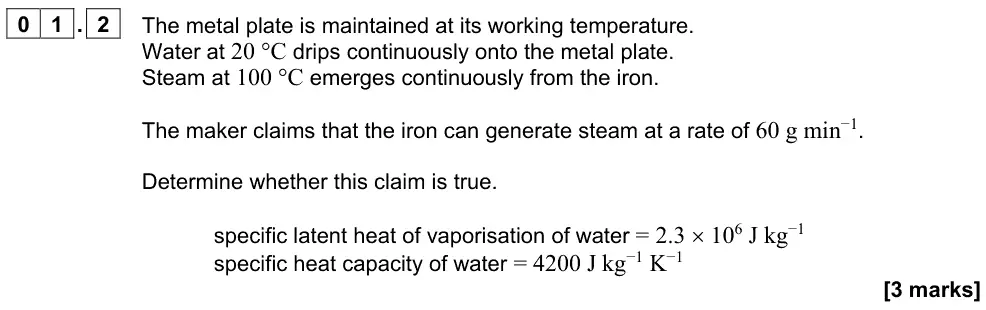
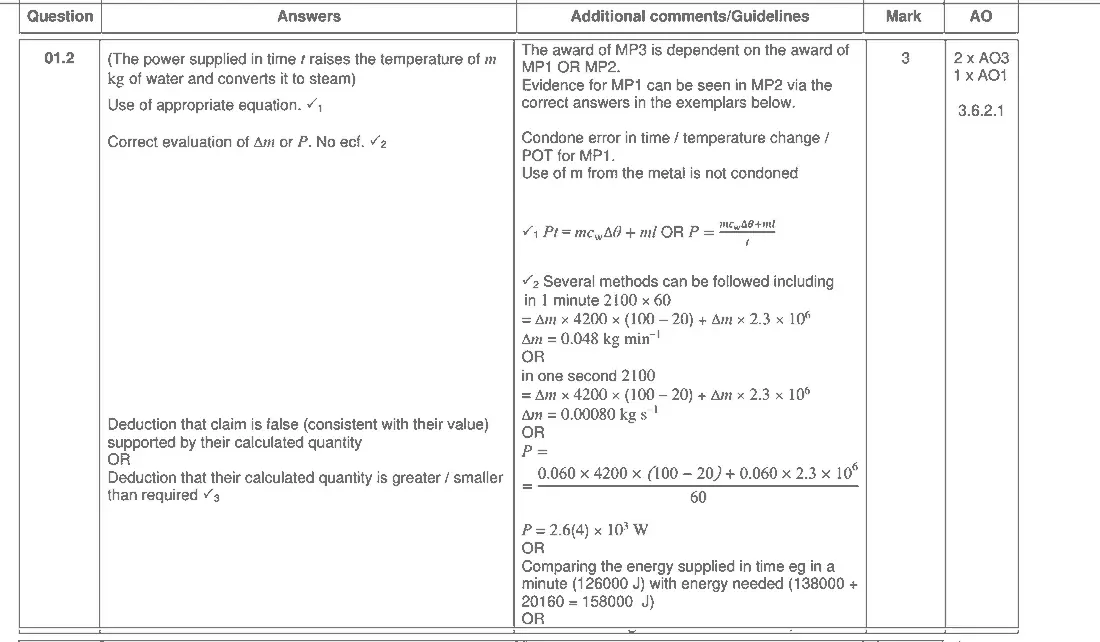
The metal plate is maintained at its working temperature.
Water at 20 °C drips continuously onto the metal plate.
Steam at 100 °C emerges continuously from the iron.
The maker claims that the iron can generate steam at a rate of 60 g min−1.
Determine whether this claim is true.
specific latent heat of vaporisation of water = 2.3 × 10⁶ J kg−1
specific heat capacity of water = 4200 J kg−1 K−1
[3 marks]
June 2022 · Paper 2 · Q2.1 2 marks AO1=2 Short answer kinetic theory
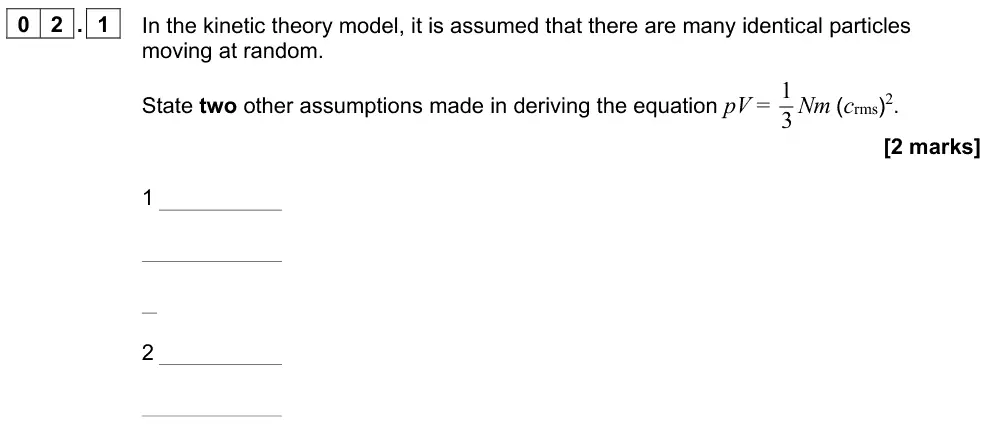
In the kinetic theory model, it is assumed that there are many identical particles
moving at random.
State two other assumptions made in deriving the equation pV = 1
3 Nm (crms)2.
[2 marks]
1
2
June 2022 · Paper 2 · Q2.2 3 marks AO2=3 Explanation kinetic theorynewtons laws and momentum
Earlier part of question 2 that this part usesEarlier part of June 2022 Paper 2 question 2
Explain why molecules of a gas exert a force on the walls of a container.
Refer to Newton’s laws of motion in your answer.
[3 marks]
June 2022 · Paper 2 · Q2.3 3 marks AO1=1, AO2=2 Calculation kinetic theorythermal energy and ideal gases
Earlier part of question 2 that this part usesEarlier part of June 2022 Paper 2 question 2
A sealed flask of volume 0.35 m3 contains an ideal gas at a pressure of 220 kPa.
The mean kinetic energy of the gas molecules is 6.7 × 10⁻²¹ J.
Calculate the amount of gas in the container.
[3 marks]
amount of gas =
mol
June 2022 · Paper 2 · Q2.4 2 marks AO2=2 Diagram or graph thermal energy and ideal gases
Earlier part of question 2 that this part usesEarlier part of June 2022 Paper 2 question 2
Figure 2 shows the variation of pressure with volume for a fixed mass of an ideal gas
at constant absolute temperature T.
Draw, on Figure 2, the graph for the same gas at temperature 2T.
[2 marks]
Figure 2
June 2022 · Paper 2 · Q3.1 2 marks AO3=2 Explanation Hard electric fields
An isolated solid conducting sphere is initially uncharged.
Electrons are then transferred to the sphere.
State and explain the location of the excess electrons.
[2 marks]
June 2022 · Paper 2 · Q3.2 4 marks AO1=2, AO2=2 Calculation electric fields
Earlier part of question 3 that this part usesEarlier part of June 2022 Paper 2 question 3
Figure 3 shows how the electric potential V varies with distance r from the centre of
the sphere.
The radius of the sphere is 0.10 m.
Figure 3
The magnitude of the electric field strength E is related to V by E =
V
r
∆
∆
.
Determine, using this relationship, the magnitude of the electric field strength at a
distance 0.30 m from the centre of the sphere.
State an appropriate SI unit for your answer.
[4 marks]
electric field strength =
unit
June 2022 · Paper 2 · Q3.3 3 marks AO2=2, AO3=1 Show that electric fieldscapacitors
Earlier part of question 3 that this part usesEarlier part of June 2022 Paper 2 question 3
The sphere acts as a capacitor because it stores charge at an electric potential.
Show that the capacitance of the sphere is approximately 1 × 10⁻¹¹ F.
[3 marks]
June 2022 · Paper 2 · Q3.4 3 marks AO2=1, AO3=2 Calculation capacitors
Earlier part of question 3 that this part usesEarlier part of June 2022 Paper 2 question 3
Electrons leak away from the sphere with time and the amount of energy stored by the
sphere decreases.  At one instant, the magnitude of the electric potential of the
sphere has fallen to 1.0 × 10⁶ V.
Calculate, for this instant, the change in the energy stored by the sphere.
[3 marks]
change in energy =
J
June 2022 · Paper 2 · Q4.1 2 marks AO3=2 Explanation gravitational fields
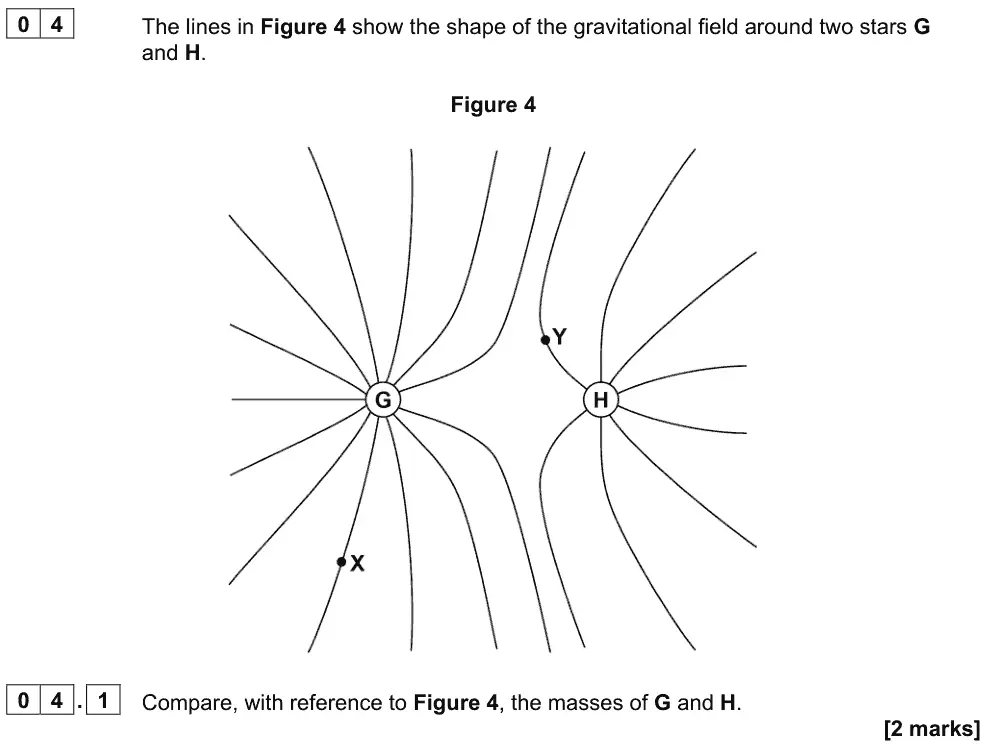
The lines in Figure 4 show the shape of the gravitational field around two stars G
and H.
Figure 4
Compare, with reference to Figure 4, the masses of G and H.
[2 marks]
June 2022 · Paper 2 · Q4.2 1 mark AO1=1 Diagram or graph gravitational fields
Earlier part of question 4 that this part usesEarlier part of June 2022 Paper 2 question 4
X and Y are two points in the field.
Annotate Figure 4 to show the field direction at X and the field direction at Y.
[1 mark]
June 2022 · Paper 2 · Q4.3 1 mark AO2=1 Calculation gravitational fields
Earlier part of question 4 that this part usesEarlier part of June 2022 Paper 2 question 4
A spherical asteroid P has a mass of 2.0 × 10²⁰ kg.
The gravitational field strength at its surface is 0.40 N kg−1.
Calculate the radius R of P.
[1 mark]
R =
m
June 2022 · Paper 2 · Q4.4 1 mark AO2=1 Diagram or graph gravitational fields
Earlier part of question 4 that this part usesEarlier part of June 2022 Paper 2 question 4
Sketch, on Figure 5, the variation of the gravitational field strength g with distance r.
The distance r is measured from the centre of P.
[1 mark]
Figure 5
June 2022 · Paper 2 · Q4.5 2 marks AO2=2 Explanation gravitational fields
Earlier part of question 4 that this part usesEarlier part of June 2022 Paper 2 question 4
Explain what is represented by the area under the graph between r = R and r = 2R on
Figure 5.
[2 marks]
June 2022 · Paper 2 · Q4.6 4 marks AO1=2, AO2=2 Calculation gravitational fieldsvectors and moments
Earlier part of question 4 that this part usesEarlier part of June 2022 Paper 2 question 4
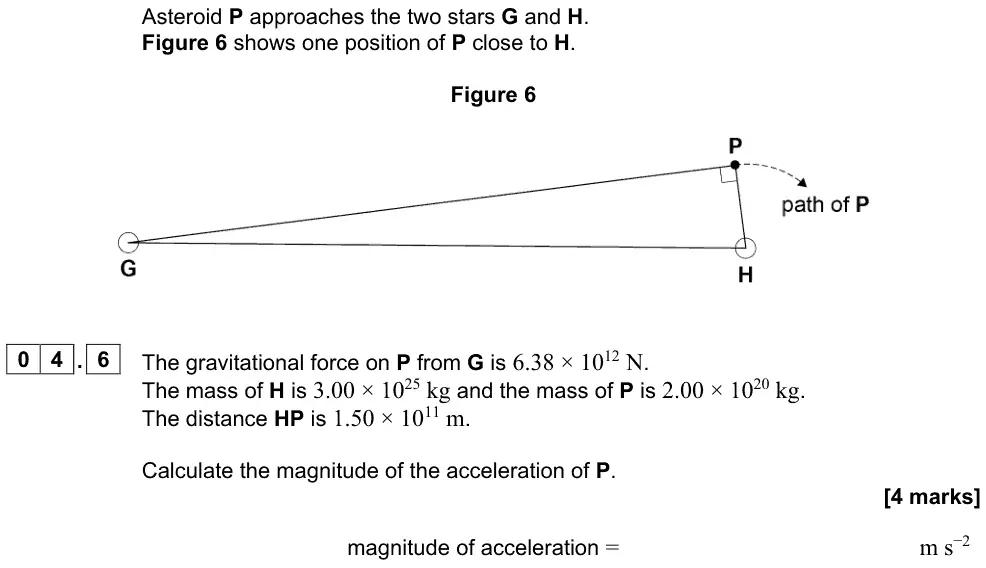
Asteroid P approaches the two stars G and H.
Figure 6 shows one position of P close to H.
Figure 6
The gravitational force on P from G is 6.38 × 10¹² N.
The mass of H is 3.00 × 1025 kg and the mass of P is 2.00 × 10²⁰ kg.
The distance HP is 1.50 × 10¹¹ m.
Calculate the magnitude of the acceleration of P.
[4 marks]
magnitude of acceleration =
m s−2
June 2022 · Paper 2 · Q4.7 1 mark AO3=1 Explanation circular motiongravitational fields
Earlier part of question 4 that this part usesEarlier part of June 2022 Paper 2 question 4
Explain why P cannot have a circular orbit around H.
[1 mark]
June 2022 · Paper 2 · Q5.1 3 marks AO1=3 Explanation electromagnetic induction
Figure 7 shows a transformer.
Figure 7
Explain the functions of the core and the secondary coil.
[3 marks]
core
secondary coil
June 2022 · Paper 2 · Q5.2 3 marks AO1=1, AO3=2 Explanation electromagnetic induction
Earlier part of question 5 that this part usesEarlier part of June 2022 Paper 2 question 5
Figure 8 shows a cross-section through the transformer core.  Thin iron sheets are
separated by material M.
Explain how the efficiency of the transformer is increased by constructing the core in
this way.
[3 marks]
Figure 8
June 2022 · Paper 2 · Q5.3 2 marks AO1=1, AO3=1 Explanation electromagnetic induction
Earlier part of question 5 that this part usesEarlier part of June 2022 Paper 2 question 5
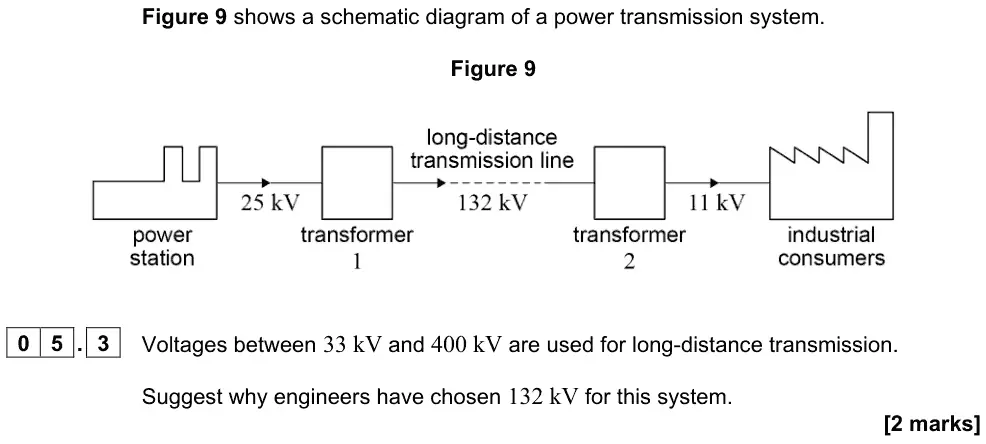
Figure 9 shows a schematic diagram of a power transmission system.
Figure 9
Voltages between 33 kV and 400 kV are used for long-distance transmission.
Suggest why engineers have chosen 132 kV for this system.
[2 marks]
June 2022 · Paper 2 · Q5.4 3 marks AO2=3 Calculation electromagnetic induction
Earlier part of question 5 that this part usesEarlier part of June 2022 Paper 2 question 5
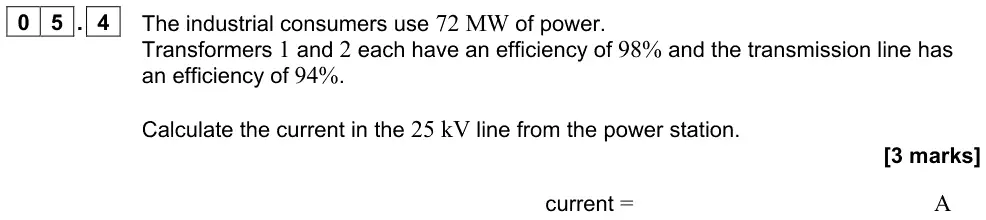
The industrial consumers use 72 MW of power.
Transformers 1 and 2 each have an efficiency of 98% and the transmission line has
an efficiency of 94%.
Calculate the current in the 25 kV line from the power station.
[3 marks]
current =
A
June 2022 · Paper 2 · Q6.1 2 marks AO1=2 Short answer mass energy and fission
Fission and fusion are two processes that can result in the transfer of binding energy
from nuclei.
State what is meant by the binding energy of a nucleus.
[2 marks]
June 2022 · Paper 2 · Q6.2 3 marks AO2=3 Calculation mass energy and fission
Earlier part of question 6 that this part usesEarlier part of June 2022 Paper 2 question 6
Calculate, in MeV, the binding energy for a nucleus of iron 56Fe
26
.
mass of 56Fe
26
nucleus = 9.288 × 10⁻²⁶ kg
[3 marks]
binding energy =
MeV
June 2022 · Paper 2 · Q6.3 2 marks AO2=2 Diagram or graph mass energy and fission
Earlier part of question 6 that this part usesEarlier part of June 2022 Paper 2 question 6
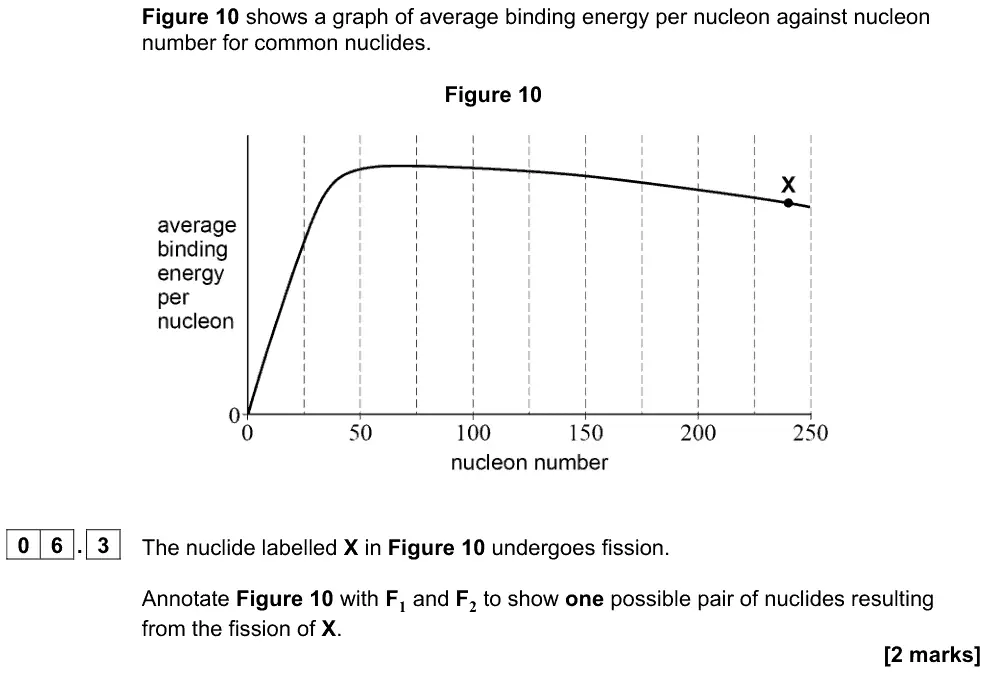
Figure 10 shows a graph of average binding energy per nucleon against nucleon
number for common nuclides.
Figure 10
The nuclide labelled X in Figure 10 undergoes fission.
Annotate Figure 10 with F1 and F2 to show one possible pair of nuclides resulting
from the fission of X.
[2 marks]
June 2022 · Paper 2 · Q6.4 3 marks AO1=1, AO3=2 Explanation radioactive decay
Earlier part of question 6 that this part usesEarlier part of June 2022 Paper 2 question 6
Figure 11 shows a graph of N against Z for stable nuclides.
Figure 11
Deduce the likely initial mode of decay of F1 and F2.
Refer to Figure 11 in your answer.
[3 marks]
June 2022 · Paper 2 · Q7 1 mark AO2=1 Multiple choice thermal energy and ideal gases
An ideal gas, initially at 300 K, is compressed to half its original volume.  It is then cooled
at constant volume until the pressure is restored to its initial value.
What is the final temperature of the gas?
[1 mark]
A 150 K
B 200 K
C 300 K
D 600 K
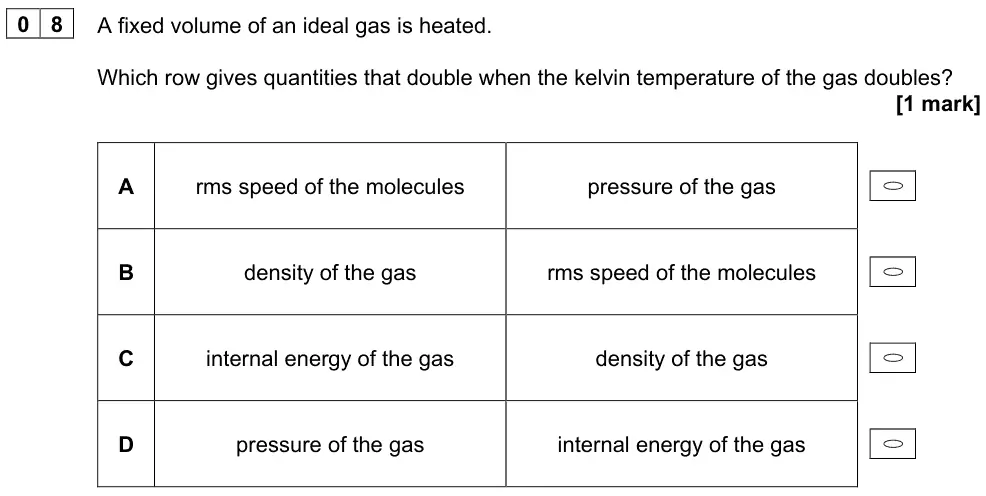
June 2022 · Paper 2 · Q8 1 mark AO2=1 Multiple choice kinetic theorythermal energy and ideal gases
A fixed volume of an ideal gas is heated.
Which row gives quantities that double when the kelvin temperature of the gas doubles?
[1 mark]
A
rms speed of the molecules
pressure of the gas
B
density of the gas
rms speed of the molecules
C
internal energy of the gas
density of the gas
D
pressure of the gas
internal energy of the gas
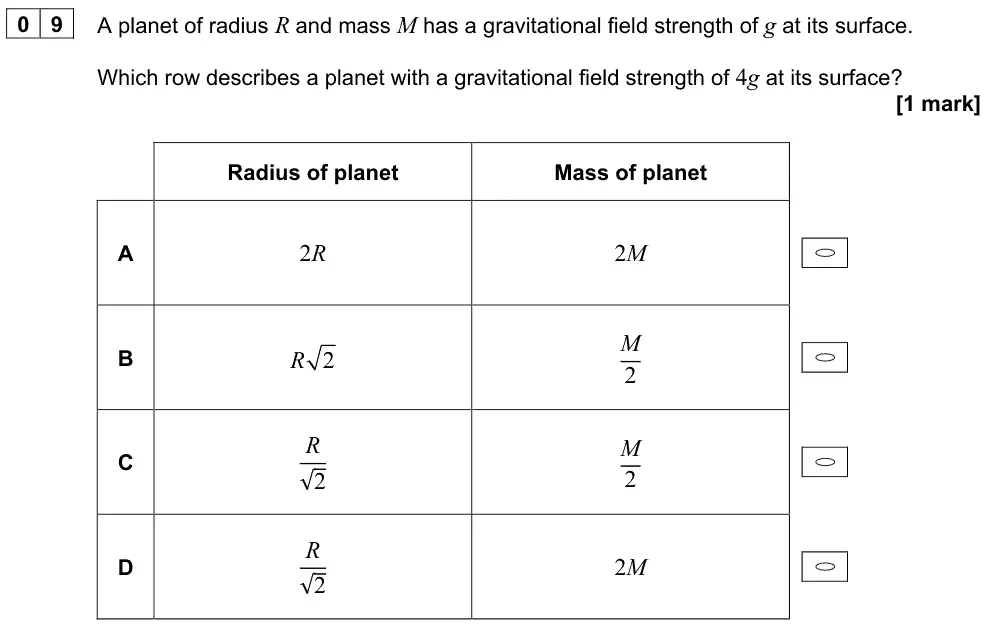
June 2022 · Paper 2 · Q9 1 mark AO2=1 Multiple choice gravitational fields
A planet of radius R and mass M has a gravitational field strength of g at its surface.
Which row describes a planet with a gravitational field strength of 4g at its surface?
[1 mark]
Radius of planet
Mass of planet
A
2R
2M
B
2
R
M
2
C
R
√2
M
2
D
R
√2
2M
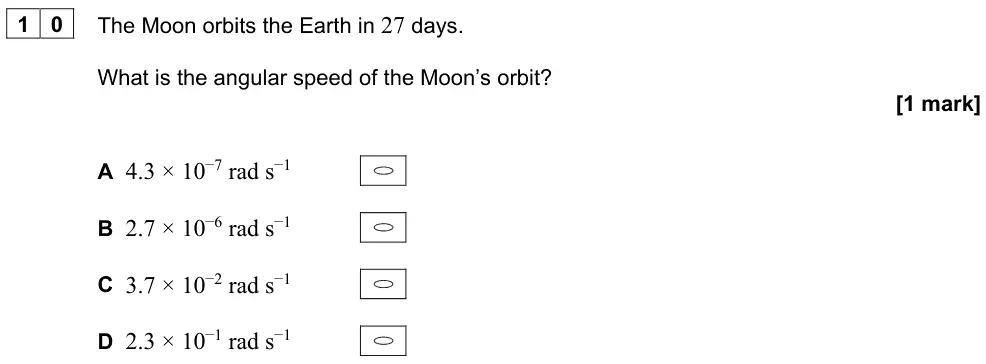
June 2022 · Paper 2 · Q10 1 mark AO1=1 Multiple choice circular motion
The Moon orbits the Earth in 27 days.
What is the angular speed of the Moon’s orbit?
[1 mark]
A 4.3 × 10⁻⁷ rad s−1
B 2.7 × 10⁻⁶ rad s−1
C 3.7 × 10⁻² rad s−1
D 2.3 × 10⁻¹ rad s−1
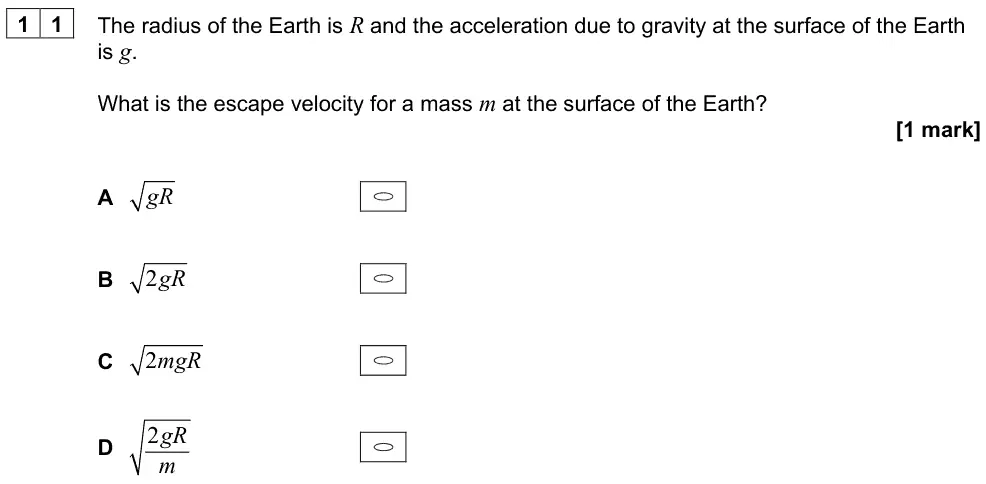
June 2022 · Paper 2 · Q11 1 mark AO2=1 Multiple choice gravitational fields
The radius of the Earth is R and the acceleration due to gravity at the surface of the Earth
is g.
What is the escape velocity for a mass m at the surface of the Earth?
[1 mark]
A
gR
B
2gR
C
2mgR
D
2gR
m
June 2022 · Paper 2 · Q12 1 mark AO2=1 Multiple choice circular motiongravitational fields
A planet has a mass M and a radius R.
Loose material at the equator only just remains in contact with the surface of the planet.
This is because the speed at which the planet rotates is very large.
What is the period of rotation of the planet?
[1 mark]
A
2
2
R
GM
π
B
2
2
GM
R
π
C
3
2
R
GM
π
D
3
2
GM
R
π
June 2022 · Paper 2 · Q13 1 mark AO2=1 Multiple choice gravitational fields
Satellites N and F have the same mass and move in circular orbits about the same planet.
The orbital radius of N is less than that of F.
Which is smaller for N than for F?
[1 mark]
A the gravitational force on the satellite
B the speed of the satellite
C the kinetic energy of the satellite
D the orbital period of the satellite
June 2022 · Paper 2 · Q14 1 mark AO2=1 Multiple choice magnetic fields
When an electron moves at a speed v perpendicular to a uniform magnetic field of flux
density B, the radius of its path is R.
A second electron moves at a speed 2
v perpendicular to a uniform magnetic field of
flux density 4B.
What is the radius of the path of the second electron?
[1 mark]
A 8
R
B 4
R
C 2R
D 8R
June 2022 · Paper 2 · Q15 1 mark AO2=1 Multiple choice electric fields
A particle of mass m and charge Q is accelerated from rest through a potential
difference V.  The final velocity of the particle is u.
A second particle of mass 2
m and charge 2Q is accelerated from rest through a potential
difference 2V.
What is the final velocity of the second particle?
[1 mark]
A
2u
B 2 2u
C 4u
D 8u
June 2022 · Paper 2 · Q16 1 mark AO1=1 Multiple choice electric fields
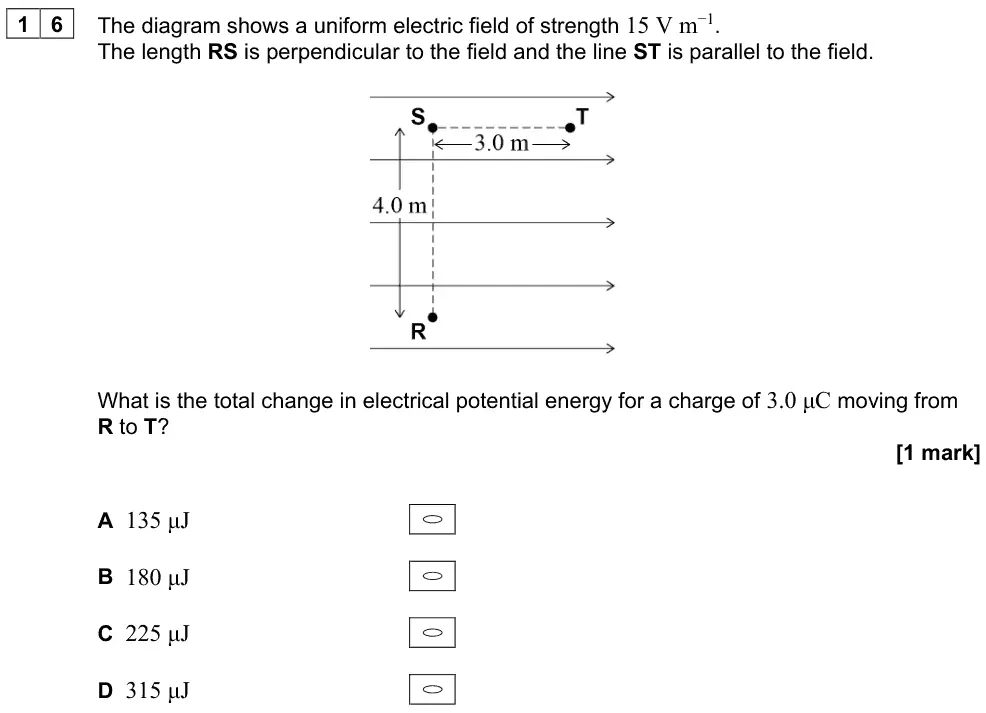
The diagram shows a uniform electric field of strength 15 V m−1.
The length RS is perpendicular to the field and the line ST is parallel to the field.
What is the total change in electrical potential energy for a charge of 3.0 μC moving from
R to T?
[1 mark]
A 135 μJ
B 180 μJ
C 225 μJ
D 315 μJ
June 2022 · Paper 2 · Q17 1 mark AO2=1 Multiple choice capacitorscurrent voltage and resistivity
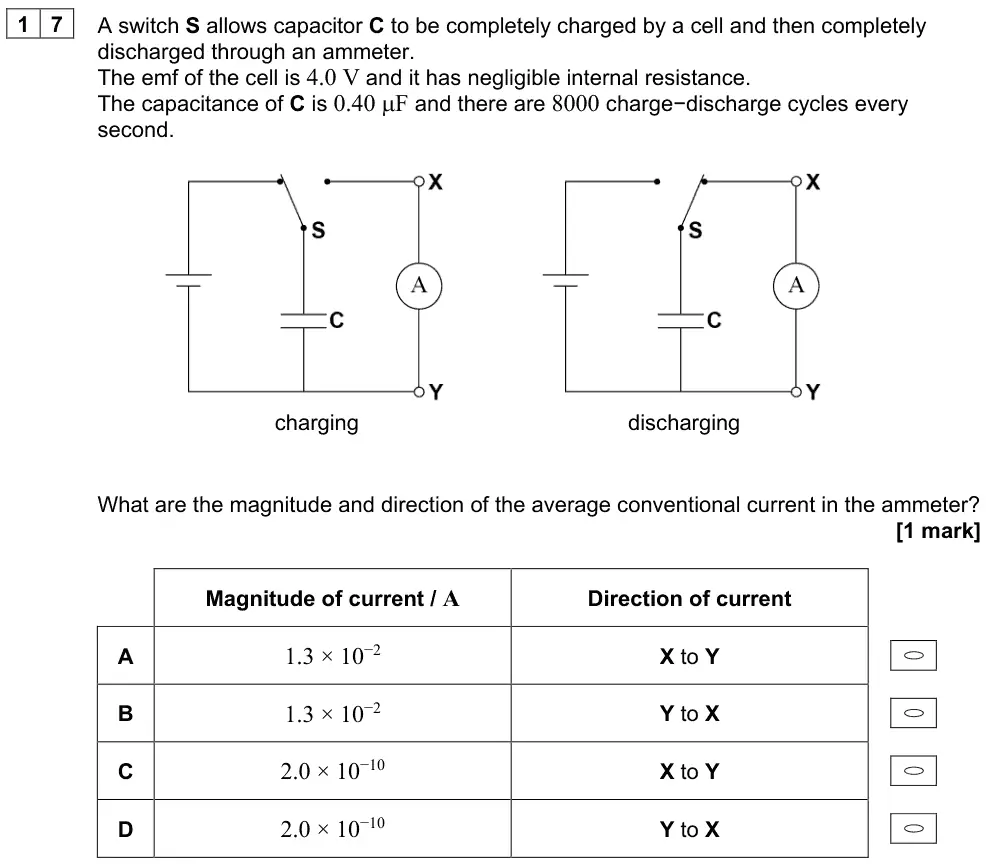
A switch S allows capacitor C to be completely charged by a cell and then completely
discharged through an ammeter.
The emf of the cell is 4.0 V and it has negligible internal resistance.
The capacitance of C is 0.40 µF and there are 8000 charge−discharge cycles every
second.
charging
discharging
What are the magnitude and direction of the average conventional current in the ammeter?
[1 mark]
Magnitude of current / A
Direction of current
A
1.3 × 10⁻²
X to Y
B
1.3 × 10⁻²
Y to X
C
2.0 × 10⁻¹⁰
X to Y
D
2.0 × 10⁻¹⁰
Y to X
June 2022 · Paper 2 · Q18 1 mark AO2=1 Multiple choice capacitors
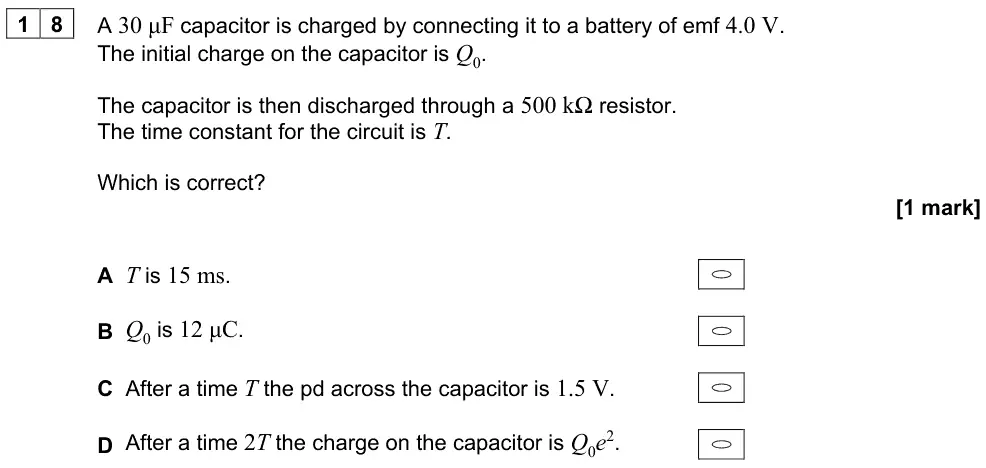
A 30 μF capacitor is charged by connecting it to a battery of emf 4.0 V.
The initial charge on the capacitor is Q0.
The capacitor is then discharged through a 500 kΩ resistor.
The time constant for the circuit is Τ.
Which is correct?
[1 mark]
A Τ is 15 ms.
B Q0 is 12 μC.
C After a time Τ the pd across the capacitor is 1.5 V.
D After a time 2Τ the charge on the capacitor is Q0e2.
June 2022 · Paper 2 · Q19 1 mark AO2=1 Multiple choice capacitors
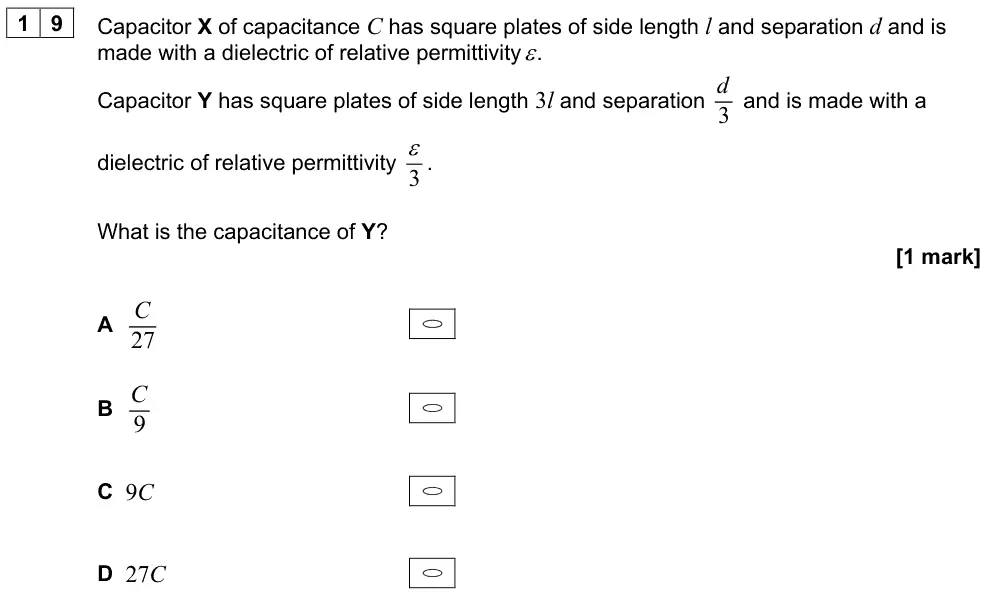
Capacitor X of capacitance C has square plates of side length l and separation d and is
made with a dielectric of relative permittivity .
Capacitor Y has square plates of side length 3l and separation 3
d and is made with a
dielectric of relative permittivity 3 .
What is the capacitance of Y?
[1 mark]
A 27
C
B 9
C
C 9C
D 27C
June 2022 · Paper 2 · Q20 1 mark AO2=1 Multiple choice capacitors
A parallel plate capacitor is connected across a battery and the energy stored in the
capacitor is E.
Without disconnecting the battery, the separation of the plates is halved.
What is the energy now stored in the capacitor?
[1 mark]
A 0.5E
B E
C 2E
D 4E
June 2022 · Paper 2 · Q21 1 mark AO2=1 Multiple choice capacitors
A fully charged capacitor of capacitance 2.0 mF discharges through a 15 kΩ resistor.
What fraction of the stored energy remains after 1.0 minute?
[1 mark]
A 1
4
B
2
1
e
C 1
16
D
4
1
e
June 2022 · Paper 2 · Q22 1 mark AO2=1 Multiple choice magnetic fields
A horizontal wire of length 0.25 m carrying a current of 3.0 A is perpendicular to a
magnetic field.  The mass of the wire is 3.0 × 10⁻³ kg and the weight of the wire is
supported in equilibrium by the magnetic field.
What is the flux density of the magnetic field?
[1 mark]
A 2.6 T
B 3.9 × 10⁻² T
C 2.2 × 10⁻² T
D 4.0 × 10⁻³ T
June 2022 · Paper 2 · Q23 1 mark AO2=1 Multiple choice electromagnetic induction
A coil is rotated at frequency f in a uniform magnetic field.
The magnetic flux linking the coil is a maximum at time t1 and the emf induced in the coil is
a maximum at time t2.
What is the smallest value of t1 − t2?
[1 mark]
A 0
B
1
4 f
C
1
2 f
D
3
4 f
June 2022 · Paper 2 · Q24 1 mark AO2=1 Multiple choice Hard electromagnetic induction
Power P is dissipated in a resistor of resistance R carrying a direct current I.
A second resistor of resistance 2R carries an alternating current with peak value I.
What is the power dissipated in the second resistor?
[1 mark]
A
2P
B P
C 2P
D 4P
June 2022 · Paper 2 · Q25 1 mark AO1=1 Multiple choice rutherford scattering and radiation
What was deduced or observed in the Rutherford scattering experiment?
[1 mark]
A All gold atoms are not alike.
B Alpha particles are helium nuclei.
C Some particles were deflected through angles greater than 90°.
D The motion of most alpha particles was reversed.
June 2022 · Paper 2 · Q26 1 mark AO1=1 Multiple choice rutherford scattering and radiation
Which row is correct for α, β and γ radiation?
[1 mark]
α
β
γ
A
Is it deflected by a magnetic field?
yes
yes
no
B
Is it deflected by an electric field?
yes
yes
yes
C
Does it have a positive charge?
yes
no
yes
D
Does it come from outside the nucleus?
no
yes
no
June 2022 · Paper 2 · Q27 1 mark AO2=1 Multiple choice radioactive decay
A sample of radioactive material consists of 200 g of nuclide P and 100 g of nuclide Q.
Nuclide P has a half-life of 2 days and nuclide Q has a half-life of 4 days.
What is the total mass of nuclides P and Q after 12 days?
[1 mark]
A 3.1 g
B 12.5 g
C 15.6 g
D 18.8 g
June 2022 · Paper 2 · Q28 1 mark AO2=1 Multiple choice radioactive decay
A nuclide has a half-life of 10 ms.
The decay constant for this nuclide lies between
[1 mark]
A 1 s−1 and 10 s−1.
B 10 s−1 and 102 s−1.
C 102 s−1 and 103 s−1.
D 103 s−1 and 106 s−1.
June 2022 · Paper 2 · Q29 1 mark AO1=1 Multiple choice radioactive decay
Which provides evidence for the existence of energy levels in nuclei?
[1 mark]
A the Rutherford alpha particle scattering experiment
B the existence of X-ray line spectra
C the existence of gamma radiation
D electron diffraction by crystals
June 2022 · Paper 2 · Q30 1 mark AO1=1 Multiple choice rutherford scattering and radiation
Which is not true for gamma radiation?
[1 mark]
A It is more penetrating than alpha or beta radiation of the same
energy through the same material.
B Its intensity is inversely proportional to the square of the distance
from its source.
C It is emitted with discrete frequencies.
D When it is absorbed it makes the absorber radioactive.
In a thermal reactor, induced fission occurs when a 235U
June 2022 · Paper 2 · Q31 1 mark AO1=1 Multiple choice mass energy and fission
92
nucleus captures a neutron.
Which statement is true?
[1 mark]
A The moderator absorbs excess neutrons.
B A large number of neutrons should be produced per fission to
sustain the reaction.
C Slow neutrons are required for this induced fission.
D The control rods slow down neutrons.

Work with an AQA physics tutor

Want a paper marked and gone through with you? Message us.

Prefer email? Send an enquiry

If you are under 18, please include a parent's contact details. Enquiries go to enquiries@physicsaleveltutor.com and are deleted once handled. All tutoring is online.