June 2023: Paper 2

85 marks · 53 question parts · Paper, mark scheme and report on AQA's site · Have the data and formulae booklet beside you

Question by question

QTopicMarksAOType
1.1 Molecular kinetic theory, Thermal energy transfer and ideal gases 1AO1=1Short answer
1.2 Molecular kinetic theory, Newton's laws of motion and momentum 1AO1=1Explanation
1.3 Molecular kinetic theory 1AO1=1Show that
1.4 Molecular kinetic theory, Newton's laws of motion and momentum 2AO1=2Explanation
2.1 Thermal energy transfer and ideal gases 5Calculation
2.2 Thermal energy transfer and ideal gases, Molecular kinetic theory 2AO2=2Explanation
3.1 Gravitational fields and orbits 2AO1=2Short answer
3.2 Gravitational fields and orbits, Work, energy, power and conservation of energy 1AO2=1Short answer
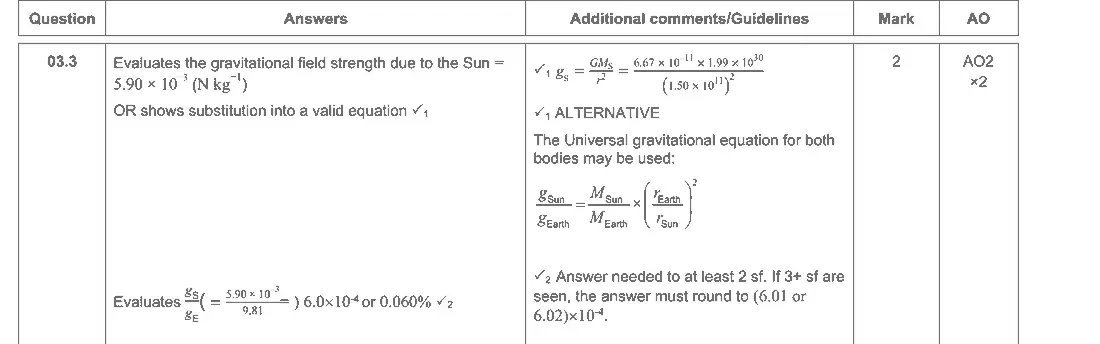
3.3 Gravitational fields and orbits 2AO2=2Calculation
3.4 Gravitational fields and orbits 1AO2=1Explanation
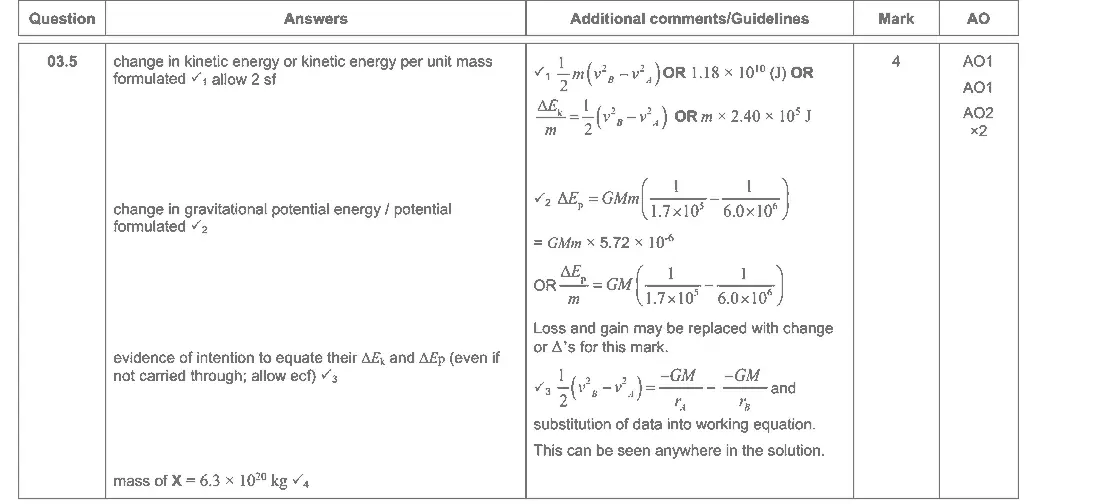
3.5 Gravitational fields and orbits, Work, energy, power and conservation of energy 4Calculation
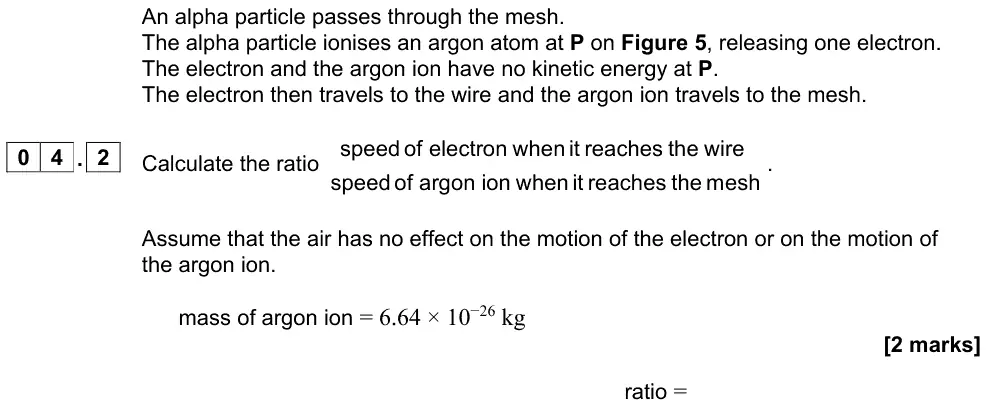
4.1 Electric fields and electric potential 2AO2=2Diagram or graph
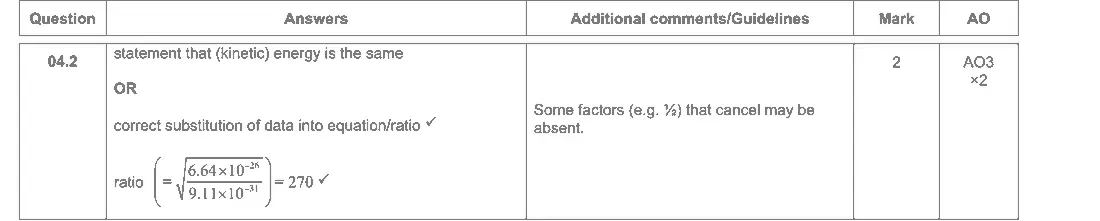
4.2 Electric fields and electric potential 2AO3=2Calculation
4.3 Electric fields and electric potential 1AO3=1Explanation
4.4 Rutherford scattering, alpha, beta and gamma radiation, Radioactive decay, half-life and nuclear instability 3AO3=3Practical and data analysis
5.1 Capacitance and capacitor charge and discharge 3Show that
5.2 Capacitance and capacitor charge and discharge 4Show that
5.3 Capacitance and capacitor charge and discharge 3AO3=3Calculation
6.1 Nuclear radius 2Short answer
6.2 Nuclear radius 2AO1=2Diagram or graph
6.3 Nuclear radius 2Show that
6.4 Nuclear radius 1AO3=1Short answer
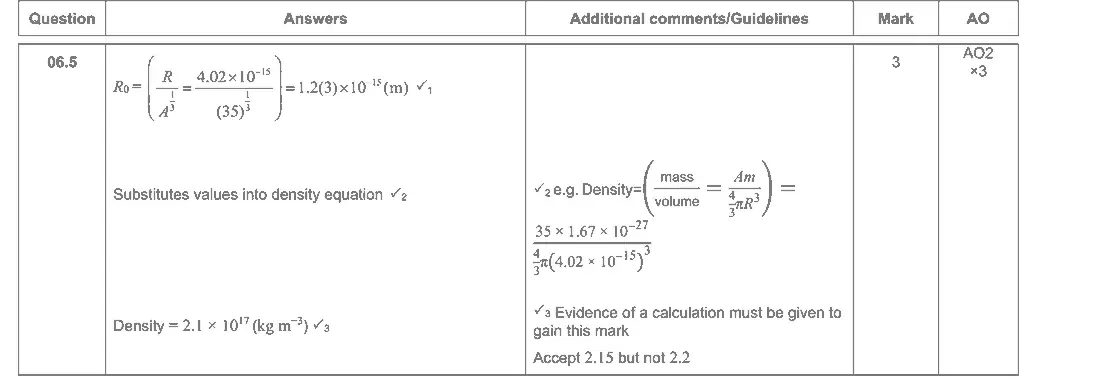
6.5 Nuclear radius 3AO2=3Calculation
7.1 Mass and energy, binding energy, fission and safety 1AO1=1Short answer
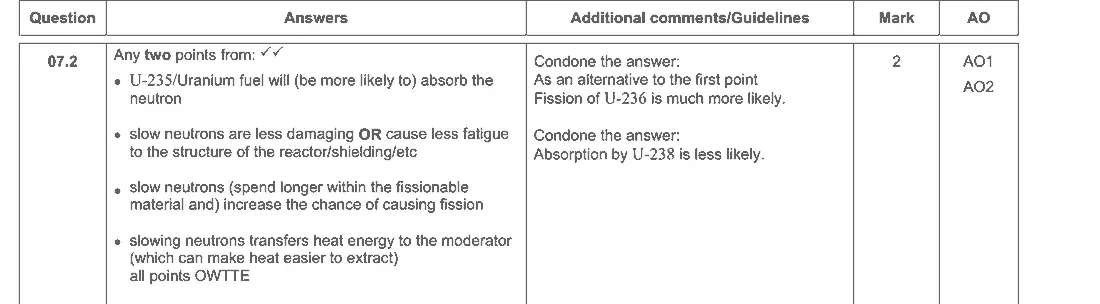
7.2 Mass and energy, binding energy, fission and safety 2Short answer
7.3 Mass and energy, binding energy, fission and safety, Work, energy, power and conservation of energy 2Show that
7.4 Molecular kinetic theory, Mass and energy, binding energy, fission and safety 3AO2=3Calculation
7.5 Mass and energy, binding energy, fission and safety 2AO2=2Explanation
8 Thermal energy transfer and ideal gases 1Multiple choice
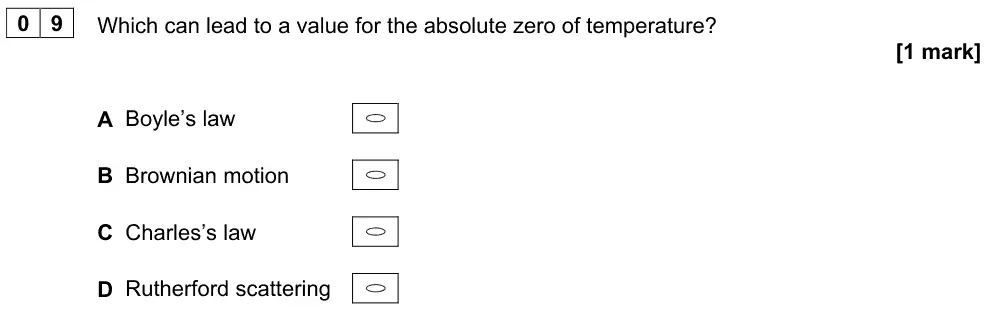
9 Thermal energy transfer and ideal gases 1Multiple choice
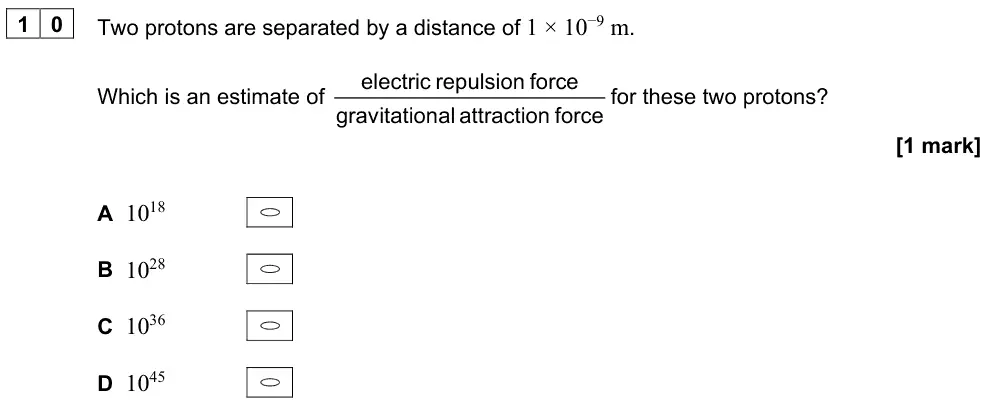
10 Electric fields and electric potential 1Multiple choice
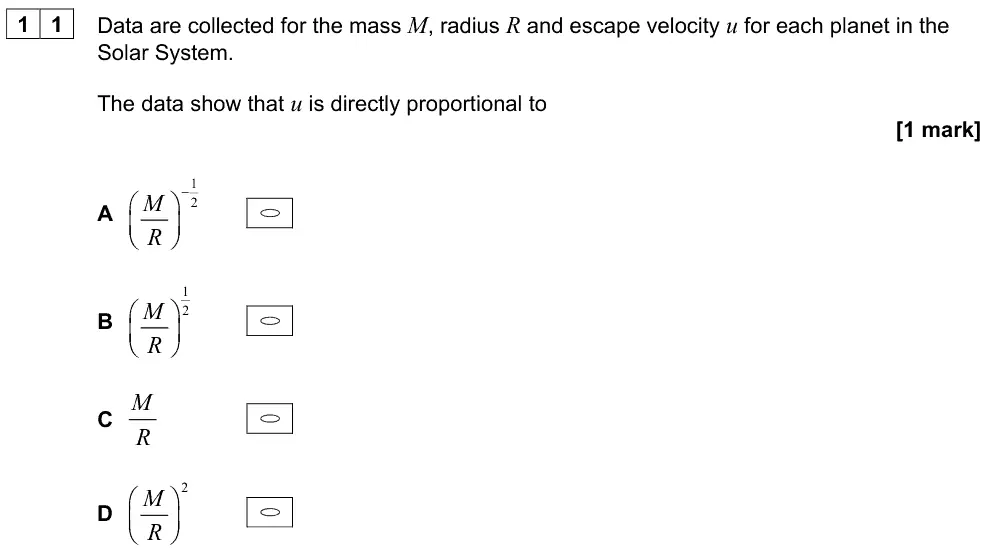
11 Gravitational fields and orbits 1Multiple choice
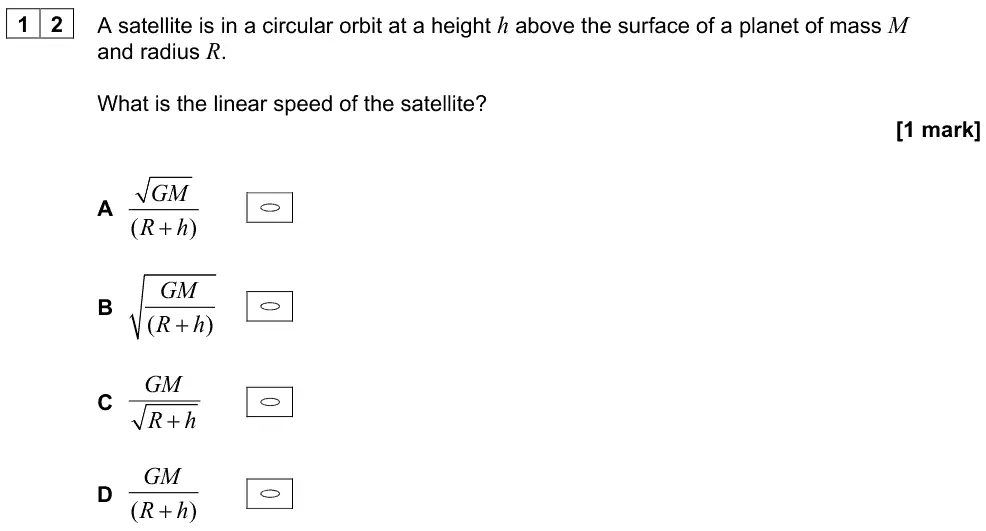
12 Gravitational fields and orbits 1Multiple choice
13 Gravitational fields and orbits 1Multiple choice
14 Electric fields and electric potential 1Multiple choice
15 Electric fields and electric potential 1Multiple choice
16 Electric fields and electric potential 1Multiple choice
17 Electric fields and electric potential 1Multiple choice
18 Capacitance and capacitor charge and discharge 1Multiple choice
19 Nuclear radius 1Multiple choice
20 Magnetic flux density and moving charges in a magnetic field 1Multiple choice
21 Magnetic flux density and moving charges in a magnetic field 1Multiple choice
22 Electromagnetic induction, alternating currents and transformers 1Multiple choice
23 Electromagnetic induction, alternating currents and transformers 1Multiple choice
24 Electromagnetic induction, alternating currents and transformers 1Multiple choice
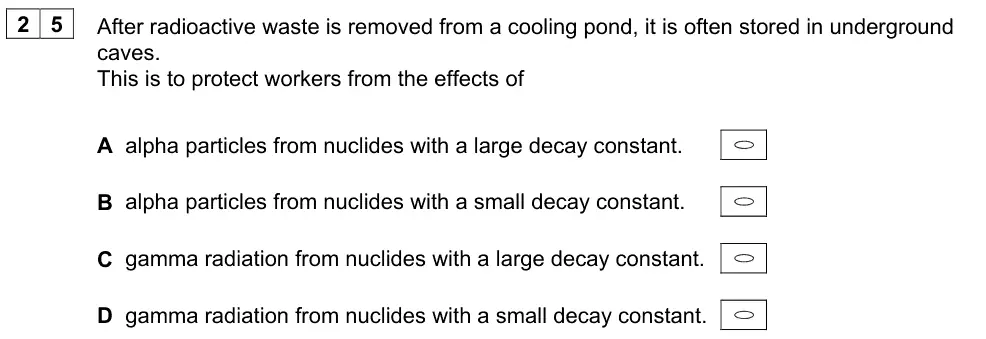
25 Mass and energy, binding energy, fission and safety 1Multiple choice
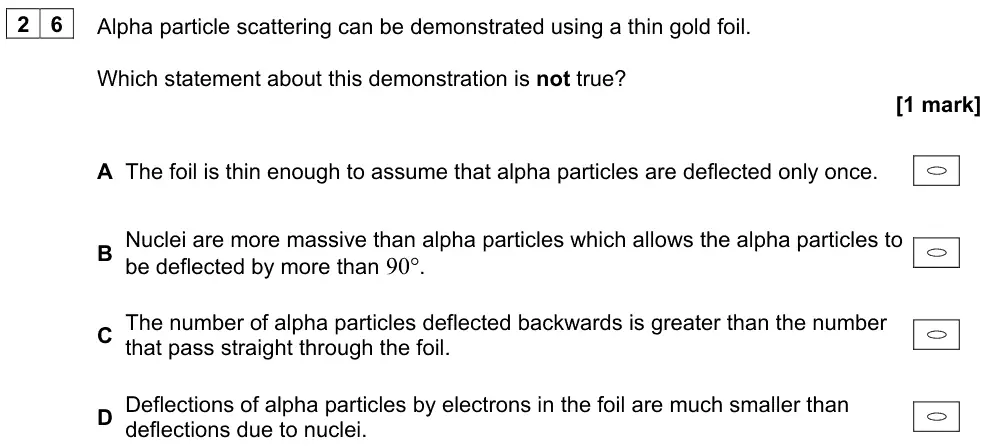
26 Rutherford scattering, alpha, beta and gamma radiation 1Multiple choice
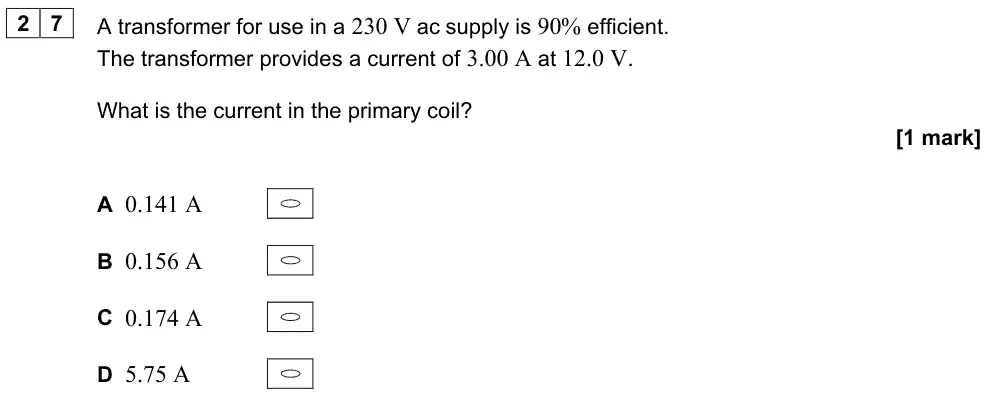
27 Electromagnetic induction, alternating currents and transformers 1Multiple choice
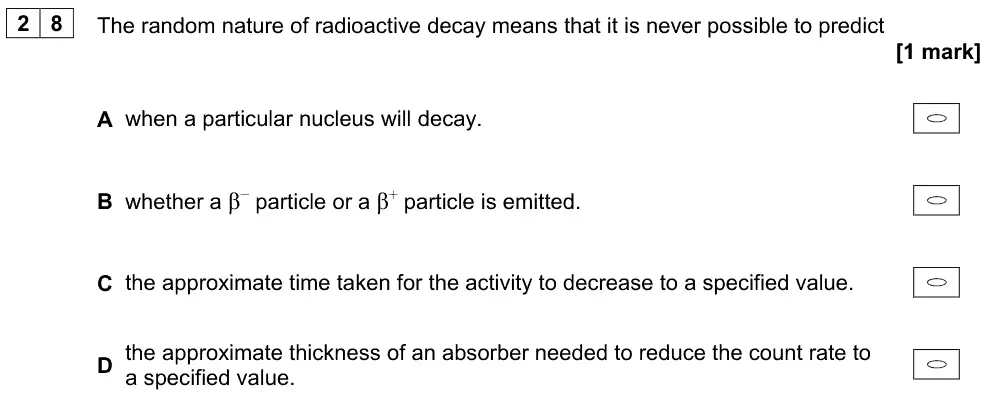
28 Radioactive decay, half-life and nuclear instability 1Multiple choice
29 Rutherford scattering, alpha, beta and gamma radiation 1Multiple choice
30 Radioactive decay, half-life and nuclear instability 1Multiple choice
31 Mass and energy, binding energy, fission and safety 1Multiple choice
32 Radioactive decay, half-life and nuclear instability 1Multiple choice

The questions

1.11.21.31.42.12.23.13.23.33.43.54.14.24.34.45.15.25.36.16.26.36.46.57.17.27.37.47.5891011121314151617181920212223242526272829303132
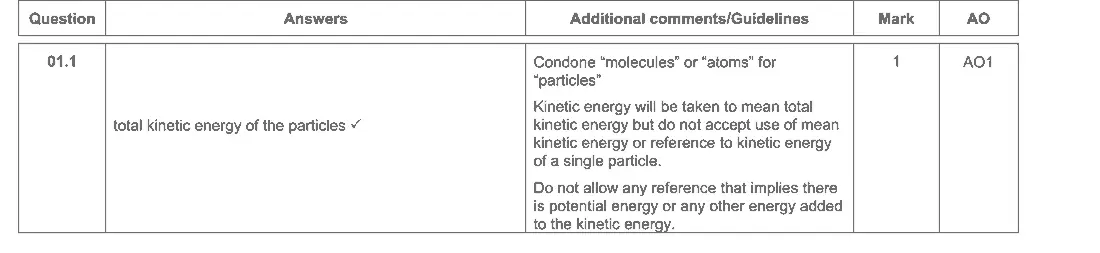
June 2023 · Paper 2 · Q1.1 1 mark AO1=1 Short answer kinetic theorythermal energy and ideal gases
State what is meant by the internal energy of an ideal gas.
[1 mark]
June 2023 · Paper 2 · Q1.2 1 mark AO1=1 Explanation kinetic theorynewtons laws and momentum
Earlier part of question 1 that this part usesEarlier part of June 2023 Paper 2 question 1
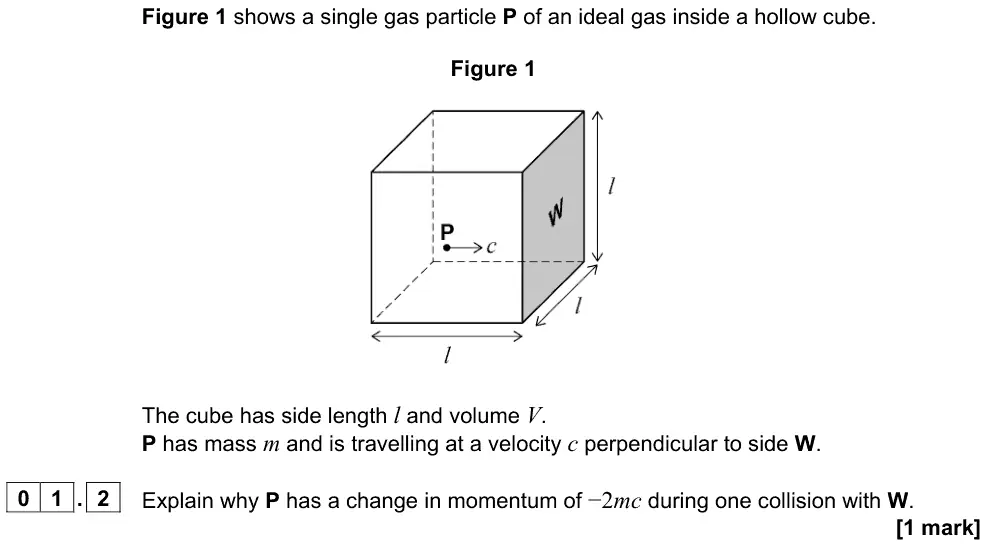
Figure 1 shows a single gas particle P of an ideal gas inside a hollow cube.
Figure 1
The cube has side length l and volume V.
P has mass m and is travelling at a velocity c perpendicular to side W.
Explain why P has a change in momentum of −2mc during one collision with W.
[1 mark]
June 2023 · Paper 2 · Q1.3 1 mark AO1=1 Show that kinetic theory
Earlier part of question 1 that this part usesEarlier part of June 2023 Paper 2 question 1
P collides repeatedly with W.
Show that the frequency f of collisions is 2
c
l
.
[1 mark]
June 2023 · Paper 2 · Q1.4 2 marks AO1=2 Explanation kinetic theorynewtons laws and momentum
Earlier part of question 1 that this part usesEarlier part of June 2023 Paper 2 question 1
Deduce an expression, in terms of m, c and V, for the contribution of P to the
pressure exerted on W.
Refer to appropriate Newton’s laws of motion.
[2 marks]
June 2023 · Paper 2 · Q2.1 5 marks Calculation thermal energy and ideal gases
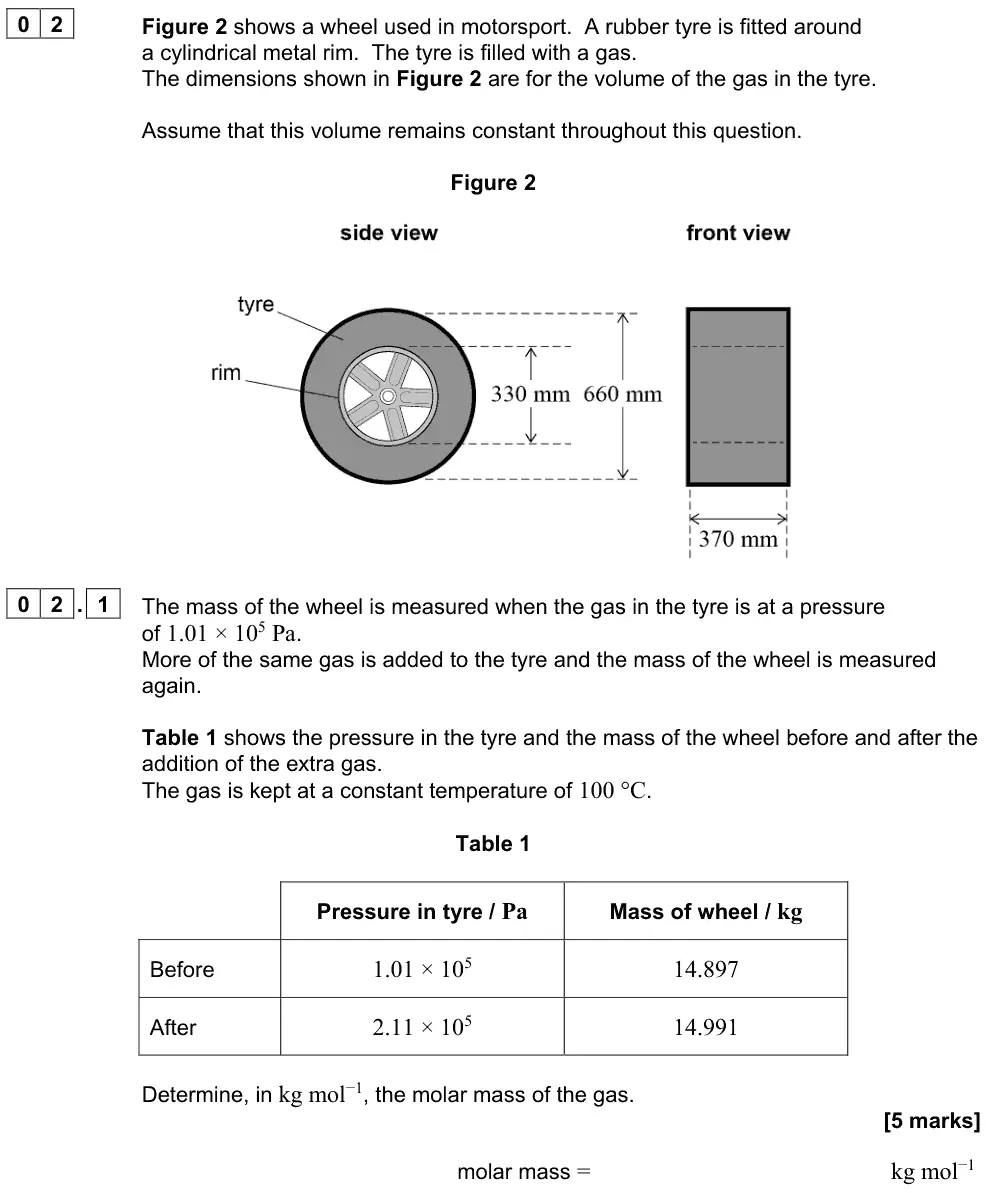
Figure 2 shows a wheel used in motorsport.  A rubber tyre is fitted around
a cylindrical metal rim.  The tyre is filled with a gas.
The dimensions shown in Figure 2 are for the volume of the gas in the tyre.
Assume that this volume remains constant throughout this question.
Figure 2
The mass of the wheel is measured when the gas in the tyre is at a pressure
of 1.01 × 10⁵ Pa.
More of the same gas is added to the tyre and the mass of the wheel is measured
again.
Table 1 shows the pressure in the tyre and the mass of the wheel before and after the
addition of the extra gas.
The gas is kept at a constant temperature of 100 °C.
Table 1
Pressure in tyre / Pa
Mass of wheel / kg
Before
1.01 × 10⁵
14.897
After
2.11 × 10⁵
14.991
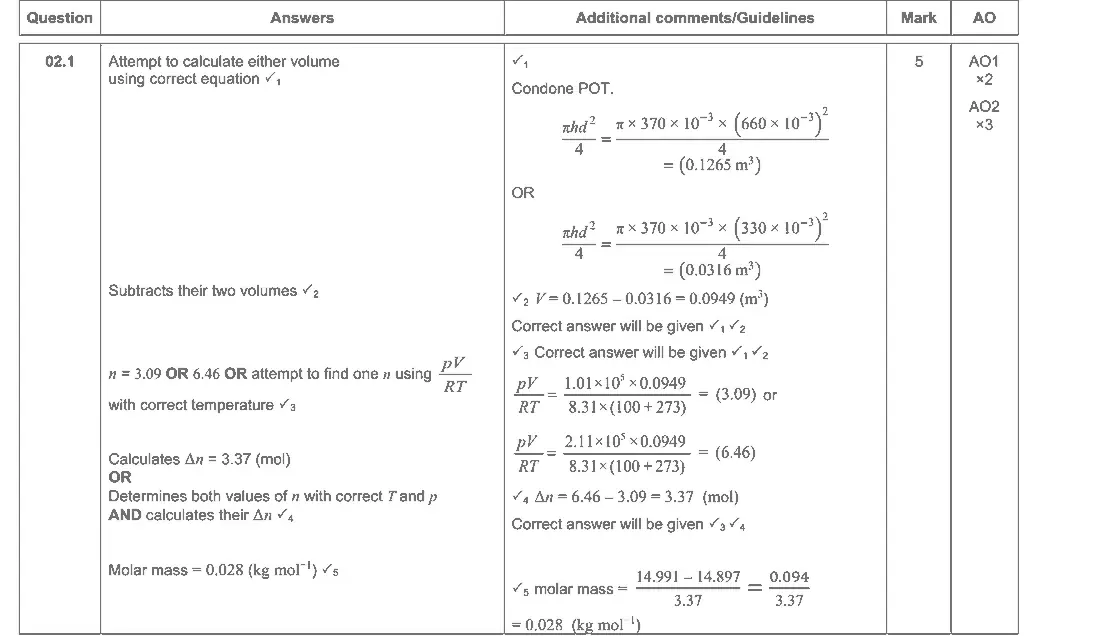
Determine, in kg mol−1, the molar mass of the gas.
[5 marks]
molar mass =
kg mol−1
June 2023 · Paper 2 · Q2.2 2 marks AO2=2 Explanation thermal energy and ideal gaseskinetic theory
Earlier part of question 2 that this part usesEarlier part of June 2023 Paper 2 question 2
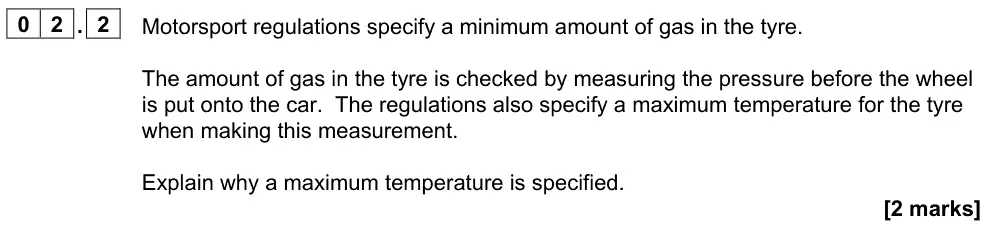
Motorsport regulations specify a minimum amount of gas in the tyre.
The amount of gas in the tyre is checked by measuring the pressure before the wheel
is put onto the car.  The regulations also specify a maximum temperature for the tyre
when making this measurement.
Explain why a maximum temperature is specified.
[2 marks]
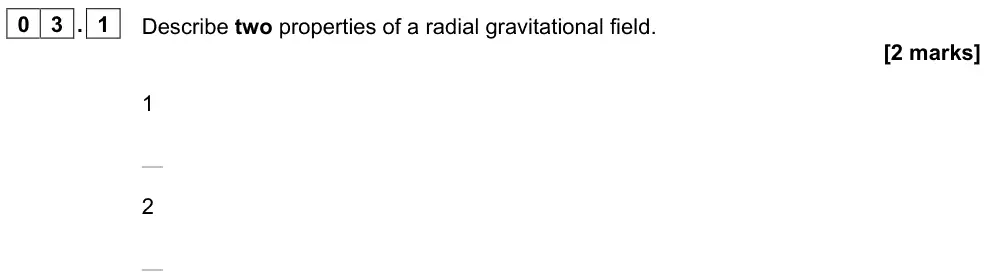
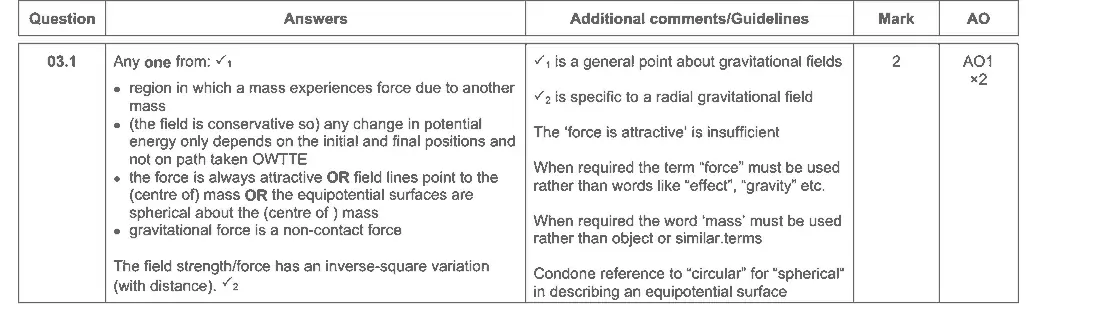
June 2023 · Paper 2 · Q3.1 2 marks AO1=2 Short answer gravitational fields
Describe two properties of a radial gravitational field.
[2 marks]
1
2
June 2023 · Paper 2 · Q3.2 1 mark AO2=1 Short answer gravitational fieldswork energy and power
Earlier part of question 3 that this part usesEarlier part of June 2023 Paper 2 question 3
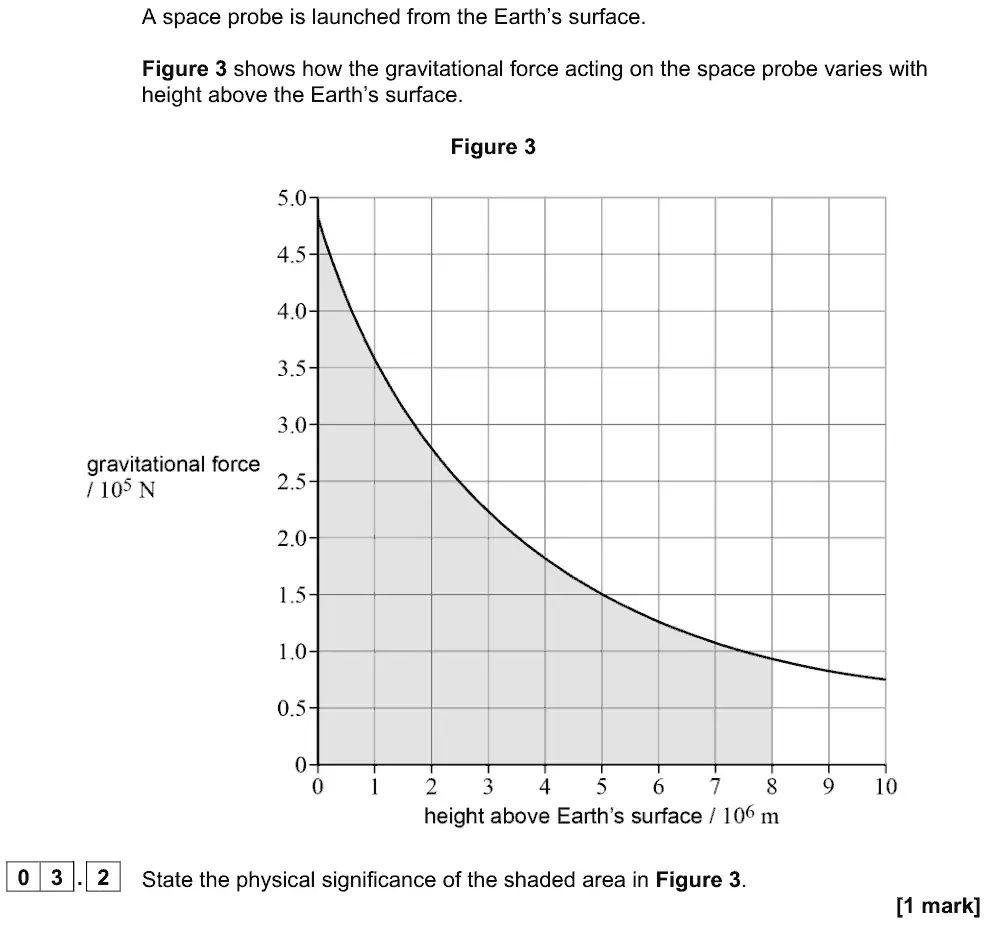
A space probe is launched from the Earth’s surface.
Figure 3 shows how the gravitational force acting on the space probe varies with
height above the Earth’s surface.
Figure 3
State the physical significance of the shaded area in Figure 3.
[1 mark]
June 2023 · Paper 2 · Q3.3 2 marks AO2=2 Calculation gravitational fields
Earlier part of question 3 that this part usesEarlier part of June 2023 Paper 2 question 3
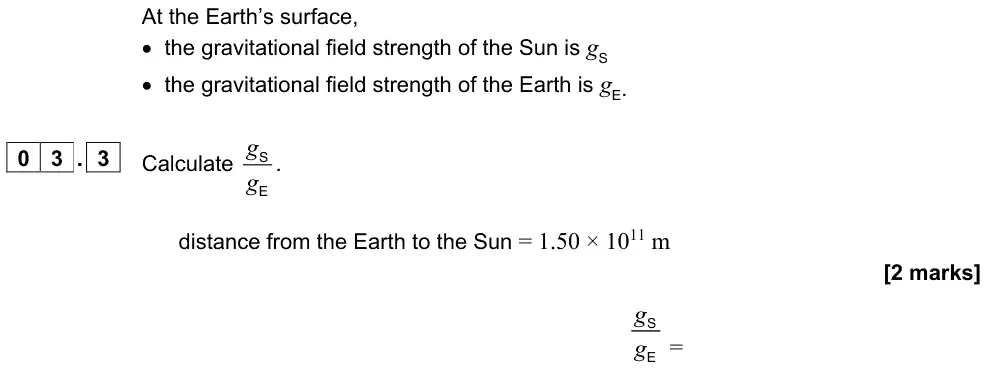
At the Earth’s surface,
• the gravitational field strength of the Sun is gS
• the gravitational field strength of the Earth is gE.
Calculate g
g
S
E
.
distance from the Earth to the Sun = 1.50 × 10¹¹ m
[2 marks]
g
g
S
E =
June 2023 · Paper 2 · Q3.4 1 mark AO2=1 Explanation gravitational fields
Earlier part of question 3 that this part usesEarlier part of June 2023 Paper 2 question 3
Explain why gS is more important than gE in predicting the motion of the space probe
as it escapes from the Solar System.
[1 mark]
June 2023 · Paper 2 · Q3.5 4 marks Calculation gravitational fieldswork energy and power
Earlier part of question 3 that this part usesEarlier part of June 2023 Paper 2 question 3
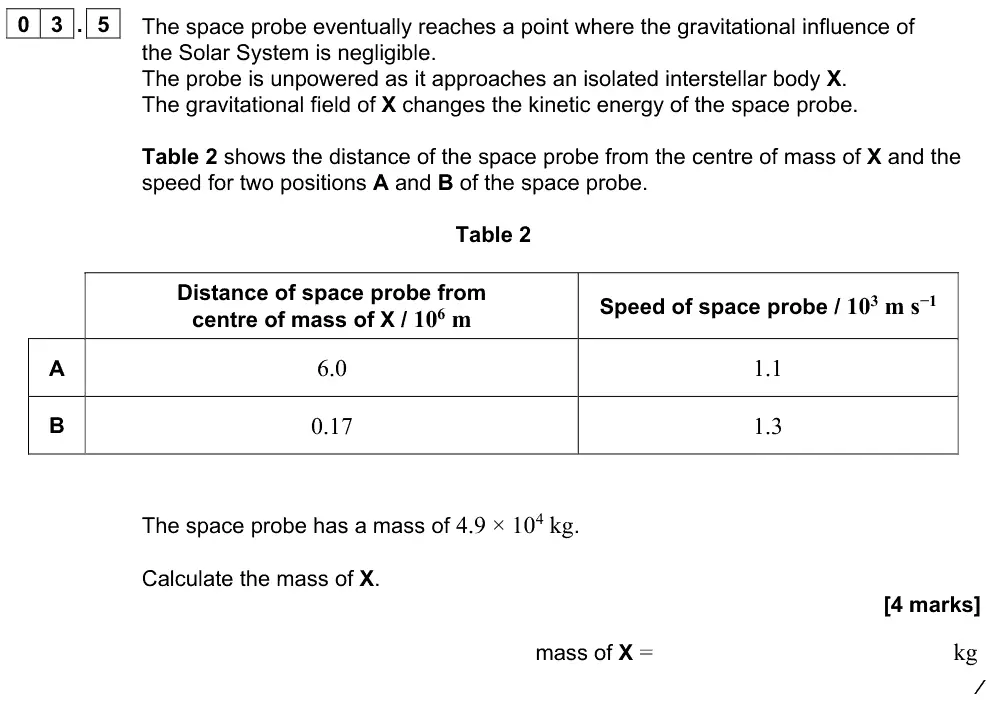
The space probe eventually reaches a point where the gravitational influence of
the Solar System is negligible.
The probe is unpowered as it approaches an isolated interstellar body X.
The gravitational field of X changes the kinetic energy of the space probe.
Table 2 shows the distance of the space probe from the centre of mass of X and the
speed for two positions A and B of the space probe.
Table 2
Distance of space probe from
centre of mass of X / 106 m
Speed of space probe / 103 m s−1
A
6.0
1.1
B
0.17
1.3
The space probe has a mass of 4.9 × 10⁴ kg.
Calculate the mass of X.
[4 marks]
mass of X =
kg
June 2023 · Paper 2 · Q4.1 2 marks AO2=2 Diagram or graph electric fields
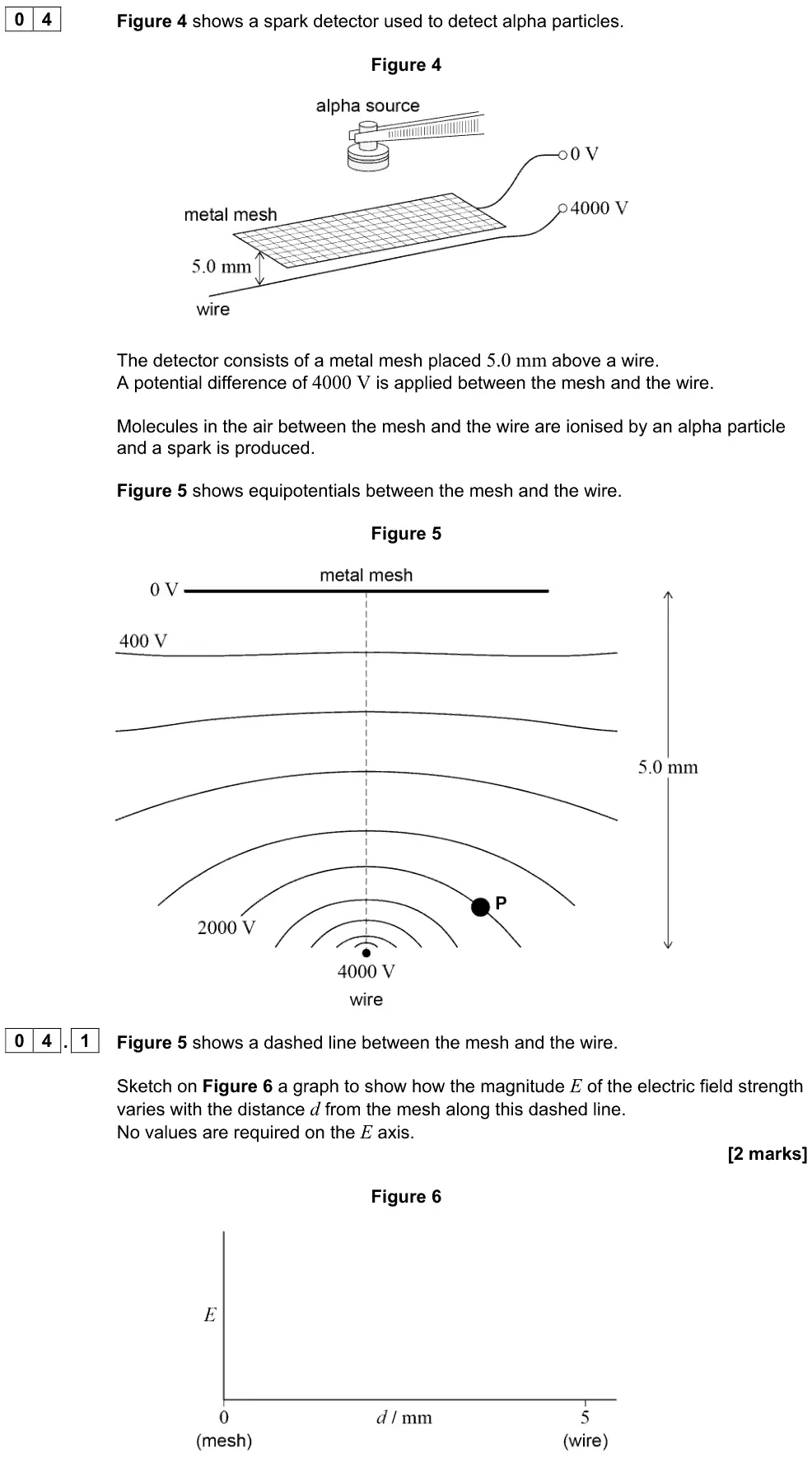
Figure 4 shows a spark detector used to detect alpha particles.
Figure 4
The detector consists of a metal mesh placed 5.0 mm above a wire.
A potential difference of 4000 V is applied between the mesh and the wire.
Molecules in the air between the mesh and the wire are ionised by an alpha particle
and a spark is produced.
Figure 5 shows equipotentials between the mesh and the wire.
Figure 5
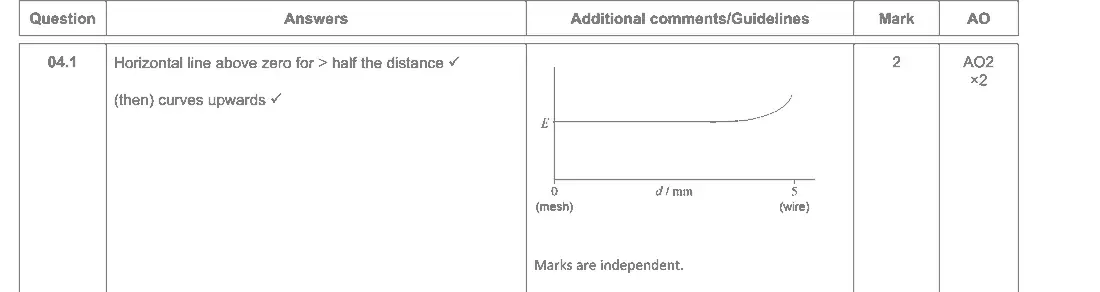
Figure 5 shows a dashed line between the mesh and the wire.
Sketch on Figure 6 a graph to show how the magnitude E of the electric field strength
varies with the distance d from the mesh along this dashed line.
No values are required on the E axis.
[2 marks]
Figure 6
June 2023 · Paper 2 · Q4.2 2 marks AO3=2 Calculation electric fields
Earlier part of question 4 that this part usesEarlier part of June 2023 Paper 2 question 4
An alpha particle passes through the mesh.
The alpha particle ionises an argon atom at P on Figure 5, releasing one electron.
The electron and the argon ion have no kinetic energy at P.
The electron then travels to the wire and the argon ion travels to the mesh.
Calculate the ratio
speed of electron when it reaches the wire
speed of argon ion when it reaches the mesh
.
Assume that the air has no effect on the motion of the electron or on the motion of
the argon ion.
mass of argon ion = 6.64 × 10⁻²⁶ kg
[2 marks]
ratio =
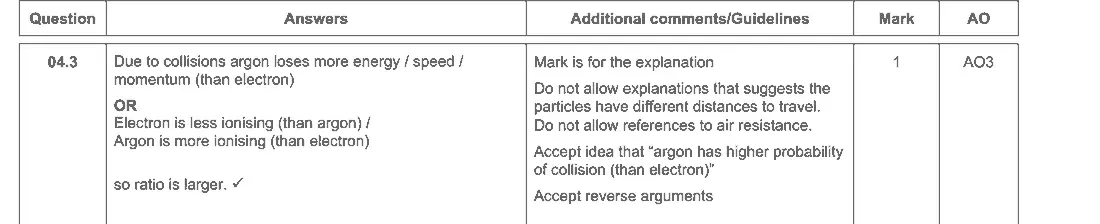
June 2023 · Paper 2 · Q4.3 1 mark AO3=1 Explanation electric fields
Earlier part of question 4 that this part usesEarlier part of June 2023 Paper 2 question 4
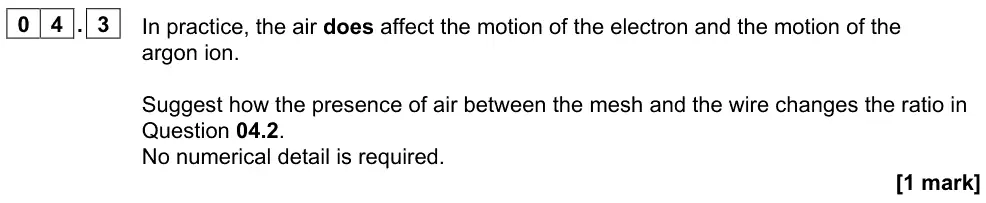
In practice, the air does affect the motion of the electron and the motion of the
argon ion.
Suggest how the presence of air between the mesh and the wire changes the ratio in
Question 04.2.
No numerical detail is required.
[1 mark]
June 2023 · Paper 2 · Q4.4 3 marks AO3=3 Practical and data analysis rutherford scattering and radiationradioactive decay
Earlier part of question 4 that this part usesEarlier part of June 2023 Paper 2 question 4
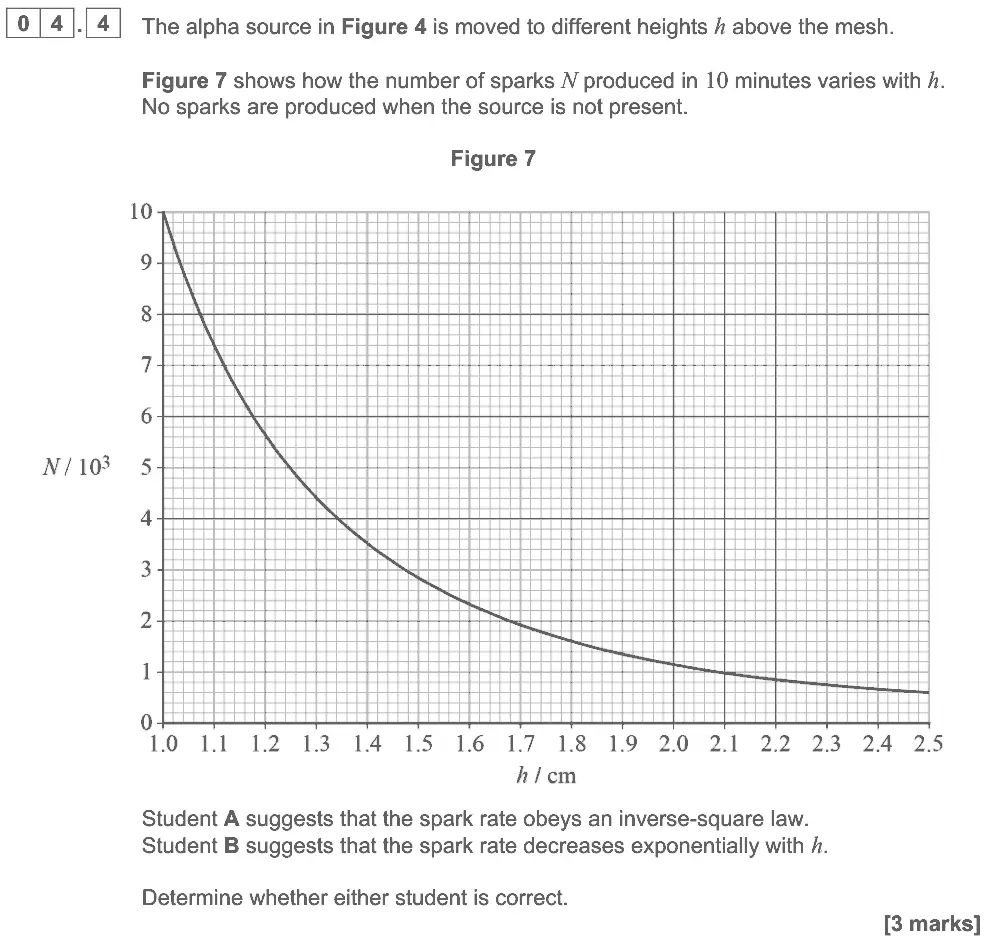
The alpha source in Figure 4 is moved to different heights h above the mesh.
Figure 7 shows how the number of sparks N produced in 10 minutes varies with h.
No sparks are produced when the source is not present.
Figure 7
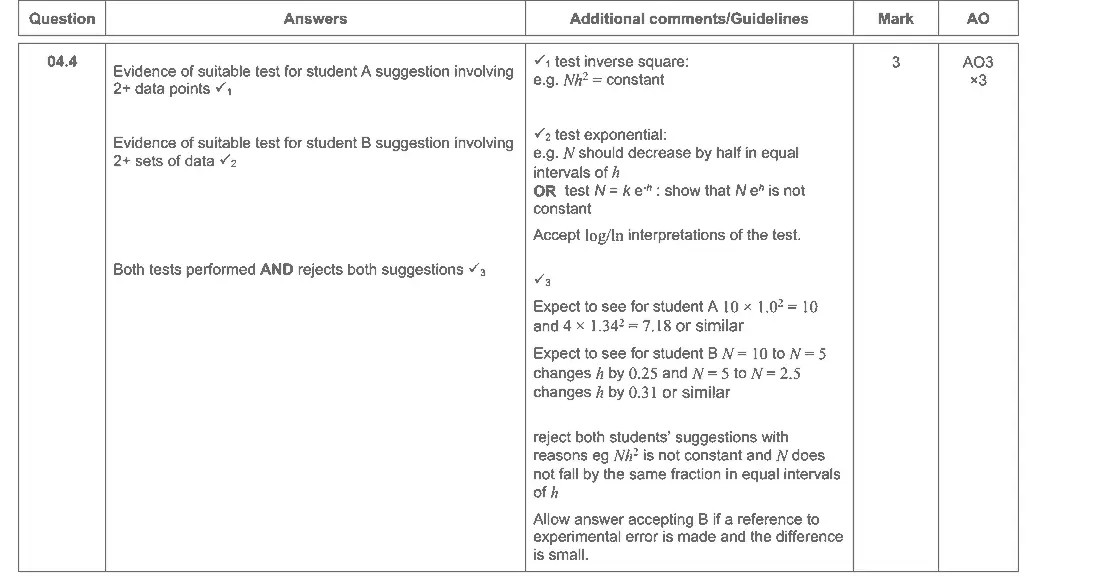
Student A suggests that the spark rate obeys an inverse-square law.
Student B suggests that the spark rate decreases exponentially with h.
Determine whether either student is correct.
[3 marks]
June 2023 · Paper 2 · Q5.1 3 marks Show that capacitors
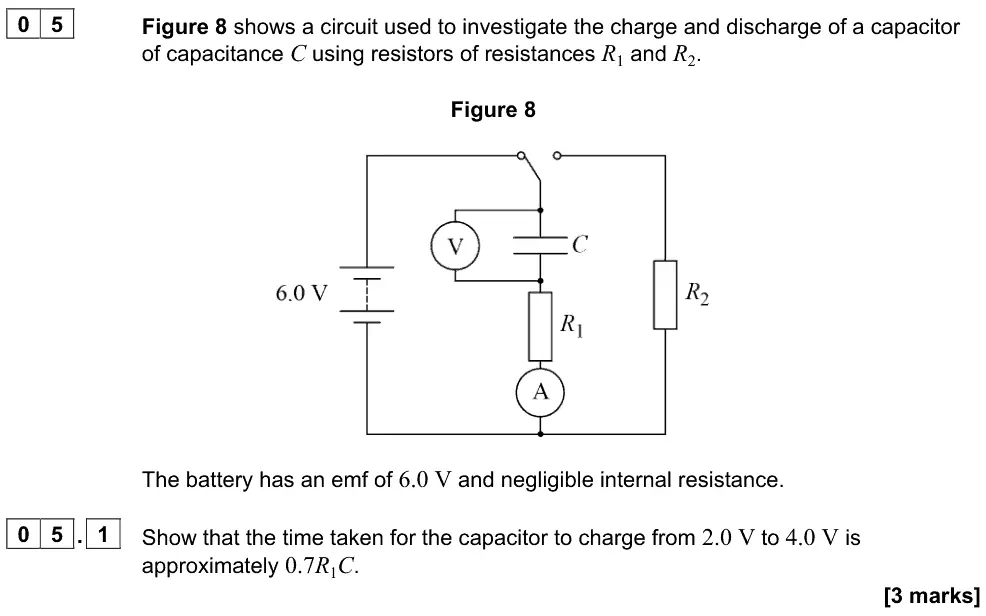
Figure 8 shows a circuit used to investigate the charge and discharge of a capacitor
of capacitance C using resistors of resistances R1 and R2.
Figure 8
The battery has an emf of 6.0 V and negligible internal resistance.
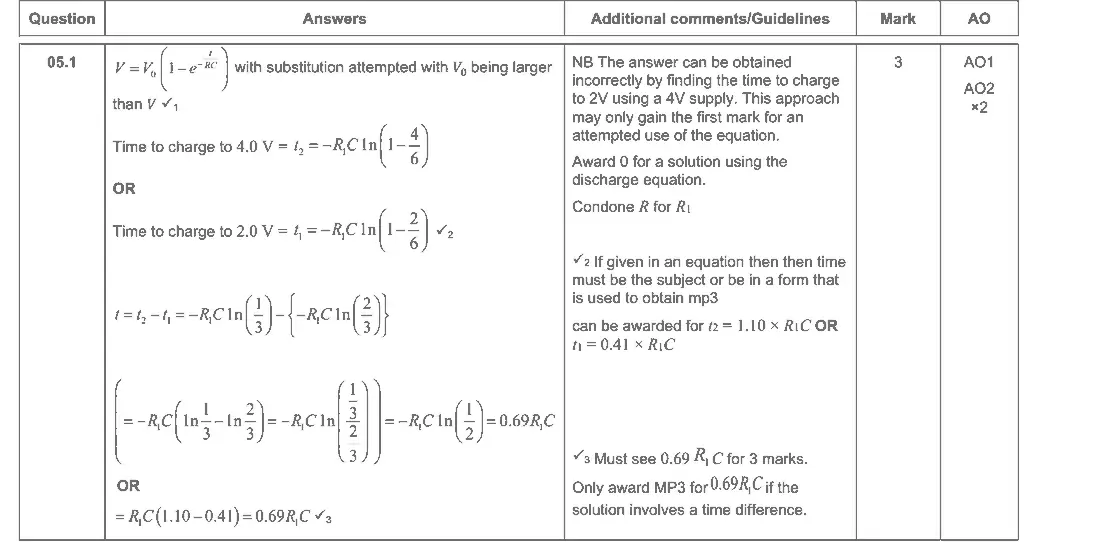
Show that the time taken for the capacitor to charge from 2.0 V to 4.0 V is
approximately 0.7R1C.
[3 marks]
June 2023 · Paper 2 · Q5.2 4 marks Show that capacitors
Earlier part of question 5 that this part usesEarlier part of June 2023 Paper 2 question 5
The capacitor is fully discharged.
The capacitor is then charged until the potential difference (pd) across it is 4.0 V.
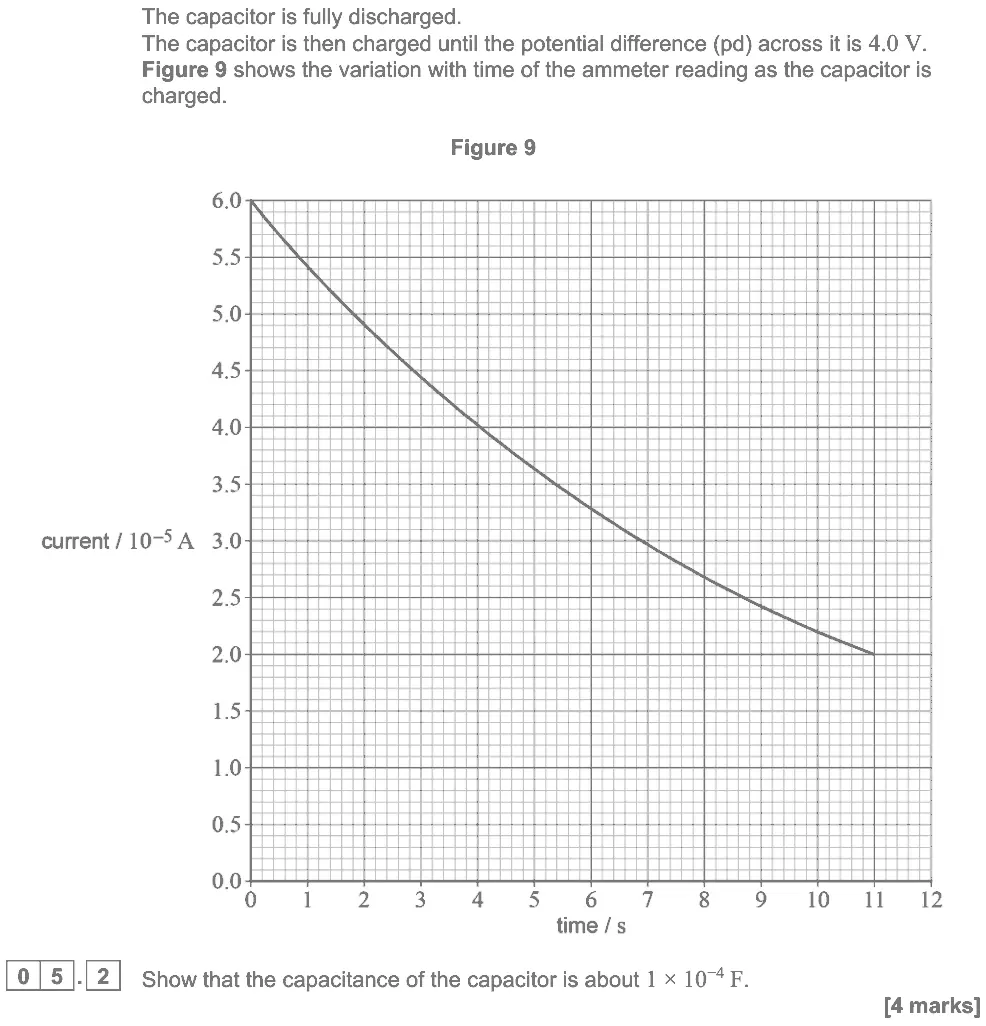
Figure 9 shows the variation with time of the ammeter reading as the capacitor is
charged.
Figure 9
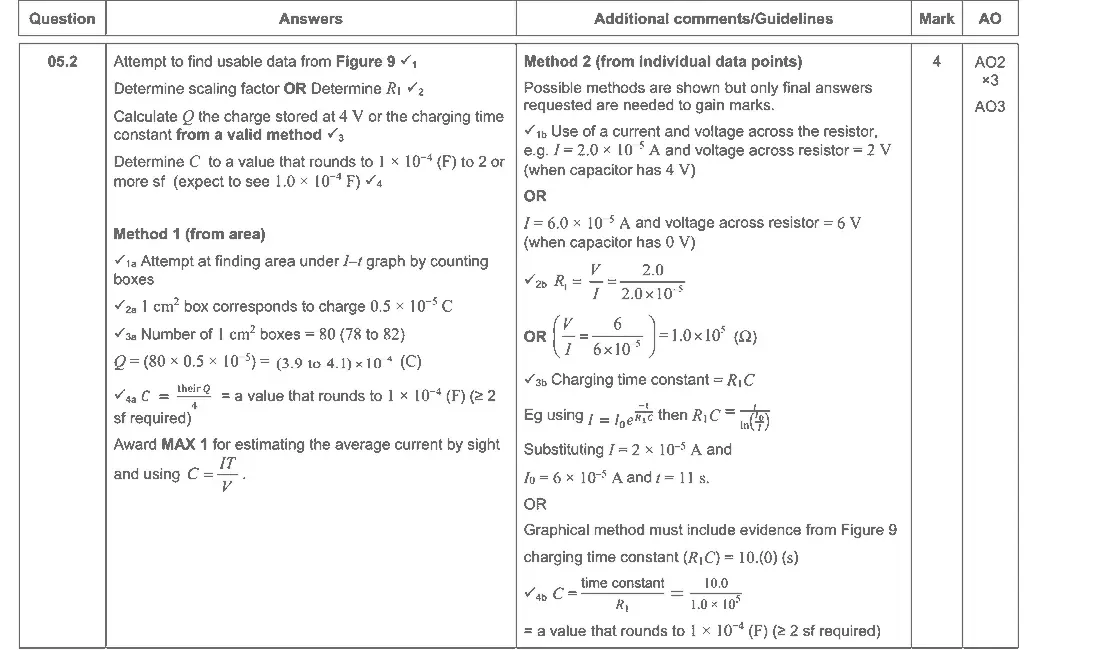
Show that the capacitance of the capacitor is about 1 × 10⁻⁴ F.
[4 marks]
June 2023 · Paper 2 · Q5.3 3 marks AO3=3 Calculation capacitors
Earlier part of question 5 that this part usesEarlier part of June 2023 Paper 2 question 5
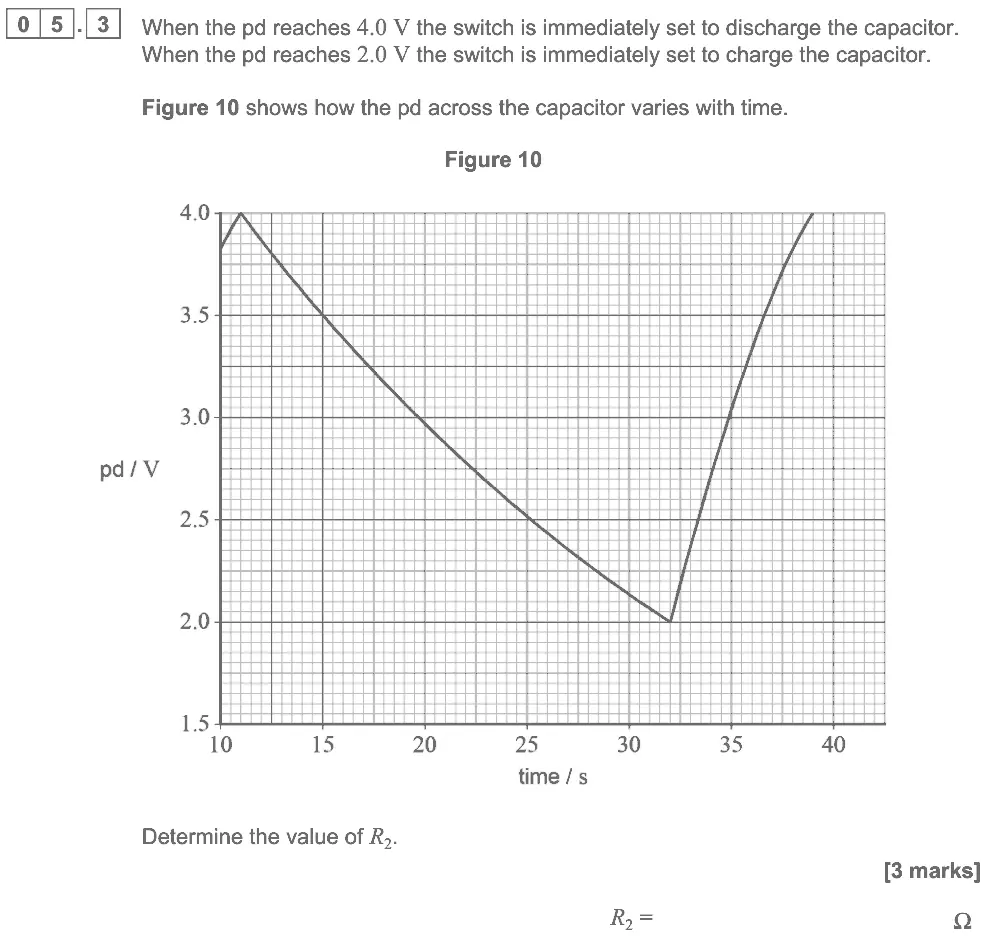
When the pd reaches 4.0 V the switch is immediately set to discharge the capacitor.
When the pd reaches 2.0 V the switch is immediately set to charge the capacitor.
Figure 10 shows how the pd across the capacitor varies with time.
Figure 10
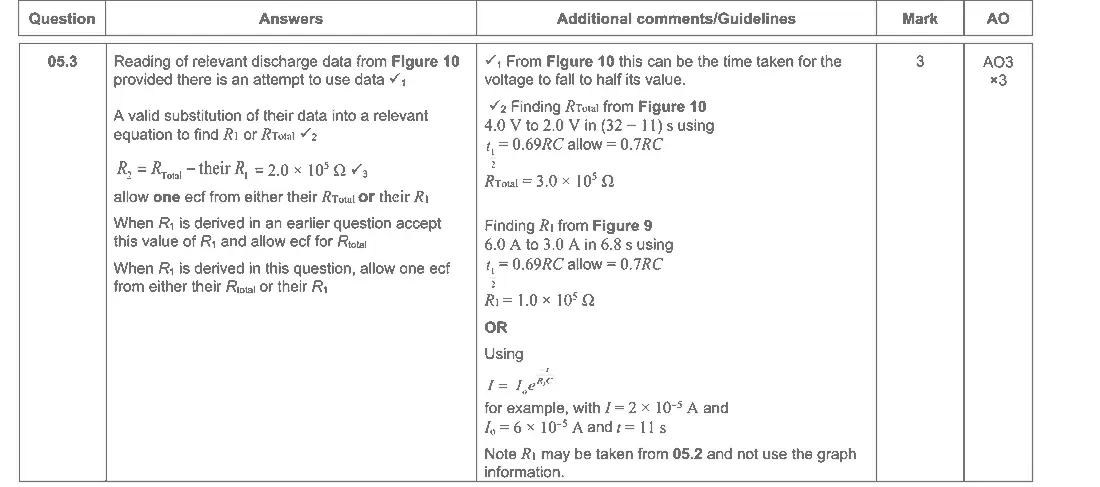
Determine the value of R2.
[3 marks]
R2 =
Ω
June 2023 · Paper 2 · Q6.1 2 marks Short answer nuclear radius
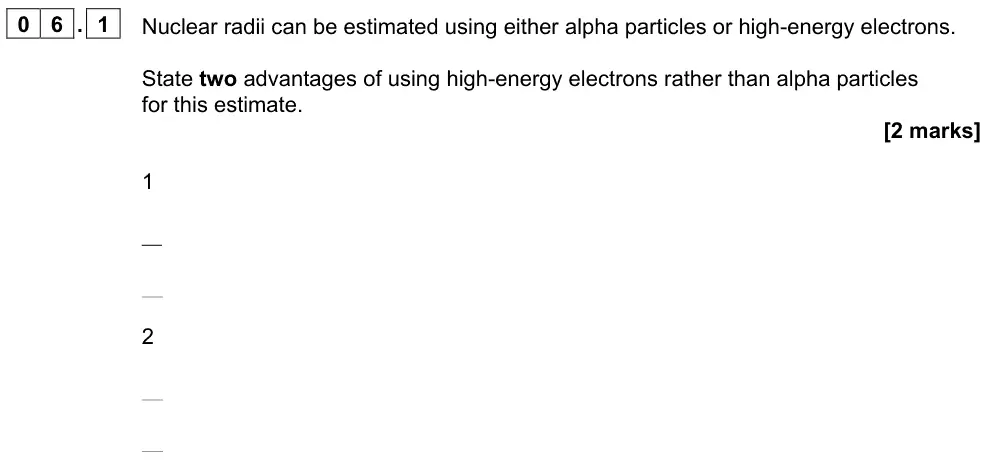
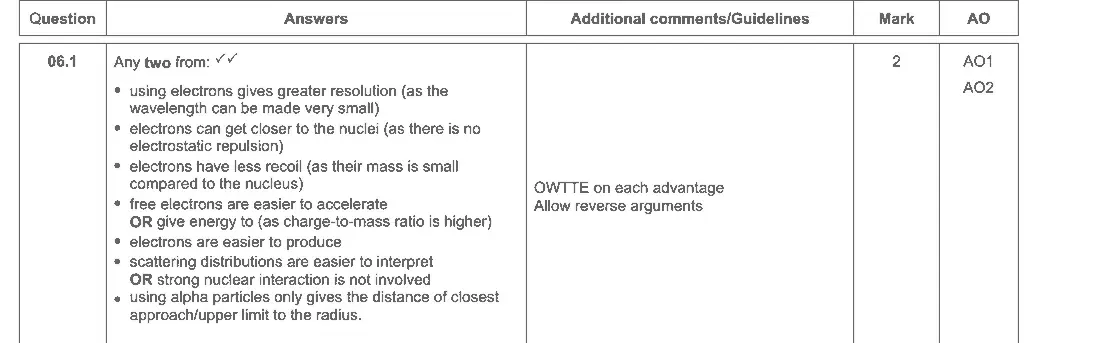
Nuclear radii can be estimated using either alpha particles or high-energy electrons.
State two advantages of using high-energy electrons rather than alpha particles
for this estimate.
[2 marks]
1
2
June 2023 · Paper 2 · Q6.2 2 marks AO1=2 Diagram or graph nuclear radius
Earlier part of question 6 that this part usesEarlier part of June 2023 Paper 2 question 6
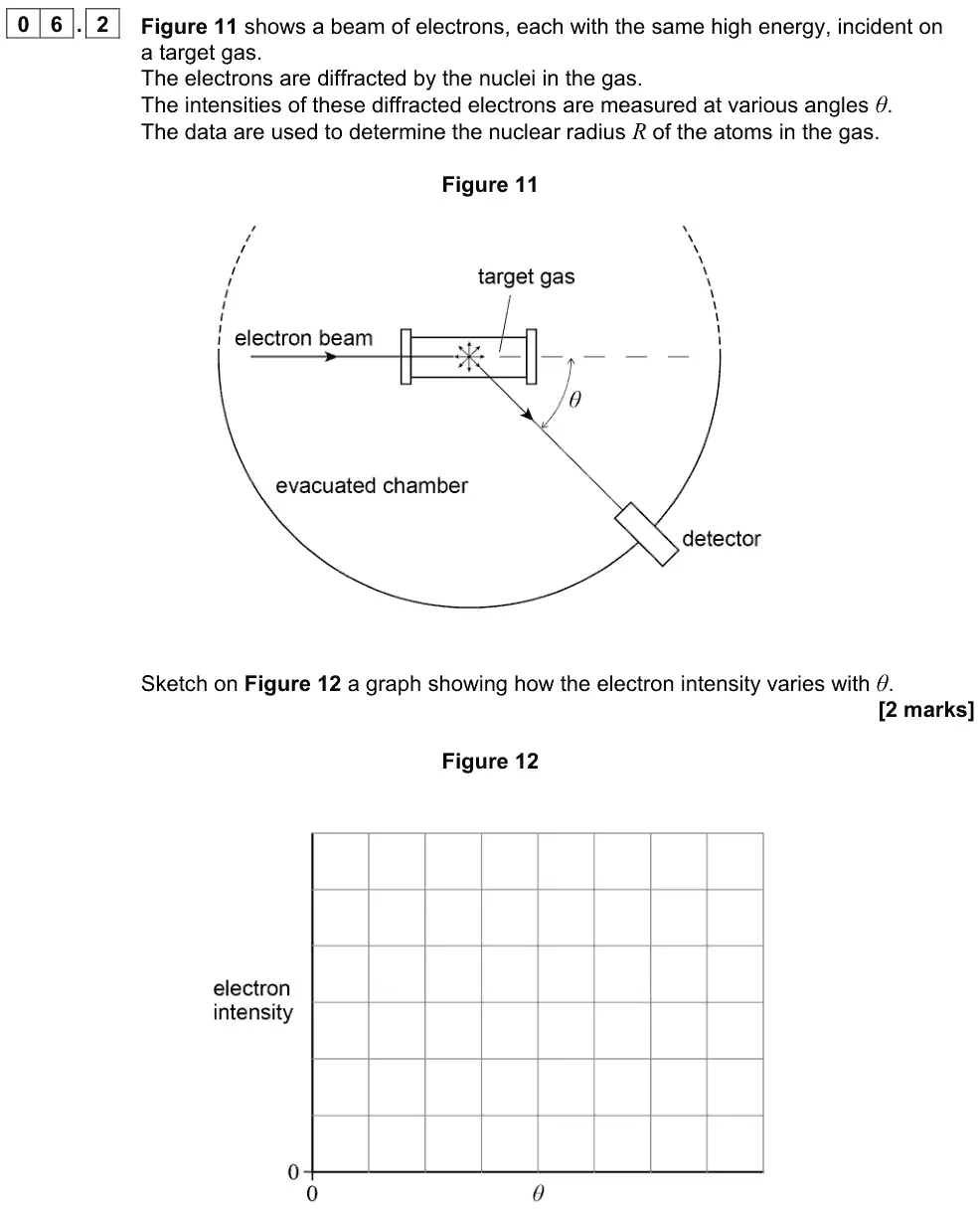
Figure 11 shows a beam of electrons, each with the same high energy, incident on
a target gas.
The electrons are diffracted by the nuclei in the gas.
The intensities of these diffracted electrons are measured at various angles θ.
The data are used to determine the nuclear radius R of the atoms in the gas.
Figure 11
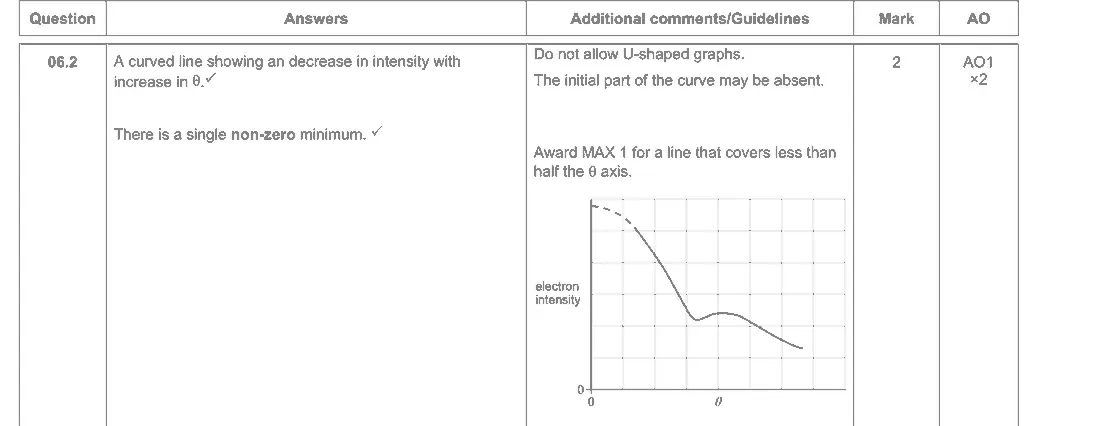
Sketch on Figure 12 a graph showing how the electron intensity varies with θ.
[2 marks]
Figure 12
1
June 2023 · Paper 2 · Q6.3 2 marks Show that nuclear radius
Earlier part of question 6 that this part usesEarlier part of June 2023 Paper 2 question 6
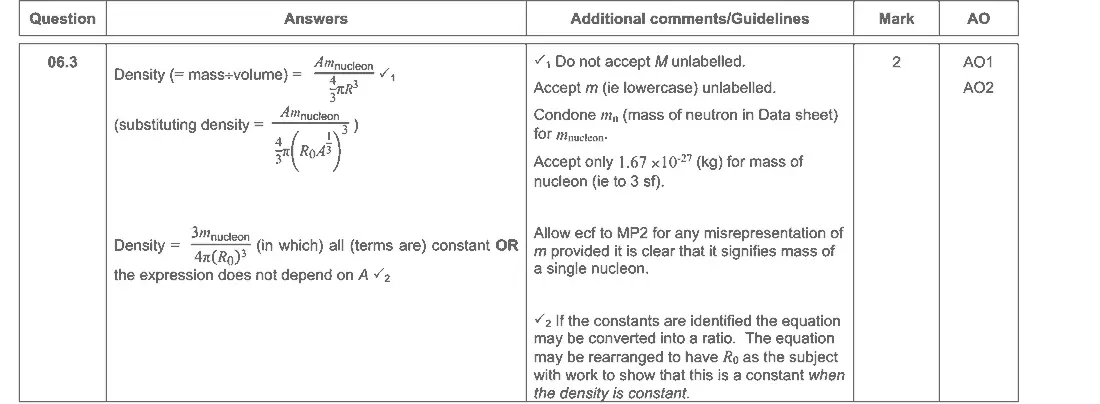
The radius R of a nucleus is related to its nucleon number by
1
3
0
R
R A
=
.
Show that this equation is consistent with the idea that all nuclei have the same
density.
[2 marks]
June 2023 · Paper 2 · Q6.4 1 mark AO3=1 Short answer nuclear radius
Earlier part of question 6 that this part usesEarlier part of June 2023 Paper 2 question 6
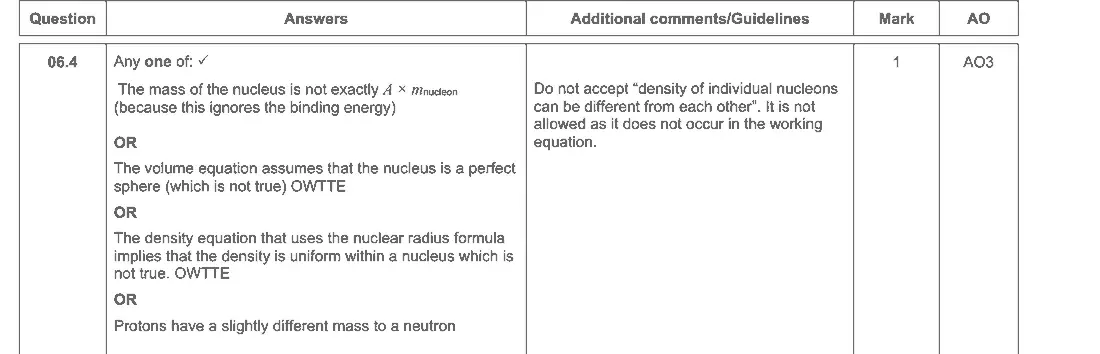
The equation
1
3
0
R
R A
=
is derived from experimental data.
Suggest one reason why the constant density of nuclear material derived from this
equation is only approximate.
[1 mark]
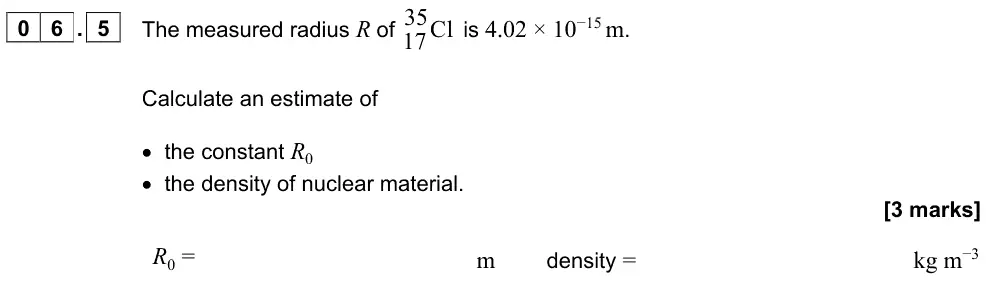
June 2023 · Paper 2 · Q6.5 3 marks AO2=3 Calculation nuclear radius
Earlier part of question 6 that this part usesEarlier part of June 2023 Paper 2 question 6
The measured radius R of 35Cl
17
is 4.02 × 10⁻¹⁵ m.
Calculate an estimate of
• the constant R0
• the density of nuclear material.
[3 marks]
R0 =
m
density =
kg m−3
June 2023 · Paper 2 · Q7.1 1 mark AO1=1 Short answer mass energy and fission
Carbon is used as the moderator in some thermal nuclear reactors.
Identify one other material commonly used as a moderator.
[1 mark]
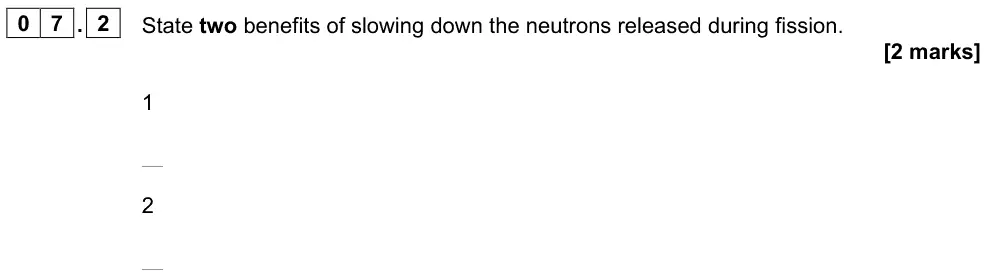
June 2023 · Paper 2 · Q7.2 2 marks Short answer Hard mass energy and fission
Earlier part of question 7 that this part usesEarlier part of June 2023 Paper 2 question 7
State two benefits of slowing down the neutrons released during fission.
[2 marks]
1
2
June 2023 · Paper 2 · Q7.3 2 marks Show that mass energy and fissionwork energy and power
Earlier part of question 7 that this part usesEarlier part of June 2023 Paper 2 question 7
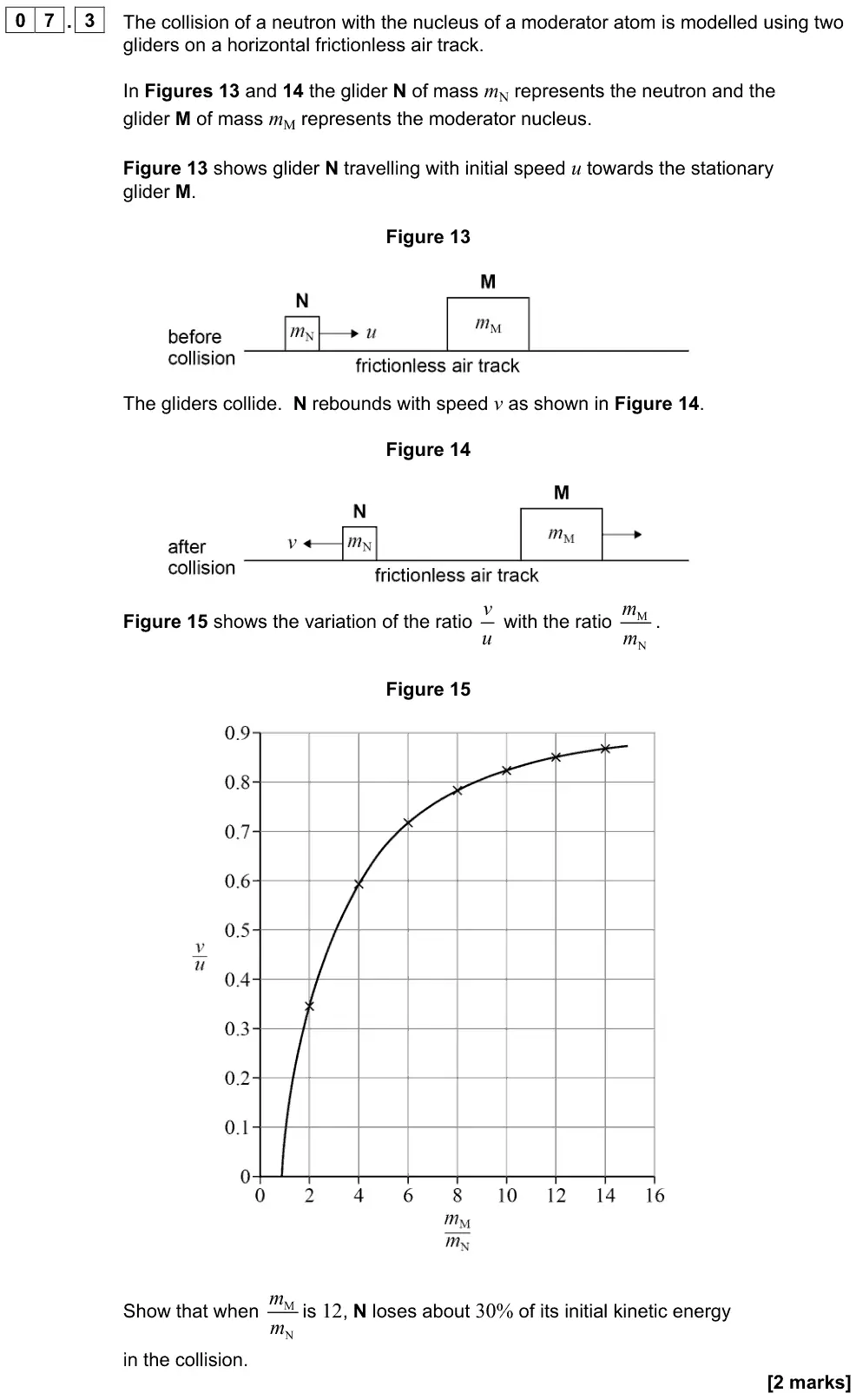
The collision of a neutron with the nucleus of a moderator atom is modelled using two
gliders on a horizontal frictionless air track.
In Figures 13 and 14 the glider N of mass mN represents the neutron and the
glider M of mass mM represents the moderator nucleus.
Figure 13 shows glider N travelling with initial speed u towards the stationary
glider M.
Figure 13
The gliders collide.  N rebounds with speed v as shown in Figure 14.
Figure 14
Figure 15 shows the variation of the ratio v
u
with the ratio
M
N
m
m
.
Figure 15
Show that when
M
N
m
m
is 12, N loses about 30% of its initial kinetic energy
in the collision.
[2 marks]
June 2023 · Paper 2 · Q7.4 3 marks AO2=3 Calculation kinetic theorymass energy and fission
Earlier part of question 7 that this part usesEarlier part of June 2023 Paper 2 question 7
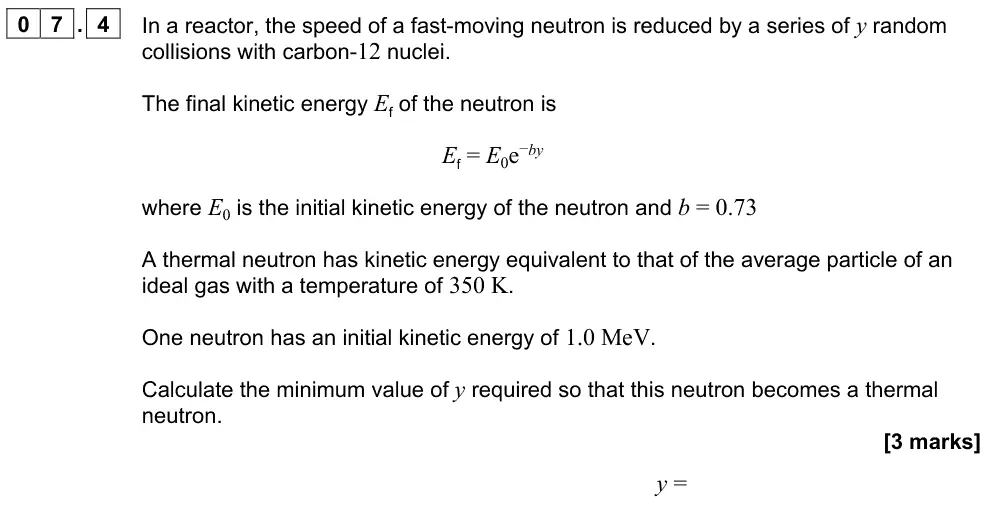
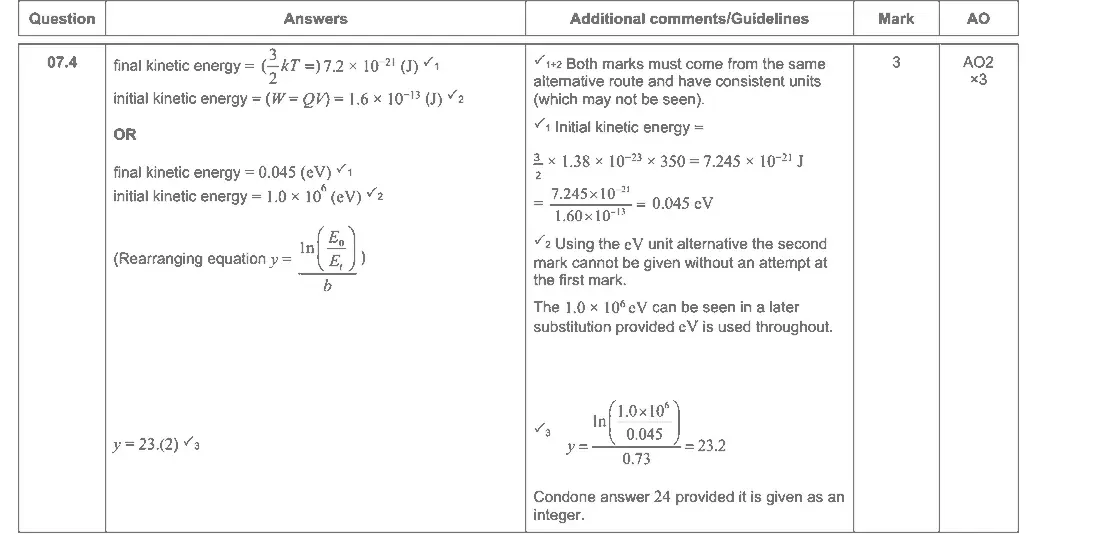
In a reactor, the speed of a fast-moving neutron is reduced by a series of y random
collisions with carbon-12 nuclei.
The final kinetic energy Ef of the neutron is
Ef = E0e−by
where E0 is the initial kinetic energy of the neutron and b = 0.73
A thermal neutron has kinetic energy equivalent to that of the average particle of an
ideal gas with a temperature of 350 K.
One neutron has an initial kinetic energy of 1.0 MeV.
Calculate the minimum value of y required so that this neutron becomes a thermal
neutron.
[3 marks]
y =
June 2023 · Paper 2 · Q7.5 2 marks AO2=2 Explanation mass energy and fission
Earlier part of question 7 that this part usesEarlier part of June 2023 Paper 2 question 7
Explain, with reference to Figure 15, why elements with a small nucleon number are
preferred as moderator materials.
[2 marks]
June 2023 · Paper 2 · Q8 1 mark Multiple choice Easy thermal energy and ideal gases
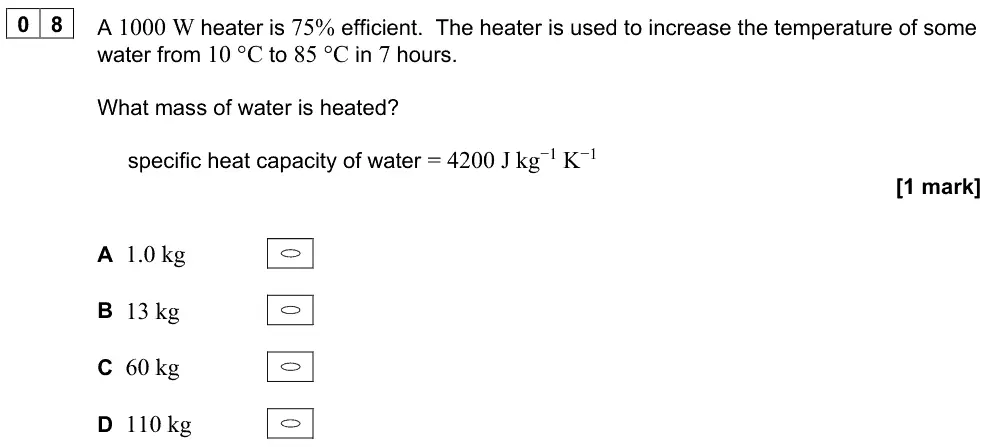
A 1000 W heater is 75% efficient.  The heater is used to increase the temperature of some
water from 10 °C to 85 °C in 7 hours.
What mass of water is heated?
specific heat capacity of water = 4200 J kg−1 K−1
[1 mark]
A 1.0 kg
B 13 kg
C 60 kg
D 110 kg
June 2023 · Paper 2 · Q9 1 mark Multiple choice thermal energy and ideal gases
Which can lead to a value for the absolute zero of temperature?
[1 mark]
A Boyle’s law
B Brownian motion
C Charles’s law
D Rutherford scattering
June 2023 · Paper 2 · Q10 1 mark Multiple choice electric fields
Two protons are separated by a distance of 1 × 10⁻⁹ m.
Which is an estimate of
electric repulsion force
gravitational attraction force
for these two protons?
[1 mark]
A 1018
B 1028
C 1036
D 1045
June 2023 · Paper 2 · Q11 1 mark Multiple choice Easy gravitational fields
Data are collected for the mass M, radius R and escape velocity u for each planet in the
Solar System.
The data show that u is directly proportional to
[1 mark]
A
1
2
M
R
−






B
1
2
M
R






C M
R
D
2
M
R






June 2023 · Paper 2 · Q12 1 mark Multiple choice Easy gravitational fields
A satellite is in a circular orbit at a height h above the surface of a planet of mass M
and radius R.
What is the linear speed of the satellite?
[1 mark]
A (
)
GM
R
h
+
B
(
)
GM
R
h
+
C
GM
R
h
+
D (
)
GM
R
h
+
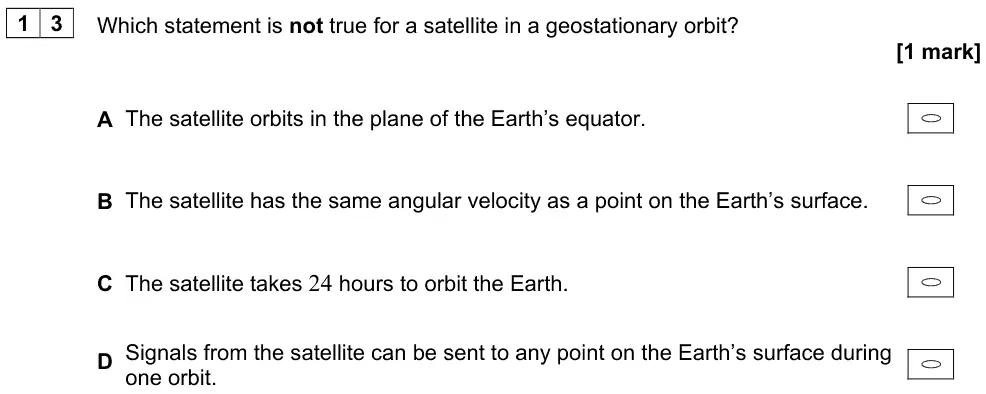
June 2023 · Paper 2 · Q13 1 mark Multiple choice gravitational fields
Which statement is not true for a satellite in a geostationary orbit?
[1 mark]
A The satellite orbits in the plane of the Earth’s equator.
B The satellite has the same angular velocity as a point on the Earth’s surface.
C The satellite takes 24 hours to orbit the Earth.
D Signals from the satellite can be sent to any point on the Earth’s surface during
one orbit.
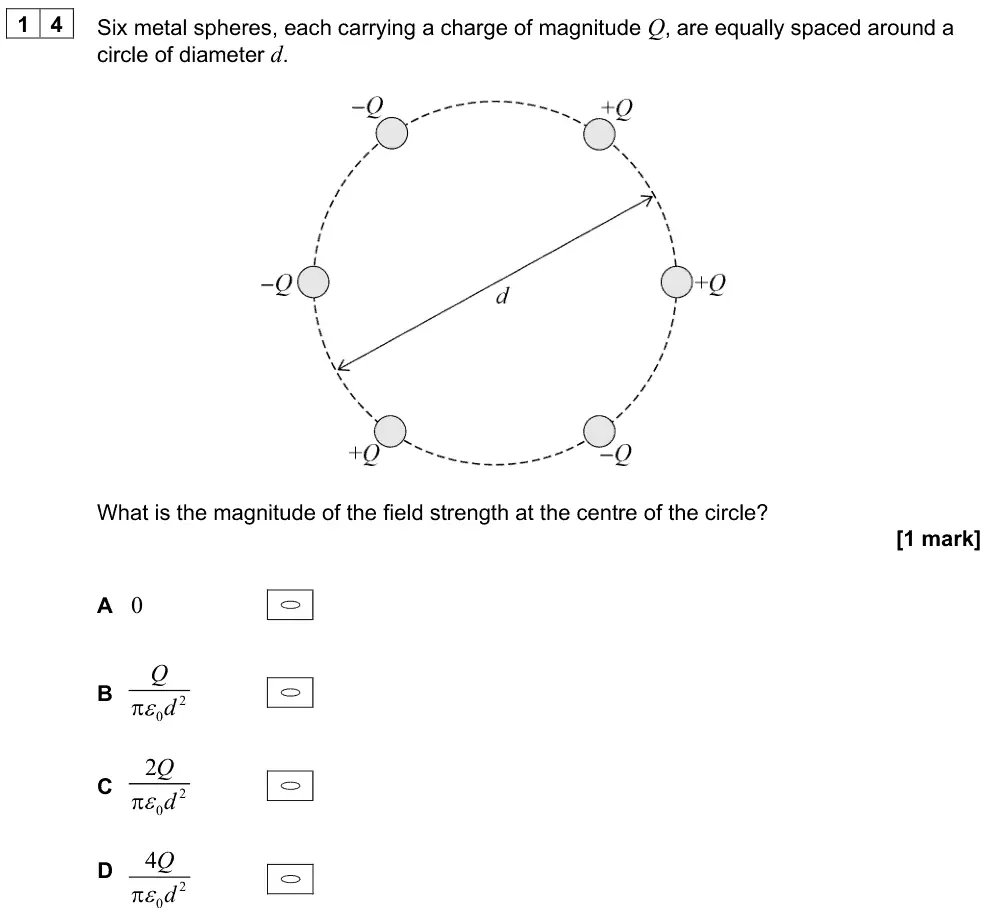
June 2023 · Paper 2 · Q14 1 mark Multiple choice Hard electric fields
Six metal spheres, each carrying a charge of magnitude Q, are equally spaced around a
circle of diameter d.
What is the magnitude of the field strength at the centre of the circle?
[1 mark]
A 0
B
2
0
Q
d
π
C
2
0
2Q
d
π
D
2
0
4Q
d
π
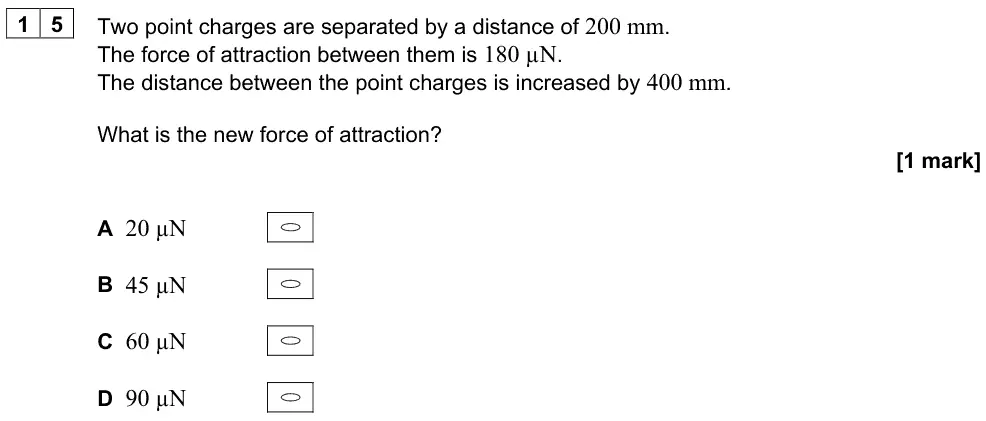
June 2023 · Paper 2 · Q15 1 mark Multiple choice Hard electric fields
Two point charges are separated by a distance of 200 mm.
The force of attraction between them is 180 µN.
The distance between the point charges is increased by 400 mm.
What is the new force of attraction?
[1 mark]
A 20 µN
B 45 µN
C 60 µN
D 90 µN
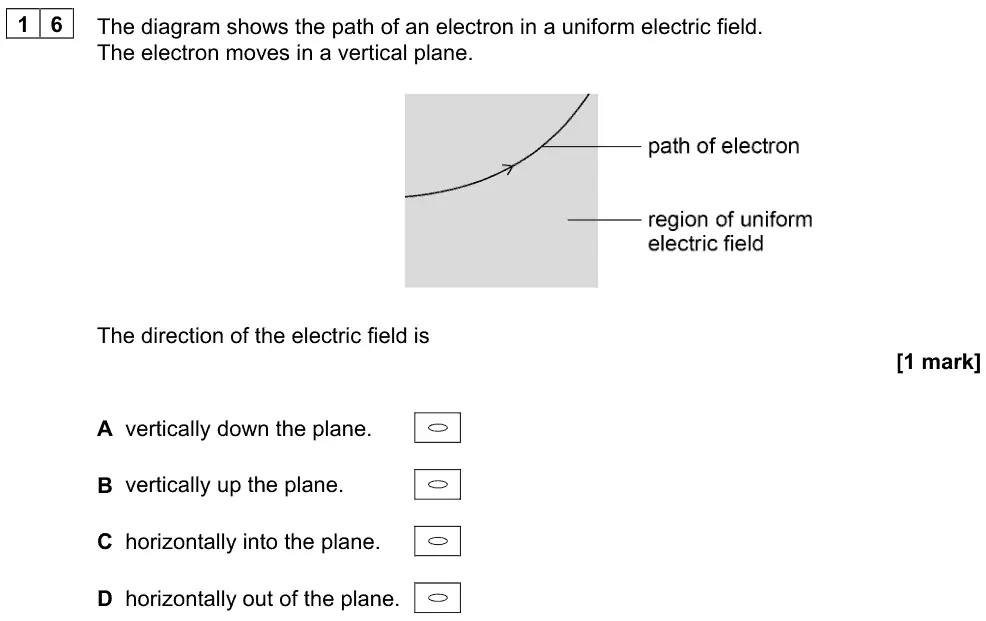
June 2023 · Paper 2 · Q16 1 mark Multiple choice electric fields
The diagram shows the path of an electron in a uniform electric field.
The electron moves in a vertical plane.
The direction of the electric field is
[1 mark]
A vertically down the plane.
B vertically up the plane.
C horizontally into the plane.
D horizontally out of the plane.
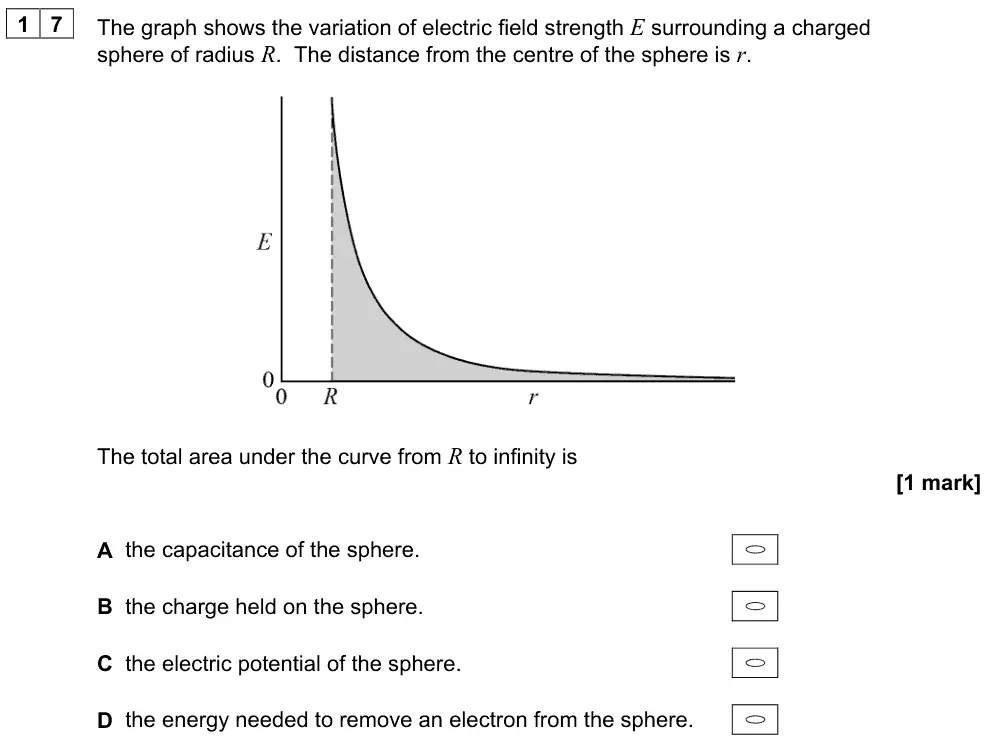
June 2023 · Paper 2 · Q17 1 mark Multiple choice Easy electric fields
The graph shows the variation of electric field strength E surrounding a charged
sphere of radius R.  The distance from the centre of the sphere is r.
The total area under the curve from R to infinity is
[1 mark]
A the capacitance of the sphere.
B the charge held on the sphere.
C the electric potential of the sphere.
D the energy needed to remove an electron from the sphere.
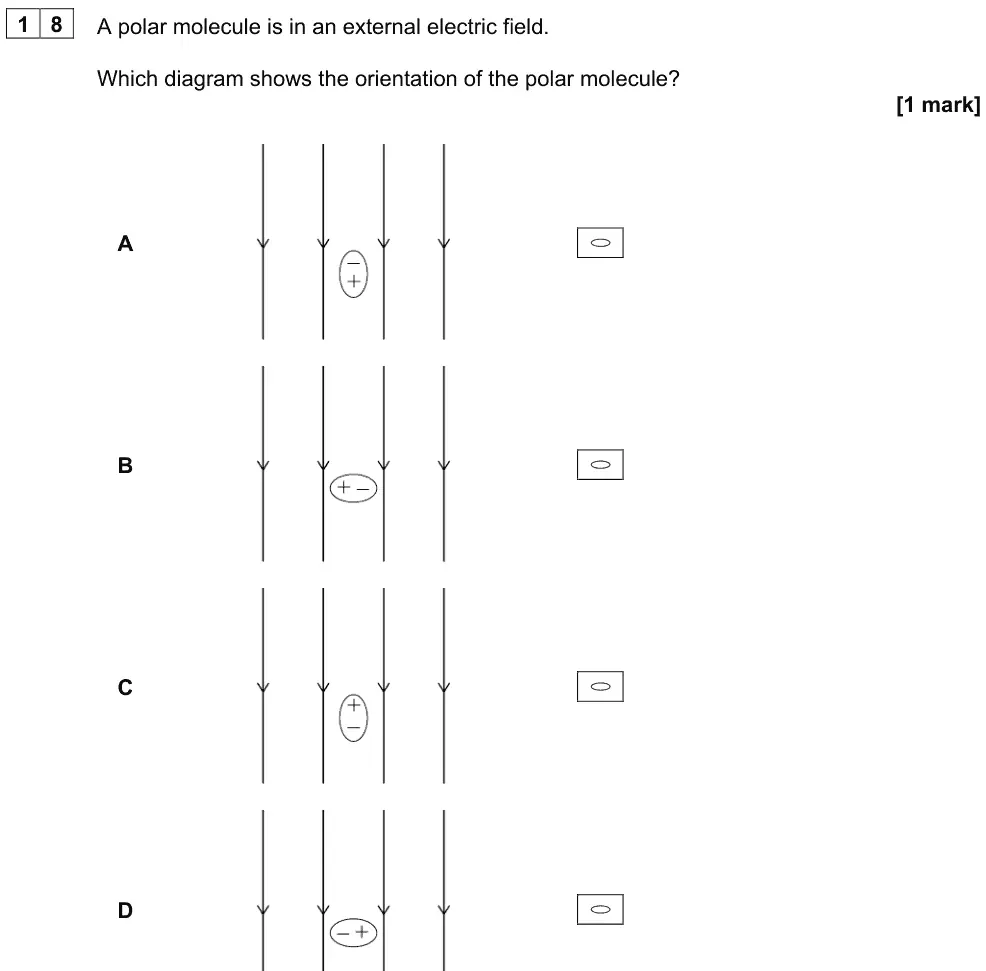
June 2023 · Paper 2 · Q18 1 mark Multiple choice Easy capacitors
A polar molecule is in an external electric field.
Which diagram shows the orientation of the polar molecule?
[1 mark]
A
B
C
D
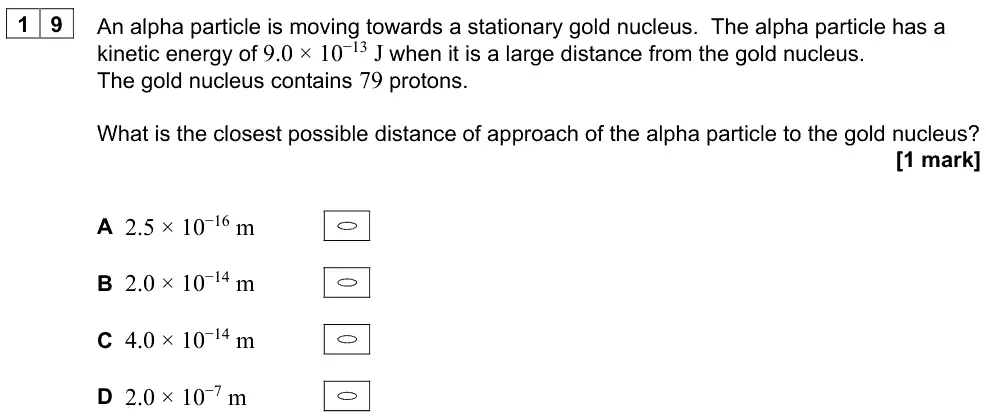
June 2023 · Paper 2 · Q19 1 mark Multiple choice nuclear radius
An alpha particle is moving towards a stationary gold nucleus.  The alpha particle has a
kinetic energy of 9.0 × 10⁻¹³ J when it is a large distance from the gold nucleus.
The gold nucleus contains 79 protons.
What is the closest possible distance of approach of the alpha particle to the gold nucleus?
[1 mark]
A 2.5 × 10⁻¹⁶ m
B 2.0 × 10⁻¹⁴ m
C 4.0 × 10⁻¹⁴ m
D 2.0 × 10⁻⁷ m
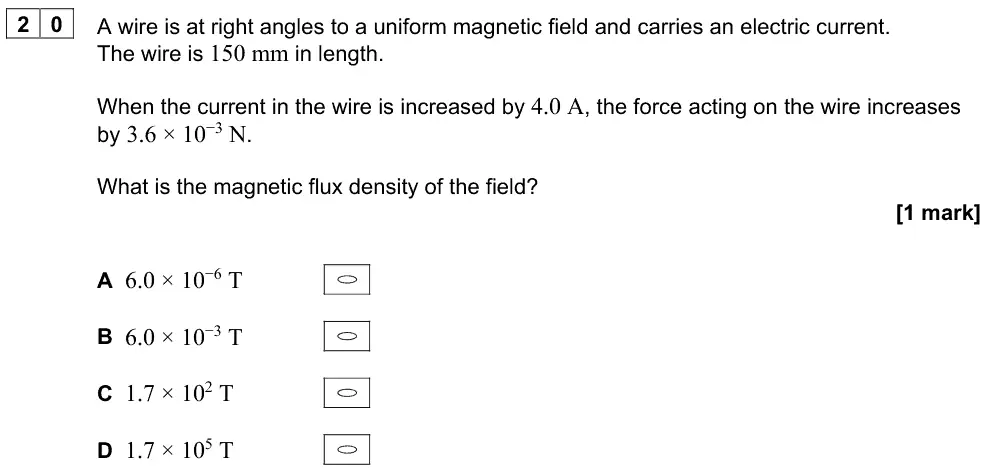
June 2023 · Paper 2 · Q20 1 mark Multiple choice Easy magnetic fields
A wire is at right angles to a uniform magnetic field and carries an electric current.
The wire is 150 mm in length.
When the current in the wire is increased by 4.0 A, the force acting on the wire increases
by 3.6 × 10⁻³ N.
What is the magnetic flux density of the field?
[1 mark]
A 6.0 × 10⁻⁶ T
B 6.0 × 10⁻³ T
C 1.7 × 10² T
D 1.7 × 10⁵ T
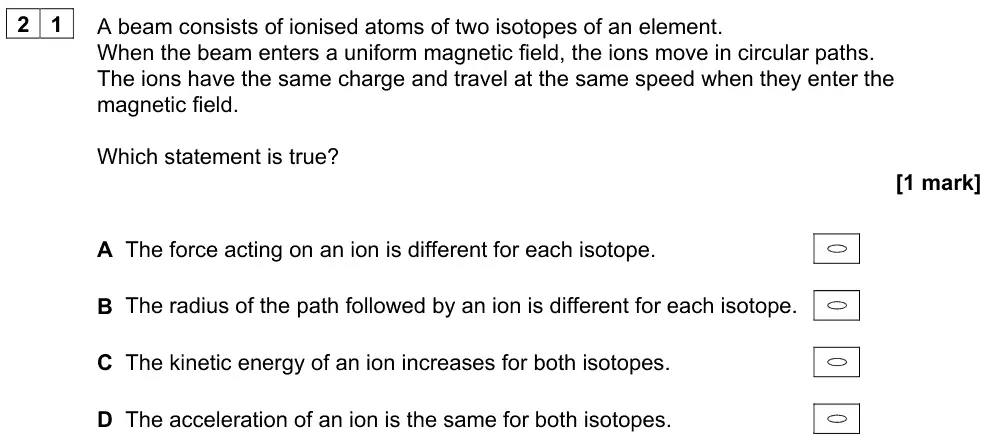
June 2023 · Paper 2 · Q21 1 mark Multiple choice magnetic fields
A beam consists of ionised atoms of two isotopes of an element.
When the beam enters a uniform magnetic field, the ions move in circular paths.
The ions have the same charge and travel at the same speed when they enter the
magnetic field.
Which statement is true?
[1 mark]
A The force acting on an ion is different for each isotope.
B The radius of the path followed by an ion is different for each isotope.
C The kinetic energy of an ion increases for both isotopes.
D The acceleration of an ion is the same for both isotopes.
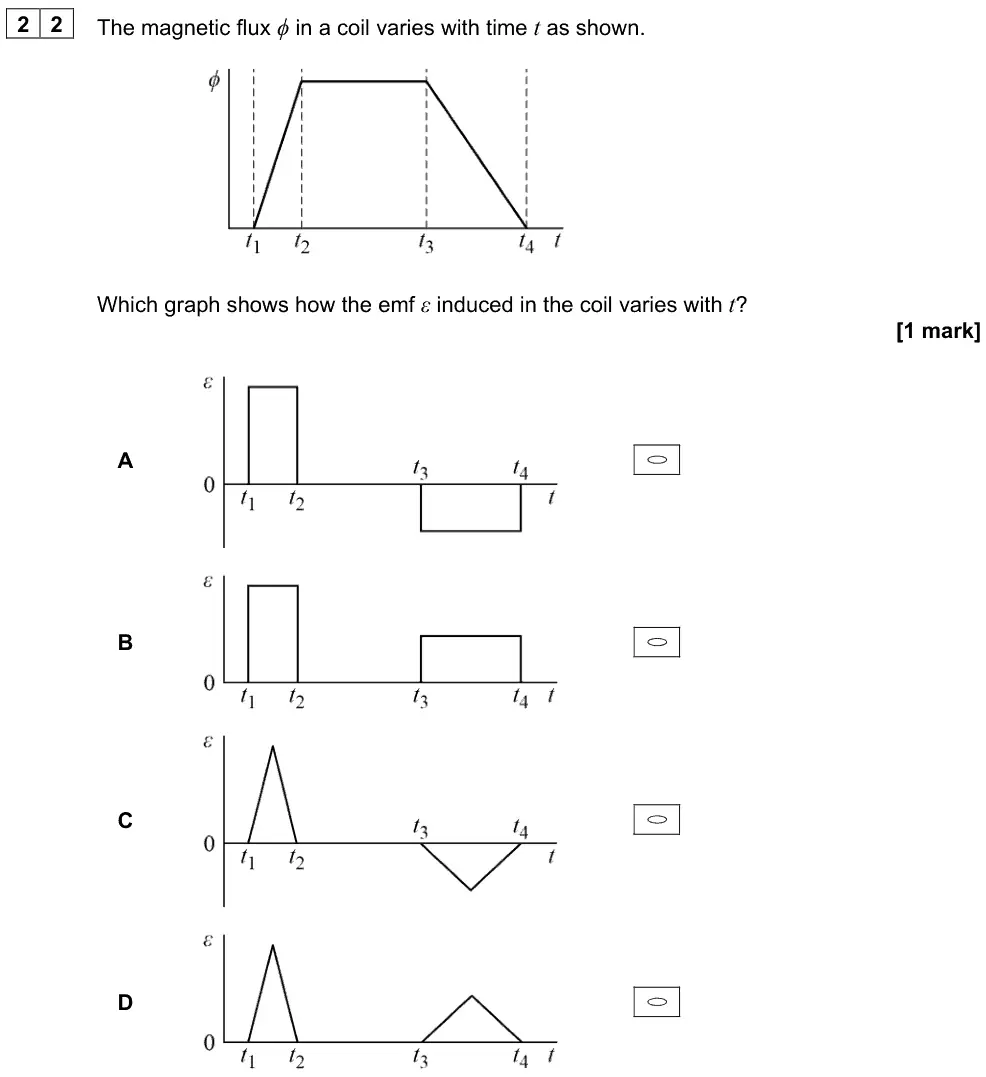
June 2023 · Paper 2 · Q22 1 mark Multiple choice electromagnetic induction
The magnetic flux ϕ in a coil varies with time t as shown.
Which graph shows how the emf ε induced in the coil varies with t?
[1 mark]
A
B
C
D
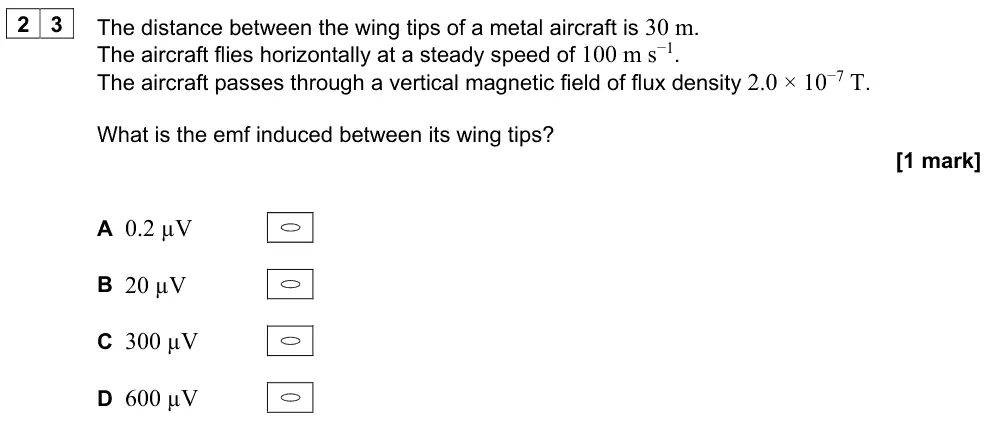
June 2023 · Paper 2 · Q23 1 mark Multiple choice electromagnetic induction
The distance between the wing tips of a metal aircraft is 30 m.
The aircraft flies horizontally at a steady speed of 100 m s−1.
The aircraft passes through a vertical magnetic field of flux density 2.0 × 10⁻⁷ T.
What is the emf induced between its wing tips?
[1 mark]
A 0.2 µV
B 20 µV
C 300 µV
D 600 µV
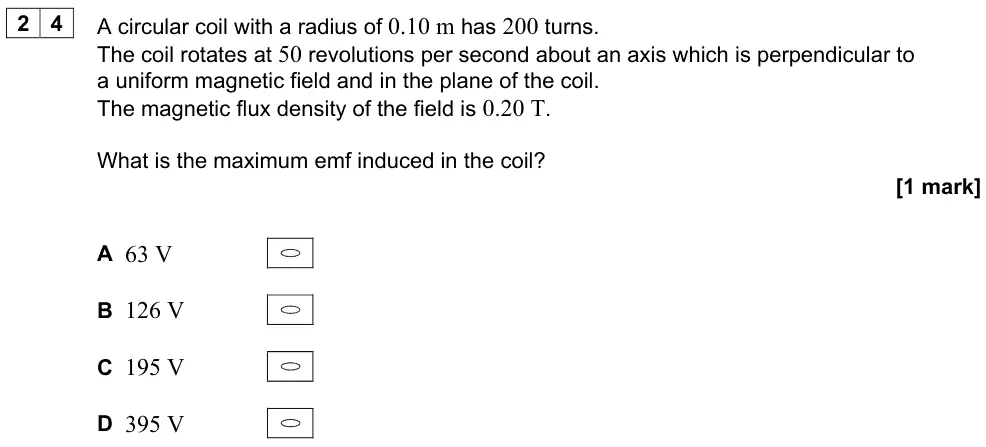
June 2023 · Paper 2 · Q24 1 mark Multiple choice electromagnetic induction
A circular coil with a radius of 0.10 m has 200 turns.
The coil rotates at 50 revolutions per second about an axis which is perpendicular to
a uniform magnetic field and in the plane of the coil.
The magnetic flux density of the field is 0.20 T.
What is the maximum emf induced in the coil?
[1 mark]
A 63 V
B 126 V
C 195 V
D 395 V
June 2023 · Paper 2 · Q25 1 mark Multiple choice Hard mass energy and fission
After radioactive waste is removed from a cooling pond, it is often stored in underground
caves.
This is to protect workers from the effects of
A alpha particles from nuclides with a large decay constant.
B alpha particles from nuclides with a small decay constant.
C gamma radiation from nuclides with a large decay constant.
D gamma radiation from nuclides with a small decay constant.
June 2023 · Paper 2 · Q26 1 mark Multiple choice Easy rutherford scattering and radiation
Alpha particle scattering can be demonstrated using a thin gold foil.
Which statement about this demonstration is not true?
[1 mark]
A The foil is thin enough to assume that alpha particles are deflected only once.
B Nuclei are more massive than alpha particles which allows the alpha particles to
be deflected by more than 90°.
C The number of alpha particles deflected backwards is greater than the number
that pass straight through the foil.
D Deflections of alpha particles by electrons in the foil are much smaller than
deflections due to nuclei.
June 2023 · Paper 2 · Q27 1 mark Multiple choice electromagnetic induction
A transformer for use in a 230 V ac supply is 90% efficient.
The transformer provides a current of 3.00 A at 12.0 V.
What is the current in the primary coil?
[1 mark]
A 0.141 A
B 0.156 A
C 0.174 A
D 5.75 A
June 2023 · Paper 2 · Q28 1 mark Multiple choice Easy radioactive decay
The random nature of radioactive decay means that it is never possible to predict
[1 mark]
A when a particular nucleus will decay.
B whether a β− particle or a β+ particle is emitted.
C the approximate time taken for the activity to decrease to a specified value.
D the approximate thickness of an absorber needed to reduce the count rate to
a specified value.
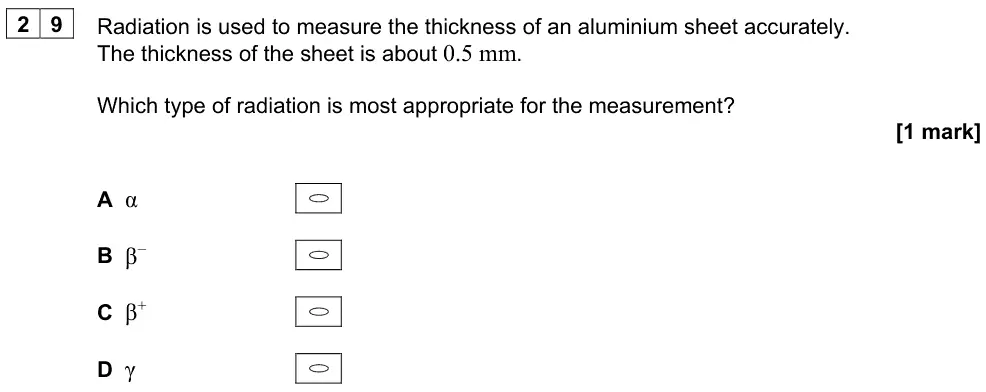
June 2023 · Paper 2 · Q29 1 mark Multiple choice rutherford scattering and radiation
Radiation is used to measure the thickness of an aluminium sheet accurately.
The thickness of the sheet is about 0.5 mm.
Which type of radiation is most appropriate for the measurement?
[1 mark]
A α
B β−
C β+
D γ
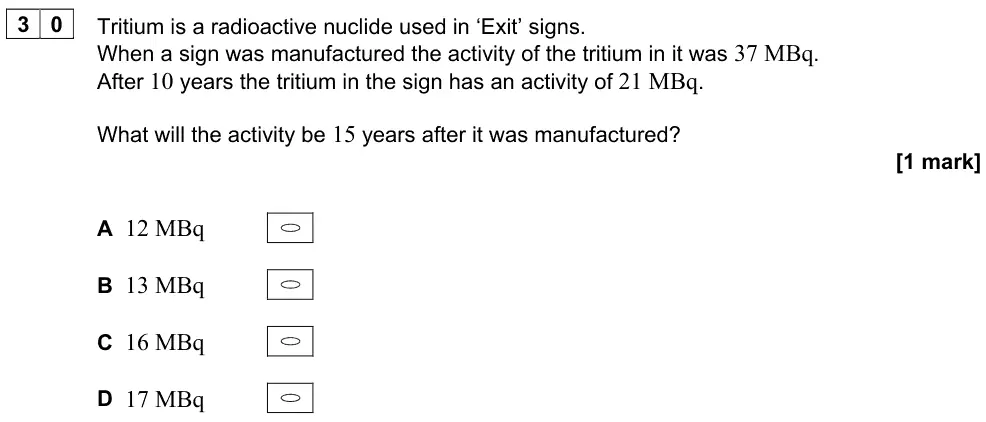
June 2023 · Paper 2 · Q30 1 mark Multiple choice radioactive decay
Tritium is a radioactive nuclide used in ‘Exit’ signs.
When a sign was manufactured the activity of the tritium in it was 37 MBq.
After 10 years the tritium in the sign has an activity of 21 MBq.
What will the activity be 15 years after it was manufactured?
[1 mark]
A 12 MBq
B 13 MBq
C 16 MBq
D 17 MBq
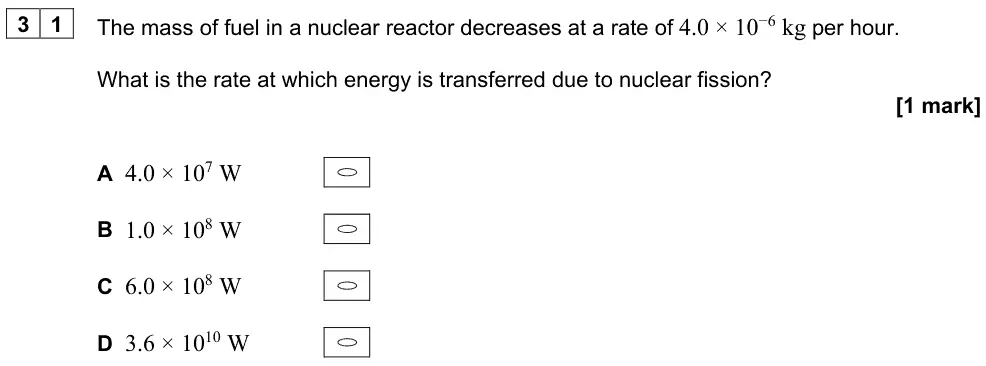
June 2023 · Paper 2 · Q31 1 mark Multiple choice mass energy and fission
The mass of fuel in a nuclear reactor decreases at a rate of 4.0 × 10⁻⁶ kg per hour.
What is the rate at which energy is transferred due to nuclear fission?
[1 mark]
A 4.0 × 10⁷ W
B 1.0 × 10⁸ W
C 6.0 × 10⁸ W
D 3.6 × 10¹⁰ W
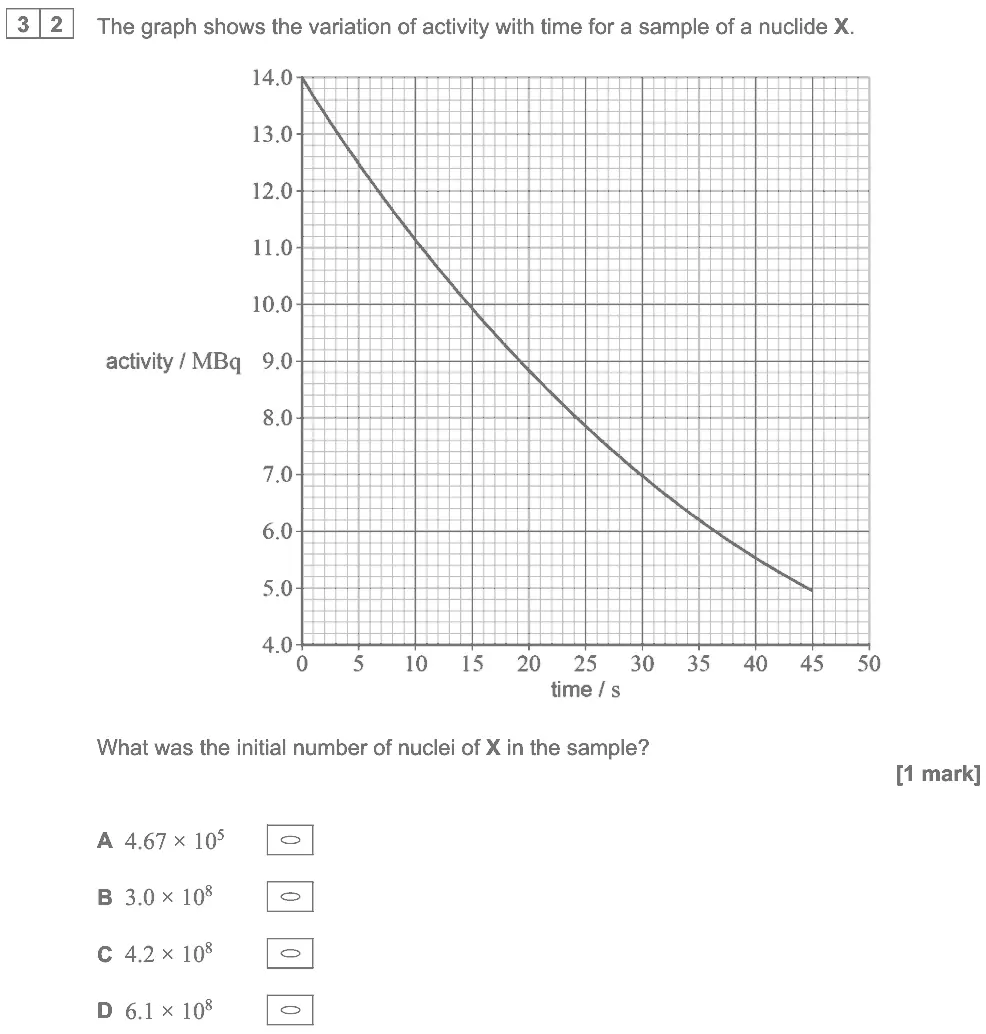
June 2023 · Paper 2 · Q32 1 mark Multiple choice radioactive decay
The graph shows the variation of activity with time for a sample of a nuclide X.
What was the initial number of nuclei of X in the sample?
[1 mark]
A 4.67 × 10⁵
B 3.0 × 10⁸
C 4.2 × 10⁸
D 6.1 × 10⁸

Work with an AQA physics tutor

Want a paper marked and gone through with you? Message us.

Prefer email? Send an enquiry

If you are under 18, please include a parent's contact details. Enquiries go to enquiries@physicsaleveltutor.com and are deleted once handled. All tutoring is online.