June 2024: Paper 2

85 marks · 49 question parts · Paper, mark scheme and report on AQA's site · Have the data and formulae booklet beside you

Question by question

QTopicMarksAOType
1.1 Thermal energy transfer and ideal gases 1AO1=1Show that
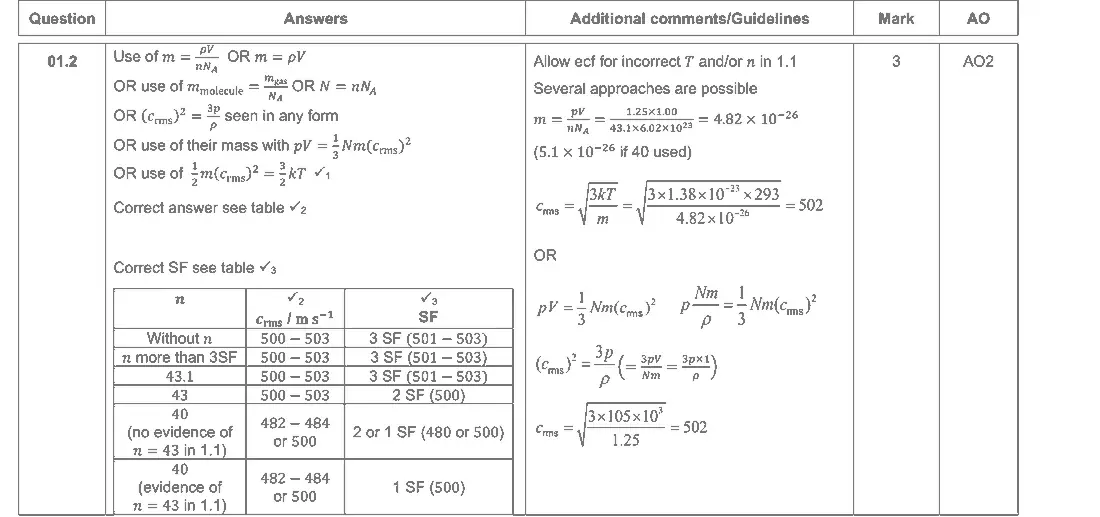
1.2 Molecular kinetic theory, Thermal energy transfer and ideal gases 3AO2=3Calculation
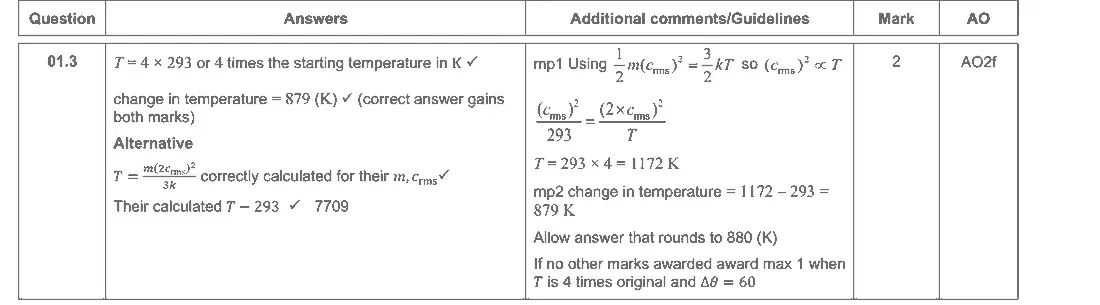
1.3 Molecular kinetic theory 2AO2=2Calculation
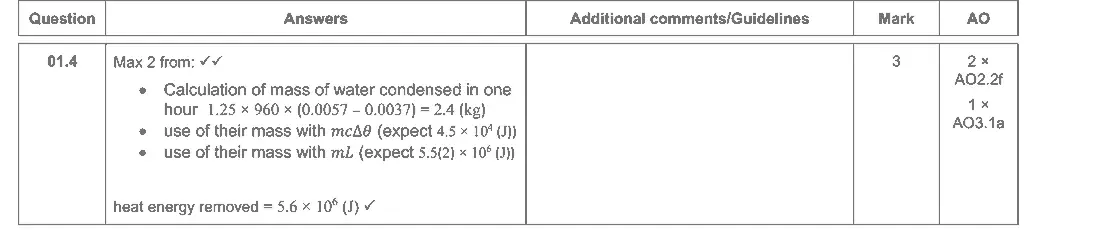
1.4 Thermal energy transfer and ideal gases 3AO2=2,AO3=1Calculation
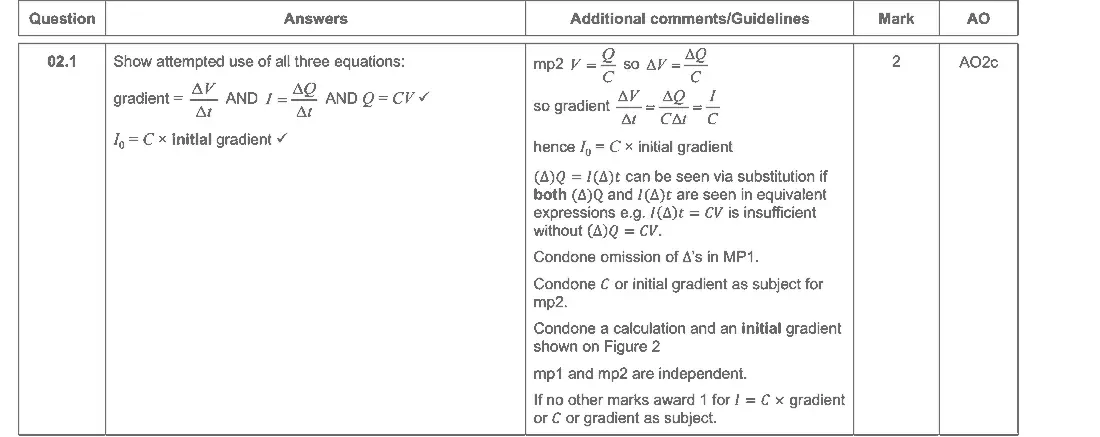
2.1 Capacitance and capacitor charge and discharge 2AO2=2Explanation
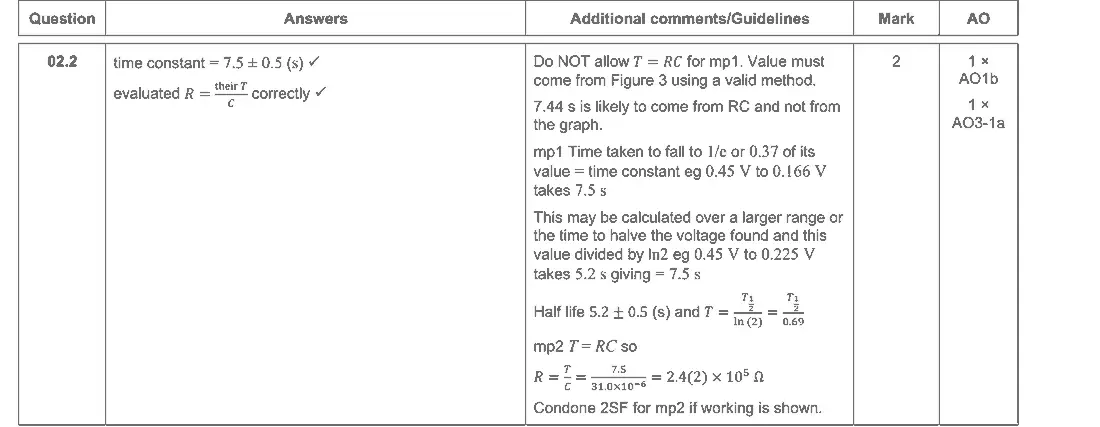
2.2 Capacitance and capacitor charge and discharge 2AO1=1,AO3=1Calculation
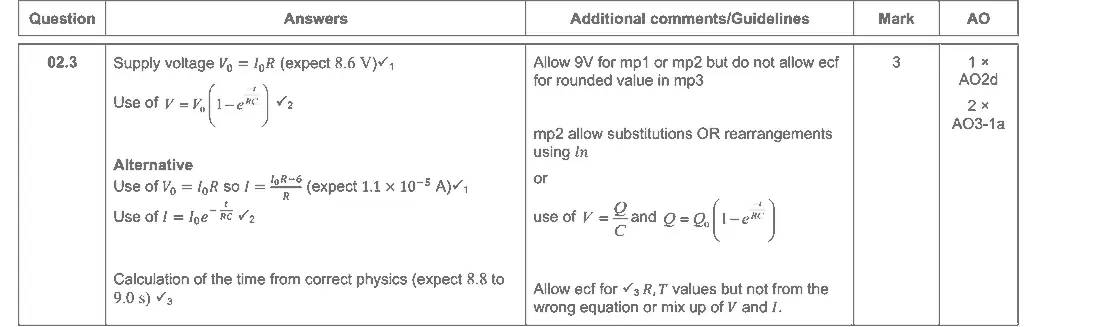
2.3 Capacitance and capacitor charge and discharge 3AO2=1,AO3=2Calculation
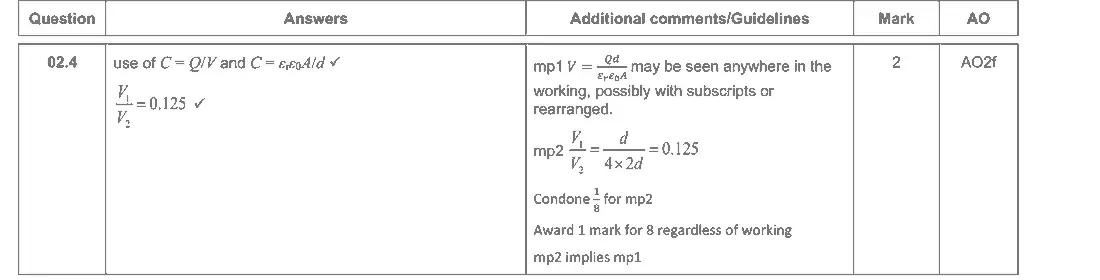
2.4 Capacitance and capacitor charge and discharge 2AO2=2Calculation
3.1 Electromagnetic induction, alternating currents and transformers 3AO1=1,AO2=1,AO3=1Calculation
3.2 Electromagnetic induction, alternating currents and transformers 4AO2=2,AO3=2Explanation
4.1 Mass and energy, binding energy, fission and safety 1AO1=1Short answer
4.2 Mass and energy, binding energy, fission and safety 2AO1=2Short answer
4.3 Mass and energy, binding energy, fission and safety 2AO1=2Explanation
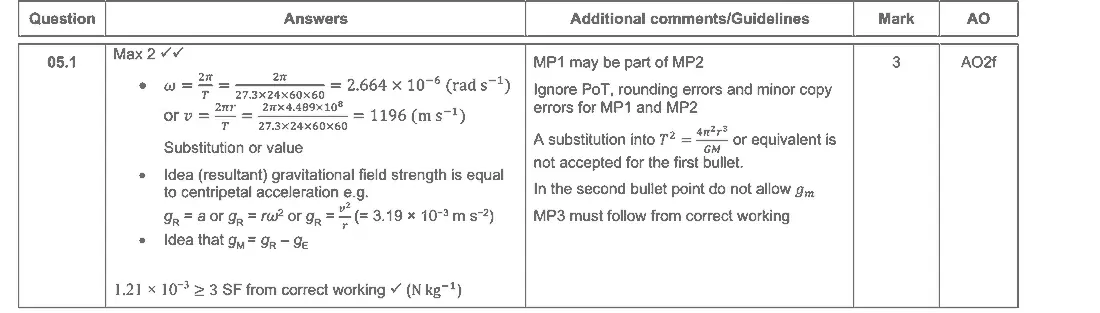
5.1 Circular motion, Gravitational fields and orbits 3AO2=3Show that
5.2 Gravitational fields and orbits 2AO2=2Calculation
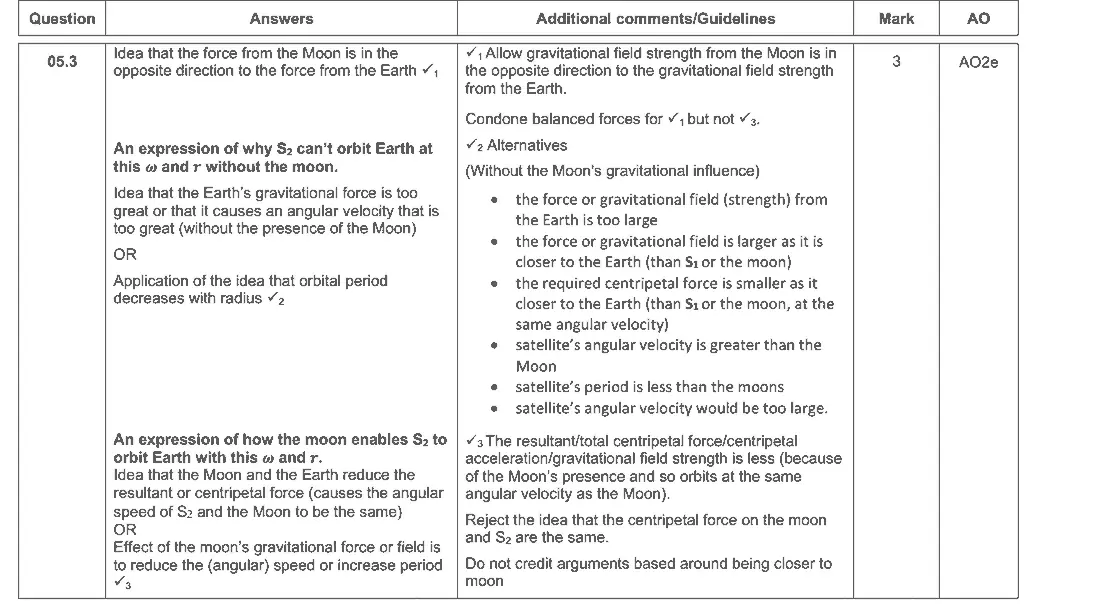
5.3 Gravitational fields and orbits, Circular motion 3AO2=3Explanation
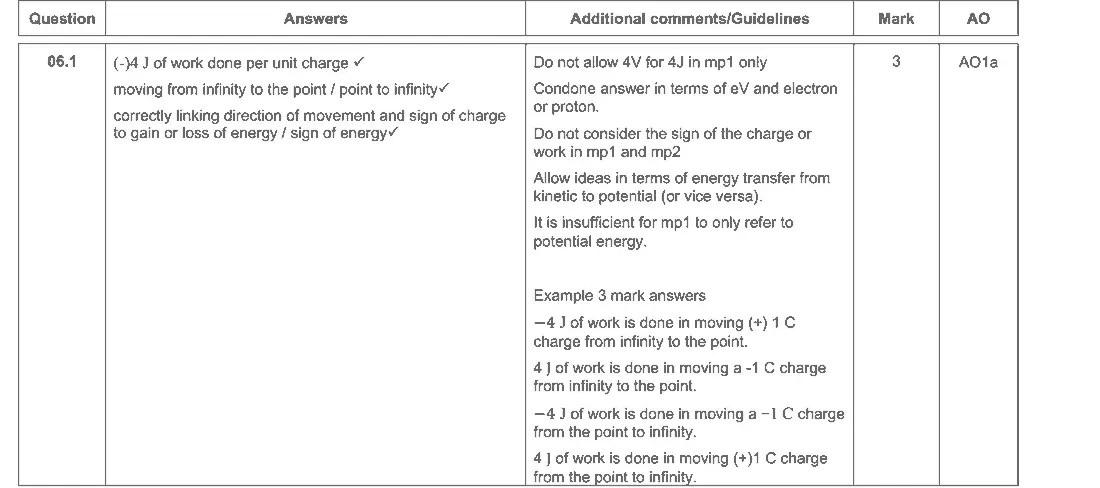
6.1 Electric fields and electric potential 3AO1=3Explanation
6.2 Electric fields and electric potential 4AO1=2,AO2=1,AO3=1Calculation
6.3 Electric fields and electric potential 2AO2=2Calculation
6.4 Electric fields and electric potential 3AO3=3Explanation
7.1 Radioactive decay, half-life and nuclear instability 1AO1=1Short answer
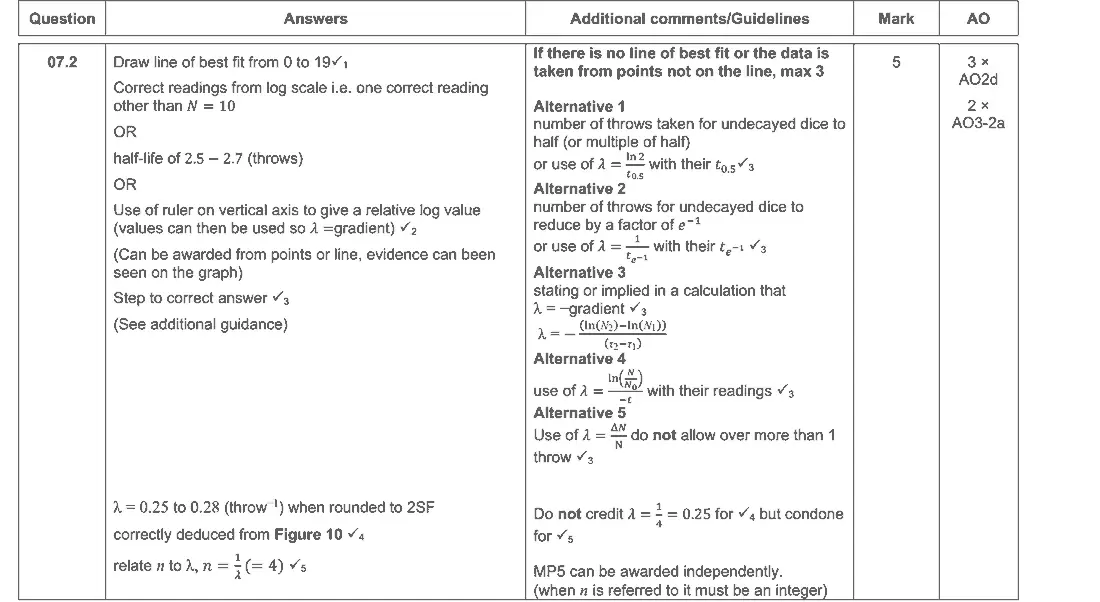
7.2 Radioactive decay, half-life and nuclear instability 5AO2=3,AO3=2Practical and data analysis
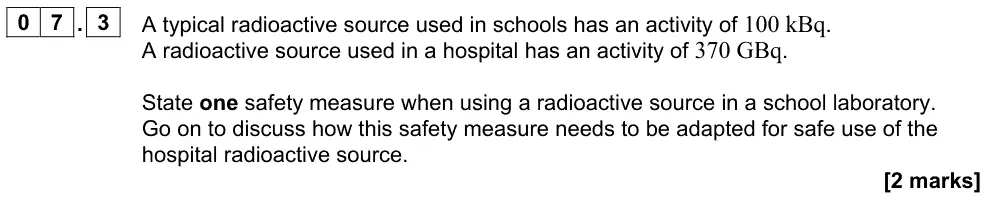
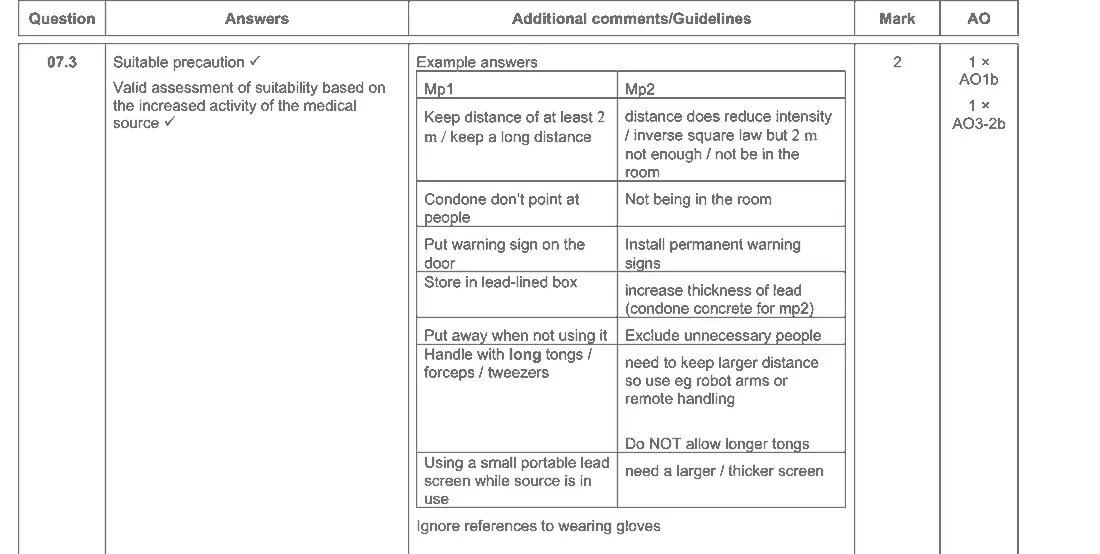
7.3 Rutherford scattering, alpha, beta and gamma radiation, Mass and energy, binding energy, fission and safety 2AO1=1,AO3=1Explanation
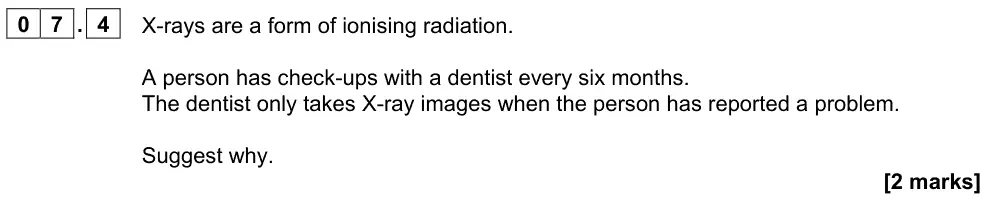
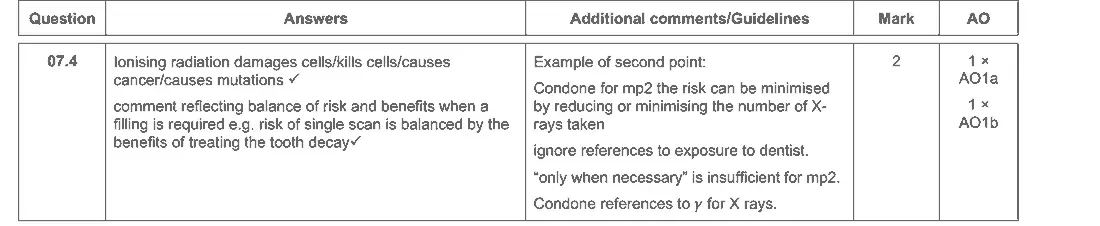
7.4 Rutherford scattering, alpha, beta and gamma radiation 2AO1=2Explanation
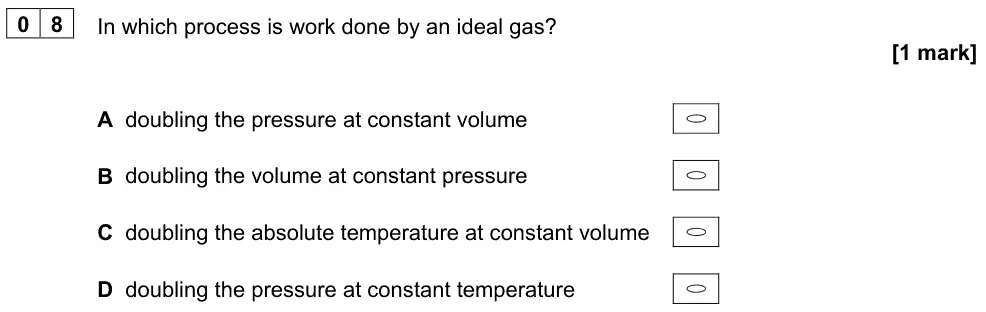
8 Thermal energy transfer and ideal gases 1Multiple choice
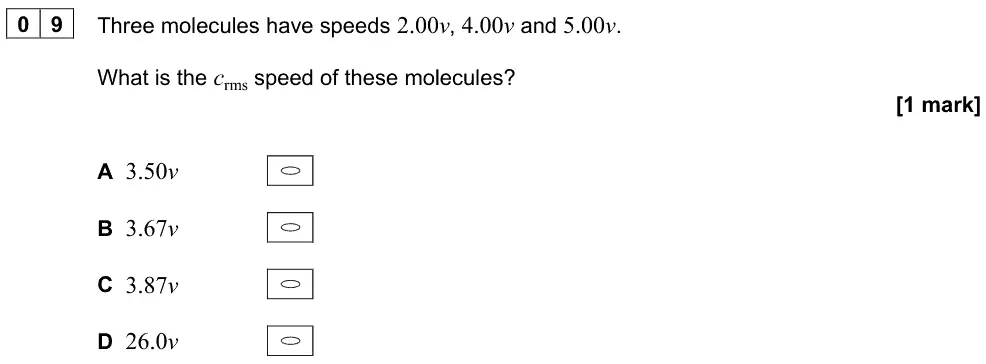
9 Molecular kinetic theory 1Multiple choice
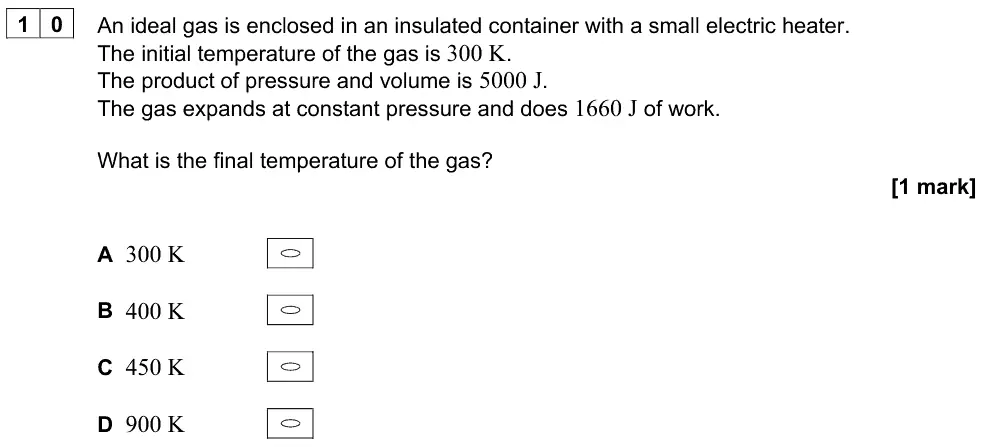
10 Thermal energy transfer and ideal gases 1Multiple choice
11 Capacitance and capacitor charge and discharge 1Multiple choice
12 Electromagnetic induction, alternating currents and transformers 1Multiple choice
13 Electromagnetic induction, alternating currents and transformers 1Multiple choice
14 Electromagnetic induction, alternating currents and transformers, Progressive waves, longitudinal and transverse waves 1Multiple choice
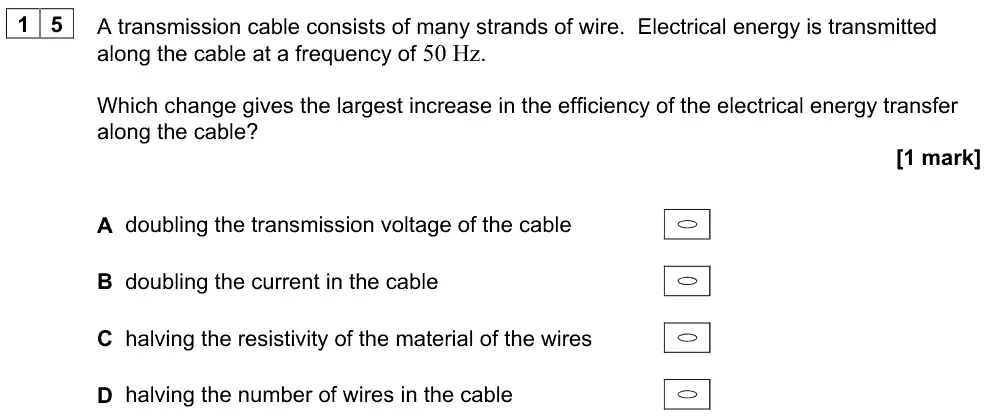
15 Electromagnetic induction, alternating currents and transformers 1Multiple choice
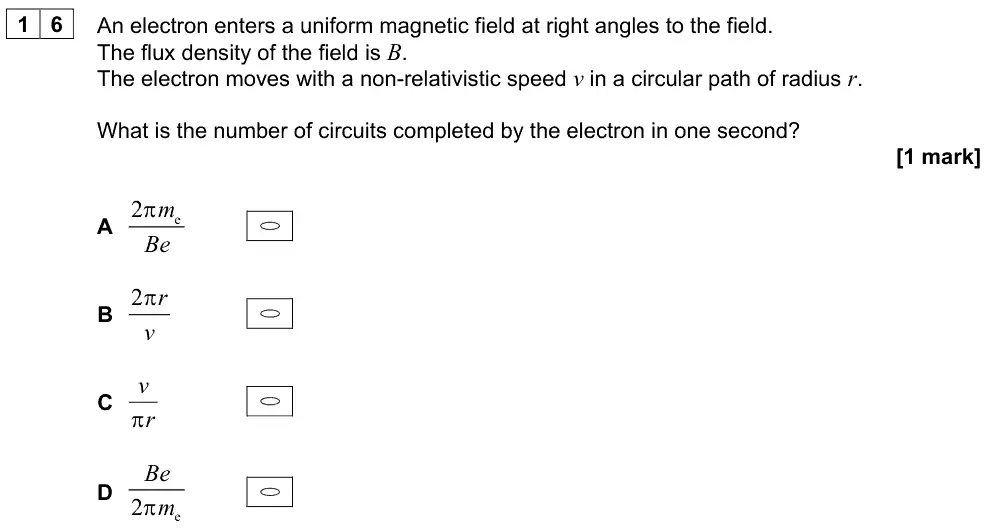
16 Magnetic flux density and moving charges in a magnetic field 1Multiple choice
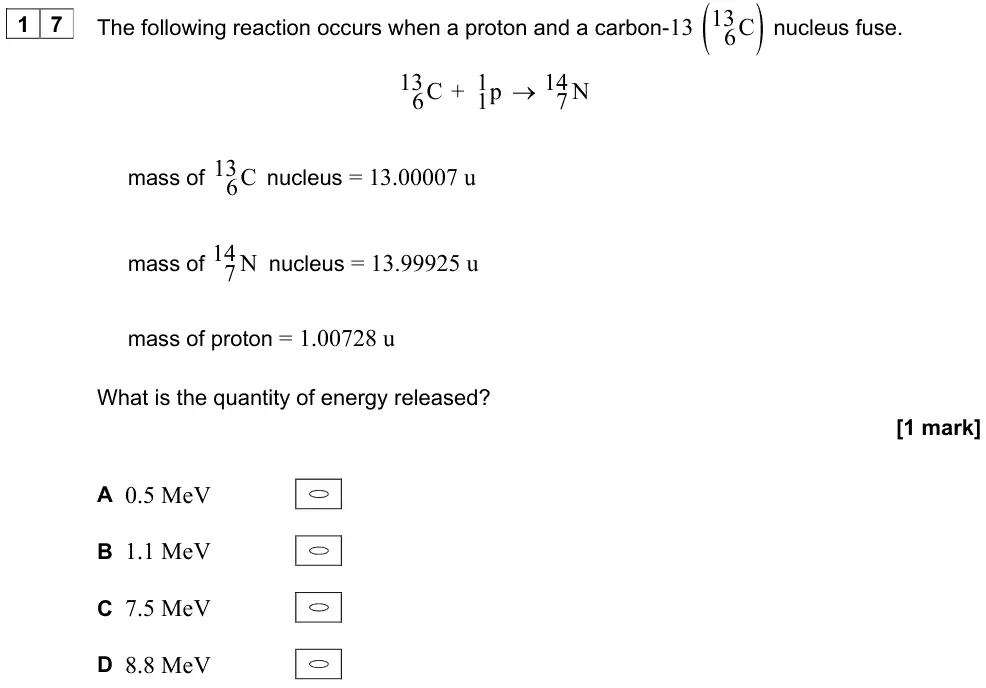
17 Mass and energy, binding energy, fission and safety 1Multiple choice
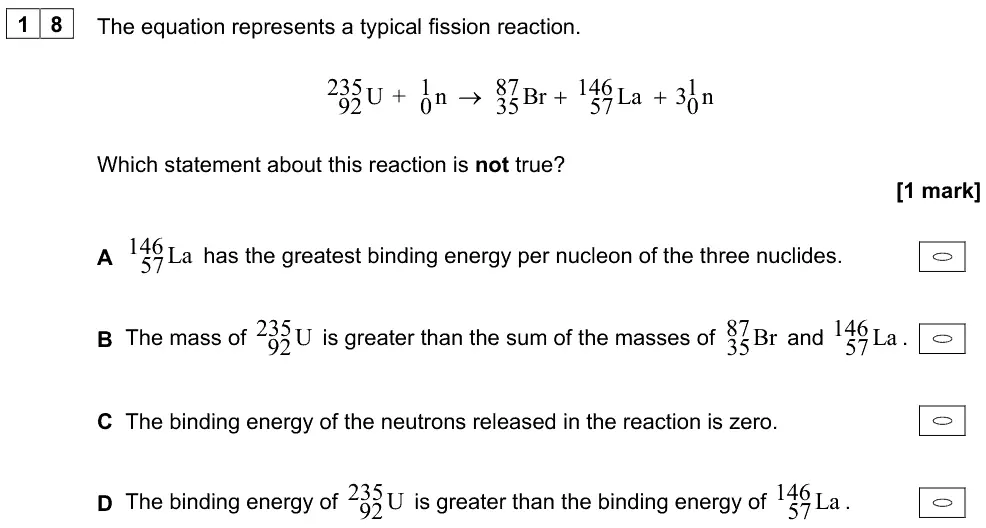
18 Mass and energy, binding energy, fission and safety 1Multiple choice
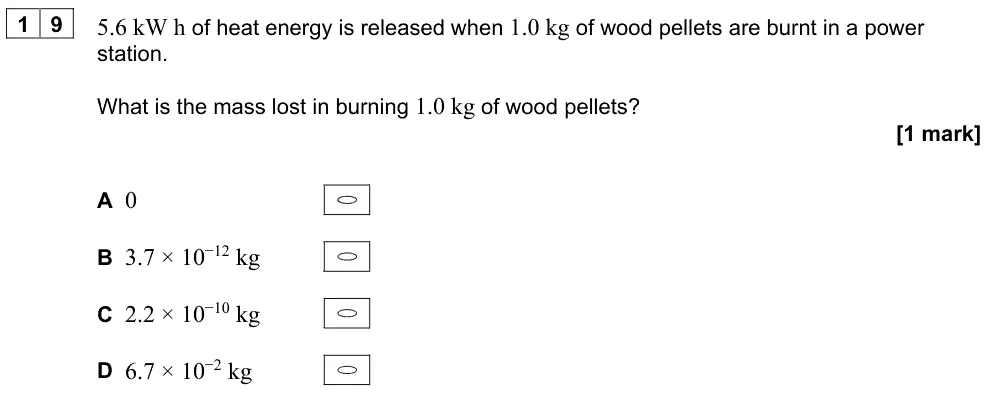
19 Mass and energy, binding energy, fission and safety 1Multiple choice
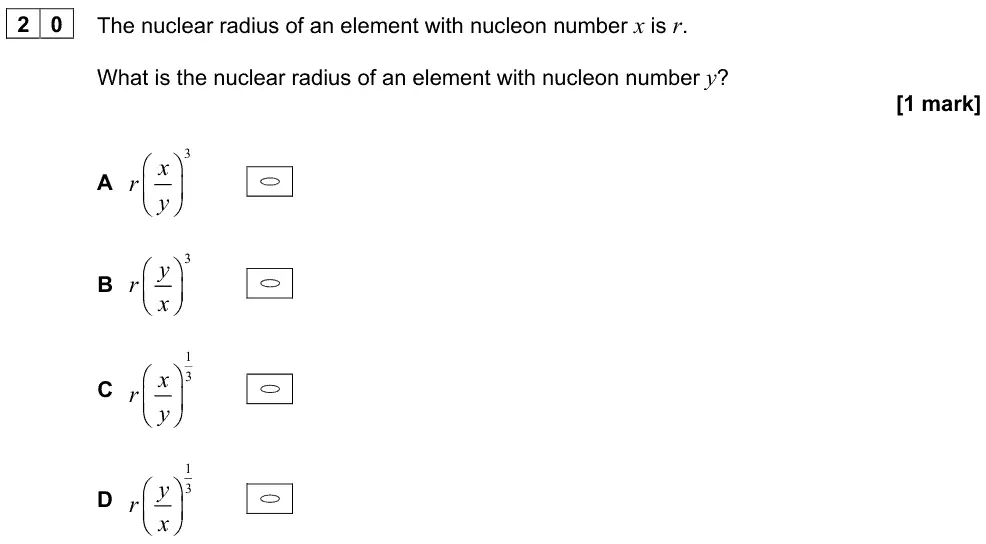
20 Nuclear radius 1Multiple choice
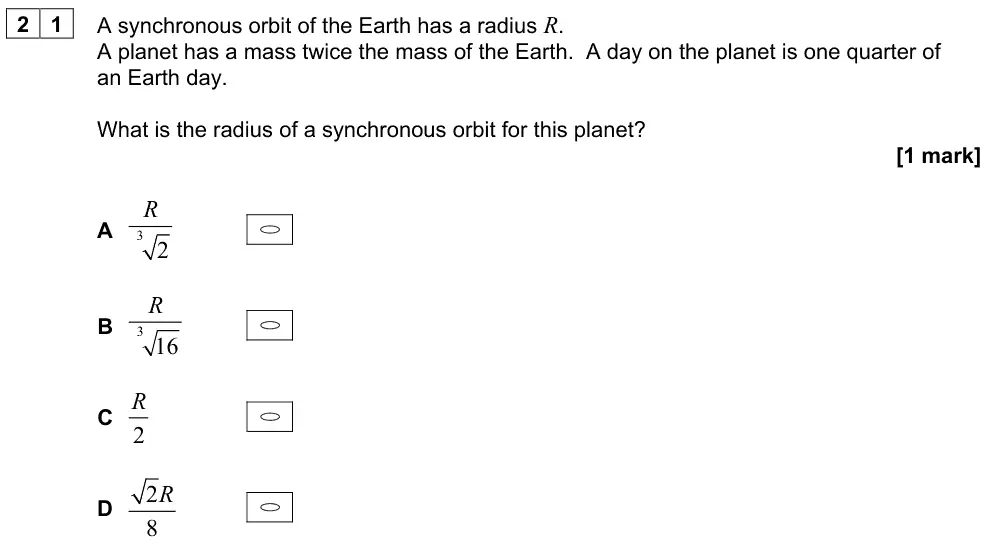
21 Gravitational fields and orbits 1Multiple choice
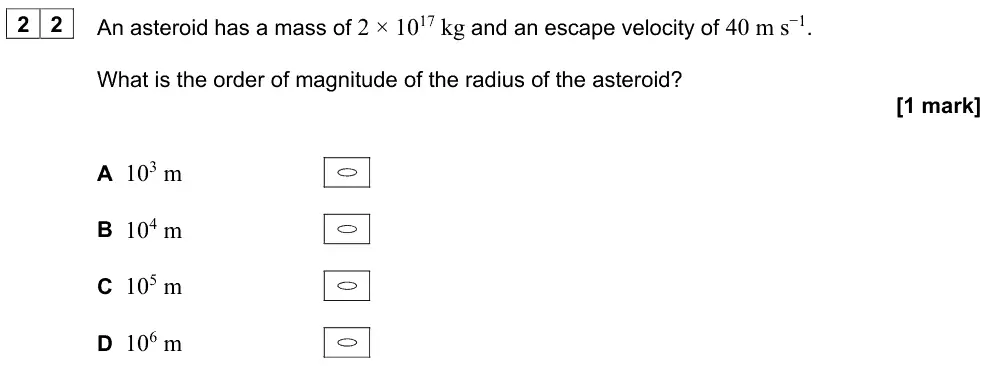
22 Gravitational fields and orbits 1Multiple choice
23 Gravitational fields and orbits 1Multiple choice
24 Capacitance and capacitor charge and discharge, Electric fields and electric potential 1Multiple choice
25 Electric fields and electric potential 1Multiple choice
26 Electric fields and electric potential 1Multiple choice
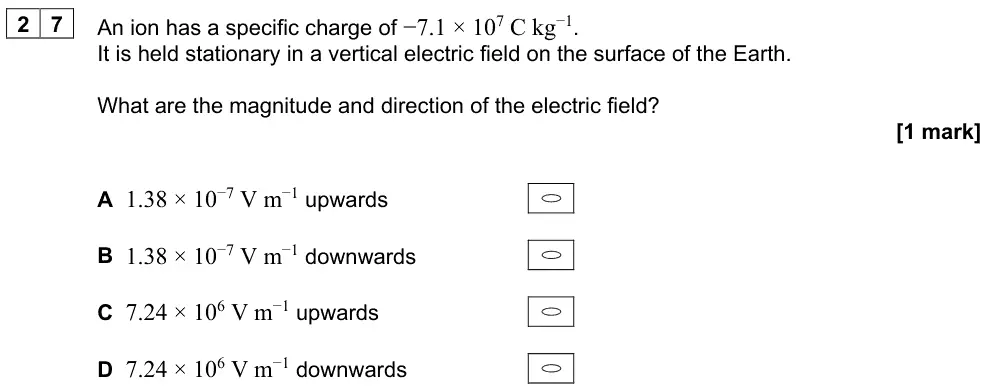
27 Electric fields and electric potential 1Multiple choice
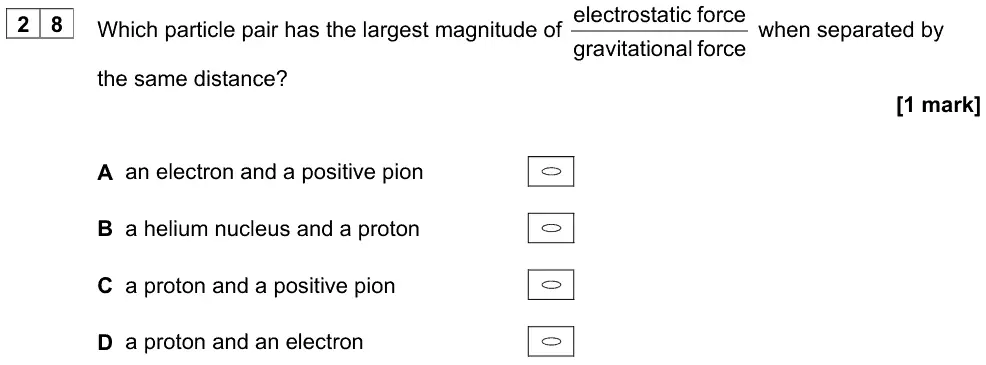
28 Electric fields and electric potential 1Multiple choice
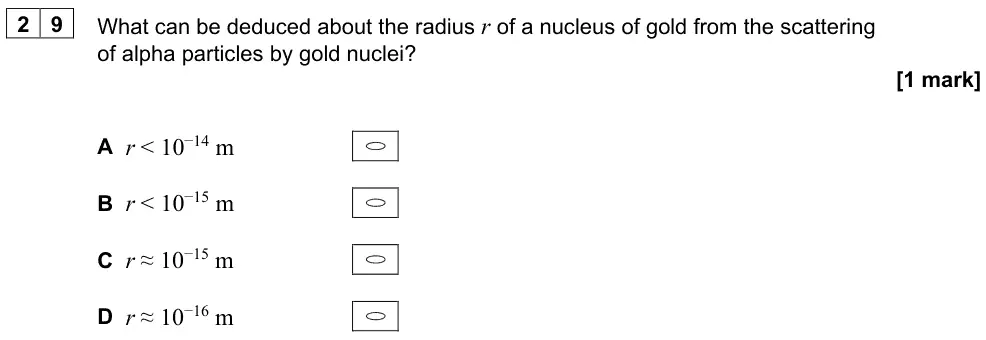
29 Nuclear radius, Rutherford scattering, alpha, beta and gamma radiation 1Multiple choice
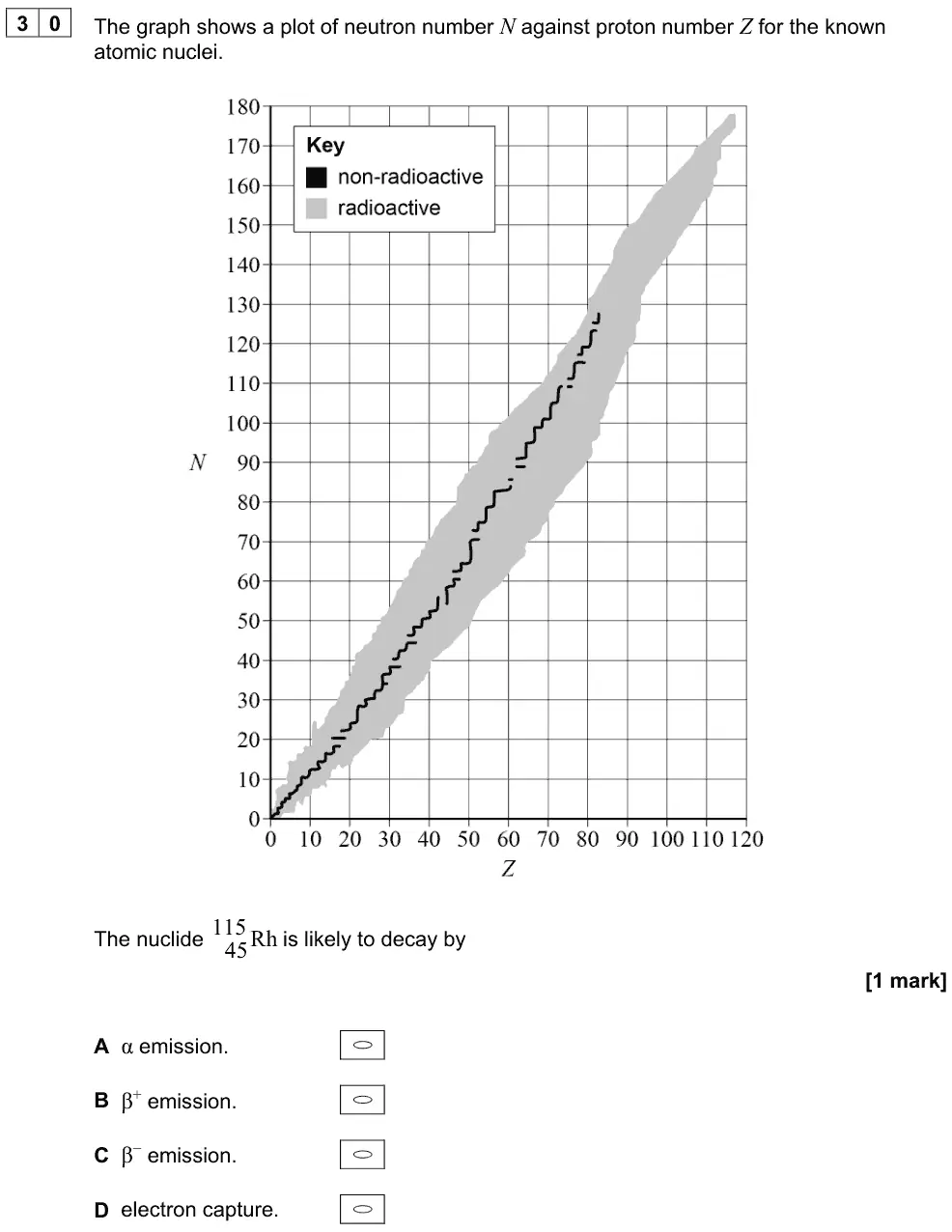
30 Radioactive decay, half-life and nuclear instability 1Multiple choice
31 Radioactive decay, half-life and nuclear instability 1Multiple choice
32 Radioactive decay, half-life and nuclear instability 1Multiple choice

The questions

1.11.21.31.42.12.22.32.43.13.24.14.24.35.15.25.36.16.26.36.47.17.27.37.4891011121314151617181920212223242526272829303132
June 2024 · Paper 2 · Q1.1 1 mark AO1=1 Show that thermal energy and ideal gases
A room contains dry air at a temperature of 20.0 °C and a pressure of 105 kPa.
Show that the amount of air in each cubic metre is about 40 mol.
[1 mark]
June 2024 · Paper 2 · Q1.2 3 marks AO2=3 Calculation kinetic theorythermal energy and ideal gases
Earlier part of question 1 that this part usesEarlier part of June 2024 Paper 2 question 1
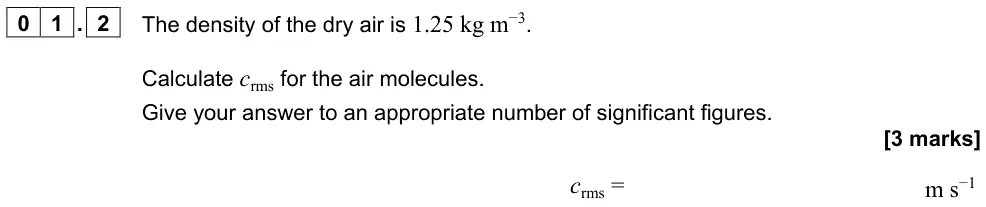
The density of the dry air is 1.25 kg m−3.
Calculate crms for the air molecules.
Give your answer to an appropriate number of significant figures.
[3 marks]
crms =
m s−1
June 2024 · Paper 2 · Q1.3 2 marks AO2=2 Calculation kinetic theory
Earlier part of question 1 that this part usesEarlier part of June 2024 Paper 2 question 1
Calculate, in K, the change of temperature that will double crms for the air molecules.
[2 marks]
change of temperature =
K
June 2024 · Paper 2 · Q1.4 3 marks AO2=2, AO3=1 Calculation thermal energy and ideal gases
Earlier part of question 1 that this part usesEarlier part of June 2024 Paper 2 question 1
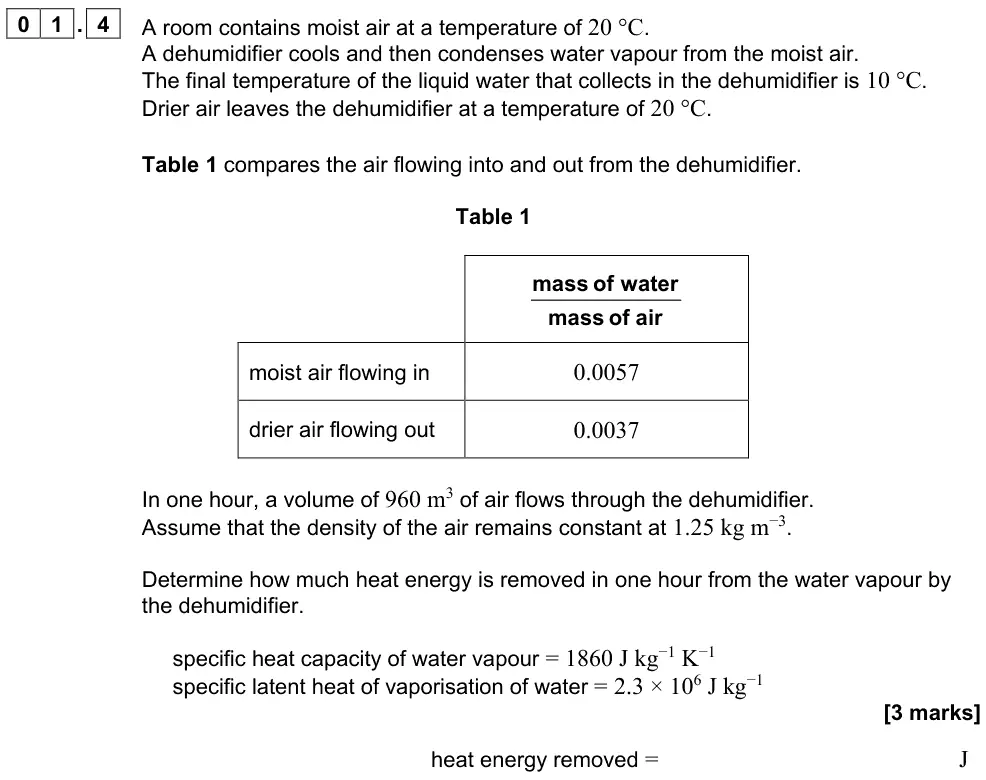
A room contains moist air at a temperature of 20 °C.
A dehumidifier cools and then condenses water vapour from the moist air.
The final temperature of the liquid water that collects in the dehumidifier is 10 °C.
Drier air leaves the dehumidifier at a temperature of 20 °C.
Table 1 compares the air flowing into and out from the dehumidifier.

Table 1
mass of water
mass of air
moist air flowing in
0.0057
drier air flowing out
0.0037
In one hour, a volume of 960 m3 of air flows through the dehumidifier.
Assume that the density of the air remains constant at 1.25 kg m−3.
Determine how much heat energy is removed in one hour from the water vapour by
the dehumidifier.
specific heat capacity of water vapour = 1860 J kg−1 K−1
specific latent heat of vaporisation of water = 2.3 × 10⁶ J kg−1
[3 marks]
heat energy removed =
J
June 2024 · Paper 2 · Q2.1 2 marks AO2=2 Explanation capacitors
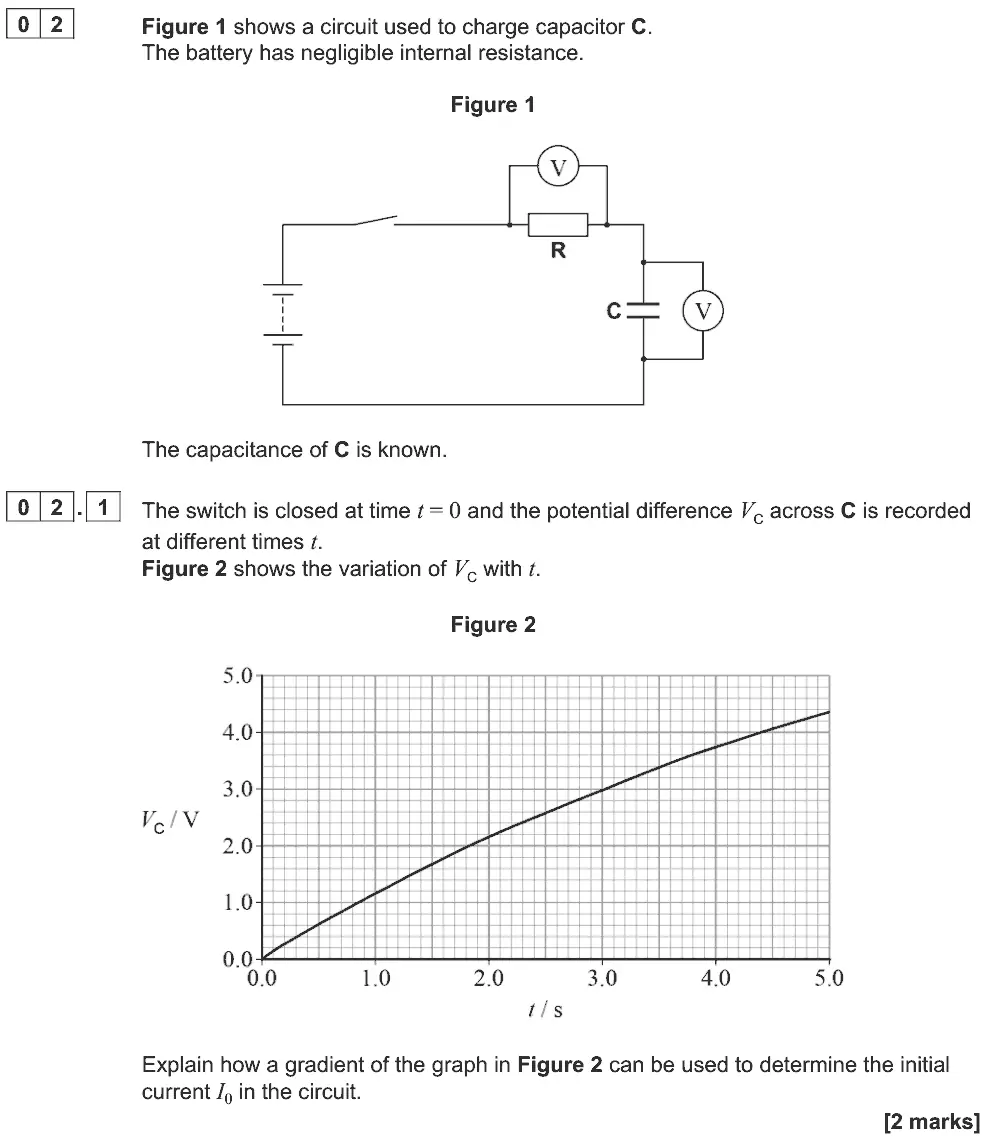
Figure 1 shows a circuit used to charge capacitor C.
The battery has negligible internal resistance.
Figure 1
The capacitance of C is known.
The switch is closed at time t = 0 and the potential difference VC across C is recorded
at different times t.
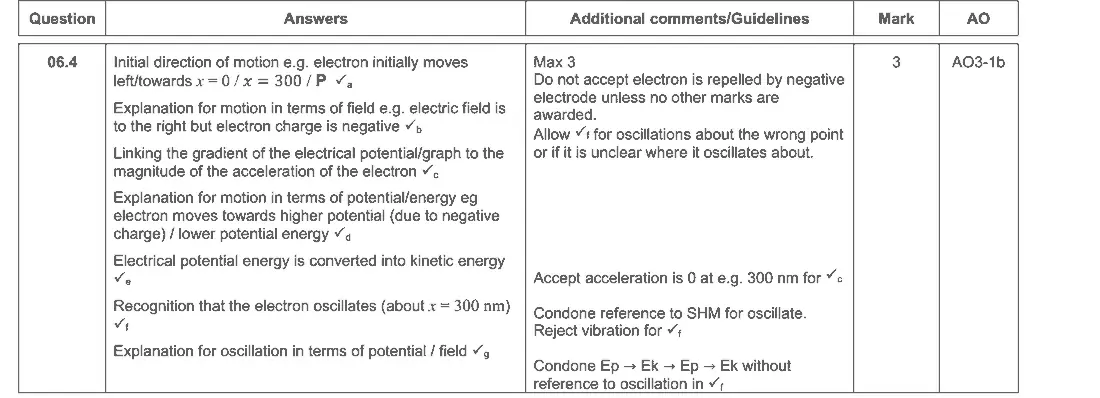
Figure 2 shows the variation of VC with t.
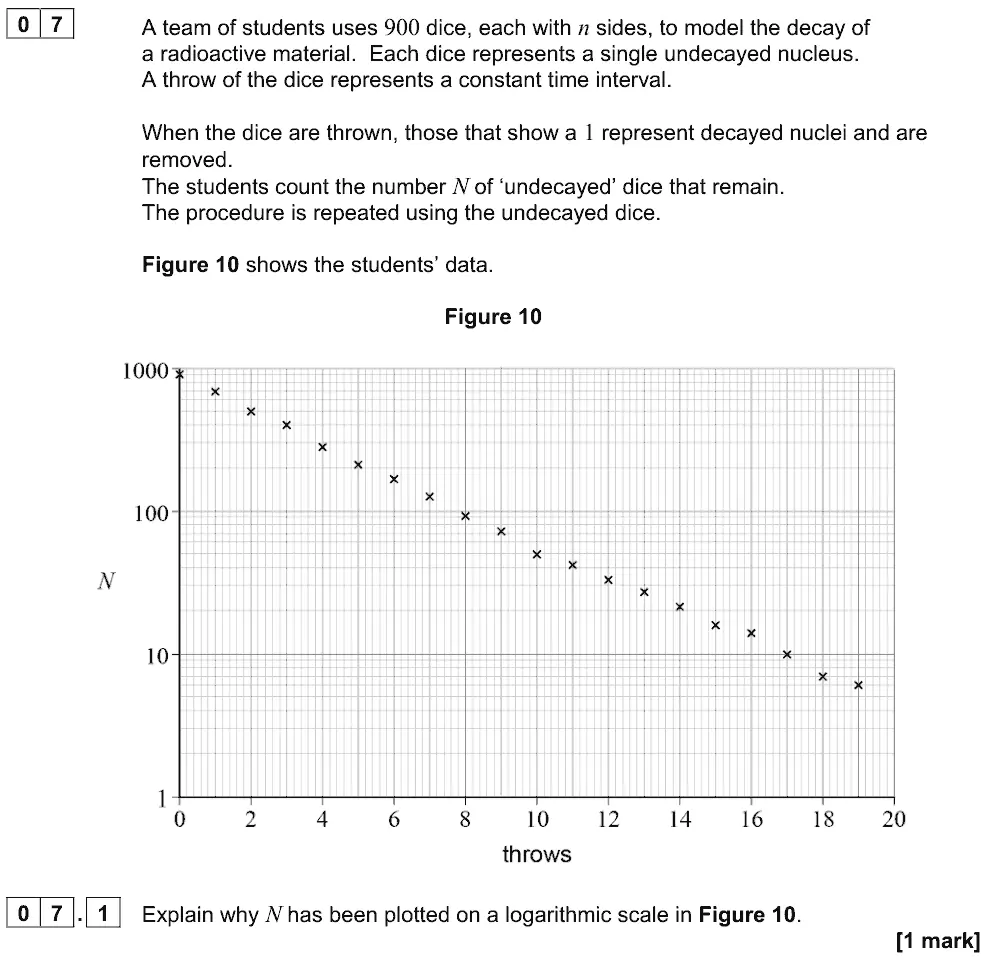
Figure 2
Explain how a gradient of the graph in Figure 2 can be used to determine the initial
current I0 in the circuit.
[2 marks]
June 2024 · Paper 2 · Q2.2 2 marks AO1=1, AO3=1 Calculation capacitors
Earlier part of question 2 that this part usesEarlier part of June 2024 Paper 2 question 2
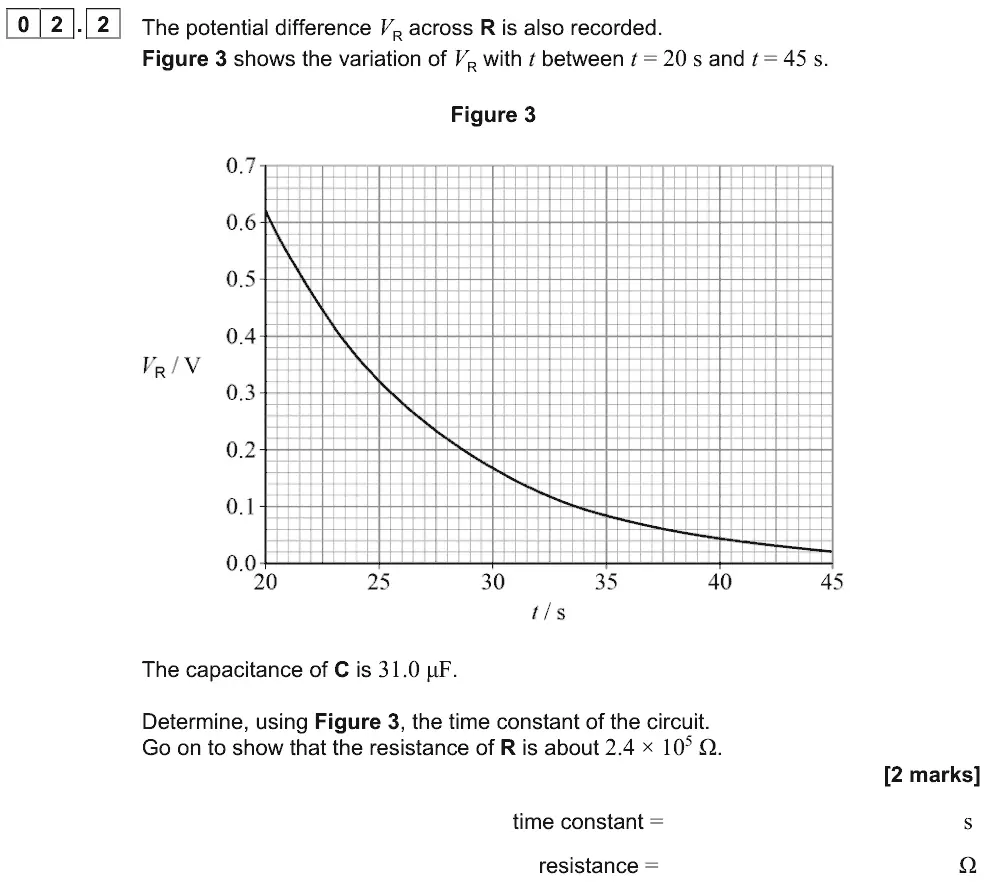
The potential difference VR across R is also recorded.
Figure 3 shows the variation of VR with t between t = 20 s and t = 45 s.
Figure 3
The capacitance of C is 31.0 μF.
Determine, using Figure 3, the time constant of the circuit.
Go on to show that the resistance of R is about 2.4 × 10⁵ Ω.
[2 marks]
time constant =
s
resistance =
Ω
June 2024 · Paper 2 · Q2.3 3 marks AO2=1, AO3=2 Calculation capacitors
Earlier part of question 2 that this part usesEarlier part of June 2024 Paper 2 question 2
The current I0 at time t = 0 is 3.6 × 10⁻⁵ A.
Determine the time at which VC is 6.0 V.
[3 marks]
time =
s
June 2024 · Paper 2 · Q2.4 2 marks AO2=2 Calculation capacitors
Earlier part of question 2 that this part usesEarlier part of June 2024 Paper 2 question 2
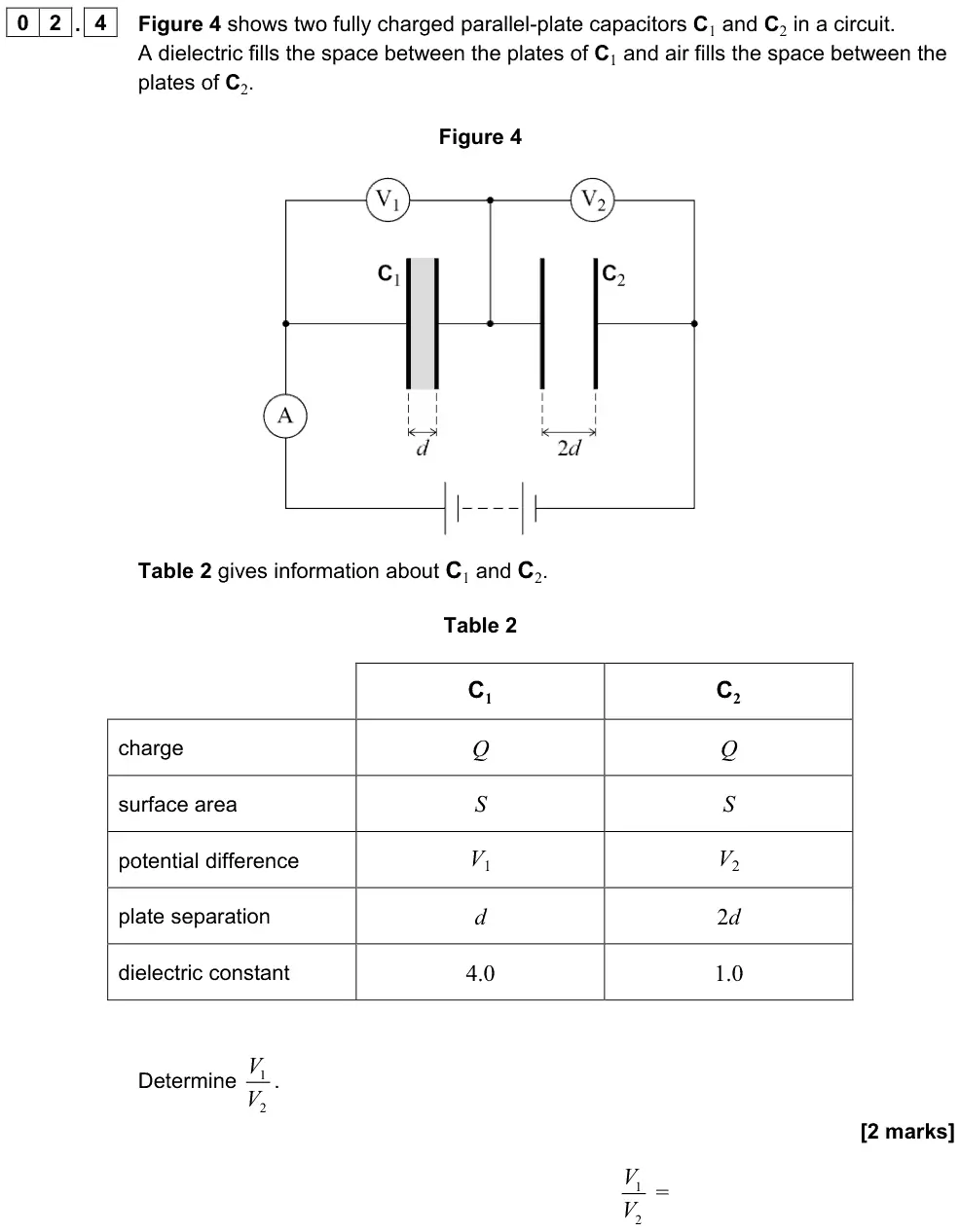
Figure 4 shows two fully charged parallel-plate capacitors C1 and C2 in a circuit.
A dielectric fills the space between the plates of C1 and air fills the space between the
plates of C2.
Figure 4
Table 2 gives information about C1 and C2.
Table 2
C1
C2
charge
Q
Q
surface area
S
S
potential difference
V1
V2
plate separation
d
2d
dielectric constant
4.0
1.0
Determine
1
2
V
V
.
[2 marks]
1
2
V
V
=
June 2024 · Paper 2 · Q3.1 3 marks AO1=1, AO2=1, AO3=1 Calculation electromagnetic induction
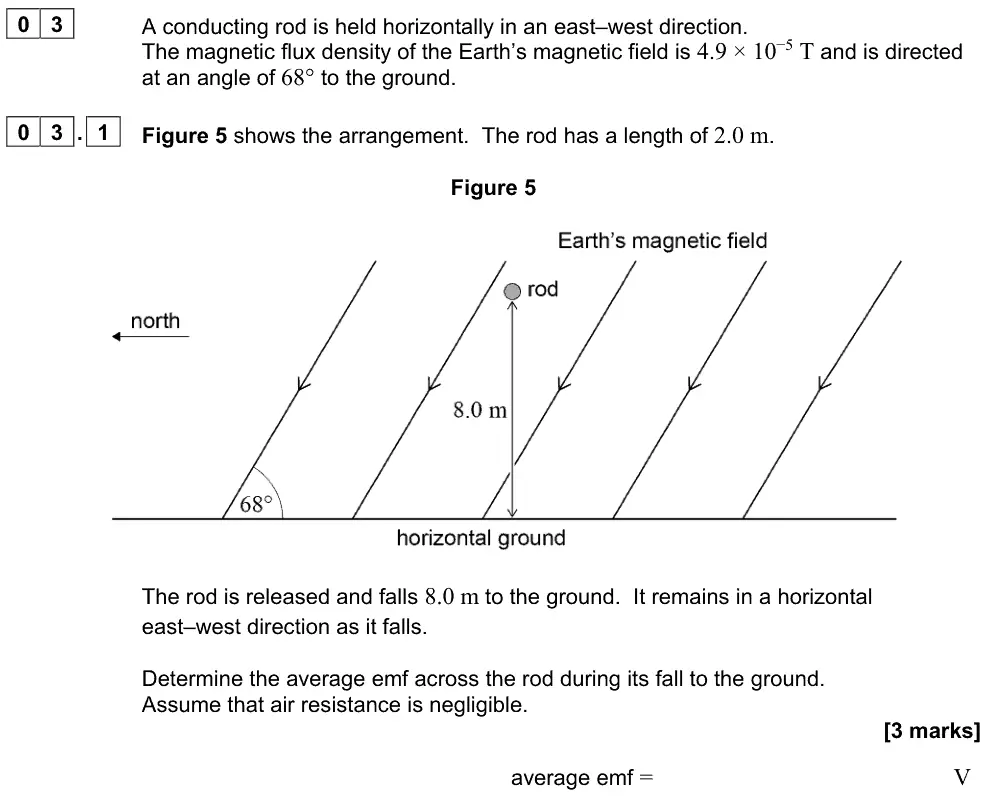
A conducting rod is held horizontally in an east–west direction.
The magnetic flux density of the Earth’s magnetic field is 4.9 × 10⁻⁵ T and is directed
at an angle of 68° to the ground.
Figure 5 shows the arrangement.  The rod has a length of 2.0 m.
Figure 5
The rod is released and falls 8.0 m to the ground.  It remains in a horizontal
east–west direction as it falls.
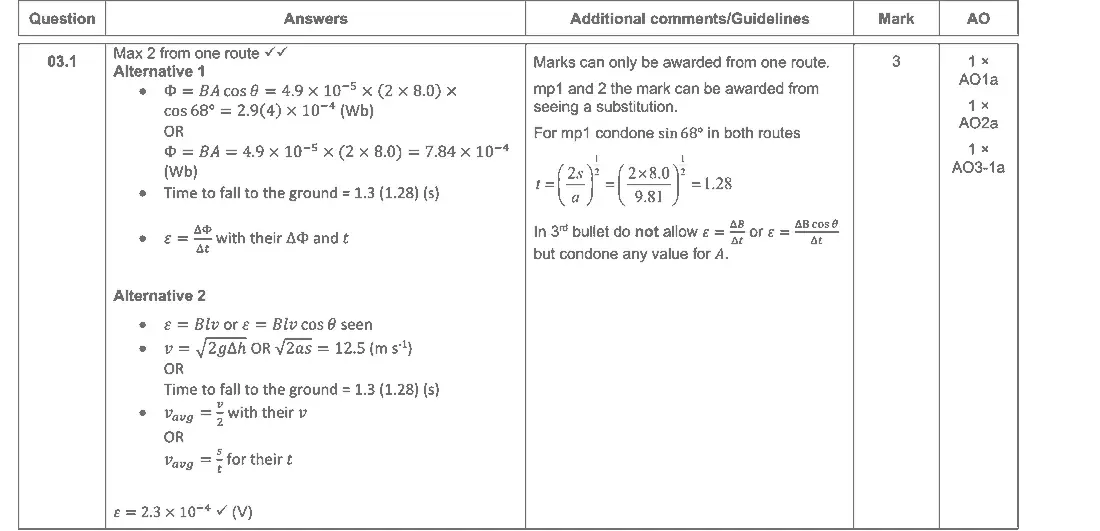
Determine the average emf across the rod during its fall to the ground.
Assume that air resistance is negligible.
[3 marks]
average emf =
V
June 2024 · Paper 2 · Q3.2 4 marks AO2=2, AO3=2 Explanation electromagnetic induction
Earlier part of question 3 that this part usesEarlier part of June 2024 Paper 2 question 3
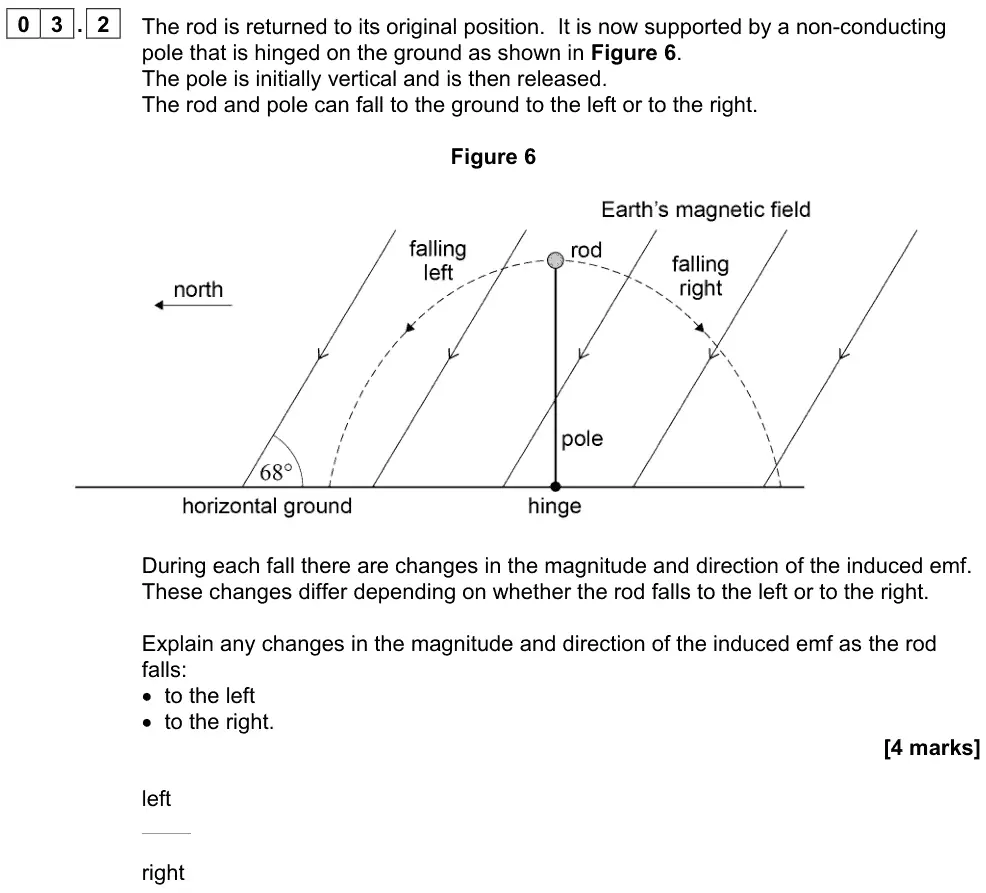
The rod is returned to its original position.  It is now supported by a non-conducting
pole that is hinged on the ground as shown in Figure 6.
The pole is initially vertical and is then released.
The rod and pole can fall to the ground to the left or to the right.
Figure 6
During each fall there are changes in the magnitude and direction of the induced emf.
These changes differ depending on whether the rod falls to the left or to the right.
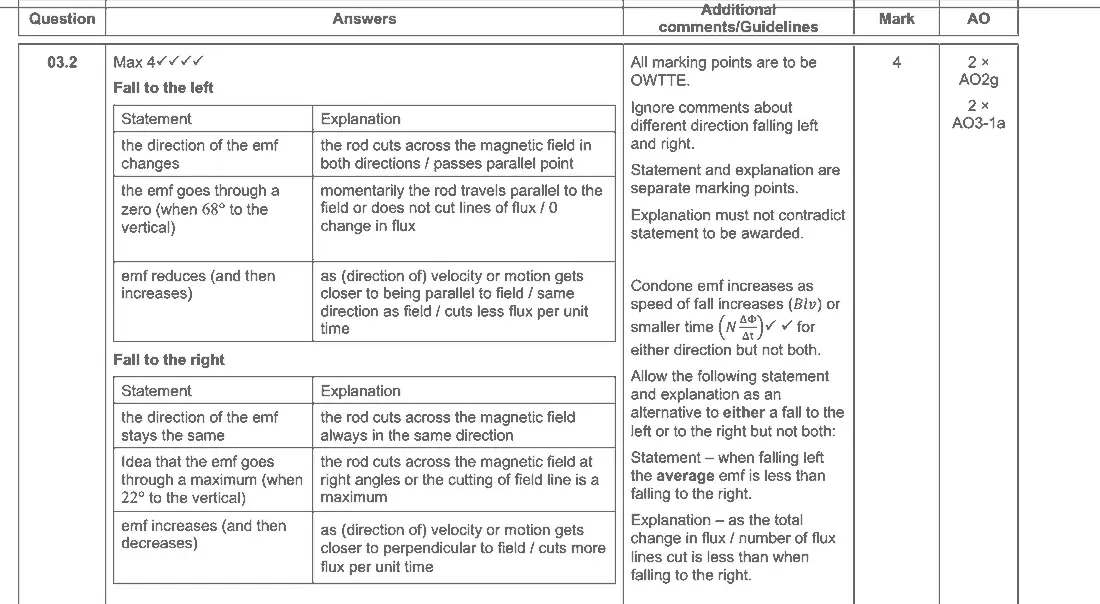
Explain any changes in the magnitude and direction of the induced emf as the rod
falls:
• to the left
• to the right.
[4 marks]
left
right
June 2024 · Paper 2 · Q4.1 1 mark AO1=1 Short answer mass energy and fission
One purpose of the coolant in a thermal nuclear reactor is to maintain a safe working
temperature within the core.
State the other purpose.
[1 mark]
June 2024 · Paper 2 · Q4.2 2 marks AO1=2 Short answer mass energy and fission
Earlier part of question 4 that this part usesEarlier part of June 2024 Paper 2 question 4
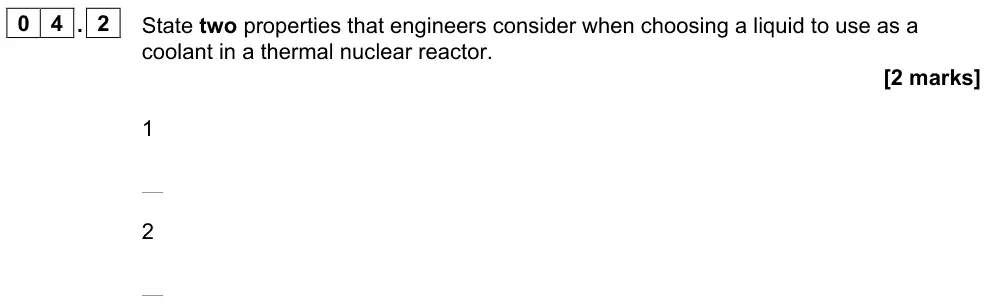
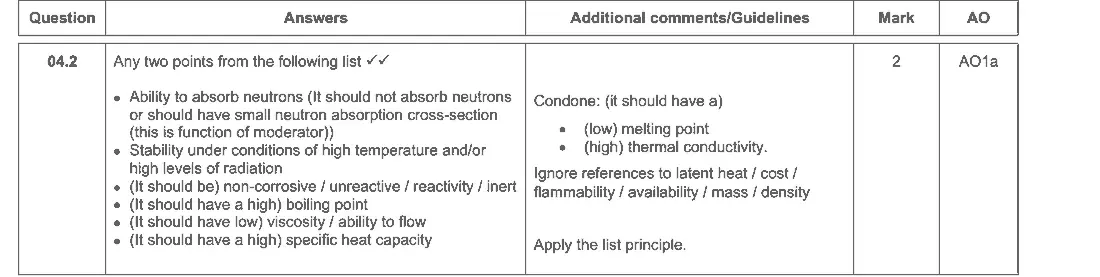
State two properties that engineers consider when choosing a liquid to use as a
coolant in a thermal nuclear reactor.
[2 marks]
1
2
June 2024 · Paper 2 · Q4.3 2 marks AO1=2 Explanation mass energy and fission
Earlier part of question 4 that this part usesEarlier part of June 2024 Paper 2 question 4
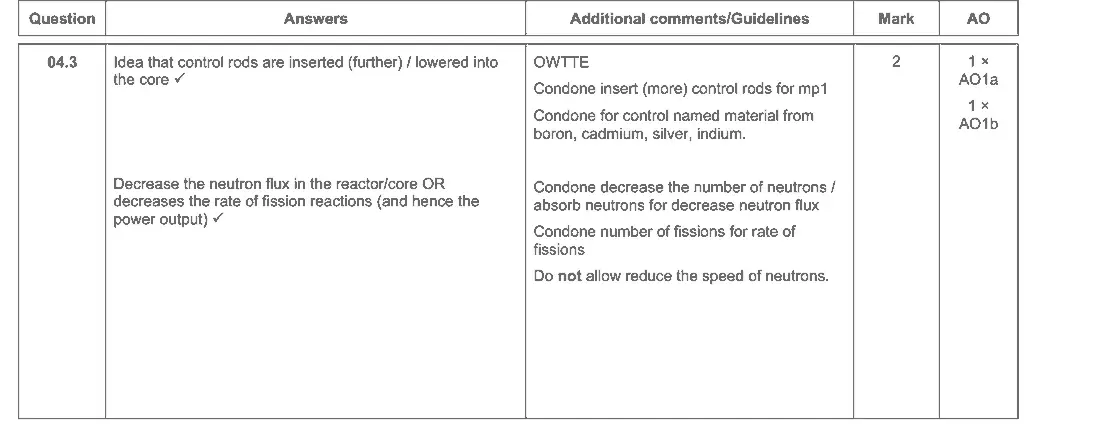
Explain how the power output of a thermal nuclear reactor is decreased.
[2 marks]
June 2024 · Paper 2 · Q5.1 3 marks AO2=3 Show that circular motiongravitational fields
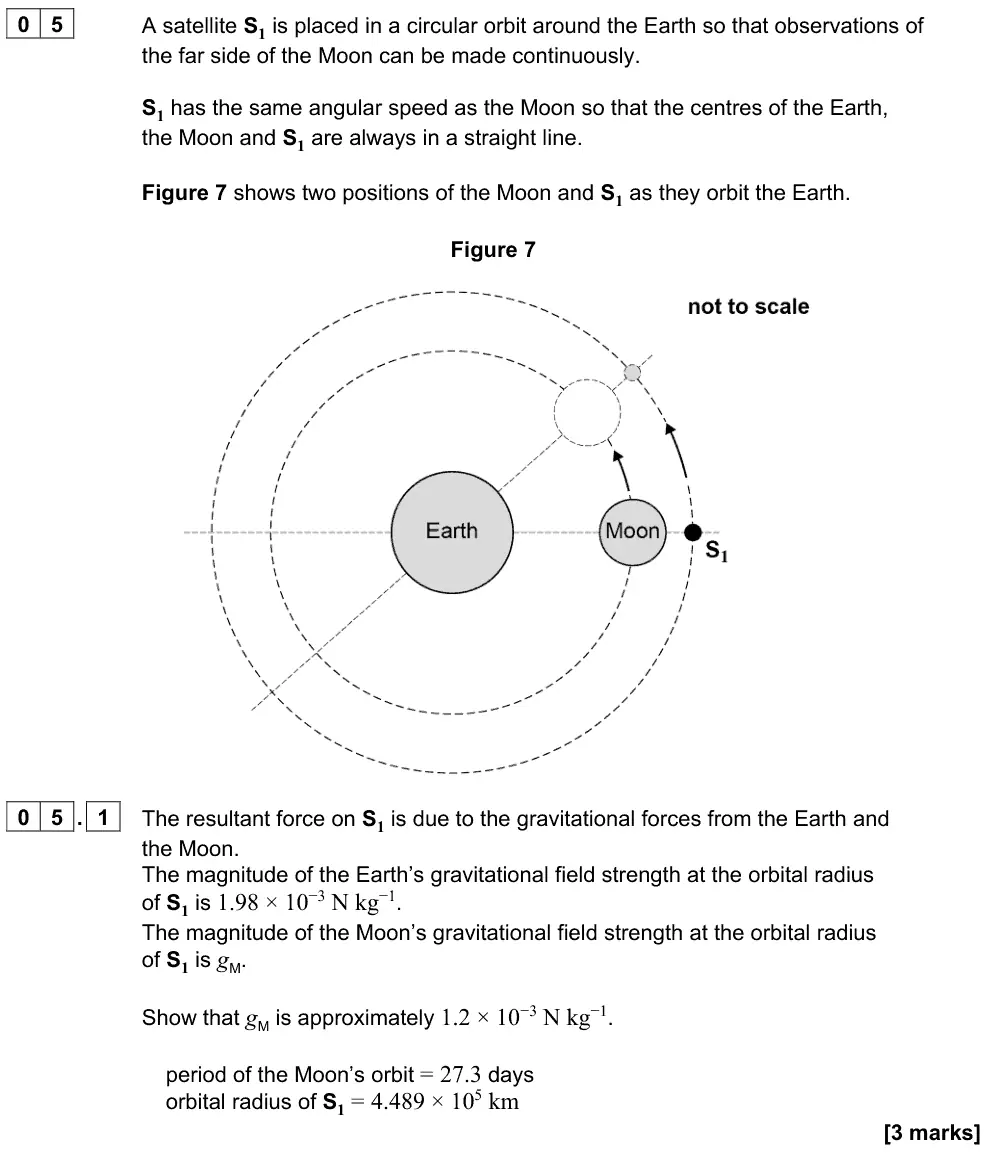
A satellite S1 is placed in a circular orbit around the Earth so that observations of
the far side of the Moon can be made continuously.
S1 has the same angular speed as the Moon so that the centres of the Earth,
the Moon and S1 are always in a straight line.
Figure 7 shows two positions of the Moon and S1 as they orbit the Earth.
Figure 7
The resultant force on S1 is due to the gravitational forces from the Earth and
the Moon.
The magnitude of the Earth’s gravitational field strength at the orbital radius
of S1 is 1.98 × 10⁻³ N kg−1.
The magnitude of the Moon’s gravitational field strength at the orbital radius
of S1 is gM.
Show that gM is approximately 1.2 × 10⁻³ N kg−1.
period of the Moon’s orbit = 27.3 days
orbital radius of S1 = 4.489 × 10⁵ km
[3 marks]
June 2024 · Paper 2 · Q5.2 2 marks AO2=2 Calculation gravitational fields
Earlier part of question 5 that this part usesEarlier part of June 2024 Paper 2 question 5
Calculate the distance from S1 to the centre of the Moon.
mass of the Moon = 7.35 × 10²² kg
[2 marks]
distance =
m
June 2024 · Paper 2 · Q5.3 3 marks AO2=3 Explanation gravitational fieldscircular motion
Earlier part of question 5 that this part usesEarlier part of June 2024 Paper 2 question 5
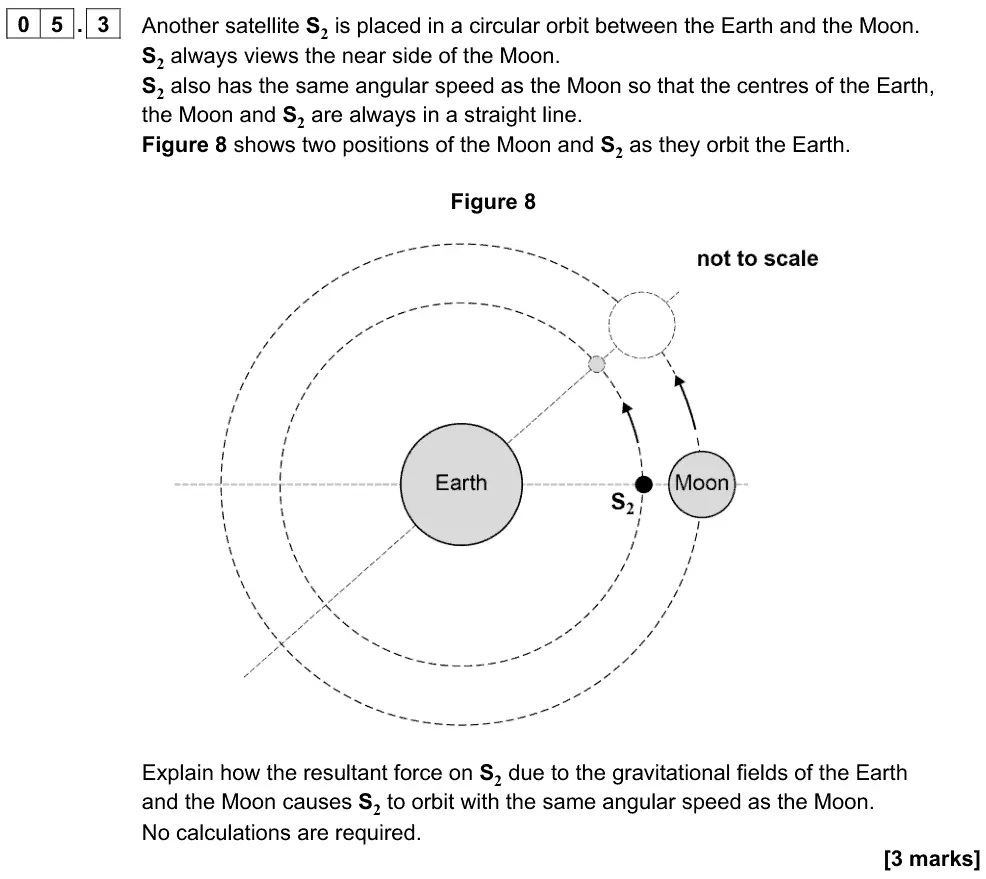
Another satellite S2 is placed in a circular orbit between the Earth and the Moon.
S2 always views the near side of the Moon.
S2 also has the same angular speed as the Moon so that the centres of the Earth,
the Moon and S2 are always in a straight line.
Figure 8 shows two positions of the Moon and S2 as they orbit the Earth.
Figure 8
Explain how the resultant force on S2 due to the gravitational fields of the Earth
and the Moon causes S2 to orbit with the same angular speed as the Moon.
No calculations are required.
[3 marks]
June 2024 · Paper 2 · Q6.1 3 marks AO1=3 Explanation electric fields
The electric potential at a point in an electric field is −4.0 V.
Explain what is meant by this statement.
[3 marks]
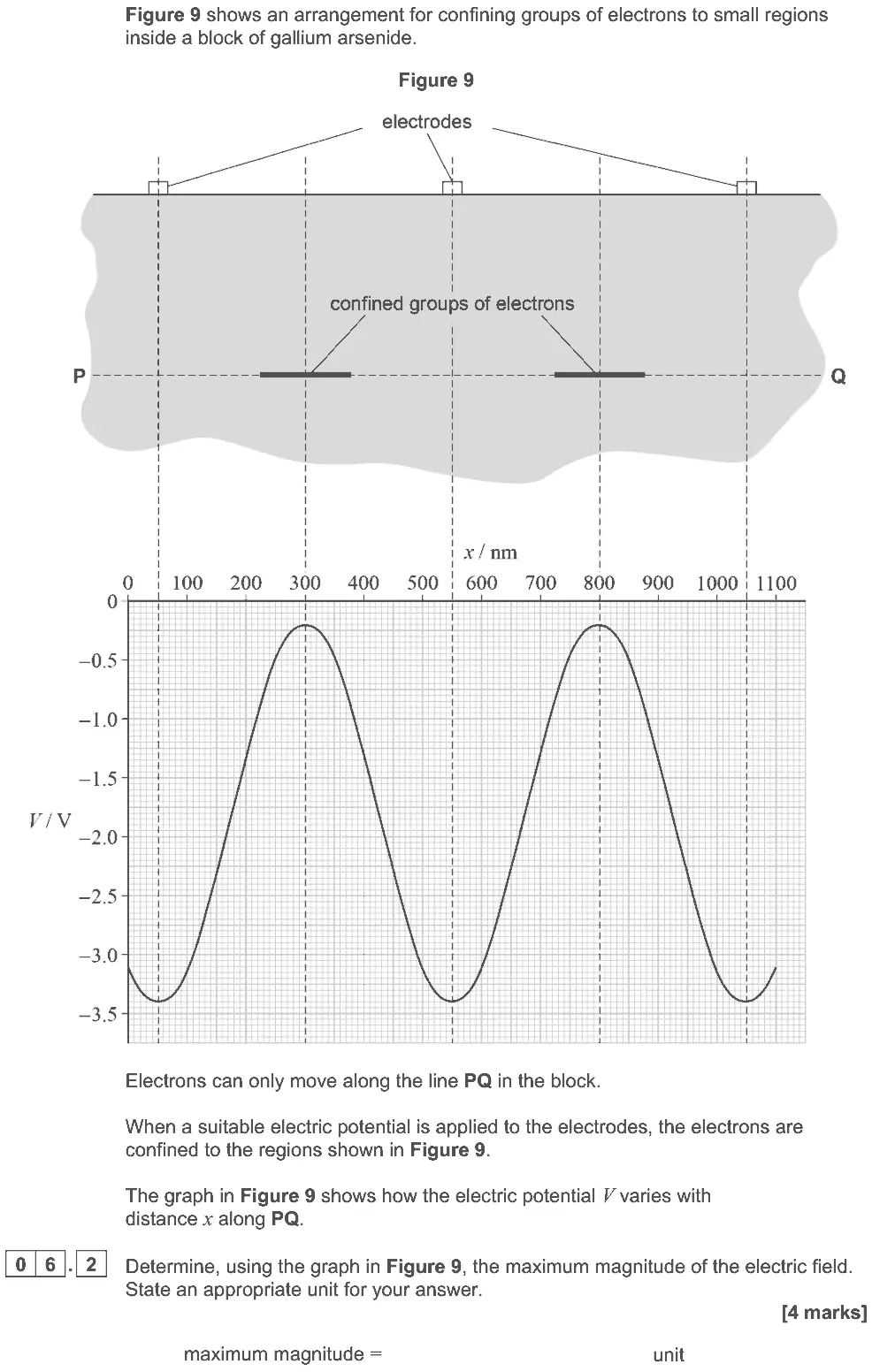
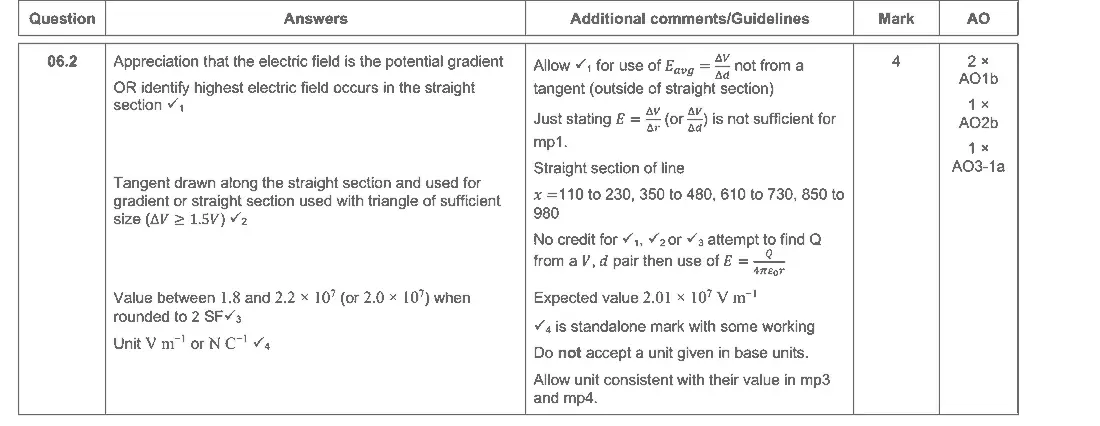
June 2024 · Paper 2 · Q6.2 4 marks AO1=2, AO2=1, AO3=1 Calculation electric fields
Earlier part of question 6 that this part usesEarlier part of June 2024 Paper 2 question 6
Figure 9 shows an arrangement for confining groups of electrons to small regions
inside a block of gallium arsenide.
Figure 9
Electrons can only move along the line PQ in the block.
When a suitable electric potential is applied to the electrodes, the electrons are
confined to the regions shown in Figure 9.
The graph in Figure 9 shows how the electric potential V varies with
distance x along PQ.
Determine, using the graph in Figure 9, the maximum magnitude of the electric field.
State an appropriate unit for your answer.
[4 marks]
maximum magnitude =
unit
June 2024 · Paper 2 · Q6.3 2 marks AO2=2 Calculation Hard electric fields
Earlier part of question 6 that this part usesEarlier part of June 2024 Paper 2 question 6
An electron at rest at x = 300 nm gains kinetic energy and moves to x = 800 nm.
Determine the minimum kinetic energy required by the electron.
[2 marks]
minimum kinetic energy =
J
June 2024 · Paper 2 · Q6.4 3 marks AO3=3 Explanation electric fields
Earlier part of question 6 that this part usesEarlier part of June 2024 Paper 2 question 6
One of the confined electrons is at x = 350 nm.
Discuss the subsequent motion of this electron due to the variation in electric potential
shown in Figure 9.
Assume that the electron starts from rest.
[3 marks]
June 2024 · Paper 2 · Q7.1 1 mark AO1=1 Short answer radioactive decay
A team of students uses 900 dice, each with n sides, to model the decay of
a radioactive material.  Each dice represents a single undecayed nucleus.
A throw of the dice represents a constant time interval.
When the dice are thrown, those that show a 1 represent decayed nuclei and are
removed.
The students count the number N of ‘undecayed’ dice that remain.
The procedure is repeated using the undecayed dice.
Figure 10 shows the students’ data.
Figure 10
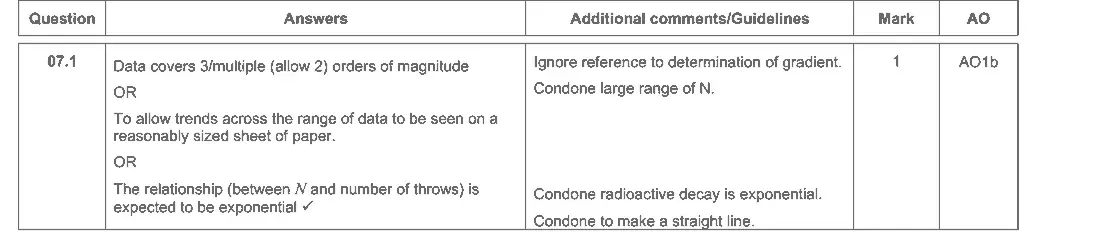
Explain why N has been plotted on a logarithmic scale in Figure 10.
[1 mark]
June 2024 · Paper 2 · Q7.2 5 marks AO2=3, AO3=2 Practical and data analysis radioactive decay
Earlier part of question 7 that this part usesEarlier part of June 2024 Paper 2 question 7
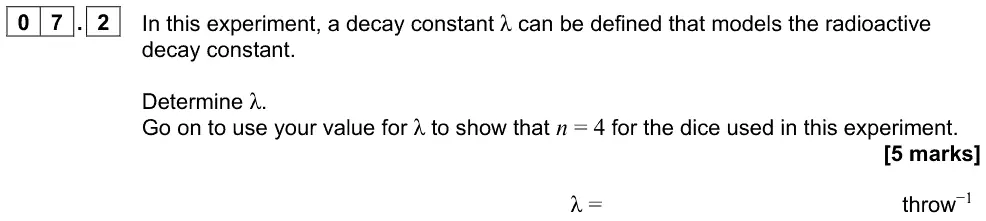
In this experiment, a decay constant λ can be defined that models the radioactive
decay constant.
Determine λ.
Go on to use your value for λ to show that n = 4 for the dice used in this experiment.
[5 marks]
λ =
throw−1
June 2024 · Paper 2 · Q7.3 2 marks AO1=1, AO3=1 Explanation rutherford scattering and radiationmass energy and fission
Earlier part of question 7 that this part usesEarlier part of June 2024 Paper 2 question 7
A typical radioactive source used in schools has an activity of 100 kBq.
A radioactive source used in a hospital has an activity of 370 GBq.
State one safety measure when using a radioactive source in a school laboratory.
Go on to discuss how this safety measure needs to be adapted for safe use of the
hospital radioactive source.
[2 marks]
June 2024 · Paper 2 · Q7.4 2 marks AO1=2 Explanation rutherford scattering and radiation
Earlier part of question 7 that this part usesEarlier part of June 2024 Paper 2 question 7
X-rays are a form of ionising radiation.
A person has check-ups with a dentist every six months.
The dentist only takes X-ray images when the person has reported a problem.
Suggest why.
[2 marks]
June 2024 · Paper 2 · Q8 1 mark Multiple choice thermal energy and ideal gases
In which process is work done by an ideal gas?
[1 mark]
A doubling the pressure at constant volume
B doubling the volume at constant pressure
C doubling the absolute temperature at constant volume
D doubling the pressure at constant temperature
June 2024 · Paper 2 · Q9 1 mark Multiple choice kinetic theory
Three molecules have speeds 2.00v, 4.00v and 5.00v.
What is the crms speed of these molecules?
[1 mark]
A 3.50v
B 3.67v
C 3.87v
D 26.0v
June 2024 · Paper 2 · Q10 1 mark Multiple choice thermal energy and ideal gases
An ideal gas is enclosed in an insulated container with a small electric heater.
The initial temperature of the gas is 300 K.
The product of pressure and volume is 5000 J.
The gas expands at constant pressure and does 1660 J of work.
What is the final temperature of the gas?
[1 mark]
A 300 K
B 400 K
C 450 K
D 900 K
June 2024 · Paper 2 · Q11 1 mark Multiple choice capacitors
An air-filled parallel-plate capacitor and a resistor are connected in series across the
terminals of a battery.
The plates of the capacitor are then moved further apart.
This change results in
[1 mark]
A a decrease in the potential difference across the capacitor plates.
B a decrease in the charge held on the capacitor plates.
C an increase in the energy stored on the capacitor.
D an increase in the capacitance of the capacitor.
June 2024 · Paper 2 · Q12 1 mark Multiple choice electromagnetic induction
Which change will increase the efficiency of a transformer?
[1 mark]
A increasing the thickness of the iron layers in the laminated core
B decreasing the frequency of the ac input voltage
C decreasing the diameter of the copper wire in the primary coil
D increasing the distance between the primary coil and the secondary coil
June 2024 · Paper 2 · Q13 1 mark Multiple choice electromagnetic induction
A signal generator supplies a sinusoidal root mean square voltage of 7.0 V.
The sinusoidal voltage is displayed on an oscilloscope screen.
The screen has eight vertical divisions.
Which volts/division setting will display the tallest complete waveform?
[1 mark]
A 1.5 V div−1
B 2.0 V div−1
C 2.5 V div−1
D 3.0 V div−1
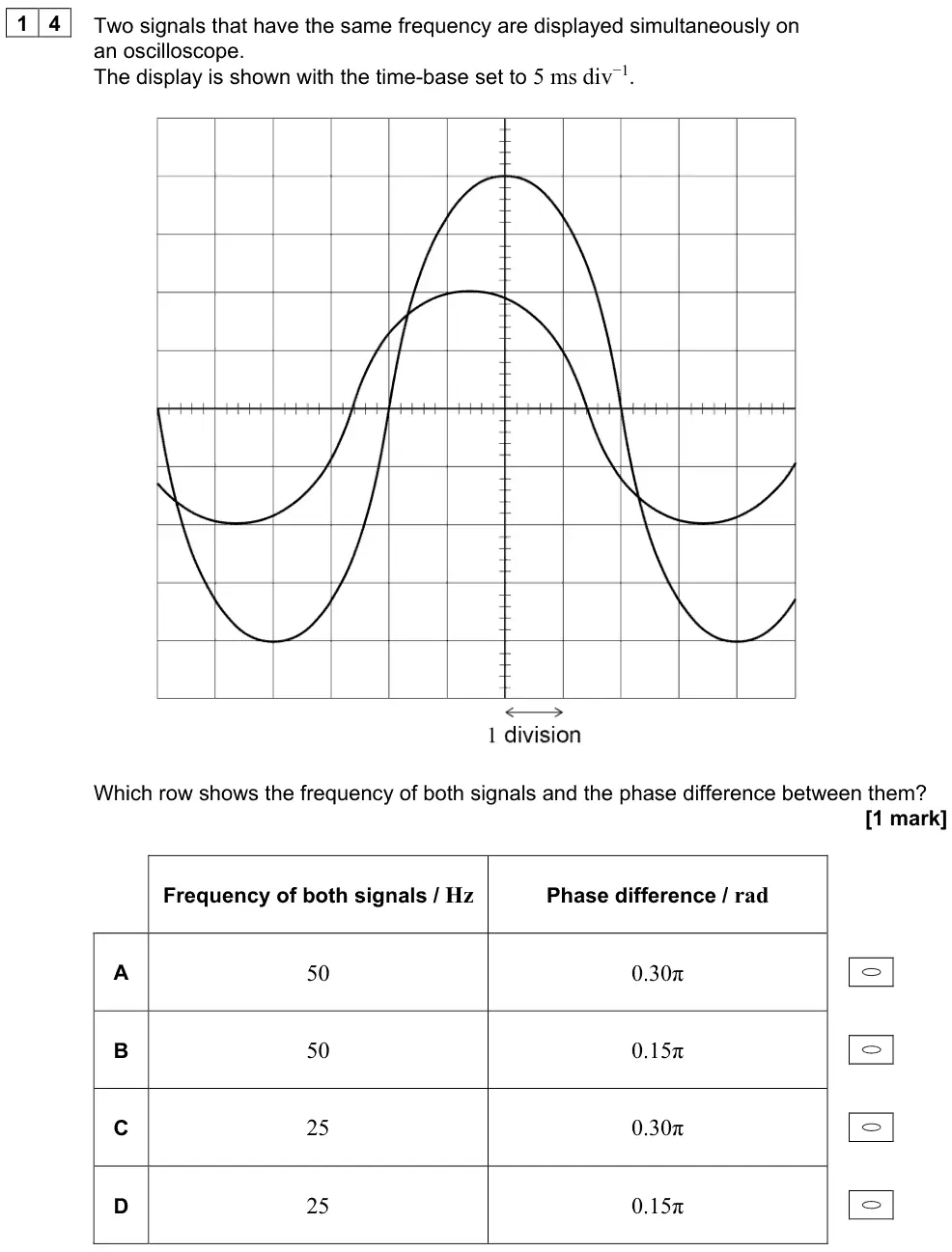
June 2024 · Paper 2 · Q14 1 mark Multiple choice electromagnetic inductionprogressive waves and polarisation
Two signals that have the same frequency are displayed simultaneously on
an oscilloscope.
The display is shown with the time-base set to 5 ms div−1.
Which row shows the frequency of both signals and the phase difference between them?
[1 mark]
Frequency of both signals / Hz
Phase difference / rad
A
50
0.30π
B
50
0.15π
C
25
0.30π
D
25
0.15π
June 2024 · Paper 2 · Q15 1 mark Multiple choice electromagnetic induction
A transmission cable consists of many strands of wire.  Electrical energy is transmitted
along the cable at a frequency of 50 Hz.
Which change gives the largest increase in the efficiency of the electrical energy transfer
along the cable?
[1 mark]
A doubling the transmission voltage of the cable
B doubling the current in the cable
C halving the resistivity of the material of the wires
D halving the number of wires in the cable
June 2024 · Paper 2 · Q16 1 mark Multiple choice magnetic fields
An electron enters a uniform magnetic field at right angles to the field.
The flux density of the field is B.
The electron moves with a non-relativistic speed v in a circular path of radius r.
What is the number of circuits completed by the electron in one second?
[1 mark]
A
e
2 m
Be
π
B 2 r
v
π
C v
r
π
D
e
2
Be
m
π
The following reaction occurs when a proton and a carbon-13 (
)
June 2024 · Paper 2 · Q17 1 mark Multiple choice mass energy and fission
13C
6
nucleus fuse.
13
1
14
C
p
N
6
1
7
+
→
mass of 13C
6
nucleus = 13.00007 u
mass of 14 N
7
nucleus = 13.99925 u
mass of proton = 1.00728 u
What is the quantity of energy released?
[1 mark]
A 0.5 MeV
B 1.1 MeV
C 7.5 MeV
D 8.8 MeV
June 2024 · Paper 2 · Q18 1 mark Multiple choice mass energy and fission
The equation represents a typical fission reaction.
235
1
87
146
1
U
n
Br
La
3 n
92
0
35
57
0
+
→
+
+
Which statement about this reaction is not true?
[1 mark]
A 146 La
57
has the greatest binding energy per nucleon of the three nuclides.
B The mass of 235U
92
is greater than the sum of the masses of 87Br
35
and 146 La
57
.
C The binding energy of the neutrons released in the reaction is zero.
D The binding energy of 235U
92
is greater than the binding energy of 146 La
57
.
June 2024 · Paper 2 · Q19 1 mark Multiple choice mass energy and fission
5.6 kW h of heat energy is released when 1.0 kg of wood pellets are burnt in a power
station.
What is the mass lost in burning 1.0 kg of wood pellets?
[1 mark]
A 0
B 3.7 × 10⁻¹² kg
C 2.2 × 10⁻¹⁰ kg
D 6.7 × 10⁻² kg
June 2024 · Paper 2 · Q20 1 mark Multiple choice nuclear radius
The nuclear radius of an element with nucleon number x is r.
What is the nuclear radius of an element with nucleon number y?
[1 mark]
A
3
x
r
y






B
3
y
r
x






C
1
3
x
r
y






D
1
3
y
r
x






June 2024 · Paper 2 · Q21 1 mark Multiple choice gravitational fields
A synchronous orbit of the Earth has a radius R.
A planet has a mass twice the mass of the Earth.  A day on the planet is one quarter of
an Earth day.
What is the radius of a synchronous orbit for this planet?
[1 mark]
A
3 2
R
B
3 16
R
C 2
R
D
2
8
R
June 2024 · Paper 2 · Q22 1 mark Multiple choice gravitational fields
An asteroid has a mass of 2 × 10¹⁷ kg and an escape velocity of 40 m s−1.
What is the order of magnitude of the radius of the asteroid?
[1 mark]
A 103 m
B 104 m
C 105 m
D 106 m
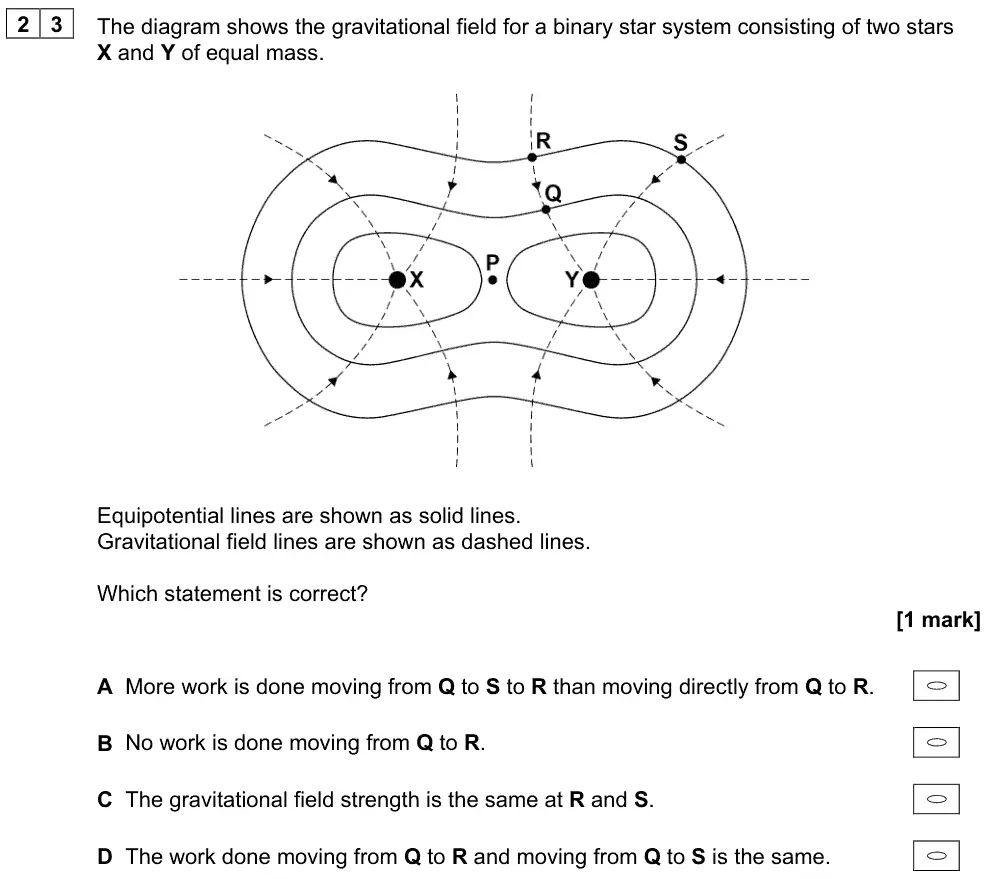
June 2024 · Paper 2 · Q23 1 mark Multiple choice gravitational fields
The diagram shows the gravitational field for a binary star system consisting of two stars
X and Y of equal mass.
Equipotential lines are shown as solid lines.
Gravitational field lines are shown as dashed lines.
Which statement is correct?
[1 mark]
A More work is done moving from Q to S to R than moving directly from Q to R.
B No work is done moving from Q to R.
C The gravitational field strength is the same at R and S.
D The work done moving from Q to R and moving from Q to S is the same.
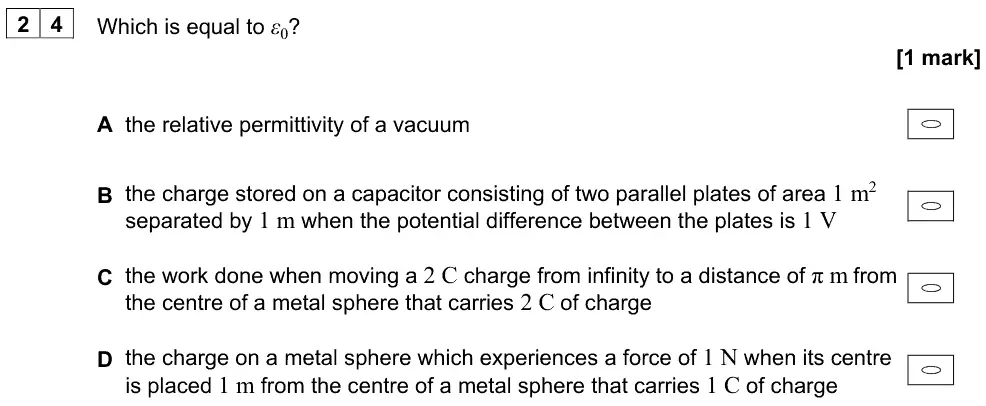
June 2024 · Paper 2 · Q24 1 mark Multiple choice capacitorselectric fields
Which is equal to ε0?
[1 mark]
A the relative permittivity of a vacuum
B the charge stored on a capacitor consisting of two parallel plates of area 1 m2
separated by 1 m when the potential difference between the plates is 1 V
C the work done when moving a 2 C charge from infinity to a distance of π m from
the centre of a metal sphere that carries 2 C of charge
D the charge on a metal sphere which experiences a force of 1 N when its centre
is placed 1 m from the centre of a metal sphere that carries 1 C of charge
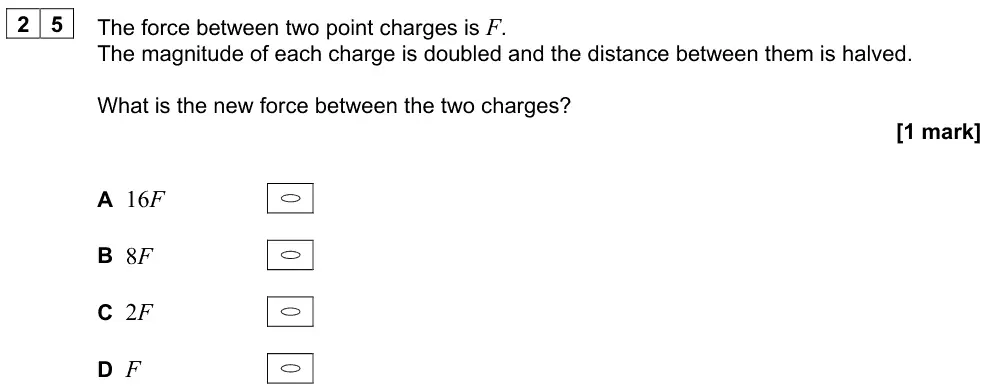
June 2024 · Paper 2 · Q25 1 mark Multiple choice electric fields
The force between two point charges is F.
The magnitude of each charge is doubled and the distance between them is halved.
What is the new force between the two charges?
[1 mark]
A 16F
B 8F
C 2F
D F
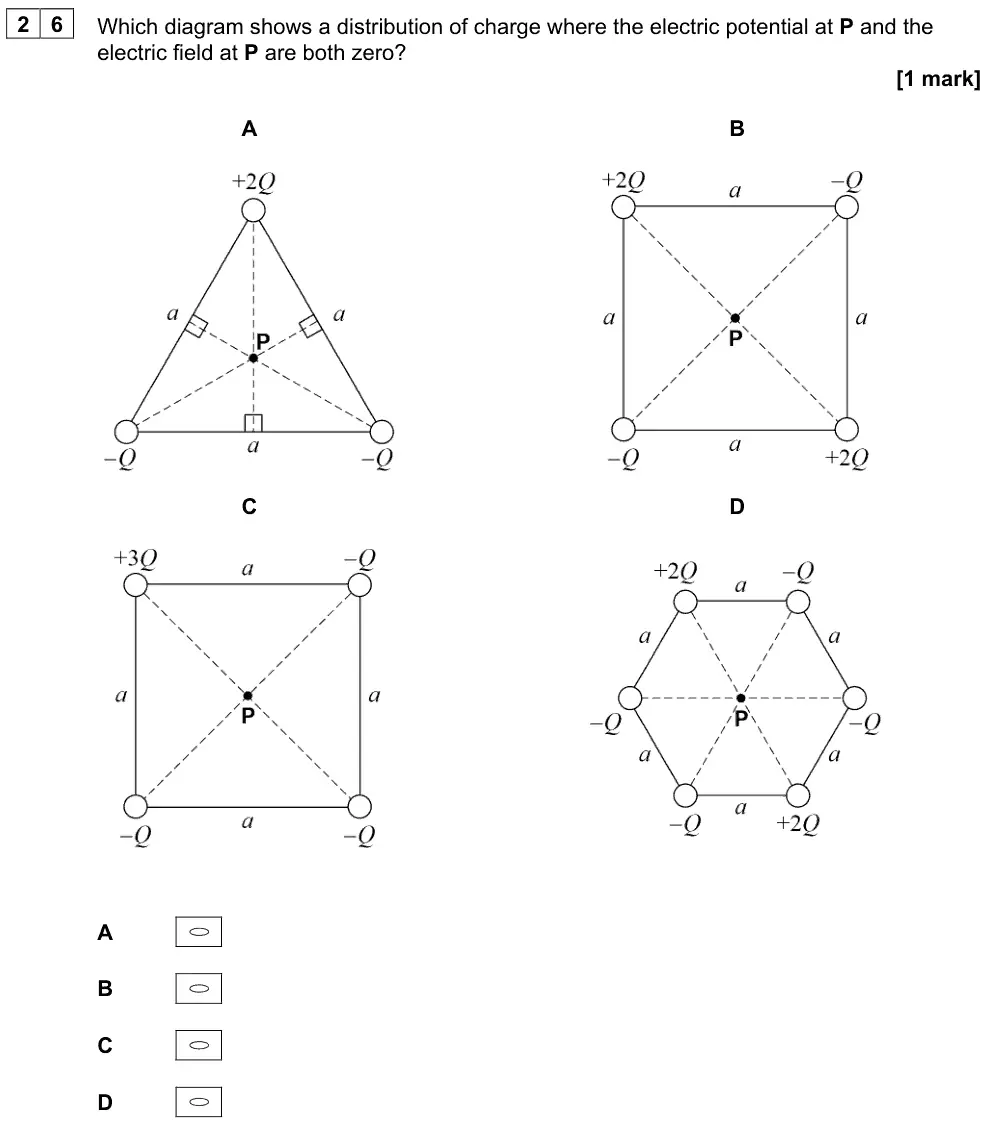
June 2024 · Paper 2 · Q26 1 mark Multiple choice electric fields
Which diagram shows a distribution of charge where the electric potential at P and the
electric field at P are both zero?
[1 mark]
A
B
C
D
A
B
C
D
June 2024 · Paper 2 · Q27 1 mark Multiple choice electric fields
An ion has a specific charge of −7.1 × 10⁷ C kg−1.
It is held stationary in a vertical electric field on the surface of the Earth.
What are the magnitude and direction of the electric field?
[1 mark]
A 1.38 × 10⁻⁷ V m−1 upwards
B 1.38 × 10⁻⁷ V m−1 downwards
C 7.24 × 10⁶ V m−1 upwards
D 7.24 × 10⁶ V m−1 downwards
Which particle pair has the largest magnitude of electrostatic force
June 2024 · Paper 2 · Q28 1 mark Multiple choice electric fields
Which particle pair has the largest magnitude of electrostatic force
gravitational force
when separated by
the same distance?
[1 mark]
A an electron and a positive pion
B a helium nucleus and a proton
C a proton and a positive pion
D a proton and an electron
June 2024 · Paper 2 · Q29 1 mark Multiple choice nuclear radiusrutherford scattering and radiation
What can be deduced about the radius r of a nucleus of gold from the scattering
of alpha particles by gold nuclei?
[1 mark]
A r < 10−14 m
B r < 10−15 m
C r ≈ 10−15 m
D r ≈ 10−16 m
June 2024 · Paper 2 · Q30 1 mark Multiple choice radioactive decay
The graph shows a plot of neutron number N against proton number Z for the known
atomic nuclei.
The nuclide 115 Rh
45
is likely to decay by
[1 mark]
A α emission.
B β+ emission.
C β− emission.
D electron capture.
June 2024 · Paper 2 · Q31 1 mark Multiple choice radioactive decay
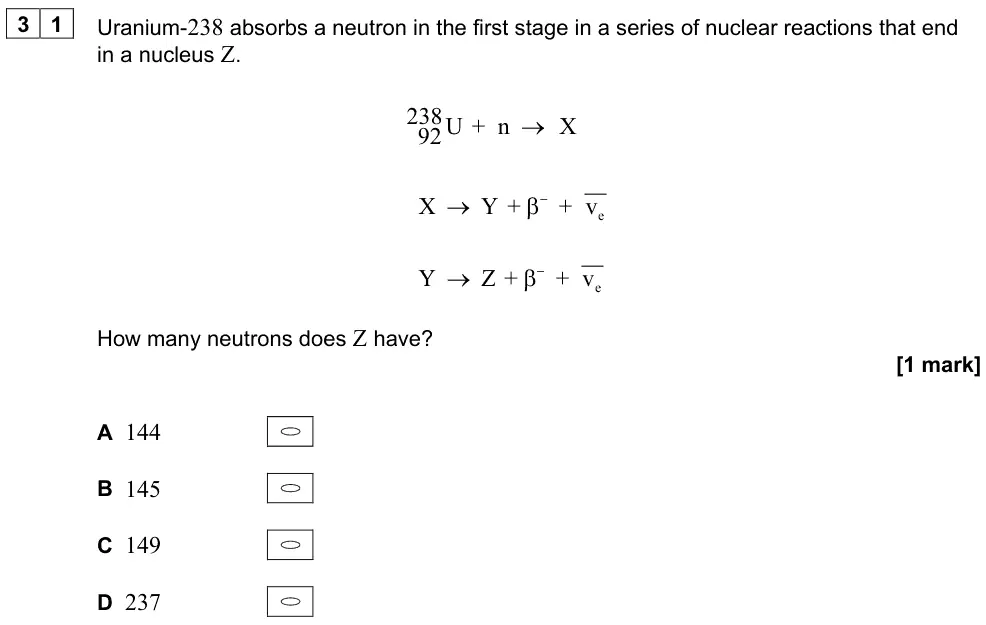
Uranium-238 absorbs a neutron in the first stage in a series of nuclear reactions that end
in a nucleus Z.
238U
n
X
92
+
→
e
X
Y
v
+
+
−
→
β
e
Y
Z
v
+
+
−
→
β
How many neutrons does Z have?
[1 mark]
A 144
B 145
C 149
D 237
June 2024 · Paper 2 · Q32 1 mark Multiple choice radioactive decay
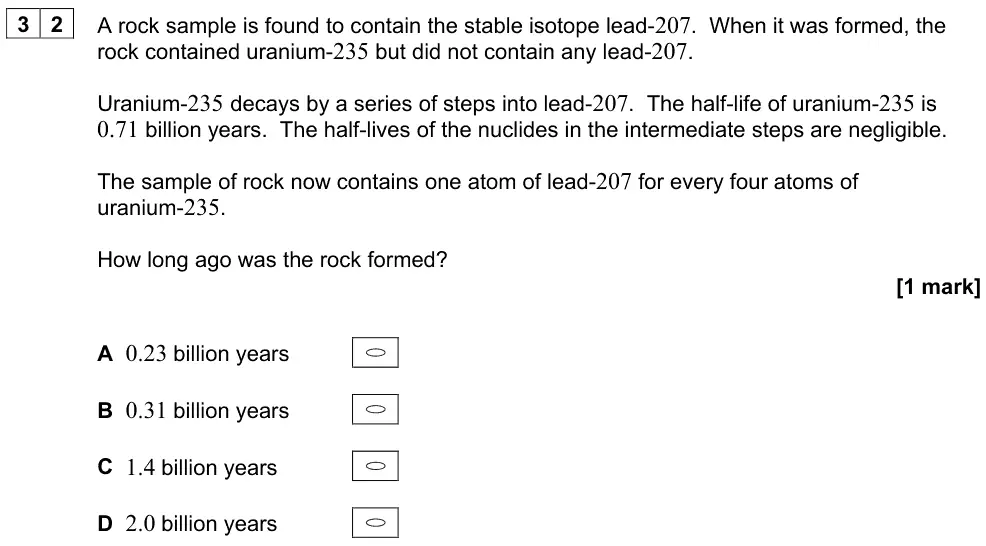
A rock sample is found to contain the stable isotope lead-207.  When it was formed, the
rock contained uranium-235 but did not contain any lead-207.
Uranium-235 decays by a series of steps into lead-207.  The half-life of uranium-235 is
0.71 billion years.  The half-lives of the nuclides in the intermediate steps are negligible.
The sample of rock now contains one atom of lead-207 for every four atoms of
uranium-235.
How long ago was the rock formed?
[1 mark]
A 0.23 billion years
B 0.31 billion years
C 1.4 billion years
D 2.0 billion years

Work with an AQA physics tutor

Want a paper marked and gone through with you? Message us.

Prefer email? Send an enquiry

If you are under 18, please include a parent's contact details. Enquiries go to enquiries@physicsaleveltutor.com and are deleted once handled. All tutoring is online.