Mark scheme
Examiner's comment
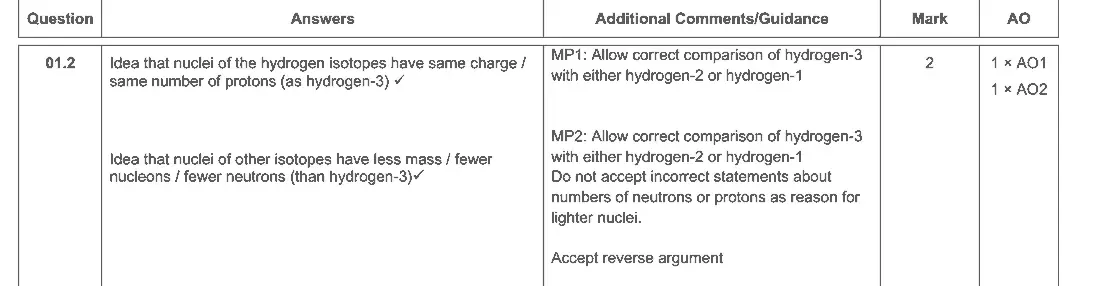
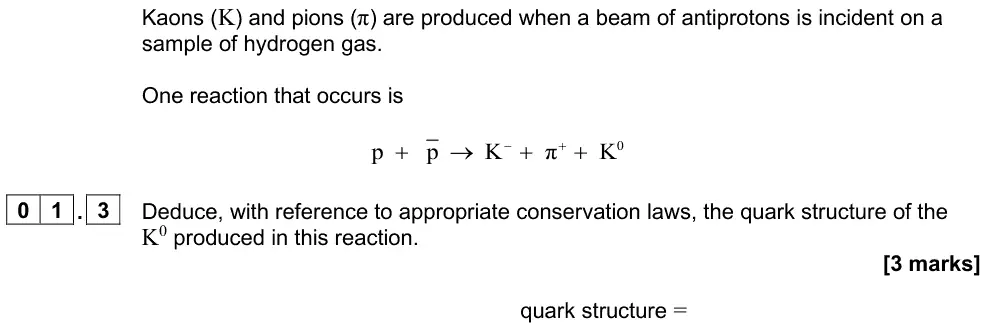
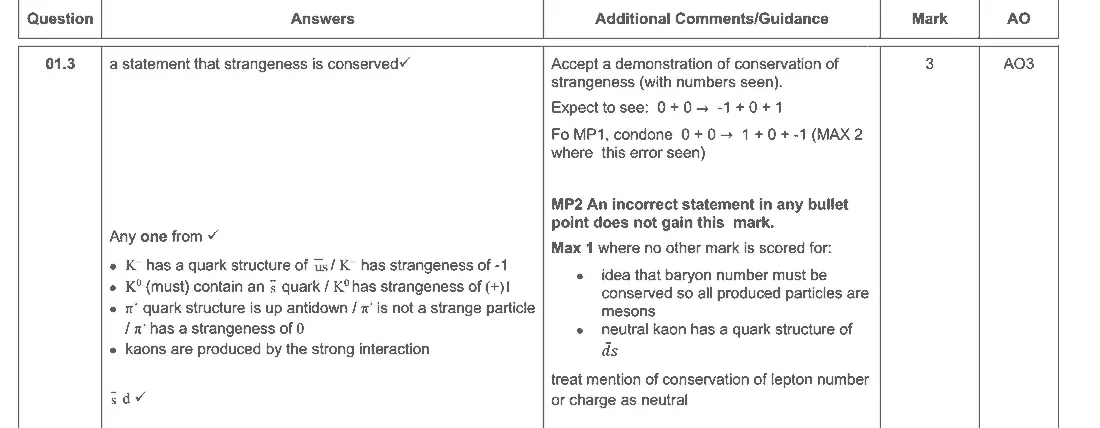
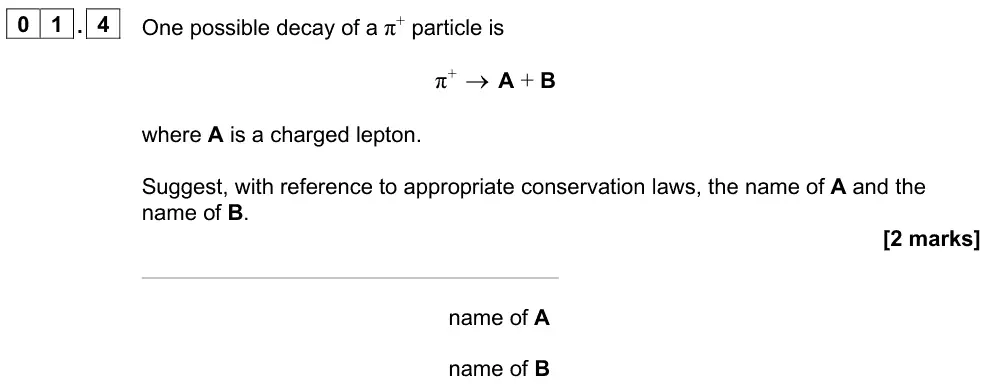
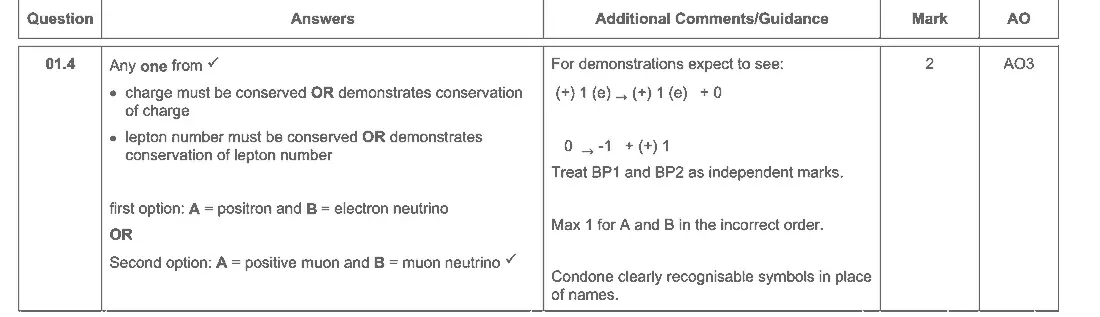
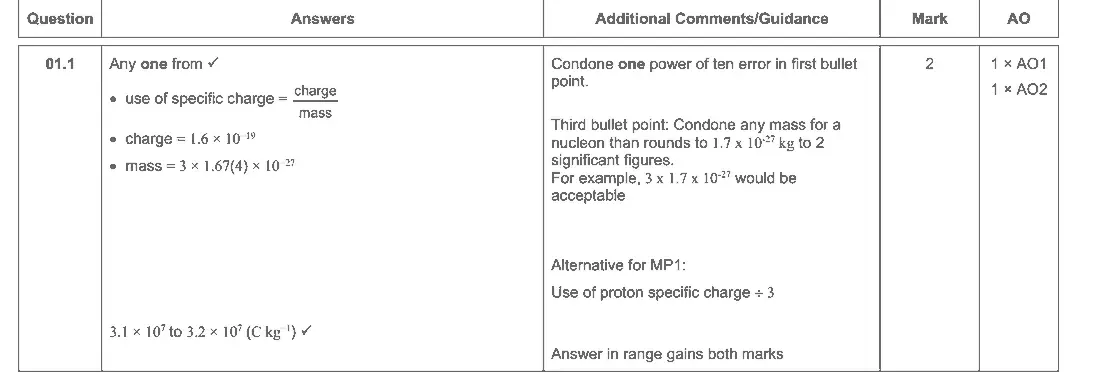
01.1 Most students performed well in this straightforward calculation, with over 65% achieving full marks and a further 20% securing one mark. Common misconceptions included: reversing the required ratio by dividing mass by charge, despite the unit (C kg–1 ) • provided on the answer line. incorrectly using the relative mass and charge values of 1 for a proton rather than the • actual values. misjudging the magnitude; some students incorrectly rewrote 3.2 × 10⁷ as 3.2 × 10⁻⁷ , • believing the initial result was implausibly large. 01.2 Over 80% of students gained at least one mark, though only about 40% were able to produce an answer that gained both marks. Common deficiencies in answers included: discussing differences in mass between isotopes without noting that the charge • remains constant. identifying that isotopes have different numbers of neutrons but neglecting to deduce, • either from previous knowledge or the information in the question, that hydrogen-3 has more neutrons. not recognising hydrogen-1 as an isotope limiting their comparisons to hydrogen-3 and • hydrogen-2 (although these students were able to gain both marks where appropriate working that mentioned charge and mass was seen). 01.3 Approximately 40% of students correctly deduced and justified the quark structure of this neutral kaon (s̅d). A further 20% gained two marks, typically by: stating the correct structure but neglecting to provide the supporting reasoning. • correctly identifying the presence of a strange quark but omitting the understanding • that a kaon is a meson. 01.4 Higher performing students (approximately 40%) were able to answer this question by realising that conservation of lepton number occurs within each generation and that particle A must be an antilepton due to it carrying a positive charge. stating that charge must be conserved. • a general statement that lepton number is conserved without realising that this is true • within each lepton generation. Common incorrect responses for A and B included: an incorrect lepton-antilepton combination such as electron and electron • antineutrino, through not applying conservation of charge. quoting A as a positron but then quoting B as an electron antineutrino, through not • realising that both are antiparticles.
Notes from the mark scheme and report
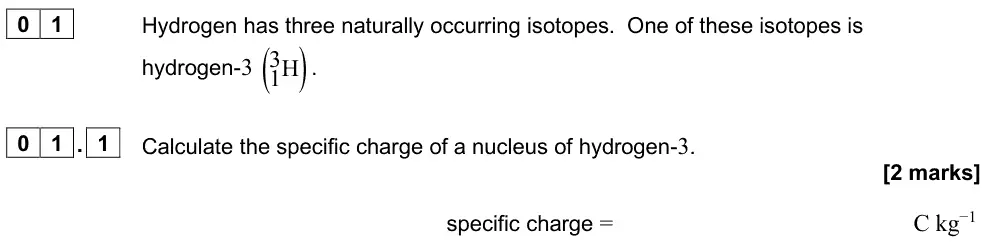
- Answer: 3.2 x 10^7 C kg^-1 (1.6 x 10^-19 / (3 x 1.67 x 10^-27))
- inverting the ratio or using relative values 1 were common errors
Skills: MS2.3 Substitute numerical values into algebraic equations using appropriate units for physical quantities; MS0.2 Recognise and use expressions in decimal and standard form