June 2025: Paper 2

85 marks · 50 question parts · Paper, mark scheme and report on AQA's site · Have the data and formulae booklet beside you

Question by question

QTopicMarksAOType
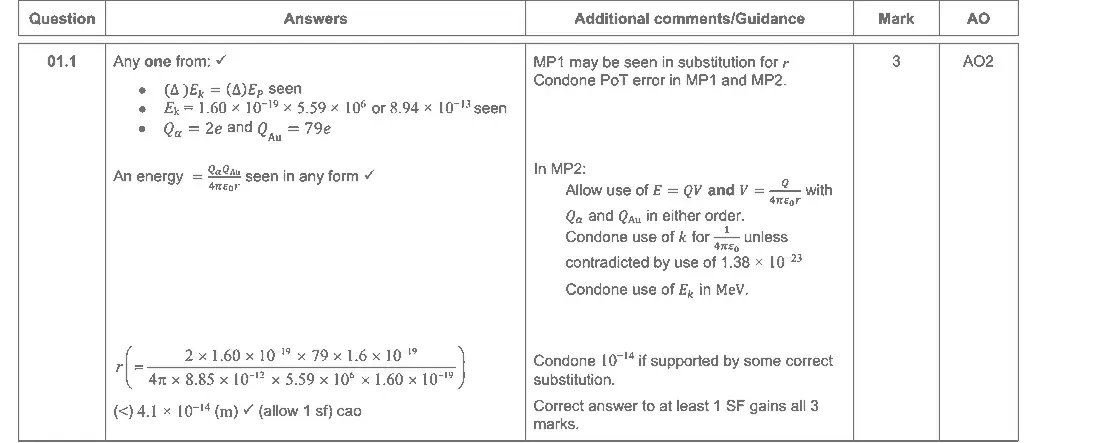
1.1 Nuclear radius 3AO2=3Calculation
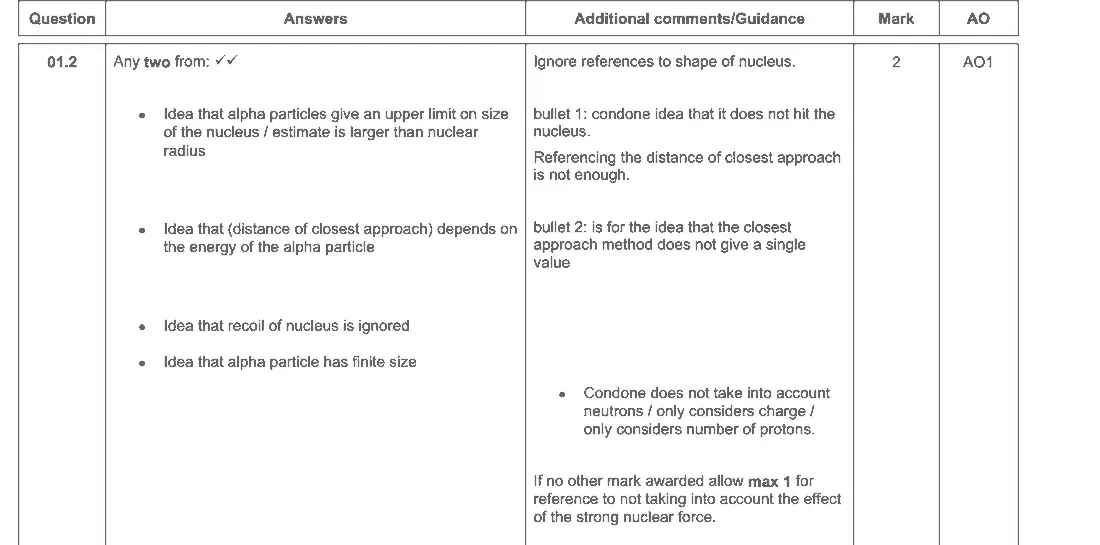
1.2 Nuclear radius 2AO1=2Explanation
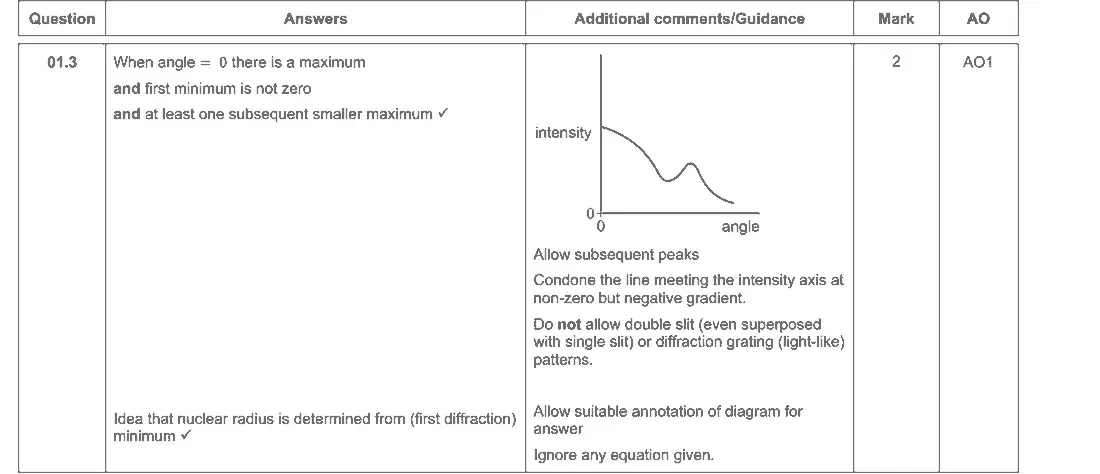
1.3 Nuclear radius 2AO1=2Diagram or graph
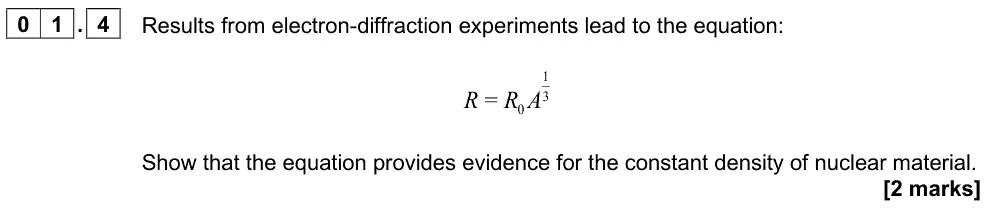
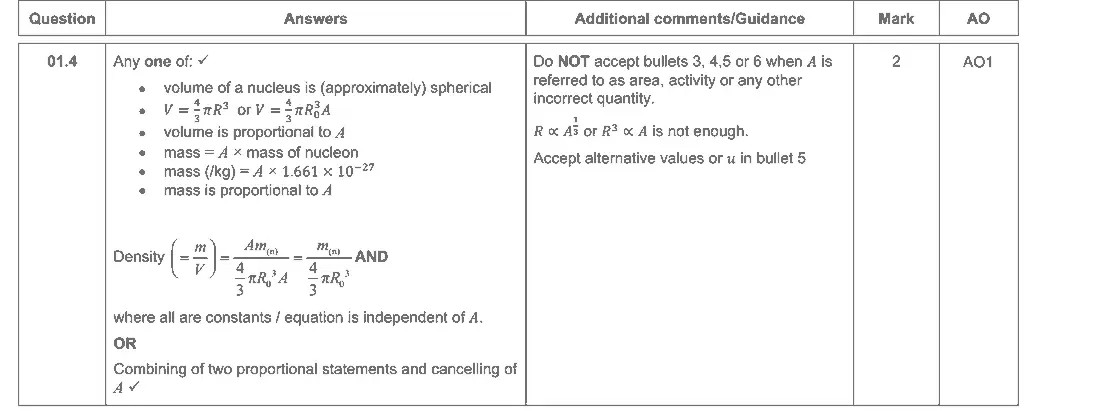
1.4 Nuclear radius 2AO1=2Show that
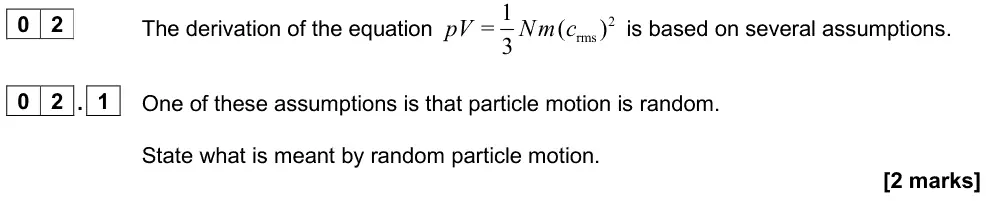
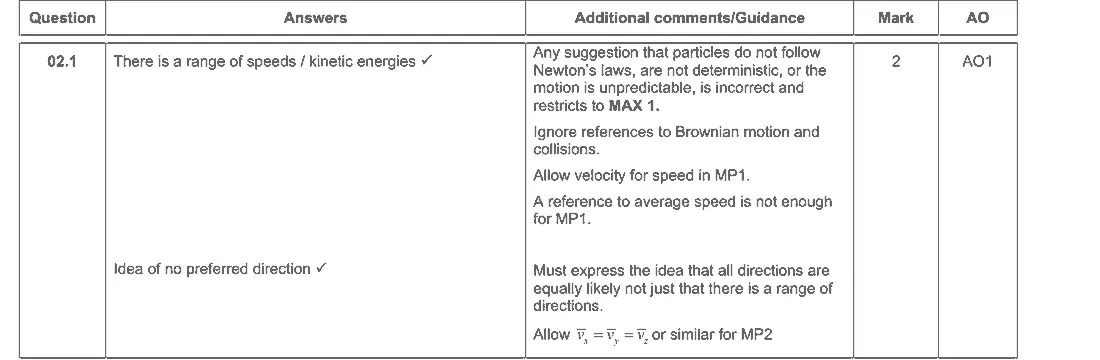
2.1 Molecular kinetic theory 2AO1=2Short answer
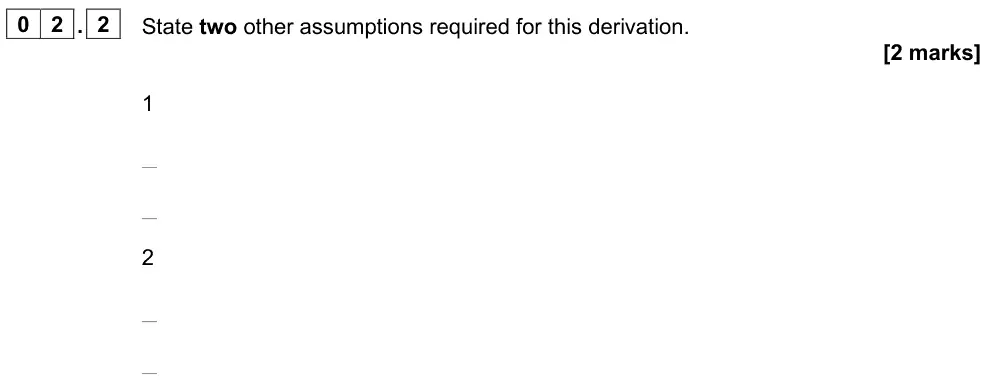
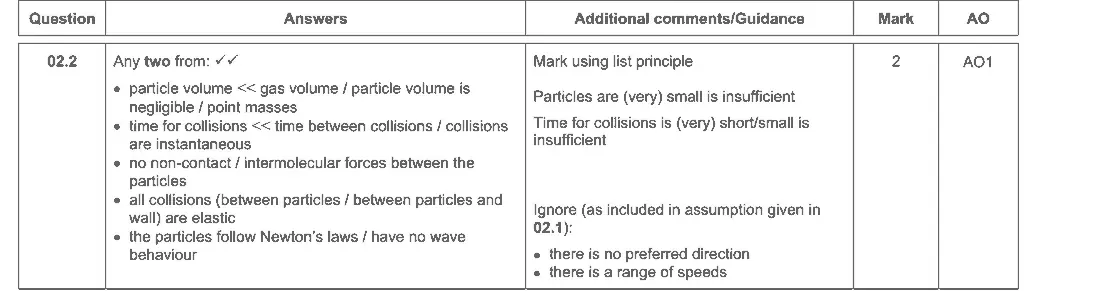
2.2 Molecular kinetic theory 2AO1=2Short answer
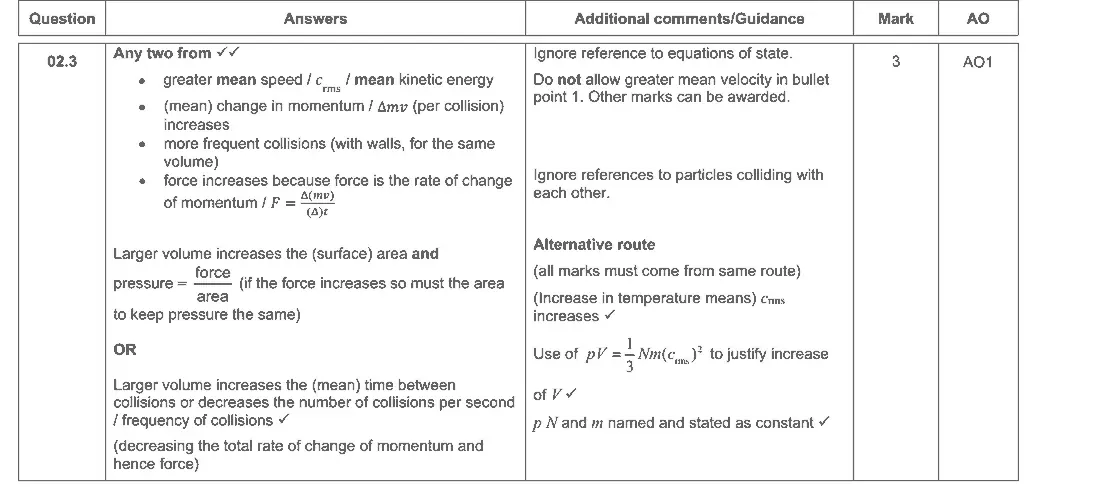
2.3 Molecular kinetic theory 3AO1=3Explanation
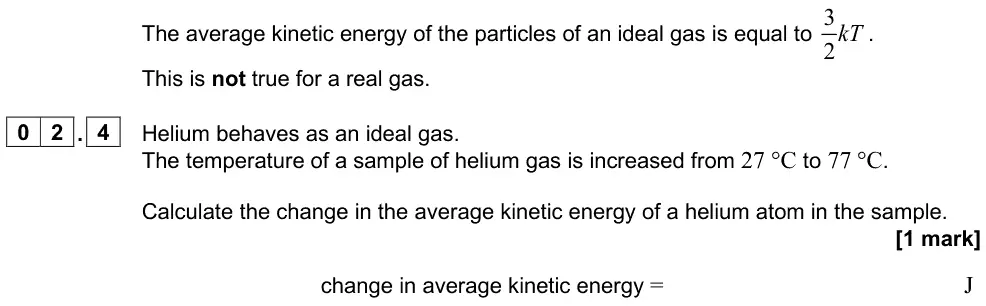
2.4 Molecular kinetic theory 1AO2=1Calculation
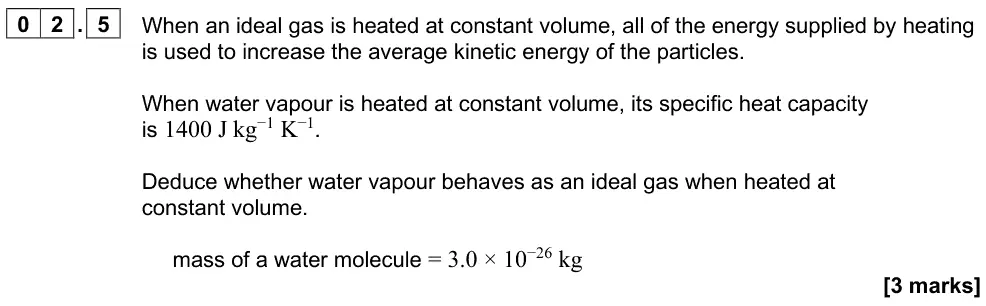
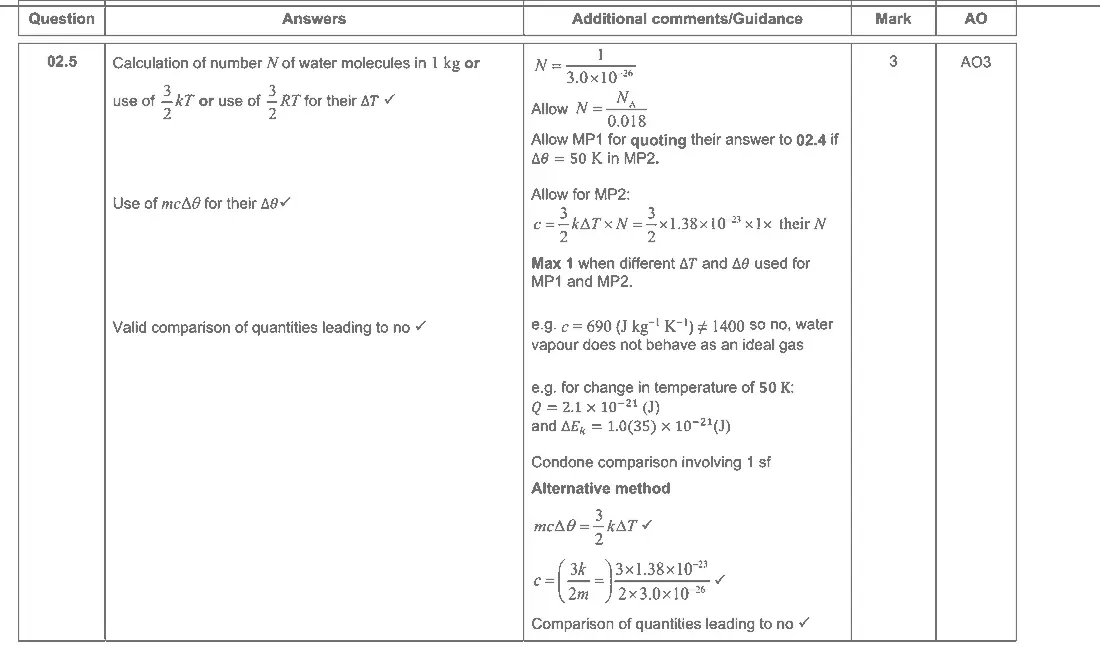
2.5 Molecular kinetic theory, Thermal energy transfer and ideal gases 3AO3=3Calculation
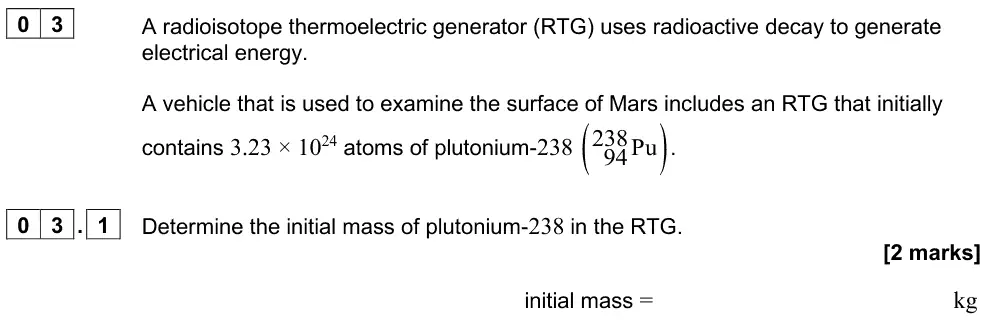
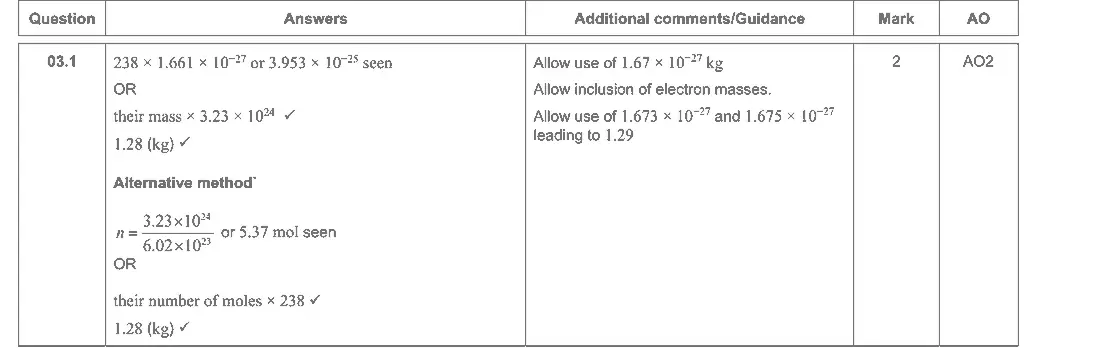
3.1 Radioactive decay, half-life and nuclear instability, Mass and energy, binding energy, fission and safety 2AO2=2Calculation
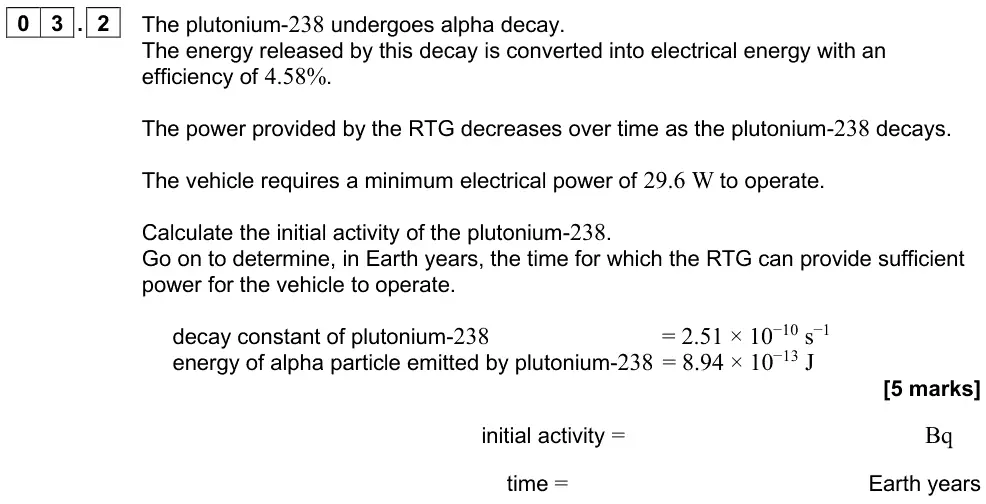
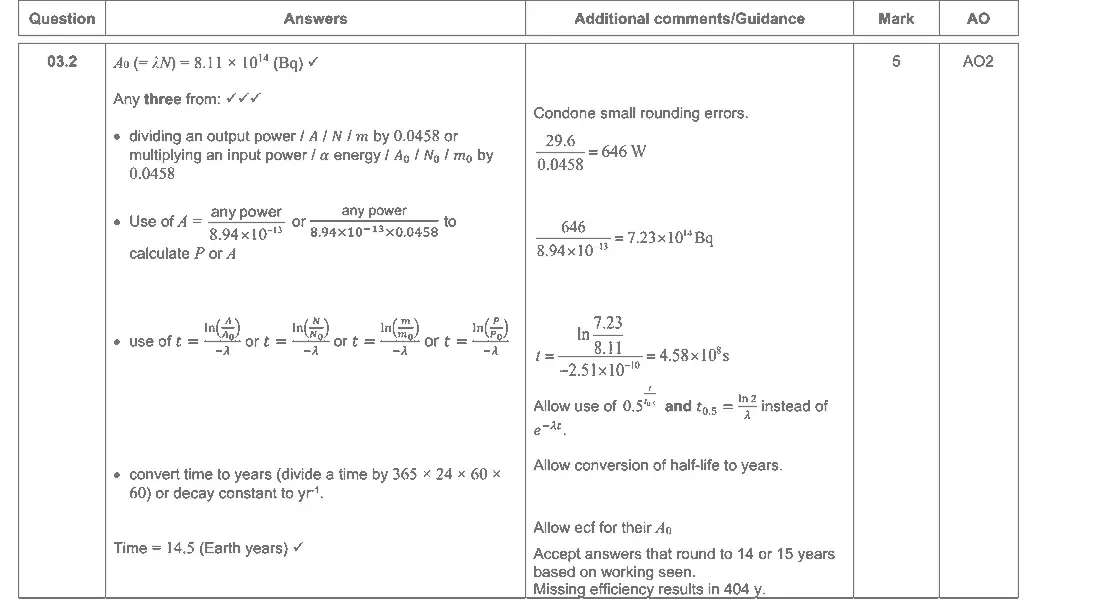
3.2 Radioactive decay, half-life and nuclear instability 5AO2=5Calculation
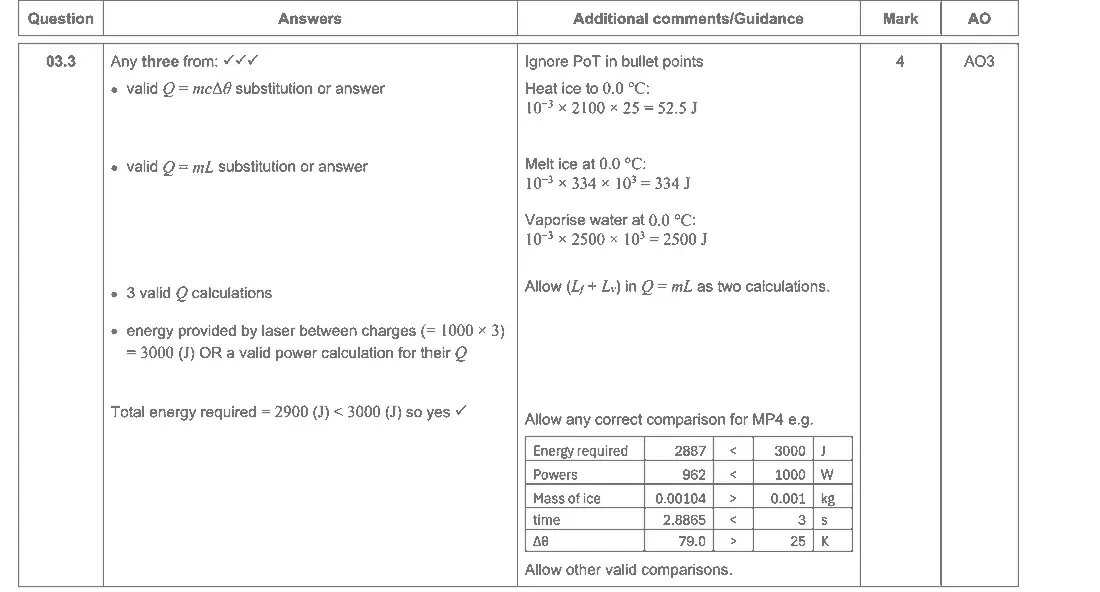
3.3 Thermal energy transfer and ideal gases 4AO3=4Calculation
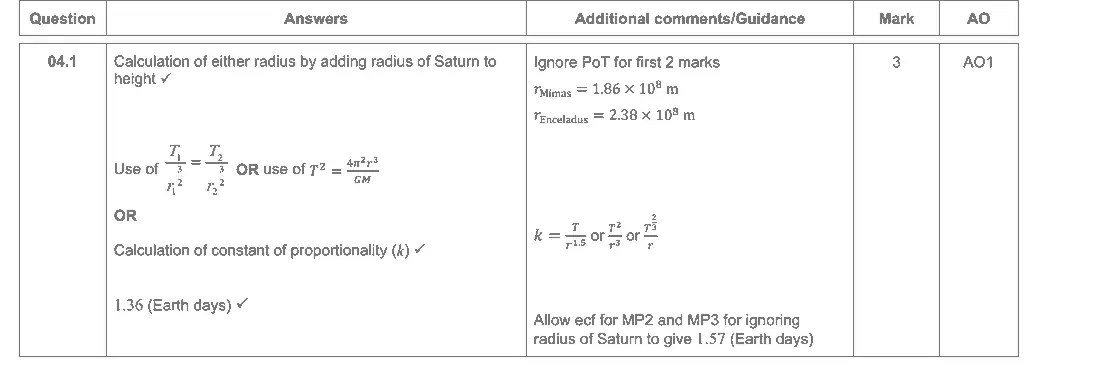
4.1 Gravitational fields and orbits 3AO1=3Calculation
4.2 Gravitational fields and orbits 1AO1=1Short answer
4.3 Gravitational fields and orbits 1AO2=1Short answer
4.4 Gravitational fields and orbits 3AO2=3Calculation
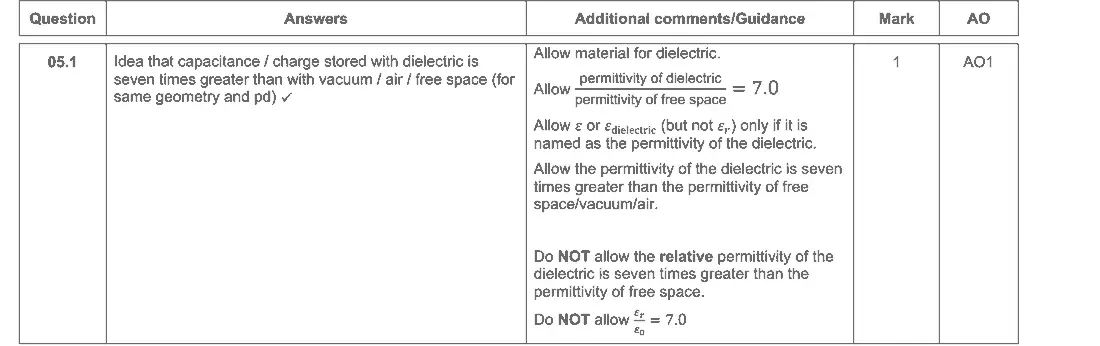
5.1 Capacitance and capacitor charge and discharge 1AO1=1Short answer
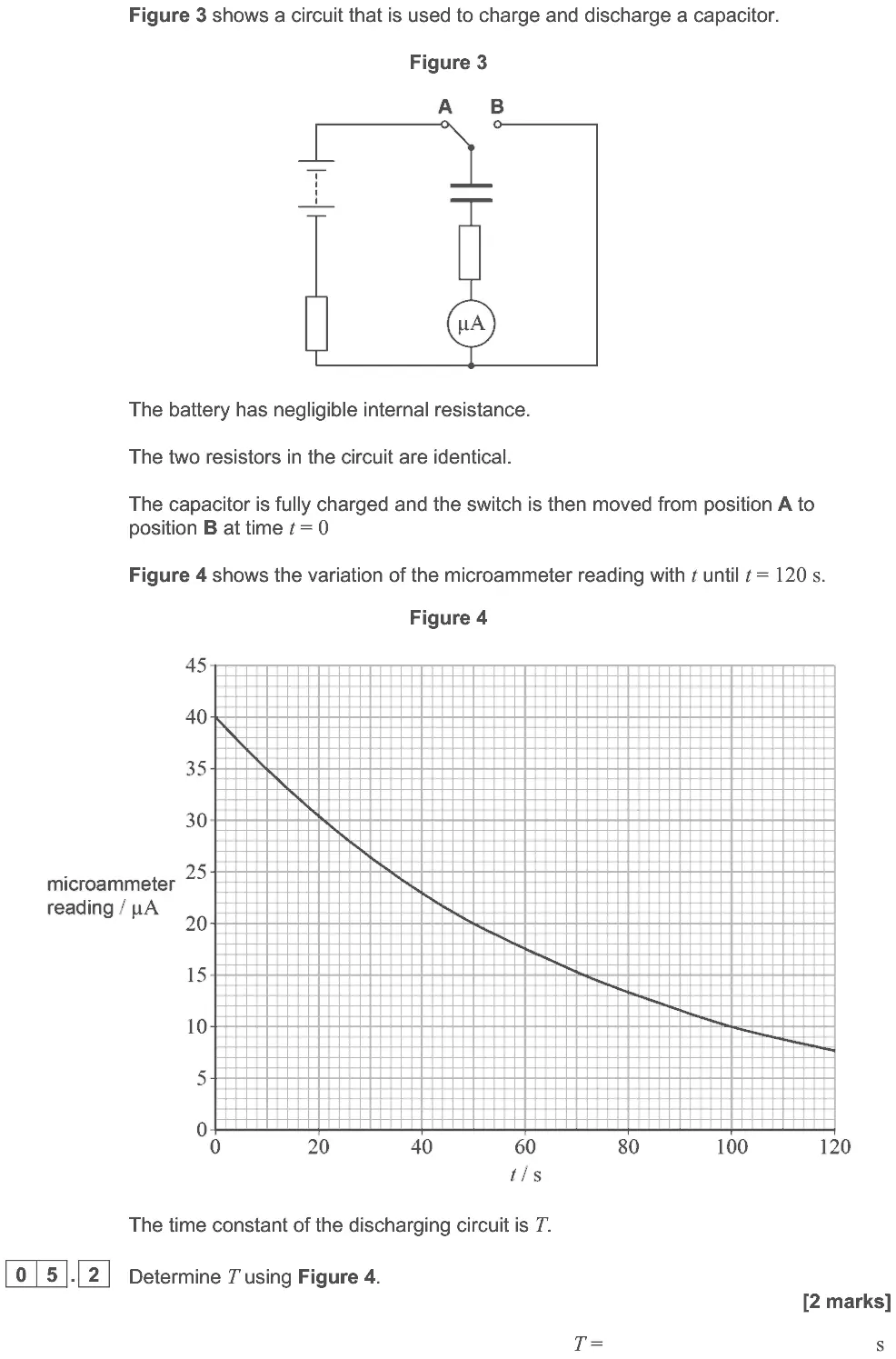
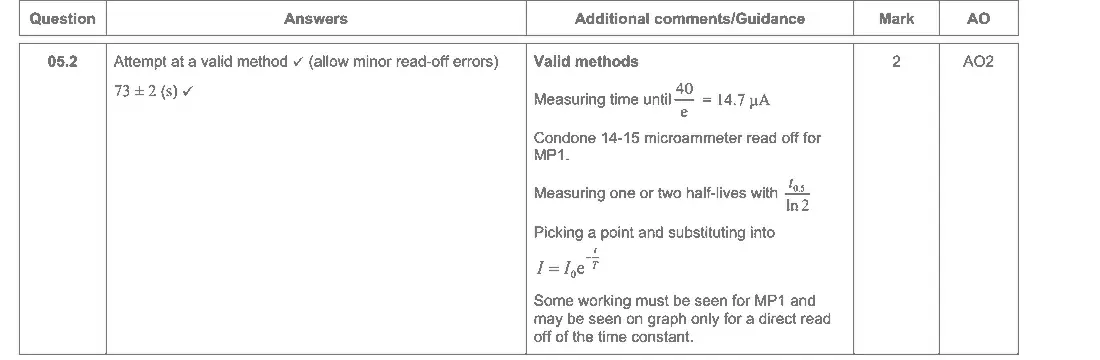
5.2 Capacitance and capacitor charge and discharge 2AO2=2Calculation
5.3 Capacitance and capacitor charge and discharge 2AO1=1,AO2=1Calculation
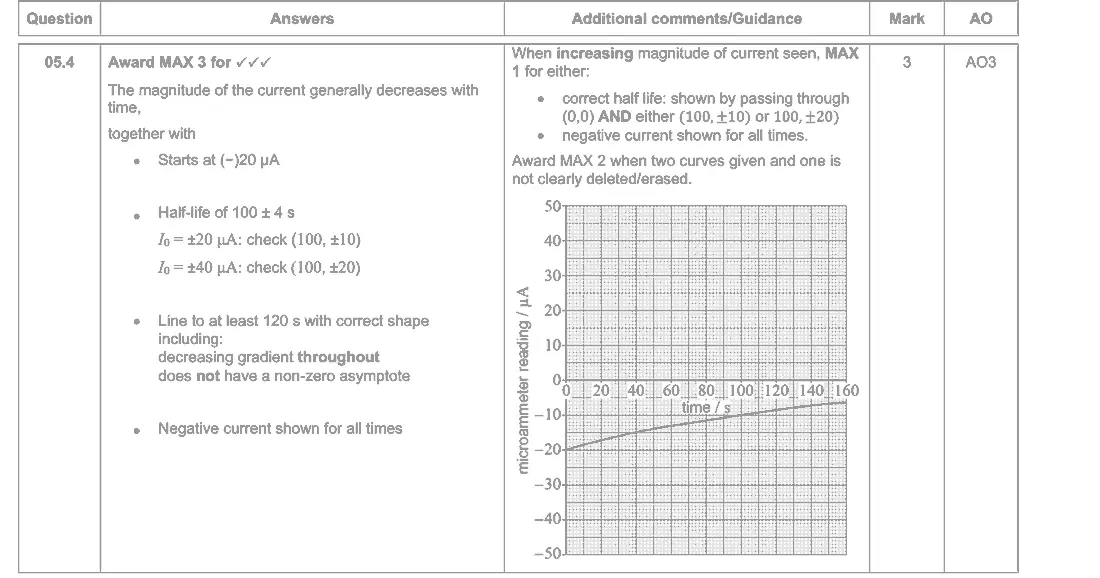
5.4 Capacitance and capacitor charge and discharge 3AO3=3Diagram or graph
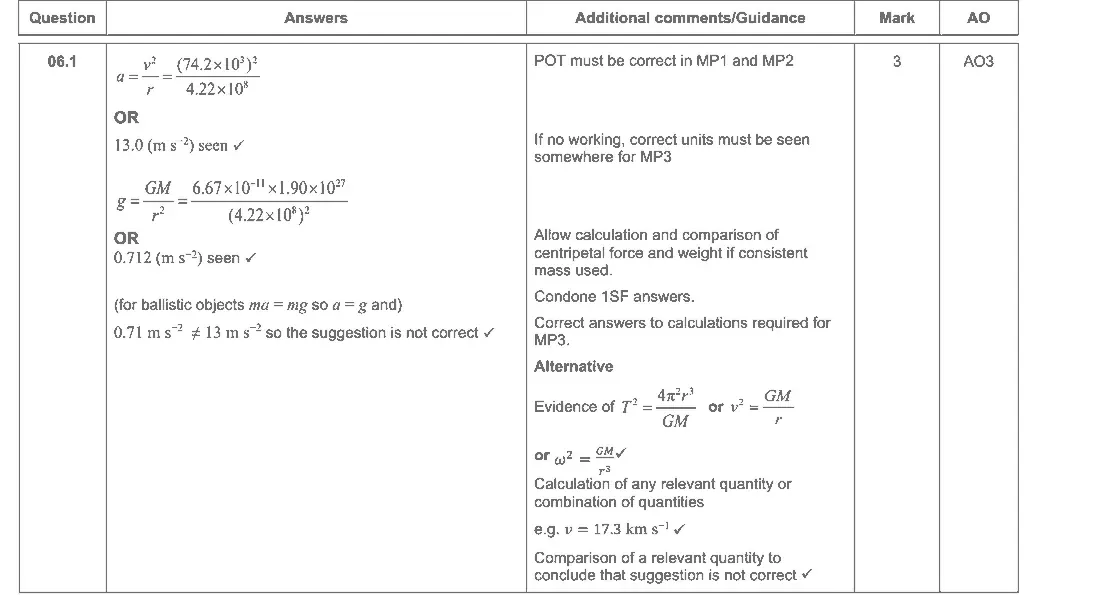
6.1 Circular motion, Gravitational fields and orbits 3AO3=3Calculation
6.2 Magnetic flux density and moving charges in a magnetic field 1AO2=1Diagram or graph
6.3 Magnetic flux density and moving charges in a magnetic field 3AO1=1,AO2=2Calculation
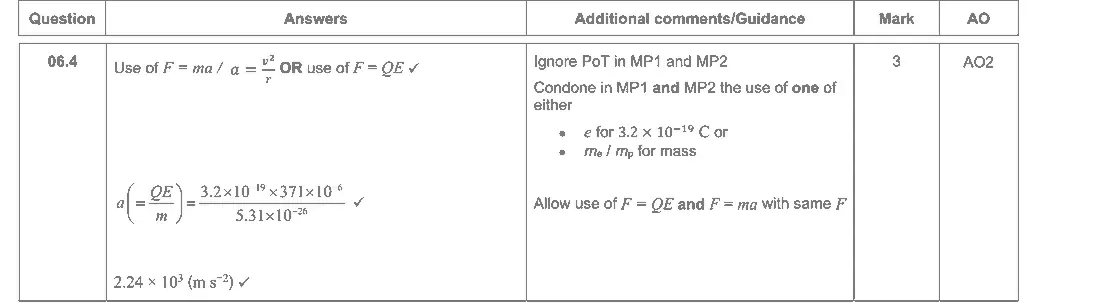
6.4 Electric fields and electric potential 3AO2=3Calculation
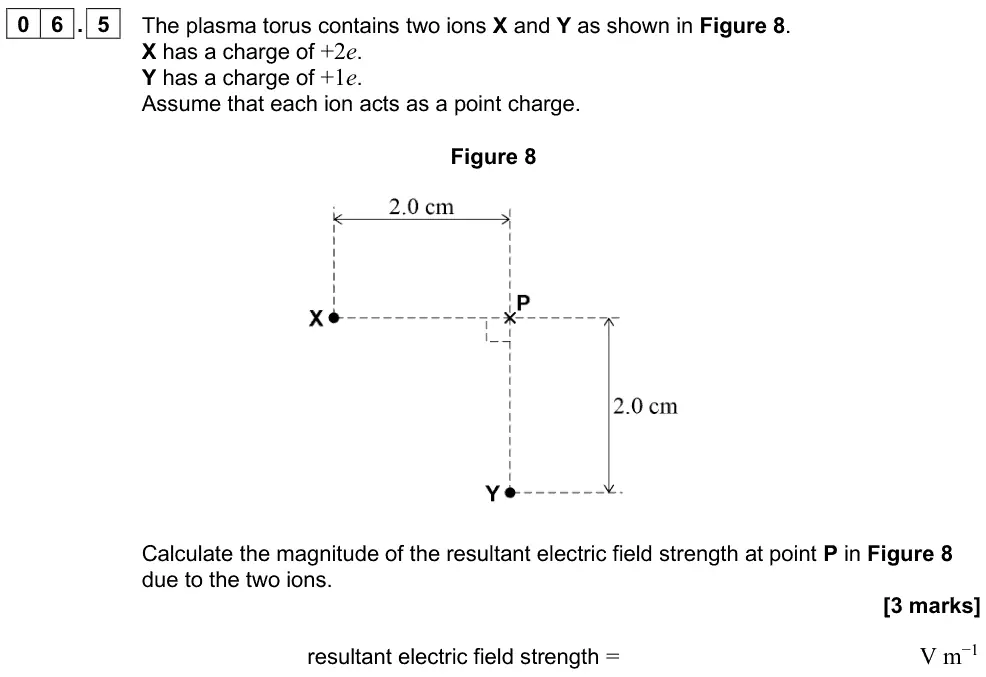
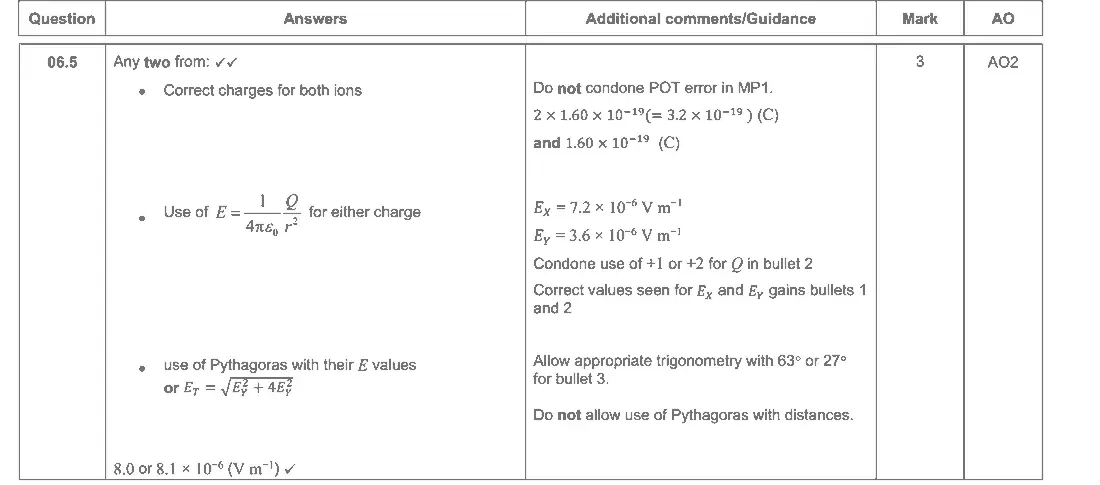
6.5 Electric fields and electric potential, Scalars, vectors and moments 3AO2=3Calculation
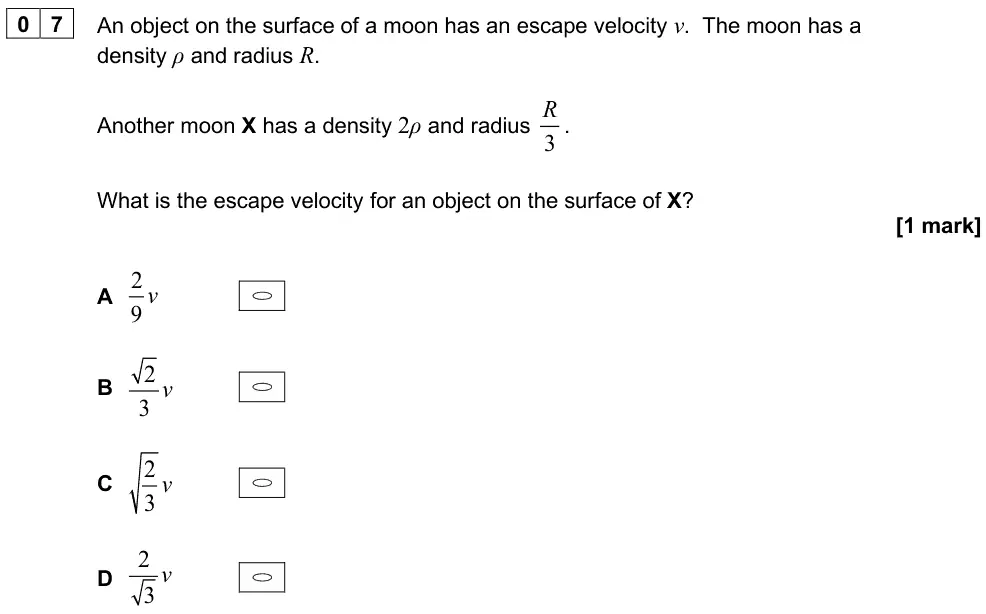
7 Gravitational fields and orbits 1AO2=1Multiple choice
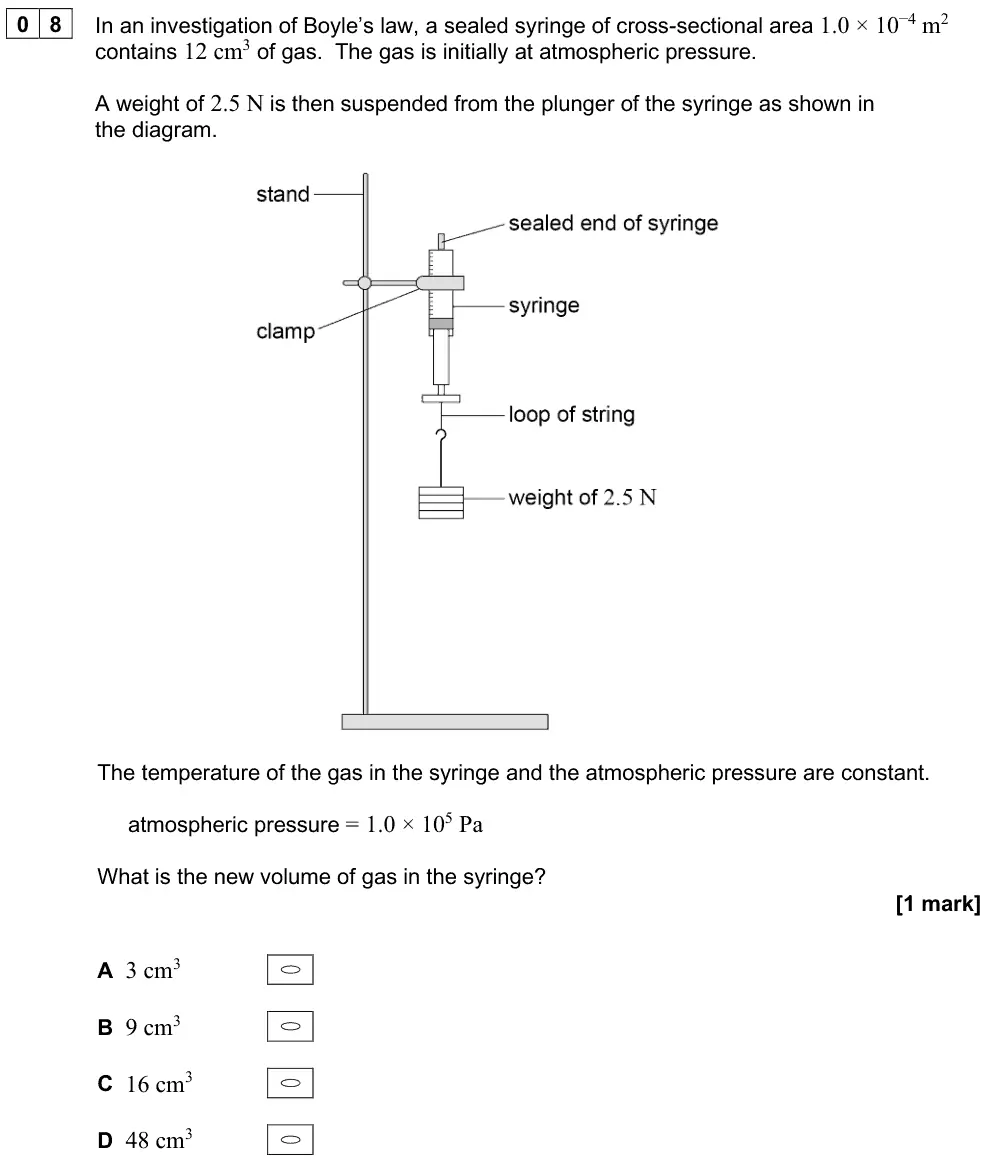
8 Thermal energy transfer and ideal gases 1AO2=1Multiple choice
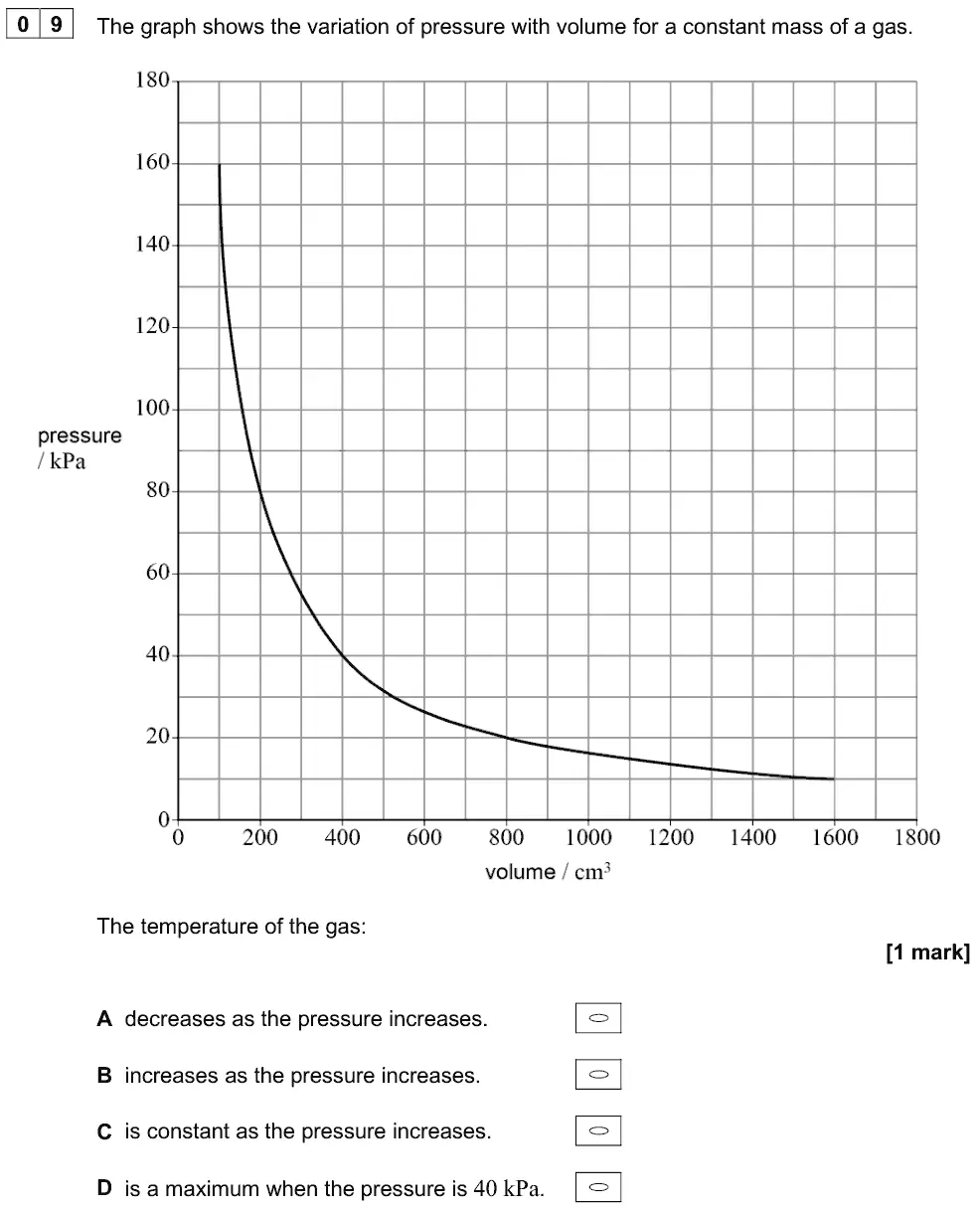
9 Thermal energy transfer and ideal gases 1AO2=1Multiple choice
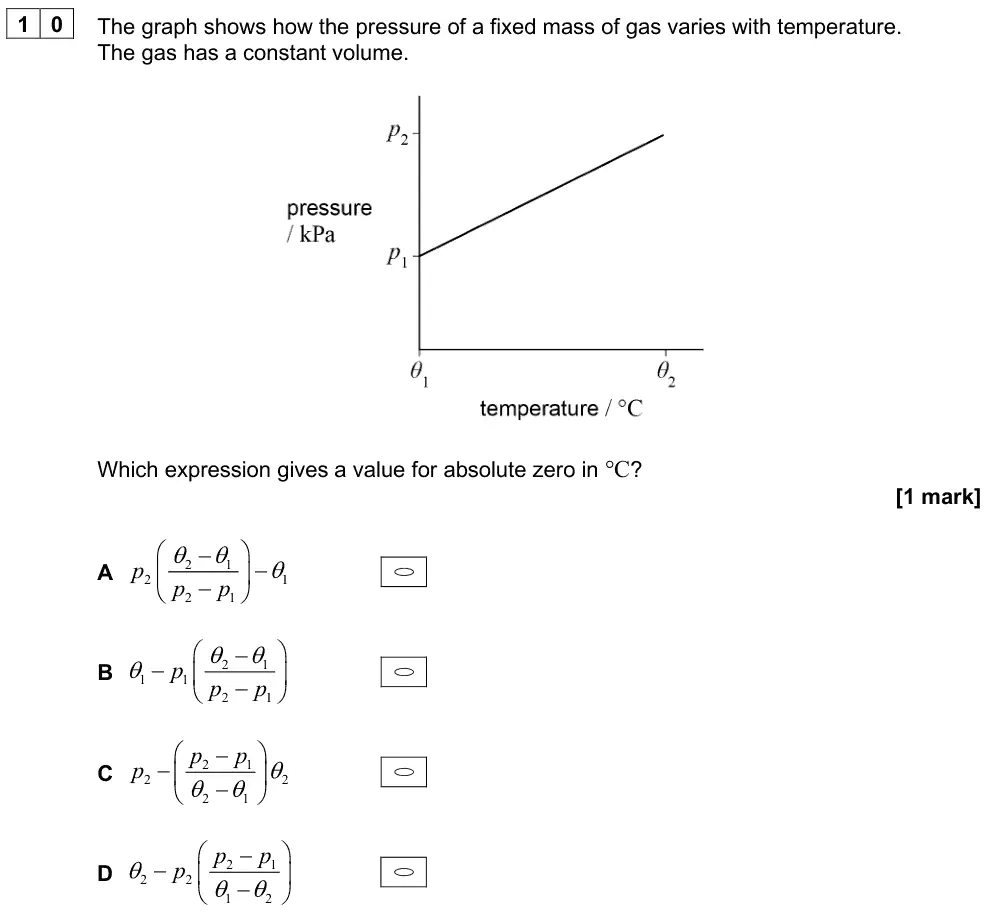
10 Thermal energy transfer and ideal gases 1AO2=1Multiple choice
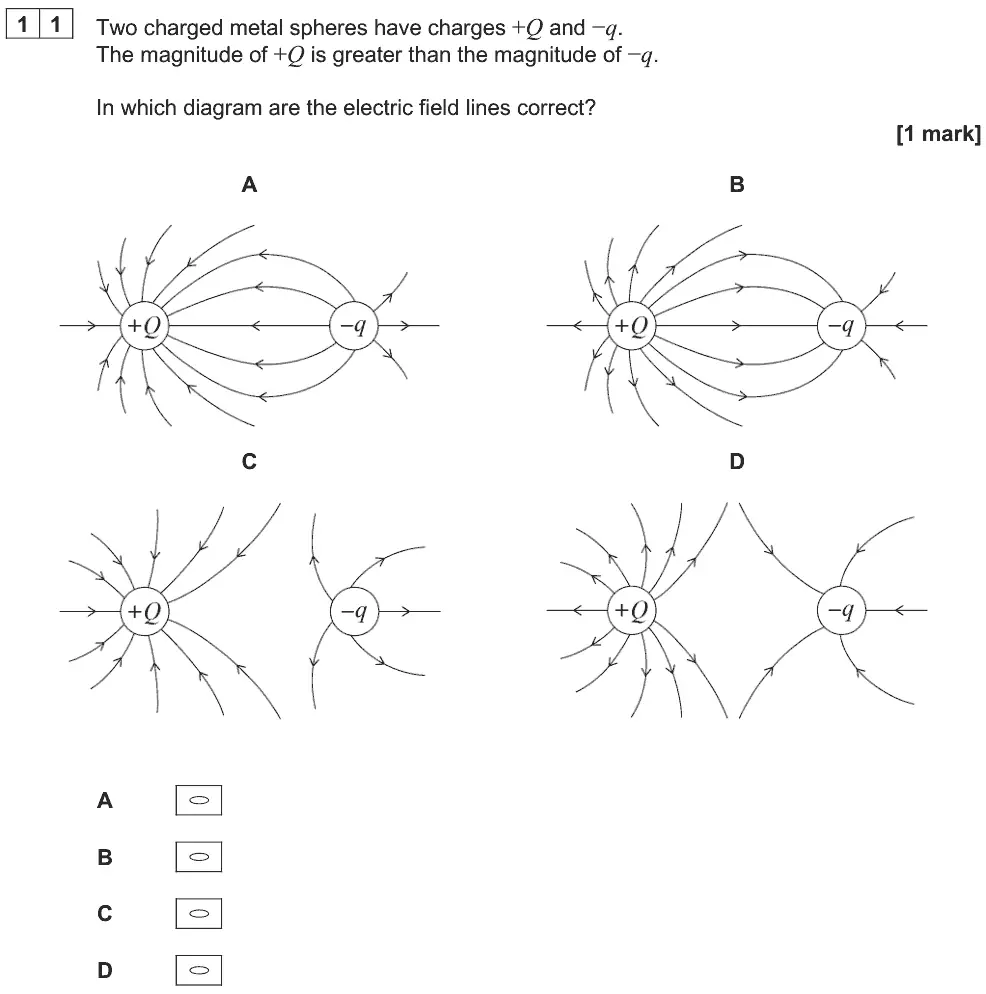
11 Electric fields and electric potential 1AO2=1Multiple choice
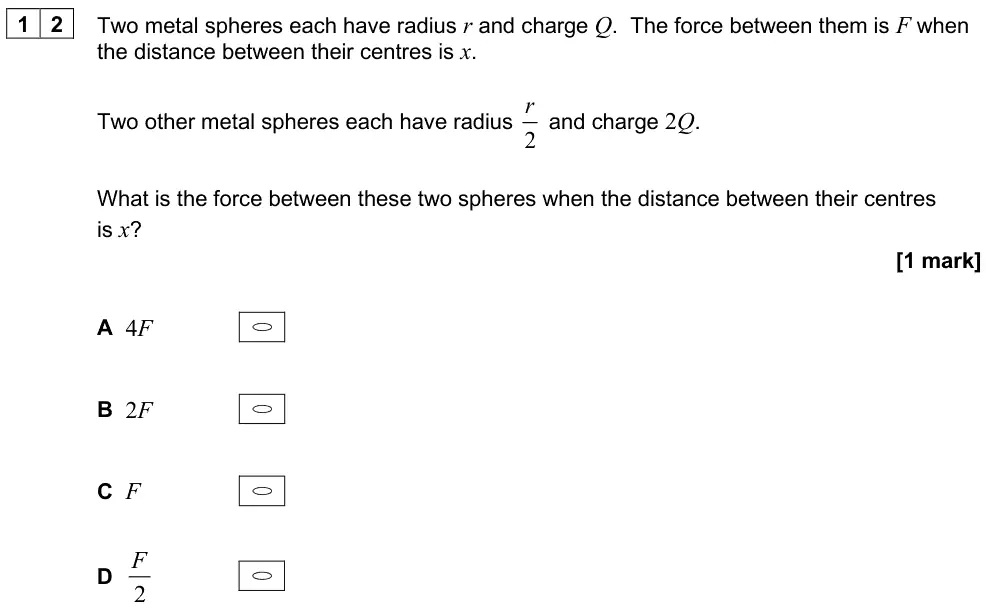
12 Electric fields and electric potential 1AO2=1Multiple choice
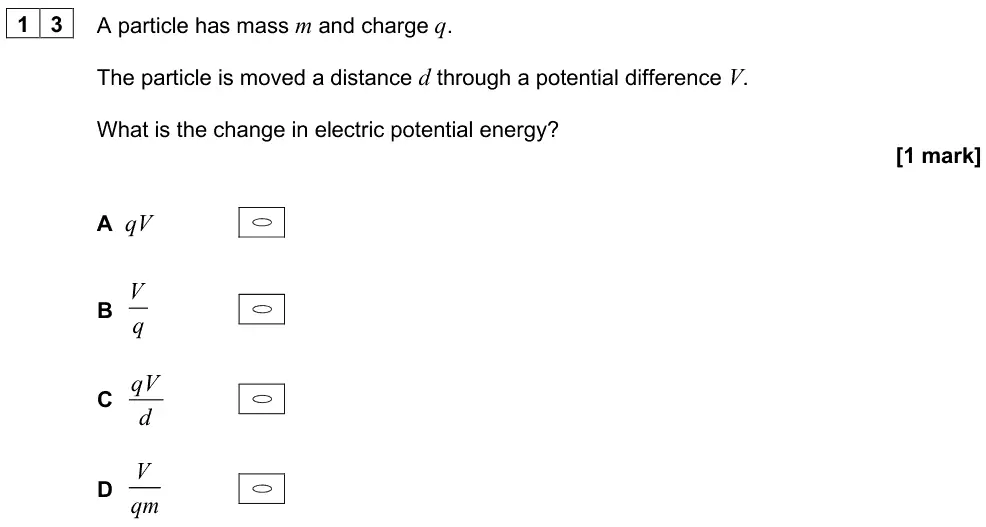
13 Electric fields and electric potential 1AO1=1Multiple choice
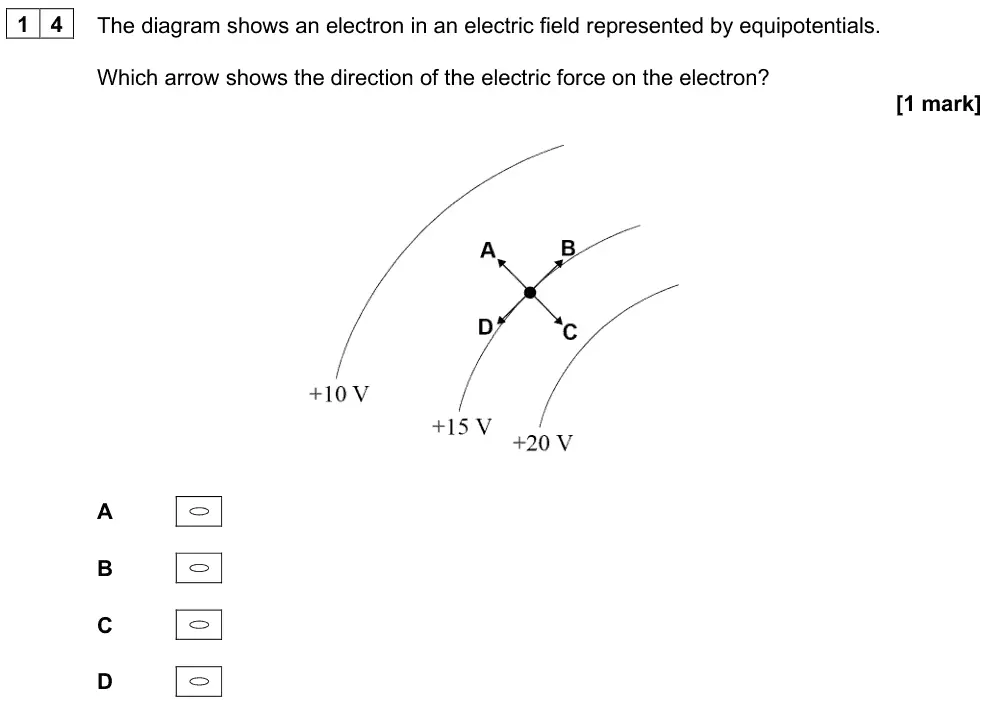
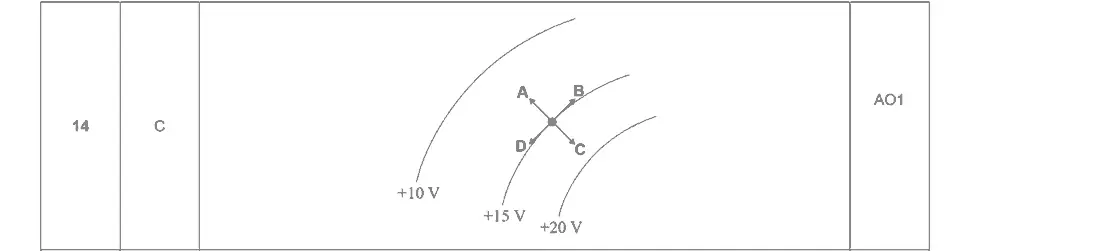
14 Electric fields and electric potential 1AO1=1Multiple choice
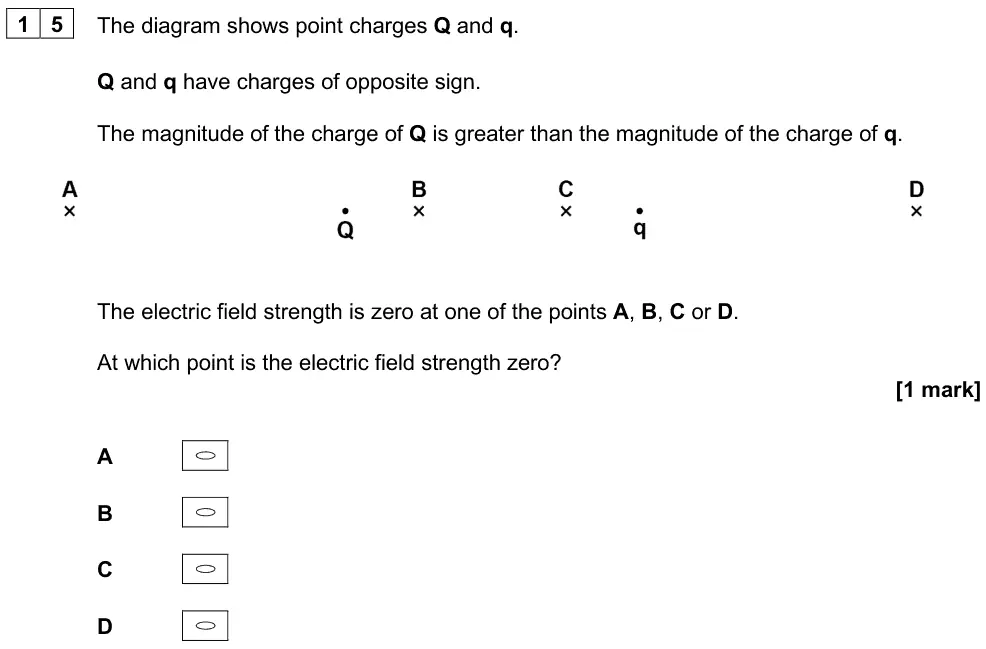
15 Electric fields and electric potential 1AO2=1Multiple choice
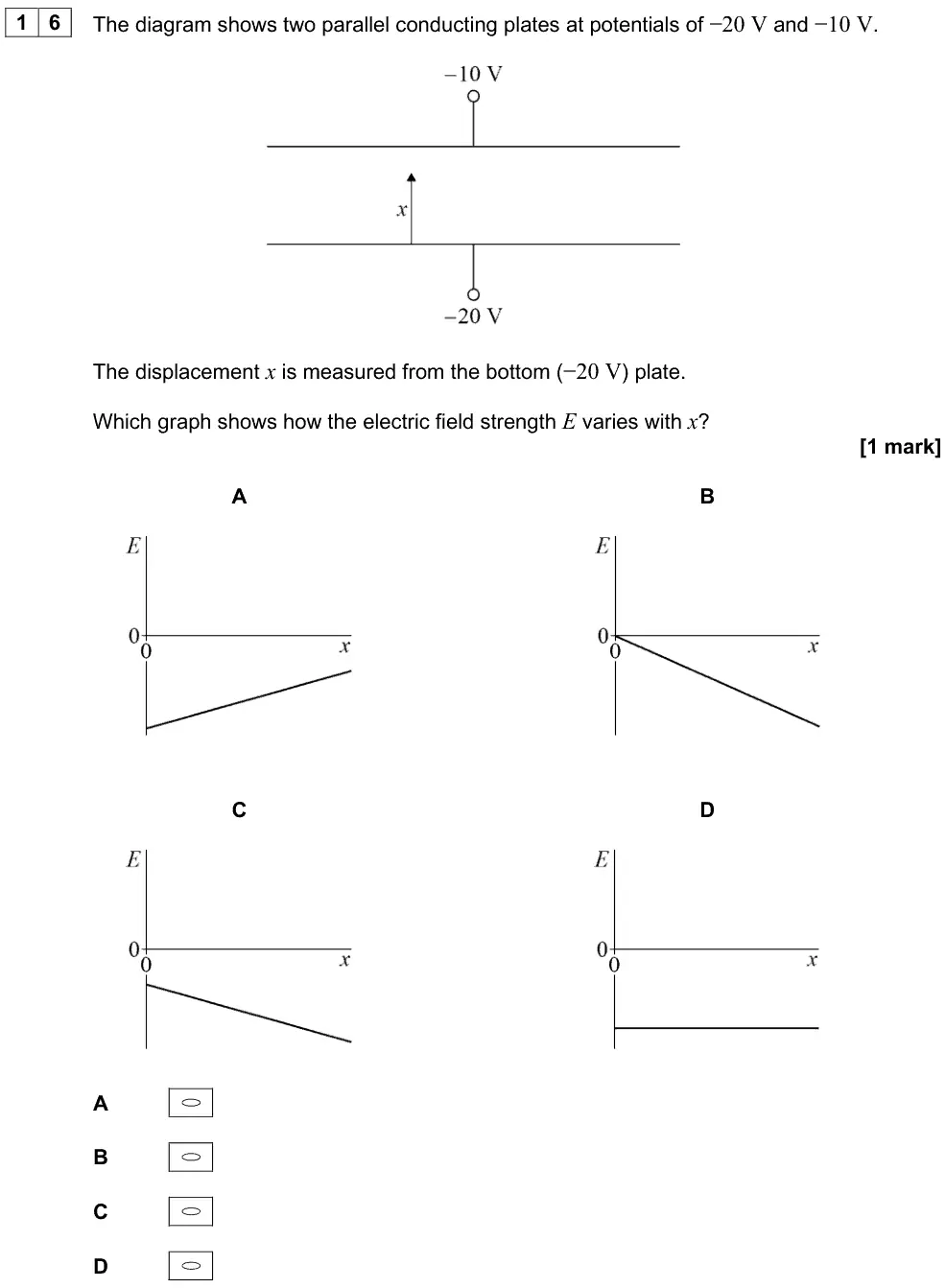
16 Electric fields and electric potential 1AO1=1Multiple choice
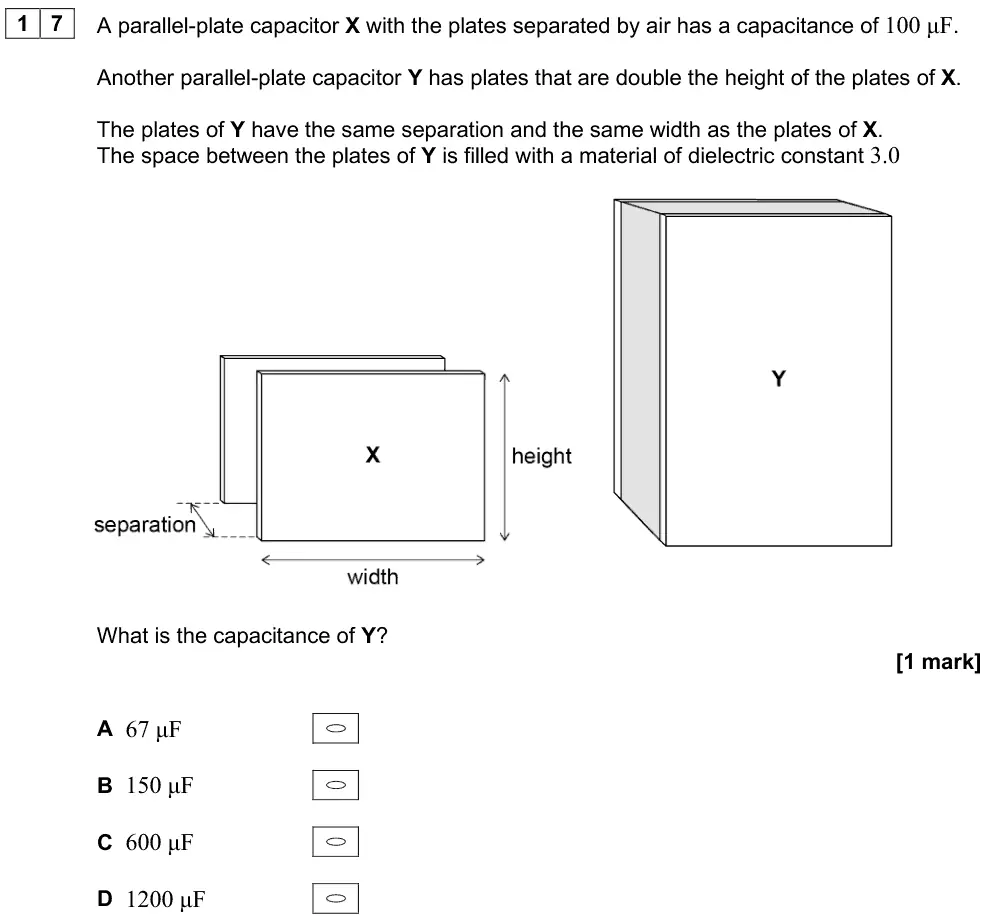
17 Capacitance and capacitor charge and discharge 1AO2=1Multiple choice
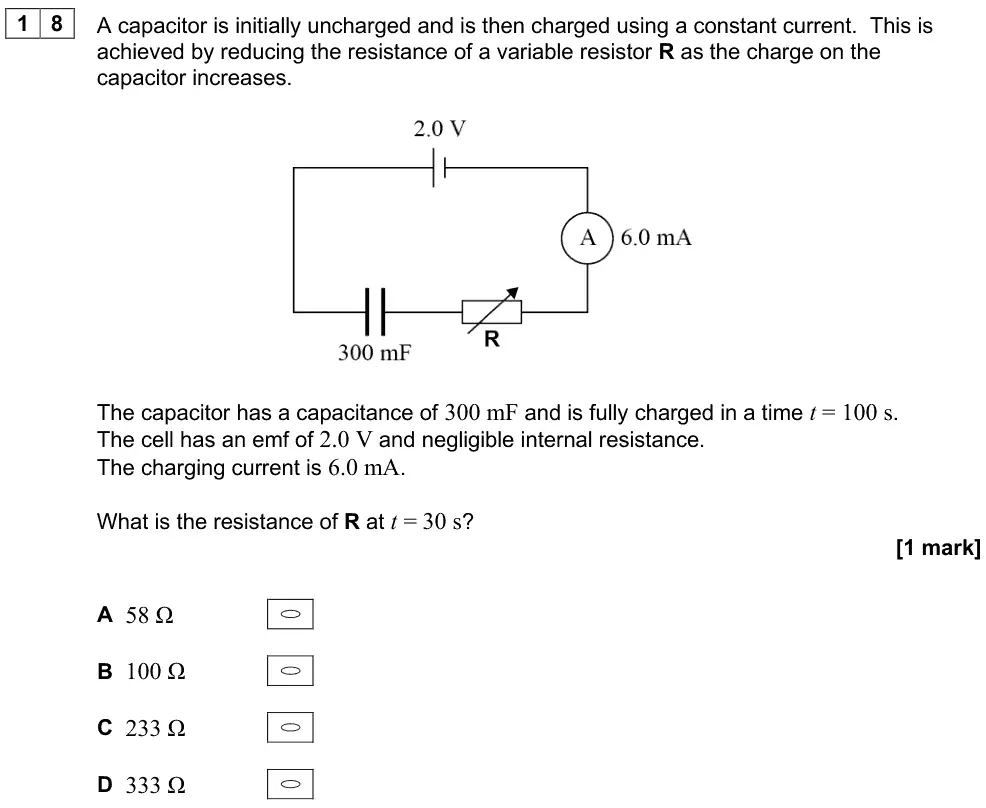
18 Capacitance and capacitor charge and discharge, Current, potential difference, I-V characteristics and resistivity 1AO2=1Multiple choice
19 Electromagnetic induction, alternating currents and transformers 1AO2=1Multiple choice
20 Magnetic flux density and moving charges in a magnetic field 1AO2=1Multiple choice
21 Electromagnetic induction, alternating currents and transformers 1AO2=1Multiple choice
22 Electromagnetic induction, alternating currents and transformers 1AO2=1Multiple choice
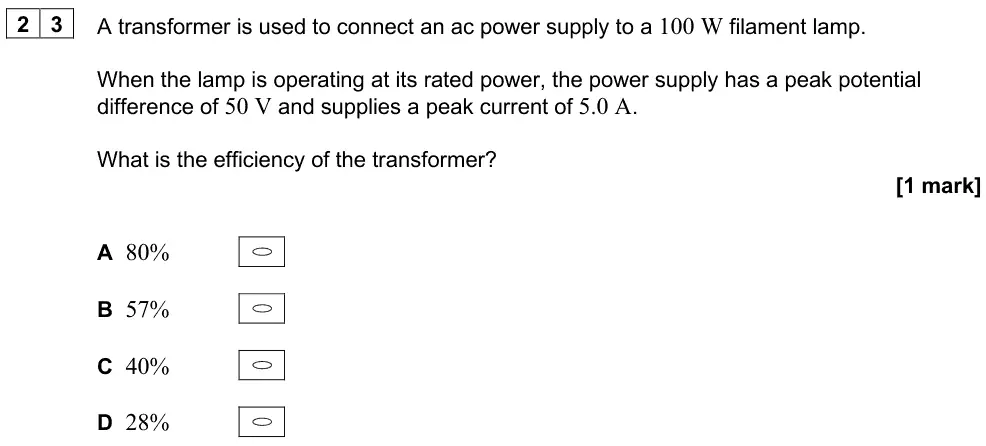
23 Electromagnetic induction, alternating currents and transformers 1AO2=1Multiple choice
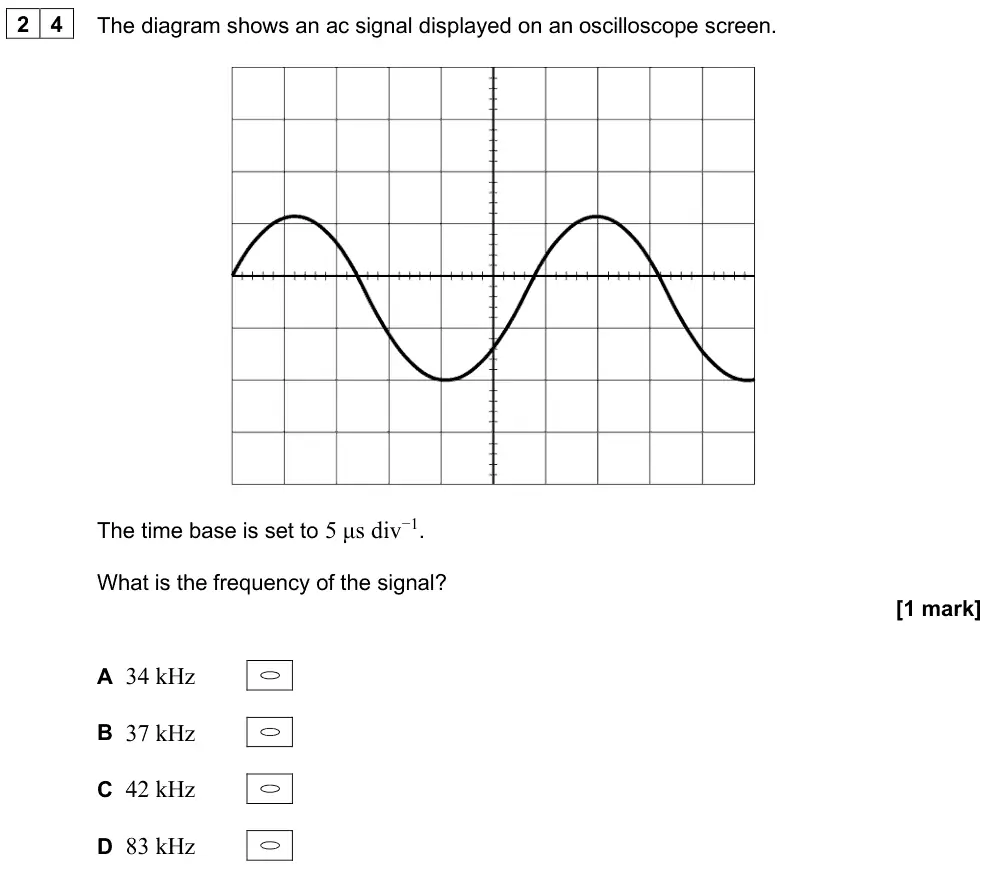
24 Electromagnetic induction, alternating currents and transformers 1AO2=1Multiple choice
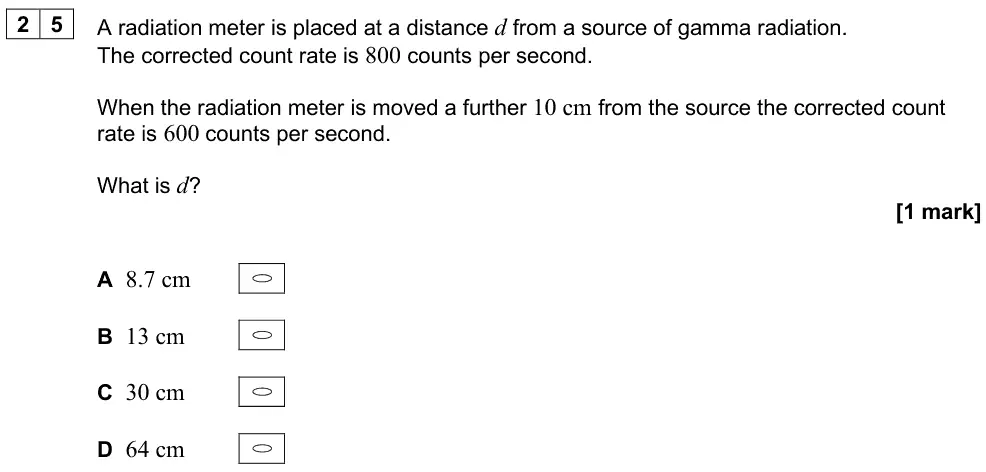
25 Rutherford scattering, alpha, beta and gamma radiation 1AO2=1Multiple choice
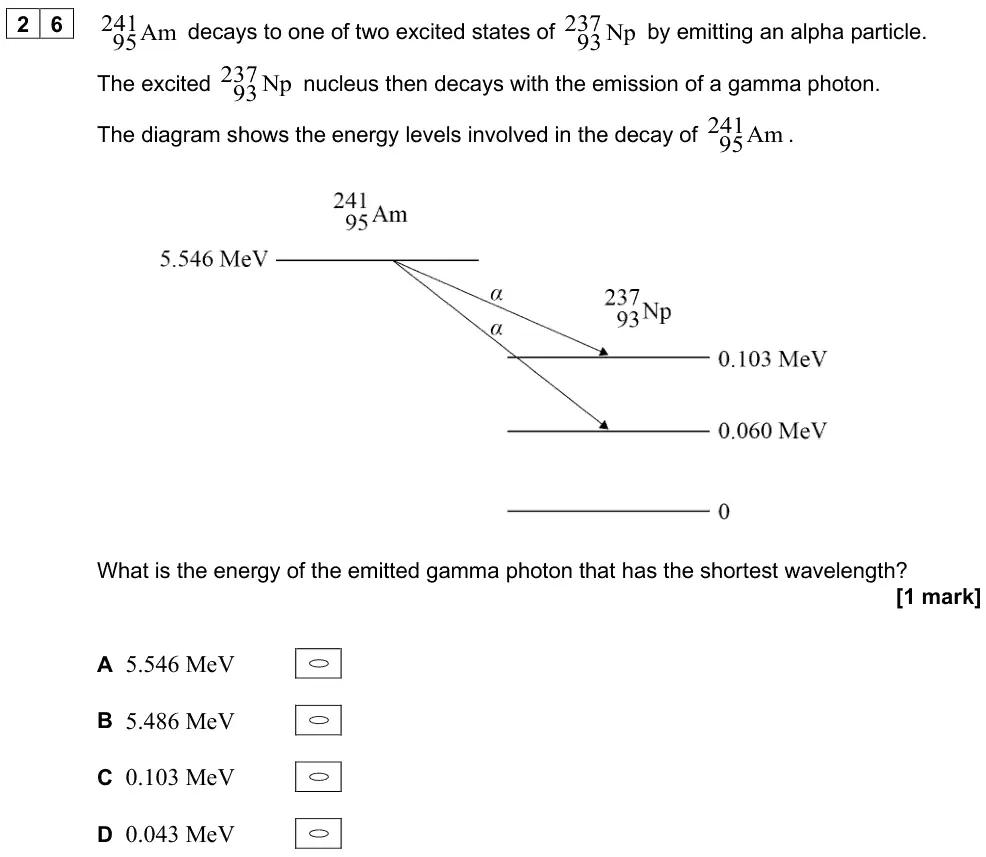
26 Radioactive decay, half-life and nuclear instability 1AO2=1Multiple choice
27 Radioactive decay, half-life and nuclear instability 1AO1=1Multiple choice
28 Mass and energy, binding energy, fission and safety 1AO2=1Multiple choice
29 Mass and energy, binding energy, fission and safety 1AO1=1Multiple choice
30 Mass and energy, binding energy, fission and safety 1AO1=1Multiple choice
31 Mass and energy, binding energy, fission and safety 1AO1=1Multiple choice

The questions
1.11.21.31.42.12.22.32.42.53.13.23.34.14.24.34.45.15.25.35.46.16.26.36.46.578910111213141516171819202122232425262728293031
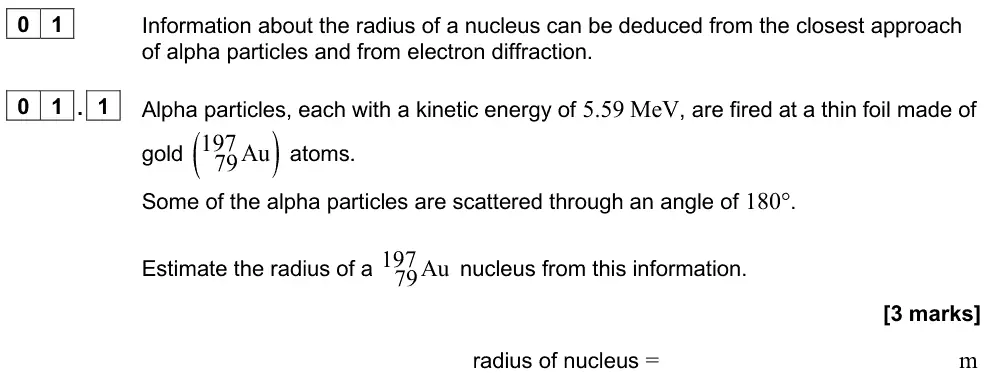
June 2025 · Paper 2 · Q1.1 3 marks AO2=3 Calculation nuclear radius
Information about the radius of a nucleus can be deduced from the closest approach
of alpha particles and from electron diffraction.
Alpha particles, each with a kinetic energy of 5.59 MeV, are fired at a thin foil made of
gold (
)
197 Au
79
atoms.
Some of the alpha particles are scattered through an angle of 180°.
Estimate the radius of a 197 Au
79
nucleus from this information.
[3 marks]
radius of nucleus =
m
June 2025 · Paper 2 · Q1.2 2 marks AO1=2 Explanation nuclear radius
Earlier part of question 1 that this part usesEarlier part of June 2025 Paper 2 question 1
Explain why your answer to Question 01.1 is an estimate.
[2 marks]
June 2025 · Paper 2 · Q1.3 2 marks AO1=2 Diagram or graph nuclear radius
Earlier part of question 1 that this part usesEarlier part of June 2025 Paper 2 question 1
Electron diffraction gives a more precise value for the radius of the nucleus.
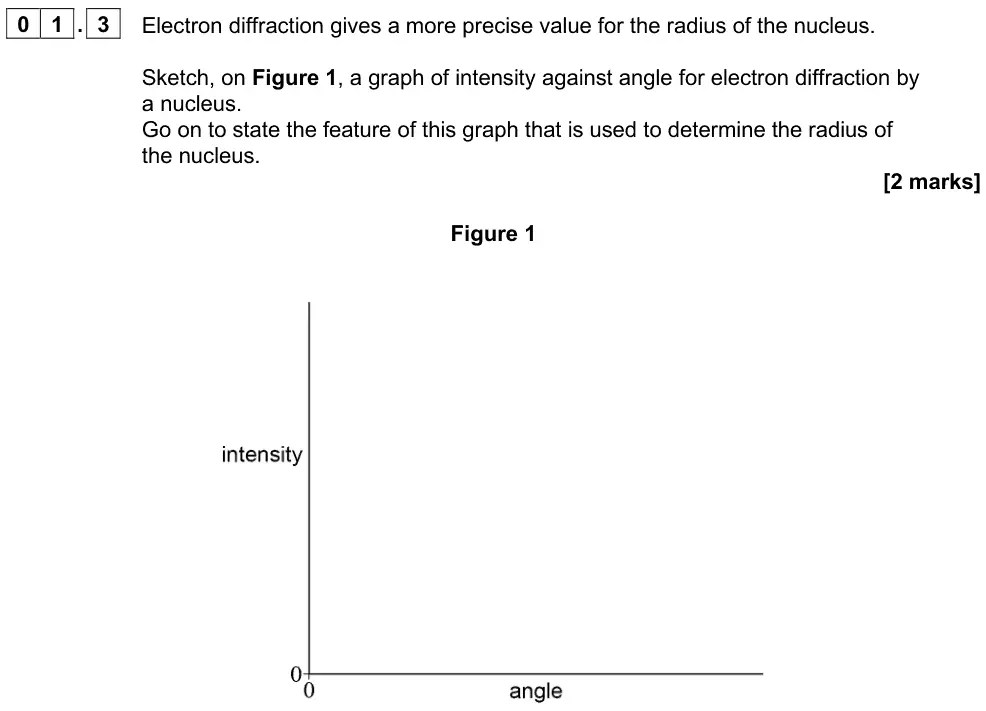
Sketch, on Figure 1, a graph of intensity against angle for electron diffraction by
a nucleus.
Go on to state the feature of this graph that is used to determine the radius of
the nucleus.
[2 marks]
Figure 1
June 2025 · Paper 2 · Q1.4 2 marks AO1=2 Show that nuclear radius
Earlier part of question 1 that this part usesEarlier part of June 2025 Paper 2 question 1
Results from electron-diffraction experiments lead to the equation:
1
3
0
=
R
R A
Show that the equation provides evidence for the constant density of nuclear material.
[2 marks]
1
June 2025 · Paper 2 · Q2.1 2 marks AO1=2 Short answer kinetic theory
The derivation of the equation
2
rms
=
(
)
3
pV
Nm c
is based on several assumptions.
One of these assumptions is that particle motion is random.

State what is meant by random particle motion.
[2 marks]
June 2025 · Paper 2 · Q2.2 2 marks AO1=2 Short answer kinetic theory
Earlier part of question 2 that this part usesEarlier part of June 2025 Paper 2 question 2
State two other assumptions required for this derivation.
[2 marks]
1
2
June 2025 · Paper 2 · Q2.3 3 marks AO1=3 Explanation kinetic theory
Earlier part of question 2 that this part usesEarlier part of June 2025 Paper 2 question 2
When the temperature of a fixed mass of an ideal gas increases at constant pressure,
the gas must expand.
Explain this expansion using the kinetic theory model.
[3 marks]
June 2025 · Paper 2 · Q2.4 1 mark AO2=1 Calculation kinetic theory
Earlier part of question 2 that this part usesEarlier part of June 2025 Paper 2 question 2
The average kinetic energy of the particles of an ideal gas is equal to 3
2kT .
This is not true for a real gas.
Helium behaves as an ideal gas.
The temperature of a sample of helium gas is increased from 27 °C to 77 °C.
Calculate the change in the average kinetic energy of a helium atom in the sample.
[1 mark]
change in average kinetic energy =
J
June 2025 · Paper 2 · Q2.5 3 marks AO3=3 Calculation kinetic theorythermal energy and ideal gases
Earlier part of question 2 that this part usesEarlier part of June 2025 Paper 2 question 2
When an ideal gas is heated at constant volume, all of the energy supplied by heating
is used to increase the average kinetic energy of the particles.
When water vapour is heated at constant volume, its specific heat capacity
is 1400 J kg−1 K−1.
Deduce whether water vapour behaves as an ideal gas when heated at
constant volume.
mass of a water molecule = 3.0 × 10⁻²⁶ kg
[3 marks]
June 2025 · Paper 2 · Q3.1 2 marks AO2=2 Calculation radioactive decaymass energy and fission
A radioisotope thermoelectric generator (RTG) uses radioactive decay to generate
electrical energy.
A vehicle that is used to examine the surface of Mars includes an RTG that initially
contains 3.23 × 1024 atoms of plutonium-238 (
)
238Pu
94
.
Determine the initial mass of plutonium-238 in the RTG.
[2 marks]
initial mass =
kg
June 2025 · Paper 2 · Q3.2 5 marks AO2=5 Calculation radioactive decay
Earlier part of question 3 that this part usesEarlier part of June 2025 Paper 2 question 3
The plutonium-238 undergoes alpha decay.
The energy released by this decay is converted into electrical energy with an
efficiency of 4.58%.
The power provided by the RTG decreases over time as the plutonium-238 decays.
The vehicle requires a minimum electrical power of 29.6 W to operate.
Calculate the initial activity of the plutonium-238.
Go on to determine, in Earth years, the time for which the RTG can provide sufficient
power for the vehicle to operate.
decay constant of plutonium-238                             = 2.51 × 10⁻¹⁰ s−1
energy of alpha particle emitted by plutonium-238  = 8.94 × 10⁻¹³ J
[5 marks]
initial activity =
Bq
time =
Earth years
June 2025 · Paper 2 · Q3.3 4 marks AO3=4 Calculation Easy thermal energy and ideal gases
Earlier part of question 3 that this part usesEarlier part of June 2025 Paper 2 question 3
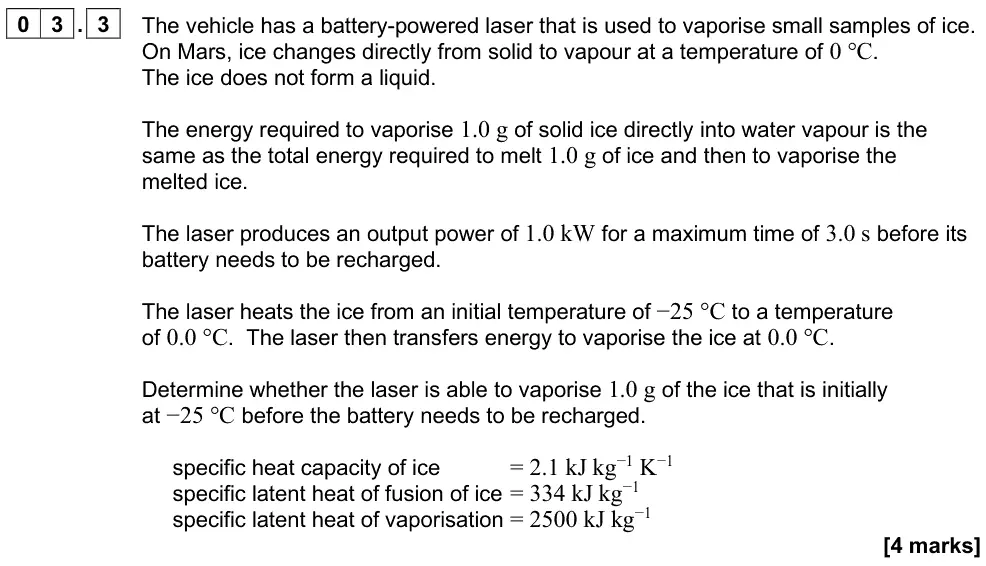
The vehicle has a battery-powered laser that is used to vaporise small samples of ice.
On Mars, ice changes directly from solid to vapour at a temperature of 0 °C.
The ice does not form a liquid.
The energy required to vaporise 1.0 g of solid ice directly into water vapour is the
same as the total energy required to melt 1.0 g of ice and then to vaporise the
melted ice.
The laser produces an output power of 1.0 kW for a maximum time of 3.0 s before its
battery needs to be recharged.
The laser heats the ice from an initial temperature of −25 °C to a temperature
of 0.0 °C.  The laser then transfers energy to vaporise the ice at 0.0 °C.
Determine whether the laser is able to vaporise 1.0 g of the ice that is initially
at −25 °C before the battery needs to be recharged.
specific heat capacity of ice            = 2.1 kJ kg−1 K−1
specific latent heat of fusion of ice  = 334 kJ kg−1
specific latent heat of vaporisation = 2500 kJ kg−1
[4 marks]
June 2025 · Paper 2 · Q4.1 3 marks AO1=3 Calculation gravitational fields
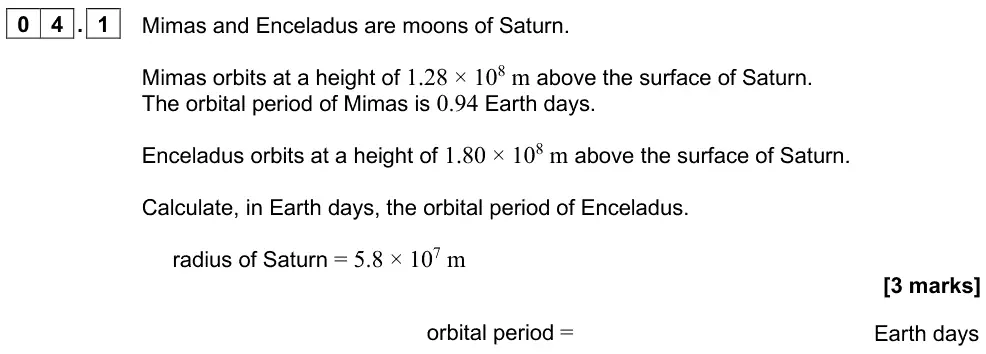
Mimas and Enceladus are moons of Saturn.
Mimas orbits at a height of 1.28 × 10⁸ m above the surface of Saturn.
The orbital period of Mimas is 0.94 Earth days.
Enceladus orbits at a height of 1.80 × 10⁸ m above the surface of Saturn.
Calculate, in Earth days, the orbital period of Enceladus.
radius of Saturn = 5.8 × 10⁷ m
[3 marks]
orbital period =
Earth days
June 2025 · Paper 2 · Q4.2 1 mark AO1=1 Short answer gravitational fields
Earlier part of question 4 that this part usesEarlier part of June 2025 Paper 2 question 4
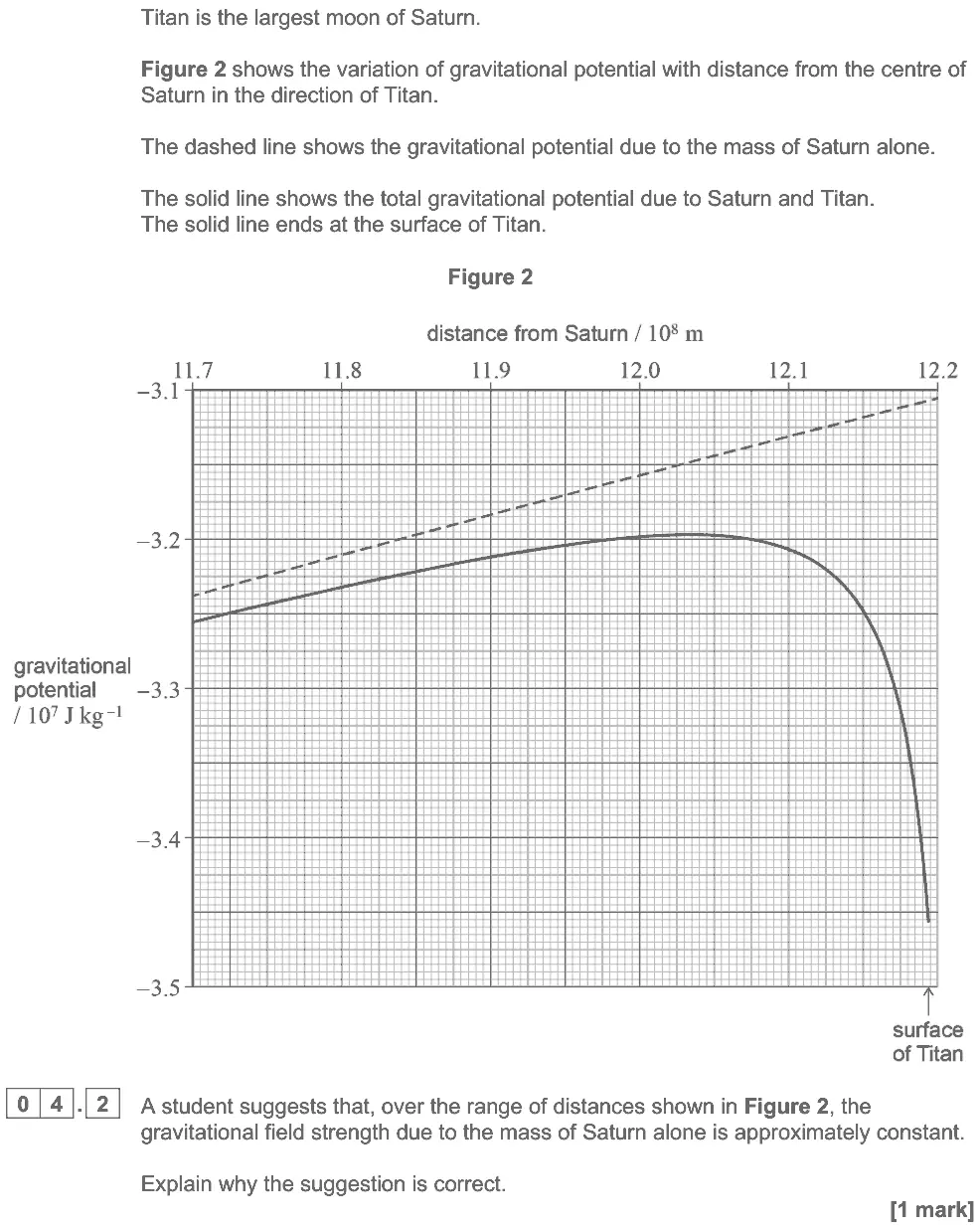
Titan is the largest moon of Saturn.
Figure 2 shows the variation of gravitational potential with distance from the centre of
Saturn in the direction of Titan.
The dashed line shows the gravitational potential due to the mass of Saturn alone.
The solid line shows the total gravitational potential due to Saturn and Titan.
The solid line ends at the surface of Titan.
Figure 2
A student suggests that, over the range of distances shown in Figure 2, the
gravitational field strength due to the mass of Saturn alone is approximately constant.
Explain why the suggestion is correct.
[1 mark]
June 2025 · Paper 2 · Q4.3 1 mark AO2=1 Short answer gravitational fields
Earlier part of question 4 that this part usesEarlier part of June 2025 Paper 2 question 4
At a point P, the resultant gravitational field strength due to Saturn and Titan is zero.
Determine, using the solid line in Figure 2, the distance from Saturn to P.
[1 mark]
distance =
m
June 2025 · Paper 2 · Q4.4 3 marks AO2=3 Calculation gravitational fields
Earlier part of question 4 that this part usesEarlier part of June 2025 Paper 2 question 4
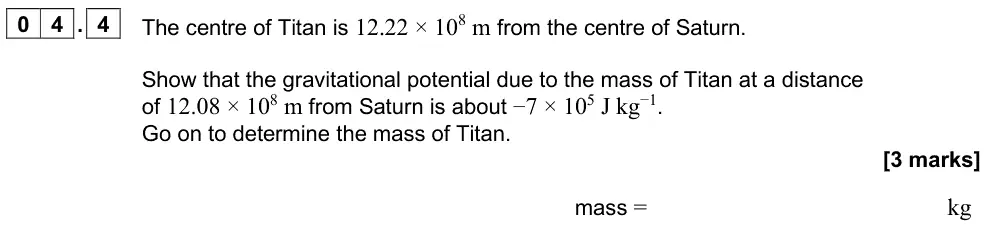
The centre of Titan is 12.22 × 10⁸ m from the centre of Saturn.
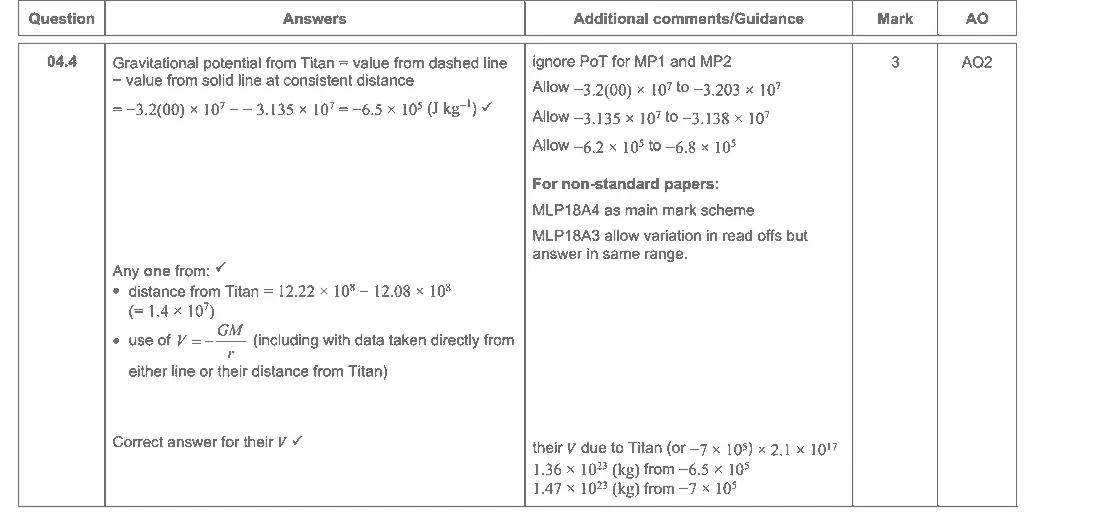
Show that the gravitational potential due to the mass of Titan at a distance
of 12.08 × 10⁸ m from Saturn is about −7 × 10⁵ J kg−1.
Go on to determine the mass of Titan.
[3 marks]
mass =
kg
June 2025 · Paper 2 · Q5.1 1 mark AO1=1 Short answer Hard capacitors
A material used between the plates of a capacitor has a dielectric constant of 7.0
State what is meant by a dielectric constant of 7.0
[1 mark]
June 2025 · Paper 2 · Q5.2 2 marks AO2=2 Calculation capacitors
Earlier part of question 5 that this part usesEarlier part of June 2025 Paper 2 question 5
Figure 3 shows a circuit that is used to charge and discharge a capacitor.
Figure 3
The battery has negligible internal resistance.
The two resistors in the circuit are identical.
The capacitor is fully charged and the switch is then moved from position A to
position B at time t = 0
Figure 4 shows the variation of the microammeter reading with t until t = 120 s.
Figure 4
The time constant of the discharging circuit is T.
Determine T using Figure 4.
[2 marks]
T =
s
June 2025 · Paper 2 · Q5.3 2 marks AO1=1, AO2=1 Calculation capacitors
Earlier part of question 5 that this part usesEarlier part of June 2025 Paper 2 question 5
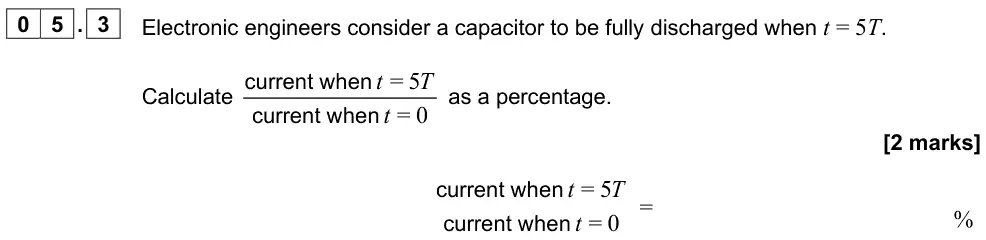
Electronic engineers consider a capacitor to be fully discharged when t = 5T.
Calculate
= 5
= 0
t
T
t
current when
current
hen
w
as a percentage.
[2 marks]
= 5
= 0
t
T
t
current when
current
hen
w
=
%
June 2025 · Paper 2 · Q5.4 3 marks AO3=3 Diagram or graph capacitors
Earlier part of question 5 that this part usesEarlier part of June 2025 Paper 2 question 5
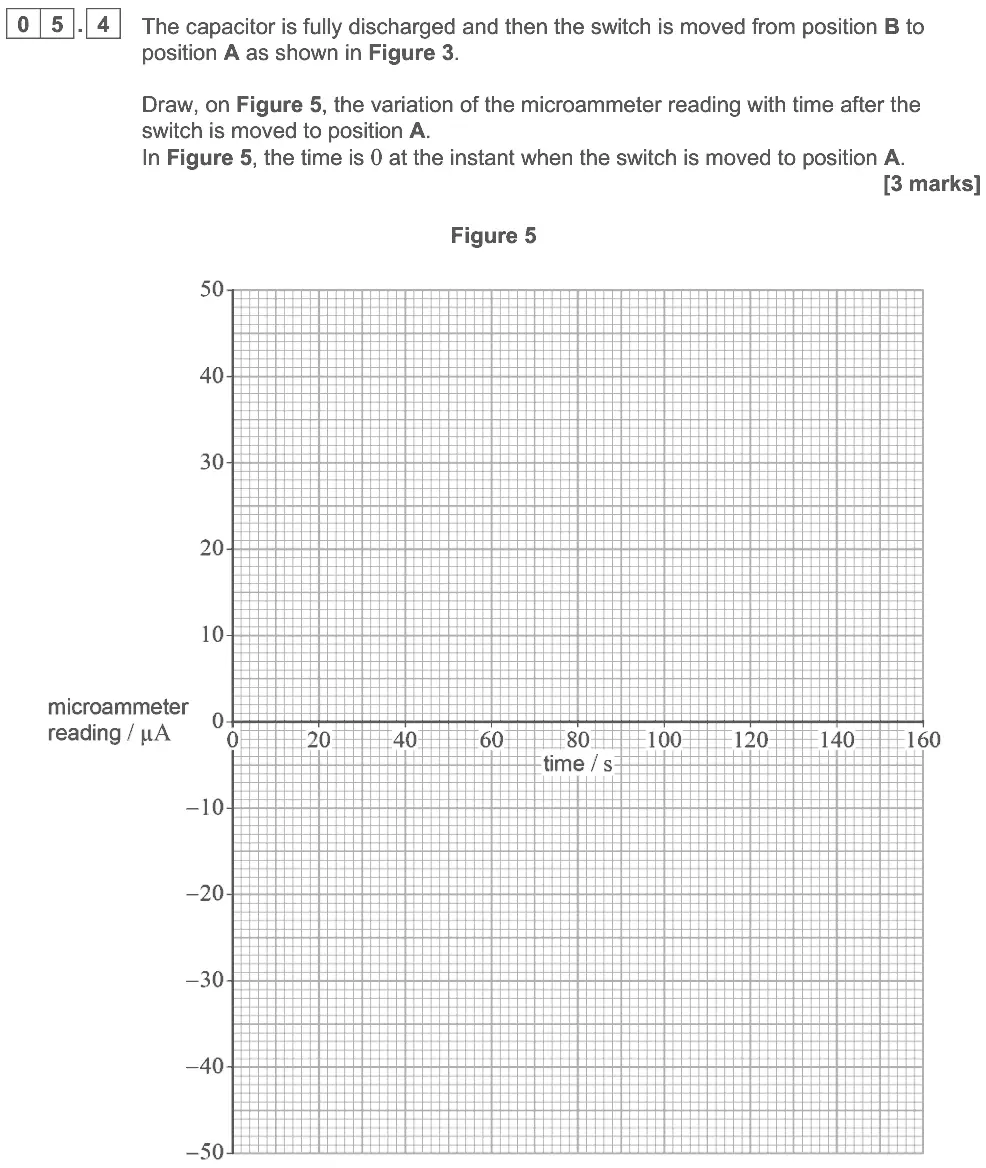
The capacitor is fully discharged and then the switch is moved from position B to
position A as shown in Figure 3.
Draw, on Figure 5, the variation of the microammeter reading with time after the
switch is moved to position A.
In Figure 5, the time is 0 at the instant when the switch is moved to position A.
[3 marks]
Figure 5
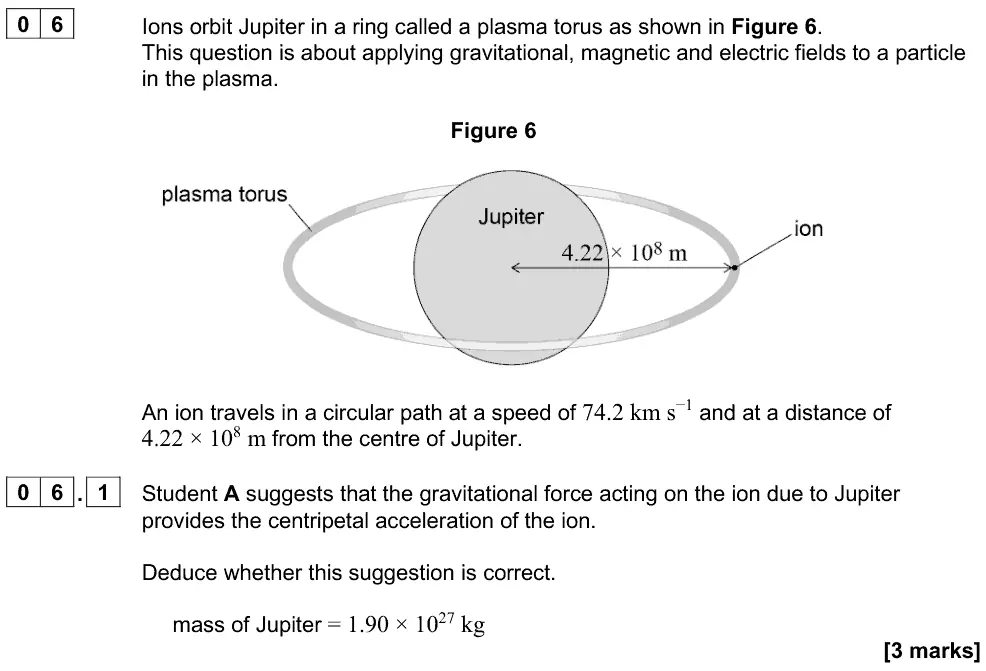
June 2025 · Paper 2 · Q6.1 3 marks AO3=3 Calculation circular motiongravitational fields
Ions orbit Jupiter in a ring called a plasma torus as shown in Figure 6.
This question is about applying gravitational, magnetic and electric fields to a particle
in the plasma.
Figure 6
An ion travels in a circular path at a speed of 74.2 km s−1 and at a distance of
4.22 × 10⁸ m from the centre of Jupiter.
Student A suggests that the gravitational force acting on the ion due to Jupiter
provides the centripetal acceleration of the ion.
Deduce whether this suggestion is correct.
mass of Jupiter = 1.90 × 1027 kg
[3 marks]
June 2025 · Paper 2 · Q6.2 1 mark AO2=1 Diagram or graph Hard magnetic fields
Earlier part of question 6 that this part usesEarlier part of June 2025 Paper 2 question 6
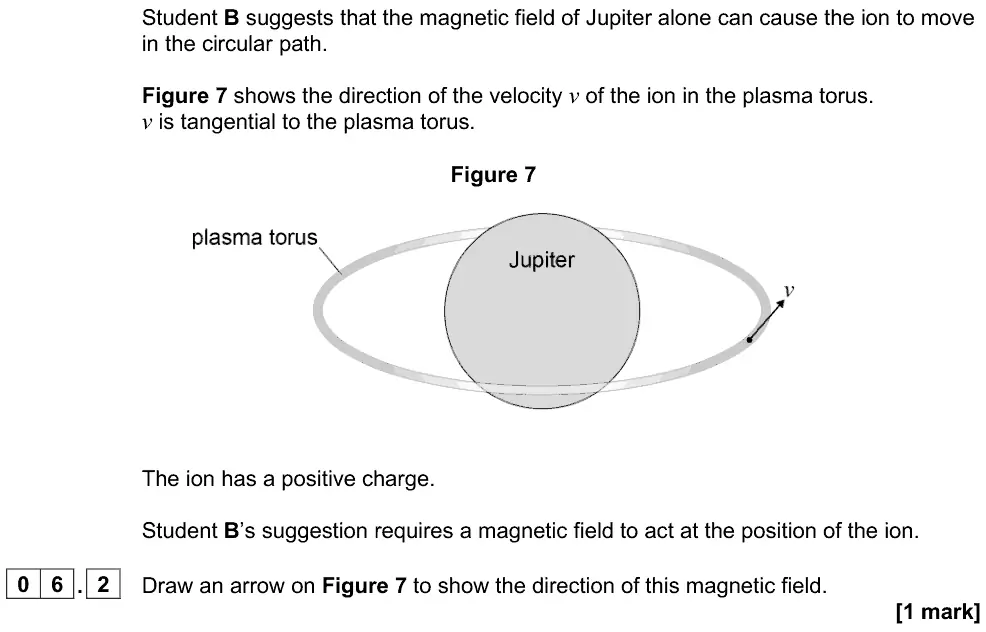
Student B suggests that the magnetic field of Jupiter alone can cause the ion to move
in the circular path.
Figure 7 shows the direction of the velocity v of the ion in the plasma torus.
v is tangential to the plasma torus.
Figure 7
The ion has a positive charge.
Student B’s suggestion requires a magnetic field to act at the position of the ion.
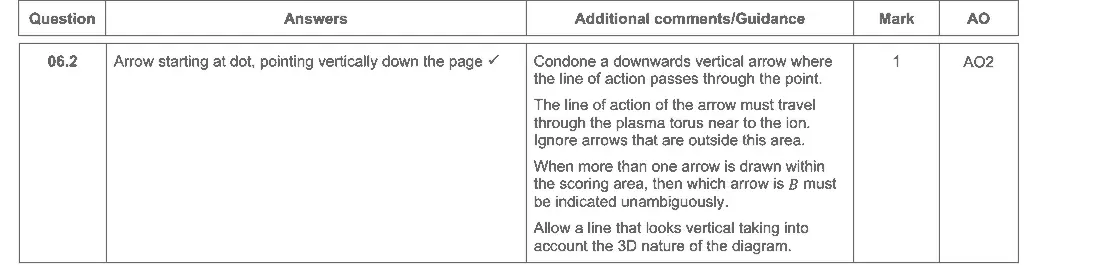
Draw an arrow on Figure 7 to show the direction of this magnetic field.
[1 mark]
June 2025 · Paper 2 · Q6.3 3 marks AO1=1, AO2=2 Calculation magnetic fields
Earlier part of question 6 that this part usesEarlier part of June 2025 Paper 2 question 6
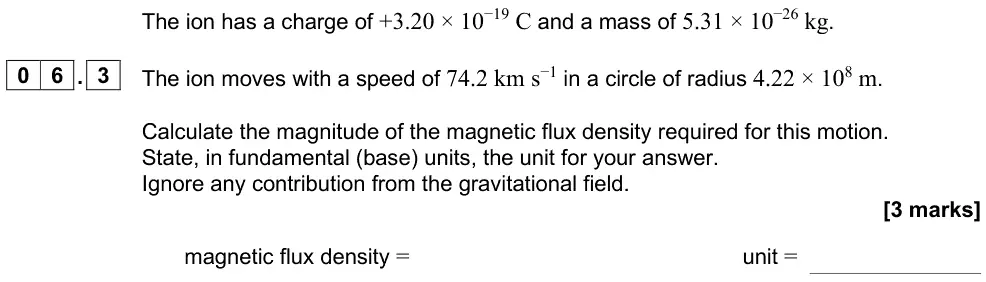
The ion has a charge of +3.20 × 10⁻¹⁹ C and a mass of 5.31 × 10⁻²⁶ kg.
The ion moves with a speed of 74.2 km s−1 in a circle of radius 4.22 × 10⁸ m.
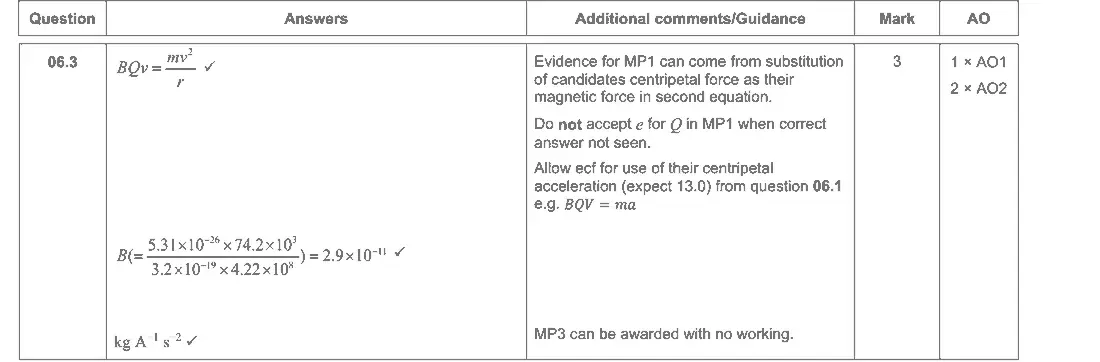
Calculate the magnitude of the magnetic flux density required for this motion.
State, in fundamental (base) units, the unit for your answer.
Ignore any contribution from the gravitational field.
[3 marks]
magnetic flux density =
unit =
June 2025 · Paper 2 · Q6.4 3 marks AO2=3 Calculation electric fields
Earlier part of question 6 that this part usesEarlier part of June 2025 Paper 2 question 6
An electric field of strength 371 μV m−1 can also accelerate the ion.
Calculate the acceleration of the ion due to this electric field.
[3 marks]
acceleration =
m s−2
June 2025 · Paper 2 · Q6.5 3 marks AO2=3 Calculation Hard electric fieldsvectors and moments
Earlier part of question 6 that this part usesEarlier part of June 2025 Paper 2 question 6
The plasma torus contains two ions X and Y as shown in Figure 8.

X has a charge of +2e.
Y has a charge of +1e.
Assume that each ion acts as a point charge.
Figure 8
Calculate the magnitude of the resultant electric field strength at point P in Figure 8
due to the two ions.
[3 marks]
resultant electric field strength =
V m−1
June 2025 · Paper 2 · Q7 1 mark AO2=1 Multiple choice gravitational fields
An object on the surface of a moon has an escape velocity v.  The moon has a
density ρ and radius R.
Another moon X has a density 2ρ and radius 3
R .
What is the escape velocity for an object on the surface of X?
[1 mark]
A 2
9 v
B
2
3 v
C
2
3 v
D 2
3
v
June 2025 · Paper 2 · Q8 1 mark AO2=1 Multiple choice thermal energy and ideal gases
In an investigation of Boyle’s law, a sealed syringe of cross-sectional area 1.0 × 10⁻⁴ m2
contains 12 cm3 of gas.  The gas is initially at atmospheric pressure.
A weight of 2.5 N is then suspended from the plunger of the syringe as shown in
the diagram.
The temperature of the gas in the syringe and the atmospheric pressure are constant.
atmospheric pressure = 1.0 × 10⁵ Pa
What is the new volume of gas in the syringe?
[1 mark]
A 3 cm3
B 9 cm3
C 16 cm3
D 48 cm3
June 2025 · Paper 2 · Q9 1 mark AO2=1 Multiple choice thermal energy and ideal gases
The graph shows the variation of pressure with volume for a constant mass of a gas.
The temperature of the gas:
[1 mark]
A decreases as the pressure increases.
B increases as the pressure increases.
C is constant as the pressure increases.
D is a maximum when the pressure is 40 kPa.
June 2025 · Paper 2 · Q10 1 mark AO2=1 Multiple choice thermal energy and ideal gases
The graph shows how the pressure of a fixed mass of gas varies with temperature.
The gas has a constant volume.
Which expression gives a value for absolute zero in °C?
[1 mark]
A
1
2
1
2
2
1
p
p
p






−
−
−
B
2
1
1
1
2
1
p
p
p





−
−

−
C
2
1
2
2
1
2
p
p
p
−
−
−






D
2
1
2
2
1
2
p
p
p 




−
−

−
June 2025 · Paper 2 · Q11 1 mark AO2=1 Multiple choice Easy electric fields
Two charged metal spheres have charges +Q and −q.
The magnitude of +Q is greater than the magnitude of −q.
In which diagram are the electric field lines correct?
[1 mark]
A
B
C
D
A
B
C
D
June 2025 · Paper 2 · Q12 1 mark AO2=1 Multiple choice electric fields
Two metal spheres each have radius r and charge Q.  The force between them is F when
the distance between their centres is x.
Two other metal spheres each have radius 2
r and charge 2Q.
What is the force between these two spheres when the distance between their centres
is x?
[1 mark]
A 4F
B 2F
C F
D 2
F
June 2025 · Paper 2 · Q13 1 mark AO1=1 Multiple choice electric fields
A particle has mass m and charge q.
The particle is moved a distance d through a potential difference V.
What is the change in electric potential energy?
[1 mark]
A qV
B V
q
C qV
d
D V
qm
June 2025 · Paper 2 · Q14 1 mark AO1=1 Multiple choice Easy electric fields
The diagram shows an electron in an electric field represented by equipotentials.
Which arrow shows the direction of the electric force on the electron?
[1 mark]
A
B
C
D
June 2025 · Paper 2 · Q15 1 mark AO2=1 Multiple choice Hard electric fields
The diagram shows point charges Q and q.
Q and q have charges of opposite sign.
The magnitude of the charge of Q is greater than the magnitude of the charge of q.
The electric field strength is zero at one of the points A, B, C or D.
At which point is the electric field strength zero?
[1 mark]
A
B
C
D
June 2025 · Paper 2 · Q16 1 mark AO1=1 Multiple choice electric fields
The diagram shows two parallel conducting plates at potentials of −20 V and −10 V.
The displacement x is measured from the bottom (−20 V) plate.
Which graph shows how the electric field strength E varies with x?
[1 mark]
A
B
C
D
A
B
C
D
June 2025 · Paper 2 · Q17 1 mark AO2=1 Multiple choice Easy capacitors
A parallel-plate capacitor X with the plates separated by air has a capacitance of 100 μF.
Another parallel-plate capacitor Y has plates that are double the height of the plates of X.
The plates of Y have the same separation and the same width as the plates of X.
The space between the plates of Y is filled with a material of dielectric constant 3.0
What is the capacitance of Y?
[1 mark]
A 67 μF
B 150 μF
C 600 μF
D 1200 μF
June 2025 · Paper 2 · Q18 1 mark AO2=1 Multiple choice capacitorscurrent voltage and resistivity
A capacitor is initially uncharged and is then charged using a constant current.  This is
achieved by reducing the resistance of a variable resistor R as the charge on the
capacitor increases.
The capacitor has a capacitance of 300 mF and is fully charged in a time t = 100 s.
The cell has an emf of 2.0 V and negligible internal resistance.
The charging current is 6.0 mA.
What is the resistance of R at t = 30 s?
[1 mark]
A 58 Ω
B 100 Ω
C 233 Ω
D 333 Ω
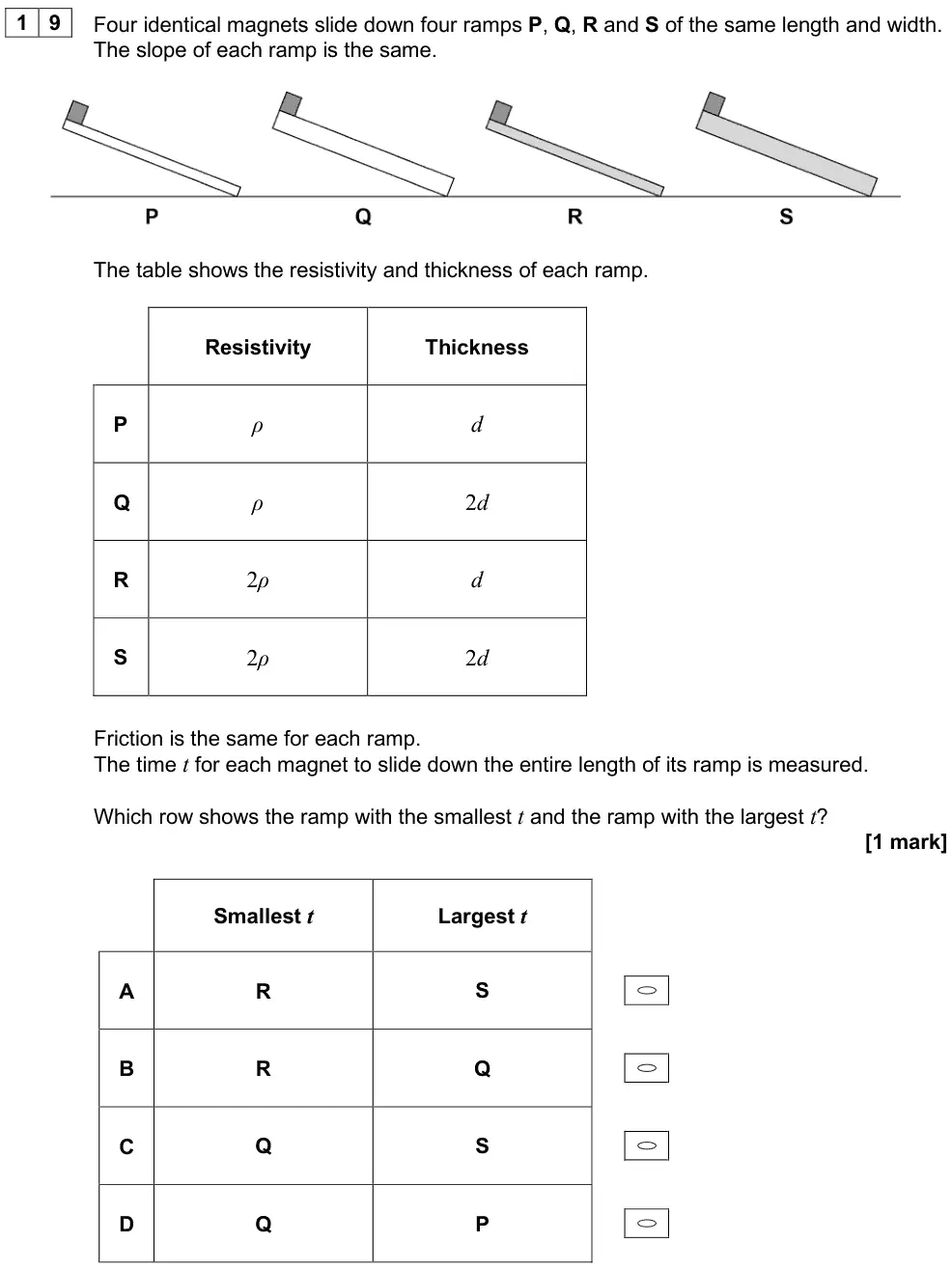
June 2025 · Paper 2 · Q19 1 mark AO2=1 Multiple choice electromagnetic induction
Four identical magnets slide down four ramps P, Q, R and S of the same length and width.
The slope of each ramp is the same.
The table shows the resistivity and thickness of each ramp.
Resistivity
Thickness
P
ρ
d
Q
ρ
2d
R
2ρ
d
S
2ρ
2d
Friction is the same for each ramp.
The time t for each magnet to slide down the entire length of its ramp is measured.
Which row shows the ramp with the smallest t and the ramp with the largest t?
[1 mark]
Smallest t
Largest t
A
R
S
B
R
Q
C
Q
S
D
Q
P
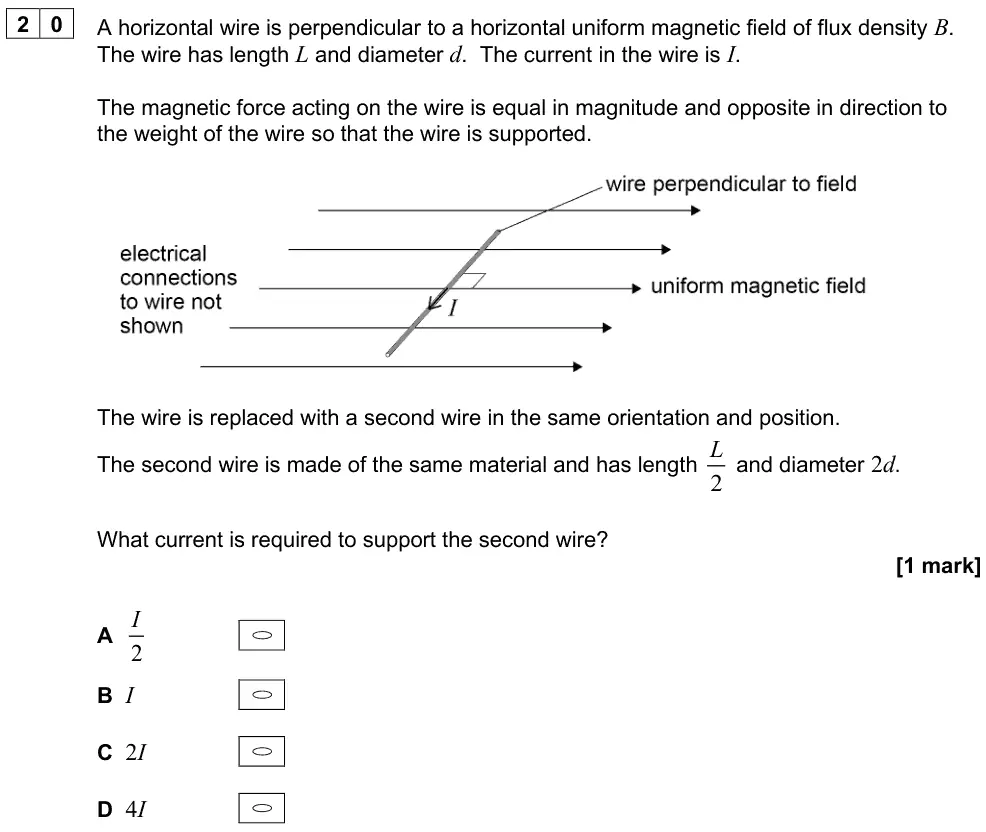
June 2025 · Paper 2 · Q20 1 mark AO2=1 Multiple choice Hard magnetic fields
A horizontal wire is perpendicular to a horizontal uniform magnetic field of flux density B.
The wire has length L and diameter d.  The current in the wire is I.
The magnetic force acting on the wire is equal in magnitude and opposite in direction to
the weight of the wire so that the wire is supported.
The wire is replaced with a second wire in the same orientation and position.
The second wire is made of the same material and has length 2
L and diameter 2d.
What current is required to support the second wire?
[1 mark]
A 2
I
B I
C 2I
D 4I
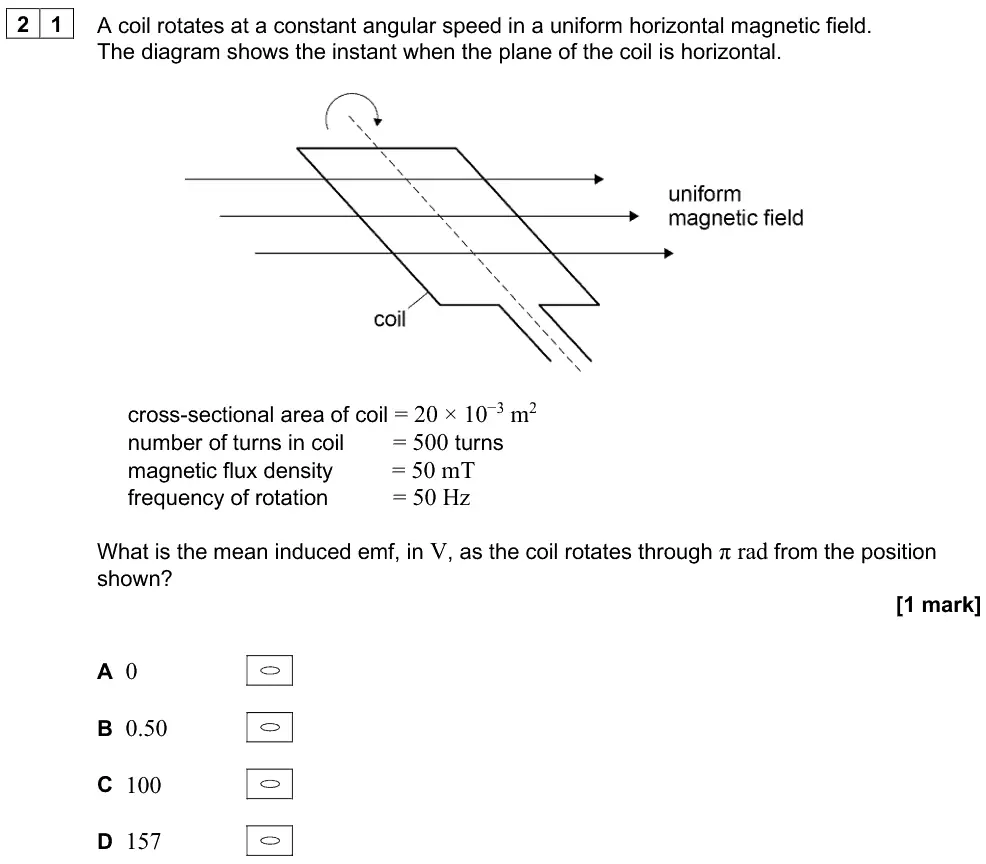
June 2025 · Paper 2 · Q21 1 mark AO2=1 Multiple choice Hard electromagnetic induction
A coil rotates at a constant angular speed in a uniform horizontal magnetic field.
The diagram shows the instant when the plane of the coil is horizontal.
cross-sectional area of coil = 20 × 10−3 m2
number of turns in coil        = 500 turns
magnetic flux density           = 50 mT
frequency of rotation           = 50 Hz
What is the mean induced emf, in V, as the coil rotates through π rad from the position
shown?
[1 mark]
A 0
B 0.50
C 100
D 157
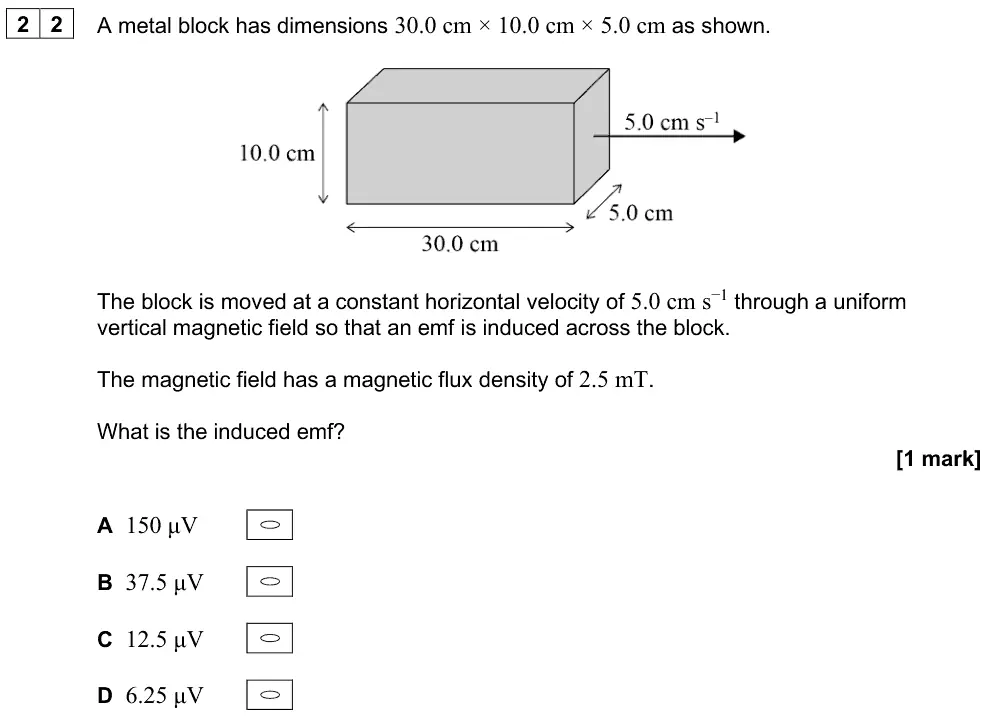
June 2025 · Paper 2 · Q22 1 mark AO2=1 Multiple choice Hard electromagnetic induction
A metal block has dimensions 30.0 cm × 10.0 cm × 5.0 cm as shown.
The block is moved at a constant horizontal velocity of 5.0 cm s−1 through a uniform
vertical magnetic field so that an emf is induced across the block.
The magnetic field has a magnetic flux density of 2.5 mT.
What is the induced emf?
[1 mark]
A 150 μV
B 37.5 μV
C 12.5 μV
D 6.25 μV
June 2025 · Paper 2 · Q23 1 mark AO2=1 Multiple choice Hard electromagnetic induction
A transformer is used to connect an ac power supply to a 100 W filament lamp.
When the lamp is operating at its rated power, the power supply has a peak potential
difference of 50 V and supplies a peak current of 5.0 A.
What is the efficiency of the transformer?
[1 mark]
A 80%
B 57%
C 40%
D 28%
June 2025 · Paper 2 · Q24 1 mark AO2=1 Multiple choice electromagnetic induction
The diagram shows an ac signal displayed on an oscilloscope screen.
The time base is set to 5 μs div−1.
What is the frequency of the signal?
[1 mark]
A 34 kHz
B 37 kHz
C 42 kHz
D 83 kHz
June 2025 · Paper 2 · Q25 1 mark AO2=1 Multiple choice rutherford scattering and radiation
A radiation meter is placed at a distance d from a source of gamma radiation.
The corrected count rate is 800 counts per second.
When the radiation meter is moved a further 10 cm from the source the corrected count
rate is 600 counts per second.
What is d?
[1 mark]
A 8.7 cm
B 13 cm
C 30 cm
D 64 cm
June 2025 · Paper 2 · Q26 1 mark AO2=1 Multiple choice radioactive decay
241Am
95
decays to one of two excited states of 237 Np
93
by emitting an alpha particle.
The excited 237 Np
93
nucleus then decays with the emission of a gamma photon.
The diagram shows the energy levels involved in the decay of 241Am
95
.
What is the energy of the emitted gamma photon that has the shortest wavelength?
[1 mark]
A 5.546 MeV
B 5.486 MeV
C 0.103 MeV
D 0.043 MeV
June 2025 · Paper 2 · Q27 1 mark AO1=1 Multiple choice radioactive decay
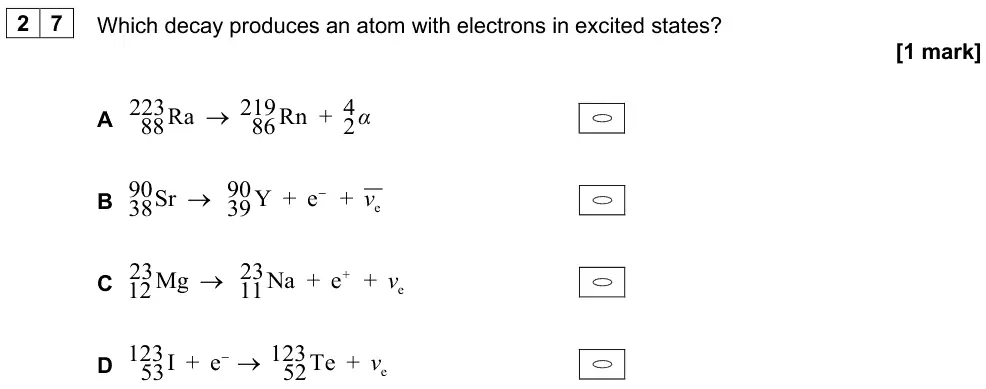
Which decay produces an atom with electrons in excited states?

[1 mark]
A 223
219
4
Ra
Rn  +
88
86
2α
→
B
e
90
90
Sr
Y  +  e  +
38
39
v
−
→
C
+
e
23
23
Mg
Na  +  e  +
12
11
v
→
D
e
123
123
I  +  e
Te  +
53
52
v
−→
June 2025 · Paper 2 · Q28 1 mark AO2=1 Multiple choice Easy mass energy and fission
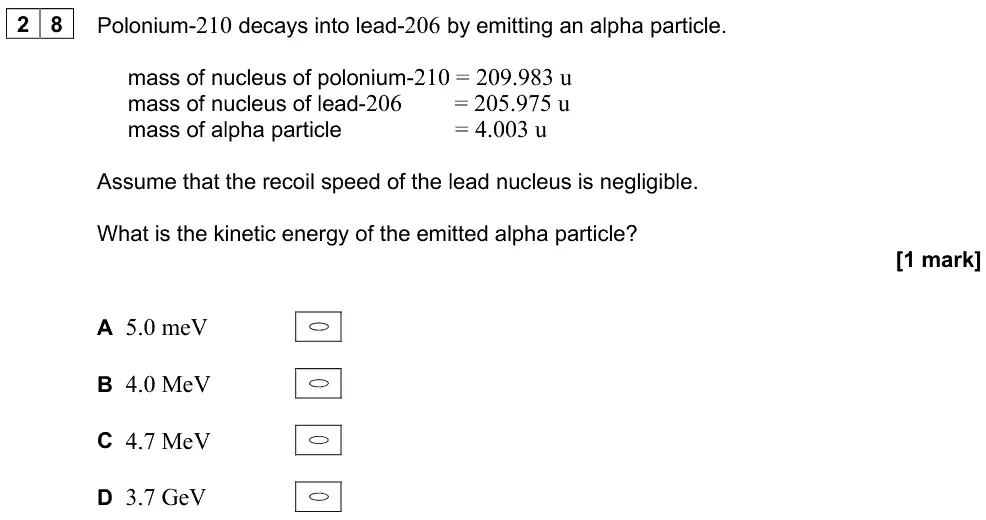
Polonium-210 decays into lead-206 by emitting an alpha particle.
mass of nucleus of polonium-210 = 209.983 u
mass of nucleus of lead-206         = 205.975 u
mass of alpha particle                   = 4.003 u
Assume that the recoil speed of the lead nucleus is negligible.
What is the kinetic energy of the emitted alpha particle?
[1 mark]
A 5.0 meV
B 4.0 MeV
C 4.7 MeV
D 3.7 GeV
June 2025 · Paper 2 · Q29 1 mark AO1=1 Multiple choice mass energy and fission
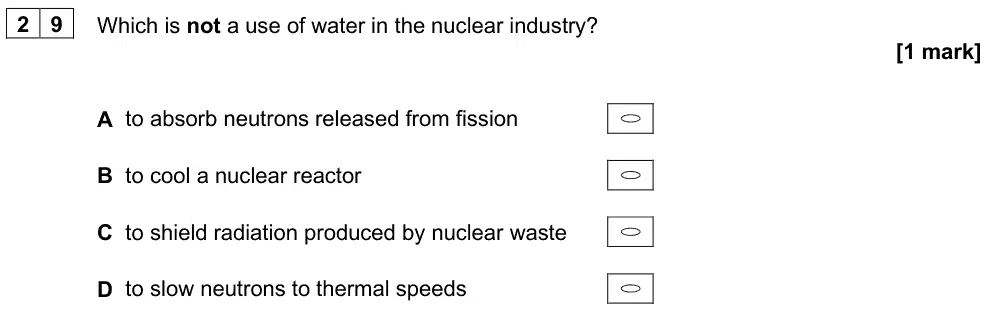
Which is not a use of water in the nuclear industry?
[1 mark]
A to absorb neutrons released from fission
B to cool a nuclear reactor
C to shield radiation produced by nuclear waste
D to slow neutrons to thermal speeds
June 2025 · Paper 2 · Q30 1 mark AO1=1 Multiple choice Easy mass energy and fission
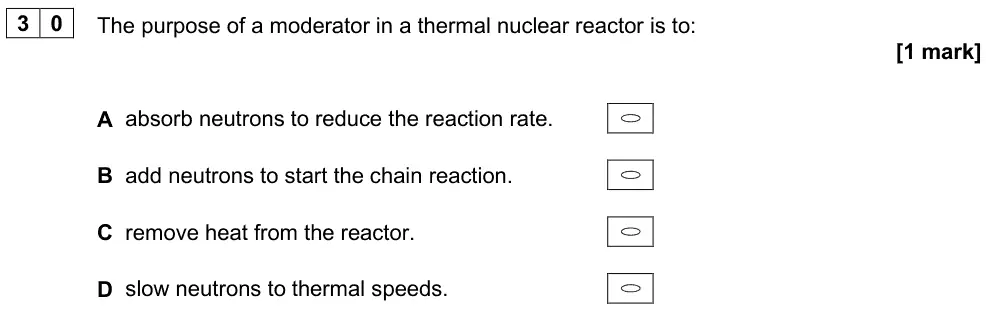
The purpose of a moderator in a thermal nuclear reactor is to:
[1 mark]
A absorb neutrons to reduce the reaction rate.
B add neutrons to start the chain reaction.
C remove heat from the reactor.
D slow neutrons to thermal speeds.
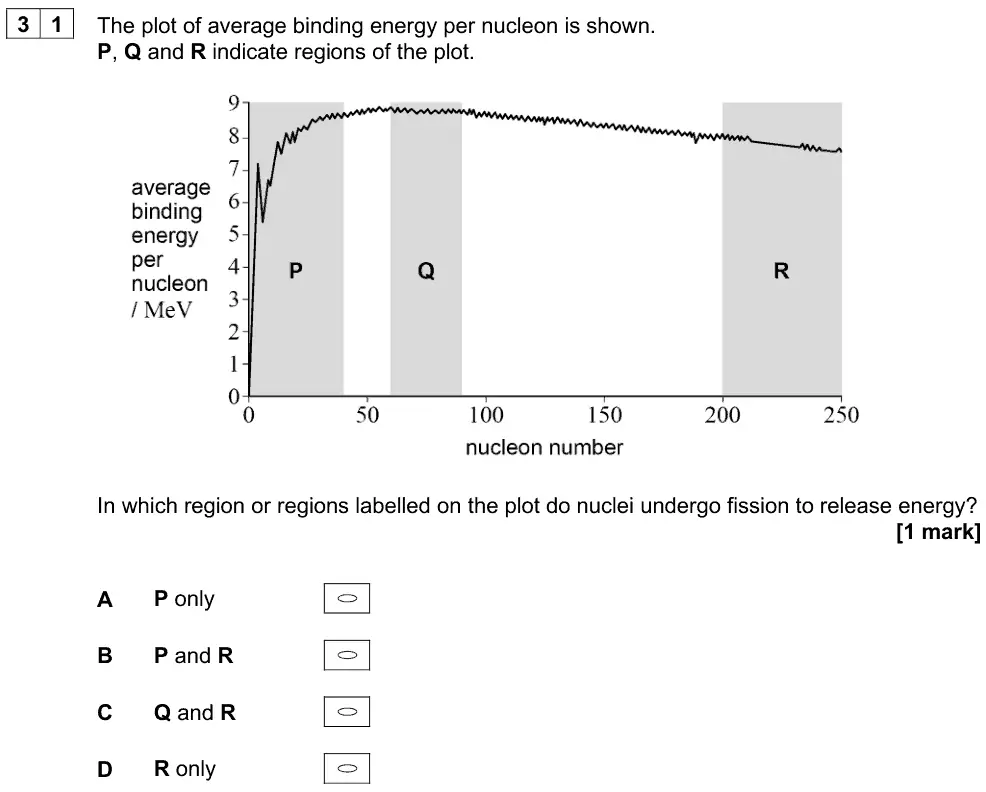
June 2025 · Paper 2 · Q31 1 mark AO1=1 Multiple choice Hard mass energy and fission
The plot of average binding energy per nucleon is shown.
P, Q and R indicate regions of the plot.
In which region or regions labelled on the plot do nuclei undergo fission to release energy?
[1 mark]
A
P only
B
P and R
C
Q and R
D
R only

Work with an AQA physics tutor

Want a paper marked and gone through with you? Message us.

Prefer email? Send an enquiry

If you are under 18, please include a parent's contact details. Enquiries go to enquiries@physicsaleveltutor.com and are deleted once handled. All tutoring is online.